
Star-hop from Orion to Sirius
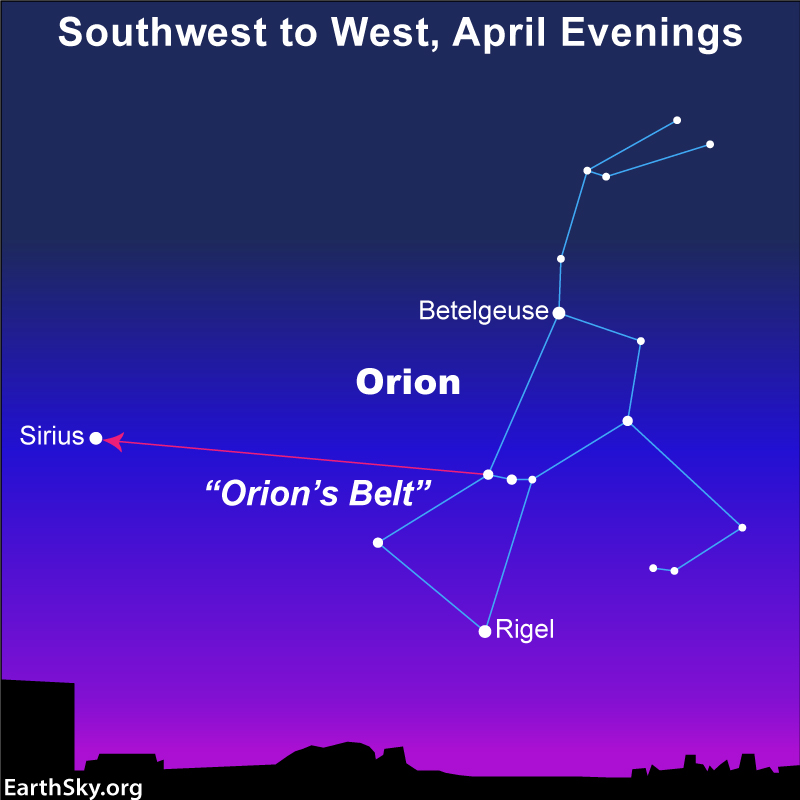
One very easy constellation to find at this time of the year is the magnificent Orion the Hunter, now descending in the west after sunset. It’s easy because Orion contains a very noticeable pattern of three medium-bright stars in a short straight row. These stars are known as Orion’s Belt. Find Orion, and continue the line of his belt to star-hop to Sirius. Found in the constellation Canis Major, this is the night sky’s brightest star!
As Earth revolves around the sun, both the constellation Orion and the star Sirius are about to disappear for a while. They always drop into the sun’s glare shortly after this time of the year, as Earth’s motion brings the sun between us and them. So be sure to look for them while you can, soon after the sun goes down. We’ll see them again in the east before dawn, beginning around late July or early August.
Try it for yourself
People learning to recognize the stars often use star-hopping – going from stars they know to objects that are fainter or less easily identifiable – to find and recognize new stars and constellations. The use of Orion’s Belt to find Sirius is one of the best-known star-hops in the sky, because the stars are so bright and the pattern is so definite.
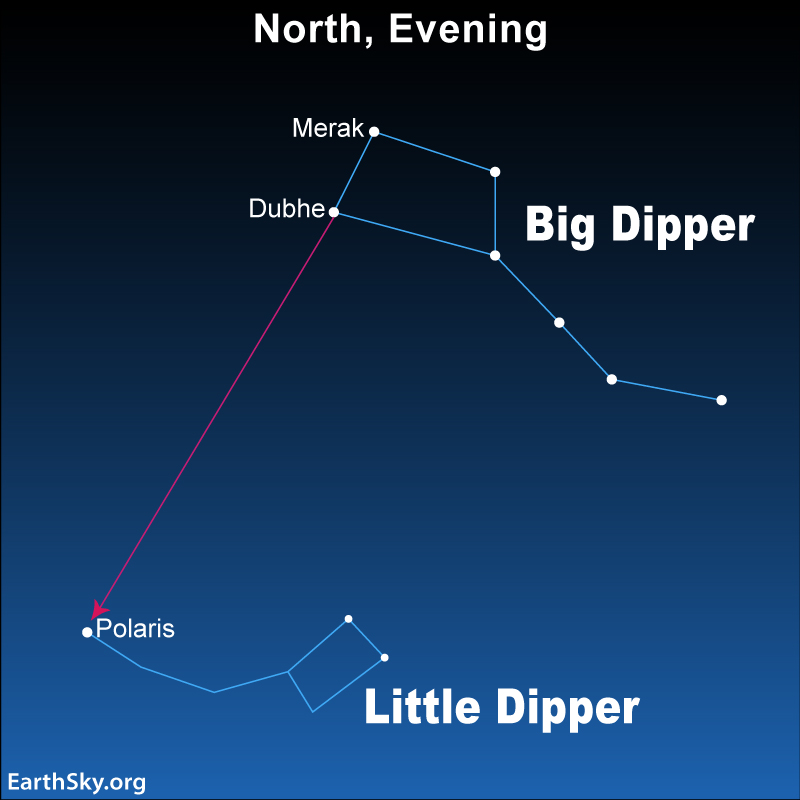
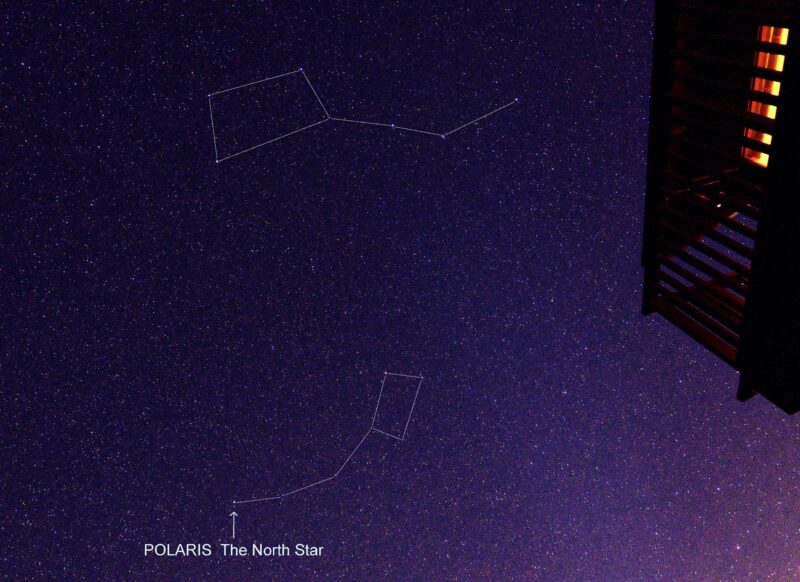
Another great star-hop to try is using the Big Dipper to find Polaris, the North Star. If you’re in the Northern Hemisphere, this star-hop will allow you to always find north!
Bottom line: Star-hopping is going from stars you know to stars you don’t know. Star-hop from the constellation Orion the Hunter to Sirius, the night sky’s brightest star, before they’re gone!
EarthSky astronomy kits are perfect for beginners. Order today from the EarthSky store
Orion the Hunter, the most recognizable constellation
Is Sirius the most luminous star in the sky?
The post Star-hop from Orion to Sirius: See them before they go! first appeared on EarthSky.
from EarthSky https://ift.tt/BlNfpSH
Star-hop from Orion to Sirius
One very easy constellation to find at this time of the year is the magnificent Orion the Hunter, now descending in the west after sunset. It’s easy because Orion contains a very noticeable pattern of three medium-bright stars in a short straight row. These stars are known as Orion’s Belt. Find Orion, and continue the line of his belt to star-hop to Sirius. Found in the constellation Canis Major, this is the night sky’s brightest star!
As Earth revolves around the sun, both the constellation Orion and the star Sirius are about to disappear for a while. They always drop into the sun’s glare shortly after this time of the year, as Earth’s motion brings the sun between us and them. So be sure to look for them while you can, soon after the sun goes down. We’ll see them again in the east before dawn, beginning around late July or early August.
Try it for yourself
People learning to recognize the stars often use star-hopping – going from stars they know to objects that are fainter or less easily identifiable – to find and recognize new stars and constellations. The use of Orion’s Belt to find Sirius is one of the best-known star-hops in the sky, because the stars are so bright and the pattern is so definite.
Another great star-hop to try is using the Big Dipper to find Polaris, the North Star. If you’re in the Northern Hemisphere, this star-hop will allow you to always find north!
Bottom line: Star-hopping is going from stars you know to stars you don’t know. Star-hop from the constellation Orion the Hunter to Sirius, the night sky’s brightest star, before they’re gone!
EarthSky astronomy kits are perfect for beginners. Order today from the EarthSky store
Orion the Hunter, the most recognizable constellation
Is Sirius the most luminous star in the sky?
The post Star-hop from Orion to Sirius: See them before they go! first appeared on EarthSky.
from EarthSky https://ift.tt/BlNfpSH

Aucun commentaire:
Enregistrer un commentaire