aads

Our sun might be a migrant from the inner Milky Way

Sun might be a migrant: A galaxy with a bright bar in the center and a group of stars with their path shown from the center to the outskirts.
A new study suggests our sun might be a migrant from a more central region of our home galaxy, the Milky Way. It suggests our sun joined a migration of other stars, which moved outward from the inner part of the galaxy some 4 to 6 billion years ago. Image via NAOJ/ EurekaAlert.
  • Astronomers suggest the sun might have migrated from near the central bar-shaped nucleus of our Milky Way galaxy.
  • Scientists studied 6,594 solar “twin” stars, using Gaia data. Many share the sun’s age (about 4–6 billion years) and appear to have migrated outward from the galaxy’s inner regions together.
  • The sun eventually took up residence in a quieter part of the galaxy, where planets (and life) could develop with fewer threats.

Science news, night sky events and beautiful photos, all in one place. Click here to subscribe to our free daily newsletter.

Our sun might be a migrant

Astronomers have long thought our sun was born closer to the center of our Milky Way galaxy than it is today.

The stumbling block to that idea has been the Milky Way’s huge central bar, which is essentially a massive gravitational engine. The galaxy’s central bar creates its own high-pressure, high-energy environment, where stars are being born and dying, and where energetic events like supernovas happen frequently. So it’s not a nice, quiet part of the galaxy for the founding and evolution of life.

Previous studies had shown the gravitational pull of this bar served as a barrier for escaping stars. But now a new study from Tokyo Metropolitan University – and reported by EurekAlert on March 12, 2026 – suggests that, as the central bar was forming somewhere between 4 and 6 billion years ago, it triggered both star formation and a wave of outward migration for stars … maybe including our sun.

How do we know?

Assistant professors Daisuke Taniguchi at Tokyo Metropolitan University and Takuji Tsujimoto at the National Astronomical Observatory of Japan led the new studies. They looked at stars that are similar to our sun – a G-type star – in terms of temperature, composition and surface gravity. Altogether, the survey included 6,594 of these virtual twins to our sun. That was out of the overall observations of 2 billion stars.

The data came from the European Space Agency’s amazing Gaia spacecraft. Gaia did what’s called astrometry. In other words, it obtained precise measurements of the positions of stars, over and over again. In this way, it revealed the movement of stars in our galaxy for more than a decade. The data showed there was a mass movement of stars, out of the turbulent inner galactic regions to more serene pastures.

Out here, farther from our galaxy’s core and its central bar, our sun now resides in a quieter part of the galaxy. And this could have big implications for why life could arise on Earth, and possibly on planets around similar stars in our neighborhood.

The researchers published two new papers in the peer-reviewed journal Astronomy and Astrophysics on March 12, 2026.

Our current place in the Milky Way

The sun and solar system lie about 25,000 light-years from the center of the Milky Way. And the central bar in the Milky Way extends some 10,000 to 15,000 light-years from its center. The 4.6-billion-year-old sun is in the Orion-Cygnus Arm, or Orion Spur, a minor spiral arm of the Milky Way galaxy.

The new study suggests our sun began its life in the galaxy at more than 10,000 light-years nearer to the galactic center than we are today. That would have put us close to the central bar.

But the central bar has a gravitational effect that scientists call a corotation barrier. Basically, its pull of gravity makes it hard for stars to travel far away from the bar. Enter the new study. It suggests the bar wasn’t fully formed until after the sun – and thousands of similar stars – made their escape.

Blue spiral with fuzzy arms, and a tiny dot halfway from the center to the edge labeled Solar System.
A graphic of the Milky Way showing our solar system’s current location in our galaxy. Note our distance from the central bar. Image via Universität Wien.

Migrating to a safer neighborhood

The scientists who conducted the new study looked at a notable concentration of stars that are around 4 to 6 billion years old, similar in age to our sun. And they all currently inhabit a region of the galaxy that’s about the same distance from the center as we are.

The scientists concluded that the age and locations of these stars are evidence of a stellar migration. They said these stars and our sun were able to escape the gravity of the still-forming bar region. The stars made a mass exodus from a region that was, coincidentally, hostile to the formation of life.

Afterward, our sun and its planets – along with thousands of similar sibling stars – came to live in a quieter galactic neighborhood. It’s a region of the Milky Way where life was able to – at least once – evolve in relative peace.

Don’t miss the next unmissable night sky event. Sign up to our free newsletter for daily night sky updates, as well as the latest science news.

A new view of the heart of the Milky Way

By the way, researchers using the Atacama Large Millimeter/submillimeter Array (ALMA) in Chile recently took a stunning new, detailed image of a molecular cloud feature in the heart of the Milky Way.

They captured the huge image in millimeter radio wavelengths. It revealed new details of a chaotic gaseous region with massive stars that orbits the supermassive black hole in our galaxy’s center. See it here, or watch the video below.


This brief video gives you a look at the new image of the Milky Way center taken in radio wavelengths. It’s the largest image the Atacama Large Millimeter/submillimeter Array (ALMA) in Chile has ever taken. Video via ALMA (ESO/ NAOJ/ NRAO)/ S. Longmore et al. Background: ESO/ D. Minniti et al.

Bottom line: A new study suggests the sun might be a migrant that was born in the inner galaxy and journeyed outward. Researchers believe it made that crossing in the company of many other stars similar to our sun.

Source: Solar twins in Gaia DR3 GSP-Spec I. Building a large catalog of solar twins with ages

Source: Solar twins in Gaia DR3 GSP-Spec II. Age distribution and its implications for the Sun’s migration

Via EurekAlert

The post Our sun might be a migrant from the inner Milky Way first appeared on EarthSky.


from EarthSky https://ift.tt/tTPk5OS
Sun might be a migrant: A galaxy with a bright bar in the center and a group of stars with their path shown from the center to the outskirts.
A new study suggests our sun might be a migrant from a more central region of our home galaxy, the Milky Way. It suggests our sun joined a migration of other stars, which moved outward from the inner part of the galaxy some 4 to 6 billion years ago. Image via NAOJ/ EurekaAlert.
  • Astronomers suggest the sun might have migrated from near the central bar-shaped nucleus of our Milky Way galaxy.
  • Scientists studied 6,594 solar “twin” stars, using Gaia data. Many share the sun’s age (about 4–6 billion years) and appear to have migrated outward from the galaxy’s inner regions together.
  • The sun eventually took up residence in a quieter part of the galaxy, where planets (and life) could develop with fewer threats.

Science news, night sky events and beautiful photos, all in one place. Click here to subscribe to our free daily newsletter.

Our sun might be a migrant

Astronomers have long thought our sun was born closer to the center of our Milky Way galaxy than it is today.

The stumbling block to that idea has been the Milky Way’s huge central bar, which is essentially a massive gravitational engine. The galaxy’s central bar creates its own high-pressure, high-energy environment, where stars are being born and dying, and where energetic events like supernovas happen frequently. So it’s not a nice, quiet part of the galaxy for the founding and evolution of life.

Previous studies had shown the gravitational pull of this bar served as a barrier for escaping stars. But now a new study from Tokyo Metropolitan University – and reported by EurekAlert on March 12, 2026 – suggests that, as the central bar was forming somewhere between 4 and 6 billion years ago, it triggered both star formation and a wave of outward migration for stars … maybe including our sun.

How do we know?

Assistant professors Daisuke Taniguchi at Tokyo Metropolitan University and Takuji Tsujimoto at the National Astronomical Observatory of Japan led the new studies. They looked at stars that are similar to our sun – a G-type star – in terms of temperature, composition and surface gravity. Altogether, the survey included 6,594 of these virtual twins to our sun. That was out of the overall observations of 2 billion stars.

The data came from the European Space Agency’s amazing Gaia spacecraft. Gaia did what’s called astrometry. In other words, it obtained precise measurements of the positions of stars, over and over again. In this way, it revealed the movement of stars in our galaxy for more than a decade. The data showed there was a mass movement of stars, out of the turbulent inner galactic regions to more serene pastures.

Out here, farther from our galaxy’s core and its central bar, our sun now resides in a quieter part of the galaxy. And this could have big implications for why life could arise on Earth, and possibly on planets around similar stars in our neighborhood.

The researchers published two new papers in the peer-reviewed journal Astronomy and Astrophysics on March 12, 2026.

Our current place in the Milky Way

The sun and solar system lie about 25,000 light-years from the center of the Milky Way. And the central bar in the Milky Way extends some 10,000 to 15,000 light-years from its center. The 4.6-billion-year-old sun is in the Orion-Cygnus Arm, or Orion Spur, a minor spiral arm of the Milky Way galaxy.

The new study suggests our sun began its life in the galaxy at more than 10,000 light-years nearer to the galactic center than we are today. That would have put us close to the central bar.

But the central bar has a gravitational effect that scientists call a corotation barrier. Basically, its pull of gravity makes it hard for stars to travel far away from the bar. Enter the new study. It suggests the bar wasn’t fully formed until after the sun – and thousands of similar stars – made their escape.

Blue spiral with fuzzy arms, and a tiny dot halfway from the center to the edge labeled Solar System.
A graphic of the Milky Way showing our solar system’s current location in our galaxy. Note our distance from the central bar. Image via Universität Wien.

Migrating to a safer neighborhood

The scientists who conducted the new study looked at a notable concentration of stars that are around 4 to 6 billion years old, similar in age to our sun. And they all currently inhabit a region of the galaxy that’s about the same distance from the center as we are.

The scientists concluded that the age and locations of these stars are evidence of a stellar migration. They said these stars and our sun were able to escape the gravity of the still-forming bar region. The stars made a mass exodus from a region that was, coincidentally, hostile to the formation of life.

Afterward, our sun and its planets – along with thousands of similar sibling stars – came to live in a quieter galactic neighborhood. It’s a region of the Milky Way where life was able to – at least once – evolve in relative peace.

Don’t miss the next unmissable night sky event. Sign up to our free newsletter for daily night sky updates, as well as the latest science news.

A new view of the heart of the Milky Way

By the way, researchers using the Atacama Large Millimeter/submillimeter Array (ALMA) in Chile recently took a stunning new, detailed image of a molecular cloud feature in the heart of the Milky Way.

They captured the huge image in millimeter radio wavelengths. It revealed new details of a chaotic gaseous region with massive stars that orbits the supermassive black hole in our galaxy’s center. See it here, or watch the video below.


This brief video gives you a look at the new image of the Milky Way center taken in radio wavelengths. It’s the largest image the Atacama Large Millimeter/submillimeter Array (ALMA) in Chile has ever taken. Video via ALMA (ESO/ NAOJ/ NRAO)/ S. Longmore et al. Background: ESO/ D. Minniti et al.

Bottom line: A new study suggests the sun might be a migrant that was born in the inner galaxy and journeyed outward. Researchers believe it made that crossing in the company of many other stars similar to our sun.

Source: Solar twins in Gaia DR3 GSP-Spec I. Building a large catalog of solar twins with ages

Source: Solar twins in Gaia DR3 GSP-Spec II. Age distribution and its implications for the Sun’s migration

Via EurekAlert

The post Our sun might be a migrant from the inner Milky Way first appeared on EarthSky.


from EarthSky https://ift.tt/tTPk5OS

NASA helps giant tortoises return to a Galápagos island


After 150 years, giant tortoises are back on Floreana! Watch as 158 tortoises take their first steps into the wild, guided by cutting-edge NASA data. Video via EarthSky.

You deserve a daily dose of good news. For the latest in science and the night sky, subscribe to EarthSky’s free daily newsletter.

NASA helps giant tortoises return to a Galápagos island

For the first time in more than 150 years, giant tortoises are roaming the wild again on Floreana Island in the Galápagos. On February 20, 2026, conservation teams from the Galápagos National Park Directorate and the Galápagos Conservancy released 158 tortoises at two sites. They chose those sites using NASA satellite data, identifying areas where the animals could easily find food, water and nesting locations.

Keith Gaddis, manager of NASA Earth Action’s Biological Diversity and Ecological Forecasting program, said:

This is exactly the kind of project where NASA Earth observations make a difference. We’re helping partners answer a practical question: where will these animals have the best chance to survive, not just today, but decades from now?

Giant tortoises: A history lost and found

Giant tortoises disappeared from Floreana in the mid-1800s. The Floreana giant tortoise went extinct due to a few reasons. First, sailors arrived and hunted the animals for their meat. The tortoises could be stored alive on ships for up to six months, providing fresh food in other locations. But sailors also introduced predators, such as pigs and rats, which preyed on tortoise eggs and hatchlings.

So, without the tortoises, the island began to change. Historically, giant tortoises helped shape the landscape. They grazed on vegetation, opening pathways through dense plant growth and carrying seeds.

The path to reintroduction began decades later. In 2000, James Gibbs, Vice President of Science and Conservation at the Galápagos Conservancy, and other researchers discovered unusual tortoises on Wolf Volcano in northern Isabela Island. They did not resemble any known living species.

About 10 years later, scientists compared DNA from these animals with genetic material from bones of extinct Floreana tortoises from caves and museums. The analysis confirmed some of the Wolf Volcano tortoises carried Floreana ancestry. These tortoises were a sort of hybrid. It seems as if the sailors, in moving the tortoises on their ships, at one point dropped some off on Isabela Island more than a century ago.

Scientists then used these hybrid tortoises to establish a breeding program. And it has produced hundreds of offspring that are now ready to return to Floreana.

Giant tortoises: A crowd of dozens of big tortoises on grassy ground, with a stone wall behind them.
From extinction to revival: Hybrid tortoises with Floreana ancestry are paving the way for the giant tortoise’s return to its historic island home. Image via David Liberio/ Galápagos Conservancy. Used with permission.

Matching tortoises with the right habitat

Releasing tortoises into the wild is not as simple as opening a gate. Young tortoises raised in captivity must learn to find food, water and nesting sites. Gibbs said:

They don’t know where food is; they don’t know where water is; they don’t know where to nest. If you can place them where conditions are already right, you give them a much better chance.

Floreana’s terrain adds another layer of challenge. Some hills and mountains capture clouds and support cool, moist forests. Meanwhile, lower areas remain dry most of the year. Because tortoises need both food and nesting areas, they naturally migrate between these contrasting habitats. Thanks to NASA satellite data, researchers can identify the best release sites.

View from orbit of an island with brown terrain especially at the shores and a green center.
This Landsat 8 image of Floreana Island from October 6, 2020, shows dry coastal lowlands surrounding greener, higher-elevation vegetation toward the island’s center. Image via Wanmei Liang/ NASA Earth Observatory.

Using NASA data to guide release of giant tortoises

NASA satellite data play a key role in understanding these movement patterns. Observations track vegetation, rainfall, moisture and land-surface temperatures across the islands. Thus, the data highlight the areas most suitable for tortoises.

The project’s team, including professor Giorgos Mountrakis at the State University of New York College, created a decision tool. It combines satellite measurements with millions of field observations of tortoise locations. The tool maps habitat suitability today and predicts conditions decades into the future. This is crucial for an animal that can live over a century. Giorgos Mountrakis said:

This isn’t a one-year project. We’re looking at where tortoises will succeed 20, 40 years from now.

The scientists used various satellites in the project. They include Landsat and European Sentinel, which monitors vegetation, the Global Precipitation Measurement mission, which provides rainfall information, and Terra, which measures land-surface temperature. Also, teams used high-resolution commercial satellite imagery from NASA’s Commercial Smallsat Data Acquisition Program. All these data allowed them to evaluate potential release sites before conducting field surveys.

Christian Sevilla, director of ecosystems at the Galápagos National Park Directorate, said:

Habitat suitability models and environmental mapping are essential tools. They allow us to integrate climate, topography and vegetation data to make evidence-based decisions. We move from intuition to precision.

A map with 13 labeled islands, some large, some small, with areas in black, blue, and green.
This map shows modeled giant tortoise habitat suitability across the Galápagos under current environmental conditions. Colors from dark to light indicate increasing likelihood of suitable food, moisture and nesting habitat availability. Image via Wanmei Liang/ NASA Earth Observatory.

Restoring Floreana’s ecosystem

The tortoise release is part of the broader Floreana Ecological Restoration Project. This project focuses on removing invasive species such as rats and feral cats that threaten eggs and hatchlings. Eventually, the plan is that 12 native animal species will return, with giant tortoises serving as a keystone species to help rebuild ecological processes.

Over the past six decades, the Galápagos National Park Directorate has raised and released more than 10,000 tortoises across the archipelago. It’s one of the largest rewilding efforts ever attempted.

Each island presents unique challenges because of differences in vegetation, moisture and terrain. Combining long-term field observations with NASA data helps scientists anticipate how tortoises will interact with these environments. Plus, they can assess habitat changes forecast for decades ahead.

If successful, Floreana could once again support a thriving tortoise population. It could restore the interactions between animals, plants and landscapes that have shaped the island for thousands of years. Sevilla said:

For those of us who live and work in Galápagos, this release is deeply meaningful. It demonstrates that large-scale ecological restoration is possible and that, with science and long-term commitment, we can recover an essential part of the archipelago’s natural heritage.

Distant view of people with large boxes on their backs, in a scrubby landscape with background mountains.
Carrying hope on their backs: Conservation teams transport young giant tortoises to carefully chosen release sites, giving Floreana Island’s ecosystem a second chance after more than a century. Image via David Liberio/ Galápagos Conservancy. Used with permission.

Bottom line: Giant tortoises return to Floreana Island in the Galápagos. NASA satellites are guiding their release and helping revive the island’s wild ecosystem.

Via NASA

Read more: Galápagos giant tortoises migrate, albeit slowly and not too far

Read more: Sea turtles are as old as dinosaurs: Lifeform of the week

The post NASA helps giant tortoises return to a Galápagos island first appeared on EarthSky.


from EarthSky https://ift.tt/yufFtw3


After 150 years, giant tortoises are back on Floreana! Watch as 158 tortoises take their first steps into the wild, guided by cutting-edge NASA data. Video via EarthSky.

You deserve a daily dose of good news. For the latest in science and the night sky, subscribe to EarthSky’s free daily newsletter.

NASA helps giant tortoises return to a Galápagos island

For the first time in more than 150 years, giant tortoises are roaming the wild again on Floreana Island in the Galápagos. On February 20, 2026, conservation teams from the Galápagos National Park Directorate and the Galápagos Conservancy released 158 tortoises at two sites. They chose those sites using NASA satellite data, identifying areas where the animals could easily find food, water and nesting locations.

Keith Gaddis, manager of NASA Earth Action’s Biological Diversity and Ecological Forecasting program, said:

This is exactly the kind of project where NASA Earth observations make a difference. We’re helping partners answer a practical question: where will these animals have the best chance to survive, not just today, but decades from now?

Giant tortoises: A history lost and found

Giant tortoises disappeared from Floreana in the mid-1800s. The Floreana giant tortoise went extinct due to a few reasons. First, sailors arrived and hunted the animals for their meat. The tortoises could be stored alive on ships for up to six months, providing fresh food in other locations. But sailors also introduced predators, such as pigs and rats, which preyed on tortoise eggs and hatchlings.

So, without the tortoises, the island began to change. Historically, giant tortoises helped shape the landscape. They grazed on vegetation, opening pathways through dense plant growth and carrying seeds.

The path to reintroduction began decades later. In 2000, James Gibbs, Vice President of Science and Conservation at the Galápagos Conservancy, and other researchers discovered unusual tortoises on Wolf Volcano in northern Isabela Island. They did not resemble any known living species.

About 10 years later, scientists compared DNA from these animals with genetic material from bones of extinct Floreana tortoises from caves and museums. The analysis confirmed some of the Wolf Volcano tortoises carried Floreana ancestry. These tortoises were a sort of hybrid. It seems as if the sailors, in moving the tortoises on their ships, at one point dropped some off on Isabela Island more than a century ago.

Scientists then used these hybrid tortoises to establish a breeding program. And it has produced hundreds of offspring that are now ready to return to Floreana.

Giant tortoises: A crowd of dozens of big tortoises on grassy ground, with a stone wall behind them.
From extinction to revival: Hybrid tortoises with Floreana ancestry are paving the way for the giant tortoise’s return to its historic island home. Image via David Liberio/ Galápagos Conservancy. Used with permission.

Matching tortoises with the right habitat

Releasing tortoises into the wild is not as simple as opening a gate. Young tortoises raised in captivity must learn to find food, water and nesting sites. Gibbs said:

They don’t know where food is; they don’t know where water is; they don’t know where to nest. If you can place them where conditions are already right, you give them a much better chance.

Floreana’s terrain adds another layer of challenge. Some hills and mountains capture clouds and support cool, moist forests. Meanwhile, lower areas remain dry most of the year. Because tortoises need both food and nesting areas, they naturally migrate between these contrasting habitats. Thanks to NASA satellite data, researchers can identify the best release sites.

View from orbit of an island with brown terrain especially at the shores and a green center.
This Landsat 8 image of Floreana Island from October 6, 2020, shows dry coastal lowlands surrounding greener, higher-elevation vegetation toward the island’s center. Image via Wanmei Liang/ NASA Earth Observatory.

Using NASA data to guide release of giant tortoises

NASA satellite data play a key role in understanding these movement patterns. Observations track vegetation, rainfall, moisture and land-surface temperatures across the islands. Thus, the data highlight the areas most suitable for tortoises.

The project’s team, including professor Giorgos Mountrakis at the State University of New York College, created a decision tool. It combines satellite measurements with millions of field observations of tortoise locations. The tool maps habitat suitability today and predicts conditions decades into the future. This is crucial for an animal that can live over a century. Giorgos Mountrakis said:

This isn’t a one-year project. We’re looking at where tortoises will succeed 20, 40 years from now.

The scientists used various satellites in the project. They include Landsat and European Sentinel, which monitors vegetation, the Global Precipitation Measurement mission, which provides rainfall information, and Terra, which measures land-surface temperature. Also, teams used high-resolution commercial satellite imagery from NASA’s Commercial Smallsat Data Acquisition Program. All these data allowed them to evaluate potential release sites before conducting field surveys.

Christian Sevilla, director of ecosystems at the Galápagos National Park Directorate, said:

Habitat suitability models and environmental mapping are essential tools. They allow us to integrate climate, topography and vegetation data to make evidence-based decisions. We move from intuition to precision.

A map with 13 labeled islands, some large, some small, with areas in black, blue, and green.
This map shows modeled giant tortoise habitat suitability across the Galápagos under current environmental conditions. Colors from dark to light indicate increasing likelihood of suitable food, moisture and nesting habitat availability. Image via Wanmei Liang/ NASA Earth Observatory.

Restoring Floreana’s ecosystem

The tortoise release is part of the broader Floreana Ecological Restoration Project. This project focuses on removing invasive species such as rats and feral cats that threaten eggs and hatchlings. Eventually, the plan is that 12 native animal species will return, with giant tortoises serving as a keystone species to help rebuild ecological processes.

Over the past six decades, the Galápagos National Park Directorate has raised and released more than 10,000 tortoises across the archipelago. It’s one of the largest rewilding efforts ever attempted.

Each island presents unique challenges because of differences in vegetation, moisture and terrain. Combining long-term field observations with NASA data helps scientists anticipate how tortoises will interact with these environments. Plus, they can assess habitat changes forecast for decades ahead.

If successful, Floreana could once again support a thriving tortoise population. It could restore the interactions between animals, plants and landscapes that have shaped the island for thousands of years. Sevilla said:

For those of us who live and work in Galápagos, this release is deeply meaningful. It demonstrates that large-scale ecological restoration is possible and that, with science and long-term commitment, we can recover an essential part of the archipelago’s natural heritage.

Distant view of people with large boxes on their backs, in a scrubby landscape with background mountains.
Carrying hope on their backs: Conservation teams transport young giant tortoises to carefully chosen release sites, giving Floreana Island’s ecosystem a second chance after more than a century. Image via David Liberio/ Galápagos Conservancy. Used with permission.

Bottom line: Giant tortoises return to Floreana Island in the Galápagos. NASA satellites are guiding their release and helping revive the island’s wild ecosystem.

Via NASA

Read more: Galápagos giant tortoises migrate, albeit slowly and not too far

Read more: Sea turtles are as old as dinosaurs: Lifeform of the week

The post NASA helps giant tortoises return to a Galápagos island first appeared on EarthSky.


from EarthSky https://ift.tt/yufFtw3

2026 has 3 Friday the 13ths. What are the odds?

Point of highlighter pen drawing a bright pink circle around Friday 13 on a calendar.
In 2026, there are 3 Friday the 13ths. They are in February, March and November. Do you believe Friday the 13th is a bad day? An unlucky day? See below to explore the myths and the legacy behind Friday the 13th. Image via Wikimedia Commons.

You deserve a daily dose of good news. For the latest in science and the night sky, subscribe to EarthSky’s free daily newsletter.

March 13, 2026, is a Friday, and it’s Act 2 of this year’s epic Friday the 13th trilogy. Plus, we’ll also have another Friday the 13th in November. We started off this year’s trilogy with a Friday the 13th in February, exactly 4 weeks before Friday, March 13, 2026!

Not that we at EarthSky suffer from friggatriskaidekaphobia – an irrational fear of Friday the 13th – but, gosh darn, it’s Friday the 13th three times over in 2026. What’s more, last year’s lone Friday the 13th on June 13, 2025, occurred exactly 39 weeks (3 x 13 weeks) before the Friday the 13th in March 2026. And next year’s lone Friday the 13th on August 13, 2027, will happen exactly 39 weeks (3 x 13 weeks) after the Friday the 13th in November 2026. Follow the links below to learn more about why some people fear this day and about 2015’s three Friday the 13ths.

Sepia-tinted photo of a portly man, seated, holding a cane, dressed in a suit.
Gioachino Rossini, a 19th century Italian composer. Folklorists say there’s no written evidence that Friday the 13th was considered unlucky before the 19th century. The earliest known documented reference in English appears to be in Henry Sutherland Edwards’ 1869 biography of Rossini. Image via Wikimedia Commons.

Scary coincidence or super unlucky?

It’s neither a scary coincidence or super unlucky. It’s just a quirk of our calendar, as you’ll see if you keep reading.

The fact is that, according to folklorists, there’s no written evidence that Friday the 13th was considered unlucky before the 19th century. The earliest known documented reference in English appears to be in Henry Sutherland Edwards’ 1869 biography of Gioachino Rossini. His portrait is above. He doesn’t look scary.

And indeed, Friday has always gotten a bad rap. In the Middle Ages, people would not marry – or set out on a journey – on a Friday.

There are also some links between Christianity and an ill association with either Fridays or the number 13. Jesus was said to be crucified on a Friday. Seating 13 people at a table was seen as bad luck because Judas Iscariot, the disciple who betrayed Jesus, is said to have been the 13th guest at the Last Supper. Meanwhile, our word for Friday comes from Frigga, an ancient Scandinavian fertility and love goddess. Christians called Frigga a witch and Friday the witches’ Sabbath.

In modern times, the slasher-movie franchise Friday the 13th has helped keep friggatriskaidekaphobia alive.

Movie poster with frightful mask and text.
The Friday the 13th slasher-movie franchise helped keep this day maintain its notoriety. Image via Wikimedia Commons.

In 2026, blame Thursday

In 2026, you can blame Thursday because the year started on a Thursday. Whenever a common year of 365 days starts on a Thursday, it’s inevitable that the months of February, March and November will start on a Sunday. And any month starting on a Sunday always has a Friday the 13th.

Of course, February has exactly four weeks in a non-leap year. So, for that reason, the days of the week have to match up with the same dates in both February and March during any common year. And in any year, the days of the week always fall on the same dates in both March and November. In short, because the year 2026 started on a Thursday, that means February, March and November all have to start on a Sunday and all must have a Friday the 13th.

The February-March-November Friday the 13th trilogy repeats …

How often does the February-March-November Friday the 13th trilogy repeat? More often than you might imagine! The last February-March-November Friday the 13th year happened 11 years ago, in 2015, for the second time in the 21st century (2001-2100). It will next happen eleven years from now, in 2037. After that, the following February-March-November Friday the 13th year will happen six years after 2037, in the year 2043.

A grand total of eleven February-March-November Friday the 13th years takes place in the 21st century (2001-2100):

2009, 2015, 2026, 2037, 2043, 2054, 2065, 2071, 2082, 2093 and 2099

And because the Gregorian calendar has a 400-year cycle, we also know the February-March-November Friday the 13th years will repeat exactly 400 years later in the 25th century (2401-2500):

2409, 2415, 2426, 2437, 2443, 2454, 2465, 2471, 2482, 2493 and 2499

Calendar for 2026

Year calendar for 2026 with 3 Friday the 13ths highlighted in yellow. They are in February, March and November.
Calendar for the year 2026. There are 3 Friday the 13ths. They are in February, March and November. Calendar via EarthSky.

The rhyme and reason of the Friday the 13th cycle

Is there any rhyme and reason to the Friday the 13th cycle? Yes, it does make sense. Within the 21st century (2001-2100), note that the February-March-November Friday the 13th years repeat in 28-year cycles (going crosswise):

2009, 2037, 2065, 2093
2015, 2043, 2071, 2099
2026, 2054, 2082

Because the Gregorian calendar suppresses the leap year in 2100, the cycle is perturbed, meaning that all eleven February-March-November Friday the 13th years in the 22nd century (2101-2200) come four years earlier than in the 21st century:

2105, 2111, 2122, 2133, 2139, 2150, 2161, 2167, 2178, 2189 and 2195.

However, within the 22nd century (2101-2200), these Friday the 13th years also repeat in cycles of 28 years.

2105, 2133, 2161, 2189
2111, 2139, 2167, 2195
2122, 2150, 2178

The cycle is perturbed again in the 23rd century (2201-2300):

2201, 2229, 2257, 2285
2207, 2235, 2263, 2291
2218, 2246, 2274

And again in the 24th century (2301-2400):

2303, 2331, 2359, 2387
2314, 2342, 2370, 2398
2325, 2353, 2381

Friday-the-13th-year repetitions within 28-year cycle

Some of you, who might not yet be dazed by calendar numerology, may wonder if some formula governs how a given Friday the 13th year repeats within the 28-year cycle. The answer is a definite yes. Keep in mind that this particular February-March-November Friday the 13th year can only happen in a common year of 365 days, and when January 1 falls on a Thursday.

Therefore, if this threefold Friday the 13th year comes one year after a leap year, the days again match up with the dates in 6, 17 and 28 years afterward. For example, take the year 2009, which came one year after a leap year:

2009, 2015, 2026, 2037

However, if this triple Friday the 13th year falls two years after a leap year, the days and dates realign in 11, 17 and 28 years. Take this year, 2026, which takes place two years after a leap year:

2026, 2037, 2043, 2054

Finally, if this trio of Friday the 13ths happens three years after a leap year, the days recur with the same dates in 11, 22 and 28 years. The year 2015 happened three years after a leap year:

2015, 2026, 2037, 2043

It appears as though cycles of 372 and 400 years prevail over the long course of centuries. Take the year 2015, for instance:

2015 + 372 = 2387

2015 + 400 = 2415

The 372-year period is known as the Gregoriana eclipse cycle, which we elaborate about in our post: How often does a solar eclipse happen on the March equinox?.

Can three Friday the 13ths occur in a leap year?

What about three Friday the 13ths in a leap year? Yes, a leap year can harbor three Friday the 13ths (January 13 – April 13 – July 13) if the leap year starts on a Sunday, which last happened in 2012. However, given that this particular Friday the 13th year happens in a leap year, and a leap year only, it recurs only in periods of 28 years. So the last January-April-July Friday the 13th year happened in 1984, and will next happen in 2040.

If a common year starts on a Thursday, there are three Friday the 13ths; and if a leap year begins on a Sunday, there are three Friday the 13ths. So these are the two scenarios whereby three Friday the 13ths can occur in single calendar year.

Bottom line: From what we have been able to gather, the 400-year cycle displayed by Gregorian calendar features 59 years with three Friday the 13ths, consisting of 44 common years (February – March – November Friday the 13ths) and 15 leap years (January – April – July Friday the 13ths).

Enjoying EarthSky so far? Sign up for our free daily newsletter today!

The post 2026 has 3 Friday the 13ths. What are the odds? first appeared on EarthSky.


from EarthSky https://ift.tt/SoXIhac
Point of highlighter pen drawing a bright pink circle around Friday 13 on a calendar.
In 2026, there are 3 Friday the 13ths. They are in February, March and November. Do you believe Friday the 13th is a bad day? An unlucky day? See below to explore the myths and the legacy behind Friday the 13th. Image via Wikimedia Commons.

You deserve a daily dose of good news. For the latest in science and the night sky, subscribe to EarthSky’s free daily newsletter.

March 13, 2026, is a Friday, and it’s Act 2 of this year’s epic Friday the 13th trilogy. Plus, we’ll also have another Friday the 13th in November. We started off this year’s trilogy with a Friday the 13th in February, exactly 4 weeks before Friday, March 13, 2026!

Not that we at EarthSky suffer from friggatriskaidekaphobia – an irrational fear of Friday the 13th – but, gosh darn, it’s Friday the 13th three times over in 2026. What’s more, last year’s lone Friday the 13th on June 13, 2025, occurred exactly 39 weeks (3 x 13 weeks) before the Friday the 13th in March 2026. And next year’s lone Friday the 13th on August 13, 2027, will happen exactly 39 weeks (3 x 13 weeks) after the Friday the 13th in November 2026. Follow the links below to learn more about why some people fear this day and about 2015’s three Friday the 13ths.

Sepia-tinted photo of a portly man, seated, holding a cane, dressed in a suit.
Gioachino Rossini, a 19th century Italian composer. Folklorists say there’s no written evidence that Friday the 13th was considered unlucky before the 19th century. The earliest known documented reference in English appears to be in Henry Sutherland Edwards’ 1869 biography of Rossini. Image via Wikimedia Commons.

Scary coincidence or super unlucky?

It’s neither a scary coincidence or super unlucky. It’s just a quirk of our calendar, as you’ll see if you keep reading.

The fact is that, according to folklorists, there’s no written evidence that Friday the 13th was considered unlucky before the 19th century. The earliest known documented reference in English appears to be in Henry Sutherland Edwards’ 1869 biography of Gioachino Rossini. His portrait is above. He doesn’t look scary.

And indeed, Friday has always gotten a bad rap. In the Middle Ages, people would not marry – or set out on a journey – on a Friday.

There are also some links between Christianity and an ill association with either Fridays or the number 13. Jesus was said to be crucified on a Friday. Seating 13 people at a table was seen as bad luck because Judas Iscariot, the disciple who betrayed Jesus, is said to have been the 13th guest at the Last Supper. Meanwhile, our word for Friday comes from Frigga, an ancient Scandinavian fertility and love goddess. Christians called Frigga a witch and Friday the witches’ Sabbath.

In modern times, the slasher-movie franchise Friday the 13th has helped keep friggatriskaidekaphobia alive.

Movie poster with frightful mask and text.
The Friday the 13th slasher-movie franchise helped keep this day maintain its notoriety. Image via Wikimedia Commons.

In 2026, blame Thursday

In 2026, you can blame Thursday because the year started on a Thursday. Whenever a common year of 365 days starts on a Thursday, it’s inevitable that the months of February, March and November will start on a Sunday. And any month starting on a Sunday always has a Friday the 13th.

Of course, February has exactly four weeks in a non-leap year. So, for that reason, the days of the week have to match up with the same dates in both February and March during any common year. And in any year, the days of the week always fall on the same dates in both March and November. In short, because the year 2026 started on a Thursday, that means February, March and November all have to start on a Sunday and all must have a Friday the 13th.

The February-March-November Friday the 13th trilogy repeats …

How often does the February-March-November Friday the 13th trilogy repeat? More often than you might imagine! The last February-March-November Friday the 13th year happened 11 years ago, in 2015, for the second time in the 21st century (2001-2100). It will next happen eleven years from now, in 2037. After that, the following February-March-November Friday the 13th year will happen six years after 2037, in the year 2043.

A grand total of eleven February-March-November Friday the 13th years takes place in the 21st century (2001-2100):

2009, 2015, 2026, 2037, 2043, 2054, 2065, 2071, 2082, 2093 and 2099

And because the Gregorian calendar has a 400-year cycle, we also know the February-March-November Friday the 13th years will repeat exactly 400 years later in the 25th century (2401-2500):

2409, 2415, 2426, 2437, 2443, 2454, 2465, 2471, 2482, 2493 and 2499

Calendar for 2026

Year calendar for 2026 with 3 Friday the 13ths highlighted in yellow. They are in February, March and November.
Calendar for the year 2026. There are 3 Friday the 13ths. They are in February, March and November. Calendar via EarthSky.

The rhyme and reason of the Friday the 13th cycle

Is there any rhyme and reason to the Friday the 13th cycle? Yes, it does make sense. Within the 21st century (2001-2100), note that the February-March-November Friday the 13th years repeat in 28-year cycles (going crosswise):

2009, 2037, 2065, 2093
2015, 2043, 2071, 2099
2026, 2054, 2082

Because the Gregorian calendar suppresses the leap year in 2100, the cycle is perturbed, meaning that all eleven February-March-November Friday the 13th years in the 22nd century (2101-2200) come four years earlier than in the 21st century:

2105, 2111, 2122, 2133, 2139, 2150, 2161, 2167, 2178, 2189 and 2195.

However, within the 22nd century (2101-2200), these Friday the 13th years also repeat in cycles of 28 years.

2105, 2133, 2161, 2189
2111, 2139, 2167, 2195
2122, 2150, 2178

The cycle is perturbed again in the 23rd century (2201-2300):

2201, 2229, 2257, 2285
2207, 2235, 2263, 2291
2218, 2246, 2274

And again in the 24th century (2301-2400):

2303, 2331, 2359, 2387
2314, 2342, 2370, 2398
2325, 2353, 2381

Friday-the-13th-year repetitions within 28-year cycle

Some of you, who might not yet be dazed by calendar numerology, may wonder if some formula governs how a given Friday the 13th year repeats within the 28-year cycle. The answer is a definite yes. Keep in mind that this particular February-March-November Friday the 13th year can only happen in a common year of 365 days, and when January 1 falls on a Thursday.

Therefore, if this threefold Friday the 13th year comes one year after a leap year, the days again match up with the dates in 6, 17 and 28 years afterward. For example, take the year 2009, which came one year after a leap year:

2009, 2015, 2026, 2037

However, if this triple Friday the 13th year falls two years after a leap year, the days and dates realign in 11, 17 and 28 years. Take this year, 2026, which takes place two years after a leap year:

2026, 2037, 2043, 2054

Finally, if this trio of Friday the 13ths happens three years after a leap year, the days recur with the same dates in 11, 22 and 28 years. The year 2015 happened three years after a leap year:

2015, 2026, 2037, 2043

It appears as though cycles of 372 and 400 years prevail over the long course of centuries. Take the year 2015, for instance:

2015 + 372 = 2387

2015 + 400 = 2415

The 372-year period is known as the Gregoriana eclipse cycle, which we elaborate about in our post: How often does a solar eclipse happen on the March equinox?.

Can three Friday the 13ths occur in a leap year?

What about three Friday the 13ths in a leap year? Yes, a leap year can harbor three Friday the 13ths (January 13 – April 13 – July 13) if the leap year starts on a Sunday, which last happened in 2012. However, given that this particular Friday the 13th year happens in a leap year, and a leap year only, it recurs only in periods of 28 years. So the last January-April-July Friday the 13th year happened in 1984, and will next happen in 2040.

If a common year starts on a Thursday, there are three Friday the 13ths; and if a leap year begins on a Sunday, there are three Friday the 13ths. So these are the two scenarios whereby three Friday the 13ths can occur in single calendar year.

Bottom line: From what we have been able to gather, the 400-year cycle displayed by Gregorian calendar features 59 years with three Friday the 13ths, consisting of 44 common years (February – March – November Friday the 13ths) and 15 leap years (January – April – July Friday the 13ths).

Enjoying EarthSky so far? Sign up for our free daily newsletter today!

The post 2026 has 3 Friday the 13ths. What are the odds? first appeared on EarthSky.


from EarthSky https://ift.tt/SoXIhac

Why are the Voyager spacecraft getting closer to Earth now?

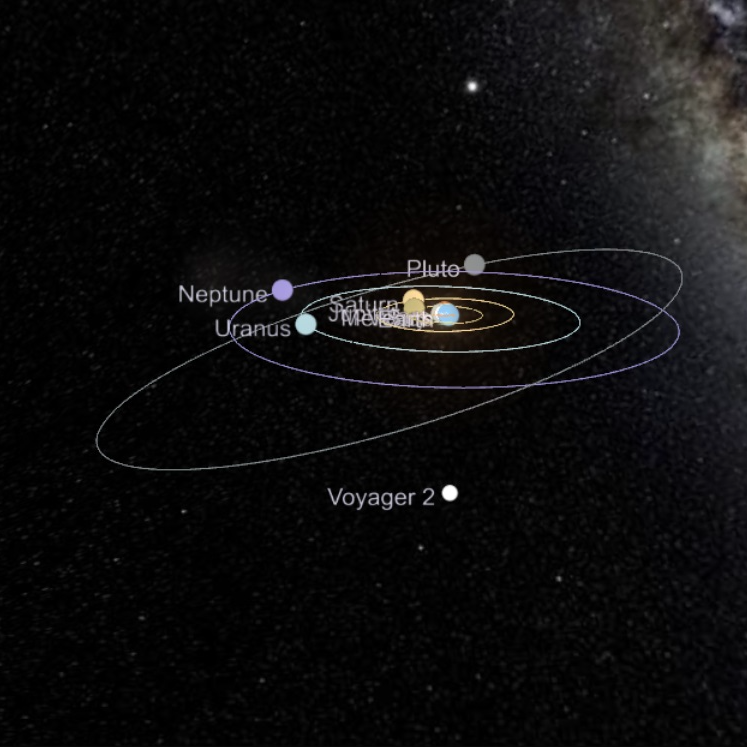
Diagram: oblique view of solar system orbits with a dot for Voyager outside the orbits.
View larger. | Both Voyager spacecraft are rushing away from Earth and into interstellar space. Yet for a portion of every year, both spacecrafts’ distances to Earth decrease. How is this possible? This chart shows the location of Voyager 2 as it leaves the solar system. Image via TheSkyLive.com. Used with permission.

Why are the Voyager spacecraft getting closer to Earth?

For a few months each year, the distances between the Voyager spacecraft and Earth actually decrease. You might know that both Voyager spacecraft were launched into space in the 1970s and visited the outer planets through the 1980s. They’ve been heading out of our solar system ever since. In 2012, Voyager 1 entered interstellar space. Then, in 2018, NASA announced that Voyager 2 had entered interstellar space, too. They are both headed outward, never to return to Earth. So, can they get closer?

The answer is that for a few months each year, Earth in its orbit moves toward the spacecraft faster than they’re moving away. Earth’s motion around the sun is faster than the motion of the Voyager spacecraft. Earth moves through space at a speed of 67,000 miles per hour (30 km/s). Voyager 1 moves at a speed of 38,000 miles per hour (17 km/s). Voyager 2 moves at a speed of 35,000 miles per hour (16 km/s).

So, for a portion of the year, Earth comes around the side of the sun and is speeding toward the spacecraft faster than they’re moving away. Therefore their distances to Earth are getting closer, if only temporarily. They never change their outward motion. It is we who change.

From this video, you can see the trajectory of the Voyager spacecraft as they leave Earth, encounter the outer planets (changing their trajectories), and then head in a straight line outward, out of the solar system.

Where are Voyager 1 and Voyager 2 now?

Don’t miss the next unmissable night sky event. Sign up to our free newsletter for daily night sky updates, as well as the latest science news.

A closer look at Voyager 2 in relation to Earth

Let’s look specifically at Voyager 2 as an example. Every year from late February to the beginning of June, Voyager 2 actually gets closer to Earth. We measure the distance between objects in space in astronomical units, or AU. This measurement is based on the distance between Earth and the sun, which is one AU.

On February 9, 2026, Voyager 2 was 143.09 AU from Earth. Then, Earth’s orbit began bringing us closer to Voyager 2 once again. The distance between us and Voyager 2 will continue to shrinking until early June when it’ll be 143.4 AU from Earth.

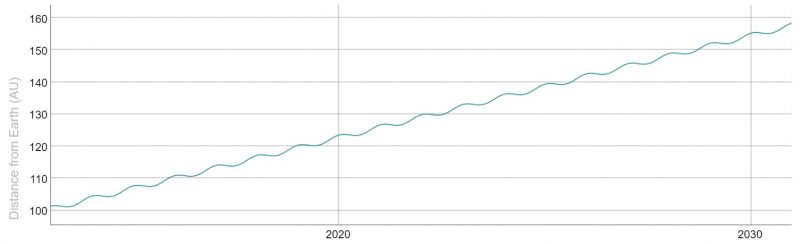
Graph with slightly wavy line going from lower left to upper right.
View larger. | This graph shows the distance of Voyager 2 from Earth from January 2020 through January 2030. It’s not a straight line because as Earth circles the sun. Earth’s faster speed means that for a part of every year, Voyager 2 and Earth temporarily get closer together. Image via TheSkyLive.com. Used with permission.

Read more: Voyager 1 location

Bottom line: The Voyager spacecraft are on a never-ending journey away from Earth. So, why do the distances between the spacecraft and Earth decrease for a few months every year? It’s because for a few months, Earth moves toward the spacecraft faster in its orbit around the sun than the spacecraft moves away from us.

The post Why are the Voyager spacecraft getting closer to Earth now? first appeared on EarthSky.


from EarthSky https://ift.tt/0CqNusc
Diagram: oblique view of solar system orbits with a dot for Voyager outside the orbits.
View larger. | Both Voyager spacecraft are rushing away from Earth and into interstellar space. Yet for a portion of every year, both spacecrafts’ distances to Earth decrease. How is this possible? This chart shows the location of Voyager 2 as it leaves the solar system. Image via TheSkyLive.com. Used with permission.

Why are the Voyager spacecraft getting closer to Earth?

For a few months each year, the distances between the Voyager spacecraft and Earth actually decrease. You might know that both Voyager spacecraft were launched into space in the 1970s and visited the outer planets through the 1980s. They’ve been heading out of our solar system ever since. In 2012, Voyager 1 entered interstellar space. Then, in 2018, NASA announced that Voyager 2 had entered interstellar space, too. They are both headed outward, never to return to Earth. So, can they get closer?

The answer is that for a few months each year, Earth in its orbit moves toward the spacecraft faster than they’re moving away. Earth’s motion around the sun is faster than the motion of the Voyager spacecraft. Earth moves through space at a speed of 67,000 miles per hour (30 km/s). Voyager 1 moves at a speed of 38,000 miles per hour (17 km/s). Voyager 2 moves at a speed of 35,000 miles per hour (16 km/s).

So, for a portion of the year, Earth comes around the side of the sun and is speeding toward the spacecraft faster than they’re moving away. Therefore their distances to Earth are getting closer, if only temporarily. They never change their outward motion. It is we who change.

From this video, you can see the trajectory of the Voyager spacecraft as they leave Earth, encounter the outer planets (changing their trajectories), and then head in a straight line outward, out of the solar system.

Where are Voyager 1 and Voyager 2 now?

Don’t miss the next unmissable night sky event. Sign up to our free newsletter for daily night sky updates, as well as the latest science news.

A closer look at Voyager 2 in relation to Earth

Let’s look specifically at Voyager 2 as an example. Every year from late February to the beginning of June, Voyager 2 actually gets closer to Earth. We measure the distance between objects in space in astronomical units, or AU. This measurement is based on the distance between Earth and the sun, which is one AU.

On February 9, 2026, Voyager 2 was 143.09 AU from Earth. Then, Earth’s orbit began bringing us closer to Voyager 2 once again. The distance between us and Voyager 2 will continue to shrinking until early June when it’ll be 143.4 AU from Earth.

Graph with slightly wavy line going from lower left to upper right.
View larger. | This graph shows the distance of Voyager 2 from Earth from January 2020 through January 2030. It’s not a straight line because as Earth circles the sun. Earth’s faster speed means that for a part of every year, Voyager 2 and Earth temporarily get closer together. Image via TheSkyLive.com. Used with permission.

Read more: Voyager 1 location

Bottom line: The Voyager spacecraft are on a never-ending journey away from Earth. So, why do the distances between the spacecraft and Earth decrease for a few months every year? It’s because for a few months, Earth moves toward the spacecraft faster in its orbit around the sun than the spacecraft moves away from us.

The post Why are the Voyager spacecraft getting closer to Earth now? first appeared on EarthSky.


from EarthSky https://ift.tt/0CqNusc

Virga is rain that doesn’t reach the ground

Rain that doesn’t reach the ground

Have you seen clouds that are pouring rain … but the rain never reaches the ground? Meteorologists call this rain by the name virga. You see virga in places where the air is dry, and often warm. The rain evaporates as it falls, before hitting Earth. So you might see virga in a desert or at high altitudes, for example, in the western U.S. and Canadian prairies, the Middle East, Australia and North Africa. Virga isn’t rare. But it’s delicate and very beautiful. Maybe you’ve seen it lots of times, but never knew it had a name?

Curtains of rain descending partway from gray clouds toward sunny mountainous landscape.
View at EarthSky Community Photos. | Ross Stone caught this virga – rain that doesn’t reach the ground – at Big Pine, California, on September 21, 2024. Good catch, Ross! Thank you.

Virga on radar

Sometimes, when you’re looking at your weather app, you might see what looks like rain or snow on the radar, but nothing is falling outside. Instead, look up at the clouds and see if you can spot virga. The radar is picking up precipitation in the air which is just not reaching the ground. As weather.gov says:

The radar isn’t lying, rather, the rain or snow is not hitting the ground. If you have a dry air mass in place in the low levels, sometimes rain cannot completely penetrate that dry layer before it evaporates.

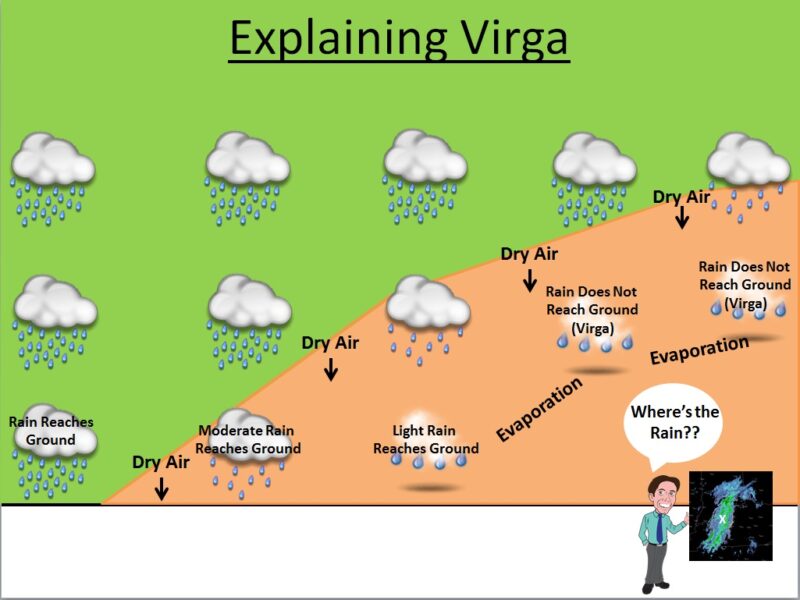
Cartoon showing a weatherman and clouds raining into a layer of warm air, where the rainfall evaporates.
This graphic gives you a better idea of how virga forms. The rainclouds higher up in the atmosphere are dropping rain, but as that moisture hits drier air below, it evaporates. So you might see radar indicating rain or snow, but nothing is reaching the ground. Image via weather.gov (public domain).

Do you want to learn to identify virga when you see it? Check out the photos on this page from our global EarthSky community. Once you acquaint yourself with the variations of virga, you’ll be able to spot it in your own sky. If you capture a photo of virga, submit it to us!

Can you identify virga?

Photos of virga from EarthSky’s community

Stringy, dark clouds off in the distance showing virga.
View at EarthSky Community Photos. | Susan Jensen captured this image on May 6, 2024, in Washington. She wrote: “Late afternoon thunder with a few brief lightning flashes caught my attention! These were such beautiful virga clouds.” Thank you, Susan.
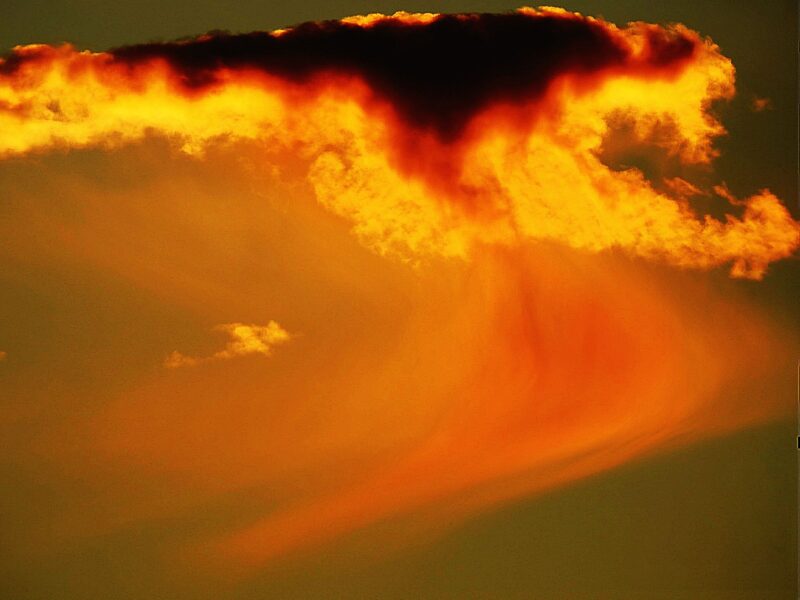
Black and orange clouds with curving orangish and redish mist below them.
View at EarthSky Community Photos. | Helio C. Vital from Saquarema, Rio de Janeiro, Brazil, took this photo on December 17, 2023, and wrote: “The photo shows precipitation that is seen pending from a cloud and evaporating before reaching the ground (virga). The virga was backlit by the setting sun, that caused its strong reddish color.” Thank you, Helio!
Distant, dark mountains with a sunset and dark clouds with slight wisps pulling downward from their undersides.
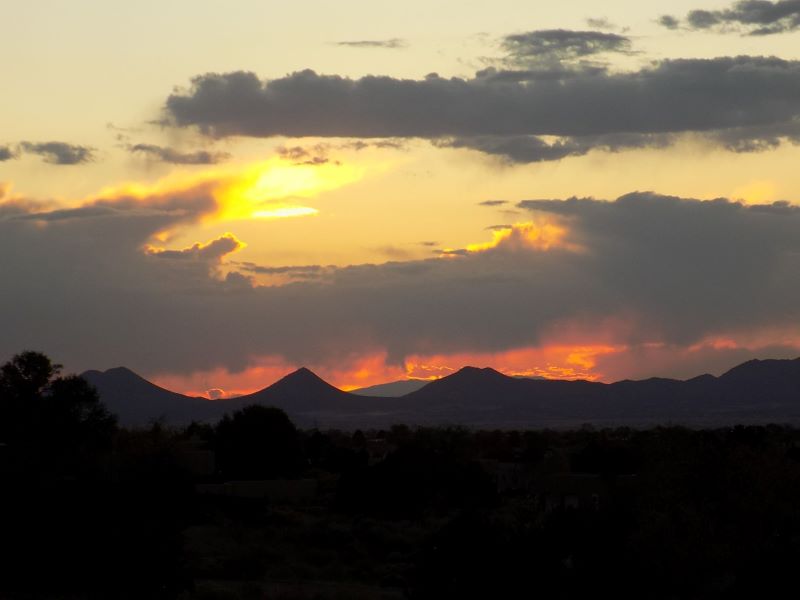
View at EarthSky Community Photos. | Jennifer Browne captured this scene of virga and New Mexico’s Sangre de Cristo Mountains on October 23, 2023. Jennifer wrote: “Looking west from my home. The magic of Santa Fe sunsets.” Thank you, Jennifer! Look closely, and you’ll see the wispy undersides of the clouds. That’s virga.

Virga photos

Rain falling from gray clouds in sweeping curtains not reaching the ground.
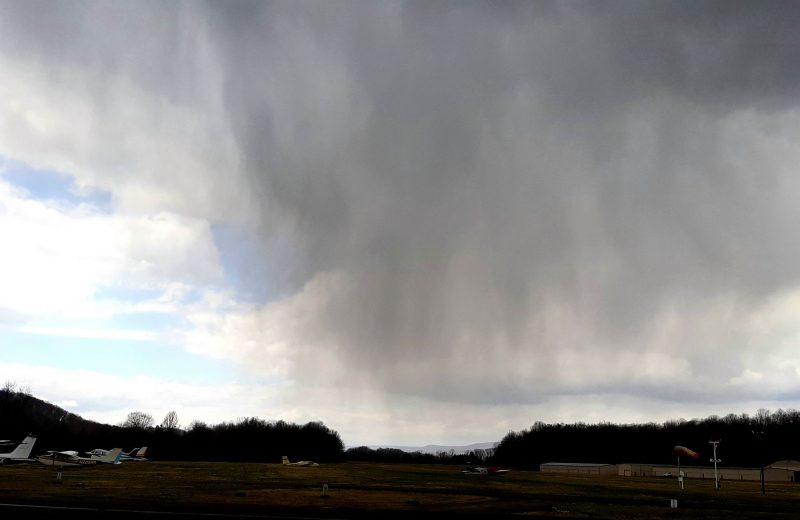
View at EarthSky Community Photos. | Sandi Hryhor in Blairstown, New Jersey, caught this image of virga on March 26, 2022. Sandi wrote: “Taken at the Blairstown airport. It was completely overcast when we left our house 10 miles away, then some sun, then it hailed, and this sky greeted us when we arrived.” Thank you for sharing!
3 white clouds in a blue, clear sky. There is white rain comming from them, but it doesn't reach the ground.
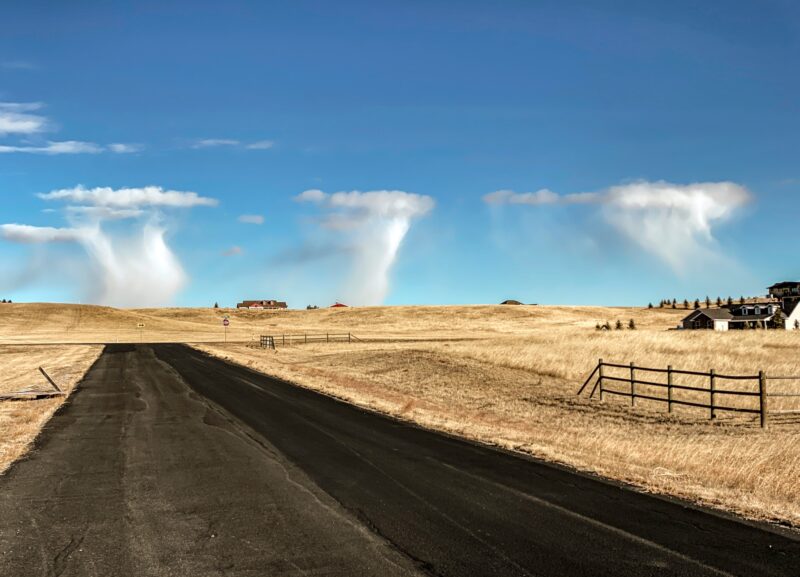
View at EarthSky Community Photos. | Jan Curtis took this photo on December 17, 2021, and wrote: “The lower levels of the atmosphere are very cold and moist. Lots of virga (ice crystals) are falling out of these thin cloud masses. Had this occurred in summer, severe weather is most likely later in the day. On this day, scattered convective snow shower occurred shortly after this mid-morning capture. An alternative cloud classification could be ‘altocumulus floccus clouds with virga’ but I believe these clouds were well below 6,000 feet [1,800 meters] above ground level.” Thank you, Jan!

More photos

Grey clouds over reddish mountains and mist that doesn't reach the mountains.
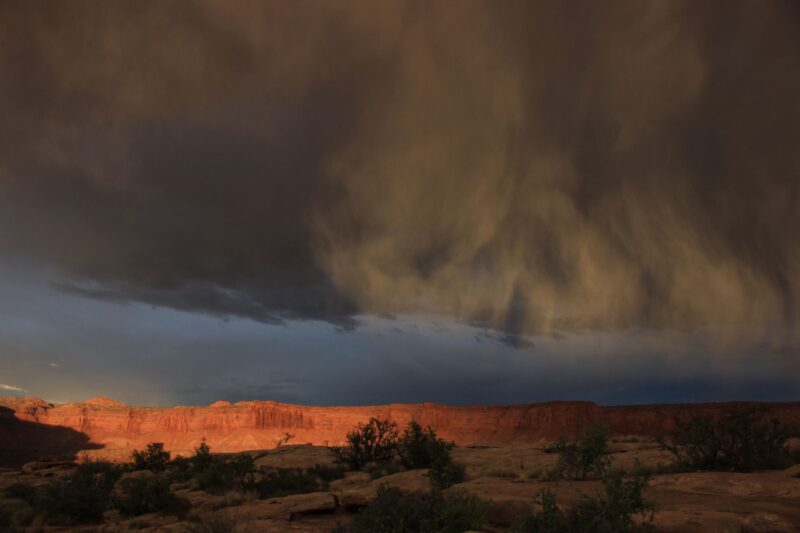
View at EarthSky Community Photos. | Wells Shoemaker from Burr Point, Utah, took this photo on April 22, 2019, and wrote: “Late sun slashed through a crease in the clouds to illuminate the Wingate and Navajo cliffs above the Dirty Devil River … through a lace of virga.” Thank you, Wells!
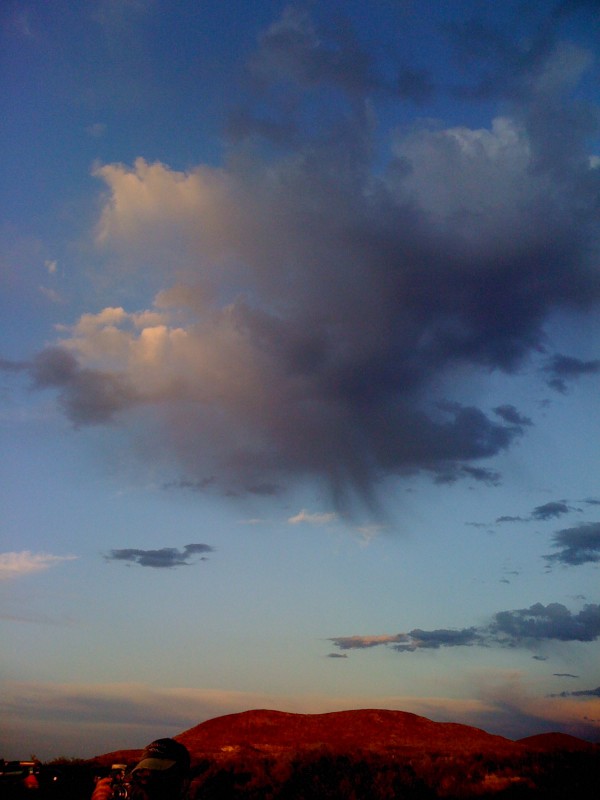
Patchy gray and white clouds against blue sky, with virga below the lowest, and a red mountain on horizon.
Virga over West Texas. Image via EarthSky founder, Deborah Byrd.
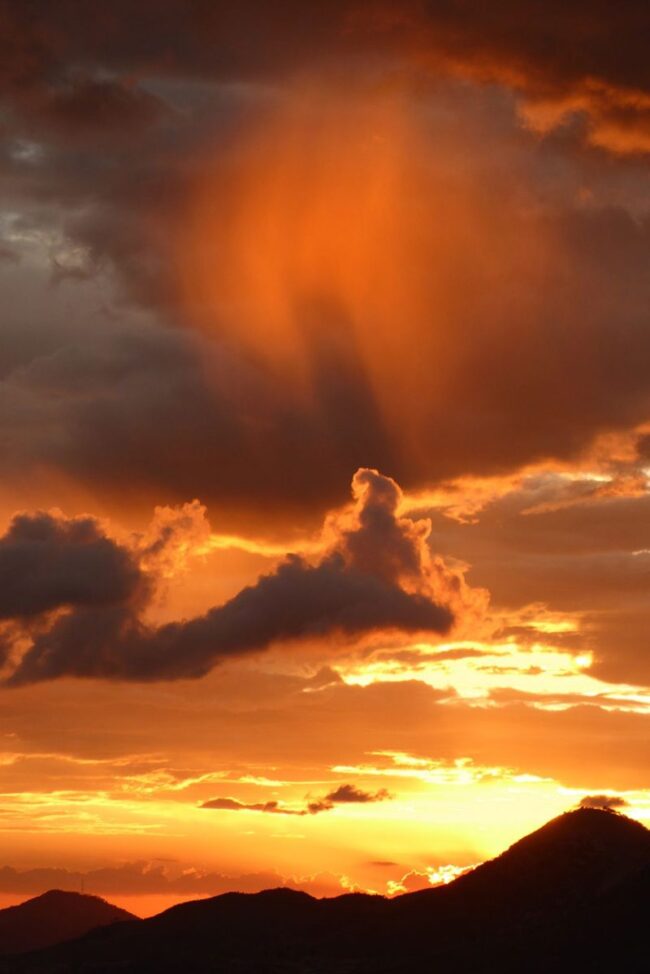
Spectacular orange sunset clouds, with glowing orange rain not reaching the ground, above a dark mountain.
Peter Lowenstein captured this scene from Mutare, Zimbabwe, on March 5, 2019. He wrote: “Some lingering clouds and a strange curtain of virga left over after a late afternoon shower produced a spectacular display just after the sun had set below the horizon.” Thank you, Peter!
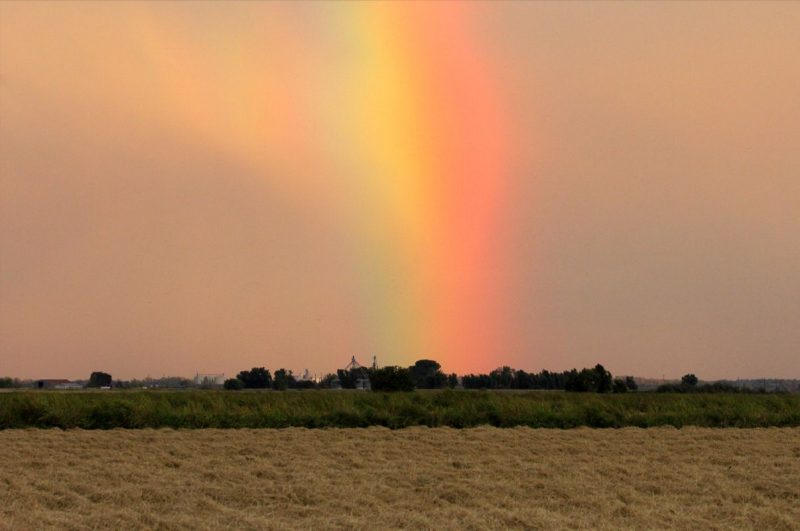
Wide, bright, irregular rainbow touching horizon, with melon-colored rain not reaching the ground to one side.
View at EarthSky Community Photos. | Here’s a tricky one: a virga rainbow. Hazel Holby in Willows, California, captured this image on September 29, 2021. She wrote: “Can you tell me how this rainbow managed to form? Thank you and love your site!” Thank you, Hazel! Les Cowley of the website Atmospheric Optics said: “This is a broad bow and also of variable width. These suggest that it was made by virga or other small water droplets. The smaller the water drops, the broader the bow. When the drops get down to mist size, then we have a fogbow.” Thank you, Les!

Bottom line: Learn what virga is and how it forms, and see great photos to help you learn how to identify it yourself!

You deserve a daily dose of good news. For the latest in science and the night sky, click here to subscribe to our free daily newsletter.

The post Virga is rain that doesn’t reach the ground first appeared on EarthSky.


from EarthSky https://ift.tt/6gyzHAl

Rain that doesn’t reach the ground

Have you seen clouds that are pouring rain … but the rain never reaches the ground? Meteorologists call this rain by the name virga. You see virga in places where the air is dry, and often warm. The rain evaporates as it falls, before hitting Earth. So you might see virga in a desert or at high altitudes, for example, in the western U.S. and Canadian prairies, the Middle East, Australia and North Africa. Virga isn’t rare. But it’s delicate and very beautiful. Maybe you’ve seen it lots of times, but never knew it had a name?

Curtains of rain descending partway from gray clouds toward sunny mountainous landscape.
View at EarthSky Community Photos. | Ross Stone caught this virga – rain that doesn’t reach the ground – at Big Pine, California, on September 21, 2024. Good catch, Ross! Thank you.

Virga on radar

Sometimes, when you’re looking at your weather app, you might see what looks like rain or snow on the radar, but nothing is falling outside. Instead, look up at the clouds and see if you can spot virga. The radar is picking up precipitation in the air which is just not reaching the ground. As weather.gov says:

The radar isn’t lying, rather, the rain or snow is not hitting the ground. If you have a dry air mass in place in the low levels, sometimes rain cannot completely penetrate that dry layer before it evaporates.

Cartoon showing a weatherman and clouds raining into a layer of warm air, where the rainfall evaporates.
This graphic gives you a better idea of how virga forms. The rainclouds higher up in the atmosphere are dropping rain, but as that moisture hits drier air below, it evaporates. So you might see radar indicating rain or snow, but nothing is reaching the ground. Image via weather.gov (public domain).

Do you want to learn to identify virga when you see it? Check out the photos on this page from our global EarthSky community. Once you acquaint yourself with the variations of virga, you’ll be able to spot it in your own sky. If you capture a photo of virga, submit it to us!

Can you identify virga?

Photos of virga from EarthSky’s community

Stringy, dark clouds off in the distance showing virga.
View at EarthSky Community Photos. | Susan Jensen captured this image on May 6, 2024, in Washington. She wrote: “Late afternoon thunder with a few brief lightning flashes caught my attention! These were such beautiful virga clouds.” Thank you, Susan.
Black and orange clouds with curving orangish and redish mist below them.
View at EarthSky Community Photos. | Helio C. Vital from Saquarema, Rio de Janeiro, Brazil, took this photo on December 17, 2023, and wrote: “The photo shows precipitation that is seen pending from a cloud and evaporating before reaching the ground (virga). The virga was backlit by the setting sun, that caused its strong reddish color.” Thank you, Helio!
Distant, dark mountains with a sunset and dark clouds with slight wisps pulling downward from their undersides.
View at EarthSky Community Photos. | Jennifer Browne captured this scene of virga and New Mexico’s Sangre de Cristo Mountains on October 23, 2023. Jennifer wrote: “Looking west from my home. The magic of Santa Fe sunsets.” Thank you, Jennifer! Look closely, and you’ll see the wispy undersides of the clouds. That’s virga.

Virga photos

Rain falling from gray clouds in sweeping curtains not reaching the ground.
View at EarthSky Community Photos. | Sandi Hryhor in Blairstown, New Jersey, caught this image of virga on March 26, 2022. Sandi wrote: “Taken at the Blairstown airport. It was completely overcast when we left our house 10 miles away, then some sun, then it hailed, and this sky greeted us when we arrived.” Thank you for sharing!
3 white clouds in a blue, clear sky. There is white rain comming from them, but it doesn't reach the ground.
View at EarthSky Community Photos. | Jan Curtis took this photo on December 17, 2021, and wrote: “The lower levels of the atmosphere are very cold and moist. Lots of virga (ice crystals) are falling out of these thin cloud masses. Had this occurred in summer, severe weather is most likely later in the day. On this day, scattered convective snow shower occurred shortly after this mid-morning capture. An alternative cloud classification could be ‘altocumulus floccus clouds with virga’ but I believe these clouds were well below 6,000 feet [1,800 meters] above ground level.” Thank you, Jan!

More photos

Grey clouds over reddish mountains and mist that doesn't reach the mountains.
View at EarthSky Community Photos. | Wells Shoemaker from Burr Point, Utah, took this photo on April 22, 2019, and wrote: “Late sun slashed through a crease in the clouds to illuminate the Wingate and Navajo cliffs above the Dirty Devil River … through a lace of virga.” Thank you, Wells!
Patchy gray and white clouds against blue sky, with virga below the lowest, and a red mountain on horizon.
Virga over West Texas. Image via EarthSky founder, Deborah Byrd.
Spectacular orange sunset clouds, with glowing orange rain not reaching the ground, above a dark mountain.
Peter Lowenstein captured this scene from Mutare, Zimbabwe, on March 5, 2019. He wrote: “Some lingering clouds and a strange curtain of virga left over after a late afternoon shower produced a spectacular display just after the sun had set below the horizon.” Thank you, Peter!
Wide, bright, irregular rainbow touching horizon, with melon-colored rain not reaching the ground to one side.
View at EarthSky Community Photos. | Here’s a tricky one: a virga rainbow. Hazel Holby in Willows, California, captured this image on September 29, 2021. She wrote: “Can you tell me how this rainbow managed to form? Thank you and love your site!” Thank you, Hazel! Les Cowley of the website Atmospheric Optics said: “This is a broad bow and also of variable width. These suggest that it was made by virga or other small water droplets. The smaller the water drops, the broader the bow. When the drops get down to mist size, then we have a fogbow.” Thank you, Les!

Bottom line: Learn what virga is and how it forms, and see great photos to help you learn how to identify it yourself!

You deserve a daily dose of good news. For the latest in science and the night sky, click here to subscribe to our free daily newsletter.

The post Virga is rain that doesn’t reach the ground first appeared on EarthSky.


from EarthSky https://ift.tt/6gyzHAl

Why no radio signals from aliens? Is space weather to blame?

Radio signals from aliens: A long row of large, white dish-type radio antennas pointing up, at dusk.
The Very Large Array is a collection of 27 radio antennas located near Socorro, New Mexico. Each antenna in the array measures 82 feet (25 m) in diameter and weighs about 507,000 pounds (230 metric tons). These telescopes have been used for SETI, the search for radio signals from aliens. But, so far, no alien signals have been verified. Image via Alex Savello/ NRAO/ SETI Institute.
  • Astronomers have searched for alien radio signals for decades. But there are still no confirmed detections. Is space weather to blame?
  • Space weather is the flow of energy and particles from the sun and other stars through space. Its presence in space could disrupt some types of artificial radio signals, says a new study from the SETI Institute.
  • The researchers found similar effects on human-made radio signals from spacecraft in our own solar system, as the craft encounter our sun’s space weather.

Why no radio signals from aliens?

For decades, astronomers have looked for radio signals from alien civilizations. They call this endeavor SETI, the Search for Extraterrestrial Intelligence. But so far, they haven’t found any confirmed signals from aliens. Why not? On March 5, 2026, two researchers at the SETI Institute in Mountainview, California, offered an explanation.

They said the answer might be space weather from our sun and other stars. That is, the restless activity of our sun and other stars in our Milky Way galaxy – as they send energy and particles sweeping across space – might be making signals from aliens harder to detect. So things like our sun’s solar wind (or the stellar winds from other stars) and the coronal mass ejections (great burps of material from our sun and other stars) might cause artificial signals to broaden and weaken so that they become unrecognizable. They said a signal might be “blurred” before it ever leaves its home star system.

In fact, the researchers say that our sun’s space weather affects radio signals close to home, including signals from spacecraft in our own solar system.

The researchers published their peer-reviewed findings in The Astrophysical Journal on March 5, 2026.

Robotic humanoid holding a transparent tablet with radio telescope in background.
The new study offers a possible explanation for why astronomers haven’t found any confirmed extraterrestrial radio signals yet. Image via Breakthrough Listen/ Danielle Futselaar/ SETI Institute.

What is space weather?

Overall, space weather includes a constant stream of turbulent charged particles (mostly electrons and protons) flowing outward from our sun’s outer atmosphere. We call this stream of particles the solar wind when speaking of our sun and solar system. We call it stellar wind when speaking of other stars.

Space weather also includes coronal mass ejections (CMEs), or great burps of solar materials and magnetic fields that leave the sun’s surface and travel across space.

When strong streams of solar wind or strong CMEs reach Earth, they can create displays of beautiful auroras. But they can also affect earthly technologies such as power grids on Earth’s surface and satellites in space.

Search for narrowband radio signals

Meanwhile, for the most part, SETI astronomers have focused most of their efforts on the search for intelligent radio signals. They typically search for narrowband radio signals, which occupy a narrow range of frequencies or have a small fractional bandwidth. On Earth, these sorts of signals are typically artificial, not natural. That’s why astronomers look for them in space as possible evidence of extraterrestrial civilizations. They are unlikely to be produced by natural earthly or astrophysical phenomena.

In fact, astronomers have made some detections of such narrowband signals. But they haven’t been able to verify any of them as artificial. Usually the signals have turned out to be earthly interference. Or the signals didn’t repeat, so that astronomers could re-observe them. In that case, we don’t know what they are.

PRESS RELEASEA new study by researchers at the SETI Institute suggests stellar “space weather” could make radio signals from extraterrestrial intelligence harder to detect. Stellar activity and plasma turbulence near a transmitting planet can broaden… ?

SETI Institute (@setiinstitute.bsky.social) 2026-03-05T18:04:09.569Z

Does space weather affect alien radio signals?

But now, two researchers at the SETI Institute, Vishal Gajjar and Grayce C. Brown, have proposed a possible explanation for the dearth of signals. Intriguingly, they suggest that space weather might be to blame. Space weather is the environment around a star – including our own sun – where stellar winds of charged particles (plasma) stream out from the star. There can be turbulence in those winds, just like turbulence in our atmosphere. Coronal mass ejections are also part of space weather. These are huge eruptions of plasma from the surface of a star.

You deserve a daily dose of good news. For the latest in science and the night sky, click here to subscribe to our free daily newsletter.

Smiling man standing in front of a tall white radio telescope in the background.
Vishal Gajjar at the SETI Institute is the lead author of the new study about alien radio signals and space weather. Image via Vishal Gajjar.

Space weather could distort narrowband alien radio signals

The new study found that space weather can “smear” a narrowband signal, making it more diffuse and weaker. This happens before the signal has even left the star system it originated from. So, by the time astronomers here on Earth detect it, it is already blurred so much as to be almost indistinguishable from natural broadband signals. Lead author Gajjar said:

SETI searches are often optimized for extremely narrow signals. If a signal gets broadened by its own star’s environment, it can slip below our detection thresholds, even if it’s there, potentially helping explain some of the radio silence we’ve seen in technosignature searches.

Graphic showing the sun at top with large solar flares, and the Earth below, with various labeled satellites, aircraft and other technological structures.
View larger. | Illustration of how space weather from the sun can affect communications, satellites, aircraft and more on Earth. Image via ESA/ Science Office (CC BY-SA 3.0 IGO).

Spacecraft in our solar system

The researchers tested the hypothesis further by using radio signals from active spacecraft in our own solar system. Our sun emits plasma in the solar wind. With this in mind, the researchers calibrated how the plasma broadens the narrowband radio signals from the spacecraft. Then, they extrapolated those results to a wide range of different stellar environments around various stars.

The results show how space weather can affect narrowband radio signals around different types of stars. This is true for red dwarf stars in particular, which are very active and emit more radiation and plasma than our sun. Plus, they are the most numerous type of star in our galaxy. Astronomers could now adapt future searches with the new findings in mind. As co-author Brown noted:

By quantifying how stellar activity can reshape narrowband signals, we can design searches that are better matched to what actually arrives at Earth, not just what might be transmitted.

Silhouette of a spacecraft with large solar panels against the cracked pink and blue surface of a moon.
View larger. | This artist’s concept of Europa Clipper shows the spacecraft silhouetted against Europa’s surface. Clipper will arrive at Jupiter in April 2030. The researchers studied the effects of space weather from the sun on spacecraft in the solar system. They found similar effects on radio signals from the spacecraft as postulated for alien radio signals from other star systems. Image via NASA/ JPL-Caltech.

Bottom line: Astronomers have looked for radio signals from aliens for decades. But none have been confirmed. A new study says space weather could make their detection difficult.

Source: Exo–IPM Scattering as a Hidden Gatekeeper of Narrowband Technosignatures

Via Space Institute

Read more: SETI@home takes a closer look at 100 notable signals

Read more: Strange double starlight pulses revealed in new SETI search

The post Why no radio signals from aliens? Is space weather to blame? first appeared on EarthSky.


from EarthSky https://ift.tt/zvxQy84
Radio signals from aliens: A long row of large, white dish-type radio antennas pointing up, at dusk.
The Very Large Array is a collection of 27 radio antennas located near Socorro, New Mexico. Each antenna in the array measures 82 feet (25 m) in diameter and weighs about 507,000 pounds (230 metric tons). These telescopes have been used for SETI, the search for radio signals from aliens. But, so far, no alien signals have been verified. Image via Alex Savello/ NRAO/ SETI Institute.
  • Astronomers have searched for alien radio signals for decades. But there are still no confirmed detections. Is space weather to blame?
  • Space weather is the flow of energy and particles from the sun and other stars through space. Its presence in space could disrupt some types of artificial radio signals, says a new study from the SETI Institute.
  • The researchers found similar effects on human-made radio signals from spacecraft in our own solar system, as the craft encounter our sun’s space weather.

Why no radio signals from aliens?

For decades, astronomers have looked for radio signals from alien civilizations. They call this endeavor SETI, the Search for Extraterrestrial Intelligence. But so far, they haven’t found any confirmed signals from aliens. Why not? On March 5, 2026, two researchers at the SETI Institute in Mountainview, California, offered an explanation.

They said the answer might be space weather from our sun and other stars. That is, the restless activity of our sun and other stars in our Milky Way galaxy – as they send energy and particles sweeping across space – might be making signals from aliens harder to detect. So things like our sun’s solar wind (or the stellar winds from other stars) and the coronal mass ejections (great burps of material from our sun and other stars) might cause artificial signals to broaden and weaken so that they become unrecognizable. They said a signal might be “blurred” before it ever leaves its home star system.

In fact, the researchers say that our sun’s space weather affects radio signals close to home, including signals from spacecraft in our own solar system.

The researchers published their peer-reviewed findings in The Astrophysical Journal on March 5, 2026.

Robotic humanoid holding a transparent tablet with radio telescope in background.
The new study offers a possible explanation for why astronomers haven’t found any confirmed extraterrestrial radio signals yet. Image via Breakthrough Listen/ Danielle Futselaar/ SETI Institute.

What is space weather?

Overall, space weather includes a constant stream of turbulent charged particles (mostly electrons and protons) flowing outward from our sun’s outer atmosphere. We call this stream of particles the solar wind when speaking of our sun and solar system. We call it stellar wind when speaking of other stars.

Space weather also includes coronal mass ejections (CMEs), or great burps of solar materials and magnetic fields that leave the sun’s surface and travel across space.

When strong streams of solar wind or strong CMEs reach Earth, they can create displays of beautiful auroras. But they can also affect earthly technologies such as power grids on Earth’s surface and satellites in space.

Search for narrowband radio signals

Meanwhile, for the most part, SETI astronomers have focused most of their efforts on the search for intelligent radio signals. They typically search for narrowband radio signals, which occupy a narrow range of frequencies or have a small fractional bandwidth. On Earth, these sorts of signals are typically artificial, not natural. That’s why astronomers look for them in space as possible evidence of extraterrestrial civilizations. They are unlikely to be produced by natural earthly or astrophysical phenomena.

In fact, astronomers have made some detections of such narrowband signals. But they haven’t been able to verify any of them as artificial. Usually the signals have turned out to be earthly interference. Or the signals didn’t repeat, so that astronomers could re-observe them. In that case, we don’t know what they are.

PRESS RELEASEA new study by researchers at the SETI Institute suggests stellar “space weather” could make radio signals from extraterrestrial intelligence harder to detect. Stellar activity and plasma turbulence near a transmitting planet can broaden… ?

SETI Institute (@setiinstitute.bsky.social) 2026-03-05T18:04:09.569Z

Does space weather affect alien radio signals?

But now, two researchers at the SETI Institute, Vishal Gajjar and Grayce C. Brown, have proposed a possible explanation for the dearth of signals. Intriguingly, they suggest that space weather might be to blame. Space weather is the environment around a star – including our own sun – where stellar winds of charged particles (plasma) stream out from the star. There can be turbulence in those winds, just like turbulence in our atmosphere. Coronal mass ejections are also part of space weather. These are huge eruptions of plasma from the surface of a star.

You deserve a daily dose of good news. For the latest in science and the night sky, click here to subscribe to our free daily newsletter.

Smiling man standing in front of a tall white radio telescope in the background.
Vishal Gajjar at the SETI Institute is the lead author of the new study about alien radio signals and space weather. Image via Vishal Gajjar.

Space weather could distort narrowband alien radio signals

The new study found that space weather can “smear” a narrowband signal, making it more diffuse and weaker. This happens before the signal has even left the star system it originated from. So, by the time astronomers here on Earth detect it, it is already blurred so much as to be almost indistinguishable from natural broadband signals. Lead author Gajjar said:

SETI searches are often optimized for extremely narrow signals. If a signal gets broadened by its own star’s environment, it can slip below our detection thresholds, even if it’s there, potentially helping explain some of the radio silence we’ve seen in technosignature searches.

Graphic showing the sun at top with large solar flares, and the Earth below, with various labeled satellites, aircraft and other technological structures.
View larger. | Illustration of how space weather from the sun can affect communications, satellites, aircraft and more on Earth. Image via ESA/ Science Office (CC BY-SA 3.0 IGO).

Spacecraft in our solar system

The researchers tested the hypothesis further by using radio signals from active spacecraft in our own solar system. Our sun emits plasma in the solar wind. With this in mind, the researchers calibrated how the plasma broadens the narrowband radio signals from the spacecraft. Then, they extrapolated those results to a wide range of different stellar environments around various stars.

The results show how space weather can affect narrowband radio signals around different types of stars. This is true for red dwarf stars in particular, which are very active and emit more radiation and plasma than our sun. Plus, they are the most numerous type of star in our galaxy. Astronomers could now adapt future searches with the new findings in mind. As co-author Brown noted:

By quantifying how stellar activity can reshape narrowband signals, we can design searches that are better matched to what actually arrives at Earth, not just what might be transmitted.

Silhouette of a spacecraft with large solar panels against the cracked pink and blue surface of a moon.
View larger. | This artist’s concept of Europa Clipper shows the spacecraft silhouetted against Europa’s surface. Clipper will arrive at Jupiter in April 2030. The researchers studied the effects of space weather from the sun on spacecraft in the solar system. They found similar effects on radio signals from the spacecraft as postulated for alien radio signals from other star systems. Image via NASA/ JPL-Caltech.

Bottom line: Astronomers have looked for radio signals from aliens for decades. But none have been confirmed. A new study says space weather could make their detection difficult.

Source: Exo–IPM Scattering as a Hidden Gatekeeper of Narrowband Technosignatures

Via Space Institute

Read more: SETI@home takes a closer look at 100 notable signals

Read more: Strange double starlight pulses revealed in new SETI search

The post Why no radio signals from aliens? Is space weather to blame? first appeared on EarthSky.


from EarthSky https://ift.tt/zvxQy84

Summer Triangle: A signpost for all seasons

Chart showing the Summer Triangle asterism
The Summer Triangle consists of 3 bright stars in 3 separate constellations: Vega, Deneb and Altair. Chart via EarthSky.

Summer Triangle: Watch before dawn

Before sunup on March mornings, look for the Summer Triangle. Although it’s not summer at our northern latitudes, the Summer Triangle’s three bright stars – Vega, Deneb and Altair – are visible now in the east before sunrise. They’re all 1st-magnitude stars and the brightest stars in their constellations. The three stars are: Vega in Lyra the Harp, Deneb in Cygnus the Swan and Altair in Aquila the Eagle.

The Summer Triangle isn’t one of the officially recognized 88 constellations. Like the Big Dipper, it’s what’s called an asterism, a pattern of stars that’s easy to pick out.

For much of the Northern Hemisphere, the Summer Triangle stars are up for at least part of the night every night of the year. Are you in the Southern Hemisphere? You probably won’t see the entire Summer Triangle yet before sunup from your part of the world. The star Deneb will be challenging to find in the glare of sunrise at southern temperate latitudes.

To gauge the size of the Summer Triangle, hold a one-foot (30cm) ruler at arm’s length from your eye. The ruler (about 1/3 of a meter) pretty much fills the gap between Vega and Altair, the Summer Triangle’s 1st- and 2nd-brightest stars, respectively.

Densely starry sky with detailed Milky Way and 3 extra-bright stars well separated.
Under a dark sky and on a moonless night, the Great Rift passes right through the Summer Triangle. Also, in this image we can see the asterism of the Summer Triangle, a giant triangle in the sky composed of the three bright stars Vega (top left), Altair (lower middle) and Deneb (far left). Image via NASA/ A. Fujii/ ESA.

Prominent after sunset around the northern summer solstice

Like all the stars, the stars of the Summer Triangle rise four minutes earlier with each passing day. That also means, the stars rise two hours earlier with each passing month. Why is this happening? It’s happening because Earth is orbiting the sun, and our night sky is pointing outward toward an ever-changing panorama of stars.

Around May 1, the Summer Triangle will climb over the eastern horizon around local midnight (1 a.m. daylight saving time).

When middle to late June comes rolling along, you’ll see the Summer Triangle sparkling in the east at evening dusk. Watch for it around the time of the June solstice. It’s a sure sign of summer’s return to the Northern Hemisphere.

EarthSky astronomy kits are perfect for beginners. Order today from the EarthSky store

Enjoying EarthSky so far? Sign up for our free daily newsletter today!

Image with part of the Milky Way showing and the Summer Triangle stars labeled.
View at EarthSky Community Photos. | Steve Wilson captured this image on October 8, 2023, from Kansas and wrote: “Went out to a dark sky site south of Salina, Kansas to the Maxwell Wildlife Refuge to take this photo of the Milky Way and the Summer Triangle.” Thank you, Steve!

Bottom line: Watch for the three bright stars of the Summer Triangle – Vega, Deneb and Altair – before dawn in March, before midnight in May and at dusk near the June solstice.

The post Summer Triangle: A signpost for all seasons first appeared on EarthSky.


from EarthSky https://ift.tt/lHhQPmG
Chart showing the Summer Triangle asterism
The Summer Triangle consists of 3 bright stars in 3 separate constellations: Vega, Deneb and Altair. Chart via EarthSky.

Summer Triangle: Watch before dawn

Before sunup on March mornings, look for the Summer Triangle. Although it’s not summer at our northern latitudes, the Summer Triangle’s three bright stars – Vega, Deneb and Altair – are visible now in the east before sunrise. They’re all 1st-magnitude stars and the brightest stars in their constellations. The three stars are: Vega in Lyra the Harp, Deneb in Cygnus the Swan and Altair in Aquila the Eagle.

The Summer Triangle isn’t one of the officially recognized 88 constellations. Like the Big Dipper, it’s what’s called an asterism, a pattern of stars that’s easy to pick out.

For much of the Northern Hemisphere, the Summer Triangle stars are up for at least part of the night every night of the year. Are you in the Southern Hemisphere? You probably won’t see the entire Summer Triangle yet before sunup from your part of the world. The star Deneb will be challenging to find in the glare of sunrise at southern temperate latitudes.

To gauge the size of the Summer Triangle, hold a one-foot (30cm) ruler at arm’s length from your eye. The ruler (about 1/3 of a meter) pretty much fills the gap between Vega and Altair, the Summer Triangle’s 1st- and 2nd-brightest stars, respectively.

Densely starry sky with detailed Milky Way and 3 extra-bright stars well separated.
Under a dark sky and on a moonless night, the Great Rift passes right through the Summer Triangle. Also, in this image we can see the asterism of the Summer Triangle, a giant triangle in the sky composed of the three bright stars Vega (top left), Altair (lower middle) and Deneb (far left). Image via NASA/ A. Fujii/ ESA.

Prominent after sunset around the northern summer solstice

Like all the stars, the stars of the Summer Triangle rise four minutes earlier with each passing day. That also means, the stars rise two hours earlier with each passing month. Why is this happening? It’s happening because Earth is orbiting the sun, and our night sky is pointing outward toward an ever-changing panorama of stars.

Around May 1, the Summer Triangle will climb over the eastern horizon around local midnight (1 a.m. daylight saving time).

When middle to late June comes rolling along, you’ll see the Summer Triangle sparkling in the east at evening dusk. Watch for it around the time of the June solstice. It’s a sure sign of summer’s return to the Northern Hemisphere.

EarthSky astronomy kits are perfect for beginners. Order today from the EarthSky store

Enjoying EarthSky so far? Sign up for our free daily newsletter today!

Image with part of the Milky Way showing and the Summer Triangle stars labeled.
View at EarthSky Community Photos. | Steve Wilson captured this image on October 8, 2023, from Kansas and wrote: “Went out to a dark sky site south of Salina, Kansas to the Maxwell Wildlife Refuge to take this photo of the Milky Way and the Summer Triangle.” Thank you, Steve!

Bottom line: Watch for the three bright stars of the Summer Triangle – Vega, Deneb and Altair – before dawn in March, before midnight in May and at dusk near the June solstice.

The post Summer Triangle: A signpost for all seasons first appeared on EarthSky.


from EarthSky https://ift.tt/lHhQPmG

adds 2