Watch EarthSky’s Deborah Byrd and Marcy Curran discuss the February 28 planet parade and what you can see in the night sky.
February 28 planet parade: Here’s what you can really see
The internet has been full of memes and claims that there will be a spectacular lineup of six visible planets on February 28. But, as is often the case with online chatter, some of it is not accurate. So here’s what you can really see in the sky on the evening of February 28.
As soon as the sun sets, the first thing you’ll probably notice in the sky is the moon. It will already have risen in the east and it will be big and bright, at almost 93% full. It’s just a few days away from full moon, on March 3, when there will be a total lunar eclipse. But on the evening of February 28, it’s not yet full, and there’s a bright “star” shining higher in the sky above the moon. That star is really the planet Jupiter.
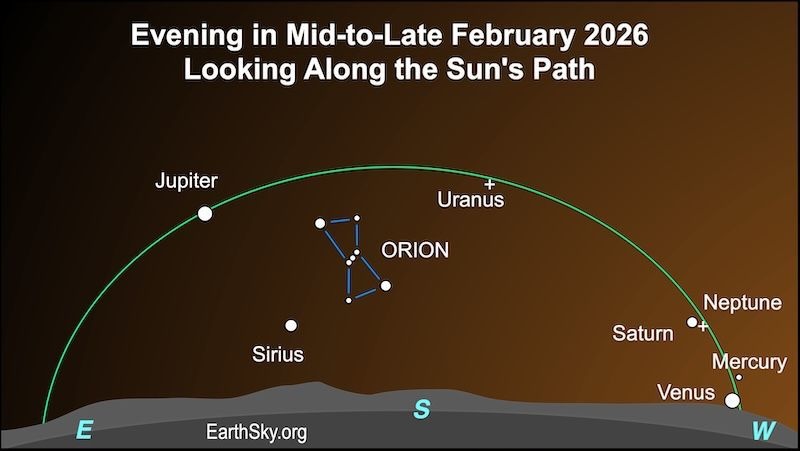
While Jupiter and the moon make a pretty scene, you’ll have to tear your eyes away and look toward the western horizon where the sun has recently set. There you’ll find a cluster of planets that will also soon be setting. Venus is the brightest, but it’s also currently close to the horizon. So it will be competing with the evening glow of twilight.
Mercury is dimmer and a bit north of Venus. Next is Saturn, a bit higher above the horizon. So it will be visible as the sky gets darker. But to see any of these three, you must have a flat horizon with no buildings, trees or other obstructions blocking your view.
So that’s only four planets, and really just one of them is easy to see. There are two other planets in the sky that night as well. Uranus is close to the pretty star cluster known as the Pleiades, while Neptune is not far from Saturn. But both of these planets require optical aid to see.
Star charts for the planetary parade
Why do posts on social media point to February 28? It’s a bit of a mystery, because the planets have been in these same general positions for weeks. Planets don’t move that quickly. Perhaps this date is popular because the moon is at one end of the line of planets, near bright Jupiter.
Check out the charts below to find where the planets are, in case you want to hunt them down yourself. And keep up with where the moon and planets are every night with EarthSky’s visible planets and night sky guide.
As seen from across Earth toward the end of February – about 40 minutes after sunset – the bright planet Jupiter will be in the east. Very low in the west, just above the horizon, is Venus, Mercury and Saturn. Note that these planets lie along the path the sun travels in the daytime (the green line on our chart, or the ecliptic). Chart via EarthSky.It’s true that there are 6 planets in the sky after sunset in mid-to-late February. But 3 (Venus, Mercury and Saturn) are hiding near the sunset’s glow, and 2 (Uranus and Neptune) require optical aid to see. Yet you can see them if you have patience, persistence, optical aid, a detailed star chart and a location with a clear view to the western horizon. And anyone can spot bright Jupiter, not far from the famous constellation Orion. Chart via EarthSky.
Bottom line: Rumors of a February 28 planet parade are sweeping the internet. Will you be able to see six planets in a line? Get the details here.
Watch EarthSky’s Deborah Byrd and Marcy Curran discuss the February 28 planet parade and what you can see in the night sky.
February 28 planet parade: Here’s what you can really see
The internet has been full of memes and claims that there will be a spectacular lineup of six visible planets on February 28. But, as is often the case with online chatter, some of it is not accurate. So here’s what you can really see in the sky on the evening of February 28.
As soon as the sun sets, the first thing you’ll probably notice in the sky is the moon. It will already have risen in the east and it will be big and bright, at almost 93% full. It’s just a few days away from full moon, on March 3, when there will be a total lunar eclipse. But on the evening of February 28, it’s not yet full, and there’s a bright “star” shining higher in the sky above the moon. That star is really the planet Jupiter.
While Jupiter and the moon make a pretty scene, you’ll have to tear your eyes away and look toward the western horizon where the sun has recently set. There you’ll find a cluster of planets that will also soon be setting. Venus is the brightest, but it’s also currently close to the horizon. So it will be competing with the evening glow of twilight.
Mercury is dimmer and a bit north of Venus. Next is Saturn, a bit higher above the horizon. So it will be visible as the sky gets darker. But to see any of these three, you must have a flat horizon with no buildings, trees or other obstructions blocking your view.
So that’s only four planets, and really just one of them is easy to see. There are two other planets in the sky that night as well. Uranus is close to the pretty star cluster known as the Pleiades, while Neptune is not far from Saturn. But both of these planets require optical aid to see.
Star charts for the planetary parade
Why do posts on social media point to February 28? It’s a bit of a mystery, because the planets have been in these same general positions for weeks. Planets don’t move that quickly. Perhaps this date is popular because the moon is at one end of the line of planets, near bright Jupiter.
Check out the charts below to find where the planets are, in case you want to hunt them down yourself. And keep up with where the moon and planets are every night with EarthSky’s visible planets and night sky guide.
As seen from across Earth toward the end of February – about 40 minutes after sunset – the bright planet Jupiter will be in the east. Very low in the west, just above the horizon, is Venus, Mercury and Saturn. Note that these planets lie along the path the sun travels in the daytime (the green line on our chart, or the ecliptic). Chart via EarthSky.It’s true that there are 6 planets in the sky after sunset in mid-to-late February. But 3 (Venus, Mercury and Saturn) are hiding near the sunset’s glow, and 2 (Uranus and Neptune) require optical aid to see. Yet you can see them if you have patience, persistence, optical aid, a detailed star chart and a location with a clear view to the western horizon. And anyone can spot bright Jupiter, not far from the famous constellation Orion. Chart via EarthSky.
Bottom line: Rumors of a February 28 planet parade are sweeping the internet. Will you be able to see six planets in a line? Get the details here.
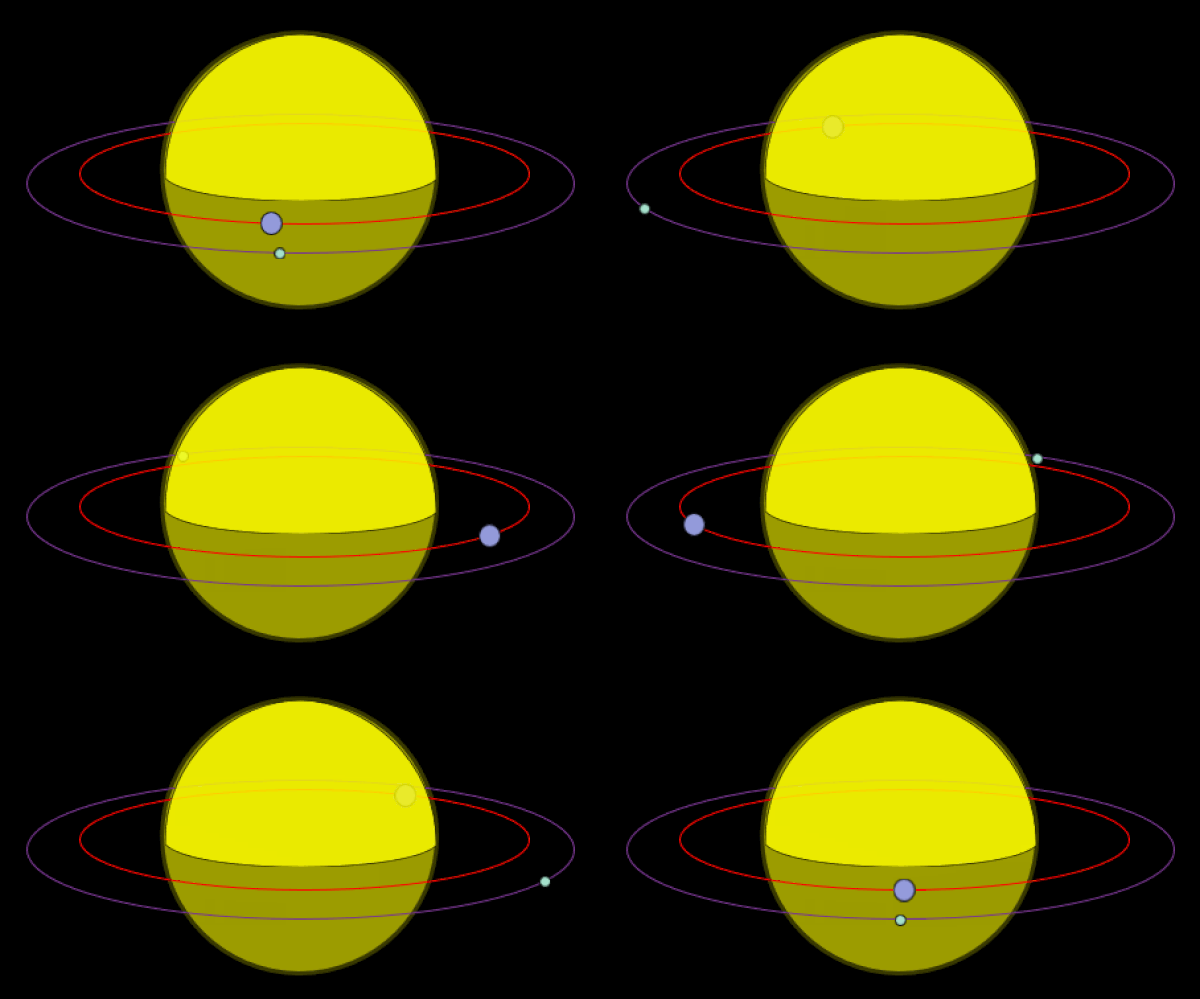
Astronomers use the term orbital resonance to describe the way planets can gravitationally affect each other when their orbits line up in a regular way. Here, we see 2 planets in a 2:1 orbital resonance. In other words, for every 2 times the inner planet goes around its star, the outer planet goes around once. Image via Amitchell125/ Wikimedia Commons (CC-BY-SA 4.0).
Planets orbit their parent stars while separated by enormous distances. In our solar system, planets are like grains of sand in a region the size of a football field. The time that planets take to orbit their suns has no specific relationship to each other.
But sometimes, their orbits display striking patterns. For example, astronomers studying six planets orbiting a star 100 light-years away have found that they orbit their star with an almost rhythmic beat, in perfect synchrony. Each pair of planets completes their orbits in times that are the ratios of whole numbers, allowing the planets to align and exert a gravitational push and pull on the other during their orbit.
This type of gravitational alignment is called orbital resonance, and it’s like a harmony between distant planets.
I’m an astronomer who studies and writes about cosmology. Researchers have discovered over 6,000 exoplanets in the past 30 years, and their extraordinary diversity continues to surprise astronomers.
Harmony of the spheres
Greek mathematician Pythagoras discovered the principles of musical harmony 2,500 years ago by analyzing the sounds of blacksmiths’ hammers and plucked strings.
He believed mathematics was at the heart of the natural world. He proposed that the sun, moon and planets each emit unique hums based on their orbital properties. Pythagoras thought this “music of the spheres” would be imperceptible to the human ear.
Four hundred years ago, Johannes Kepler picked up this idea. He proposed that musical intervals and harmonies described the motions of the six known planets at the time.
To Kepler, the solar system had two basses, Jupiter and Saturn; a tenor, Mars; two altos, Venus and Earth; and a soprano, Mercury. These roles reflected how long it took each planet to orbit the sun, lower speeds for the outer planets and higher speeds for the inner planets.
He called the book he wrote on these mathematical relationships The Harmony of the World. While these ideas have some similarities to the concept of orbital resonance, planets don’t actually make sounds, since sound can’t travel through the vacuum of space.
Orbital resonance
Resonance happens when planets or moons have orbital periods that are ratios of whole numbers. The orbital period is the time taken for a planet to make one complete circuit of the star. So, for example, two planets orbiting a star would be in a 2:1 resonance when one planet takes twice as long as the other to orbit the star. Resonance is seen in only 5% of planetary systems.
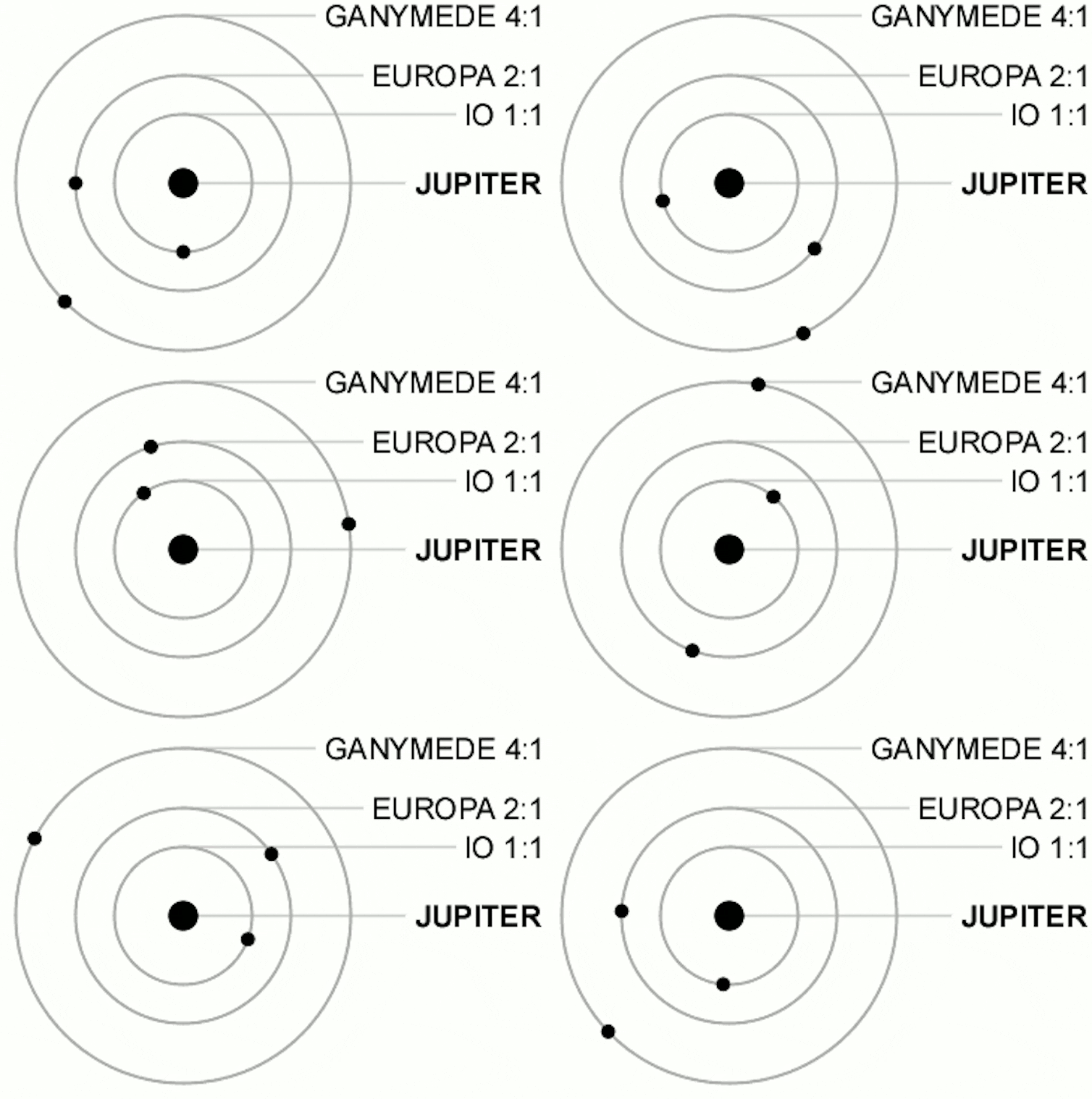
Orbital resonance, as seen with Jupiter’s moons, happens when planetary bodies’ orbits line up. For example, Io orbits Jupiter four times in the time it takes Europa to orbit twice and Ganymede to orbit once. Image via WolfmanSF/ Wikimedia Commons (CC0 1.0).
In the solar system, Neptune and Pluto are in a 3:2 resonance. There’s also a triple resonance, 4:2:1, among Jupiter’s three moons Ganymede, Europa and Io. In the time it takes Ganymede to orbit Jupiter, Europa orbits twice and Io orbits four times. Resonances occur naturally, when planets happen to have orbital periods that are the ratio of whole numbers.
The relation to music
Musical intervals describe the relationship between two musical notes. In the musical analogy, important musical intervals based on ratios of frequencies are the fourth, 4:3, the fifth, 3:2, and the octave, 2:1. Anyone who plays the guitar or the piano might recognize these intervals.
Musical intervals can be used to create scales and harmony.
What does orbital resonance do?
Orbital resonances can change how gravity influences two bodies, causing them to speed up, slow down, stabilize on their orbital path and sometimes have their orbits disrupted.
Think of pushing a child on a swing. A planet and a swing both have a natural frequency. Give the child a push that matches the swing motion and they’ll get a boost. They’ll also get a boost if you push them every other time they’re in that position, or every third time. But push them at random times, sometimes with the motion of the swing and sometimes against, and they get no boost.
Orbital resonance can cause planets or asteroids to speed up or start to wobble.
For planets, the boost can keep them continuing on their orbital paths, but it’s much more likely to disrupt their orbits.
Exoplanet resonance
Exoplanets, or planets outside the solar system, show striking examples of resonance, not just between two objects but also between resonant “chains” involving three or more objects.
The star Gliese 876 has three planets with orbit period ratios of 4:2:1, just like Jupiter’s three moons. Kepler 223 has four planets with ratios of 8:6:4:3.
The red dwarf Kepler 80 has five planets with ratios of 9:6:4:3:2, and TOI 178 has six planets, of which five are in a resonant chain with ratios of 18:9:6:4:3.
TRAPPIST-1 is the record holder. It has seven Earth-like planets, two of which might be habitable, with orbit ratios of 24:15:9:6:4:3:2.
The newest example of a resonant chain is the HD 110067 system. It’s about 100 light-years away and has six sub-Neptune planets, a common type of exoplanet, with orbit ratios of 54:36:24:16:12:9. The discovery is interesting because most resonance chains are unstable and disappear over time.
Despite these examples, resonant chains are rare, and only 1% of all planetary systems display them. Astronomers think that planets form in resonance, but small gravitational nudges from passing stars and wandering planets erase the resonance over time. With HD 110067, the resonant chain has survived for billions of years, offering a rare and pristine view of the system as it was when it formed.
With exoplanets, sonification can convey the mathematical relationships of their orbits. Astronomers at the European Southern Observatory created what they call music of the spheres for the TOI 178 system by associating a sound on a pentatonic scale to each of the five planets.
Music from planetary orbits, created by astronomers at the European Southern Observatory.
A similar musical translation has been done for the TRAPPIST-1 system, with the orbital frequencies scaled up by a factor of 212 million to bring them into audible range.
Astronomers have also created a sonification for the HD 110067 system. People may not agree on whether these renditions sound like actual music, but it’s inspiring to see Pythagoras’ ideas realized after 2,500 years.
Bottom line: What is orbital resonance? It’s a precise dance between heavenly bodies when their orbits line up, causing them to have specific synchronicities.
Astronomers use the term orbital resonance to describe the way planets can gravitationally affect each other when their orbits line up in a regular way. Here, we see 2 planets in a 2:1 orbital resonance. In other words, for every 2 times the inner planet goes around its star, the outer planet goes around once. Image via Amitchell125/ Wikimedia Commons (CC-BY-SA 4.0).
Planets orbit their parent stars while separated by enormous distances. In our solar system, planets are like grains of sand in a region the size of a football field. The time that planets take to orbit their suns has no specific relationship to each other.
But sometimes, their orbits display striking patterns. For example, astronomers studying six planets orbiting a star 100 light-years away have found that they orbit their star with an almost rhythmic beat, in perfect synchrony. Each pair of planets completes their orbits in times that are the ratios of whole numbers, allowing the planets to align and exert a gravitational push and pull on the other during their orbit.
This type of gravitational alignment is called orbital resonance, and it’s like a harmony between distant planets.
I’m an astronomer who studies and writes about cosmology. Researchers have discovered over 6,000 exoplanets in the past 30 years, and their extraordinary diversity continues to surprise astronomers.
Harmony of the spheres
Greek mathematician Pythagoras discovered the principles of musical harmony 2,500 years ago by analyzing the sounds of blacksmiths’ hammers and plucked strings.
He believed mathematics was at the heart of the natural world. He proposed that the sun, moon and planets each emit unique hums based on their orbital properties. Pythagoras thought this “music of the spheres” would be imperceptible to the human ear.
Four hundred years ago, Johannes Kepler picked up this idea. He proposed that musical intervals and harmonies described the motions of the six known planets at the time.
To Kepler, the solar system had two basses, Jupiter and Saturn; a tenor, Mars; two altos, Venus and Earth; and a soprano, Mercury. These roles reflected how long it took each planet to orbit the sun, lower speeds for the outer planets and higher speeds for the inner planets.
He called the book he wrote on these mathematical relationships The Harmony of the World. While these ideas have some similarities to the concept of orbital resonance, planets don’t actually make sounds, since sound can’t travel through the vacuum of space.
Orbital resonance
Resonance happens when planets or moons have orbital periods that are ratios of whole numbers. The orbital period is the time taken for a planet to make one complete circuit of the star. So, for example, two planets orbiting a star would be in a 2:1 resonance when one planet takes twice as long as the other to orbit the star. Resonance is seen in only 5% of planetary systems.
Orbital resonance, as seen with Jupiter’s moons, happens when planetary bodies’ orbits line up. For example, Io orbits Jupiter four times in the time it takes Europa to orbit twice and Ganymede to orbit once. Image via WolfmanSF/ Wikimedia Commons (CC0 1.0).
In the solar system, Neptune and Pluto are in a 3:2 resonance. There’s also a triple resonance, 4:2:1, among Jupiter’s three moons Ganymede, Europa and Io. In the time it takes Ganymede to orbit Jupiter, Europa orbits twice and Io orbits four times. Resonances occur naturally, when planets happen to have orbital periods that are the ratio of whole numbers.
The relation to music
Musical intervals describe the relationship between two musical notes. In the musical analogy, important musical intervals based on ratios of frequencies are the fourth, 4:3, the fifth, 3:2, and the octave, 2:1. Anyone who plays the guitar or the piano might recognize these intervals.
Musical intervals can be used to create scales and harmony.
What does orbital resonance do?
Orbital resonances can change how gravity influences two bodies, causing them to speed up, slow down, stabilize on their orbital path and sometimes have their orbits disrupted.
Think of pushing a child on a swing. A planet and a swing both have a natural frequency. Give the child a push that matches the swing motion and they’ll get a boost. They’ll also get a boost if you push them every other time they’re in that position, or every third time. But push them at random times, sometimes with the motion of the swing and sometimes against, and they get no boost.
Orbital resonance can cause planets or asteroids to speed up or start to wobble.
For planets, the boost can keep them continuing on their orbital paths, but it’s much more likely to disrupt their orbits.
Exoplanet resonance
Exoplanets, or planets outside the solar system, show striking examples of resonance, not just between two objects but also between resonant “chains” involving three or more objects.
The star Gliese 876 has three planets with orbit period ratios of 4:2:1, just like Jupiter’s three moons. Kepler 223 has four planets with ratios of 8:6:4:3.
The red dwarf Kepler 80 has five planets with ratios of 9:6:4:3:2, and TOI 178 has six planets, of which five are in a resonant chain with ratios of 18:9:6:4:3.
TRAPPIST-1 is the record holder. It has seven Earth-like planets, two of which might be habitable, with orbit ratios of 24:15:9:6:4:3:2.
The newest example of a resonant chain is the HD 110067 system. It’s about 100 light-years away and has six sub-Neptune planets, a common type of exoplanet, with orbit ratios of 54:36:24:16:12:9. The discovery is interesting because most resonance chains are unstable and disappear over time.
Despite these examples, resonant chains are rare, and only 1% of all planetary systems display them. Astronomers think that planets form in resonance, but small gravitational nudges from passing stars and wandering planets erase the resonance over time. With HD 110067, the resonant chain has survived for billions of years, offering a rare and pristine view of the system as it was when it formed.
With exoplanets, sonification can convey the mathematical relationships of their orbits. Astronomers at the European Southern Observatory created what they call music of the spheres for the TOI 178 system by associating a sound on a pentatonic scale to each of the five planets.
Music from planetary orbits, created by astronomers at the European Southern Observatory.
A similar musical translation has been done for the TRAPPIST-1 system, with the orbital frequencies scaled up by a factor of 212 million to bring them into audible range.
Astronomers have also created a sonification for the HD 110067 system. People may not agree on whether these renditions sound like actual music, but it’s inspiring to see Pythagoras’ ideas realized after 2,500 years.
Bottom line: What is orbital resonance? It’s a precise dance between heavenly bodies when their orbits line up, causing them to have specific synchronicities.
A total lunar eclipse of the full Worm Moon will sweep across the Pacific Ocean and western North America on March 2-3, 2026. The Blood Moon will be high in the sky for east Asia on the evening on March 3. East of the International Date Line – in Hawaii – the eclipse starts on the evening of March 2. Half a world away, in North America, we’ll have an early morning eclipse on March 3. We’ll be watching the eclipse as the Blood Moon sinks in the west before dawn. Japan, New Zealand, and most of Australia will see the entire event. From central Asia, the moon will rise with the eclipse already in progress. None of the eclipse will be visible from eastern Europe, Africa or western Asia.
And the next total lunar eclipse will be the total lunar eclipse on the morning of New Year’s Eve in 2028. It’s already being widely called the New Year’s Eve Blood Moon and it’ll occur on December 31, 2028.
Total eclipses can turn the moon a deep shade of red. That’s why you’ll hear this eclipse called a Blood Moon eclipse. The shade of red on the moon will depend mostly on what’s happening Earth’s atmosphere at the moment of the eclipse. How dark red will the March 2026 total lunar eclipse be?
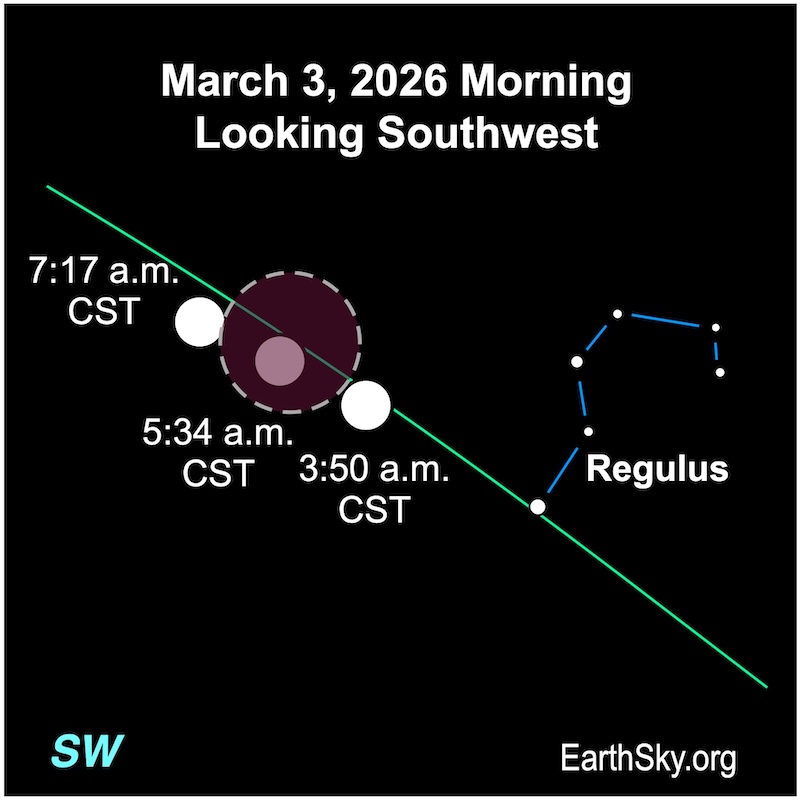
View larger. | Map showing the areas of visibility for the March 3, 2026, total lunar eclipse of the full Worm Moon. Image via Dominic Ford from In-The-Sky.org. Used with permission.The crest of the full moon occurs at 11:38 UTC on March 3. That’s 5:38 a.m. CST. Also, that morning, at 3:50 a.m. CST on March 3, the moon begins to pass through Earth’s umbral (dark) shadow. It becomes totally eclipsed from 5:04 to 6:03 a.m CST. And the bright star Regulus is nearby. By 7:17 a.m. CST the moon has exited the umbral (lighter) shadow ending the total lunar eclipse. Check details on the eclipse below. Chart via EarthSky.
Eclipse details
Full moon occurs at 11:38 UTC on March 3 (5:38 a.m. CST). That’s 35 minutes after totality begins. Penumbral eclipse begins at 8:43:58 UTC (2:43 a.m. CST) on March 3. Partial eclipse begins at 9:49:37 UTC (3:49 a.m. CST) on March 3. Totality begins (moon engulfed in Earth’s shadow) begins at 11:03:54 UTC (5:03 a.m. CST) on March 3. Maximum eclipse is at 11:33:40 UTC (5:33 a.m. CST) on March 3. Totality ends at 12:02:53 UTC (6:02 a.m. CST) on March 3. Partial eclipse ends at 13:17:26 UTC (7:17 a.m. CST) on March 3. Penumbral eclipse ends at 14:23:19 UTC (8:23 a.m. CST) on March 3. Duration of totality is about 59 minutes. Note: A total lunar eclipse is when the sun, Earth and moon are aligned in space, with Earth in the middle. Earth’s shadow falls on the moon.
Also, lunar eclipses are safe to view with the unaided eye. Binoculars and telescopes – and a dark sky – enhance the view, but aren’t required.
At 3:50 a.m. CST on March 3, the moon begins to pass through Earth’s umbral shadow. It becomes totally eclipsed from 5:04 a.m. to 6:03 a.m CST. Can you spot the bright star Regulus near the moon during the eclipse? By 7:17 a.m. CST the moon has exited the umbral shadow ending the total lunar eclipse. And the farther east you live in North America, the less of the eclipse you’ll see, because the moon will set before the entire event is over.
Moon, constellation, Saros
The moment of greatest eclipse takes place 6.5 days after the moon reaches perigee, its closest point from Earth for the month.
At mid-eclipse, the moon is located in the direction of the constellation Leo the Lion.
The Saros catalog describes the periodicity of eclipses. This March 3 total lunar eclipse belongs to Saros 133. It is number 27 of 71 eclipses in the series. All eclipses in this series occur at the moon’s descending node. The moon moves northward with respect to the node with each succeeding eclipse in the series.
The instant of greatest eclipse – when the axis of the Earth’s shadow cone passes closest to the moon’s center – takes place at 11:33 UTC on March 3. The moon will lie at zenith – directly overhead – in the Pacific Ocean.
An eclipse season is an approximate 35-day period during which it’s inevitable for at least two (and possibly three) eclipses to take place. In 2026 we have another eclipse season in August with a total solar eclipse on August 12 and a partial lunar eclipse on August 28.
March full moon is the Worm Moon
The 2026 March full moon is the Worm Moon. All the full moons have popular nicknames. Popular names for the March full moon are Worm Moon, Crow Moon and Sap Moon. The name Worm Moon honors the stirring of earthworms and insect larvae in the slowly warming late winter and early spring soil.
Visit Sunrise Sunset Calendars to know the moonrise time, remembering to check the moonrise and moonset box.
March full moon is in Leo
The full moon on the night of March 3, 2026, is located in the direction of the constellation Leo the Lion. The moon is roundest on the day when it is full, but the day before and the day after, it appears almost, but not quite, full.
Bottom line: Overnight on March 2-3, 2026, there will be a total lunar eclipse of the March full Worm Moon visible from across northwest South America, North America, the Pacific Ocean, Australia, Asia, Japan, southeast Asia, China, India, and most of Russia.
A total lunar eclipse of the full Worm Moon will sweep across the Pacific Ocean and western North America on March 2-3, 2026. The Blood Moon will be high in the sky for east Asia on the evening on March 3. East of the International Date Line – in Hawaii – the eclipse starts on the evening of March 2. Half a world away, in North America, we’ll have an early morning eclipse on March 3. We’ll be watching the eclipse as the Blood Moon sinks in the west before dawn. Japan, New Zealand, and most of Australia will see the entire event. From central Asia, the moon will rise with the eclipse already in progress. None of the eclipse will be visible from eastern Europe, Africa or western Asia.
And the next total lunar eclipse will be the total lunar eclipse on the morning of New Year’s Eve in 2028. It’s already being widely called the New Year’s Eve Blood Moon and it’ll occur on December 31, 2028.
Total eclipses can turn the moon a deep shade of red. That’s why you’ll hear this eclipse called a Blood Moon eclipse. The shade of red on the moon will depend mostly on what’s happening Earth’s atmosphere at the moment of the eclipse. How dark red will the March 2026 total lunar eclipse be?
View larger. | Map showing the areas of visibility for the March 3, 2026, total lunar eclipse of the full Worm Moon. Image via Dominic Ford from In-The-Sky.org. Used with permission.The crest of the full moon occurs at 11:38 UTC on March 3. That’s 5:38 a.m. CST. Also, that morning, at 3:50 a.m. CST on March 3, the moon begins to pass through Earth’s umbral (dark) shadow. It becomes totally eclipsed from 5:04 to 6:03 a.m CST. And the bright star Regulus is nearby. By 7:17 a.m. CST the moon has exited the umbral (lighter) shadow ending the total lunar eclipse. Check details on the eclipse below. Chart via EarthSky.
Eclipse details
Full moon occurs at 11:38 UTC on March 3 (5:38 a.m. CST). That’s 35 minutes after totality begins. Penumbral eclipse begins at 8:43:58 UTC (2:43 a.m. CST) on March 3. Partial eclipse begins at 9:49:37 UTC (3:49 a.m. CST) on March 3. Totality begins (moon engulfed in Earth’s shadow) begins at 11:03:54 UTC (5:03 a.m. CST) on March 3. Maximum eclipse is at 11:33:40 UTC (5:33 a.m. CST) on March 3. Totality ends at 12:02:53 UTC (6:02 a.m. CST) on March 3. Partial eclipse ends at 13:17:26 UTC (7:17 a.m. CST) on March 3. Penumbral eclipse ends at 14:23:19 UTC (8:23 a.m. CST) on March 3. Duration of totality is about 59 minutes. Note: A total lunar eclipse is when the sun, Earth and moon are aligned in space, with Earth in the middle. Earth’s shadow falls on the moon.
Also, lunar eclipses are safe to view with the unaided eye. Binoculars and telescopes – and a dark sky – enhance the view, but aren’t required.
At 3:50 a.m. CST on March 3, the moon begins to pass through Earth’s umbral shadow. It becomes totally eclipsed from 5:04 a.m. to 6:03 a.m CST. Can you spot the bright star Regulus near the moon during the eclipse? By 7:17 a.m. CST the moon has exited the umbral shadow ending the total lunar eclipse. And the farther east you live in North America, the less of the eclipse you’ll see, because the moon will set before the entire event is over.
Moon, constellation, Saros
The moment of greatest eclipse takes place 6.5 days after the moon reaches perigee, its closest point from Earth for the month.
At mid-eclipse, the moon is located in the direction of the constellation Leo the Lion.
The Saros catalog describes the periodicity of eclipses. This March 3 total lunar eclipse belongs to Saros 133. It is number 27 of 71 eclipses in the series. All eclipses in this series occur at the moon’s descending node. The moon moves northward with respect to the node with each succeeding eclipse in the series.
The instant of greatest eclipse – when the axis of the Earth’s shadow cone passes closest to the moon’s center – takes place at 11:33 UTC on March 3. The moon will lie at zenith – directly overhead – in the Pacific Ocean.
An eclipse season is an approximate 35-day period during which it’s inevitable for at least two (and possibly three) eclipses to take place. In 2026 we have another eclipse season in August with a total solar eclipse on August 12 and a partial lunar eclipse on August 28.
March full moon is the Worm Moon
The 2026 March full moon is the Worm Moon. All the full moons have popular nicknames. Popular names for the March full moon are Worm Moon, Crow Moon and Sap Moon. The name Worm Moon honors the stirring of earthworms and insect larvae in the slowly warming late winter and early spring soil.
Visit Sunrise Sunset Calendars to know the moonrise time, remembering to check the moonrise and moonset box.
March full moon is in Leo
The full moon on the night of March 3, 2026, is located in the direction of the constellation Leo the Lion. The moon is roundest on the day when it is full, but the day before and the day after, it appears almost, but not quite, full.
Bottom line: Overnight on March 2-3, 2026, there will be a total lunar eclipse of the March full Worm Moon visible from across northwest South America, North America, the Pacific Ocean, Australia, Asia, Japan, southeast Asia, China, India, and most of Russia.
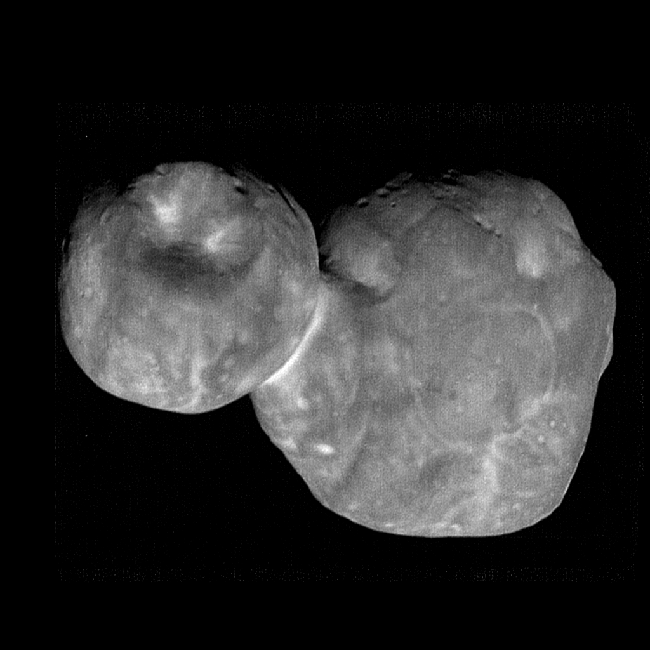
In 2019, NASA’s New Horizons mission flew by Kuiper Belt object 486958 Arrokoth. Arrokoth has a snowman shape – or 2-lobed figure – that is common in our outer solar system. Why is this snowman shape so prevalent? Scientists at Michigan State University said the answer might be surprisingly simple. Image via NASA/ Johns Hopkins Applied Physics Laboratory/ Southwest Research Institute/ National Optical Astronomy Observatory.
Why is the snowman shape so common in the outer solar system?
The outer region of the solar system is home to a slew of snowman-shaped objects. One famous example is Arrokoth, a member of the Kuiper Belt, which is a region beyond Neptune that contains Pluto and other icy objects such as planetesimals. In fact, one in 10 Kuiper Belt objects is snowman-shaped, or what astronomers call a contact binary. On February 19, 2026, researchers at Michigan State University said the reason for all these snowman-shaped objects might be surprisingly simple.
Lead author Jackson Barnes of Michigan State University (MSU) created computer simulations that show gravitational collapse can naturally produce these snowman-shaped objects. Barnes used MSU’s Institute for Cyber-Enabled Research’s High-Performance Computing Center to create simulations that show the formation of dual-lobed objects doesn’t rely on chance collisions or unusual encounters.
If we think 10% of planetesimal objects are contact binaries, the process that forms them can’t be rare. Gravitational collapse fits nicely with what we’ve observed.
Our first closeup look at a contact binary was Arrokoth. The New Horizons spacecraft flew past the rocky snowman on New Year’s Day in 2019.
The researchers published their peer-reviewed paper in the journal Monthly Notices of the Royal Astronomical Society on February 19, 2026.
Modeling the collapse process
The simulations needed to find an explanation that allowed the contact binaries to happen fairly regularly. And they needed to assure that these objects could retain their shapes over the years. Other computer models ended up with something that eventually morphed into a single, blob-like shape. Barnes’ simulations allow the snowmen to retain their characteristic shape.
In the early solar system, the sun and planets formed out of a swirling disk of gas and dust. On the outer edges of our solar system were remnants of this disk that didn’t become incorporated into the larger bodies. These Kuiper Belt objects live placid lives in the spacious regions of the solar system’s outskirts. Scientists say few collisions occur here.
In Barnes’ simulations, planetesimals form out of the dusty disk into loose aggregations of material. Gravity can then cause the objects to collapse inward, which can rip the object into two parts that then orbit each other until they are once again pulled into a single snowman-shaped object. In a sparsely populated environment, there’s nothing to knock into the objects and separate them again. The scientists note:
Most binaries aren’t even pocked with craters.
The MSU scientists are now working to create even more accurate modeling of the collapse process.
Watch a simulation of a snowman-shaped object after its collapse into 2 and as it reconnects.
Bottom line: Scientists at MSU have modeled the process of gravitational collapse that they say creates the snowman shape that is so common in the outer solar system.
In 2019, NASA’s New Horizons mission flew by Kuiper Belt object 486958 Arrokoth. Arrokoth has a snowman shape – or 2-lobed figure – that is common in our outer solar system. Why is this snowman shape so prevalent? Scientists at Michigan State University said the answer might be surprisingly simple. Image via NASA/ Johns Hopkins Applied Physics Laboratory/ Southwest Research Institute/ National Optical Astronomy Observatory.
Why is the snowman shape so common in the outer solar system?
The outer region of the solar system is home to a slew of snowman-shaped objects. One famous example is Arrokoth, a member of the Kuiper Belt, which is a region beyond Neptune that contains Pluto and other icy objects such as planetesimals. In fact, one in 10 Kuiper Belt objects is snowman-shaped, or what astronomers call a contact binary. On February 19, 2026, researchers at Michigan State University said the reason for all these snowman-shaped objects might be surprisingly simple.
Lead author Jackson Barnes of Michigan State University (MSU) created computer simulations that show gravitational collapse can naturally produce these snowman-shaped objects. Barnes used MSU’s Institute for Cyber-Enabled Research’s High-Performance Computing Center to create simulations that show the formation of dual-lobed objects doesn’t rely on chance collisions or unusual encounters.
If we think 10% of planetesimal objects are contact binaries, the process that forms them can’t be rare. Gravitational collapse fits nicely with what we’ve observed.
Our first closeup look at a contact binary was Arrokoth. The New Horizons spacecraft flew past the rocky snowman on New Year’s Day in 2019.
The researchers published their peer-reviewed paper in the journal Monthly Notices of the Royal Astronomical Society on February 19, 2026.
Modeling the collapse process
The simulations needed to find an explanation that allowed the contact binaries to happen fairly regularly. And they needed to assure that these objects could retain their shapes over the years. Other computer models ended up with something that eventually morphed into a single, blob-like shape. Barnes’ simulations allow the snowmen to retain their characteristic shape.
In the early solar system, the sun and planets formed out of a swirling disk of gas and dust. On the outer edges of our solar system were remnants of this disk that didn’t become incorporated into the larger bodies. These Kuiper Belt objects live placid lives in the spacious regions of the solar system’s outskirts. Scientists say few collisions occur here.
In Barnes’ simulations, planetesimals form out of the dusty disk into loose aggregations of material. Gravity can then cause the objects to collapse inward, which can rip the object into two parts that then orbit each other until they are once again pulled into a single snowman-shaped object. In a sparsely populated environment, there’s nothing to knock into the objects and separate them again. The scientists note:
Most binaries aren’t even pocked with craters.
The MSU scientists are now working to create even more accurate modeling of the collapse process.
Watch a simulation of a snowman-shaped object after its collapse into 2 and as it reconnects.
Bottom line: Scientists at MSU have modeled the process of gravitational collapse that they say creates the snowman shape that is so common in the outer solar system.
Your latitude determines which stars are visible in the sky dome above. Here’s the sky dome view for February 2026. It shows stars above the horizon at mid-evening (about halfway between your local sunset and local midnight) for mid-northern latitudes. But what about the view from other latitudes? See charts below showing how the sky dome changes by latitude and the stars that are visible in the sky. The gray line is the celestial equator (an imaginary line above Earth’s equator). The blue line is the ecliptic or sun’s path. Image via Guy Ottewell’s 2026 Astronomical Calendar.
On many of EarthSky’s articles about the night sky, you’ll see a note suggesting “for a precise view from your location try Stellarium Online“. That’s because the sky encircles all of Earth. And your location on the globe – or more specifically your latitude – determines which part of this encircling sky you’re able to see. Meanwhile, your longitude doesn’t so much determine what you see as when you’ll see it.
Below are some charts showing the sky dome from different latitudes.
Sky view from the North Pole: 90 degrees N latitude
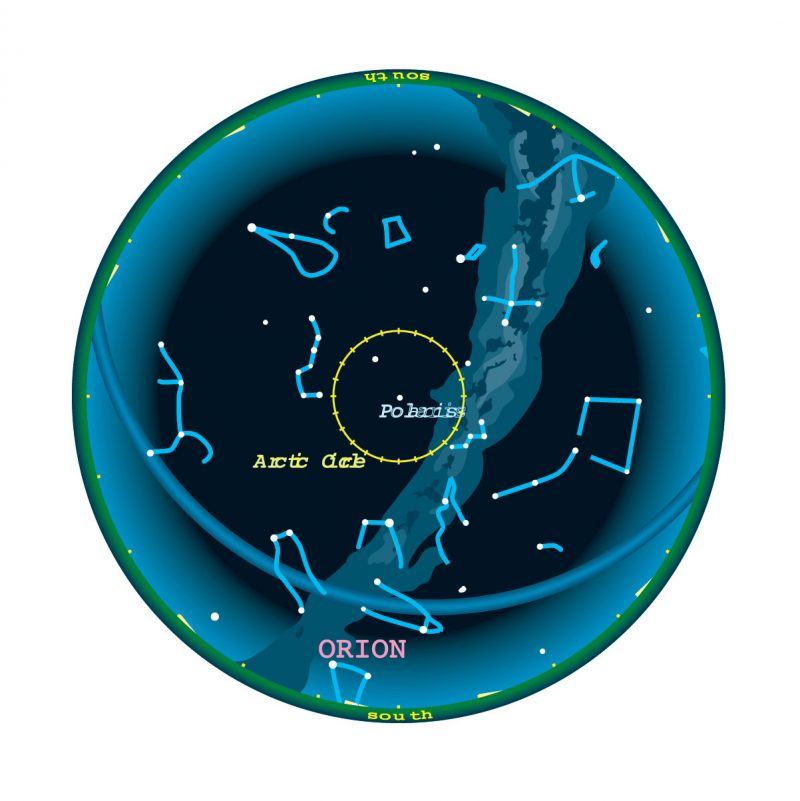
The sky dome view from the North Pole. From there, Polaris – the North Star – is overhead. The gray line – the celestial equator (an imaginary line above Earth’s equator) – lies flat around your horizon. The blue line is the ecliptic or sun’s path. Image via Guy Ottewell. Used with permission.
If you’re standing at the North Pole, you’ll see the entire northern half of the celestial sphere visible every single night, except in the season of the midnight sun. That’s because the celestial pole is at your zenith, or overhead point. In fact, the stars don’t rise or set, but instead move around your sky, parallel to each other and parallel to the horizon.
So in the language of astronomy, from Earth’s North Pole, all visible stars are circumpolar stars. Circumpolar stars never rise or set but instead circle endlessly around the pole star. Any star above the horizon will be visible all night (or all day and night if it’s winter, when the sun never rises).
A star trail photo taken from the North Pole shows all the stars tracing circles around the center point overhead.
Sky view from 30 degrees N latitude
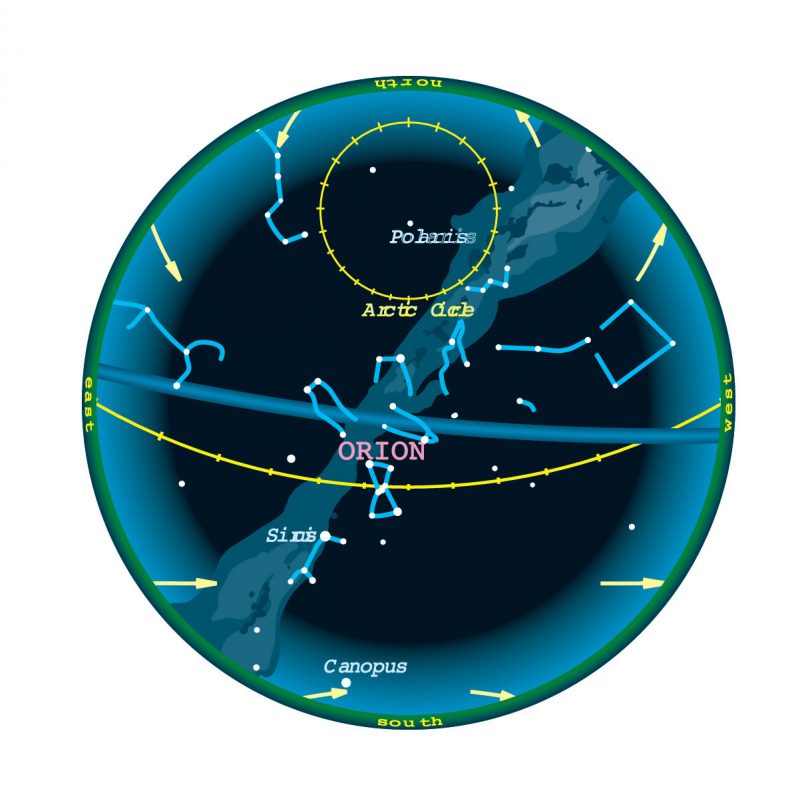
The sky dome view from 30 degrees north latitude. The gray line is the celestial equator (an imaginary line above Earth’s equator). The blue line is the ecliptic or sun’s path. Image via Guy Ottewell. Used with permission.
At Earth’s northerly latitudes, the North Star, Polaris, lies somewhere between your zenith and your northern horizon. That’s because it lies at a height above your northern horizon that’s equal to your latitude. In other words, from 30 degrees north latitude, Polaris lies 30 degrees above due north.
So any star or constellation within 30 degrees of Polaris is circumpolar and visible all night.
Meanwhile, to the south, a part of the southern sky – the part below the celestial equator (indicated by the gray line on the charts on this page) – is now in view.
Sky view from the equator: 0 Latitude
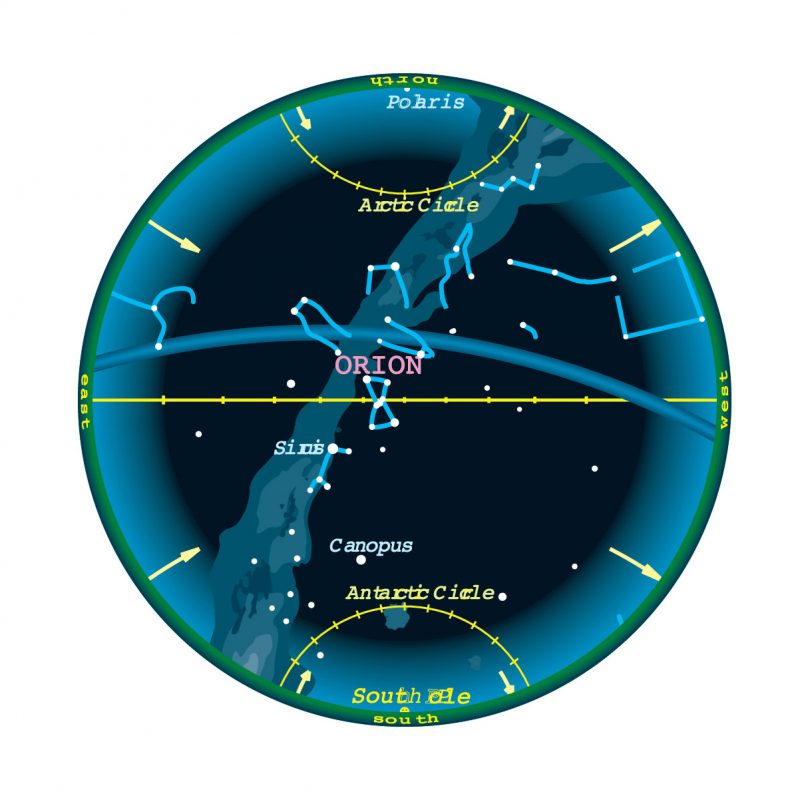
The sky dome view from the equator. The gray line – the celestial equator (an imaginary line above Earth’s equator) – now arcs directly overhead. The blue line is the ecliptic or sun’s path. Image via Guy Ottewell. Used with permission.
If you are on the equator, you can see all stars visible from all parts of Earth over the course of a year. From there, the celestial equator sweeps overhead and goes through your zenith, or overhead point.
Consequently, all the stars make great arcs across your sky, parallel to the celestial equator and to each other. There are no circumpolar stars as seen from the equator. That’s because the north and south celestial poles can’t be seen. They’re on your northern and southern horizon.
A star trail photo taken from Ecuador shows about 90% of all stars. Looking toward the celestial equator, the star trails are almost a straight horizontal line through the center of the image. While the 2 celestial poles are hinted at by the more circular motions of the stars to the left and right.
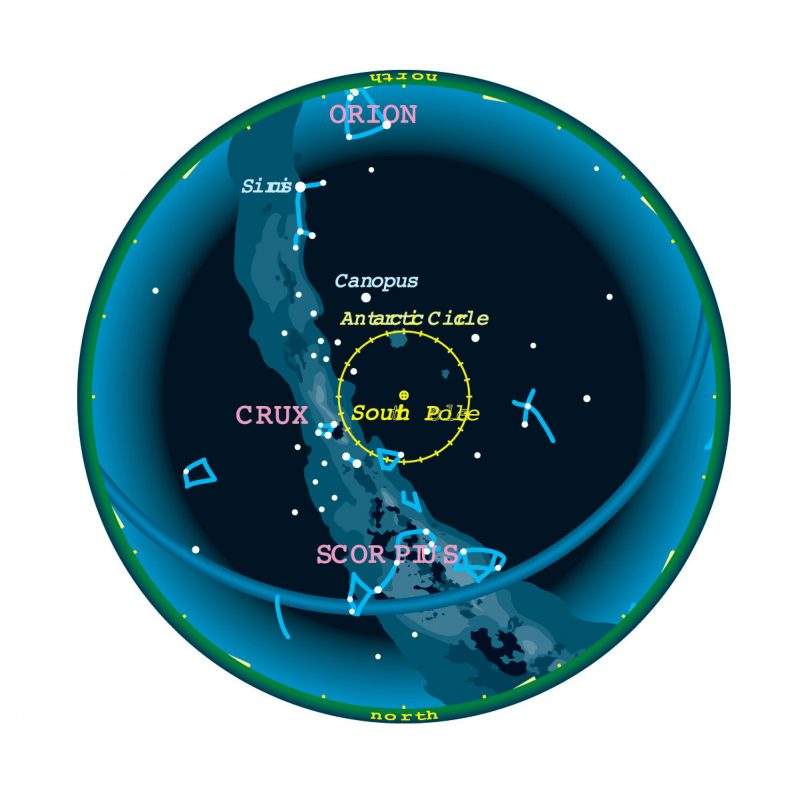
Sky view from 30 degrees S latitude
The sky dome view from 30 degrees south latitude. The gray line is the celestial equator (an imaginary line above Earth’s equator). The blue line is the ecliptic or sun’s path. Image via Guy Ottewell. Used with permission.
There is no bright southern pole star. But, at Earth’s southerly latitudes, the south celestial pole – a point on the sky’s dome directly above Earth’s south pole – lies somewhere between your zenith and your southern horizon. It lies at a height above your southern horizon that’s equal to your latitude. In other words, from 30 degrees south latitude, the south celestial pole lies 30 degrees above due south.
So any star or constellation within 30 degrees of the south celestial pole is circumpolar and visible all night.
Meanwhile, to the north, a part of the north sky – the part above the celestial equator (indicated by the gray line on the charts on this page) – is now in view.
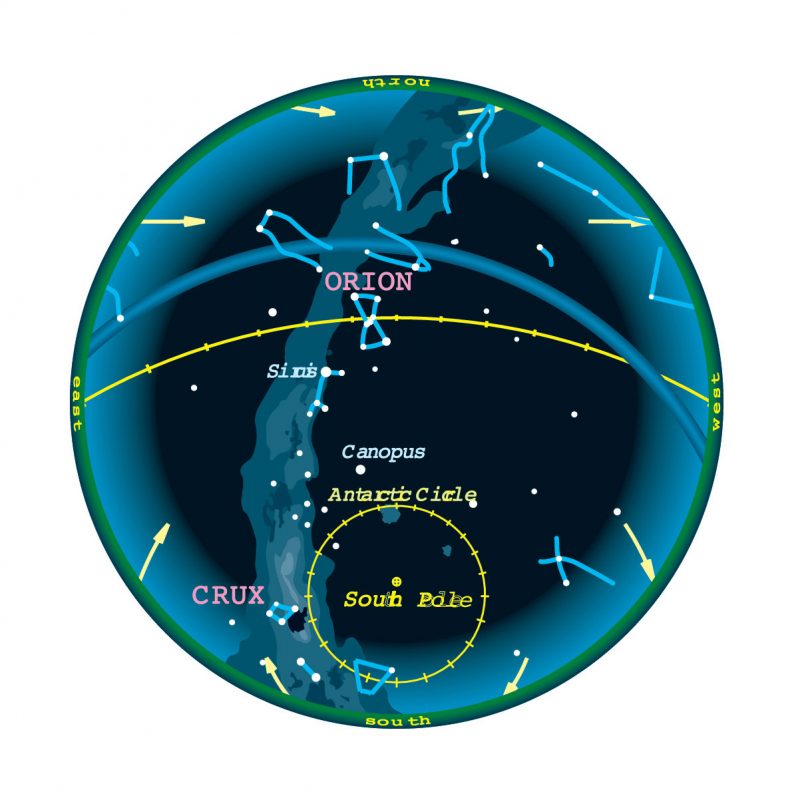
Sky view from the South Pole: 90 degrees S latitude
The sky dome view from the South Pole. The gray line – the celestial equator (an imaginary line above Earth’s equator) – lies flat around your horizon. The blue line is the ecliptic or sun’s path. Image via Guy Ottewell. Used with permission.
If you’re standing at the South Pole, you’ll see the entire southern half of the celestial sphere visible every single night, except in the season of the midnight sun. That’s because the celestial pole is at your zenith, or overhead point. The stars don’t rise or set, but instead move around your sky, parallel to each other and parallel to the horizon.
In the language of astronomy, from Earth’s South Pole, all visible stars are circumpolar stars. Circumpolar stars never rise or set, but instead circle endlessly around the pole. Any star above the horizon will be visible all night (or all day and night if it’s winter, when the sun never rises).
A star trail photo taken from the South Pole will show all the stars tracing circles around the center point overhead.
Bottom line: See charts showing how the sky dome changes by latitude and the stars that are then visible in the sky.
Your latitude determines which stars are visible in the sky dome above. Here’s the sky dome view for February 2026. It shows stars above the horizon at mid-evening (about halfway between your local sunset and local midnight) for mid-northern latitudes. But what about the view from other latitudes? See charts below showing how the sky dome changes by latitude and the stars that are visible in the sky. The gray line is the celestial equator (an imaginary line above Earth’s equator). The blue line is the ecliptic or sun’s path. Image via Guy Ottewell’s 2026 Astronomical Calendar.
On many of EarthSky’s articles about the night sky, you’ll see a note suggesting “for a precise view from your location try Stellarium Online“. That’s because the sky encircles all of Earth. And your location on the globe – or more specifically your latitude – determines which part of this encircling sky you’re able to see. Meanwhile, your longitude doesn’t so much determine what you see as when you’ll see it.
Below are some charts showing the sky dome from different latitudes.
Sky view from the North Pole: 90 degrees N latitude
The sky dome view from the North Pole. From there, Polaris – the North Star – is overhead. The gray line – the celestial equator (an imaginary line above Earth’s equator) – lies flat around your horizon. The blue line is the ecliptic or sun’s path. Image via Guy Ottewell. Used with permission.
If you’re standing at the North Pole, you’ll see the entire northern half of the celestial sphere visible every single night, except in the season of the midnight sun. That’s because the celestial pole is at your zenith, or overhead point. In fact, the stars don’t rise or set, but instead move around your sky, parallel to each other and parallel to the horizon.
So in the language of astronomy, from Earth’s North Pole, all visible stars are circumpolar stars. Circumpolar stars never rise or set but instead circle endlessly around the pole star. Any star above the horizon will be visible all night (or all day and night if it’s winter, when the sun never rises).
A star trail photo taken from the North Pole shows all the stars tracing circles around the center point overhead.
Sky view from 30 degrees N latitude
The sky dome view from 30 degrees north latitude. The gray line is the celestial equator (an imaginary line above Earth’s equator). The blue line is the ecliptic or sun’s path. Image via Guy Ottewell. Used with permission.
At Earth’s northerly latitudes, the North Star, Polaris, lies somewhere between your zenith and your northern horizon. That’s because it lies at a height above your northern horizon that’s equal to your latitude. In other words, from 30 degrees north latitude, Polaris lies 30 degrees above due north.
So any star or constellation within 30 degrees of Polaris is circumpolar and visible all night.
Meanwhile, to the south, a part of the southern sky – the part below the celestial equator (indicated by the gray line on the charts on this page) – is now in view.
Sky view from the equator: 0 Latitude
The sky dome view from the equator. The gray line – the celestial equator (an imaginary line above Earth’s equator) – now arcs directly overhead. The blue line is the ecliptic or sun’s path. Image via Guy Ottewell. Used with permission.
If you are on the equator, you can see all stars visible from all parts of Earth over the course of a year. From there, the celestial equator sweeps overhead and goes through your zenith, or overhead point.
Consequently, all the stars make great arcs across your sky, parallel to the celestial equator and to each other. There are no circumpolar stars as seen from the equator. That’s because the north and south celestial poles can’t be seen. They’re on your northern and southern horizon.
A star trail photo taken from Ecuador shows about 90% of all stars. Looking toward the celestial equator, the star trails are almost a straight horizontal line through the center of the image. While the 2 celestial poles are hinted at by the more circular motions of the stars to the left and right.
Sky view from 30 degrees S latitude
The sky dome view from 30 degrees south latitude. The gray line is the celestial equator (an imaginary line above Earth’s equator). The blue line is the ecliptic or sun’s path. Image via Guy Ottewell. Used with permission.
There is no bright southern pole star. But, at Earth’s southerly latitudes, the south celestial pole – a point on the sky’s dome directly above Earth’s south pole – lies somewhere between your zenith and your southern horizon. It lies at a height above your southern horizon that’s equal to your latitude. In other words, from 30 degrees south latitude, the south celestial pole lies 30 degrees above due south.
So any star or constellation within 30 degrees of the south celestial pole is circumpolar and visible all night.
Meanwhile, to the north, a part of the north sky – the part above the celestial equator (indicated by the gray line on the charts on this page) – is now in view.
Sky view from the South Pole: 90 degrees S latitude
The sky dome view from the South Pole. The gray line – the celestial equator (an imaginary line above Earth’s equator) – lies flat around your horizon. The blue line is the ecliptic or sun’s path. Image via Guy Ottewell. Used with permission.
If you’re standing at the South Pole, you’ll see the entire southern half of the celestial sphere visible every single night, except in the season of the midnight sun. That’s because the celestial pole is at your zenith, or overhead point. The stars don’t rise or set, but instead move around your sky, parallel to each other and parallel to the horizon.
In the language of astronomy, from Earth’s South Pole, all visible stars are circumpolar stars. Circumpolar stars never rise or set, but instead circle endlessly around the pole. Any star above the horizon will be visible all night (or all day and night if it’s winter, when the sun never rises).
A star trail photo taken from the South Pole will show all the stars tracing circles around the center point overhead.
Bottom line: See charts showing how the sky dome changes by latitude and the stars that are then visible in the sky.
EarthSky’s Cristina Ortiz explains fascinating new research into elephant whiskers.
Elephant whiskers show nature’s design for touch
Scientists have made a discovery that might change how we understand animal touch. The research team, led by the Max Planck Institute for Intelligent Systems, said on February 12, 2026, that the secret behind the elephant’s extraordinary tactile abilities lies in the material structure of its trunk whiskers.
They found that these specialized hairs allow elephants to sense precise points of contact. This happens despite an elephant’s thick skin and relatively poor eyesight.
The study, published in the peer-reviewed journal Science on February 12, 2026, shows that each whisker has a stiff base that gradually transitions into a soft, rubber-like tip. This change in stiffness along its length lets elephants feel precise contact with objects. As a result, elephants can manipulate delicate objects with astonishing precision. For example, they can grasp something as fragile as a tortilla chip without breaking it, or pick up a peanut with remarkable control.
How material intelligence enhances elephant whiskers
At first, the researchers expected elephant whiskers to resemble those of rodents, which stay uniformly stiff from base to tip. However, detailed imaging and mechanical testing revealed a different structure.
The team used advanced microscopy and nanoindentation (a test where a small probe presses on the whisker to measure stiffness). This allowed the team to examine the whiskers down to the nanometer scale (a billionth of a meter). They discovered the base behaves like rigid plastic, while the tip acts like resilient rubber that bends without breaking or losing its shape.
This gradual shift in stiffness creates what engineers call embodied intelligence. Instead of relying solely on brain signals, the whisker’s material properties themselves encode information about where contact occurs. In other words, the whisker’s structure helps the animal determine how close its trunk is to an object and how it should respond. Co-lead author Andrew K. Schulz expressed his excitement about the finding. He said:
It’s pretty amazing! The stiffness gradient provides a map to allow elephants to detect where contact occurs along each whisker.
Note the elephant whiskers on the top edge of the trunk. The whiskers are smart sensors that allow elephants to feel their surroundings and grab objects with precision. Image via MPI-IS / A. Posada and Heidelberg Zoo (used with permission).
The architecture of the whiskers
In addition, micro-CT scans (a type of 3D X-ray imaging) showed that elephant whiskers have a flattened, blade-like shape with a hollow base and internal channels. This porous architecture reduces weight and makes the whiskers more durable. Because these hairs never grow back and elephants eat large amounts of food every day, durability is essential. The structure prevents breakage while still allowing sensitive touch.
Microscopic view of an elephant whisker in cross-section. Image via MPI-IS/ D. Philip & H. David (used with permission).
A 3D-printed breakthrough moment
Although the team had discovered the stiffness gradient, they initially struggled to understand how it affected the sense of touch. To explore this in a tangible way, Schulz and his colleagues created a scaled-up 3D-printed whisker. The model had a dark, stiff base and a transparent, soft tip, mimicking the natural whisker.
The turning point came unexpectedly. Co-lead author Katherine J. Kuchenbecker, from the Haptic Intelligence Department at MPI-IS, carried the model through the institute’s hallways. She tapped it against railings and columns, immediately noticing that each section felt different. She explained:
I noticed that tapping the railing with different parts of the whisker wand felt distinct – soft and gentle at the tip, and sharp and strong at the base. I didn’t need to look to know where the contact was happening; I could just feel it.
This simple experiment clarified the concept. The stiffness gradient produces different signals depending on where contact occurs. Computational simulations confirmed this effect. They show the transition from stiff to soft helps elephants detect exactly where something touches the whisker, allowing careful and precise manipulation of objects.
Cats share the elephant whisker secret
Interestingly, elephants are not the only animals with this design. Cats also have whiskers with the same type of stiffness gradient. This similarity suggests that evolution favors this structure in animals that rely heavily on touch for exploring their environment.
Notably, not all elephant hairs follow this pattern. When the researchers compared the Asian elephant’s trunk whiskers to its body hair, they found that body hairs remain stiff from base to tip. This contrast highlights how specially adapted the trunk whiskers are for fine touch rather than general protection. Schulz reflected on the finding:
The hairs on the head, body and tail of Asian elephants are stiff from base to tip, which is what we were expecting when we found the surprising stiffness gradient of elephant trunk whiskers.
Elephants have stiff body hairs, but trunk whiskers bend and flex, turning touch into a finely tuned sense. Image via MPI-IS (used with permission).
From whiskers to robotics
This discovery could inspire a new generation of robots and sensors. By embedding “smart” features directly into materials, engineers could build devices that sense their environment more accurately, without needing complex computer systems. Schulz highlighted this potential:
Bio-inspired sensors that have an artificial elephant-like stiffness gradient could give precise information with little computational cost purely by intelligent material design.
Dr. Lena V. Kaufmann, a co-author of the study and a neuroscience expert at the Humboldt University of Berlin, explained the bigger picture:
Our findings contribute to our understanding of the tactile perception of these fascinating animals and open up exciting opportunities to further study the relation of whisker material properties and neuronal computation.
The collaboration also included materials scientists from the University of Stuttgart, showing how teamwork across disciplines drives innovation. Reflecting on the project, Kuchenbecker praised the collective effort:
Andrew pulled together an amazing team of engineers, materials scientists, and neuroscientists from five different research groups and led us on an exhilarating three-year-long journey to discover the secrets behind the powerful elephant’s gentle sense of touch.
This study was the collaboration of engineers, neuroscientists and materials scientists. They uncovered the sensing of elephant whisker, paving the way for a new generation of robots and materials that can sense and respond like living systems. Image via MPI-IS (used with permission).
Bottom line: Elephant whiskers reveal how giants with thick skin and poor eyesight can sense touch with astonishing delicacy, precision and subtle awareness.
EarthSky’s Cristina Ortiz explains fascinating new research into elephant whiskers.
Elephant whiskers show nature’s design for touch
Scientists have made a discovery that might change how we understand animal touch. The research team, led by the Max Planck Institute for Intelligent Systems, said on February 12, 2026, that the secret behind the elephant’s extraordinary tactile abilities lies in the material structure of its trunk whiskers.
They found that these specialized hairs allow elephants to sense precise points of contact. This happens despite an elephant’s thick skin and relatively poor eyesight.
The study, published in the peer-reviewed journal Science on February 12, 2026, shows that each whisker has a stiff base that gradually transitions into a soft, rubber-like tip. This change in stiffness along its length lets elephants feel precise contact with objects. As a result, elephants can manipulate delicate objects with astonishing precision. For example, they can grasp something as fragile as a tortilla chip without breaking it, or pick up a peanut with remarkable control.
How material intelligence enhances elephant whiskers
At first, the researchers expected elephant whiskers to resemble those of rodents, which stay uniformly stiff from base to tip. However, detailed imaging and mechanical testing revealed a different structure.
The team used advanced microscopy and nanoindentation (a test where a small probe presses on the whisker to measure stiffness). This allowed the team to examine the whiskers down to the nanometer scale (a billionth of a meter). They discovered the base behaves like rigid plastic, while the tip acts like resilient rubber that bends without breaking or losing its shape.
This gradual shift in stiffness creates what engineers call embodied intelligence. Instead of relying solely on brain signals, the whisker’s material properties themselves encode information about where contact occurs. In other words, the whisker’s structure helps the animal determine how close its trunk is to an object and how it should respond. Co-lead author Andrew K. Schulz expressed his excitement about the finding. He said:
It’s pretty amazing! The stiffness gradient provides a map to allow elephants to detect where contact occurs along each whisker.
Note the elephant whiskers on the top edge of the trunk. The whiskers are smart sensors that allow elephants to feel their surroundings and grab objects with precision. Image via MPI-IS / A. Posada and Heidelberg Zoo (used with permission).
The architecture of the whiskers
In addition, micro-CT scans (a type of 3D X-ray imaging) showed that elephant whiskers have a flattened, blade-like shape with a hollow base and internal channels. This porous architecture reduces weight and makes the whiskers more durable. Because these hairs never grow back and elephants eat large amounts of food every day, durability is essential. The structure prevents breakage while still allowing sensitive touch.
Microscopic view of an elephant whisker in cross-section. Image via MPI-IS/ D. Philip & H. David (used with permission).
A 3D-printed breakthrough moment
Although the team had discovered the stiffness gradient, they initially struggled to understand how it affected the sense of touch. To explore this in a tangible way, Schulz and his colleagues created a scaled-up 3D-printed whisker. The model had a dark, stiff base and a transparent, soft tip, mimicking the natural whisker.
The turning point came unexpectedly. Co-lead author Katherine J. Kuchenbecker, from the Haptic Intelligence Department at MPI-IS, carried the model through the institute’s hallways. She tapped it against railings and columns, immediately noticing that each section felt different. She explained:
I noticed that tapping the railing with different parts of the whisker wand felt distinct – soft and gentle at the tip, and sharp and strong at the base. I didn’t need to look to know where the contact was happening; I could just feel it.
This simple experiment clarified the concept. The stiffness gradient produces different signals depending on where contact occurs. Computational simulations confirmed this effect. They show the transition from stiff to soft helps elephants detect exactly where something touches the whisker, allowing careful and precise manipulation of objects.
Cats share the elephant whisker secret
Interestingly, elephants are not the only animals with this design. Cats also have whiskers with the same type of stiffness gradient. This similarity suggests that evolution favors this structure in animals that rely heavily on touch for exploring their environment.
Notably, not all elephant hairs follow this pattern. When the researchers compared the Asian elephant’s trunk whiskers to its body hair, they found that body hairs remain stiff from base to tip. This contrast highlights how specially adapted the trunk whiskers are for fine touch rather than general protection. Schulz reflected on the finding:
The hairs on the head, body and tail of Asian elephants are stiff from base to tip, which is what we were expecting when we found the surprising stiffness gradient of elephant trunk whiskers.
Elephants have stiff body hairs, but trunk whiskers bend and flex, turning touch into a finely tuned sense. Image via MPI-IS (used with permission).
From whiskers to robotics
This discovery could inspire a new generation of robots and sensors. By embedding “smart” features directly into materials, engineers could build devices that sense their environment more accurately, without needing complex computer systems. Schulz highlighted this potential:
Bio-inspired sensors that have an artificial elephant-like stiffness gradient could give precise information with little computational cost purely by intelligent material design.
Dr. Lena V. Kaufmann, a co-author of the study and a neuroscience expert at the Humboldt University of Berlin, explained the bigger picture:
Our findings contribute to our understanding of the tactile perception of these fascinating animals and open up exciting opportunities to further study the relation of whisker material properties and neuronal computation.
The collaboration also included materials scientists from the University of Stuttgart, showing how teamwork across disciplines drives innovation. Reflecting on the project, Kuchenbecker praised the collective effort:
Andrew pulled together an amazing team of engineers, materials scientists, and neuroscientists from five different research groups and led us on an exhilarating three-year-long journey to discover the secrets behind the powerful elephant’s gentle sense of touch.
This study was the collaboration of engineers, neuroscientists and materials scientists. They uncovered the sensing of elephant whisker, paving the way for a new generation of robots and materials that can sense and respond like living systems. Image via MPI-IS (used with permission).
Bottom line: Elephant whiskers reveal how giants with thick skin and poor eyesight can sense touch with astonishing delicacy, precision and subtle awareness.
View at EarthSky Community Photos. | Rui Santos in Amor, Leiria, Portugal, shared this composite image of star trails on February 16, 2025, and wrote: “We can’t feel it, but everything is in motion. Everything moves, even when it seems still. And nature is never the same twice; it is constantly changing, in a vivid and silent way.” Thank you, Rui! Read more about circumpolar stars below.
The closer you are to either of Earth’s poles, the more circumpolar stars you see. Circumpolar stars neither rise nor set but stay above the horizon at all hours of the day, every day of the year. Even when you can’t see them – when the sun is out and it’s daytime – these stars are up there. They are circling endlessly around the sky’s north or south celestial pole.
The Big Dipper and the W-shaped constellation Cassiopeia circle around Polaris, the North Star, in a period of 23 hours and 56 minutes. The Dipper is circumpolar at 41 degrees north latitude, and all latitudes farther north. Image via Mjchael/ Wikipedia (CC BY-SA 2.5).
No circumpolar stars at Earth’s equator
How many circumpolar stars appear in your sky depends on where you are. For example, at Earth’s North and South Poles, every visible star is circumpolar. That is, at Earth’s North Pole, every star north of the celestial equator is circumpolar, while every star south of the celestial equator stays below the horizon. On the other hand, at the Earth’s South Pole, it’s the exact opposite. That’s where every star south of the celestial equator is circumpolar, whereas every star north of the celestial equator remains beneath the horizon.
Meanwhile at the Earth’s equator, no star is circumpolar because all the stars rise and set daily in that part of the world. You can (theoretically) see every star in the night sky over the course of one year. Of course, things like clouds and horizon haze get in the way.
Circumpolar stars and where you live
Places between the equator and poles have some stars that are circumpolar, some stars that rise and set daily (like the sun), and some stars that remain below the horizon all year round. In short, the closer you are to the North or South Pole, the greater the circle of circumpolar stars; the closer you are to the Earth’s equator, the smaller the circle of circumpolar stars.
Here is how to determine what is circumpolar from your location. Subtract your latitude from 90 and you get the declination of the objects that barely skim above your northern (or southern) horizon. For instance, from a latitude of 40 degrees north, everything north of a declination of +50° is circumpolar. From the Southern Hemisphere, at a latitude of 20° south, then everything south of -70° declination is circumpolar, above your southern horizon.
We in the Northern Hemisphere are lucky to have a moderately bright star, Polaris, nearly coinciding with the north celestial pole: the point in the sky that’s at zenith (straight overhead) at the Earth’s North Pole.
Polaris at the center of the circle
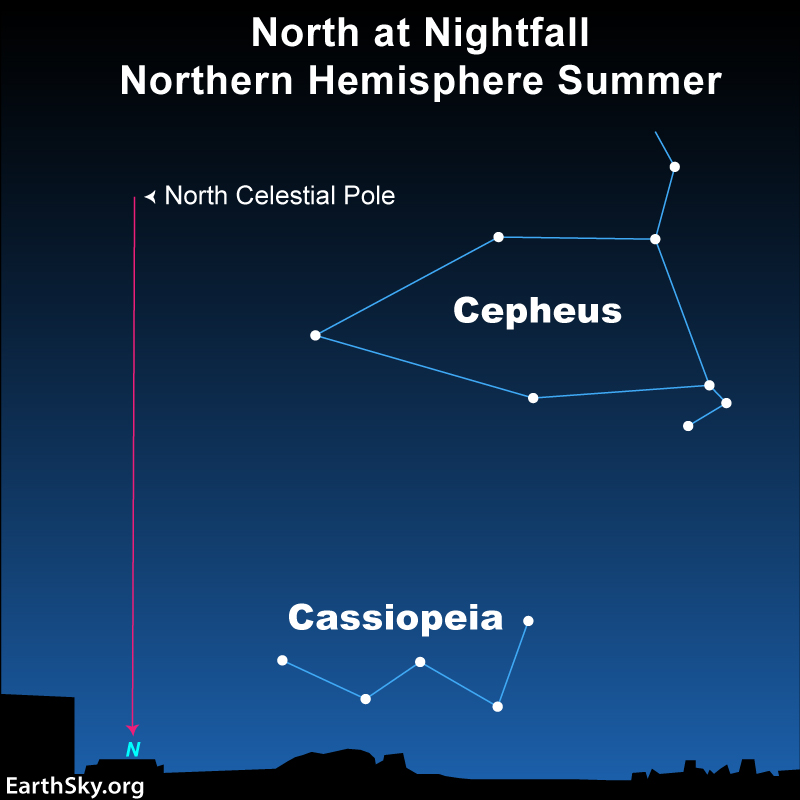
Draw an imaginary line straight down from Polaris, the North Star, to the horizon, and presto, you have what it takes to draw out the circle of circumpolar stars in your sky.
For people in the Northern Hemisphere, Polaris nearly pinpoints the center of the great big circle of circumpolar stars on the sky’s dome. And the imaginary vertical line from Polaris to the horizon depicts the radius measure. (See the chart below, which has this line drawn in for you.)
So let your arm serve as a circle compass, enabling you to envision the circle of circumpolar stars with your mind’s eye. Closer to the equator, the circle of circumpolar stars grows smaller; nearer to the North Pole (or South Pole) the circle of circumpolar stars grows larger.
In the Northern Hemisphere, an imaginary vertical line from the north celestial pole to your horizon serves as a radius measure for the circle of circumpolar stars in your sky. The closer you are to the Earth’s North Pole, the closer the north celestial pole is to your zenith (overhead point). Chart via EarthSky.
Circumpolar stars in Southern Hemisphere
This technique for locating the circle of circumpolar stars works in the Southern Hemisphere, as well. However, it’s trickier to star-hop to the south celestial pole: the point on the sky’s dome that’s at zenith over the Earth’s South Pole. Thus, practiced stargazers in the Southern Hemisphere rely on the Southern Cross, and key stars, to star-hop to the south celestial pole.
By the way, Cassiopeia lies on the opposite side of Polaris from the Big Dipper. So, from mid-northern latitudes, the Big Dipper and Polaris help you to locate Cassiopeia.
If Cassiopeia is circumpolar in your sky, then the Southern Cross never climbs above your horizon. Conversely, if the Southern Cross is circumpolar in your sky, then the constellation Cassiopeia never climbs above the horizon.
As seen from the tropics (and a part of the subtropics), neither the Southern Cross nor Cassiopeia is circumpolar. From this part of the world, the Southern Cross rises over the southern horizon when Cassiopeia sinks below the northern horizon. Conversely, Cassiopeia rises over the northern horizon when the Southern Cross sinks below the southern horizon.
Circumpolar star trail gallery
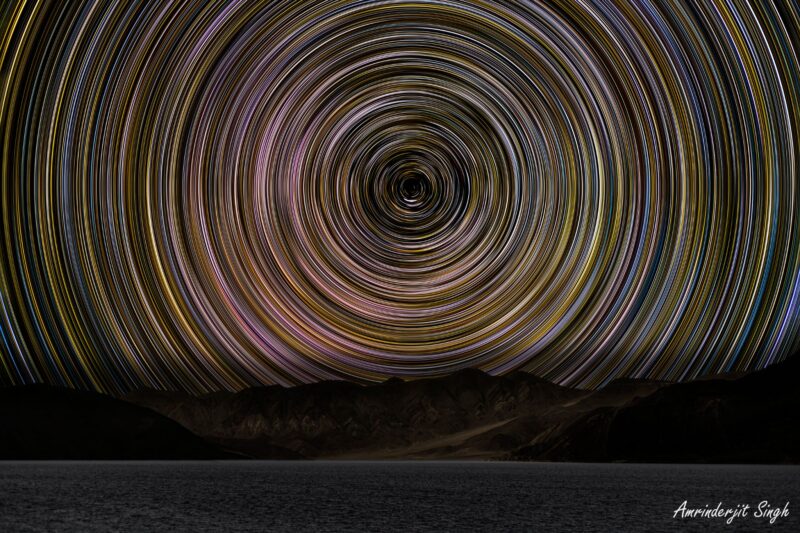
View at EarthSky Community Photos. | Eddie Little of North Carolina captured the stars circling around Polaris, the North Star, on January 2, 2025, and wrote: “I had a mostly cloudless, nearly moonless night on one of the longest nights of the year. Approximately 12 hours of shooting. 1667 individual 30 second exposures were merged with star trails.” Thank you, Eddie! Polaris, our North Star, is in the center of the star trails.View at EarthSky Community Photos. | Amrinderjit Singh captured these star trails from Pangong Lake, nestled 14,300 feet (4,350 meters) above sea level in the Himalayas. Amrinderjit wrote: “Behold the mesmerizing dance of stars. As the night falls, it transforms into a celestial canvas, painted with streaks of yellow, blue, and pink, courtesy of the star trails swirling above. Each streak represents the movement of Earth beneath the starlit sky, a silent yet profound reminder of our place in the cosmos. Capturing this moment was a blend of patience and wonder as I marveled at nature’s masterpiece unfolding before my eyes.” Thanks, Amrinderjit!
Steve Torrence made this video of circumpolar stars from near the equator on June 21, 2016. Video via Wikimedia Commons (CC BY 4.0).
Bottom line: Circumpolar stars stay above the horizon all hours of the day, every day of the year. Although you can’t see them, they’re up even in the daytime.
View at EarthSky Community Photos. | Rui Santos in Amor, Leiria, Portugal, shared this composite image of star trails on February 16, 2025, and wrote: “We can’t feel it, but everything is in motion. Everything moves, even when it seems still. And nature is never the same twice; it is constantly changing, in a vivid and silent way.” Thank you, Rui! Read more about circumpolar stars below.
The closer you are to either of Earth’s poles, the more circumpolar stars you see. Circumpolar stars neither rise nor set but stay above the horizon at all hours of the day, every day of the year. Even when you can’t see them – when the sun is out and it’s daytime – these stars are up there. They are circling endlessly around the sky’s north or south celestial pole.
The Big Dipper and the W-shaped constellation Cassiopeia circle around Polaris, the North Star, in a period of 23 hours and 56 minutes. The Dipper is circumpolar at 41 degrees north latitude, and all latitudes farther north. Image via Mjchael/ Wikipedia (CC BY-SA 2.5).
No circumpolar stars at Earth’s equator
How many circumpolar stars appear in your sky depends on where you are. For example, at Earth’s North and South Poles, every visible star is circumpolar. That is, at Earth’s North Pole, every star north of the celestial equator is circumpolar, while every star south of the celestial equator stays below the horizon. On the other hand, at the Earth’s South Pole, it’s the exact opposite. That’s where every star south of the celestial equator is circumpolar, whereas every star north of the celestial equator remains beneath the horizon.
Meanwhile at the Earth’s equator, no star is circumpolar because all the stars rise and set daily in that part of the world. You can (theoretically) see every star in the night sky over the course of one year. Of course, things like clouds and horizon haze get in the way.
Circumpolar stars and where you live
Places between the equator and poles have some stars that are circumpolar, some stars that rise and set daily (like the sun), and some stars that remain below the horizon all year round. In short, the closer you are to the North or South Pole, the greater the circle of circumpolar stars; the closer you are to the Earth’s equator, the smaller the circle of circumpolar stars.
Here is how to determine what is circumpolar from your location. Subtract your latitude from 90 and you get the declination of the objects that barely skim above your northern (or southern) horizon. For instance, from a latitude of 40 degrees north, everything north of a declination of +50° is circumpolar. From the Southern Hemisphere, at a latitude of 20° south, then everything south of -70° declination is circumpolar, above your southern horizon.
We in the Northern Hemisphere are lucky to have a moderately bright star, Polaris, nearly coinciding with the north celestial pole: the point in the sky that’s at zenith (straight overhead) at the Earth’s North Pole.
Polaris at the center of the circle
Draw an imaginary line straight down from Polaris, the North Star, to the horizon, and presto, you have what it takes to draw out the circle of circumpolar stars in your sky.
For people in the Northern Hemisphere, Polaris nearly pinpoints the center of the great big circle of circumpolar stars on the sky’s dome. And the imaginary vertical line from Polaris to the horizon depicts the radius measure. (See the chart below, which has this line drawn in for you.)
So let your arm serve as a circle compass, enabling you to envision the circle of circumpolar stars with your mind’s eye. Closer to the equator, the circle of circumpolar stars grows smaller; nearer to the North Pole (or South Pole) the circle of circumpolar stars grows larger.
In the Northern Hemisphere, an imaginary vertical line from the north celestial pole to your horizon serves as a radius measure for the circle of circumpolar stars in your sky. The closer you are to the Earth’s North Pole, the closer the north celestial pole is to your zenith (overhead point). Chart via EarthSky.
Circumpolar stars in Southern Hemisphere
This technique for locating the circle of circumpolar stars works in the Southern Hemisphere, as well. However, it’s trickier to star-hop to the south celestial pole: the point on the sky’s dome that’s at zenith over the Earth’s South Pole. Thus, practiced stargazers in the Southern Hemisphere rely on the Southern Cross, and key stars, to star-hop to the south celestial pole.
By the way, Cassiopeia lies on the opposite side of Polaris from the Big Dipper. So, from mid-northern latitudes, the Big Dipper and Polaris help you to locate Cassiopeia.
If Cassiopeia is circumpolar in your sky, then the Southern Cross never climbs above your horizon. Conversely, if the Southern Cross is circumpolar in your sky, then the constellation Cassiopeia never climbs above the horizon.
As seen from the tropics (and a part of the subtropics), neither the Southern Cross nor Cassiopeia is circumpolar. From this part of the world, the Southern Cross rises over the southern horizon when Cassiopeia sinks below the northern horizon. Conversely, Cassiopeia rises over the northern horizon when the Southern Cross sinks below the southern horizon.
Circumpolar star trail gallery
View at EarthSky Community Photos. | Eddie Little of North Carolina captured the stars circling around Polaris, the North Star, on January 2, 2025, and wrote: “I had a mostly cloudless, nearly moonless night on one of the longest nights of the year. Approximately 12 hours of shooting. 1667 individual 30 second exposures were merged with star trails.” Thank you, Eddie! Polaris, our North Star, is in the center of the star trails.View at EarthSky Community Photos. | Amrinderjit Singh captured these star trails from Pangong Lake, nestled 14,300 feet (4,350 meters) above sea level in the Himalayas. Amrinderjit wrote: “Behold the mesmerizing dance of stars. As the night falls, it transforms into a celestial canvas, painted with streaks of yellow, blue, and pink, courtesy of the star trails swirling above. Each streak represents the movement of Earth beneath the starlit sky, a silent yet profound reminder of our place in the cosmos. Capturing this moment was a blend of patience and wonder as I marveled at nature’s masterpiece unfolding before my eyes.” Thanks, Amrinderjit!
Steve Torrence made this video of circumpolar stars from near the equator on June 21, 2016. Video via Wikimedia Commons (CC BY 4.0).
Bottom line: Circumpolar stars stay above the horizon all hours of the day, every day of the year. Although you can’t see them, they’re up even in the daytime.