

EarthSky’s 2026 lunar calendar is available now. Get yours today! Makes a great gift.
Latitude and the stars
On many of EarthSky’s articles about the night sky, you’ll see a note suggesting “for a precise view from your location try Stellarium Online“. That’s because the sky encircles all of Earth. And your location on the globe – or more specifically your latitude – determines which part of this encircling sky you’re able to see. Meanwhile, your longitude doesn’t so much determine what you see as when you’ll see it.
Below are some charts showing the sky dome from different latitudes.
Sky view from the North Pole: 90 degrees N latitude
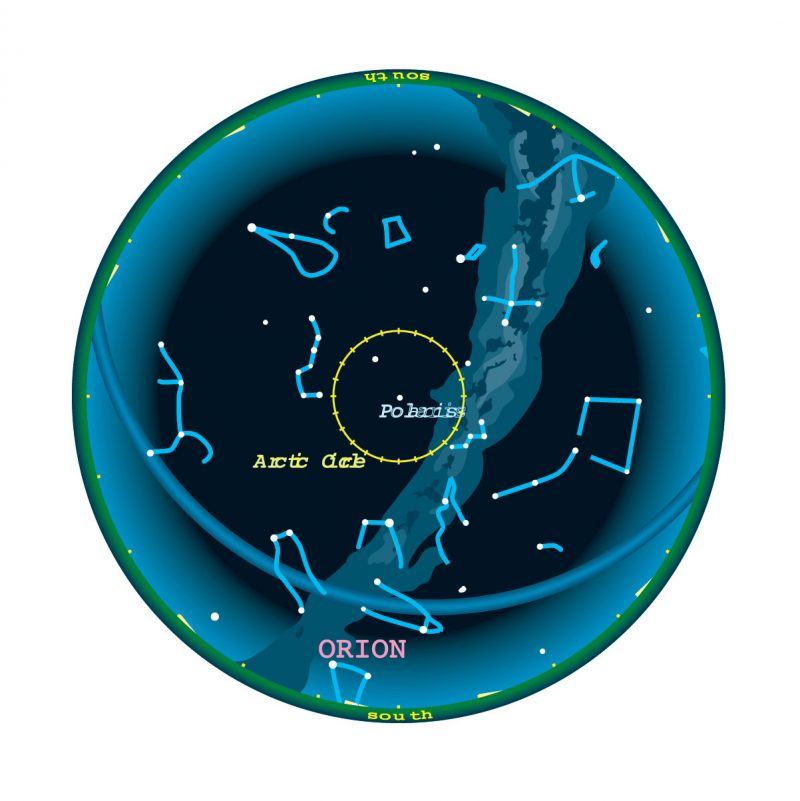
If you’re standing at the North Pole, you’ll see the entire northern half of the celestial sphere visible every single night, except in the season of the midnight sun. That’s because the celestial pole is at your zenith, or overhead point. In fact, the stars don’t rise or set, but instead move around your sky, parallel to each other and parallel to the horizon.
So in the language of astronomy, from Earth’s North Pole, all visible stars are circumpolar stars. Circumpolar stars never rise or set but instead circle endlessly around the pole star. Any star above the horizon will be visible all night (or all day and night if it’s winter, when the sun never rises).
A star trail photo taken from the North Pole shows all the stars tracing circles around the center point overhead.
Sky view from 30 degrees N latitude
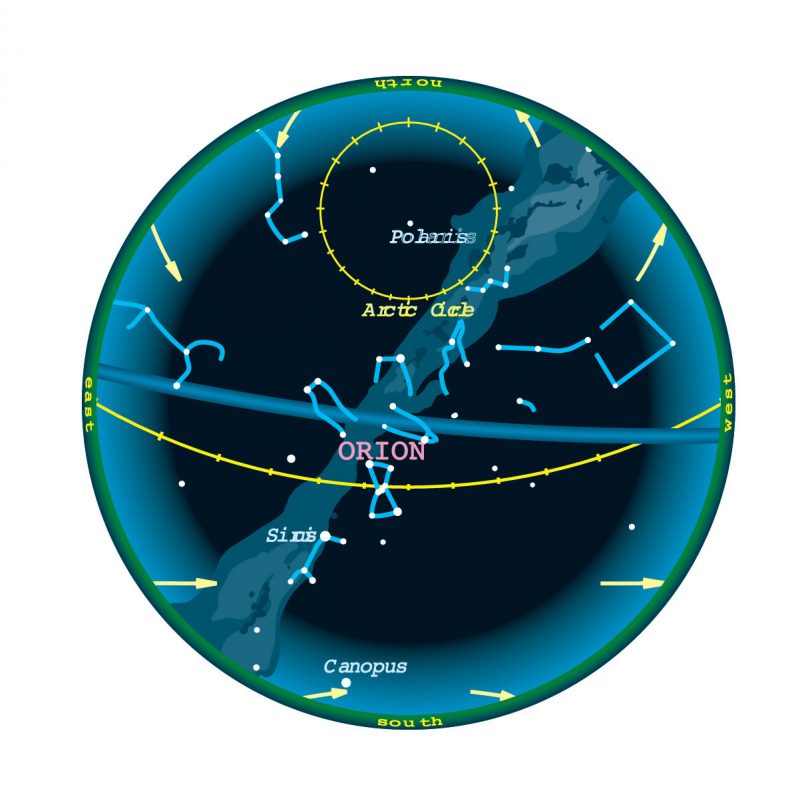
At Earth’s northerly latitudes, the North Star, Polaris, lies somewhere between your zenith and your northern horizon. That’s because it lies at a height above your northern horizon that’s equal to your latitude. In other words, from 30 degrees north latitude, Polaris lies 30 degrees above due north.
So any star or constellation within 30 degrees of Polaris is circumpolar and visible all night.
Meanwhile, to the south, a part of the southern sky – the part below the celestial equator (indicated by the gray line on the charts on this page) – is now in view.
Sky view from the equator: 0 Latitude
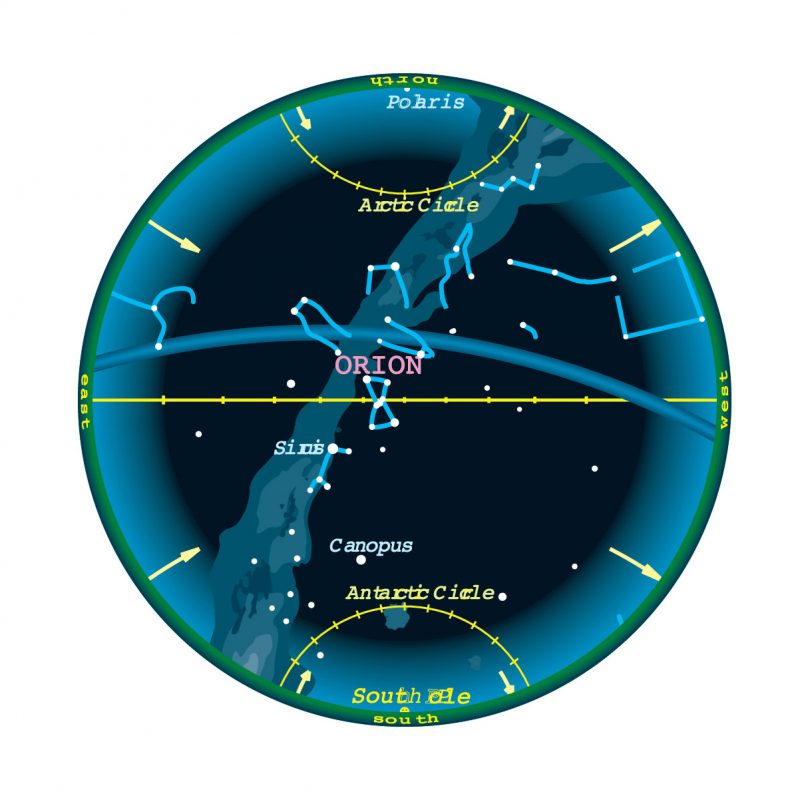
If you are on the equator, you can see all stars visible from all parts of Earth over the course of a year. From there, the celestial equator sweeps overhead and goes through your zenith, or overhead point.
Consequently, all the stars make great arcs across your sky, parallel to the celestial equator and to each other. There are no circumpolar stars as seen from the equator. That’s because the north and south celestial poles can’t be seen. They’re on your northern and southern horizon.
A star trail photo taken from Ecuador shows about 90% of all stars. Looking toward the celestial equator, the star trails are almost a straight horizontal line through the center of the image. While the 2 celestial poles are hinted at by the more circular motions of the stars to the left and right.
Sky view from 30 degrees S latitude
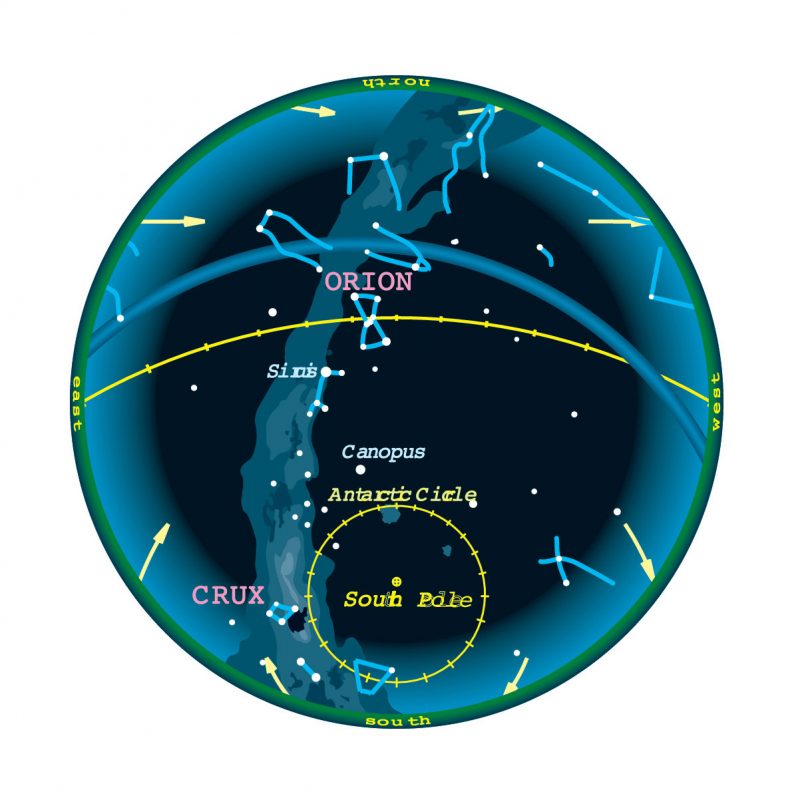
There is no bright southern pole star. But, at Earth’s southerly latitudes, the south celestial pole – a point on the sky’s dome directly above Earth’s south pole – lies somewhere between your zenith and your southern horizon. It lies at a height above your southern horizon that’s equal to your latitude. In other words, from 30 degrees south latitude, the south celestial pole lies 30 degrees above due south.
So any star or constellation within 30 degrees of the south celestial pole is circumpolar and visible all night.
Meanwhile, to the north, a part of the north sky – the part above the celestial equator (indicated by the gray line on the charts on this page) – is now in view.
Sky view from the South Pole: 90 degrees S latitude
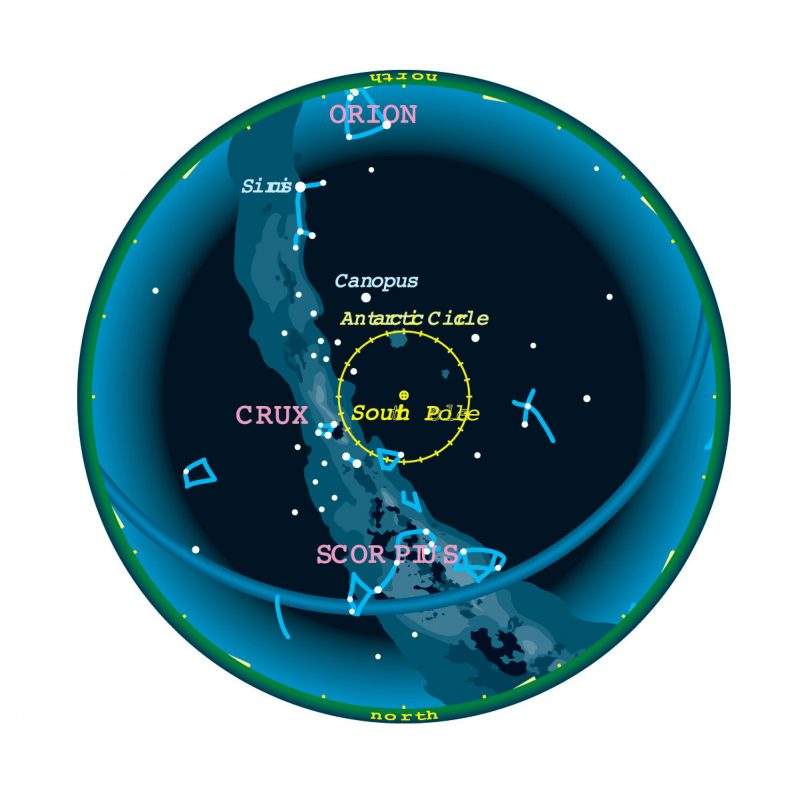
If you’re standing at the South Pole, you’ll see the entire southern half of the celestial sphere visible every single night, except in the season of the midnight sun. That’s because the celestial pole is at your zenith, or overhead point. The stars don’t rise or set, but instead move around your sky, parallel to each other and parallel to the horizon.
In the language of astronomy, from Earth’s South Pole, all visible stars are circumpolar stars. Circumpolar stars never rise or set, but instead circle endlessly around the pole. Any star above the horizon will be visible all night (or all day and night if it’s winter, when the sun never rises).
A star trail photo taken from the South Pole will show all the stars tracing circles around the center point overhead.
Bottom line: See charts showing how the sky dome changes by latitude and the stars that are then visible in the sky.
The post Latitude and the stars: Your location is key first appeared on EarthSky.
from EarthSky https://ift.tt/deZrU1v
EarthSky’s 2026 lunar calendar is available now. Get yours today! Makes a great gift.
Latitude and the stars
On many of EarthSky’s articles about the night sky, you’ll see a note suggesting “for a precise view from your location try Stellarium Online“. That’s because the sky encircles all of Earth. And your location on the globe – or more specifically your latitude – determines which part of this encircling sky you’re able to see. Meanwhile, your longitude doesn’t so much determine what you see as when you’ll see it.
Below are some charts showing the sky dome from different latitudes.
Sky view from the North Pole: 90 degrees N latitude
If you’re standing at the North Pole, you’ll see the entire northern half of the celestial sphere visible every single night, except in the season of the midnight sun. That’s because the celestial pole is at your zenith, or overhead point. In fact, the stars don’t rise or set, but instead move around your sky, parallel to each other and parallel to the horizon.
So in the language of astronomy, from Earth’s North Pole, all visible stars are circumpolar stars. Circumpolar stars never rise or set but instead circle endlessly around the pole star. Any star above the horizon will be visible all night (or all day and night if it’s winter, when the sun never rises).
A star trail photo taken from the North Pole shows all the stars tracing circles around the center point overhead.
Sky view from 30 degrees N latitude
At Earth’s northerly latitudes, the North Star, Polaris, lies somewhere between your zenith and your northern horizon. That’s because it lies at a height above your northern horizon that’s equal to your latitude. In other words, from 30 degrees north latitude, Polaris lies 30 degrees above due north.
So any star or constellation within 30 degrees of Polaris is circumpolar and visible all night.
Meanwhile, to the south, a part of the southern sky – the part below the celestial equator (indicated by the gray line on the charts on this page) – is now in view.
Sky view from the equator: 0 Latitude
If you are on the equator, you can see all stars visible from all parts of Earth over the course of a year. From there, the celestial equator sweeps overhead and goes through your zenith, or overhead point.
Consequently, all the stars make great arcs across your sky, parallel to the celestial equator and to each other. There are no circumpolar stars as seen from the equator. That’s because the north and south celestial poles can’t be seen. They’re on your northern and southern horizon.
A star trail photo taken from Ecuador shows about 90% of all stars. Looking toward the celestial equator, the star trails are almost a straight horizontal line through the center of the image. While the 2 celestial poles are hinted at by the more circular motions of the stars to the left and right.
Sky view from 30 degrees S latitude
There is no bright southern pole star. But, at Earth’s southerly latitudes, the south celestial pole – a point on the sky’s dome directly above Earth’s south pole – lies somewhere between your zenith and your southern horizon. It lies at a height above your southern horizon that’s equal to your latitude. In other words, from 30 degrees south latitude, the south celestial pole lies 30 degrees above due south.
So any star or constellation within 30 degrees of the south celestial pole is circumpolar and visible all night.
Meanwhile, to the north, a part of the north sky – the part above the celestial equator (indicated by the gray line on the charts on this page) – is now in view.
Sky view from the South Pole: 90 degrees S latitude
If you’re standing at the South Pole, you’ll see the entire southern half of the celestial sphere visible every single night, except in the season of the midnight sun. That’s because the celestial pole is at your zenith, or overhead point. The stars don’t rise or set, but instead move around your sky, parallel to each other and parallel to the horizon.
In the language of astronomy, from Earth’s South Pole, all visible stars are circumpolar stars. Circumpolar stars never rise or set, but instead circle endlessly around the pole. Any star above the horizon will be visible all night (or all day and night if it’s winter, when the sun never rises).
A star trail photo taken from the South Pole will show all the stars tracing circles around the center point overhead.
Bottom line: See charts showing how the sky dome changes by latitude and the stars that are then visible in the sky.
The post Latitude and the stars: Your location is key first appeared on EarthSky.
from EarthSky https://ift.tt/deZrU1v

Aucun commentaire:
Enregistrer un commentaire