aads

New discovery of ammonia on Europa hints at active geology

Ammonia on Europa: Large rectangle showing gray surface from above, with long, dark cracks and small red and purple pixelated shapes. A moon, Europa, with long cracks on its surface is to the left of the rectangle. It is connected to the rectangle by 2 thin white lines.
View larger. | Composite image showing location of some of the ammonia-bearing compounds on Jupiter’s moon Europa (red pixels). Scientists found them near large fractures in the icy surface crust. The discovery of ammonia on Europa supports the possibility that Europa’s subsurface ocean is habitable. Image via NASA/ JPL-Caltech.

EarthSky’s 2026 lunar calendar shows the moon phase for every day of the year. Get yours today!

  • Scientists have found ammonia compounds on the surface of Jupiter’s moon Europa. Why is this significant?
  • The compounds likely came up from the ocean below, through cracks in the icy surface. They could be evidence for active geology in the crust and habitable conditions in the ocean.
  • New analysis of old images from the Galileo mission revealed the ammonia deposits near large fractures in the crust.

Ammonia on Europa: Active geology and life?

The debate about whether Jupiter’s moon Europa could support life in its hidden ocean continues. One key is active geology, which might serve as an life-engine on a world like Europa by connecting this world’s internal chemistry to its ocean. But one recent study said Europa’s seafloor might not be geologically active enough to support life. And then another study found the chemical nutrients needed could still come from Europa’s icy crust. Maybe they seep down into the ocean, and life gets a boost that way. Now, there’s a new piece of evidence. NASA said on January 29, 2026, that new analysis of data from the old Galileo mission has found, for the first time, ammonia-bearing compounds on Europa’s surface. Ammonia is a nitrogen-bearing molecule, and nitrogen is a foundational building block for life.

The ammonia deposits are located near large fractures on the surface. This is where liquid water – either from the ocean itself or smaller lakes within the ice crust – could come up to the surface.

Al Emran at NASA’s Jet Propulsion Laboratory in California is the author of the new peer-reviewed paper, published in The Planetary Science Journal on November 7, 2025.

NASA’s Galileo Mission Points to Ammonia at Europa, Recent Study Showsastrobiology.com/2026/01/nasa… #Astrobiology @NASAScience_

Astrobiology (@astrobiology.bsky.social) 2026-01-29T20:38:40.483Z

Old images from Galileo reveal ammonia on Europa

Emran found the ammonia-bearing compound deposits in old images from the Galileo mission. Galileo explored Jupiter and its moons from 1995 to 2003. No one had noticed the ammonia (NH3) deposits before. But now, new advanced reanalysis of the images revealed the deposits. The image at the top zooms in on an area about 250 miles (400 km) wide. Galileo obtained it during its 11th orbit of Jupiter in 1997.

The pixelated shapes are representations of data from Galileo’s Near-Infrared Mapping Spectrometer (NIMS) instrument. The red pixels show locations of the ammonia (aka NH3) compounds, while the purple pixels indicate no detections.

The paper states:

The presence of NH3-bearing components on icy planetary bodies has important implications for their geology and potential habitability. Here, I report the detection of a characteristic NH3 absorption feature on Europa, identified in an observation from the Galileo Near Infrared Mapping Spectrometer. Spectral modeling and band position indicate that NH3 hydrate and NH4 chloride are the most plausible candidates.
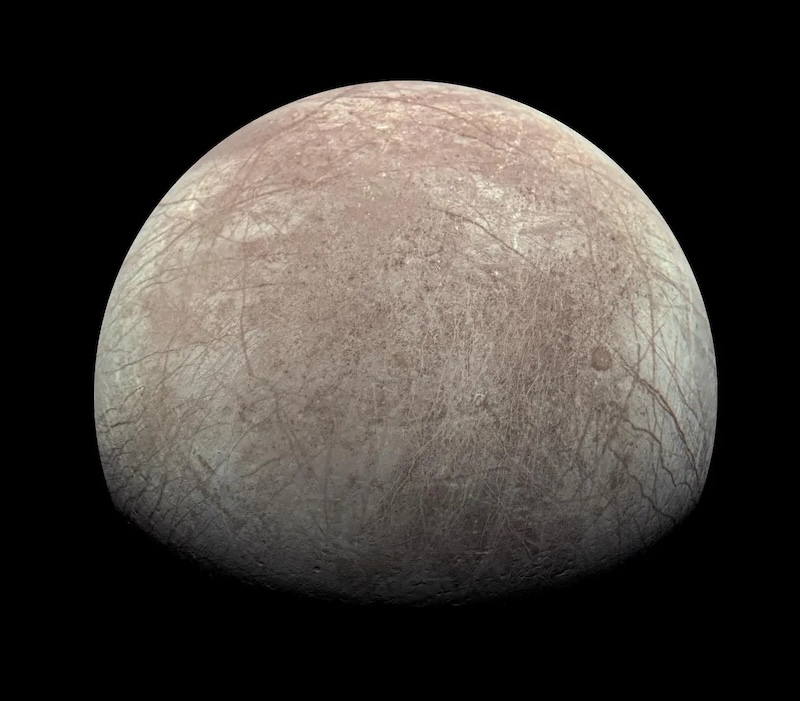
Smooth grayish-white planet-like sphere, with many thin cracks on its surface.
View larger. | View of Europa from NASA’s Juno spacecraft on September 29, 2022. Image via NASA/ JPL-Caltech/ SwRI/ MSSS /Image processing: Kevin M. Gill (CC BY 3.0).
Many criss-crossing reddish bands and cracks on lighter-colored surface.
A closer look at some of the cracks in Europa’s otherwise smooth surface. It’s through these cracks that scientists think water can come up to the surface and leave the brownish deposits around the cracks. The Galileo spacecraft took this image on September 26, 1998. Image via NASA/ JPL-Caltech/ SETI Institute.

Is the ammonia from the subsurface ocean?

The paper suggests the most likely source of the ammonia compounds is the subsurface ocean or other water reservoirs within the ice crust. The compounds could reach the surface through cryovolcanism, a form of volcanism with icy materials instead of hot magma. Ammonia can’t last long in space – or exposed on Europa’s virtually airless surface – so its presence suggests it came up to the surface relatively recently geologically. The paper says:

I posit that ammonia-bearing materials were transported to the surface via effusive cryovolcanism or similar mechanisms during Europa’s recent geological past.

The transport of ammonia-bearing material from subsurface sources provides insight into the composition and chemistry of Europa’s interior, suggesting a chemically reduced high-pH and thicker subsurface ocean beneath a comparatively thinner ice shell. Nonetheless, the detection of ammonia-bearing components in this study provides the first evidence of nitrogen-bearing species on Europa, an observation of considerable astrobiological significance due to nitrogen’s foundational role in the molecular basis of life.

Smiling man with brown hair and dark complexion.
Al Emran at NASA’s Jet Propulsion Laboratory in California is the author of the new paper about ammonia on Europa. Image via Jet Propulsion Laboratory.

Implications for habitability

The discovery of ammonia provides another important clue about the potential habitability of Europa’s ocean. Ammonia contains one nitrogen and three hydrogen atoms. It can be produced both biologically and abiotically (without life).

The fact that it contains nitrogen makes it even more interesting. Nitrogen is one of the key molecules required for life as we know it. It assists in the formation of amino acids, DNA, chlorophyll and proteins.

Ammonia also lowers the freezing point of water. This means that water containing ammonia can stay liquid at lower freezing temperatures than usual. This could be important in the case of Europa or other moons with subsurface oceans, even though scientists have found ammonia on quite a few other icy bodies in the solar system, both with oceans and without.

It will be interesting to see what NASA’s Europa Clipper finds when it reaches Europa in 2030. It will study both Europa’s surface and interior in unprecedented detail. Will it show that Europa is a habitable world?

Bottom line: A new analysis of images from the Galileo mission has revealed deposits of ammonia on Jupiter’s moon Europa. It could mean a geologically active crust and habitable ocean.

Source: Detection of an NH3 Absorption Band at 2.2 um on Europa

Via NASA

Via NASA

Read more: Strange ‘spider’ on Europa hints at water lurking below

Read more: Juno images of Europa reveal a complex, active surface

The post New discovery of ammonia on Europa hints at active geology first appeared on EarthSky.


from EarthSky https://ift.tt/4MpXLiO
Ammonia on Europa: Large rectangle showing gray surface from above, with long, dark cracks and small red and purple pixelated shapes. A moon, Europa, with long cracks on its surface is to the left of the rectangle. It is connected to the rectangle by 2 thin white lines.
View larger. | Composite image showing location of some of the ammonia-bearing compounds on Jupiter’s moon Europa (red pixels). Scientists found them near large fractures in the icy surface crust. The discovery of ammonia on Europa supports the possibility that Europa’s subsurface ocean is habitable. Image via NASA/ JPL-Caltech.

EarthSky’s 2026 lunar calendar shows the moon phase for every day of the year. Get yours today!

  • Scientists have found ammonia compounds on the surface of Jupiter’s moon Europa. Why is this significant?
  • The compounds likely came up from the ocean below, through cracks in the icy surface. They could be evidence for active geology in the crust and habitable conditions in the ocean.
  • New analysis of old images from the Galileo mission revealed the ammonia deposits near large fractures in the crust.

Ammonia on Europa: Active geology and life?

The debate about whether Jupiter’s moon Europa could support life in its hidden ocean continues. One key is active geology, which might serve as an life-engine on a world like Europa by connecting this world’s internal chemistry to its ocean. But one recent study said Europa’s seafloor might not be geologically active enough to support life. And then another study found the chemical nutrients needed could still come from Europa’s icy crust. Maybe they seep down into the ocean, and life gets a boost that way. Now, there’s a new piece of evidence. NASA said on January 29, 2026, that new analysis of data from the old Galileo mission has found, for the first time, ammonia-bearing compounds on Europa’s surface. Ammonia is a nitrogen-bearing molecule, and nitrogen is a foundational building block for life.

The ammonia deposits are located near large fractures on the surface. This is where liquid water – either from the ocean itself or smaller lakes within the ice crust – could come up to the surface.

Al Emran at NASA’s Jet Propulsion Laboratory in California is the author of the new peer-reviewed paper, published in The Planetary Science Journal on November 7, 2025.

NASA’s Galileo Mission Points to Ammonia at Europa, Recent Study Showsastrobiology.com/2026/01/nasa… #Astrobiology @NASAScience_

Astrobiology (@astrobiology.bsky.social) 2026-01-29T20:38:40.483Z

Old images from Galileo reveal ammonia on Europa

Emran found the ammonia-bearing compound deposits in old images from the Galileo mission. Galileo explored Jupiter and its moons from 1995 to 2003. No one had noticed the ammonia (NH3) deposits before. But now, new advanced reanalysis of the images revealed the deposits. The image at the top zooms in on an area about 250 miles (400 km) wide. Galileo obtained it during its 11th orbit of Jupiter in 1997.

The pixelated shapes are representations of data from Galileo’s Near-Infrared Mapping Spectrometer (NIMS) instrument. The red pixels show locations of the ammonia (aka NH3) compounds, while the purple pixels indicate no detections.

The paper states:

The presence of NH3-bearing components on icy planetary bodies has important implications for their geology and potential habitability. Here, I report the detection of a characteristic NH3 absorption feature on Europa, identified in an observation from the Galileo Near Infrared Mapping Spectrometer. Spectral modeling and band position indicate that NH3 hydrate and NH4 chloride are the most plausible candidates.

Smooth grayish-white planet-like sphere, with many thin cracks on its surface.
View larger. | View of Europa from NASA’s Juno spacecraft on September 29, 2022. Image via NASA/ JPL-Caltech/ SwRI/ MSSS /Image processing: Kevin M. Gill (CC BY 3.0).
Many criss-crossing reddish bands and cracks on lighter-colored surface.
A closer look at some of the cracks in Europa’s otherwise smooth surface. It’s through these cracks that scientists think water can come up to the surface and leave the brownish deposits around the cracks. The Galileo spacecraft took this image on September 26, 1998. Image via NASA/ JPL-Caltech/ SETI Institute.

Is the ammonia from the subsurface ocean?

The paper suggests the most likely source of the ammonia compounds is the subsurface ocean or other water reservoirs within the ice crust. The compounds could reach the surface through cryovolcanism, a form of volcanism with icy materials instead of hot magma. Ammonia can’t last long in space – or exposed on Europa’s virtually airless surface – so its presence suggests it came up to the surface relatively recently geologically. The paper says:

I posit that ammonia-bearing materials were transported to the surface via effusive cryovolcanism or similar mechanisms during Europa’s recent geological past.

The transport of ammonia-bearing material from subsurface sources provides insight into the composition and chemistry of Europa’s interior, suggesting a chemically reduced high-pH and thicker subsurface ocean beneath a comparatively thinner ice shell. Nonetheless, the detection of ammonia-bearing components in this study provides the first evidence of nitrogen-bearing species on Europa, an observation of considerable astrobiological significance due to nitrogen’s foundational role in the molecular basis of life.

Smiling man with brown hair and dark complexion.
Al Emran at NASA’s Jet Propulsion Laboratory in California is the author of the new paper about ammonia on Europa. Image via Jet Propulsion Laboratory.

Implications for habitability

The discovery of ammonia provides another important clue about the potential habitability of Europa’s ocean. Ammonia contains one nitrogen and three hydrogen atoms. It can be produced both biologically and abiotically (without life).

The fact that it contains nitrogen makes it even more interesting. Nitrogen is one of the key molecules required for life as we know it. It assists in the formation of amino acids, DNA, chlorophyll and proteins.

Ammonia also lowers the freezing point of water. This means that water containing ammonia can stay liquid at lower freezing temperatures than usual. This could be important in the case of Europa or other moons with subsurface oceans, even though scientists have found ammonia on quite a few other icy bodies in the solar system, both with oceans and without.

It will be interesting to see what NASA’s Europa Clipper finds when it reaches Europa in 2030. It will study both Europa’s surface and interior in unprecedented detail. Will it show that Europa is a habitable world?

Bottom line: A new analysis of images from the Galileo mission has revealed deposits of ammonia on Jupiter’s moon Europa. It could mean a geologically active crust and habitable ocean.

Source: Detection of an NH3 Absorption Band at 2.2 um on Europa

Via NASA

Via NASA

Read more: Strange ‘spider’ on Europa hints at water lurking below

Read more: Juno images of Europa reveal a complex, active surface

The post New discovery of ammonia on Europa hints at active geology first appeared on EarthSky.


from EarthSky https://ift.tt/4MpXLiO
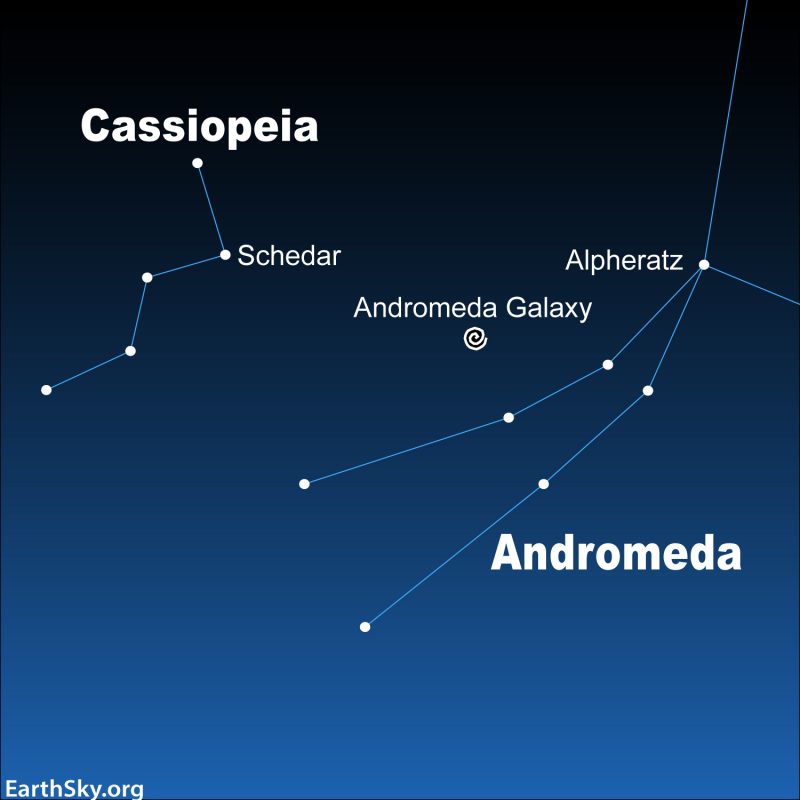
Find the Andromeda Galaxy using Cassiopeia

Star chart of constellations Cassiopeia and Andromeda with labeled Andromeda galaxy between them.
Here’s the technique some people use to find the Andromeda Galaxy aka M31. But be sure you’re looking in a dark sky. Look northward for the M – or W – shaped constellation Cassiopeia the Queen. Then locate the star Schedar in Cassiopeia. It’s the constellation’s brightest star, and it points to the Andromeda Galaxy. Chart via EarthSky.

The Andromeda Galaxy

The Andromeda galaxy, aka Messier 31 (M31), is the nearest large spiral galaxy to our Milky Way. It’s about 2.5 million light-years away, teeming with hundreds of billions of stars. In fact, it’s considered the farthest object you can see with the unaided eye.

Read more: The Andromeda Galaxy: All you need to know

Use Cassiopeia to find the Andromeda Galaxy

Tonight, if you have a dark sky, try star-hopping to the Andromeda Galaxy from the constellation Cassiopeia the Queen. If your sky is dark, you might even spot this hazy patch of light with no optical aid, as the ancient stargazers did before the days of city lights.

But what if you aren’t under a dark sky, and you can’t find the Andromeda Galaxy with the eyes alone? Well, some stargazers use binoculars and star-hop to the Andromeda Galaxy via this W- or M-shaped constellation.

Cassiopeia appears in high in the sky at nightfall and early evening, then swings downward as evening deepens into late night. Then in the wee hours before dawn, Cassiopeia is found climbing in the east. Note that one half of the W is more deeply notched than the other half. This deeper V is your “arrow” in the sky, pointing to the Andromeda Galaxy.

To see a precise view – and time – from your location, try Stellarium Online.

Images of the Andromeda Galaxy

Members of the EarthSky community have captured gorgeous images of this neighboring spiral galaxy.

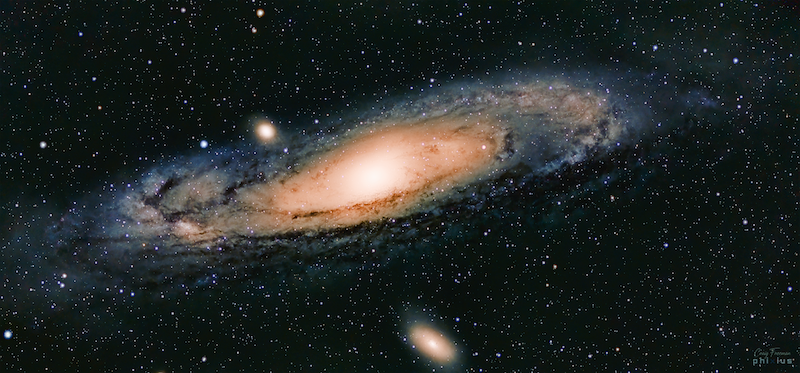
A very detailed glowing spiral in space seen obliquely in a starfield.
View at EarthSky Community Photos. | Craig Freeman imaged the Andromeda Galaxy from Mansfield, Ohio, on October 5, 2025. Beautiful! Thank you, Craig.
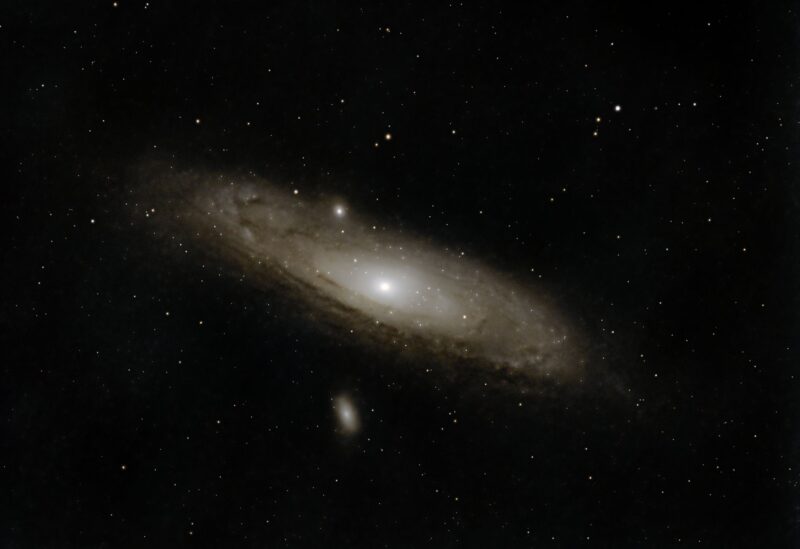
A vast, yellowish disk with sparse foreground stars.
View at EarthSky Community Photos. | Aquib Ali Ansari in Jaipur, Rajasthan, India, captured Messier 31, the Andromeda Galaxy, on September 26, 2025. Thank you, Aquib!
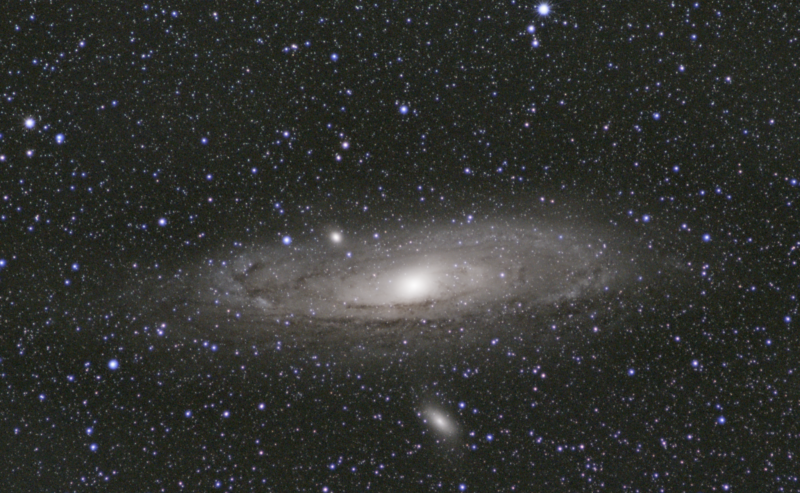
Oblique view of a large disk with a bright nucleus, dark lanes and thousands of foreground stars.
View at EarthSky Community Photos. | Jan Curtis in Cheyenne, Wyoming, caught Messier 31, the Andromeda Galaxy, on September 25, 2024. Jan wrote: “M31 is well-placed this time of year for all-night viewing.” Thank you, Jan!

Finder chart for the Andromeda Galaxy

Star chart of constellation Cassiopeia and arrow pointing to Andromeda Galaxy below it.
Draw an imaginary line from the star Kappa Cassiopeiae (abbreviated Kappa) through the star Schedar, then go about 3 times the Kappa-Schedar distance to locate the Andromeda Galaxy (Messier 31). Image via Wikimedia Commons (CC BY 3.0).

Binoculars enhance the view

Binoculars are an excellent choice for beginners to observe the Andromeda Galaxy, because they are so easy to point. As you stand beneath a dark sky, locate the galaxy with your eye first. Then slowly bring the binoculars up to your eyes so that the galaxy comes into binocular view. If that doesn’t work for you, try sweeping the area with your binoculars. Go slowly, and be sure your eyes are dark-adapted. The galaxy will appear as a fuzzy patch to the eye. Naturally, it’ll appear brighter in binoculars. And can you see its central region is brighter and more concentrated?

But remember, with the eye, binoculars, or with a backyard telescope, the Andromeda Galaxy won’t look like the images from famous telescopes and observatories. But it will be beautiful. Plus, it’ll take your breath away. And just think, you’re looking at a galaxy over 2 million light-years away. Wow!

Bottom line: You can find the Andromeda Galaxy using the constellation Cassiopeia as a guide. Remember, on a dark night, this galaxy will look like a faint smudge of light. And once you’ve found it with the unaided eye or binoculars, look at it with a telescope if you have one.

Read more: Andromeda Galaxy: Find it by star-hopping from Pegasus

Read more: Andromeda Galaxy stuns in new images and sounds!

The post Find the Andromeda Galaxy using Cassiopeia first appeared on EarthSky.


from EarthSky https://ift.tt/rTRsZM8
Star chart of constellations Cassiopeia and Andromeda with labeled Andromeda galaxy between them.
Here’s the technique some people use to find the Andromeda Galaxy aka M31. But be sure you’re looking in a dark sky. Look northward for the M – or W – shaped constellation Cassiopeia the Queen. Then locate the star Schedar in Cassiopeia. It’s the constellation’s brightest star, and it points to the Andromeda Galaxy. Chart via EarthSky.

The Andromeda Galaxy

The Andromeda galaxy, aka Messier 31 (M31), is the nearest large spiral galaxy to our Milky Way. It’s about 2.5 million light-years away, teeming with hundreds of billions of stars. In fact, it’s considered the farthest object you can see with the unaided eye.

Read more: The Andromeda Galaxy: All you need to know

Use Cassiopeia to find the Andromeda Galaxy

Tonight, if you have a dark sky, try star-hopping to the Andromeda Galaxy from the constellation Cassiopeia the Queen. If your sky is dark, you might even spot this hazy patch of light with no optical aid, as the ancient stargazers did before the days of city lights.

But what if you aren’t under a dark sky, and you can’t find the Andromeda Galaxy with the eyes alone? Well, some stargazers use binoculars and star-hop to the Andromeda Galaxy via this W- or M-shaped constellation.

Cassiopeia appears in high in the sky at nightfall and early evening, then swings downward as evening deepens into late night. Then in the wee hours before dawn, Cassiopeia is found climbing in the east. Note that one half of the W is more deeply notched than the other half. This deeper V is your “arrow” in the sky, pointing to the Andromeda Galaxy.

To see a precise view – and time – from your location, try Stellarium Online.

Images of the Andromeda Galaxy

Members of the EarthSky community have captured gorgeous images of this neighboring spiral galaxy.

A very detailed glowing spiral in space seen obliquely in a starfield.
View at EarthSky Community Photos. | Craig Freeman imaged the Andromeda Galaxy from Mansfield, Ohio, on October 5, 2025. Beautiful! Thank you, Craig.
A vast, yellowish disk with sparse foreground stars.
View at EarthSky Community Photos. | Aquib Ali Ansari in Jaipur, Rajasthan, India, captured Messier 31, the Andromeda Galaxy, on September 26, 2025. Thank you, Aquib!
Oblique view of a large disk with a bright nucleus, dark lanes and thousands of foreground stars.
View at EarthSky Community Photos. | Jan Curtis in Cheyenne, Wyoming, caught Messier 31, the Andromeda Galaxy, on September 25, 2024. Jan wrote: “M31 is well-placed this time of year for all-night viewing.” Thank you, Jan!

Finder chart for the Andromeda Galaxy

Star chart of constellation Cassiopeia and arrow pointing to Andromeda Galaxy below it.
Draw an imaginary line from the star Kappa Cassiopeiae (abbreviated Kappa) through the star Schedar, then go about 3 times the Kappa-Schedar distance to locate the Andromeda Galaxy (Messier 31). Image via Wikimedia Commons (CC BY 3.0).

Binoculars enhance the view

Binoculars are an excellent choice for beginners to observe the Andromeda Galaxy, because they are so easy to point. As you stand beneath a dark sky, locate the galaxy with your eye first. Then slowly bring the binoculars up to your eyes so that the galaxy comes into binocular view. If that doesn’t work for you, try sweeping the area with your binoculars. Go slowly, and be sure your eyes are dark-adapted. The galaxy will appear as a fuzzy patch to the eye. Naturally, it’ll appear brighter in binoculars. And can you see its central region is brighter and more concentrated?

But remember, with the eye, binoculars, or with a backyard telescope, the Andromeda Galaxy won’t look like the images from famous telescopes and observatories. But it will be beautiful. Plus, it’ll take your breath away. And just think, you’re looking at a galaxy over 2 million light-years away. Wow!

Bottom line: You can find the Andromeda Galaxy using the constellation Cassiopeia as a guide. Remember, on a dark night, this galaxy will look like a faint smudge of light. And once you’ve found it with the unaided eye or binoculars, look at it with a telescope if you have one.

Read more: Andromeda Galaxy: Find it by star-hopping from Pegasus

Read more: Andromeda Galaxy stuns in new images and sounds!

The post Find the Andromeda Galaxy using Cassiopeia first appeared on EarthSky.


from EarthSky https://ift.tt/rTRsZM8

Did we see a black hole explode? If so, it could explain a lot

Many small round reddish rings with black centers floating through space.
Did we just see a black hole explode? UMass Amherst’s physicists think so. This artist’s concept takes a fanciful approach to imagining small primordial black holes. Image via NASA/ Goddard Space Flight Center.

EarthSky’s 2026 lunar calendar shows the moon phase for every day of the year. Available now. Get yours today!

  • An “impossible” ultra-high-energy neutrino – detected in 2023 – might have come from the explosion of a tiny primordial black hole.
  • This led astronomers to a new dark-charge model. This model of primordial black holes could explain why one detector saw the high-energy event while another didn’t.
  • If confirmed, such explosions could reveal new particles, help verify Hawking radiation and potentially explain the nature of dark matter.

The University of Massachusetts Amherst published this original article on February 3, 2026. Edits by EarthSky.

Did we see a black hole explode?

In 2023, a subatomic particle called a neutrino crashed into Earth with an impossibly huge amount of energy. In fact, no known sources anywhere in the universe can produce that much energy, 100,000 times more than the highest-energy particle ever produced by the largest earthly particle accelerators.

In 2023, a subatomic particle called a neutrino crashed into Earth with an impossibly huge amount of energy. In fact, no known sources anywhere in the universe can produce that much energy, 100,000 times more than the highest-energy particle ever produced by the Large Hadron Collider, Earth’s most powerful particle accelerator. However, a team of physicists at the University of Massachusetts Amherst recently hypothesized that something like this could happen when a special kind of black hole, called a quasi-extremal primordial black hole, explodes.

The journal Physical Review Letters published the new research on December 18, 2025. The team not only accounts for the otherwise impossible neutrino but shows that the elementary particle could reveal the fundamental nature of the universe.

Primordial black holes

Black holes exist, and we have a good understanding of their life cycle: an old, large star runs out of fuel, implodes in a massively powerful supernova, and leaves behind an area of spacetime with such intense gravity that nothing, not even light, can escape. These black holes are incredibly heavy and are essentially stable.

But, as physicist Stephen Hawking pointed out in 1970, another kind of black hole – a primordial black hole – could be created not by the collapse of a star, but from the universe’s primordial conditions shortly after the Big Bang. Primordial black holes exist only in theory so far. And, like standard black holes, they’re so massively dense that almost nothing can escape them … which is what makes them black. However, despite their density, primordial black holes could be much lighter than the black holes we have so far observed. Furthermore, Hawking showed that primordial black holes could slowly emit particles via what is now known as Hawking radiation if they got hot enough.

Andrea Thamm, co-author of the new research and assistant professor of physics at UMass Amherst, said:

The lighter a black hole is, the hotter it should be and the more particles it will emit. As primordial black holes evaporate, they become ever lighter, and so hotter, emitting even more radiation in a runaway process until explosion. It’s that Hawking radiation that our telescopes can detect.

A young woman with long blonde hair smiling at the camera.
Andrea Thamm of the University of Massachusetts Amherst is a co-author of the new study. Image via University of Massachusetts Amherst.

Observing a black hole explode

If such an explosion were to be observed, it would give us a definitive catalog of all the subatomic particles in existence. That would include the ones we have observed, such as electrons, quarks and Higgs bosons. And also the ones that we have only hypothesized, like dark matter particles, as well as everything else that is, so far, entirely unknown to science. The UMass Amherst team has previously shown that such explosions could happen with surprising frequency – every decade or so – and if we were to pay attention, our current cosmos-observing instruments could register these explosions.

So far, so theoretical.

Then, in 2023, an experiment called the KM3NeT Collaboration captured that impossible neutrino. It was exactly the kind of evidence the UMass Amherst team hypothesized we might soon see.

But there was a hitch: A similar experiment, called IceCube, also set up to capture high-energy cosmic neutrinos, didn’t register the event. Not only that, but it had never clocked anything with even one hundredth of its power. If the universe is relatively thick with primordial black holes, and they are exploding frequently, shouldn’t we be showered in high-energy neutrinos? What can explain the discrepancy?

The missing link

Co-author Joaquim Iguaz Juan, a postdoctoral researcher in physics at UMass Amherst, said:

We think that primordial black holes with a ‘dark charge’ – what we call quasi-extremal primordial black holes – are the missing link.

The dark charge is essentially a copy of the usual electric force as we know it. But it includes a very heavy, hypothesized version of the electron, which the team calls a dark electron.

Co-author Michael Baker, an assistant professor of physics at UMass Amherst, said:

There are other, simpler models of primordial black holes out there. Our dark-charge model is more complex, which means it may provide a more accurate model of reality. What’s so cool is to see that our model can explain this otherwise unexplainable phenomenon.

Thamm added:

A primordial black hole with a dark charge has unique properties and behaves in ways that are different from other, simpler primordial black hole models. We have shown that this can provide an explanation of all of the seemingly inconsistent experimental data.

Dark matter explained?

The team is confident that, not only can their dark-charge model primordial black holes explain the neutrino, it can also answer the mystery of dark matter. Baker said:

Observations of galaxies and the cosmic microwave background suggest that some kind of dark matter exists.

Iguaz Juan added:

If our hypothesized dark charge is true, then we believe there could be a significant population of primordial black holes, which would be consistent with other astrophysical observations, and account for all the missing dark matter in the universe.

Baker concluded:

Observing the high-energy neutrino was an incredible event. It gave us a new window on the universe. But we could now be on the cusp of experimentally verifying Hawking radiation, obtaining evidence for both primordial black holes and new particles beyond the Standard Model, and explaining the mystery of dark matter.

Bottom line: Did we just witness a black hole explode? Astronomers observed a strange particle collide with Earth that could have been the result of a black hole exploding. It could help reveal new particles, help verify Hawking radiation and potentially explain the nature of dark matter.

Source: Explaining the PeV neutrino fluxes at KM3NeT and IceCube with quasiextremal primordial black holes

Via University of Massachusetts Amherst

The post Did we see a black hole explode? If so, it could explain a lot first appeared on EarthSky.


from EarthSky https://ift.tt/W2mXaSN
Many small round reddish rings with black centers floating through space.
Did we just see a black hole explode? UMass Amherst’s physicists think so. This artist’s concept takes a fanciful approach to imagining small primordial black holes. Image via NASA/ Goddard Space Flight Center.

EarthSky’s 2026 lunar calendar shows the moon phase for every day of the year. Available now. Get yours today!

  • An “impossible” ultra-high-energy neutrino – detected in 2023 – might have come from the explosion of a tiny primordial black hole.
  • This led astronomers to a new dark-charge model. This model of primordial black holes could explain why one detector saw the high-energy event while another didn’t.
  • If confirmed, such explosions could reveal new particles, help verify Hawking radiation and potentially explain the nature of dark matter.

The University of Massachusetts Amherst published this original article on February 3, 2026. Edits by EarthSky.

Did we see a black hole explode?

In 2023, a subatomic particle called a neutrino crashed into Earth with an impossibly huge amount of energy. In fact, no known sources anywhere in the universe can produce that much energy, 100,000 times more than the highest-energy particle ever produced by the largest earthly particle accelerators.

In 2023, a subatomic particle called a neutrino crashed into Earth with an impossibly huge amount of energy. In fact, no known sources anywhere in the universe can produce that much energy, 100,000 times more than the highest-energy particle ever produced by the Large Hadron Collider, Earth’s most powerful particle accelerator. However, a team of physicists at the University of Massachusetts Amherst recently hypothesized that something like this could happen when a special kind of black hole, called a quasi-extremal primordial black hole, explodes.

The journal Physical Review Letters published the new research on December 18, 2025. The team not only accounts for the otherwise impossible neutrino but shows that the elementary particle could reveal the fundamental nature of the universe.

Primordial black holes

Black holes exist, and we have a good understanding of their life cycle: an old, large star runs out of fuel, implodes in a massively powerful supernova, and leaves behind an area of spacetime with such intense gravity that nothing, not even light, can escape. These black holes are incredibly heavy and are essentially stable.

But, as physicist Stephen Hawking pointed out in 1970, another kind of black hole – a primordial black hole – could be created not by the collapse of a star, but from the universe’s primordial conditions shortly after the Big Bang. Primordial black holes exist only in theory so far. And, like standard black holes, they’re so massively dense that almost nothing can escape them … which is what makes them black. However, despite their density, primordial black holes could be much lighter than the black holes we have so far observed. Furthermore, Hawking showed that primordial black holes could slowly emit particles via what is now known as Hawking radiation if they got hot enough.

Andrea Thamm, co-author of the new research and assistant professor of physics at UMass Amherst, said:

The lighter a black hole is, the hotter it should be and the more particles it will emit. As primordial black holes evaporate, they become ever lighter, and so hotter, emitting even more radiation in a runaway process until explosion. It’s that Hawking radiation that our telescopes can detect.

A young woman with long blonde hair smiling at the camera.
Andrea Thamm of the University of Massachusetts Amherst is a co-author of the new study. Image via University of Massachusetts Amherst.

Observing a black hole explode

If such an explosion were to be observed, it would give us a definitive catalog of all the subatomic particles in existence. That would include the ones we have observed, such as electrons, quarks and Higgs bosons. And also the ones that we have only hypothesized, like dark matter particles, as well as everything else that is, so far, entirely unknown to science. The UMass Amherst team has previously shown that such explosions could happen with surprising frequency – every decade or so – and if we were to pay attention, our current cosmos-observing instruments could register these explosions.

So far, so theoretical.

Then, in 2023, an experiment called the KM3NeT Collaboration captured that impossible neutrino. It was exactly the kind of evidence the UMass Amherst team hypothesized we might soon see.

But there was a hitch: A similar experiment, called IceCube, also set up to capture high-energy cosmic neutrinos, didn’t register the event. Not only that, but it had never clocked anything with even one hundredth of its power. If the universe is relatively thick with primordial black holes, and they are exploding frequently, shouldn’t we be showered in high-energy neutrinos? What can explain the discrepancy?

The missing link

Co-author Joaquim Iguaz Juan, a postdoctoral researcher in physics at UMass Amherst, said:

We think that primordial black holes with a ‘dark charge’ – what we call quasi-extremal primordial black holes – are the missing link.

The dark charge is essentially a copy of the usual electric force as we know it. But it includes a very heavy, hypothesized version of the electron, which the team calls a dark electron.

Co-author Michael Baker, an assistant professor of physics at UMass Amherst, said:

There are other, simpler models of primordial black holes out there. Our dark-charge model is more complex, which means it may provide a more accurate model of reality. What’s so cool is to see that our model can explain this otherwise unexplainable phenomenon.

Thamm added:

A primordial black hole with a dark charge has unique properties and behaves in ways that are different from other, simpler primordial black hole models. We have shown that this can provide an explanation of all of the seemingly inconsistent experimental data.

Dark matter explained?

The team is confident that, not only can their dark-charge model primordial black holes explain the neutrino, it can also answer the mystery of dark matter. Baker said:

Observations of galaxies and the cosmic microwave background suggest that some kind of dark matter exists.

Iguaz Juan added:

If our hypothesized dark charge is true, then we believe there could be a significant population of primordial black holes, which would be consistent with other astrophysical observations, and account for all the missing dark matter in the universe.

Baker concluded:

Observing the high-energy neutrino was an incredible event. It gave us a new window on the universe. But we could now be on the cusp of experimentally verifying Hawking radiation, obtaining evidence for both primordial black holes and new particles beyond the Standard Model, and explaining the mystery of dark matter.

Bottom line: Did we just witness a black hole explode? Astronomers observed a strange particle collide with Earth that could have been the result of a black hole exploding. It could help reveal new particles, help verify Hawking radiation and potentially explain the nature of dark matter.

Source: Explaining the PeV neutrino fluxes at KM3NeT and IceCube with quasiextremal primordial black holes

Via University of Massachusetts Amherst

The post Did we see a black hole explode? If so, it could explain a lot first appeared on EarthSky.


from EarthSky https://ift.tt/W2mXaSN

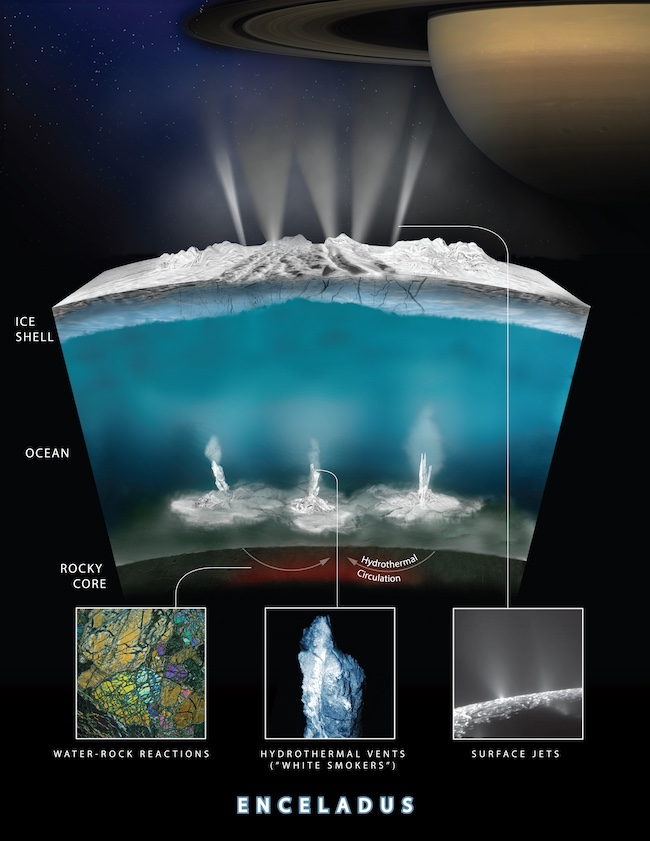
Simulation of Enceladus’ ocean shows strong potential for life

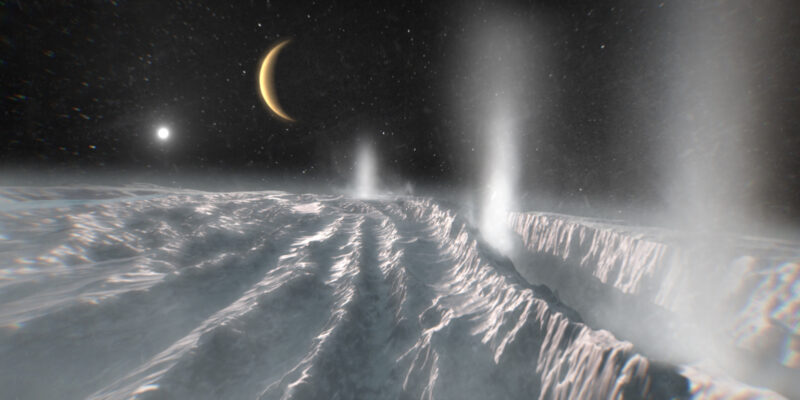
Enceladus' ocean: White, ridged terrain with fuzzy plumes bursting upward, a crescent-lit moon and a bright sun in the sky.
Artist’s concept of water vapor plumes erupting onto the surface of Saturn’s moon Enceladus. In the background we see another moon, Titan, lit as a crescent, with the distant sun beyond. Recently, scientists in Japan and Germany recreated the conditions of Enceladus’ ocean beneath its icy crust. They used data the Cassini spacecraft sampled from the plumes. And they found that organic molecules – both simple and complex – can form easily there, increasing the potential for life. Image via ESA/ Science Office.

EarthSky’s 2026 lunar calendar shows the moon phase for every day of the year. Get yours today!

  • Saturn’s moon Enceladus has a global ocean beneath its icy crust. The Cassini spacecraft found various kinds of organic molecules in Enceladus’ plumes. Could life itself exist in those alien waters?
  • Scientists simulated the conditions of the ocean in experiments in a lab on Earth. The tests created many of the same organics that Cassini found, both simple and complex.
  • So molecular building blocks of life can form easily in Enceladus’ ocean, according to the results. This increases the possibility of life.

Recreation of Enceladus’ ocean

Saturn’s moon Enceladus has a global subsurface ocean that scientists say might be able to support life. NASA’s Cassini spacecraft discovered various organic compounds, both simple and more complex, in the geyser-like plumes of water vapor that erupt through cracks in the moon’s icy crust. And now scientists in Japan and Germany have recreated the conditions of Enceladus’ ocean in a lab on Earth. The researchers said on January 18, 2026, they found many of the organics can form easily in the ocean itself. This adds to the growing evidence that Enceladus’ ocean contains the molecular building blocks of life … and could be habitable.

Cassini first found the organics when it passed through the plumes several times between 2005 and 2017. It analyzed the composition of the plumes and found a variety of organic molecules, both simple and more complex. It also found salts, ammonia, hydrogen, hydrogen cyanide, phosphorous, methane, sodium, potassium, chlorine and carbonate-containing compounds. Scientists said the plumes originate from the ocean below the outer icy crust. They erupt through huge cracks in the ice at the south pole called Tiger Stripes.

The researchers published their new peer-reviewed findings in the journal Icarus on January 15, 2026.

Organics from inside or outside Enceladus?

While scientists have confirmed the organics in the plumes, there has still been debate about their origin. Are they currently being produced in the ocean, or were they left over from when the moon first formed? As lead author Max Craddock at the Institute of Science Tokyo noted:

However, it remained unclear whether those compounds were produced inside the moon or inherited from ancient material that formed it. While earlier laboratory studies explored hydrothermal organic synthesis relevant to early Earth and comets, they rarely focused on Enceladus’ distinctive environment.

Last year, some scientists reported that radiation might create some of the organic molecules found on Saturn’s moon Enceladus. But then, another international team of researchers said that a new analysis of data from the Cassini mission had found new complex organics that they are certain originate in an ocean below Enceladus’ surface.

Laboratory experiments simulating Enceladus' subsurface ocean conditions have produced organic molecules similar to those detected by Cassini, supporting the moon's potential for prebiotic chemistry. doi.org/hbkc9t

Science X / Phys.org (@sciencex.bsky.social) 2026-01-18T13:30:14-05:00

Simulating conditions in Enceladus’ ocean

So, where do the organics come from? To try to answer that question, the researchers simulated the conditions of Enceladus’ ocean in the lab. They based their simulations on what is known about conditions at Enceladus from the Cassini data.

Saturn’s gravity pulls and squeezes Enceladus as it orbits the planet. This creates cycles of heating and cryogenic freezing. Evidence from Cassini suggests this is enough to create hydrothermal activity on Enceladus’ seafloor, like hydrothermal vents on the seafloor on Earth. As a result, this could help create more complex organic compounds.

The researchers recreated the ocean water using a mixture of the known chemicals in Enceladus’ ocean. Then, they used a high-pressure reactor to simulate the heating/freezing cycle. Lastly, they analyzed the simulated ocean water with a spectrometer similar to the one on Cassini. Craddock said:

We then analyzed the products using a laser-based mass spectrometer designed to mimic Cassini’s Cosmic Dust Analyzer, allowing us to directly compare our experimental chemistry with the spacecraft’s measurements.

Complicated diagram of a rotating cylindrical device with various attachments, with text labels.
View larger. | Diagram of the high-pressure reactor used in the experiments. Image via Craddock et al./ Icarus (CC-BY).
Young man wearing a blue shirt with his hands folded together.
Max Craddock at the Institute of Science Tokyo led the new research about organics in Enceladus’ ocean. Image via Max Craddock.

A wide variety of organic compounds

Sure enough, the experiments produced a wide array of complex organics, including amino acids, aldehydes and nitriles. The freezing part of the cycle also produced additional simpler organic molecules, such as glycine.

Overall, the results closely matched what Cassini actually found.

Cutaway view of ocean with ice and geysers on top and geyser-like vents on the bottom, text labels and detailed insets.
View larger. | Graphic depicting hydrothermal activity on the ocean floor of Enceladus. The new study shows that hydrothermal activity can create many of the organics found in the plumes. Image via NASA/ JPL-Caltech/ Southwest Research Institute.

Other puzzling organics

The results show that organic molecules can easily form in Enceladus’ ocean. There are still some puzzles to solve, however. Some of the larger organic molecules that Cassini found didn’t show up in the experiments. So we don’t know exactly how they formed. There might be other hot, catalyzed chemical reactions in the ocean that we don’t know about yet. Or perhaps those molecules are ancient leftovers from when Enceladus first formed.

We will likely need future missions back to Enceladus to answer these questions, as Craddock explained:

For future missions, this sharpens how plume measurements should be interpreted and underscores the importance of instruments capable of verifying amino acids and resolving whether complex organics reflect ongoing internal chemistry or ancient material.

Together, such observations will be central to evaluating Enceladus’ habitability and to probing how chemistry in ocean worlds might progress toward life.

Bottom line: Researchers simulated the conditions in Enceladus’ ocean and found that a wide variety of organic molecules can easily form, increasing the chances for life.

Source: Laboratory simulations of organic synthesis in Enceladus: Implications for the origin of organic matter in the plume

Via Phys.org

Read more: Do the organics in Enceladus’ ocean point to habitability?

Read more: Hidden ocean on Enceladus might be stable enough for life

The post Simulation of Enceladus’ ocean shows strong potential for life first appeared on EarthSky.


from EarthSky https://ift.tt/uOlRMCn
Enceladus' ocean: White, ridged terrain with fuzzy plumes bursting upward, a crescent-lit moon and a bright sun in the sky.
Artist’s concept of water vapor plumes erupting onto the surface of Saturn’s moon Enceladus. In the background we see another moon, Titan, lit as a crescent, with the distant sun beyond. Recently, scientists in Japan and Germany recreated the conditions of Enceladus’ ocean beneath its icy crust. They used data the Cassini spacecraft sampled from the plumes. And they found that organic molecules – both simple and complex – can form easily there, increasing the potential for life. Image via ESA/ Science Office.

EarthSky’s 2026 lunar calendar shows the moon phase for every day of the year. Get yours today!

  • Saturn’s moon Enceladus has a global ocean beneath its icy crust. The Cassini spacecraft found various kinds of organic molecules in Enceladus’ plumes. Could life itself exist in those alien waters?
  • Scientists simulated the conditions of the ocean in experiments in a lab on Earth. The tests created many of the same organics that Cassini found, both simple and complex.
  • So molecular building blocks of life can form easily in Enceladus’ ocean, according to the results. This increases the possibility of life.

Recreation of Enceladus’ ocean

Saturn’s moon Enceladus has a global subsurface ocean that scientists say might be able to support life. NASA’s Cassini spacecraft discovered various organic compounds, both simple and more complex, in the geyser-like plumes of water vapor that erupt through cracks in the moon’s icy crust. And now scientists in Japan and Germany have recreated the conditions of Enceladus’ ocean in a lab on Earth. The researchers said on January 18, 2026, they found many of the organics can form easily in the ocean itself. This adds to the growing evidence that Enceladus’ ocean contains the molecular building blocks of life … and could be habitable.

Cassini first found the organics when it passed through the plumes several times between 2005 and 2017. It analyzed the composition of the plumes and found a variety of organic molecules, both simple and more complex. It also found salts, ammonia, hydrogen, hydrogen cyanide, phosphorous, methane, sodium, potassium, chlorine and carbonate-containing compounds. Scientists said the plumes originate from the ocean below the outer icy crust. They erupt through huge cracks in the ice at the south pole called Tiger Stripes.

The researchers published their new peer-reviewed findings in the journal Icarus on January 15, 2026.

Organics from inside or outside Enceladus?

While scientists have confirmed the organics in the plumes, there has still been debate about their origin. Are they currently being produced in the ocean, or were they left over from when the moon first formed? As lead author Max Craddock at the Institute of Science Tokyo noted:

However, it remained unclear whether those compounds were produced inside the moon or inherited from ancient material that formed it. While earlier laboratory studies explored hydrothermal organic synthesis relevant to early Earth and comets, they rarely focused on Enceladus’ distinctive environment.

Last year, some scientists reported that radiation might create some of the organic molecules found on Saturn’s moon Enceladus. But then, another international team of researchers said that a new analysis of data from the Cassini mission had found new complex organics that they are certain originate in an ocean below Enceladus’ surface.

Laboratory experiments simulating Enceladus' subsurface ocean conditions have produced organic molecules similar to those detected by Cassini, supporting the moon's potential for prebiotic chemistry. doi.org/hbkc9t

Science X / Phys.org (@sciencex.bsky.social) 2026-01-18T13:30:14-05:00

Simulating conditions in Enceladus’ ocean

So, where do the organics come from? To try to answer that question, the researchers simulated the conditions of Enceladus’ ocean in the lab. They based their simulations on what is known about conditions at Enceladus from the Cassini data.

Saturn’s gravity pulls and squeezes Enceladus as it orbits the planet. This creates cycles of heating and cryogenic freezing. Evidence from Cassini suggests this is enough to create hydrothermal activity on Enceladus’ seafloor, like hydrothermal vents on the seafloor on Earth. As a result, this could help create more complex organic compounds.

The researchers recreated the ocean water using a mixture of the known chemicals in Enceladus’ ocean. Then, they used a high-pressure reactor to simulate the heating/freezing cycle. Lastly, they analyzed the simulated ocean water with a spectrometer similar to the one on Cassini. Craddock said:

We then analyzed the products using a laser-based mass spectrometer designed to mimic Cassini’s Cosmic Dust Analyzer, allowing us to directly compare our experimental chemistry with the spacecraft’s measurements.

Complicated diagram of a rotating cylindrical device with various attachments, with text labels.
View larger. | Diagram of the high-pressure reactor used in the experiments. Image via Craddock et al./ Icarus (CC-BY).
Young man wearing a blue shirt with his hands folded together.
Max Craddock at the Institute of Science Tokyo led the new research about organics in Enceladus’ ocean. Image via Max Craddock.

A wide variety of organic compounds

Sure enough, the experiments produced a wide array of complex organics, including amino acids, aldehydes and nitriles. The freezing part of the cycle also produced additional simpler organic molecules, such as glycine.

Overall, the results closely matched what Cassini actually found.

Cutaway view of ocean with ice and geysers on top and geyser-like vents on the bottom, text labels and detailed insets.
View larger. | Graphic depicting hydrothermal activity on the ocean floor of Enceladus. The new study shows that hydrothermal activity can create many of the organics found in the plumes. Image via NASA/ JPL-Caltech/ Southwest Research Institute.

Other puzzling organics

The results show that organic molecules can easily form in Enceladus’ ocean. There are still some puzzles to solve, however. Some of the larger organic molecules that Cassini found didn’t show up in the experiments. So we don’t know exactly how they formed. There might be other hot, catalyzed chemical reactions in the ocean that we don’t know about yet. Or perhaps those molecules are ancient leftovers from when Enceladus first formed.

We will likely need future missions back to Enceladus to answer these questions, as Craddock explained:

For future missions, this sharpens how plume measurements should be interpreted and underscores the importance of instruments capable of verifying amino acids and resolving whether complex organics reflect ongoing internal chemistry or ancient material.

Together, such observations will be central to evaluating Enceladus’ habitability and to probing how chemistry in ocean worlds might progress toward life.

Bottom line: Researchers simulated the conditions in Enceladus’ ocean and found that a wide variety of organic molecules can easily form, increasing the chances for life.

Source: Laboratory simulations of organic synthesis in Enceladus: Implications for the origin of organic matter in the plume

Via Phys.org

Read more: Do the organics in Enceladus’ ocean point to habitability?

Read more: Hidden ocean on Enceladus might be stable enough for life

The post Simulation of Enceladus’ ocean shows strong potential for life first appeared on EarthSky.


from EarthSky https://ift.tt/uOlRMCn

Ice-cold Earth? Possible new exoplanet might be chillier than Mars

Ice-cold Earth: A light-colored brownish and whitish planet with patches of small clouds. Stars are in the background.
View larger. | Artist’s concept of HD 137010 b. This candidate exoplanet is rocky and just slightly larger than Earth, with a similar orbit as Earth’s. But it might be colder than Mars, basically an ice-cold Earth. Image via NASA/ JPL-Caltech/ Keith Miller (Caltech/ IPAC).
  • HD 137010 b is a new candidate exoplanet, 146 light-years away. Astronomers found it in data from NASA’s Kepler Space Telescope mission.
  • If real, it is rocky, just slightly larger than Earth and has an orbit similar to Earth’s.
  • The planet might be a bit colder than Mars, however, because its star is a bit cooler and dimmer than our sun.

EarthSky’s 2026 lunar calendar is available now. Get yours today! Makes a great gift.

An ice-cold Earth?

Have astronomers found a colder version of Earth? An international team of researchers said on January 27, 2026, that they have discovered a new “exo-Earth” candidate 146 light-years away. The exoplanet – HD 137010 b – is rocky, only slightly larger than Earth and orbits a sunlike star. Its orbit is similar to Earth’s too. That’s exciting, although there’s one big caveat: it might be colder than Mars. But, it could also turn out to be more temperate, even watery.

The researchers found the candidate planet in data from NASA’s Kepler Space Telescope, which ended its mission in 2018. Right now, the exoplanet is still considered a candidate, because it hasn’t been fully confirmed yet.

The researchers published their intriguing peer-reviewed findings in The Astrophysical Journal Letters on January 27, 2026.

Exoplanet Candidate HD 137010 b: An Ice-Cold Earth Analog?astrobiology.com/2026/01/exop… #Astrobiology #astronomy #exoplanet

Astrobiology (@astrobiology.bsky.social) 2026-01-30T19:43:57.821Z

Colder than Mars?

The researchers said HD 137010 b might orbit just within the outer edge of its star’s habitable zone. That’s the region around a star where temperatures on a rocky planet could support liquid water. The problem, however, is that the planet receives less than a third of the heat and light from its star than Earth does from the sun. Why is that? It’s because the star is cooler and dimmer than our sun, even though it is the same spectral type (G-type star).

With this in mind, the researchers calculated that the surface temperature of HD 137010 b could be about -90 degrees Fahrenheit (-68 C). That’s a bit colder than Mars, which has an average temperature of -85 degrees Fahrenheit (-65 C).


An artist’s animation of exoplanet candidate HD 137010 b. This view also creates an effect similar to a transit, as the planet’s star disappears and then reappears from behind HD 137010 b. Video via NASA/ JPL-Caltech/ Keith Miller (Caltech/ IPAC).

From candidate to confirmation

As of now, HD 137010 b is still a candidate exoplanet. That means the data suggest it is a real planet, but it still requires full confirmation from additional observations. The paper states:

A comprehensive analysis of the K2 observations, historical low-resolution imaging and new high-resolution speckle imaging data, archival HARPS RVs, and Hipparcos–Gaia astrometry allow us to exclude the conventional false-positive hypotheses for the transit signal, leaving a transiting exoplanet as the most plausible explanation for the photometric event. However, since we only have the evidence of one transit event, we ultimately classify HD 137010 b as a candidate planet.

The research team used the transit method to detect the planet. That’s when the planet transits – passes in front of – its star, as viewed from Earth. Unfortunately, Kepler only saw one transit before its mission ended. Astronomers want to see additional transits to feel confident the planet is real. They are hoping that NASA’s TESS (Transiting Exoplanet Survey Satellite) or the European Space Agency’s CHEOPS (CHaracterising ExOPlanets Satellite) will be able detect additional transits.

Reddish planet with darker regions on its rocky surface. A long canyon cuts across just south of the equator.
View larger. | The European Space Agency’s Mars Express orbiter captured this global view of reddish Mars, released in 2023. Mars is a very cold place, but HD 137010 b might be even colder. Image via ESA/ DLR/ FU Berlin/ G. Michael (CC BY-SA 3.0 IGO).

Maybe not so cold after all?

Although the astronomers say that HD 137010 b – if real – is likely very cold, there is still a possibility that it is warmer. That would require a carbon dioxide-rich atmosphere. Currently, we don’t know if it has an atmosphere or not. And whether or not the planet is actually in the habitable zone would be a factor, also.

The researchers said there is a 40% chance the planet is within the nominal “conservative” habitable zone. And a 51% chance it lies within the broader “optimistic” habitable zone. There is, however, a 50% chance the planet isn’t within the habitable zone at all. This is also why more observations are needed.

Bottom line: Astronomers have discovered a possible ice-cold Earth exoplanet 146 light-years away. It might be colder than Mars, but there’s also a chance it’s more Earth-like.

Source: A Cool Earth-sized Planet Candidate Transiting a Tenth Magnitude K-dwarf From K2

Via NASA

Read more: Quantum computers and exoplanets: New view of distant worlds

Read more: Colorful life on exoplanets might be lurking in clouds

The post Ice-cold Earth? Possible new exoplanet might be chillier than Mars first appeared on EarthSky.


from EarthSky https://ift.tt/SU9qvam
Ice-cold Earth: A light-colored brownish and whitish planet with patches of small clouds. Stars are in the background.
View larger. | Artist’s concept of HD 137010 b. This candidate exoplanet is rocky and just slightly larger than Earth, with a similar orbit as Earth’s. But it might be colder than Mars, basically an ice-cold Earth. Image via NASA/ JPL-Caltech/ Keith Miller (Caltech/ IPAC).
  • HD 137010 b is a new candidate exoplanet, 146 light-years away. Astronomers found it in data from NASA’s Kepler Space Telescope mission.
  • If real, it is rocky, just slightly larger than Earth and has an orbit similar to Earth’s.
  • The planet might be a bit colder than Mars, however, because its star is a bit cooler and dimmer than our sun.

EarthSky’s 2026 lunar calendar is available now. Get yours today! Makes a great gift.

An ice-cold Earth?

Have astronomers found a colder version of Earth? An international team of researchers said on January 27, 2026, that they have discovered a new “exo-Earth” candidate 146 light-years away. The exoplanet – HD 137010 b – is rocky, only slightly larger than Earth and orbits a sunlike star. Its orbit is similar to Earth’s too. That’s exciting, although there’s one big caveat: it might be colder than Mars. But, it could also turn out to be more temperate, even watery.

The researchers found the candidate planet in data from NASA’s Kepler Space Telescope, which ended its mission in 2018. Right now, the exoplanet is still considered a candidate, because it hasn’t been fully confirmed yet.

The researchers published their intriguing peer-reviewed findings in The Astrophysical Journal Letters on January 27, 2026.

Exoplanet Candidate HD 137010 b: An Ice-Cold Earth Analog?astrobiology.com/2026/01/exop… #Astrobiology #astronomy #exoplanet

Astrobiology (@astrobiology.bsky.social) 2026-01-30T19:43:57.821Z

Colder than Mars?

The researchers said HD 137010 b might orbit just within the outer edge of its star’s habitable zone. That’s the region around a star where temperatures on a rocky planet could support liquid water. The problem, however, is that the planet receives less than a third of the heat and light from its star than Earth does from the sun. Why is that? It’s because the star is cooler and dimmer than our sun, even though it is the same spectral type (G-type star).

With this in mind, the researchers calculated that the surface temperature of HD 137010 b could be about -90 degrees Fahrenheit (-68 C). That’s a bit colder than Mars, which has an average temperature of -85 degrees Fahrenheit (-65 C).


An artist’s animation of exoplanet candidate HD 137010 b. This view also creates an effect similar to a transit, as the planet’s star disappears and then reappears from behind HD 137010 b. Video via NASA/ JPL-Caltech/ Keith Miller (Caltech/ IPAC).

From candidate to confirmation

As of now, HD 137010 b is still a candidate exoplanet. That means the data suggest it is a real planet, but it still requires full confirmation from additional observations. The paper states:

A comprehensive analysis of the K2 observations, historical low-resolution imaging and new high-resolution speckle imaging data, archival HARPS RVs, and Hipparcos–Gaia astrometry allow us to exclude the conventional false-positive hypotheses for the transit signal, leaving a transiting exoplanet as the most plausible explanation for the photometric event. However, since we only have the evidence of one transit event, we ultimately classify HD 137010 b as a candidate planet.

The research team used the transit method to detect the planet. That’s when the planet transits – passes in front of – its star, as viewed from Earth. Unfortunately, Kepler only saw one transit before its mission ended. Astronomers want to see additional transits to feel confident the planet is real. They are hoping that NASA’s TESS (Transiting Exoplanet Survey Satellite) or the European Space Agency’s CHEOPS (CHaracterising ExOPlanets Satellite) will be able detect additional transits.

Reddish planet with darker regions on its rocky surface. A long canyon cuts across just south of the equator.
View larger. | The European Space Agency’s Mars Express orbiter captured this global view of reddish Mars, released in 2023. Mars is a very cold place, but HD 137010 b might be even colder. Image via ESA/ DLR/ FU Berlin/ G. Michael (CC BY-SA 3.0 IGO).

Maybe not so cold after all?

Although the astronomers say that HD 137010 b – if real – is likely very cold, there is still a possibility that it is warmer. That would require a carbon dioxide-rich atmosphere. Currently, we don’t know if it has an atmosphere or not. And whether or not the planet is actually in the habitable zone would be a factor, also.

The researchers said there is a 40% chance the planet is within the nominal “conservative” habitable zone. And a 51% chance it lies within the broader “optimistic” habitable zone. There is, however, a 50% chance the planet isn’t within the habitable zone at all. This is also why more observations are needed.

Bottom line: Astronomers have discovered a possible ice-cold Earth exoplanet 146 light-years away. It might be colder than Mars, but there’s also a chance it’s more Earth-like.

Source: A Cool Earth-sized Planet Candidate Transiting a Tenth Magnitude K-dwarf From K2

Via NASA

Read more: Quantum computers and exoplanets: New view of distant worlds

Read more: Colorful life on exoplanets might be lurking in clouds

The post Ice-cold Earth? Possible new exoplanet might be chillier than Mars first appeared on EarthSky.


from EarthSky https://ift.tt/SU9qvam

Amazing cloud streets video: See it here!

Moving image of clouds moving in columns off the southeast of the US over water.
NOAA’s GOES-19 satellite captured these cloud streets flowing off the southeastern U.S. on February 1, 2026. Read more about cloud streets below. Image via NOAA.

On February 3, 2026, NOAA shared the above image of clouds rolling off the southeastern United States in neat columns. Meteorologists call this phenomenon cloud streets. NOAA said:

The recent Arctic blast that prompted freeze warnings as far south as southern Florida also created a captivating phenomenon over the waters of the Gulf and Atlantic on Sunday, February 1, 2026. NOAA’s GOES East satellite captured long, parallel bands of clouds called horizontal convective rolls.

Better known as ‘cloud streets,’ these formations can develop when cold, dry air flows over relatively warmer water. As the air absorbs heat and moisture from below, rows of long, parallel lines of cumulus clouds form, usually aligned with the wind direction. In the satellite imagery above, a gap of clear skies is visible between the coastline and where the cloud streets begin. That’s due to the time and distance it takes the cold air to pick up the heat and moisture from the water to form clouds.

The frigid air that plunged southward on Sunday was some of the coldest that Florida has seen in years. Temperatures dropped to 23 degrees Fahrenheit in Winter Haven, 29 degrees in Tampa, 30 degrees in West Palm Beach and 35 degrees in Miami.

EarthSky’s 2026 lunar calendar is available now. Get yours today! Makes a great gift.

What are cloud streets?

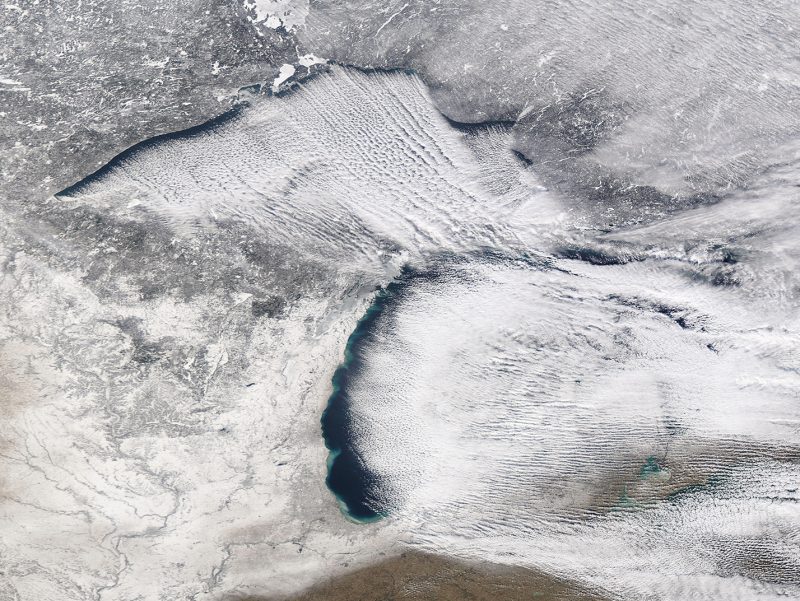
Cloud streets are long rows of cumulus clouds that are oriented parallel to the direction of the wind. Their technical name, more specifically, is horizontal convective rolls. As a matter of fact, you’ve probably seen them in satellite photos. Typically, they most often form straight rows, but when the wind driving the clouds hits an obstacle, the clouds might curl into patterns and become von Kármán vortex streets.

Orbital view of Great Lakes with clouds in thin parallel lines; entire region snow-covered.
These cloud streets appeared over the Great Lakes on January 20, 2022. Image via MODIS Land Rapid Response Team/ NASA/ GSFC.
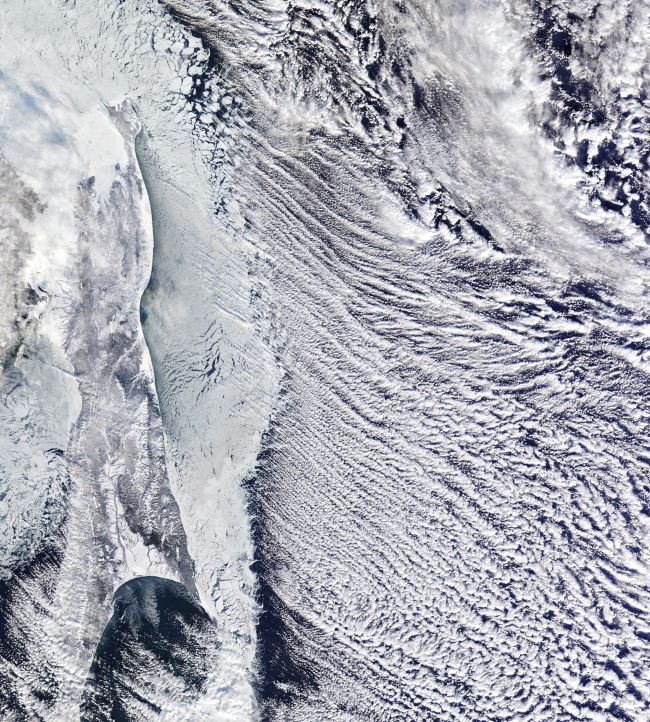
Satellite image showing thin, close rows of clouds streaming away from a body of water.
These cloud streets appeared over the Sea of Okhotsk, Russia, on December 28, 2023. The Moderate Resolution Imaging Spectroradiometer (MODIS) on NASA’s Terra satellite captured these parallel lines of cumulus clouds. Image via Michala Garrison, using MODIS data from NASA EOSDIS LANCE and GIBS/ Worldview/ NASA’s Earth Observatory.

How do cloud streets form?

Convection rolls of rising warm air and sinking cool air form cloud streets. First, rising warm air cools gradually as it ascends into the atmosphere. Then, when moisture in the warm air mass cools and condenses, it forms clouds. Meanwhile, sinking cool air on either side of the cloud formation zone creates a cloud-free area. Later, when several of these alternating rising and sinking air masses align with the wind, cloud streets develop.

Diagram of counter-rotating winds indicated by circular arrows.
This diagram depicts convection rolls and the formation of cloud streets. Image via NOAA.

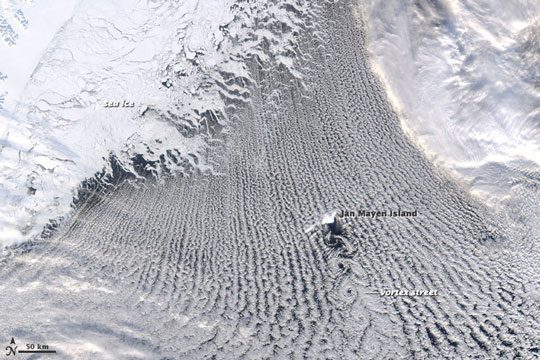
Typically, cloud streets form fairly straight lines over large, flat areas such as the ocean. However, when geological features like islands disrupt the flow of the wind, this disruption can create spiral patterns in the cloud streets. This is similar to the way in which large boulders create downstream eddies in rivers. Notably, the spiral patterns in clouds, called von Kármán vortex streets, were named after Theodore von Kármán, a co-founder of NASA’s Jet Propulsion Laboratory. He was one of the first scientists to describe this type of atmospheric phenomenon.

Meteorological phenomena such as cloud streets and von Kármán vortices are a manifestation of Earth’s atmosphere in motion.

The view from above

NASA has taken some amazing photographs of cloud streets over the past few years with MODIS on board the Terra and Aqua satellites. The satellite images on this page are from these instruments.

Closely arrayed thin parallel lines of clouds with a small circular formation and chain of vortices extending from it.
The MODIS instrument on NASA’s Aqua satellite acquired this image of a von Kármán vortex street that formed off the coast of Greenland on February 24, 2009. Image via NASA/ Jeff Schmaltz/ MODIS Rapid Response Team. Read more about this image.
Many curved parallel lines of clouds seen from orbit in black and white.
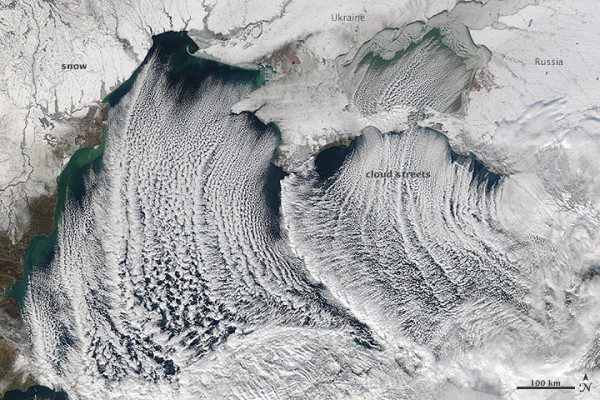
The MODIS instrument on NASA’s Aqua satellite captured this image of cloud streets over the Black Sea on January 8, 2015. Image via NASA Earth Observatory/ Jeff Schmaltz. Read more about this image.
Cloud streets: Thin parallel lines of clouds extending from ice shelf in black-and-white orbital photo.
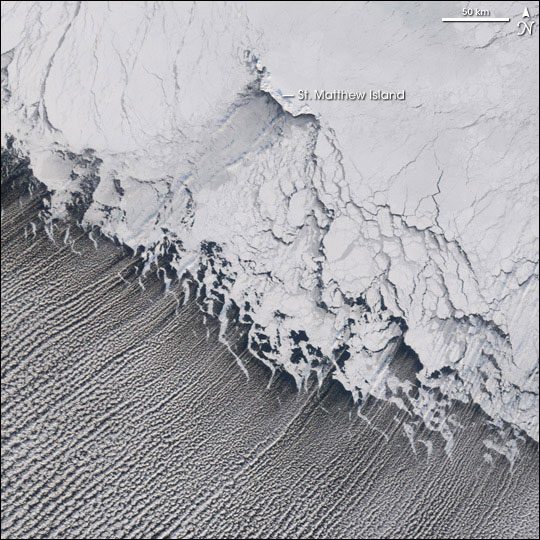
The MODIS instrument on NASA’s Terra satellite captured these cloud streets over the Bering Sea on January 20, 2006. Image via Jesse Allen/ NASA. Read more about this image.
Rows of puffy cumulus clouds seen from above with part of airplane wing visible.
View larger. | Typically, cloud streets are most readily seen in satellite photography, but this aerial image comes from Rosimar Ríos Berríos, via NOAA/ Hurricane Research Division.

Bottom line: See a new video of cloud streets from off the coast of the southeastern U.S. and read more about the phenomenon here.

The post Amazing cloud streets video: See it here! first appeared on EarthSky.


from EarthSky https://ift.tt/b1Jiv2g
Moving image of clouds moving in columns off the southeast of the US over water.
NOAA’s GOES-19 satellite captured these cloud streets flowing off the southeastern U.S. on February 1, 2026. Read more about cloud streets below. Image via NOAA.

On February 3, 2026, NOAA shared the above image of clouds rolling off the southeastern United States in neat columns. Meteorologists call this phenomenon cloud streets. NOAA said:

The recent Arctic blast that prompted freeze warnings as far south as southern Florida also created a captivating phenomenon over the waters of the Gulf and Atlantic on Sunday, February 1, 2026. NOAA’s GOES East satellite captured long, parallel bands of clouds called horizontal convective rolls.

Better known as ‘cloud streets,’ these formations can develop when cold, dry air flows over relatively warmer water. As the air absorbs heat and moisture from below, rows of long, parallel lines of cumulus clouds form, usually aligned with the wind direction. In the satellite imagery above, a gap of clear skies is visible between the coastline and where the cloud streets begin. That’s due to the time and distance it takes the cold air to pick up the heat and moisture from the water to form clouds.

The frigid air that plunged southward on Sunday was some of the coldest that Florida has seen in years. Temperatures dropped to 23 degrees Fahrenheit in Winter Haven, 29 degrees in Tampa, 30 degrees in West Palm Beach and 35 degrees in Miami.

EarthSky’s 2026 lunar calendar is available now. Get yours today! Makes a great gift.

What are cloud streets?

Cloud streets are long rows of cumulus clouds that are oriented parallel to the direction of the wind. Their technical name, more specifically, is horizontal convective rolls. As a matter of fact, you’ve probably seen them in satellite photos. Typically, they most often form straight rows, but when the wind driving the clouds hits an obstacle, the clouds might curl into patterns and become von Kármán vortex streets.

Orbital view of Great Lakes with clouds in thin parallel lines; entire region snow-covered.
These cloud streets appeared over the Great Lakes on January 20, 2022. Image via MODIS Land Rapid Response Team/ NASA/ GSFC.
Satellite image showing thin, close rows of clouds streaming away from a body of water.
These cloud streets appeared over the Sea of Okhotsk, Russia, on December 28, 2023. The Moderate Resolution Imaging Spectroradiometer (MODIS) on NASA’s Terra satellite captured these parallel lines of cumulus clouds. Image via Michala Garrison, using MODIS data from NASA EOSDIS LANCE and GIBS/ Worldview/ NASA’s Earth Observatory.

How do cloud streets form?

Convection rolls of rising warm air and sinking cool air form cloud streets. First, rising warm air cools gradually as it ascends into the atmosphere. Then, when moisture in the warm air mass cools and condenses, it forms clouds. Meanwhile, sinking cool air on either side of the cloud formation zone creates a cloud-free area. Later, when several of these alternating rising and sinking air masses align with the wind, cloud streets develop.

Diagram of counter-rotating winds indicated by circular arrows.
This diagram depicts convection rolls and the formation of cloud streets. Image via NOAA.

Typically, cloud streets form fairly straight lines over large, flat areas such as the ocean. However, when geological features like islands disrupt the flow of the wind, this disruption can create spiral patterns in the cloud streets. This is similar to the way in which large boulders create downstream eddies in rivers. Notably, the spiral patterns in clouds, called von Kármán vortex streets, were named after Theodore von Kármán, a co-founder of NASA’s Jet Propulsion Laboratory. He was one of the first scientists to describe this type of atmospheric phenomenon.

Meteorological phenomena such as cloud streets and von Kármán vortices are a manifestation of Earth’s atmosphere in motion.

The view from above

NASA has taken some amazing photographs of cloud streets over the past few years with MODIS on board the Terra and Aqua satellites. The satellite images on this page are from these instruments.

Closely arrayed thin parallel lines of clouds with a small circular formation and chain of vortices extending from it.
The MODIS instrument on NASA’s Aqua satellite acquired this image of a von Kármán vortex street that formed off the coast of Greenland on February 24, 2009. Image via NASA/ Jeff Schmaltz/ MODIS Rapid Response Team. Read more about this image.
Many curved parallel lines of clouds seen from orbit in black and white.
The MODIS instrument on NASA’s Aqua satellite captured this image of cloud streets over the Black Sea on January 8, 2015. Image via NASA Earth Observatory/ Jeff Schmaltz. Read more about this image.
Cloud streets: Thin parallel lines of clouds extending from ice shelf in black-and-white orbital photo.
The MODIS instrument on NASA’s Terra satellite captured these cloud streets over the Bering Sea on January 20, 2006. Image via Jesse Allen/ NASA. Read more about this image.
Rows of puffy cumulus clouds seen from above with part of airplane wing visible.
View larger. | Typically, cloud streets are most readily seen in satellite photography, but this aerial image comes from Rosimar Ríos Berríos, via NOAA/ Hurricane Research Division.

Bottom line: See a new video of cloud streets from off the coast of the southeastern U.S. and read more about the phenomenon here.

The post Amazing cloud streets video: See it here! first appeared on EarthSky.


from EarthSky https://ift.tt/b1Jiv2g

Mercury lives on? Strange streaks hint at active world

More than half-lit, gray, moonlike planet with many craters, some white with white radial streaks.
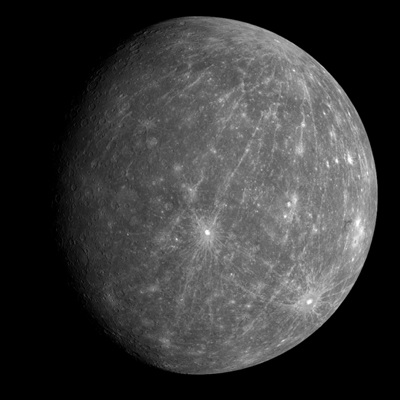
Mercury, as seen by NASA’s MESSENGER orbiter. Through a new analysis of MESSENGER’s images, researchers have found surprising geological activity on our solar system’s innermost planet. Image via NASA.

EarthSky’s 2026 lunar calendar is available now. Get yours today! Makes a great gift.

Strange streaks on Mercury hint at an active world

A new study suggests the reports of Mercury’s death have been greatly exaggerated.

Until now, Mercury’s barren and unchanging surface has long led scientists to believe that it’s a dead, geologically inactive world. But recently, researchers found evidence that geological processes continue to shape the surface of our sun’s innermost planet.

By analyzing images captured by the Mercury-orbiting MESSENGER spacecraft between 2011 and 2015, scientists uncovered and mapped some 400 lineae – strange, bright streaks – scattered across Mercury.

The researchers believe volatile material spewing from beneath the planet’s surface created these streaks. And this geological activity, they said, is likely continuing today.

The research team, from the University of Bern and the Astronomical Observatory of Padua (INAF), published its findings on January 27, 2026, in the peer-reviewed journal Nature Communications Earth & Environment.

A tall crater wall viewed from orbit with bright white streaks running downward from its rim.
According to a new study, these bright streaks on Mercury – long considered a dead world – point to unexpected recent geological activity on the planet’s surface. The MESSENGER spacecraft took this image on April 10, 2014. Image via NASA/ JHUAPL/ Carnegie Institution of Washington.

Strange bright streaks on Mercury

This exciting discovery comes from the first ever mapping of lineae on Mercury. Lineae is a catch-all term referring to any long markings on a world’s surface. These features have been observed throughout the solar system, most notably on Mars and Jupiter’s moon Europa. Although a few lineae were spotted on Mercury prior to this study, not enough were documented for scientists to identify the process behind them.

That’s why this research team, led by Valentin Bickel of the University of Bern, set out to perform the first comprehensive survey of lineae on our solar system’s innermost world. Bickel explained:

Until now, lineae on Mercury had not been systematically mapped and studied; only a small handful of streaks were known. With the image analysis, we were able to create the first census, i.e., a systematic inventory, of slope streaks on Mercury.

The team used machine learning to analyze some 100,000 images captured by NASA’s MESSENGER spacecraft. Their study revealed around 400 of these strange streaks on Mercury. After mapping their distribution across the planet, researchers noticed an intriguing trend.

Solar-powered activity

On Mercury, the streaks are mostly found on the sun-facing slopes of the youngest impact craters. This indicates two processes.

When space rocks impact Mercury, it appears they create routes into the bedrock through which volatiles – materials that easily vaporize and escape into space – flow out. This spewing out of gaseous material is known as outgassing. Bickel explained:

Volatile material could reach the surface from deeper layers through networks of cracks in the rock caused by the preceding impact.

Most of the streaks appear to originate from bright depressions, so-called hollows. These hollows are probably also formed by the outgassing of volatile material and are usually located in the shallow interior or along the edges of large impact craters.

So the crater-forming impacts provide a route for these materials – mostly sulfur and other light elements – to escape. But the fact that the streaks are found in the exposed, sun-catching parts of these craters offers another clue. It appears that radiation from the sun helps agitate these chemicals and draws them out of Mercury’s interior.

Combined, these 2 processes result in continual geological change on a planet that had seemed dormant. Bickel summarized:

Our findings paint a completely different, dynamic picture of the supposedly dead, dry and boring planet Mercury.

A deep circular crater with white streaks running from the rim down the crater walls.
Another view of lineae on the slope of one of Mercury’s craters. MESSENGER captured this image on October 19, 2013. Image via NASA/ JHUAPL/ Carnegie Institution of Washington.

Deepening our understanding of Mercury

The lineae could also reveal how the geological activity is affecting Mercury. Bickel explained:

As the streaks on Mercury are presumably caused by the outgassing of volatile material, they could be a promising indicator of Mercury’s ‘volatile budget,’ i.e., how much volatile material the planet is continuously losing.

It’s a great time to investigate this geological change on Mercury, as the European-Japanese BepiColombo mission is on its way to study Mercury up close. Launched in 2018, BepiColombo has already performed six flybys of Mercury, but its real science mission will begin shortly after it enters orbit around the planet in late 2026.

BepiColombo will study Mercury’s composition, atmosphere and magnetic field in unprecedented detail. Plus, it will create a new map of the planet’s surface. Bickel and his team can then compare the new map to the MESSENGER images, revealing any new streaks that have emerged in the past decade. By comparing MESSENGER and BepiColombo data, researchers will know if this once-presumed-dead planet is active and alive.

Bottom line: New analysis of bright streaks on the surface of Mercury suggests that this world, long thought dead, is geologically active.

Via University of Bern

Source: Slope lineae as potential indicators of recent volatile loss on Mercury

Read more: Massive grazing collision created Mercury, new theory says

The post Mercury lives on? Strange streaks hint at active world first appeared on EarthSky.


from EarthSky https://ift.tt/SO3QIYA
More than half-lit, gray, moonlike planet with many craters, some white with white radial streaks.
Mercury, as seen by NASA’s MESSENGER orbiter. Through a new analysis of MESSENGER’s images, researchers have found surprising geological activity on our solar system’s innermost planet. Image via NASA.

EarthSky’s 2026 lunar calendar is available now. Get yours today! Makes a great gift.

Strange streaks on Mercury hint at an active world

A new study suggests the reports of Mercury’s death have been greatly exaggerated.

Until now, Mercury’s barren and unchanging surface has long led scientists to believe that it’s a dead, geologically inactive world. But recently, researchers found evidence that geological processes continue to shape the surface of our sun’s innermost planet.

By analyzing images captured by the Mercury-orbiting MESSENGER spacecraft between 2011 and 2015, scientists uncovered and mapped some 400 lineae – strange, bright streaks – scattered across Mercury.

The researchers believe volatile material spewing from beneath the planet’s surface created these streaks. And this geological activity, they said, is likely continuing today.

The research team, from the University of Bern and the Astronomical Observatory of Padua (INAF), published its findings on January 27, 2026, in the peer-reviewed journal Nature Communications Earth & Environment.

A tall crater wall viewed from orbit with bright white streaks running downward from its rim.
According to a new study, these bright streaks on Mercury – long considered a dead world – point to unexpected recent geological activity on the planet’s surface. The MESSENGER spacecraft took this image on April 10, 2014. Image via NASA/ JHUAPL/ Carnegie Institution of Washington.

Strange bright streaks on Mercury

This exciting discovery comes from the first ever mapping of lineae on Mercury. Lineae is a catch-all term referring to any long markings on a world’s surface. These features have been observed throughout the solar system, most notably on Mars and Jupiter’s moon Europa. Although a few lineae were spotted on Mercury prior to this study, not enough were documented for scientists to identify the process behind them.

That’s why this research team, led by Valentin Bickel of the University of Bern, set out to perform the first comprehensive survey of lineae on our solar system’s innermost world. Bickel explained:

Until now, lineae on Mercury had not been systematically mapped and studied; only a small handful of streaks were known. With the image analysis, we were able to create the first census, i.e., a systematic inventory, of slope streaks on Mercury.

The team used machine learning to analyze some 100,000 images captured by NASA’s MESSENGER spacecraft. Their study revealed around 400 of these strange streaks on Mercury. After mapping their distribution across the planet, researchers noticed an intriguing trend.

Solar-powered activity

On Mercury, the streaks are mostly found on the sun-facing slopes of the youngest impact craters. This indicates two processes.

When space rocks impact Mercury, it appears they create routes into the bedrock through which volatiles – materials that easily vaporize and escape into space – flow out. This spewing out of gaseous material is known as outgassing. Bickel explained:

Volatile material could reach the surface from deeper layers through networks of cracks in the rock caused by the preceding impact.

Most of the streaks appear to originate from bright depressions, so-called hollows. These hollows are probably also formed by the outgassing of volatile material and are usually located in the shallow interior or along the edges of large impact craters.

So the crater-forming impacts provide a route for these materials – mostly sulfur and other light elements – to escape. But the fact that the streaks are found in the exposed, sun-catching parts of these craters offers another clue. It appears that radiation from the sun helps agitate these chemicals and draws them out of Mercury’s interior.

Combined, these 2 processes result in continual geological change on a planet that had seemed dormant. Bickel summarized:

Our findings paint a completely different, dynamic picture of the supposedly dead, dry and boring planet Mercury.

A deep circular crater with white streaks running from the rim down the crater walls.
Another view of lineae on the slope of one of Mercury’s craters. MESSENGER captured this image on October 19, 2013. Image via NASA/ JHUAPL/ Carnegie Institution of Washington.

Deepening our understanding of Mercury

The lineae could also reveal how the geological activity is affecting Mercury. Bickel explained:

As the streaks on Mercury are presumably caused by the outgassing of volatile material, they could be a promising indicator of Mercury’s ‘volatile budget,’ i.e., how much volatile material the planet is continuously losing.

It’s a great time to investigate this geological change on Mercury, as the European-Japanese BepiColombo mission is on its way to study Mercury up close. Launched in 2018, BepiColombo has already performed six flybys of Mercury, but its real science mission will begin shortly after it enters orbit around the planet in late 2026.

BepiColombo will study Mercury’s composition, atmosphere and magnetic field in unprecedented detail. Plus, it will create a new map of the planet’s surface. Bickel and his team can then compare the new map to the MESSENGER images, revealing any new streaks that have emerged in the past decade. By comparing MESSENGER and BepiColombo data, researchers will know if this once-presumed-dead planet is active and alive.

Bottom line: New analysis of bright streaks on the surface of Mercury suggests that this world, long thought dead, is geologically active.

Via University of Bern

Source: Slope lineae as potential indicators of recent volatile loss on Mercury

Read more: Massive grazing collision created Mercury, new theory says

The post Mercury lives on? Strange streaks hint at active world first appeared on EarthSky.


from EarthSky https://ift.tt/SO3QIYA

adds 2