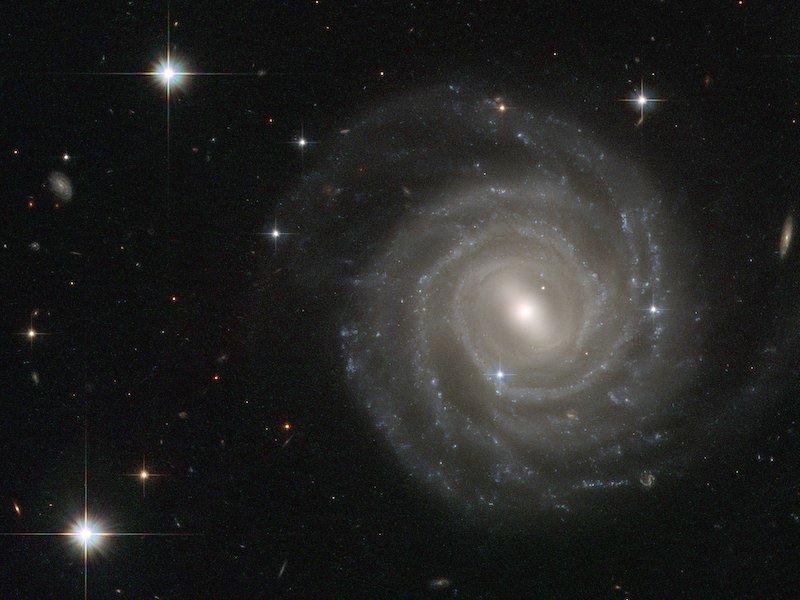
Our Milky Way galaxy is the island of stars we call home. If you imagine it as a disk with spiral arms emanating from the center, our sun is approximately halfway from the center to the visible edge.
But we aren’t free floating in empty space, however. That’s because we lie on the edge of a relatively minor spiral arm, the Orion-Cygnus Arm, or simply, the Orion Arm or Local Arm. The Orion Arm of the Milky Way is probably some 3,500 light-years wide. A 2016 study suggests it’s more than 20,000 light-years long.
The Milky Way is what’s called a barred spiral galaxy. That means it has a central bar. However, there’s still a lot we don’t know about the structure of our galaxy. But studies indicate the Milky Way is about 100,000 light-years across, about 2,000 light-years deep, and has 100 to 400 billion stars.
Previously, astronomers thought that our spiral galaxy had four major arms. But now, they say it has just two major arms and many minor arms.
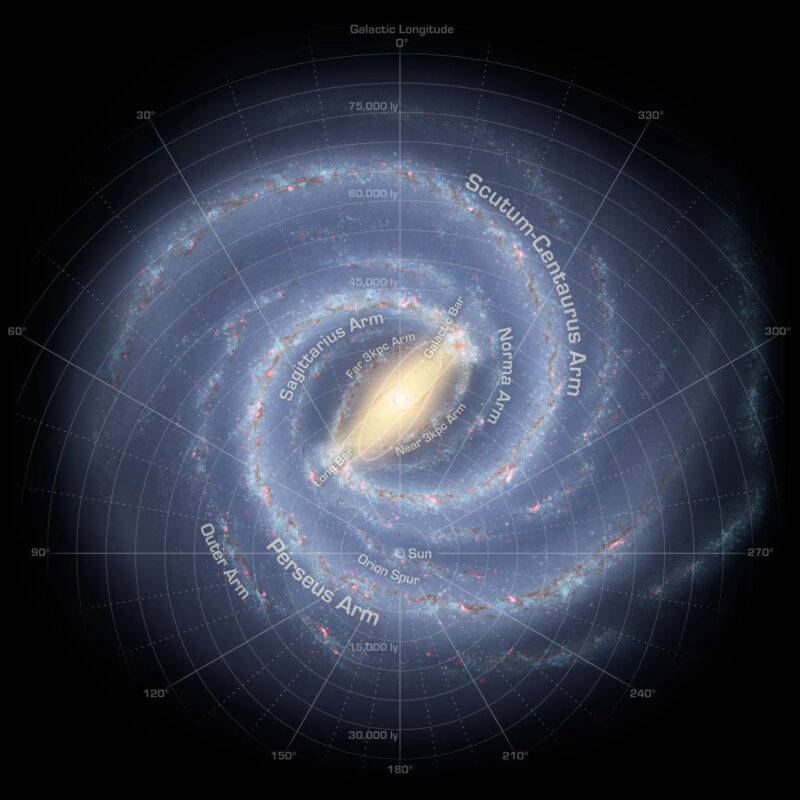
So where, within this vast spiral structure, do our sun and its planets reside? We’re about 26,000 light-years from the center of the galaxy, on the inner edge of the Orion-Cygnus Arm.
View larger. | Artist’s concept of our Milky Way galaxy. Astronomers now believe the Milky Way galaxy has 2 major arms and many minor arms. Our sun is about halfway from the galactic center, on a minor arm that’s sometimes called the Orion Spur. Image via NASA.
How our local spiral arm got its name
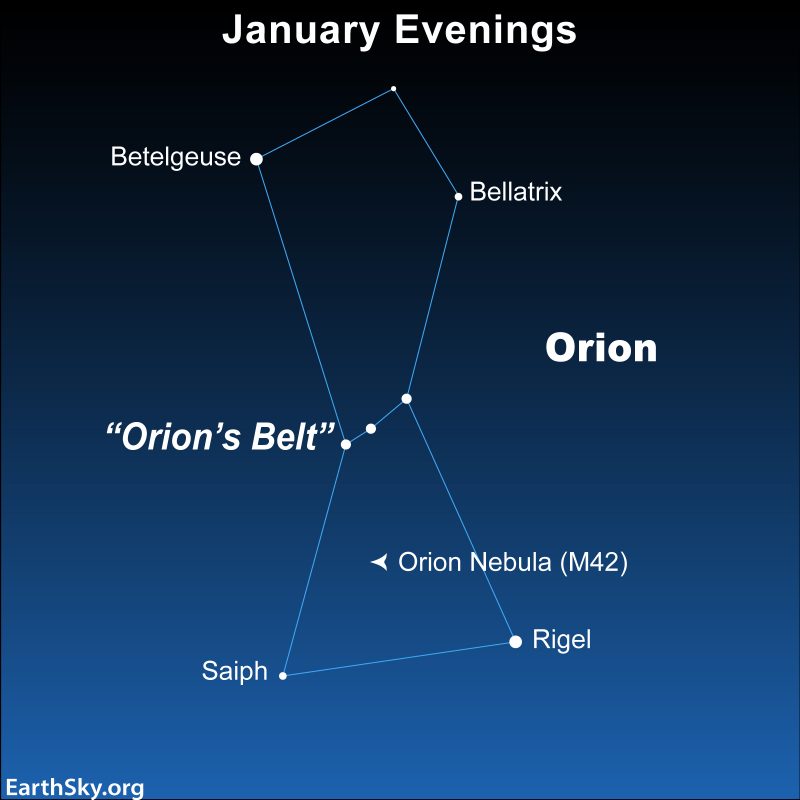
The Orion Arm gets its name from the constellation Orion the Hunter, which is one of the most prominent constellations of the Northern Hemisphere winter (Southern Hemisphere summer). Indeed, some of the brightest stars and most famous celestial objects of this constellation (Betelgeuse, Rigel, the stars of Orion’s Belt, the Orion nebula) are neighbors to our sun. The reason we see so many bright objects within the constellation Orion is because when we look at it, we’re looking into our own local spiral arm.
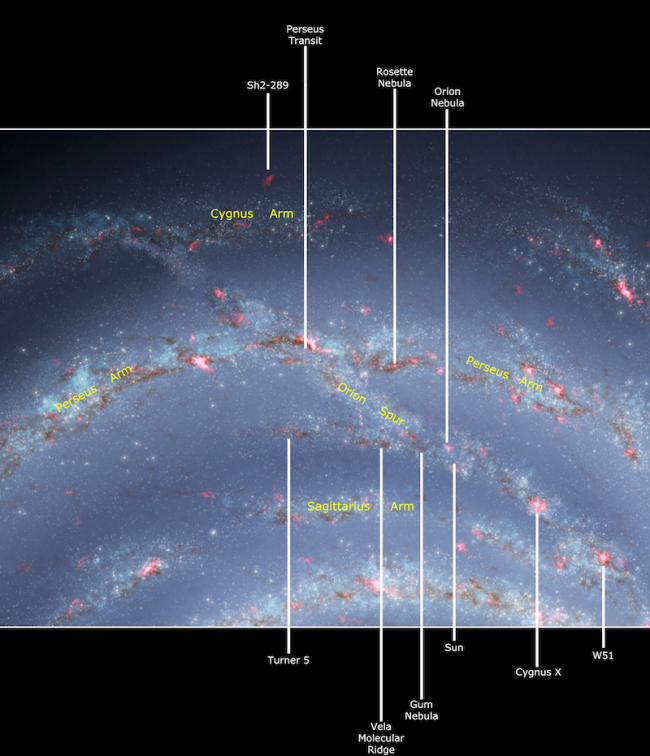
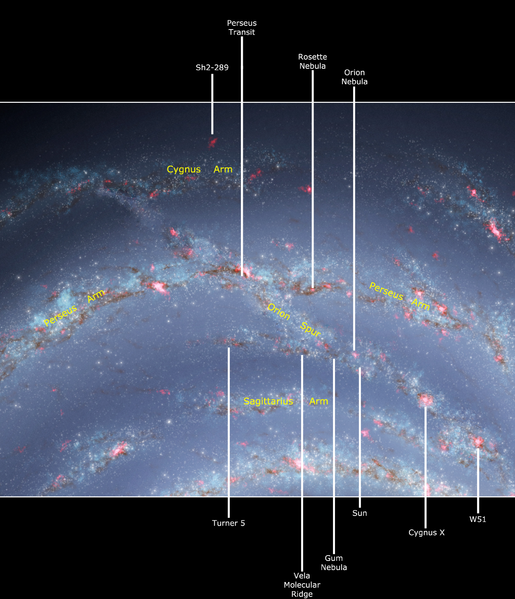
View larger. | Artist’s concept of our galactic neighborhood. Some of the best-known astronomical objects in our sky lie in the Orion Arm, along with our sun. Image via NASA/ R. Hurt/ Wikimedia Commons.
Our location in the galaxy is significant, as it appears that – like planetary systems – galaxies have habitable zones.
An astonishing 95% of the Milky Way’s suns may not be able to sustain habitable planets, because many orbit the galaxy in paths that carry them through the deadly spiral arms. Any star that passes through one of these starry swarms is subject to deadly radiation from the congested stars. Our own solar system orbits far enough from the center to keep it in sync with the rotation of the rest of the galaxy, so that it remains in the quieter space between the spiral arms. The Earth and its planetary siblings are well placed in a quiet, resource-rich niche of a vast and complex galaxy.
Flying into Orion’s Belt at 0.001c ?
The hunter isn’t flat. It’s a real 3D region of space. (Upgraded animation!) #astronomy ?
Our Milky Way galaxy is the island of stars we call home. If you imagine it as a disk with spiral arms emanating from the center, our sun is approximately halfway from the center to the visible edge.
But we aren’t free floating in empty space, however. That’s because we lie on the edge of a relatively minor spiral arm, the Orion-Cygnus Arm, or simply, the Orion Arm or Local Arm. The Orion Arm of the Milky Way is probably some 3,500 light-years wide. A 2016 study suggests it’s more than 20,000 light-years long.
The Milky Way is what’s called a barred spiral galaxy. That means it has a central bar. However, there’s still a lot we don’t know about the structure of our galaxy. But studies indicate the Milky Way is about 100,000 light-years across, about 2,000 light-years deep, and has 100 to 400 billion stars.
Previously, astronomers thought that our spiral galaxy had four major arms. But now, they say it has just two major arms and many minor arms.
So where, within this vast spiral structure, do our sun and its planets reside? We’re about 26,000 light-years from the center of the galaxy, on the inner edge of the Orion-Cygnus Arm.
View larger. | Artist’s concept of our Milky Way galaxy. Astronomers now believe the Milky Way galaxy has 2 major arms and many minor arms. Our sun is about halfway from the galactic center, on a minor arm that’s sometimes called the Orion Spur. Image via NASA.
How our local spiral arm got its name
The Orion Arm gets its name from the constellation Orion the Hunter, which is one of the most prominent constellations of the Northern Hemisphere winter (Southern Hemisphere summer). Indeed, some of the brightest stars and most famous celestial objects of this constellation (Betelgeuse, Rigel, the stars of Orion’s Belt, the Orion nebula) are neighbors to our sun. The reason we see so many bright objects within the constellation Orion is because when we look at it, we’re looking into our own local spiral arm.
View larger. | Artist’s concept of our galactic neighborhood. Some of the best-known astronomical objects in our sky lie in the Orion Arm, along with our sun. Image via NASA/ R. Hurt/ Wikimedia Commons.
Our location in the galaxy is significant, as it appears that – like planetary systems – galaxies have habitable zones.
An astonishing 95% of the Milky Way’s suns may not be able to sustain habitable planets, because many orbit the galaxy in paths that carry them through the deadly spiral arms. Any star that passes through one of these starry swarms is subject to deadly radiation from the congested stars. Our own solar system orbits far enough from the center to keep it in sync with the rotation of the rest of the galaxy, so that it remains in the quieter space between the spiral arms. The Earth and its planetary siblings are well placed in a quiet, resource-rich niche of a vast and complex galaxy.
Flying into Orion’s Belt at 0.001c ?
The hunter isn’t flat. It’s a real 3D region of space. (Upgraded animation!) #astronomy ?
View larger. | This is an artist’s concept of a super-Earth with a deep magma ocean generating a magnetic field. Could powerful magnetic fields on super-Earths help these worlds be habitable for life? Image via University of Rochester Laboratory for Laser Energetics/ Michael Franchot/ University of Rochester.
Super-Earths are rocky exoplanets larger than Earth but smaller than Neptune. Could they support life?
Super-Earths could have powerful magnetic fields stronger than Earth’s magnetic field. Magma oceans beneath their surfaces could generate them.
These magnetic fields could help shield the surface – and possible life – from their stars’ intense radiation, just as Earth’s magnetic field protects us.
Super-Earths – or rocky exoplanets between Earth and Neptune in size – might be more friendly to life than scientists thought. On January 15, 2026, researchers at the University of Rochester in New York said super-Earths might have powerful magnetic fields that help protect the surface – and any potential life – from deadly radiation from their stars.
On Earth, our protective magnetic field is generated by movement in the liquid iron outer core. But on super-Earths, the scientists said deep oceans of hot magma could produce the magnetic fields. If a super-Earth were habitable, then its magnetic field would shield any life present from the star’s radiation, just as happens on Earth.
The research team published its intriguing peer-reviewed findings in Nature Astronomy on January 15, 2026.
Molten rock layers deep within super-Earths may generate strong magnetic fields, potentially shielding these exoplanets from harmful cosmic radiation and enhancing their habitability. doi.org/hbj5pg
Magma oceans and strong magnetic fields on super-Earths
Scientists have said super-Earths might not have the same kind of liquid iron outer core as Earth does. So could they still have magnetic fields?
The new study suggests they could, through a slightly different mechanism than what happens on Earth. These large rocky worlds could have a subsurface ocean of hot magma called a basal magma ocean. This magma could produce magnetic fields even stronger than Earth’s. As lead author Miki Nakajima at the University of Rochester explained:
A strong magnetic field is very important for life on a planet, but most of the terrestrial planets in the solar system, such as Venus and Mars, do not have them because their cores don’t have the right physical conditions to generate a magnetic field. However, super-Earths can produce dynamos in their core and/or magma, which can increase their planetary habitability.
To find out if super-Earths could have magnetic fields, the researchers needed to simulate conditions inside them. Super-Earths are larger than Earth, and so they have immense pressures inside them. That means they could have long-lasting basal magma oceans and, therefore, magnetic fields.
To test that hypothesis, the researchers studied molten rock under similar conditions to what would happen in a basal magma ocean inside a super-Earth. They conducted laser shock experiments at the University of Rochester’s Laboratory for Laser Energetics. They then combined the data with quantum mechanical simulations and planetary evolution models.
The result? They found that the molten rock became electrically conductive. In fact, the magma was able to produce a powerful magnetic field stronger than Earth’s. In addition, the magnetic field could last for billions of years. That’s good news in terms of potential habitability. Nakajima said:
This work was exciting and challenging, given that my background is primarily computational and this was my first experimental work. I’m very grateful for the support from my collaborators from various research fields to conduct this interdisciplinary work. I cannot wait for future magnetic field observations of exoplanets to test our hypothesis.
Miki Nakajima at Rochester University in New York led the new study about super-Earths and their magnetic fields. Image via University of Rochester.
Potentially habitable super-Earths
There’s still a lot we don’t know about super-Earths. This includes whether they can truly be habitable. They are rocky like Earth, but bigger and more massive. How would that affect conditions on the surface?
But a powerful magnetic field would be hugely beneficial. Just as Earth’s magnetic field helps protect life on the surface by blocking deadly radiation from the sun, the same could apply to super-Earths.
Super-Earths are surprisingly common
Super-Earths are some of the most common exoplanets that astronomers have found so far. That was a bit surprising to astronomers, because our own solar system doesn’t have one. But that makes them all the more intriguing.
How many are there in our galaxy? How do they form? Can they support life? These are all questions that scientists are seeking the answers to. And if any of them are indeed confirmed to have magnetic fields, that will make them even more enticing in the search for life elsewhere.
Bottom line: A new study said powerful magnetic fields on super-Earths could help shield them from radiation from their stars, making them potentially more friendly to life.
View larger. | This is an artist’s concept of a super-Earth with a deep magma ocean generating a magnetic field. Could powerful magnetic fields on super-Earths help these worlds be habitable for life? Image via University of Rochester Laboratory for Laser Energetics/ Michael Franchot/ University of Rochester.
Super-Earths are rocky exoplanets larger than Earth but smaller than Neptune. Could they support life?
Super-Earths could have powerful magnetic fields stronger than Earth’s magnetic field. Magma oceans beneath their surfaces could generate them.
These magnetic fields could help shield the surface – and possible life – from their stars’ intense radiation, just as Earth’s magnetic field protects us.
Super-Earths – or rocky exoplanets between Earth and Neptune in size – might be more friendly to life than scientists thought. On January 15, 2026, researchers at the University of Rochester in New York said super-Earths might have powerful magnetic fields that help protect the surface – and any potential life – from deadly radiation from their stars.
On Earth, our protective magnetic field is generated by movement in the liquid iron outer core. But on super-Earths, the scientists said deep oceans of hot magma could produce the magnetic fields. If a super-Earth were habitable, then its magnetic field would shield any life present from the star’s radiation, just as happens on Earth.
The research team published its intriguing peer-reviewed findings in Nature Astronomy on January 15, 2026.
Molten rock layers deep within super-Earths may generate strong magnetic fields, potentially shielding these exoplanets from harmful cosmic radiation and enhancing their habitability. doi.org/hbj5pg
Magma oceans and strong magnetic fields on super-Earths
Scientists have said super-Earths might not have the same kind of liquid iron outer core as Earth does. So could they still have magnetic fields?
The new study suggests they could, through a slightly different mechanism than what happens on Earth. These large rocky worlds could have a subsurface ocean of hot magma called a basal magma ocean. This magma could produce magnetic fields even stronger than Earth’s. As lead author Miki Nakajima at the University of Rochester explained:
A strong magnetic field is very important for life on a planet, but most of the terrestrial planets in the solar system, such as Venus and Mars, do not have them because their cores don’t have the right physical conditions to generate a magnetic field. However, super-Earths can produce dynamos in their core and/or magma, which can increase their planetary habitability.
To find out if super-Earths could have magnetic fields, the researchers needed to simulate conditions inside them. Super-Earths are larger than Earth, and so they have immense pressures inside them. That means they could have long-lasting basal magma oceans and, therefore, magnetic fields.
To test that hypothesis, the researchers studied molten rock under similar conditions to what would happen in a basal magma ocean inside a super-Earth. They conducted laser shock experiments at the University of Rochester’s Laboratory for Laser Energetics. They then combined the data with quantum mechanical simulations and planetary evolution models.
The result? They found that the molten rock became electrically conductive. In fact, the magma was able to produce a powerful magnetic field stronger than Earth’s. In addition, the magnetic field could last for billions of years. That’s good news in terms of potential habitability. Nakajima said:
This work was exciting and challenging, given that my background is primarily computational and this was my first experimental work. I’m very grateful for the support from my collaborators from various research fields to conduct this interdisciplinary work. I cannot wait for future magnetic field observations of exoplanets to test our hypothesis.
Miki Nakajima at Rochester University in New York led the new study about super-Earths and their magnetic fields. Image via University of Rochester.
Potentially habitable super-Earths
There’s still a lot we don’t know about super-Earths. This includes whether they can truly be habitable. They are rocky like Earth, but bigger and more massive. How would that affect conditions on the surface?
But a powerful magnetic field would be hugely beneficial. Just as Earth’s magnetic field helps protect life on the surface by blocking deadly radiation from the sun, the same could apply to super-Earths.
Super-Earths are surprisingly common
Super-Earths are some of the most common exoplanets that astronomers have found so far. That was a bit surprising to astronomers, because our own solar system doesn’t have one. But that makes them all the more intriguing.
How many are there in our galaxy? How do they form? Can they support life? These are all questions that scientists are seeking the answers to. And if any of them are indeed confirmed to have magnetic fields, that will make them even more enticing in the search for life elsewhere.
Bottom line: A new study said powerful magnetic fields on super-Earths could help shield them from radiation from their stars, making them potentially more friendly to life.
Scientists found a piece of woolly rhino tissue in the stomach of this 14,400-year-old wolf pup. Genomic analysis of that rhino tissue and 2 other specimens indicate the species went extinct relatively fast. Image via Mietje Germonpré/ Stockholm University.
Scientists found woolly rhino tissue inside the stomach of a 14,400-year-old frozen wolf pup in Siberia.
Genomic analysis showed woolly rhinos stayed genetically healthy until a rapid population collapse near the end of the last Ice Age.
Researchers believe sudden climate warming played a key role in the species’ quick extinction.
Tissue in 14,400-year-old wolf pup belonged to a woolly rhino
As permafrost in far northern and southern latitudes thaws, people have found the remains of ancient animals, tens of thousands of years old. One wolf pup, buried for 14,400 years in the frozen ground at Tumat in northeastern Siberia, had a surprise inside. Scientists found a piece of tissue in its stomach. On January 15, 2026, researchers at Stockholm University said DNA analysis identified it as a now-extinct woolly rhinoceros (Coelodonta antiquitati). Plus, additional genomic analysis of this rhino and two others indicate woolly rhinos remained genetically healthy till the end of the last ice age. Then they underwent a sharp population collapse due to a rapidly changing climate.
Camilo Chacón-Duque of Stockholm University is a co-author of the new paper on these results. He said:
Sequencing the entire genome of an Ice Age animal found in the stomach of another animal has never been done before.
Recovering genomes from individuals that lived right before extinction is challenging, but it can provide important clues on what caused the species to disappear, which may also be relevant for the conservation of endangered species today.
The researchers published their findings in the peer-reviewed journal Genome Biology and Evolution on January 14, 2026.
Woolly rhinos once roamed northern Eurasia
Woolly rhinos were well-adapted for ice age conditions. These hefty creatures had brown fur coats and were insulated by thick layers of fat under the skin. They grazed in cold tundra grasslands of Northern Europe and Asia during the Middle and Late Pleistocene (spanning 774,100 to 11,700 years ago).
These rhinos were about 11 feet (3.3 m) long from head to tail, comparable in size to the white rhinoceros. But the woolly rhino had a longer head and body, and shorter legs. In addition, it had small ears and a short tail, which were adaptations to minimize heat loss. Moreover, the impressive horn on its head may have been used in fights and perhaps to push away snow covering the grass.
There is archaeological evidence that humans hunted or scavenged woolly rhinos, but scientists don’t know if this happened frequently. For instance, bones found in some caves in Europe show signs of cut marks and breaks. Early modern humans even used woolly rhino bones to make tools and weapons. Remarkably, they also depicted woolly rhinos in their art, such as in cave paintings and even as statuettes.
This is artist Benjamin Langlois’ depiction of how the woolly rhino may have appeared in life. Image via Mr Langlois10/ Wikimedia Commons. (CC BY-SA 4.0)
A challenging analysis of tissue from a wolf’s stomach
Scientists used radiocarbon dating to age the wolf pup and the tissue in its stomach. Their results showed both were 14,400 years old. Subsequent DNA analysis of the tissue revealed it belonged to a woolly rhinoceros.
This rhino was a large animal. Therefore, the researchers think the wolves did not hunt it, but instead scavenged a carcass. What’s remarkable about this find is that it was – at 14,400 years old – the youngest woolly rhino tissue sample ever found. Moreover, researchers dated it to just a few centuries before the species became extinct, about 14,000 years ago.
The tissue, just 1.6 by 1.2 inches (4 cm by 3 cm) large, ended up in the wolf shortly before it died. Still, mapping the genome proved to be difficult because DNA degrades over time, and parts of the sample contained wolf DNA.
It was really exciting, but also very challenging, to extract a complete genome from such an unusual sample.
The woolly rhino tissue recovered from the wolf pup’s stomach. Image via Love Dalén/ Stockholm University.
What happened to the woolly rhino?
The researchers also examined the genome of two other woolly rhinoceros specimens, from 18,000 and 49,000 years ago. They wanted to compare the three samples to study changes in the diversity of the genomes, the level of inbreeding and harmful mutations.
If the woolly rhino population had gradually dwindled to low numbers, the researchers would have seen signs of inbreeding and a rise in genetic mutations in the 14,400-year-old sample from the wolf’s stomach.
Instead, they found the opposite. Co-author Edana Lord of Stockholm University remarked:
Our analyses showed a surprisingly stable genetic pattern with no change in inbreeding levels through tens of thousands of years prior to the extinction of woolly rhinos.
Therefore, the scientists concluded, extinction happened relatively quickly. They think it occurred during a period in geological history known as the Bølling–Allerød interstadial (14,690 to 12,890 years ago). That’s when the Northern Hemisphere warmed abruptly. The change in climate increased rainfall, transforming the rhinos’ grassy plains to one of trees and shrubs.
Bottom line: Scientists found tissue from a woolly rhino in the stomach of a 14,400-year-old frozen wolf. Genomic analysis of the tissue indicates woolly rhinos became extinct relatively quickly.
Scientists found a piece of woolly rhino tissue in the stomach of this 14,400-year-old wolf pup. Genomic analysis of that rhino tissue and 2 other specimens indicate the species went extinct relatively fast. Image via Mietje Germonpré/ Stockholm University.
Scientists found woolly rhino tissue inside the stomach of a 14,400-year-old frozen wolf pup in Siberia.
Genomic analysis showed woolly rhinos stayed genetically healthy until a rapid population collapse near the end of the last Ice Age.
Researchers believe sudden climate warming played a key role in the species’ quick extinction.
Tissue in 14,400-year-old wolf pup belonged to a woolly rhino
As permafrost in far northern and southern latitudes thaws, people have found the remains of ancient animals, tens of thousands of years old. One wolf pup, buried for 14,400 years in the frozen ground at Tumat in northeastern Siberia, had a surprise inside. Scientists found a piece of tissue in its stomach. On January 15, 2026, researchers at Stockholm University said DNA analysis identified it as a now-extinct woolly rhinoceros (Coelodonta antiquitati). Plus, additional genomic analysis of this rhino and two others indicate woolly rhinos remained genetically healthy till the end of the last ice age. Then they underwent a sharp population collapse due to a rapidly changing climate.
Camilo Chacón-Duque of Stockholm University is a co-author of the new paper on these results. He said:
Sequencing the entire genome of an Ice Age animal found in the stomach of another animal has never been done before.
Recovering genomes from individuals that lived right before extinction is challenging, but it can provide important clues on what caused the species to disappear, which may also be relevant for the conservation of endangered species today.
The researchers published their findings in the peer-reviewed journal Genome Biology and Evolution on January 14, 2026.
Woolly rhinos once roamed northern Eurasia
Woolly rhinos were well-adapted for ice age conditions. These hefty creatures had brown fur coats and were insulated by thick layers of fat under the skin. They grazed in cold tundra grasslands of Northern Europe and Asia during the Middle and Late Pleistocene (spanning 774,100 to 11,700 years ago).
These rhinos were about 11 feet (3.3 m) long from head to tail, comparable in size to the white rhinoceros. But the woolly rhino had a longer head and body, and shorter legs. In addition, it had small ears and a short tail, which were adaptations to minimize heat loss. Moreover, the impressive horn on its head may have been used in fights and perhaps to push away snow covering the grass.
There is archaeological evidence that humans hunted or scavenged woolly rhinos, but scientists don’t know if this happened frequently. For instance, bones found in some caves in Europe show signs of cut marks and breaks. Early modern humans even used woolly rhino bones to make tools and weapons. Remarkably, they also depicted woolly rhinos in their art, such as in cave paintings and even as statuettes.
This is artist Benjamin Langlois’ depiction of how the woolly rhino may have appeared in life. Image via Mr Langlois10/ Wikimedia Commons. (CC BY-SA 4.0)
A challenging analysis of tissue from a wolf’s stomach
Scientists used radiocarbon dating to age the wolf pup and the tissue in its stomach. Their results showed both were 14,400 years old. Subsequent DNA analysis of the tissue revealed it belonged to a woolly rhinoceros.
This rhino was a large animal. Therefore, the researchers think the wolves did not hunt it, but instead scavenged a carcass. What’s remarkable about this find is that it was – at 14,400 years old – the youngest woolly rhino tissue sample ever found. Moreover, researchers dated it to just a few centuries before the species became extinct, about 14,000 years ago.
The tissue, just 1.6 by 1.2 inches (4 cm by 3 cm) large, ended up in the wolf shortly before it died. Still, mapping the genome proved to be difficult because DNA degrades over time, and parts of the sample contained wolf DNA.
It was really exciting, but also very challenging, to extract a complete genome from such an unusual sample.
The woolly rhino tissue recovered from the wolf pup’s stomach. Image via Love Dalén/ Stockholm University.
What happened to the woolly rhino?
The researchers also examined the genome of two other woolly rhinoceros specimens, from 18,000 and 49,000 years ago. They wanted to compare the three samples to study changes in the diversity of the genomes, the level of inbreeding and harmful mutations.
If the woolly rhino population had gradually dwindled to low numbers, the researchers would have seen signs of inbreeding and a rise in genetic mutations in the 14,400-year-old sample from the wolf’s stomach.
Instead, they found the opposite. Co-author Edana Lord of Stockholm University remarked:
Our analyses showed a surprisingly stable genetic pattern with no change in inbreeding levels through tens of thousands of years prior to the extinction of woolly rhinos.
Therefore, the scientists concluded, extinction happened relatively quickly. They think it occurred during a period in geological history known as the Bølling–Allerød interstadial (14,690 to 12,890 years ago). That’s when the Northern Hemisphere warmed abruptly. The change in climate increased rainfall, transforming the rhinos’ grassy plains to one of trees and shrubs.
Bottom line: Scientists found tissue from a woolly rhino in the stomach of a 14,400-year-old frozen wolf. Genomic analysis of the tissue indicates woolly rhinos became extinct relatively quickly.
AI image and video generators now produce fully lifelike content. Siwei Lyu, a professor of computer science and engineering at the University at Buffalo said deepfakes are flooding the internet, and they will only be more prevalent in 2026. Siwei Lyu generated this AI image using Google Gemini 3. Image via Siwei Lyu using Google Gemini 3/ The Conversation.
Deepfakes are AI-generated images and videos that often fool viewers into believing they’re real. They are exploding on the internet, and anyone can create them.
A cybersecurity firm estimated an increase from roughly 500,000 online deepfakes in 2023 to about 8 million in 2025, with annual growth nearing 900%.
In 2026, deepfakes will likely only get harder to recognize. They’re moving toward real-time synthesis that can produce videos that closely resemble the nuances of a human’s appearance, making it easier for them to evade detection systems.
Over the course of 2025, deepfakes improved dramatically. AI-generated faces, voices and full-body performances that mimic real people increased in quality far beyond what even many experts expected would be the case just a few years ago. They were also increasingly used to deceive people.
For many everyday scenarios – especially low-resolution video calls and media shared on social media platforms – their realism is now high enough to reliably fool nonexpert viewers. In practical terms, synthetic media have become indistinguishable from authentic recordings for ordinary people and, in some cases, even for institutions.
And this surge is not limited to quality. The volume of deepfakes has grown explosively: Cybersecurity firm DeepStrike estimates an increase from roughly 500,000 online deepfakes in 2023 to about 8 million in 2025, with annual growth nearing 900%.
I’m a computer scientist who researches deepfakes and other synthetic media. From my vantage point, I see that the situation is likely to get worse in 2026 as deepfakes become synthetic performers capable of reacting to people in real time.
Just about anyone can now make a deepfake video.
Dramatic improvements
Several technical shifts underlie this dramatic escalation. First, video realism made a significant leap thanks to video generation models designed specifically to maintain temporal consistency. These models produce videos that have coherent motion, consistent identities of the people portrayed, and content that makes sense from one frame to the next. The models disentangle the information related to representing a person’s identity from the information about motion so that the same motion can be mapped to different identities, or the same identity can have multiple types of motions.
These models produce stable, coherent faces without the flicker, warping or structural distortions around the eyes and jawline that once served as reliable forensic evidence of deepfakes.
Audio improvements
Second, voice cloning has crossed what I would call the “indistinguishable threshold.” A few seconds of audio now suffice to generate a convincing clone – complete with natural intonation, rhythm, emphasis, emotion, pauses and breathing noise. This capability is already fueling large-scale fraud. Some major retailers report receiving over 1,000 AI-generated scam calls per day. The perceptual tells that once gave away synthetic voices have largely disappeared.
Anyone can make deepfakes
Third, consumer tools have pushed the technical barrier almost to zero. Upgrades from OpenAI’s Sora 2 and Google’s Veo 3 and a wave of startups mean that anyone can describe an idea, let a large language model such as OpenAI’s ChatGPT or Google’s Gemini draft a script, and generate polished audio-visual media in minutes. AI agents can automate the entire process. The capacity to generate coherent, storyline-driven deepfakes at a large scale has effectively been democratized.
This combination of surging quantity and personas that are nearly indistinguishable from real humans creates serious challenges for detecting deepfakes, especially in a media environment where people’s attention is fragmented and content moves faster than it can be verified. There has already been real-world harm – from misinformation to targeted harassment and financial scams – enabled by deepfakes that spread before people have a chance to realize what’s happening.
AI researcher Hany Farid explains how deepfakes work and how good they’re getting.
The future is real time
Looking forward, the trajectory for next year is clear: Deepfakes are moving toward real-time synthesis that can produce videos that closely resemble the nuances of a human’s appearance, making it easier for them to evade detection systems. The frontier is shifting from static visual realism to temporal and behavioral coherence: models that generate live or near-live content rather than pre-rendered clips.
Identity modeling is converging into unified systems that capture not just how a person looks, but how they move, sound and speak across contexts. The result goes beyond “this resembles person X,” to “this behaves like person X over time.” I expect entire video-call participants to be synthesized in real time; interactive AI-driven actors whose faces, voices and mannerisms adapt instantly to a prompt; and scammers deploying responsive avatars rather than fixed videos.
As these capabilities mature, the perceptual gap between synthetic and authentic human media will continue to narrow. The meaningful line of defense will shift away from human judgment. Instead, it will depend on infrastructure-level protections. These include secure provenance such as media signed cryptographically, and AI content tools that use the Coalition for Content Provenance and Authenticity specifications. It will also depend on multimodal forensic tools such as my lab’s Deepfake-o-Meter.
Simply looking harder at pixels will no longer be adequate.
Bottom line: Deepfakes are AI-generated images and videos that often fool viewers into believing they are real. They are exploding on the internet, and anyone can create them.
AI image and video generators now produce fully lifelike content. Siwei Lyu, a professor of computer science and engineering at the University at Buffalo said deepfakes are flooding the internet, and they will only be more prevalent in 2026. Siwei Lyu generated this AI image using Google Gemini 3. Image via Siwei Lyu using Google Gemini 3/ The Conversation.
Deepfakes are AI-generated images and videos that often fool viewers into believing they’re real. They are exploding on the internet, and anyone can create them.
A cybersecurity firm estimated an increase from roughly 500,000 online deepfakes in 2023 to about 8 million in 2025, with annual growth nearing 900%.
In 2026, deepfakes will likely only get harder to recognize. They’re moving toward real-time synthesis that can produce videos that closely resemble the nuances of a human’s appearance, making it easier for them to evade detection systems.
Over the course of 2025, deepfakes improved dramatically. AI-generated faces, voices and full-body performances that mimic real people increased in quality far beyond what even many experts expected would be the case just a few years ago. They were also increasingly used to deceive people.
For many everyday scenarios – especially low-resolution video calls and media shared on social media platforms – their realism is now high enough to reliably fool nonexpert viewers. In practical terms, synthetic media have become indistinguishable from authentic recordings for ordinary people and, in some cases, even for institutions.
And this surge is not limited to quality. The volume of deepfakes has grown explosively: Cybersecurity firm DeepStrike estimates an increase from roughly 500,000 online deepfakes in 2023 to about 8 million in 2025, with annual growth nearing 900%.
I’m a computer scientist who researches deepfakes and other synthetic media. From my vantage point, I see that the situation is likely to get worse in 2026 as deepfakes become synthetic performers capable of reacting to people in real time.
Just about anyone can now make a deepfake video.
Dramatic improvements
Several technical shifts underlie this dramatic escalation. First, video realism made a significant leap thanks to video generation models designed specifically to maintain temporal consistency. These models produce videos that have coherent motion, consistent identities of the people portrayed, and content that makes sense from one frame to the next. The models disentangle the information related to representing a person’s identity from the information about motion so that the same motion can be mapped to different identities, or the same identity can have multiple types of motions.
These models produce stable, coherent faces without the flicker, warping or structural distortions around the eyes and jawline that once served as reliable forensic evidence of deepfakes.
Audio improvements
Second, voice cloning has crossed what I would call the “indistinguishable threshold.” A few seconds of audio now suffice to generate a convincing clone – complete with natural intonation, rhythm, emphasis, emotion, pauses and breathing noise. This capability is already fueling large-scale fraud. Some major retailers report receiving over 1,000 AI-generated scam calls per day. The perceptual tells that once gave away synthetic voices have largely disappeared.
Anyone can make deepfakes
Third, consumer tools have pushed the technical barrier almost to zero. Upgrades from OpenAI’s Sora 2 and Google’s Veo 3 and a wave of startups mean that anyone can describe an idea, let a large language model such as OpenAI’s ChatGPT or Google’s Gemini draft a script, and generate polished audio-visual media in minutes. AI agents can automate the entire process. The capacity to generate coherent, storyline-driven deepfakes at a large scale has effectively been democratized.
This combination of surging quantity and personas that are nearly indistinguishable from real humans creates serious challenges for detecting deepfakes, especially in a media environment where people’s attention is fragmented and content moves faster than it can be verified. There has already been real-world harm – from misinformation to targeted harassment and financial scams – enabled by deepfakes that spread before people have a chance to realize what’s happening.
AI researcher Hany Farid explains how deepfakes work and how good they’re getting.
The future is real time
Looking forward, the trajectory for next year is clear: Deepfakes are moving toward real-time synthesis that can produce videos that closely resemble the nuances of a human’s appearance, making it easier for them to evade detection systems. The frontier is shifting from static visual realism to temporal and behavioral coherence: models that generate live or near-live content rather than pre-rendered clips.
Identity modeling is converging into unified systems that capture not just how a person looks, but how they move, sound and speak across contexts. The result goes beyond “this resembles person X,” to “this behaves like person X over time.” I expect entire video-call participants to be synthesized in real time; interactive AI-driven actors whose faces, voices and mannerisms adapt instantly to a prompt; and scammers deploying responsive avatars rather than fixed videos.
As these capabilities mature, the perceptual gap between synthetic and authentic human media will continue to narrow. The meaningful line of defense will shift away from human judgment. Instead, it will depend on infrastructure-level protections. These include secure provenance such as media signed cryptographically, and AI content tools that use the Coalition for Content Provenance and Authenticity specifications. It will also depend on multimodal forensic tools such as my lab’s Deepfake-o-Meter.
Simply looking harder at pixels will no longer be adequate.
Bottom line: Deepfakes are AI-generated images and videos that often fool viewers into believing they are real. They are exploding on the internet, and anyone can create them.
EarthSky founder Deborah Byrd wants you to come to know the constellation Orion the Hunter. It’s one of the most famous constellations because it’s easy to identify, with several noticeably bright and interesting stars. Plus, Orion can help you visualize your place in the Milky Way galaxy. What’s not to like? Click here for the video. Prefer to read? See below!
Tonight look for the constellation Orion the Hunter. It’s a constant companion on winter evenings in the Northern Hemisphere, and on summer nights in the Southern Hemisphere. Plus, it’s probably the easiest constellation to spot thanks to its distinctive Belt. Orion’s Belt consists of three medium-bright stars in a short, straight row at the Hunter’s waistline. So if you see any three equally bright stars in a row this evening, you’re probably looking at Orion. Do you want to be sure? There are two even brighter stars – one reddish and the other blue – on either side of the Belt stars.
If you want to learn just one constellation … this is a good one! And it’s a very easy constellation to spot. Those of us in the Northern Hemisphere see Orion the Hunter arcing across the southern sky on January evenings. Southern Hemisphere? Turn this chart upside-down, and look in your northern sky. To see a precise view from your location, try Stellarium Online.
When to look for Orion
As seen from mid-northern latitudes, you’ll find Orion in the southeast in the January early evening and shining high in the south by mid-to-late evening (around 9 to 10 p.m. local time, the time on your clock wherever you live). If you live at temperate latitudes south of the equator, you’ll see Orion high in your northern sky around that same hour.
View at EarthSky Community Photos. | Aayan Shaikh in Sindhudurg, Maharashtra, India, shared this image of the constellation Orion the Hunter on November 21, 2025, and wrote: “One of the brightest and most iconic winter constellations. It contains one of the brightest nebulas of the sky, the Orion nebula.” Thank you, Aayan!
What to look for in Orion the Hunter
First, look for the two brightest stars in Orion: Betelgeuse and Rigel. Rigel’s distance is approximately 860 light-years. However, the distance to Betelgeuse has been harder for scientists to determine. The current estimate is about 700 light-years away, but uncertainties remain.
Next, take a moment to trace the Belt of Orion and the Sword that hangs from his belt. If one of the stars in the Sword looks blurry to you, that’s because you’re actually seeing the Orion Nebula. And if you use binoculars or a telescope to look at the Orion Nebula, you’ll start to see some shape in the gas and dust cloud.
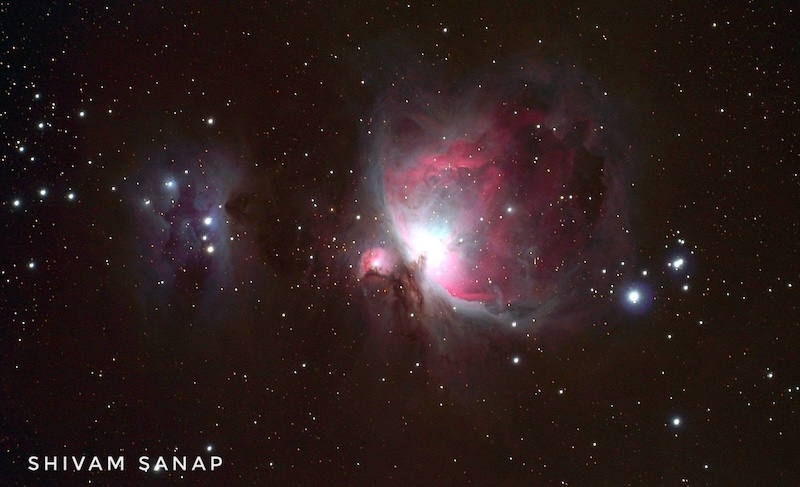
View at EarthSky Community Photos. | Shivam Sanap imaged the Orion Nebula on August 2, 2025, from India, and wrote: “I captured the Orion nebula after a lot of hard work, and the results are truly amazing!”. Thank you, Shivam!
Connections between the stars
While the stars of constellations often look like they should be physically related and gravitationally bound, they usually are not.
However, some of Orion’s most famous stars do have a connection. Several of the brightest stars in Orion are members of our local spiral arm, sometimes called the Orion Arm or sometimes the Orion Spur of the Milky Way. Our local spiral arm lies between the Sagittarius and Perseus Arms of the Milky Way.
Now consider those three prominent Belt stars. They appear fainter than Rigel or Betelgeuse, and, not surprisingly, they’re farther away. As a matter of fact, they’re all giant stars located in the Orion Arm. These stars’ names and approximate distances are Mintaka (1,200 light-years), Alnilam (2,000 light-years), and Alnitak (1,260 light-years). When you look at these three stars, know that you’re looking across vast space, and into our local arm of the Milky Way galaxy.
View larger. | Artist’s concept of part of the Milky Way galaxy. Our sun is located in the Orion Arm, or Orion Spur, of the Milky Way. Several bright stars in Orion, including Rigel, Betelgeuse, the three stars in Orion’s Belt, and the Orion Nebula, also reside in the Orion Arm. Image via R. Hurt/ Wikimedia Commons (public domain).
Bottom line: Orion the Hunter is one of the easiest constellations to identify thanks to Orion’s Belt, the three medium-bright stars in a short, straight row at his waist.
EarthSky founder Deborah Byrd wants you to come to know the constellation Orion the Hunter. It’s one of the most famous constellations because it’s easy to identify, with several noticeably bright and interesting stars. Plus, Orion can help you visualize your place in the Milky Way galaxy. What’s not to like? Click here for the video. Prefer to read? See below!
Tonight look for the constellation Orion the Hunter. It’s a constant companion on winter evenings in the Northern Hemisphere, and on summer nights in the Southern Hemisphere. Plus, it’s probably the easiest constellation to spot thanks to its distinctive Belt. Orion’s Belt consists of three medium-bright stars in a short, straight row at the Hunter’s waistline. So if you see any three equally bright stars in a row this evening, you’re probably looking at Orion. Do you want to be sure? There are two even brighter stars – one reddish and the other blue – on either side of the Belt stars.
If you want to learn just one constellation … this is a good one! And it’s a very easy constellation to spot. Those of us in the Northern Hemisphere see Orion the Hunter arcing across the southern sky on January evenings. Southern Hemisphere? Turn this chart upside-down, and look in your northern sky. To see a precise view from your location, try Stellarium Online.
When to look for Orion
As seen from mid-northern latitudes, you’ll find Orion in the southeast in the January early evening and shining high in the south by mid-to-late evening (around 9 to 10 p.m. local time, the time on your clock wherever you live). If you live at temperate latitudes south of the equator, you’ll see Orion high in your northern sky around that same hour.
View at EarthSky Community Photos. | Aayan Shaikh in Sindhudurg, Maharashtra, India, shared this image of the constellation Orion the Hunter on November 21, 2025, and wrote: “One of the brightest and most iconic winter constellations. It contains one of the brightest nebulas of the sky, the Orion nebula.” Thank you, Aayan!
What to look for in Orion the Hunter
First, look for the two brightest stars in Orion: Betelgeuse and Rigel. Rigel’s distance is approximately 860 light-years. However, the distance to Betelgeuse has been harder for scientists to determine. The current estimate is about 700 light-years away, but uncertainties remain.
Next, take a moment to trace the Belt of Orion and the Sword that hangs from his belt. If one of the stars in the Sword looks blurry to you, that’s because you’re actually seeing the Orion Nebula. And if you use binoculars or a telescope to look at the Orion Nebula, you’ll start to see some shape in the gas and dust cloud.
View at EarthSky Community Photos. | Shivam Sanap imaged the Orion Nebula on August 2, 2025, from India, and wrote: “I captured the Orion nebula after a lot of hard work, and the results are truly amazing!”. Thank you, Shivam!
Connections between the stars
While the stars of constellations often look like they should be physically related and gravitationally bound, they usually are not.
However, some of Orion’s most famous stars do have a connection. Several of the brightest stars in Orion are members of our local spiral arm, sometimes called the Orion Arm or sometimes the Orion Spur of the Milky Way. Our local spiral arm lies between the Sagittarius and Perseus Arms of the Milky Way.
Now consider those three prominent Belt stars. They appear fainter than Rigel or Betelgeuse, and, not surprisingly, they’re farther away. As a matter of fact, they’re all giant stars located in the Orion Arm. These stars’ names and approximate distances are Mintaka (1,200 light-years), Alnilam (2,000 light-years), and Alnitak (1,260 light-years). When you look at these three stars, know that you’re looking across vast space, and into our local arm of the Milky Way galaxy.
View larger. | Artist’s concept of part of the Milky Way galaxy. Our sun is located in the Orion Arm, or Orion Spur, of the Milky Way. Several bright stars in Orion, including Rigel, Betelgeuse, the three stars in Orion’s Belt, and the Orion Nebula, also reside in the Orion Arm. Image via R. Hurt/ Wikimedia Commons (public domain).
Bottom line: Orion the Hunter is one of the easiest constellations to identify thanks to Orion’s Belt, the three medium-bright stars in a short, straight row at his waist.
View at EarthSky Community Photos. | Ross Stone captured this glowing aurora from the edge of Death Valley National Park last night. Thank you, Ross! Amid a severe geomagnetic storm, expectations were high for stunning auroral displays down to mid-latitudes, but the auroras were weaker and less widespread than expected. Read on to find out why.
On the evening of January 18, 2026, the sun unleashed a powerful X1.9 solar flare. This intense burst of energy launched a fast burst of solar material and magnetic fields – a coronal mass ejection (CME) – toward Earth. And when it reached our planet on the evening of January 19, it produced a rare G4 (severe) geomagnetic storm.
But while a severe storm holds the potential to trigger beautiful auroras at mid-latitudes, this storm’s real-world effects were surprisingly limited. Why? It was due to the storm’s magnetic makeup. The arrangement of the CME’s magnetic field limited how much energy actually reached Earth’s atmosphere, shaping which regions saw auroras and which did not.
The CME struck Earth’s magnetosphere at approximately 18:38 UTC on January 19, arriving with a sharp shock that immediately disturbed Earth’s magnetic field.
To understand what happened next, you need to know what Bz is. Bz describes whether the sun’s magnetic field is pointing north or south. This magnetic field is carried out into the solar system through the solar wind. And if the Bz is southward, it’s much easier for this solar wind to rush into Earth’s magnetosphere, or the magnetic bubble around our planet.
During the CME’s initial impact phase, the Bz briefly dipped strongly southward. So that allowed solar wind energy to flow efficiently into Earth’s magnetic field. This short-lived interaction quickly caused G4 (severe) geomagnetic storm levels, with Kp (another measure of Earth’s magnetic disturbance) exceeding 8.
Soon after the initial impact, the character of the severe geomagnetic storm changed dramatically. As Earth moved deeper into the core of the CME, the Bz – again, the orientation of the sun’s magnetic field – turned strongly northward.
This sustained northward orientation sharply limited the transfer of transfer into Earth’s magnetosphere. And that was what restricted the auroras, despite the overall strength of the storm.
This is why geomagnetic storm ratings can mislead
Conditions shifted southward again around 5:14 UTC on January 20, but the reversal was modest and short-lived. While this allowed for some renewed geomagnetic response, it was not sufficient to drive widespread auroras into mid or lower latitudes.
As a result, auroral activity remained largely confined to higher latitudes, even though the storm rating suggested a much wider impact. This severe solar storm clearly illustrates why Kp values and NOAA storm ratings alone do not fully describe auroral visibility or real-world effects.
Severe geomagnetic storm coincided with intense radiation event
Adding to the space weather complexity, the same X1.9 flare also triggered a solar radiation storm that reached S4 (severe) levels, making it the largest event in more than 20 years.
These storms occur when magnetic activity accelerates charged particles in the solar atmosphere to very high velocities. After making the journey to Earth in just tens of minutes, these then rain down at the poles. This can expose astronauts and those in high-latitude aircraft to increased radiation.
Not over yet
By the numbers, this was certainly a severe geomagnetic storm. But in practice, it was a selective and magnetically constrained event driven by an extremely strong CME. It is a reminder that space weather impacts depend on magnetic geometry, not just raw intensity.
This is what makes following space weather and chasing auroras both exciting and frustrating. Ultimately, it’s so rewarding when the sky finally delivers a spectacular show.
Bottom line: A powerful blast from the sun triggered a severe geomagnetic storm on the night of January 19, but the auroras weren’t as widespread as hoped. It’s because storm strength isn’t the only factor affecting auroras.
View at EarthSky Community Photos. | Ross Stone captured this glowing aurora from the edge of Death Valley National Park last night. Thank you, Ross! Amid a severe geomagnetic storm, expectations were high for stunning auroral displays down to mid-latitudes, but the auroras were weaker and less widespread than expected. Read on to find out why.
On the evening of January 18, 2026, the sun unleashed a powerful X1.9 solar flare. This intense burst of energy launched a fast burst of solar material and magnetic fields – a coronal mass ejection (CME) – toward Earth. And when it reached our planet on the evening of January 19, it produced a rare G4 (severe) geomagnetic storm.
But while a severe storm holds the potential to trigger beautiful auroras at mid-latitudes, this storm’s real-world effects were surprisingly limited. Why? It was due to the storm’s magnetic makeup. The arrangement of the CME’s magnetic field limited how much energy actually reached Earth’s atmosphere, shaping which regions saw auroras and which did not.
The CME struck Earth’s magnetosphere at approximately 18:38 UTC on January 19, arriving with a sharp shock that immediately disturbed Earth’s magnetic field.
To understand what happened next, you need to know what Bz is. Bz describes whether the sun’s magnetic field is pointing north or south. This magnetic field is carried out into the solar system through the solar wind. And if the Bz is southward, it’s much easier for this solar wind to rush into Earth’s magnetosphere, or the magnetic bubble around our planet.
During the CME’s initial impact phase, the Bz briefly dipped strongly southward. So that allowed solar wind energy to flow efficiently into Earth’s magnetic field. This short-lived interaction quickly caused G4 (severe) geomagnetic storm levels, with Kp (another measure of Earth’s magnetic disturbance) exceeding 8.
Soon after the initial impact, the character of the severe geomagnetic storm changed dramatically. As Earth moved deeper into the core of the CME, the Bz – again, the orientation of the sun’s magnetic field – turned strongly northward.
This sustained northward orientation sharply limited the transfer of transfer into Earth’s magnetosphere. And that was what restricted the auroras, despite the overall strength of the storm.
This is why geomagnetic storm ratings can mislead
Conditions shifted southward again around 5:14 UTC on January 20, but the reversal was modest and short-lived. While this allowed for some renewed geomagnetic response, it was not sufficient to drive widespread auroras into mid or lower latitudes.
As a result, auroral activity remained largely confined to higher latitudes, even though the storm rating suggested a much wider impact. This severe solar storm clearly illustrates why Kp values and NOAA storm ratings alone do not fully describe auroral visibility or real-world effects.
Severe geomagnetic storm coincided with intense radiation event
Adding to the space weather complexity, the same X1.9 flare also triggered a solar radiation storm that reached S4 (severe) levels, making it the largest event in more than 20 years.
These storms occur when magnetic activity accelerates charged particles in the solar atmosphere to very high velocities. After making the journey to Earth in just tens of minutes, these then rain down at the poles. This can expose astronauts and those in high-latitude aircraft to increased radiation.
Not over yet
By the numbers, this was certainly a severe geomagnetic storm. But in practice, it was a selective and magnetically constrained event driven by an extremely strong CME. It is a reminder that space weather impacts depend on magnetic geometry, not just raw intensity.
This is what makes following space weather and chasing auroras both exciting and frustrating. Ultimately, it’s so rewarding when the sky finally delivers a spectacular show.
Bottom line: A powerful blast from the sun triggered a severe geomagnetic storm on the night of January 19, but the auroras weren’t as widespread as hoped. It’s because storm strength isn’t the only factor affecting auroras.
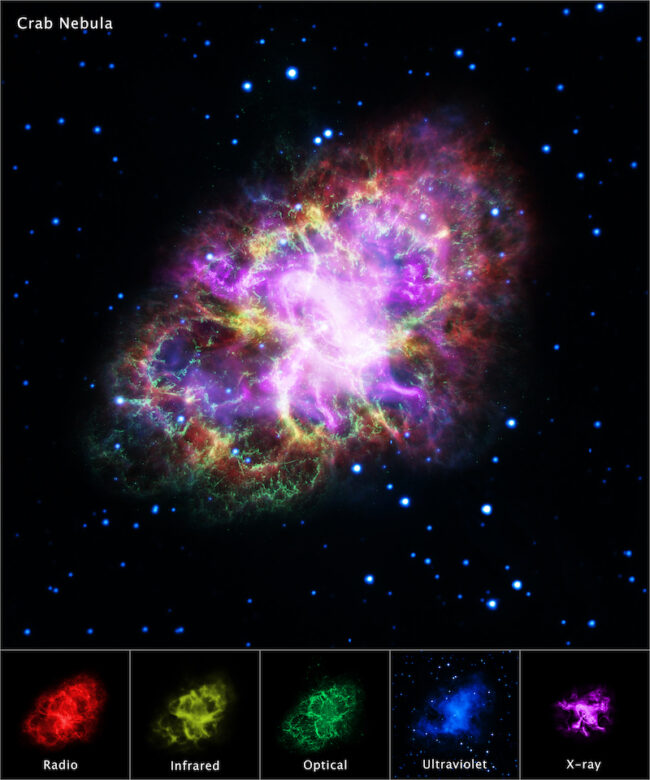
The Crab nebula is a supernova remnant. It’s what’s left of an exploded star. A vast expanding cloud of gas and dust surrounding one of the densest objects in the universe, a neutron star.
Chinese astronomers noticed the sudden appearance of a star blazing in the daytime sky on July 4, 1054 CE. It likely outshone the brightest planet, Venus, and was temporarily the 3rd-brightest object in the sky, after the sun and moon. This “guest star” – the exploding supernova – remained visible in daylight for some 23 days. At night it shone near Tianguan – a star we now call Zeta Tauri, in the constellation Taurus the Bull – for nearly two years. Then it faded from view.
The supernova erupted – and the Crab nebula formed – about 6,500 light-years away.
Since the Crab nebula is located among some of the brightest stars and constellations – including Orion – in the heavens, it is easy to find. And it’s best placed for evening observing from late fall through early spring. You can spot the Crab nebula near the star Zeta Tauri, which is the end star of one of the horns of Taurus the Bull.
The Crab nebula and supernova in history
The ancestral Puebloan people in the American Southwest may have viewed the bright new star in 1054. A crescent moon was in the sky near the new star on the morning of July 5, the day following the observations by the Chinese. So the pictograph below, from Chaco Canyon in New Mexico, might depict the event. The multi-spiked star to the left represents the supernova near the crescent moon. Furthermore, the handprint above may signify the importance of the event or may be the artist’s signature.
After exploding onto the scene in 1054 and shining brightly for two years, there are no reports of anything unusual in this spot in the sky until 1731. Then in that year, English amateur astronomer John Bevis recorded an observation of a faint nebulosity. In 1758, French comet-hunter Charles Messier spotted the hazy patch. It became the first entry in his catalog of objects that were fuzzy but not comets, now known as the Messier Catalog. Thus, the Crab nebula has the name M1.
In 1844, astronomer William Parsons – the 3rd Earl of Rosse – observed M1 through his large telescope in Ireland. Because he described it as having a shape resembling a crab, that became its familiar nickname.
Yet it wasn’t until 1921 that people made the association between the Crab nebula and Chinese records of the 1054 guest star.
Ancestral Puebloan pictograph possibly depicting the Crab nebula supernova in 1054 CE in Chaco Canyon, New Mexico. Image via Alex Marentes/ Wikimedia Commons (CC BY-SA 2.0).
How to see the Crab nebula
Since this beautiful nebula shines at magnitude 8.4, it requires magnification to see. Fortunately, it’s relatively easy to find with binoculars or a telescope due to its location near several bright stars. Plus, it’s near several recognizable constellations. Although you can see it at some time of night all year except – from roughly May through July when it’s too close to the sun – the best observing is late in the Northern Hemisphere fall through early spring. And from the late spring to early fall in the Southern Hemisphere. Most Southern Hemisphere viewers can see it except for the extreme southern portions of the globe.
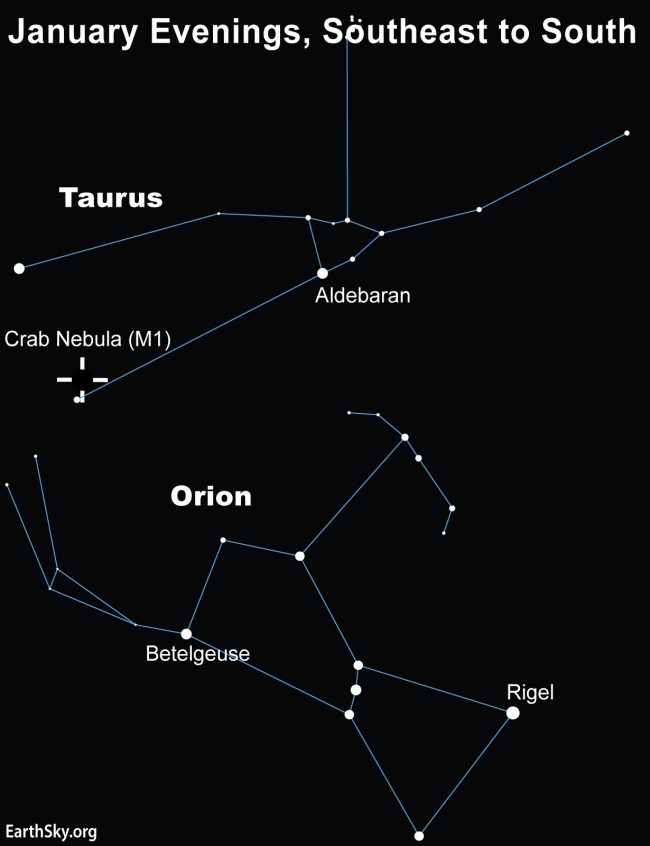
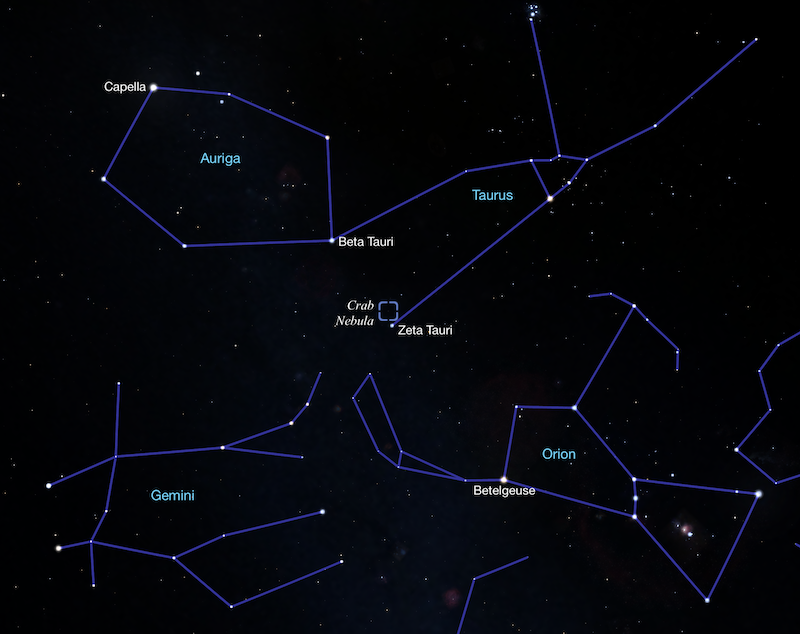
To find the Crab nebula, first draw an imaginary line from bright Betelgeuse in Orion to Capella in Auriga. About halfway along that line is the star Beta Tauri (or Elnath) on the Taurus-Auriga border.
Having identified Beta Tauri, backtrack a little more than a 3rd of the way back to Betelgeuse to find the fainter star Zeta Tauri. Scanning the area around Zeta Tauri should reveal a tiny, faint smudge. It’s about a degree (twice the width of the full moon) from Zeta Tauri and more or less in the direction of Beta Tauri.
View larger. | As shown here, you see the location of the Crab nebula (in the square crosshairs) relative to Capella, Betelgeuse, Beta Tauri and Zeta Tauri. Image via Stellarium. Used with permission.
Views through binoculars or a telescope
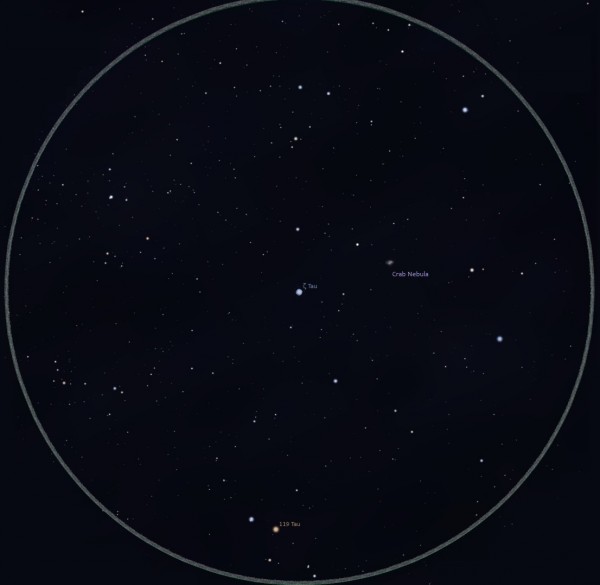
Binoculars and small telescopes are useful for finding the object and showing its roughly oblong shape. However, they won’t show the filamentary structure or any of its internal detail. Here are two examples showing what to expect in binoculars or through a telescope.
Simulated view of Zeta Tauri and the Crab nebula in a 7-degree field of view. Chart via Stellarium. Used with permission.
First, the eyepiece view, above, simulates a 7-degree field of view centered around Zeta Tauri. This is what you might expect from a 7 X 50 pair of binoculars. Of course, the exact orientation and visibility will range widely depending on time of observation, sky conditions and so on. Scan around Zeta Tauri for the faint nebulosity.
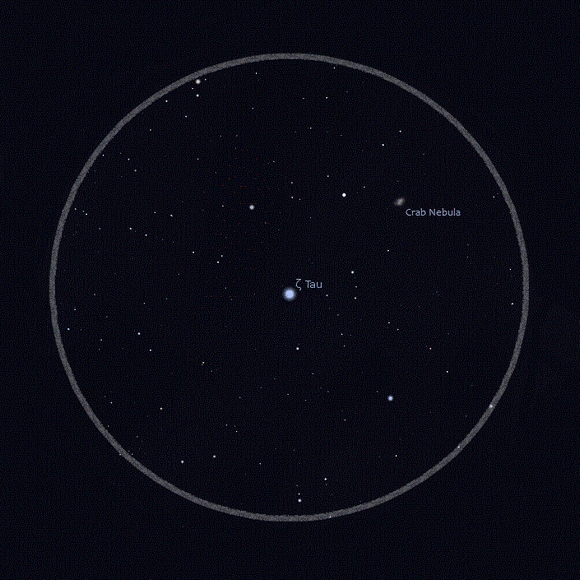
Simulated view of Zeta Tauri and Crab nebula with a 3.5-degree field of view. Chart via Stellarium. Used with permission.
Then the second image, above, simulates an approximately 3.5-degree view that you might see through a small telescope or finder scope. To give you a clear idea of scale, two full moons would fit with room to spare in the space between Zeta Tauri and the Crab nebula in this chart.
Keep in mind that exact conditions will vary.
Science of the Crab nebula
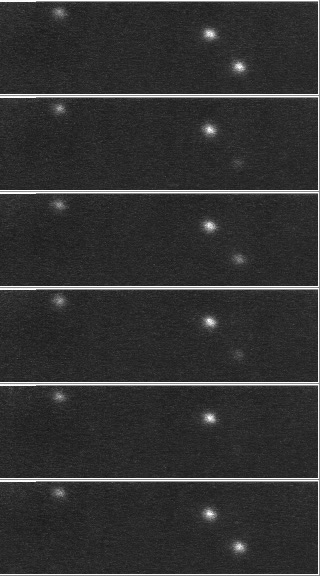
The Crab nebula is an oval gaseous nebula with fine filamentary (thread-like) structures, expanding at around 930 miles (1,500 km) per second. In its heart is a neutron star about the mass of the sun but only about 12-19 miles (20-30 km) in diameter. This neutron star is also a pulsar that spins about 30 times per second. The neutron star’s powerful magnetic field concentrates radiation emitted by the star as two beams that appear to flash periodically as the beams sweep into view. It lies about 6,500 light-years from Earth.
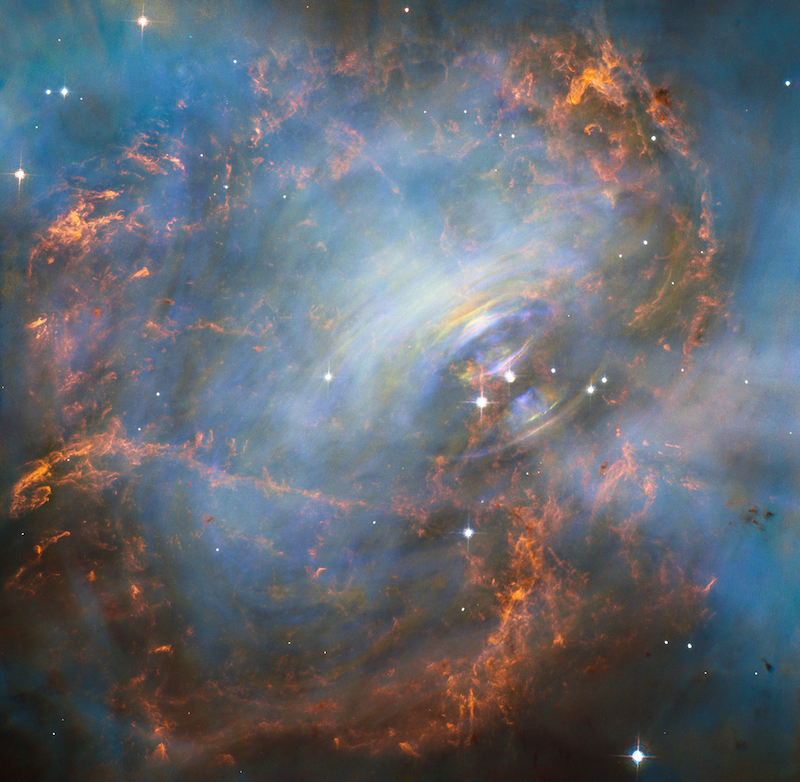
The flashing of the Crab nebula pulsar in infrared wavelengths. However, this view is considerably slower than its 30 times per second period. Image via Cambridge University Lucky Imaging Group/ Wikimedia Commons/ GFDL.The Hubble Space Telescope imaged the center of the Crab nebula in 2016. Notably, there’s a rapidly spinning neutron star at the center of the nebula, known as a pulsar. That’s the rightmost of the two stars near the center of the image. The bluish light is radiation emitted by electrons speeding at close to the speed of light along the neutron star’s powerful magnetic field. Scientists think the wispy circular features move out of the pulsar due to a shockwave that piles up highly energetic particles coming from high-speed winds emanating from the neutron star. Image via NASA/ ESA/ J. Hester/ M. Weisskopf.
The Crab nebula may be from a new type of supernova
For a long time scientists thought the Crab nebula was the remnant of a type II supernova. But in June 2021, scientists announced they’d finally found evidence for a new type of supernova, an electron-capture supernova. Consequently, they now believe the Crab nebula may be this type of supernova. Read more about this exciting discovery.
Views from the Hubble and Webb space telescopes
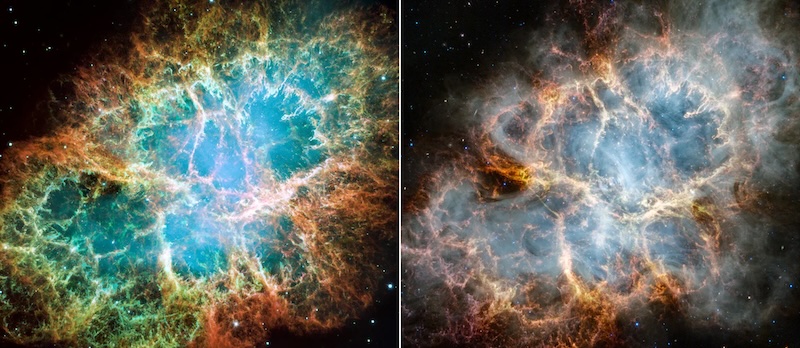
This side-by-side comparison of the Crab nebula as seen by the Hubble Space Telescope in optical light (left) and the James Webb Space Telescope in infrared light (right) reveals different details. By studying the collected Webb data, and consulting previous observations of the Crab taken by other telescopes like Hubble, astronomers can build a more comprehensive understanding of this supernova remnant. Hubble Image via NASA/ ESA J. Hester, A. Loll; Webb Image via NASA ESA CSA STScI T. Temim.
Views for our Community Photos
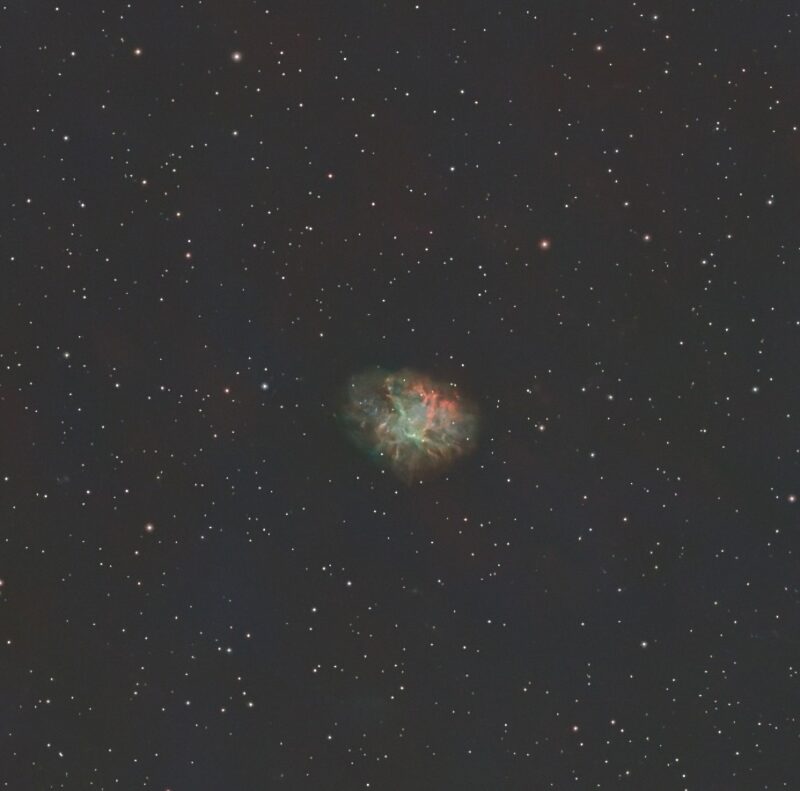
View at EarthSky Community Photos. | EarthSky’s own Marcy Curran from EarthSky, in Cheyenne, Wyoming, captured this telescopic view of the supernova remnant Messier 1 on April 12, 2025. Marcy wrote: “Here’s an image of M1 – aka the Crab nebula – a supernova remnant in the constellation of Taurus the Bull. The supernova appeared in 1054 AD. It was visible in daylight and could be seen at night for over a year. It’s known as the Crab nebula and in its center lies the Crab pulsar (a neutron star). M1 is in the constellation of Taurus and lies about 6,500 light-years away.” Thank you, Marcy!View at EarthSky Community Photos. | Jeremy Likness in Newport, Oregon, submitted this image on January 18, 2025, and wrote: “First nebula of the year! M1 Crab nebula.” Thank you, Jeremy! Jeremey used hydrogen alpha, sulfur, and oxygen filters to record M1.
The center of the Crab nebula is approximately at RA: 5h 34m 32s; Dec: +22° 0′ 52″
Bottom line: The Crab nebula is visible with binoculars and small telescopes, and relatively easy to find since it’s near bright stars in prominent constellations. Although astronomers long thought that it was the remnant of a type II supernova, there’s increasing evidence that it may have been a new type of supernova called an electron capture supernova.
The Crab nebula is a supernova remnant. It’s what’s left of an exploded star. A vast expanding cloud of gas and dust surrounding one of the densest objects in the universe, a neutron star.
Chinese astronomers noticed the sudden appearance of a star blazing in the daytime sky on July 4, 1054 CE. It likely outshone the brightest planet, Venus, and was temporarily the 3rd-brightest object in the sky, after the sun and moon. This “guest star” – the exploding supernova – remained visible in daylight for some 23 days. At night it shone near Tianguan – a star we now call Zeta Tauri, in the constellation Taurus the Bull – for nearly two years. Then it faded from view.
The supernova erupted – and the Crab nebula formed – about 6,500 light-years away.
Since the Crab nebula is located among some of the brightest stars and constellations – including Orion – in the heavens, it is easy to find. And it’s best placed for evening observing from late fall through early spring. You can spot the Crab nebula near the star Zeta Tauri, which is the end star of one of the horns of Taurus the Bull.
The Crab nebula and supernova in history
The ancestral Puebloan people in the American Southwest may have viewed the bright new star in 1054. A crescent moon was in the sky near the new star on the morning of July 5, the day following the observations by the Chinese. So the pictograph below, from Chaco Canyon in New Mexico, might depict the event. The multi-spiked star to the left represents the supernova near the crescent moon. Furthermore, the handprint above may signify the importance of the event or may be the artist’s signature.
After exploding onto the scene in 1054 and shining brightly for two years, there are no reports of anything unusual in this spot in the sky until 1731. Then in that year, English amateur astronomer John Bevis recorded an observation of a faint nebulosity. In 1758, French comet-hunter Charles Messier spotted the hazy patch. It became the first entry in his catalog of objects that were fuzzy but not comets, now known as the Messier Catalog. Thus, the Crab nebula has the name M1.
In 1844, astronomer William Parsons – the 3rd Earl of Rosse – observed M1 through his large telescope in Ireland. Because he described it as having a shape resembling a crab, that became its familiar nickname.
Yet it wasn’t until 1921 that people made the association between the Crab nebula and Chinese records of the 1054 guest star.
Ancestral Puebloan pictograph possibly depicting the Crab nebula supernova in 1054 CE in Chaco Canyon, New Mexico. Image via Alex Marentes/ Wikimedia Commons (CC BY-SA 2.0).
How to see the Crab nebula
Since this beautiful nebula shines at magnitude 8.4, it requires magnification to see. Fortunately, it’s relatively easy to find with binoculars or a telescope due to its location near several bright stars. Plus, it’s near several recognizable constellations. Although you can see it at some time of night all year except – from roughly May through July when it’s too close to the sun – the best observing is late in the Northern Hemisphere fall through early spring. And from the late spring to early fall in the Southern Hemisphere. Most Southern Hemisphere viewers can see it except for the extreme southern portions of the globe.
To find the Crab nebula, first draw an imaginary line from bright Betelgeuse in Orion to Capella in Auriga. About halfway along that line is the star Beta Tauri (or Elnath) on the Taurus-Auriga border.
Having identified Beta Tauri, backtrack a little more than a 3rd of the way back to Betelgeuse to find the fainter star Zeta Tauri. Scanning the area around Zeta Tauri should reveal a tiny, faint smudge. It’s about a degree (twice the width of the full moon) from Zeta Tauri and more or less in the direction of Beta Tauri.
View larger. | As shown here, you see the location of the Crab nebula (in the square crosshairs) relative to Capella, Betelgeuse, Beta Tauri and Zeta Tauri. Image via Stellarium. Used with permission.
Views through binoculars or a telescope
Binoculars and small telescopes are useful for finding the object and showing its roughly oblong shape. However, they won’t show the filamentary structure or any of its internal detail. Here are two examples showing what to expect in binoculars or through a telescope.
Simulated view of Zeta Tauri and the Crab nebula in a 7-degree field of view. Chart via Stellarium. Used with permission.
First, the eyepiece view, above, simulates a 7-degree field of view centered around Zeta Tauri. This is what you might expect from a 7 X 50 pair of binoculars. Of course, the exact orientation and visibility will range widely depending on time of observation, sky conditions and so on. Scan around Zeta Tauri for the faint nebulosity.
Simulated view of Zeta Tauri and Crab nebula with a 3.5-degree field of view. Chart via Stellarium. Used with permission.
Then the second image, above, simulates an approximately 3.5-degree view that you might see through a small telescope or finder scope. To give you a clear idea of scale, two full moons would fit with room to spare in the space between Zeta Tauri and the Crab nebula in this chart.
Keep in mind that exact conditions will vary.
Science of the Crab nebula
The Crab nebula is an oval gaseous nebula with fine filamentary (thread-like) structures, expanding at around 930 miles (1,500 km) per second. In its heart is a neutron star about the mass of the sun but only about 12-19 miles (20-30 km) in diameter. This neutron star is also a pulsar that spins about 30 times per second. The neutron star’s powerful magnetic field concentrates radiation emitted by the star as two beams that appear to flash periodically as the beams sweep into view. It lies about 6,500 light-years from Earth.
The flashing of the Crab nebula pulsar in infrared wavelengths. However, this view is considerably slower than its 30 times per second period. Image via Cambridge University Lucky Imaging Group/ Wikimedia Commons/ GFDL.The Hubble Space Telescope imaged the center of the Crab nebula in 2016. Notably, there’s a rapidly spinning neutron star at the center of the nebula, known as a pulsar. That’s the rightmost of the two stars near the center of the image. The bluish light is radiation emitted by electrons speeding at close to the speed of light along the neutron star’s powerful magnetic field. Scientists think the wispy circular features move out of the pulsar due to a shockwave that piles up highly energetic particles coming from high-speed winds emanating from the neutron star. Image via NASA/ ESA/ J. Hester/ M. Weisskopf.
The Crab nebula may be from a new type of supernova
For a long time scientists thought the Crab nebula was the remnant of a type II supernova. But in June 2021, scientists announced they’d finally found evidence for a new type of supernova, an electron-capture supernova. Consequently, they now believe the Crab nebula may be this type of supernova. Read more about this exciting discovery.
Views from the Hubble and Webb space telescopes
This side-by-side comparison of the Crab nebula as seen by the Hubble Space Telescope in optical light (left) and the James Webb Space Telescope in infrared light (right) reveals different details. By studying the collected Webb data, and consulting previous observations of the Crab taken by other telescopes like Hubble, astronomers can build a more comprehensive understanding of this supernova remnant. Hubble Image via NASA/ ESA J. Hester, A. Loll; Webb Image via NASA ESA CSA STScI T. Temim.
Views for our Community Photos
View at EarthSky Community Photos. | EarthSky’s own Marcy Curran from EarthSky, in Cheyenne, Wyoming, captured this telescopic view of the supernova remnant Messier 1 on April 12, 2025. Marcy wrote: “Here’s an image of M1 – aka the Crab nebula – a supernova remnant in the constellation of Taurus the Bull. The supernova appeared in 1054 AD. It was visible in daylight and could be seen at night for over a year. It’s known as the Crab nebula and in its center lies the Crab pulsar (a neutron star). M1 is in the constellation of Taurus and lies about 6,500 light-years away.” Thank you, Marcy!View at EarthSky Community Photos. | Jeremy Likness in Newport, Oregon, submitted this image on January 18, 2025, and wrote: “First nebula of the year! M1 Crab nebula.” Thank you, Jeremy! Jeremey used hydrogen alpha, sulfur, and oxygen filters to record M1.
The center of the Crab nebula is approximately at RA: 5h 34m 32s; Dec: +22° 0′ 52″
Bottom line: The Crab nebula is visible with binoculars and small telescopes, and relatively easy to find since it’s near bright stars in prominent constellations. Although astronomers long thought that it was the remnant of a type II supernova, there’s increasing evidence that it may have been a new type of supernova called an electron capture supernova.