
EarthSky founder Deborah Byrd wants you to come to know the constellation Orion the Hunter. It’s one of the most famous constellations because it’s easy to identify, with several noticeably bright and interesting stars. Plus, Orion can help you visualize your place in the Milky Way galaxy. What’s not to like? Click here for the video. Prefer to read? See below!
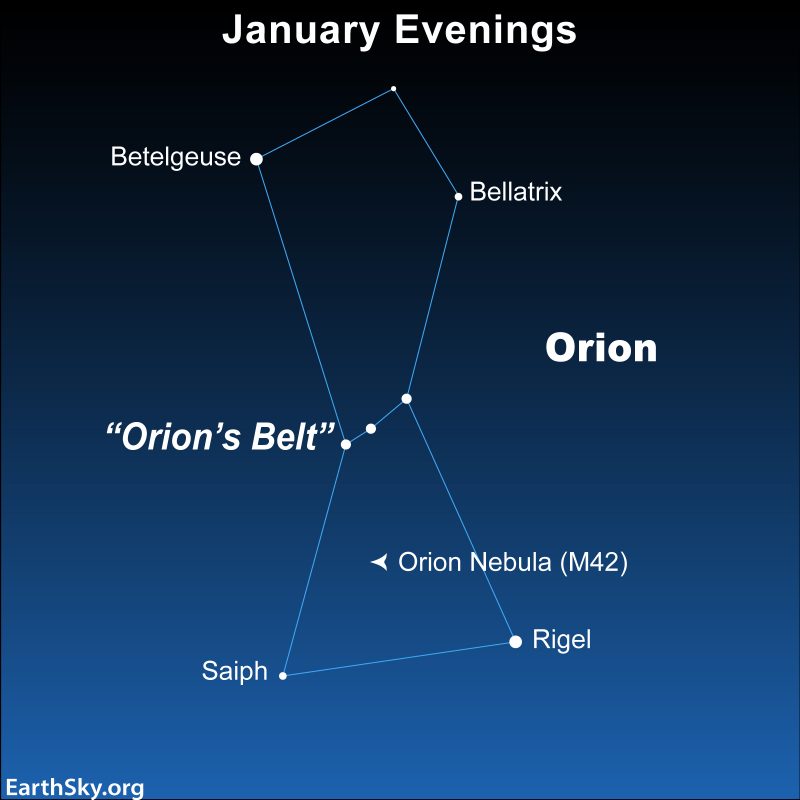
Tonight look for the constellation Orion the Hunter. It’s a constant companion on winter evenings in the Northern Hemisphere, and on summer nights in the Southern Hemisphere. Plus, it’s probably the easiest constellation to spot thanks to its distinctive Belt. Orion’s Belt consists of three medium-bright stars in a short, straight row at the Hunter’s waistline. So if you see any three equally bright stars in a row this evening, you’re probably looking at Orion. Do you want to be sure? There are two even brighter stars – one reddish and the other blue – on either side of the Belt stars.
When to look for Orion
As seen from mid-northern latitudes, you’ll find Orion in the southeast in the January early evening and shining high in the south by mid-to-late evening (around 9 to 10 p.m. local time, the time on your clock wherever you live). If you live at temperate latitudes south of the equator, you’ll see Orion high in your northern sky around that same hour.

What to look for in Orion the Hunter
First, look for the two brightest stars in Orion: Betelgeuse and Rigel. Rigel’s distance is approximately 860 light-years. However, the distance to Betelgeuse has been harder for scientists to determine. The current estimate is about 700 light-years away, but uncertainties remain.
Betelgeuse dimmed for a while in late 2019, generating a fair amount of excitement, because Betelgeuse is a star on the brink of a supernova. However, the star has since returned to its normal brightness. So how bright does it look tonight?
Also, a recent study confirmed Betelgeuse is not one star, but two! It’s companion star has been Betelbuddy.
Read more: Betelgeuse’s companion star leaves detectable wake
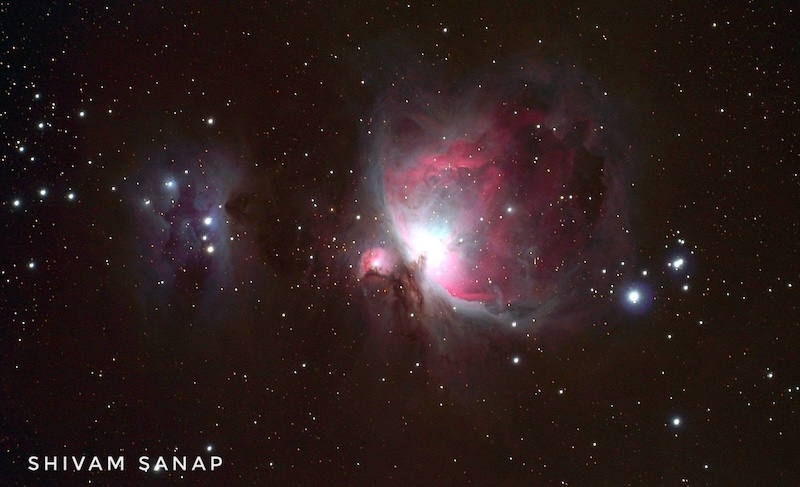
Next, take a moment to trace the Belt of Orion and the Sword that hangs from his belt. If one of the stars in the Sword looks blurry to you, that’s because you’re actually seeing the Orion Nebula. And if you use binoculars or a telescope to look at the Orion Nebula, you’ll start to see some shape in the gas and dust cloud.
Connections between the stars
While the stars of constellations often look like they should be physically related and gravitationally bound, they usually are not.
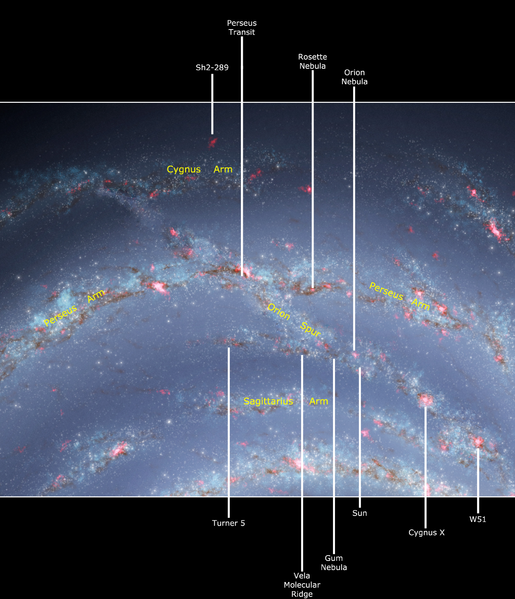
However, some of Orion’s most famous stars do have a connection. Several of the brightest stars in Orion are members of our local spiral arm, sometimes called the Orion Arm or sometimes the Orion Spur of the Milky Way. Our local spiral arm lies between the Sagittarius and Perseus Arms of the Milky Way.
Now consider those three prominent Belt stars. They appear fainter than Rigel or Betelgeuse, and, not surprisingly, they’re farther away. As a matter of fact, they’re all giant stars located in the Orion Arm. These stars’ names and approximate distances are Mintaka (1,200 light-years), Alnilam (2,000 light-years), and Alnitak (1,260 light-years). When you look at these three stars, know that you’re looking across vast space, and into our local arm of the Milky Way galaxy.
Bottom line: Orion the Hunter is one of the easiest constellations to identify thanks to Orion’s Belt, the three medium-bright stars in a short, straight row at his waist.
Why do stars seem brighter in winter?
The post Orion the Hunter is easy to spot in January first appeared on EarthSky.
from EarthSky https://ift.tt/FMBRQ8N
EarthSky founder Deborah Byrd wants you to come to know the constellation Orion the Hunter. It’s one of the most famous constellations because it’s easy to identify, with several noticeably bright and interesting stars. Plus, Orion can help you visualize your place in the Milky Way galaxy. What’s not to like? Click here for the video. Prefer to read? See below!
Tonight look for the constellation Orion the Hunter. It’s a constant companion on winter evenings in the Northern Hemisphere, and on summer nights in the Southern Hemisphere. Plus, it’s probably the easiest constellation to spot thanks to its distinctive Belt. Orion’s Belt consists of three medium-bright stars in a short, straight row at the Hunter’s waistline. So if you see any three equally bright stars in a row this evening, you’re probably looking at Orion. Do you want to be sure? There are two even brighter stars – one reddish and the other blue – on either side of the Belt stars.
When to look for Orion
As seen from mid-northern latitudes, you’ll find Orion in the southeast in the January early evening and shining high in the south by mid-to-late evening (around 9 to 10 p.m. local time, the time on your clock wherever you live). If you live at temperate latitudes south of the equator, you’ll see Orion high in your northern sky around that same hour.
What to look for in Orion the Hunter
First, look for the two brightest stars in Orion: Betelgeuse and Rigel. Rigel’s distance is approximately 860 light-years. However, the distance to Betelgeuse has been harder for scientists to determine. The current estimate is about 700 light-years away, but uncertainties remain.
Betelgeuse dimmed for a while in late 2019, generating a fair amount of excitement, because Betelgeuse is a star on the brink of a supernova. However, the star has since returned to its normal brightness. So how bright does it look tonight?
Also, a recent study confirmed Betelgeuse is not one star, but two! It’s companion star has been Betelbuddy.
Read more: Betelgeuse’s companion star leaves detectable wake
Next, take a moment to trace the Belt of Orion and the Sword that hangs from his belt. If one of the stars in the Sword looks blurry to you, that’s because you’re actually seeing the Orion Nebula. And if you use binoculars or a telescope to look at the Orion Nebula, you’ll start to see some shape in the gas and dust cloud.
Connections between the stars
While the stars of constellations often look like they should be physically related and gravitationally bound, they usually are not.
However, some of Orion’s most famous stars do have a connection. Several of the brightest stars in Orion are members of our local spiral arm, sometimes called the Orion Arm or sometimes the Orion Spur of the Milky Way. Our local spiral arm lies between the Sagittarius and Perseus Arms of the Milky Way.
Now consider those three prominent Belt stars. They appear fainter than Rigel or Betelgeuse, and, not surprisingly, they’re farther away. As a matter of fact, they’re all giant stars located in the Orion Arm. These stars’ names and approximate distances are Mintaka (1,200 light-years), Alnilam (2,000 light-years), and Alnitak (1,260 light-years). When you look at these three stars, know that you’re looking across vast space, and into our local arm of the Milky Way galaxy.
Bottom line: Orion the Hunter is one of the easiest constellations to identify thanks to Orion’s Belt, the three medium-bright stars in a short, straight row at his waist.
Why do stars seem brighter in winter?
The post Orion the Hunter is easy to spot in January first appeared on EarthSky.
from EarthSky https://ift.tt/FMBRQ8N

Aucun commentaire:
Enregistrer un commentaire