aads

James Webb Space Telescope launch date delayed

NASA’s James Webb Space Telescope is folded and ready for its final suite of testing. The Webb is the successor to the Hubble Space Telescope. Once in orbit, it will unfold its delicate 5-layered sunshield until it reaches the size of a tennis court. The Webb telescope is an international project, led by NASA with its partners, the European Space Agency and the Canadian Space Agency.

NASA originally published this article on July 22, 2020.

NASA now is targeting October 31, 2021, for the launch of the agency’s James Webb Space Telescope from French Guiana, due to impacts from the ongoing coronavirus (COVID-19) pandemic, as well as technical challenges.

This decision is based on a recently completed schedule risk assessment of the remaining integration and test activities prior to launch. Previously, Webb was targeted to launch in March 2021.

Thomas Zurbuchen is associate administrator for NASA’s Science Mission Directorate at the agency’s headquarters in Washington. He said:

Webb is the world’s most complex space observatory, and our top science priority, and we’ve worked hard to keep progress moving during the pandemic. The team continues to be focused on reaching milestones and arriving at the technical solutions that will see us through to this new launch date next year.
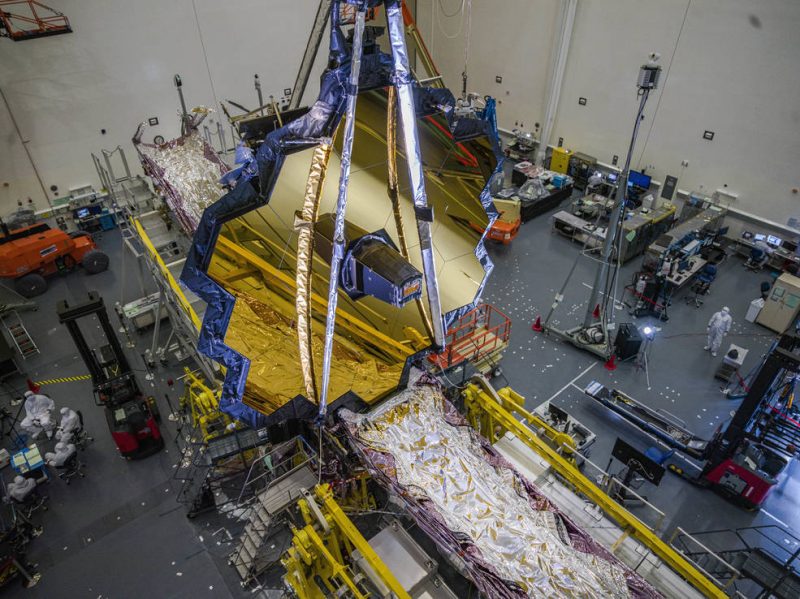
Indoor construction site.

NASA’s James Webb Space Telescope in the clean room at Northrop Grumman, Redondo Beach, California, in July 2020. Image via NASA/ Chris Gunn.

Testing of the observatory continues to go well at Northrop Grumman, the mission’s main industry partner, in Redondo Beach, California, despite the challenges of the coronavirus pandemic. Prior to the pandemic’s associated delays, the team made significant progress in achieving milestones to prepare for launch in 2021.

As schedule margins grew tighter last fall, the agency planned to assess the progress of the project in April. This assessment was postponed due to the pandemic and was completed this week. The factors contributing to the decision to move the launch date include the impacts of augmented safety precautions, reduced on-site personnel, disruption to shift work, and other technical challenges. Webb will use existing program funding to stay within its $8.8 billion development cost cap.

Gregory Robinson is NASA Webb program director at the agency’s headquarters. He said:

Based on current projections, the program expects to complete the remaining work within the new schedule without requiring additional funds. Although efficiency has been affected and there are challenges ahead, we have retired significant risk through the achievements and good schedule performance over the past year. After resuming full operations to prepare for upcoming final observatory system-level environmental testing this summer, major progress continues towards preparing this highly complex observatory for launch.

The project team will continue to complete a final set of extremely difficult environmental tests of the full observatory before it will be shipped to the launch site in Kourou, French Guiana, situated on the northeastern coast of South America.

Over the last week, the project successfully completed electrical testing of the observatory. The test highlighted a major milestone in preparation for the upcoming acoustics and vibration environmental tests of the full observatory that are scheduled to start in August. In addition to ongoing deployments, ground system testing of the fully integrated observatory has followed immediately afterwards. Ensuring that every element of Webb functions properly before it gets to space is critical to its success.

The design of a very large space telescope and highly sophisticated instruments was required to enable Webb to answer fundamental questions about our cosmic origins outlined in the National Academy of Sciences 2000 Decadal Survey. Eric Smith, NASA Webb’s program scientist at the agency’s headquarters, said:

Webb is designed to build upon the incredible legacies of the Hubble and Spitzer space telescopes, by observing the infrared universe and exploring every phase of cosmic history. The observatory will detect light from the first generation of galaxies that formed in the early universe after the Big Bang and study the atmospheres of nearby exoplanets for possible signs of habitability.

Early next year, Webb will be will folded “origami-style” for shipment to the launch site and fitted compactly inside Arianespace’s Ariane 5 launch vehicle fairing, which is about 16 feet (5 meters) wide. On its journey to space, Webb will be the first mission to complete an intricate and technically challenging series of deployments – a critical part of Webb’s journey to its orbit about one million miles from Earth. Once in orbit, Webb will unfold its delicate five-layered sunshield until it reaches the size of a tennis court. Webb will then deploy its iconic 6.5-meter primary mirror that will detect the faint light of far-away stars and galaxies.

Bottom line: NASA is delaying the launch of the James Webb Space Telescope from March 2021 to October 31, 2021


from EarthSky https://ift.tt/3eXZ3CZ

NASA’s James Webb Space Telescope is folded and ready for its final suite of testing. The Webb is the successor to the Hubble Space Telescope. Once in orbit, it will unfold its delicate 5-layered sunshield until it reaches the size of a tennis court. The Webb telescope is an international project, led by NASA with its partners, the European Space Agency and the Canadian Space Agency.

NASA originally published this article on July 22, 2020.

NASA now is targeting October 31, 2021, for the launch of the agency’s James Webb Space Telescope from French Guiana, due to impacts from the ongoing coronavirus (COVID-19) pandemic, as well as technical challenges.

This decision is based on a recently completed schedule risk assessment of the remaining integration and test activities prior to launch. Previously, Webb was targeted to launch in March 2021.

Thomas Zurbuchen is associate administrator for NASA’s Science Mission Directorate at the agency’s headquarters in Washington. He said:

Webb is the world’s most complex space observatory, and our top science priority, and we’ve worked hard to keep progress moving during the pandemic. The team continues to be focused on reaching milestones and arriving at the technical solutions that will see us through to this new launch date next year.

Indoor construction site.

NASA’s James Webb Space Telescope in the clean room at Northrop Grumman, Redondo Beach, California, in July 2020. Image via NASA/ Chris Gunn.

Testing of the observatory continues to go well at Northrop Grumman, the mission’s main industry partner, in Redondo Beach, California, despite the challenges of the coronavirus pandemic. Prior to the pandemic’s associated delays, the team made significant progress in achieving milestones to prepare for launch in 2021.

As schedule margins grew tighter last fall, the agency planned to assess the progress of the project in April. This assessment was postponed due to the pandemic and was completed this week. The factors contributing to the decision to move the launch date include the impacts of augmented safety precautions, reduced on-site personnel, disruption to shift work, and other technical challenges. Webb will use existing program funding to stay within its $8.8 billion development cost cap.

Gregory Robinson is NASA Webb program director at the agency’s headquarters. He said:

Based on current projections, the program expects to complete the remaining work within the new schedule without requiring additional funds. Although efficiency has been affected and there are challenges ahead, we have retired significant risk through the achievements and good schedule performance over the past year. After resuming full operations to prepare for upcoming final observatory system-level environmental testing this summer, major progress continues towards preparing this highly complex observatory for launch.

The project team will continue to complete a final set of extremely difficult environmental tests of the full observatory before it will be shipped to the launch site in Kourou, French Guiana, situated on the northeastern coast of South America.

Over the last week, the project successfully completed electrical testing of the observatory. The test highlighted a major milestone in preparation for the upcoming acoustics and vibration environmental tests of the full observatory that are scheduled to start in August. In addition to ongoing deployments, ground system testing of the fully integrated observatory has followed immediately afterwards. Ensuring that every element of Webb functions properly before it gets to space is critical to its success.

The design of a very large space telescope and highly sophisticated instruments was required to enable Webb to answer fundamental questions about our cosmic origins outlined in the National Academy of Sciences 2000 Decadal Survey. Eric Smith, NASA Webb’s program scientist at the agency’s headquarters, said:

Webb is designed to build upon the incredible legacies of the Hubble and Spitzer space telescopes, by observing the infrared universe and exploring every phase of cosmic history. The observatory will detect light from the first generation of galaxies that formed in the early universe after the Big Bang and study the atmospheres of nearby exoplanets for possible signs of habitability.

Early next year, Webb will be will folded “origami-style” for shipment to the launch site and fitted compactly inside Arianespace’s Ariane 5 launch vehicle fairing, which is about 16 feet (5 meters) wide. On its journey to space, Webb will be the first mission to complete an intricate and technically challenging series of deployments – a critical part of Webb’s journey to its orbit about one million miles from Earth. Once in orbit, Webb will unfold its delicate five-layered sunshield until it reaches the size of a tennis court. Webb will then deploy its iconic 6.5-meter primary mirror that will detect the faint light of far-away stars and galaxies.

Bottom line: NASA is delaying the launch of the James Webb Space Telescope from March 2021 to October 31, 2021


from EarthSky https://ift.tt/3eXZ3CZ

Moon and Spica on July 25 and 26

On July 25 and 26, 2020 – as the setting sun closes the curtains on the day, and the darkening skies bring out a myriad of far-off suns – let the moon introduce you to a special star. The bright star close to the moon on these dates is none other than Spica, the sole 1st-magnitude star in the constellation Virgo the Maiden.

The much brighter starlike object in the southeast sky (outside the sky chart at the top of this post) is the giant planet Jupiter. Jupiter, the fifth planet outward from the sun, shines rather close to the ringed planet Saturn.

The sky chart at the top of this post is set for North America. If you live in the Earth’s Eastern Hemisphere, the moon will appear a little farther west of where it does on this chart. If you live in Hawaii, the moon will be offset somewhat in the opposite direction. Also, the moon on the sky chart appears larger than it does in the real sky.

SKY CHART OF ANTARES?

SKY CHART OF JUPITER & SATURN (NEEDS TO BE MADE)

No matter where you live, the moon continually moves eastward in front of the backdrop stars of the zodiac at the rate of about one-half degree per hour. For a convenient measuring stick, the moon’s angular diameter approximates one-half degree of sky. So the moon moves its own diameter eastward per hour or about 13 degrees (26 moon diameters) eastward per day. Look for the moon to snuggle up more closely with Spica as darkness falls on July 9.

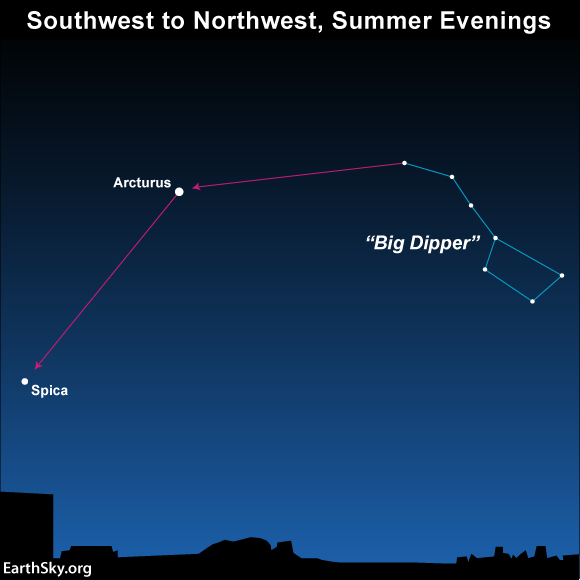
When the moon is no longer close to Spica, you might find it helpful to “star-hop” to Spica instead, as shown on the sky chart below:

Enjoying EarthSky so far? Sign up for our free daily newsletter today!

Star chart showing Big Dipper with line to Arcturus continuing to Spica.

If you live in the Northern Hemisphere, and you’re familiar with the Big Dipper, you can count on this famous pattern of stars to guide you to Spica. Simply extend the Big Dipper handle to arc to the brilliant yellow-orange star Arcturus and then to spike Spica, a blue-white gem of a star. If you have difficulty discerning stellar color with the eye alone, try your luck with binoculars.

Bottom line: Let the moon guide you to Spica on July 25 and 26, 2020, and then use the Big Dipper to locate Virgo’s brightest star, after the moon’s flirtation with Spica ends.

Donate: Your support means the world to us

EarthSky astronomy kits are perfect for beginners. Order today from the EarthSky store


from EarthSky https://ift.tt/327r2e2

On July 25 and 26, 2020 – as the setting sun closes the curtains on the day, and the darkening skies bring out a myriad of far-off suns – let the moon introduce you to a special star. The bright star close to the moon on these dates is none other than Spica, the sole 1st-magnitude star in the constellation Virgo the Maiden.

The much brighter starlike object in the southeast sky (outside the sky chart at the top of this post) is the giant planet Jupiter. Jupiter, the fifth planet outward from the sun, shines rather close to the ringed planet Saturn.

The sky chart at the top of this post is set for North America. If you live in the Earth’s Eastern Hemisphere, the moon will appear a little farther west of where it does on this chart. If you live in Hawaii, the moon will be offset somewhat in the opposite direction. Also, the moon on the sky chart appears larger than it does in the real sky.

SKY CHART OF ANTARES?

SKY CHART OF JUPITER & SATURN (NEEDS TO BE MADE)

No matter where you live, the moon continually moves eastward in front of the backdrop stars of the zodiac at the rate of about one-half degree per hour. For a convenient measuring stick, the moon’s angular diameter approximates one-half degree of sky. So the moon moves its own diameter eastward per hour or about 13 degrees (26 moon diameters) eastward per day. Look for the moon to snuggle up more closely with Spica as darkness falls on July 9.

When the moon is no longer close to Spica, you might find it helpful to “star-hop” to Spica instead, as shown on the sky chart below:

Enjoying EarthSky so far? Sign up for our free daily newsletter today!

Star chart showing Big Dipper with line to Arcturus continuing to Spica.

If you live in the Northern Hemisphere, and you’re familiar with the Big Dipper, you can count on this famous pattern of stars to guide you to Spica. Simply extend the Big Dipper handle to arc to the brilliant yellow-orange star Arcturus and then to spike Spica, a blue-white gem of a star. If you have difficulty discerning stellar color with the eye alone, try your luck with binoculars.

Bottom line: Let the moon guide you to Spica on July 25 and 26, 2020, and then use the Big Dipper to locate Virgo’s brightest star, after the moon’s flirtation with Spica ends.

Donate: Your support means the world to us

EarthSky astronomy kits are perfect for beginners. Order today from the EarthSky store


from EarthSky https://ift.tt/327r2e2

1st quarter moon is July 27

Closeup of edge of sunlight on moon, with inset photo of nearly semicircular moon.

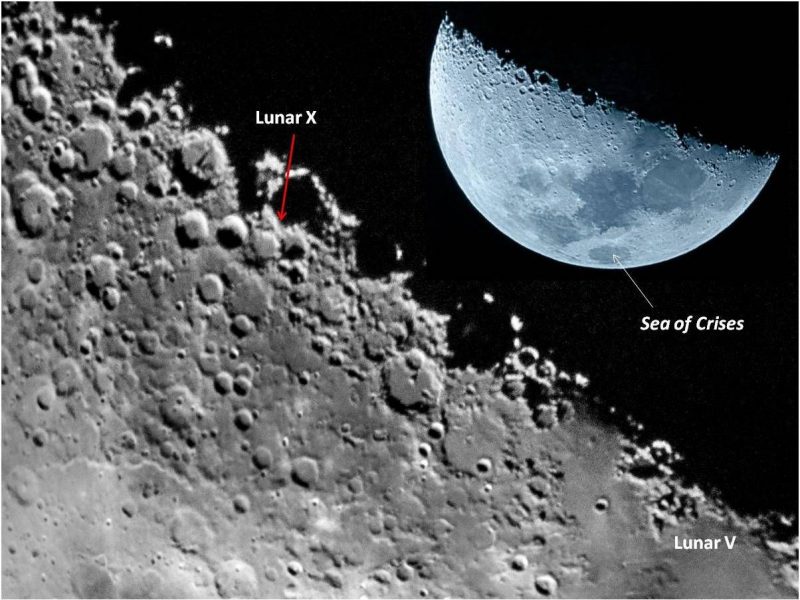
View at EarthSky Community Photos. | Composite image of a moon nearly at 1st quarter with some of the features you can see on the moon at this phase – captured April 30, 2020 – by our friend Dr Ski in the Philippines. He wrote: “… 10 hours before 1st quarter and the Lunar V and Lunar X are well defined …” More about Lunar V and X below. Thank you, Dr Ski!

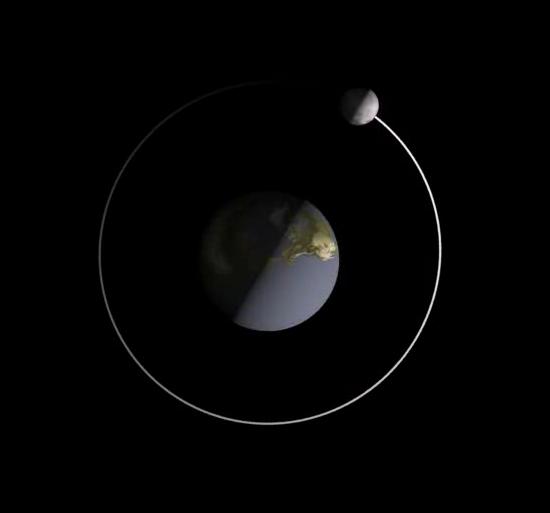
A first quarter moon rises around noon and sets around midnight. You’ll likely spot it in late afternoon or early evening, when it’s at its highest in the sky. At this moon phase, the moon is showing us precisely half of its lighted half. Or you might say that – at first quarter moon – we’re seeing half the moon’s day side.

Half-lit Earth from north, and half-lit moon with divisions between dark and light sides lined up.

Click here to see animation. As seen from the north side of the moon’s orbital plane, the Earth rotates counterclockwise on its rotational axis, and the moon revolves counterclockwise around Earth. The terminators of the Earth and moon align at first and last quarter moons, and only the near half of the moon’s day side is visible from Earth.

We call this moon a quarter and not a half because it is one quarter of the way around in its orbit of Earth, as measured from one new moon to the next. Also, although a first quarter moon appears half-lit to us, the illuminated portion we see of a first quarter moon truly is just a quarter. We’re now seeing half the moon’s day side, that is. Another lighted quarter of the moon shines just as brightly in the direction opposite Earth!

And what about the term half moon? That’s a beloved term, but not an official one.

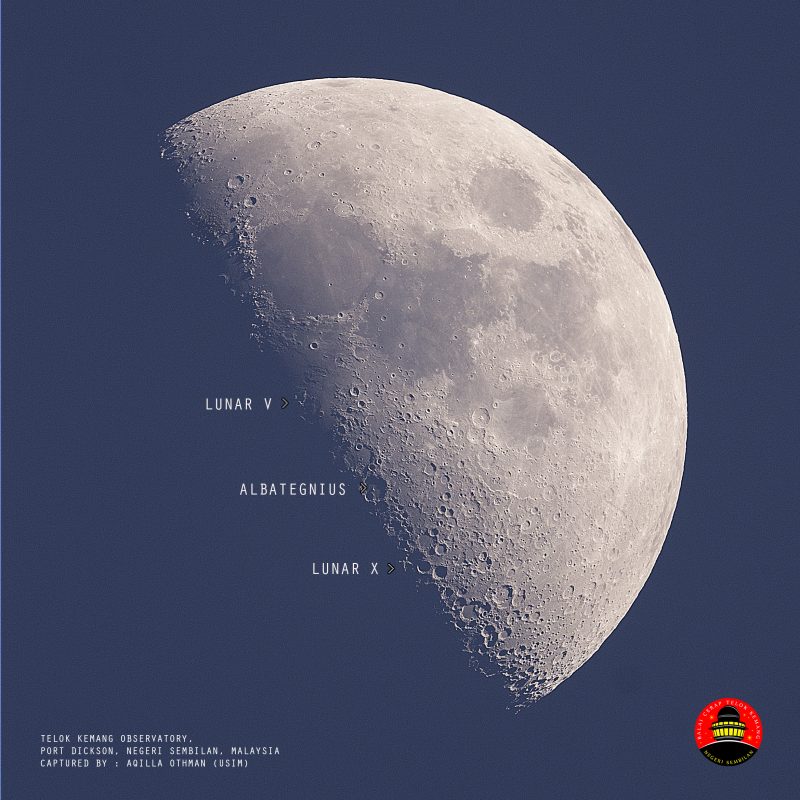
Half of the moon with tiny labeled X and V shapes along straight edge.

Lunar X and Lunar V appear when the moon is near its 1st quarter phase. They aren’t really Xs and Vs on the moon. They’re just high areas, catching sunlight, creating an example of pareidolia on the moon. Aqilla Othman in Port Dickson, Negeri Sembilan, Malaysia, caught them both in May 2017. Notice that he caught Lunar X and Lunar V.

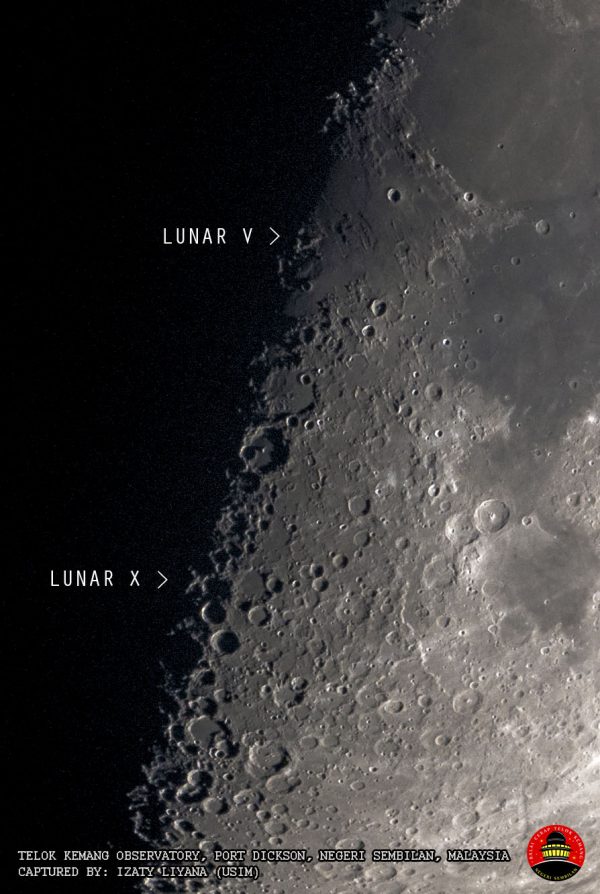
Closeup of boundary between light and dark areas of the moon with Lunar V and X labeled.

Here’s a closer look at Lunar X and Lunar V. Photo by Izaty Liyana in Port Dickson, Negeri Sembilan, Malaysia. What is Lunar X?

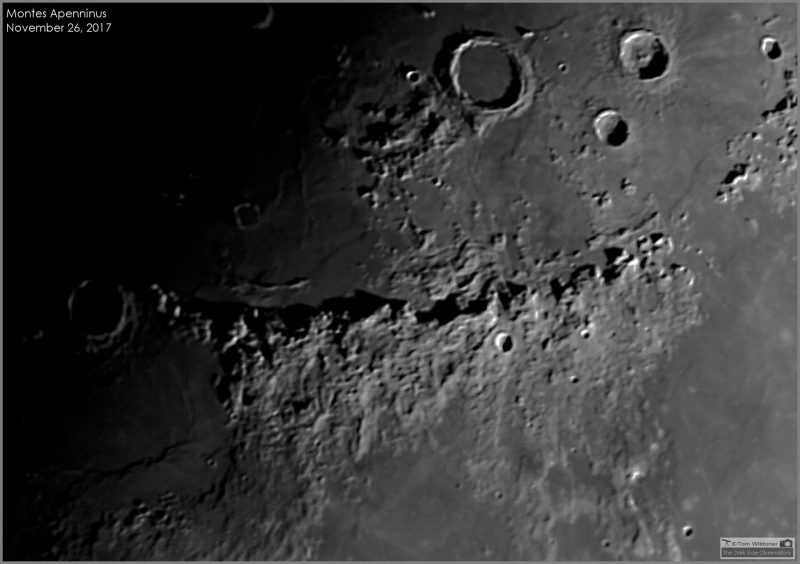
Telescopic closeup of band of mountains on moon with a few large craters.

Tom Wildoner wrote: “One of my favorite areas to photograph on the moon near the 1st quarter! I captured this view of the sun lighting up the mountain range called Montes Apenninus. The moon was casting a nice shadow on the back side of the mountains. This mountain range is about 370 miles (600 km) long with some of the peaks rising as high as 3.1 miles (5 km).”

Bottom line: The next 1st quarter moon will come on July 27, 2020, at 12:32 UTC.

Read more: Top 4 keys to understanding moon phases

Check out EarthSky’s guide to the bright planets.

Help EarthSky keep going! Please donate.


from EarthSky https://ift.tt/2OIzLvs
Closeup of edge of sunlight on moon, with inset photo of nearly semicircular moon.

View at EarthSky Community Photos. | Composite image of a moon nearly at 1st quarter with some of the features you can see on the moon at this phase – captured April 30, 2020 – by our friend Dr Ski in the Philippines. He wrote: “… 10 hours before 1st quarter and the Lunar V and Lunar X are well defined …” More about Lunar V and X below. Thank you, Dr Ski!

A first quarter moon rises around noon and sets around midnight. You’ll likely spot it in late afternoon or early evening, when it’s at its highest in the sky. At this moon phase, the moon is showing us precisely half of its lighted half. Or you might say that – at first quarter moon – we’re seeing half the moon’s day side.

Half-lit Earth from north, and half-lit moon with divisions between dark and light sides lined up.

Click here to see animation. As seen from the north side of the moon’s orbital plane, the Earth rotates counterclockwise on its rotational axis, and the moon revolves counterclockwise around Earth. The terminators of the Earth and moon align at first and last quarter moons, and only the near half of the moon’s day side is visible from Earth.

We call this moon a quarter and not a half because it is one quarter of the way around in its orbit of Earth, as measured from one new moon to the next. Also, although a first quarter moon appears half-lit to us, the illuminated portion we see of a first quarter moon truly is just a quarter. We’re now seeing half the moon’s day side, that is. Another lighted quarter of the moon shines just as brightly in the direction opposite Earth!

And what about the term half moon? That’s a beloved term, but not an official one.

Half of the moon with tiny labeled X and V shapes along straight edge.

Lunar X and Lunar V appear when the moon is near its 1st quarter phase. They aren’t really Xs and Vs on the moon. They’re just high areas, catching sunlight, creating an example of pareidolia on the moon. Aqilla Othman in Port Dickson, Negeri Sembilan, Malaysia, caught them both in May 2017. Notice that he caught Lunar X and Lunar V.

Closeup of boundary between light and dark areas of the moon with Lunar V and X labeled.

Here’s a closer look at Lunar X and Lunar V. Photo by Izaty Liyana in Port Dickson, Negeri Sembilan, Malaysia. What is Lunar X?

Telescopic closeup of band of mountains on moon with a few large craters.

Tom Wildoner wrote: “One of my favorite areas to photograph on the moon near the 1st quarter! I captured this view of the sun lighting up the mountain range called Montes Apenninus. The moon was casting a nice shadow on the back side of the mountains. This mountain range is about 370 miles (600 km) long with some of the peaks rising as high as 3.1 miles (5 km).”

Bottom line: The next 1st quarter moon will come on July 27, 2020, at 12:32 UTC.

Read more: Top 4 keys to understanding moon phases

Check out EarthSky’s guide to the bright planets.

Help EarthSky keep going! Please donate.


from EarthSky https://ift.tt/2OIzLvs

News digest – cancer blood test, gum disease and junk food ads

With news about the coronavirus pandemic developing daily, we want to make sure everyone affected by cancer gets the information they need during this time.

We’re pulling together the latest government and NHS health updates from across the UK in a separate blog post, which we’re updating regularly.

Cancer blood test hits the headlines

Researchers in China have developed a new blood test that can detect cancers in blood samples taken up to 4 years before diagnosis. The PanSeer test is said to spot cancer in 95% of individuals who had no symptoms when the blood was taken but went on to receive a diagnosis in the next 4 years.  Samantha Harrison, senior early diagnosis manager at Cancer Research UK, said: “The PanSeer test has achieved encouraging initial results. Promisingly the test may be able to detect cancer in blood samples taken years before diagnosis. But these are early results that now need to be validated in larger studies.” Read more in the The Guardian and check out our blog post on blood tests being developed to detect cancer early.

Government to unveil new measures to help reduce obesity

Prime Minister Boris Johnson is set to unveil a new obesity strategy. What’s in the report – including proposed measures on banning junk food advertising before 9pm on TV and online – may not be fully revealed until early next week, but speculation is high. Restrictions on junk food discounts and adverts are vital to help give families greater control of their diets and help reduce childhood obesity, as outlined in a letter from a group of public health directors in England, picked up by The Guardian.

Study suggests link between gum disease and stomach cancer

A new Harvard University paper has prompted some bold headlines  about tooth brushing, after it hints at a relationship between gum disease and a higher risk of throat and stomach cancers. The study assessed 148,144 people over a 22 to28-year period and established a potential link between an as-yet-unknown oral bacteria and cancer, but the mechanism behind the link hasn’t been explored. It also raised the possibility of tooth loss being associated with throat and stomach cancers. More research would be needed to confirm if gum disease or tooth loss directly caused these cancer types.

And finally…

New Atlas covers research aiming to dramatically reduce the time it takes to detect radiation sickness, by measuring key biomarkers in a solitary drop of blood. And their ambition doesn’t end there, the team hope that in the future the same technology could be useful for monitoring radiotherapy dosages.

Jake Richards is a writer for PA Media Group


from Cancer Research UK – Science blog https://ift.tt/3eYrmkF

With news about the coronavirus pandemic developing daily, we want to make sure everyone affected by cancer gets the information they need during this time.

We’re pulling together the latest government and NHS health updates from across the UK in a separate blog post, which we’re updating regularly.

Cancer blood test hits the headlines

Researchers in China have developed a new blood test that can detect cancers in blood samples taken up to 4 years before diagnosis. The PanSeer test is said to spot cancer in 95% of individuals who had no symptoms when the blood was taken but went on to receive a diagnosis in the next 4 years.  Samantha Harrison, senior early diagnosis manager at Cancer Research UK, said: “The PanSeer test has achieved encouraging initial results. Promisingly the test may be able to detect cancer in blood samples taken years before diagnosis. But these are early results that now need to be validated in larger studies.” Read more in the The Guardian and check out our blog post on blood tests being developed to detect cancer early.

Government to unveil new measures to help reduce obesity

Prime Minister Boris Johnson is set to unveil a new obesity strategy. What’s in the report – including proposed measures on banning junk food advertising before 9pm on TV and online – may not be fully revealed until early next week, but speculation is high. Restrictions on junk food discounts and adverts are vital to help give families greater control of their diets and help reduce childhood obesity, as outlined in a letter from a group of public health directors in England, picked up by The Guardian.

Study suggests link between gum disease and stomach cancer

A new Harvard University paper has prompted some bold headlines  about tooth brushing, after it hints at a relationship between gum disease and a higher risk of throat and stomach cancers. The study assessed 148,144 people over a 22 to28-year period and established a potential link between an as-yet-unknown oral bacteria and cancer, but the mechanism behind the link hasn’t been explored. It also raised the possibility of tooth loss being associated with throat and stomach cancers. More research would be needed to confirm if gum disease or tooth loss directly caused these cancer types.

And finally…

New Atlas covers research aiming to dramatically reduce the time it takes to detect radiation sickness, by measuring key biomarkers in a solitary drop of blood. And their ambition doesn’t end there, the team hope that in the future the same technology could be useful for monitoring radiotherapy dosages.

Jake Richards is a writer for PA Media Group


from Cancer Research UK – Science blog https://ift.tt/3eYrmkF

Should A Doctor Prescribe A Walk In The Park?

Should A Doctor Prescribe A Walk In The Park?

Has your doctor recommended you go for regular jogs in the park, countryside walks, community food growing sessions, or some other nature-based activity? These so-called “green prescriptions” are typically given alongside conventional therapies and have existed in various forms for a number of years.

In recognition of the potential health benefits of green prescriptions, the UK government has just announced a £4 million investment in a two-year pilot as part of its post-COVID-19 recovery plan, with plans to scale up in the future.

There is increasing evidence of the benefits of contact with nature, and the World Health Organization has identified ten ways in which nature impacts positively on our physical and mental health. When parks and other greenspaces are accessible and inclusive they can promote physical activity, psychological relaxation and social cohesion.

There is even evidence to suggest that contact with microbes in the environment can “train” our immune systems and reinforce the microbial communities on our skin, and in our airways and guts. These “microbiomes” could play a role in how our bodies respond to infectious diseases such as COVID-19 and to secondary infections. Microbes from the environment could also potentially supplement our bodies with fatty acids such as butyrate, which are linked to reduced inflammation and may promote mental health.

Green prescriptions therefore have huge potential. But if they are to work, they need to be seen as the start of a much more holistic mode of health and social care delivery: part of a post-COVID “new normal”. This would chime strongly both with the renewed appreciation of nature and the surge in community mobilization and action we saw under the lockdown.

This needs to go beyond simply substituting green for conventional prescriptions. Instead we should provide greener, more natural settings and practices for health, social care, education, transport and active travel. A good example is the GoGoGreen project at a primary school we have worked with in Sheffield. There, greening a school playground not only created a barrier against air pollution from vehicle emissions but also provided multiple other benefits to the school community and started a conversation about cleaner modes of travel.

Green prescribing cannot be seen as a low-cost alternative to conventional treatments. To be effective it still demands investment and resources. The two year pilot is welcome, but if it is to be successful in the long-run the government must make a firm commitment to scaling-up while also addressing systemic issues such as social inequality. All this will take time, and if this holistic approach is not adopted then people in crisis with more immediate priorities will be less likely to go on that prescribed walk in the woods.

Our own research on improving wellbeing through urban nature in Sheffield confirms that people in more deprived communities, with poorer health and shorter life expectancies, don’t have the same levels of access to high quality, well-maintained greenspaces. These are the people that arguably most need green prescriptions, but if they don’t have the basic access then those prescriptions are unlikely to be effective. What’s more, many doctors are not aware of green prescribing, nor do they have a firm understanding of the benefits or know how to get involved.

Our research also reveals that context is critical and green prescriptions need to be rooted in their local area and closely related to the people and places who are going to use them. A wealthy white pensioner in a rural area is likely to have very different experience of and access to nature compared with a young working class person of color in an inner city. A formulaic top-down approach is unlikely to work for both these people.

Recommendations

To sum up, this is what we need to make green prescriptions a success.

They have to be part of a systemic approach to incorporating nature-based interventions and nature-based thinking in urban infrastructure and service provision.

The prescribing process needs to be made easy, for doctors, social care professionals and patients. GPs often lack time and resources, while patients may lack motivation and confidence, or have little previous positive experiences of nature.

Green prescribing also needs to be seen as one part of a holistic health-promotion strategy based on a planetary health perspective. In order to care for ourselves, we also need to care for our environments.

Finally, we need new ways of working with local organisations and communities to understand what’s needed in local contexts, and to build skills and capacity.

By Anna Jorgensen, Chair in Urban Natural Environments, Health and Wellbeing, University of Sheffield and Jake M. Robinson, PhD Researcher, Department of Landscape, University of Sheffield. Jorgensen receives funding from the British Academy and the European Commission. Robinson receives funding from the Economic and Social Research Council (ESRC). He is affiliated with inVIVO Planetary Health, the Healthy Urban Microbiome Initiative and Greener Practice. This article is republished from The Conversation under a Creative Commons license. Read the original article. The Conversation

sb admin Fri, 07/24/2020 - 15:39
Categories


from ScienceBlogs - Where the world discusses science https://ift.tt/2OPJ7Ii
Should A Doctor Prescribe A Walk In The Park?

Has your doctor recommended you go for regular jogs in the park, countryside walks, community food growing sessions, or some other nature-based activity? These so-called “green prescriptions” are typically given alongside conventional therapies and have existed in various forms for a number of years.

In recognition of the potential health benefits of green prescriptions, the UK government has just announced a £4 million investment in a two-year pilot as part of its post-COVID-19 recovery plan, with plans to scale up in the future.

There is increasing evidence of the benefits of contact with nature, and the World Health Organization has identified ten ways in which nature impacts positively on our physical and mental health. When parks and other greenspaces are accessible and inclusive they can promote physical activity, psychological relaxation and social cohesion.

There is even evidence to suggest that contact with microbes in the environment can “train” our immune systems and reinforce the microbial communities on our skin, and in our airways and guts. These “microbiomes” could play a role in how our bodies respond to infectious diseases such as COVID-19 and to secondary infections. Microbes from the environment could also potentially supplement our bodies with fatty acids such as butyrate, which are linked to reduced inflammation and may promote mental health.

Green prescriptions therefore have huge potential. But if they are to work, they need to be seen as the start of a much more holistic mode of health and social care delivery: part of a post-COVID “new normal”. This would chime strongly both with the renewed appreciation of nature and the surge in community mobilization and action we saw under the lockdown.

This needs to go beyond simply substituting green for conventional prescriptions. Instead we should provide greener, more natural settings and practices for health, social care, education, transport and active travel. A good example is the GoGoGreen project at a primary school we have worked with in Sheffield. There, greening a school playground not only created a barrier against air pollution from vehicle emissions but also provided multiple other benefits to the school community and started a conversation about cleaner modes of travel.

Green prescribing cannot be seen as a low-cost alternative to conventional treatments. To be effective it still demands investment and resources. The two year pilot is welcome, but if it is to be successful in the long-run the government must make a firm commitment to scaling-up while also addressing systemic issues such as social inequality. All this will take time, and if this holistic approach is not adopted then people in crisis with more immediate priorities will be less likely to go on that prescribed walk in the woods.

Our own research on improving wellbeing through urban nature in Sheffield confirms that people in more deprived communities, with poorer health and shorter life expectancies, don’t have the same levels of access to high quality, well-maintained greenspaces. These are the people that arguably most need green prescriptions, but if they don’t have the basic access then those prescriptions are unlikely to be effective. What’s more, many doctors are not aware of green prescribing, nor do they have a firm understanding of the benefits or know how to get involved.

Our research also reveals that context is critical and green prescriptions need to be rooted in their local area and closely related to the people and places who are going to use them. A wealthy white pensioner in a rural area is likely to have very different experience of and access to nature compared with a young working class person of color in an inner city. A formulaic top-down approach is unlikely to work for both these people.

Recommendations

To sum up, this is what we need to make green prescriptions a success.

They have to be part of a systemic approach to incorporating nature-based interventions and nature-based thinking in urban infrastructure and service provision.

The prescribing process needs to be made easy, for doctors, social care professionals and patients. GPs often lack time and resources, while patients may lack motivation and confidence, or have little previous positive experiences of nature.

Green prescribing also needs to be seen as one part of a holistic health-promotion strategy based on a planetary health perspective. In order to care for ourselves, we also need to care for our environments.

Finally, we need new ways of working with local organisations and communities to understand what’s needed in local contexts, and to build skills and capacity.

By Anna Jorgensen, Chair in Urban Natural Environments, Health and Wellbeing, University of Sheffield and Jake M. Robinson, PhD Researcher, Department of Landscape, University of Sheffield. Jorgensen receives funding from the British Academy and the European Commission. Robinson receives funding from the Economic and Social Research Council (ESRC). He is affiliated with inVIVO Planetary Health, the Healthy Urban Microbiome Initiative and Greener Practice. This article is republished from The Conversation under a Creative Commons license. Read the original article. The Conversation

sb admin Fri, 07/24/2020 - 15:39
Categories


from ScienceBlogs - Where the world discusses science https://ift.tt/2OPJ7Ii

Astronomers ponder Odd Radio Circles in space

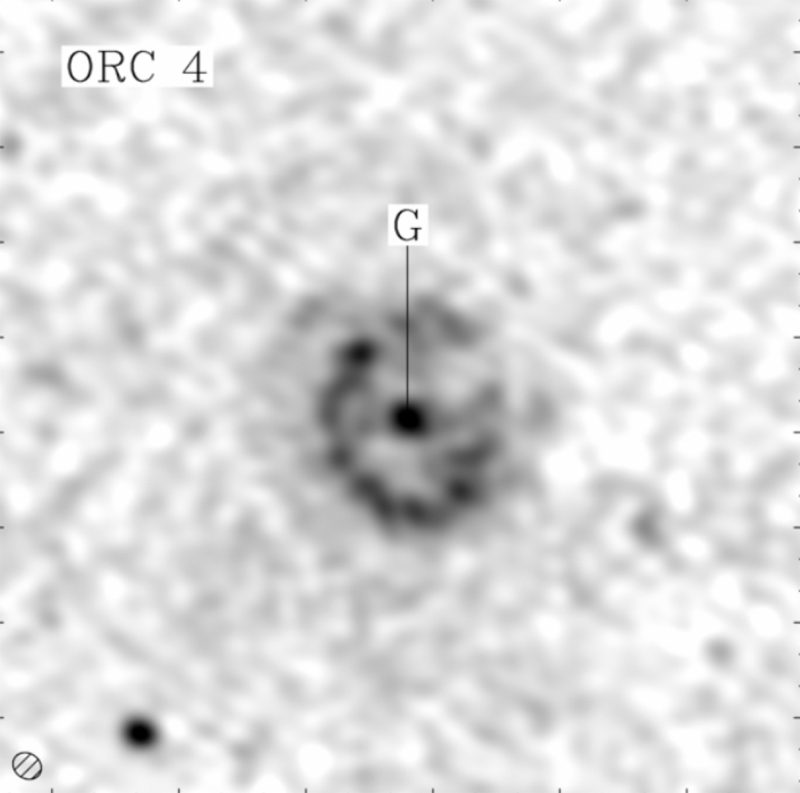
A circle surrounding a black dot, on a field of stars.

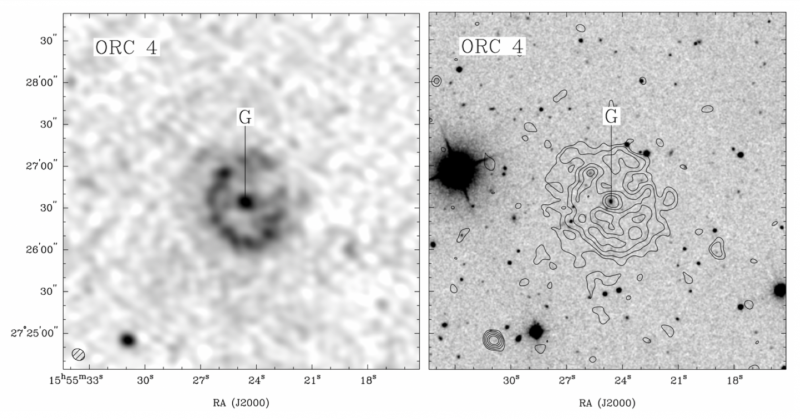
Odd Radio Circle – aka ORC – number 4. The ASKAP radio telescope in Australia spotted the 4 ORCS in 2019. Image via Norris et al./ arXiv/ ScienceAlert.

EarthSky’s yearly crowd-funding campaign is in progress. In 2020, we are donating 8.5% of all incoming revenues to No Kids Hungry. Click to learn more – donate – and help feed a child.

Our universe is full of weird and wonderful things, and astronomers keep making new and increasingly bizarre discoveries. The latest discovery has them going in circles, literally. Using a radio telescope, astronomers at Western Sydney University in Australia spotted four unusual objects in deep space that look like a ring or bubble. They’ve dubbed them Odd Radio Circles or ORCs because they are circular … and so odd.

The researchers have submitted a new paper to Nature Astronomy, where it is currently awaiting peer review.

As explained in the paper’s abstract:

We have found an unexpected class of astronomical objects which have not previously been reported, in the Evolutionary Map of the Universe Pilot [EMU]survey, using the Australian Square Kilometre Array Pathfinder telescope (ASKAP).

The objects appear in radio images as circular edge-brightened discs about one arc-minute diameter, and do not seem to correspond to any known type of object. We speculate that they may represent a spherical shock wave from an extra-galactic transient event, or the outflow, or a remnant, from a radio galaxy viewed end-on.

In other words, they don’t know what they’ve found. They can only speculate.

Left: Dark ring with spot in middle. Right: circle of squiggly concentric lines with dot in middle.

Radio image of ORC 4 again, found in archival data from 2013 (left), along with a contour map of the ring (right). Image via Norris et al./ arXiv.

Radio telescopes are able to “see” various kinds of circular objects in space. What makes these ORCs unique? From the paper:

Circular features are well-known in radio astronomical images, and usually represent a spherical object such as a supernova remnant, a planetary nebula, a circumstellar shell [composed of circumstellar dust], or a face-on disc such as a protoplanetary disk or a star-forming galaxy.

They may also arise from imaging artifacts [lens flares] around bright sources …

Here we report the discovery of a class of circular feature in radio images that do not seem to correspond to any of these known types of object or artifact, but rather appear to be a new class of astronomical object.

Scientists first noticed the ORCs in images from the late 2019 Pilot Survey of the Evolutionary Map of the Universe (EMU). The images were collected using ASKAP, one of the world’s most highly sensitive radio telescope arrays.

First, one faint circle was seen in the images, then another. Then the astronomers found a third. Were they glitches? One or two maybe, but three?

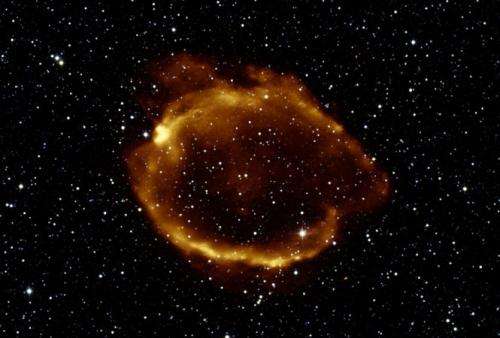
Reddish ring with many stars in background.

One idea was that ORCs might be supernova remnants like this one, G299.2-2.9, but there would need to be many more such remnants than are known to exist in our galaxy. Image via X-ray: NASA/ CXC/ U.Texas/ S. Park et al/ ROSAT/ 2MASS/ UMass/ IPAC-Caltech/ NASA/ NSF/ Phys.org.

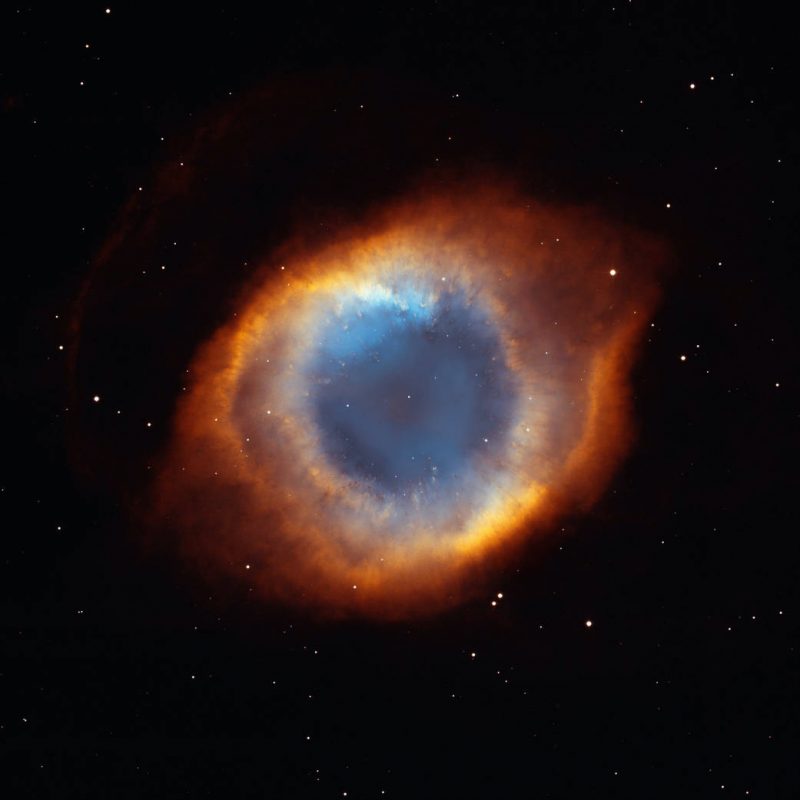
Colorful gaseous ring with blue center and stars in background.

Another possibility was that ORCs are planetary nebulae, like the Helix Nebula. But the radio spectral index of such a nebula is not consistent with the radio spectral index of ORCs. In other words, the observational details of planetary nebulae don’t match those of ORCs. Image via NASA.

Then, a fourth ORC was found in archived data from 2013. In that case, the Giant Metrewave Radio Telescope (GMRT) had been used, a few years before ASKAP began observing.

ORC 1 and ORC 2 were then later observed again using using yet another telescope, the Australian Telescope Compact Array (ATCA). All of these observations showed that these were real objects, not just glitches with ASKAP.

So scientists now accepted that these strange objects were real phenomena, ones that had not been seen before. But what were they?

We still don’t know.

What we do know is that all four ORCs are found at high galactic latitudes, well away from the plane of the galaxy, the flat part containing our sun and most other Milky Way stars. And, as observed, the ORCs are about one arcminute in size (a 60th of a degree or about 3% of the size of the moon).

Scientists still don’t know how far away they are. That’s a big gap in our knowledge about these objects, since, for many objects, the distance away can provide clues to the objects’ identities.

The ORCs are visible only at radio wavelengths, with radio telescopes. They can’t be seen at all in X-ray, optical or infrared wavelengths. Two of the ORCs have a galaxy near the center of the circles, but the other two don’t. ORC 3 appears as a uniform disk, while the other three look more like rings.

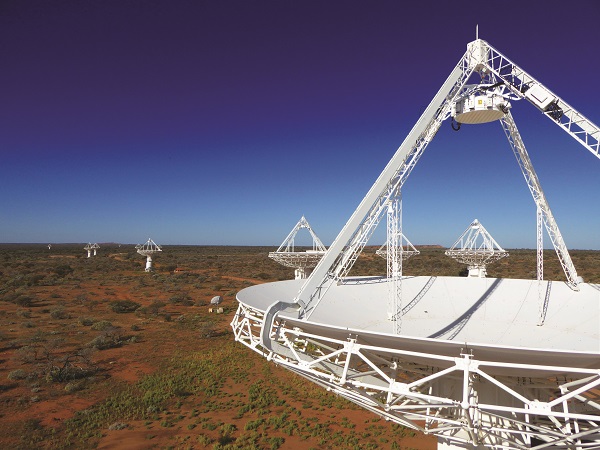
Array of dish-shaped radio telescopes on desert terrain with blue sky.

The Australian Square Kilometre Array Pathfinder, which first detected the ORCs in 2019. Image via Australia Telescope National Facility (ATNF).

Could they be supernova remnants or planetary nebulae, two other well-known kinds of cosmic rings? There’s a similarity, but the researchers say no. They are unlikely to be supernova remnants because three of the ORCs were found in a very small patch of sky. That would imply they were very common, and there would need to be at least 50,000 such supernova remnants in our galaxy to make the numbers work. But astronomers only know of about 350. 

So what else could they be? One idea is that they might be huge circular shockwaves from some massive event(s), outside the galaxy. As the researchers noted in the paper:

Several such classes of transient events, capable of producing a spherical shock wave, have recently been discovered, such as fast radio bursts, gamma-ray bursts and neutron star mergers. However, because of the large angular size of the ORCs, any such transients would have taken place in the distant past.

It is also possible that the ORCs represent a new category of a known phenomenon, such as the jets of a radio galaxy or blazar when seen end-on, down the ‘barrel’ of the jet. Alternatively, they may represent some remnant of a previous outflow from a radio galaxy.

Since the discovery of these first four ORCs, the researchers have identified six other candidate ORCs that are fainter.

Smiling man with blue ribbon around his neck on black background.

Ray Norris at Western Sydney University in Australia, who led the new study. Image via The Conversation.

The ORCs are a fascinating new mystery for astronomers. For those with a truly speculative turn of mind, it might be natural to wonder if they could be artificial in origin. Right now, however, there’s no way to determine that possibility. For now, the ORCs are considered to be most likely natural phenomena. Stay tuned, as astronomers continue to probe for answers.

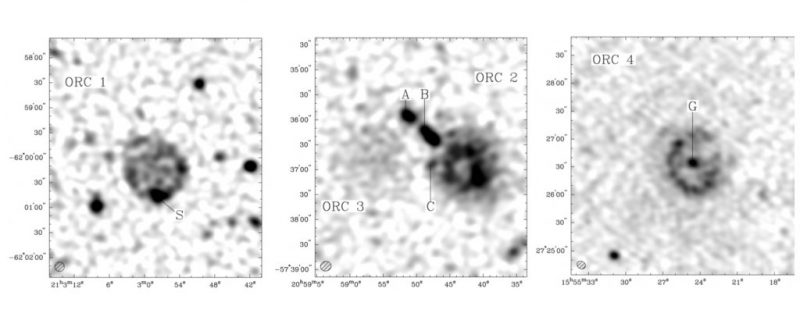
Three panes, each with a dark round blob, with text annotations on white background.

Three of the 4 Odd Radio Circles (ORCs) discovered by the Australian Square Kilometre Array Pathfinder (ASKAP) radio telescope in 2019. Image via Norris et al./ arXiv/ ScienceAlert.

Bottom line: Astronomers have discovered four Odd Radio Circles outside of our galaxy.

Source: Unexpected Circular Radio Objects at High Galactic Latitude

Via ScienceAlert

EarthSky’s yearly crowd-funding campaign is in progress. In 2020, we are donating 8.5% of all incoming revenues to No Kids Hungry. Click to learn more – donate – and help feed a child.


from EarthSky https://ift.tt/32PNCdT
A circle surrounding a black dot, on a field of stars.

Odd Radio Circle – aka ORC – number 4. The ASKAP radio telescope in Australia spotted the 4 ORCS in 2019. Image via Norris et al./ arXiv/ ScienceAlert.

EarthSky’s yearly crowd-funding campaign is in progress. In 2020, we are donating 8.5% of all incoming revenues to No Kids Hungry. Click to learn more – donate – and help feed a child.

Our universe is full of weird and wonderful things, and astronomers keep making new and increasingly bizarre discoveries. The latest discovery has them going in circles, literally. Using a radio telescope, astronomers at Western Sydney University in Australia spotted four unusual objects in deep space that look like a ring or bubble. They’ve dubbed them Odd Radio Circles or ORCs because they are circular … and so odd.

The researchers have submitted a new paper to Nature Astronomy, where it is currently awaiting peer review.

As explained in the paper’s abstract:

We have found an unexpected class of astronomical objects which have not previously been reported, in the Evolutionary Map of the Universe Pilot [EMU]survey, using the Australian Square Kilometre Array Pathfinder telescope (ASKAP).

The objects appear in radio images as circular edge-brightened discs about one arc-minute diameter, and do not seem to correspond to any known type of object. We speculate that they may represent a spherical shock wave from an extra-galactic transient event, or the outflow, or a remnant, from a radio galaxy viewed end-on.

In other words, they don’t know what they’ve found. They can only speculate.

Left: Dark ring with spot in middle. Right: circle of squiggly concentric lines with dot in middle.

Radio image of ORC 4 again, found in archival data from 2013 (left), along with a contour map of the ring (right). Image via Norris et al./ arXiv.

Radio telescopes are able to “see” various kinds of circular objects in space. What makes these ORCs unique? From the paper:

Circular features are well-known in radio astronomical images, and usually represent a spherical object such as a supernova remnant, a planetary nebula, a circumstellar shell [composed of circumstellar dust], or a face-on disc such as a protoplanetary disk or a star-forming galaxy.

They may also arise from imaging artifacts [lens flares] around bright sources …

Here we report the discovery of a class of circular feature in radio images that do not seem to correspond to any of these known types of object or artifact, but rather appear to be a new class of astronomical object.

Scientists first noticed the ORCs in images from the late 2019 Pilot Survey of the Evolutionary Map of the Universe (EMU). The images were collected using ASKAP, one of the world’s most highly sensitive radio telescope arrays.

First, one faint circle was seen in the images, then another. Then the astronomers found a third. Were they glitches? One or two maybe, but three?

Reddish ring with many stars in background.

One idea was that ORCs might be supernova remnants like this one, G299.2-2.9, but there would need to be many more such remnants than are known to exist in our galaxy. Image via X-ray: NASA/ CXC/ U.Texas/ S. Park et al/ ROSAT/ 2MASS/ UMass/ IPAC-Caltech/ NASA/ NSF/ Phys.org.

Colorful gaseous ring with blue center and stars in background.

Another possibility was that ORCs are planetary nebulae, like the Helix Nebula. But the radio spectral index of such a nebula is not consistent with the radio spectral index of ORCs. In other words, the observational details of planetary nebulae don’t match those of ORCs. Image via NASA.

Then, a fourth ORC was found in archived data from 2013. In that case, the Giant Metrewave Radio Telescope (GMRT) had been used, a few years before ASKAP began observing.

ORC 1 and ORC 2 were then later observed again using using yet another telescope, the Australian Telescope Compact Array (ATCA). All of these observations showed that these were real objects, not just glitches with ASKAP.

So scientists now accepted that these strange objects were real phenomena, ones that had not been seen before. But what were they?

We still don’t know.

What we do know is that all four ORCs are found at high galactic latitudes, well away from the plane of the galaxy, the flat part containing our sun and most other Milky Way stars. And, as observed, the ORCs are about one arcminute in size (a 60th of a degree or about 3% of the size of the moon).

Scientists still don’t know how far away they are. That’s a big gap in our knowledge about these objects, since, for many objects, the distance away can provide clues to the objects’ identities.

The ORCs are visible only at radio wavelengths, with radio telescopes. They can’t be seen at all in X-ray, optical or infrared wavelengths. Two of the ORCs have a galaxy near the center of the circles, but the other two don’t. ORC 3 appears as a uniform disk, while the other three look more like rings.

Array of dish-shaped radio telescopes on desert terrain with blue sky.

The Australian Square Kilometre Array Pathfinder, which first detected the ORCs in 2019. Image via Australia Telescope National Facility (ATNF).

Could they be supernova remnants or planetary nebulae, two other well-known kinds of cosmic rings? There’s a similarity, but the researchers say no. They are unlikely to be supernova remnants because three of the ORCs were found in a very small patch of sky. That would imply they were very common, and there would need to be at least 50,000 such supernova remnants in our galaxy to make the numbers work. But astronomers only know of about 350. 

So what else could they be? One idea is that they might be huge circular shockwaves from some massive event(s), outside the galaxy. As the researchers noted in the paper:

Several such classes of transient events, capable of producing a spherical shock wave, have recently been discovered, such as fast radio bursts, gamma-ray bursts and neutron star mergers. However, because of the large angular size of the ORCs, any such transients would have taken place in the distant past.

It is also possible that the ORCs represent a new category of a known phenomenon, such as the jets of a radio galaxy or blazar when seen end-on, down the ‘barrel’ of the jet. Alternatively, they may represent some remnant of a previous outflow from a radio galaxy.

Since the discovery of these first four ORCs, the researchers have identified six other candidate ORCs that are fainter.

Smiling man with blue ribbon around his neck on black background.

Ray Norris at Western Sydney University in Australia, who led the new study. Image via The Conversation.

The ORCs are a fascinating new mystery for astronomers. For those with a truly speculative turn of mind, it might be natural to wonder if they could be artificial in origin. Right now, however, there’s no way to determine that possibility. For now, the ORCs are considered to be most likely natural phenomena. Stay tuned, as astronomers continue to probe for answers.

Three panes, each with a dark round blob, with text annotations on white background.

Three of the 4 Odd Radio Circles (ORCs) discovered by the Australian Square Kilometre Array Pathfinder (ASKAP) radio telescope in 2019. Image via Norris et al./ arXiv/ ScienceAlert.

Bottom line: Astronomers have discovered four Odd Radio Circles outside of our galaxy.

Source: Unexpected Circular Radio Objects at High Galactic Latitude

Via ScienceAlert

EarthSky’s yearly crowd-funding campaign is in progress. In 2020, we are donating 8.5% of all incoming revenues to No Kids Hungry. Click to learn more – donate – and help feed a child.


from EarthSky https://ift.tt/32PNCdT

How to find Delta Aquariid radiant point

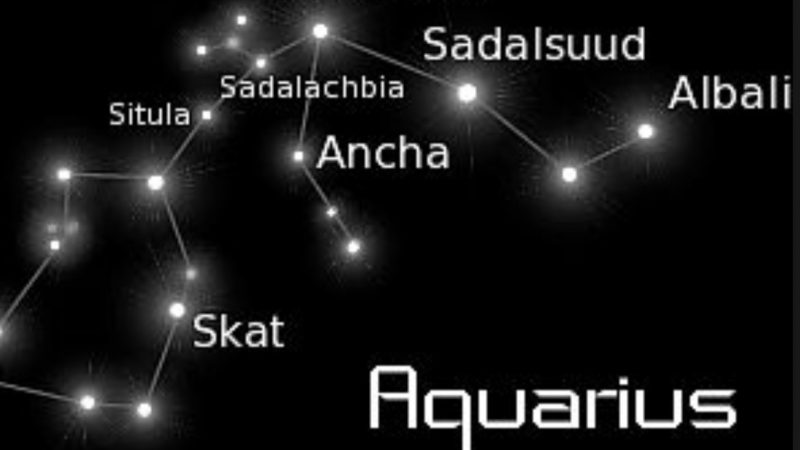
Star chart of the constellation Aquarius with six stars labeled, including Skat.

The star Skat – near the radiant for the Delta Aquariids – is the 3rd-brightest in the faint constellation Aquarius.

EarthSky’s yearly crowd-funding campaign is in progress. In 2020, we are donating 8.5% to No Kids Hungry. Please donate to help us keep going, and help feed a kid!

The Delta Aquariid meteor shower has a broad maximum and produces meteors throughout late July and early August. It overlaps with the more famous Perseid meteor shower, which peaks this year on the mornings of August 11, 12 and 13. The Delta Aquariid shower takes its name from the star Skat – also known by its Greek designation Delta Aquarii. If you trace the paths of the meteors backward, you’ll find that all Delta Aquariids appear to originate from a point near this star. This point – near Skat – is called the radiant point of the Delta Aquariid meteor shower.

Skat isn’t a bright star. It ranks as only the third-brightest in the dim constellation Aquarius the Water Bearer. Still, you can glimpse this constellation and this star, if you go someplace nice and dark. If you’re in the Northern Hemisphere, you’ll also need a good view to the south. From mid-latitudes in the Southern Hemisphere, the star and constellation are northward and higher in the sky.

Skat or Delta Aquarii appears modestly bright in a dark country sky. It’s near on the sky’s dome to a very bright star, Fomalhaut in the constellation Piscis Austrinus the Southern Fish.

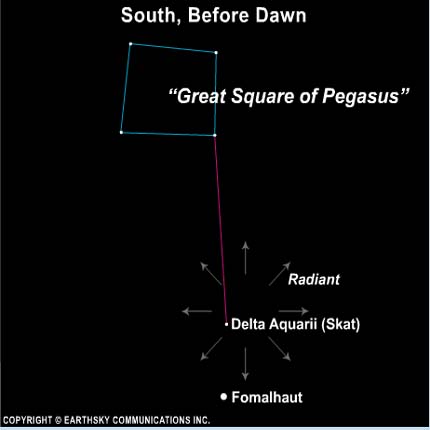
If you can see the Great Square of Pegasus and Fomalhaut, they can help you find Skat. See the chart below.

Outlined square of stars with arrow pointing down and radial arrows from point near star Skat.

Find the star Skat by first finding the Great Square of Pegasus. Skat is found roughly on a line drawn southward through stars on the Square’s west side. It’s between the Great Square and the bright star Fomalhaut.

Of course, in actuality, the Delta Aquariid meteors have nothing whatever to do with the star Skat. The meteors burn up some 60 miles (100 km) above Earth’s surface. Skat lies about 160 light-years away.

A meteor shower results when the Earth passes through the orbital path of a comet, and the debris from this passing comet vaporizes in the Earth’s upper atmosphere. The meteors enter Earth’s atmosphere on parallel paths.

Seeing them come from a radiant point in the sky is much the same illusion as standing on railroad tracks and seeing the tracks converge in the distance.

View of train tracks as if wide apart close to you and close together in the distance.

When you stand on a railroad track, you can see the illusion of tracks converging in the distance. Likewise, the paths of meteors in a single meteor shower appear to converge at a point – the radiant point – on the sky’s dome. Image via Shutterstock.

In late July and early August, when the Delta Aquariid meteors are flying, Skat and its constellation Aquarius rise above the horizon in the hours between midnight and dawn. They’re best seen in the evening sky in the months of October, November and December.

No matter when you look, you’ll always find Skat to the south (or below) the Great Square of Pegasus and to the north (or above) the bright star Fomalhaut.

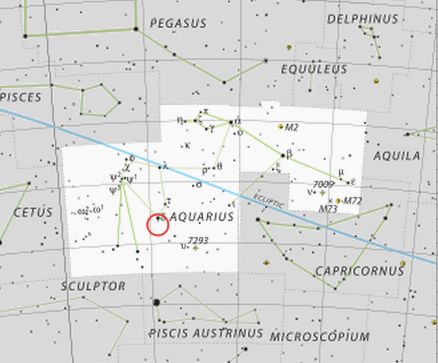
Star chart of constellation Aquarius with red circle around star Skat.

View larger. | Want to see the star Skat? This chart can help, and you also need a dark sky. Chart via Wikimedia Commons.

Bottom line: How to find the star Skat, or Delta Aquarii, third-brightest star in the constellation Aquarius the Water Bearer, radiant point for the Delta Aquariid meteor shower. Plus an explanation of why meteors in annual showers have radiant points.

Great Square of Pegasus: Easy to see

Read about all the major meteor showers: EarthSky’s meteor shower guide


from EarthSky https://ift.tt/318acKX
Star chart of the constellation Aquarius with six stars labeled, including Skat.

The star Skat – near the radiant for the Delta Aquariids – is the 3rd-brightest in the faint constellation Aquarius.

EarthSky’s yearly crowd-funding campaign is in progress. In 2020, we are donating 8.5% to No Kids Hungry. Please donate to help us keep going, and help feed a kid!

The Delta Aquariid meteor shower has a broad maximum and produces meteors throughout late July and early August. It overlaps with the more famous Perseid meteor shower, which peaks this year on the mornings of August 11, 12 and 13. The Delta Aquariid shower takes its name from the star Skat – also known by its Greek designation Delta Aquarii. If you trace the paths of the meteors backward, you’ll find that all Delta Aquariids appear to originate from a point near this star. This point – near Skat – is called the radiant point of the Delta Aquariid meteor shower.

Skat isn’t a bright star. It ranks as only the third-brightest in the dim constellation Aquarius the Water Bearer. Still, you can glimpse this constellation and this star, if you go someplace nice and dark. If you’re in the Northern Hemisphere, you’ll also need a good view to the south. From mid-latitudes in the Southern Hemisphere, the star and constellation are northward and higher in the sky.

Skat or Delta Aquarii appears modestly bright in a dark country sky. It’s near on the sky’s dome to a very bright star, Fomalhaut in the constellation Piscis Austrinus the Southern Fish.

If you can see the Great Square of Pegasus and Fomalhaut, they can help you find Skat. See the chart below.

Outlined square of stars with arrow pointing down and radial arrows from point near star Skat.

Find the star Skat by first finding the Great Square of Pegasus. Skat is found roughly on a line drawn southward through stars on the Square’s west side. It’s between the Great Square and the bright star Fomalhaut.

Of course, in actuality, the Delta Aquariid meteors have nothing whatever to do with the star Skat. The meteors burn up some 60 miles (100 km) above Earth’s surface. Skat lies about 160 light-years away.

A meteor shower results when the Earth passes through the orbital path of a comet, and the debris from this passing comet vaporizes in the Earth’s upper atmosphere. The meteors enter Earth’s atmosphere on parallel paths.

Seeing them come from a radiant point in the sky is much the same illusion as standing on railroad tracks and seeing the tracks converge in the distance.

View of train tracks as if wide apart close to you and close together in the distance.

When you stand on a railroad track, you can see the illusion of tracks converging in the distance. Likewise, the paths of meteors in a single meteor shower appear to converge at a point – the radiant point – on the sky’s dome. Image via Shutterstock.

In late July and early August, when the Delta Aquariid meteors are flying, Skat and its constellation Aquarius rise above the horizon in the hours between midnight and dawn. They’re best seen in the evening sky in the months of October, November and December.

No matter when you look, you’ll always find Skat to the south (or below) the Great Square of Pegasus and to the north (or above) the bright star Fomalhaut.

Star chart of constellation Aquarius with red circle around star Skat.

View larger. | Want to see the star Skat? This chart can help, and you also need a dark sky. Chart via Wikimedia Commons.

Bottom line: How to find the star Skat, or Delta Aquarii, third-brightest star in the constellation Aquarius the Water Bearer, radiant point for the Delta Aquariid meteor shower. Plus an explanation of why meteors in annual showers have radiant points.

Great Square of Pegasus: Easy to see

Read about all the major meteor showers: EarthSky’s meteor shower guide


from EarthSky https://ift.tt/318acKX

adds 2