aads

Altair and Aquila the Eagle

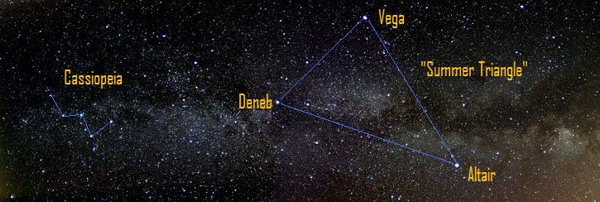
In the east after dark on these July evenings, look near the horizon for Altair, the brightest star in the constellation Aquila the Eagle. This is the bottom star of the Summer Triangle; that is, it’s the last of these three bright stars to ascend over the horizon. This star is 16.7 light-years from our sun and is one of the closest stars visible to the unaided eye.

You will recognize Altair by the two fainter stars on either side of it. In her classic book “The Friendly Stars” (1907), Martha Evans Martin described the three this way:

Then there comes a soft June evening, with its lovely twilight that begins with the last song of the woodthrush and ends with the first strenuous admonitions of the whippoorwill; and, almost as if it were an impulse of nature, one walks to the eastern end of the porch and looks for Altair. It is sure to be there smiling at one just over the tree-tops, with a bright companion on either side, the three gently advancing in a straight line as if they were walking the Milky Way hand in hand and three abreast.

And indeed the Great Rift of the summer Milky Way passes through the Summer Triangle, between the stars Vega and Altair. In dark skies in June, July and August, you can see rich star fields with your binoculars on both sides of the Great Rift.

In modern western culture, Altair is probably best known for being the home star system of the aliens in the 1956 science fiction film “Forbidden Planet”. But in Asian cultures, Altair and the star Vega figure in one of the most beautiful of all stories of the night sky. In Japan, for example, Vega is sometimes called Tanabata (or Orihime), a celestial princess or goddess. She falls in love with a mortal, Kengyu (or Hikoboshi), represented by the star Altair. Read the rest of the story here.

The whole Summer Triangle area is great to observe with binoculars or in dark skies with just your eyes. If you like finding hidden pictures, get set to find a Coathanger, the North American Nebula (NGC7000) and the Ring Nebula (M57).

Panorama of Milky Way with dark streak along middle and Summer Triangle lines drawn in, Cassiopeia to one side.

The Great Rift of the Milky Way passes through the constellation Cassiopeia and the Summer Triangle.

Our Summer Triangle series also includes:

Part 1: Vega and its constellation Lyra

Part 2: Deneb and its constellation Cygnus

Bottom line: The star Altair in Aquila the Eagle appears in the east on July evenings. You’ll recognize it by the 2 fainter stars on either side of it.

Donate: Your support means the world to us


from EarthSky https://ift.tt/2GmEdhV

In the east after dark on these July evenings, look near the horizon for Altair, the brightest star in the constellation Aquila the Eagle. This is the bottom star of the Summer Triangle; that is, it’s the last of these three bright stars to ascend over the horizon. This star is 16.7 light-years from our sun and is one of the closest stars visible to the unaided eye.

You will recognize Altair by the two fainter stars on either side of it. In her classic book “The Friendly Stars” (1907), Martha Evans Martin described the three this way:

Then there comes a soft June evening, with its lovely twilight that begins with the last song of the woodthrush and ends with the first strenuous admonitions of the whippoorwill; and, almost as if it were an impulse of nature, one walks to the eastern end of the porch and looks for Altair. It is sure to be there smiling at one just over the tree-tops, with a bright companion on either side, the three gently advancing in a straight line as if they were walking the Milky Way hand in hand and three abreast.

And indeed the Great Rift of the summer Milky Way passes through the Summer Triangle, between the stars Vega and Altair. In dark skies in June, July and August, you can see rich star fields with your binoculars on both sides of the Great Rift.

In modern western culture, Altair is probably best known for being the home star system of the aliens in the 1956 science fiction film “Forbidden Planet”. But in Asian cultures, Altair and the star Vega figure in one of the most beautiful of all stories of the night sky. In Japan, for example, Vega is sometimes called Tanabata (or Orihime), a celestial princess or goddess. She falls in love with a mortal, Kengyu (or Hikoboshi), represented by the star Altair. Read the rest of the story here.

The whole Summer Triangle area is great to observe with binoculars or in dark skies with just your eyes. If you like finding hidden pictures, get set to find a Coathanger, the North American Nebula (NGC7000) and the Ring Nebula (M57).

Panorama of Milky Way with dark streak along middle and Summer Triangle lines drawn in, Cassiopeia to one side.

The Great Rift of the Milky Way passes through the constellation Cassiopeia and the Summer Triangle.

Our Summer Triangle series also includes:

Part 1: Vega and its constellation Lyra

Part 2: Deneb and its constellation Cygnus

Bottom line: The star Altair in Aquila the Eagle appears in the east on July evenings. You’ll recognize it by the 2 fainter stars on either side of it.

Donate: Your support means the world to us


from EarthSky https://ift.tt/2GmEdhV

Solar Orbiter’s 1st views of the sun

The European Space Agency (ESA) and NASA released the first images from the Solar Orbiter (SolO) this week (July 16, 2020), and the images are – as expected – dazzlingly beautiful. They are the closest images taken of the sun so far. Launched on February 10 of this year, SolO’s very elliptical orbit ultimately will carry it periodically closer to the sun than the innermost planet, Mercury. Those very close perihelions – or closest points to the sun – will take several years to achieve, after gravity boosts from Earth and Venus. Meanwhile, in late May and June 2020, SolO swept closer to the sun than Venus, the sun’s second planet, coming within 47 million miles (77 million km) and capturing detail never seen before, including miniature solar flares that the scientists are referring to as campfires.

Animated illustration of SolO's orbits in relation to Earth's, Venus' and Mercury's orbits.

Solar Orbiter’s elliptical orbit will ultimately carry it closer to the sun than Mercury, or to within 26 million miles (42 million km) from the sun’s surface, or about 0.28 Earth’s distance. Animation via Phoenix7777/ Wikimedia Commons.

The features – in the sun’s outer atmosphere, or corona – are only as wide across as 250 miles (400 km). That’s in contrast to the sun’s diameter of 865,370 miles (1.4 million km). The scientists described the features as:

… a multitude of small flaring loops, erupting bright spots and dark, moving fibrils.

Solar Orbiter captured them in a series of views acquired by several remote-sensing instruments on the spacecraft, between May 30 and June 21, when the craft was roughly halfway between the Earth and the sun – closer to the sun than any other solar telescope has ever been before.

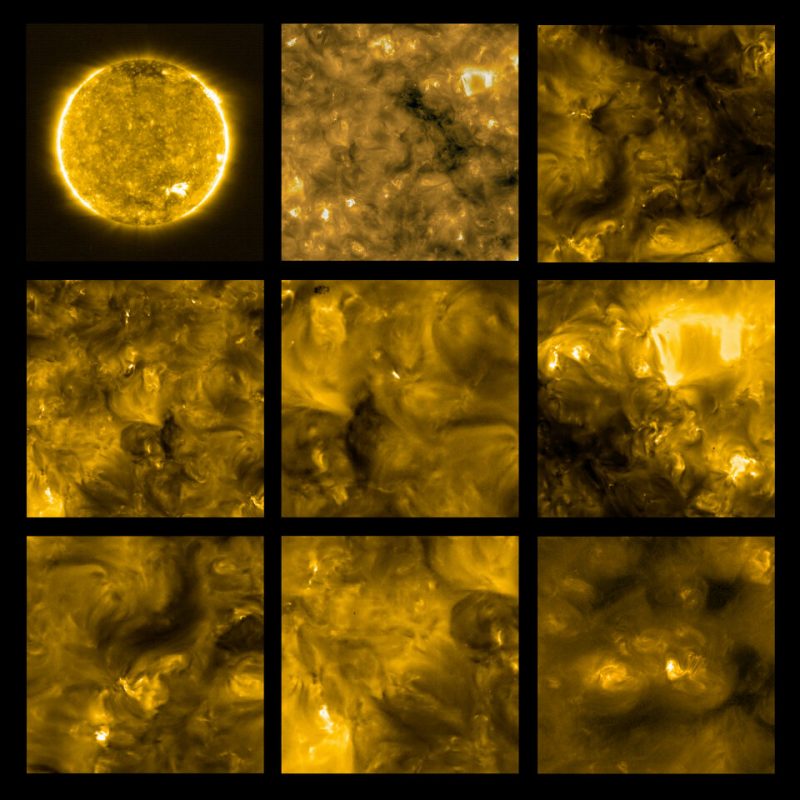
A 9-paned mosaic. The top left pane shows the full sun, and the other 8 show close views of swirling orange features, the campfires.

The Extreme Ultraviolet Imager (EUI) on ESA’s Solar Orbiter spacecraft took these images on May 30, 2020. They show the sun’s appearance in the extreme ultraviolet region of the electromagnetic spectrum. Images at this wavelength reveal the upper atmosphere of the sun, the corona, with a temperature of around 1 million degrees Fahrenheit (600,000 degrees Celsius). EUI takes full disk images (top left) using the Full Sun Imager (FSI) telescope, as well as high resolution images using the HRIEUV telescope. Image via ESA.

The scientists compared the campfires to solar flares, which are short-lived eruptions on the sun associated with sunspots and times of high solar activity. There are few flares or spots on the sun now; we’re at a low point in the 11-year solar cycle. When they do occur, solar flares can cause electromagnetic disturbances on Earth, affecting communications satellites and electrical power grids.

The campfires seen by Solar Orbiter, on the other hand, are only a millionth or a billionth the size of solar flares.

However, these features on the sun may affect our local star. Scientists said the campfires might be contributing to the high temperatures of the sun’s corona. The high temperature of the corona – the wispy outer atmosphere of the sun that becomes visible during total solar eclipses – has long been a mystery. The temperature of the corona is more than a million degrees F (600,000 degrees C). That’s much hotter – mysteriously hotter – than the temperature at the sun’s visible surface, which is around 10,000 degrees F (5,500 degrees C).

Why do temperatures soar as you go farther from the center of the sun? That’s one question scientists have long wanted to answer.

Four-paned view of space, with a bright light from the sun on one side, and a tiny dot (Mercury).

This mosaic is the 1st-light image from the SoloHI telescope. What you’re seeing here is light scattered by electrons in the solar wind. In this view, the sun is to the right of the frame, its light blocked by a series of baffles. The partial ellipse visible on the right is the zodiacal light – what we on Earth sometimes call the false dawn – created by sunlight reflecting off the dust particles that are orbiting the sun. Along the lower edge of the upper left tile, you can see a small dot: the planet Mercury. Image via NASA/ ESA Solar Orbiter.

In addition, the scientists said, the campfire features might be linked to the origin of the solar wind, a stream of charged particles released mostly from the sun’s corona, expanding from the sun and streaming past the planets to some three times Pluto’s distance. You might think of our solar system as a family of planets, but it’s also possible to think of it as a heliosphere, a bubble-like region surrounding the sun created by the solar wind.

Our sun’s heliosphere ends where the interstellar medium – or space between the stars – begins. It’s Solar Orbiter’s job, in part, to explore the heliosphere, and to answer questions about how the sun creates and controls it.

SolO is an international collaboration between ESA and NASA. Over time, the spacecraft’s orbit will be tilted upward out of the plane of the ecliptic, to give it a better view of the sun’s north and south poles. The SolO mission is expected to carry out 22 orbits in 10 years.

Another 4-paned image, 2 green and 2 red. In each image. the sun itself is blocked by an occulting disk.

Here’s an image from a different instrument aboad Solar Orbiter, called the Metis coronograph. It blocks out the dazzling light from the solar surface, bringing the fainter corona into view. The green images here show what’s seen in visible light, and the red images show what’s seen in ultraviolet light. The scientists said these images (acquired closer to the sun than any before) showed “unprecedented temporal coverage and spatial resolution. These images reveal the two bright equatorial streamers and fainter polar regions that are characteristic of the solar corona during times of minimal magnetic activity.” Image via NASA/ ESA Solar Orbiter.

Bottom line: Solar Orbiter’s new views – released by NASA and ESA on July 16, 2020 – are the closest images of the sun taken so far.

Via ESA


from EarthSky https://ift.tt/3eJPQhy

The European Space Agency (ESA) and NASA released the first images from the Solar Orbiter (SolO) this week (July 16, 2020), and the images are – as expected – dazzlingly beautiful. They are the closest images taken of the sun so far. Launched on February 10 of this year, SolO’s very elliptical orbit ultimately will carry it periodically closer to the sun than the innermost planet, Mercury. Those very close perihelions – or closest points to the sun – will take several years to achieve, after gravity boosts from Earth and Venus. Meanwhile, in late May and June 2020, SolO swept closer to the sun than Venus, the sun’s second planet, coming within 47 million miles (77 million km) and capturing detail never seen before, including miniature solar flares that the scientists are referring to as campfires.

Animated illustration of SolO's orbits in relation to Earth's, Venus' and Mercury's orbits.

Solar Orbiter’s elliptical orbit will ultimately carry it closer to the sun than Mercury, or to within 26 million miles (42 million km) from the sun’s surface, or about 0.28 Earth’s distance. Animation via Phoenix7777/ Wikimedia Commons.

The features – in the sun’s outer atmosphere, or corona – are only as wide across as 250 miles (400 km). That’s in contrast to the sun’s diameter of 865,370 miles (1.4 million km). The scientists described the features as:

… a multitude of small flaring loops, erupting bright spots and dark, moving fibrils.

Solar Orbiter captured them in a series of views acquired by several remote-sensing instruments on the spacecraft, between May 30 and June 21, when the craft was roughly halfway between the Earth and the sun – closer to the sun than any other solar telescope has ever been before.

A 9-paned mosaic. The top left pane shows the full sun, and the other 8 show close views of swirling orange features, the campfires.

The Extreme Ultraviolet Imager (EUI) on ESA’s Solar Orbiter spacecraft took these images on May 30, 2020. They show the sun’s appearance in the extreme ultraviolet region of the electromagnetic spectrum. Images at this wavelength reveal the upper atmosphere of the sun, the corona, with a temperature of around 1 million degrees Fahrenheit (600,000 degrees Celsius). EUI takes full disk images (top left) using the Full Sun Imager (FSI) telescope, as well as high resolution images using the HRIEUV telescope. Image via ESA.

The scientists compared the campfires to solar flares, which are short-lived eruptions on the sun associated with sunspots and times of high solar activity. There are few flares or spots on the sun now; we’re at a low point in the 11-year solar cycle. When they do occur, solar flares can cause electromagnetic disturbances on Earth, affecting communications satellites and electrical power grids.

The campfires seen by Solar Orbiter, on the other hand, are only a millionth or a billionth the size of solar flares.

However, these features on the sun may affect our local star. Scientists said the campfires might be contributing to the high temperatures of the sun’s corona. The high temperature of the corona – the wispy outer atmosphere of the sun that becomes visible during total solar eclipses – has long been a mystery. The temperature of the corona is more than a million degrees F (600,000 degrees C). That’s much hotter – mysteriously hotter – than the temperature at the sun’s visible surface, which is around 10,000 degrees F (5,500 degrees C).

Why do temperatures soar as you go farther from the center of the sun? That’s one question scientists have long wanted to answer.

Four-paned view of space, with a bright light from the sun on one side, and a tiny dot (Mercury).

This mosaic is the 1st-light image from the SoloHI telescope. What you’re seeing here is light scattered by electrons in the solar wind. In this view, the sun is to the right of the frame, its light blocked by a series of baffles. The partial ellipse visible on the right is the zodiacal light – what we on Earth sometimes call the false dawn – created by sunlight reflecting off the dust particles that are orbiting the sun. Along the lower edge of the upper left tile, you can see a small dot: the planet Mercury. Image via NASA/ ESA Solar Orbiter.

In addition, the scientists said, the campfire features might be linked to the origin of the solar wind, a stream of charged particles released mostly from the sun’s corona, expanding from the sun and streaming past the planets to some three times Pluto’s distance. You might think of our solar system as a family of planets, but it’s also possible to think of it as a heliosphere, a bubble-like region surrounding the sun created by the solar wind.

Our sun’s heliosphere ends where the interstellar medium – or space between the stars – begins. It’s Solar Orbiter’s job, in part, to explore the heliosphere, and to answer questions about how the sun creates and controls it.

SolO is an international collaboration between ESA and NASA. Over time, the spacecraft’s orbit will be tilted upward out of the plane of the ecliptic, to give it a better view of the sun’s north and south poles. The SolO mission is expected to carry out 22 orbits in 10 years.

Another 4-paned image, 2 green and 2 red. In each image. the sun itself is blocked by an occulting disk.

Here’s an image from a different instrument aboad Solar Orbiter, called the Metis coronograph. It blocks out the dazzling light from the solar surface, bringing the fainter corona into view. The green images here show what’s seen in visible light, and the red images show what’s seen in ultraviolet light. The scientists said these images (acquired closer to the sun than any before) showed “unprecedented temporal coverage and spatial resolution. These images reveal the two bright equatorial streamers and fainter polar regions that are characteristic of the solar corona during times of minimal magnetic activity.” Image via NASA/ ESA Solar Orbiter.

Bottom line: Solar Orbiter’s new views – released by NASA and ESA on July 16, 2020 – are the closest images of the sun taken so far.

Via ESA


from EarthSky https://ift.tt/3eJPQhy

Coronavirus reports – Part 6 “The kids being home all the time has been quite a challenge”

Ashlea and her daughters.

We caught up with people living with cancer across the country, to find out how the coronavirus pandemic has affected them and their families.

Jane: “I was worried I might be deprioritised, but thankfully that’s not happened.”

Jane (right) with her family. Credit: June Snowdon Photography

Jane is being treated for incurable ovarian cancer.

At the beginning of the COVID-19 outbreak, Jane was having chemotherapy every three weeks, which continued despite the pandemic. “I’m glad it carried on. But the communications have not been brilliant – I have had to follow up things myself, so it’s been stressful.”

Jane’s doctors have since altered her treatment, as the chemotherapy wasn’t working as well as they’d hoped. “I was told in person. The doctor was wearing a mask, but I knew it was bad news because otherwise it would have been on the phone.”

Jane’s now on a weekly chemotherapy treatment, which she’s conscious means going into the hospital more. “It does add to my COVID-19 risk, but as the cancer is advanced, the benefits outweigh the risk.”

Having visited the hospital a number of times since the COVID-19 pandemic began, Jane has seen how things have evolved during locked. “It was very quiet at first – there were no masks or plastic guards, but there were very few people in the hospital.”

And while the rules have tightened, the hospital is a lot busier, which Jane says can somehow feel more frightening. “You have to think more about distancing.

“It was easier at first, as everyone was dealing with the uncertainty, and everyone felt connected. Now, people are going back to things and it can feel lonely again.”

Jane’s kids are now back at school, which means the house is quieter. But she’s glad the family is getting back to some sense of normality.

And while her treatment has been unaffected so far, the impact of COVID-19 on cancer services is worrying for Jane. “The delays to screening and with people putting off checks, it’s going to lead to more late diagnosis. And for ovarian cancer, which is often diagnosed late, this is such a concern.”

Clinical trials are also extremely important to Jane. “I’ve already been on one trial and hope to be on another. Trials could be the difference between me having an extra year with my children, so I’m so worried to hear about any disruptions. It’s pretty raw for me.”

Sal: “It is so worrying being ill at this time”

Sal (left) was diagnosed with bile duct cancer in 2018.

“Everything was unsettling. I was able to have the main treatment as planned, but it was so concerning about how and where things happen, and if things went wrong.”

Sal was diagnosed with bile duct cancer in 2018, 5 years after being diagnosed with breast cancer. She’s currently having chemotherapy every other week, which has taken its toll. “It’s difficult as there is no time to recover. I am in for infusions for four hours and then carry a pump home for a further 48 hours, which is extremely uncomfortable.”

Despite her treatment continuing, there have been a lot of disruptions during the pandemic. “There was upheaval in the hospital where I was being treated, and it was hard only having updates on the phone with my oncologist. CT scans were moved to different hospitals with unfamiliar staff and procedures.”

“I’ve had infections and been really unwell. It’s so worrying being ill at this time. Without seeing friends and family and receiving that extra support, it just caused further anxiety.”

Sal has been experiencing a number of other side effects as well, including neuropathy and extreme sensitivity to cold. “Even touching the fridge, I can get a shock and my hands go into spasm.” Sal says she’s been existing hour to hour for the last 10 weeks. “My whole body is exhausted. Some days I can go for a 10 min walk, but others I can’t move for two days.”

And while she’s been prescribed medication for the pain, it’s not been enough. “After several weeks, I managed to get acupuncture as an emergency case. It’s frustrating that reflexology, massage and reiki are all closed, to me this is all critical care for cancer patients and practitioners are just as needed as hospital key workers – but Poundland is open! How can I not get chronic pain relief?”

The uncertainty combined with the side effects of treatment have taken its toll on Sal, who’s been having panic attacks. “I’m feeling better now, by searching and doing alternative therapy online. The kids are ok and my husband has been brilliant – he has been doing everything to hold us all together.”

Ashlea: “The kids being home all the time has been quite a challenge”

Ashlea with her daughters.

Ashlea was diagnosed with triple negative breast cancer in May last year. She initially had a lumpectomy and 11 rounds of chemotherapy but has since had surgery to remove both breasts in February to try and prevent her cancer returning.

Ashlea, a Special Educational Needs teacher at Portland Academy, is still recovering from the impact of her surgery, which she had hoped would be the end of her treatment. But she developed a range of infections, which required further surgery.

“I developed necrosis, which left a hole in my chest that required more treatment in hospital during COVID-19, which was a scary experience. I also have lasting side effects from chemotherapy, which leave me very tired at times, so the kids being home all the time has been quite a challenge.”

Despite her teaching experience, Ashlea says she’s found home schooling a challenge. “You’d think being a teacher would make home schooling easy, but it’s definitely not! We have, however, had an amazing time together, they’ve really missed me this past year when I’ve been in and out of hospital, so this time together has been so precious.”

Ashlea has been getting the kids to do some paper maths and England, but mostly they’ve been enjoying new experiences and learning skills like gardening, cooking and how to operate the washing machine, which Ashlea says has come in handy as she struggles to do everyday things.

“My husband Jamie is a key worker and went back to work a few weeks ago, so the kids have had to help with chores as the movement in my arms is limited. The more they do, the better they’re becoming. My six-year-old can get the worktops sparkling!”

And the tasks have helped her eldest son too. “My eldest son is autistic and has struggled being at home with no routine, but being able to give him daily tasks around the house has really helped.

“We can all play a part, no matter how big or small, to lessen the impact of cancer, so I’m proud of the way my children have embraced the challenge and I hope others will do what they can.”

Thanks to Jane, Sal and Ashlea for sharing their experiences with our Media Volunteer Liaison team.

If you would like to share your story with us, please visit our website. And if you have questions about cancer, you can talk to our nurses Monday to Friday, 9-5pm, on freephone 0808 800 4040.


from Cancer Research UK – Science blog https://ift.tt/3jcz0ey
Ashlea and her daughters.

We caught up with people living with cancer across the country, to find out how the coronavirus pandemic has affected them and their families.

Jane: “I was worried I might be deprioritised, but thankfully that’s not happened.”

Jane (right) with her family. Credit: June Snowdon Photography

Jane is being treated for incurable ovarian cancer.

At the beginning of the COVID-19 outbreak, Jane was having chemotherapy every three weeks, which continued despite the pandemic. “I’m glad it carried on. But the communications have not been brilliant – I have had to follow up things myself, so it’s been stressful.”

Jane’s doctors have since altered her treatment, as the chemotherapy wasn’t working as well as they’d hoped. “I was told in person. The doctor was wearing a mask, but I knew it was bad news because otherwise it would have been on the phone.”

Jane’s now on a weekly chemotherapy treatment, which she’s conscious means going into the hospital more. “It does add to my COVID-19 risk, but as the cancer is advanced, the benefits outweigh the risk.”

Having visited the hospital a number of times since the COVID-19 pandemic began, Jane has seen how things have evolved during locked. “It was very quiet at first – there were no masks or plastic guards, but there were very few people in the hospital.”

And while the rules have tightened, the hospital is a lot busier, which Jane says can somehow feel more frightening. “You have to think more about distancing.

“It was easier at first, as everyone was dealing with the uncertainty, and everyone felt connected. Now, people are going back to things and it can feel lonely again.”

Jane’s kids are now back at school, which means the house is quieter. But she’s glad the family is getting back to some sense of normality.

And while her treatment has been unaffected so far, the impact of COVID-19 on cancer services is worrying for Jane. “The delays to screening and with people putting off checks, it’s going to lead to more late diagnosis. And for ovarian cancer, which is often diagnosed late, this is such a concern.”

Clinical trials are also extremely important to Jane. “I’ve already been on one trial and hope to be on another. Trials could be the difference between me having an extra year with my children, so I’m so worried to hear about any disruptions. It’s pretty raw for me.”

Sal: “It is so worrying being ill at this time”

Sal (left) was diagnosed with bile duct cancer in 2018.

“Everything was unsettling. I was able to have the main treatment as planned, but it was so concerning about how and where things happen, and if things went wrong.”

Sal was diagnosed with bile duct cancer in 2018, 5 years after being diagnosed with breast cancer. She’s currently having chemotherapy every other week, which has taken its toll. “It’s difficult as there is no time to recover. I am in for infusions for four hours and then carry a pump home for a further 48 hours, which is extremely uncomfortable.”

Despite her treatment continuing, there have been a lot of disruptions during the pandemic. “There was upheaval in the hospital where I was being treated, and it was hard only having updates on the phone with my oncologist. CT scans were moved to different hospitals with unfamiliar staff and procedures.”

“I’ve had infections and been really unwell. It’s so worrying being ill at this time. Without seeing friends and family and receiving that extra support, it just caused further anxiety.”

Sal has been experiencing a number of other side effects as well, including neuropathy and extreme sensitivity to cold. “Even touching the fridge, I can get a shock and my hands go into spasm.” Sal says she’s been existing hour to hour for the last 10 weeks. “My whole body is exhausted. Some days I can go for a 10 min walk, but others I can’t move for two days.”

And while she’s been prescribed medication for the pain, it’s not been enough. “After several weeks, I managed to get acupuncture as an emergency case. It’s frustrating that reflexology, massage and reiki are all closed, to me this is all critical care for cancer patients and practitioners are just as needed as hospital key workers – but Poundland is open! How can I not get chronic pain relief?”

The uncertainty combined with the side effects of treatment have taken its toll on Sal, who’s been having panic attacks. “I’m feeling better now, by searching and doing alternative therapy online. The kids are ok and my husband has been brilliant – he has been doing everything to hold us all together.”

Ashlea: “The kids being home all the time has been quite a challenge”

Ashlea with her daughters.

Ashlea was diagnosed with triple negative breast cancer in May last year. She initially had a lumpectomy and 11 rounds of chemotherapy but has since had surgery to remove both breasts in February to try and prevent her cancer returning.

Ashlea, a Special Educational Needs teacher at Portland Academy, is still recovering from the impact of her surgery, which she had hoped would be the end of her treatment. But she developed a range of infections, which required further surgery.

“I developed necrosis, which left a hole in my chest that required more treatment in hospital during COVID-19, which was a scary experience. I also have lasting side effects from chemotherapy, which leave me very tired at times, so the kids being home all the time has been quite a challenge.”

Despite her teaching experience, Ashlea says she’s found home schooling a challenge. “You’d think being a teacher would make home schooling easy, but it’s definitely not! We have, however, had an amazing time together, they’ve really missed me this past year when I’ve been in and out of hospital, so this time together has been so precious.”

Ashlea has been getting the kids to do some paper maths and England, but mostly they’ve been enjoying new experiences and learning skills like gardening, cooking and how to operate the washing machine, which Ashlea says has come in handy as she struggles to do everyday things.

“My husband Jamie is a key worker and went back to work a few weeks ago, so the kids have had to help with chores as the movement in my arms is limited. The more they do, the better they’re becoming. My six-year-old can get the worktops sparkling!”

And the tasks have helped her eldest son too. “My eldest son is autistic and has struggled being at home with no routine, but being able to give him daily tasks around the house has really helped.

“We can all play a part, no matter how big or small, to lessen the impact of cancer, so I’m proud of the way my children have embraced the challenge and I hope others will do what they can.”

Thanks to Jane, Sal and Ashlea for sharing their experiences with our Media Volunteer Liaison team.

If you would like to share your story with us, please visit our website. And if you have questions about cancer, you can talk to our nurses Monday to Friday, 9-5pm, on freephone 0808 800 4040.


from Cancer Research UK – Science blog https://ift.tt/3jcz0ey

Giant A-68 iceberg 3 years on

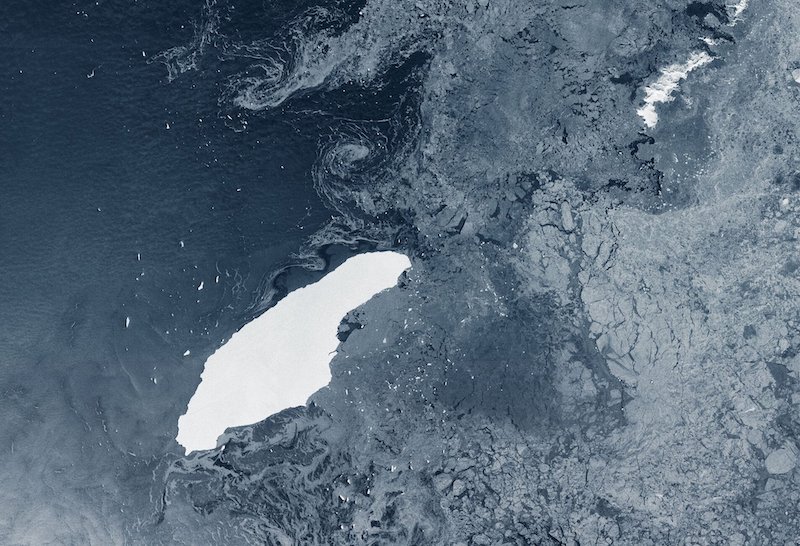
Textured slate blue swirly background with large stark white oblong in the middle.

Iceberg A-68A in open waters. Captured by the Copernicus Sentinel-1 radar mission, this image shows the berg on July 5, 2020, a few days before its 3rd birthday. Image via ESA.

This post was originally published July 10, 2020, by ESA

The colossus iceberg that split from Antarctica’s Larsen C ice shelf on July 12, 2017, is now in the open waters of the South Atlantic near the South Orkney Islands, about 1,050 km (650 miles) from its birthplace. Having lost two chunks of ice, this record berg is a little less huge than it once was – and now that it is in rougher waters, it may break up further.

When it calved, A-68 was about twice the size of Luxembourg and one of the largest icebergs on record, changing the outline of the Antarctic Peninsula forever. Despite its size, however, it is remarkably thin, just a couple of hundred meters thick.

Over the last three years, satellite missions such as Copernicus Sentinel-1 have been used to track the berg as it drifted in the Southern Ocean. For the first two years, it remained close to its parent ice sheet, impeded by sea ice.

However, it lost a chunk of ice almost immediately after being calved, resulting in it being renamed A-68A, and its offspring became A-68B. More recently, in April 2020, A-68A lost another chunk: A-68C.

Rather unromantically, Antarctic icebergs are named from the Antarctic quadrant in which they were originally sighted, then a sequential number, then, if the iceberg breaks, a sequential letter.

Although A-68A is a relatively thin iceberg, it has held together reasonably well, but satellites will be key to monitoring how it changes in open waters.

Map of part of Antarctica with many blue lines of past iceberg paths, showing A-68's path among them.

View larger. | A-68A path. Read more about this map. Image via ESA.

The map above shows the different positions of A-68A during its three-year journey. The map not only highlights how long it remained close to the Larsen C ice sheet, but how, over the last year or so, its pace of drift has increased considerably.

The map also includes historic iceberg tracks, based on data from a number of satellites including ESA’s ERS-1 and ERS-2, and shows that A-68A is following this well-trodden path.

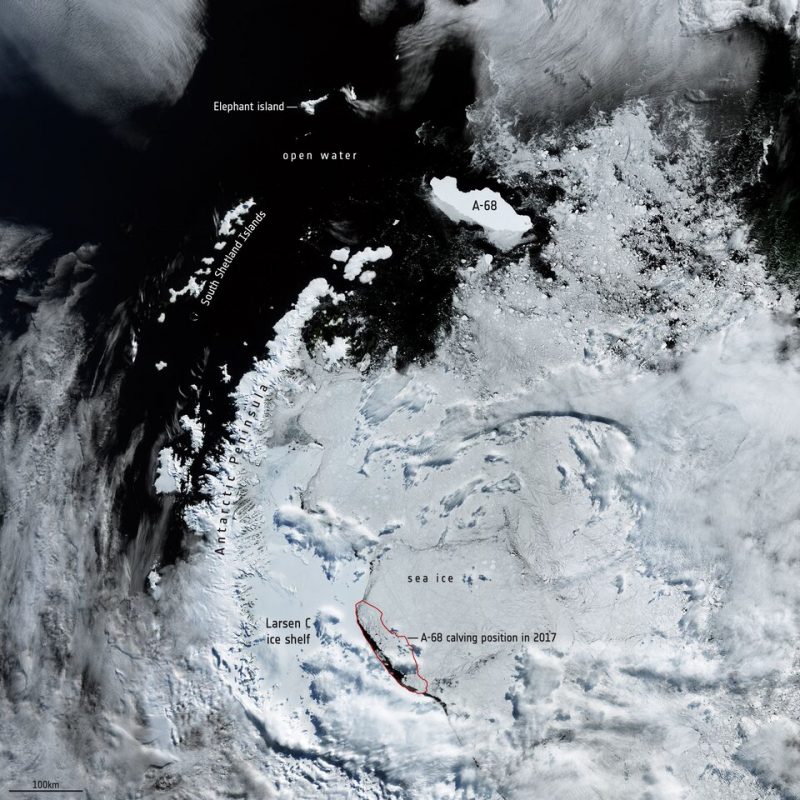
Large white area and dark slate blue sea with A-68 near edge of white area.

This image from the Copernicus Sentinel-3 mission shows A-68A’s position in February 2020. Image via ESA.

Bottom line: Colossal iceberg A-68, that split from Antarctica’s Larsen C ice shelf in July 2017, is now in the open waters of the South Atlantic, about 650 miles (1,050 km) from its birthplace.

Via ESA


from EarthSky https://ift.tt/32nc9Hc
Textured slate blue swirly background with large stark white oblong in the middle.

Iceberg A-68A in open waters. Captured by the Copernicus Sentinel-1 radar mission, this image shows the berg on July 5, 2020, a few days before its 3rd birthday. Image via ESA.

This post was originally published July 10, 2020, by ESA

The colossus iceberg that split from Antarctica’s Larsen C ice shelf on July 12, 2017, is now in the open waters of the South Atlantic near the South Orkney Islands, about 1,050 km (650 miles) from its birthplace. Having lost two chunks of ice, this record berg is a little less huge than it once was – and now that it is in rougher waters, it may break up further.

When it calved, A-68 was about twice the size of Luxembourg and one of the largest icebergs on record, changing the outline of the Antarctic Peninsula forever. Despite its size, however, it is remarkably thin, just a couple of hundred meters thick.

Over the last three years, satellite missions such as Copernicus Sentinel-1 have been used to track the berg as it drifted in the Southern Ocean. For the first two years, it remained close to its parent ice sheet, impeded by sea ice.

However, it lost a chunk of ice almost immediately after being calved, resulting in it being renamed A-68A, and its offspring became A-68B. More recently, in April 2020, A-68A lost another chunk: A-68C.

Rather unromantically, Antarctic icebergs are named from the Antarctic quadrant in which they were originally sighted, then a sequential number, then, if the iceberg breaks, a sequential letter.

Although A-68A is a relatively thin iceberg, it has held together reasonably well, but satellites will be key to monitoring how it changes in open waters.

Map of part of Antarctica with many blue lines of past iceberg paths, showing A-68's path among them.

View larger. | A-68A path. Read more about this map. Image via ESA.

The map above shows the different positions of A-68A during its three-year journey. The map not only highlights how long it remained close to the Larsen C ice sheet, but how, over the last year or so, its pace of drift has increased considerably.

The map also includes historic iceberg tracks, based on data from a number of satellites including ESA’s ERS-1 and ERS-2, and shows that A-68A is following this well-trodden path.

Large white area and dark slate blue sea with A-68 near edge of white area.

This image from the Copernicus Sentinel-3 mission shows A-68A’s position in February 2020. Image via ESA.

Bottom line: Colossal iceberg A-68, that split from Antarctica’s Larsen C ice shelf in July 2017, is now in the open waters of the South Atlantic, about 650 miles (1,050 km) from its birthplace.

Via ESA


from EarthSky https://ift.tt/32nc9Hc

Beautyberry leaf extract restores drug's power to fight 'superbug'

"We decided to investigate the chemical properties of the American beautyberry because it was an important medicinal plant for Native Americans," says Emory ethnobotanist Cassandra Quave, a senior author of the study. (Photo by Tharanga Samarakoon)

By Carol Clark

Scientists discovered a compound in the leaves of a common shrub, the American beautyberry, that boosts an antibiotic’s activity against antibiotic-resistant staph bacteria. Laboratory experiments showed that the plant compound works in combination with oxacillin to knock down the resistance to the drug of methicillin-resistant Staphylococcus aureus, or MRSA.

The American Chemical Society's ACS Infectious Diseases published the finding, led by scientists at Emory University and the University of Notre Dame.

The American beautyberry, or Callicarpa americana, is native to the southern United States. Prolific in the wild, the shrub is also popular in ornamental landscaping. It’s known for showy clusters of bright purple berries that begin to ripen in the summer and are an important food source for many species of birds.

“We decided to investigate the chemical properties of the American beautyberry because it was an important medicinal plant for Native Americans,” says Cassandra Quave, co-senior author of the study and an assistant professor in Emory University’s Center for the Study of Human Health and Emory School of Medicine’s Department of Dermatology. Quave is also a member of the Emory Antibiotic Resistance Center and a leader in the field of medical ethnobotany, studying how indigenous people incorporate plants in healing practices to uncover promising candidates for new drugs.

Micah Dettweiler, a recent Emory graduate and a staff member of the Quave lab, is first author of the study. Christian Melander, professor of chemistry at Notre Dame, is co-senior author.

The Alabama, Choctaw, Creek, Koasati, Seminole and other Native American tribes relied on the American beautyberry for various medicinal purposes. Leaves and other parts of the plant were boiled for use in sweat baths to treat malarial fevers and rheumatism. The boiled roots were made into treatments for dizziness, stomachaches and urine retention, while bark from the stems and roots were made into concoctions for itchy skin.

Previous research found that extracts from the leaves of the beautyberry deter mosquitoes and ticks. And a prior study by Quave and colleagues found that extracts from the leaves inhibit growth of the bacterium that causes acne. For this study, the researchers focused on testing extracts collected from the leaves for efficacy against MRSA.

“Even a single plant tissue can contain hundreds of unique molecules,” Quave says. “It’s a painstaking process to chemically separate them out, then test and retest until you find one that’s effective.”

The researchers identified a compound from the leaves that slightly inhibited the growth of MRSA. The compound belongs to a group of chemicals known as clerodane diterpenoids, some of which are used by plants to repel predators.

Since the compound only modestly inhibited MRSA, the researchers tried it in combination with beta-lactam antibiotics.

“Beta-lactam antibiotics are some of the safest and least toxic that are currently available in the antibiotic arsenal,” Quave says. “Unfortunately, MRSA has developed resistance to them.” 

Laboratory tests showed that the beautyberry leaf compound synergizes with the beta-lactam antibiotic oxacillin to knock down MRSA’s resistance to the drug.

The next step is to test the combination of the beautyberry leaf extract and oxacillin as a therapy in animal models. If those results prove effective against MRSA infections, the researchers will synthesize the plant compound in the lab and tweak its chemical structure to try to further enhance its efficacy as a combination therapy with oxacillin.

“We need to keep filling the drug-discovery pipeline with innovative solutions, including potential combination therapies, to address the ongoing and growing problem of antibiotic resistance,” Quave says.

 Each year in the U.S., at least 2.8 million people get an antibiotic-resistant infection and more than 35,000 people die, according to the Centers for Disease Control and Prevention.

“Even in the midst of the COVID-19, we can’t forget about the issue of antibiotic resistance,” Quave says. She notes that many COVID-19 patients are receiving antibiotics to deal with secondary infections brought on by their weakened conditions, raising concerns about a later surge in antibiotic-resistant infections.

Co-authors of the study include Emory post-doctoral fellow Gina Porras; Emory graduate students Caitlin Risener and Lewis Marquez; Tharanga Samarakoon, collections manager of the Emory Herbarium; and Roberta Melander from the University of Notre Dame.

The work was supported by the National Institute of Allergy and Infectious Disease, the National Institute of General Medical Sciences, the Jones Ecological Research Center and Emory University.

Related:
Chemicals in a noxious weed 'disarm' deadly bacteria
Civil War plant medicines blast drug-resistant bacteria
The plant hunters

from eScienceCommons https://ift.tt/32oNSR1
"We decided to investigate the chemical properties of the American beautyberry because it was an important medicinal plant for Native Americans," says Emory ethnobotanist Cassandra Quave, a senior author of the study. (Photo by Tharanga Samarakoon)

By Carol Clark

Scientists discovered a compound in the leaves of a common shrub, the American beautyberry, that boosts an antibiotic’s activity against antibiotic-resistant staph bacteria. Laboratory experiments showed that the plant compound works in combination with oxacillin to knock down the resistance to the drug of methicillin-resistant Staphylococcus aureus, or MRSA.

The American Chemical Society's ACS Infectious Diseases published the finding, led by scientists at Emory University and the University of Notre Dame.

The American beautyberry, or Callicarpa americana, is native to the southern United States. Prolific in the wild, the shrub is also popular in ornamental landscaping. It’s known for showy clusters of bright purple berries that begin to ripen in the summer and are an important food source for many species of birds.

“We decided to investigate the chemical properties of the American beautyberry because it was an important medicinal plant for Native Americans,” says Cassandra Quave, co-senior author of the study and an assistant professor in Emory University’s Center for the Study of Human Health and Emory School of Medicine’s Department of Dermatology. Quave is also a member of the Emory Antibiotic Resistance Center and a leader in the field of medical ethnobotany, studying how indigenous people incorporate plants in healing practices to uncover promising candidates for new drugs.

Micah Dettweiler, a recent Emory graduate and a staff member of the Quave lab, is first author of the study. Christian Melander, professor of chemistry at Notre Dame, is co-senior author.

The Alabama, Choctaw, Creek, Koasati, Seminole and other Native American tribes relied on the American beautyberry for various medicinal purposes. Leaves and other parts of the plant were boiled for use in sweat baths to treat malarial fevers and rheumatism. The boiled roots were made into treatments for dizziness, stomachaches and urine retention, while bark from the stems and roots were made into concoctions for itchy skin.

Previous research found that extracts from the leaves of the beautyberry deter mosquitoes and ticks. And a prior study by Quave and colleagues found that extracts from the leaves inhibit growth of the bacterium that causes acne. For this study, the researchers focused on testing extracts collected from the leaves for efficacy against MRSA.

“Even a single plant tissue can contain hundreds of unique molecules,” Quave says. “It’s a painstaking process to chemically separate them out, then test and retest until you find one that’s effective.”

The researchers identified a compound from the leaves that slightly inhibited the growth of MRSA. The compound belongs to a group of chemicals known as clerodane diterpenoids, some of which are used by plants to repel predators.

Since the compound only modestly inhibited MRSA, the researchers tried it in combination with beta-lactam antibiotics.

“Beta-lactam antibiotics are some of the safest and least toxic that are currently available in the antibiotic arsenal,” Quave says. “Unfortunately, MRSA has developed resistance to them.” 

Laboratory tests showed that the beautyberry leaf compound synergizes with the beta-lactam antibiotic oxacillin to knock down MRSA’s resistance to the drug.

The next step is to test the combination of the beautyberry leaf extract and oxacillin as a therapy in animal models. If those results prove effective against MRSA infections, the researchers will synthesize the plant compound in the lab and tweak its chemical structure to try to further enhance its efficacy as a combination therapy with oxacillin.

“We need to keep filling the drug-discovery pipeline with innovative solutions, including potential combination therapies, to address the ongoing and growing problem of antibiotic resistance,” Quave says.

 Each year in the U.S., at least 2.8 million people get an antibiotic-resistant infection and more than 35,000 people die, according to the Centers for Disease Control and Prevention.

“Even in the midst of the COVID-19, we can’t forget about the issue of antibiotic resistance,” Quave says. She notes that many COVID-19 patients are receiving antibiotics to deal with secondary infections brought on by their weakened conditions, raising concerns about a later surge in antibiotic-resistant infections.

Co-authors of the study include Emory post-doctoral fellow Gina Porras; Emory graduate students Caitlin Risener and Lewis Marquez; Tharanga Samarakoon, collections manager of the Emory Herbarium; and Roberta Melander from the University of Notre Dame.

The work was supported by the National Institute of Allergy and Infectious Disease, the National Institute of General Medical Sciences, the Jones Ecological Research Center and Emory University.

Related:
Chemicals in a noxious weed 'disarm' deadly bacteria
Civil War plant medicines blast drug-resistant bacteria
The plant hunters

from eScienceCommons https://ift.tt/32oNSR1

These ancient crocodiles walked on 2 legs like dinosaurs

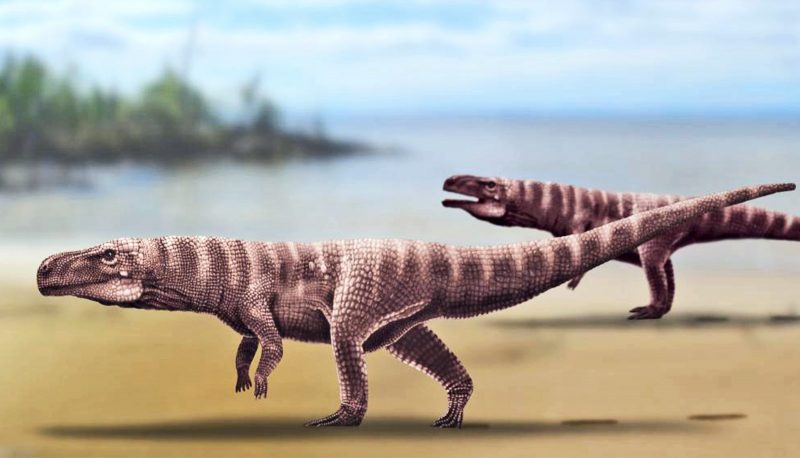
A reconstruction of the ancient landscape of South Korea with crocodile track-makers. Image via Anthony Romilio.

An international team of researchers say that a trackway of ancient footprints – first thought to belong to a pterosaur – may actually have been made by ancestors of today’s crocodiles that walked on their two hind legs like dinosaurs. The fossil footprints, which the researchers estimate are 110 to 120 million years old, were discovered in the Jinju rock formation, near Sacheon City in South Korea.

University of Queensland paleontologist Anthony Romilio is a co-author of the study, which was published June 11, 2020 in Scientific Reports.. He said in a statement:

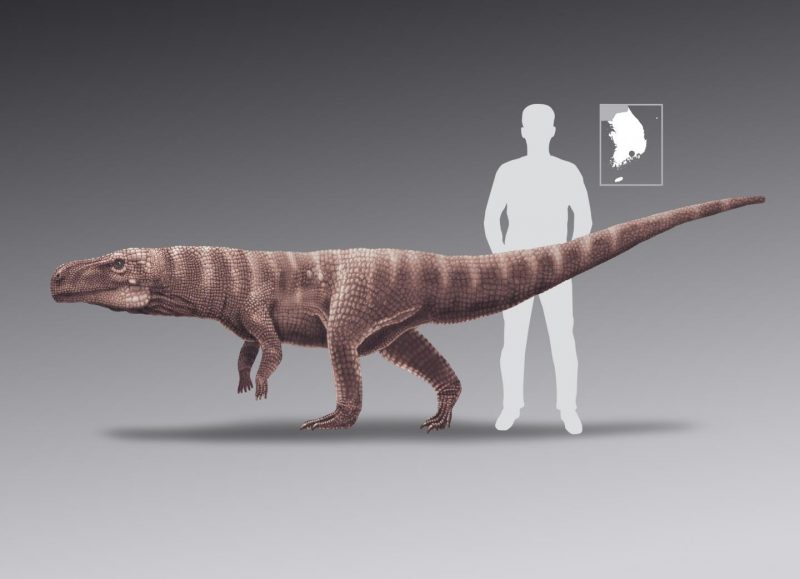
At one site, the footprints were initially thought to be made by a giant bipedal pterosaur walking on the mudflat. We now understand that these were bipedal crocodile prints. The footprints measure around 24 centimeters (9 inches), suggesting the track-makers had legs about the same height as human adult legs. These were long animals that we estimate were over 3 meters (10 feet) in length.

A reconstruction of ancient South Korean crocodile track-makers. Image via Anthony Romilio

While footprints were everywhere on the site, the researchers noticed that there were no handprints. Study leader Kyung Soo Kim, from Chinju National University of Education, said:

Typical crocodiles walk in a squat stance and create trackways that are wide. Oddly, our trackways are very narrow looking – more like a crocodile balancing on a tight-rope.

When combined with the lack of any tail-drag marks, it became clear that these creatures were moving bipedally.

They were moving in the same way as many dinosaurs, but the footprints were not made by dinosaurs. Dinosaurs and their bird descendants walk on their toes. Crocodiles walk on the flat of their feet leaving clear heel impressions, like humans do.

Researchers initially questioned the absence of hand impressions from the trackways, given that today’s typical crocodiles are ‘four-legged’ or quadrupedal. Romilio said:

Fossil crocodile tracks are quite rare in Asia, so finding an abundance of nearly one hundred footprints was extraordinary.

As an animal walks, the hind feet have the potential of stepping into the impression made by the hand and ‘over-printing’ it, but we find no evidence of this at these Korean sites.

It isn’t due to poor preservation either, because these fossils are spectacular, they even have the fine details of the toe-pads and scales on their soles preserved.

Fossilized trackways made by ancient South Korean bipedal crocodiles. Image via Seul Mi Bae

Biologist Michela Johnson studies crocodylomorphs – extinct ancestors of modern crocodiles – at the University of Edinburgh. She told New Scientist that the fossilized tracks appear to have very distinct, chunky-looking toes, in addition to impressions from crocodile-like scales. She added:

But modern crocodiles have at least some webbing between toes in their back feet, whereas these tracks don’t appear to have any.

Bottom line: Researchers say that a trackway of 110–120 million-year-old fossil footprints may have been made by ancient crocodiles that walked on two hind legs about the same length as adult human legs.

Source: Trackway evidence for large bipedal crocodylomorphs from the Cretaceous of Korea

Via University of Queensland


from EarthSky https://ift.tt/2ZwnyTd

A reconstruction of the ancient landscape of South Korea with crocodile track-makers. Image via Anthony Romilio.

An international team of researchers say that a trackway of ancient footprints – first thought to belong to a pterosaur – may actually have been made by ancestors of today’s crocodiles that walked on their two hind legs like dinosaurs. The fossil footprints, which the researchers estimate are 110 to 120 million years old, were discovered in the Jinju rock formation, near Sacheon City in South Korea.

University of Queensland paleontologist Anthony Romilio is a co-author of the study, which was published June 11, 2020 in Scientific Reports.. He said in a statement:

At one site, the footprints were initially thought to be made by a giant bipedal pterosaur walking on the mudflat. We now understand that these were bipedal crocodile prints. The footprints measure around 24 centimeters (9 inches), suggesting the track-makers had legs about the same height as human adult legs. These were long animals that we estimate were over 3 meters (10 feet) in length.

A reconstruction of ancient South Korean crocodile track-makers. Image via Anthony Romilio

While footprints were everywhere on the site, the researchers noticed that there were no handprints. Study leader Kyung Soo Kim, from Chinju National University of Education, said:

Typical crocodiles walk in a squat stance and create trackways that are wide. Oddly, our trackways are very narrow looking – more like a crocodile balancing on a tight-rope.

When combined with the lack of any tail-drag marks, it became clear that these creatures were moving bipedally.

They were moving in the same way as many dinosaurs, but the footprints were not made by dinosaurs. Dinosaurs and their bird descendants walk on their toes. Crocodiles walk on the flat of their feet leaving clear heel impressions, like humans do.

Researchers initially questioned the absence of hand impressions from the trackways, given that today’s typical crocodiles are ‘four-legged’ or quadrupedal. Romilio said:

Fossil crocodile tracks are quite rare in Asia, so finding an abundance of nearly one hundred footprints was extraordinary.

As an animal walks, the hind feet have the potential of stepping into the impression made by the hand and ‘over-printing’ it, but we find no evidence of this at these Korean sites.

It isn’t due to poor preservation either, because these fossils are spectacular, they even have the fine details of the toe-pads and scales on their soles preserved.

Fossilized trackways made by ancient South Korean bipedal crocodiles. Image via Seul Mi Bae

Biologist Michela Johnson studies crocodylomorphs – extinct ancestors of modern crocodiles – at the University of Edinburgh. She told New Scientist that the fossilized tracks appear to have very distinct, chunky-looking toes, in addition to impressions from crocodile-like scales. She added:

But modern crocodiles have at least some webbing between toes in their back feet, whereas these tracks don’t appear to have any.

Bottom line: Researchers say that a trackway of 110–120 million-year-old fossil footprints may have been made by ancient crocodiles that walked on two hind legs about the same length as adult human legs.

Source: Trackway evidence for large bipedal crocodylomorphs from the Cretaceous of Korea

Via University of Queensland


from EarthSky https://ift.tt/2ZwnyTd

5 years after New Horizons flyby, 10 cool things about Pluto

Planet with large russet patches and wide white heart-shaped feature.

Enhanced color global view of Pluto, taken when NASA’s New Horizons spacecraft was 280,000 miles (450,000 km) away. Image via NASA/ Johns Hopkins APL/ Southwest Research Institute)

NASA originally published this article on July 14, 2020.

On July 14, 2015, after a voyage of nearly 10 years and more than 3 billion miles, NASA’s New Horizons spacecraft flew within 7,800 miles (12,550 km) of Pluto. Thanks to the piano-sized probe, we saw the surface of this distant world in spectacular, colored detail for the first time.

The encounter – which also included a detailed look at Charon, the largest of Pluto’s five moons – revealed an icy world replete in magnificent landscapes and geology, with towering mountains, giant ice sheets, pits, scarps, valleys and terrains seen nowhere else in the solar system.

In the five years since that groundbreaking flyby, nearly every conjecture about Pluto being an inert ball of ice has been thrown out the window.

Here are 10 of the coolest, weirdest and most unexpected findings about the Pluto system that scientists have learned since 2015, thanks to data from New Horizons.

Mottled tan planet in foreground with smaller brownish moon in distance.

Natural-color view of Pluto and its large moon Charon, compiled from images taken by NASA’s New Horizons spacecraft on July 13 and 14, 2015. Image via NASA/ Johns Hopkins APL/ Southwest Research Institute.

1. Pluto has a “heart,” and it drives activity on the planet

Pluto’s heart – one of the signature features New Horizons observed on approach and imaged in high resolution during the flyby – is a vast, million-square-mile nitrogen glacier. The heart’s left ventricle, called Sputnik Planitia, literally forced the dwarf planet to reorient itself so the basin now faces almost squarely opposite Pluto’s moon Charon.

James Tuttle Keane is a planetary scientist and New Horizons team member at the Jet Propulsion Laboratory in Pasadena, California. He said:

It’s a process called true polar wander – it’s when a planetary body changes its spin axis, usually in response to large geologic processes.

Sputnik Planitia’s current position is no accident. It’s a cold trap, where nitrogen ices have accumulated to make an ice sheet that’s at least 2.5 miles (4 kilometers) thick. The constant imbalance of that hefty mass, combined with the tidal yanks and pulls of Charon as it orbited Pluto, literally tipped the dwarf planet so the basin aligned more closely with the tidal axis between Pluto and Charon. Keane said:

That event was also likely responsible for cracking Pluto’s surface and creating the many gigantic faults in its crust that zigzag over large portions of Pluto.

The basin is thought to have formed to the northwest of its present location, and closer to Pluto’s north pole. And should ices continue to accumulate on the basin, Pluto will continue to reorient itself.
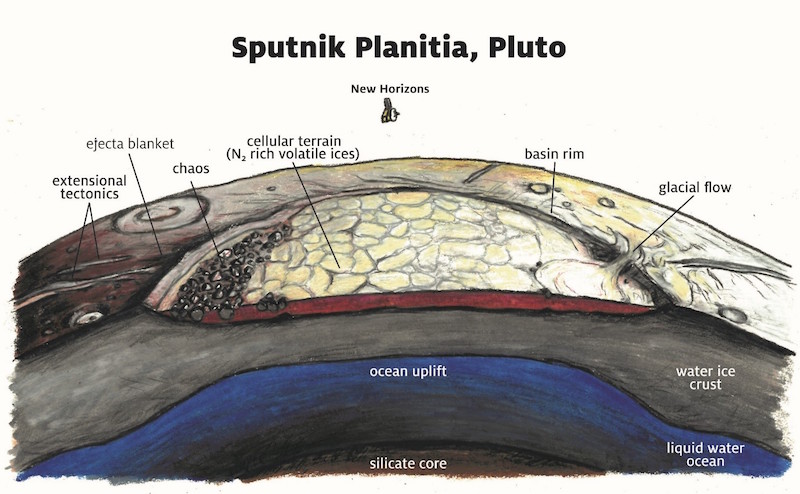
Cross-section of Pluto's surface and subsurface features.

Image via James Tuttle Keane/ NASA.

2. There’s probably a vast liquid water ocean sloshing beneath Pluto’s surface

Gathered ices may not be the only thing that helped reorient Sputnik Planitia. New Horizons data from the basin indicated there may be a heavier mass beneath it that played a part, and scientists suspect that the heavier mass is a water ocean. Keane said:

That was an astonishing discovery. It would make Pluto an elusive ‘ocean world,’ in the same vein as Europa, Enceladus and Titan.

Several other lines of evidence, including tectonic structures seen in New Horizons imagery, also point to an ocean beneath Pluto’s crust.

Sputnik Planitia was likely created some 4 billion years ago by the impact of a Kuiper Belt object 30 to 60 miles (50 to 100 km) across that carved out a massive chunk of Pluto’s icy crust and left only a thin, weak layer at the basin’s floor. A subsurface ocean likely intruded the basin from below by pushing up against the weakened crust, and later the thick layer of nitrogen ice seen there now was laid on top.

Recent models based on images of the planet suggest that this liquid ocean may have arisen from a rapid, violent formation of Pluto.
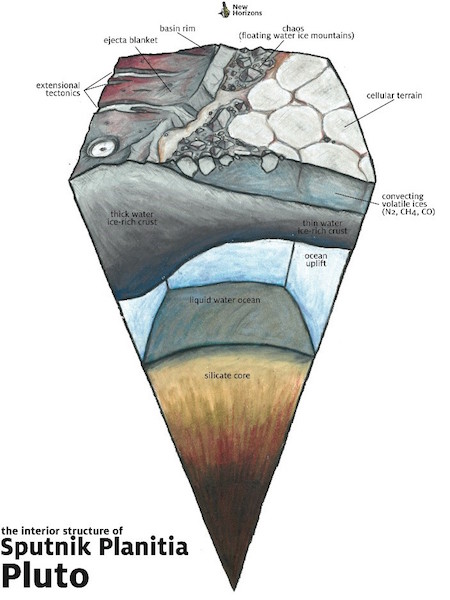
V-shaped cross-section from surface down to core.

Image via James Tuttle Keane/ NASA.

3. Pluto may still be tectonically active because that ocean is still liquid

Enormous faults stretch for hundreds of miles and cut roughly 2.5 miles into the icy crust covering Pluto’s surface. One of the only ways scientists reason Pluto got those fissures, though, is by the gradual freezing of an ocean beneath its surface.

Water expands as it freezes, and under an icy crust, that expansion will push and crack the surface, just like an ice cube in your freezer. But if the temperature is low enough and the pressure high enough, water crystals can start to form a more compact crystal configuration and the ice will once again contract.

Models using New Horizons data showed Pluto has the conditions for that type of contraction, but it doesn’t have any known geologic features that indicate that contraction has occurred. To scientists, that means the subsurface ocean is still in the process of freezing and potentially creating new faults on the surface today. Keane said:

If Pluto is an active ocean world, that suggests that the Kuiper Belt may be filled with other ocean worlds among its dwarf planets, dramatically expanding the number of potentially habitable places in our solar system.

But while Pluto’s liquid ocean likely still exists today, scientists suspect it’s isolated in most places (though not beneath Sputnik) by almost 200 miles (320 km) of ice. That means it probably doesn’t contact the surface today; but in the past, it may have oozed through volcanic activity called cryovolcanism.
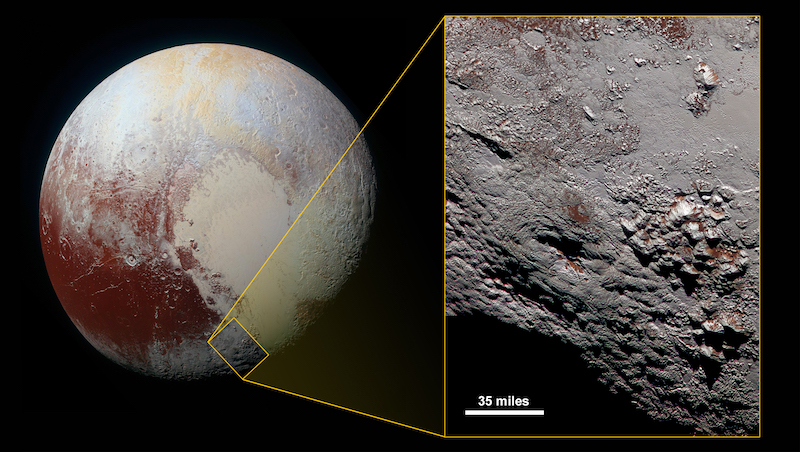
Planet on left, with inset showing closeup of rugged territory.

Close up view of Wright Mons, one of two potential cryovolcanoes spotted on the surface of Pluto by the passing New Horizons spacecraft in July 2015. Image via NASA/ Johns Hopkins APL/ Southwest Research Institute.

4. Pluto was – and still may be – volcanically active

But maybe not “volcanic” in the way you might think.

On Earth, molten lava spits, drools, bubbles, and erupts from underwater fissures through volcanoes sitting miles high in and protruding from the oceans, like on Hawaii. But on Pluto, there are numerous indications that a kind of cold, slushy cryolava has poured over the surface at various points.

Scientists call that “cryovolcanism.”

Wright Mons and Piccard Mons, two large mountains to the south of Sputnik Planitia, each bear a deep central pit that scientists believe are likely to be the mouths of cryovolcanoes unlike any others found in the solar system.

To the west of Sputnik sits Viking Terra, with its long fractures and grabens that show evidence of once-flowing cryolavas all over the surface there too.

And farther west of Sputnik Planitia is the Virgil Fossae region, where ammonia-rich cryolavas seem to have burst to the surface and coated an area of several thousand square kilometers in red-colored organic molecules no more than 1 billion years ago, if not even more recently.

And speaking of recently…

Flat surfaces with millions of tiny dots and two black objects on them.

This detailed image of the glaciers in Pluto’s Sputnik Planitia, about 50 miles wide, shows thousands of pits in its surface of nitrogen ice as well as larger circulation patterns. Scientists suspect the “Islands” are floating bergs of water ice, or perhaps the tips of ice mountains. Image via NASA/ Johns Hopkins APL/ Southwest Research Institute.

5. Glaciers cut across Pluto’s surface even today, and they’ve done so for billions of years

Pluto joins the ranks of Earth, Mars, and a handful of moons that have actively flowing glaciers.

East of Sputnik Planitia are dozens of (mostly) nitrogen-ice glaciers that course down from pitted highlands into the basin, carving out valleys as they go. Scientists suspect seasonal and “mega-seasonal” cycles of nitrogen ices that sublimate from ice to vapor, waft around the dwarf planet and then freeze back on the surface are the source of the glacier ice.

But these glaciers are not like our own water-ice glaciers here on Earth. For one, any melt within them won’t fall toward the bottom of the glacier. It will rise to the top, because liquid nitrogen is less dense than solid nitrogen. As that liquid nitrogen emerges on top of the glacier, it potentially even erupts as jets or geysers.

Additionally, there is the fact that some of Pluto’s surface is composed of water ice, which is slightly less dense than nitrogen ice. As Pluto’s glaciers carve the surface, some of those water-ice “rocks” will rise up through the glacier and float like icebergs. Such icebergs are seen in several New Horizons images of Sputnik Planitia, the largest of Pluto’s known glaciers, which stretches more than 620 miles (1,000 km) across – about the size of Oklahoma and Texas combined.
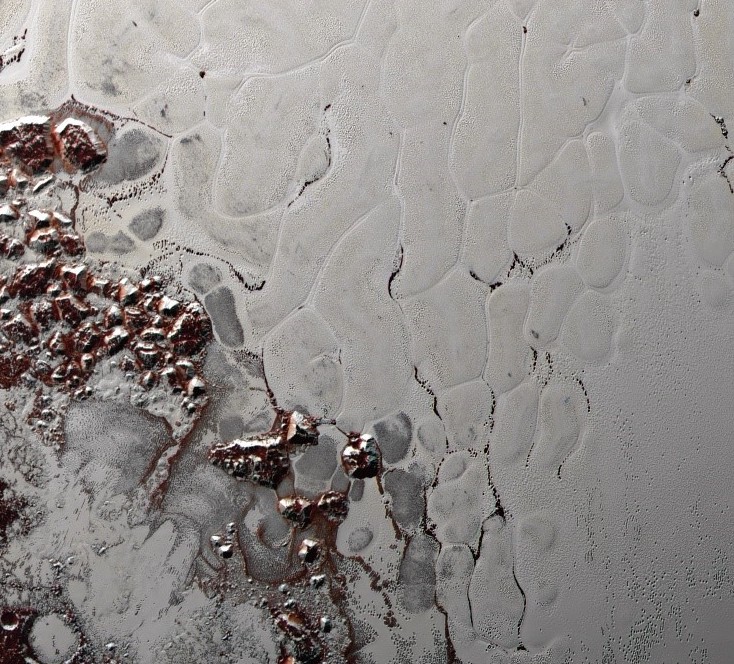
Surface with flat, white, roundish features packed together and string of red-gold mountains.

Scientists from NASA’s New Horizons mission used state-of-the-art computer simulations to show that the surface of Pluto’s Sputnik Planitia is covered with churning ice “cells” that are geologically young and turning over due to a process called convection. Image via NASA/ Johns Hopkins APL/ Southwest Research Institute.

6. Pluto has heat convection cells on its giant glacier Sputnik

Zoom in close to the surface of Sputnik Planitia and you’ll see something unlike anywhere else in the solar system: a network of strange polygonal shapes in the ice, each at least 6 miles (10 km) across, churning on the surface of the glacier.

Although they resemble cells under a microscope, these aren’t; they’re evidence of Pluto’s internal heat trying to escape from underneath the glacier, and forming bubbles of upwelling and downwelling nitrogen ice, something like a hot lava lamp.

Warm ice rises up into the center of the cells while cold ice sinks along their margins. There’s nothing like it in any of Earth’s glaciers, and or anywhere else in the solar system that we’ve explored!

Orbital view with patchy russet surface on one side of planet and wide, smooth, white surface on the other.

Image via NASA.

7. Pluto has a literal beating “heart” that controls its atmosphere and climate

Cold and far-flung as Pluto may be, its icy “heart” still beats to a daily, rhythmic drum that drives Pluto’s atmosphere and climate much in the way Greenland and Antarctica help control Earth’s climate.

Nitrogen ices in Pluto’s heart-shaped Tombaugh Regio go through a cycle every day, subliming from ice to vapor in the daytime sunlight and condensing back on the surface during the frigid night. Each round acts like a heartbeat, driving nitrogen winds that circulate around the planet at up to 20 mph (32 kph).

Tanguy Bertrand is a planetary scientist at NASA Ames Research Center in Mountain View, California. Bertrand said:

Pluto’s heart actually controls its atmosphere circulation.

Sophisticated weather forecast models Bertrand has created using New Horizons data show that as these ices sublime in the northern reaches of Pluto’s icy heart and freeze out in the southern part, they drive brisk winds in a westward direction – curiously opposite Pluto’s eastward spin.

Those westward winds, bumping up against the rugged topography at the fringes of Pluto’s heart, explain why there are wind streaks on the western edge of Sputnik Planitia, a remarkable finding considering Pluto’s atmosphere is only 1/100,000th that of Earth’s, Bertrand said. They also explain some other surprising desert-like features …

Faceted-looking mountains to left, close-packed flat white oblong features to right.

Closeup of the water-ice mountains on the northwest fringes of Pluto’s Sputnik glacier may provide the particles, and Pluto’s beating nitrogen “heart” provides winds. Image via NASA/ Johns Hopkins APL/ Southwest Research Institute.

8. Pluto has dunes

It’s not the Sahara Desert, or the Gobi Desert. This is Pluto. Hundreds of dunes stretch over at least 45 miles (75 km) of the western edge of Sputnik Planitia, and scientists suspect they formed recently.

Dunes require small particles and sustained, driving winds that can lift and blow the specks of sand or whatever else along. And despite its weak gravity, thin atmosphere, extreme cold and entire surface composition of ices, Pluto apparently had (or still may have) everything needed to make dunes.

Water-ice mountains on the northwest fringes of the Sputnik glacier may provide the particles, and Pluto’s beating nitrogen “heart” provides winds. Instead of quartz, basalt and gypsum sands blown by sometimes gale-force winds on Earth, though, scientists suspect the dunes on Pluto are sand-sized grains of methane ice carried by winds that blow at no more than 20 mph (32 kph), although given the size of the dunes, the winds may have been stronger and atmosphere much thicker in the past.

A few large scattered craters on a white surface.

Image via NASA.

9. Pluto and Charon have almost no little craters, and that has some big implications

Finding craters on the surface of planets is kind of the norm in space. But if there’s one abnormal thing about the Pluto system, it’s that neither Pluto nor Charon has many small craters – they’re almost all big.

Kelsi Singer is a New Horizons deputy project scientist and co-investigator from the Southwest Research Institute in Boulder, Colorado. She said:

That surprised us because there were fewer small craters than we expected, which means there are also fewer small Kuiper Belt objects than we expected.

Analyses of crater images from New Horizons indicate that few objects less than about a mile in diameter bombarded either world. Because scientists have no reason to believe tectonic activity would have preferentially wiped the surface clean of these small craters, It could mean the Kuiper Belt is mostly devoid of very small objects. Singer said:

These results give us clues about how the solar system formed because they tell us about the population of building blocks of larger objects, like Pluto and even perhaps Earth.
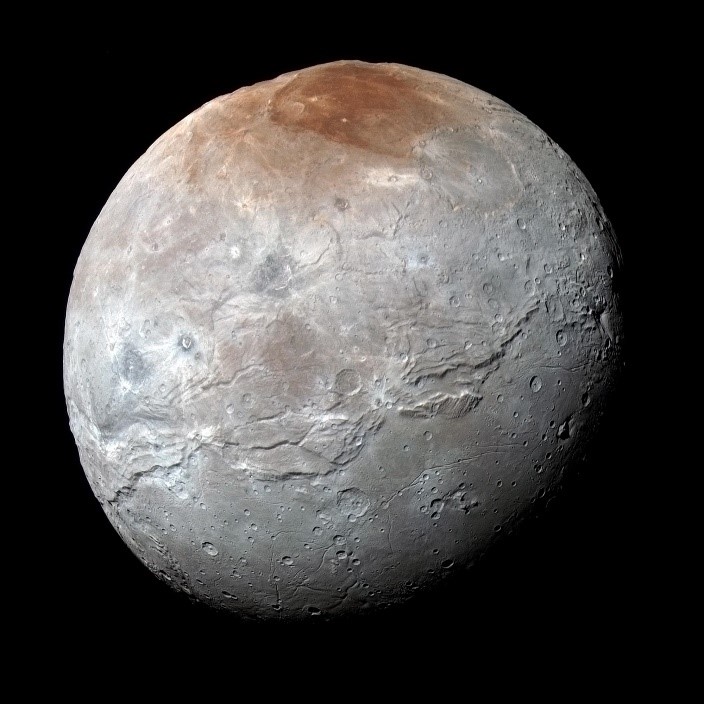
Mottled gray globe with russet patch on top and long belt of mountains and cracks nearly around equator.

Enhanced color view of Pluto’s largest moon, Charon. The colors are processed to highlight the variation of surface properties across the moon; most striking is the reddish north (top) polar region. Image via NASA/ Johns Hopkins APL/ Southwest Research Institute.

10. Charon had a volcanic past, and it could be key to understanding other icy worlds

New Horizons also captured stunning images of Pluto’s moon Charon, and they revealed some surprising geology there too.

On the side of Charon that New Horizons imaged in high resolution, Charon has two distinct terrain types: an immense, southward-stretching plain officially called Vulcan Planitia that’s at least the size of California, and a rugged terrain colloquially called Oz Terra that stretches northward to Charon’s north pole. Both seem to have formed from the freezing and expansion of (you guessed it!) an ancient ocean beneath Charon’s crust.

Moderate expansion in the north created the rugged, mountainous terrain of Oz Terra seen today, whereas the expansion in the south forced its way through vents, cracks and other openings as cryolava, spilling across the surface. In fact, Vulcan Planitia is thought to be a giant cryoflow that covered the entire region early in Charon’s history.

Similar features exist on some icy satellites all around the solar system, including Neptune’s giant moon Triton, Saturn’s moons Tethys, Dione and Enceladus, and Uranus’ moons Miranda and Ariel. And thanks to the detailed images of Charon from New Horizons, the models of Charon’s past might be a Rosetta Stone to aid in understanding the volcanic and geologic activity of those other icy worlds too.

Bottom line: Ten cool things about Pluto, from New Horizons data.

Via NASA


from EarthSky https://ift.tt/2WptsDP
Planet with large russet patches and wide white heart-shaped feature.

Enhanced color global view of Pluto, taken when NASA’s New Horizons spacecraft was 280,000 miles (450,000 km) away. Image via NASA/ Johns Hopkins APL/ Southwest Research Institute)

NASA originally published this article on July 14, 2020.

On July 14, 2015, after a voyage of nearly 10 years and more than 3 billion miles, NASA’s New Horizons spacecraft flew within 7,800 miles (12,550 km) of Pluto. Thanks to the piano-sized probe, we saw the surface of this distant world in spectacular, colored detail for the first time.

The encounter – which also included a detailed look at Charon, the largest of Pluto’s five moons – revealed an icy world replete in magnificent landscapes and geology, with towering mountains, giant ice sheets, pits, scarps, valleys and terrains seen nowhere else in the solar system.

In the five years since that groundbreaking flyby, nearly every conjecture about Pluto being an inert ball of ice has been thrown out the window.

Here are 10 of the coolest, weirdest and most unexpected findings about the Pluto system that scientists have learned since 2015, thanks to data from New Horizons.

Mottled tan planet in foreground with smaller brownish moon in distance.

Natural-color view of Pluto and its large moon Charon, compiled from images taken by NASA’s New Horizons spacecraft on July 13 and 14, 2015. Image via NASA/ Johns Hopkins APL/ Southwest Research Institute.

1. Pluto has a “heart,” and it drives activity on the planet

Pluto’s heart – one of the signature features New Horizons observed on approach and imaged in high resolution during the flyby – is a vast, million-square-mile nitrogen glacier. The heart’s left ventricle, called Sputnik Planitia, literally forced the dwarf planet to reorient itself so the basin now faces almost squarely opposite Pluto’s moon Charon.

James Tuttle Keane is a planetary scientist and New Horizons team member at the Jet Propulsion Laboratory in Pasadena, California. He said:

It’s a process called true polar wander – it’s when a planetary body changes its spin axis, usually in response to large geologic processes.

Sputnik Planitia’s current position is no accident. It’s a cold trap, where nitrogen ices have accumulated to make an ice sheet that’s at least 2.5 miles (4 kilometers) thick. The constant imbalance of that hefty mass, combined with the tidal yanks and pulls of Charon as it orbited Pluto, literally tipped the dwarf planet so the basin aligned more closely with the tidal axis between Pluto and Charon. Keane said:

That event was also likely responsible for cracking Pluto’s surface and creating the many gigantic faults in its crust that zigzag over large portions of Pluto.

The basin is thought to have formed to the northwest of its present location, and closer to Pluto’s north pole. And should ices continue to accumulate on the basin, Pluto will continue to reorient itself.

Cross-section of Pluto's surface and subsurface features.

Image via James Tuttle Keane/ NASA.

2. There’s probably a vast liquid water ocean sloshing beneath Pluto’s surface

Gathered ices may not be the only thing that helped reorient Sputnik Planitia. New Horizons data from the basin indicated there may be a heavier mass beneath it that played a part, and scientists suspect that the heavier mass is a water ocean. Keane said:

That was an astonishing discovery. It would make Pluto an elusive ‘ocean world,’ in the same vein as Europa, Enceladus and Titan.

Several other lines of evidence, including tectonic structures seen in New Horizons imagery, also point to an ocean beneath Pluto’s crust.

Sputnik Planitia was likely created some 4 billion years ago by the impact of a Kuiper Belt object 30 to 60 miles (50 to 100 km) across that carved out a massive chunk of Pluto’s icy crust and left only a thin, weak layer at the basin’s floor. A subsurface ocean likely intruded the basin from below by pushing up against the weakened crust, and later the thick layer of nitrogen ice seen there now was laid on top.

Recent models based on images of the planet suggest that this liquid ocean may have arisen from a rapid, violent formation of Pluto.

V-shaped cross-section from surface down to core.

Image via James Tuttle Keane/ NASA.

3. Pluto may still be tectonically active because that ocean is still liquid

Enormous faults stretch for hundreds of miles and cut roughly 2.5 miles into the icy crust covering Pluto’s surface. One of the only ways scientists reason Pluto got those fissures, though, is by the gradual freezing of an ocean beneath its surface.

Water expands as it freezes, and under an icy crust, that expansion will push and crack the surface, just like an ice cube in your freezer. But if the temperature is low enough and the pressure high enough, water crystals can start to form a more compact crystal configuration and the ice will once again contract.

Models using New Horizons data showed Pluto has the conditions for that type of contraction, but it doesn’t have any known geologic features that indicate that contraction has occurred. To scientists, that means the subsurface ocean is still in the process of freezing and potentially creating new faults on the surface today. Keane said:

If Pluto is an active ocean world, that suggests that the Kuiper Belt may be filled with other ocean worlds among its dwarf planets, dramatically expanding the number of potentially habitable places in our solar system.

But while Pluto’s liquid ocean likely still exists today, scientists suspect it’s isolated in most places (though not beneath Sputnik) by almost 200 miles (320 km) of ice. That means it probably doesn’t contact the surface today; but in the past, it may have oozed through volcanic activity called cryovolcanism.

Planet on left, with inset showing closeup of rugged territory.

Close up view of Wright Mons, one of two potential cryovolcanoes spotted on the surface of Pluto by the passing New Horizons spacecraft in July 2015. Image via NASA/ Johns Hopkins APL/ Southwest Research Institute.

4. Pluto was – and still may be – volcanically active

But maybe not “volcanic” in the way you might think.

On Earth, molten lava spits, drools, bubbles, and erupts from underwater fissures through volcanoes sitting miles high in and protruding from the oceans, like on Hawaii. But on Pluto, there are numerous indications that a kind of cold, slushy cryolava has poured over the surface at various points.

Scientists call that “cryovolcanism.”

Wright Mons and Piccard Mons, two large mountains to the south of Sputnik Planitia, each bear a deep central pit that scientists believe are likely to be the mouths of cryovolcanoes unlike any others found in the solar system.

To the west of Sputnik sits Viking Terra, with its long fractures and grabens that show evidence of once-flowing cryolavas all over the surface there too.

And farther west of Sputnik Planitia is the Virgil Fossae region, where ammonia-rich cryolavas seem to have burst to the surface and coated an area of several thousand square kilometers in red-colored organic molecules no more than 1 billion years ago, if not even more recently.

And speaking of recently…

Flat surfaces with millions of tiny dots and two black objects on them.

This detailed image of the glaciers in Pluto’s Sputnik Planitia, about 50 miles wide, shows thousands of pits in its surface of nitrogen ice as well as larger circulation patterns. Scientists suspect the “Islands” are floating bergs of water ice, or perhaps the tips of ice mountains. Image via NASA/ Johns Hopkins APL/ Southwest Research Institute.

5. Glaciers cut across Pluto’s surface even today, and they’ve done so for billions of years

Pluto joins the ranks of Earth, Mars, and a handful of moons that have actively flowing glaciers.

East of Sputnik Planitia are dozens of (mostly) nitrogen-ice glaciers that course down from pitted highlands into the basin, carving out valleys as they go. Scientists suspect seasonal and “mega-seasonal” cycles of nitrogen ices that sublimate from ice to vapor, waft around the dwarf planet and then freeze back on the surface are the source of the glacier ice.

But these glaciers are not like our own water-ice glaciers here on Earth. For one, any melt within them won’t fall toward the bottom of the glacier. It will rise to the top, because liquid nitrogen is less dense than solid nitrogen. As that liquid nitrogen emerges on top of the glacier, it potentially even erupts as jets or geysers.

Additionally, there is the fact that some of Pluto’s surface is composed of water ice, which is slightly less dense than nitrogen ice. As Pluto’s glaciers carve the surface, some of those water-ice “rocks” will rise up through the glacier and float like icebergs. Such icebergs are seen in several New Horizons images of Sputnik Planitia, the largest of Pluto’s known glaciers, which stretches more than 620 miles (1,000 km) across – about the size of Oklahoma and Texas combined.

Surface with flat, white, roundish features packed together and string of red-gold mountains.

Scientists from NASA’s New Horizons mission used state-of-the-art computer simulations to show that the surface of Pluto’s Sputnik Planitia is covered with churning ice “cells” that are geologically young and turning over due to a process called convection. Image via NASA/ Johns Hopkins APL/ Southwest Research Institute.

6. Pluto has heat convection cells on its giant glacier Sputnik

Zoom in close to the surface of Sputnik Planitia and you’ll see something unlike anywhere else in the solar system: a network of strange polygonal shapes in the ice, each at least 6 miles (10 km) across, churning on the surface of the glacier.

Although they resemble cells under a microscope, these aren’t; they’re evidence of Pluto’s internal heat trying to escape from underneath the glacier, and forming bubbles of upwelling and downwelling nitrogen ice, something like a hot lava lamp.

Warm ice rises up into the center of the cells while cold ice sinks along their margins. There’s nothing like it in any of Earth’s glaciers, and or anywhere else in the solar system that we’ve explored!

Orbital view with patchy russet surface on one side of planet and wide, smooth, white surface on the other.

Image via NASA.

7. Pluto has a literal beating “heart” that controls its atmosphere and climate

Cold and far-flung as Pluto may be, its icy “heart” still beats to a daily, rhythmic drum that drives Pluto’s atmosphere and climate much in the way Greenland and Antarctica help control Earth’s climate.

Nitrogen ices in Pluto’s heart-shaped Tombaugh Regio go through a cycle every day, subliming from ice to vapor in the daytime sunlight and condensing back on the surface during the frigid night. Each round acts like a heartbeat, driving nitrogen winds that circulate around the planet at up to 20 mph (32 kph).

Tanguy Bertrand is a planetary scientist at NASA Ames Research Center in Mountain View, California. Bertrand said:

Pluto’s heart actually controls its atmosphere circulation.

Sophisticated weather forecast models Bertrand has created using New Horizons data show that as these ices sublime in the northern reaches of Pluto’s icy heart and freeze out in the southern part, they drive brisk winds in a westward direction – curiously opposite Pluto’s eastward spin.

Those westward winds, bumping up against the rugged topography at the fringes of Pluto’s heart, explain why there are wind streaks on the western edge of Sputnik Planitia, a remarkable finding considering Pluto’s atmosphere is only 1/100,000th that of Earth’s, Bertrand said. They also explain some other surprising desert-like features …

Faceted-looking mountains to left, close-packed flat white oblong features to right.

Closeup of the water-ice mountains on the northwest fringes of Pluto’s Sputnik glacier may provide the particles, and Pluto’s beating nitrogen “heart” provides winds. Image via NASA/ Johns Hopkins APL/ Southwest Research Institute.

8. Pluto has dunes

It’s not the Sahara Desert, or the Gobi Desert. This is Pluto. Hundreds of dunes stretch over at least 45 miles (75 km) of the western edge of Sputnik Planitia, and scientists suspect they formed recently.

Dunes require small particles and sustained, driving winds that can lift and blow the specks of sand or whatever else along. And despite its weak gravity, thin atmosphere, extreme cold and entire surface composition of ices, Pluto apparently had (or still may have) everything needed to make dunes.

Water-ice mountains on the northwest fringes of the Sputnik glacier may provide the particles, and Pluto’s beating nitrogen “heart” provides winds. Instead of quartz, basalt and gypsum sands blown by sometimes gale-force winds on Earth, though, scientists suspect the dunes on Pluto are sand-sized grains of methane ice carried by winds that blow at no more than 20 mph (32 kph), although given the size of the dunes, the winds may have been stronger and atmosphere much thicker in the past.

A few large scattered craters on a white surface.

Image via NASA.

9. Pluto and Charon have almost no little craters, and that has some big implications

Finding craters on the surface of planets is kind of the norm in space. But if there’s one abnormal thing about the Pluto system, it’s that neither Pluto nor Charon has many small craters – they’re almost all big.

Kelsi Singer is a New Horizons deputy project scientist and co-investigator from the Southwest Research Institute in Boulder, Colorado. She said:

That surprised us because there were fewer small craters than we expected, which means there are also fewer small Kuiper Belt objects than we expected.

Analyses of crater images from New Horizons indicate that few objects less than about a mile in diameter bombarded either world. Because scientists have no reason to believe tectonic activity would have preferentially wiped the surface clean of these small craters, It could mean the Kuiper Belt is mostly devoid of very small objects. Singer said:

These results give us clues about how the solar system formed because they tell us about the population of building blocks of larger objects, like Pluto and even perhaps Earth.

Mottled gray globe with russet patch on top and long belt of mountains and cracks nearly around equator.

Enhanced color view of Pluto’s largest moon, Charon. The colors are processed to highlight the variation of surface properties across the moon; most striking is the reddish north (top) polar region. Image via NASA/ Johns Hopkins APL/ Southwest Research Institute.

10. Charon had a volcanic past, and it could be key to understanding other icy worlds

New Horizons also captured stunning images of Pluto’s moon Charon, and they revealed some surprising geology there too.

On the side of Charon that New Horizons imaged in high resolution, Charon has two distinct terrain types: an immense, southward-stretching plain officially called Vulcan Planitia that’s at least the size of California, and a rugged terrain colloquially called Oz Terra that stretches northward to Charon’s north pole. Both seem to have formed from the freezing and expansion of (you guessed it!) an ancient ocean beneath Charon’s crust.

Moderate expansion in the north created the rugged, mountainous terrain of Oz Terra seen today, whereas the expansion in the south forced its way through vents, cracks and other openings as cryolava, spilling across the surface. In fact, Vulcan Planitia is thought to be a giant cryoflow that covered the entire region early in Charon’s history.

Similar features exist on some icy satellites all around the solar system, including Neptune’s giant moon Triton, Saturn’s moons Tethys, Dione and Enceladus, and Uranus’ moons Miranda and Ariel. And thanks to the detailed images of Charon from New Horizons, the models of Charon’s past might be a Rosetta Stone to aid in understanding the volcanic and geologic activity of those other icy worlds too.

Bottom line: Ten cool things about Pluto, from New Horizons data.

Via NASA


from EarthSky https://ift.tt/2WptsDP

adds 2