aads

Insights on Jupiter at opposition

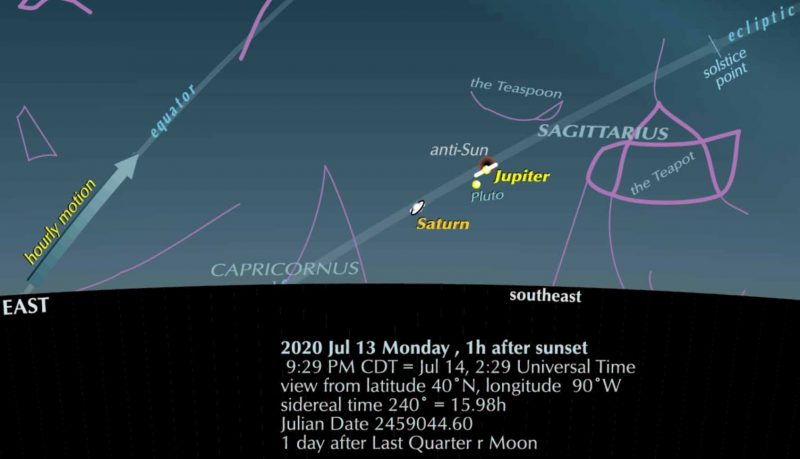
A chart showing the ecliptic line, Jupiter and Saturn, and some constellations.

View larger. | The moment in 2020 when Jupiter is in the opposite direction from the sun is July 14 at 08:00 UTC. This is 2 a.m. in, for instance, the Central time zone of North America. So our sky scene – above – is for the nearest evening, Monday July 13, just a few hours before Jupiter’s exact opposition. Chart via Guy Ottewell’s blog.

Originally published July 11, 2020, at Guy Ottewell’s blog. Reprinted with permission. By the way, Guy’s new book is out! It called Venus, A Longer View.

In 2020, Jupiter comes to opposition on July 14 at 08:00 UTC. At that moment, Jupiter is most nearly opposite the sun in our sky for this year.

Because Jupiter is opposite the sun, it rises about sunset. This year, it is accompanied in the remote background by invisible Pluto. It is followed, a few degrees later, by Saturn, whose turn at opposition will come on July 20. At the time depicted in the chart above, Jupiter has reached 10 degrees above the horizon. As the night goes on, the planets will climb to the meridian of the sky around midnight.

In the chart above, the short arrows through the symbols for the planets represent their movement over five days. They are retrograding – moving slowly back westward – during the time, centered on opposition, when Earth is overtaking them.

Because Jupiter is only about a quarter of a degree south of the ecliptic (through which it descended on February 26), it is almost exactly at the point we have marked as the “anti-sun.”

And it is not far past the solstice point, where the sun is at the December solstice – the most southerly point of the ecliptic. This is one of the most southerly oppositions in Jupiter’s 12-year cycle.

Speaking of that 12-year cycle, which stems from Jupiter’s nearly-12-year orbit around the sun … look at the chart below. It shows the 12 constellations of the zodiac and illustrates the fact that Jupiter goes from one to the next, at each year’s opposition.
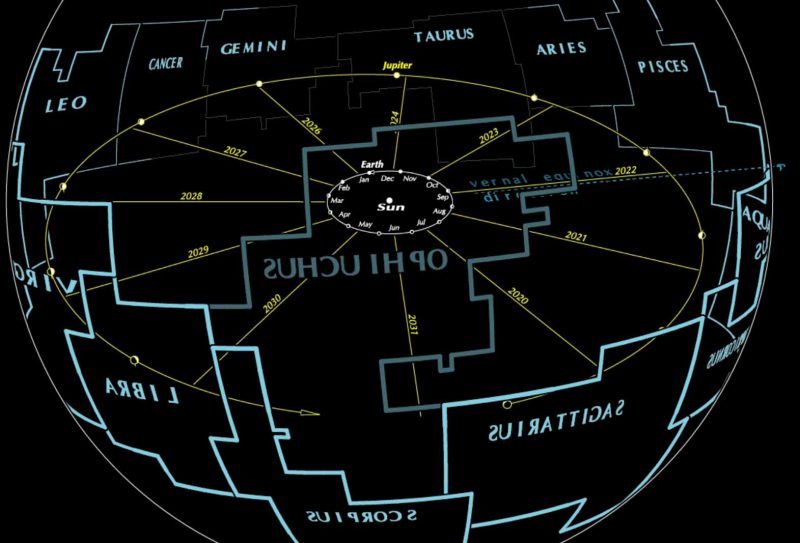
Imaginary celestial sphere, with the constellation boundaries marked, and 12 lines radiating out to Jupiter's positions.

View larger. | In this illustration, the constellation boundaries are painted on the inner surface of an imaginary sphere 6 astronomical units (sun-Earth distances) in radius. The yellow lines are sightlines from Earth to Jupiter at the dates of opposition. Notice how Jupiter appears – approximately – in the various constellations of the zodiac, one after another, each year. That happens because there are 12 “official” zodiacal constellations, and Jupiter’s orbit around the sun happens to be nearly 12 years long. Chart via Guy Ottewell’s blog.

The picture above – showing the constellations of the zodiac – is large, so it may appear at low resolution on your screen. So I have made from it a PDF, which you should be able to enlarge and explore as much as you like.

Roughly, Jupiter goes around the sun in 12 years, so that it spends a year in each of the 12 constellations of the zodiac. And each opposition is a month later, as Earth gets around to its next overtaking of Jupiter, so that they are 13 months apart. Thus, 2020 June opposition in Sagittarius; 2021 July in Capricornus; and so on. An opposition falls in December 2024, therefore spills over the end of December 2025 into January of 2026.

This simple pattern is irregularized in two ways:

Jupiter gets around the sun a little faster: the period of revolution is 11.85 years. That’s why in the diagram I omit the path for 2031: it would slightly overlap that for 2020.

And the astronomically defined constellations are not equal 30 degree-wide segments like the corresponding astrological “signs.” Virgo is wide, Libra and Aries are relatively small, and Scorpius is mostly south of the ecliptic, a stretch of which is in Ophiuchus. I use huge Ophiuchus as a foreground window into my imaginary sphere.

Now, let’s talk a bit about Jupiter’s four largest moons. Because Jupiter is generally closest to Earth at opposition (in fact, it is closest in 2020 one day after opposition), the moons are easiest to see around now.

Movement of Jupiter moons - marked by arrows - around the time of Jupiter's July 14, 2020 opposition.

View larger. | Here are the movements of Jupiter’s 4 great Galilean satellites in the first 6 hours of the day of the opposition (that is, from 00:00 to 06:00 UTC). Ecliptic north is at the top. The satellites are exaggerated 5 times in size. Chart via Guy Ottewell’s blog.

The moons are always moving, of course, and this chart captures them in the first six hours of the day of opposition. At this time, the largest moon, Ganymede (satellite III), is moving out from behind the planet. Io (I) is about to pass in front of the planet. Callisto (IV) has just turned back from its extreme elongation.

This opposition is, in the cycle from now to 2032, the second southernmost (declination -21°56′, exceeded only by June 1, 2031, -22°48′).

This opposition is fairly near to Earth (4.14 astronomical units, compared with 3.95 in 2022 and 4.45 in 2029).

It is among the brightest oppositions of Jupiter (the planet shines this year at magnitude -2.8 at its brightest, as compared with -2.9 at the next three oppositions; it is slightly dimmer at -2.5 at some others).

Bottom line: Like so much in astronomy, Jupiter’s opposition happens in a way that’s cyclical. And the cycle of oppositions for Jupiter is especially pleasing to the mind. Astronomer Guy Ottewell offers his insights – and chart-making skills – to you during this 2020 opposition of our solar system’s largest planet.

Guy Ottewell’s new book is out! It’s called “Venus, A Longer View.” It’s a richly detailed illustrated book of 148 large pages, about Venus the planet and Venus the Goddess of Love. Click here for more information.


from EarthSky https://ift.tt/3gM2ZYK
A chart showing the ecliptic line, Jupiter and Saturn, and some constellations.

View larger. | The moment in 2020 when Jupiter is in the opposite direction from the sun is July 14 at 08:00 UTC. This is 2 a.m. in, for instance, the Central time zone of North America. So our sky scene – above – is for the nearest evening, Monday July 13, just a few hours before Jupiter’s exact opposition. Chart via Guy Ottewell’s blog.

Originally published July 11, 2020, at Guy Ottewell’s blog. Reprinted with permission. By the way, Guy’s new book is out! It called Venus, A Longer View.

In 2020, Jupiter comes to opposition on July 14 at 08:00 UTC. At that moment, Jupiter is most nearly opposite the sun in our sky for this year.

Because Jupiter is opposite the sun, it rises about sunset. This year, it is accompanied in the remote background by invisible Pluto. It is followed, a few degrees later, by Saturn, whose turn at opposition will come on July 20. At the time depicted in the chart above, Jupiter has reached 10 degrees above the horizon. As the night goes on, the planets will climb to the meridian of the sky around midnight.

In the chart above, the short arrows through the symbols for the planets represent their movement over five days. They are retrograding – moving slowly back westward – during the time, centered on opposition, when Earth is overtaking them.

Because Jupiter is only about a quarter of a degree south of the ecliptic (through which it descended on February 26), it is almost exactly at the point we have marked as the “anti-sun.”

And it is not far past the solstice point, where the sun is at the December solstice – the most southerly point of the ecliptic. This is one of the most southerly oppositions in Jupiter’s 12-year cycle.

Speaking of that 12-year cycle, which stems from Jupiter’s nearly-12-year orbit around the sun … look at the chart below. It shows the 12 constellations of the zodiac and illustrates the fact that Jupiter goes from one to the next, at each year’s opposition.

Imaginary celestial sphere, with the constellation boundaries marked, and 12 lines radiating out to Jupiter's positions.

View larger. | In this illustration, the constellation boundaries are painted on the inner surface of an imaginary sphere 6 astronomical units (sun-Earth distances) in radius. The yellow lines are sightlines from Earth to Jupiter at the dates of opposition. Notice how Jupiter appears – approximately – in the various constellations of the zodiac, one after another, each year. That happens because there are 12 “official” zodiacal constellations, and Jupiter’s orbit around the sun happens to be nearly 12 years long. Chart via Guy Ottewell’s blog.

The picture above – showing the constellations of the zodiac – is large, so it may appear at low resolution on your screen. So I have made from it a PDF, which you should be able to enlarge and explore as much as you like.

Roughly, Jupiter goes around the sun in 12 years, so that it spends a year in each of the 12 constellations of the zodiac. And each opposition is a month later, as Earth gets around to its next overtaking of Jupiter, so that they are 13 months apart. Thus, 2020 June opposition in Sagittarius; 2021 July in Capricornus; and so on. An opposition falls in December 2024, therefore spills over the end of December 2025 into January of 2026.

This simple pattern is irregularized in two ways:

Jupiter gets around the sun a little faster: the period of revolution is 11.85 years. That’s why in the diagram I omit the path for 2031: it would slightly overlap that for 2020.

And the astronomically defined constellations are not equal 30 degree-wide segments like the corresponding astrological “signs.” Virgo is wide, Libra and Aries are relatively small, and Scorpius is mostly south of the ecliptic, a stretch of which is in Ophiuchus. I use huge Ophiuchus as a foreground window into my imaginary sphere.

Now, let’s talk a bit about Jupiter’s four largest moons. Because Jupiter is generally closest to Earth at opposition (in fact, it is closest in 2020 one day after opposition), the moons are easiest to see around now.

Movement of Jupiter moons - marked by arrows - around the time of Jupiter's July 14, 2020 opposition.

View larger. | Here are the movements of Jupiter’s 4 great Galilean satellites in the first 6 hours of the day of the opposition (that is, from 00:00 to 06:00 UTC). Ecliptic north is at the top. The satellites are exaggerated 5 times in size. Chart via Guy Ottewell’s blog.

The moons are always moving, of course, and this chart captures them in the first six hours of the day of opposition. At this time, the largest moon, Ganymede (satellite III), is moving out from behind the planet. Io (I) is about to pass in front of the planet. Callisto (IV) has just turned back from its extreme elongation.

This opposition is, in the cycle from now to 2032, the second southernmost (declination -21°56′, exceeded only by June 1, 2031, -22°48′).

This opposition is fairly near to Earth (4.14 astronomical units, compared with 3.95 in 2022 and 4.45 in 2029).

It is among the brightest oppositions of Jupiter (the planet shines this year at magnitude -2.8 at its brightest, as compared with -2.9 at the next three oppositions; it is slightly dimmer at -2.5 at some others).

Bottom line: Like so much in astronomy, Jupiter’s opposition happens in a way that’s cyclical. And the cycle of oppositions for Jupiter is especially pleasing to the mind. Astronomer Guy Ottewell offers his insights – and chart-making skills – to you during this 2020 opposition of our solar system’s largest planet.

Guy Ottewell’s new book is out! It’s called “Venus, A Longer View.” It’s a richly detailed illustrated book of 148 large pages, about Venus the planet and Venus the Goddess of Love. Click here for more information.


from EarthSky https://ift.tt/3gM2ZYK

Jupiter’s opposition is July 13-14. But Jupiter isn’t closest until July 15. Why?

Immense globe of Jupiter with horizontal bands and large orange oval in lower right.

Jupiter as seen by amateur astronomer Anthony Wesley on May 19, 2019. Image via Anthony Wesley.

Jupiter’s opposition happens on July 14, 2020 at 08:00 UTC. At opposition, Earth in its orbit flies between Jupiter and the sun, placing Jupiter opposite the sun in our sky. You’d think Jupiter would be closest to Earth on the day of opposition. But it isn’t. Jupiter doesn’t come closest to us for the year 2020 until July 15 at 10:00 UTC. The least distance between Earth and Jupiter this year will be 385 million miles (619 million km).

Why isn’t Jupiter closest to Earth on the day Earth goes between Jupiter and the sun?

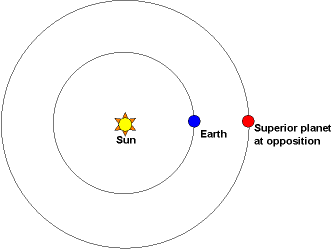
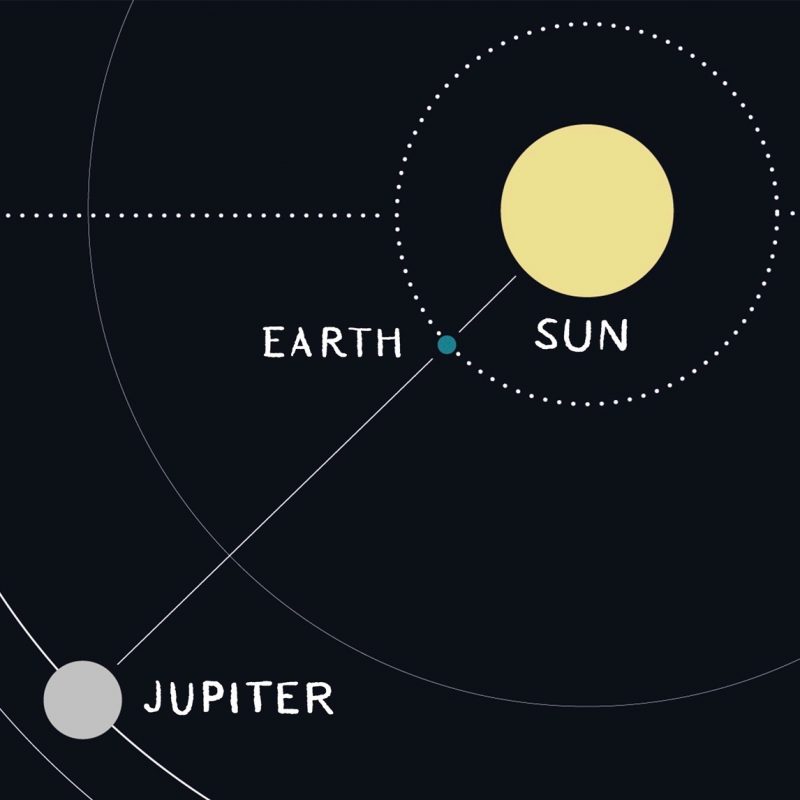
Simple diagram of orbits of Earth and a superior planet.

Opposition happens when Earth flies between an outer planet, like Jupiter, and the sun. Why aren’t Earth and Jupiter closest on the day of opposition? Illustration via Heavens-Above.

Jupiter and Earth would be closest on the day of opposition, if the orbits of Earth and Jupiter were perfect circles and if our two worlds orbited on the same exact plane. Both Earth and Jupiter have orbits that are very nearly circular. They go around the sun on almost the same plane. But – in both cases – not quite.

Consider that, because Jupiter’s orbit is elliptical, not circular, Jupiter’s distance from the sun varies.

Likewise, Earth’s orbit is elliptical, not circular. Our distance from the sun varies, too.

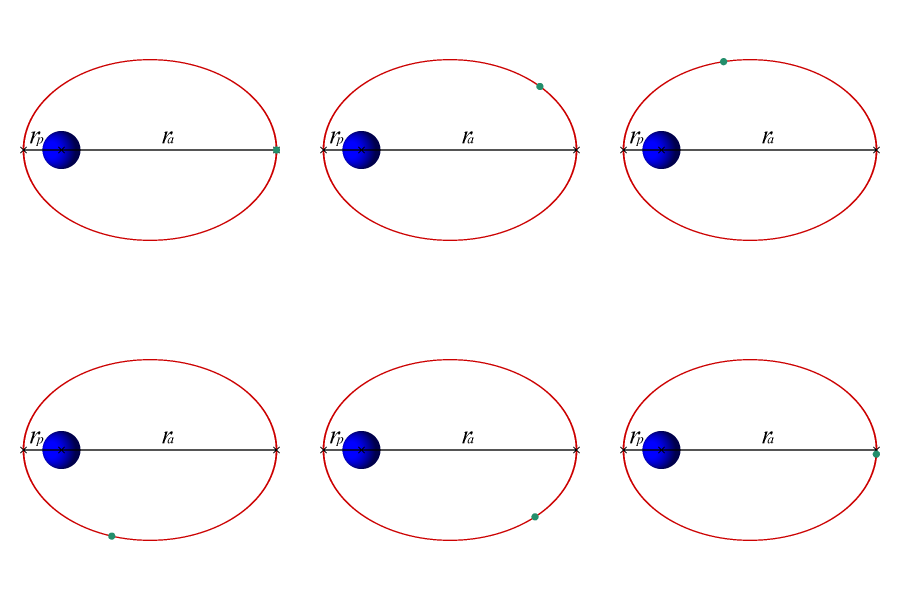
Animated diagram, small black dot orbiting large blue object in elongated oval path.

This animation shows an orbit that’s vastly more elliptical than either Earth’s or Jupiter’s. Still, you get the idea. Perihelion = closest to sun. Aphelion = farthest from sun. Image via Brandir/ Wikipedia.

Jupiter’s orbit takes 11.9 Earth-years. Earth’s orbit takes one year.

Right now, we’re headed toward a perihelion – or closest point to the sun – for Jupiter. In other words, every single day, Jupiter is closer to the sun than it was the day before. Are you beginning to see how it can be closer to Earth after we go between it and the sun?

Not yet? Keep reading …

Jupiter passed aphelion – its farthest point from the sun in its orbit – on February 18, 2017. Jupiter will reach perihelion – its closest point – on January 25, 2023.

So Jupiter is getting closer to the sun each day. And what is Earth doing?

Earth’s perihelion happens every year in early January. So Earth is getting a bit closer to the sun each day now.

Jupiter is now getting closer to the sun – bit by bit, closer and closer – every earthly day. And Earth is getting closer to the sun – bit by bit, closer and closer – every day. Yet Earth’s change of distance (relative to the sun) is small compared to Jupiter’s. So Jupiter makes a small gain on Earth between July 14 and 15, 2020. After July 15, 2020, the gap between Earth and Jupiter widens again.

And that’s how Jupiter and Earth can be closest for 2020 on the day after our planet passes between Jupiter and the sun.

Understand? If not, check out these two links … or let’s talk in the comments below …

Geocentric ephemeris for Jupiter: 2020

Geocentric ephemeris for sun: 2020

Here are those numbers again:

Jupiter’s opposition July 14 at 08:00 UTC (June 14 at 3 a.m. CDT).

Jupiter closest July 15 at 10:00 UTC (June 15 at 5 a.m CDT).

Big diagram with partial orbits of Jupiter and Earth lined up with the sun.

Another artist’s concept of Jupiter and Earth at opposition, when Earth passes between the sun and Jupiter.

Bottom line: You’d think Jupiter would be closest to Earth on the day we pass between it and the sun. But, in 2020, Jupiter’s opposition comes the day before its closest point to Earth. Why?

Read more: We go between Jupiter and the sun July 14, 2020


from EarthSky https://ift.tt/38SOSyc
Immense globe of Jupiter with horizontal bands and large orange oval in lower right.

Jupiter as seen by amateur astronomer Anthony Wesley on May 19, 2019. Image via Anthony Wesley.

Jupiter’s opposition happens on July 14, 2020 at 08:00 UTC. At opposition, Earth in its orbit flies between Jupiter and the sun, placing Jupiter opposite the sun in our sky. You’d think Jupiter would be closest to Earth on the day of opposition. But it isn’t. Jupiter doesn’t come closest to us for the year 2020 until July 15 at 10:00 UTC. The least distance between Earth and Jupiter this year will be 385 million miles (619 million km).

Why isn’t Jupiter closest to Earth on the day Earth goes between Jupiter and the sun?

Simple diagram of orbits of Earth and a superior planet.

Opposition happens when Earth flies between an outer planet, like Jupiter, and the sun. Why aren’t Earth and Jupiter closest on the day of opposition? Illustration via Heavens-Above.

Jupiter and Earth would be closest on the day of opposition, if the orbits of Earth and Jupiter were perfect circles and if our two worlds orbited on the same exact plane. Both Earth and Jupiter have orbits that are very nearly circular. They go around the sun on almost the same plane. But – in both cases – not quite.

Consider that, because Jupiter’s orbit is elliptical, not circular, Jupiter’s distance from the sun varies.

Likewise, Earth’s orbit is elliptical, not circular. Our distance from the sun varies, too.

Animated diagram, small black dot orbiting large blue object in elongated oval path.

This animation shows an orbit that’s vastly more elliptical than either Earth’s or Jupiter’s. Still, you get the idea. Perihelion = closest to sun. Aphelion = farthest from sun. Image via Brandir/ Wikipedia.

Jupiter’s orbit takes 11.9 Earth-years. Earth’s orbit takes one year.

Right now, we’re headed toward a perihelion – or closest point to the sun – for Jupiter. In other words, every single day, Jupiter is closer to the sun than it was the day before. Are you beginning to see how it can be closer to Earth after we go between it and the sun?

Not yet? Keep reading …

Jupiter passed aphelion – its farthest point from the sun in its orbit – on February 18, 2017. Jupiter will reach perihelion – its closest point – on January 25, 2023.

So Jupiter is getting closer to the sun each day. And what is Earth doing?

Earth’s perihelion happens every year in early January. So Earth is getting a bit closer to the sun each day now.

Jupiter is now getting closer to the sun – bit by bit, closer and closer – every earthly day. And Earth is getting closer to the sun – bit by bit, closer and closer – every day. Yet Earth’s change of distance (relative to the sun) is small compared to Jupiter’s. So Jupiter makes a small gain on Earth between July 14 and 15, 2020. After July 15, 2020, the gap between Earth and Jupiter widens again.

And that’s how Jupiter and Earth can be closest for 2020 on the day after our planet passes between Jupiter and the sun.

Understand? If not, check out these two links … or let’s talk in the comments below …

Geocentric ephemeris for Jupiter: 2020

Geocentric ephemeris for sun: 2020

Here are those numbers again:

Jupiter’s opposition July 14 at 08:00 UTC (June 14 at 3 a.m. CDT).

Jupiter closest July 15 at 10:00 UTC (June 15 at 5 a.m CDT).

Big diagram with partial orbits of Jupiter and Earth lined up with the sun.

Another artist’s concept of Jupiter and Earth at opposition, when Earth passes between the sun and Jupiter.

Bottom line: You’d think Jupiter would be closest to Earth on the day we pass between it and the sun. But, in 2020, Jupiter’s opposition comes the day before its closest point to Earth. Why?

Read more: We go between Jupiter and the sun July 14, 2020


from EarthSky https://ift.tt/38SOSyc

Jupiter reaches opposition July 13-14

On the night of July 13-14, 2020, our planet Earth flies between the sun and the biggest planet in our solar system, mighty Jupiter. Our faster motion places Jupiter – an exceedingly bright planet in our sky – opposite the sun. Jupiter is now rising in the east as the sun is setting below the western horizon. Astronomers call this event an opposition of Jupiter.

Jupiter reaches opposition on July 14, 2020, at 8:00 UTC; translate UTC to your time. At United States’ time zones, that’s 4 a.m. Eastern Time, 3 a.m. Central Time, 2 a.m. Mountain Time, 1 a.m. Pacific Time, 12 midnight July 13-14 Alaskan Time, and on July 13, at 10 p.m. Hawaiian time.

Opposition marks the middle of the best time of year to see a planet. That’s because it’s when the planet is up all night and generally closest for the year (the exact date of Jupiter at its closest this year is June 15).

Jupiter’s opposition is doubly exciting this year, because golden Saturn is near Jupiter on the sky’s dome. Saturn’s opoosition will come less than a week from now, on July 20.

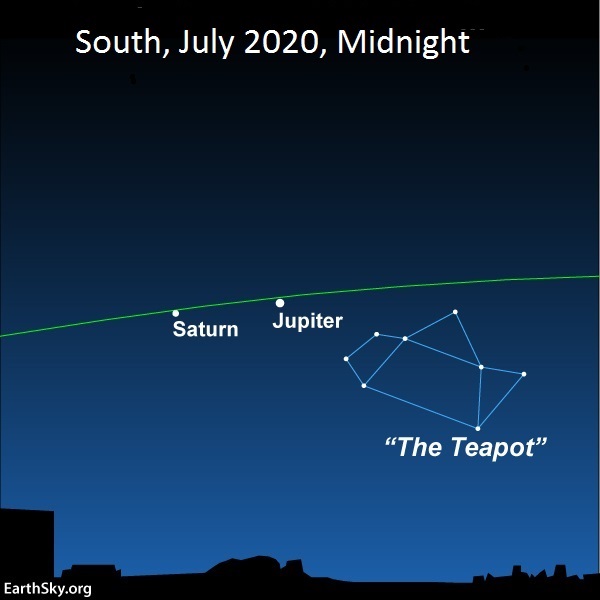
Both Jupiter and Saturn are in front of the constellation Sagittarius the Archer. It’ll remain in Sagittarius till late December 2020. You probably won’t see an Archer in the stars around Jupiter, but, if your sky is fairly dark, and if you let your eyes wander among the stars, picking out patterns, you might notice the pattern of a Teapot near Jupiter and Saturn. This famous Teapot in Sagittarius marks the direction to the center of our Milky Way galaxy.

Read more: Before 2020 ends, a great conjunction of Saturn and Jupiter

Jupiter, Saturn and the Teapot in the July 2020 midnight sky.

Jupiter reaches opposition on July 14, 2020, and about a week later, Saturn sweeps to opposition on July 20, 2020. Both are in front of the constellation Sagittarius. Jupiter is very bright. With the exception of the sun and moon, only Venus – the brightest planet, now low in the east before sunrise – outshines Jupiter. Saturn appears as a golden “star” a short hop to the east of Jupiter. In July 2020, these two worlds ascend in the east in the evening hours and climb highest up for the night around midnight (middle of the night). A month from now, the dynamic twosome will be highest up for the night around mid-evening.

Jupiter is now in the east around sunset. It climbs highest in the sky at midnight (that is, midway between sunset and sunrise). It sets in the west around sunrise.

As the biggest planet in our solar system, Jupiter is always bright. It shines more brightly than any star in the evening sky. There’s no way to mistake Saturn for Jupiter, though, because dazzling Jupiter outshines this 1st-magnitude planet by some 14 times.

Among starlike objects in our sky, only Venus is brighter than Jupiter. And Venus is up in the east before sunrise now … nowhere near Jupiter on the sky’s dome. In fact, this week and next, it’ll be possible to see Jupiter and Venus together at morning dawn, on opposite sides of the sky. Venus will be blazing low in the east while Jupiter is sitting low in the west, shortly before sunup. You’ll need an unobstructed horizon in both directions to see both Venus and Jupiter before sunrise. As the minutes tick by, and the light of dawn rises, Venus will be ascending higher in the eastern sky. Meanwhile, Jupiter will be descending in the west.

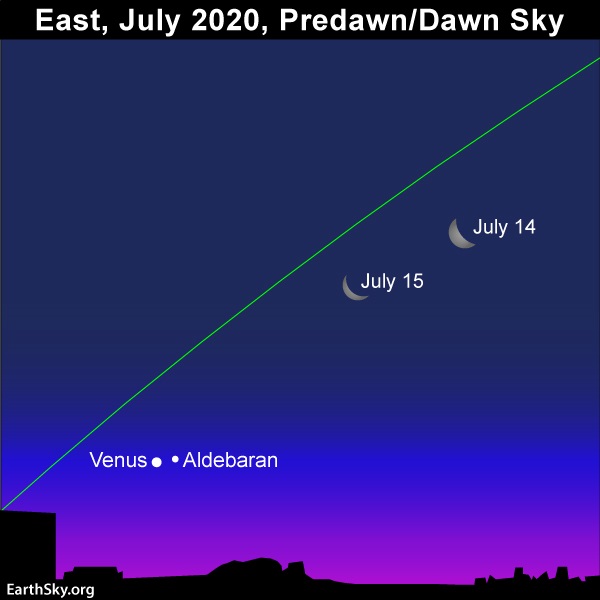
Waning crescent moon points to Venus in the early morning sky.

Up before daybreak? The illuminated side of the waning moon will be pointing at Venus, the sky’s brightest planet, on the mornings of July 14 and 15, 2020. The bright star near Venus this week is Aldebaran, the Eye of the Bull in the constellation Taurus.

Jupiter comes to opposition roughly every 13 months. That’s how long Earth takes to travel once around the sun relative to Jupiter. As a result – according to our earthly calendars – Jupiter’s opposition comes about a month later each year.

Last year – in 2019 – Jupiter’s opposition date was June 10.

Next year – in 2021 – it’ll be August 19.

Read more from Guy Ottewell: Jupiter’s opposition in Sagittarius

Jupiter isn’t a rocky planet like Earth. It’s more like a failed star, not massive enough or hot enough inside to spark thermonuclear fusion reactions, but some 2.5 times more massive than all the other planets in our solar system combined. You’d need some 80 Jupiters – rolled into a ball – to be hot enough inside for thermonuclear reactions … for Jupiter to shine as stars do.

Yet on this July night – as Jupiter rises opposite the sun – you can imagine it beaming down on us as a tiny sun all night long.

Animated diagram of plane of solar system showing Jupiter moving slowly and Earth going fast.

Jupiter (red) completes one orbit of the sun (center) for every 11.86 orbits of the Earth (blue). Our orbit is smaller, and we move faster! Animation via Wikimedia Commons.

Bottom line: Look for Jupiter on the night of July 13-14, 2020, as this world comes to opposition, the point opposite the sun in our sky.

Read more: How to see Jupiter’s moons

Read more: Why is Jupiter closest after we go between it and the sun?

Donate: Your support means the world to us


from EarthSky https://ift.tt/3iUReRD

On the night of July 13-14, 2020, our planet Earth flies between the sun and the biggest planet in our solar system, mighty Jupiter. Our faster motion places Jupiter – an exceedingly bright planet in our sky – opposite the sun. Jupiter is now rising in the east as the sun is setting below the western horizon. Astronomers call this event an opposition of Jupiter.

Jupiter reaches opposition on July 14, 2020, at 8:00 UTC; translate UTC to your time. At United States’ time zones, that’s 4 a.m. Eastern Time, 3 a.m. Central Time, 2 a.m. Mountain Time, 1 a.m. Pacific Time, 12 midnight July 13-14 Alaskan Time, and on July 13, at 10 p.m. Hawaiian time.

Opposition marks the middle of the best time of year to see a planet. That’s because it’s when the planet is up all night and generally closest for the year (the exact date of Jupiter at its closest this year is June 15).

Jupiter’s opposition is doubly exciting this year, because golden Saturn is near Jupiter on the sky’s dome. Saturn’s opoosition will come less than a week from now, on July 20.

Both Jupiter and Saturn are in front of the constellation Sagittarius the Archer. It’ll remain in Sagittarius till late December 2020. You probably won’t see an Archer in the stars around Jupiter, but, if your sky is fairly dark, and if you let your eyes wander among the stars, picking out patterns, you might notice the pattern of a Teapot near Jupiter and Saturn. This famous Teapot in Sagittarius marks the direction to the center of our Milky Way galaxy.

Read more: Before 2020 ends, a great conjunction of Saturn and Jupiter

Jupiter, Saturn and the Teapot in the July 2020 midnight sky.

Jupiter reaches opposition on July 14, 2020, and about a week later, Saturn sweeps to opposition on July 20, 2020. Both are in front of the constellation Sagittarius. Jupiter is very bright. With the exception of the sun and moon, only Venus – the brightest planet, now low in the east before sunrise – outshines Jupiter. Saturn appears as a golden “star” a short hop to the east of Jupiter. In July 2020, these two worlds ascend in the east in the evening hours and climb highest up for the night around midnight (middle of the night). A month from now, the dynamic twosome will be highest up for the night around mid-evening.

Jupiter is now in the east around sunset. It climbs highest in the sky at midnight (that is, midway between sunset and sunrise). It sets in the west around sunrise.

As the biggest planet in our solar system, Jupiter is always bright. It shines more brightly than any star in the evening sky. There’s no way to mistake Saturn for Jupiter, though, because dazzling Jupiter outshines this 1st-magnitude planet by some 14 times.

Among starlike objects in our sky, only Venus is brighter than Jupiter. And Venus is up in the east before sunrise now … nowhere near Jupiter on the sky’s dome. In fact, this week and next, it’ll be possible to see Jupiter and Venus together at morning dawn, on opposite sides of the sky. Venus will be blazing low in the east while Jupiter is sitting low in the west, shortly before sunup. You’ll need an unobstructed horizon in both directions to see both Venus and Jupiter before sunrise. As the minutes tick by, and the light of dawn rises, Venus will be ascending higher in the eastern sky. Meanwhile, Jupiter will be descending in the west.

Waning crescent moon points to Venus in the early morning sky.

Up before daybreak? The illuminated side of the waning moon will be pointing at Venus, the sky’s brightest planet, on the mornings of July 14 and 15, 2020. The bright star near Venus this week is Aldebaran, the Eye of the Bull in the constellation Taurus.

Jupiter comes to opposition roughly every 13 months. That’s how long Earth takes to travel once around the sun relative to Jupiter. As a result – according to our earthly calendars – Jupiter’s opposition comes about a month later each year.

Last year – in 2019 – Jupiter’s opposition date was June 10.

Next year – in 2021 – it’ll be August 19.

Read more from Guy Ottewell: Jupiter’s opposition in Sagittarius

Jupiter isn’t a rocky planet like Earth. It’s more like a failed star, not massive enough or hot enough inside to spark thermonuclear fusion reactions, but some 2.5 times more massive than all the other planets in our solar system combined. You’d need some 80 Jupiters – rolled into a ball – to be hot enough inside for thermonuclear reactions … for Jupiter to shine as stars do.

Yet on this July night – as Jupiter rises opposite the sun – you can imagine it beaming down on us as a tiny sun all night long.

Animated diagram of plane of solar system showing Jupiter moving slowly and Earth going fast.

Jupiter (red) completes one orbit of the sun (center) for every 11.86 orbits of the Earth (blue). Our orbit is smaller, and we move faster! Animation via Wikimedia Commons.

Bottom line: Look for Jupiter on the night of July 13-14, 2020, as this world comes to opposition, the point opposite the sun in our sky.

Read more: How to see Jupiter’s moons

Read more: Why is Jupiter closest after we go between it and the sun?

Donate: Your support means the world to us


from EarthSky https://ift.tt/3iUReRD

A proposed new mission to Venus

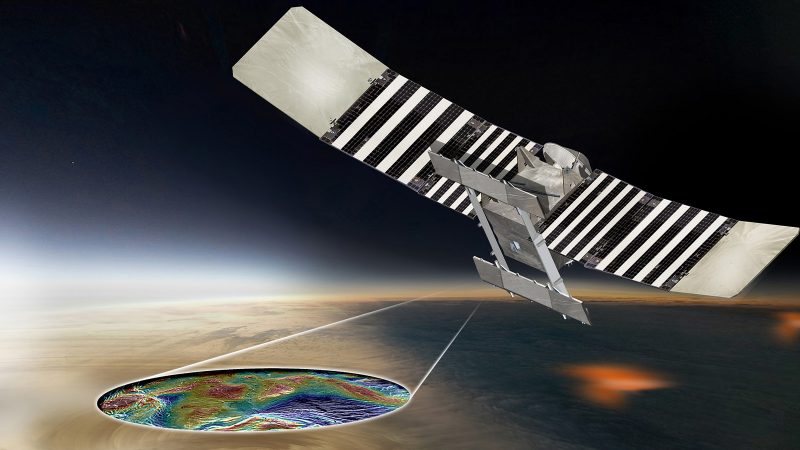
Spacecraft above a cloudy planet with view into color-filled oval on the surface.

Artist’s concept of VERITAS spacecraft orbiting Venus, using its radar to peer through the planet’s dense clouds and produce high-resolution maps of its surface. Image via NASA/ JPL-Caltech.

Venus is often called Earth’s sister planet, and it’s also our closest planetary neighbor. It’s about the same size and density as Earth. But, beyond that, Venus is a very different – and hostile – world. While Earth is a garden, Venus is hot enough on its surface to melt lead. Scientists think that Venus used to be more Earthlike a few billion years ago, when the solar system was younger. Something happened that altered its evolutionary course forever, but exactly what that was is still not well understood. Somehow, Venus changed from being a clement world, possibly with oceans, to the cloud-enshrouded, searing hellhole we know today. A proposed new NASA mission, called VERITAS, would study Venus’ geology, both below and on the surface. It would try to answer fundamental questions about how this world ended up being so very different from our own.

The latest overview of the VERITAS mission was posted by NASA’s Jet Propulsion Laboratory (JPL) on July 8, 2020.

VERITAS – Venus Emissivity, Radio Science, InSAR, Topography & Spectroscopy – is one of the four proposed missions being considered for NASA’s Discovery Program. Suzanne Smrekar, principal investigator of VERITAS at JPL, stated:

Venus is like this cosmic gift of an accident. You have these two planetary bodies – Earth and Venus – that started out nearly the same but have gone down two completely different evolutionary paths, but we don’t know why.

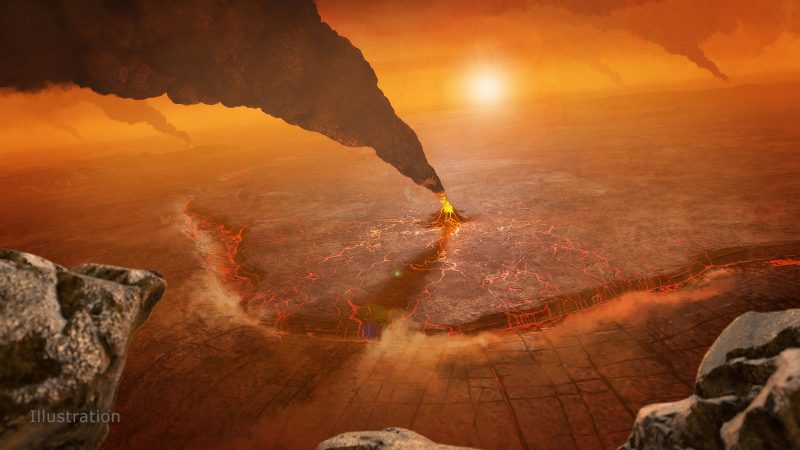
Long, smoky volcanic plume from fiery mountain in reddish terrain and hazy atmosphere.

Artist’s concept of active volcanoes on Venus, and a subduction zone, where a tectonic plate on the surface sinks into the interior of the planet. Image via NASA/ JPL-Caltech/ Peter Rubin.

Venus is a rocky world like Earth, but its surface is completely obscured by a thick, dense atmosphere of carbon dioxide. Temperatures at the surface never fall below about 900 degrees Fahrenheit (500 degrees Celsius), and the pressure, similar to that deep in the oceans on Earth, would quickly crush humans. The clouds contain sulfuric acid. Not exactly the most hospitable place in the solar system, although higher up in the atmosphere, temperatures and pressures are much more clement.

VERITAS would peer through the dense clouds with radar and a near-infrared spectrometer, to create 3-D global maps of the planet and analyze what the surface is composed of (we do know already that most of the surface is volcanic basalt). By measuring Venus’ gravitational field, VERITAS could also determine the structure of the planet’s interior. VERITAS would provide the most detailed analysis of Venus ever obtained by an orbiting spacecraft.

If selected, VERITAS would launch sometime in 2026.

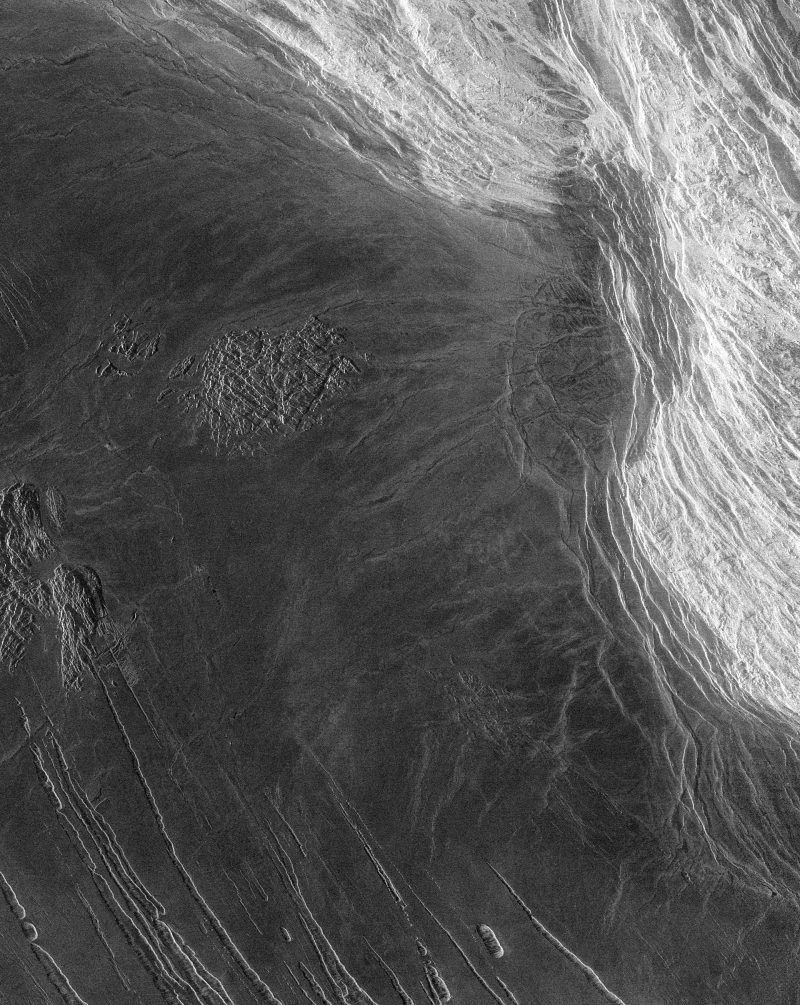
Gray and white terrain with many small parallel ridges.

An example of tessera deformation terrain (white terrain on right side of image) on the western edge of Maxwell Montes on Venus. Image via NASA/ JPL/ Wikipedia.

Scientists are very interested in learning more about Venus, to understand why it changed so dramatically. This could also offer new insights into Earth’s own evolution as a planet, as well as other rocky planet orbiting other stars.

VERITAS will study Venus’ geology, and the similarities it may have to that of the early Earth. The planet’s warm crust is thought to be a good analog to that of Earth a few billion years ago, when tectonic plates were just starting to form. Did the same thing happen on Venus? According to Joann Stock, a geologist and geophysicist at Caltech’s Seismological Laboratory in Pasadena:

The biggest mystery to me is the extent of deformation structures on Venus that could be studied to understand the nature of tectonic activity on the planet.

The deformation structures are areas of rock on the surface that have buckled under immense geologic pressure. On Earth, the outer crust is broken into tectonic plates that sit on top of the mantle. Some plates descend downward in a process called subduction, caused by convection in the mantle. Since the temperature increases the farther down you go, those plates start melting. This releases volcanic gases and other materials called volatiles, including water, nitrogen, carbon dioxide and methane into the atmosphere.

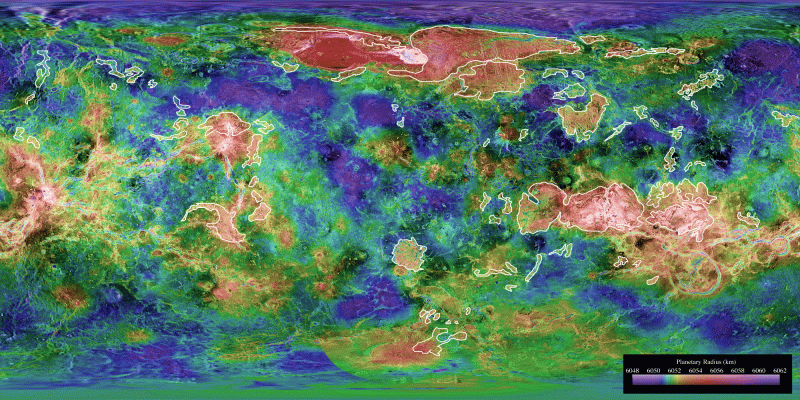
Terrain map covered with irregular multicolored patches with white outlines around some areas.

Map of extensive tessera terrain on Venus (white outlines). Image via USGS Astrogeology Science Center/ Sjoh197/ Wikipedia.

Could the deformation structures be a form of tectonic plates similar to those on the early Earth? VERITAS would help scientists answer that question. The 3-D topographic maps would be able to see features much smaller than previously possible with earlier missions. It could identify strike-slip faults, similar to San Andreas Fault in California, by seeing the raised topography on each side of the fault. If VERITAS found such formations, that would be evidence for substantial tectonic activity on the planet in the past, and perhaps even today. VERITAS would also use interferometric deformation maps – using interferometry – to look for active faulting on the planet’s surface, something never done before anywhere but on Earth.

If plate tectonics were to be confirmed on Venus, that would be an exciting discovery, since Earth is the only planet in our solar system known to have that kind of geological activity. (Jupiter’s moon Europa is now thought to have a more primitive form of plate tectonics, but Europa’s crust is composed of water ice, not rock).

The largest and most widespread deformation structures on Venus are called tessera, plateau-like regions that may be analogous to Earth’s continents. VERITAS would study their composition, to see if they formed in a similar manner to continents on Earth. That could provide valuable clues about the former ocean(s) that many scientists think once existed on Venus, Earth’s continents are thought to have formed when iron-rich oceanic crust subducted and melted in the presence of water.

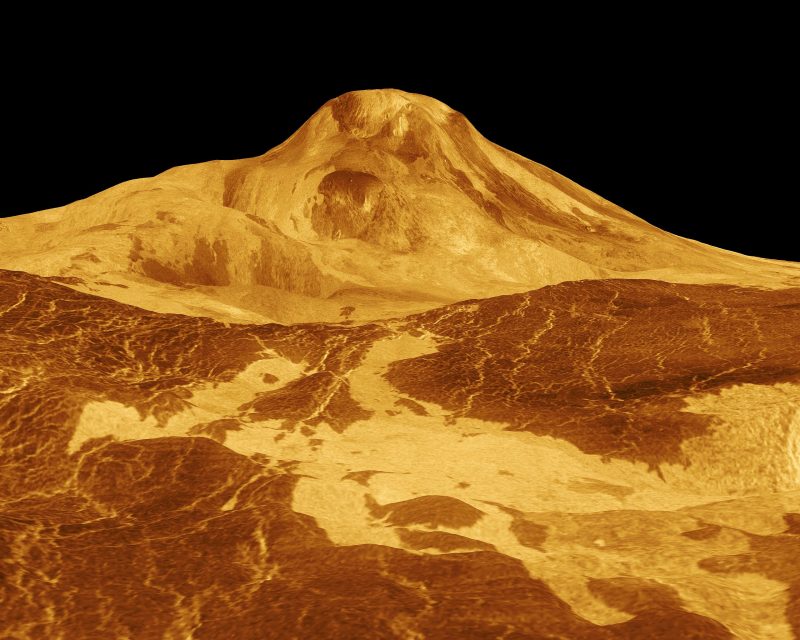
Tall bright yellow-orange hill and orange-patched foreground, with black sky.

Perspective view of the Maat Mons volcano on Venus, based on radar images from Magellan. The volcano is 5 miles (8 km) tall. Image via PD/ USGOV/ NASA/ Wikipedia.

What about volcanism? Volcanism is very much intertwined with plate tectonics on Earth. We already know that Venus has many volcanoes, but are any of them still active? There is currently tentative evidence still-active volcanoes on Venus, but not completely confirmed yet. VERITAS could help do that. Jennifer Whitten, a VERITAS science team member at Tulane University in New Orleans, said:

Determining whether Venus is actively undergoing volcanic activity and understanding what process is driving it is one of the really exciting questions I’d love to see answered.

VERITAS would be able to look for hotspots from active eruptions using its spectrometer, and the radar could detect active faulting, which would be evidence for current tectonic activity. The spectrometer could also detect rocks that had been formed from hot magma, before the chemical composition of the rocks had been altered by the corrosive atmosphere. Knowing how geologically active Venus still is, or isn’t, would also help scientists figure out how much water is in the interior of the planet.

Venus’ geology, plate tectonics in particular, is also important to understand in terms of habitability. The planet’s surface may be extremely inhospitable now, but it wasn’t always like that. Plate tectonics and volcanism have played a major role in Earth’s habitability, where plate tectonics help keep the long-term climate stable (apart from human-caused climate change). Volcanism releases volatiles into the atmosphere, while subduction recycles them back into the planet’s interior. This continuous cycle keeps the atmosphere in balance. The composition of both the atmosphere and oceans is affected by the formation and erosion of the continents, which provide the necessary nutrients for life.

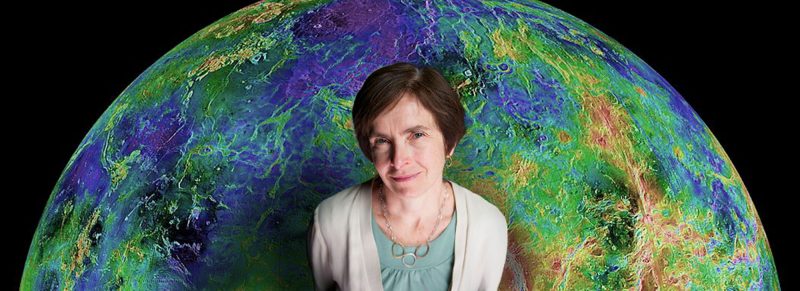
Woman standing in front of multi-colored globe of Venus on black background.

Suzanne Smrekar, principal investigator of VERITAS at JPL. Image via Keck Institute for Space Studies.

Smrekar said:

To unwrap the mysteries of Venus we have to look under the hood at Venus’ interior; it is the engine for global geologic and atmospheric evolution. Are Venus and Earth fundamentally unique worlds? Or are the differences between these ‘twins’ only cosmetic? Answering this question is key to understanding what makes other rocky planets habitable and, ultimately, emerge with life.

The last spacecraft to study Venus’ surface from orbit was Magellan, which ended in 1994. If it does get selected as a mission, VERITAS will revolutionize our understanding of how Venus formed and evolved, and why our sister planet changed so dramatically from a habitable world to one that could just as well have been forged in hell itself.

Bottom line: The proposed VERITAS mission would study the complex geology of Venus.

Via Jet Propulsion Laboratory


from EarthSky https://ift.tt/2Zm0Blw
Spacecraft above a cloudy planet with view into color-filled oval on the surface.

Artist’s concept of VERITAS spacecraft orbiting Venus, using its radar to peer through the planet’s dense clouds and produce high-resolution maps of its surface. Image via NASA/ JPL-Caltech.

Venus is often called Earth’s sister planet, and it’s also our closest planetary neighbor. It’s about the same size and density as Earth. But, beyond that, Venus is a very different – and hostile – world. While Earth is a garden, Venus is hot enough on its surface to melt lead. Scientists think that Venus used to be more Earthlike a few billion years ago, when the solar system was younger. Something happened that altered its evolutionary course forever, but exactly what that was is still not well understood. Somehow, Venus changed from being a clement world, possibly with oceans, to the cloud-enshrouded, searing hellhole we know today. A proposed new NASA mission, called VERITAS, would study Venus’ geology, both below and on the surface. It would try to answer fundamental questions about how this world ended up being so very different from our own.

The latest overview of the VERITAS mission was posted by NASA’s Jet Propulsion Laboratory (JPL) on July 8, 2020.

VERITAS – Venus Emissivity, Radio Science, InSAR, Topography & Spectroscopy – is one of the four proposed missions being considered for NASA’s Discovery Program. Suzanne Smrekar, principal investigator of VERITAS at JPL, stated:

Venus is like this cosmic gift of an accident. You have these two planetary bodies – Earth and Venus – that started out nearly the same but have gone down two completely different evolutionary paths, but we don’t know why.

Long, smoky volcanic plume from fiery mountain in reddish terrain and hazy atmosphere.

Artist’s concept of active volcanoes on Venus, and a subduction zone, where a tectonic plate on the surface sinks into the interior of the planet. Image via NASA/ JPL-Caltech/ Peter Rubin.

Venus is a rocky world like Earth, but its surface is completely obscured by a thick, dense atmosphere of carbon dioxide. Temperatures at the surface never fall below about 900 degrees Fahrenheit (500 degrees Celsius), and the pressure, similar to that deep in the oceans on Earth, would quickly crush humans. The clouds contain sulfuric acid. Not exactly the most hospitable place in the solar system, although higher up in the atmosphere, temperatures and pressures are much more clement.

VERITAS would peer through the dense clouds with radar and a near-infrared spectrometer, to create 3-D global maps of the planet and analyze what the surface is composed of (we do know already that most of the surface is volcanic basalt). By measuring Venus’ gravitational field, VERITAS could also determine the structure of the planet’s interior. VERITAS would provide the most detailed analysis of Venus ever obtained by an orbiting spacecraft.

If selected, VERITAS would launch sometime in 2026.

Gray and white terrain with many small parallel ridges.

An example of tessera deformation terrain (white terrain on right side of image) on the western edge of Maxwell Montes on Venus. Image via NASA/ JPL/ Wikipedia.

Scientists are very interested in learning more about Venus, to understand why it changed so dramatically. This could also offer new insights into Earth’s own evolution as a planet, as well as other rocky planet orbiting other stars.

VERITAS will study Venus’ geology, and the similarities it may have to that of the early Earth. The planet’s warm crust is thought to be a good analog to that of Earth a few billion years ago, when tectonic plates were just starting to form. Did the same thing happen on Venus? According to Joann Stock, a geologist and geophysicist at Caltech’s Seismological Laboratory in Pasadena:

The biggest mystery to me is the extent of deformation structures on Venus that could be studied to understand the nature of tectonic activity on the planet.

The deformation structures are areas of rock on the surface that have buckled under immense geologic pressure. On Earth, the outer crust is broken into tectonic plates that sit on top of the mantle. Some plates descend downward in a process called subduction, caused by convection in the mantle. Since the temperature increases the farther down you go, those plates start melting. This releases volcanic gases and other materials called volatiles, including water, nitrogen, carbon dioxide and methane into the atmosphere.

Terrain map covered with irregular multicolored patches with white outlines around some areas.

Map of extensive tessera terrain on Venus (white outlines). Image via USGS Astrogeology Science Center/ Sjoh197/ Wikipedia.

Could the deformation structures be a form of tectonic plates similar to those on the early Earth? VERITAS would help scientists answer that question. The 3-D topographic maps would be able to see features much smaller than previously possible with earlier missions. It could identify strike-slip faults, similar to San Andreas Fault in California, by seeing the raised topography on each side of the fault. If VERITAS found such formations, that would be evidence for substantial tectonic activity on the planet in the past, and perhaps even today. VERITAS would also use interferometric deformation maps – using interferometry – to look for active faulting on the planet’s surface, something never done before anywhere but on Earth.

If plate tectonics were to be confirmed on Venus, that would be an exciting discovery, since Earth is the only planet in our solar system known to have that kind of geological activity. (Jupiter’s moon Europa is now thought to have a more primitive form of plate tectonics, but Europa’s crust is composed of water ice, not rock).

The largest and most widespread deformation structures on Venus are called tessera, plateau-like regions that may be analogous to Earth’s continents. VERITAS would study their composition, to see if they formed in a similar manner to continents on Earth. That could provide valuable clues about the former ocean(s) that many scientists think once existed on Venus, Earth’s continents are thought to have formed when iron-rich oceanic crust subducted and melted in the presence of water.

Tall bright yellow-orange hill and orange-patched foreground, with black sky.

Perspective view of the Maat Mons volcano on Venus, based on radar images from Magellan. The volcano is 5 miles (8 km) tall. Image via PD/ USGOV/ NASA/ Wikipedia.

What about volcanism? Volcanism is very much intertwined with plate tectonics on Earth. We already know that Venus has many volcanoes, but are any of them still active? There is currently tentative evidence still-active volcanoes on Venus, but not completely confirmed yet. VERITAS could help do that. Jennifer Whitten, a VERITAS science team member at Tulane University in New Orleans, said:

Determining whether Venus is actively undergoing volcanic activity and understanding what process is driving it is one of the really exciting questions I’d love to see answered.

VERITAS would be able to look for hotspots from active eruptions using its spectrometer, and the radar could detect active faulting, which would be evidence for current tectonic activity. The spectrometer could also detect rocks that had been formed from hot magma, before the chemical composition of the rocks had been altered by the corrosive atmosphere. Knowing how geologically active Venus still is, or isn’t, would also help scientists figure out how much water is in the interior of the planet.

Venus’ geology, plate tectonics in particular, is also important to understand in terms of habitability. The planet’s surface may be extremely inhospitable now, but it wasn’t always like that. Plate tectonics and volcanism have played a major role in Earth’s habitability, where plate tectonics help keep the long-term climate stable (apart from human-caused climate change). Volcanism releases volatiles into the atmosphere, while subduction recycles them back into the planet’s interior. This continuous cycle keeps the atmosphere in balance. The composition of both the atmosphere and oceans is affected by the formation and erosion of the continents, which provide the necessary nutrients for life.

Woman standing in front of multi-colored globe of Venus on black background.

Suzanne Smrekar, principal investigator of VERITAS at JPL. Image via Keck Institute for Space Studies.

Smrekar said:

To unwrap the mysteries of Venus we have to look under the hood at Venus’ interior; it is the engine for global geologic and atmospheric evolution. Are Venus and Earth fundamentally unique worlds? Or are the differences between these ‘twins’ only cosmetic? Answering this question is key to understanding what makes other rocky planets habitable and, ultimately, emerge with life.

The last spacecraft to study Venus’ surface from orbit was Magellan, which ended in 1994. If it does get selected as a mission, VERITAS will revolutionize our understanding of how Venus formed and evolved, and why our sister planet changed so dramatically from a habitable world to one that could just as well have been forged in hell itself.

Bottom line: The proposed VERITAS mission would study the complex geology of Venus.

Via Jet Propulsion Laboratory


from EarthSky https://ift.tt/2Zm0Blw

Physicists report on a unique new particle, a ‘tetraquark’

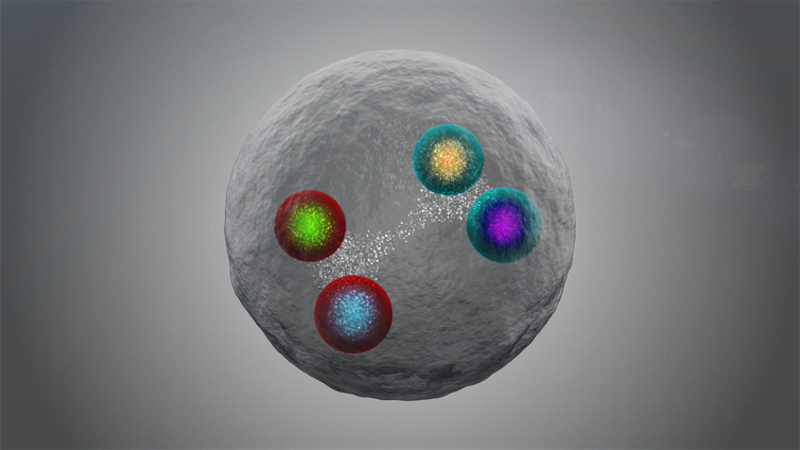
A gray ball with 4 brightly colored circles inside it.

A tetraquark. Image via The Conversation.

By Lorenzo Capriotti, Università di Bologna and Harry Cliff, University of Cambridge

The LHCb collaboration at CERN has announced the discovery of a new exotic particle: a so-called “tetraquark”. The paper by more than 800 authors is yet to be evaluated by other scientists in a process called “peer review”, but has been presented at a seminar. It also meets the usual statistical threshold for claiming the discovery of a new particle.

The finding marks a major breakthrough in a search of almost 20 years, carried out in particle physics labs all over the world.

To understand what a tetraquark is and why the discovery is important, we need to step back in time to 1964, when particle physics was in the midst of a revolution. Beatlemania had just exploded, the Vietnam war was raging and two young radio astronomers in New Jersey had just discovered the strongest evidence ever for the Big Bang theory.

On the other side of the US, at the California Institute of Technology, and on the other side of the Atlantic, at CERN in Switzerland, two particle physicists were publishing two independent papers on the same subject. Both were about how to make sense of the enormous number of new particles that had been discovered over the past two decades.

Many physicists struggled to accept that so many elementary particles could exist in the universe, in what had become known as the particle zoo. Caltech’s George Zweig and Murray Gell-Mann from CERN had struck upon the same solution. What if all these different particles were really made of smaller, unknown building blocks, in the same way that the hundred-odd elements in the periodic table are made of protons, neutrons and electrons? Zweig called these building blocks “aces”, while Gell-Mann chose the term that we still use today: “quarks”.

We now know that there are six different kinds of quarks – up, down, charm, strange, top, bottom. These particles also have respective antimatter companions with opposite charge, which can bind together according to simple rules based on symmetries. A particle made of a quark and an antiquark is called a meson; while three quarks bound together form baryons. The familiar protons and neutrons that make up the atomic nucleus are examples of baryons.

This classification scheme beautifully described the particle zoo of the 1960s. However, even in his original paper, Gell-Mann realized that other combinations of quarks might be possible. For example, two quarks and two antiquarks might stick together to form a tetraquark, while four quarks and an antiquark would make a “pentaquark”.

Exotic particles

Fast-forward to 2003, when the Belle experiment at the KEK laboratory in Japan reported the observation of a new meson, called X(3872), which showed “exotic” properties quite different from ordinary mesons.

In the following years, several new exotic particles were discovered, and physicists started to realize that most of these particles could only be explained successfully if they were tetraquarks made of four quarks instead of two. Then, in 2015, the LHCb experiment at CERN discovered the first pentaquark particles made of five quarks.

All tetraquarks and pentaquarks that have been discovered so far contain two charm quarks, which are relatively heavy, and two or three light quarks – up, down or strange. This particular configuration is indeed the easiest to discover in experiments.

But the latest tetraquark discovered by LHCb, which has been dubbed X(6900), is composed of four charm quarks. Produced in high-energy proton collisions at the Large Hadron Collider, the new tetraquark was observed via its decay into pairs of well-known particles called J/psi mesons, each made of a charm quark and a charm antiquark. This makes it particularly interesting as it is not only composed entirely of heavy quarks, but also four quarks of the same kind – making it a unique specimen to test our understanding on how quarks bind together.

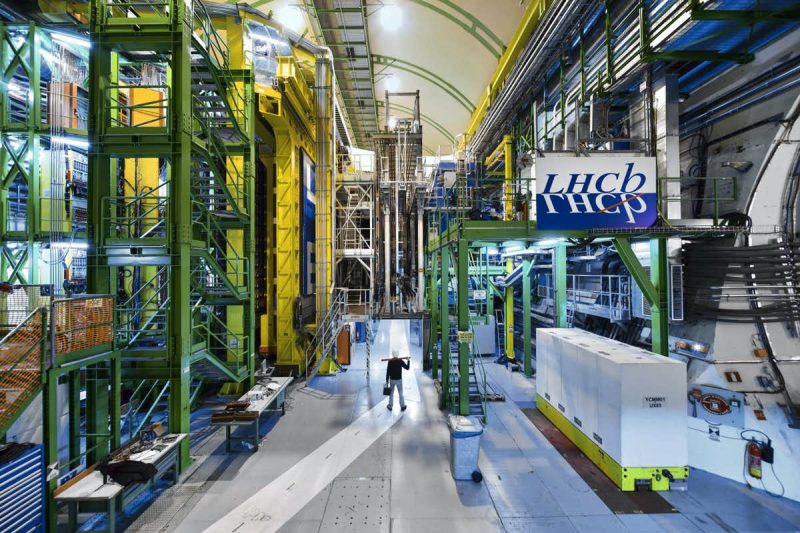
LHCb detector. Image viaM. Brice, J. Ordan/ CERN/ The Conversation.

For now, there are two different models that could explain how quarks bind together: it could be that they are strongly bound, creating what we refer to as a compact tetraquark. Or it could be that the quarks are arranged to form two mesons, which are stuck together loosely in a “molecule”.

Ordinary molecules are made from atoms bound together by the electromagnetic force, which acts between positively charged nuclei and negatively charged electrons. But the quarks in a meson or baryon are connected via a different force, the “strong force”. It is really fascinating that atoms and quarks, following very different rules, can both form very similar complex objects.

The new particle appears to be most consistent with being a compact tetraquark rather than a two-meson molecule, which was the best explanation for previous discoveries. This makes it unusual, as it will allow physicists to study this new binding mechanism in detail. It also implies the existence of other heavy compact tetraquarks.

Window into micro-cosmos

The strong force operating between quarks obeys very complicated rules – so complicated, in fact, that usually the only way to calculate its effects is to use approximations and supercomputers.

The unique nature of the X(6900) will help understand how to improve the accuracy of these approximations, so that in the future we will be able to describe other, more complex mechanisms in physics that are not within our reach today.

Since the discovery of the X(3872), the study of exotic particles has thrived, with hundreds of theoretical and experimental physicists working together to shed some light on this exciting new field. The discovery of the new tetraquark is a huge leap forward, and is an indication that there are still many new exotic particles out there, waiting for someone to unveil them.

Lorenzo Capriotti, Research fellow in Particle Physics, Università di Bologna and Harry Cliff, Particle physicist, University of Cambridge

This article is republished from The Conversation under a Creative Commons license. Read the original article.

Bottom line: On July 1, 2020, the LHCb collaboration at CERN announced the discovery of a new exotic particle – a so-called “tetraquark”.

The Conversation


from EarthSky https://ift.tt/2CrZBn3
A gray ball with 4 brightly colored circles inside it.

A tetraquark. Image via The Conversation.

By Lorenzo Capriotti, Università di Bologna and Harry Cliff, University of Cambridge

The LHCb collaboration at CERN has announced the discovery of a new exotic particle: a so-called “tetraquark”. The paper by more than 800 authors is yet to be evaluated by other scientists in a process called “peer review”, but has been presented at a seminar. It also meets the usual statistical threshold for claiming the discovery of a new particle.

The finding marks a major breakthrough in a search of almost 20 years, carried out in particle physics labs all over the world.

To understand what a tetraquark is and why the discovery is important, we need to step back in time to 1964, when particle physics was in the midst of a revolution. Beatlemania had just exploded, the Vietnam war was raging and two young radio astronomers in New Jersey had just discovered the strongest evidence ever for the Big Bang theory.

On the other side of the US, at the California Institute of Technology, and on the other side of the Atlantic, at CERN in Switzerland, two particle physicists were publishing two independent papers on the same subject. Both were about how to make sense of the enormous number of new particles that had been discovered over the past two decades.

Many physicists struggled to accept that so many elementary particles could exist in the universe, in what had become known as the particle zoo. Caltech’s George Zweig and Murray Gell-Mann from CERN had struck upon the same solution. What if all these different particles were really made of smaller, unknown building blocks, in the same way that the hundred-odd elements in the periodic table are made of protons, neutrons and electrons? Zweig called these building blocks “aces”, while Gell-Mann chose the term that we still use today: “quarks”.

We now know that there are six different kinds of quarks – up, down, charm, strange, top, bottom. These particles also have respective antimatter companions with opposite charge, which can bind together according to simple rules based on symmetries. A particle made of a quark and an antiquark is called a meson; while three quarks bound together form baryons. The familiar protons and neutrons that make up the atomic nucleus are examples of baryons.

This classification scheme beautifully described the particle zoo of the 1960s. However, even in his original paper, Gell-Mann realized that other combinations of quarks might be possible. For example, two quarks and two antiquarks might stick together to form a tetraquark, while four quarks and an antiquark would make a “pentaquark”.

Exotic particles

Fast-forward to 2003, when the Belle experiment at the KEK laboratory in Japan reported the observation of a new meson, called X(3872), which showed “exotic” properties quite different from ordinary mesons.

In the following years, several new exotic particles were discovered, and physicists started to realize that most of these particles could only be explained successfully if they were tetraquarks made of four quarks instead of two. Then, in 2015, the LHCb experiment at CERN discovered the first pentaquark particles made of five quarks.

All tetraquarks and pentaquarks that have been discovered so far contain two charm quarks, which are relatively heavy, and two or three light quarks – up, down or strange. This particular configuration is indeed the easiest to discover in experiments.

But the latest tetraquark discovered by LHCb, which has been dubbed X(6900), is composed of four charm quarks. Produced in high-energy proton collisions at the Large Hadron Collider, the new tetraquark was observed via its decay into pairs of well-known particles called J/psi mesons, each made of a charm quark and a charm antiquark. This makes it particularly interesting as it is not only composed entirely of heavy quarks, but also four quarks of the same kind – making it a unique specimen to test our understanding on how quarks bind together.

LHCb detector. Image viaM. Brice, J. Ordan/ CERN/ The Conversation.

For now, there are two different models that could explain how quarks bind together: it could be that they are strongly bound, creating what we refer to as a compact tetraquark. Or it could be that the quarks are arranged to form two mesons, which are stuck together loosely in a “molecule”.

Ordinary molecules are made from atoms bound together by the electromagnetic force, which acts between positively charged nuclei and negatively charged electrons. But the quarks in a meson or baryon are connected via a different force, the “strong force”. It is really fascinating that atoms and quarks, following very different rules, can both form very similar complex objects.

The new particle appears to be most consistent with being a compact tetraquark rather than a two-meson molecule, which was the best explanation for previous discoveries. This makes it unusual, as it will allow physicists to study this new binding mechanism in detail. It also implies the existence of other heavy compact tetraquarks.

Window into micro-cosmos

The strong force operating between quarks obeys very complicated rules – so complicated, in fact, that usually the only way to calculate its effects is to use approximations and supercomputers.

The unique nature of the X(6900) will help understand how to improve the accuracy of these approximations, so that in the future we will be able to describe other, more complex mechanisms in physics that are not within our reach today.

Since the discovery of the X(3872), the study of exotic particles has thrived, with hundreds of theoretical and experimental physicists working together to shed some light on this exciting new field. The discovery of the new tetraquark is a huge leap forward, and is an indication that there are still many new exotic particles out there, waiting for someone to unveil them.

Lorenzo Capriotti, Research fellow in Particle Physics, Università di Bologna and Harry Cliff, Particle physicist, University of Cambridge

This article is republished from The Conversation under a Creative Commons license. Read the original article.

Bottom line: On July 1, 2020, the LHCb collaboration at CERN announced the discovery of a new exotic particle – a so-called “tetraquark”.

The Conversation


from EarthSky https://ift.tt/2CrZBn3

Nishinoshima volcano belches ash and lava

Dark blue square with a brown stripe down the middle.

The Moderate Resolution Imaging Spectroradiometer (MODIS) on NASA’s Aqua satellite acquired the natural-color image above on July 6, 2020, when the volcanic plume stretched hundreds of kilometers to the north and rose several thousand meters into the sky. Image via NASA.

By Michael Carlowicz/ Originally published by NASA Earth Obvservatory

A young volcanic island has been growing in the western Pacific Ocean since 2013. Since mid-June 2020, it has been going through a vigorous growth spurt.

The images on this page show some of the latest eruptive activity at Nishinoshima, a volcanic island about 600 miles (1,000 km) south of Tokyo, Japan.

(You can see the evolution of the island eruption by visiting the NASA Earth Observatory Nishinoshima event page.)

A light purple puff on a dark backfground.

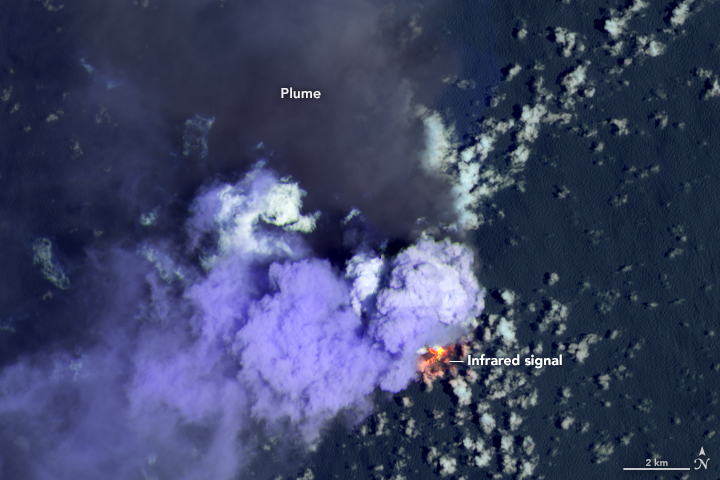
This false-color image, acquired by Landsat 8 on July 4, 2020, combines shortwave infrared and visible wavelengths (bands 7-6-4). It reveals the heat signature of erupting lava and the relative coolness of the dark ash plume (blowing north). The bright purple clouds close to the island could be steam from the volcano or from lava vaporizing seawater. Image via NASA.

According to reports and aerial photographs from the Japan Coast Guard, activity at the volcano appeared to pick up in late May, spewing ash and lava with more vigor than in previous months. On July 3, the volcanic plume rose as high as 15,400 feet (4,700 meters) above sea level; the next day, ash was detected as high as 27,200 feet (8,300 meters), the highest altitude a plume has risen since the volcano poked above the water line in 2013. Volcanic bombs were ejected as far as 1.6 miles (2.5 km) from Nishinoshima that day.

According to news reports citing the Geospatial Information Authority of Japan, the southern shore of the island grew by at least 150 meters (490 feet) between June 19 and July 3. The European Space Agency’s TROPOMI satellite also observed a sizable plume of sulfur dioxide from the eruption.

Nishinoshima is part of the Ogasawara Islands, in the Volcano Islands arc. It is located at 27° 14’ North latitude and 140° 52’ East longitude, about 80 miles (130 km) from the nearest inhabited island.

Location of Nishinoshima.

Bottom line: The Nishinoshima volcanic island in the western Pacific Ocean has been going through a vigorous growth spurt since mid-June 2020.


from EarthSky https://ift.tt/2Zk3zqy
Dark blue square with a brown stripe down the middle.

The Moderate Resolution Imaging Spectroradiometer (MODIS) on NASA’s Aqua satellite acquired the natural-color image above on July 6, 2020, when the volcanic plume stretched hundreds of kilometers to the north and rose several thousand meters into the sky. Image via NASA.

By Michael Carlowicz/ Originally published by NASA Earth Obvservatory

A young volcanic island has been growing in the western Pacific Ocean since 2013. Since mid-June 2020, it has been going through a vigorous growth spurt.

The images on this page show some of the latest eruptive activity at Nishinoshima, a volcanic island about 600 miles (1,000 km) south of Tokyo, Japan.

(You can see the evolution of the island eruption by visiting the NASA Earth Observatory Nishinoshima event page.)

A light purple puff on a dark backfground.

This false-color image, acquired by Landsat 8 on July 4, 2020, combines shortwave infrared and visible wavelengths (bands 7-6-4). It reveals the heat signature of erupting lava and the relative coolness of the dark ash plume (blowing north). The bright purple clouds close to the island could be steam from the volcano or from lava vaporizing seawater. Image via NASA.

According to reports and aerial photographs from the Japan Coast Guard, activity at the volcano appeared to pick up in late May, spewing ash and lava with more vigor than in previous months. On July 3, the volcanic plume rose as high as 15,400 feet (4,700 meters) above sea level; the next day, ash was detected as high as 27,200 feet (8,300 meters), the highest altitude a plume has risen since the volcano poked above the water line in 2013. Volcanic bombs were ejected as far as 1.6 miles (2.5 km) from Nishinoshima that day.

According to news reports citing the Geospatial Information Authority of Japan, the southern shore of the island grew by at least 150 meters (490 feet) between June 19 and July 3. The European Space Agency’s TROPOMI satellite also observed a sizable plume of sulfur dioxide from the eruption.

Nishinoshima is part of the Ogasawara Islands, in the Volcano Islands arc. It is located at 27° 14’ North latitude and 140° 52’ East longitude, about 80 miles (130 km) from the nearest inhabited island.

Location of Nishinoshima.

Bottom line: The Nishinoshima volcanic island in the western Pacific Ocean has been going through a vigorous growth spurt since mid-June 2020.


from EarthSky https://ift.tt/2Zk3zqy

Here’s how to see Jupiter’s four largest moons

Large planet with four smaller moons on black background.

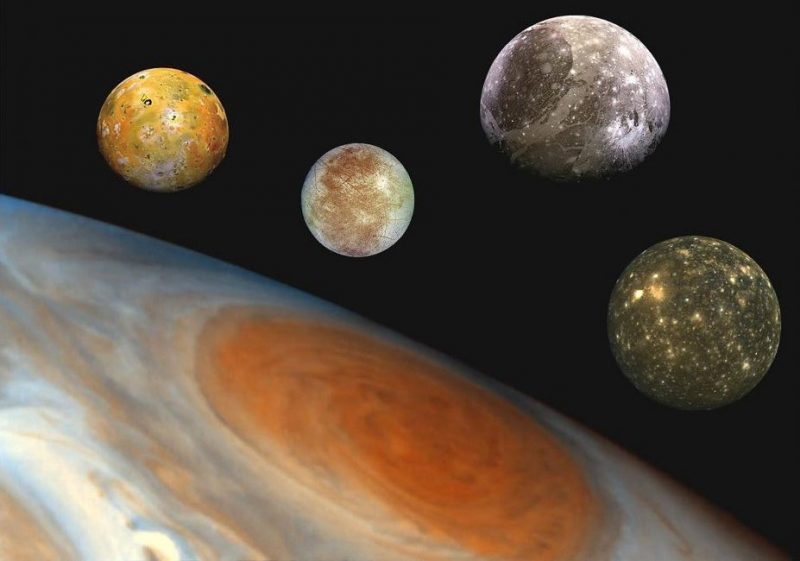
Composite image of Jupiter and its 4 Galilean moons. From left to right the moons are Io, Europa, Ganymede and Callisto. The Galileo spacecraft obtained the images to make this composite in 1996. Image via NASA Photojournal.

Even though Jupiter is way out in the outer solar system, you can still see its four largest moons, often called the Galilean moons to honour the Italian astronomer Galileo, who discovered and confirmed them in 1610. If you have binoculars or a telescope, it’s actually fairly easy to see these moons whenever Jupiter is visible.

They may only look like tiny star-like pinpricks of light, but you can observe them all on or near the same plane as they cross – or transit – in front of Jupiter.

Going from closest to Jupiter to the outermost, their order is Io, Europa, Ganymede and Callisto.

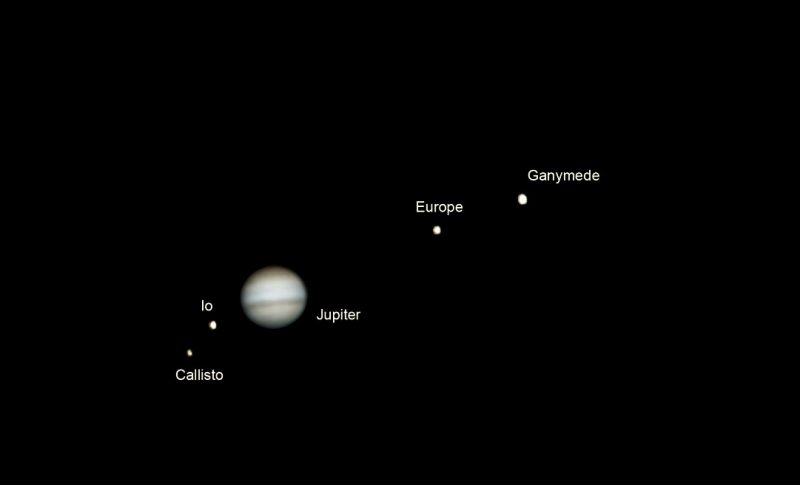
Bright orb with four smaller orbs nearby, with text annotations on black background.

Jupiter and its four Galilean moons as seen through a small telescope. Image via Jean B./ Astronomy.

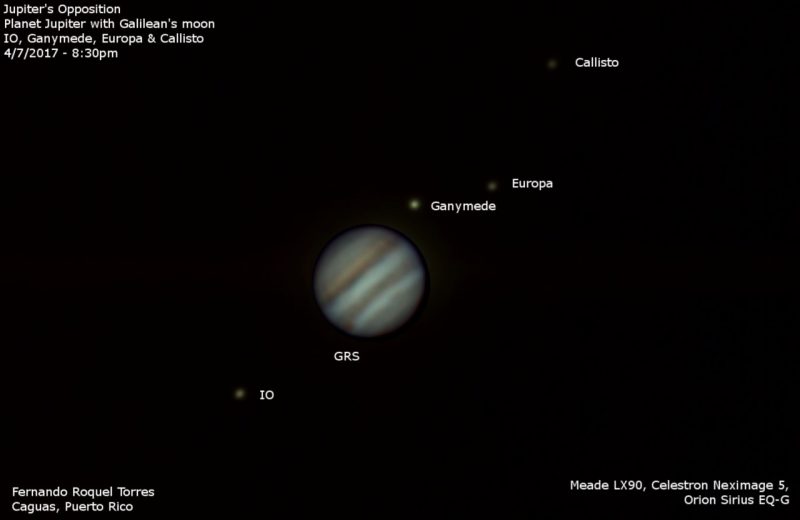
Banded planet with four small moons near it, with text annotations on black background.

Fernando Roquel Torres in Caguas, Puerto Rico, captured Jupiter, its Great Red Spot and all 4 of its largest moons – the Galilean satellites – at Jupiter’s 2017 opposition.

Writing at SkyandTelescope.com in June last year, Bob King said:

Etched in my brain cells is an image of a sharp, gleaming disk striped with two dark belts and accompanied by four star-like moons through my 2.4-inch refractor in the winter of 1966. A 6-inch reflector will make you privy to nearly all of the planet’s secrets …

When magnified at 150× or higher [the four Galilean moons] lose their star-like appearance and show disks that range in size from 1.0″ to 1.7″ (current opposition). Europa’s the smallest and Ganymede largest.

Ganymede also casts the largest shadow on the planet’s cloud tops when it transits in front of Jupiter. Shadow transits are visible at least once a week with ‘double transits’ – two moons casting shadows simultaneously – occurring once or twice a month. Ganymede’s shadow looks like a bullet hole, while little Europa’s more resembles a pinprick. Moons also fade away and then reappear over several minutes when they enter and exit Jupiter’s shadow during eclipse. Or a moon may be occulted by the Jovian disk and hover at the planet’s edge like a pearl before fading from sight.

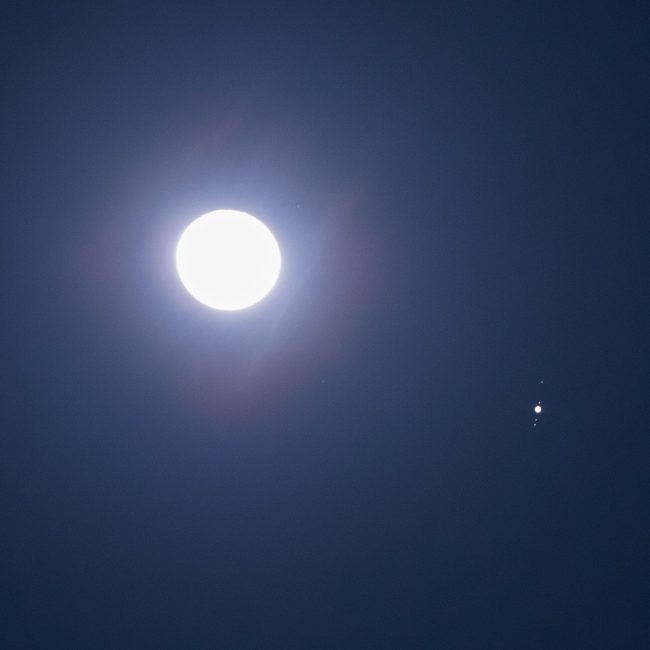
Bright full moon, bright dot of Jupiter nearby, 4 pinpricks of light aligned with Jupiter's equator.

View at EarthSky Community Photos. | Beautiful shot of Earth’s moon – plus Jupiter and its 4 largest moons – on May 20, 2019, via Asthadi Setyawan in Malang, East Java, Indonesia. Thank you, Asthadi!

Like with most moons and planets, the Galilean moons orbit Jupiter around its equator. We do see their orbits almost exactly edge-on, but, as with so much in astronomy, there’s a cycle for viewing the edge-on-ness of Jupiter’s moons. This particular cycle is six years long. That is, every six years, we view Jupiter’s equator – and the moons orbiting above its equator – at the most edge-on.

And that’s why, in 2015, we were able to view a number of mutual events (eclipses and shadow transits) involving Jupiter’s moons, through telescopes.

Starting in late 2016, Jupiter’s axis began tilting enough toward the sun and Earth so that the outermost of the four moons, Callisto, had not been passing in front of Jupiter or behind Jupiter, as seen from our vantage point. This will continue for a period of about three years, during which time Callisto is perpetually visible to those with telescopes, alternately swinging above and below Jupiter as seen from Earth.

Large yellow circle and smaller circles with rings and text annotations on black background.

Opposition – when Earth is directly between Jupiter and the sun – is the best time to observe the largest planet and its four Galilean moons. This year, it is July 13-14. Image via EarthSky.

The next eclipse series of Callisto, whereby this moon actually passes behind Jupiter, started on November 9, 2019, and ends on August 22, 2022, to present a total of 61 eclipses. After that, the next eclipse series will occur from May 29, 2025, to June 7, 2028, to feature 67 eclipses.

Right now, Jupiter is at opposition, when Earth is directly between Jupiter and the sun. Opposition is the middle of the best time of the year to see a planet, since that’s when the planet is up and viewable all night and is generally closest for the year. This year, Jupiter is at peak opposition from July 13-14, 2020. So if you get a chance, grab some binoculars or a small telescope and go see Jupiter’s Galilean moons with your own eyes!

Click here for recommended sky almanacs; they can tell you Jupiter’s rising time in your sky.

Bottom line: How to see Jupiter’s four largest moons.


from EarthSky https://ift.tt/2LhWrFE
Large planet with four smaller moons on black background.

Composite image of Jupiter and its 4 Galilean moons. From left to right the moons are Io, Europa, Ganymede and Callisto. The Galileo spacecraft obtained the images to make this composite in 1996. Image via NASA Photojournal.

Even though Jupiter is way out in the outer solar system, you can still see its four largest moons, often called the Galilean moons to honour the Italian astronomer Galileo, who discovered and confirmed them in 1610. If you have binoculars or a telescope, it’s actually fairly easy to see these moons whenever Jupiter is visible.

They may only look like tiny star-like pinpricks of light, but you can observe them all on or near the same plane as they cross – or transit – in front of Jupiter.

Going from closest to Jupiter to the outermost, their order is Io, Europa, Ganymede and Callisto.

Bright orb with four smaller orbs nearby, with text annotations on black background.

Jupiter and its four Galilean moons as seen through a small telescope. Image via Jean B./ Astronomy.

Banded planet with four small moons near it, with text annotations on black background.

Fernando Roquel Torres in Caguas, Puerto Rico, captured Jupiter, its Great Red Spot and all 4 of its largest moons – the Galilean satellites – at Jupiter’s 2017 opposition.

Writing at SkyandTelescope.com in June last year, Bob King said:

Etched in my brain cells is an image of a sharp, gleaming disk striped with two dark belts and accompanied by four star-like moons through my 2.4-inch refractor in the winter of 1966. A 6-inch reflector will make you privy to nearly all of the planet’s secrets …

When magnified at 150× or higher [the four Galilean moons] lose their star-like appearance and show disks that range in size from 1.0″ to 1.7″ (current opposition). Europa’s the smallest and Ganymede largest.

Ganymede also casts the largest shadow on the planet’s cloud tops when it transits in front of Jupiter. Shadow transits are visible at least once a week with ‘double transits’ – two moons casting shadows simultaneously – occurring once or twice a month. Ganymede’s shadow looks like a bullet hole, while little Europa’s more resembles a pinprick. Moons also fade away and then reappear over several minutes when they enter and exit Jupiter’s shadow during eclipse. Or a moon may be occulted by the Jovian disk and hover at the planet’s edge like a pearl before fading from sight.

Bright full moon, bright dot of Jupiter nearby, 4 pinpricks of light aligned with Jupiter's equator.

View at EarthSky Community Photos. | Beautiful shot of Earth’s moon – plus Jupiter and its 4 largest moons – on May 20, 2019, via Asthadi Setyawan in Malang, East Java, Indonesia. Thank you, Asthadi!

Like with most moons and planets, the Galilean moons orbit Jupiter around its equator. We do see their orbits almost exactly edge-on, but, as with so much in astronomy, there’s a cycle for viewing the edge-on-ness of Jupiter’s moons. This particular cycle is six years long. That is, every six years, we view Jupiter’s equator – and the moons orbiting above its equator – at the most edge-on.

And that’s why, in 2015, we were able to view a number of mutual events (eclipses and shadow transits) involving Jupiter’s moons, through telescopes.

Starting in late 2016, Jupiter’s axis began tilting enough toward the sun and Earth so that the outermost of the four moons, Callisto, had not been passing in front of Jupiter or behind Jupiter, as seen from our vantage point. This will continue for a period of about three years, during which time Callisto is perpetually visible to those with telescopes, alternately swinging above and below Jupiter as seen from Earth.

Large yellow circle and smaller circles with rings and text annotations on black background.

Opposition – when Earth is directly between Jupiter and the sun – is the best time to observe the largest planet and its four Galilean moons. This year, it is July 13-14. Image via EarthSky.

The next eclipse series of Callisto, whereby this moon actually passes behind Jupiter, started on November 9, 2019, and ends on August 22, 2022, to present a total of 61 eclipses. After that, the next eclipse series will occur from May 29, 2025, to June 7, 2028, to feature 67 eclipses.

Right now, Jupiter is at opposition, when Earth is directly between Jupiter and the sun. Opposition is the middle of the best time of the year to see a planet, since that’s when the planet is up and viewable all night and is generally closest for the year. This year, Jupiter is at peak opposition from July 13-14, 2020. So if you get a chance, grab some binoculars or a small telescope and go see Jupiter’s Galilean moons with your own eyes!

Click here for recommended sky almanacs; they can tell you Jupiter’s rising time in your sky.

Bottom line: How to see Jupiter’s four largest moons.


from EarthSky https://ift.tt/2LhWrFE

adds 2