
Here we present 10 cool things about stars!
1. Every star you see in the night sky is bigger and brighter than our sun
Of the 5,000 or so stars bright enough to see with the unaided eye (brighter than magnitude 6) only a handful of very faint stars are near the same size and brightness of our sun. All the rest are all bigger and brighter.
Of the 500 or so that are brighter than 4th magnitude – which includes essentially every star visible to the unaided eye from an urban location – all are bigger and brighter than our sun, many by a large percentage.
Of the brightest 50 stars visible to the human eye from Earth, the least intrinsically bright star is Alpha Centauri. This star still appears very bright to us, because it’s the closest star system to Earth at 4.2 light-years away. And Alpha Centauri is still more than 1.5 times more luminous than our sun.
Read about brightness and luminosity here
2. You can’t see millions of stars on a dark night
Despite what you may hear in poems, songs and commercials, you cannot see a million stars … anywhere. There simply are not enough stars close enough and bright enough to equal a million.
On a really exceptional night, with no moon and far from any source of lights, a person with very good eyesight may be able to see 2,000-2,500 stars at any one time. So the next time you hear someone claim to have seen a million stars in the sky, just attribute it to wonder-inspired exaggeration.
3. Red hot, blue cool? No!
We are accustomed to referring to things that are red as hot and those that are blue as cool. This is not entirely unreasonable, since a red, glowing fireplace poker is hot; and ice, especially in glaciers and polar regions, can have a bluish cast. But we say that only because our everyday experience is limited.
In fact, heated objects change color as their temperature changes. And red represents the lowest temperature at which a heated object can glow in visible light. As it gets hotter, the color changes to white and ultimately to blue. So the red stars you see in the sky are the “coolest” (least hot), and the blue stars are the hottest!
4. Stars are black bodies
A black body is an object that absorbs 100% of all electromagnetic radiation (light, radio waves and so on) that falls on it. A common image here is that of a brick oven with the interior painted black and the only opening a small window. All light that shines through the window is absorbed by the interior of the oven and none is reflected outside the oven. It is a perfect absorber.
As it turns out, this definition of being a perfect absorber suits stars very well! But this just says that a black body absorbs all the radiant energy that hits it. And it does not forbid the black body from re-emitting the energy. In the case of a star, it absorbs all radiation that falls on it, but it also radiates back into space much more than it absorbs. Thus a star is a black body that glows with great brilliance!
An even more perfect black body is a black hole. But, unlike stars, a black hole appears truly black, and radiates no light.
5. There are no green stars
There are scattered claims for stars that appear green, including Beta Librae (Zubeneschamali). But most observers do not see green in any stars except as an optical effect from their telescopes, or else a quirk of personal vision and contrast.
Stars emit a spectrum (“rainbow”) of colors, including green. But the human eye-brain connection mixes the colors together in a manner that rarely, if ever, comes out green. One color can dominate the radiation, but within the range of wavelengths and intensities found in stars, greens get mixed with other colors. And in that case the star appears white. For stars, the general colors are, from lower to higher temperatures, red, orange, yellow, white and blue. So as far as the human eye can tell, there are no green stars.
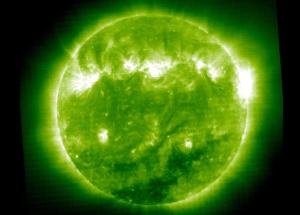
6. Our sun is a green star
This might seem contradictory after the last fact … But our sun is a “green” star, or more specifically, a green-blue star. That is, its peak wavelength lies clearly in the transition area on the spectrum between blue and green.
This isn’t just an idle fact, but is important because the temperature of a star is related to the color of its main emission wavelength. In the sun’s case, the surface temperature is about 5,800 kelvin (about 9,900 Fahrenheit or 5,500 Celsius), or 500 nanometers, which is a green-blue. However, as we said above, when the human eye factors in the other colors around it, the sun’s apparent color comes out as yellowish white.
7. Our sun is a dwarf star
We are accustomed to think of the sun as a “normal” star. And in many respects, it is. But did you know that it is a dwarf star? Technically, as far as normal stars go, there are only dwarf stars, giant stars and supergiant stars.
The giants and supergiants represent the terminal (old age) stages of stars. But the vast majority of stars – those in the long, mature stage of evolution called the main sequence by astronomers – are all called “dwarfs.”
There is quite a bit of range in size here, but they are all much smaller than the giants and supergiants. So technically, the sun is a dwarf star … And is sometimes called a “yellow dwarf”, in contradiction to the entry above!
8. Stars don’t twinkle
Stars often appear to twinkle (“scintillate”), especially when they are near the horizon. The brightest star, Sirius, twinkles, sparkles and flashes so much sometimes that people actually report it as a UFO.
Is twinkling a property of the stars then? No. It’s a property of Earth’s turbulent atmosphere. As the light from a star passes through the atmosphere, especially when the star appears near the horizon, it must pass through many layers of often rapidly differing density. This has the effect of deflecting the light slightly like a ball in a pinball machine. The light eventually gets to your eyes, but every deflection causes it to change slightly in color and intensity. The result is “twinkling.” Above the Earth’s atmosphere, stars do not twinkle.
9. You can see 20 quadrillion miles, at least
On a good night, you can see about 19,000,000,000,000,000 miles, easily. That’s 19 quadrillion miles, the approximate distance to the bright star Deneb in the constellation Cygnus the Swan.
Cygnus is prominent in the evening skies of summer, fall and winter. And Deneb is bright enough to be seen virtually anywhere in the Northern Hemisphere and, in fact, from almost anywhere in the inhabited world.
There is another star, Eta Carinae, that is a little more than twice as far away, or about 44 quadrillion miles. But Eta Carinae is faint, and not well placed for observers in most of the Northern Hemisphere.
Of course, we’re limiting this to just stars. Both the Andromeda galaxy and the Triangulum galaxy are also visible under certain conditions, and are roughly 15 and 18 quintillion miles away! (One quintillion is 10 raised to the power of 18.)
10. Black holes don’t suck
Many writers frequently describe black holes as “sucking in” everything around them. And it is a common worry among the ill-informed that the so-far-hypothetical “mini” black holes that may be produced by the Large Hadron Collider (LHC) would suck in everything around them in an ever-increasing vortex that would consume the Earth! In the case of the LHC, it isn’t true for a number of reasons, but black holes in general do not “suck.”
This is not just a semantic distinction, but one of process and consequence as well. The word “suck” via suction, as in the way vacuum cleaners work, is not how black holes attract matter. In a vacuum cleaner, the fan produces a partial vacuum (really, just a slightly lower pressure) at the floor end of the vacuum, and regular air pressure outside, being greater, pushes the air into it, carrying along loose dirt and dust.
In the case of black holes, there is no suction involved. Instead, matter is pulled into the black hole by a very strong gravitational attraction. In one way of visualizing it, it really is a bit like falling into a hole, but not like being hoovered into it. Gravity is a fundamental force of nature, and all matter has it. When something is pulled into a black hole, the process is more like a fish being reeled in by an angler, rather than being pushed along like a rafter inexorably being dragged over a waterfall.
The difference may seem trivial, but from a physical standpoint it is fundamental. So black holes don’t suck, but they are very cool. Actually, they are cold. Very, very cold. But that’s a story for another time.
Enjoying EarthSky? Sign up for our free daily newsletter today!
Bottom line: Here’s a collection of 10 cool things about stars that you probably didn’t know. Big stars, green stars, black holes, stars by the millions, and more!
The post Top 10 cool things about stars that you probably didn’t know first appeared on EarthSky.
from EarthSky https://ift.tt/agoN9Qi
Here we present 10 cool things about stars!
1. Every star you see in the night sky is bigger and brighter than our sun
Of the 5,000 or so stars bright enough to see with the unaided eye (brighter than magnitude 6) only a handful of very faint stars are near the same size and brightness of our sun. All the rest are all bigger and brighter.
Of the 500 or so that are brighter than 4th magnitude – which includes essentially every star visible to the unaided eye from an urban location – all are bigger and brighter than our sun, many by a large percentage.
Of the brightest 50 stars visible to the human eye from Earth, the least intrinsically bright star is Alpha Centauri. This star still appears very bright to us, because it’s the closest star system to Earth at 4.2 light-years away. And Alpha Centauri is still more than 1.5 times more luminous than our sun.
Read about brightness and luminosity here
2. You can’t see millions of stars on a dark night
Despite what you may hear in poems, songs and commercials, you cannot see a million stars … anywhere. There simply are not enough stars close enough and bright enough to equal a million.
On a really exceptional night, with no moon and far from any source of lights, a person with very good eyesight may be able to see 2,000-2,500 stars at any one time. So the next time you hear someone claim to have seen a million stars in the sky, just attribute it to wonder-inspired exaggeration.
3. Red hot, blue cool? No!
We are accustomed to referring to things that are red as hot and those that are blue as cool. This is not entirely unreasonable, since a red, glowing fireplace poker is hot; and ice, especially in glaciers and polar regions, can have a bluish cast. But we say that only because our everyday experience is limited.
In fact, heated objects change color as their temperature changes. And red represents the lowest temperature at which a heated object can glow in visible light. As it gets hotter, the color changes to white and ultimately to blue. So the red stars you see in the sky are the “coolest” (least hot), and the blue stars are the hottest!
4. Stars are black bodies
A black body is an object that absorbs 100% of all electromagnetic radiation (light, radio waves and so on) that falls on it. A common image here is that of a brick oven with the interior painted black and the only opening a small window. All light that shines through the window is absorbed by the interior of the oven and none is reflected outside the oven. It is a perfect absorber.
As it turns out, this definition of being a perfect absorber suits stars very well! But this just says that a black body absorbs all the radiant energy that hits it. And it does not forbid the black body from re-emitting the energy. In the case of a star, it absorbs all radiation that falls on it, but it also radiates back into space much more than it absorbs. Thus a star is a black body that glows with great brilliance!
An even more perfect black body is a black hole. But, unlike stars, a black hole appears truly black, and radiates no light.
5. There are no green stars
There are scattered claims for stars that appear green, including Beta Librae (Zubeneschamali). But most observers do not see green in any stars except as an optical effect from their telescopes, or else a quirk of personal vision and contrast.
Stars emit a spectrum (“rainbow”) of colors, including green. But the human eye-brain connection mixes the colors together in a manner that rarely, if ever, comes out green. One color can dominate the radiation, but within the range of wavelengths and intensities found in stars, greens get mixed with other colors. And in that case the star appears white. For stars, the general colors are, from lower to higher temperatures, red, orange, yellow, white and blue. So as far as the human eye can tell, there are no green stars.
6. Our sun is a green star
This might seem contradictory after the last fact … But our sun is a “green” star, or more specifically, a green-blue star. That is, its peak wavelength lies clearly in the transition area on the spectrum between blue and green.
This isn’t just an idle fact, but is important because the temperature of a star is related to the color of its main emission wavelength. In the sun’s case, the surface temperature is about 5,800 kelvin (about 9,900 Fahrenheit or 5,500 Celsius), or 500 nanometers, which is a green-blue. However, as we said above, when the human eye factors in the other colors around it, the sun’s apparent color comes out as yellowish white.
7. Our sun is a dwarf star
We are accustomed to think of the sun as a “normal” star. And in many respects, it is. But did you know that it is a dwarf star? Technically, as far as normal stars go, there are only dwarf stars, giant stars and supergiant stars.
The giants and supergiants represent the terminal (old age) stages of stars. But the vast majority of stars – those in the long, mature stage of evolution called the main sequence by astronomers – are all called “dwarfs.”
There is quite a bit of range in size here, but they are all much smaller than the giants and supergiants. So technically, the sun is a dwarf star … And is sometimes called a “yellow dwarf”, in contradiction to the entry above!
8. Stars don’t twinkle
Stars often appear to twinkle (“scintillate”), especially when they are near the horizon. The brightest star, Sirius, twinkles, sparkles and flashes so much sometimes that people actually report it as a UFO.
Is twinkling a property of the stars then? No. It’s a property of Earth’s turbulent atmosphere. As the light from a star passes through the atmosphere, especially when the star appears near the horizon, it must pass through many layers of often rapidly differing density. This has the effect of deflecting the light slightly like a ball in a pinball machine. The light eventually gets to your eyes, but every deflection causes it to change slightly in color and intensity. The result is “twinkling.” Above the Earth’s atmosphere, stars do not twinkle.
9. You can see 20 quadrillion miles, at least
On a good night, you can see about 19,000,000,000,000,000 miles, easily. That’s 19 quadrillion miles, the approximate distance to the bright star Deneb in the constellation Cygnus the Swan.
Cygnus is prominent in the evening skies of summer, fall and winter. And Deneb is bright enough to be seen virtually anywhere in the Northern Hemisphere and, in fact, from almost anywhere in the inhabited world.
There is another star, Eta Carinae, that is a little more than twice as far away, or about 44 quadrillion miles. But Eta Carinae is faint, and not well placed for observers in most of the Northern Hemisphere.
Of course, we’re limiting this to just stars. Both the Andromeda galaxy and the Triangulum galaxy are also visible under certain conditions, and are roughly 15 and 18 quintillion miles away! (One quintillion is 10 raised to the power of 18.)
10. Black holes don’t suck
Many writers frequently describe black holes as “sucking in” everything around them. And it is a common worry among the ill-informed that the so-far-hypothetical “mini” black holes that may be produced by the Large Hadron Collider (LHC) would suck in everything around them in an ever-increasing vortex that would consume the Earth! In the case of the LHC, it isn’t true for a number of reasons, but black holes in general do not “suck.”
This is not just a semantic distinction, but one of process and consequence as well. The word “suck” via suction, as in the way vacuum cleaners work, is not how black holes attract matter. In a vacuum cleaner, the fan produces a partial vacuum (really, just a slightly lower pressure) at the floor end of the vacuum, and regular air pressure outside, being greater, pushes the air into it, carrying along loose dirt and dust.
In the case of black holes, there is no suction involved. Instead, matter is pulled into the black hole by a very strong gravitational attraction. In one way of visualizing it, it really is a bit like falling into a hole, but not like being hoovered into it. Gravity is a fundamental force of nature, and all matter has it. When something is pulled into a black hole, the process is more like a fish being reeled in by an angler, rather than being pushed along like a rafter inexorably being dragged over a waterfall.
The difference may seem trivial, but from a physical standpoint it is fundamental. So black holes don’t suck, but they are very cool. Actually, they are cold. Very, very cold. But that’s a story for another time.
Enjoying EarthSky? Sign up for our free daily newsletter today!
Bottom line: Here’s a collection of 10 cool things about stars that you probably didn’t know. Big stars, green stars, black holes, stars by the millions, and more!
The post Top 10 cool things about stars that you probably didn’t know first appeared on EarthSky.
from EarthSky https://ift.tt/agoN9Qi

Aucun commentaire:
Enregistrer un commentaire