

Science matters. Wonder matters. You matter. Join our 2026 Donation Campaign today.
The U.S. has a big holiday tomorrow. It’s the 250th Independence Day, aka the 4th of July. And that means it’s fireworks season!
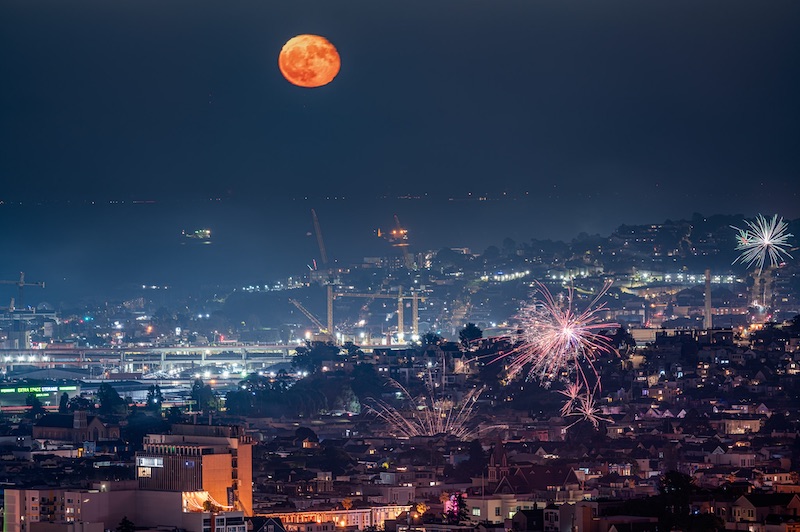
If you watch your local fireworks display, you’ll see the reds, oranges, yellows, greens, blues and purples exploding in the skies. You’ll hear lots of “oohs” and “ahs!”
But what creates the colors of fireworks?
How to sound really smart to your friends on the 4th of July: Know what minerals create the colors in fireworks. ? ? #knowbefore pic.twitter.com/vqnr9617TO
— WeatherBug (@WeatherBug) July 1, 2024
What creates the colors in fireworks?
The colors in fireworks come from a simple source. They’re created by the use of metal salts. These chemical salts are different from table salt, referring instead to any compound that contains metal and non-metal atoms. And some of these compounds produce intense colors when they burn, which makes them ideal for fireworks.
Others, like potassium nitrate, sulfur and charcoal are useful to help the fireworks burn. Nitrates, chlorates and perchlorates provide oxygen for the combustion of the fuel. Dextrin, often used as a starch, holds the mixture together. In addition, the use of chlorine-carrying chemicals strengthens some colors.
Metal salts commonly used in firework displays include: strontium carbonate (red fireworks), calcium chloride (orange fireworks), sodium nitrate (yellow fireworks), barium chloride (green fireworks) and copper chloride (blue fireworks). Purple fireworks are typically a mixture of strontium (red) and copper (blue) compounds.
Then they pack these metal salts into small pea- to plum-sized pellets called “stars” or pyrotechnic stars.
What happens after fireworks ignite?
After a firework ignites, a lift charge propels it into the sky. That’s just explosive black powder in a confined space that, when lit, causes a fast increase of heat and gas that can send a firework as high as 1,000 feet (300 meters) into the air.
Meanwhile, a time-delay fuse burns slowly into the interior of the firework shell. Then, after about five seconds, as the shell is soaring overhead, the fuse kindles a charge that reaches the core of the firework, explodes and ignites the stars that contain the metal salts.
Voilà! A beautiful and colorful fireworks display.
Word of caution
By the way, the people who create fireworks are precise, expert craftsmen. If even one thing is off – too much black powder, stars that aren’t aligned correctly or a trigger that fires too soon or too late – everything can go kaboom. After all, fireworks are explosives, and working with them is best left to the professionals.
Bottom line: The red, orange, yellow, green, blue and purple colors exploding in the night sky during a fireworks festival are created by the use of metal salts.
Read more: The Chemistry of Fireworks Colors
Read more: The Chemistry of Fireworks
Enjoying EarthSky? Sign up for our free daily newsletter today!
The post How do fireworks get their beautiful colors? first appeared on EarthSky.
from EarthSky https://ift.tt/OAfcnB2
Science matters. Wonder matters. You matter. Join our 2026 Donation Campaign today.
The U.S. has a big holiday tomorrow. It’s the 250th Independence Day, aka the 4th of July. And that means it’s fireworks season!
If you watch your local fireworks display, you’ll see the reds, oranges, yellows, greens, blues and purples exploding in the skies. You’ll hear lots of “oohs” and “ahs!”
But what creates the colors of fireworks?
How to sound really smart to your friends on the 4th of July: Know what minerals create the colors in fireworks. ? ? #knowbefore pic.twitter.com/vqnr9617TO
— WeatherBug (@WeatherBug) July 1, 2024
What creates the colors in fireworks?
The colors in fireworks come from a simple source. They’re created by the use of metal salts. These chemical salts are different from table salt, referring instead to any compound that contains metal and non-metal atoms. And some of these compounds produce intense colors when they burn, which makes them ideal for fireworks.
Others, like potassium nitrate, sulfur and charcoal are useful to help the fireworks burn. Nitrates, chlorates and perchlorates provide oxygen for the combustion of the fuel. Dextrin, often used as a starch, holds the mixture together. In addition, the use of chlorine-carrying chemicals strengthens some colors.
Metal salts commonly used in firework displays include: strontium carbonate (red fireworks), calcium chloride (orange fireworks), sodium nitrate (yellow fireworks), barium chloride (green fireworks) and copper chloride (blue fireworks). Purple fireworks are typically a mixture of strontium (red) and copper (blue) compounds.
Then they pack these metal salts into small pea- to plum-sized pellets called “stars” or pyrotechnic stars.
What happens after fireworks ignite?
After a firework ignites, a lift charge propels it into the sky. That’s just explosive black powder in a confined space that, when lit, causes a fast increase of heat and gas that can send a firework as high as 1,000 feet (300 meters) into the air.
Meanwhile, a time-delay fuse burns slowly into the interior of the firework shell. Then, after about five seconds, as the shell is soaring overhead, the fuse kindles a charge that reaches the core of the firework, explodes and ignites the stars that contain the metal salts.
Voilà! A beautiful and colorful fireworks display.
Word of caution
By the way, the people who create fireworks are precise, expert craftsmen. If even one thing is off – too much black powder, stars that aren’t aligned correctly or a trigger that fires too soon or too late – everything can go kaboom. After all, fireworks are explosives, and working with them is best left to the professionals.
Bottom line: The red, orange, yellow, green, blue and purple colors exploding in the night sky during a fireworks festival are created by the use of metal salts.
Read more: The Chemistry of Fireworks Colors
Read more: The Chemistry of Fireworks
Enjoying EarthSky? Sign up for our free daily newsletter today!
The post How do fireworks get their beautiful colors? first appeared on EarthSky.
from EarthSky https://ift.tt/OAfcnB2

Aucun commentaire:
Enregistrer un commentaire