
The Day the Earth Smiled
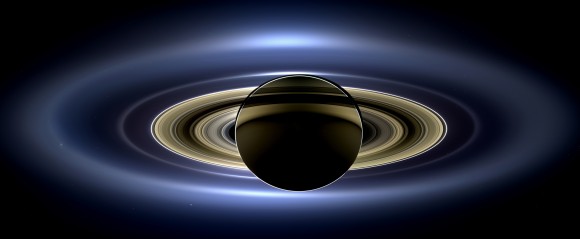
On this date – July 19, 2013 – humanity acquired its 3rd-ever image of Earth from the outer solar system. And it’s one of the most awe-inspiring space photos ever. On that day, the planet Saturn eclipsed the sun from the vantage point of the Saturn-orbiting Cassini spacecraft. And we on Earth cast our thoughts toward space and our tiny place in it.
The Cassini imaging team later dubbed this image The Day the Earth Smiled.
Cassini had been orbiting Saturn, and weaving in and out among its moons, since 2004.
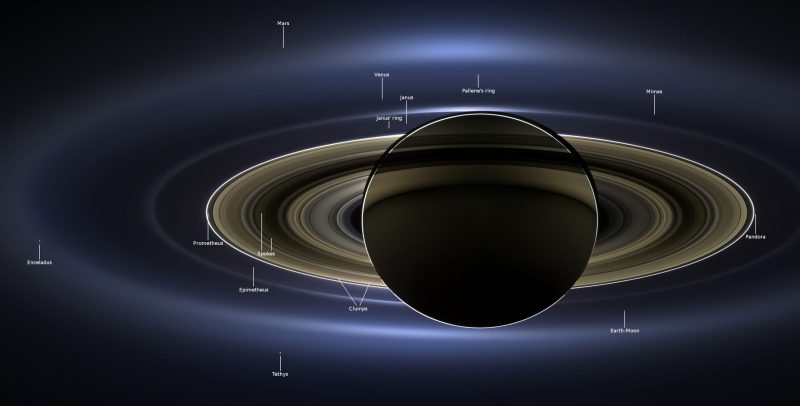
On July 19, 2013, the spacecraft, Saturn and the sun lined up, so that Cassini saw Saturn eclipse the sun. As Cassini slipped into Saturn’s shadow that day, it was able to capture images not just of the Earth, but also of the planets Venus and Mars, Saturn’s backlit rings, and several of Saturn’s moons, all at once. You can see the dark side of Saturn, its bright limb, the main rings and the F, G and E rings. The view looks toward the unilluminated side of the rings from about 20 degrees below the ring plane.
Science matters. Wonder matters. You matter. Join our 2026 Donation Campaign today.
A unique chance to be photographed from a distant world
Before this event, NASA invited everyone on Earth to turn skyward and to smile and wave at Cassini’s camera, which was hundreds of millions of miles away. As the day approached, Carolyn Porco, Cassini imaging team lead at the Space Science Institute in Boulder, Colorado, said people should:
… look up, think about our cosmic place, think about our planet, how unusual it is, how lush and life-giving it is. Think about your own existence. Think about the magnitude of the accomplishment that this picture-taking session entails. We have a spacecraft at Saturn. We are truly interplanetary explorers. Think about all that, and smile.
Porco also said:
Ever since we caught sight of the Earth among the rings of Saturn in September 2006 in a mosaic that has become one of Cassini’s most beloved images, I have wanted to do it all over again, only better. This time, I wanted to turn the entire event into an opportunity for everyone around the globe to savor the uniqueness of our planet and the preciousness of the life on it.
Thus, the idea for The Day the Earth Smiled was born. And – on that day – people on Earth went out, looked up, waved and smiled.
She accomplished that, and much more. Porco was also involved with the planning of the earlier Pale Blue Orb and Pale Blue Dot images, discussed below.
The pictures from Saturn
The incredible 2013 image spans a distance of 404,880 miles (650,000 km), roughly twice the distance from the Earth to the moon. Cassini was about 898 million miles (1.45 billion km) away from Earth at the time. That distance is nearly 10 times the distance from the sun to Earth.
NASA said the natural-color image is as the human eye would see it, if you had been there with Cassini. Using both its wide-angle and narrow-angle cameras, the spacecraft captured a total of 323 photographs over four hours. But only 141 images ended up in this panoramic mosaic.
This mosaic is also one of 33 “footprints” that cover the entire ring system and Saturn itself.

Collages from around the globe on The Day the Earth Smiled
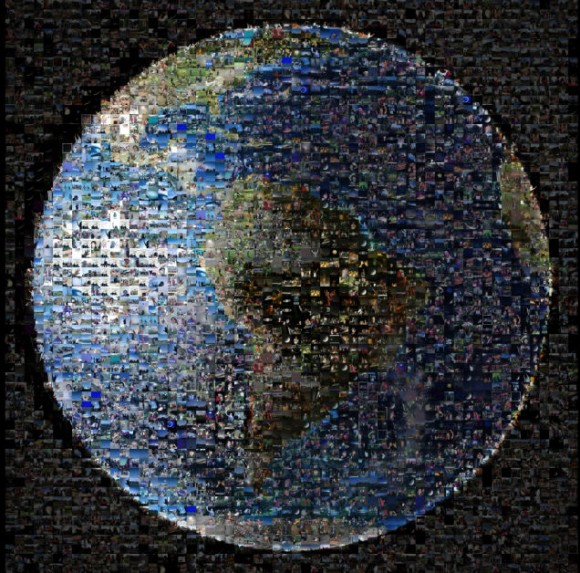
NASA also created a collage of people on Earth to celebrate The Day the Earth Smiled.
In other words, on the same day that Cassini captured The Day the Earth Smiled image, participants from 40 countries took photos of themselves waving at Saturn. This awesome collage is the result.
The images came to NASA/ JPL-Caltech via Twitter, Facebook, Flickr, Instagram, Google+ and email.

Earlier image: Pale Blue Orb
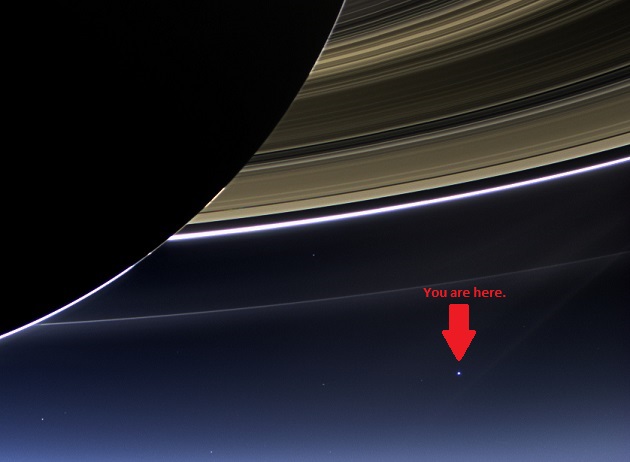
The Pale Blue Orb image by Cassini was the 2nd-ever image of Earth taken from the outer solar system. Cassini captured it on September 15, 2006, just two years after Cassini began orbiting Saturn. At the time, the spacecraft was about 930 million miles (1.5 billion km) from Earth. The Earth and moon appear as a tiny blue dot on the right side of the image, just above center. When magnified, you can see the moon as a slight “protrusion” on the upper left side of the Earth.
As with the 2013 image, the 2006 image captured the passing of Saturn directly in front of the sun as seen from Cassini.
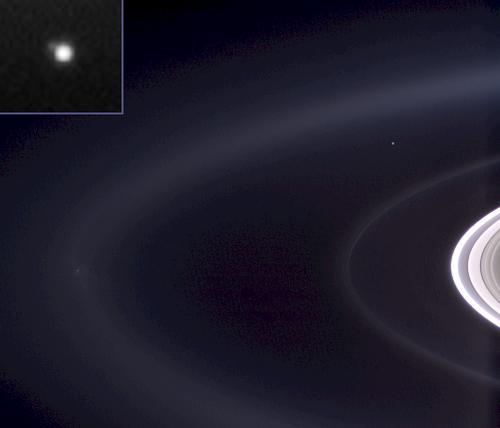
You can read more about the Pale Blue Orb image here.
Original image: Pale Blue Dot
The Pale Blue Dot image is the first image ever taken of Earth from the outer solar system. NASA’s Voyager 1 spacecraft captured it on February 14, 1990. And it’s still the most distant image of Earth. Voyager’s distance from Earth at the time was 4 billion miles (6.4 billion km). The image showed Earth as a pale blue dot, hence the name. Earth appears as a very tiny crescent, only 0.12 pixel in size. Voyager 1 had reached the edge of the solar system, 12 years after its launch. Of course, by then, it had completed its primary mission.
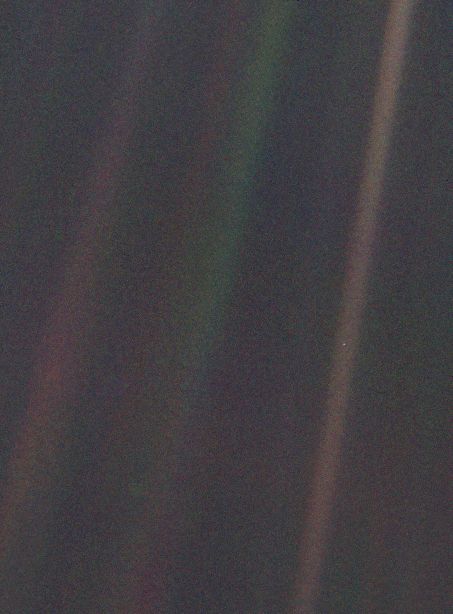
You can read more about the Pale Blue Dot here.
Carl Sagan requested the Pale Blue Dot
At the request of astronomer Carl Sagan, NASA commanded the spacecraft to turn around and photograph the planets of the solar system. The solar system mosaic was interesting. However, this image – the image of our tiny world in space, surrounded by emptiness – was heart-rending. Carl Sagan later famously said, in part:
Look again at that dot. That’s here. That’s home. That’s us. On it everyone you love, everyone you know, everyone you ever heard of, every human being who ever was, lived out their lives. The aggregate of our joy and suffering, thousands of confident religions, ideologies, and economic doctrines, every hunter and forager, every hero and coward, every creator and destroyer of civilization, every king and peasant, every young couple in love, every mother and father, hopeful child, inventor and explorer, every teacher of morals, every corrupt politician, every superstar, every supreme leader, every saint and sinner in the history of our species lived there, on a mote of dust suspended in a sunbeam.
Read more about the Pale Blue Dot image and about what Carl Sagan said.
Bottom line: NASA’s Cassini spacecraft, which orbited Saturn until 2017, took the 3rd-ever picture of Earth from the outer solar system 13 years ago on July 19, 2013. The image is called The Day the Earth Smiled. This followed two previous similar pictures taken in 1990 and 2006.
The post The Day the Earth Smiled: July 19, 2013 first appeared on EarthSky.
from EarthSky https://ift.tt/B45POyV
The Day the Earth Smiled
On this date – July 19, 2013 – humanity acquired its 3rd-ever image of Earth from the outer solar system. And it’s one of the most awe-inspiring space photos ever. On that day, the planet Saturn eclipsed the sun from the vantage point of the Saturn-orbiting Cassini spacecraft. And we on Earth cast our thoughts toward space and our tiny place in it.
The Cassini imaging team later dubbed this image The Day the Earth Smiled.
Cassini had been orbiting Saturn, and weaving in and out among its moons, since 2004.
On July 19, 2013, the spacecraft, Saturn and the sun lined up, so that Cassini saw Saturn eclipse the sun. As Cassini slipped into Saturn’s shadow that day, it was able to capture images not just of the Earth, but also of the planets Venus and Mars, Saturn’s backlit rings, and several of Saturn’s moons, all at once. You can see the dark side of Saturn, its bright limb, the main rings and the F, G and E rings. The view looks toward the unilluminated side of the rings from about 20 degrees below the ring plane.
Science matters. Wonder matters. You matter. Join our 2026 Donation Campaign today.
A unique chance to be photographed from a distant world
Before this event, NASA invited everyone on Earth to turn skyward and to smile and wave at Cassini’s camera, which was hundreds of millions of miles away. As the day approached, Carolyn Porco, Cassini imaging team lead at the Space Science Institute in Boulder, Colorado, said people should:
… look up, think about our cosmic place, think about our planet, how unusual it is, how lush and life-giving it is. Think about your own existence. Think about the magnitude of the accomplishment that this picture-taking session entails. We have a spacecraft at Saturn. We are truly interplanetary explorers. Think about all that, and smile.
Porco also said:
Ever since we caught sight of the Earth among the rings of Saturn in September 2006 in a mosaic that has become one of Cassini’s most beloved images, I have wanted to do it all over again, only better. This time, I wanted to turn the entire event into an opportunity for everyone around the globe to savor the uniqueness of our planet and the preciousness of the life on it.
Thus, the idea for The Day the Earth Smiled was born. And – on that day – people on Earth went out, looked up, waved and smiled.
She accomplished that, and much more. Porco was also involved with the planning of the earlier Pale Blue Orb and Pale Blue Dot images, discussed below.
The pictures from Saturn
The incredible 2013 image spans a distance of 404,880 miles (650,000 km), roughly twice the distance from the Earth to the moon. Cassini was about 898 million miles (1.45 billion km) away from Earth at the time. That distance is nearly 10 times the distance from the sun to Earth.
NASA said the natural-color image is as the human eye would see it, if you had been there with Cassini. Using both its wide-angle and narrow-angle cameras, the spacecraft captured a total of 323 photographs over four hours. But only 141 images ended up in this panoramic mosaic.
This mosaic is also one of 33 “footprints” that cover the entire ring system and Saturn itself.
Collages from around the globe on The Day the Earth Smiled
NASA also created a collage of people on Earth to celebrate The Day the Earth Smiled.
In other words, on the same day that Cassini captured The Day the Earth Smiled image, participants from 40 countries took photos of themselves waving at Saturn. This awesome collage is the result.
The images came to NASA/ JPL-Caltech via Twitter, Facebook, Flickr, Instagram, Google+ and email.
Earlier image: Pale Blue Orb
The Pale Blue Orb image by Cassini was the 2nd-ever image of Earth taken from the outer solar system. Cassini captured it on September 15, 2006, just two years after Cassini began orbiting Saturn. At the time, the spacecraft was about 930 million miles (1.5 billion km) from Earth. The Earth and moon appear as a tiny blue dot on the right side of the image, just above center. When magnified, you can see the moon as a slight “protrusion” on the upper left side of the Earth.
As with the 2013 image, the 2006 image captured the passing of Saturn directly in front of the sun as seen from Cassini.
You can read more about the Pale Blue Orb image here.
Original image: Pale Blue Dot
The Pale Blue Dot image is the first image ever taken of Earth from the outer solar system. NASA’s Voyager 1 spacecraft captured it on February 14, 1990. And it’s still the most distant image of Earth. Voyager’s distance from Earth at the time was 4 billion miles (6.4 billion km). The image showed Earth as a pale blue dot, hence the name. Earth appears as a very tiny crescent, only 0.12 pixel in size. Voyager 1 had reached the edge of the solar system, 12 years after its launch. Of course, by then, it had completed its primary mission.
You can read more about the Pale Blue Dot here.
Carl Sagan requested the Pale Blue Dot
At the request of astronomer Carl Sagan, NASA commanded the spacecraft to turn around and photograph the planets of the solar system. The solar system mosaic was interesting. However, this image – the image of our tiny world in space, surrounded by emptiness – was heart-rending. Carl Sagan later famously said, in part:
Look again at that dot. That’s here. That’s home. That’s us. On it everyone you love, everyone you know, everyone you ever heard of, every human being who ever was, lived out their lives. The aggregate of our joy and suffering, thousands of confident religions, ideologies, and economic doctrines, every hunter and forager, every hero and coward, every creator and destroyer of civilization, every king and peasant, every young couple in love, every mother and father, hopeful child, inventor and explorer, every teacher of morals, every corrupt politician, every superstar, every supreme leader, every saint and sinner in the history of our species lived there, on a mote of dust suspended in a sunbeam.
Read more about the Pale Blue Dot image and about what Carl Sagan said.
Bottom line: NASA’s Cassini spacecraft, which orbited Saturn until 2017, took the 3rd-ever picture of Earth from the outer solar system 13 years ago on July 19, 2013. The image is called The Day the Earth Smiled. This followed two previous similar pictures taken in 1990 and 2006.
The post The Day the Earth Smiled: July 19, 2013 first appeared on EarthSky.
from EarthSky https://ift.tt/B45POyV

Aucun commentaire:
Enregistrer un commentaire