
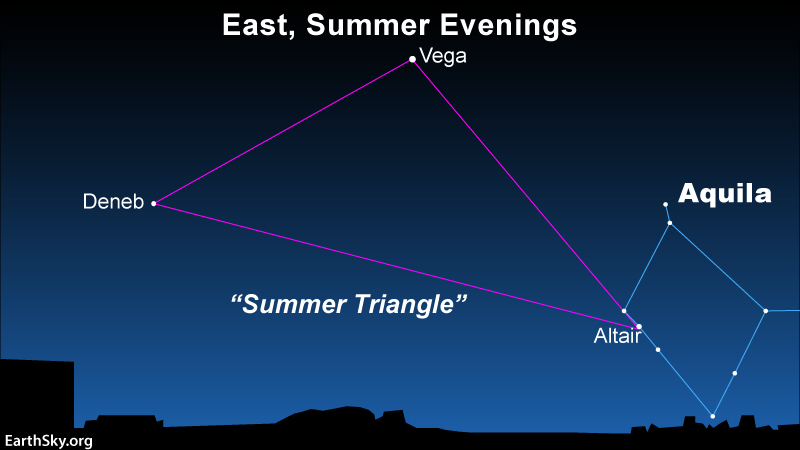
Altair shines as the brightest star in the constellation Aquila the Eagle. Though best known for being one of the three Summer Triangle stars, this star is distinctive in its own right. It shines at an impressive magnitude +0.76 and is only 16.8 light-years away from Earth, making it one of our nearest stellar neighbors. Plus, it has two more noteworthy features.
First, Altair rotates rapidly
Incredibly, this star requires only about 10 hours to spin once on its axis. That’s in contrast to about 27 days for our sun! And, of course, Earth takes 24 hours to spin once, so Altair rotates over twice as fast as our planet.
This speedy spin tends to flatten the star a bit, much as a pizza dough flattens as it spins. Rough estimates are that Altair’s flattening is about 14%. Our sun is also slightly flattened, although this flattening is difficult to measure because its slow rotation produces only a very small deformation.
In 2007, University of Michigan astronomers combined light from four widely separated telescopes to produce the 1st picture showing surface details on Altair. The researchers, led by John Monnier, used optical interferometry to get this image. Read more about the study at SpaceDaily.com.
The bright star Altair in the constellation Aquila is spinning on its axis so fast that it's flattened almost like an M&M. While our Sun rotates at a stately pace of once every 25 days, Altair flies around its axis once every 10 hours – close to its breakup speed.#Psalm19 pic.twitter.com/9YboZV7eq1
— Sarah Salviander (@sarahsalviander) September 25, 2019
Second, it’s variable … but not in a usual way
Variable stars brighten and dim, many on a roughly regular schedule. But Altair has as many as nine different rates of brightening and dimming. You won’t see these brightness variations with your eye. They’re too small to measure without sensitive instruments. But they’re there, and they’re likely related to Altair’s fast rotation.
Altair compared with our sun
If Altair took the place of our sun, life on Earth would be doomed. That’s because Altair is over 10 times more luminous than our sun.
As you might have guessed, Altair is a more massive star than our sun, with about 1.8 times the sun’s mass. Its diameter is estimated to be between 1.6 to 2 times that of the sun. And its surface temperature is between 11,960 degrees F (6,620 C) and 14,840 F (8,230 C), compared to about 10,000F (5,800 C) on our sun.
Altair is a white main sequence star – with a spectral type A7 – and is the 12th brightest star in the sky. It shares that spot with the star Acrux in the constellation Crux.
The star is classified as a Delta Scuti variable star since it shows slight changes in luminosity. It has three dim companion stars visible through telescopes.
And not only is Altair a fast spinner, but it also moves quickly in front of its background stars. In fact, it’ll move about a full degree on our sky over the next 5,000 years.
How to see Altair from the Northern Hemisphere
Altair has an apparent magnitude of +0.76, meaning you can see Altair easily with the unaided eye.
But how will you recognize it? If you’re outside on a July or August evening in the Northern Hemisphere, watch for the large Summer Triangle asterism in the east (as shown on the chart at the top). Look near the horizon for Altair, the last of the three Summer Triangle stars to ascend over your horizon.
You will recognize Altair by the two fainter stars on either side of it.
Also, the Great Rift of the summer Milky Way passes through the Summer Triangle. In fact, it goes right between the stars Vega and Altair. In dark skies in June, July and August, you can see rich star fields with binoculars on both sides of the Great Rift.
Altair in culture, history and myth
In modern western culture, Altair is probably best known for being the home star system of the aliens in the 1956 science fiction film Forbidden Planet.
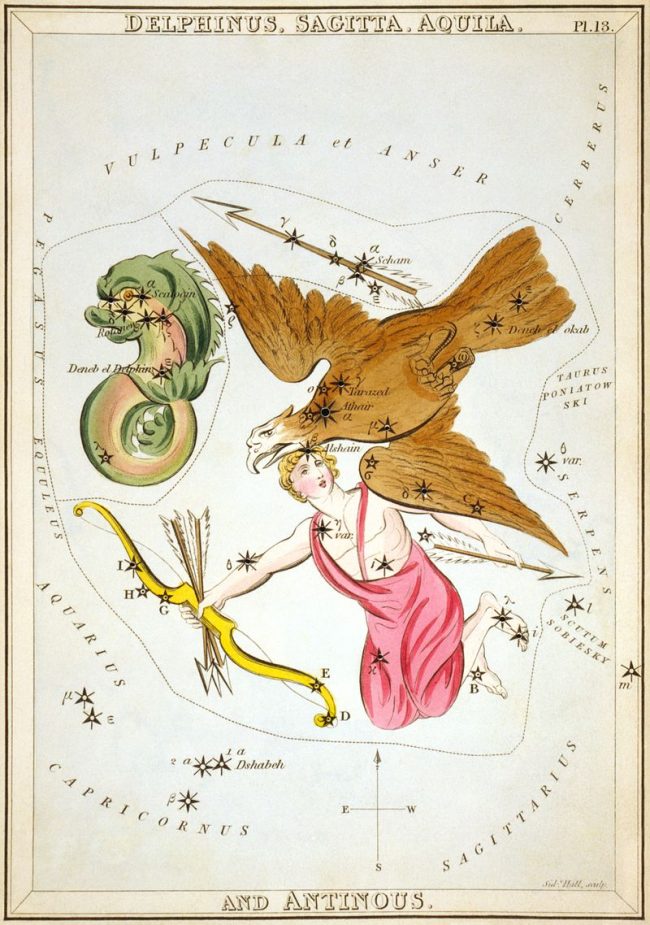
The name Altair is Arabic in origin, and means “eagle”. Interestingly, its constellation’s name, Aquila, is the Latin word for eagle.
In classical mythology, Aquila – and, by extension, Altair – was an eagle favored by Zeus. He played a part in numerous myths, including the abduction of Ganymede in which Aquila carries off a young boy (Ganymede) to Mount Olympus on Zeus’ command to become the cupbearer to the gods. In another myth Aquila is the eagle that torments Prometheus, until Hercules shoots it with poisoned arrows.
In India, Altair with its two flanking stars – Beta and Gamma (Tarazed and Alshain) – traditionally represent the celestial footprints of the god Vishnu.
Altair is separated from the similar looking (but brighter) star Vega in the constellation Lyra the Harp by the great starlit band of the Milky Way. In Asia, this hazy band across our sky is known as the Celestial River. One story common in China, Japan and Korea is of a young herdsman (Altair) who falls in love with a celestial princess (Vega), who weaves the fabric of heaven.
The princess became so enamored of the herdsman that she neglects her weaving duties. This act enrages the princess’s father, the Celestial Emperor, who decrees that the herdsman must stay away from his daughter, on the opposite side of the river. The emperor finally listened to the princess’s pleas, however, and allowed the herdsman to cross the Celestial River once per year, on the seventh day of the seventh month.
In Japan, Altair is Hikoboshi, and Vega is Orihime (or Tanabata). If it rains on the day of the festival of Tanabata, the rain represents Orihime’s tears shed because Hikoboshi could not navigate the treacherous waters of the Celestial River.
Altair’s position
The position of Altair is RA: 19h 50m 47.0s, dec: +08° 52′ 06″.
Bottom line: Altair is the brightest star in the constellation Aquila the Eagle, and one of the closest stars to our solar system. Although 1.8 times our sun’s mass, it spins on its axis in only about 10 hours.
Our Summer Triangle series also includes:
Deneb is distant and very luminous
The post Summer Triangle star: Altair is variable and spins fast! first appeared on EarthSky.
from EarthSky https://ift.tt/fU7Lski
Altair shines as the brightest star in the constellation Aquila the Eagle. Though best known for being one of the three Summer Triangle stars, this star is distinctive in its own right. It shines at an impressive magnitude +0.76 and is only 16.8 light-years away from Earth, making it one of our nearest stellar neighbors. Plus, it has two more noteworthy features.
First, Altair rotates rapidly
Incredibly, this star requires only about 10 hours to spin once on its axis. That’s in contrast to about 27 days for our sun! And, of course, Earth takes 24 hours to spin once, so Altair rotates over twice as fast as our planet.
This speedy spin tends to flatten the star a bit, much as a pizza dough flattens as it spins. Rough estimates are that Altair’s flattening is about 14%. Our sun is also slightly flattened, although this flattening is difficult to measure because its slow rotation produces only a very small deformation.
In 2007, University of Michigan astronomers combined light from four widely separated telescopes to produce the 1st picture showing surface details on Altair. The researchers, led by John Monnier, used optical interferometry to get this image. Read more about the study at SpaceDaily.com.
The bright star Altair in the constellation Aquila is spinning on its axis so fast that it's flattened almost like an M&M. While our Sun rotates at a stately pace of once every 25 days, Altair flies around its axis once every 10 hours – close to its breakup speed.#Psalm19 pic.twitter.com/9YboZV7eq1
— Sarah Salviander (@sarahsalviander) September 25, 2019
Second, it’s variable … but not in a usual way
Variable stars brighten and dim, many on a roughly regular schedule. But Altair has as many as nine different rates of brightening and dimming. You won’t see these brightness variations with your eye. They’re too small to measure without sensitive instruments. But they’re there, and they’re likely related to Altair’s fast rotation.
Altair compared with our sun
If Altair took the place of our sun, life on Earth would be doomed. That’s because Altair is over 10 times more luminous than our sun.
As you might have guessed, Altair is a more massive star than our sun, with about 1.8 times the sun’s mass. Its diameter is estimated to be between 1.6 to 2 times that of the sun. And its surface temperature is between 11,960 degrees F (6,620 C) and 14,840 F (8,230 C), compared to about 10,000F (5,800 C) on our sun.
Altair is a white main sequence star – with a spectral type A7 – and is the 12th brightest star in the sky. It shares that spot with the star Acrux in the constellation Crux.
The star is classified as a Delta Scuti variable star since it shows slight changes in luminosity. It has three dim companion stars visible through telescopes.
And not only is Altair a fast spinner, but it also moves quickly in front of its background stars. In fact, it’ll move about a full degree on our sky over the next 5,000 years.
How to see Altair from the Northern Hemisphere
Altair has an apparent magnitude of +0.76, meaning you can see Altair easily with the unaided eye.
But how will you recognize it? If you’re outside on a July or August evening in the Northern Hemisphere, watch for the large Summer Triangle asterism in the east (as shown on the chart at the top). Look near the horizon for Altair, the last of the three Summer Triangle stars to ascend over your horizon.
You will recognize Altair by the two fainter stars on either side of it.
Also, the Great Rift of the summer Milky Way passes through the Summer Triangle. In fact, it goes right between the stars Vega and Altair. In dark skies in June, July and August, you can see rich star fields with binoculars on both sides of the Great Rift.
Altair in culture, history and myth
In modern western culture, Altair is probably best known for being the home star system of the aliens in the 1956 science fiction film Forbidden Planet.
The name Altair is Arabic in origin, and means “eagle”. Interestingly, its constellation’s name, Aquila, is the Latin word for eagle.
In classical mythology, Aquila – and, by extension, Altair – was an eagle favored by Zeus. He played a part in numerous myths, including the abduction of Ganymede in which Aquila carries off a young boy (Ganymede) to Mount Olympus on Zeus’ command to become the cupbearer to the gods. In another myth Aquila is the eagle that torments Prometheus, until Hercules shoots it with poisoned arrows.
In India, Altair with its two flanking stars – Beta and Gamma (Tarazed and Alshain) – traditionally represent the celestial footprints of the god Vishnu.
Altair is separated from the similar looking (but brighter) star Vega in the constellation Lyra the Harp by the great starlit band of the Milky Way. In Asia, this hazy band across our sky is known as the Celestial River. One story common in China, Japan and Korea is of a young herdsman (Altair) who falls in love with a celestial princess (Vega), who weaves the fabric of heaven.
The princess became so enamored of the herdsman that she neglects her weaving duties. This act enrages the princess’s father, the Celestial Emperor, who decrees that the herdsman must stay away from his daughter, on the opposite side of the river. The emperor finally listened to the princess’s pleas, however, and allowed the herdsman to cross the Celestial River once per year, on the seventh day of the seventh month.
In Japan, Altair is Hikoboshi, and Vega is Orihime (or Tanabata). If it rains on the day of the festival of Tanabata, the rain represents Orihime’s tears shed because Hikoboshi could not navigate the treacherous waters of the Celestial River.
Altair’s position
The position of Altair is RA: 19h 50m 47.0s, dec: +08° 52′ 06″.
Bottom line: Altair is the brightest star in the constellation Aquila the Eagle, and one of the closest stars to our solar system. Although 1.8 times our sun’s mass, it spins on its axis in only about 10 hours.
Our Summer Triangle series also includes:
Deneb is distant and very luminous
The post Summer Triangle star: Altair is variable and spins fast! first appeared on EarthSky.
from EarthSky https://ift.tt/fU7Lski

Aucun commentaire:
Enregistrer un commentaire