
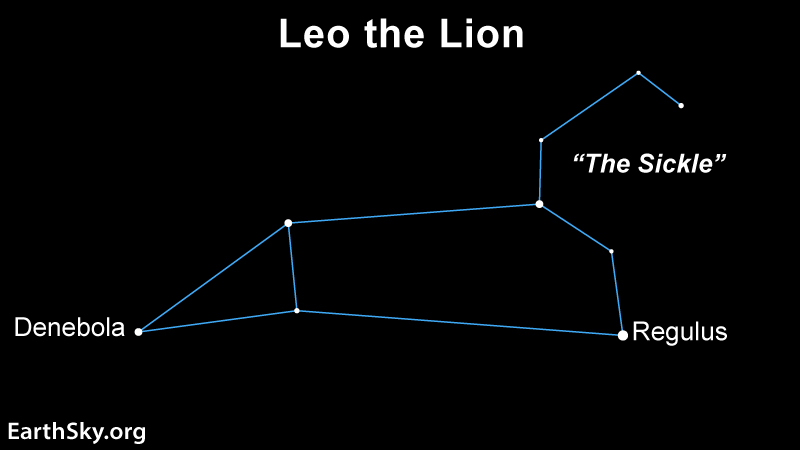
Regulus is the brightest star in the constellation Leo the Lion. Also known as Alpha Leonis, it ranks 21st in the list of brightest stars in our sky.
It’s located near the ecliptic, or sun’s path across our sky. So both Earth’s Northern and Southern Hemispheres see Regulus equally well.
Regulus is part of a backward question mark star pattern, and it marks the dot at the bottom of the question mark. This pattern, known as the Sickle, makes up the head and forequarters of Leo the Lion.
You’ll recognize Regulus for its brightness and blue-white color. It looks like one star to the eye, but it’s really four stars (that we know of so far).
Regulus is located about 79 light-years from Earth.
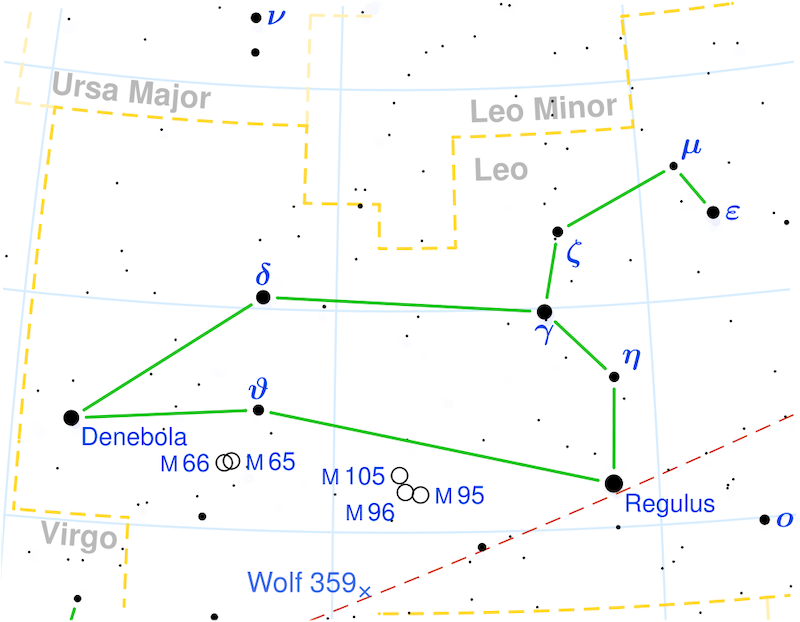
Finding the Lion from the Northern Hemisphere
In the Northern Hemisphere, the star Regulus and its constellation Leo the Lion are harbingers of spring.
They crept higher in the sky with each passing day in March and April, as northern winter favorites – like Orion the Hunter – descended westward.
And now, in May, blue-white Regulus is brilliant in the eastern evening sky as soon as the sun goes down.
And a darker sky reveals the distinctive Sickle and the overall shape of the Lion.
From the Northern Hemisphere, Regulus is visible at some time of night throughout the year, except for about a month on either side of August 22. If you looked toward Regulus around that date, you’d see the sun.
In the Northern Hemisphere, Regulus is known as one of three bright stars making up the asterism of the Spring Triangle.
From the Southern Hemisphere, the Lion is upside down
Via Daniel Gaussen, Founder & Guide – Stargaze Mackenzie – New Zealand
From southern latitudes, the figure of the Lion – named long ago by stargazers on the northern part of Earth’s globe – appears upside down. Regulus traditionally marks Leo’s lower front paw. But Regulus appears as the highest of Leo’s stars from our southerly perspective.
And, from our latitudes on the south of Earth’s globe, the Sickle asterism appears as a mirrored upside-down question mark. This pattern is clearly recognizable for skywatchers tracing the inverted Lion across the northern sky.
As seen from either the Northern or Southern Hemisphere, Regulus more or less follows the sun and moon’s path across our sky. So those in the Northern Hemisphere face generally southward to see Regulus make its wide arc across the sky. But we in the Southern Hemisphere face generally northward to see it.
At a latitude of 35 degrees south, Regulus climbs to about 43 degrees above the northern horizon at its highest. It’s noticeably higher than other bright northern stars, such as Vega. In the Southern Hemisphere, Regulus is one of the easier northern stars to spot during the southern autumn and early winter evenings (May through August).
So, while Leo is a northern constellation, its most prominent marker – Regulus – remains a useful and reliable reference point from the Southern Hemisphere during the colder months.
Despite the constellation’s inverted appearance, the clarity of Regulus and the distinctive Sickle pattern make Leo surprisingly easy to identify once you know what to look for.
Planets and the moon pass near it
Regulus is the only 1st magnitude star to sit almost squarely on the ecliptic, or path of the sun, moon and planets across our sky.
So the moon sweeps past Regulus once a month when this star is visible. In some years, the moon occults – or passes in front of – Regulus as seen from Earth. We’re in a series of 20 lunar occultations of Regulus now, lasting from July 2025 to December 2026. During the December 2026 occultation, Mars and Jupiter will be nearby.
And bright planets also sometimes pass Regulus. Planets can even sometimes occult – or pass in front of – this star. The last planet to occult Regulus was Venus on July 7, 1959. Then on October 1, 2044, Venus will occult Regulus again.
Don’t miss a thing! Visit our monthly night sky guide.
A blue, egg-shaped star
Regulus is a multiple star system, consisting of at least four stars. The main star – Regulus A – is large and blue with a spectral type of B8 IVn. Its surface temperature averages about 12,460 kelvin (21,970 degrees F or 12,190 degrees C), which is much higher than our sun’s surface temperature. Regulus A is 3.8 times the mass of our sun, about 4 times as wide, and almost 300 times as bright.
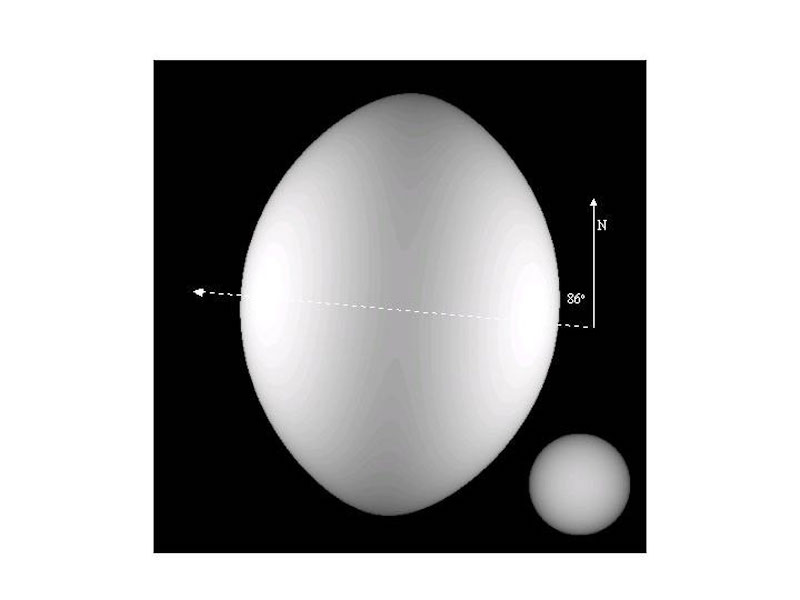
Regulus A spins on its axis once every 16 hours. In contrast, our sun spins on its axis about once every 27 days. This fast rotation causes Regulus A to bulge at its equator, so it appears oblate, or egg-shaped. In fact, if Regulus rotated just a bit faster, it would fly apart!
And Regulus isn’t the only star with a fast spin. The stars Altair and Achernar are also fast spinners with flattened, oblate shapes.
We can see 3 of Regulus’ 4 stars
Look through a small telescope using at least 50x magnification, and you will see Regulus as two objects separated by 177 arcseconds. The brighter of the pair is Regulus A.
The fainter one is Regulus B, a cool “orange” dwarf star with a spectral classification of K2 V. The B star has a mass that is 80% of the sun’s, and it’s half as bright. It has a surface temperature of 4,885 kelvin (8,300 F or 4,600 C), and it shines at magnitude 8.1.
Regulus B has its own companion: Regulus C. At magnitude 13.5, it’s only visible with powerful telescopes. With just 1/3 the mass of the sun, Regulus C is a red dwarf star with a spectral classification of M4 V. Regulus B and C are gravitationally bound to each other, and together they’re called Regulus BC. The distances between B and C ranged from 4.0 to 2.5 arcseconds between 1867 and 1943. There are no recently available measurements.
The 4th star in the system has never been directly resolved via imaging. But its presence is revealed by spectroscopic analysis of Regulus A. Astronomers think it may be a closely orbiting white dwarf star.
You might have heard of a star called Regulus D. This doesn’t refer to the spectroscopic companion of Regulus A, but to a 12th-magnitude star that sits 212 arcseconds from Regulus. For decades, people believed it to be a companion of Regulus, but recent studies from the Gaia satellite show this to be a background star not related to the Regulus system.
A rex by any other name
The name Regulus is from the diminutive form of the Latin rex, meaning little king.
Ancient Arab stargazers called Regulus by the name Qalb al-Asad, which means Heart of the Lion. It also bears the nickname Cor Leonis, again meaning Lion’s Heart. Fittingly, King Richard I of England was also famously known as the Lionheart, or more commonly Coeur de Lion in French.
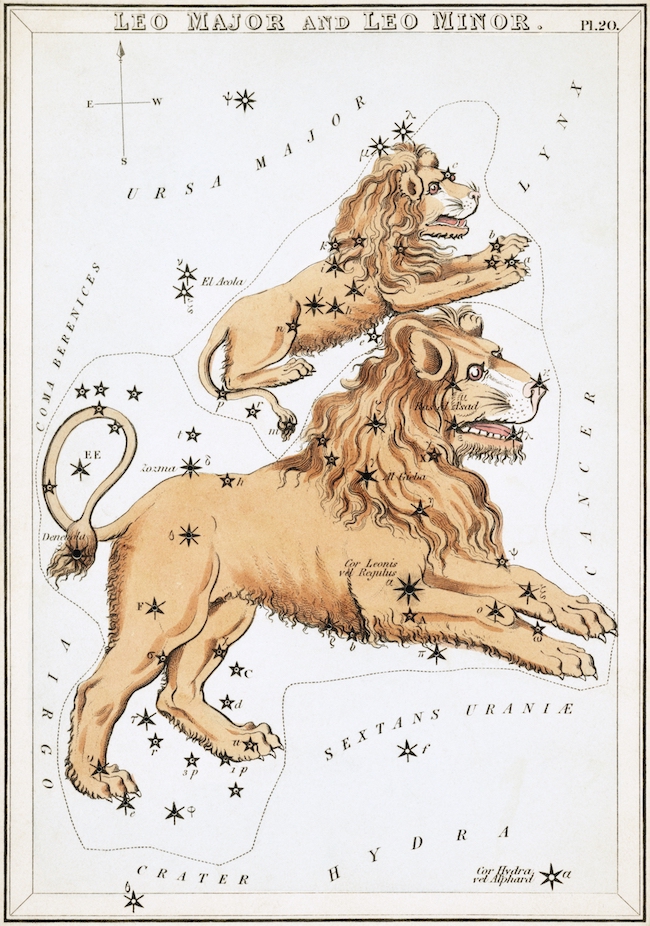
There is a great deal of mythology associated with Leo, perhaps the most common tale being that Leo was the Nemean Lion of the Hercules story. Some Peruvians also knew these stars as the Mountain Lion, whereas in China it was sometimes seen as a horse, and at other times as part of a dragon. Christians in the Middle Ages sometimes referred to it as one of Daniel’s lions.
A galaxy photobombs Regulus
Situated 1/3 degree north of Regulus is the galaxy Leo I. You can see it as a faint patch of light in the photo below. Leo I is difficult to see due to its proximity to Regulus. Albert George Wilson found it on photographic plates taken as part of the National Geographic Society-Palomar Observatory Sky Survey in 1950. It would be another 40 years before anyone viewed it.
Leo I is a dwarf galaxy, and a member of our local group. Amateur astronomers can view it, but this requires dark skies and a large telescope.
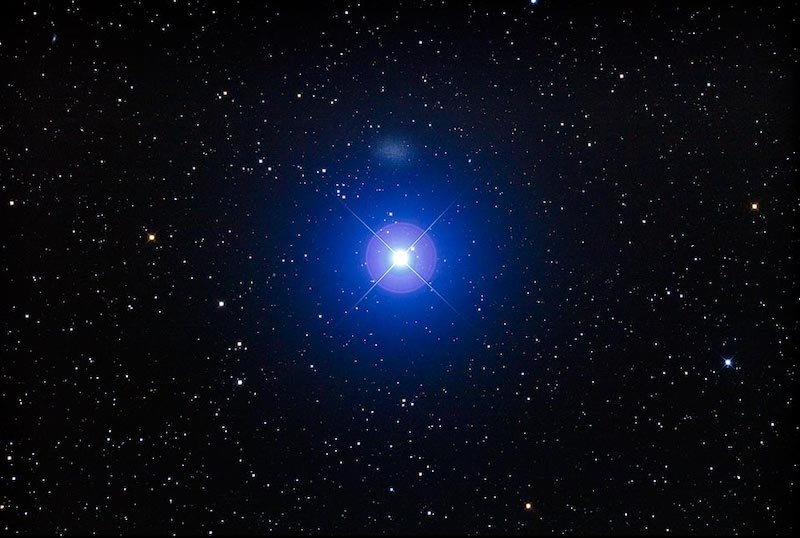
Bottom line: Regulus, the brightest star in the constellation Leo the Lion, is associated with the arrival of spring and is prominent in May skies. It looks like a single point of light, but is really four stars.
Summer Triangle star: Altair is variable and spins fast!
The post Meet Regulus, Leo the Lion’s Heart and brightest star first appeared on EarthSky.
from EarthSky https://ift.tt/KkvAnO1
Regulus is the brightest star in the constellation Leo the Lion. Also known as Alpha Leonis, it ranks 21st in the list of brightest stars in our sky.
It’s located near the ecliptic, or sun’s path across our sky. So both Earth’s Northern and Southern Hemispheres see Regulus equally well.
Regulus is part of a backward question mark star pattern, and it marks the dot at the bottom of the question mark. This pattern, known as the Sickle, makes up the head and forequarters of Leo the Lion.
You’ll recognize Regulus for its brightness and blue-white color. It looks like one star to the eye, but it’s really four stars (that we know of so far).
Regulus is located about 79 light-years from Earth.
Finding the Lion from the Northern Hemisphere
In the Northern Hemisphere, the star Regulus and its constellation Leo the Lion are harbingers of spring.
They crept higher in the sky with each passing day in March and April, as northern winter favorites – like Orion the Hunter – descended westward.
And now, in May, blue-white Regulus is brilliant in the eastern evening sky as soon as the sun goes down.
And a darker sky reveals the distinctive Sickle and the overall shape of the Lion.
From the Northern Hemisphere, Regulus is visible at some time of night throughout the year, except for about a month on either side of August 22. If you looked toward Regulus around that date, you’d see the sun.
In the Northern Hemisphere, Regulus is known as one of three bright stars making up the asterism of the Spring Triangle.
From the Southern Hemisphere, the Lion is upside down
Via Daniel Gaussen, Founder & Guide – Stargaze Mackenzie – New Zealand
From southern latitudes, the figure of the Lion – named long ago by stargazers on the northern part of Earth’s globe – appears upside down. Regulus traditionally marks Leo’s lower front paw. But Regulus appears as the highest of Leo’s stars from our southerly perspective.
And, from our latitudes on the south of Earth’s globe, the Sickle asterism appears as a mirrored upside-down question mark. This pattern is clearly recognizable for skywatchers tracing the inverted Lion across the northern sky.
As seen from either the Northern or Southern Hemisphere, Regulus more or less follows the sun and moon’s path across our sky. So those in the Northern Hemisphere face generally southward to see Regulus make its wide arc across the sky. But we in the Southern Hemisphere face generally northward to see it.
At a latitude of 35 degrees south, Regulus climbs to about 43 degrees above the northern horizon at its highest. It’s noticeably higher than other bright northern stars, such as Vega. In the Southern Hemisphere, Regulus is one of the easier northern stars to spot during the southern autumn and early winter evenings (May through August).
So, while Leo is a northern constellation, its most prominent marker – Regulus – remains a useful and reliable reference point from the Southern Hemisphere during the colder months.
Despite the constellation’s inverted appearance, the clarity of Regulus and the distinctive Sickle pattern make Leo surprisingly easy to identify once you know what to look for.
Planets and the moon pass near it
Regulus is the only 1st magnitude star to sit almost squarely on the ecliptic, or path of the sun, moon and planets across our sky.
So the moon sweeps past Regulus once a month when this star is visible. In some years, the moon occults – or passes in front of – Regulus as seen from Earth. We’re in a series of 20 lunar occultations of Regulus now, lasting from July 2025 to December 2026. During the December 2026 occultation, Mars and Jupiter will be nearby.
And bright planets also sometimes pass Regulus. Planets can even sometimes occult – or pass in front of – this star. The last planet to occult Regulus was Venus on July 7, 1959. Then on October 1, 2044, Venus will occult Regulus again.
Don’t miss a thing! Visit our monthly night sky guide.
A blue, egg-shaped star
Regulus is a multiple star system, consisting of at least four stars. The main star – Regulus A – is large and blue with a spectral type of B8 IVn. Its surface temperature averages about 12,460 kelvin (21,970 degrees F or 12,190 degrees C), which is much higher than our sun’s surface temperature. Regulus A is 3.8 times the mass of our sun, about 4 times as wide, and almost 300 times as bright.
Regulus A spins on its axis once every 16 hours. In contrast, our sun spins on its axis about once every 27 days. This fast rotation causes Regulus A to bulge at its equator, so it appears oblate, or egg-shaped. In fact, if Regulus rotated just a bit faster, it would fly apart!
And Regulus isn’t the only star with a fast spin. The stars Altair and Achernar are also fast spinners with flattened, oblate shapes.
We can see 3 of Regulus’ 4 stars
Look through a small telescope using at least 50x magnification, and you will see Regulus as two objects separated by 177 arcseconds. The brighter of the pair is Regulus A.
The fainter one is Regulus B, a cool “orange” dwarf star with a spectral classification of K2 V. The B star has a mass that is 80% of the sun’s, and it’s half as bright. It has a surface temperature of 4,885 kelvin (8,300 F or 4,600 C), and it shines at magnitude 8.1.
Regulus B has its own companion: Regulus C. At magnitude 13.5, it’s only visible with powerful telescopes. With just 1/3 the mass of the sun, Regulus C is a red dwarf star with a spectral classification of M4 V. Regulus B and C are gravitationally bound to each other, and together they’re called Regulus BC. The distances between B and C ranged from 4.0 to 2.5 arcseconds between 1867 and 1943. There are no recently available measurements.
The 4th star in the system has never been directly resolved via imaging. But its presence is revealed by spectroscopic analysis of Regulus A. Astronomers think it may be a closely orbiting white dwarf star.
You might have heard of a star called Regulus D. This doesn’t refer to the spectroscopic companion of Regulus A, but to a 12th-magnitude star that sits 212 arcseconds from Regulus. For decades, people believed it to be a companion of Regulus, but recent studies from the Gaia satellite show this to be a background star not related to the Regulus system.
A rex by any other name
The name Regulus is from the diminutive form of the Latin rex, meaning little king.
Ancient Arab stargazers called Regulus by the name Qalb al-Asad, which means Heart of the Lion. It also bears the nickname Cor Leonis, again meaning Lion’s Heart. Fittingly, King Richard I of England was also famously known as the Lionheart, or more commonly Coeur de Lion in French.
There is a great deal of mythology associated with Leo, perhaps the most common tale being that Leo was the Nemean Lion of the Hercules story. Some Peruvians also knew these stars as the Mountain Lion, whereas in China it was sometimes seen as a horse, and at other times as part of a dragon. Christians in the Middle Ages sometimes referred to it as one of Daniel’s lions.
A galaxy photobombs Regulus
Situated 1/3 degree north of Regulus is the galaxy Leo I. You can see it as a faint patch of light in the photo below. Leo I is difficult to see due to its proximity to Regulus. Albert George Wilson found it on photographic plates taken as part of the National Geographic Society-Palomar Observatory Sky Survey in 1950. It would be another 40 years before anyone viewed it.
Leo I is a dwarf galaxy, and a member of our local group. Amateur astronomers can view it, but this requires dark skies and a large telescope.
Bottom line: Regulus, the brightest star in the constellation Leo the Lion, is associated with the arrival of spring and is prominent in May skies. It looks like a single point of light, but is really four stars.
Summer Triangle star: Altair is variable and spins fast!
The post Meet Regulus, Leo the Lion’s Heart and brightest star first appeared on EarthSky.
from EarthSky https://ift.tt/KkvAnO1

Aucun commentaire:
Enregistrer un commentaire