
Read: NOAA’s hurricane season forecast for 2026
Atlantic hurricane names for 2026
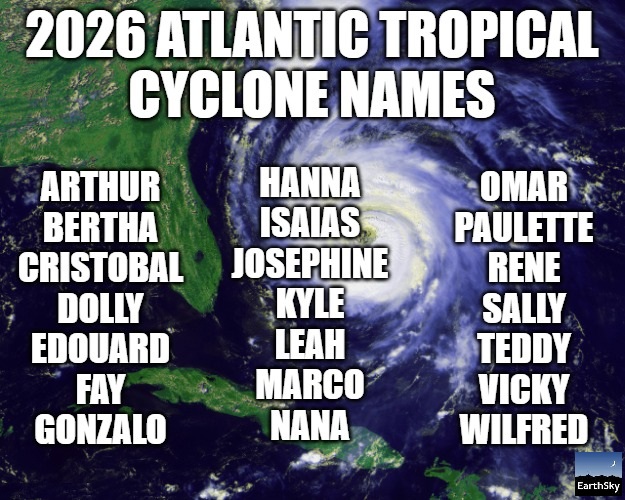
NOAA’s Climate Prediction Center has just released its hurricane season outlook for 2026. But what are the names for the 2026 Atlantic tropical cyclones and hurricanes?
See the complete list of 2026 tropical cyclone and hurricane names in the image above. If any of these storms become truly destructive in 2026, the World Meteorological Organization, which is in charge of the list, retires and replaces the name. For example, in 2024, the World Meteorological Organization retired the names Beryl, Helene and Milton. Helene, in particular, became the deadliest storm in the U.S. since Katrina in 2005.
The 2026 Atlantic hurricane season officially starts June 1 and extends through November 30.
If you live near the Atlantic basin, you can keep up-to-date with forecasts from the National Hurricane Center.
Learn more about how to prepare for hurricane season.
How do hurricanes get their names?
Meteorologists long ago learned that naming tropical storms and hurricanes helps people remember the storms, communicate about them more effectively, and consequently stay safer if and when a particular storm strikes a coast.
These experts assign names to tropical storms according to an approved list before the start of each hurricane season. The U.S. National Hurricane Center started this practice in the early 1950s. Now, the World Meteorological Organization (WMO) generates and maintains the list of hurricane names.
Here are the hurricane names for 2026
Atlantic hurricane names (season runs from June 1 to November 30) are: Arthur, Bertha, Cristobal, Dolly, Edouard, Fay, Gonzalo, Hanna, Isaias, Josephine, Kyle. Leah, Marco, Nana, Omar. Paulette, Rene, Sally, Teddy, Vicky and Wilfred.
Eastern North Pacific hurricane names (season runs from May 15 to November 30) are: Amanda, Boris, Cristina, Douglas, Elida, Fausto, Genevieve, Hernan, Iselle, Julio, Karina, Lowell, Marie, Norbert, Odalys, Polo, Rachel, Simon, Trudy, Vance, Winnie. Xavier, Yolanda and Zeke.
If you’re interested, you can view those names, and names for upcoming years, at the U.S. National Hurricane Center.
The history of hurricane names
While people have been naming major storms for hundreds of years, most hurricanes originally had a designation using a system of latitude-longitude numbers. This was useful to meteorologists trying to track these storms. Unfortunately, this system confused people living on coasts seeking hurricane information.
In the early 1950s, the U.S. National Hurricane Center first developed a formal practice for storm naming for the Atlantic Ocean. At that time, storms got their names according to a phonetic alphabet (e.g., Able, Baker, Charlie) and the names used were the same for each hurricane season. In other words, the first hurricane of a season was always named “Able,” the second “Baker,” and so on.
In 1953, to avoid the repetitive use of names, the National Weather Service revised the system to give storms female names. By doing this, the National Weather Service was mimicking the habit of naval meteorologists, who named the storms after women, much as ships at sea traditionally had female names.
In 1978–1979, they revised the system again to include both female and male hurricane names.
See the complete history of naming hurricanes, including retired names, from NOAA.
When does a storm receive a name?
Tropical storms get a name when they display a rotating circulation pattern and wind speeds reach 39 miles per hour (63 kilometers per hour). A tropical storm develops into a hurricane when wind speeds go above 74 mph (119 km/h).
Experts have developed lists of hurricane names for many of the major ocean basins around the world. Today, there are six lists of hurricane names in use for Atlantic Ocean and Eastern North Pacific storms. These lists rotate, one each year. So that means the list of this year’s hurricane names for each basin will come up again six years from now.
However, there’s an exception to this practice. The World Meteorological Organization retires the names of extremely damaging hurricanes for legal, cultural sensitivity and historical reasons. For example, they retired the name Katrina in 2005 following the devastating impact that Hurricane Katrina had on New Orleans. In 2022, the World Meteorological Organization Hurricane Committee retired the names Fiona and Ian.
Bottom line: The forecasts for Atlantic hurricanes and tropical storms is out. And the hurricane names for 2026 are ready. What’ll happen next?
Read: NOAA’s hurricane season forecast for 2026
Read more: What is a hurricane storm surge?
The post 2026 name list for Atlantic hurricanes: Is yours among them? first appeared on EarthSky.
from EarthSky https://ift.tt/0lK3YCe
Read: NOAA’s hurricane season forecast for 2026
Atlantic hurricane names for 2026
NOAA’s Climate Prediction Center has just released its hurricane season outlook for 2026. But what are the names for the 2026 Atlantic tropical cyclones and hurricanes?
See the complete list of 2026 tropical cyclone and hurricane names in the image above. If any of these storms become truly destructive in 2026, the World Meteorological Organization, which is in charge of the list, retires and replaces the name. For example, in 2024, the World Meteorological Organization retired the names Beryl, Helene and Milton. Helene, in particular, became the deadliest storm in the U.S. since Katrina in 2005.
The 2026 Atlantic hurricane season officially starts June 1 and extends through November 30.
If you live near the Atlantic basin, you can keep up-to-date with forecasts from the National Hurricane Center.
Learn more about how to prepare for hurricane season.
How do hurricanes get their names?
Meteorologists long ago learned that naming tropical storms and hurricanes helps people remember the storms, communicate about them more effectively, and consequently stay safer if and when a particular storm strikes a coast.
These experts assign names to tropical storms according to an approved list before the start of each hurricane season. The U.S. National Hurricane Center started this practice in the early 1950s. Now, the World Meteorological Organization (WMO) generates and maintains the list of hurricane names.
Here are the hurricane names for 2026
Atlantic hurricane names (season runs from June 1 to November 30) are: Arthur, Bertha, Cristobal, Dolly, Edouard, Fay, Gonzalo, Hanna, Isaias, Josephine, Kyle. Leah, Marco, Nana, Omar. Paulette, Rene, Sally, Teddy, Vicky and Wilfred.
Eastern North Pacific hurricane names (season runs from May 15 to November 30) are: Amanda, Boris, Cristina, Douglas, Elida, Fausto, Genevieve, Hernan, Iselle, Julio, Karina, Lowell, Marie, Norbert, Odalys, Polo, Rachel, Simon, Trudy, Vance, Winnie. Xavier, Yolanda and Zeke.
If you’re interested, you can view those names, and names for upcoming years, at the U.S. National Hurricane Center.
The history of hurricane names
While people have been naming major storms for hundreds of years, most hurricanes originally had a designation using a system of latitude-longitude numbers. This was useful to meteorologists trying to track these storms. Unfortunately, this system confused people living on coasts seeking hurricane information.
In the early 1950s, the U.S. National Hurricane Center first developed a formal practice for storm naming for the Atlantic Ocean. At that time, storms got their names according to a phonetic alphabet (e.g., Able, Baker, Charlie) and the names used were the same for each hurricane season. In other words, the first hurricane of a season was always named “Able,” the second “Baker,” and so on.
In 1953, to avoid the repetitive use of names, the National Weather Service revised the system to give storms female names. By doing this, the National Weather Service was mimicking the habit of naval meteorologists, who named the storms after women, much as ships at sea traditionally had female names.
In 1978–1979, they revised the system again to include both female and male hurricane names.
See the complete history of naming hurricanes, including retired names, from NOAA.
When does a storm receive a name?
Tropical storms get a name when they display a rotating circulation pattern and wind speeds reach 39 miles per hour (63 kilometers per hour). A tropical storm develops into a hurricane when wind speeds go above 74 mph (119 km/h).
Experts have developed lists of hurricane names for many of the major ocean basins around the world. Today, there are six lists of hurricane names in use for Atlantic Ocean and Eastern North Pacific storms. These lists rotate, one each year. So that means the list of this year’s hurricane names for each basin will come up again six years from now.
However, there’s an exception to this practice. The World Meteorological Organization retires the names of extremely damaging hurricanes for legal, cultural sensitivity and historical reasons. For example, they retired the name Katrina in 2005 following the devastating impact that Hurricane Katrina had on New Orleans. In 2022, the World Meteorological Organization Hurricane Committee retired the names Fiona and Ian.
Bottom line: The forecasts for Atlantic hurricanes and tropical storms is out. And the hurricane names for 2026 are ready. What’ll happen next?
Read: NOAA’s hurricane season forecast for 2026
Read more: What is a hurricane storm surge?
The post 2026 name list for Atlantic hurricanes: Is yours among them? first appeared on EarthSky.
from EarthSky https://ift.tt/0lK3YCe

Aucun commentaire:
Enregistrer un commentaire