
We’ll have another supermoon in December. It crests at 5:14 p.m. CST (23:14 UTC) on Dec 4. Expect large tides. Let the moon guide you to Jupiter, the brightest planet up in December. And let Jupiter guide you to the radiant point for December’s Geminid meteor shower! Plus … why doesn’t the earliest sunset fall on the shortest day? Two veteran stargazers – EarthSky’s Deborah Byrd and John Goss – have all you need to know. Join them at noon CST (18 UTC) on December 3.
When and where to look in 2025: For us in the Northern Hemisphere, the bright, round, full moon will rise in the east around sunset on December 4. It’ll be highest in the sky around midnight, and will set in the west around sunrise. It’s also a supermoon, the third of four supermoons in a row and the last supermoon of 2025. The 4th full supermoon of this series will come about a month from now, in January 2026.
The crest of the full moon will fall at 23:14 UTC on December 4. That’s 5:14 p.m. CST, about two hours after moonrise in central North America. And that’s also the moment when this month’s moon is most directly opposite the sun as seen from Earth.
Note: The moon is roundest on the day when it is full, but the day before and after, it appears almost, but not quite full.
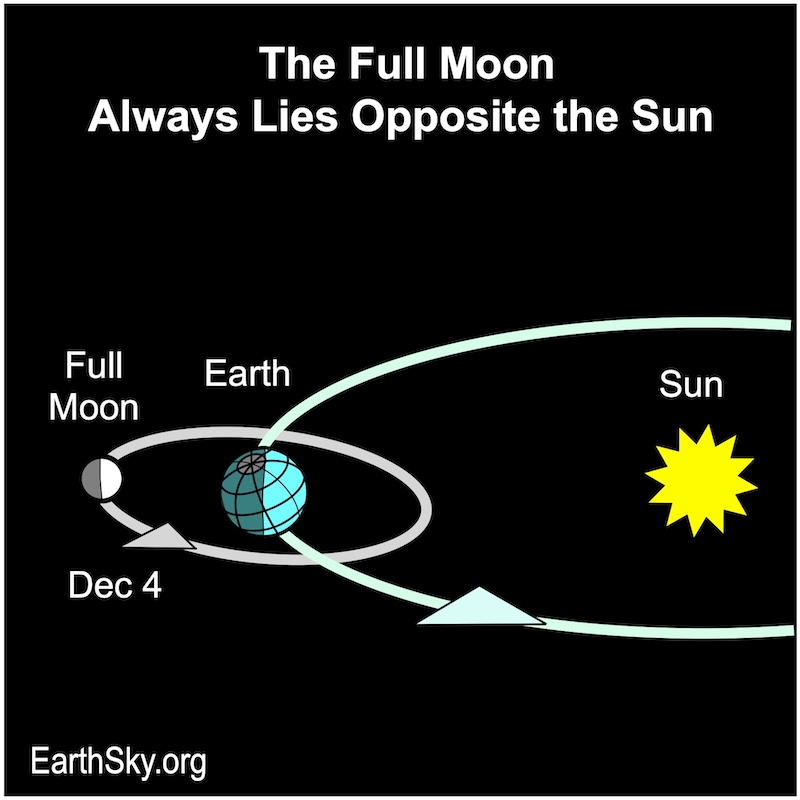
This Cold Moon is also a supermoon
December 2025 lunar perigee – the point in the moon’s orbit where it comes closest to Earth – occurs about 12 hours before the crest of the full moon. This means it is a perigean full moon – or supermoon. At this perigee, the moon is about 222,000 miles (357,000 km) from us on Earth. For comparison, a more typical full moon lies 18,000 miles (29,000 km) further, putting it at 240,000 miles (386,000 km).
Since it is closer, does a supermoon appear noticeably larger than an ordinary full moon?
While it’s true that experienced observers do say they can detect a size difference, you’d have to be a very keen observer to notice it. Truly, most of us can’t tell any difference in the size of a supermoon and an ordinary moon.
But … do super moons look brighter than ordinary full moons? Yes! By a noticeable amount. That’s because a supermoon exceeds the disk size of an average-sized full moon by up to 8% and the brightness of an average-sized full moon by some 16%. And then, it exceeds the disk size of a micro-moon (a year’s most distant, and, therefore, smallest appearing full moon) up to 14% and the brightness of a micro-moon by some 30%. So, if you go outside in the pre-dawn hours of December 4 and 5, as well as in the evening of December 4, there’s a potential you’ll notice the supermoon is exceptionally bright!
And folks living along the coast might notice that potentially flooding high tides – sometimes called king tides – will not only occur on, but precede and follow a supermoon by a day or two.
December full moon mimics the June sun
Every full moon is more or less opposite the sun. And a full moon’s path through the night is opposite the sun’s path. So, this December full moon’s path roughly follows the sun’s daytime path from six months ago, or of six months hence. No matter where you are on Earth, notice the moon’s path on December 4. The Northern Hemisphere will see the December full moon rise to nearly the top of the sky, just as the sun does near the June solstice. The Southern Hemisphere will see a low moon, mimicking a low winter sun.
Here’s another way to look at it. In the Northern Hemisphere, the December solstice has the least amount of daylight of the year. Since there’s still 24 hours in a day no matter how much daylight there is, the shortest day means it must also be the longest night. So, for the moon to stay up all night and remain roughly opposite the sun, it needs to take a longer path across the sky. The higher an object crosses the sky, the longer its path and the longer it stays above the horizon.
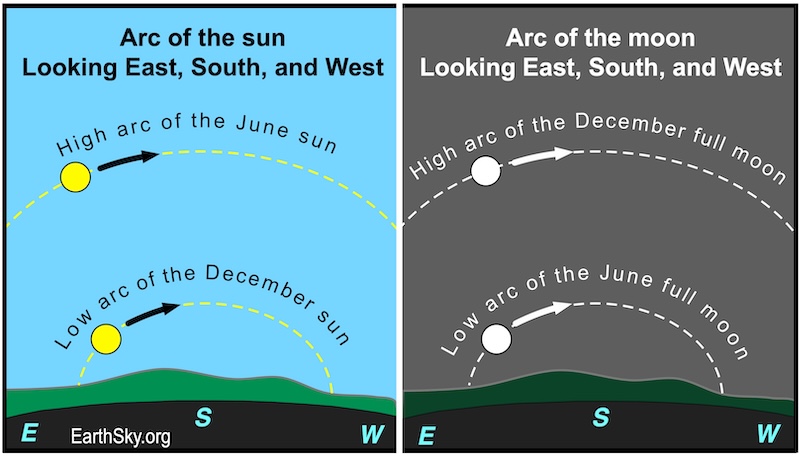
Tracing the high path of the December full moon
To see for yourself, try this: Trace a line in the sky with your finger from east to west to emulate the sun’s path in December. If you’re in the Northern Hemisphere, you’ll be tracing a low arc above the southern horizon. If you’re in the Southern Hemisphere, you’ll be tracing a high arc above the northern horizon. Then, again with your finger, trace another path high overhead. Now you’re emulating the moon’s December path, and you’ll see it’s a longer path than the lower one.
And likewise, if you are in the Southern Hemisphere, trace a low arc to emulate the moon’s December path.
Little by little, we can watch the two paths come back into balance. Each month until June, the full moon will cross the sky at a slightly lower arc than the previous month. Each successive full moon will take less time than the previous one to cross the sky.
What about an equinox moon?
At March’s full moon, which is near the Northern Hemisphere’s spring equinox, the two paths of the moon and of the sun will be nearly the same. Three months later near the June solstice, those of us in the Northern Hemisphere will see the sun cross high overhead during the year’s longest days. And, during the short northern summer nights, we’ll see the moon cross a lower path on the sky dome and spend less time in the sky.
And on the cycle goes.
Names for the December full moon
Of course, now we see why sometimes the December full moon is called the Long Night Moon. But – like all full moons – the full moon of December has many nicknames: Long Night Moon, Full Cold Moon, and in Decembers when it falls before Christmas, like this one, Moon Before Yule. But no matter which name appeals to you, be sure to notice the moon’s high path!
Last full moon of 2025
This full moon is the last one of 2025. It is also the last full moon of the Northern Hemisphere’s autumn and the Southern Hemisphere’s spring. But it is not the closest full moon to this December 21st solstice, because it occurs 17 days before, while the first full moon of 2026 happens just 12 days after.
The solstice marks the start of winter in the Northern Hemisphere and summer in the Southern Hemisphere. It lands at 15:03 UTC on December 21, 2025. That’s 9:03 CST.
December full moon in Taurus
The December full moon can lie in front of one of two constellations of the zodiac, and occasionally two additional constellations. This year, as it does in most, it lands in Taurus the Bull. But next year on December 22, it falls in Gemini the Twins. Strangely on December 20, 2029, it will occur at the northern edge of the constellation Orion the Hunter. When it rises then at 5:15 p.m. CST (23:15 UTC), the full moon will be in the middle of a total lunar eclipse!
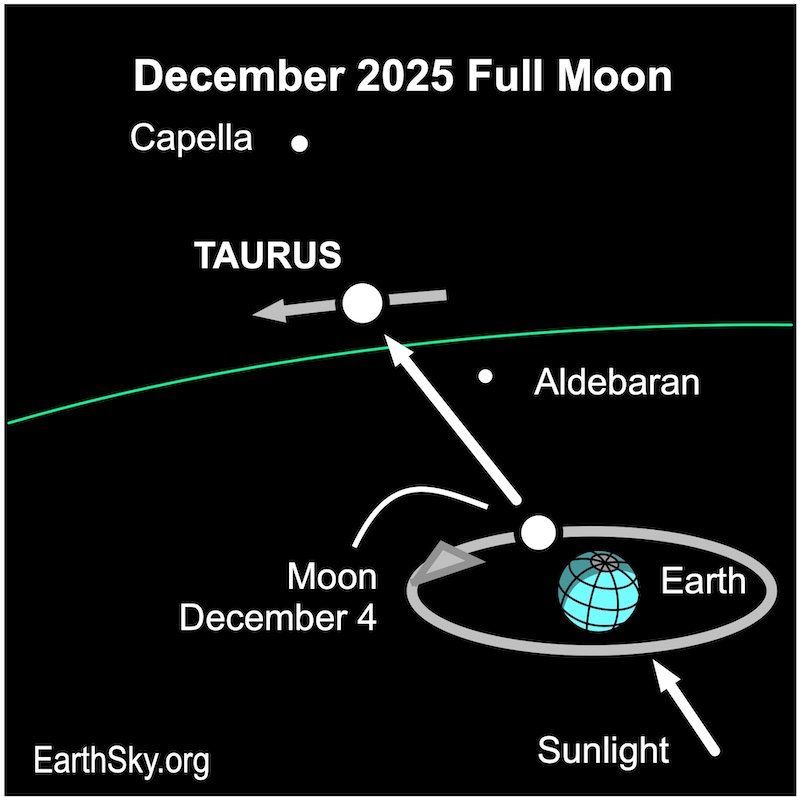
And this year, in 2025, the Cold Moon will also be near Jupiter, Orion and the bright stars Aldebaran and Capella.
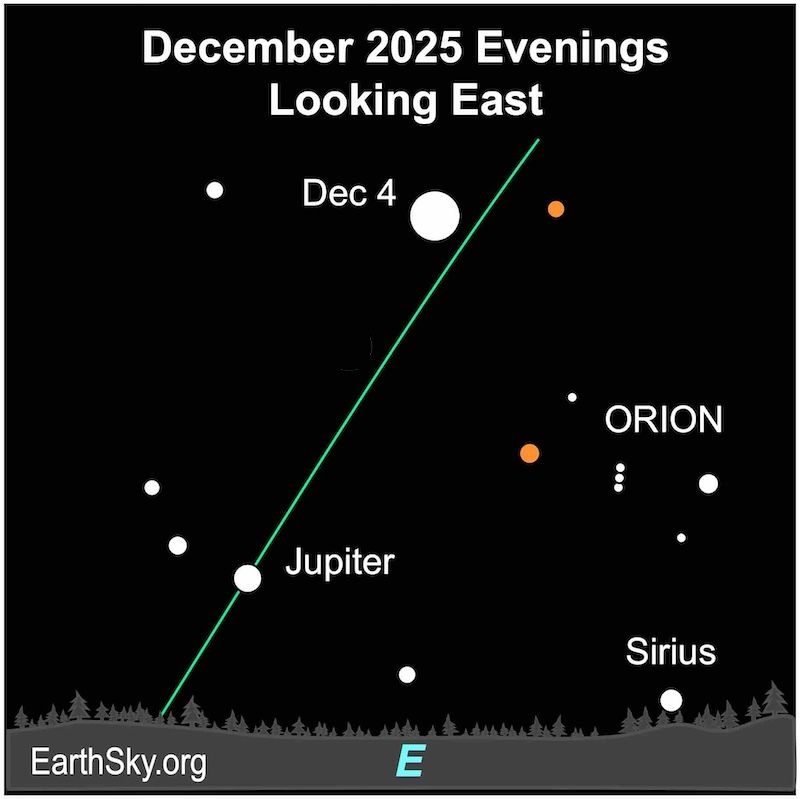
Enjoy December’s full moon!
Bottom line: The 2025 December full moon will occur on December 4 and closely follows the path of the June sun. It will lie in the constellation Taurus the bull, and be between its bright red star Aldebaran, and the brighter star Capella.
The post December full moon is the Cold Moon and a supermoon first appeared on EarthSky.
from EarthSky https://ift.tt/krXSvUM
We’ll have another supermoon in December. It crests at 5:14 p.m. CST (23:14 UTC) on Dec 4. Expect large tides. Let the moon guide you to Jupiter, the brightest planet up in December. And let Jupiter guide you to the radiant point for December’s Geminid meteor shower! Plus … why doesn’t the earliest sunset fall on the shortest day? Two veteran stargazers – EarthSky’s Deborah Byrd and John Goss – have all you need to know. Join them at noon CST (18 UTC) on December 3.
When and where to look in 2025: For us in the Northern Hemisphere, the bright, round, full moon will rise in the east around sunset on December 4. It’ll be highest in the sky around midnight, and will set in the west around sunrise. It’s also a supermoon, the third of four supermoons in a row and the last supermoon of 2025. The 4th full supermoon of this series will come about a month from now, in January 2026.
The crest of the full moon will fall at 23:14 UTC on December 4. That’s 5:14 p.m. CST, about two hours after moonrise in central North America. And that’s also the moment when this month’s moon is most directly opposite the sun as seen from Earth.
Note: The moon is roundest on the day when it is full, but the day before and after, it appears almost, but not quite full.
This Cold Moon is also a supermoon
December 2025 lunar perigee – the point in the moon’s orbit where it comes closest to Earth – occurs about 12 hours before the crest of the full moon. This means it is a perigean full moon – or supermoon. At this perigee, the moon is about 222,000 miles (357,000 km) from us on Earth. For comparison, a more typical full moon lies 18,000 miles (29,000 km) further, putting it at 240,000 miles (386,000 km).
Since it is closer, does a supermoon appear noticeably larger than an ordinary full moon?
While it’s true that experienced observers do say they can detect a size difference, you’d have to be a very keen observer to notice it. Truly, most of us can’t tell any difference in the size of a supermoon and an ordinary moon.
But … do super moons look brighter than ordinary full moons? Yes! By a noticeable amount. That’s because a supermoon exceeds the disk size of an average-sized full moon by up to 8% and the brightness of an average-sized full moon by some 16%. And then, it exceeds the disk size of a micro-moon (a year’s most distant, and, therefore, smallest appearing full moon) up to 14% and the brightness of a micro-moon by some 30%. So, if you go outside in the pre-dawn hours of December 4 and 5, as well as in the evening of December 4, there’s a potential you’ll notice the supermoon is exceptionally bright!
And folks living along the coast might notice that potentially flooding high tides – sometimes called king tides – will not only occur on, but precede and follow a supermoon by a day or two.
December full moon mimics the June sun
Every full moon is more or less opposite the sun. And a full moon’s path through the night is opposite the sun’s path. So, this December full moon’s path roughly follows the sun’s daytime path from six months ago, or of six months hence. No matter where you are on Earth, notice the moon’s path on December 4. The Northern Hemisphere will see the December full moon rise to nearly the top of the sky, just as the sun does near the June solstice. The Southern Hemisphere will see a low moon, mimicking a low winter sun.
Here’s another way to look at it. In the Northern Hemisphere, the December solstice has the least amount of daylight of the year. Since there’s still 24 hours in a day no matter how much daylight there is, the shortest day means it must also be the longest night. So, for the moon to stay up all night and remain roughly opposite the sun, it needs to take a longer path across the sky. The higher an object crosses the sky, the longer its path and the longer it stays above the horizon.
Tracing the high path of the December full moon
To see for yourself, try this: Trace a line in the sky with your finger from east to west to emulate the sun’s path in December. If you’re in the Northern Hemisphere, you’ll be tracing a low arc above the southern horizon. If you’re in the Southern Hemisphere, you’ll be tracing a high arc above the northern horizon. Then, again with your finger, trace another path high overhead. Now you’re emulating the moon’s December path, and you’ll see it’s a longer path than the lower one.
And likewise, if you are in the Southern Hemisphere, trace a low arc to emulate the moon’s December path.
Little by little, we can watch the two paths come back into balance. Each month until June, the full moon will cross the sky at a slightly lower arc than the previous month. Each successive full moon will take less time than the previous one to cross the sky.
What about an equinox moon?
At March’s full moon, which is near the Northern Hemisphere’s spring equinox, the two paths of the moon and of the sun will be nearly the same. Three months later near the June solstice, those of us in the Northern Hemisphere will see the sun cross high overhead during the year’s longest days. And, during the short northern summer nights, we’ll see the moon cross a lower path on the sky dome and spend less time in the sky.
And on the cycle goes.
Names for the December full moon
Of course, now we see why sometimes the December full moon is called the Long Night Moon. But – like all full moons – the full moon of December has many nicknames: Long Night Moon, Full Cold Moon, and in Decembers when it falls before Christmas, like this one, Moon Before Yule. But no matter which name appeals to you, be sure to notice the moon’s high path!
Last full moon of 2025
This full moon is the last one of 2025. It is also the last full moon of the Northern Hemisphere’s autumn and the Southern Hemisphere’s spring. But it is not the closest full moon to this December 21st solstice, because it occurs 17 days before, while the first full moon of 2026 happens just 12 days after.
The solstice marks the start of winter in the Northern Hemisphere and summer in the Southern Hemisphere. It lands at 15:03 UTC on December 21, 2025. That’s 9:03 CST.
December full moon in Taurus
The December full moon can lie in front of one of two constellations of the zodiac, and occasionally two additional constellations. This year, as it does in most, it lands in Taurus the Bull. But next year on December 22, it falls in Gemini the Twins. Strangely on December 20, 2029, it will occur at the northern edge of the constellation Orion the Hunter. When it rises then at 5:15 p.m. CST (23:15 UTC), the full moon will be in the middle of a total lunar eclipse!
And this year, in 2025, the Cold Moon will also be near Jupiter, Orion and the bright stars Aldebaran and Capella.
Enjoy December’s full moon!
Bottom line: The 2025 December full moon will occur on December 4 and closely follows the path of the June sun. It will lie in the constellation Taurus the bull, and be between its bright red star Aldebaran, and the brighter star Capella.
The post December full moon is the Cold Moon and a supermoon first appeared on EarthSky.
from EarthSky https://ift.tt/krXSvUM

Aucun commentaire:
Enregistrer un commentaire