
Mercury farthest from the sunrise on December 7
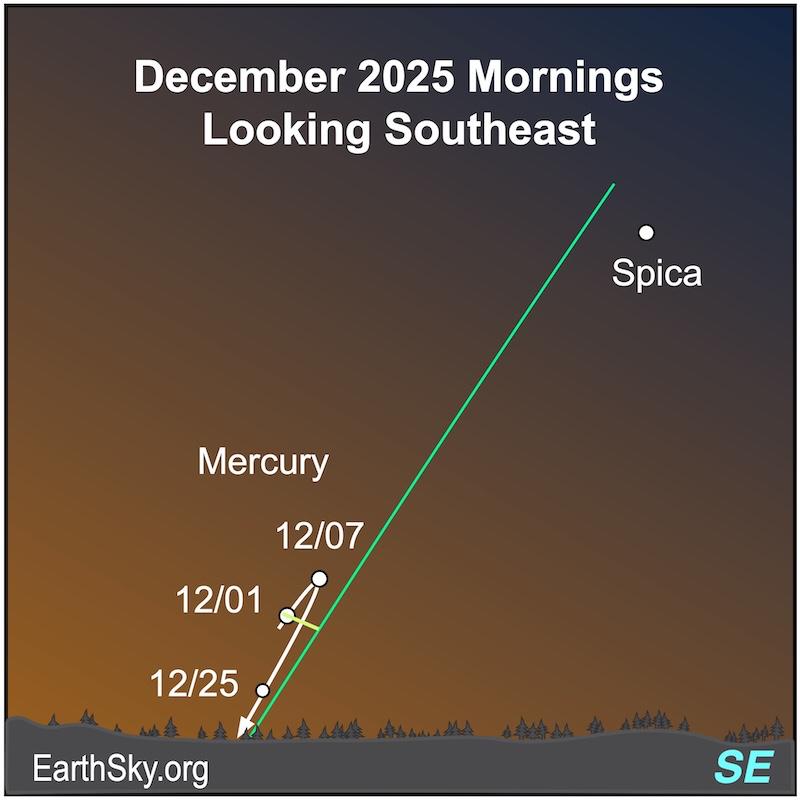
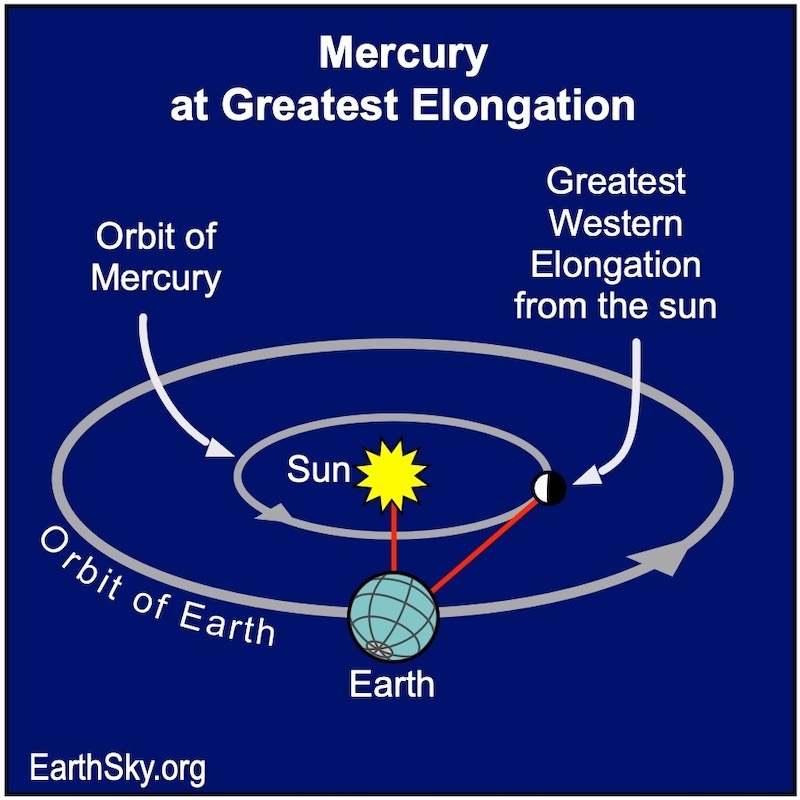
The innermost planet Mercury orbits the sun every 88 days. And Earth is moving, too. So Mercury goes between us and the sun pretty often, about every 116 days. It did this last at 9 UTC on November 20, 2025, reaching the point astronomers call inferior conjunction. And since then, Mercury has been speeding ahead of Earth in orbit. It re-emerged into our eastern morning sky in late November. Look for it in the sunrise direction, just above the sunrise point. Mercury will reach its greatest morning elongation – its greatest apparent distance from the rising sun – on December 7, 2025. This is the best morning apparition for the Northern Hemisphere in 2025.
Mercury greatest elongation, December 2025
When to watch: Officially, Mercury emerged in late November in the morning sky. Look for it shortly before sunrise. At greatest elongation – December 7, 2025 – Mercury is farthest from the sunrise on our sky’s dome. And after that, when it’ll be edging back toward the sunrise, it’ll brighten a little bit more, making Mercury easier to spot in the morning twilight. It’ll be low in the sky!
Where to look: Look in the sunrise direction as the sky is getting lighter.
Greatest elongation – marking Mercury’s farthest point from the sunrise glare – is on December 7 at 21 UTC (3:00 p.m. CST). Mercury will shine at magnitude -0.5 that morning. At that time, Mercury will be 21 degrees from the sun on our sky’s dome.
Through a telescope on and around December 7, Mercury appears 61% illuminated, in a gibbous phase, and 6.68 arcseconds across.
Note: Once you spot it, notice that Mercury remains a magnitude -0.5 (bright, but competing with the morning twilight) until around December 25. Around that time, it’ll slip away in the morning twilight.
By the way, this Mercury elongation – due to the high angle of the ecliptic to the horizon – favors the Northern Hemisphere.
After greatest elongation on December 7, the innermost planet – named for the fleet-footed messenger god of the ancient Romans – will be visible for another two weeks, especially from the Northern Hemisphere.
For precise sun and Mercury rising times at your location:
Old Farmer’s Almanac (U.S. and Canada)
timeanddate.com (worldwide)
Stellarium (online planetarium)
Mercury events in 2025
Feb 8, 2025: Superior conjunction (passes behind sun from Earth)
Mar 8, 2025: Greatest elongation (evening)
Mar 24, 2025: Inferior conjunction (races between Earth and sun)
Apr 21, 2025: Greatest elongation (morning)
May 30, 2025: Superior conjunction (passes behind sun from Earth)
Jul 4, 2025: Greatest elongation (evening)
Aug 1, 2025: Inferior conjunction (races between Earth and sun)
Aug 19, 2025: Greatest elongation (morning)
Sep 13, 2025: Superior conjunction (passes behind sun from Earth)
Oct 29, 2025: Greatest elongation (evening)
Nov 20, 2025: Inferior conjunction (races between Earth and sun)
Dec 7, 2025: Greatest elongation (morning)
Mercury charts from Guy Ottewell
A comparison of elongations
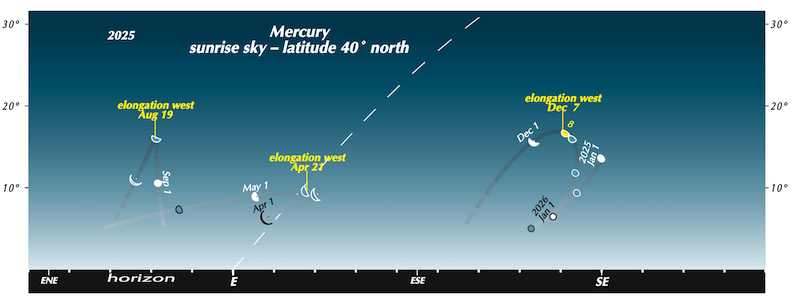
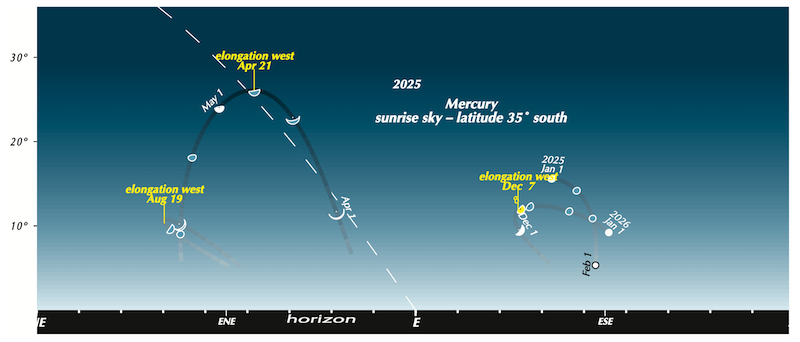
Mercury’s greatest elongations are not equal. Indeed, some are “greater” than others. For example, the distance of Mercury from the sun on our sky’s dome varies from about 28 degrees (maximum) to 18 degrees (minimum).
Also, Mercury’s elongations are better or worse depending on the time of the year they occur and your location on Earth. So, for both hemispheres, spring evenings and autumn mornings are best.
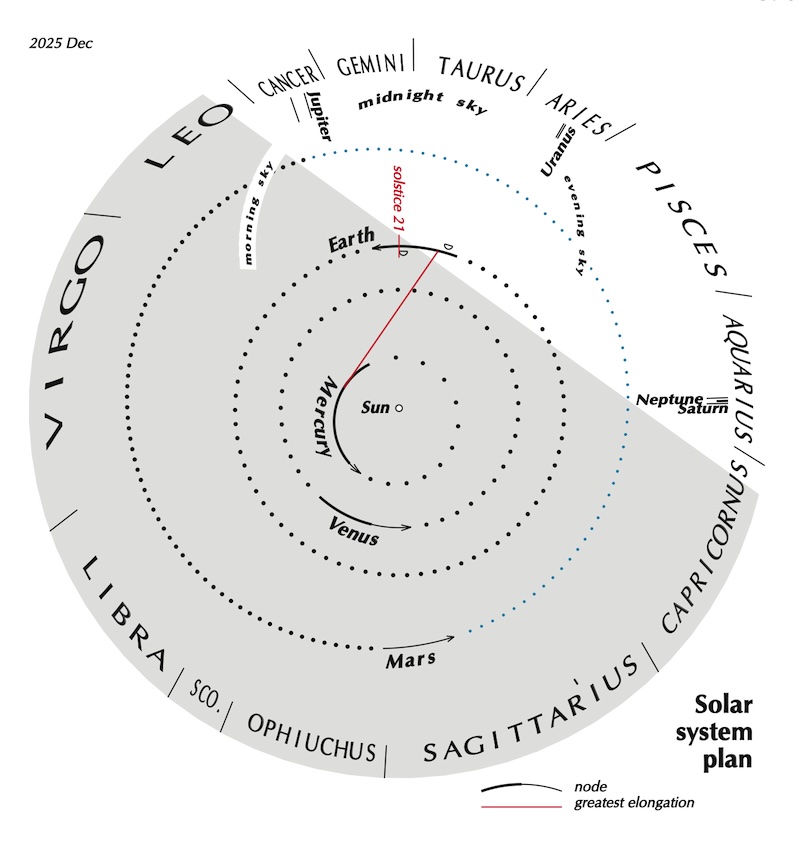
As an illustration, the chart below – from a Northern Hemisphere perspective – might help you visualize these differences.

Heliocentric solar system, December 2025
Seasons make a difference
So, in the autumn for either hemisphere, the ecliptic – or path of the sun, moon and planets – makes a narrow angle to the horizon in the evening. Conversely, it makes a steep slant, nearly perpendicular, in the morning. So – in autumn from either hemisphere – morning elongations of Mercury are best. Then, Mercury appears higher above the horizon and farther from the glow of the sun. Conversely, evening elongations in autumn are harder to see.
On the other hand, in the spring for either hemisphere, the situation reverses. Then, the ecliptic and the horizon meet at a sharper angle on spring evenings and at a narrower angle on spring mornings. So, in springtime for either hemisphere, evening elongations of Mercury are best. Meanwhile, morning elongations in springtime are harder to see.
Bottom line: Mercury will reach its greatest elongation – greatest distance from the sunrise – on December 7, 2025. Look east at dawn. It’ll disappear from the morning sky in late December.
Do you love twilight? The 3 stages explained
Visible planets and night sky guide for December
The post Look for Mercury farthest from the morning sun on December 7 first appeared on EarthSky.
from EarthSky https://ift.tt/pUiWxQ0
Mercury farthest from the sunrise on December 7
The innermost planet Mercury orbits the sun every 88 days. And Earth is moving, too. So Mercury goes between us and the sun pretty often, about every 116 days. It did this last at 9 UTC on November 20, 2025, reaching the point astronomers call inferior conjunction. And since then, Mercury has been speeding ahead of Earth in orbit. It re-emerged into our eastern morning sky in late November. Look for it in the sunrise direction, just above the sunrise point. Mercury will reach its greatest morning elongation – its greatest apparent distance from the rising sun – on December 7, 2025. This is the best morning apparition for the Northern Hemisphere in 2025.
Mercury greatest elongation, December 2025
When to watch: Officially, Mercury emerged in late November in the morning sky. Look for it shortly before sunrise. At greatest elongation – December 7, 2025 – Mercury is farthest from the sunrise on our sky’s dome. And after that, when it’ll be edging back toward the sunrise, it’ll brighten a little bit more, making Mercury easier to spot in the morning twilight. It’ll be low in the sky!
Where to look: Look in the sunrise direction as the sky is getting lighter.
Greatest elongation – marking Mercury’s farthest point from the sunrise glare – is on December 7 at 21 UTC (3:00 p.m. CST). Mercury will shine at magnitude -0.5 that morning. At that time, Mercury will be 21 degrees from the sun on our sky’s dome.
Through a telescope on and around December 7, Mercury appears 61% illuminated, in a gibbous phase, and 6.68 arcseconds across.
Note: Once you spot it, notice that Mercury remains a magnitude -0.5 (bright, but competing with the morning twilight) until around December 25. Around that time, it’ll slip away in the morning twilight.
By the way, this Mercury elongation – due to the high angle of the ecliptic to the horizon – favors the Northern Hemisphere.
After greatest elongation on December 7, the innermost planet – named for the fleet-footed messenger god of the ancient Romans – will be visible for another two weeks, especially from the Northern Hemisphere.
For precise sun and Mercury rising times at your location:
Old Farmer’s Almanac (U.S. and Canada)
timeanddate.com (worldwide)
Stellarium (online planetarium)
Mercury events in 2025
Feb 8, 2025: Superior conjunction (passes behind sun from Earth)
Mar 8, 2025: Greatest elongation (evening)
Mar 24, 2025: Inferior conjunction (races between Earth and sun)
Apr 21, 2025: Greatest elongation (morning)
May 30, 2025: Superior conjunction (passes behind sun from Earth)
Jul 4, 2025: Greatest elongation (evening)
Aug 1, 2025: Inferior conjunction (races between Earth and sun)
Aug 19, 2025: Greatest elongation (morning)
Sep 13, 2025: Superior conjunction (passes behind sun from Earth)
Oct 29, 2025: Greatest elongation (evening)
Nov 20, 2025: Inferior conjunction (races between Earth and sun)
Dec 7, 2025: Greatest elongation (morning)
Mercury charts from Guy Ottewell
A comparison of elongations
Mercury’s greatest elongations are not equal. Indeed, some are “greater” than others. For example, the distance of Mercury from the sun on our sky’s dome varies from about 28 degrees (maximum) to 18 degrees (minimum).
Also, Mercury’s elongations are better or worse depending on the time of the year they occur and your location on Earth. So, for both hemispheres, spring evenings and autumn mornings are best.
As an illustration, the chart below – from a Northern Hemisphere perspective – might help you visualize these differences.
Heliocentric solar system, December 2025
Seasons make a difference
So, in the autumn for either hemisphere, the ecliptic – or path of the sun, moon and planets – makes a narrow angle to the horizon in the evening. Conversely, it makes a steep slant, nearly perpendicular, in the morning. So – in autumn from either hemisphere – morning elongations of Mercury are best. Then, Mercury appears higher above the horizon and farther from the glow of the sun. Conversely, evening elongations in autumn are harder to see.
On the other hand, in the spring for either hemisphere, the situation reverses. Then, the ecliptic and the horizon meet at a sharper angle on spring evenings and at a narrower angle on spring mornings. So, in springtime for either hemisphere, evening elongations of Mercury are best. Meanwhile, morning elongations in springtime are harder to see.
Bottom line: Mercury will reach its greatest elongation – greatest distance from the sunrise – on December 7, 2025. Look east at dawn. It’ll disappear from the morning sky in late December.
Do you love twilight? The 3 stages explained
Visible planets and night sky guide for December
The post Look for Mercury farthest from the morning sun on December 7 first appeared on EarthSky.
from EarthSky https://ift.tt/pUiWxQ0

Aucun commentaire:
Enregistrer un commentaire