
7 weird things space does to the human body
Human beings are adapted to life on Earth. From its Goldilocks-type temperatures to the pull of gravity, Earth’s specific environment suits us just fine. However, even on Earth, there are plenty of environments where humans can’t naturally live, like underwater, at the top of the highest mountains, in bone-dry deserts or at the frigid poles. So living in space is a monumental challenge. You might think the biggest challenge is the lack of oxygen, but, in fact, it’s the lack of gravity that truly challenges our bodies. But that’s not all. Here are seven weird things that space does to our bodies.
1. Puffy heads and bird legs
Microgravity causes the human body a lot of problems. The fluids in our body, without the strong pull of Earth’s gravity, don’t move the same as we’re used to. And one of these effects is that astronauts get puffy heads and bird legs. In Earth’s stronger gravity, our fluids get pulled down to our legs. But in space, those fluids can move to the head, giving it a puffy appearance. And they can move away from the legs, making them look smaller. Astronauts report feeling like they have a stuffy head, similar to a head cold.
Up to an extra gallon and a half of fluids can collect up near your head. In space, these effects will go away after astronauts have had enough time to flush (urinate) the extra liquids out of their system. Also, the effects can reverse themselves within a few days of returning to Earth.
On November 18, 2025, NASA said that the residents aboard the International Space Station were testing a thigh cuff that could help pull fluids toward the lower body and keep them there. This could reduce brain and eye pressure. Read more about their research here.
Watch a video with astronaut Randy Bresnik describing what it’s like when the body’s fluids pool in the head.
2. Flattened eyeballs
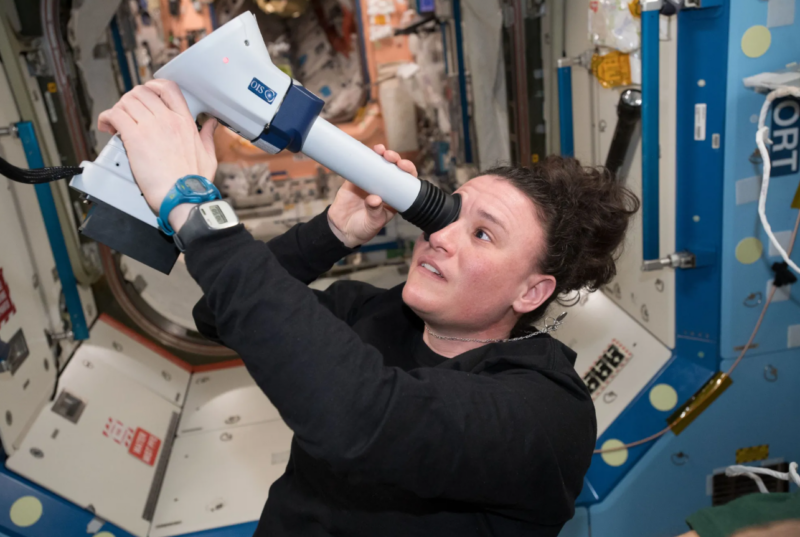
An astronaut’s eyes are also subject to microgravity and the associated shift in bodily fluids. With fluids shifting toward the head, astronauts can get what’s called spaceflight associated neuro-ocular syndrome (SANS). This involves swelling of the optic nerve, a flattening of the back of the eye and even a swelling in the brain. NASA has said that 70% of astronauts aboard the International Space Station experience some swelling in the back of their eyes.
And they can have blurry vision while on missions. The issue can be overcome with glasses, but researchers don’t yet know how long-duration flights – like those to Mars that could last 1,000 days – could affect the eyes.
3. Weakened muscles and bones
Yet another problem of the microgravity environment is that bones and muscles start to weaken. Without the pull of gravity, they aren’t constantly working to hold up your frame. On average, bones can lose 1% or more of mineral density per month in microgravity. And your muscles – especially in the legs, back and core – can weaken and shrink from less use.
In order to fight against this bone and muscle loss, astronauts in space must exercise about two hours a day. They use a weightlifting machine, exercise bikes and treadmills to counteract this loss. In fact, these countermeasures can work so well that astronauts have come back in better shape than when they left for space.
Watch a video with astronaut Randy Bresnik explaining how astronauts exercise in space.
4. A shrunken heart
The issue of fluids not being pulled downward in microgravity can even affect the heart pumping your blood. In space, the heart doesn’t need to work as hard to pump blood what would normally be “uphill,” or upward in your body. For this reason, the heart can become a bit smaller and more spherical in shape. And when astronauts return to Earth, they can have trouble maintaining blood pressure when standing.
This is an area of research that astronauts aboard the International Space Station participate in. Not only do they track their vital signs, but exercising in space is also beneficial for their cardio health. Some of the changes they experience, due to inflammation and lack of exercise, are similar to what an aging body can encounter on Earth. So their research is useful both at home and in space.
5. Shifting brains
Studies have shown that astronauts’ brains change structure in space. Their brains, along with their cerebrospinal fluid, can shift position in their skulls. Some of the effects of this means astronauts can feel disoriented. They can also have issues with loss of balance and coordination. This is especially true upon immediately entering or leaving microgravity.
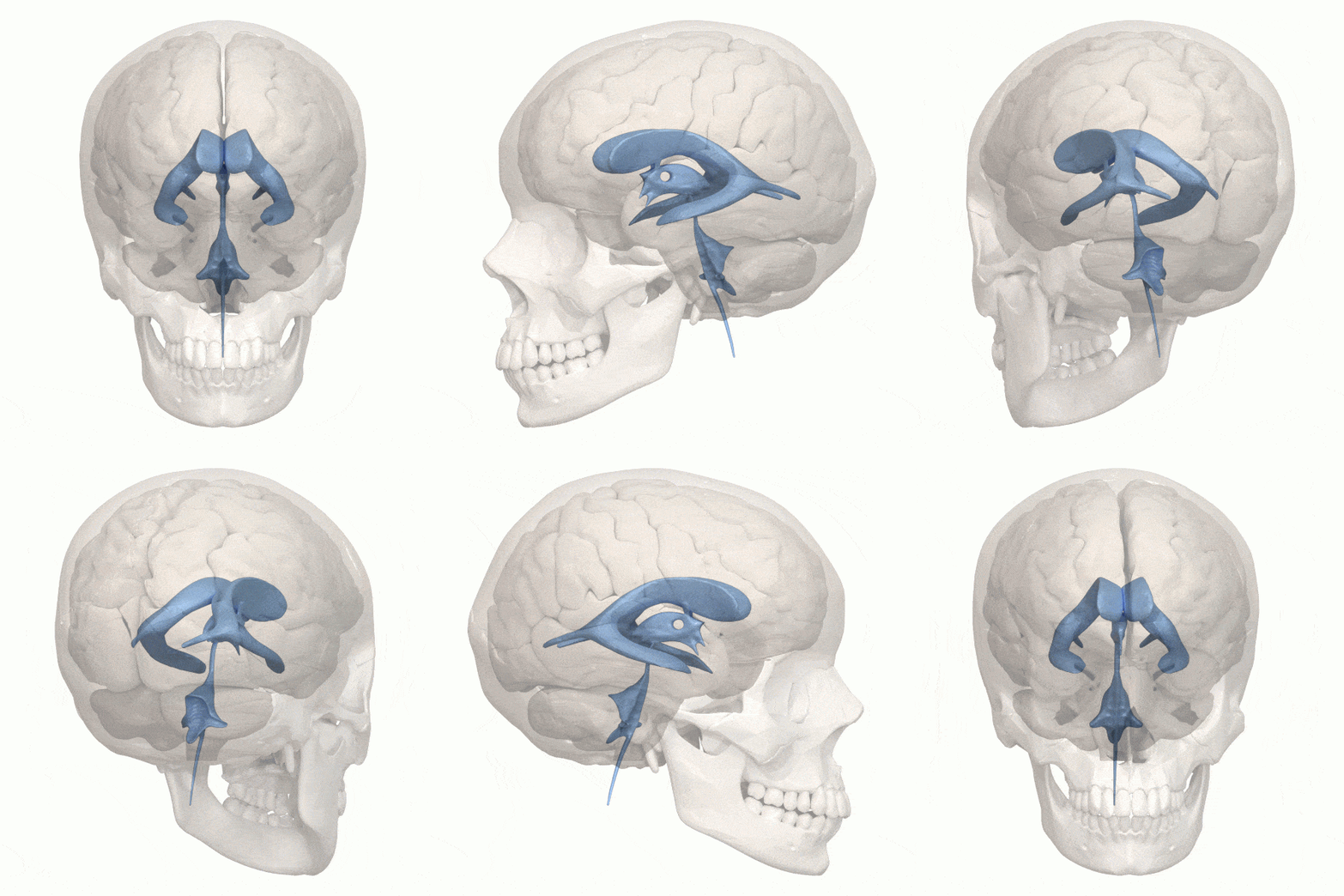
Plus, the ventricles – or large open cavities deep inside your brain – enlarge during longer stays in space. A 2023 study showed that brains probably need about three years after long spaceflights to recover. Rachael Seidler, an author of the study from the University of Florida, said:
We don’t yet know for sure what the long-term consequences of this is on the health and behavioral health of space travelers, so allowing the brain time to recover seems like a good idea.
Read more: Astronauts’ brains need a 3-year break after long missions
6. Radiation exposure
Space is a harsh environment for biology. Without Earth’s protective atmosphere and magnetic field, cosmic radiation exposure is higher. The short term risk of radiation damage involves anemia, fatigue, nausea, vomiting and fever. In the long run, the damage can be worse. Radiation exposure can increase the risk of damage to DNA, cancer, heart damage, cognitive decline and more.
Astronauts have various ways to protect themselves from radiation. There are certain areas of their spacecraft that are more heavily shielded against radiation. They also have specific vests to protect against radiation. And when they know there’s incoming space weather that will increase their radiation exposure, they can cancel spacewalks and change their activities.
Watch a video discussing radiation damage to astronauts.
7. Insomnia and cabin fever
Living in space doesn’t just affect physiology. It also affects your mind. On the International Space Station, astronauts see about 16 sunrises and sunsets per day. That’s because they orbit Earth approximately every 90 minutes. So it’s not surprising that astronauts’ circadian rhythms get disrupted. The space station has different light settings. At bedtime they have a dim light for 8.5 hours to help them sleep. (They are never in the dark in case of emergencies.) Then during the day, there are three different settings: a regular setting, a setting with more blue light to help them focus on a task, and one with less blue light for before bedtime.
Then there’s the isolation, confinement, distance from Earth and the unusual environment. These all contribute to psychological stress. Astronauts have to learn to deal with cabin fever, homesickness and many other mental stressors. Some possible ways to deal with stress include time allowed to air grievances, virtual reality helmets to simulate being on Earth and practicing for longer Mars missions while in lunar orbit.
Read more: How astronauts to Mars can manage stress on the long journey
Watch a video about how astronauts headed to Mars can manage stress.
Space is a challenging place
Traveling to space, whether for a few weeks or for a years-long journey, takes a toll on the human body. As humans hope to expand their presence in space to the moon, Mars and beyond, they will have to learn how to deal with the challenges it presents to our bodies.
Bottom line: Humans are adapted to earthly life. Here are seven weird things space does to the human body. Would you be willing to go to space?
The post 7 weird things space does to the human body first appeared on EarthSky.
from EarthSky https://ift.tt/8fsSizY
7 weird things space does to the human body
Human beings are adapted to life on Earth. From its Goldilocks-type temperatures to the pull of gravity, Earth’s specific environment suits us just fine. However, even on Earth, there are plenty of environments where humans can’t naturally live, like underwater, at the top of the highest mountains, in bone-dry deserts or at the frigid poles. So living in space is a monumental challenge. You might think the biggest challenge is the lack of oxygen, but, in fact, it’s the lack of gravity that truly challenges our bodies. But that’s not all. Here are seven weird things that space does to our bodies.
1. Puffy heads and bird legs
Microgravity causes the human body a lot of problems. The fluids in our body, without the strong pull of Earth’s gravity, don’t move the same as we’re used to. And one of these effects is that astronauts get puffy heads and bird legs. In Earth’s stronger gravity, our fluids get pulled down to our legs. But in space, those fluids can move to the head, giving it a puffy appearance. And they can move away from the legs, making them look smaller. Astronauts report feeling like they have a stuffy head, similar to a head cold.
Up to an extra gallon and a half of fluids can collect up near your head. In space, these effects will go away after astronauts have had enough time to flush (urinate) the extra liquids out of their system. Also, the effects can reverse themselves within a few days of returning to Earth.
On November 18, 2025, NASA said that the residents aboard the International Space Station were testing a thigh cuff that could help pull fluids toward the lower body and keep them there. This could reduce brain and eye pressure. Read more about their research here.
Watch a video with astronaut Randy Bresnik describing what it’s like when the body’s fluids pool in the head.
2. Flattened eyeballs
An astronaut’s eyes are also subject to microgravity and the associated shift in bodily fluids. With fluids shifting toward the head, astronauts can get what’s called spaceflight associated neuro-ocular syndrome (SANS). This involves swelling of the optic nerve, a flattening of the back of the eye and even a swelling in the brain. NASA has said that 70% of astronauts aboard the International Space Station experience some swelling in the back of their eyes.
And they can have blurry vision while on missions. The issue can be overcome with glasses, but researchers don’t yet know how long-duration flights – like those to Mars that could last 1,000 days – could affect the eyes.
3. Weakened muscles and bones
Yet another problem of the microgravity environment is that bones and muscles start to weaken. Without the pull of gravity, they aren’t constantly working to hold up your frame. On average, bones can lose 1% or more of mineral density per month in microgravity. And your muscles – especially in the legs, back and core – can weaken and shrink from less use.
In order to fight against this bone and muscle loss, astronauts in space must exercise about two hours a day. They use a weightlifting machine, exercise bikes and treadmills to counteract this loss. In fact, these countermeasures can work so well that astronauts have come back in better shape than when they left for space.
Watch a video with astronaut Randy Bresnik explaining how astronauts exercise in space.
4. A shrunken heart
The issue of fluids not being pulled downward in microgravity can even affect the heart pumping your blood. In space, the heart doesn’t need to work as hard to pump blood what would normally be “uphill,” or upward in your body. For this reason, the heart can become a bit smaller and more spherical in shape. And when astronauts return to Earth, they can have trouble maintaining blood pressure when standing.
This is an area of research that astronauts aboard the International Space Station participate in. Not only do they track their vital signs, but exercising in space is also beneficial for their cardio health. Some of the changes they experience, due to inflammation and lack of exercise, are similar to what an aging body can encounter on Earth. So their research is useful both at home and in space.
5. Shifting brains
Studies have shown that astronauts’ brains change structure in space. Their brains, along with their cerebrospinal fluid, can shift position in their skulls. Some of the effects of this means astronauts can feel disoriented. They can also have issues with loss of balance and coordination. This is especially true upon immediately entering or leaving microgravity.
Plus, the ventricles – or large open cavities deep inside your brain – enlarge during longer stays in space. A 2023 study showed that brains probably need about three years after long spaceflights to recover. Rachael Seidler, an author of the study from the University of Florida, said:
We don’t yet know for sure what the long-term consequences of this is on the health and behavioral health of space travelers, so allowing the brain time to recover seems like a good idea.
Read more: Astronauts’ brains need a 3-year break after long missions
6. Radiation exposure
Space is a harsh environment for biology. Without Earth’s protective atmosphere and magnetic field, cosmic radiation exposure is higher. The short term risk of radiation damage involves anemia, fatigue, nausea, vomiting and fever. In the long run, the damage can be worse. Radiation exposure can increase the risk of damage to DNA, cancer, heart damage, cognitive decline and more.
Astronauts have various ways to protect themselves from radiation. There are certain areas of their spacecraft that are more heavily shielded against radiation. They also have specific vests to protect against radiation. And when they know there’s incoming space weather that will increase their radiation exposure, they can cancel spacewalks and change their activities.
Watch a video discussing radiation damage to astronauts.
7. Insomnia and cabin fever
Living in space doesn’t just affect physiology. It also affects your mind. On the International Space Station, astronauts see about 16 sunrises and sunsets per day. That’s because they orbit Earth approximately every 90 minutes. So it’s not surprising that astronauts’ circadian rhythms get disrupted. The space station has different light settings. At bedtime they have a dim light for 8.5 hours to help them sleep. (They are never in the dark in case of emergencies.) Then during the day, there are three different settings: a regular setting, a setting with more blue light to help them focus on a task, and one with less blue light for before bedtime.
Then there’s the isolation, confinement, distance from Earth and the unusual environment. These all contribute to psychological stress. Astronauts have to learn to deal with cabin fever, homesickness and many other mental stressors. Some possible ways to deal with stress include time allowed to air grievances, virtual reality helmets to simulate being on Earth and practicing for longer Mars missions while in lunar orbit.
Read more: How astronauts to Mars can manage stress on the long journey
Watch a video about how astronauts headed to Mars can manage stress.
Space is a challenging place
Traveling to space, whether for a few weeks or for a years-long journey, takes a toll on the human body. As humans hope to expand their presence in space to the moon, Mars and beyond, they will have to learn how to deal with the challenges it presents to our bodies.
Bottom line: Humans are adapted to earthly life. Here are seven weird things space does to the human body. Would you be willing to go to space?
The post 7 weird things space does to the human body first appeared on EarthSky.
from EarthSky https://ift.tt/8fsSizY

Aucun commentaire:
Enregistrer un commentaire