

What is a new moon? When the moon is new, it’s most nearly between the Earth and sun for any particular month. It’s rising and setting when the sun does and traveling across the sky with the sun during the day. Because it is near the sun its shadowed side points toward Earth, and hence it is invisible, except when it crosses the face of the sun in a solar eclipse.
Why there’s no eclipse every new moon
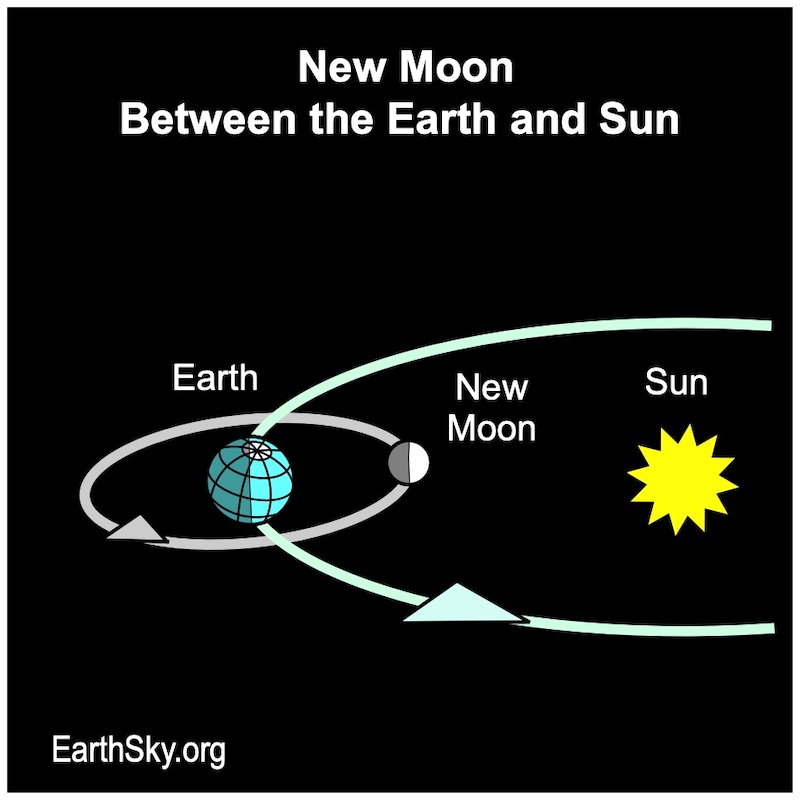
New moon occurs about once a month, because the moon takes about a month to orbit Earth. Most of the time, the new moon passes not in front of the sun at new moon, but only near the sun in our sky. That’s why, in most months, there’s no solar eclipse.
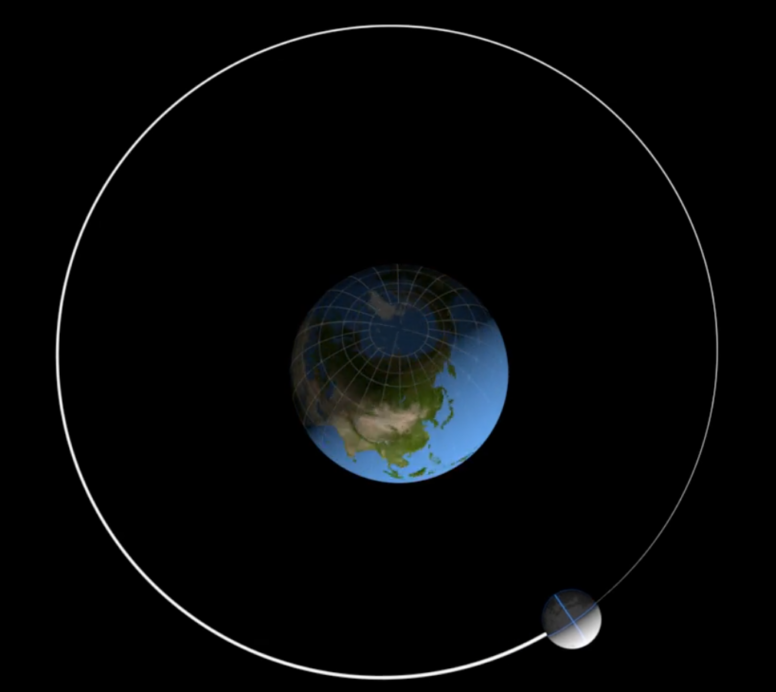
The new moon is generally invisible
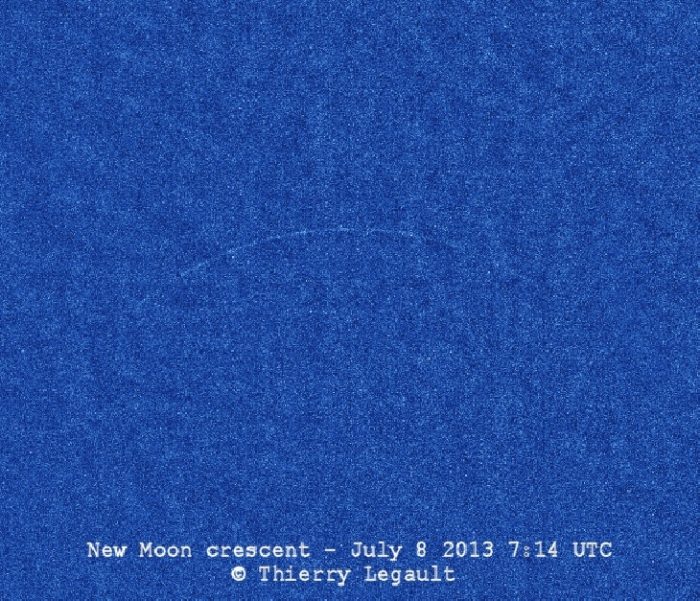
This photo of a new moon shows the moon as it passed near the sun on July 8, 2013. There was no eclipse that day; it was an ordinary new moon. New moons are generally completely invisible without special equipment and a lot of moon-photography experience. Thierry Legault was able to catch the moon at the instant it was new because the moon that month passed slightly north or south of the sun, and the faintest of lunar crescents was visible.
New moon or young moon?
Read more: What’s the youngest moon you can see?
Some people use the term new moon for a thin crescent moon visible in the west after sunset. You always see these little crescents – which set shortly after the sun – a day or two after each month’s new moon. Astronomers don’t call these little crescent moons new moons, however. In the language of astronomy, this slim crescent is called a young moon.
New moons, and young moons, are fascinating to many. The Farmer’s Almanac, for example, still offers information on gardening by the moon. And many cultures have holidays based on moon phases.
As the moon orbits Earth, it changes phase in an orderly way. Follow the links below to understand the phases of the moon.
New moon
Waxing crescent moon
First quarter moon
Waxing gibbous moon
Full moon
Waning gibbous moon
Last quarter moon
Waning crescent moon
Bottom line: New moon occurs when the moon is between the Earth and the sun, so that its shadowed side points toward Earth. Ordinarily you can’t see a new moon, because it crosses the sky with the sun. The new moon is visible only during a solar eclipse.
Read more: Top 4 keys to understanding moon phases
The post What is a new moon? first appeared on EarthSky.
from EarthSky https://ift.tt/npyilfO
What is a new moon? When the moon is new, it’s most nearly between the Earth and sun for any particular month. It’s rising and setting when the sun does and traveling across the sky with the sun during the day. Because it is near the sun its shadowed side points toward Earth, and hence it is invisible, except when it crosses the face of the sun in a solar eclipse.
Why there’s no eclipse every new moon
New moon occurs about once a month, because the moon takes about a month to orbit Earth. Most of the time, the new moon passes not in front of the sun at new moon, but only near the sun in our sky. That’s why, in most months, there’s no solar eclipse.
The new moon is generally invisible
This photo of a new moon shows the moon as it passed near the sun on July 8, 2013. There was no eclipse that day; it was an ordinary new moon. New moons are generally completely invisible without special equipment and a lot of moon-photography experience. Thierry Legault was able to catch the moon at the instant it was new because the moon that month passed slightly north or south of the sun, and the faintest of lunar crescents was visible.
New moon or young moon?
Read more: What’s the youngest moon you can see?
Some people use the term new moon for a thin crescent moon visible in the west after sunset. You always see these little crescents – which set shortly after the sun – a day or two after each month’s new moon. Astronomers don’t call these little crescent moons new moons, however. In the language of astronomy, this slim crescent is called a young moon.
New moons, and young moons, are fascinating to many. The Farmer’s Almanac, for example, still offers information on gardening by the moon. And many cultures have holidays based on moon phases.
As the moon orbits Earth, it changes phase in an orderly way. Follow the links below to understand the phases of the moon.
New moon
Waxing crescent moon
First quarter moon
Waxing gibbous moon
Full moon
Waning gibbous moon
Last quarter moon
Waning crescent moon
Bottom line: New moon occurs when the moon is between the Earth and the sun, so that its shadowed side points toward Earth. Ordinarily you can’t see a new moon, because it crosses the sky with the sun. The new moon is visible only during a solar eclipse.
Read more: Top 4 keys to understanding moon phases
The post What is a new moon? first appeared on EarthSky.
from EarthSky https://ift.tt/npyilfO

Aucun commentaire:
Enregistrer un commentaire