
In late July and early August, look east as darkness gives way to morning dawn for Orion the Hunter, one of the sky’s easiest-to-spot constellations. EarthSky’s Deborah Byrd shows you how and introduces Orion’s brightest stars. Join us at 12:15 p.m. CDT (17 UTC) on Friday, July 25.
Orion the Hunter returns
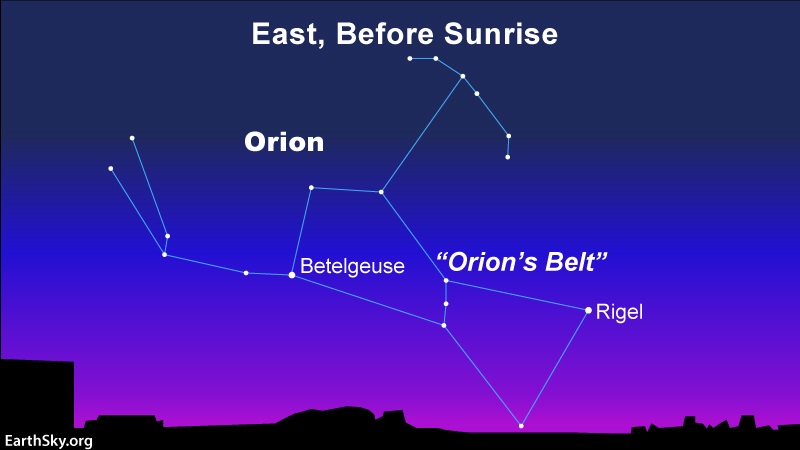
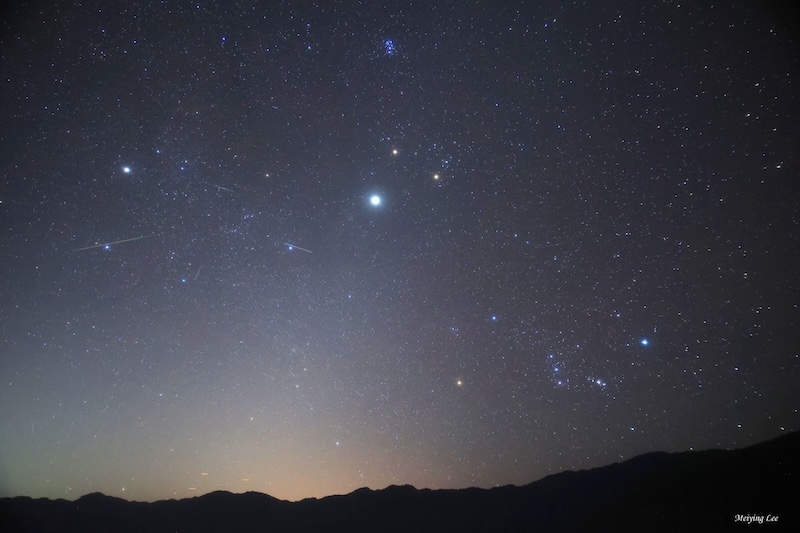
Want to see the return of Orion? In late July and early August, look eastward as darkness gives way to morning dawn. Orion the Hunter is one of the sky’s easiest-to-spot constellations. We in the Northern Hemisphere think of Orion as a winter constellation. But, by June, Orion is gone from our evening sky. Then, at this time of the year – late July and early August – Orion returns, ascending once more in the east before sunrise.
That’s why Orion has been called the ghost of the shimmering summer dawn. The Hunter rises on his side, with his three Belt stars – Mintaka, Alnitak and Alnilam – pointing upward. It’s a stirring sight, and one you can look forward to every year.
Many people around the globe see Orion in December and January. They notice this distinctive, large and bright pattern of stars arcing across the sky during the evening hours.
And in 2025, you can look northward (left) along the dawn horizon for the brilliant planet Venus and the bright planet Jupiter. They’ll be closest to each other around August 12. For more information visit EarthSky’s visible planets and night sky guide.
Want a view of Orion from your location? Try Stellarium.
How can you be sure it’s Orion?
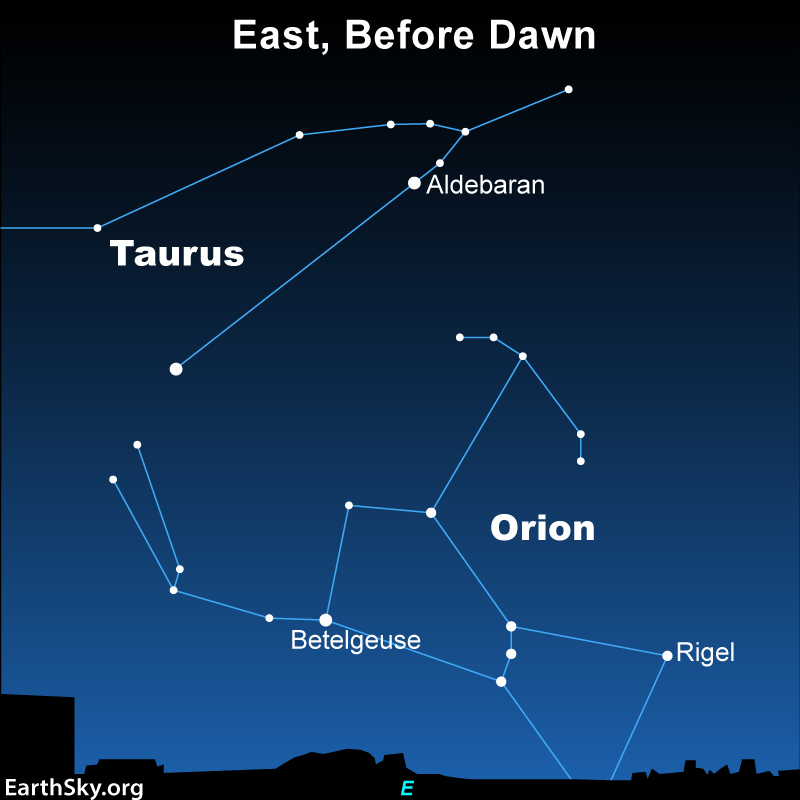
If you’re new to stargazing, the night sky with its plethora of stars can be bewildering. The good news is that the stars stay “fixed” relative to each other. If you’re not sure the pattern you’re seeing is Orion, try looking nearby for the reddish star Aldebaran in the constellation Taurus the Bull. In a dark sky, you can see a V-shaped pattern of stars around Aldebaran. This pattern represents the Bull’s face. Aldebaran, likewise, represents the Bull’s fiery eye. Orion is said to be holding up a great shield to fend off the charging bull, so if you think you see Orion before sunup at this time of the year, you can check by looking for Aldebaran above.
As the year passes, Orion will soon be up by midnight, then 10 p.m. … and by December you’ll find it rising in early evening. There’s nothing unusual about Orion’s shift from predawn to evening sky. The constellation is simply following the westward shift of all the stars, caused by Earth’s orbit around the sun. As we orbit our star, our night sky shifts through an ever-changing panorama of the Milky Way galaxy. Because of this orbit, all stars rise approximately four minutes earlier each day.
Ghost of the shimmering summer dawn
A poem by Sophia C. Prentice, published in the magazine Popular Astronomy in April 1924, memorialized Orion’s early morning return.
Across the winter sky by night
Orion proudly strides;
The rising moon in silver state
His splendor scarcely hides;
His jeweled belt, his glittering sword,
In brilliancy combine,
Great Sirius and Procyon,
His loyal followers shine,
The Book of books records his name,
Of him the poets write;
From nursery windows, children’s eyes
Greet him with gay delight.The soft breeze stirs to greet the dawn,
The summer stars grow dim,
When lo, a mystic shape appears
Above the Ocean’s rim.
The form so faintly shining there
No royalty can boast,
Yet with a thrill my heart proclaims,
‘It is Orion’s ghost!”Alone and pale he trembles there
A moment and is gone,
While radiant couriers of the sun
Announce the coming morn.Orion, greatest of the tribe
That pace the starry heights.
Ghost of the shimmering summer dawn,
King of the winter nights!
Bottom line: The return of Orion to your predawn sky happens around late July or early August every year. In the Northern Hemisphere, Orion is sometimes called the ghost of the shimmering summer dawn. That name comes from a 1924 poem by Sophia C. Prentice.
Enjoying EarthSky so far? Sign up for our free daily newsletter today!
The post Return of Orion the Hunter, ghost of the summer dawn first appeared on EarthSky.
from EarthSky https://ift.tt/xofcHYt
In late July and early August, look east as darkness gives way to morning dawn for Orion the Hunter, one of the sky’s easiest-to-spot constellations. EarthSky’s Deborah Byrd shows you how and introduces Orion’s brightest stars. Join us at 12:15 p.m. CDT (17 UTC) on Friday, July 25.
Orion the Hunter returns
Want to see the return of Orion? In late July and early August, look eastward as darkness gives way to morning dawn. Orion the Hunter is one of the sky’s easiest-to-spot constellations. We in the Northern Hemisphere think of Orion as a winter constellation. But, by June, Orion is gone from our evening sky. Then, at this time of the year – late July and early August – Orion returns, ascending once more in the east before sunrise.
That’s why Orion has been called the ghost of the shimmering summer dawn. The Hunter rises on his side, with his three Belt stars – Mintaka, Alnitak and Alnilam – pointing upward. It’s a stirring sight, and one you can look forward to every year.
Many people around the globe see Orion in December and January. They notice this distinctive, large and bright pattern of stars arcing across the sky during the evening hours.
And in 2025, you can look northward (left) along the dawn horizon for the brilliant planet Venus and the bright planet Jupiter. They’ll be closest to each other around August 12. For more information visit EarthSky’s visible planets and night sky guide.
Want a view of Orion from your location? Try Stellarium.
How can you be sure it’s Orion?
If you’re new to stargazing, the night sky with its plethora of stars can be bewildering. The good news is that the stars stay “fixed” relative to each other. If you’re not sure the pattern you’re seeing is Orion, try looking nearby for the reddish star Aldebaran in the constellation Taurus the Bull. In a dark sky, you can see a V-shaped pattern of stars around Aldebaran. This pattern represents the Bull’s face. Aldebaran, likewise, represents the Bull’s fiery eye. Orion is said to be holding up a great shield to fend off the charging bull, so if you think you see Orion before sunup at this time of the year, you can check by looking for Aldebaran above.
As the year passes, Orion will soon be up by midnight, then 10 p.m. … and by December you’ll find it rising in early evening. There’s nothing unusual about Orion’s shift from predawn to evening sky. The constellation is simply following the westward shift of all the stars, caused by Earth’s orbit around the sun. As we orbit our star, our night sky shifts through an ever-changing panorama of the Milky Way galaxy. Because of this orbit, all stars rise approximately four minutes earlier each day.
Ghost of the shimmering summer dawn
A poem by Sophia C. Prentice, published in the magazine Popular Astronomy in April 1924, memorialized Orion’s early morning return.
Across the winter sky by night
Orion proudly strides;
The rising moon in silver state
His splendor scarcely hides;
His jeweled belt, his glittering sword,
In brilliancy combine,
Great Sirius and Procyon,
His loyal followers shine,
The Book of books records his name,
Of him the poets write;
From nursery windows, children’s eyes
Greet him with gay delight.The soft breeze stirs to greet the dawn,
The summer stars grow dim,
When lo, a mystic shape appears
Above the Ocean’s rim.
The form so faintly shining there
No royalty can boast,
Yet with a thrill my heart proclaims,
‘It is Orion’s ghost!”Alone and pale he trembles there
A moment and is gone,
While radiant couriers of the sun
Announce the coming morn.Orion, greatest of the tribe
That pace the starry heights.
Ghost of the shimmering summer dawn,
King of the winter nights!
Bottom line: The return of Orion to your predawn sky happens around late July or early August every year. In the Northern Hemisphere, Orion is sometimes called the ghost of the shimmering summer dawn. That name comes from a 1924 poem by Sophia C. Prentice.
Enjoying EarthSky so far? Sign up for our free daily newsletter today!
The post Return of Orion the Hunter, ghost of the summer dawn first appeared on EarthSky.
from EarthSky https://ift.tt/xofcHYt

Aucun commentaire:
Enregistrer un commentaire