

The colorful world of Rho Ophiuchi
The Rho Ophiuchi cloud complex is one of the most colorful areas of the night sky. Therefore, it’s a favorite target for astrophotographers. The Rho Ophiuchi region in its entirety stretches 4.5 degrees by 6.5 degrees across the dome of the sky. For reference, the width of the full moon is 0.5 degree.
This cloud complex is thick with gas and dust that is forming new stars. In fact, it’s one of the closest star-forming regions to Earth at a mere 460 light-years away. Clouds of gas and dust in space are called nebulae. Reflection nebula is the name for the kind of bright bluish halo extending around the star Rho Ophiuchi. The light from the star brightens the surrounding nebulae. But this region also has dark nebulae, or dense clouds that completely obscure background stars. In fact, there’s so much material in the Rho Ophiuchi cloud complex that it’s enough to form 3,000 suns.
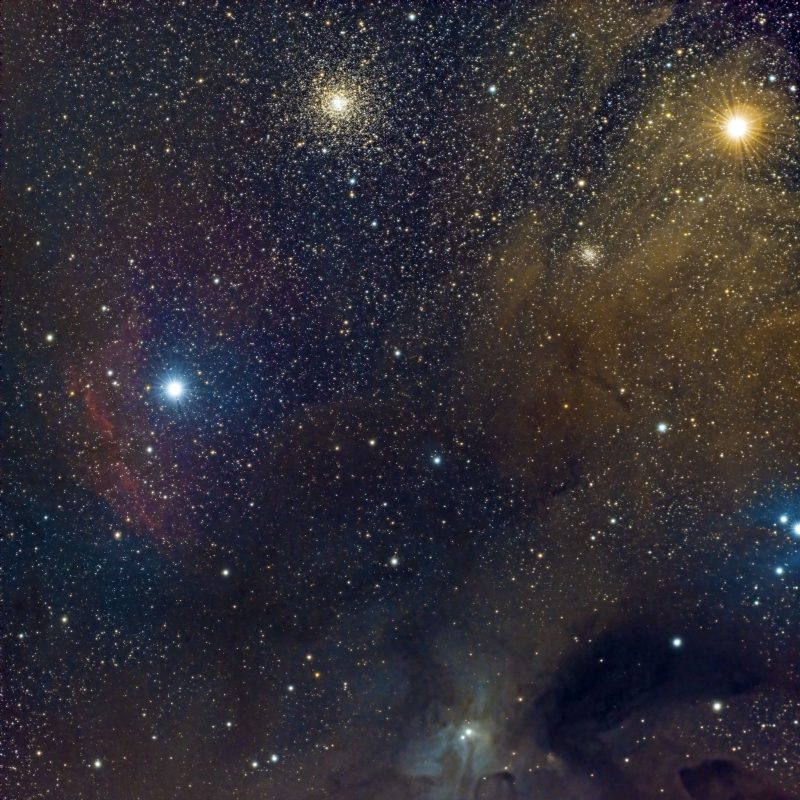
Antares and the surrounding region
Across the border from Ophiuchus in the constellation Scorpius, the star Antares shines brightly from 550 light-years away. In images of the Rho Ophiuchi cloud complex, Antares has a yellowish glow. But, to the unaided eye, Antares looks more red than yellow. So, in these long-exposure images, the yellow reflection nebula around Antares makes it look yellowish.
But you won’t see the nebula at night when you look at this region of sky. You need a long-exposure photo to pick up those faint traces of gas and dust. And, in fact, Antares earned its name thanks to its red appearance to our eye. Ancient cultures considered Antares a rival of reddish Mars, known as Ares in Greek, making Antares the “Anti-Ares” star.
Antares is nearing the end of its life cycle. That is to say, the star is beginning to puff off layers of gas, creating its own funeral shroud.
Other gems in this cloud complex
If you view Alessandro’s image at the top, Al Niyat, or Sigma Scorpii, is the bluish star on the left with red gas around it. Just above it you’ll see a spherical collection of stars. That’s the magnificent globular cluster M4. It’s one of the nearest globular clusters to Earth at 7,000 light-years away. Also, NGC 6144 is a smaller globular cluster between Antares and M4. It’s a whopping 33,000 light-years away.
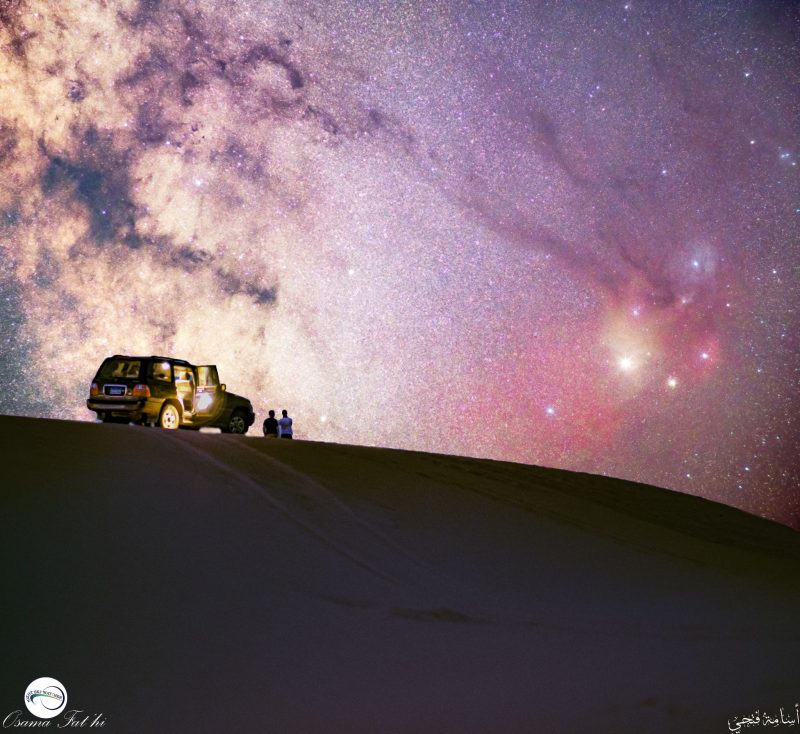
Locating the colorful Rho Ophiuchi cloud complex
The Rho Ophiuchi region lies along the edge of the Milky Way galaxy as seen from Earth. The Northern Hemisphere gets its best view of Ophiuchus, Scorpius and this general region of the Milky Way during the summer. So the farther north you are, the lower the constellation is on your horizon. Thus, in places such as Seattle or Stockholm, the entire constellation of Scorpius never clears the horizon.
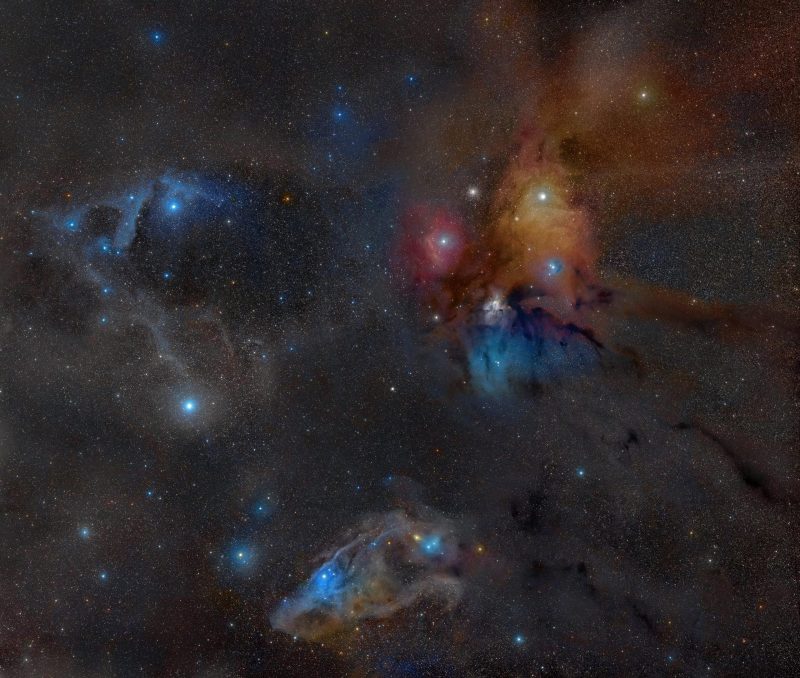
Rho Ophiuchi is a double star
The star Rho Ophiuchi, which gives its name to this region, is a double star. It’s not a particularly bright pair, shining at magnitude 4.6. The star would be 2 magnitudes brighter if not for the dusty clouds that obscure it. The dark nebulae that streak out around Rho Ophiuchi extend for 100 light-years into Sagittarius to the east. One day these dusty clouds of gas will disappear as bright new stars radiate from this region of space.
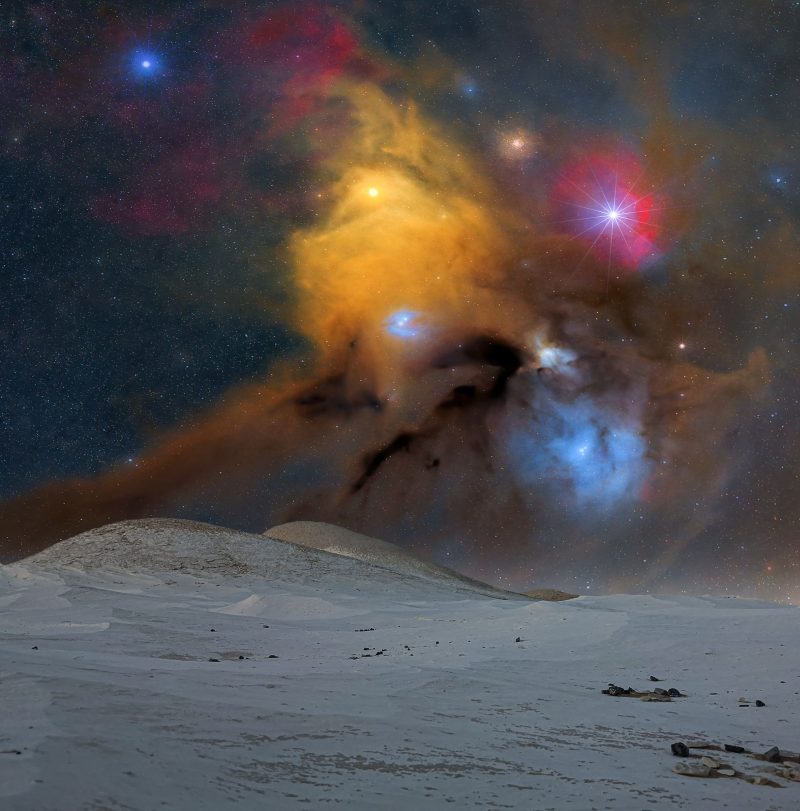
Bottom line: The Rho Ophiuchi region of the sky contains an abundance of beautiful starry gems.
The post Rho Ophiuchi is filled with glorious color first appeared on EarthSky.
from EarthSky https://ift.tt/SkA8tNT
The colorful world of Rho Ophiuchi
The Rho Ophiuchi cloud complex is one of the most colorful areas of the night sky. Therefore, it’s a favorite target for astrophotographers. The Rho Ophiuchi region in its entirety stretches 4.5 degrees by 6.5 degrees across the dome of the sky. For reference, the width of the full moon is 0.5 degree.
This cloud complex is thick with gas and dust that is forming new stars. In fact, it’s one of the closest star-forming regions to Earth at a mere 460 light-years away. Clouds of gas and dust in space are called nebulae. Reflection nebula is the name for the kind of bright bluish halo extending around the star Rho Ophiuchi. The light from the star brightens the surrounding nebulae. But this region also has dark nebulae, or dense clouds that completely obscure background stars. In fact, there’s so much material in the Rho Ophiuchi cloud complex that it’s enough to form 3,000 suns.
Antares and the surrounding region
Across the border from Ophiuchus in the constellation Scorpius, the star Antares shines brightly from 550 light-years away. In images of the Rho Ophiuchi cloud complex, Antares has a yellowish glow. But, to the unaided eye, Antares looks more red than yellow. So, in these long-exposure images, the yellow reflection nebula around Antares makes it look yellowish.
But you won’t see the nebula at night when you look at this region of sky. You need a long-exposure photo to pick up those faint traces of gas and dust. And, in fact, Antares earned its name thanks to its red appearance to our eye. Ancient cultures considered Antares a rival of reddish Mars, known as Ares in Greek, making Antares the “Anti-Ares” star.
Antares is nearing the end of its life cycle. That is to say, the star is beginning to puff off layers of gas, creating its own funeral shroud.
Other gems in this cloud complex
If you view Alessandro’s image at the top, Al Niyat, or Sigma Scorpii, is the bluish star on the left with red gas around it. Just above it you’ll see a spherical collection of stars. That’s the magnificent globular cluster M4. It’s one of the nearest globular clusters to Earth at 7,000 light-years away. Also, NGC 6144 is a smaller globular cluster between Antares and M4. It’s a whopping 33,000 light-years away.
Locating the colorful Rho Ophiuchi cloud complex
The Rho Ophiuchi region lies along the edge of the Milky Way galaxy as seen from Earth. The Northern Hemisphere gets its best view of Ophiuchus, Scorpius and this general region of the Milky Way during the summer. So the farther north you are, the lower the constellation is on your horizon. Thus, in places such as Seattle or Stockholm, the entire constellation of Scorpius never clears the horizon.
Rho Ophiuchi is a double star
The star Rho Ophiuchi, which gives its name to this region, is a double star. It’s not a particularly bright pair, shining at magnitude 4.6. The star would be 2 magnitudes brighter if not for the dusty clouds that obscure it. The dark nebulae that streak out around Rho Ophiuchi extend for 100 light-years into Sagittarius to the east. One day these dusty clouds of gas will disappear as bright new stars radiate from this region of space.
Bottom line: The Rho Ophiuchi region of the sky contains an abundance of beautiful starry gems.
The post Rho Ophiuchi is filled with glorious color first appeared on EarthSky.
from EarthSky https://ift.tt/SkA8tNT

Aucun commentaire:
Enregistrer un commentaire