aads

Venus before sunrise: Its greatest distance is June 1


Blazing Venus will be farthest from the sunrise at 4 UTC on June 1, 2025. So the mornings of May 31 and June 1 will both be great times to look. A much-fainter planet, Saturn, will be nearby.

When to watch: Venus – the brightest planet – is in the east before dawn. It’ll remain there until sometime in November 2025 (how long you see it will depend on your latitude, with Northern Hemisphere observers seeing it best in the month of November). Greatest elongation – when Venus will be farthest from the sunrise – will be at 4 UTC on June 1 (11 p.m. CDT on May 31). And don’t worry about that time too much. Just know that – for all of us on Earth – Venus is super-bright in the east before every new dawn, in late May and early June. Much-fainter Saturn is nearby.
Where to look: Look in the sunrise direction while the sky is still dark or just getting light. Venus is the glorious “morning star” now for all of Earth.
Greatest elongation distance is 46 degrees. That’s the distance of Venus from sun on our sky’s dome. 
Greatest elongation magnitude: Venus shines with dazzling brightness at magnitude -4.4.
Through a telescope: Venus appears 49% illuminated, in a 3rd quarter phase, 23.92″ arcseconds across.
Note: As the sun’s 2nd planet, Venus is bound by an invisible tether to the sun in our sky. It’s always east before sunrise, or west after sunset (never overhead at midnight). Venus is the brightest planet visible from Earth and shines brilliantly throughout every morning or evening apparition. Greatest elongation happens when Venus is farthest from the sun on the sky’s dome. At the June 2025 greatest elongation, Venus will appear higher in the sky from the Southern Hemisphere than from the Northern Hemisphere due to the steep angle of the ecliptic (path of the sun, moon and planets) on spring mornings.

Chart with a starred dot representing Venus with a small dot sitting to its upper right. Both are above the wavy line of the horizon.
Venus will appear farthest from the sun in the morning sky on June 1. On that morning, Venus will be about 46 degrees, or 4 1/2 fist widths, from the sun. This position in its orbit is known as greatest western elongation. Each morning after this, Venus will move slightly closer to the sun. And the planet Saturn will be nearby. Chart via EarthSky.

Venus at greatest elongation

A starred circle, the sun, lies at the center of two ovals, the inner is Venus' orbit, and the outer is Earth's orbit. A hemisphere, Venus, is on the far right of the inner oval. A circle, Earth, is at the bottom of the outer oval.
At 4 UTC on June 1, 2025 – 11 p.m. CDT on May 31 – Venus will reach its greatest elongation – 46 degrees – from the sun, an orbital position known as greatest western elongation. Each morning after this, Venus will move slightly closer to the sun. Chart via EarthSky.

For precise sun and Venus rising times at your location:

Old Farmer’s Almanac (U.S. and Canada)

Timeanddate.com (worldwide)

Stellarium (free online planetarium program)

A pair of planets in the June morning sky: Northern Hemisphere

Sphere chart showing two planets in the June morning sky: Venus and Saturn from the Northern Hemisphere.
Here’s the view from the Northern Hemisphere. There are 2 visible planets in the morning sky in early June 2025. They will lie along the path the sun travels in the daytime (the green line on our chart). Try to catch them before dawn. Bright Venus will be the easiest to spot. Saturn blends in with 1st magnitude stars and moves farther away from Venus this month. Venus reached its greatest distance from the morning sun on May 31-June 1. It’ll remain visible in the morning sky through October. Chart via EarthSky.

June morning planets: Southern Hemisphere

Sphere chart showing two planets in the June morning sky: Venus and Saturn from the Southern Hemisphere.
The view from the Southern Hemisphere. There are 2 visible planets in the morning sky in early June 2025. They will lie along the path the sun travels in the daytime (the green line on our chart). Try to catch them before dawn. Bright Venus will be the easiest to spot. Saturn blends in with 1st magnitude stars and moves farther away from Venus this month. Venus reached its greatest distance from the morning sun on May 31-June 1. It’ll remain visible in the morning sky through October. Chart via EarthSky.

June 21 and 22 mornings: Moon and Venus

A crescent shape, the moon, is above a starred dot, Venus. On the next morning, the crescent is left of the starred dot, and right of five small dots representing the Pleiades star cluster.
Before sunrise on the morning of June 21, the thin waning crescent moon will lie near brilliant Venus. Then on the following morning, June 22, a thinner crescent moon will float between Venus and the delicate Pleiades star cluster. Also watch for the lovely glow of earthshine on the unlit portion of the moon. That’s light reflected off Earth. Chart via EarthSky.

Venus before sunrise in the Northern Hemisphere

Diagram: Path of Venus over horizon, a pointy arc, with planet's phases with their dates shown along it.
Venus’s greatest morning elongation in 2025 from the Northern Hemisphere as viewed through a powerful telescope. The planet images are at the 1st, 11th, and 21st of each month. Dots show the actual positions of Venus every day. Chart via Guy Ottewell’s 2025 Astronomical Calendar. Used with permission.

Venus before sunrise in the Southern Hemisphere

Diagram: Path of Venus over horizon, a pointy arc, with planet's phases with their dates shown along it.
Venus’s greatest morning elongation in 2025 from the Southern Hemisphere as viewed through a powerful telescope. The planet images are at the 1st, 11th, and 21st of each month. Dots show the actual positions of Venus every day. Chart via Guy Ottewell’s 2025 Astronomical Calendar. Used with permission.

A comparison of elongations

Not all of Venus’ greatest elongations are created equal. That’s because the farthest from the sun that Venus can ever appear on the sky’s dome is about 47.3 degrees. On the other hand, the least distance is around 45.4 degrees.

Elongations are also higher or lower depending on the time of year they occur and your location on Earth.

Diagram: 3asymmetrical humps, 2 gray and 1 blue, with arced lines in them and dates.
A comparison chart of Venus elongations in 2025. Gray areas represent evening apparitions (eastward elongation). Blue areas represent morning apparitions (westward elongation). The top figures are the maximum elongations, reached at the top dates shown beneath. Curves show the altitude of the planet above the horizon at sunrise or sunset, for latitude 40 degrees north (thick line) and 35 degrees south (thin line). Maxima are reached at the parenthesized dates below (40 degrees north bold). Chart via Guy Ottewell’s 2025 Astronomical Calendar. Used with permission.

When are the best elongations?

As hinted at above, morning elongations of Venus (or Mercury) are best around the autumn equinox (around September for the Northern Hemisphere, around March for the Southern Hemisphere). These elongations, called western elongations because Venus is west of the sun, happen when the ecliptic – path of the sun, moon and planets – makes a steep angle to the morning horizon. A steep ecliptic angle keeps the planets more directly above the sunrise or sunset.

Springtime elongations that occur in the morning (around March for the Northern Hemisphere, around September for the Southern Hemisphere) are less glorious because of the shallow angle of the ecliptic. When the ecliptic makes a shallow angle with respect to the horizon, that angle keeps the planets closer to the bright sun’s rays.
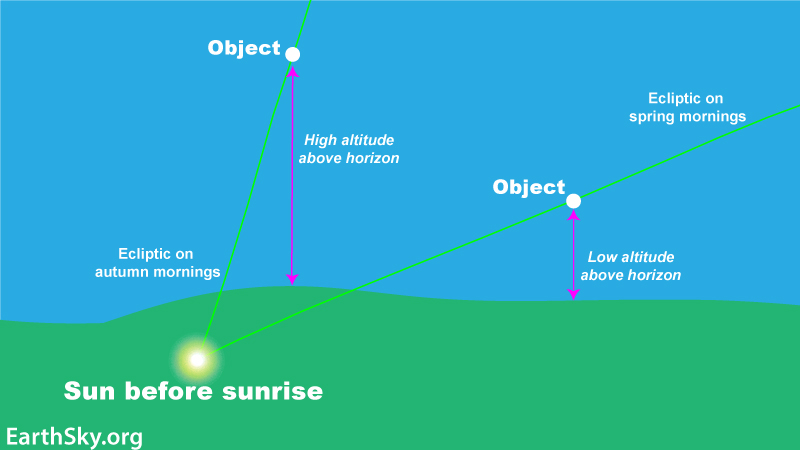
Chart showing the high ecliptic on autumn mornings and low ecliptic on spring mornings.
This image shows the path of the ecliptic in the morning sky around the fall and spring equinoxes.

How far can Venus be from the sun?

The farthest from the sun that Venus can ever appear on the sky’s dome is about 47.3 degrees. On the other hand, the least distance is around 45.4 degrees.

Venus events, 2025

January 10, 2025: Greatest elongation (evening)
March 22, 2025: Inferior conjunction (races between Earth and sun)
June 1, 2025: Greatest elongation (morning)
January 6, 2026: Superior conjunction (passes behind sun from Earth)

Bottom line: Look for Venus before sunrise. It’ll reach greatest elongation – its greatest distance from the sunrise – on June 1, 2025 (4 UTC on June 1 or 11 p.m. CDT on May 31). It’s blazingly bright! You can’t miss it!

Read more: Why is Venus so bright in our Earth’s sky?

Venus in the daytime: The best ways to see it

Read more: Venus brightest in the morning sky on April 27, 2025

The post Venus before sunrise: Its greatest distance is June 1 first appeared on EarthSky.


from EarthSky https://ift.tt/1f3BYte


Blazing Venus will be farthest from the sunrise at 4 UTC on June 1, 2025. So the mornings of May 31 and June 1 will both be great times to look. A much-fainter planet, Saturn, will be nearby.

When to watch: Venus – the brightest planet – is in the east before dawn. It’ll remain there until sometime in November 2025 (how long you see it will depend on your latitude, with Northern Hemisphere observers seeing it best in the month of November). Greatest elongation – when Venus will be farthest from the sunrise – will be at 4 UTC on June 1 (11 p.m. CDT on May 31). And don’t worry about that time too much. Just know that – for all of us on Earth – Venus is super-bright in the east before every new dawn, in late May and early June. Much-fainter Saturn is nearby.
Where to look: Look in the sunrise direction while the sky is still dark or just getting light. Venus is the glorious “morning star” now for all of Earth.
Greatest elongation distance is 46 degrees. That’s the distance of Venus from sun on our sky’s dome. 
Greatest elongation magnitude: Venus shines with dazzling brightness at magnitude -4.4.
Through a telescope: Venus appears 49% illuminated, in a 3rd quarter phase, 23.92″ arcseconds across.
Note: As the sun’s 2nd planet, Venus is bound by an invisible tether to the sun in our sky. It’s always east before sunrise, or west after sunset (never overhead at midnight). Venus is the brightest planet visible from Earth and shines brilliantly throughout every morning or evening apparition. Greatest elongation happens when Venus is farthest from the sun on the sky’s dome. At the June 2025 greatest elongation, Venus will appear higher in the sky from the Southern Hemisphere than from the Northern Hemisphere due to the steep angle of the ecliptic (path of the sun, moon and planets) on spring mornings.

Chart with a starred dot representing Venus with a small dot sitting to its upper right. Both are above the wavy line of the horizon.
Venus will appear farthest from the sun in the morning sky on June 1. On that morning, Venus will be about 46 degrees, or 4 1/2 fist widths, from the sun. This position in its orbit is known as greatest western elongation. Each morning after this, Venus will move slightly closer to the sun. And the planet Saturn will be nearby. Chart via EarthSky.

Venus at greatest elongation

A starred circle, the sun, lies at the center of two ovals, the inner is Venus' orbit, and the outer is Earth's orbit. A hemisphere, Venus, is on the far right of the inner oval. A circle, Earth, is at the bottom of the outer oval.
At 4 UTC on June 1, 2025 – 11 p.m. CDT on May 31 – Venus will reach its greatest elongation – 46 degrees – from the sun, an orbital position known as greatest western elongation. Each morning after this, Venus will move slightly closer to the sun. Chart via EarthSky.

For precise sun and Venus rising times at your location:

Old Farmer’s Almanac (U.S. and Canada)

Timeanddate.com (worldwide)

Stellarium (free online planetarium program)

A pair of planets in the June morning sky: Northern Hemisphere

Sphere chart showing two planets in the June morning sky: Venus and Saturn from the Northern Hemisphere.
Here’s the view from the Northern Hemisphere. There are 2 visible planets in the morning sky in early June 2025. They will lie along the path the sun travels in the daytime (the green line on our chart). Try to catch them before dawn. Bright Venus will be the easiest to spot. Saturn blends in with 1st magnitude stars and moves farther away from Venus this month. Venus reached its greatest distance from the morning sun on May 31-June 1. It’ll remain visible in the morning sky through October. Chart via EarthSky.

June morning planets: Southern Hemisphere

Sphere chart showing two planets in the June morning sky: Venus and Saturn from the Southern Hemisphere.
The view from the Southern Hemisphere. There are 2 visible planets in the morning sky in early June 2025. They will lie along the path the sun travels in the daytime (the green line on our chart). Try to catch them before dawn. Bright Venus will be the easiest to spot. Saturn blends in with 1st magnitude stars and moves farther away from Venus this month. Venus reached its greatest distance from the morning sun on May 31-June 1. It’ll remain visible in the morning sky through October. Chart via EarthSky.

June 21 and 22 mornings: Moon and Venus

A crescent shape, the moon, is above a starred dot, Venus. On the next morning, the crescent is left of the starred dot, and right of five small dots representing the Pleiades star cluster.
Before sunrise on the morning of June 21, the thin waning crescent moon will lie near brilliant Venus. Then on the following morning, June 22, a thinner crescent moon will float between Venus and the delicate Pleiades star cluster. Also watch for the lovely glow of earthshine on the unlit portion of the moon. That’s light reflected off Earth. Chart via EarthSky.

Venus before sunrise in the Northern Hemisphere

Diagram: Path of Venus over horizon, a pointy arc, with planet's phases with their dates shown along it.
Venus’s greatest morning elongation in 2025 from the Northern Hemisphere as viewed through a powerful telescope. The planet images are at the 1st, 11th, and 21st of each month. Dots show the actual positions of Venus every day. Chart via Guy Ottewell’s 2025 Astronomical Calendar. Used with permission.

Venus before sunrise in the Southern Hemisphere

Diagram: Path of Venus over horizon, a pointy arc, with planet's phases with their dates shown along it.
Venus’s greatest morning elongation in 2025 from the Southern Hemisphere as viewed through a powerful telescope. The planet images are at the 1st, 11th, and 21st of each month. Dots show the actual positions of Venus every day. Chart via Guy Ottewell’s 2025 Astronomical Calendar. Used with permission.

A comparison of elongations

Not all of Venus’ greatest elongations are created equal. That’s because the farthest from the sun that Venus can ever appear on the sky’s dome is about 47.3 degrees. On the other hand, the least distance is around 45.4 degrees.

Elongations are also higher or lower depending on the time of year they occur and your location on Earth.

Diagram: 3asymmetrical humps, 2 gray and 1 blue, with arced lines in them and dates.
A comparison chart of Venus elongations in 2025. Gray areas represent evening apparitions (eastward elongation). Blue areas represent morning apparitions (westward elongation). The top figures are the maximum elongations, reached at the top dates shown beneath. Curves show the altitude of the planet above the horizon at sunrise or sunset, for latitude 40 degrees north (thick line) and 35 degrees south (thin line). Maxima are reached at the parenthesized dates below (40 degrees north bold). Chart via Guy Ottewell’s 2025 Astronomical Calendar. Used with permission.

When are the best elongations?

As hinted at above, morning elongations of Venus (or Mercury) are best around the autumn equinox (around September for the Northern Hemisphere, around March for the Southern Hemisphere). These elongations, called western elongations because Venus is west of the sun, happen when the ecliptic – path of the sun, moon and planets – makes a steep angle to the morning horizon. A steep ecliptic angle keeps the planets more directly above the sunrise or sunset.

Springtime elongations that occur in the morning (around March for the Northern Hemisphere, around September for the Southern Hemisphere) are less glorious because of the shallow angle of the ecliptic. When the ecliptic makes a shallow angle with respect to the horizon, that angle keeps the planets closer to the bright sun’s rays.

Chart showing the high ecliptic on autumn mornings and low ecliptic on spring mornings.
This image shows the path of the ecliptic in the morning sky around the fall and spring equinoxes.

How far can Venus be from the sun?

The farthest from the sun that Venus can ever appear on the sky’s dome is about 47.3 degrees. On the other hand, the least distance is around 45.4 degrees.

Venus events, 2025

January 10, 2025: Greatest elongation (evening)
March 22, 2025: Inferior conjunction (races between Earth and sun)
June 1, 2025: Greatest elongation (morning)
January 6, 2026: Superior conjunction (passes behind sun from Earth)

Bottom line: Look for Venus before sunrise. It’ll reach greatest elongation – its greatest distance from the sunrise – on June 1, 2025 (4 UTC on June 1 or 11 p.m. CDT on May 31). It’s blazingly bright! You can’t miss it!

Read more: Why is Venus so bright in our Earth’s sky?

Venus in the daytime: The best ways to see it

Read more: Venus brightest in the morning sky on April 27, 2025

The post Venus before sunrise: Its greatest distance is June 1 first appeared on EarthSky.


from EarthSky https://ift.tt/1f3BYte

Aucun commentaire:

Enregistrer un commentaire

adds 2