

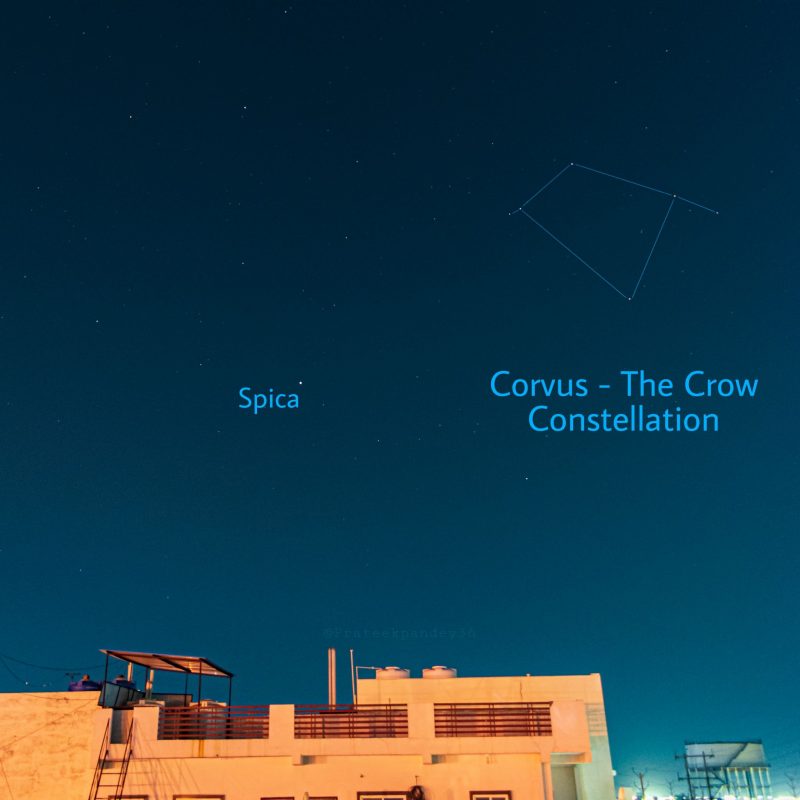
A favorite constellation for many, little squarish Corvus the Crow can be found after sunset at this time of year. It’s not far from Spica, the only bright star in the constellation Virgo the Maiden. Once you find Spica, you’ll recognize Corvus easily. It’s always near the star Spica on the sky’s dome and recognizable for its compact, boxy shape. Spica is supposed to represent an Ear of Wheat, held by Virgo the Maiden. With a good imagination and a dark-enough sky, you can almost see Corvus as a real crow, pecking toward Spica, trying to snatch the wheat.
And thus the stories of the heavens were born …
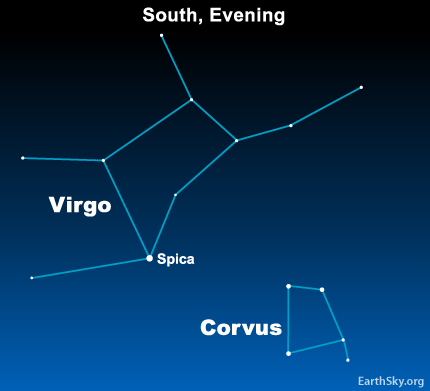
How to find Spica and Corvus
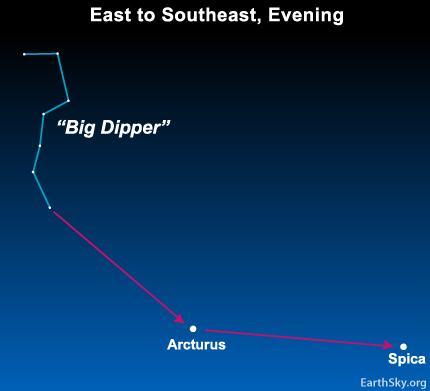
You don’t need Corvus to identify the bright star Spica. You can use the Big Dipper for that as shown on the diagram below. After you find Spica, Corvus is easy. It’s right next to the bright star, a small boxy pattern that’s noticeable to the eye.
Old stories about Corvus
Because Corvus is such an easy and fun constellation to pick out in the sky, there are many legends in skylore about it. A lovely one comes from China, where this grouping of stars was seen as an imperial chariot, riding on the wind. In ancient Israel, and sometimes in Greek mythology, Corvus was said to be a raven, not a crow. The early Greeks saw Corvus as a cupbearer to Apollo, god of the sun. The website Constellation-Guide.com explains that Corvus was:
… Apollo’s sacred bird in Greek mythology. According to the myth, the raven originally had white feathers. In one story, Apollo told the bird to watch over Coronis, one of his lovers, who was pregnant at the time.
Coronis gradually lost interest in Apollo and fell in love with a mortal man, Ischys. When the raven reported the affair to Apollo, the god was so enraged that the bird did nothing to stop it that he flung a curse on it, scorching the raven’s feathers. That, the legend goes, is why all ravens are black.
Corvus is a friendly sight in the heavens. Along with all the stars, Corvus’s stars will be found a bit farther west at nightfall in the coming weeks and months as Earth moves around the sun. Check it out now and watch for it in the next few months.
The bright star Spica – near Corvus on our sky’s dome – will always be there to guide your eye.
Stars of Corvus
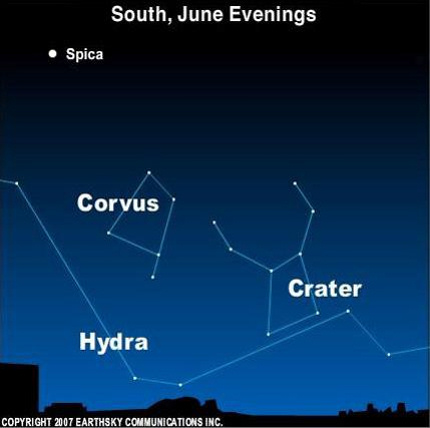
The brightest star in Corvus is magnitude 2.59 Gienah, or Gamma Corvi. Gienah lies 165 light-years away. The four brightest stars in the constellation form a crooked square. The second brightest star in the Crow is in the opposite corner: magnitude 2.65 Beta Corvi, lying 140 light-years away. In the northeast corner is magnitude 2.94 Algorab, or Delta Corvi. Algorab lies about 88 light-years away. The last corner is marked by magnitude 3.02 Epsilon Corvi, lying 303 light-years away.
Two other small stars of note reside in the constellation Corvus the Crow. Less than a half a degree from Algorab is magnitude 4.3 Eta Corvi, which lies about 60 light-years away. Directly below Epsilon is Alchiba, or Alpha Corvi, at magnitude 4.01. Alchiba lies 48 light-years away. This constellation serves as proof that the Alpha star in a constellation is not always the brightest, or even one of the brightest.
Deep-sky objects in Corvus
There is one main reason amateur observers usually turn their telescopes toward Corvus, and that is for the galaxy pair NGC 4038 and NGC 4039. This pair of colliding galaxies is known as the Antennae Galaxy, or sometimes the Ringtail Galaxy. The Antennae are located on the western side of the constellation and register as a magnitude 10.7. Dark skies and a telescope of at least 4 inches are required to view it.
These interacting galaxies were first discovered by William Herschel on February 7, 1785. At the time galaxies were still unknown, so they were originally classified as nebulae.
One other object of note is the planetary nebula NGC 4361. This 10th magnitude round glow lies within the crooked square of Corvus. A 4- to 6-inch telescope is a good place to start to try to pick up the nebula, and higher powers will increase your odds of finding it and the 13th magnitude star that lies within.
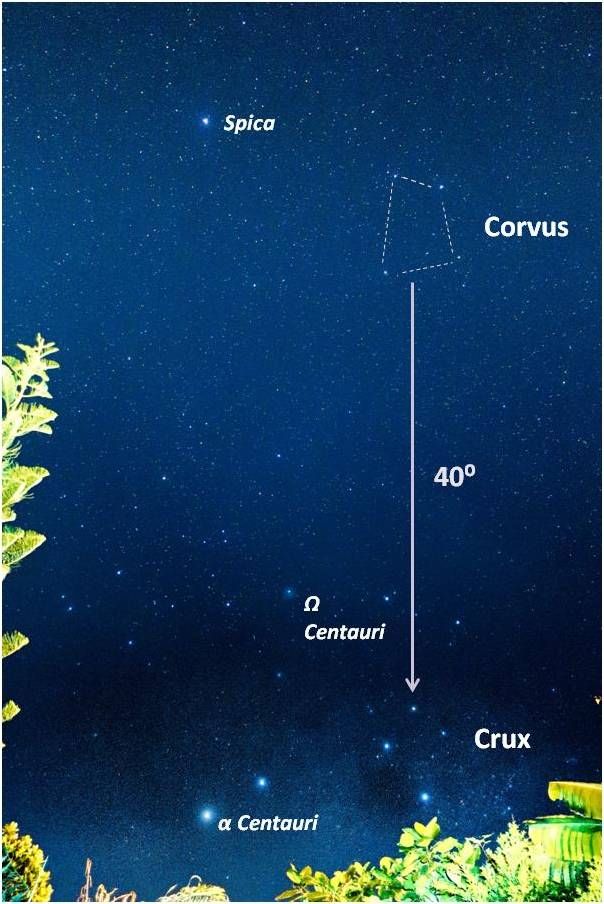
If you’re far enough south on the globe …
Bottom line: Use the star Spica to introduce yourself to the constellation Corvus the Crow.
Enjoying EarthSky so far? Sign up for our free daily newsletter today!
The post Meet lovable, easy-to-find Corvus the Crow first appeared on EarthSky.
from EarthSky https://ift.tt/3NFConL
A favorite constellation for many, little squarish Corvus the Crow can be found after sunset at this time of year. It’s not far from Spica, the only bright star in the constellation Virgo the Maiden. Once you find Spica, you’ll recognize Corvus easily. It’s always near the star Spica on the sky’s dome and recognizable for its compact, boxy shape. Spica is supposed to represent an Ear of Wheat, held by Virgo the Maiden. With a good imagination and a dark-enough sky, you can almost see Corvus as a real crow, pecking toward Spica, trying to snatch the wheat.
And thus the stories of the heavens were born …
How to find Spica and Corvus
You don’t need Corvus to identify the bright star Spica. You can use the Big Dipper for that as shown on the diagram below. After you find Spica, Corvus is easy. It’s right next to the bright star, a small boxy pattern that’s noticeable to the eye.
Old stories about Corvus
Because Corvus is such an easy and fun constellation to pick out in the sky, there are many legends in skylore about it. A lovely one comes from China, where this grouping of stars was seen as an imperial chariot, riding on the wind. In ancient Israel, and sometimes in Greek mythology, Corvus was said to be a raven, not a crow. The early Greeks saw Corvus as a cupbearer to Apollo, god of the sun. The website Constellation-Guide.com explains that Corvus was:
… Apollo’s sacred bird in Greek mythology. According to the myth, the raven originally had white feathers. In one story, Apollo told the bird to watch over Coronis, one of his lovers, who was pregnant at the time.
Coronis gradually lost interest in Apollo and fell in love with a mortal man, Ischys. When the raven reported the affair to Apollo, the god was so enraged that the bird did nothing to stop it that he flung a curse on it, scorching the raven’s feathers. That, the legend goes, is why all ravens are black.
Corvus is a friendly sight in the heavens. Along with all the stars, Corvus’s stars will be found a bit farther west at nightfall in the coming weeks and months as Earth moves around the sun. Check it out now and watch for it in the next few months.
The bright star Spica – near Corvus on our sky’s dome – will always be there to guide your eye.
Stars of Corvus
The brightest star in Corvus is magnitude 2.59 Gienah, or Gamma Corvi. Gienah lies 165 light-years away. The four brightest stars in the constellation form a crooked square. The second brightest star in the Crow is in the opposite corner: magnitude 2.65 Beta Corvi, lying 140 light-years away. In the northeast corner is magnitude 2.94 Algorab, or Delta Corvi. Algorab lies about 88 light-years away. The last corner is marked by magnitude 3.02 Epsilon Corvi, lying 303 light-years away.
Two other small stars of note reside in the constellation Corvus the Crow. Less than a half a degree from Algorab is magnitude 4.3 Eta Corvi, which lies about 60 light-years away. Directly below Epsilon is Alchiba, or Alpha Corvi, at magnitude 4.01. Alchiba lies 48 light-years away. This constellation serves as proof that the Alpha star in a constellation is not always the brightest, or even one of the brightest.
Deep-sky objects in Corvus
There is one main reason amateur observers usually turn their telescopes toward Corvus, and that is for the galaxy pair NGC 4038 and NGC 4039. This pair of colliding galaxies is known as the Antennae Galaxy, or sometimes the Ringtail Galaxy. The Antennae are located on the western side of the constellation and register as a magnitude 10.7. Dark skies and a telescope of at least 4 inches are required to view it.
These interacting galaxies were first discovered by William Herschel on February 7, 1785. At the time galaxies were still unknown, so they were originally classified as nebulae.
One other object of note is the planetary nebula NGC 4361. This 10th magnitude round glow lies within the crooked square of Corvus. A 4- to 6-inch telescope is a good place to start to try to pick up the nebula, and higher powers will increase your odds of finding it and the 13th magnitude star that lies within.
If you’re far enough south on the globe …
Bottom line: Use the star Spica to introduce yourself to the constellation Corvus the Crow.
Enjoying EarthSky so far? Sign up for our free daily newsletter today!
The post Meet lovable, easy-to-find Corvus the Crow first appeared on EarthSky.
from EarthSky https://ift.tt/3NFConL

Aucun commentaire:
Enregistrer un commentaire