

Fire season gets an early start in Canada and Minnesota
The state of Minnesota, along with the Canadian provinces of Manitoba and Ontario, are seeing an early start to fire season this year. Hot, dry and windy conditions have set the stage for wildfires. So far, the wildfires have led to the loss of structures, evacuations and the tragic deaths of two people in Manitoba.
While these regions aren’t strangers to May wildfires, the strength of the fires and amount of land burned is unusual for this time of year. Kristin Hayward, assistant deputy minister for the Conservation Officer Service and Manitoba Wildfire Service, told the CBC:
We’re not seeing a typical fire season anymore. Typically we wouldn’t be seeing this level of activity happening until later on in the summer.
Meanwhile, in the U.S. state of Minnesota, the forestry director of the Minnesota Department of Natural Resources (DNR), Patty Thielen, said the area already burned statewide in 2025 is roughly triple the amount burned in an average year.
In early May, the weather was abnormally hot in these regions. For example, International Falls, Minnesota, known as the Nation’s Icebox, hit 96 F (35.5 C) on May 11. Its previous record high for that date was 83 F (28.3 C). And Winnipeg, Manitoba, hit 95 F (35.2 C) on May 12. Fortunately, at this time, cooler weather is on the way.
Minnesota fires
Three wildfires, the Jenkins Creek, Camp House and Munger Shaw fires are all burning in the arrowhead of Minnesota. These wildfires have burned more than 35,000 acres as of May 15, 2025. The Jenkins Creek fire has now become the largest of the three. The fire began on May 11 and 12 and has already destroyed more than 100 structures.
The Camp House and Jenkins Creek fires in northern Minnesota vs. the Duluth-Superior metro at the same scale. These fires are huge and still growing.
— Jordan van der Hagen (@thejvandy.bsky.social) May 14, 2025 at 10:15 AM
Manitoba and Ontario fires
NASA Earth Observatory said:
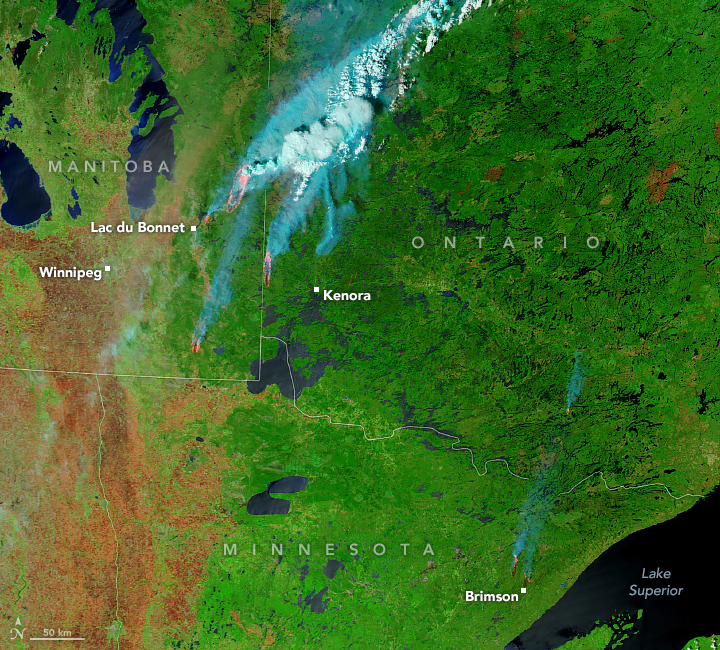
Large smoke plumes billowed from blazes near Lac du Bonnet in eastern Manitoba. One fire close to the rural municipality burned thousands of hectares and threatened infrastructure. Another one, to the northeast near Nopiming Provincial Park, exhibited ‘extremely volatile fire behavior’ on May 13, officials said, and grew to 100,000 hectares (250,000 acres). Authorities closed multiple provincial parks due to the fires and issued evacuation orders for several communities in both Manitoba and Ontario.
Fire season in Saskatchewan
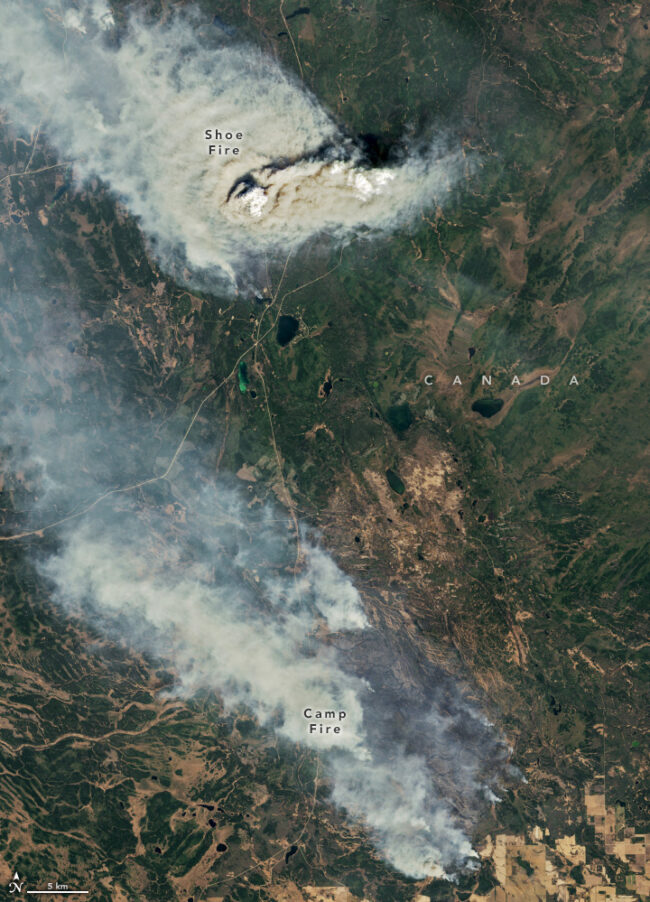
Another Canadian province, Saskatchewan, has already had a busy start to its fire season, too. The central part of the province saw wildfires crop up in early May. NASA Earth Observatory said that Saskatchewan’s public safety agency reported 12 active fires across the province on May 12, 2025, and that:
Saskatchewan officials have tallied 146 fires to date in 2025, nearly twice the five-year average.
These fires were even intense enough to create a pyrocumulonimbus cloud. The University of Wisconsin-Madison said it was the first documented pyrocumulonimbus cloud of the 2025 North America wildfire season. NASA Earth Observatory explained the significance of these clouds:
These fire-generated clouds are associated with extreme fire behavior that can hinder firefighting efforts and threaten communities. They can also inject large plumes of smoke into the stratosphere, where they can linger for several months, alter stratospheric circulation and influence Earth’s radiative balance and the Antarctic ozone hole.
Bottom line: Fire season in Minnesota and Canada has gotten off to a strong, early start. Read more about the wildfires raging in the north.
Read more: This Is Wildfire: Tips on preparing yourself and your home
The post Fire season gets an early start in Canada and Minnesota first appeared on EarthSky.
from EarthSky https://ift.tt/eqEzN1f
Fire season gets an early start in Canada and Minnesota
The state of Minnesota, along with the Canadian provinces of Manitoba and Ontario, are seeing an early start to fire season this year. Hot, dry and windy conditions have set the stage for wildfires. So far, the wildfires have led to the loss of structures, evacuations and the tragic deaths of two people in Manitoba.
While these regions aren’t strangers to May wildfires, the strength of the fires and amount of land burned is unusual for this time of year. Kristin Hayward, assistant deputy minister for the Conservation Officer Service and Manitoba Wildfire Service, told the CBC:
We’re not seeing a typical fire season anymore. Typically we wouldn’t be seeing this level of activity happening until later on in the summer.
Meanwhile, in the U.S. state of Minnesota, the forestry director of the Minnesota Department of Natural Resources (DNR), Patty Thielen, said the area already burned statewide in 2025 is roughly triple the amount burned in an average year.
In early May, the weather was abnormally hot in these regions. For example, International Falls, Minnesota, known as the Nation’s Icebox, hit 96 F (35.5 C) on May 11. Its previous record high for that date was 83 F (28.3 C). And Winnipeg, Manitoba, hit 95 F (35.2 C) on May 12. Fortunately, at this time, cooler weather is on the way.
Minnesota fires
Three wildfires, the Jenkins Creek, Camp House and Munger Shaw fires are all burning in the arrowhead of Minnesota. These wildfires have burned more than 35,000 acres as of May 15, 2025. The Jenkins Creek fire has now become the largest of the three. The fire began on May 11 and 12 and has already destroyed more than 100 structures.
The Camp House and Jenkins Creek fires in northern Minnesota vs. the Duluth-Superior metro at the same scale. These fires are huge and still growing.
— Jordan van der Hagen (@thejvandy.bsky.social) May 14, 2025 at 10:15 AM
Manitoba and Ontario fires
NASA Earth Observatory said:
Large smoke plumes billowed from blazes near Lac du Bonnet in eastern Manitoba. One fire close to the rural municipality burned thousands of hectares and threatened infrastructure. Another one, to the northeast near Nopiming Provincial Park, exhibited ‘extremely volatile fire behavior’ on May 13, officials said, and grew to 100,000 hectares (250,000 acres). Authorities closed multiple provincial parks due to the fires and issued evacuation orders for several communities in both Manitoba and Ontario.
Fire season in Saskatchewan
Another Canadian province, Saskatchewan, has already had a busy start to its fire season, too. The central part of the province saw wildfires crop up in early May. NASA Earth Observatory said that Saskatchewan’s public safety agency reported 12 active fires across the province on May 12, 2025, and that:
Saskatchewan officials have tallied 146 fires to date in 2025, nearly twice the five-year average.
These fires were even intense enough to create a pyrocumulonimbus cloud. The University of Wisconsin-Madison said it was the first documented pyrocumulonimbus cloud of the 2025 North America wildfire season. NASA Earth Observatory explained the significance of these clouds:
These fire-generated clouds are associated with extreme fire behavior that can hinder firefighting efforts and threaten communities. They can also inject large plumes of smoke into the stratosphere, where they can linger for several months, alter stratospheric circulation and influence Earth’s radiative balance and the Antarctic ozone hole.
Bottom line: Fire season in Minnesota and Canada has gotten off to a strong, early start. Read more about the wildfires raging in the north.
Read more: This Is Wildfire: Tips on preparing yourself and your home
The post Fire season gets an early start in Canada and Minnesota first appeared on EarthSky.
from EarthSky https://ift.tt/eqEzN1f

Aucun commentaire:
Enregistrer un commentaire