
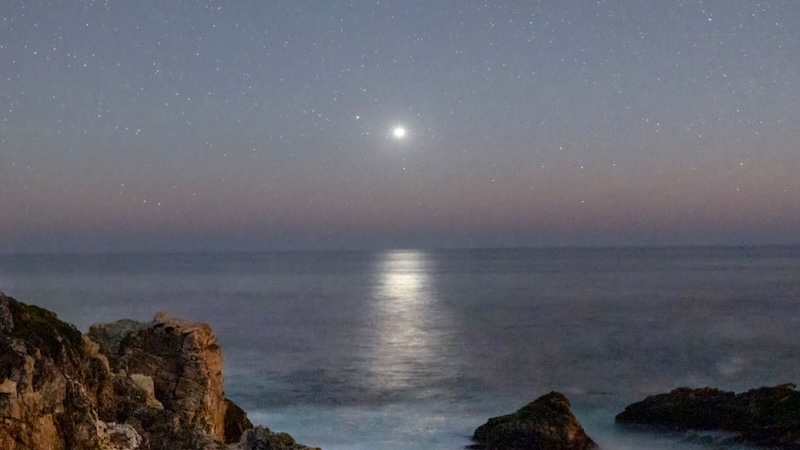
Have you noticed a bright object in the eastern sky before sunrise? That’s Venus. Here’s why it’s so bright.
Why is Venus so bright?
Jupiter is a bright planet, and Mars is sometimes bright, too. But neither Jupiter nor Mars at their brightest can outshine Venus. The first few months of 2025 found all three planets in our evening sky. Since then, Venus emerged in the morning sky in late March and is now on its way to its greatest brilliancy in the morning sky on April 27.
So why is Venus so bright?
Our neighboring world – orbiting one step inward from Earth around the sun – is the third-brightest natural object in the sky, after the sun and the moon. It’s currently a brilliant light ascending in the morning sky, shining at magnitude -4.6. Greatest brilliancy for Venus for this 2025 morning apparition will happen on April 27.
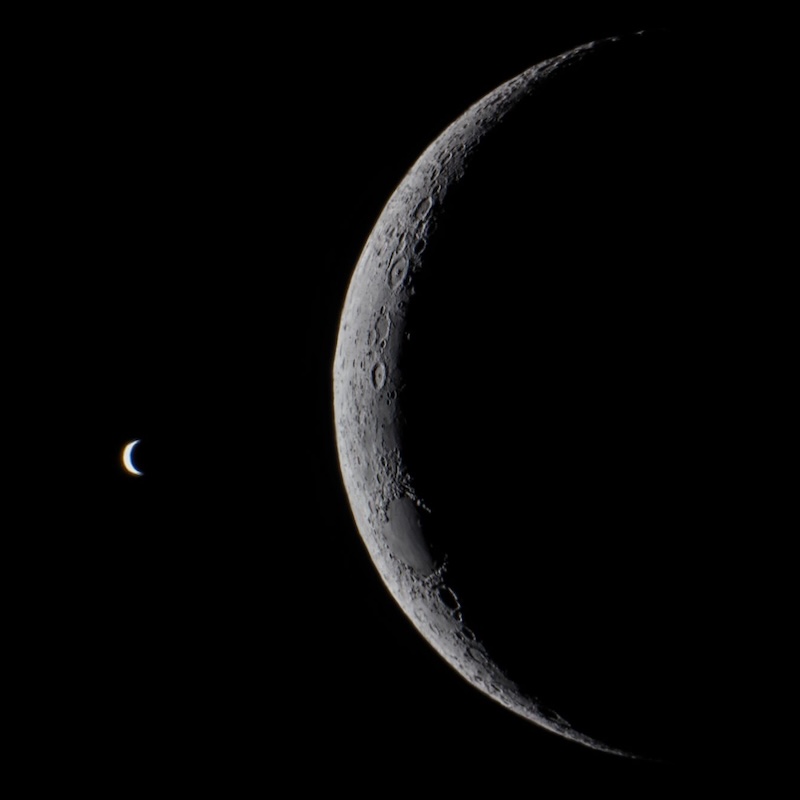
Look at the photo above. Venus now appears as a crescent – through telescopes – as seen from Earth. How can a crescent Venus appear brighter to us than the fuller Venus we see at other times?
Albedo = reflectivity
As the planet next inward from Earth in orbit around the sun, Venus is relatively nearby. But its nearness isn’t the only reason Venus is bright. Consider that Mars orbits one step outward from Earth. And Mars waxes and wanes in brightness in our sky over about a two-year cycle. It’s only exceptionally bright around the time Earth passes between Mars and the sun, at the same time Mars is closest to the sun. The last time that happened was in 2018. And the next time will be in 2035.
With Venus, something else is going on. Astronomers use the term albedo to describe how bright a planet is in absolute terms. When sunlight strikes a planet, the planet’s surface absorbs some of the light and reflects the rest.
Albedo is a comparison between how much light strikes an object and how much the object reflects. And, as you might have guessed, Venus has the highest albedo of any major planet in our solar system.
Reflectivity makes Venus bright
The albedo of Venus is close to 0.7, meaning it reflects about 70% of the sunlight striking it. When the moon is close to full in Earth’s sky, it can look a lot brighter than Venus. But the moon – whose surface is dark volcanic rock – reflects only about 10% of the light that hits it. The moon appears bright to us because it’s close to Earth. It’s only about a light-second away, in contrast to the several light-minutes distance of Venus.
Venus is bright (it has a high albedo) because it’s blanketed by highly reflective clouds. The clouds in the atmosphere of Venus contain droplets of sulfuric acid, as well as acidic crystals suspended in a mixture of gases. Light bounces easily off the smooth surfaces of these spheres and crystals. Sunlight bouncing from these clouds is a big part of why Venus is so bright.
By the way, Venus is the brightest major planet. But it isn’t the most reflective body in our solar system. That honor goes to Enceladus, a moon of Saturn. The little moon’s icy surface reflects some 90% of the sunlight striking it.
Enjoying EarthSky so far? Sign up for our free daily newsletter today!
When and why is Venus brightest?
Venus is brightest when two factors combine – the phase of its crescent, plus largest overall size of Venus’ disk – so that the greatest amount of surface area of Venus shows in our sky. Astronomers call this greatest illuminated extent.
Why does it happen? Because Venus orbits the sun inside Earth’s orbit, it sometimes goes between us and the sun. At such times, its lighted hemisphere, or day side, is facing away from us. Then it’s difficult to see Venus at all (though experienced astrophotographers sometimes catch it).
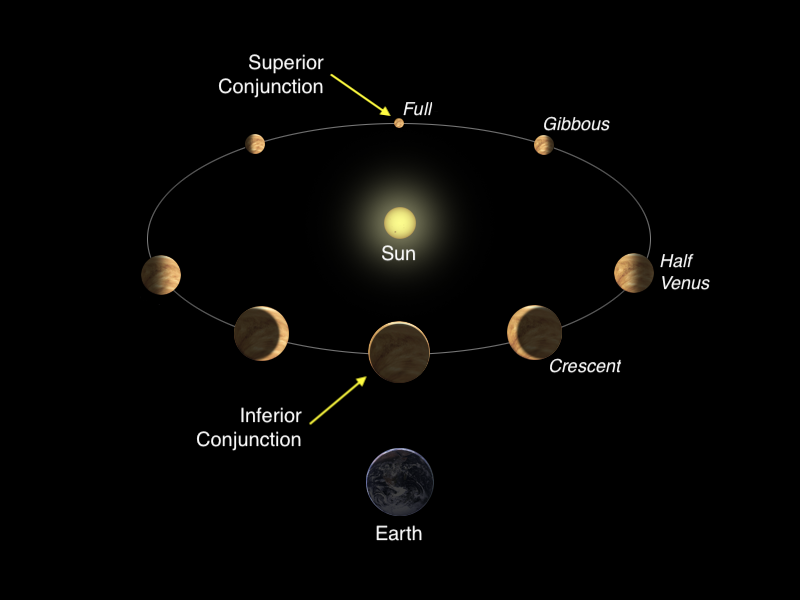
Also, around the time it passes between us and the sun – known as inferior conjunction – we see Venus exhibit phases … like a tiny moon. Venus reached inferior conjunction on March 22-23, 2025. Now Venus is racing ahead of Earth in our orbits – it “lapped” us in the race of the planets – observers on Earth can watch as the phase of Venus waxes. As Venus moves away from its inferior conjunction, it’ll decrease in size as its phase increases.
And now that Venus is racing ahead of us in orbit, we see Venus wax in phase. As the crescent Venus waxes in Earth’s sky, the overall size of the disk of Venus gets smaller in our sky, as Venus speeds ahead of us.
Venus at greatest brilliancy soon
Venus passed between us and the sun at 1 UTC on March 23, 2025. Since then, it’s been rushing ahead of us in orbit. Its phase will be increasing. But its disk size will be decreasing. Greatest brilliancy happens when we see the greatest illuminated surface area of Venus: a combination of phase size and disk size. Astronomers call this a “greatest illuminated extent” of Venus.
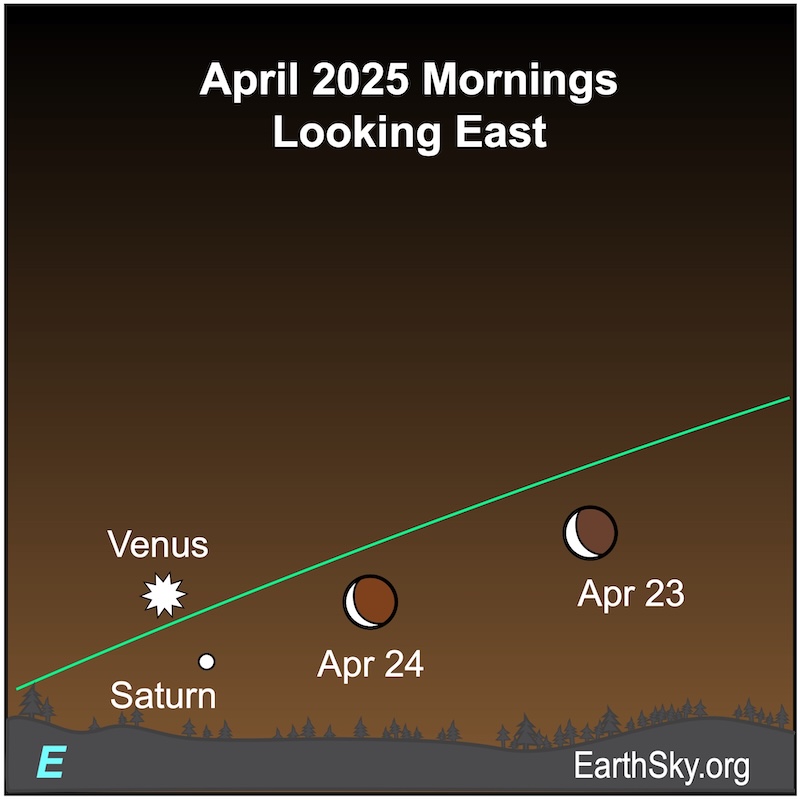
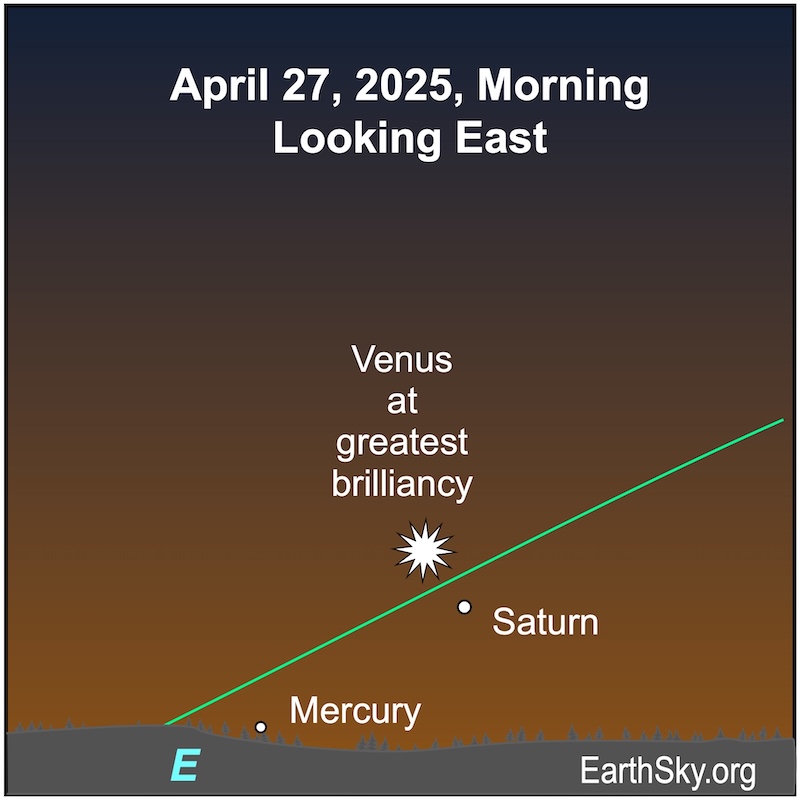
It’s happening now in the east before sunrise! Don’t miss Venus blazing before twilight begins April 27, 2025. Or look for it that morning in the bright twilight. It’ll reach greatest brilliancy in the morning sky on April 27, 2025. Check Stellarium.org for local times.
Read about Venus at greatest brilliancy
The view from above

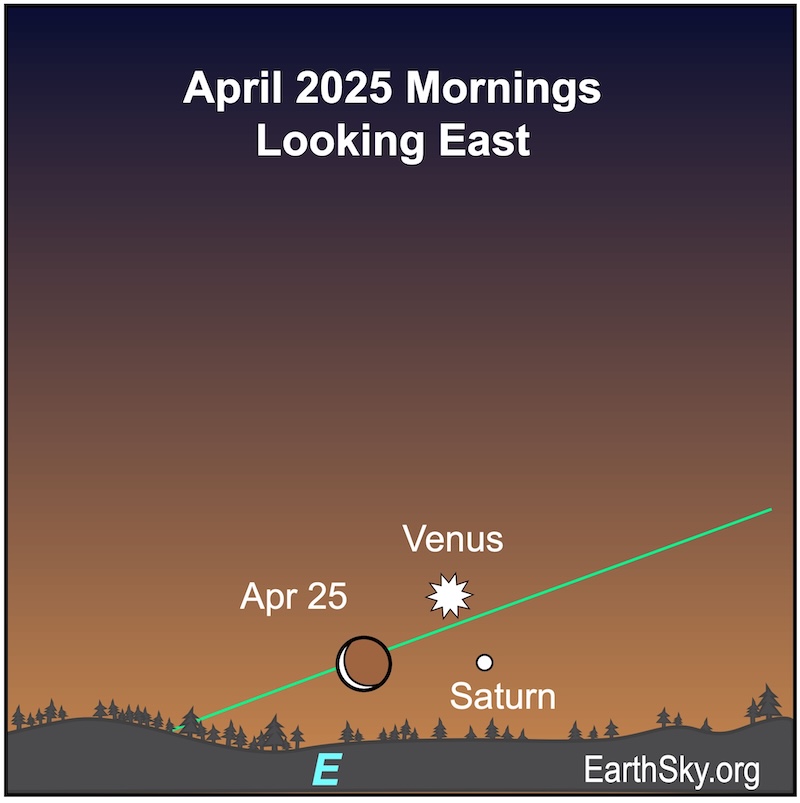
April finder charts
More photos from our community


Bottom line: Look for dazzling Venus in the east before dawn and in the morning twilight. It’s the 3rd brightest object in the sky, after the sun and moon. But why is Venus so bright?
Read more: Venus before sunrise: Greatest distance May 31-June 1, 2025
The post Why is Venus so bright in our Earth’s sky? first appeared on EarthSky.
from EarthSky https://ift.tt/E5cVC3q
Have you noticed a bright object in the eastern sky before sunrise? That’s Venus. Here’s why it’s so bright.
Why is Venus so bright?
Jupiter is a bright planet, and Mars is sometimes bright, too. But neither Jupiter nor Mars at their brightest can outshine Venus. The first few months of 2025 found all three planets in our evening sky. Since then, Venus emerged in the morning sky in late March and is now on its way to its greatest brilliancy in the morning sky on April 27.
So why is Venus so bright?
Our neighboring world – orbiting one step inward from Earth around the sun – is the third-brightest natural object in the sky, after the sun and the moon. It’s currently a brilliant light ascending in the morning sky, shining at magnitude -4.6. Greatest brilliancy for Venus for this 2025 morning apparition will happen on April 27.
Look at the photo above. Venus now appears as a crescent – through telescopes – as seen from Earth. How can a crescent Venus appear brighter to us than the fuller Venus we see at other times?
Albedo = reflectivity
As the planet next inward from Earth in orbit around the sun, Venus is relatively nearby. But its nearness isn’t the only reason Venus is bright. Consider that Mars orbits one step outward from Earth. And Mars waxes and wanes in brightness in our sky over about a two-year cycle. It’s only exceptionally bright around the time Earth passes between Mars and the sun, at the same time Mars is closest to the sun. The last time that happened was in 2018. And the next time will be in 2035.
With Venus, something else is going on. Astronomers use the term albedo to describe how bright a planet is in absolute terms. When sunlight strikes a planet, the planet’s surface absorbs some of the light and reflects the rest.
Albedo is a comparison between how much light strikes an object and how much the object reflects. And, as you might have guessed, Venus has the highest albedo of any major planet in our solar system.
Reflectivity makes Venus bright
The albedo of Venus is close to 0.7, meaning it reflects about 70% of the sunlight striking it. When the moon is close to full in Earth’s sky, it can look a lot brighter than Venus. But the moon – whose surface is dark volcanic rock – reflects only about 10% of the light that hits it. The moon appears bright to us because it’s close to Earth. It’s only about a light-second away, in contrast to the several light-minutes distance of Venus.
Venus is bright (it has a high albedo) because it’s blanketed by highly reflective clouds. The clouds in the atmosphere of Venus contain droplets of sulfuric acid, as well as acidic crystals suspended in a mixture of gases. Light bounces easily off the smooth surfaces of these spheres and crystals. Sunlight bouncing from these clouds is a big part of why Venus is so bright.
By the way, Venus is the brightest major planet. But it isn’t the most reflective body in our solar system. That honor goes to Enceladus, a moon of Saturn. The little moon’s icy surface reflects some 90% of the sunlight striking it.
Enjoying EarthSky so far? Sign up for our free daily newsletter today!
When and why is Venus brightest?
Venus is brightest when two factors combine – the phase of its crescent, plus largest overall size of Venus’ disk – so that the greatest amount of surface area of Venus shows in our sky. Astronomers call this greatest illuminated extent.
Why does it happen? Because Venus orbits the sun inside Earth’s orbit, it sometimes goes between us and the sun. At such times, its lighted hemisphere, or day side, is facing away from us. Then it’s difficult to see Venus at all (though experienced astrophotographers sometimes catch it).
Also, around the time it passes between us and the sun – known as inferior conjunction – we see Venus exhibit phases … like a tiny moon. Venus reached inferior conjunction on March 22-23, 2025. Now Venus is racing ahead of Earth in our orbits – it “lapped” us in the race of the planets – observers on Earth can watch as the phase of Venus waxes. As Venus moves away from its inferior conjunction, it’ll decrease in size as its phase increases.
And now that Venus is racing ahead of us in orbit, we see Venus wax in phase. As the crescent Venus waxes in Earth’s sky, the overall size of the disk of Venus gets smaller in our sky, as Venus speeds ahead of us.
Venus at greatest brilliancy soon
Venus passed between us and the sun at 1 UTC on March 23, 2025. Since then, it’s been rushing ahead of us in orbit. Its phase will be increasing. But its disk size will be decreasing. Greatest brilliancy happens when we see the greatest illuminated surface area of Venus: a combination of phase size and disk size. Astronomers call this a “greatest illuminated extent” of Venus.
It’s happening now in the east before sunrise! Don’t miss Venus blazing before twilight begins April 27, 2025. Or look for it that morning in the bright twilight. It’ll reach greatest brilliancy in the morning sky on April 27, 2025. Check Stellarium.org for local times.
Read about Venus at greatest brilliancy
The view from above
April finder charts
More photos from our community
Bottom line: Look for dazzling Venus in the east before dawn and in the morning twilight. It’s the 3rd brightest object in the sky, after the sun and moon. But why is Venus so bright?
Read more: Venus before sunrise: Greatest distance May 31-June 1, 2025
The post Why is Venus so bright in our Earth’s sky? first appeared on EarthSky.
from EarthSky https://ift.tt/E5cVC3q

Aucun commentaire:
Enregistrer un commentaire