aads

The Orion nebula (M42) is a starry nursery

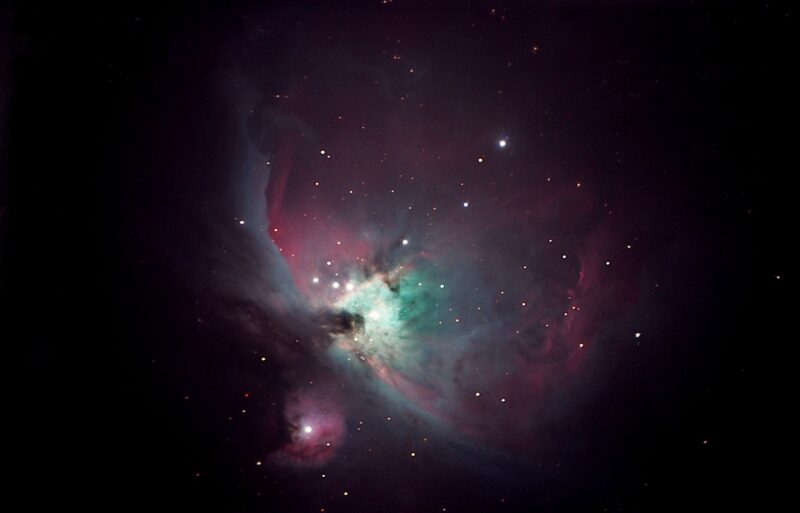
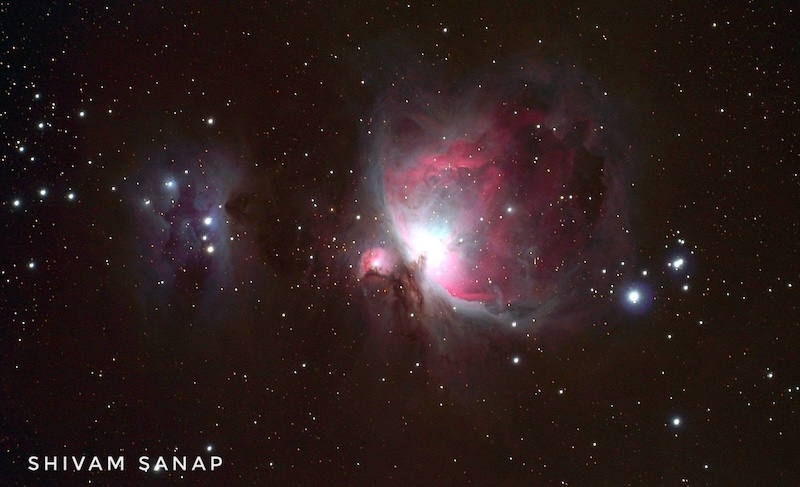
Crisply outlined swirls of 3 glowing, multicolored gas clouds with stars embedded in them.
View at EarthSky Community Photos. | Shivam Sanap imaged the Orion nebula on August 2, 2025, from India, and wrote: “I captured the Orion nebula after a lot of hard work, and the results are truly amazing!”. Thank you, Shivam!

EarthSky’s 2026 lunar calendar is available now. Get yours today! Makes a great New Year’s gift.

Orion the Hunter is the most noticeable of all constellations. The three stars of Orion’s Belt jump out at you as a short, straight row of medium-bright stars, midway between Orion’s two brightest stars, Betelgeuse and Rigel. Once you find the Belt stars, you can also locate the Orion nebula, otherwise known as M42. When you look at it, you’re gazing toward a stellar nursery, a place where new stars are born.

How to locate the Orion nebula

If you want to find this famous nebula, first you have to locate the constellation Orion. Fortunately, that’s easy, if you’re looking at the right time of year. The Northern Hemisphere winter months (Southern Hemisphere summer months) are the perfect time to come to know Orion.

First, look for the three medium-bright stars in a short, straight row. These stars represent Orion’s Belt.

Next, if you look closely, you’ll notice a curved line of stars “hanging” from the three Belt stars. These stars represent Orion’s Sword. Look for the Orion nebula about midway down in the Sword of Orion.

As a general rule, the higher the constellation Orion is in the sky, the easier it is to see the Orion nebula. From Northern Hemisphere locations, Orion is due south and highest in the sky around midnight in the middle of December. Then the stars return to the same place in the sky some four minutes earlier each night, or two hours earlier each month. So look for Orion to be highest up around 10 p.m. in mid-January and 8 p.m. in mid-February.

Another time people notice Orion is around the months of August and September, when this constellation appears in the east before dawn.
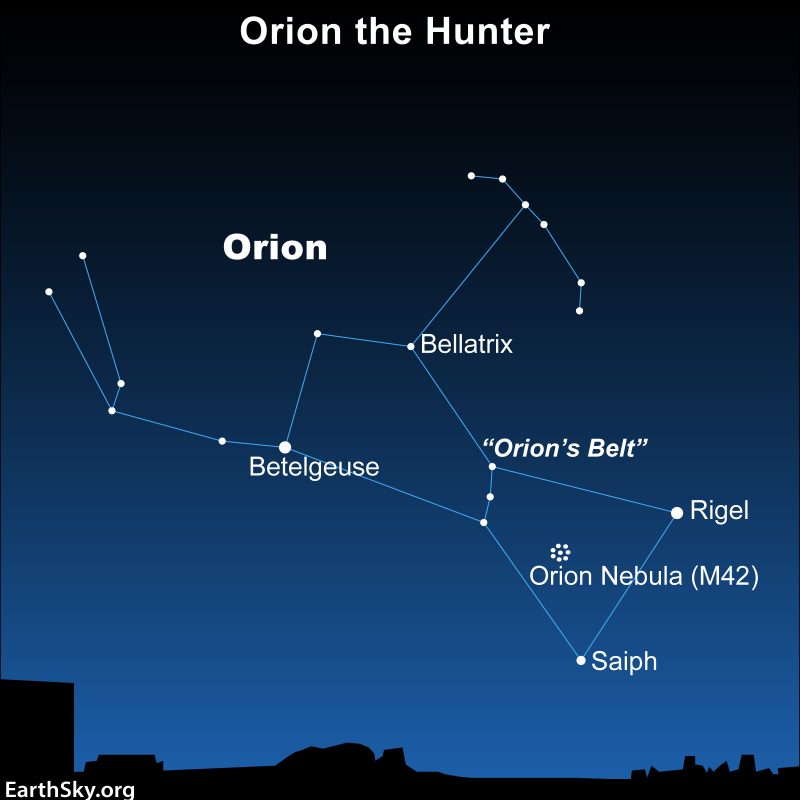
Star chart of big 19-star constellation Orion with stars, Belt, and a nebula labeled.
Orion the Hunter – visible to both hemispheres – rises in the east on December evenings. Chart via EarthSky.

A globe of luminescent fog

Generally, most nebulae – clouds of interstellar gas and dust – are difficult if not impossible to see with the unaided eye or even binoculars. But the Orion nebula is in a class nearly all by itself. That’s because it’s visible to the unaided eye on a dark, moonless night. To me, it looks like a star encased in a globe of luminescent fog. The star-gazing aficionado Stephen James O’Meara described it as:

… angel’s breath against a frosted sky.

In a dark-sky location, observe the Orion nebula for yourself to see what it looks like. A backyard telescope, or even binoculars, will do wonders to showcase one of the greatest celestial treasures in the winter sky.
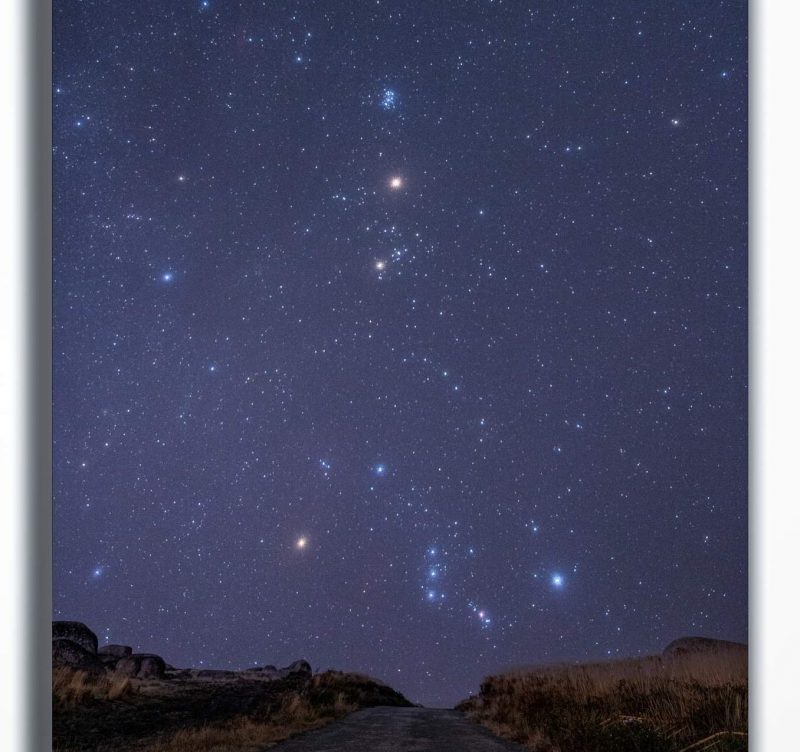
Starry sky with red Mars and Orion, Taurus, and the Pleiades over a rocky horizon.
View at EarthSky Community Photos. | Miguel Ventura in Fafe, Portugal, captured this image on August 28, 2022, and wrote: “Every now and then the night sky offers us moments like this. We can see the Pleiades and the constellation Taurus with the planet Mars between these 2 … below near the horizon the imposing constellation Orion appears.” Thank you, Miguel! Can you see the expanded glow around one of the Sword stars? That’s M42, the Orion nebula.

Science and the Orion nebula

According to modern astronomers, the Orion nebula is an enormous cloud of gas and dust, one of many in our Milky Way galaxy. It lies roughly 1,300 light-years from Earth.

At some 30 light-years in diameter, this great nebulous cocoon is giving birth to perhaps a thousand stars. A young open star cluster, whose stars were born together in the gas cloud and are still loosely bound by gravity, appears within the nebula. Some people refer to it as the Orion Nebula Star Cluster. In 2012, an international team of astronomers suggested this cluster in the Orion nebula might have a black hole at its heart.

Through small telescopes you can see the four brightest stars in the Orion nebula, known as the Trapezium. The light of the young, hot Trapezium stars illuminate the Orion nebula. These stars are only a million or so years old, babies on the scale of star lifetimes.

But most of the stars in this emerging cluster are veiled behind the Orion nebula itself, the great stellar nursery in Orion’s Sword.

The Orion nebula’s position is Right Ascension: 5h 35m; Declination: 5 degrees 23′ south.

Read more: Life’s building blocks found in Orion Nebula

Some images from our EarthSky Community Photos
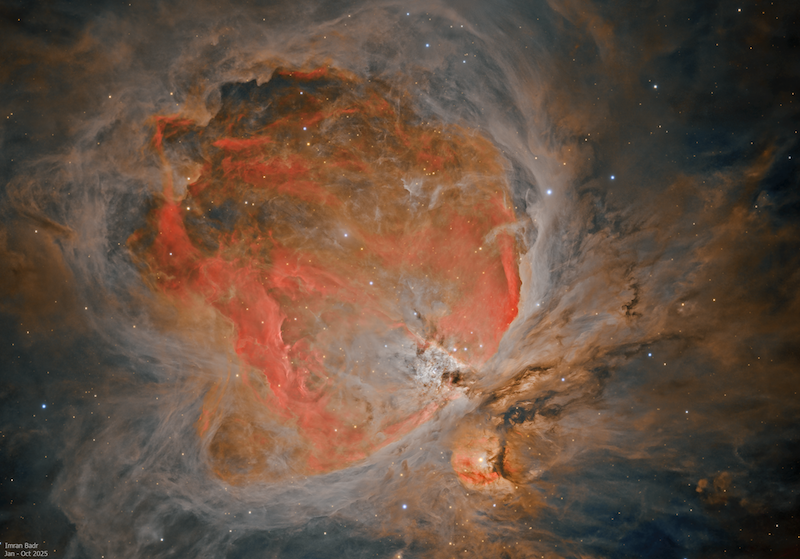
A large roundish, mostly orange nebula with detailed swirls.
View at EarthSky Community Photos. | Imran Badr in San Jose, California, captured the Orion nebula on October 19, 2025. Imran wrote: “I wanted to show the delicate swirls of gases in this amazing deep space target. Due to very high brightness, such details are often hidden. I attempted this target using three telescopes, mounts and cameras.” Thank you, Imran!
Crisply outlined swirls of 3 glowing, multicolored gas clouds with stars embedded in them.
View at EarthSky Community Photos. | Jeremy Likness in Newport, Oregon, shared this image he captured on September 25, 2025, and wrote: “I shot maybe my most detailed version of Orion’s sword over the past 2 nights. This is the great Orion nebula (M42), de Mairan’s nebula (M43) and the Running Man nebula (NGC19677).” Thank you, Jeremy!
Swirls and streamers of bright purple cloudiness in black space, brighter toward the middle and scattered with stars.
View at EarthSky Community Photos. | Randy Strauss in Papillion, Nebraska, captured this telescopic view of the Orion nebula on March 4, 2024. Thank you, Randy! The Orion nebula is one of the most familiar celestial objects, easily visible to the unaided eye below the 3 stars of Orion’s Belt. But it’s a vast stellar nursery, a place where new stars are forming.

Bottom line: The Orion nebula appears to the eye as a tiny, hazy spot. But it’s a vast stellar nursery, a place where new stars are forming.

Enjoying EarthSky? Sign up for our free daily newsletter today!

The post The Orion nebula (M42) is a starry nursery first appeared on EarthSky.


from EarthSky https://ift.tt/vTUmaw6
Crisply outlined swirls of 3 glowing, multicolored gas clouds with stars embedded in them.
View at EarthSky Community Photos. | Shivam Sanap imaged the Orion nebula on August 2, 2025, from India, and wrote: “I captured the Orion nebula after a lot of hard work, and the results are truly amazing!”. Thank you, Shivam!

EarthSky’s 2026 lunar calendar is available now. Get yours today! Makes a great New Year’s gift.

Orion the Hunter is the most noticeable of all constellations. The three stars of Orion’s Belt jump out at you as a short, straight row of medium-bright stars, midway between Orion’s two brightest stars, Betelgeuse and Rigel. Once you find the Belt stars, you can also locate the Orion nebula, otherwise known as M42. When you look at it, you’re gazing toward a stellar nursery, a place where new stars are born.

How to locate the Orion nebula

If you want to find this famous nebula, first you have to locate the constellation Orion. Fortunately, that’s easy, if you’re looking at the right time of year. The Northern Hemisphere winter months (Southern Hemisphere summer months) are the perfect time to come to know Orion.

First, look for the three medium-bright stars in a short, straight row. These stars represent Orion’s Belt.

Next, if you look closely, you’ll notice a curved line of stars “hanging” from the three Belt stars. These stars represent Orion’s Sword. Look for the Orion nebula about midway down in the Sword of Orion.

As a general rule, the higher the constellation Orion is in the sky, the easier it is to see the Orion nebula. From Northern Hemisphere locations, Orion is due south and highest in the sky around midnight in the middle of December. Then the stars return to the same place in the sky some four minutes earlier each night, or two hours earlier each month. So look for Orion to be highest up around 10 p.m. in mid-January and 8 p.m. in mid-February.

Another time people notice Orion is around the months of August and September, when this constellation appears in the east before dawn.

Star chart of big 19-star constellation Orion with stars, Belt, and a nebula labeled.
Orion the Hunter – visible to both hemispheres – rises in the east on December evenings. Chart via EarthSky.

A globe of luminescent fog

Generally, most nebulae – clouds of interstellar gas and dust – are difficult if not impossible to see with the unaided eye or even binoculars. But the Orion nebula is in a class nearly all by itself. That’s because it’s visible to the unaided eye on a dark, moonless night. To me, it looks like a star encased in a globe of luminescent fog. The star-gazing aficionado Stephen James O’Meara described it as:

… angel’s breath against a frosted sky.

In a dark-sky location, observe the Orion nebula for yourself to see what it looks like. A backyard telescope, or even binoculars, will do wonders to showcase one of the greatest celestial treasures in the winter sky.

Starry sky with red Mars and Orion, Taurus, and the Pleiades over a rocky horizon.
View at EarthSky Community Photos. | Miguel Ventura in Fafe, Portugal, captured this image on August 28, 2022, and wrote: “Every now and then the night sky offers us moments like this. We can see the Pleiades and the constellation Taurus with the planet Mars between these 2 … below near the horizon the imposing constellation Orion appears.” Thank you, Miguel! Can you see the expanded glow around one of the Sword stars? That’s M42, the Orion nebula.

Science and the Orion nebula

According to modern astronomers, the Orion nebula is an enormous cloud of gas and dust, one of many in our Milky Way galaxy. It lies roughly 1,300 light-years from Earth.

At some 30 light-years in diameter, this great nebulous cocoon is giving birth to perhaps a thousand stars. A young open star cluster, whose stars were born together in the gas cloud and are still loosely bound by gravity, appears within the nebula. Some people refer to it as the Orion Nebula Star Cluster. In 2012, an international team of astronomers suggested this cluster in the Orion nebula might have a black hole at its heart.

Through small telescopes you can see the four brightest stars in the Orion nebula, known as the Trapezium. The light of the young, hot Trapezium stars illuminate the Orion nebula. These stars are only a million or so years old, babies on the scale of star lifetimes.

But most of the stars in this emerging cluster are veiled behind the Orion nebula itself, the great stellar nursery in Orion’s Sword.

The Orion nebula’s position is Right Ascension: 5h 35m; Declination: 5 degrees 23′ south.

Read more: Life’s building blocks found in Orion Nebula

Some images from our EarthSky Community Photos
A large roundish, mostly orange nebula with detailed swirls.
View at EarthSky Community Photos. | Imran Badr in San Jose, California, captured the Orion nebula on October 19, 2025. Imran wrote: “I wanted to show the delicate swirls of gases in this amazing deep space target. Due to very high brightness, such details are often hidden. I attempted this target using three telescopes, mounts and cameras.” Thank you, Imran!
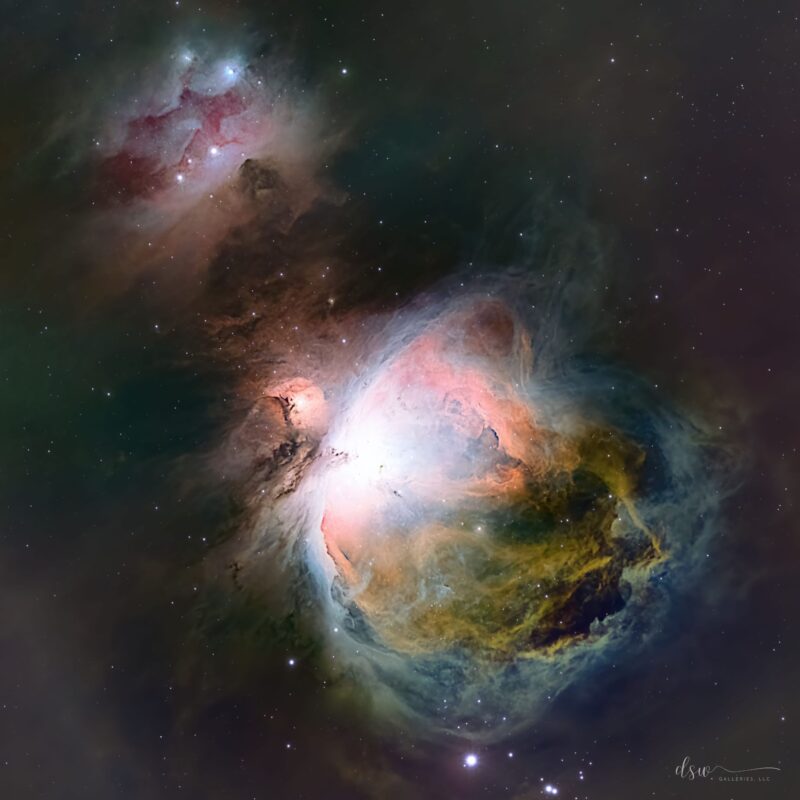
Crisply outlined swirls of 3 glowing, multicolored gas clouds with stars embedded in them.
View at EarthSky Community Photos. | Jeremy Likness in Newport, Oregon, shared this image he captured on September 25, 2025, and wrote: “I shot maybe my most detailed version of Orion’s sword over the past 2 nights. This is the great Orion nebula (M42), de Mairan’s nebula (M43) and the Running Man nebula (NGC19677).” Thank you, Jeremy!
Swirls and streamers of bright purple cloudiness in black space, brighter toward the middle and scattered with stars.
View at EarthSky Community Photos. | Randy Strauss in Papillion, Nebraska, captured this telescopic view of the Orion nebula on March 4, 2024. Thank you, Randy! The Orion nebula is one of the most familiar celestial objects, easily visible to the unaided eye below the 3 stars of Orion’s Belt. But it’s a vast stellar nursery, a place where new stars are forming.

Bottom line: The Orion nebula appears to the eye as a tiny, hazy spot. But it’s a vast stellar nursery, a place where new stars are forming.

Enjoying EarthSky? Sign up for our free daily newsletter today!

The post The Orion nebula (M42) is a starry nursery first appeared on EarthSky.


from EarthSky https://ift.tt/vTUmaw6

Earth flies between Jupiter and the sun January 10

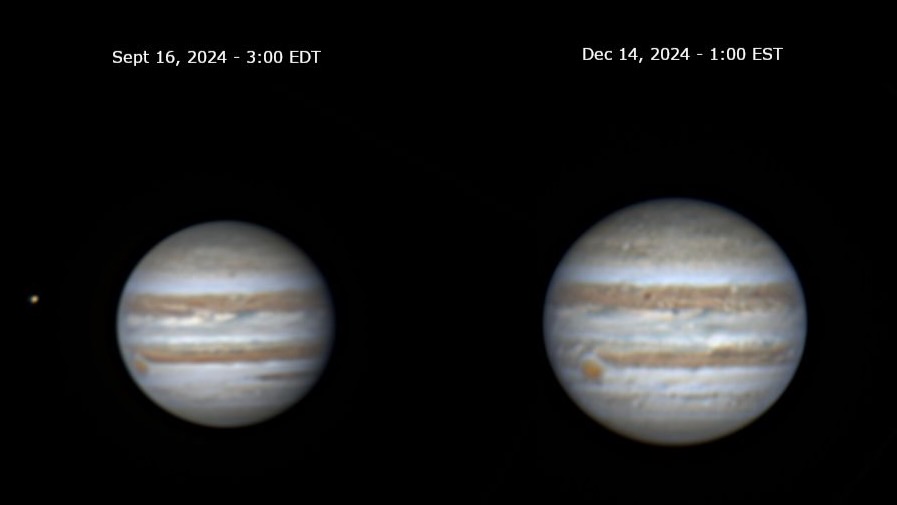
Two images of a banded planet. One planet is bigger than the other.
View at EarthSky Community Photos. | Nishat Khan in Ontario, Canada, shared this image of Jupiter from September 16, 2024, comparing it with one taken a few months later on December 14. Thank you, Nishat! December 2024 was Jupiter’s last opposition, the last time Earth flew between this planet and the sun. At that time, it was at its closest to Earth and so appeared biggest in our sky (through the eyepieces of earthly telescopes). Jupiter will be closest to Earth again on January 9, 2026. It’ll reach opposition on January 10, 2026.

Jupiter in 2025: Earth will fly between the biggest planet in our solar system – Jupiter – and the sun on January 10, 2026. At that time, this mighty world will be most opposite the sun from Earth for this year. It’ll be rising in the east as the sun sets in the west. Astronomers will call it Jupiter’s opposition to the sun. The early months of 2026 will be a great time to observe it!
The exact time of Jupiter’s opposition is 9 UTC (3 a.m. CDT) on January 10, 2026.
Jupiter will be closest to Earth one day before its opposition, on January 9, 2026. At that time, its distance will be 393 million miles/ 633 million km/ 35 light-minutes from Earth. Read: Why is Jupiter closest before opposition?
Opposition constellation in 2026: Gemini the Twins.
Brightness at opposition: Magnitude -2.53. Jupiter shines as the 4th-brightest object in the sky, after the sun, moon and planet Venus. In mid-January 2026, Venus is behind the sun. So Jupiter will be the brightest starlike object visible for most of the night.
Angular size at opposition (as seen through a telescope): 46.58 arcseconds.
Through binoculars (anytime): Jupiter reveals a bright disk. If you look closely, you’ll see several of its four large moons – called the Galilean satellites – appearing as pinpoints of light, arrayed in a line that bisects the giant planet. Read: How to see and enjoy Jupiter’s moons.

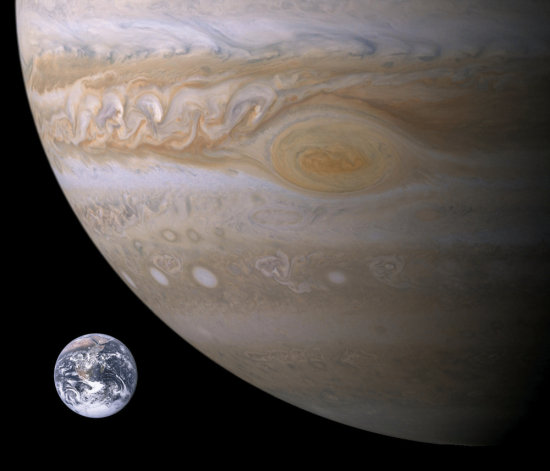
A huge banded planet next to tiny Earth.
More than one thousand Earths could fit inside the giant planet Jupiter. Here, the Apollo 17 mission to the moon acquired this image of Earth on December 7, 1972. The Cassini spacecraft, on its way to Saturn, captured this image of Jupiter on December 29, 2000. Image via Brian1908 at Wikimedia Commons.

How often does Jupiter reach opposition?

Jupiter takes 12 earthly years to orbit the sun once. So, the giant planet comes to opposition roughly every 13 months. It didn’t have an opposition in 2025.

2024 Jupiter opposition – December 7
2026 Jupiter opposition – January 10
2027 Jupiter opposition – February 10

Earth takes 12 months to travel once around the sun relative to Jupiter. So, according to our earthly calendars, Jupiter’s opposition comes about a month later each year. Add to that the fact that we recognize 12 constellations of the zodiac. And there are 12 months in a year. So Jupiter appears in front of a new zodiacal constellation at each year’s opposition. This year, it’s in front of Gemini the Twins.

For the fanciful, the giant planet Jupiter is like a real giant, stepping one by one around the zodiacal constellations, over the period of its 12-year orbit.

A bright starlike object, and a fainter one, with a silhouette of a person reaching for them.
Bright Jupiter and fainter Saturn on December 18, 2020 from our friend VegaStar VegaStar C/ Liard Photography. Thank you, VegaStar! ??

Recent Jupiter events

December 7, 2024: Jupiter came to opposition in front of the constellation Taurus.
February 4, 2025: Jupiter ended retrograde motion, a sign that the best time to observe Jupiter had ended. But the planet remained in the night sky through April 2025. In May, it was nearing the sunset glare, becoming increasingly difficult to see.
June 24, 2025: Jupiter was at solar conjunction, or behind the sun as seen from Earth. Afterwards, it emerged in the morning sky in July 2025.
November 11, 2025: Jupiter began retrograde motion, that is, westward motion on the sky’s dome, a sign that opposition lay just ahead.
January 9, 2026: Jupiter at perigee, or closest to Earth for 2026.
January 10, 2026: Jupiter at opposition, or opposite the sun as seen from Earth.

A failed star?

Especially around the time of opposition, it’s fun to think of Jupiter as a failed star. Our sun contains some 99.86% of all the mass in our solar system. Jupiter contains 0.1% of the solar system’s mass. And all the other planets (including Earth), moons, asteroids and comets in our solar system contain 0.04% of the solar system’s mass. So Jupiter is much more massive than all the other planets combined. And, for that reason, we sometimes speak of Jupiter as a failed star.

It’s failed in the sense that it’s not massive enough or hot enough inside to spark thermonuclear fusion reactions, the process that enables stars to shine. Jupiter is big! But, without that thermonuclear reaction it can’t shine as stars do.

Overall, you’d need some 80 Jupiters – rolled into a ball – to be hot enough inside to spark fusion. So, Jupiter isn’t a star. That is, it doesn’t shine with its own light. Instead, it shines by reflected sunlight.

Yet in January 2026 – as bright Jupiter rises in the east opposite the sunset – you can stand on Earth all night and peer toward bright Jupiter in our sky. And indeed, you can imagine that, if the giant planet did have enough mass to shine as stars do, then around Jupiter’s opposition, we’d have no night at all. Instead, Jupiter would shine as a tiny 2nd sun, all night long.

Read more: How to see Jupiter’s moons

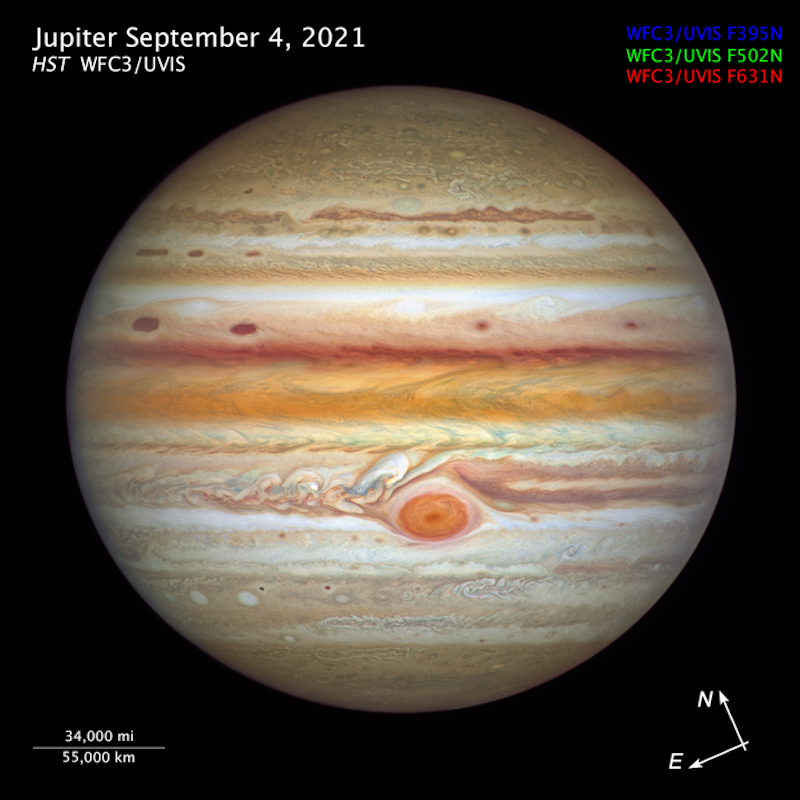
Jupiter with colorful, swirly banded atmosphere, spotted with oval storms. Titles and scale of size.
Jupiter and its stormy atmosphere as seen by the Hubble Space Telescope on September 4, 2021. Image via Amy Simon (NASA-GSFC)/ Michael H. Wong (UC Berkeley)/ Hubblesite.

For precise sun and Jupiter rising times at your location:

Old Farmer’s Almanac (U.S. and Canada)

timeanddate.com (worldwide)

Stellarium (online planetarium program)

In-the-sky information and finder chart for your location

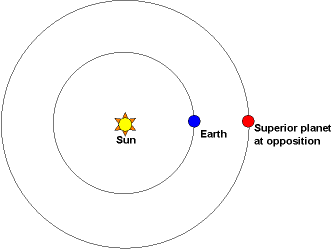
Simple diagram of orbits, showing Earth between an outer planet and the sun.
Opposition happens when Earth flies between an outer planet, like Jupiter, and the sun. Illustration via Chris Peat/ Heavens-Above. Used with permission.

EarthSky Community Photos

Banded planet.
View at EarthSky Community Photos. | Jupiter as captured by David Hoskin in Halifax, Nova Scotia, Canada, on December 7, 2024. David said: “Jupiter is always a lovely sight, especially when at its brightest. The Galilean moon Europa is to the left of the planet.” Thank you, David!
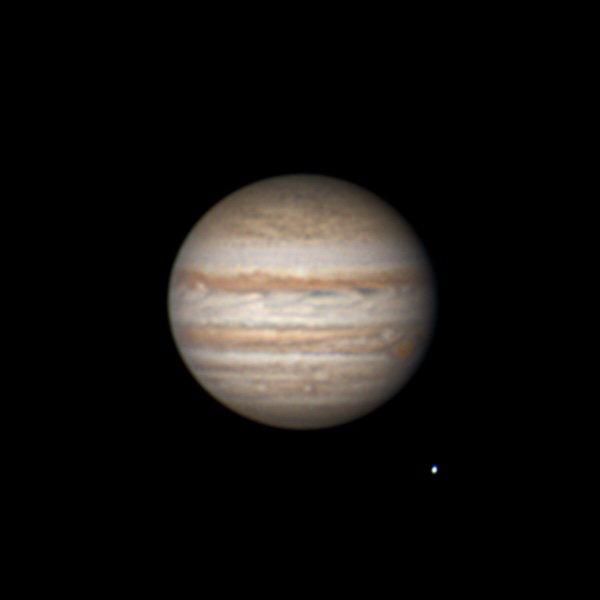
Slightly fuzzy large banded planet with small white dot nearby.
View at EarthSky Community Photos. | Aurelian Neacsu of Visina, Dambovita, Romania, captured this image of Jupiter on August 22, 2023, and wrote: “The bright dot visible on the right bottom corner is not a planet’s satellite; it’s the star Sigma Arietis.” Thank you, Aurelian.

Got a picture of Jupiter? We’d love to see it. Submit them here.

Bottom line: Giant Jupiter is closest to Earth for 2026 on January 9. Then Earth will fly between the sun and Jupiter – bringing Jupiter to opposition – January 10.

Read more: Jupiter’s moons: How to see and enjoy them

Read: Why is Jupiter closest to Earth 1 day before opposition?

The post Earth flies between Jupiter and the sun January 10 first appeared on EarthSky.


from EarthSky https://ift.tt/aAZVyo2
Two images of a banded planet. One planet is bigger than the other.
View at EarthSky Community Photos. | Nishat Khan in Ontario, Canada, shared this image of Jupiter from September 16, 2024, comparing it with one taken a few months later on December 14. Thank you, Nishat! December 2024 was Jupiter’s last opposition, the last time Earth flew between this planet and the sun. At that time, it was at its closest to Earth and so appeared biggest in our sky (through the eyepieces of earthly telescopes). Jupiter will be closest to Earth again on January 9, 2026. It’ll reach opposition on January 10, 2026.

Jupiter in 2025: Earth will fly between the biggest planet in our solar system – Jupiter – and the sun on January 10, 2026. At that time, this mighty world will be most opposite the sun from Earth for this year. It’ll be rising in the east as the sun sets in the west. Astronomers will call it Jupiter’s opposition to the sun. The early months of 2026 will be a great time to observe it!
The exact time of Jupiter’s opposition is 9 UTC (3 a.m. CDT) on January 10, 2026.
Jupiter will be closest to Earth one day before its opposition, on January 9, 2026. At that time, its distance will be 393 million miles/ 633 million km/ 35 light-minutes from Earth. Read: Why is Jupiter closest before opposition?
Opposition constellation in 2026: Gemini the Twins.
Brightness at opposition: Magnitude -2.53. Jupiter shines as the 4th-brightest object in the sky, after the sun, moon and planet Venus. In mid-January 2026, Venus is behind the sun. So Jupiter will be the brightest starlike object visible for most of the night.
Angular size at opposition (as seen through a telescope): 46.58 arcseconds.
Through binoculars (anytime): Jupiter reveals a bright disk. If you look closely, you’ll see several of its four large moons – called the Galilean satellites – appearing as pinpoints of light, arrayed in a line that bisects the giant planet. Read: How to see and enjoy Jupiter’s moons.

A huge banded planet next to tiny Earth.
More than one thousand Earths could fit inside the giant planet Jupiter. Here, the Apollo 17 mission to the moon acquired this image of Earth on December 7, 1972. The Cassini spacecraft, on its way to Saturn, captured this image of Jupiter on December 29, 2000. Image via Brian1908 at Wikimedia Commons.

How often does Jupiter reach opposition?

Jupiter takes 12 earthly years to orbit the sun once. So, the giant planet comes to opposition roughly every 13 months. It didn’t have an opposition in 2025.

2024 Jupiter opposition – December 7
2026 Jupiter opposition – January 10
2027 Jupiter opposition – February 10

Earth takes 12 months to travel once around the sun relative to Jupiter. So, according to our earthly calendars, Jupiter’s opposition comes about a month later each year. Add to that the fact that we recognize 12 constellations of the zodiac. And there are 12 months in a year. So Jupiter appears in front of a new zodiacal constellation at each year’s opposition. This year, it’s in front of Gemini the Twins.

For the fanciful, the giant planet Jupiter is like a real giant, stepping one by one around the zodiacal constellations, over the period of its 12-year orbit.

A bright starlike object, and a fainter one, with a silhouette of a person reaching for them.
Bright Jupiter and fainter Saturn on December 18, 2020 from our friend VegaStar VegaStar C/ Liard Photography. Thank you, VegaStar! ??

Recent Jupiter events

December 7, 2024: Jupiter came to opposition in front of the constellation Taurus.
February 4, 2025: Jupiter ended retrograde motion, a sign that the best time to observe Jupiter had ended. But the planet remained in the night sky through April 2025. In May, it was nearing the sunset glare, becoming increasingly difficult to see.
June 24, 2025: Jupiter was at solar conjunction, or behind the sun as seen from Earth. Afterwards, it emerged in the morning sky in July 2025.
November 11, 2025: Jupiter began retrograde motion, that is, westward motion on the sky’s dome, a sign that opposition lay just ahead.
January 9, 2026: Jupiter at perigee, or closest to Earth for 2026.
January 10, 2026: Jupiter at opposition, or opposite the sun as seen from Earth.

A failed star?

Especially around the time of opposition, it’s fun to think of Jupiter as a failed star. Our sun contains some 99.86% of all the mass in our solar system. Jupiter contains 0.1% of the solar system’s mass. And all the other planets (including Earth), moons, asteroids and comets in our solar system contain 0.04% of the solar system’s mass. So Jupiter is much more massive than all the other planets combined. And, for that reason, we sometimes speak of Jupiter as a failed star.

It’s failed in the sense that it’s not massive enough or hot enough inside to spark thermonuclear fusion reactions, the process that enables stars to shine. Jupiter is big! But, without that thermonuclear reaction it can’t shine as stars do.

Overall, you’d need some 80 Jupiters – rolled into a ball – to be hot enough inside to spark fusion. So, Jupiter isn’t a star. That is, it doesn’t shine with its own light. Instead, it shines by reflected sunlight.

Yet in January 2026 – as bright Jupiter rises in the east opposite the sunset – you can stand on Earth all night and peer toward bright Jupiter in our sky. And indeed, you can imagine that, if the giant planet did have enough mass to shine as stars do, then around Jupiter’s opposition, we’d have no night at all. Instead, Jupiter would shine as a tiny 2nd sun, all night long.

Read more: How to see Jupiter’s moons

Jupiter with colorful, swirly banded atmosphere, spotted with oval storms. Titles and scale of size.
Jupiter and its stormy atmosphere as seen by the Hubble Space Telescope on September 4, 2021. Image via Amy Simon (NASA-GSFC)/ Michael H. Wong (UC Berkeley)/ Hubblesite.

For precise sun and Jupiter rising times at your location:

Old Farmer’s Almanac (U.S. and Canada)

timeanddate.com (worldwide)

Stellarium (online planetarium program)

In-the-sky information and finder chart for your location

Simple diagram of orbits, showing Earth between an outer planet and the sun.
Opposition happens when Earth flies between an outer planet, like Jupiter, and the sun. Illustration via Chris Peat/ Heavens-Above. Used with permission.

EarthSky Community Photos

Banded planet.
View at EarthSky Community Photos. | Jupiter as captured by David Hoskin in Halifax, Nova Scotia, Canada, on December 7, 2024. David said: “Jupiter is always a lovely sight, especially when at its brightest. The Galilean moon Europa is to the left of the planet.” Thank you, David!
Slightly fuzzy large banded planet with small white dot nearby.
View at EarthSky Community Photos. | Aurelian Neacsu of Visina, Dambovita, Romania, captured this image of Jupiter on August 22, 2023, and wrote: “The bright dot visible on the right bottom corner is not a planet’s satellite; it’s the star Sigma Arietis.” Thank you, Aurelian.

Got a picture of Jupiter? We’d love to see it. Submit them here.

Bottom line: Giant Jupiter is closest to Earth for 2026 on January 9. Then Earth will fly between the sun and Jupiter – bringing Jupiter to opposition – January 10.

Read more: Jupiter’s moons: How to see and enjoy them

Read: Why is Jupiter closest to Earth 1 day before opposition?

The post Earth flies between Jupiter and the sun January 10 first appeared on EarthSky.


from EarthSky https://ift.tt/aAZVyo2

NASA’s SPHEREx observatory completes stunning 1st cosmic map

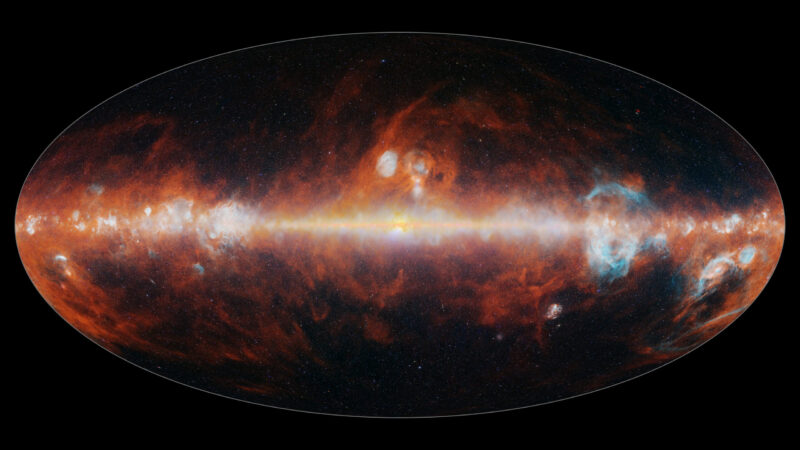
In a dark oval, the bright band of the milky way runs horizontally, surrounded by wild plumes of red and orange gas.
NASA’s SPHEREx has mapped the entire sky in 102 infrared colors, which are invisible to the human eye but can be used to reveal different features of the cosmos. This image features a selection of colors emitted primarily by stars (blue, green, and white), hot hydrogen gas (blue), and cosmic dust (red). Image via NASA/ JPL-Caltech.

EarthSky’s 2026 lunar calendar is available now. Get yours today! Makes a great New Year’s gift.

NASA originally posted this article on December 18, 2025. Edits by EarthSky.

NASA’s SPHEREx observatory completes stunning 1st cosmic map

Launched in March 2025, NASA’s SPHEREx space telescope has completed its first infrared map of the entire sky in 102 colors. While not visible to the human eye, these 102 infrared wavelengths of light are prevalent in the cosmos. And observing the entire sky this way enables scientists to answer big questions, including how a dramatic event that occurred in the first billionth of a trillionth of a trillionth of a second after the Big Bang influenced the distribution of hundreds of millions of galaxies in our universe.

In addition, scientists will use the data to study how galaxies have changed over the universe’s nearly 14-billion-year history, and learn about the distribution of key ingredients for life in our own galaxy.

Shawn Domagal-Goldman, director of the Astrophysics Division at NASA Headquarters in Washington, said:

It’s incredible how much information SPHEREx has collected in just six months, information that will be especially valuable when used alongside our other missions’ data to better understand our universe.

We essentially have 102 new maps of the entire sky, each one in a different wavelength and containing unique information about the objects it sees. I think every astronomer is going to find something of value here, as NASA’s missions enable the world to answer fundamental questions about how the universe got its start, and how it changed to eventually create a home for us in it.


This panoramic view of SPHEREx’s first all-sky map shows how the sky looks to the telescope. It transitions between observations of colors emitted by hot hydrogen gas (blue) and cosmic dust (red), and those primarily emitted by stars. Via NASA/ JPL-Caltech.

What makes SPHEREx special?

Circling Earth about 14 1/2 times a day, SPHEREx (which stands for Spectro-Photometer for the History of the Universe, Epoch of Reionization, and Ices Explorer) travels from north to south, passing over the poles.

Each day it takes about 3,600 images along one circular strip of the sky, and as the days pass and the planet moves around the sun, SPHEREx’s field of view shifts as well. After six months, the observatory has looked out into space in every direction, capturing the entire sky in 360 degrees.

The mission began mapping the sky in May and completed its first all-sky mosaic in December. It will complete three additional all-sky scans during its two-year primary mission. Merging those maps together will increase the sensitivity of the measurements.

The entire dataset is freely available to scientists and the public.

JPL Director Dave Gallagher said:

SPHEREx is a mid-sized astrophysics mission delivering big science. It’s a phenomenal example of how we turn bold ideas into reality, and in doing so, unlock enormous potential for discovery.

Superpowered telescope

Each of the 102 colors detected by SPHEREx represents a wavelength of infrared light, and each wavelength provides unique information about the galaxies, stars, planet-forming regions, and other cosmic features therein.

For example, dense clouds of dust in our galaxy where stars and planets form radiate brightly in certain wavelengths, but emit no light (and are therefore totally invisible) in others. The process of separating the light from a source into its component wavelengths is called spectroscopy.

And while a handful of previous missions have also mapped the entire sky, such as NASA’s Wide-field Infrared Survey Explorer (WISE), none have done so in nearly as many colors as SPHEREx. By contrast, NASA’s James Webb Space Telescope can do spectroscopy with significantly more wavelengths of light than SPHEREx, but with a field of view thousands of times smaller. The combination of colors and such a wide field of view is why SPHEREx is so powerful.

Beth Fabinsky, the SPHEREx project manager at JPL, said:

The superpower of SPHEREx is that it captures the whole sky in 102 colors about every six months. That’s an amazing amount of information to gather in a short amount of time.

I think this makes us the mantis shrimp of telescopes, because we have an amazing multicolor visual detection system and we can also see a very wide swath of our surroundings.


Each frame of this movie shows the entire sky in a different infrared wavelength, indicated by the color bar in the top right corner. Taken by NASA’s SPHEREx observatory, the maps illustrate how viewing the universe in different wavelengths of light can reveal unique cosmic features. Via NASA/ JPL-Caltech.

6 detectors, 102 colors

To accomplish this feat, SPHEREx uses six detectors, each paired with a specially designed filter that contains a gradient of 17 colors. That means every image taken with those six detectors contains 102 colors (six times 17). It also means that every all-sky map that SPHEREx produces is really 102 maps, each in a different color.

The observatory will use those colors to measure the distance to hundreds of millions of galaxies. Though the positions of most of those galaxies have already been mapped in two dimensions by other observatories, SPHEREx’s map will be in 3D, enabling scientists to measure subtle variations in the way galaxies are clustered and distributed across the universe.

Those measurements will offer insights into an event that took place in the first billionth of a trillionth of a trillionth of a second after the Big Bang. In this moment, called inflation, the universe expanded by a trillion-trillionfold. Nothing like it has occurred in the universe since, and scientists want to understand it better. The SPHEREx mission’s approach is one way to help in that effort.

Bottom line: NASA’s SPHEREx has produced its spectacular 1st cosmic map, revealing the entire sky in 102 colors.

Via NASA JPL

Read more: First 1% of new cosmic atlas reveals millions of galaxies

The post NASA’s SPHEREx observatory completes stunning 1st cosmic map first appeared on EarthSky.


from EarthSky https://ift.tt/CQdr8RO
In a dark oval, the bright band of the milky way runs horizontally, surrounded by wild plumes of red and orange gas.
NASA’s SPHEREx has mapped the entire sky in 102 infrared colors, which are invisible to the human eye but can be used to reveal different features of the cosmos. This image features a selection of colors emitted primarily by stars (blue, green, and white), hot hydrogen gas (blue), and cosmic dust (red). Image via NASA/ JPL-Caltech.

EarthSky’s 2026 lunar calendar is available now. Get yours today! Makes a great New Year’s gift.

NASA originally posted this article on December 18, 2025. Edits by EarthSky.

NASA’s SPHEREx observatory completes stunning 1st cosmic map

Launched in March 2025, NASA’s SPHEREx space telescope has completed its first infrared map of the entire sky in 102 colors. While not visible to the human eye, these 102 infrared wavelengths of light are prevalent in the cosmos. And observing the entire sky this way enables scientists to answer big questions, including how a dramatic event that occurred in the first billionth of a trillionth of a trillionth of a second after the Big Bang influenced the distribution of hundreds of millions of galaxies in our universe.

In addition, scientists will use the data to study how galaxies have changed over the universe’s nearly 14-billion-year history, and learn about the distribution of key ingredients for life in our own galaxy.

Shawn Domagal-Goldman, director of the Astrophysics Division at NASA Headquarters in Washington, said:

It’s incredible how much information SPHEREx has collected in just six months, information that will be especially valuable when used alongside our other missions’ data to better understand our universe.

We essentially have 102 new maps of the entire sky, each one in a different wavelength and containing unique information about the objects it sees. I think every astronomer is going to find something of value here, as NASA’s missions enable the world to answer fundamental questions about how the universe got its start, and how it changed to eventually create a home for us in it.


This panoramic view of SPHEREx’s first all-sky map shows how the sky looks to the telescope. It transitions between observations of colors emitted by hot hydrogen gas (blue) and cosmic dust (red), and those primarily emitted by stars. Via NASA/ JPL-Caltech.

What makes SPHEREx special?

Circling Earth about 14 1/2 times a day, SPHEREx (which stands for Spectro-Photometer for the History of the Universe, Epoch of Reionization, and Ices Explorer) travels from north to south, passing over the poles.

Each day it takes about 3,600 images along one circular strip of the sky, and as the days pass and the planet moves around the sun, SPHEREx’s field of view shifts as well. After six months, the observatory has looked out into space in every direction, capturing the entire sky in 360 degrees.

The mission began mapping the sky in May and completed its first all-sky mosaic in December. It will complete three additional all-sky scans during its two-year primary mission. Merging those maps together will increase the sensitivity of the measurements.

The entire dataset is freely available to scientists and the public.

JPL Director Dave Gallagher said:

SPHEREx is a mid-sized astrophysics mission delivering big science. It’s a phenomenal example of how we turn bold ideas into reality, and in doing so, unlock enormous potential for discovery.

Superpowered telescope

Each of the 102 colors detected by SPHEREx represents a wavelength of infrared light, and each wavelength provides unique information about the galaxies, stars, planet-forming regions, and other cosmic features therein.

For example, dense clouds of dust in our galaxy where stars and planets form radiate brightly in certain wavelengths, but emit no light (and are therefore totally invisible) in others. The process of separating the light from a source into its component wavelengths is called spectroscopy.

And while a handful of previous missions have also mapped the entire sky, such as NASA’s Wide-field Infrared Survey Explorer (WISE), none have done so in nearly as many colors as SPHEREx. By contrast, NASA’s James Webb Space Telescope can do spectroscopy with significantly more wavelengths of light than SPHEREx, but with a field of view thousands of times smaller. The combination of colors and such a wide field of view is why SPHEREx is so powerful.

Beth Fabinsky, the SPHEREx project manager at JPL, said:

The superpower of SPHEREx is that it captures the whole sky in 102 colors about every six months. That’s an amazing amount of information to gather in a short amount of time.

I think this makes us the mantis shrimp of telescopes, because we have an amazing multicolor visual detection system and we can also see a very wide swath of our surroundings.


Each frame of this movie shows the entire sky in a different infrared wavelength, indicated by the color bar in the top right corner. Taken by NASA’s SPHEREx observatory, the maps illustrate how viewing the universe in different wavelengths of light can reveal unique cosmic features. Via NASA/ JPL-Caltech.

6 detectors, 102 colors

To accomplish this feat, SPHEREx uses six detectors, each paired with a specially designed filter that contains a gradient of 17 colors. That means every image taken with those six detectors contains 102 colors (six times 17). It also means that every all-sky map that SPHEREx produces is really 102 maps, each in a different color.

The observatory will use those colors to measure the distance to hundreds of millions of galaxies. Though the positions of most of those galaxies have already been mapped in two dimensions by other observatories, SPHEREx’s map will be in 3D, enabling scientists to measure subtle variations in the way galaxies are clustered and distributed across the universe.

Those measurements will offer insights into an event that took place in the first billionth of a trillionth of a trillionth of a second after the Big Bang. In this moment, called inflation, the universe expanded by a trillion-trillionfold. Nothing like it has occurred in the universe since, and scientists want to understand it better. The SPHEREx mission’s approach is one way to help in that effort.

Bottom line: NASA’s SPHEREx has produced its spectacular 1st cosmic map, revealing the entire sky in 102 colors.

Via NASA JPL

Read more: First 1% of new cosmic atlas reveals millions of galaxies

The post NASA’s SPHEREx observatory completes stunning 1st cosmic map first appeared on EarthSky.


from EarthSky https://ift.tt/CQdr8RO

Orion the Hunter, the most recognizable constellation


EarthSky founder Deborah Byrd wants you to come to know the constellation Orion the Hunter. It’s one of the most famous constellations because it’s easy to identify, with several noticeably bright and interesting stars. Plus, Orion can help you visualize your place in the Milky Way galaxy. What’s not to like? Click here for the video. Prefer to read? See below.

Orion the Hunter is arguably the most recognizable constellation in the world. Orion lies on the celestial equator, making it visible from both the Northern and Southern Hemispheres. Orion’s shape is easy to pick out because of its many bright stars and signature Orion’s Belt: three stars close together in a nearly straight line.

The 2026 lunar calendars are here! Great gift for the New Year! Check ’em out here.

Mythology of Orion the Hunter

In many drawings of the constellation Orion, the Hunter looks to be battling his neighbor, Taurus the Bull. Yet there is no such story in the mythology of Orion. Some stories have Orion pursuing the seven sisters of the Pleiades, which is a star cluster in the constellation Taurus. On the other side of Orion are his hunting dogs, Canis Major and Canis Minor (not to be confused with Canes Venatici, a different constellation with the actual nickname of the Hunting Dogs).

Mythology says that a scorpion killed Orion; that’s why Orion is on one side of the sky while Scorpius the Scorpion is on the opposite side. As Scorpius is about to rise in the east, Orion makes a hurried exit from the sky in the west.

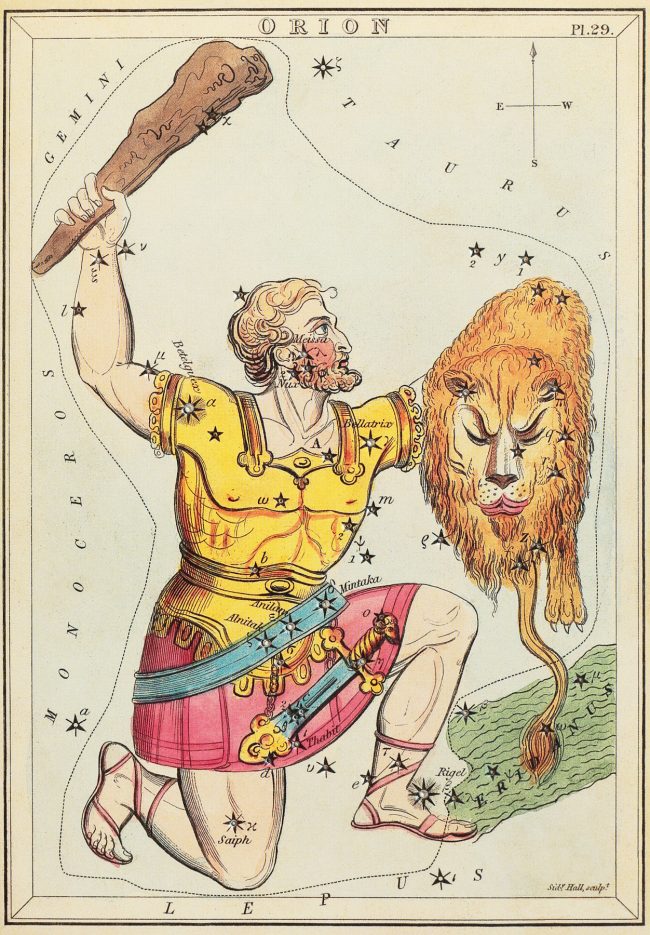
Antique colored etching of a man with a raised club holding a dead lion on his other arm.
Orion the Hunter, as depicted in Urania’s Mirror, a set of constellation cards from around 1825. Image via Wikimedia Commons (public domain).

Brightest stars in Orion

The brightest star in Orion is the bluish Rigel, which marks his western knee or foot. Rigel is a blue supergiant 770 light-years away with a magnitude of 0.2. Rigel is the seventh brightest star in the entire sky. The star marking the other knee or foot of Orion is Saiph, a magnitude 2.1 star. It’s a blue supergiant, 720 light-years distant.

The second brightest star in Orion is reddish-orange Betelgeuse, which marks one shoulder. Betelgeuse is the 10th brightest star in the sky at magnitude 0.5. It’s a red supergiant 550 light-years away and a whopping 800 times larger than our sun. If we substituted Betelgeuse for our sun, it would swallow up all the inner planets.

The third brightest star of Orion, which marks his other shoulder, is Bellatrix. Bellatrix, a blue supergiant shining at magnitude 1.6, is the 22nd brightest star in the sky and lies 245 light-years away.

Wide array of somewhat fuzzy stars, one distinctly orange, in a dark, star-strewn sky.
View at EarthSky Community Photos. | Amr Elsayed of Egypt submitted this photo on December 6, 2024, and wrote: “The Orion constellation is one of the most recognizable due to the 3 stars that form a line in the center. The image also shows the Orion Nebula, a gas and dust cloud about 1,500 light-years away, and includes the orange star Betelgeuse, which is expected to end its life soon, and will potentially be as bright as the moon.” Thank you, Amr!

Other stars in Orion

Extending out from Bellatrix is Orion’s arm, where he is holding either a shield or an animal, depending on the artist’s concept. The brighter stars marking this object are all of 3rd and 4th magnitude.

Extending upward from Betelgeuse is Orion’s other arm, which holds a club or sword. The brightest stars in the arm and club are all 4th magnitude.

The stars that make up Orion’s head are a test of your sky’s darkness. They range from 3rd magnitude to 6th magnitude. The more stars you can see, the better your skies are.

The three Belt stars from east to west are Alnitak (magnitude 1.8), Alnilam (magnitude 1.7) and Mintaka (magnitude 2.2).


EarthSky’s Marcy Curran shows you how to use the constellation Orion as a key to find other stars and constellations in the night sky.

Nebulae of Orion the Hunter

The stars in the Sword that hangs down from the Belt are part of the Orion Nebula (M42). Yes, you can see the nebula, or cloud of gas, without optical aid as a hazy, 4th-magnitude patch. Using magnification reveals a quadruple star at the center of the nebula. These four newborn stars – the Trapezium Cluster – light up their dusty cocoon, making its glow visible to us here on Earth, a vast 1,400 light-years away.

The famous Horsehead Nebula lies near the Belt star Alnitak. This dark nebula is a faint target even for most amateur telescopes; your best bet is to view it in a picture compliments of an astrophotographer. (Learn more about dark nebulae.)

Along Orion’s side between Alnitak and Betelgeuse (but closer to the belt stars) is the 8th-magnitude nebula M78. M78 has the awkward title of “brightest diffuse reflection nebula in the sky.” One more notable nebula in Orion is near Rigel and crosses into Eridanus the River. IC 2118, the Witch Head Nebula, is extremely faint but also extremely large, spanning six full moons.

Large swirls of mixed purple and blue cloudiness with prolific stars in the foreground.
View at EarthSky Community Photos. | Andy Dungan near Cotopaxi, Colorado, captured this telescopic view of the Orion Nebula on October 4, 2024. Andy wrote: “I recently took a pic of Orion [look here] using an Antlia RGB enhancer. This photo turned out much bluer. Both pics are fun and I think I like the bluer one better. Orion is such a wonderful object to explore.” It definitely is, thank you, Andy!

More EarthSky Community Photos of Orion

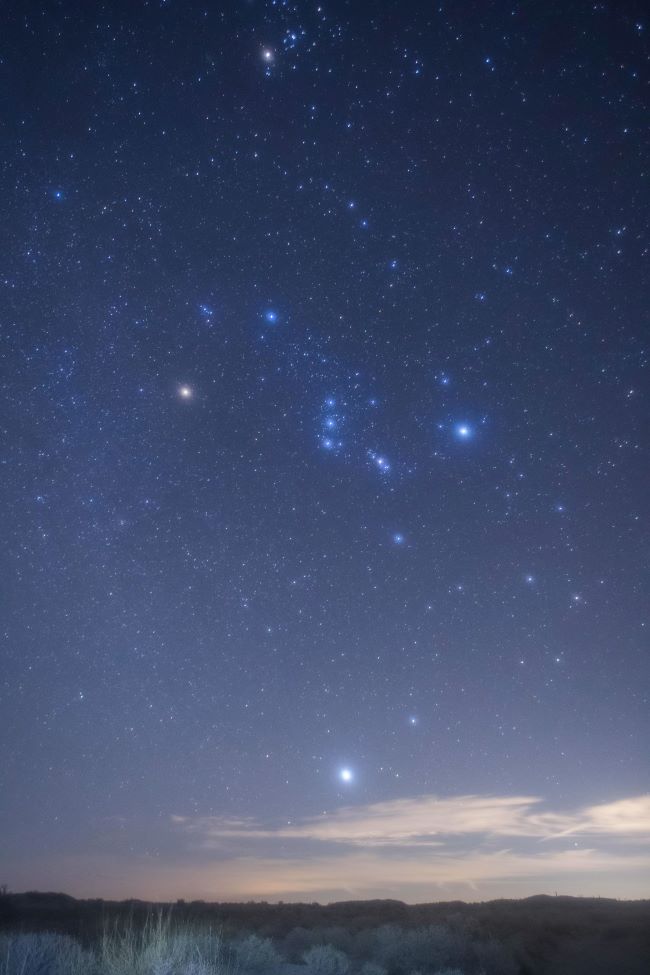
Bright but slightly fuzzy stars in wide array high above dark landscape, and one single one near horizon.
View at EarthSky Community Photos. | Sergei Timofeevski shared this image from November 13, 2023. Sergei wrote: “The constellation Orion the Hunter and the star Sirius rising just above the eastern horizon in the Anza-Borrego Desert State Park, California.” Thank you, Sergei! Note bright Sirius is on the bottom, and Orion’s Belt pointing to it.
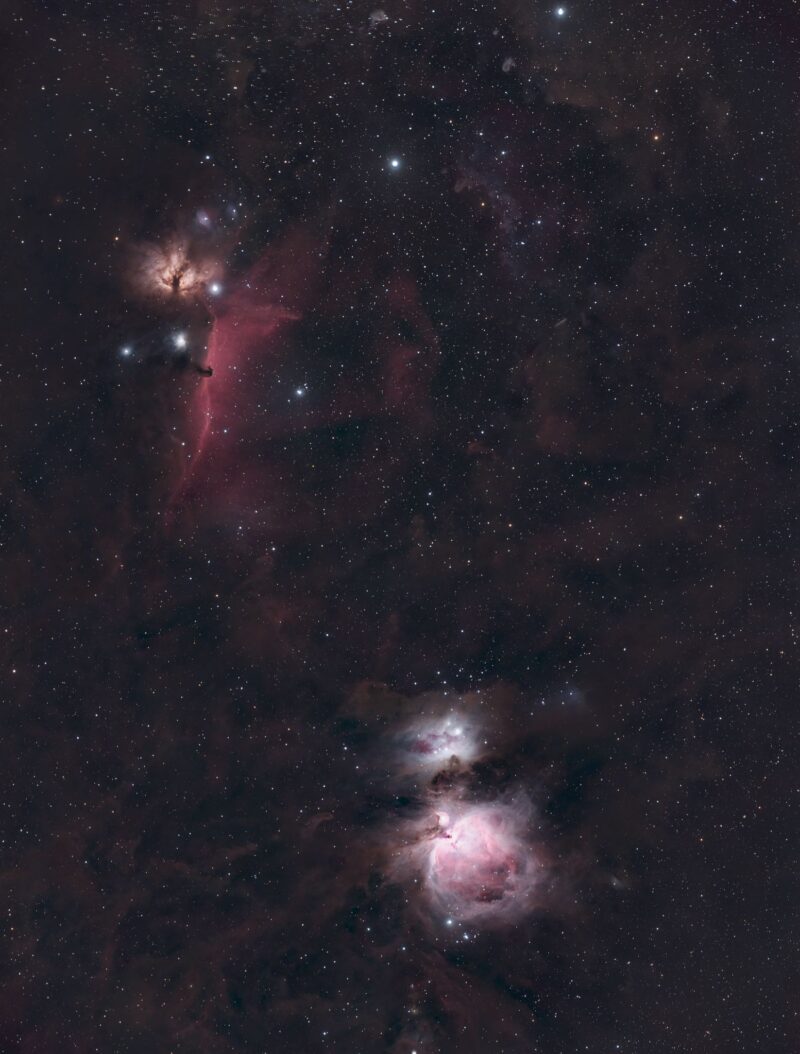
Two clouds of bright nebulosity (the one at top red, the one at bottom white and pink) over a multitude of distant stars.
View at EarthSky Community Photos. | Catherine Hyde in Cambria, California, captured these nebulae in Orion on January 5, 2024. Catherine wrote: “This is essentially first light on my new Redcat 51 scope, the smallest scope I’ve ever had. The short focal length allowed me to frame the belt and sword of Orion in one image. Included are the Flame and Horsehead Nebulae, and the iconic Orion Nebula with the Running Man above it.” Thank you, Catherine!
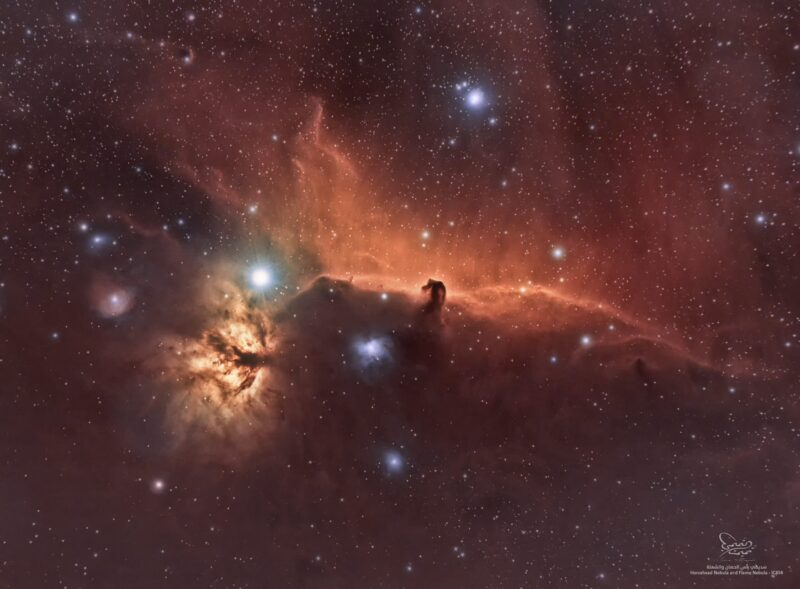
Orange cloud of gas with a dark, horsehead-shaped indentation. Many stars, several very bright.
View at EarthSky Community Photos. | Tameem Altameemi in the Ras Al Khaimah Mountains, United Arab Emirates (UAE), captured this telescopic view of the Horsehead Nebula in the constellation Orion on November 18, 2023. Tameem wrote: “My astrophotography from the sky of UAE. The Flame Nebula, designated as NGC 2024 and Sh2-277, is an emission nebula in the constellation Orion. It is about 900 to 1,500 light-years away, and the Horsehead Nebula, a small dark nebula in the constellation Orion.” Thank you, Tameem!

Bottom line: Orion the Hunter may be the most recognizable constellation in the world. It’s visible from the north in winter and from the south in summer. And it’s full of many deep-sky treasures.

Read more: Orion the Hunter is easy to spot

The post Orion the Hunter, the most recognizable constellation first appeared on EarthSky.


from EarthSky https://ift.tt/O5F0uN1


EarthSky founder Deborah Byrd wants you to come to know the constellation Orion the Hunter. It’s one of the most famous constellations because it’s easy to identify, with several noticeably bright and interesting stars. Plus, Orion can help you visualize your place in the Milky Way galaxy. What’s not to like? Click here for the video. Prefer to read? See below.

Orion the Hunter is arguably the most recognizable constellation in the world. Orion lies on the celestial equator, making it visible from both the Northern and Southern Hemispheres. Orion’s shape is easy to pick out because of its many bright stars and signature Orion’s Belt: three stars close together in a nearly straight line.

The 2026 lunar calendars are here! Great gift for the New Year! Check ’em out here.

Mythology of Orion the Hunter

In many drawings of the constellation Orion, the Hunter looks to be battling his neighbor, Taurus the Bull. Yet there is no such story in the mythology of Orion. Some stories have Orion pursuing the seven sisters of the Pleiades, which is a star cluster in the constellation Taurus. On the other side of Orion are his hunting dogs, Canis Major and Canis Minor (not to be confused with Canes Venatici, a different constellation with the actual nickname of the Hunting Dogs).

Mythology says that a scorpion killed Orion; that’s why Orion is on one side of the sky while Scorpius the Scorpion is on the opposite side. As Scorpius is about to rise in the east, Orion makes a hurried exit from the sky in the west.

Antique colored etching of a man with a raised club holding a dead lion on his other arm.
Orion the Hunter, as depicted in Urania’s Mirror, a set of constellation cards from around 1825. Image via Wikimedia Commons (public domain).

Brightest stars in Orion

The brightest star in Orion is the bluish Rigel, which marks his western knee or foot. Rigel is a blue supergiant 770 light-years away with a magnitude of 0.2. Rigel is the seventh brightest star in the entire sky. The star marking the other knee or foot of Orion is Saiph, a magnitude 2.1 star. It’s a blue supergiant, 720 light-years distant.

The second brightest star in Orion is reddish-orange Betelgeuse, which marks one shoulder. Betelgeuse is the 10th brightest star in the sky at magnitude 0.5. It’s a red supergiant 550 light-years away and a whopping 800 times larger than our sun. If we substituted Betelgeuse for our sun, it would swallow up all the inner planets.

The third brightest star of Orion, which marks his other shoulder, is Bellatrix. Bellatrix, a blue supergiant shining at magnitude 1.6, is the 22nd brightest star in the sky and lies 245 light-years away.

Wide array of somewhat fuzzy stars, one distinctly orange, in a dark, star-strewn sky.
View at EarthSky Community Photos. | Amr Elsayed of Egypt submitted this photo on December 6, 2024, and wrote: “The Orion constellation is one of the most recognizable due to the 3 stars that form a line in the center. The image also shows the Orion Nebula, a gas and dust cloud about 1,500 light-years away, and includes the orange star Betelgeuse, which is expected to end its life soon, and will potentially be as bright as the moon.” Thank you, Amr!

Other stars in Orion

Extending out from Bellatrix is Orion’s arm, where he is holding either a shield or an animal, depending on the artist’s concept. The brighter stars marking this object are all of 3rd and 4th magnitude.

Extending upward from Betelgeuse is Orion’s other arm, which holds a club or sword. The brightest stars in the arm and club are all 4th magnitude.

The stars that make up Orion’s head are a test of your sky’s darkness. They range from 3rd magnitude to 6th magnitude. The more stars you can see, the better your skies are.

The three Belt stars from east to west are Alnitak (magnitude 1.8), Alnilam (magnitude 1.7) and Mintaka (magnitude 2.2).


EarthSky’s Marcy Curran shows you how to use the constellation Orion as a key to find other stars and constellations in the night sky.

Nebulae of Orion the Hunter

The stars in the Sword that hangs down from the Belt are part of the Orion Nebula (M42). Yes, you can see the nebula, or cloud of gas, without optical aid as a hazy, 4th-magnitude patch. Using magnification reveals a quadruple star at the center of the nebula. These four newborn stars – the Trapezium Cluster – light up their dusty cocoon, making its glow visible to us here on Earth, a vast 1,400 light-years away.

The famous Horsehead Nebula lies near the Belt star Alnitak. This dark nebula is a faint target even for most amateur telescopes; your best bet is to view it in a picture compliments of an astrophotographer. (Learn more about dark nebulae.)

Along Orion’s side between Alnitak and Betelgeuse (but closer to the belt stars) is the 8th-magnitude nebula M78. M78 has the awkward title of “brightest diffuse reflection nebula in the sky.” One more notable nebula in Orion is near Rigel and crosses into Eridanus the River. IC 2118, the Witch Head Nebula, is extremely faint but also extremely large, spanning six full moons.

Large swirls of mixed purple and blue cloudiness with prolific stars in the foreground.
View at EarthSky Community Photos. | Andy Dungan near Cotopaxi, Colorado, captured this telescopic view of the Orion Nebula on October 4, 2024. Andy wrote: “I recently took a pic of Orion [look here] using an Antlia RGB enhancer. This photo turned out much bluer. Both pics are fun and I think I like the bluer one better. Orion is such a wonderful object to explore.” It definitely is, thank you, Andy!

More EarthSky Community Photos of Orion

Bright but slightly fuzzy stars in wide array high above dark landscape, and one single one near horizon.
View at EarthSky Community Photos. | Sergei Timofeevski shared this image from November 13, 2023. Sergei wrote: “The constellation Orion the Hunter and the star Sirius rising just above the eastern horizon in the Anza-Borrego Desert State Park, California.” Thank you, Sergei! Note bright Sirius is on the bottom, and Orion’s Belt pointing to it.
Two clouds of bright nebulosity (the one at top red, the one at bottom white and pink) over a multitude of distant stars.
View at EarthSky Community Photos. | Catherine Hyde in Cambria, California, captured these nebulae in Orion on January 5, 2024. Catherine wrote: “This is essentially first light on my new Redcat 51 scope, the smallest scope I’ve ever had. The short focal length allowed me to frame the belt and sword of Orion in one image. Included are the Flame and Horsehead Nebulae, and the iconic Orion Nebula with the Running Man above it.” Thank you, Catherine!
Orange cloud of gas with a dark, horsehead-shaped indentation. Many stars, several very bright.
View at EarthSky Community Photos. | Tameem Altameemi in the Ras Al Khaimah Mountains, United Arab Emirates (UAE), captured this telescopic view of the Horsehead Nebula in the constellation Orion on November 18, 2023. Tameem wrote: “My astrophotography from the sky of UAE. The Flame Nebula, designated as NGC 2024 and Sh2-277, is an emission nebula in the constellation Orion. It is about 900 to 1,500 light-years away, and the Horsehead Nebula, a small dark nebula in the constellation Orion.” Thank you, Tameem!

Bottom line: Orion the Hunter may be the most recognizable constellation in the world. It’s visible from the north in winter and from the south in summer. And it’s full of many deep-sky treasures.

Read more: Orion the Hunter is easy to spot

The post Orion the Hunter, the most recognizable constellation first appeared on EarthSky.


from EarthSky https://ift.tt/O5F0uN1

Strange ‘spider’ on Europa hints at water lurking below

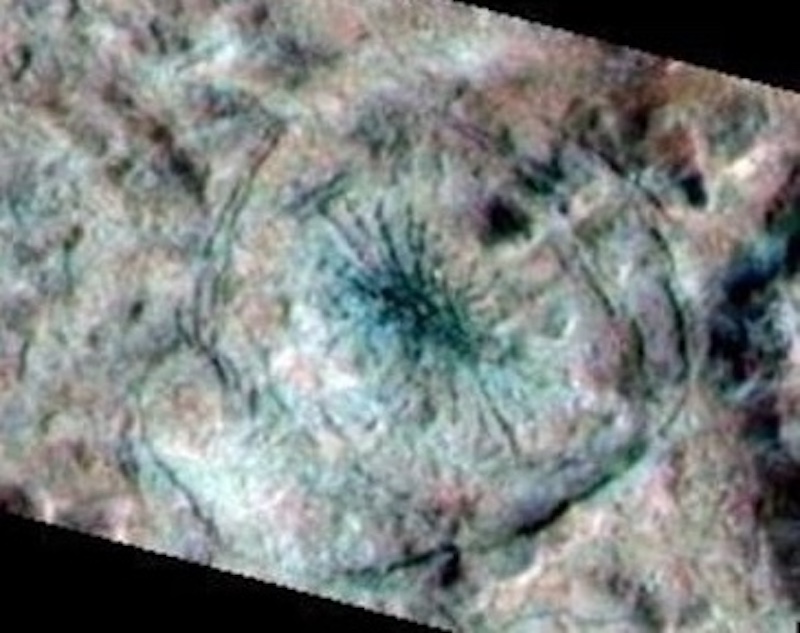
Spider on Europa: Large shallow crater with dark many-legged spider-like shape at its center.
View larger. | NASA’s Galileo spacecraft captured this view of the ‘spider’ on Europa – one of Jupiter’s moons – in Manannán crater in May 1998. Image via NASA/JPL/ University of Arizona/ Planetary Science Institute.

EarthSky’s 2026 lunar calendar is available now. Get yours today! Makes a great New Year’s gift.

  • A huge spider-like formation on Jupiter’s moon Europa appears in a shallow crater. How did it form?
  • Briny (salty) water coming to the surface after the impact that made the crater probably created the unusual feature.
  • The “spider” is similar to features on Mars and Earth, even though the conditions it formed in are quite different. It could provide clues about habitability in pockets of water within the icy crust.

A giant ‘spider’ on Europa

Did you know there is a huge ‘spider’ on Jupiter’s moon Europa? A team of researchers from the Planetary Science Institute, the University of Central Florida, NASA’s Jet Propulsion Laboratory (JPL) and other institutions has recently completed a new study into the unusual feature, located in Manannán crater.

The researchers said earlier this month that the odd formation likely formed from brines – salty water – that erupted to the surface due to the impact that created the crater. And while this spider is not an actual lifeform of course, it could provide valuable clues about subsurface conditions within the ice crust, including lakes or other pockets of liquid water.

There are similar features on both Earth and Mars, too. The Europa spider differs from the ones on Mars in that the Martian ones form when carbon dioxide gas escapes from underground. The gas then erodes the dust and sand on the surface into the spider-like shapes. On Earth, similar features on frozen lakes and ponds are called lake stars.

The unusual spider-like formation – nicknamed Damhán Alla, Irish for “spider” – is in Manannán crater. The crater is about 21-23 kilometers (13-14 miles) in diameter, making it one of the largest craters on Europa. The spider sits in the middle of the crater.

Spacecraft have previously mapped the crater in infrared, finding ice and hydrated water minerals concentrated around the crater. The crater is quite shallow, suggesting the impact occurred in a warmer, soft icy crust over the subsurface ocean.

The researchers published their peer-reviewed findings in The Planetary Science Journal on December 2, 2025.

“This spider-like feature might have formed through the eruption of melted brines following the Manannán impact,” said Elodie Lesage, PSI research scientist and study co-author. Read the full story: buff.ly/J8YWM1P

Planetary Science Institute (@psi.edu) 2025-12-02T18:37:07.728Z

‘Spider’ on Europa born in an ancient impact

So, how did the intriguing spider form? Co-author Elodie Lesage at the Planetary Science Institute said it was probably the result of briny water coming to the surface:

This spider-like feature might have formed through the eruption of melted brines following the Manannán impact. This would mean that it can inform us on subsurface properties and brine composition at the time of the impact.

The researchers tested the hypothesis by observing earthly lake stars in Breckenridge, Colorado, and recreating the process in a cryogenic glovebox at NASA’s Jet Propulsion Laboratory (JPL), using Europa ice simulants cooled with liquid nitrogen. Lead author Lauren Mc Keown, a planetary geomorphologist at the University of Central Florida, said:

We flowed water through these simulants under different temperatures and found that similar star-like patterns formed even under extremely cold temperatures (-100 degrees Celsius/ -148 degrees Fahrenheit), supporting the idea that the same mechanism could occur on Europa after impact.


This animation depicts how the spider might have formed in the crater on Europa. Video via Mc Keown et al./ Planetary Science Institute (CC BY 4.0).

Spiders on Mars

Even though the formation process might be a bit different, the spider on Europa does resemble the spiders on Mars.

On Mars, carbon dioxide gas escapes to the surface from underground at the south pole. The gas erupts through a layer of frozen carbon dioxide (dry ice) in the Martian spring when temperatures warm up a bit. The gas erodes the surrounding dust and sand into the spider-like shapes.

Smiling young woman with long blond hair wearing a black t-shirt with blue logo that says Europa Clipper.
Lauren Mc Keown, a planetary geomorphologist at the University of Central Florida, led the new study about the ‘spider’ on Europa. Image via University of Central Florida.

Lake stars on Earth

There is also a similarity to lake stars on Earth. Lake stars form when snow falls on frozen lakes. As Mc Keown explained:

Lake stars [on Earth] are radial, branching patterns that form when snow falls on frozen lakes and the weight of the snow creates holes in the ice, allowing water to flow through the snow, melting it and spreading in a way that is energetically favorable. On Europa, we believe a subsurface brine reservoir could have erupted [after an impact] and spread through porous surface ice, producing a similar pattern.

As the researchers note, lake stars on Earth can provide clues about similar formations on Europa. But the conditions they form in are quite different from those on our planet. Mc Keown said:

While lake stars have provided valuable insight, Earth’s conditions are very different from Europa’s. Earth has a nitrogen-rich atmosphere, while Europa’s environment is extremely low in pressure and temperature. In this study, we combined field observations with lab experiments to better simulate Europa’s surface conditions.

Several spider-like shapes of cracks in reddish terrain. Each shape has many cracks radiating outward.
View larger. | Martian spider formations in the south polar region. NASA’s Mars Reconnaissance Orbiter took this photo on August 23, 2009. The shapes were carved into the terrain by carbon dioxide gas escaping from beneath layers of ice. Image via NASA/ JPL-Caltech/ University of Arizona.
6 photos of spider-like branching formations on ice-covered lakes and ponds.
View larger. | Examples of lake stars on Earth. Image via Joe Stock/ Mc Keown et al./ The Planetary Science Journal (CC BY 4.0).
Dark circular opening in ice with many cracks like legs radiating from it.
View at EarthSky Community Photos. | An Earthly lake star in icy Southern Alberta, Canada. Sheryl R. Garrison captured this image on December 21, 2025, and wrote: “A short cold snap, enough to freeze ice several inches thick, followed by warmer weather, then the magic of snowfall on top, gives me an excellent opportunity to spot these beautiful ice formations.” Thank you, Sheryl.

Clues about habitability

While the spider on Europa doesn’t seem to be directly associated with the subsurface ocean, it can still provide clues as to possible habitability within the ice crust on top of the ocean. Some studies suggest there are lakes in the crust. And the brine that was exposed on the surface by the crater impact might have originated from one of those lakes or another reservoir of salty water. Lesage said:

Using numerical modelling of the brine reservoir, we obtained constraints on the reservoir potential depth (up to 3.7 miles or 6 km) below the surface) and lifetime (up to a few thousands of years post-impact). This is valuable information for future missions looking for habitable environments within icy shells.

NASA’s upcoming Europa Clipper mission, due to arrive in 2030, will be able to take a closer look at this and possibly other spiders on Europa. Scientists could then better understand just how they form and whether the briny water might be habitable for microbes.

Bottom line: Researchers say that a huge ‘spider’ on Europa likely formed when a crater-creating impact caused briny water to spill out onto the surface.

Source: Lake Stars as an Earth Analog for Europa’s Manannán Crater Spider Feature

Via Planetary Science Institute

Read more: Juno images of Europa reveal a complex, active surface

Read more: Scientists recreate exotic Martian ‘spiders’ for 1st time

The post Strange ‘spider’ on Europa hints at water lurking below first appeared on EarthSky.


from EarthSky https://ift.tt/a4qZ51P
Spider on Europa: Large shallow crater with dark many-legged spider-like shape at its center.
View larger. | NASA’s Galileo spacecraft captured this view of the ‘spider’ on Europa – one of Jupiter’s moons – in Manannán crater in May 1998. Image via NASA/JPL/ University of Arizona/ Planetary Science Institute.

EarthSky’s 2026 lunar calendar is available now. Get yours today! Makes a great New Year’s gift.

  • A huge spider-like formation on Jupiter’s moon Europa appears in a shallow crater. How did it form?
  • Briny (salty) water coming to the surface after the impact that made the crater probably created the unusual feature.
  • The “spider” is similar to features on Mars and Earth, even though the conditions it formed in are quite different. It could provide clues about habitability in pockets of water within the icy crust.

A giant ‘spider’ on Europa

Did you know there is a huge ‘spider’ on Jupiter’s moon Europa? A team of researchers from the Planetary Science Institute, the University of Central Florida, NASA’s Jet Propulsion Laboratory (JPL) and other institutions has recently completed a new study into the unusual feature, located in Manannán crater.

The researchers said earlier this month that the odd formation likely formed from brines – salty water – that erupted to the surface due to the impact that created the crater. And while this spider is not an actual lifeform of course, it could provide valuable clues about subsurface conditions within the ice crust, including lakes or other pockets of liquid water.

There are similar features on both Earth and Mars, too. The Europa spider differs from the ones on Mars in that the Martian ones form when carbon dioxide gas escapes from underground. The gas then erodes the dust and sand on the surface into the spider-like shapes. On Earth, similar features on frozen lakes and ponds are called lake stars.

The unusual spider-like formation – nicknamed Damhán Alla, Irish for “spider” – is in Manannán crater. The crater is about 21-23 kilometers (13-14 miles) in diameter, making it one of the largest craters on Europa. The spider sits in the middle of the crater.

Spacecraft have previously mapped the crater in infrared, finding ice and hydrated water minerals concentrated around the crater. The crater is quite shallow, suggesting the impact occurred in a warmer, soft icy crust over the subsurface ocean.

The researchers published their peer-reviewed findings in The Planetary Science Journal on December 2, 2025.

“This spider-like feature might have formed through the eruption of melted brines following the Manannán impact,” said Elodie Lesage, PSI research scientist and study co-author. Read the full story: buff.ly/J8YWM1P

Planetary Science Institute (@psi.edu) 2025-12-02T18:37:07.728Z

‘Spider’ on Europa born in an ancient impact

So, how did the intriguing spider form? Co-author Elodie Lesage at the Planetary Science Institute said it was probably the result of briny water coming to the surface:

This spider-like feature might have formed through the eruption of melted brines following the Manannán impact. This would mean that it can inform us on subsurface properties and brine composition at the time of the impact.

The researchers tested the hypothesis by observing earthly lake stars in Breckenridge, Colorado, and recreating the process in a cryogenic glovebox at NASA’s Jet Propulsion Laboratory (JPL), using Europa ice simulants cooled with liquid nitrogen. Lead author Lauren Mc Keown, a planetary geomorphologist at the University of Central Florida, said:

We flowed water through these simulants under different temperatures and found that similar star-like patterns formed even under extremely cold temperatures (-100 degrees Celsius/ -148 degrees Fahrenheit), supporting the idea that the same mechanism could occur on Europa after impact.


This animation depicts how the spider might have formed in the crater on Europa. Video via Mc Keown et al./ Planetary Science Institute (CC BY 4.0).

Spiders on Mars

Even though the formation process might be a bit different, the spider on Europa does resemble the spiders on Mars.

On Mars, carbon dioxide gas escapes to the surface from underground at the south pole. The gas erupts through a layer of frozen carbon dioxide (dry ice) in the Martian spring when temperatures warm up a bit. The gas erodes the surrounding dust and sand into the spider-like shapes.

Smiling young woman with long blond hair wearing a black t-shirt with blue logo that says Europa Clipper.
Lauren Mc Keown, a planetary geomorphologist at the University of Central Florida, led the new study about the ‘spider’ on Europa. Image via University of Central Florida.

Lake stars on Earth

There is also a similarity to lake stars on Earth. Lake stars form when snow falls on frozen lakes. As Mc Keown explained:

Lake stars [on Earth] are radial, branching patterns that form when snow falls on frozen lakes and the weight of the snow creates holes in the ice, allowing water to flow through the snow, melting it and spreading in a way that is energetically favorable. On Europa, we believe a subsurface brine reservoir could have erupted [after an impact] and spread through porous surface ice, producing a similar pattern.

As the researchers note, lake stars on Earth can provide clues about similar formations on Europa. But the conditions they form in are quite different from those on our planet. Mc Keown said:

While lake stars have provided valuable insight, Earth’s conditions are very different from Europa’s. Earth has a nitrogen-rich atmosphere, while Europa’s environment is extremely low in pressure and temperature. In this study, we combined field observations with lab experiments to better simulate Europa’s surface conditions.

Several spider-like shapes of cracks in reddish terrain. Each shape has many cracks radiating outward.
View larger. | Martian spider formations in the south polar region. NASA’s Mars Reconnaissance Orbiter took this photo on August 23, 2009. The shapes were carved into the terrain by carbon dioxide gas escaping from beneath layers of ice. Image via NASA/ JPL-Caltech/ University of Arizona.
6 photos of spider-like branching formations on ice-covered lakes and ponds.
View larger. | Examples of lake stars on Earth. Image via Joe Stock/ Mc Keown et al./ The Planetary Science Journal (CC BY 4.0).
Dark circular opening in ice with many cracks like legs radiating from it.
View at EarthSky Community Photos. | An Earthly lake star in icy Southern Alberta, Canada. Sheryl R. Garrison captured this image on December 21, 2025, and wrote: “A short cold snap, enough to freeze ice several inches thick, followed by warmer weather, then the magic of snowfall on top, gives me an excellent opportunity to spot these beautiful ice formations.” Thank you, Sheryl.

Clues about habitability

While the spider on Europa doesn’t seem to be directly associated with the subsurface ocean, it can still provide clues as to possible habitability within the ice crust on top of the ocean. Some studies suggest there are lakes in the crust. And the brine that was exposed on the surface by the crater impact might have originated from one of those lakes or another reservoir of salty water. Lesage said:

Using numerical modelling of the brine reservoir, we obtained constraints on the reservoir potential depth (up to 3.7 miles or 6 km) below the surface) and lifetime (up to a few thousands of years post-impact). This is valuable information for future missions looking for habitable environments within icy shells.

NASA’s upcoming Europa Clipper mission, due to arrive in 2030, will be able to take a closer look at this and possibly other spiders on Europa. Scientists could then better understand just how they form and whether the briny water might be habitable for microbes.

Bottom line: Researchers say that a huge ‘spider’ on Europa likely formed when a crater-creating impact caused briny water to spill out onto the surface.

Source: Lake Stars as an Earth Analog for Europa’s Manannán Crater Spider Feature

Via Planetary Science Institute

Read more: Juno images of Europa reveal a complex, active surface

Read more: Scientists recreate exotic Martian ‘spiders’ for 1st time

The post Strange ‘spider’ on Europa hints at water lurking below first appeared on EarthSky.


from EarthSky https://ift.tt/a4qZ51P

Earth at perihelion – closest to sun – on January 3

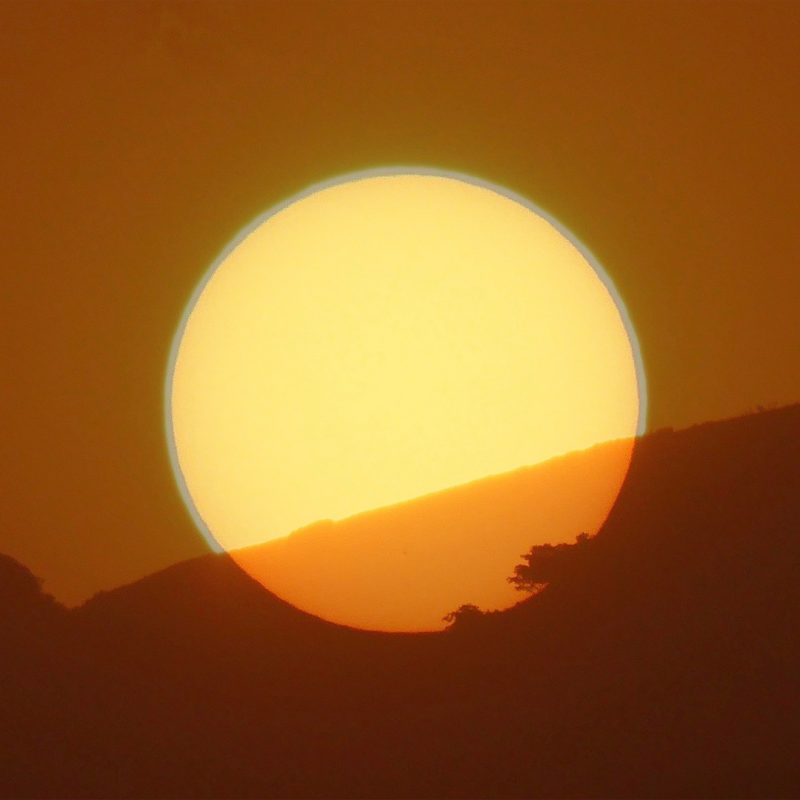
Large solid yellow circle on horizon with a thin green band around its outside.
The gray outline illustrates how much bigger the sun looks at perihelion, our closest point to the sun, on January 3, 2026. It’s in contrast to the yellow ball, showing the apparent size of the sun when Earth is farthest from the sun in July. This size difference isn’t large enough to detect with the eye. And, of course, you should NEVER look directly at the sun! Image via Peter Lowenstein in Mutare, Zimbabwe. Read more about this image.

A cool cosmic coincidence kicks off 2026! The first full moon of the year — a supermoon — will coincide with Earth’s closest approach to the sun, known as perihelion, on and around January 2–3. That means the Earth, moon, and sun will all be unusually close and aligned as the new year begins. This rare event hasn’t happened since January 1912 and won’t occur again in our lifetimes. Join us on EarthSky’s livestream at 12 p.m. CST (18 UTC) on Wednesday, December 31, to explore this unique celestial alignment, learn why the seasons don’t follow Earth’s distance from the sun, and see how these subtle cosmic forces shape our sky.

Earth at perihelion in January

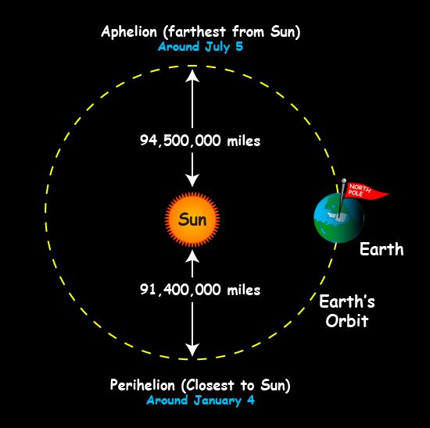
Earth’s orbit around the sun isn’t a circle. Instead, it’s an ellipse, like a circle someone sat down on. So, it makes sense that Earth has closest and farthest points from the sun each year. For 2026, our closest point comes at 17 UTC on January 3 (11 a.m. CST). This closest Earth-sun distance is called perihelion, from the Greek roots peri meaning near and helios meaning sun. At that time, Earth will be 91,403,637 miles (147,099,894 km) from the sun.

In early January, we’re about 3% closer to the sun – roughly 1.5 million miles (2.5 million km) – than we are during Earth’s aphelion (farthest point) in early July. That’s in contrast to our average distance of about 93 million miles (150 million km).

NASA Earth Fact Sheet with precise perihelion and aphelion distances.

So, Earth is closest to the sun every year in early January, when it’s winter for the Northern Hemisphere.

And we’re farthest away from the sun in early July, during our Northern Hemisphere summer.

Clearly, Earth’s distance from the sun isn’t the cause of the seasons.

Earth’s orbit doesn’t cause seasons

Earth’s orbit isn’t a circle. But it’s nearly circular. And it’s not our distance from the sun that creates winter and summer on Earth. Instead, the tilt of our world’s axis with respect to our orbit causes seasons.

In winter, your part of Earth is tilted away from the sun. In summer, your part of Earth is tilted toward the sun. The day of maximum tilt toward or away from the sun is the December or June solstice.

The tilt changes the angle of sunlight falling on your part of Earth. More direct sunlight = summer. Less direct sunlight = winter.

Diagram of sun at center with Earth orbit shown, labeled with distances apart during aphelion and perihelion.
Earth is closest to the sun at perihelion and farthest at aphelion. But – for Earth – the difference in distance isn’t much. Please note that the relative diameters of the sun and Earth are not to scale. Image via NASA.

Earth’s orbit affects length of the seasons

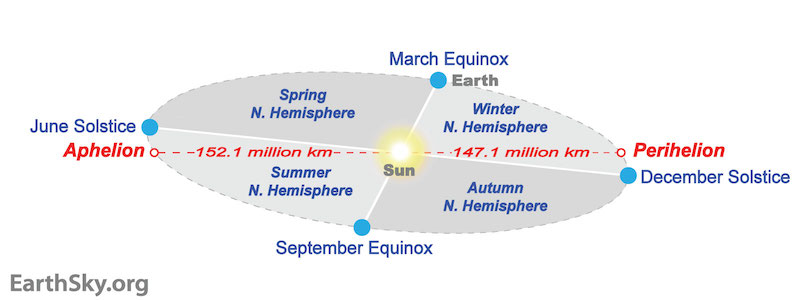
Though not responsible for the seasons, Earth’s closest and farthest points to the sun do affect seasonal lengths. When the Earth comes closest to the sun for the year, as we do every year in early January, our world is moving fastest in orbit. Earth is rushing along now at almost 19 miles per second (30.3 km/s), moving about 0.6 miles per second (1 km/s) faster than when Earth is farthest from the sun in early July. So the Northern Hemisphere winter and – simultaneously – the Southern Hemisphere summer are the shortest seasons, as Earth rushes from the solstice in December to the equinox in March.

In the Northern Hemisphere, the summer season (June solstice to September equinox) lasts nearly five days longer than our winter season. This holds true for the corresponding seasons in the Southern Hemisphere, as well. And the Southern Hemisphere winter is nearly five days longer than the Southern Hemisphere summer.

The 30-second YouTube video below illustrates how a planetary body speeds up around perihelion and slows down at aphelion. It’s due to Kepler’s second law of planetary motion: a line connecting the sun and a planet sweeps out equal areas in equal times.

Complicated diagram of elliptical orbit with 4 sections labeled as the seasons and perihelion and aphelion marked.
For 2026, the Northern Hemisphere winter stretches from December 21, 2025, to March 20, 2026. Perihelion occurs within this period, on January 3, 2026. Since Earth moves faster the closer it is to the sun, the Northern Hemisphere winter period is shorter by almost 5 days compared to the Northern Hemisphere summer, when the Earth is moving more slowly in its orbit. Chart via EarthSky.

Bottom line: In 2026, Earth’s closest point to the sun – its perihelion – is on January 3, at 17 UTC. That’s 11 a.m. CST.

The post Earth at perihelion – closest to sun – on January 3 first appeared on EarthSky.


from EarthSky https://ift.tt/9nqtwFu
Large solid yellow circle on horizon with a thin green band around its outside.
The gray outline illustrates how much bigger the sun looks at perihelion, our closest point to the sun, on January 3, 2026. It’s in contrast to the yellow ball, showing the apparent size of the sun when Earth is farthest from the sun in July. This size difference isn’t large enough to detect with the eye. And, of course, you should NEVER look directly at the sun! Image via Peter Lowenstein in Mutare, Zimbabwe. Read more about this image.

A cool cosmic coincidence kicks off 2026! The first full moon of the year — a supermoon — will coincide with Earth’s closest approach to the sun, known as perihelion, on and around January 2–3. That means the Earth, moon, and sun will all be unusually close and aligned as the new year begins. This rare event hasn’t happened since January 1912 and won’t occur again in our lifetimes. Join us on EarthSky’s livestream at 12 p.m. CST (18 UTC) on Wednesday, December 31, to explore this unique celestial alignment, learn why the seasons don’t follow Earth’s distance from the sun, and see how these subtle cosmic forces shape our sky.

Earth at perihelion in January

Earth’s orbit around the sun isn’t a circle. Instead, it’s an ellipse, like a circle someone sat down on. So, it makes sense that Earth has closest and farthest points from the sun each year. For 2026, our closest point comes at 17 UTC on January 3 (11 a.m. CST). This closest Earth-sun distance is called perihelion, from the Greek roots peri meaning near and helios meaning sun. At that time, Earth will be 91,403,637 miles (147,099,894 km) from the sun.

In early January, we’re about 3% closer to the sun – roughly 1.5 million miles (2.5 million km) – than we are during Earth’s aphelion (farthest point) in early July. That’s in contrast to our average distance of about 93 million miles (150 million km).

NASA Earth Fact Sheet with precise perihelion and aphelion distances.

So, Earth is closest to the sun every year in early January, when it’s winter for the Northern Hemisphere.

And we’re farthest away from the sun in early July, during our Northern Hemisphere summer.

Clearly, Earth’s distance from the sun isn’t the cause of the seasons.

Earth’s orbit doesn’t cause seasons

Earth’s orbit isn’t a circle. But it’s nearly circular. And it’s not our distance from the sun that creates winter and summer on Earth. Instead, the tilt of our world’s axis with respect to our orbit causes seasons.

In winter, your part of Earth is tilted away from the sun. In summer, your part of Earth is tilted toward the sun. The day of maximum tilt toward or away from the sun is the December or June solstice.

The tilt changes the angle of sunlight falling on your part of Earth. More direct sunlight = summer. Less direct sunlight = winter.

Diagram of sun at center with Earth orbit shown, labeled with distances apart during aphelion and perihelion.
Earth is closest to the sun at perihelion and farthest at aphelion. But – for Earth – the difference in distance isn’t much. Please note that the relative diameters of the sun and Earth are not to scale. Image via NASA.

Earth’s orbit affects length of the seasons

Though not responsible for the seasons, Earth’s closest and farthest points to the sun do affect seasonal lengths. When the Earth comes closest to the sun for the year, as we do every year in early January, our world is moving fastest in orbit. Earth is rushing along now at almost 19 miles per second (30.3 km/s), moving about 0.6 miles per second (1 km/s) faster than when Earth is farthest from the sun in early July. So the Northern Hemisphere winter and – simultaneously – the Southern Hemisphere summer are the shortest seasons, as Earth rushes from the solstice in December to the equinox in March.

In the Northern Hemisphere, the summer season (June solstice to September equinox) lasts nearly five days longer than our winter season. This holds true for the corresponding seasons in the Southern Hemisphere, as well. And the Southern Hemisphere winter is nearly five days longer than the Southern Hemisphere summer.

The 30-second YouTube video below illustrates how a planetary body speeds up around perihelion and slows down at aphelion. It’s due to Kepler’s second law of planetary motion: a line connecting the sun and a planet sweeps out equal areas in equal times.

Complicated diagram of elliptical orbit with 4 sections labeled as the seasons and perihelion and aphelion marked.
For 2026, the Northern Hemisphere winter stretches from December 21, 2025, to March 20, 2026. Perihelion occurs within this period, on January 3, 2026. Since Earth moves faster the closer it is to the sun, the Northern Hemisphere winter period is shorter by almost 5 days compared to the Northern Hemisphere summer, when the Earth is moving more slowly in its orbit. Chart via EarthSky.

Bottom line: In 2026, Earth’s closest point to the sun – its perihelion – is on January 3, at 17 UTC. That’s 11 a.m. CST.

The post Earth at perihelion – closest to sun – on January 3 first appeared on EarthSky.


from EarthSky https://ift.tt/9nqtwFu

Fledgling seabirds in Hawaii are easy prey for tiger sharks

Fledgling seabirds: Shark lunging out of water to catch a dark-colored, long-winged bird.
A tiger shark lunges out of the water to grab a young albatross. A new study has revealed that fledgling seabirds attract tiger sharks during the summer at Hawaii’s French Frigate Shoals. Image via Joe Spring/ NOAA/ University of Hawaii Manoa.

EarthSky’s 2026 lunar calendar is available now. Get yours today! Makes a great New Year’s gift.

  • Tiger sharks gather around Hawaii’s French Frigate Shoals in summer to prey on newly fledged seabirds, a new study has revealed.
  • The influx of tiger sharks pushes smaller shark species to change where and how they hunt.
  • Seasonal seabird movements strongly influence the balance of the entire local shark ecosystem.

When seabirds fledge, northwestern Hawaii shark ecosystems are disrupted

There are several shark species that patrol the waters of the French Frigate Shoals atoll in northwestern Hawaii. In December 2025, scientists reported that the population of tiger sharks surges during the summer in some areas of the atoll. That’s because those sharks are opportunistically preying on newly fledged seabirds, primarily albatross chicks. Moreover, that high seasonal influx of tiger sharks forces smaller sharks in those waters to change the way they use their habitat.

Chloé Blandino, at the Hawaii Institute of Marine Biology Shark Lab, is the lead author of the paper on this study. She said in a statement:

We discovered that tiger sharks gather around small islands in summer to hunt fledgling seabirds, which, in turn, forces other smaller sharks to adjust their habitat use. It’s a clear example of how a seasonal food source can influence habitat use by an entire predator community.

The researchers published their findings in the peer-reviewed journal Ecosphere on December 2, 2025.

Tiger sharks go after young seabirds

The French Frigate Shoals in northwestern Hawaii is a crescent-shaped barrier reef with small sandy islands. These tiny islands provide critical habitat for seabirds, green sea turtles, and Hawaiian monk seals. The seabirds include species like albatrosses, tropicbirds and terns.

Blue ocean with a crescent-shaped atoll and some clouds.
This image of the French Frigate Shoals in the northwestern Hawaiian Islands was captured by an astronaut in 2003. It shows the crescent shaped reef hugging a lagoon with small sandy islands. Image via NASA.

During the summer, tiger sharks converge in the atoll waters to prey on fledgling seabirds. These young birds, which hatched just months earlier, are just learning to fly. As a result, they have not yet become adept at avoiding predators.

Tracking shark behavior

The researchers targeted three species known to frequent the atoll waters: tiger sharks (Galeocerdo cuvier), Galapagos sharks (Carcharhinus galapagensis), and gray reef sharks (Carcharhinus amblyrhynchos).

They surgically inserted acoustic transmitters in the sharks, each one emitting a unique coded signal. Their work followed careful animal handling protocols that University of Hawaii researchers developed to minimize harm to the sharks.

In addition, the researchers installed underwater receivers to pick up sounds from each shark’s transmitter. These receivers were placed in habitats occupied by the sharks: near coral reefs, as well as in deep and shallow lagoon areas. As a result, when a shark swam near a receiver, the signal from its transmitter was picked up, recording a timestamped location for the animal. This allowed the scientists to track each shark’s movement.

Blue ocean with a crescent-shaped atoll. It is marked with blue, yellow, and red dots within circles and oblongs of dotted lines.
Another image of the French Frigate Shoals, marked with the locations of acoustic receivers. Yellow dots indicate the locations of receivers in the shallow lagoon area and near small sandy islands. Blue dots are for receivers at the deep parts of the lagoon. And red dots are receivers near the coral reef. The dotted boundaries are data analysis regions used by the scientists. Image via Blandino, C. A., et al./ Ecosphere (CC BY 4.0)

Extra influx of tiger sharks affects other sharks

For two years, the scientists tracked 128 sharks at the French Frigate Shoals. Their data revealed interesting information about the sharks’ movements.

They found that tiger sharks are more abundant in the shallow lagoon of the atoll in summer, around the time that albatross chicks are fledging. They were taking advantage of easy prey since the chicks were not yet adept fliers.

Moreover, the summer influx of tiger sharks also affected the dynamics of the atoll’s shark community. Grey reef sharks, which are smaller than tiger sharks, moved out of the lagoon areas occupied by tiger sharks. They retreated to waters near the reef to primarily hunt fish. Meanwhile, Galapagos sharks changed the timing of their hunts in some places. They also preyed on monk seal pups, avoiding albatross chicks.

Towards the end of summer, surviving fledgling seabirds, along with their parents, dispersed farther out to sea. With no more easy prey to take down, most tiger sharks moved out of the shallow lagoon, and the other sharks returned to their usual ecological niches.

Seabirds have a big impact on shark population

Carl Meyer, also at the Hawaii Institute of Marine Biology Shark Lab, is a paper co-author. He and his colleagues noted that if the birds lost their habitat to adverse weather, it would have a significant effect on the shark community, the Hawaiian monk seals, and of course, the seabirds themselves.

Two seals on a beach looking at two sharks in shallow water.
Two Hawaiian monk seal pups watching two Galapagos sharks swimming in shallow water at Trig Island in the French Frigate Shoals. Image via Carl Meyer/ University of Hawaii Manoa.

Meyer commented:

This study highlights the far-reaching impact of seabirds, showing they can shape the movements of top predators like tiger sharks, which then ripple through the entire food web. Understanding these predator-prey links is crucial for managing Hawaii’s marine ecosystems.

Bottom line: When seabirds fledge at the French Frigate Shoals atoll of northwestern Hawaii, tiger sharks move in to prey on the fledgling seabirds, disrupting shark populations in the area.

Source: Seabirds mediate intraguild and competitive interactions in a shark community

Via University of Hawaii Manoa

Read more: Teenage Greenland sharks’ hangout spot revealed in new study

The post Fledgling seabirds in Hawaii are easy prey for tiger sharks first appeared on EarthSky.


from EarthSky https://ift.tt/8mb1DOu
Fledgling seabirds: Shark lunging out of water to catch a dark-colored, long-winged bird.
A tiger shark lunges out of the water to grab a young albatross. A new study has revealed that fledgling seabirds attract tiger sharks during the summer at Hawaii’s French Frigate Shoals. Image via Joe Spring/ NOAA/ University of Hawaii Manoa.

EarthSky’s 2026 lunar calendar is available now. Get yours today! Makes a great New Year’s gift.

  • Tiger sharks gather around Hawaii’s French Frigate Shoals in summer to prey on newly fledged seabirds, a new study has revealed.
  • The influx of tiger sharks pushes smaller shark species to change where and how they hunt.
  • Seasonal seabird movements strongly influence the balance of the entire local shark ecosystem.

When seabirds fledge, northwestern Hawaii shark ecosystems are disrupted

There are several shark species that patrol the waters of the French Frigate Shoals atoll in northwestern Hawaii. In December 2025, scientists reported that the population of tiger sharks surges during the summer in some areas of the atoll. That’s because those sharks are opportunistically preying on newly fledged seabirds, primarily albatross chicks. Moreover, that high seasonal influx of tiger sharks forces smaller sharks in those waters to change the way they use their habitat.

Chloé Blandino, at the Hawaii Institute of Marine Biology Shark Lab, is the lead author of the paper on this study. She said in a statement:

We discovered that tiger sharks gather around small islands in summer to hunt fledgling seabirds, which, in turn, forces other smaller sharks to adjust their habitat use. It’s a clear example of how a seasonal food source can influence habitat use by an entire predator community.

The researchers published their findings in the peer-reviewed journal Ecosphere on December 2, 2025.

Tiger sharks go after young seabirds

The French Frigate Shoals in northwestern Hawaii is a crescent-shaped barrier reef with small sandy islands. These tiny islands provide critical habitat for seabirds, green sea turtles, and Hawaiian monk seals. The seabirds include species like albatrosses, tropicbirds and terns.

Blue ocean with a crescent-shaped atoll and some clouds.
This image of the French Frigate Shoals in the northwestern Hawaiian Islands was captured by an astronaut in 2003. It shows the crescent shaped reef hugging a lagoon with small sandy islands. Image via NASA.

During the summer, tiger sharks converge in the atoll waters to prey on fledgling seabirds. These young birds, which hatched just months earlier, are just learning to fly. As a result, they have not yet become adept at avoiding predators.

Tracking shark behavior

The researchers targeted three species known to frequent the atoll waters: tiger sharks (Galeocerdo cuvier), Galapagos sharks (Carcharhinus galapagensis), and gray reef sharks (Carcharhinus amblyrhynchos).

They surgically inserted acoustic transmitters in the sharks, each one emitting a unique coded signal. Their work followed careful animal handling protocols that University of Hawaii researchers developed to minimize harm to the sharks.

In addition, the researchers installed underwater receivers to pick up sounds from each shark’s transmitter. These receivers were placed in habitats occupied by the sharks: near coral reefs, as well as in deep and shallow lagoon areas. As a result, when a shark swam near a receiver, the signal from its transmitter was picked up, recording a timestamped location for the animal. This allowed the scientists to track each shark’s movement.

Blue ocean with a crescent-shaped atoll. It is marked with blue, yellow, and red dots within circles and oblongs of dotted lines.
Another image of the French Frigate Shoals, marked with the locations of acoustic receivers. Yellow dots indicate the locations of receivers in the shallow lagoon area and near small sandy islands. Blue dots are for receivers at the deep parts of the lagoon. And red dots are receivers near the coral reef. The dotted boundaries are data analysis regions used by the scientists. Image via Blandino, C. A., et al./ Ecosphere (CC BY 4.0)

Extra influx of tiger sharks affects other sharks

For two years, the scientists tracked 128 sharks at the French Frigate Shoals. Their data revealed interesting information about the sharks’ movements.

They found that tiger sharks are more abundant in the shallow lagoon of the atoll in summer, around the time that albatross chicks are fledging. They were taking advantage of easy prey since the chicks were not yet adept fliers.

Moreover, the summer influx of tiger sharks also affected the dynamics of the atoll’s shark community. Grey reef sharks, which are smaller than tiger sharks, moved out of the lagoon areas occupied by tiger sharks. They retreated to waters near the reef to primarily hunt fish. Meanwhile, Galapagos sharks changed the timing of their hunts in some places. They also preyed on monk seal pups, avoiding albatross chicks.

Towards the end of summer, surviving fledgling seabirds, along with their parents, dispersed farther out to sea. With no more easy prey to take down, most tiger sharks moved out of the shallow lagoon, and the other sharks returned to their usual ecological niches.

Seabirds have a big impact on shark population

Carl Meyer, also at the Hawaii Institute of Marine Biology Shark Lab, is a paper co-author. He and his colleagues noted that if the birds lost their habitat to adverse weather, it would have a significant effect on the shark community, the Hawaiian monk seals, and of course, the seabirds themselves.

Two seals on a beach looking at two sharks in shallow water.
Two Hawaiian monk seal pups watching two Galapagos sharks swimming in shallow water at Trig Island in the French Frigate Shoals. Image via Carl Meyer/ University of Hawaii Manoa.

Meyer commented:

This study highlights the far-reaching impact of seabirds, showing they can shape the movements of top predators like tiger sharks, which then ripple through the entire food web. Understanding these predator-prey links is crucial for managing Hawaii’s marine ecosystems.

Bottom line: When seabirds fledge at the French Frigate Shoals atoll of northwestern Hawaii, tiger sharks move in to prey on the fledgling seabirds, disrupting shark populations in the area.

Source: Seabirds mediate intraguild and competitive interactions in a shark community

Via University of Hawaii Manoa

Read more: Teenage Greenland sharks’ hangout spot revealed in new study

The post Fledgling seabirds in Hawaii are easy prey for tiger sharks first appeared on EarthSky.


from EarthSky https://ift.tt/8mb1DOu

adds 2