aads

DNA 'origami' takes flight in emerging field of nano machines

DNA nanotechnology, nicknamed DNA origami after the traditional Japanese paper craft, is moving from a nanoscale novelty to a practical research tool. Emory chemists Khalid Salaita and Aaron Blanchard wrote about this emerging field for the journal Science. (Getty Images)

By Carol Clark

Just as the steam engine set the stage for the Industrial Revolution, and micro transistors sparked the digital age, nanoscale devices made from DNA are opening up a new era in bio-medical research and materials science.

The journal Science describes the emerging uses of DNA mechanical devices in a “Perspective” article by Khalid Salaita, a professor of chemistry at Emory University, and Aaron Blanchard, a graduate student in the Wallace H. Coulter Department of Biomedical Engineering, a joint program of Georgia Institute of Technology and Emory.

The article heralds a new field, which Blanchard dubbed “DNA mechanotechnology,” to engineer DNA machines that generate, transmit and sense mechanical forces at the nanoscale.

“For a long time,” Salaita says, “scientists have been good at making micro devices, hundreds of times smaller than the width of a human hair. It’s been more challenging to make functional nano devices, thousands of times smaller than that. But using DNA as the component parts is making it possible to build extremely elaborate nano devices because the DNA parts self-assemble.”

"DNA mechanotechnology expands the opportunities for research involving biomedicine and materials science," Salaita says. (Graphic by Salaita Lab)

DNA, or deoxyribonucleic acid, stores and transmits genetic information as a code made up of four chemical bases: adenine (A), guanine (G), cytosine (C) and thymine (T). The DNA bases have a natural affinity to pair up with each other — A with T and C with G. Synthetic strands of DNA can be combined with natural DNA strands from bacteriophages. By moving around the sequence of letters on the strands, researchers can get the DNA strands to bind together in ways that create different shapes. The stiffness of DNA strands can also easily be adjusted, so they remain straight as a piece of dry spaghetti or bend and coil like boiled spaghetti.

The idea of using DNA as a construction material goes back to the 1980s, when biochemist Nadrian Seeman pioneered DNA nanotechnology. This field uses strands DNA to make functional devices at the nanoscale. The ability to make these precise, three-dimensional structures began as a novelty, nicknamed DNA origami, resulting in objects such as a microscopic map of the world and, more recently, the tiniest-ever game of tic-tac-toe, played on a DNA board.

Work on novelty objects continues to provide new insights into the mechanical properties of DNA. These insights are driving the ability to make DNA machines that generate, transmit and sense mechanical forces.

“If you put together these three main components of mechanical devices, you begin to get hammers and cogs and wheels and you can start building nano machines,” Salaita says. “DNA mechanotechnology expands the opportunities for research involving biomedicine and materials science. It’s like discovering a new continent and opening up fresh territory to explore.”

Watch a video about how DNA machines work


Potential uses for such devices include drug delivery devices in the form of nano capsules that open up when they reach a target site, nano computers and nano robots working on nanoscale assembly lines.

The use of DNA self-assembly by the genomics industry, for biomedical research and diagnostics, is further propelling DNA mechanotechnology, making DNA synthesis inexpensive and readily available. “Potentially anyone can dream up a nano-machine design and make it a reality,” Salaita says.

He gives the example of creating a pair of nano scissors. “You know that you need two rigid rods and that they need to be linked by a pivot mechanism,” he says. “By tinkering with some open-source software, you can create this design and then go onto a computer and place an order to custom synthesize your design. You’ll receive your order in a tube. You simply put the tube contents into a solution, let your device self-assemble, and then use a microscope to see if it works the way you thought that it would.”

The Salaita Lab is one of only about 100 around the world working at the forefront of DNA mechanotechnology. He and Blanchard developed the world’s strongest synthetic DNA-based motor, which was recently reported in Nano Letters.

A key focus of Salaita’s research is mapping and measuring how cells push and pull to learn more about the mechanical forces involved in the human immune system. Salaita developed the first DNA force gauges for cells, providing the first detailed view of the mechanical forces that one molecule applies to another molecule across the entire surface of a living cell. Mapping such forces may help to diagnose and treat diseases related to cellular mechanics. Cancer cells, for instance, move differently from normal cells, and it is unclear whether that difference is a cause or an effect of the disease.

Watch a video about the Salaita Lab's work with T cells


In 2016, Salaita used these DNA force gauges to provide the first direct evidence for the mechanical forces of T cells, the security guards of the immune system. His lab showed how T cells use a kind of mechanical “handshake” or tug to test whether a cell they encounter is a friend or foe. These mechanical tugs are central to a T cell’s decision for whether to mount an immune response.

“Your blood contains millions of different types of T cells, and each T cell is evolved to detect a certain pathogen or foreign agent,” Salaita explains. “T cells are constantly sampling cells throughout your body using these mechanical tugs. They bind and pull on proteins on a cell’s surface and, if the bond is strong, that’s a signal that the T cell has found a foreign agent.”

Salaita’s lab built on this discovery in a paper recently published in the Proceedings of the National Academy of Sciences (PNAS). Work led by Emory chemistry graduate student Rong Ma refined the sensitivity of the DNA force gauges. Not only can they detect these mechanical tugs at a force so slight that it is nearly one-billionth the weight of a paperclip, they can also capture evidence of tugs as brief as the blink of an eye.

The research provides an unprecedented look at the mechanical forces involved in the immune system. “We showed that, in addition to being evolved to detect certain foreign agents, T cells will also apply very brief mechanical tugs to foreign agents that are a near match,” Salaita says. “The frequency and duration of the tug depends on how closely the foreign agent is matched to the T cell receptor.”

The result provides a tool to predict how strong of an immune response a T cell will mount. “We hope this tool may eventually be used to fine tune immunotherapies for individual cancer patients,” Salaita says. “It could potentially help engineer T cells to go after particular cancer cells.”

Related:
Nano-walkers take speedy leap forward with first rolling DNA-based motor
T cells use 'handshakes' to sort friends from foes 
New methods reveal the mechanics of blood clotting 
Chemists reveal the force within you

from eScienceCommons https://ift.tt/2O9bEcO
DNA nanotechnology, nicknamed DNA origami after the traditional Japanese paper craft, is moving from a nanoscale novelty to a practical research tool. Emory chemists Khalid Salaita and Aaron Blanchard wrote about this emerging field for the journal Science. (Getty Images)

By Carol Clark

Just as the steam engine set the stage for the Industrial Revolution, and micro transistors sparked the digital age, nanoscale devices made from DNA are opening up a new era in bio-medical research and materials science.

The journal Science describes the emerging uses of DNA mechanical devices in a “Perspective” article by Khalid Salaita, a professor of chemistry at Emory University, and Aaron Blanchard, a graduate student in the Wallace H. Coulter Department of Biomedical Engineering, a joint program of Georgia Institute of Technology and Emory.

The article heralds a new field, which Blanchard dubbed “DNA mechanotechnology,” to engineer DNA machines that generate, transmit and sense mechanical forces at the nanoscale.

“For a long time,” Salaita says, “scientists have been good at making micro devices, hundreds of times smaller than the width of a human hair. It’s been more challenging to make functional nano devices, thousands of times smaller than that. But using DNA as the component parts is making it possible to build extremely elaborate nano devices because the DNA parts self-assemble.”

"DNA mechanotechnology expands the opportunities for research involving biomedicine and materials science," Salaita says. (Graphic by Salaita Lab)

DNA, or deoxyribonucleic acid, stores and transmits genetic information as a code made up of four chemical bases: adenine (A), guanine (G), cytosine (C) and thymine (T). The DNA bases have a natural affinity to pair up with each other — A with T and C with G. Synthetic strands of DNA can be combined with natural DNA strands from bacteriophages. By moving around the sequence of letters on the strands, researchers can get the DNA strands to bind together in ways that create different shapes. The stiffness of DNA strands can also easily be adjusted, so they remain straight as a piece of dry spaghetti or bend and coil like boiled spaghetti.

The idea of using DNA as a construction material goes back to the 1980s, when biochemist Nadrian Seeman pioneered DNA nanotechnology. This field uses strands DNA to make functional devices at the nanoscale. The ability to make these precise, three-dimensional structures began as a novelty, nicknamed DNA origami, resulting in objects such as a microscopic map of the world and, more recently, the tiniest-ever game of tic-tac-toe, played on a DNA board.

Work on novelty objects continues to provide new insights into the mechanical properties of DNA. These insights are driving the ability to make DNA machines that generate, transmit and sense mechanical forces.

“If you put together these three main components of mechanical devices, you begin to get hammers and cogs and wheels and you can start building nano machines,” Salaita says. “DNA mechanotechnology expands the opportunities for research involving biomedicine and materials science. It’s like discovering a new continent and opening up fresh territory to explore.”

Watch a video about how DNA machines work


Potential uses for such devices include drug delivery devices in the form of nano capsules that open up when they reach a target site, nano computers and nano robots working on nanoscale assembly lines.

The use of DNA self-assembly by the genomics industry, for biomedical research and diagnostics, is further propelling DNA mechanotechnology, making DNA synthesis inexpensive and readily available. “Potentially anyone can dream up a nano-machine design and make it a reality,” Salaita says.

He gives the example of creating a pair of nano scissors. “You know that you need two rigid rods and that they need to be linked by a pivot mechanism,” he says. “By tinkering with some open-source software, you can create this design and then go onto a computer and place an order to custom synthesize your design. You’ll receive your order in a tube. You simply put the tube contents into a solution, let your device self-assemble, and then use a microscope to see if it works the way you thought that it would.”

The Salaita Lab is one of only about 100 around the world working at the forefront of DNA mechanotechnology. He and Blanchard developed the world’s strongest synthetic DNA-based motor, which was recently reported in Nano Letters.

A key focus of Salaita’s research is mapping and measuring how cells push and pull to learn more about the mechanical forces involved in the human immune system. Salaita developed the first DNA force gauges for cells, providing the first detailed view of the mechanical forces that one molecule applies to another molecule across the entire surface of a living cell. Mapping such forces may help to diagnose and treat diseases related to cellular mechanics. Cancer cells, for instance, move differently from normal cells, and it is unclear whether that difference is a cause or an effect of the disease.

Watch a video about the Salaita Lab's work with T cells


In 2016, Salaita used these DNA force gauges to provide the first direct evidence for the mechanical forces of T cells, the security guards of the immune system. His lab showed how T cells use a kind of mechanical “handshake” or tug to test whether a cell they encounter is a friend or foe. These mechanical tugs are central to a T cell’s decision for whether to mount an immune response.

“Your blood contains millions of different types of T cells, and each T cell is evolved to detect a certain pathogen or foreign agent,” Salaita explains. “T cells are constantly sampling cells throughout your body using these mechanical tugs. They bind and pull on proteins on a cell’s surface and, if the bond is strong, that’s a signal that the T cell has found a foreign agent.”

Salaita’s lab built on this discovery in a paper recently published in the Proceedings of the National Academy of Sciences (PNAS). Work led by Emory chemistry graduate student Rong Ma refined the sensitivity of the DNA force gauges. Not only can they detect these mechanical tugs at a force so slight that it is nearly one-billionth the weight of a paperclip, they can also capture evidence of tugs as brief as the blink of an eye.

The research provides an unprecedented look at the mechanical forces involved in the immune system. “We showed that, in addition to being evolved to detect certain foreign agents, T cells will also apply very brief mechanical tugs to foreign agents that are a near match,” Salaita says. “The frequency and duration of the tug depends on how closely the foreign agent is matched to the T cell receptor.”

The result provides a tool to predict how strong of an immune response a T cell will mount. “We hope this tool may eventually be used to fine tune immunotherapies for individual cancer patients,” Salaita says. “It could potentially help engineer T cells to go after particular cancer cells.”

Related:
Nano-walkers take speedy leap forward with first rolling DNA-based motor
T cells use 'handshakes' to sort friends from foes 
New methods reveal the mechanics of blood clotting 
Chemists reveal the force within you

from eScienceCommons https://ift.tt/2O9bEcO

No, asteroid 2007 FT3 won’t hit Earth in October

Diagram of solar system with long elliptical orbit at an angle to the other orbits.

This illustration shows the positions of Earth and asteroid 2007 FT3 on October 3, 2019. Note the space rock’s orbit (not the object itself) does come close to the orbit of the Earth. Image via NASA/JPL.

Asteroid 2007 FT3 – a 1,115-foot (340-meter) space rock – is appearing in doomsday headlines suggesting the asteroid could hit our planet on October 3, 2019. Here’s an example: Deadly 1,100-Foot Asteroid Could Hit Earth In October, NASA Reveals. Sounds scary, right? But is it true? Is this asteroid really deadly? It’s only deadly if it kills something, and that’s not going to happen. Asteroid 2007 FT3 is not going to hit us. Of course, NASA knows that. What’s going on here? Why does the headline say NASA reveals?

The truth is, asteroid 2007 FT3 is likely pass Earth at such an extreme distance that even big professional telescopes at major observatories won’t be able to detect it this October. How far will it be at its closest distance? Preliminary estimates indicate asteroid 2007 FT3 will pass on October, 2019 at almost 360 times the Earth-moon distance. That’s many millions of miles, an enormous distance!

Asteroid 2007 FT3 was discovered on March 20, 2007 from Mount Lemmon, in Arizona. It was observed only briefly – just 14 times over 1.2 days – and then became too faint to observe, disappearing back into the depths of space. Because it was observed for such a short time, there are uncertainties in its orbit. Those sorts of uncertainties for a newly observed, or briefly observed, asteroid are very, very normal and ordinary. They’re just part of the process.

Because of the uncertainties, however, 2007 FT3 does appear in a “risk list” maintained by astronomers at the Center for Near Earth Object Studies (CNEOS) at NASA’s Jet Propulsion Laboratory in Pasadena, California. The Sentry Risk Table is part of a highly automated collision monitoring system that continually scans the most current asteroid catalog for possibilities of future impact with Earth over the next 100 years. Asteroid 2007 FT3 does appear on the current Sentry Risk Table (although objects are removed from this table as their orbits become better known).

But being in a “risk table” doesn’t mean there’s actual risk. Look at the table carefully. Click into the numbers in the column labeled Impact Probability (Cumulative). You’ll see that 2007 FT3 has an extremely low chance of impacting Earth in October:

0.00015% chance of Earth impact
1 in 670,000 odds of impact
99.99985% chance the asteroid will miss the Earth

Let’s linger on the Sentry Risk Table a little longer. CNEOS, which maintains this table, explains on its website:

When interpreting Sentry pages, where information on known potential NEA [Near-Earth Asteroid] impacts is posted, one must bear in mind that an Earth collision by a sizable NEA is a very low probability event. Objects normally appear on the Risk Page because their orbits can bring them close to the Earth’s orbit and the limited number of available observations do not yet allow their trajectories to be well-enough defined. In such cases, there may be a wide range of possible future paths that can be fit to the existing observations, sometimes including a few that can intersect the Earth.

Whenever a newly discovered NEA is posted on the Sentry Impact Risk Page, by far the most likely outcome is that the object will eventually be removed as new observations become available, the object’s orbit is improved, and its future motion is more tightly constrained. As a result, several new NEAs each month may be listed on the Sentry Impact Risk page, only to be removed shortly afterwards. This is a normal process, completely expected. The removal of an object from the Impact Risk page does not indicate that the object’s risk was evaluated mistakenly: the risk was real until additional observations showed that it was not.

And so on and so on. We encourage you to read all of this page if you want to understand the Sentry system.

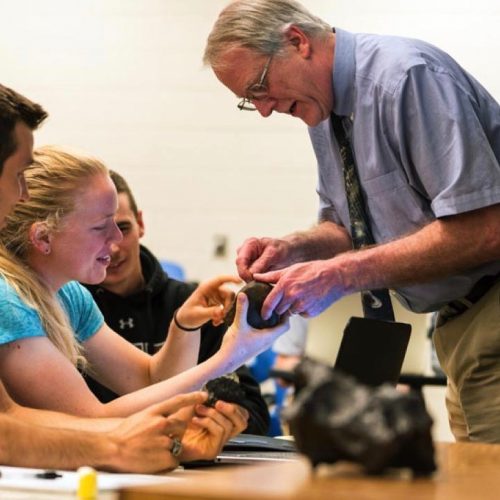
A kindly looking professor talking to students about a rock, maybe a meteorite?

This MIT professor – Richard P. Binzel – is one of the astronomers who helped develop an important tool for understanding asteroid risk and conveying it to the public: the Torino Scale. If you’re ever fearful of a particular asteroid, be sure to find out its ranking on the Torino Scale. That’ll nearly always make you feel better! Image via MIT.

Now let’s look at another important tool for understanding Near-Earth Asteroids (NEAs): the Torino Scale. It was created by astronomer Richard P. Binzel of MIT in 1995 and presented at a United Nations conference that year. CNEOS described the Torino Scale this way:

The Torino Scale, adopted by the [International Astronomical Union] in 1999, is a tool for categorizing potential Earth impact events. An integer scale ranging from 0 to 10 with associated color coding, it is intended primarily to facilitate public communication by the asteroid impact hazard monitoring community. The scale captures the likelihood and consequences of a potential impact event, but does not consider the time remaining until the potential impact. More extraordinary events are indicated by a higher Torino Scale value.

Read Richard P. Binzel’s description of the Torino Scale

Asteroid 2007 FT3 has a Torino Scale ranking of 0, which indicates:

The likelihood of a collision is zero, or is so low as to be effectively zero.

Even with the poorly constrained orbit or limited data, NASA scientists estimate that on October 3,2019, asteroid 2007 FT3 should pass at some 86 million miles (138 million km) from Earth.

2007 FT3 should be a little “closer” to Earth on October 11, 2068. During that “closer” approach, the space rock should be passing at more than 15 million miles (24.5 million km), or about 64 times the Earth-moon distance. That’s still a huge distance.

2007 FT3 is categorized as an Apollo-type asteroid. It takes 1.2 years (438 days) to complete an orbit around the Sun. Its orbit – not the object itself – does come close to the orbit of the Earth, and it is therefore considered a potentially hazardous asteroid, by CNEOS:

Potentially Hazardous Asteroids (PHAs) are currently defined based on parameters that measure the asteroid’s potential to make threatening close approaches to the Earth. Specifically, all asteroids with a minimum orbit intersection distance (MOID) of 0.05 au or less and an absolute magnitude (H) of 22.0 or less are considered PHAs.

Radar animation of 3200 Phaethon shows the asteroid tumbling in space.

We can’t see asteroids very well, because they’re small. This animation is built from Arecibo radar images of near-Earth asteroid 3200 Phaethon, acquired from December 15 through 19, 2017. Read more about these observations.

Do you see what’s going on here? In recent decades, astronomers have realized the potential for asteroids to strike Earth. That is a very real potential. The world as a whole has recognized that it’s important for a planet with 7.6 billion humans to understand the potential threat of asteroids, and to track asteroids, and even to discuss what we might do if we did learn an asteroid was heading our way. Hopefully, we would learn this some years before it happened, and not days before.

But all of this formalization of a potential threat – nomenclature, lists, acronyms – has also created a potential to create misunderstandings and fear. And, we all know, on the internet fear means clicks, and clicks mean $$.

Meanwhile, the asteroids are just out there, as they’ve been for billions of years, pursuing their orbits around the sun. If asteroid 2007 FT3 is re-observed in late September or early October, 2019, the new observations might let astronomers better refine its orbit. Then, perhaps, it’ll be removed from the Sentry Risk Table.

In the meantime, don’t worry. What you’re seeing here is just astronomy in action, and, in particular, the branch of astronomy that aims to keep us safe from asteroids. And the preliminary data – based on these astronomers’ best-possible observations and most careful orbit calculations – clearly indicate that this particular asteroid, 2007 FT3, poses no risk to our planet.

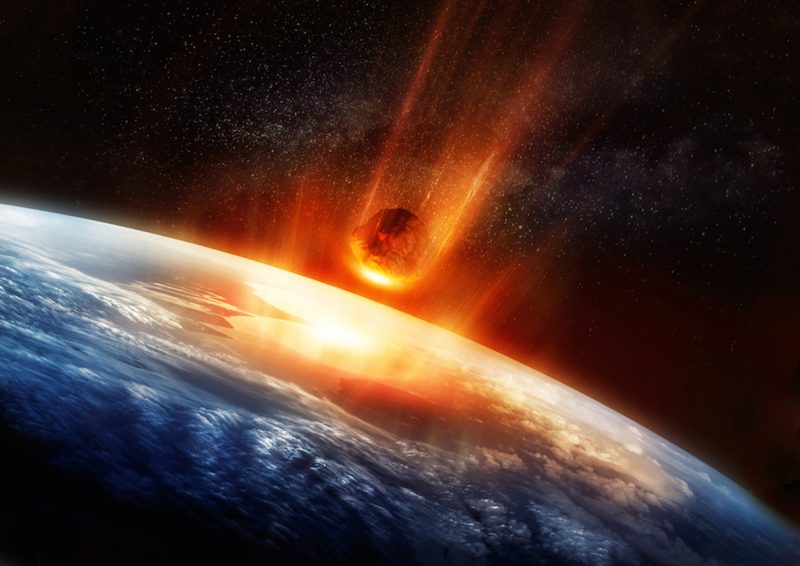
A painting of a huge flaming space rock falling to Earth.

Artist’s concept of a large asteroid hitting Earth. Has this ever happened? Sure. Large asteroids have struck Earth in the past. Large craters on Earth – for example, Meteor Crater in Arizona – bear witness to an asteroid strike. Could a large asteroid strike us in the future? It’s possible, and that’s why astronomers are so busy nowadays with asteroid tracking. But, at this writing, no large asteroid is known to be on a collision course with Earth. Image via SolarSeven/ Shutterstock.

Bottom line: Asteroid 2007 FT3 will not strike Earth on October 3, 2019.


from EarthSky https://ift.tt/309BpRd
Diagram of solar system with long elliptical orbit at an angle to the other orbits.

This illustration shows the positions of Earth and asteroid 2007 FT3 on October 3, 2019. Note the space rock’s orbit (not the object itself) does come close to the orbit of the Earth. Image via NASA/JPL.

Asteroid 2007 FT3 – a 1,115-foot (340-meter) space rock – is appearing in doomsday headlines suggesting the asteroid could hit our planet on October 3, 2019. Here’s an example: Deadly 1,100-Foot Asteroid Could Hit Earth In October, NASA Reveals. Sounds scary, right? But is it true? Is this asteroid really deadly? It’s only deadly if it kills something, and that’s not going to happen. Asteroid 2007 FT3 is not going to hit us. Of course, NASA knows that. What’s going on here? Why does the headline say NASA reveals?

The truth is, asteroid 2007 FT3 is likely pass Earth at such an extreme distance that even big professional telescopes at major observatories won’t be able to detect it this October. How far will it be at its closest distance? Preliminary estimates indicate asteroid 2007 FT3 will pass on October, 2019 at almost 360 times the Earth-moon distance. That’s many millions of miles, an enormous distance!

Asteroid 2007 FT3 was discovered on March 20, 2007 from Mount Lemmon, in Arizona. It was observed only briefly – just 14 times over 1.2 days – and then became too faint to observe, disappearing back into the depths of space. Because it was observed for such a short time, there are uncertainties in its orbit. Those sorts of uncertainties for a newly observed, or briefly observed, asteroid are very, very normal and ordinary. They’re just part of the process.

Because of the uncertainties, however, 2007 FT3 does appear in a “risk list” maintained by astronomers at the Center for Near Earth Object Studies (CNEOS) at NASA’s Jet Propulsion Laboratory in Pasadena, California. The Sentry Risk Table is part of a highly automated collision monitoring system that continually scans the most current asteroid catalog for possibilities of future impact with Earth over the next 100 years. Asteroid 2007 FT3 does appear on the current Sentry Risk Table (although objects are removed from this table as their orbits become better known).

But being in a “risk table” doesn’t mean there’s actual risk. Look at the table carefully. Click into the numbers in the column labeled Impact Probability (Cumulative). You’ll see that 2007 FT3 has an extremely low chance of impacting Earth in October:

0.00015% chance of Earth impact
1 in 670,000 odds of impact
99.99985% chance the asteroid will miss the Earth

Let’s linger on the Sentry Risk Table a little longer. CNEOS, which maintains this table, explains on its website:

When interpreting Sentry pages, where information on known potential NEA [Near-Earth Asteroid] impacts is posted, one must bear in mind that an Earth collision by a sizable NEA is a very low probability event. Objects normally appear on the Risk Page because their orbits can bring them close to the Earth’s orbit and the limited number of available observations do not yet allow their trajectories to be well-enough defined. In such cases, there may be a wide range of possible future paths that can be fit to the existing observations, sometimes including a few that can intersect the Earth.

Whenever a newly discovered NEA is posted on the Sentry Impact Risk Page, by far the most likely outcome is that the object will eventually be removed as new observations become available, the object’s orbit is improved, and its future motion is more tightly constrained. As a result, several new NEAs each month may be listed on the Sentry Impact Risk page, only to be removed shortly afterwards. This is a normal process, completely expected. The removal of an object from the Impact Risk page does not indicate that the object’s risk was evaluated mistakenly: the risk was real until additional observations showed that it was not.

And so on and so on. We encourage you to read all of this page if you want to understand the Sentry system.

A kindly looking professor talking to students about a rock, maybe a meteorite?

This MIT professor – Richard P. Binzel – is one of the astronomers who helped develop an important tool for understanding asteroid risk and conveying it to the public: the Torino Scale. If you’re ever fearful of a particular asteroid, be sure to find out its ranking on the Torino Scale. That’ll nearly always make you feel better! Image via MIT.

Now let’s look at another important tool for understanding Near-Earth Asteroids (NEAs): the Torino Scale. It was created by astronomer Richard P. Binzel of MIT in 1995 and presented at a United Nations conference that year. CNEOS described the Torino Scale this way:

The Torino Scale, adopted by the [International Astronomical Union] in 1999, is a tool for categorizing potential Earth impact events. An integer scale ranging from 0 to 10 with associated color coding, it is intended primarily to facilitate public communication by the asteroid impact hazard monitoring community. The scale captures the likelihood and consequences of a potential impact event, but does not consider the time remaining until the potential impact. More extraordinary events are indicated by a higher Torino Scale value.

Read Richard P. Binzel’s description of the Torino Scale

Asteroid 2007 FT3 has a Torino Scale ranking of 0, which indicates:

The likelihood of a collision is zero, or is so low as to be effectively zero.

Even with the poorly constrained orbit or limited data, NASA scientists estimate that on October 3,2019, asteroid 2007 FT3 should pass at some 86 million miles (138 million km) from Earth.

2007 FT3 should be a little “closer” to Earth on October 11, 2068. During that “closer” approach, the space rock should be passing at more than 15 million miles (24.5 million km), or about 64 times the Earth-moon distance. That’s still a huge distance.

2007 FT3 is categorized as an Apollo-type asteroid. It takes 1.2 years (438 days) to complete an orbit around the Sun. Its orbit – not the object itself – does come close to the orbit of the Earth, and it is therefore considered a potentially hazardous asteroid, by CNEOS:

Potentially Hazardous Asteroids (PHAs) are currently defined based on parameters that measure the asteroid’s potential to make threatening close approaches to the Earth. Specifically, all asteroids with a minimum orbit intersection distance (MOID) of 0.05 au or less and an absolute magnitude (H) of 22.0 or less are considered PHAs.

Radar animation of 3200 Phaethon shows the asteroid tumbling in space.

We can’t see asteroids very well, because they’re small. This animation is built from Arecibo radar images of near-Earth asteroid 3200 Phaethon, acquired from December 15 through 19, 2017. Read more about these observations.

Do you see what’s going on here? In recent decades, astronomers have realized the potential for asteroids to strike Earth. That is a very real potential. The world as a whole has recognized that it’s important for a planet with 7.6 billion humans to understand the potential threat of asteroids, and to track asteroids, and even to discuss what we might do if we did learn an asteroid was heading our way. Hopefully, we would learn this some years before it happened, and not days before.

But all of this formalization of a potential threat – nomenclature, lists, acronyms – has also created a potential to create misunderstandings and fear. And, we all know, on the internet fear means clicks, and clicks mean $$.

Meanwhile, the asteroids are just out there, as they’ve been for billions of years, pursuing their orbits around the sun. If asteroid 2007 FT3 is re-observed in late September or early October, 2019, the new observations might let astronomers better refine its orbit. Then, perhaps, it’ll be removed from the Sentry Risk Table.

In the meantime, don’t worry. What you’re seeing here is just astronomy in action, and, in particular, the branch of astronomy that aims to keep us safe from asteroids. And the preliminary data – based on these astronomers’ best-possible observations and most careful orbit calculations – clearly indicate that this particular asteroid, 2007 FT3, poses no risk to our planet.

A painting of a huge flaming space rock falling to Earth.

Artist’s concept of a large asteroid hitting Earth. Has this ever happened? Sure. Large asteroids have struck Earth in the past. Large craters on Earth – for example, Meteor Crater in Arizona – bear witness to an asteroid strike. Could a large asteroid strike us in the future? It’s possible, and that’s why astronomers are so busy nowadays with asteroid tracking. But, at this writing, no large asteroid is known to be on a collision course with Earth. Image via SolarSeven/ Shutterstock.

Bottom line: Asteroid 2007 FT3 will not strike Earth on October 3, 2019.


from EarthSky https://ift.tt/309BpRd

Volcanic eruption creates moveable islands of pumice

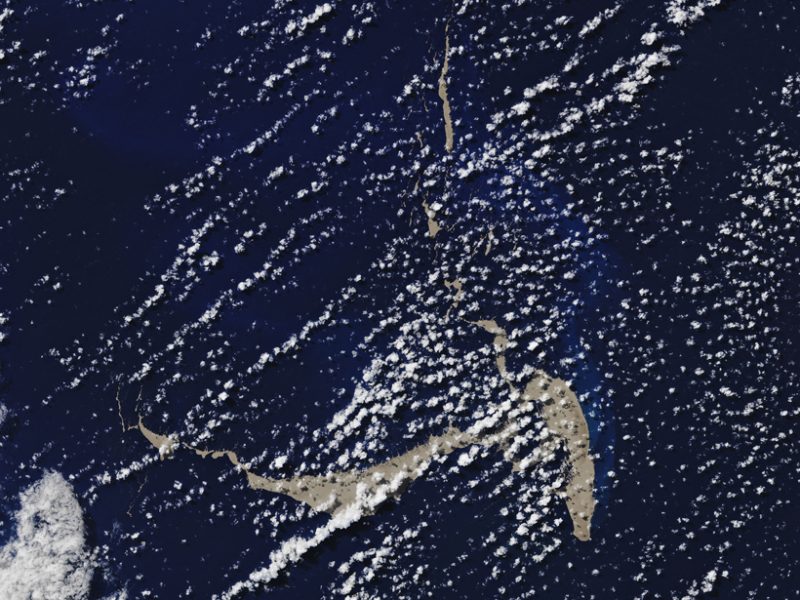
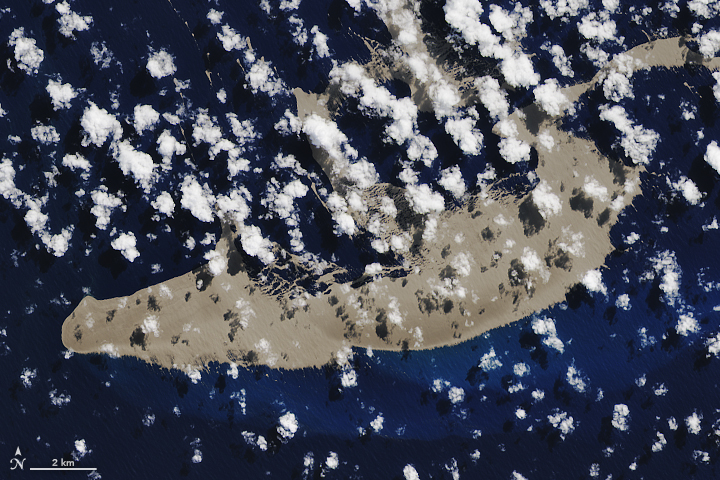
Aerial view of blue sea mottled with white dots and lines and with large tan areas (the rafts).

Satellite image of a pumice raft floating near the Kingdom of Tonga. Image via NASA Earth Observatory.

In early August 2019, an unnamed volcano in the South Pacific Ocean near the Kingdom of Tonga erupted roughly 130 feet (40 meters) underwater. As lava spewed from the volcano, it cooled into pumice — porous rock filled with gas bubbles — and floated to the surface. This volcanic debris, with some fragments tiny and some as large as beach balls, aggregated into pumice rafts spanning an area of about 60 square miles (200 square km) — almost as big as Washington, D.C.

These temporary islands of volcanic rock are shaped and moved by ocean currents, wind, and waves, and provide a literal toehold for marine life, such as barnacles, coral, seaweed and mollusks, say scientists.

Several sailing crews have encountered the rocks. In a video, below, posted on YouTube on August 17, Shannon Lenz said:

On August 9, 2019, we sailed through a pumice field for 6-8 hours, much of the time there was no visible water. It was like plowing through a field. We figured the pumice was at least 6-inches thick.

An Australian couple, Michael Hoult and Larissa Brill, were sailing a catamaran to Fiji, when they encountered the raft on August 16. The couple said in a Facebook post:

We entered a total rock rubble slick made up of pumice stones from marble to basketball size.

Pumice rafts aren’t that common, according to Martin Jutzeler, a volcanologist at the University of Tasmania in Hobart. He told EOS:

We see about two per decade.

Jutzeler told EOS that not all undersea eruptions produce them, but the rafts that do form tend to stick around. They can last for months or years until the pumice abrades itself into dust or finally sinks. And floating pumice can traverse long distances. For example, he said, when the same unnamed volcano near Tonga erupted in 2001, the pumice raft it created eventually arrived in Queensland, Australia.

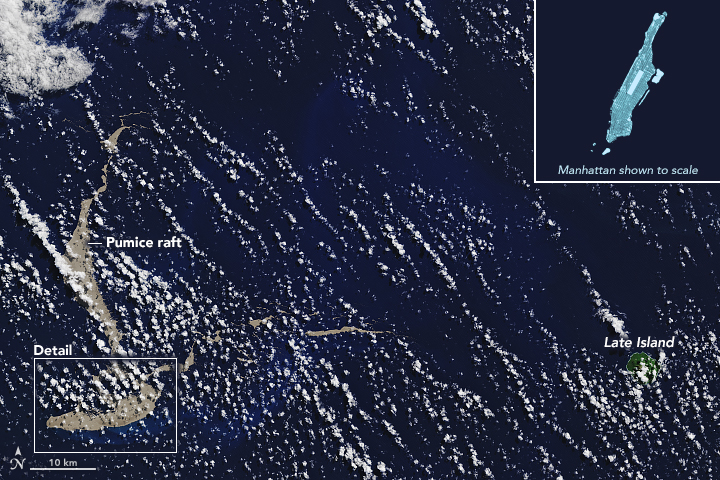
Aerial view sea with large tan areas and inset showing Manhattan Island for scale.

August 13, 2109. See detail below. Image via NASA Earth Observatory.

Aarial view, blue sea, scattered white clouds, tan raft nearly filling image.

Detail of above image, taken August 13, 2109. Image via NASA Earth Observatory.

These transient, movable islands play an important role in marine ecosystems, scientists say, moving barnacles, coral, and seaweed that cling to the pumice to new homes. Some news outlets are reporting that the pumice might make it to Australia to help restore the Great Barrier Reef’s corals , half of which have been killed in recent years as a result of climate change. According to Denison University volcanologist Erik Klemetti, the long-distance journeys of pumice rafts are

… definitely a way to get organisms to disperse widely.

But the idea that the stowaways aboard pumice rafts might replenish the Great Barrier Reef’s corals is wishful thinking, Klemetti told EOS. He said:

That’s probably an oversell.

Researchers are keeping a close watch on how the rafts are moving. Satellite imagery provides nearly daily updates. Ocean currents, wind, and waves sculpt and power the rafts, which now number in the hundreds.

Bottom line: In August 2019, rafts of pumice, spewed from an undersea volcano and spanning an area about the size of Washington, D.C., appeared in the South Pacific.

Via EOS


from EarthSky https://ift.tt/31x2RFi
Aerial view of blue sea mottled with white dots and lines and with large tan areas (the rafts).

Satellite image of a pumice raft floating near the Kingdom of Tonga. Image via NASA Earth Observatory.

In early August 2019, an unnamed volcano in the South Pacific Ocean near the Kingdom of Tonga erupted roughly 130 feet (40 meters) underwater. As lava spewed from the volcano, it cooled into pumice — porous rock filled with gas bubbles — and floated to the surface. This volcanic debris, with some fragments tiny and some as large as beach balls, aggregated into pumice rafts spanning an area of about 60 square miles (200 square km) — almost as big as Washington, D.C.

These temporary islands of volcanic rock are shaped and moved by ocean currents, wind, and waves, and provide a literal toehold for marine life, such as barnacles, coral, seaweed and mollusks, say scientists.

Several sailing crews have encountered the rocks. In a video, below, posted on YouTube on August 17, Shannon Lenz said:

On August 9, 2019, we sailed through a pumice field for 6-8 hours, much of the time there was no visible water. It was like plowing through a field. We figured the pumice was at least 6-inches thick.

An Australian couple, Michael Hoult and Larissa Brill, were sailing a catamaran to Fiji, when they encountered the raft on August 16. The couple said in a Facebook post:

We entered a total rock rubble slick made up of pumice stones from marble to basketball size.

Pumice rafts aren’t that common, according to Martin Jutzeler, a volcanologist at the University of Tasmania in Hobart. He told EOS:

We see about two per decade.

Jutzeler told EOS that not all undersea eruptions produce them, but the rafts that do form tend to stick around. They can last for months or years until the pumice abrades itself into dust or finally sinks. And floating pumice can traverse long distances. For example, he said, when the same unnamed volcano near Tonga erupted in 2001, the pumice raft it created eventually arrived in Queensland, Australia.

Aerial view sea with large tan areas and inset showing Manhattan Island for scale.

August 13, 2109. See detail below. Image via NASA Earth Observatory.

Aarial view, blue sea, scattered white clouds, tan raft nearly filling image.

Detail of above image, taken August 13, 2109. Image via NASA Earth Observatory.

These transient, movable islands play an important role in marine ecosystems, scientists say, moving barnacles, coral, and seaweed that cling to the pumice to new homes. Some news outlets are reporting that the pumice might make it to Australia to help restore the Great Barrier Reef’s corals , half of which have been killed in recent years as a result of climate change. According to Denison University volcanologist Erik Klemetti, the long-distance journeys of pumice rafts are

… definitely a way to get organisms to disperse widely.

But the idea that the stowaways aboard pumice rafts might replenish the Great Barrier Reef’s corals is wishful thinking, Klemetti told EOS. He said:

That’s probably an oversell.

Researchers are keeping a close watch on how the rafts are moving. Satellite imagery provides nearly daily updates. Ocean currents, wind, and waves sculpt and power the rafts, which now number in the hundreds.

Bottom line: In August 2019, rafts of pumice, spewed from an undersea volcano and spanning an area about the size of Washington, D.C., appeared in the South Pacific.

Via EOS


from EarthSky https://ift.tt/31x2RFi

How to see the Great Square of Pegasus

Sky chart with Great Square stars connected with white lines and east marked.

The Great Square of Pegasus consists of 4 stars of nearly equal brightness: Scheat, Alpheratz, Markab and Algenib. Illustration via AstroBob.

The Great Square of Pegasus gallops into the fall sky just after dark around the September equinox, which fells in 2019 on September 23. It consists of four stars of nearly equal brightness: Scheat, Alpheratz, Markab and Algenib. It’s a landmark of the Northern Hemisphere’s autumn sky.

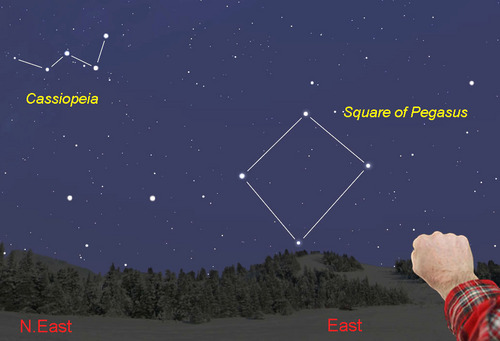
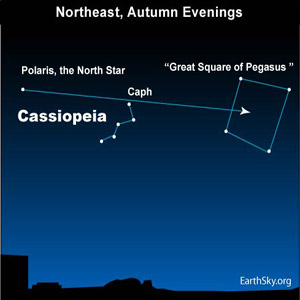
To find it, first of all use the Big Dipper to star-hop to Polaris the North Star. By drawing an imaginary line from any Big Dipper handle star through Polaris, and going twice the distance, you’ll always land on the W or M-shaped constellation Cassiopeia the Queen. A line from Polaris through the star Caph of Cassiopeia faithfully escorts you to the Great Square of Pegasus.

Chart of Cassiopeia and Great Square with N east and east marked and man's fist for measurement.

Image via astrobob.

Chart: line drawn from Polaris through Cassiopeia star Caph to Great Square.

Finding the Great Square of Pegasus.

Like the Big Dipper, the Great Square of Pegasus isn’t a constellation. Instead, it’s an asterism, or noticeable pattern on our sky’s dome.

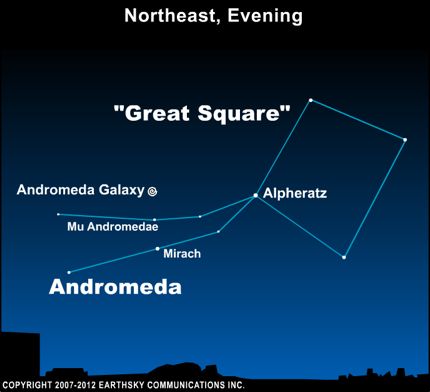
The Great Square is used much like the Big Dipper to help you find other sky treasures, the most notable being the Andromeda Galaxy.

Chart of constellation Andromeda next to Square with galaxy shown slightly above it.

Use the Great Square of Pegasus to find the Andromeda galaxy. Here’s how to do it.

A great big square of nothing. Often at events where many are stargazing for the first time, one may hear:

… the Great Square has nothing in it.

But, of course, the Great Square isn’t empty. The stars in the Square are faint enough that the unaided eye can’t easily detect them. If you have binoculars or small telescopes many stars pop up within the Square.

Dense star field with four brighter stars at corners of Square.

View larger. | You often hear people say the Great Square is “empty” of stars. Of course, it’s not. Charles White created this composite on November 20, 2017. It consists of 10 images, each a 30-second exposure. Rokinon 35mm lens, f2.0 ISA1600. Camera: Sony QX1 ILCE. Iptron Sky Tracker.

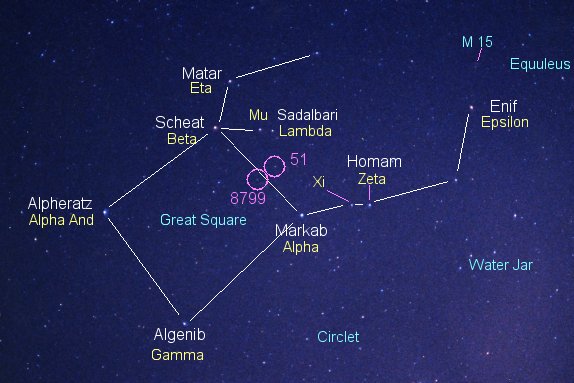
One of the most famous faint stars near the Great Square is 51 Pegasi. In 1995 astronomers announced they discovered a planet around this star. After a few months of skepticism from the astronomical community, it was confirmed that the first planet outside of our solar system had been discovered. Now we know that two planets orbit the star.

Some books say that 51 Pegasi can be viewed with the eye alone, but it’s a bit of a challenge. Using binoculars, look roughly halfway between Scheat and Markab. The chart below is courtesy of Professor Jim Kaler. Note that you won’t be able to see the planets. Pegasus 51 is approximately 50 light-years away from Earth.

Chart of constellation Pegasus with 10 stars labeled.

The star 51 Pegasi in the Great Square, via Jim Kaler.

You might recall that Pegasus was a winged horse in Greek mythology. The constellation Pegasus is one of seven constellations in the sky that tells why it is not good to say that a mortal is more beautiful than the gods. This story is plastered all over the autumn night sky.

Queen Cassiopeia bragged that she (or her daughter Andromeda) was more beautiful than immortal Nereids, or sea nymphs. This angered the gods, who asked the sea-god Poseidon to take revenge. The punishment was that King Cepheus and the Queen had to sacrifice their only daughter Andromeda to Cetus the sea monster. Andromeda while chained down to a rock at sea, and about to be gobbled up by the sea monster, saw Perseus riding Pegasus the flying horse. Perseus swooped down and showed the head of the Medusa to the Cetus, the sea monster, then Cetus immediately turned to stone. Then he whacked the chains holding Andromeda and freed her.

They flew off into the sunset to live happily ever after. The mortal horse on the last day of his life was given the honor of becoming a constellation for his loyal service. The dolphin that provided comfort to Andromeda was also granted immortality in the heavens by Zeus with the Delphinus constellation.

Enjoying EarthSky so far? Sign up for our free daily newsletter today!

Donate to EarthSky: Your support means the world to us

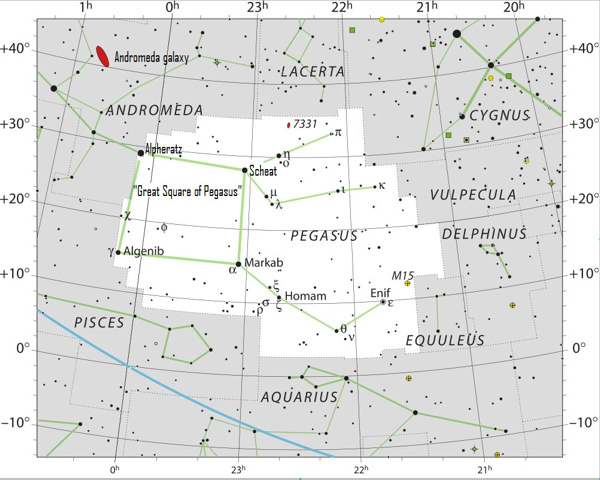
Star chart with black stars on white of constellation Pegasus.

The Great Square of Pegasus makes up the eastern (left) half of the constellation Pegasus. Image via Wikimedia Commons

Bottom line: How to see the Great Square of Pegasus star pattern.


from EarthSky https://ift.tt/304jMBp
Sky chart with Great Square stars connected with white lines and east marked.

The Great Square of Pegasus consists of 4 stars of nearly equal brightness: Scheat, Alpheratz, Markab and Algenib. Illustration via AstroBob.

The Great Square of Pegasus gallops into the fall sky just after dark around the September equinox, which fells in 2019 on September 23. It consists of four stars of nearly equal brightness: Scheat, Alpheratz, Markab and Algenib. It’s a landmark of the Northern Hemisphere’s autumn sky.

To find it, first of all use the Big Dipper to star-hop to Polaris the North Star. By drawing an imaginary line from any Big Dipper handle star through Polaris, and going twice the distance, you’ll always land on the W or M-shaped constellation Cassiopeia the Queen. A line from Polaris through the star Caph of Cassiopeia faithfully escorts you to the Great Square of Pegasus.

Chart of Cassiopeia and Great Square with N east and east marked and man's fist for measurement.

Image via astrobob.

Chart: line drawn from Polaris through Cassiopeia star Caph to Great Square.

Finding the Great Square of Pegasus.

Like the Big Dipper, the Great Square of Pegasus isn’t a constellation. Instead, it’s an asterism, or noticeable pattern on our sky’s dome.

The Great Square is used much like the Big Dipper to help you find other sky treasures, the most notable being the Andromeda Galaxy.

Chart of constellation Andromeda next to Square with galaxy shown slightly above it.

Use the Great Square of Pegasus to find the Andromeda galaxy. Here’s how to do it.

A great big square of nothing. Often at events where many are stargazing for the first time, one may hear:

… the Great Square has nothing in it.

But, of course, the Great Square isn’t empty. The stars in the Square are faint enough that the unaided eye can’t easily detect them. If you have binoculars or small telescopes many stars pop up within the Square.

Dense star field with four brighter stars at corners of Square.

View larger. | You often hear people say the Great Square is “empty” of stars. Of course, it’s not. Charles White created this composite on November 20, 2017. It consists of 10 images, each a 30-second exposure. Rokinon 35mm lens, f2.0 ISA1600. Camera: Sony QX1 ILCE. Iptron Sky Tracker.

One of the most famous faint stars near the Great Square is 51 Pegasi. In 1995 astronomers announced they discovered a planet around this star. After a few months of skepticism from the astronomical community, it was confirmed that the first planet outside of our solar system had been discovered. Now we know that two planets orbit the star.

Some books say that 51 Pegasi can be viewed with the eye alone, but it’s a bit of a challenge. Using binoculars, look roughly halfway between Scheat and Markab. The chart below is courtesy of Professor Jim Kaler. Note that you won’t be able to see the planets. Pegasus 51 is approximately 50 light-years away from Earth.

Chart of constellation Pegasus with 10 stars labeled.

The star 51 Pegasi in the Great Square, via Jim Kaler.

You might recall that Pegasus was a winged horse in Greek mythology. The constellation Pegasus is one of seven constellations in the sky that tells why it is not good to say that a mortal is more beautiful than the gods. This story is plastered all over the autumn night sky.

Queen Cassiopeia bragged that she (or her daughter Andromeda) was more beautiful than immortal Nereids, or sea nymphs. This angered the gods, who asked the sea-god Poseidon to take revenge. The punishment was that King Cepheus and the Queen had to sacrifice their only daughter Andromeda to Cetus the sea monster. Andromeda while chained down to a rock at sea, and about to be gobbled up by the sea monster, saw Perseus riding Pegasus the flying horse. Perseus swooped down and showed the head of the Medusa to the Cetus, the sea monster, then Cetus immediately turned to stone. Then he whacked the chains holding Andromeda and freed her.

They flew off into the sunset to live happily ever after. The mortal horse on the last day of his life was given the honor of becoming a constellation for his loyal service. The dolphin that provided comfort to Andromeda was also granted immortality in the heavens by Zeus with the Delphinus constellation.

Enjoying EarthSky so far? Sign up for our free daily newsletter today!

Donate to EarthSky: Your support means the world to us

Star chart with black stars on white of constellation Pegasus.

The Great Square of Pegasus makes up the eastern (left) half of the constellation Pegasus. Image via Wikimedia Commons

Bottom line: How to see the Great Square of Pegasus star pattern.


from EarthSky https://ift.tt/304jMBp

Learning to live on the moon … underwater

Person in gear in underwater tank, with other people floating around.

Image via NASA/Bill Brassard.

In this image, taken September 5, 2019, in the massive pool at NASA’s Neutral Buoyancy Lab at the Johnson Space Center in Houston, astronaut teams move around, set up habitats, collect samples and deploy experiments as they will on the moon

The astronauts wear weighted vests and backpacks to simulate walking on the moon, which has one-sixth the gravity of Earth. The huge pool is used primarily to train astronauts for spacewalks aboard the International Space Station.

Via NASA


from EarthSky https://ift.tt/2QgNwYm
Person in gear in underwater tank, with other people floating around.

Image via NASA/Bill Brassard.

In this image, taken September 5, 2019, in the massive pool at NASA’s Neutral Buoyancy Lab at the Johnson Space Center in Houston, astronaut teams move around, set up habitats, collect samples and deploy experiments as they will on the moon

The astronauts wear weighted vests and backpacks to simulate walking on the moon, which has one-sixth the gravity of Earth. The huge pool is used primarily to train astronauts for spacewalks aboard the International Space Station.

Via NASA


from EarthSky https://ift.tt/2QgNwYm

Close-up on Cassiopeia the Queen

Tonight – or any autumn evening – Cassiopeia the Queen can be found in the northeast after sunset. This constellation has the distinctive shape of a W, or M, depending on the time of night you see it. The shape of this constellation makes Cassiopeia’s stars very noticeable. Look for the Queen, starting at nightfall or early evening.

Cassiopeia represents an ancient queen of Ethiopia. The entire constellation is sometimes also called Cassiopeia’s Chair, and some old star maps depict the queen sitting on the chair, marked by the five brightest stars of this constellation. These stars are Schedar, Caph, Gamma Cassiopeiae, Ruchbah and Segin.

Animated diagram of Cassiopeia stars and Big Dipper circling around Polaris.

The Big Dipper and the W-shaped constellation Cassiopeia circle around Polaris, the North Star, in a period of 23 hours and 56 minutes. The Big Dipper is circumpolar at 41 degrees north latitude, and all latitudes farther north.

If you have a dark sky, you can look below Cassiopeia in the northeast on these autumn evenings for a famous binocular object. This object is called the Double Cluster in Perseus. These are open star clusters, each of which consists of young stars still moving together from the primordial cloud of gas and dust that gave birth to the cluster’s stars. These clusters are familiarly known to stargazers as H and Chi Persei.

Stargazers smile when they peer at them through their binoculars, not only because they are beautiful, but also because of their names. They are named from two different alphabets, the Greek and the Roman. Stars have Greek letter names, but most star clusters don’t. Johann Bayer (1572-1625) gave Chi Persei – the cluster on the top – its Greek letter name. Then, it’s said, he ran out of Greek letters. That’s when he used a Roman letter – the letter H – to name the other cluster.

After midnight, Cassiopeia swings above Polaris, the North Star. Before dawn, she is found in the northwest. But during the evening hours, Queen Cassiopeia lights up the northeast sky.

Bottom line: The constellation Cassiopeia the Queen has the distinct shape of a W or M. Find her in the north-northeast sky on September and October evenings.

Help support EarthSky! Visit the EarthSky store to see the great selection of educational tools and team gear we have to offer.

Enjoying EarthSky so far? Sign up for our free daily newsletter today!


from EarthSky https://ift.tt/2O6ZMI7

Tonight – or any autumn evening – Cassiopeia the Queen can be found in the northeast after sunset. This constellation has the distinctive shape of a W, or M, depending on the time of night you see it. The shape of this constellation makes Cassiopeia’s stars very noticeable. Look for the Queen, starting at nightfall or early evening.

Cassiopeia represents an ancient queen of Ethiopia. The entire constellation is sometimes also called Cassiopeia’s Chair, and some old star maps depict the queen sitting on the chair, marked by the five brightest stars of this constellation. These stars are Schedar, Caph, Gamma Cassiopeiae, Ruchbah and Segin.

Animated diagram of Cassiopeia stars and Big Dipper circling around Polaris.

The Big Dipper and the W-shaped constellation Cassiopeia circle around Polaris, the North Star, in a period of 23 hours and 56 minutes. The Big Dipper is circumpolar at 41 degrees north latitude, and all latitudes farther north.

If you have a dark sky, you can look below Cassiopeia in the northeast on these autumn evenings for a famous binocular object. This object is called the Double Cluster in Perseus. These are open star clusters, each of which consists of young stars still moving together from the primordial cloud of gas and dust that gave birth to the cluster’s stars. These clusters are familiarly known to stargazers as H and Chi Persei.

Stargazers smile when they peer at them through their binoculars, not only because they are beautiful, but also because of their names. They are named from two different alphabets, the Greek and the Roman. Stars have Greek letter names, but most star clusters don’t. Johann Bayer (1572-1625) gave Chi Persei – the cluster on the top – its Greek letter name. Then, it’s said, he ran out of Greek letters. That’s when he used a Roman letter – the letter H – to name the other cluster.

After midnight, Cassiopeia swings above Polaris, the North Star. Before dawn, she is found in the northwest. But during the evening hours, Queen Cassiopeia lights up the northeast sky.

Bottom line: The constellation Cassiopeia the Queen has the distinct shape of a W or M. Find her in the north-northeast sky on September and October evenings.

Help support EarthSky! Visit the EarthSky store to see the great selection of educational tools and team gear we have to offer.

Enjoying EarthSky so far? Sign up for our free daily newsletter today!


from EarthSky https://ift.tt/2O6ZMI7

Skeptical Science to join the Global Climate Strike on September 20!

By now, many of you will already be aware that a big week of climate action kicks off on Friday, September 20 with a Global Climate Strike. Skeptical Science will join the digital version of the strike which is why we added a special - and closable - footer pointing to more information to our homepage.

ClimateStrikePoster

Come September 20, the footer will be replaced by a full screen overlay. However, as we expect many attacks from the usual suspects to coincide with the week of action, we‘ll not switch off Skeptical Science completely and the overlay can be closed to keep all our content readily available should any debunkings become necessary. Frankly, we‘d be quite surprised if this were not needed!

GlobalStrike

If you have a website or blog, how about joining the Digital Global Climate Strike? Find all the information and resources you need here.

Will you join the strike on the ground somewhere? If yes, please share in the comments where you participated!


from Skeptical Science https://ift.tt/2IciwCp

By now, many of you will already be aware that a big week of climate action kicks off on Friday, September 20 with a Global Climate Strike. Skeptical Science will join the digital version of the strike which is why we added a special - and closable - footer pointing to more information to our homepage.

ClimateStrikePoster

Come September 20, the footer will be replaced by a full screen overlay. However, as we expect many attacks from the usual suspects to coincide with the week of action, we‘ll not switch off Skeptical Science completely and the overlay can be closed to keep all our content readily available should any debunkings become necessary. Frankly, we‘d be quite surprised if this were not needed!

GlobalStrike

If you have a website or blog, how about joining the Digital Global Climate Strike? Find all the information and resources you need here.

Will you join the strike on the ground somewhere? If yes, please share in the comments where you participated!


from Skeptical Science https://ift.tt/2IciwCp

Skeptical Science New Research for Week #37, 2019

63 articles with 10 freely available as open access 

Pitch in!

In the abstract for Unlocking pre-1850 instrumental meteorological records: A global inventory (an open access article), Stefan Brönnimann tells us:

Instrumental meteorological measurements from periods prior to the start of national weather services are designated “early instrumental data”. They have played an important role in climate research as they allow daily-to-decadal variability and changes of temperature, pressure, and precipitation, including extremes, to be addressed. Early instrumental data can also help place 21st century climatic changes into a historical context such as to define pre-industrial climate and its variability. Until recently, the focus was on long, high-quality series, while the large number of shorter series (which together also cover long periods) received little to no attention. The shift in climate and climate impact research from mean climate characteristics towards weather variability and extremes, as well as the success of historical reanalyses which make use of short series, generates a need for locating and exploring further early instrumental measurements. However, information on early instrumental series has never been electronically compiled on a global scale. Here we attempt a worldwide compilation of metadata on early instrumental meteorological records prior to 1850 (1890 for Africa and the Arctic). Our global inventory comprises information on several thousand records, about half of which have not yet been digitized (not even as monthly means), and only approximately 20% of which have made it to global repositories. 

Having an inventory in hand, the next logical step is to render these records into a format suitable for computational input. There are ongoing efforts to do this— projects to which all of us may contribute help. For more information and leads to ongoing conversions, visit the ACRE website. The "citizen scientists" approach has proven very successful; in a brief period of time some 3,272 volunteers made thousands of old meteorological observations from the UK available as input to various weather and climate research avenues. Collections in the inventory described by Brönnimann will doubtless become grist for the mill of citizen volunteers.

"Let them eat lobster thermidor"

With yet another week's articles ranging from "concerning" to "dismal,"  adolescent lobsters finding an expanded habitat in certain areas thanks to a changing climate seem a welcome relief. Unfortunately, close reading of Goode et al's The brighter side of climate change: How local oceanography amplified a lobster boom in the Gulf of Maine reveals that generally warming waters on the larger scale are the reason for otherwise less suitable lobster habitat improving so as to produce a burgeoning boon of deliciousness. As is the case with setting one's house on fire and basking in warmth on a cold winter's evening, local and ephemeral effects are likely not worth the ultimate cost.

Articles:

Physical science of anthropogenic global warming

Connecting AMOC changes

Indian Ocean warming can strengthen the Atlantic meridional overturning circulation

Quantifying the importance of interannual, interdecadal and multidecadal climate natural variabilities in the modulation of global warming rates

Emergent Constraints on Climate-Carbon Cycle Feedbacks (open access)

Observation of global warming and global warming effects

More hots: Quantifying upward trends in the number of extremely hot days and nights in Tallahassee, Florida, USA: 1892–2018

Changes in mean flow and atmospheric wave activity in the North Atlantic sector

Physical retrieval of sea-surface temperature from INSAT-3D imager observations (open access)

An interdecadal shift of the extratropical teleconnection from the tropical Pacific during boreal summer

Trends in Compound Flooding in Northwestern Europe during 1901–2014

Large Decadal Changes in Air‐Sea CO2 Fluxes in the Caribbean Sea

Hot Summers in the Northern Hemisphere

Nineteenth‐century Tides in the Gulf of Maine and Implications for Secular Trends

Upper ocean distribution of glacial meltwater in the Amundsen Sea, Antarctica

Climate, irrigation, and land‐cover change explain streamflow trends in countries bordering the Northeast Atlantic

Significant increases in extreme precipitation and the associations with global warming over the global land monsoon regions

Observed Changes in Extreme Temperature over the Global Land Based on a Newly Developed Station Daily Dataset

Influence of Track Changes on the Poleward Shift of LMI Location of Western North Pacific Tropical Cyclones

 Unlocking pre-1850 instrumental meteorological records: A global inventory (open access)

Saharan air intrusions as a relevant mechanism for Iberian heatwaves: The record breaking events of August 2018 and June 2019

Contribution of extreme daily precipitation to total rainfall over the Arabian Peninsula

Innovative trend analysis of annual and seasonal rainfall in the Yangtze River Delta, eastern China

Modeling global warming and global warming effects

Tidal responses to future sea level trends on the Yellow Sea shelf

Northern Hemisphere atmospheric stilling accelerates lake thermal responses to a warming world

Quantifying the cloud particle‐size feedback in an Earth system model

Understanding Monsoonal Water Cycle Changes in a Warmer Climate in E3SMv1 Using a Normalized Gross Moist Stability Framework

Projected changes in the probability distributions, seasonality, and spatiotemporal scaling of daily and sub‐daily extreme precipitation simulated by a 50‐member ensemble over northeastern North America

Deglacial abrupt climate changes: not simply a freshwater problem (open access)

Assessment of the changes in precipitation and temperature in Teesta River basin in Indian Himalayan Region under climate change

Impact of internal variability on climate change for the upcoming decades: analysis of the CanESM2-LE and CESM-LE large ensembles (open access)

A bias-corrected projection for the changes in East Asian summer monsoon rainfall under global warming

Streamflow response to climate change in the Greater Horn of Africa (open access)

Intensified hydroclimatic regime in Korean basins under 1.5 and 2 °C global warming

Humans dealing with our warming of the planet

Importance of framing for extreme event attribution: the role of spatial and temporal scales (open access)

Assessing the maturity of China’s seven carbon trading pilots

Cross-sectoral and trans-national interactions in national-scale climate change impacts assessment—the case of the Czech Republic (open access)

Adaptive capacity in urban areas of developing countries

An intra-household analysis of farmers’ perceptions of and adaptation to climate change impacts: empirical evidence from drought prone zones of Bangladesh

The road traveled and pathways forward: A review of Loss and Damage from Climate Change: Concepts, Methods and Policy Options

Spatiotemporal changes of rice phenology in China under climate change from 1981 to 2010

A policy mixes approach to conceptualizing and measuring climate change adaptation policy

The brighter side of climate change: How local oceanography amplified a lobster boom in the Gulf of Maine

The acclimation of leaf photosynthesis of wheat and rice to seasonal temperature changes in T‐FACE environments

Post‐truth and anthropogenic climate change: Asking the right questions

Fairness conceptions and self-determined mitigation ambition under the Paris Agreement: Is there a relationship?

Historical development of climate change policies and the Climate Change Secretariat in Sri Lanka

A global decarbonisation bond (open access)

Climate change adaptation in coastal cities of developing countries: characterizing types of vulnerability and adaptation options

The potential impacts of Emissions Trading Scheme and biofuel options to carbon emissions of U.S. airlines

Regional carbon policies in an interconnected power system: How expanded coverage could exacerbate emission leakage

Examining concern about climate change and local environmental changes from an ecosystem service perspective in the Western U.S

Implementation solutions for greenhouse gas mitigation measures in livestock agriculture: A framework for coherent strategy

Projected declines in global DHA availability for human consumption as a result of global warming (open access)

Building political support for carbon pricing—Lessons from cap-and-trade policies

Cities and greenhouse gas reduction: Policy makers or policy takers?

Biology and global warming

A review of environmental droughts: Increased risk under global warming?

Climate change alters elevational phenology patterns of the European spruce bark beetle (Ips typographus)

Global warming promotes biological invasion of a honey bee pest

Flexibility in a changing arctic food web: Can rough‐legged buzzards cope with changing small rodent communities?

Effects of climate warming on Sphagnum photosynthesis in peatlands depend on peat moisture and species‐specific anatomical traits

Trait structure and redundancy determine sensitivity to disturbance in marine fish communities

Temporal and spatial trends in marine carbon isotopes in the Arctic Ocean and implications for food web studies

Testing for changes in biomass dynamics in large‐scale forest datasets

Future projections of record-breaking sea surface temperature and cyanobacteria bloom events in the Baltic Sea


Suggestions

Please let us know if you're aware of an article you think may be of interest for Skeptical Science research news, or if we've missed something that may be important. Send your input to Skeptical Science via our contact form.

The previous edition of Skeptical Science new research may be found here. 


from Skeptical Science https://ift.tt/303aw0n

63 articles with 10 freely available as open access 

Pitch in!

In the abstract for Unlocking pre-1850 instrumental meteorological records: A global inventory (an open access article), Stefan Brönnimann tells us:

Instrumental meteorological measurements from periods prior to the start of national weather services are designated “early instrumental data”. They have played an important role in climate research as they allow daily-to-decadal variability and changes of temperature, pressure, and precipitation, including extremes, to be addressed. Early instrumental data can also help place 21st century climatic changes into a historical context such as to define pre-industrial climate and its variability. Until recently, the focus was on long, high-quality series, while the large number of shorter series (which together also cover long periods) received little to no attention. The shift in climate and climate impact research from mean climate characteristics towards weather variability and extremes, as well as the success of historical reanalyses which make use of short series, generates a need for locating and exploring further early instrumental measurements. However, information on early instrumental series has never been electronically compiled on a global scale. Here we attempt a worldwide compilation of metadata on early instrumental meteorological records prior to 1850 (1890 for Africa and the Arctic). Our global inventory comprises information on several thousand records, about half of which have not yet been digitized (not even as monthly means), and only approximately 20% of which have made it to global repositories. 

Having an inventory in hand, the next logical step is to render these records into a format suitable for computational input. There are ongoing efforts to do this— projects to which all of us may contribute help. For more information and leads to ongoing conversions, visit the ACRE website. The "citizen scientists" approach has proven very successful; in a brief period of time some 3,272 volunteers made thousands of old meteorological observations from the UK available as input to various weather and climate research avenues. Collections in the inventory described by Brönnimann will doubtless become grist for the mill of citizen volunteers.

"Let them eat lobster thermidor"

With yet another week's articles ranging from "concerning" to "dismal,"  adolescent lobsters finding an expanded habitat in certain areas thanks to a changing climate seem a welcome relief. Unfortunately, close reading of Goode et al's The brighter side of climate change: How local oceanography amplified a lobster boom in the Gulf of Maine reveals that generally warming waters on the larger scale are the reason for otherwise less suitable lobster habitat improving so as to produce a burgeoning boon of deliciousness. As is the case with setting one's house on fire and basking in warmth on a cold winter's evening, local and ephemeral effects are likely not worth the ultimate cost.

Articles:

Physical science of anthropogenic global warming

Connecting AMOC changes

Indian Ocean warming can strengthen the Atlantic meridional overturning circulation

Quantifying the importance of interannual, interdecadal and multidecadal climate natural variabilities in the modulation of global warming rates

Emergent Constraints on Climate-Carbon Cycle Feedbacks (open access)

Observation of global warming and global warming effects

More hots: Quantifying upward trends in the number of extremely hot days and nights in Tallahassee, Florida, USA: 1892–2018

Changes in mean flow and atmospheric wave activity in the North Atlantic sector

Physical retrieval of sea-surface temperature from INSAT-3D imager observations (open access)

An interdecadal shift of the extratropical teleconnection from the tropical Pacific during boreal summer

Trends in Compound Flooding in Northwestern Europe during 1901–2014

Large Decadal Changes in Air‐Sea CO2 Fluxes in the Caribbean Sea

Hot Summers in the Northern Hemisphere

Nineteenth‐century Tides in the Gulf of Maine and Implications for Secular Trends

Upper ocean distribution of glacial meltwater in the Amundsen Sea, Antarctica

Climate, irrigation, and land‐cover change explain streamflow trends in countries bordering the Northeast Atlantic

Significant increases in extreme precipitation and the associations with global warming over the global land monsoon regions

Observed Changes in Extreme Temperature over the Global Land Based on a Newly Developed Station Daily Dataset

Influence of Track Changes on the Poleward Shift of LMI Location of Western North Pacific Tropical Cyclones

 Unlocking pre-1850 instrumental meteorological records: A global inventory (open access)

Saharan air intrusions as a relevant mechanism for Iberian heatwaves: The record breaking events of August 2018 and June 2019

Contribution of extreme daily precipitation to total rainfall over the Arabian Peninsula

Innovative trend analysis of annual and seasonal rainfall in the Yangtze River Delta, eastern China

Modeling global warming and global warming effects

Tidal responses to future sea level trends on the Yellow Sea shelf

Northern Hemisphere atmospheric stilling accelerates lake thermal responses to a warming world

Quantifying the cloud particle‐size feedback in an Earth system model

Understanding Monsoonal Water Cycle Changes in a Warmer Climate in E3SMv1 Using a Normalized Gross Moist Stability Framework

Projected changes in the probability distributions, seasonality, and spatiotemporal scaling of daily and sub‐daily extreme precipitation simulated by a 50‐member ensemble over northeastern North America

Deglacial abrupt climate changes: not simply a freshwater problem (open access)

Assessment of the changes in precipitation and temperature in Teesta River basin in Indian Himalayan Region under climate change

Impact of internal variability on climate change for the upcoming decades: analysis of the CanESM2-LE and CESM-LE large ensembles (open access)

A bias-corrected projection for the changes in East Asian summer monsoon rainfall under global warming

Streamflow response to climate change in the Greater Horn of Africa (open access)

Intensified hydroclimatic regime in Korean basins under 1.5 and 2 °C global warming

Humans dealing with our warming of the planet

Importance of framing for extreme event attribution: the role of spatial and temporal scales (open access)

Assessing the maturity of China’s seven carbon trading pilots

Cross-sectoral and trans-national interactions in national-scale climate change impacts assessment—the case of the Czech Republic (open access)

Adaptive capacity in urban areas of developing countries

An intra-household analysis of farmers’ perceptions of and adaptation to climate change impacts: empirical evidence from drought prone zones of Bangladesh

The road traveled and pathways forward: A review of Loss and Damage from Climate Change: Concepts, Methods and Policy Options

Spatiotemporal changes of rice phenology in China under climate change from 1981 to 2010

A policy mixes approach to conceptualizing and measuring climate change adaptation policy

The brighter side of climate change: How local oceanography amplified a lobster boom in the Gulf of Maine

The acclimation of leaf photosynthesis of wheat and rice to seasonal temperature changes in T‐FACE environments

Post‐truth and anthropogenic climate change: Asking the right questions

Fairness conceptions and self-determined mitigation ambition under the Paris Agreement: Is there a relationship?

Historical development of climate change policies and the Climate Change Secretariat in Sri Lanka

A global decarbonisation bond (open access)

Climate change adaptation in coastal cities of developing countries: characterizing types of vulnerability and adaptation options

The potential impacts of Emissions Trading Scheme and biofuel options to carbon emissions of U.S. airlines

Regional carbon policies in an interconnected power system: How expanded coverage could exacerbate emission leakage

Examining concern about climate change and local environmental changes from an ecosystem service perspective in the Western U.S

Implementation solutions for greenhouse gas mitigation measures in livestock agriculture: A framework for coherent strategy

Projected declines in global DHA availability for human consumption as a result of global warming (open access)

Building political support for carbon pricing—Lessons from cap-and-trade policies

Cities and greenhouse gas reduction: Policy makers or policy takers?

Biology and global warming

A review of environmental droughts: Increased risk under global warming?

Climate change alters elevational phenology patterns of the European spruce bark beetle (Ips typographus)

Global warming promotes biological invasion of a honey bee pest

Flexibility in a changing arctic food web: Can rough‐legged buzzards cope with changing small rodent communities?

Effects of climate warming on Sphagnum photosynthesis in peatlands depend on peat moisture and species‐specific anatomical traits

Trait structure and redundancy determine sensitivity to disturbance in marine fish communities

Temporal and spatial trends in marine carbon isotopes in the Arctic Ocean and implications for food web studies

Testing for changes in biomass dynamics in large‐scale forest datasets

Future projections of record-breaking sea surface temperature and cyanobacteria bloom events in the Baltic Sea


Suggestions

Please let us know if you're aware of an article you think may be of interest for Skeptical Science research news, or if we've missed something that may be important. Send your input to Skeptical Science via our contact form.

The previous edition of Skeptical Science new research may be found here. 


from Skeptical Science https://ift.tt/303aw0n

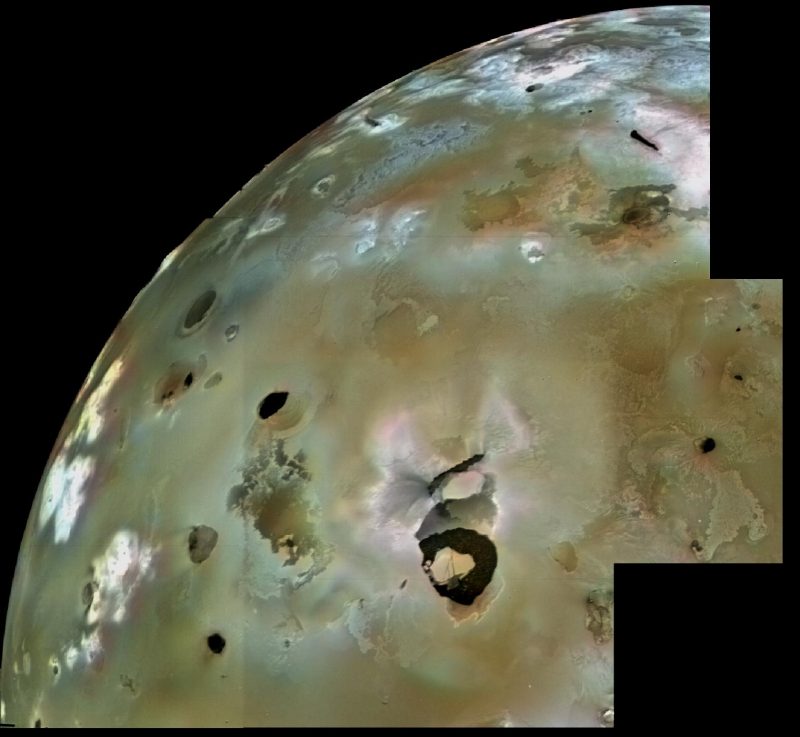
Will a huge volcano on Jupiter’s moon Io erupt this month?

A portion of the surface of Io, appearing mottled.

View larger. | Voyager 1 image mosaic – acquired in 1979 – showing a huge area of the volcanic plains on Jupiter’s moon Io. Numerous volcanic calderas and lava flows are visible here. Loki Patera, an active lava lake, is the large, U-shaped black feature, about in the center, toward the bottom of this image. Image via NASA PhotoJournal.

Jupiter’s moon Io is a world of active volcanoes, and Loki Patera is the largest of these, a great depression in the moon’s surface some 126 miles (202 km) across. An active lava lake resides in this depression, and the molten lava there is thought to be directly connected to a magma reservoir below. Above, the lake is likely covered over by a thin, solidified crust. Scientists peering through earthly telescopes have seen this area as continuously active. They think that the crust overlying the lake occasionally gives way, causing a brightness increase. In fact, Loki’s periodic eruptions are so regular that an astronomers has predicted one for this month. Loki is expected to erupt again in mid-September 2019, according to astronomer Julie Rathbun of the Planetary Science Institute based in Tucson, Arizona.

She presented this work today (September 17, 2019) at the joint meeting of the European Planetary Science Congress and the AAS Division for Planetary Sciences in Geneva, Switzerland. She said in a statement that, if Loki behaves as expected, it:

…should erupt in September 2019, around the same time as the EPSC-DPS joint meeting.

Rathbun added:

We correctly predicted that the last eruption would occur in May of 2018. Volcanoes are so difficult to predict because they are so complicated. Many things influence volcanic eruptions, including the rate of magma supply, the composition of the magma — particularly the presence of bubbles in the magma, the type of rock the volcano sits in, the fracture state of the rock, and many other issues.

We think that Loki could be predictable because it is so large. Because of its size, basic physics are likely to dominate when it erupts, so the small complications that affect smaller volcanoes are likely to not affect Loki as much.

In 2002, Rathbun published a paper showing that Loki’s eruption schedule had been approximately every 540 days during the 1990s. It currently appears to be approximately every 475 days. She explained:

Loki is the largest and most powerful volcano on Io, so bright in the infrared that we can detect it using telescopes on the Earth.

Will Loki erupt this month? This week, as Rathbun suggested? She reminded us:

… you have to be careful because Loki is named after a trickster god, and the volcano has not been known to behave itself. In the early 2000s, once the 540 day pattern was detected, Loki’s behavior changed and did not exhibit periodic behavior again until about 2013.

We’ll keep you updated.

Voyager image of volcano Loki on Io.

View larger. | The Voyager 1 spacecraft acquired this image of the volcano Loki on Jupiter’s moon Io in ___. As Voyager was sweeping past, the main eruptive activity came from the lower left of the dark linear feature (perhaps a rift) in the center. Below is the “lava lake,” a U-shaped dark area about 120 miles (200 km) across.

By the way, volcanos on Earth are driven by heat produced within Earth via the radioactive decay of isotopes in our planet’s mantle and crust, and also via the primordial heat leftover from Earth’s formation.

The source of Io’s heat is very different. Io’s heat is due to tidal frictional heating caused by the continual flexing of Io by the gravity of Jupiter and Europa, another of Jupiter’s satellites.

An active volcano on the edge, or limb, of Io can be seen spewing material into space.

A massive volcanic plume erupts from a volcano the surface of Jupiter’s moon Io. This plume isn’t from Loki, but, still, it’s cool, isn’t it? Image via NASA/ JHU-APL/ SRI.

Bottom line: A planetary scientists predicts that Loki, the largest volcano on Jupiter’s moon Io, will erupt in September, 2019.

Via EuroPlanet


from EarthSky https://ift.tt/2LWGTVJ
A portion of the surface of Io, appearing mottled.

View larger. | Voyager 1 image mosaic – acquired in 1979 – showing a huge area of the volcanic plains on Jupiter’s moon Io. Numerous volcanic calderas and lava flows are visible here. Loki Patera, an active lava lake, is the large, U-shaped black feature, about in the center, toward the bottom of this image. Image via NASA PhotoJournal.

Jupiter’s moon Io is a world of active volcanoes, and Loki Patera is the largest of these, a great depression in the moon’s surface some 126 miles (202 km) across. An active lava lake resides in this depression, and the molten lava there is thought to be directly connected to a magma reservoir below. Above, the lake is likely covered over by a thin, solidified crust. Scientists peering through earthly telescopes have seen this area as continuously active. They think that the crust overlying the lake occasionally gives way, causing a brightness increase. In fact, Loki’s periodic eruptions are so regular that an astronomers has predicted one for this month. Loki is expected to erupt again in mid-September 2019, according to astronomer Julie Rathbun of the Planetary Science Institute based in Tucson, Arizona.

She presented this work today (September 17, 2019) at the joint meeting of the European Planetary Science Congress and the AAS Division for Planetary Sciences in Geneva, Switzerland. She said in a statement that, if Loki behaves as expected, it:

…should erupt in September 2019, around the same time as the EPSC-DPS joint meeting.

Rathbun added:

We correctly predicted that the last eruption would occur in May of 2018. Volcanoes are so difficult to predict because they are so complicated. Many things influence volcanic eruptions, including the rate of magma supply, the composition of the magma — particularly the presence of bubbles in the magma, the type of rock the volcano sits in, the fracture state of the rock, and many other issues.

We think that Loki could be predictable because it is so large. Because of its size, basic physics are likely to dominate when it erupts, so the small complications that affect smaller volcanoes are likely to not affect Loki as much.

In 2002, Rathbun published a paper showing that Loki’s eruption schedule had been approximately every 540 days during the 1990s. It currently appears to be approximately every 475 days. She explained:

Loki is the largest and most powerful volcano on Io, so bright in the infrared that we can detect it using telescopes on the Earth.

Will Loki erupt this month? This week, as Rathbun suggested? She reminded us:

… you have to be careful because Loki is named after a trickster god, and the volcano has not been known to behave itself. In the early 2000s, once the 540 day pattern was detected, Loki’s behavior changed and did not exhibit periodic behavior again until about 2013.

We’ll keep you updated.

Voyager image of volcano Loki on Io.

View larger. | The Voyager 1 spacecraft acquired this image of the volcano Loki on Jupiter’s moon Io in ___. As Voyager was sweeping past, the main eruptive activity came from the lower left of the dark linear feature (perhaps a rift) in the center. Below is the “lava lake,” a U-shaped dark area about 120 miles (200 km) across.

By the way, volcanos on Earth are driven by heat produced within Earth via the radioactive decay of isotopes in our planet’s mantle and crust, and also via the primordial heat leftover from Earth’s formation.

The source of Io’s heat is very different. Io’s heat is due to tidal frictional heating caused by the continual flexing of Io by the gravity of Jupiter and Europa, another of Jupiter’s satellites.

An active volcano on the edge, or limb, of Io can be seen spewing material into space.

A massive volcanic plume erupts from a volcano the surface of Jupiter’s moon Io. This plume isn’t from Loki, but, still, it’s cool, isn’t it? Image via NASA/ JHU-APL/ SRI.

Bottom line: A planetary scientists predicts that Loki, the largest volcano on Jupiter’s moon Io, will erupt in September, 2019.

Via EuroPlanet


from EarthSky https://ift.tt/2LWGTVJ

Are Saturn’s rings young or old?

Saturn viewed via spacecraft, half illuminated with rings casting a shadow on the planet.

View larger. | Saturn, via the Cassini spacecraft. Image via NASA/JPL-Caltech/Space Science Institute/Europlanet.

Four decades ago, when I was first learning astronomy, we all assumed that Saturn’s iconic rings had always been there, as old as the solar system itself. We assumed that Saturn formed with its rings, which are vast and glorious, stretching nearly 200,000 miles (300,000 km) above the planet’s equator. The rings seemed so integral to Saturn itself. But then came the visits to Saturn by Voyagers 1 and 2. Their observations suggested that the rings might be younger than the planet – much younger – a temporary phenomenon, lasting only millions of years in the 4 1/2 billion year lifetime of our solar system. And in recent years, data from the Cassini spacecraft (2004-2017) seemed to nail down the idea that Saturn’s rings are from 10 million to 100 million years old. Now we hear that insight from Cassini wasn’t the final word, either. A team of researchers has reignited the debate about the age of Saturn’s rings with a study that dates the rings as most likely to have formed in the early solar system.

The authors suggest that processes that preferentially eject dusty and organic material out of Saturn’s rings – a “ring rain” that falls in part onto Saturn – could make the rings appear younger than they really are. Cassini, in fact, encountered this ring rain when it dived between Saturn’s rings and its upper atmosphere during its Grand Finale in 2017.

The idea is being discussed this week by astronomers at a joint meeting of the European Planetary Science Congress and the AAS Division for Planetary Sciences in Geneva, Switzerland. It was published just in time for this meeting, on September 16, 2019, in the peer-reviewed journal Nature Astronomy.

Saturn and its rings in false color with green rings and bands on planet in red, blue, and purple.

Voyager 2 captured the images to make this composite, taken through ultraviolet, violet and green filters. The image was considered mind-blowingly detailed at the time. The Voyager 1 and 2 Saturn encounters occurred nine months apart, in November 1980 and August 1981. Those missions were what first sparked speculation that Saturn’s rings might be younger than astronomers had always assumed. Image via NASA/JPL-Caltech.

A statement from the new study’s authors said:

Cassini’s dive through the rings during the mission’s Grand Finale in 2017 provided data that was interpreted as evidence that Saturn’s rings formed just a few tens of millions of years ago, around the time that dinosaurs walked the Earth. Gravity measurements taken during the dive gave a more accurate estimate of the mass of the rings, which are made up of more than 95% water ice and less than 5% rocks, organic materials and metals. The mass estimate was then used to work out how long the pristine ice of the rings would need to be exposed to dust and micrometeorites to reach the level of other ‘pollutants’ that we see today. For many, this resolved the mystery of the age of the rings.

But not all scientists were convinced. In an article about Saturn’s rings in Scientific American in August, ring expert Luke Dones of the Southwest Research Institute was quoted as saying:

I have no objection to young rings. I just think no one has found a very plausible way of making them. It requires an unlikely event.

In other words, in the early solar system, when there was a lot of debris flying around, it’s easy to imagine the dynamic processes capable of creating the rings: the capture of debris by Saturn’s gravity and/or the breakup of comets, asteroids, or even small moons. Once the rings began to form, it’s also easy to imagine the separate ring particles colliding with each other and breaking up even smaller, spreading out around Saturn to form its rings. But, the Scientific American article said:

… it is just too hard, some critics say, to craft such expansive rings in the relatively placid solar system of now and near-yesteryear.

Youngish, red-curly-haired, bearded, smiling man with glasses.

Astronomer Aurélien Crida, via OCA. He is lead author of the new study suggesting Saturn’s rings are very old.

Aurélien Crida of the Observatoire de la Côte d’Azur, is lead author of the new study. Here’s why he believes the debate is not yet settled; he said:

We can’t directly measure the age of Saturn’s rings like the rings on a tree-stump, so we have to deduce their age from other properties like mass and chemical composition. Recent studies have made assumptions that the dust flow is constant, the mass of the rings is constant, and that the rings retain all the pollution material that they receive.

However, there is still a lot of uncertainty about all these points and, when taken with other results from the Cassini mission, we believe that there is a strong case that the rings are much, much older.

Crida and his colleagues argue in their study that the mass measured during the Cassini mission finale is in “extraordinarily good agreement” with models of the dynamical evolution of massive rings dating back to the primordial solar system.

Thirteen arly drawings of Saturn with its rings in white on black, from the 1600s.

Galileo discovered Saturn’s rings in 1610. Through his early telescope, he thought they looked like “handles,” or perhaps large moons on either side of Saturn. Christiaan Huygens then took up the observations of Saturn and published this compilation image, showing how Saturn’s appearance had changed from 1610 to 1646, in his Systema Saturnium. It was Huygens who revealed the mystery of Saturn’s rings, saying were “It [Saturn] is surrounded by a thin, flat, ring, nowhere touching, inclined to the ecliptic.” Read more history of our knowledge of Saturn’s rings.

Nadia Drake, who authored Scientific American’s Saturn article in August, described Saturn’s rings as “icy particles ranging in size from microscopic to mobile home.” Crida and colleagues described the individual components in Saturn’s rings more prosaically as:

… particles and blocks ranging in size from meters down to micrometers. Viscous interactions between the blocks cause the rings to spread out and carry material away like a conveyor-belt. This leads to mass loss from the innermost edge, where particles fall into the planet, and from the outer edge, where material crosses the outer boundary into a region where moonlets and satellites start to form.

More massive rings spread more rapidly and lose mass faster. The models show that whatever the initial mass of the rings, there is a tendency for the rings to converge on a mass measured by Cassini after around 4 billion years, matching the timescale of the formation of the solar system.

Crida summed up his team’s position, saying:

From our present understanding of the viscosity of the rings, the mass measured during the Cassini Grand Finale would be the natural product of several billion years of evolution, which is appealing. Admittedly, nothing forbids the rings from having been formed very recently with this precise mass and having barely evolved since. However, that would be quite a coincidence.

A young man wearing a blue jacket in a mountainous setting.

Hsiang-Wen (Sean) Hsu of LASP and his colleagues reported in 2018 that they successfully collected microscopic material streaming from Saturn’s rings. Read more.

Hsiang-Wen Hsu of the Laboratory for Atmospheric and Space Physics (LASP) in Boulder, Colorado, was part of a team that announced results in October 2018 related to a “ring rain.” The results, via Cassini, showed that 600 kilograms (1,300 pounds) of silicate grains fall on Saturn from the rings every second. Other studies have shown the presence of organic molecules in Saturn’s upper atmosphere that are thought to derive from the rings. Hsu commented:

These results suggest that the rings are ‘cleaning’ themselves of pollutants. The nature of this potential ring-cleaning process is still mysterious.

However, our study shows that the exposure age is not necessarily linked to the formation age, thus the rings may appear artificially young.

A wide arc of Saturn's rings, showing the gap known as Cassini's Division and other gaps and shadings.

View larger. | Another Cassini image of Saturn’s rings, via NASA/JPL-Caltech/Space Science Institute/Europlanet.

Bottom line: Cassini data seemed to indicate rings lasting only 10 million to 100 million years. A new study suggests that dusty and organic material ejected from Saturn’s rings – a “ring rain” – could make the rings appear younger than they really are. As things stand now, we don’t know if Saturn’s rings are young or old; we only know that astronomers are continuing to learn about them.

Source: Are Saturn’s rings actually young?

Via Europlanet


from EarthSky https://ift.tt/2AnsnRs
Saturn viewed via spacecraft, half illuminated with rings casting a shadow on the planet.

View larger. | Saturn, via the Cassini spacecraft. Image via NASA/JPL-Caltech/Space Science Institute/Europlanet.

Four decades ago, when I was first learning astronomy, we all assumed that Saturn’s iconic rings had always been there, as old as the solar system itself. We assumed that Saturn formed with its rings, which are vast and glorious, stretching nearly 200,000 miles (300,000 km) above the planet’s equator. The rings seemed so integral to Saturn itself. But then came the visits to Saturn by Voyagers 1 and 2. Their observations suggested that the rings might be younger than the planet – much younger – a temporary phenomenon, lasting only millions of years in the 4 1/2 billion year lifetime of our solar system. And in recent years, data from the Cassini spacecraft (2004-2017) seemed to nail down the idea that Saturn’s rings are from 10 million to 100 million years old. Now we hear that insight from Cassini wasn’t the final word, either. A team of researchers has reignited the debate about the age of Saturn’s rings with a study that dates the rings as most likely to have formed in the early solar system.

The authors suggest that processes that preferentially eject dusty and organic material out of Saturn’s rings – a “ring rain” that falls in part onto Saturn – could make the rings appear younger than they really are. Cassini, in fact, encountered this ring rain when it dived between Saturn’s rings and its upper atmosphere during its Grand Finale in 2017.

The idea is being discussed this week by astronomers at a joint meeting of the European Planetary Science Congress and the AAS Division for Planetary Sciences in Geneva, Switzerland. It was published just in time for this meeting, on September 16, 2019, in the peer-reviewed journal Nature Astronomy.

Saturn and its rings in false color with green rings and bands on planet in red, blue, and purple.

Voyager 2 captured the images to make this composite, taken through ultraviolet, violet and green filters. The image was considered mind-blowingly detailed at the time. The Voyager 1 and 2 Saturn encounters occurred nine months apart, in November 1980 and August 1981. Those missions were what first sparked speculation that Saturn’s rings might be younger than astronomers had always assumed. Image via NASA/JPL-Caltech.

A statement from the new study’s authors said:

Cassini’s dive through the rings during the mission’s Grand Finale in 2017 provided data that was interpreted as evidence that Saturn’s rings formed just a few tens of millions of years ago, around the time that dinosaurs walked the Earth. Gravity measurements taken during the dive gave a more accurate estimate of the mass of the rings, which are made up of more than 95% water ice and less than 5% rocks, organic materials and metals. The mass estimate was then used to work out how long the pristine ice of the rings would need to be exposed to dust and micrometeorites to reach the level of other ‘pollutants’ that we see today. For many, this resolved the mystery of the age of the rings.

But not all scientists were convinced. In an article about Saturn’s rings in Scientific American in August, ring expert Luke Dones of the Southwest Research Institute was quoted as saying:

I have no objection to young rings. I just think no one has found a very plausible way of making them. It requires an unlikely event.

In other words, in the early solar system, when there was a lot of debris flying around, it’s easy to imagine the dynamic processes capable of creating the rings: the capture of debris by Saturn’s gravity and/or the breakup of comets, asteroids, or even small moons. Once the rings began to form, it’s also easy to imagine the separate ring particles colliding with each other and breaking up even smaller, spreading out around Saturn to form its rings. But, the Scientific American article said:

… it is just too hard, some critics say, to craft such expansive rings in the relatively placid solar system of now and near-yesteryear.

Youngish, red-curly-haired, bearded, smiling man with glasses.

Astronomer Aurélien Crida, via OCA. He is lead author of the new study suggesting Saturn’s rings are very old.

Aurélien Crida of the Observatoire de la Côte d’Azur, is lead author of the new study. Here’s why he believes the debate is not yet settled; he said:

We can’t directly measure the age of Saturn’s rings like the rings on a tree-stump, so we have to deduce their age from other properties like mass and chemical composition. Recent studies have made assumptions that the dust flow is constant, the mass of the rings is constant, and that the rings retain all the pollution material that they receive.

However, there is still a lot of uncertainty about all these points and, when taken with other results from the Cassini mission, we believe that there is a strong case that the rings are much, much older.

Crida and his colleagues argue in their study that the mass measured during the Cassini mission finale is in “extraordinarily good agreement” with models of the dynamical evolution of massive rings dating back to the primordial solar system.

Thirteen arly drawings of Saturn with its rings in white on black, from the 1600s.

Galileo discovered Saturn’s rings in 1610. Through his early telescope, he thought they looked like “handles,” or perhaps large moons on either side of Saturn. Christiaan Huygens then took up the observations of Saturn and published this compilation image, showing how Saturn’s appearance had changed from 1610 to 1646, in his Systema Saturnium. It was Huygens who revealed the mystery of Saturn’s rings, saying were “It [Saturn] is surrounded by a thin, flat, ring, nowhere touching, inclined to the ecliptic.” Read more history of our knowledge of Saturn’s rings.

Nadia Drake, who authored Scientific American’s Saturn article in August, described Saturn’s rings as “icy particles ranging in size from microscopic to mobile home.” Crida and colleagues described the individual components in Saturn’s rings more prosaically as:

… particles and blocks ranging in size from meters down to micrometers. Viscous interactions between the blocks cause the rings to spread out and carry material away like a conveyor-belt. This leads to mass loss from the innermost edge, where particles fall into the planet, and from the outer edge, where material crosses the outer boundary into a region where moonlets and satellites start to form.

More massive rings spread more rapidly and lose mass faster. The models show that whatever the initial mass of the rings, there is a tendency for the rings to converge on a mass measured by Cassini after around 4 billion years, matching the timescale of the formation of the solar system.

Crida summed up his team’s position, saying:

From our present understanding of the viscosity of the rings, the mass measured during the Cassini Grand Finale would be the natural product of several billion years of evolution, which is appealing. Admittedly, nothing forbids the rings from having been formed very recently with this precise mass and having barely evolved since. However, that would be quite a coincidence.

A young man wearing a blue jacket in a mountainous setting.

Hsiang-Wen (Sean) Hsu of LASP and his colleagues reported in 2018 that they successfully collected microscopic material streaming from Saturn’s rings. Read more.

Hsiang-Wen Hsu of the Laboratory for Atmospheric and Space Physics (LASP) in Boulder, Colorado, was part of a team that announced results in October 2018 related to a “ring rain.” The results, via Cassini, showed that 600 kilograms (1,300 pounds) of silicate grains fall on Saturn from the rings every second. Other studies have shown the presence of organic molecules in Saturn’s upper atmosphere that are thought to derive from the rings. Hsu commented:

These results suggest that the rings are ‘cleaning’ themselves of pollutants. The nature of this potential ring-cleaning process is still mysterious.

However, our study shows that the exposure age is not necessarily linked to the formation age, thus the rings may appear artificially young.

A wide arc of Saturn's rings, showing the gap known as Cassini's Division and other gaps and shadings.

View larger. | Another Cassini image of Saturn’s rings, via NASA/JPL-Caltech/Space Science Institute/Europlanet.

Bottom line: Cassini data seemed to indicate rings lasting only 10 million to 100 million years. A new study suggests that dusty and organic material ejected from Saturn’s rings – a “ring rain” – could make the rings appear younger than they really are. As things stand now, we don’t know if Saturn’s rings are young or old; we only know that astronomers are continuing to learn about them.

Source: Are Saturn’s rings actually young?

Via Europlanet


from EarthSky https://ift.tt/2AnsnRs

What makes a red rainbow?

Two concentric red semicircular arcs against deep orange clouds over a brushy desert lanscape.

View larger. | Double red rainbow on July 21, 2015, by Steve Lacy, near Las Cruces, New Mexico.

It’s rare to see a red rainbow. I’ve seen only one in all my decades of skywatching … although, I admit, I live in a place where it doesn’t rain much. I spotted my sole red rainbow early one morning decades ago, around sunup, while driving on the dirt road leading from Chaco Canyon in New Mexico. That is such a magical place, and I fancied at the time that the magic of the canyon helped create the red rainbow. Not so.

Les Cowley of the great website Atmospheric Optics says that red rainbows are created when there is a low sun so that, he says, the blue and green of its rays are weakened by scattering during the long journey through the atmosphere. In that way, red rainbows are akin to red sunrises and sunsets. Les explained:

Sunset and sunrise rays travel long paths through the lower atmosphere where they are scattered by air molecules and dust. Short wavelength blues and greens are scattered most strongly leaving the remaining transmitted light proportionately richer in reds and yellows. The result, glorious sunsets and red rainbows.

Partial pink semicircles in deep blue sky above purple sea.

Frances Pelletier caught this double red rainbow on February 9, 2016, from Myrtle Beach, South Carolina.

In 2014, astrophotographer Göran Strand of Sweden kindly gave us permission to publish the photo below, which shows an ordinary double rainbow (if any rainbow, especially a double rainbow, can be called ordinary), followed by a double red rainbow. It illustrates how red rainbows are made. Göran told Earthsky that he shot the upper image in the afternoon, with the sun about 27 degrees above the horizon. He shot the lower photo with the sun 2 degrees above the horizon.

Notice two things in the photo below: the heights of the two rainbows above the horizon, and their colors.

The height of a rainbow depends on the sun. The lower the sun, the higher the rainbow. You can see evidence of this fact by looking at the red rainbow photo, shot when the sun was setting. See how much higher in the sky it arcs than the other double rainbow?

2 images: very flat arc regular double rainbow and somewhat taller red rainbow.

View larger. | Göran Strand of Sweden captured this double rainbow in 2014 … and, shortly afterwards, caught it again as the sun sank lower, and it became a double red rainbow. Used with permission. Visit Göran’s astrophotography website or his Facebook page.

Interested in double rainbows, by the way, and in how regular rainbows are made? All rainbows happen when sunlight shines through raindrops. If the sun is behind you, and if you see the sun sunlight emerging from many raindrops at once, you see a mosaic of light spread out in an arc in the sky: a rainbow. Double rainbows happen when sunlight inside a raindrop is reflected twice instead of once.

Here are more photos of red rainbows from the EarthSky community. Thank you all!

Partial arc of pink in pink and blue twilight clouds.

Red rainbow at sunset – May 25, 2015 – over Bluewater, Ontario, Canada. Photo by Kelly Schenk.

Dark orange semicircle in stormy clouds over blazing yellow sunset.

Red rainbow over Roque del Conde, on the island of Tenerife, submitted to EarthSky by Roberto Porto.

Full red arc below stormy slate-blue clouds.

Here’s another beautiful shot of a red rainbow, from EarthSky Facebook friend Jesper Kristensen. It’s from August 14, 2014. Thank you, Jesper.

Bottom line: If you’re watching a sunset, and there’s rain in the air, turn in the direction opposite the sun and watch for the elusive red rainbow. Red rainbows happen when the sun is on the horizon. They’re created for much the same reason that a sunset or sunrise looks red. When the sun is low, its blue and green light is weakened by scattering during the long journey to your eyes through Earth’s atmosphere. The red light travels through more directly. Voila … a red rainbow.


from EarthSky https://ift.tt/34RiFog
Two concentric red semicircular arcs against deep orange clouds over a brushy desert lanscape.

View larger. | Double red rainbow on July 21, 2015, by Steve Lacy, near Las Cruces, New Mexico.

It’s rare to see a red rainbow. I’ve seen only one in all my decades of skywatching … although, I admit, I live in a place where it doesn’t rain much. I spotted my sole red rainbow early one morning decades ago, around sunup, while driving on the dirt road leading from Chaco Canyon in New Mexico. That is such a magical place, and I fancied at the time that the magic of the canyon helped create the red rainbow. Not so.

Les Cowley of the great website Atmospheric Optics says that red rainbows are created when there is a low sun so that, he says, the blue and green of its rays are weakened by scattering during the long journey through the atmosphere. In that way, red rainbows are akin to red sunrises and sunsets. Les explained:

Sunset and sunrise rays travel long paths through the lower atmosphere where they are scattered by air molecules and dust. Short wavelength blues and greens are scattered most strongly leaving the remaining transmitted light proportionately richer in reds and yellows. The result, glorious sunsets and red rainbows.

Partial pink semicircles in deep blue sky above purple sea.

Frances Pelletier caught this double red rainbow on February 9, 2016, from Myrtle Beach, South Carolina.

In 2014, astrophotographer Göran Strand of Sweden kindly gave us permission to publish the photo below, which shows an ordinary double rainbow (if any rainbow, especially a double rainbow, can be called ordinary), followed by a double red rainbow. It illustrates how red rainbows are made. Göran told Earthsky that he shot the upper image in the afternoon, with the sun about 27 degrees above the horizon. He shot the lower photo with the sun 2 degrees above the horizon.

Notice two things in the photo below: the heights of the two rainbows above the horizon, and their colors.

The height of a rainbow depends on the sun. The lower the sun, the higher the rainbow. You can see evidence of this fact by looking at the red rainbow photo, shot when the sun was setting. See how much higher in the sky it arcs than the other double rainbow?

2 images: very flat arc regular double rainbow and somewhat taller red rainbow.

View larger. | Göran Strand of Sweden captured this double rainbow in 2014 … and, shortly afterwards, caught it again as the sun sank lower, and it became a double red rainbow. Used with permission. Visit Göran’s astrophotography website or his Facebook page.

Interested in double rainbows, by the way, and in how regular rainbows are made? All rainbows happen when sunlight shines through raindrops. If the sun is behind you, and if you see the sun sunlight emerging from many raindrops at once, you see a mosaic of light spread out in an arc in the sky: a rainbow. Double rainbows happen when sunlight inside a raindrop is reflected twice instead of once.

Here are more photos of red rainbows from the EarthSky community. Thank you all!

Partial arc of pink in pink and blue twilight clouds.

Red rainbow at sunset – May 25, 2015 – over Bluewater, Ontario, Canada. Photo by Kelly Schenk.

Dark orange semicircle in stormy clouds over blazing yellow sunset.

Red rainbow over Roque del Conde, on the island of Tenerife, submitted to EarthSky by Roberto Porto.

Full red arc below stormy slate-blue clouds.

Here’s another beautiful shot of a red rainbow, from EarthSky Facebook friend Jesper Kristensen. It’s from August 14, 2014. Thank you, Jesper.

Bottom line: If you’re watching a sunset, and there’s rain in the air, turn in the direction opposite the sun and watch for the elusive red rainbow. Red rainbows happen when the sun is on the horizon. They’re created for much the same reason that a sunset or sunrise looks red. When the sun is low, its blue and green light is weakened by scattering during the long journey to your eyes through Earth’s atmosphere. The red light travels through more directly. Voila … a red rainbow.


from EarthSky https://ift.tt/34RiFog

adds 2