Everyone on Earth sees essentially the same moon phase at the same time. But the moon can look different depending on where you are. Its orientation changes with your location and even over the course of a single night.
Why does this happen? It comes down to Earth’s rotation and our different perspectives on the sky.
The moon appears to change its angle in the sky as the night goes on. That’s because Earth rotates, changing our view of the moon. Like the sun and stars, the moon appears to travel in an arc across the sky.
The illustration below shows the curved line traveled by the stars and the moon, as they traverse sky’s dome each night (or day). And that is because Earth’s rotation under the sky causes the stars and moon to move westward throughout the night. However, the moon’s motion in its orbit around Earth each day is eastward, in front of the background stars.
Each night, the stars and moon travel along curved lines moving westward across the sky dome. That’s why the moon’s orientation with respect to your horizon changes throughout the night. On the other hand, the moon’s orbit around Earth results in the moon moving eastward relative to the background stars each day. Chart via Marcy Curran.
How the moon changes over hours
Overnight — or even in a few hours — you can notice that the appearance of the moon changes.
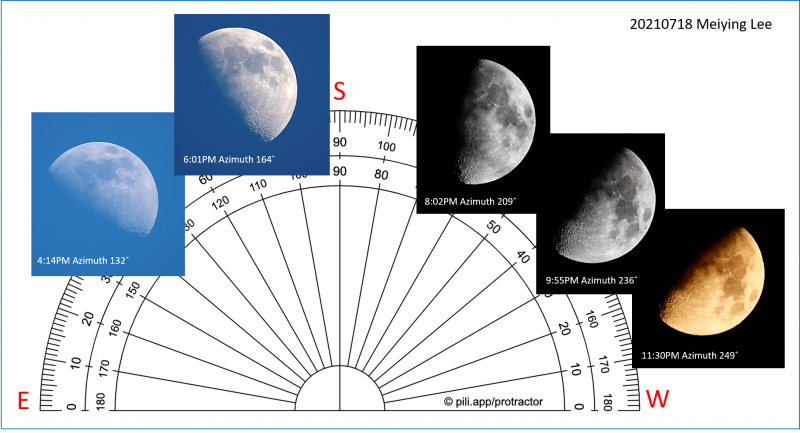
View at EarthSky Community Photos. | Meiying Lee in Taipei, Taiwan, captured these images and made this composite chart of the moon over a single evening in July. It shows how the angle of the waxing gibbous moon — and the color of both the moon itself and the background sky — change from when you might first spy it in late afternoon until after midnight, when it sets. Thank you, Meiying!
View at EarthSky Community Photos. | This is a crop of an image taken by Andy Bentley in Mountain View, California, showing the moon on a single night in February. See the full image here. We all see the same moon phase. But, as the image shows, the moon’s orientation to your horizon changes throughout the night, or as you move northward or southward on Earth’s globe. Thanks, Andy!
How the moon changes between hemispheres
So, why do people in different parts of the globe see the same moon phase, but it appears different? People in the Northern and Southern Hemispheres see the moon oriented differently from one another. It’s not a change in phase. It’s a change in the orientation of the moon with respect to your horizon. The differences can be hard to comprehend!
For one thing, observers in the Northern and Southern Hemispheres see the moon apparently upside down with respect to each other. You can see that if you scrutinize the moon’s features in the image below.
From Earth’s Northern Hemisphere, the moon’s north pole appears at the top. From Earth’s Southern Hemisphere, the moon’s south pole appears at the top. It’s all a matter of perspective! Image and caption via The Planetary Society. Used with permission.
Also, notice that from the Northern Hemisphere, a waxing moon (from new moon to full moon) increases its phase from right to left. Meanwhile, from the Southern Hemisphere, a waxing moon increases its phase from left to right.
Have you ever been to the southern hemisphere Ashes?? Ever see the Southern Cross? Sigma Octantis? The sun moving from right to left each day? The stars moving clockwise each night? The moon phases move from left to right over 28 days?#SouthernHemisphereDisprovesFlatEarthpic.twitter.com/pfESD411yH
Why so different? Think of the moon’s path across your sky. Just picture yourself standing there, looking at it. From the Northern Hemisphere, we look generally southward to see the moon (or sun) crossing our sky. From the Southern Hemisphere, people look generally northward to see the moon (or sun) crossing the sky.
Can you see why that shift in your orientation on the globe would cause you to see the moon differently?
A final thought
What we on Earth call moon phases are really about sunrise/set on the moon. Astronomers call the line between light and dark on the moon the terminator. That’s the line of sunrise or sunset on the moon, and it shifts, just as the line of sunrise and sunset on Earth is constantly shifting.
Also, Earth spins relatively fast, approximately once every 24 hours. The moon spins on its axis only about once a month, and its line of sunrise/set moves slowly. It’s wonderful fun to beg or borrow a telescope for a night when the moon is up … and watch for yourself over several hours. The shadows slowly shift on the moon, as the lunar sunrise or sunset slowly creeps across the moon’s face.
Of course, it’s also a great way to clear the mind!
View at EarthSky Community Photos. | Meiying Lee submitted this composite image of moon phases and wrote: “The photos of the moon were taken from August 15th, through September 10th. On September 11th, typhoon #14 Chanthu began to hit Taiwan and interrupted the progress. A friend Bob in Phoenix, Arizona agreed to complete the last three moon phase photographs that ended on September 13th. Through the cooperation of Taiwan and USA, the month-long moon phases documentation finally completes.” Thank you, Meiying!
Bottom line: The moon shows one phase to the Earth at the same time, but our different perspectives due to where we are on the globe can make the moon appear differently in our sky.
View larger. | Color-coded topographic map of the Alba Mons volcano (center) and surrounding region. Many cracks in the surface are visible around the volcano. The European Space Agency’s Trace Gas Orbiter (TGO) detected the gas hydrogen chloride coming from some of the cracks. Are they evidence of active volcanoes on Mars? Image via NASA/ JPL-Caltech/ Arizona State University/ Wikimedia Commons.
Are there still active volcanoes on Mars? The planet’s volcanoes are no longer erupting, but there could still be flowing magma underground.
The European Space Agency’s Trace Gas Orbiter has detected hydrogen chloride coming out of cracks in the surface in the Alba Mons volcano region.
The noxious gas is often produced by hot magma moving below the surface on Earth.
Mars’ enormous volcanoes — including Olympus Mons, the largest in the solar system — are remnants of an active volcanic past. But, unlike Earth, Mars has no moving tectonic plates to continually reshape its surface. And so, for much of the space age, Mars has been considered a largely dormant world.
But that picture has been changing. NASA’s InSight lander detected more than 1,300 seismic events, revealing that Mars still experiences marsquakes. And evidence of relatively recent volcanic activity has been accumulating, too.
Now, an international team of researchers says it has found perhaps the strongest evidence yet that Mars might still be volcanically active, with magma moving beneath its surface.
The researchers said on November 4, 2026, that the European Space Agency’s Trace Gas Orbiter (TGO) has detected the gas hydrogen chloride (HCl) above cracks in the Martian surface in the region of the Alba Mons volcano. Alba Mons is northeast of Olympus Mons.
On Earth, magmatism — the movement of hot magma below the surface — often produces hydrogen chloride. It is a minor volcanic gas compared to water vapor, carbon dioxide, and sulfur dioxide from earthly volcanoes. But, on Mars, hydrogen chloride might be a major volcanic gas, according to scientists.
The detection adds to previous evidence for active volcanism still occurring on Mars today. Even though Mars’ volcanoes are no long erupting, magma could still flow deeper down.
The researchers published their new peer-reviewed findings in Science Advances on November 4, 2026.
Mars may not be geologically dead after all. ? Our ExoMars Trace Gas Orbiter has detected hydrogen chloride above volcanic fissures in the Alba Mons region, which scientists suggest could be linked to dormant volcanic activity beneath the surface. Read more: new.esa.int/articles/new…
Traces of noxious gas point to possible active volcanoes on Mars
Trace Gas Orbiter detected the traces of hydrogen chloride above geologically fresh cracks in the surface in the Alba Mons region. The gas was at parts-per-billion levels, but still higher than expected (if future studies confirm it is there at all). The paper states:
Detections of hydrogen chloride at low altitudes, unexplained by observed atmospheric state and models, together with the geological context of the region, hint at an igneous origin of this gas.
Mars is reputed to lack ongoing volcanic activity. However, marsquakes were revealed recently, and clues to volcanism younger than tens of million years have accumulated. While sulfur dioxide, so far undetected, could testify to ongoing eruptive activity, evidence of active magma chambers may be better identified by seepage of halogen gases, such as hydrogen chloride.
Co-lead author Daniel Mège at the Space Research Center of the Polish Academy of Sciences said:
Our findings suggest that Mars has retained enough internal heat to support volcanic activity until recently, and possibly still does.
The Trace Gas Orbiter was able to find the smoking gun. It was like looking for a needle in a haystack. It’s truly amazing that it spotted a handful of molecules from a perhaps intermittent source, whilst moving continuously along its orbit to monitor the whole martian atmosphere,
A huge part of the work consisted of examining all the possible chemical processes going on in the martian atmosphere. We needed to be rigorous, critical and creative to explain the presence of hydrogen chloride. The data were complex, but also excellent brain food.
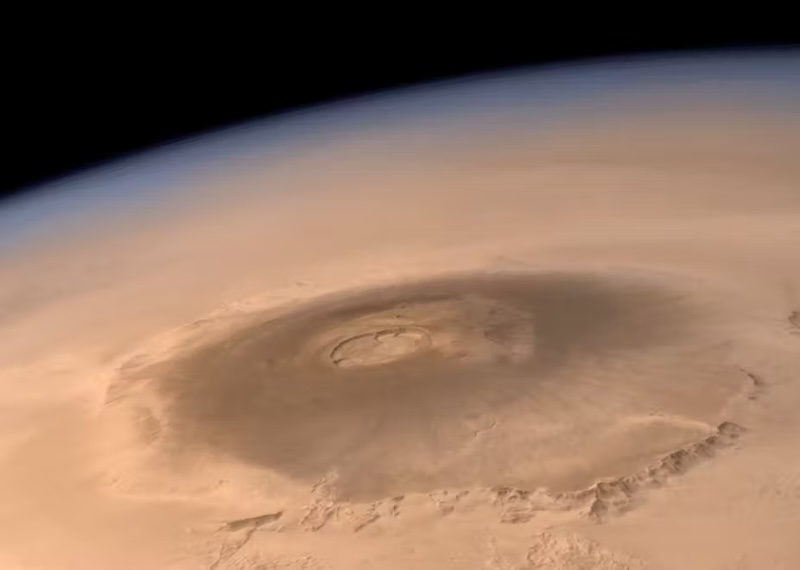
View larger. | This Mars Express spacecraft view shows Olympus Mons on Mars, the largest volcano in the solar system. Mars’ volcanoes might no longer be erupting, but it seems there may still be magma flowing beneath the surface. If so, Mars could still have active volcanic systems deep underground. Image via ESA/ DLR/ FU Berlin/ J. Cowart.
Aerosols and seepage
Hydrogen chloride can be found virtually everywhere in the Martian atmosphere. But those observations are typically during warmer seasons, when the hydrogen chloride behaves as an aerosol. Aerosols are fine solid particles or liquid droplets in the atmosphere.
This gas isn’t seen as much during Mars’ colder seasons because its molecules are quickly “absorbed” by water ice crystals and disappear from the observations. But the detections at Alba Mons were during the cold season. And the levels were much higher than anticipated. The gas was detected above geologically fresh new cracks in the surface around the volcano. The cracks were several hundred meters long, and tens of centimeters wide.
The researchers said it’s likely that the hydrogen chloride seeped into Mars’ atmosphere from these cracks. That would make it volcanic in origin. The paper states:
Observations by Atmospheric Chemistry Suite led to the widespread observations of hydrogen chloride at part-per-billion levels in the atmosphere of Mars during the warm perihelion period [when Mars was closest to the sun in its 2-year orbit], attributed to aerosol-atmospheric sources. Here, we report hydrogen chloride detections during the cold aphelion season [when Mars is farthest from the sun] that are isolated in the Alba Mons region.
We also identify fresh and narrow (<1 meter) fissures in this area, which we interpret to be potential hydrogen chloride pathways rooted into magmatic bodies at depth. Our results are best explained by ongoing igneous processes in the Martian interior.
A supplementary to the main paper (pdf download) also states:
Localized aphelion detections of HCl at low altitudes, together with the geological context of the area, suggests an igneous origin of this gas and that the detections are made above the seepage.
Icy buffer zone
It’s possible that the hydrogen chloride doesn’t come straight from the magma. It might come from a buffer zone, a layer of permafrost above the magma.
In the cold winter, the ice traps the hydrogen chloride molecules. But when the temperatures get a bit warmer in spring, the ice sublimates and release the gas into the atmosphere.
If there is a permanent source of hydrogen chloride in the surface “soil,” this could explain the seasonality of the observations and their binding to a certain area.
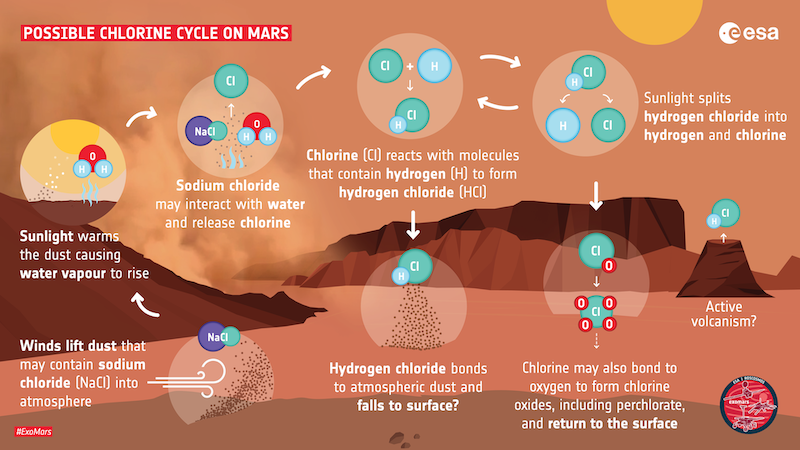
View larger. | The possible chlorine cycle on Mars, including hydrogen chloride. Image via ESA.
The chlorine cycle
On both Earth and Mars, there was a chlorine cycle initiated by degassing while the planets were still forming. In other words, as molten rock cooled and solidified, it released gases from the planets’ interiors into their atmospheres.The paper states:
On Mars, as on Earth, the chlorine cycle initiated by volcanic degassing from the deep interior upon planetary accretion was fed by the subsequent volcanic eruptions, and, because of its high mobility and solubility, chlorine has been continuously recycled in water, sediments, permafrost, and ice clouds. However, contrary to Earth, the absence of recycling due to plate tectonics probably make the volcanic source the main input to the surface-atmosphere system on Mars. The topic addressed here is volcanism still contributing to this cycle on Mars today?
The more we know about Mars, the more we learn that it’s not as cold and dead as we thought it was. While the surface is a cold desert, there might still be heat deeper down. Heat from flowing magma that just might be able to melt ice and support life.
Co-lead author Daniel Mège at the Space Research Center of the Polish Academy of Sciences. Image via Daniel Mège.
Habitats for life?
Plus, hot magma deeper down could heat ice and create groundwater. So could there still be active hydrothermal systems, too? If so, they might provide habitable conditions for microbes below the surface. Mège said:
Looking for Martian life in the seeping fissures of the Alba Mons region would make a lot of sense. If hydrothermal systems are active, they could contain the ingredients and energy needed for microorganisms to develop, and shield microorganisms from the hostile and changing environment above the surface.
Bottom line: Are there still active volcanoes on Mars? New detections of hydrogen chloride from below the surface suggest flowing magma.
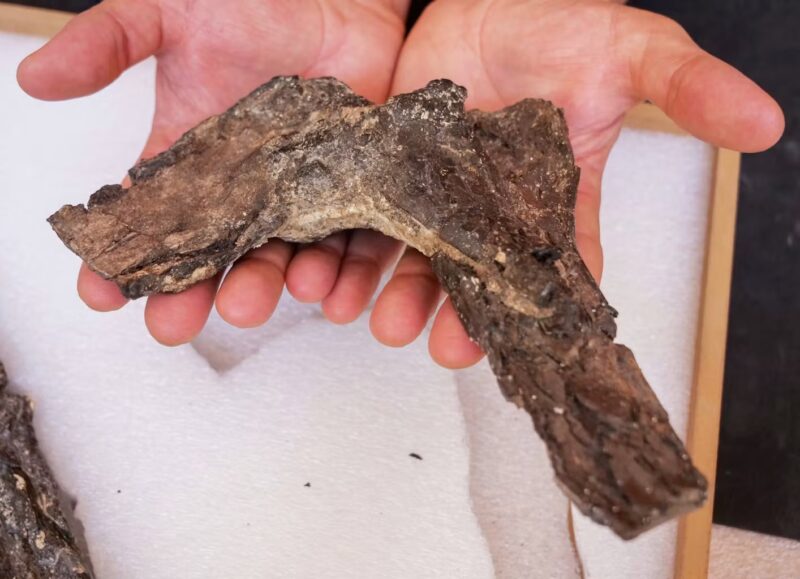
Within this fossil is the first direct molecular evidence of compounds from dinosaur blood preserved within structures that look like red blood cells. Image via Curtin University/ The Conversation.
Scientists found the first direct molecular evidence of dinosaur blood in a 115-million-year-old fossil bone from Brazil. The bone contains structures resembling red blood cells.
Chemical analysis revealed heme molecules, a key component of hemoglobin. It also found traces of collagen, supporting the conclusion that the remains came from blood and connective tissue.
Rapid burial in a low-oxygen environment and protective minerals might have helped preserve these molecules for millions of years. Thus, other museum fossils could hold similar biological clues.
A 115-million-year-old fossil dinosaur bone encased in a dense mat of microbes found in Brazil contains tiny structures resembling red blood cells, and molecular traces of blood.
Along with colleagues from Brazil, Japan and the United States, we reported the discovery on November 2, 2026, in the Proceedings of the National Academy of Sciences.
This is the first direct molecular evidence of compounds from dinosaur blood preserved within structures that look like red blood cells. The find offers an unprecedented window into the biology of extinct animals.
It also expands what we thought possible: that fossils can preserve soft tissues and biomolecules such as blood over millions of years.
The Romualdo Formation is renowned for its exquisitely preserved fish, turtles, crocodile relatives and pterosaurs. It also contains rare dinosaur material. The site’s unique geochemical conditions have preserved fossils with fine anatomical detail rarely seen elsewhere.
The specimen was in Brazil’s National Museum until a catastrophic fire destroyed much of the museum’s irreplaceable collection in 2018. However, the building holding this fossil was not affected by the fire.
Its name reflects this extraordinary history. Aratasaurus combines the Tupi (an Indigenous Brazilian language) words ara (“born”) and atá (“fire”) with the Greek sauros (“lizard”). The species name museunacionali honors the museum itself.
Together, the name means “the dinosaur born from the National Museum fire”.
What we discovered inside the bone
A key question was whether the structures we saw were really biological remnants – that is, actual blood – or something that may have happened to the fossil later as the tissues were turning to stone.
Some of the most compelling evidence comes from the precise anatomical location of the structures. They are exclusively within vascular canals inside the bone – where red blood cells are found in living vertebrates.
At the same time, the sediment that surrounded the fossil didn’t have any of these structures. This makes it even less likely they came from some sort of external contamination.
We evaluated and ruled out several alternative explanations for the structures. In the end, we believe they’re most likely authentic fossilized red blood cell remains.
Chemical fingerprints of ancient blood
To further strengthen the claim, we also found two chemical “fingerprints” of blood. These had the structure of heme molecules – a key component of hemoglobin, the protein in blood which carries oxygen.
There was a dramatic difference when we analyzed the chemistry of the sediment that surrounded the fossil, and the chemistry inside it. The sediment mostly contained compounds from plant and bacterial sources. The fossil bone contained a distinct signature dominated by the heme molecules.
Together, this evidence points to the conclusion that we’re seeing real preserved compounds derived from blood.
Other analysis techniques confirmed the presence of molecules from heme, as well as elements including iron, carbon and nitrogen. We also discovered amino acids associated with collagen, which is found in connective tissue.
How could this be preserved for 115 million years?
The dinosaur was rapidly buried in a low-oxygen environment which slowed down its decay. The blood did not remain fresh or unchanged. Instead, microscopic red blood cells turned into minerals during fossilization.
Another crucial factor may be the presence of minerals such as hausmannite, which can act a bit like antioxidants. They could stabilize sensitive organic molecules and slow their breakdown.
Together, these conditions preserved biological information at a molecular level – blood and collagen – for far longer than expected.
Illustration shows a limb bone from the theropod dinosaur Artasaurus preserved red blood cells containing heme and heme breakdown products.Victor O. Leshyk
What the cells reveal
The fossil red blood cell-like structures appear a bit larger and more rounded than the cells found in modern birds and crocodilians.
This difference may be because they were deformed as the bone fossilized. Alternatively, it could suggest the red blood cells of dinosaurs not related to birds were shaped differently than those of birds, their modern relatives.
We’ll need further research to resolve this question. However, the discovery opens intriguing new possibilities for understanding dinosaurs’ bodies at a cellular level.
How sure are we it’s really blood?
Evidence from microscopy, mineralogy, spectroscopy and molecular geochemistry all points toward the same conclusion. We are convinced these are fossilized red blood cell structures containing traces of heme molecules.
Our discovery shows that blood-derived molecules can survive for more than 110 million years under the right conditions. It also provides a plausible explanation of how it happened.
Fundamentally, it suggests soft tissues in fossils are more likely to withstand time than researchers previously thought.
Perhaps the most exciting implication is that museums around the world already hold an enormous, largely untapped scientific resource. Many fossils are not spectacular display specimens. Even so, they may preserve remarkable molecular, chemical and environmental information.
Using modern analytical techniques, we can revisit specimens collected decades ago and ask completely new questions about ancient life.
The fossil was collected and curated through the efforts of researchers including Renan Bantim and Antônio Saraiva of the Regional University of Cariri, along with Juliana Sayão and Alexander Kellner from Brazil’s National Museum and the Federal University of Rio de Janeiro, who also contributed to the research and facilitated access to the specimen. Other collaborators include Yuta Isaji, Calum Fox, Nana Ogawa and Noa Ohkouchi from the Japan Agency for Marine-Earth Science and Technology and Jasmina Wiemann from Johns Hopkins University in the US.
Kliti Grice, Founding Director of WA-Organic & Isotope Geochemistry Centre, School of Earth and Planetary Sciences, Curtin University
Bottom line: For the 1st time, scientists say they’ve found trace of dinosaur blood. It comes from a 115-million-year-old fossil dinosaur bone from Brazil.
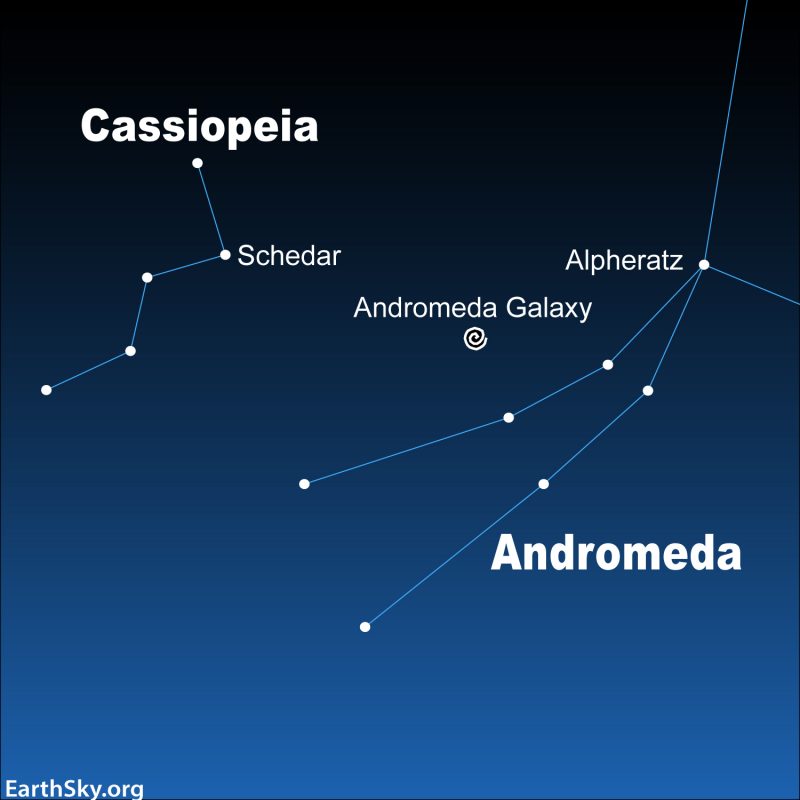
The W-shaped constellation Cassiopeia points to the stars of the constellation Andromeda and the Andromeda Galaxy (M31). Chart via EarthSky.
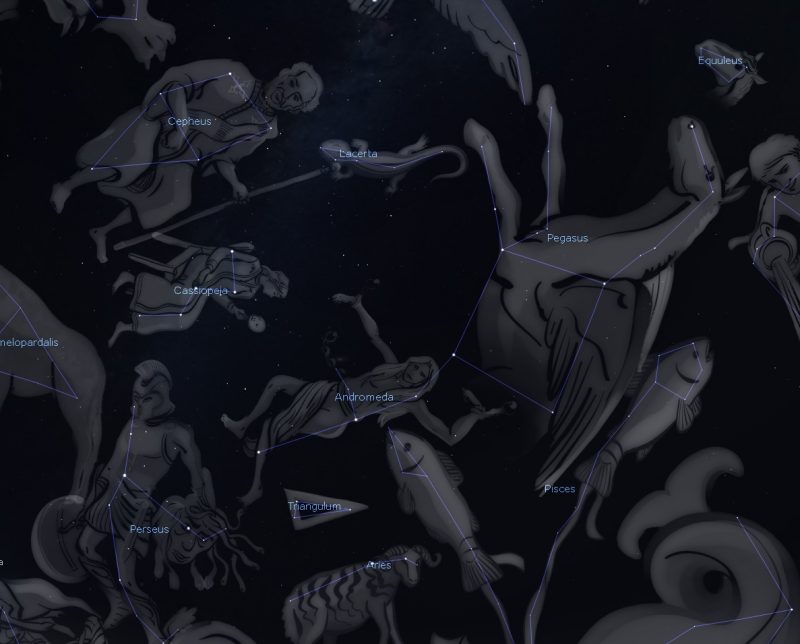
The constellation Andromeda is named for the daughter of Queen Cassiopeia and King Cepheus of Greek mythology. Andromeda has the nickname of the Chained Lady because her parents chained her up and offered her as a sacrifice to appease the sea monster Cetus. In the story, she is saved by Perseus and eventually becomes his queen. All these mythological characters are now visible as constellations in the night sky.
View larger. | Andromeda the Chained Lady lies near her parents, Queen Cassiopeia and King Cepheus. She also contributes one star to the Great Square of Pegasus. Image via Stellarium. Used with permission.
How to find the constellation Andromeda
Andromeda is easy to find because of the company it keeps. The W-shaped constellation Cassiopeia points toward Andromeda. Andromeda is also next to the Great Square of Pegasus. In fact, one of the stars of the Great Square actually belongs to Andromeda.
November and December are excellent months to try to spot Andromeda the Chained Lady. Look east after it gets dark to find the constellation already high above the horizon. Plus, Andromeda favors viewers in the Northern Hemisphere; it is not visible to those south of 40 degrees south latitude. The constellation is the 19th largest, in size, of the 88 constellations. The finder chart above can guide you to it.
Stars of the constellation Andromeda
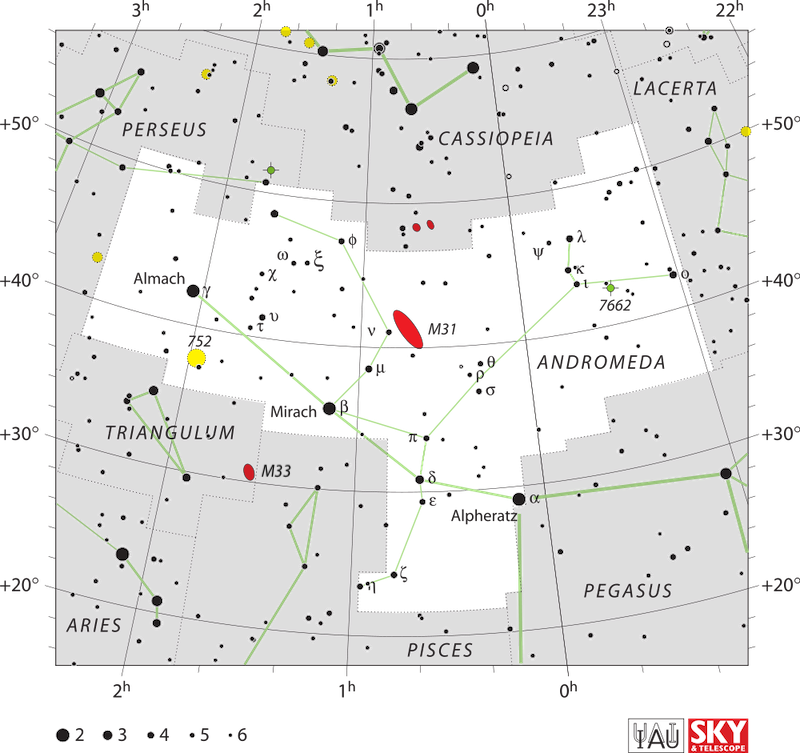
The brightest star in the Great Square of Pegasus actually belongs to Andromeda: the magnitude 2.06 star Alpheratz. Alpheratz lies 97 light-years away. In addition, another magnitude 2.06 star, Mirach, lies to the upper left of Alpheratz. Mirach lies 197 light-years away and is the closest bright star to the Andromeda Galaxy. The third brightest star in Andromeda is magnitude 2.26 Almach, to the upper left of Mirach. Almach lies 355 light-years away.
A star map of the constellation Andromeda showing the locations of the Andromeda Galaxy (M31) and the Triangulum galaxy (M33). Image via IAU/ Sky & Telescope/ Wikimedia Commons.
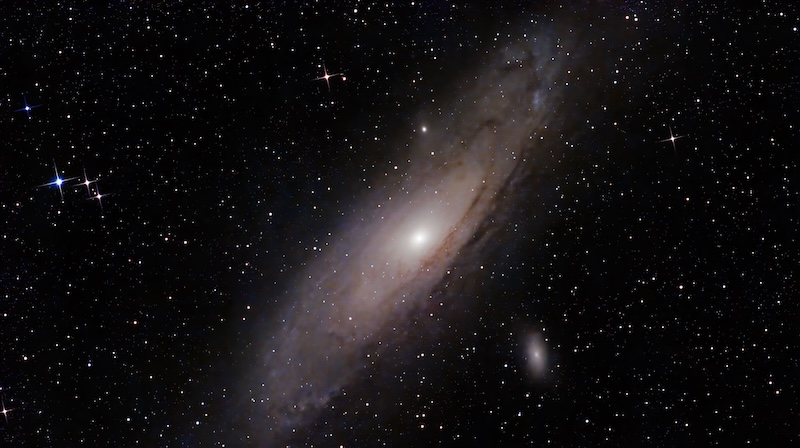
View at EarthSky Community Photos. | Vikash Singh captured this image on July 15, 2026, from India. Vikash wrote: “This is the Andromeda Galaxy (M31), captured using the Dwarf 3 smart telescope. The completely clear night sky and low light pollution of Ladakh made it possible to capture incredible details of our neighboring galaxy.” Thank you, Vikash!
Finding the Andromeda Galaxy with Cassiopeia
Although M31, the Andromeda Galaxy, is centrally located in the constellation Andromeda, it’s also easy to find by using the stars of Cassiopeia. The magnitude 3.5 galaxy can be seen as a hazy patch in a dark sky, but most people will need binoculars or a telescope to find the wide misty patch.
Andromeda stretches about 3 degrees across and 1 degree wide. That’s twice as wide as the full moon. It lies at a distance of approximately 2.5 million light-years from Earth, which means that as we view the light from Andromeda, we are seeing it as it was 2.5 million years ago.
To find the Andromeda Galaxy, look for the W shape of Cassiopeia. With the two V shapes that make up the W, use the V shape on the right. Imagine the V as an arrow, pointing into the constellation Andromeda. From the tip of the arrow star to the spiral galaxy, the angular distance is a little over 15 degrees. (Hold your hand at arm’s length and use your index finger and pinky spread apart to measure 15 degrees on the sky’s dome.) The arrow of Cassiopeia does not point precisely to Andromeda, however. You will have to look a bit to the right to find the galaxy M31.
Finding Andromeda Galaxy from the Great Square of Pegasus
One of the stars that makes up the Great Square of Pegasus — Alpheratz — belongs to the constellation Andromeda. You can use Alpheratz to find the Andromeda Galaxy. Then look left and find three stars leading away from it: a 3rd magnitude star (Delta Andromedae), Mirach and Almach. Focus on Mirach, and then look above Mirach. There are two stars in a line above it, the top one dimmer than the bottom. If you can see the highest star without optical aid, look just to its right for a slightly lighter patch of sky. Put your binoculars or a telescope on it to confirm that you’ve found the Andromeda Galaxy.
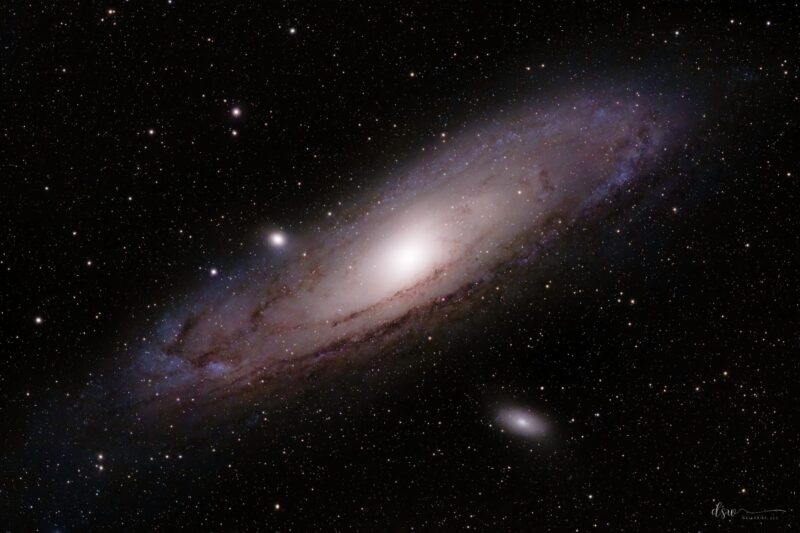
M31, at magnitude 3.5, should be easy to see once you have it located in your binoculars or telescope. Indeed, the grayish patch should show an oval shape, characteristic of spiral galaxies. In addition, two other Messier objects are within your field of view when you are looking at Andromeda. M32 and M110 are elliptical galaxies that are companions to the large Andromeda Galaxy. They also lie 2.5 million light-years away. M32 is magnitude 8.1 and is closest to the galaxy, appearing to lie on the larger spiral’s edge. M110 is magnitude 8.5 and is a bit farther away from the large spiral.
View at EarthSky Community Photos. | Jeremy Likness in Newport, Oregon, captured this telescopic view of the Andromeda Galaxy on September 10, 2026. Jeremy wrote: “The numbers are mind-numbing. 2.5 million light years? One trillion stars? My target: M31, the Andromeda Galaxy. Our nearest galactic neighbor is also enthusiastically approaching us at a rate of 250,000 miles per hour, on track to collide after the estimated billions of years it will take to cross the estimated 250 million light years between our galaxies. And this is the busy neighborhood!” Thank you, Jeremy!
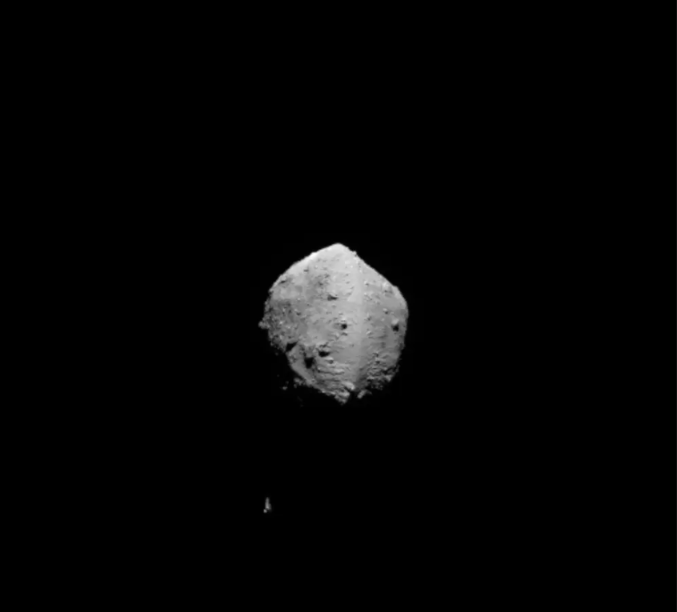
This is Hera’s 1st closeup view of Didymos. The ESA space mission is on its way to investigate what happened when the DART mission impacted Didymos’s little moonlet, Dimorphos. A glimpse of Dimorphos is visible here, hiding in Didymos’s shadow. Image via ESA.
Hera’s 1st closeup view of Didymos and Dimorphos
On November 5, 2026, ESA said that its Hera mission has caught its first glimpse of its target, the binary asteroid system of Didymos and Dimorphos. Dimorphos, a little moonlet of asteroid Didymos, was struck by NASA’s DART mission back in 2022, in the name of planetary defense. Hera was about 37 miles (60 km) away from Didymos when it took this image. Little Dimorphos also shows a glimpse of itself, hiding in the larger asteroid’s shadow.
The first thing we said was wow! This is the other side of Didymos from the one that DART’s camera showed us shortly before impact, so this feels like looking at a whole new world. This side of Didymos has the same central ridge along its equator that we saw before, but otherwise appears very different, with multiple boulders and craters and what look like patterns of grooves or ridges.
Since we expect a lot of impact-ejected material to have made it across the approximately 1 km of space from Dimorphos to Didymos, it may be that some of these characteristics originate from this transport of material, and we have an exciting work ahead of us to sort it out. We look forward to seeing much more of both bodies and systemically mapping all the changes we identify.
ESA said that detailed images of both asteroids will be unveiled on November 25.
The Hera mission hits the brakes
The European Space Agency’s Hera mission has hit the brakes! The spacecraft is headed for the site of a human-made impact on the asteroid Dimorphos, created in 2022 by NASA’s DART spacecraft as a test of our ability to move an asteroid in its orbit. But — before Hera can properly reach Dimorphos — first it had to slow down.
That’s why the spacecraft will fire its thrusters on October 15, 2026. And, ESA said, the maneuver was a tricky one:
Hera will rotate around so that its ring of Orbit Control Thrusters face toward the Didymos system. Three of these hydrazine-based thrusters will be ignited at once, burning continuously for a total of 93 minutes, to reduce Hera’s velocity relative to the asteroids by a few hundred meters per second.
We’re happy to report that all went well. Now, Hera is closing in on Dimorphos to begin its investigations!
The Hera mission to asteroid Dimorphos — the asteroid struck by another earthly spacecraft (DART) in 2022, in the name of planetary defense — performed a braking maneuver on October 15. Why is Hera going to Dimorphos? Read more below. Image via ESA Science Office.
Hera is ready for its asteroid rendezvous
In 2022, the groundbreaking DART mission struck and moved an asteroid. It was a test of Earth’s ability to defend itself from an incoming asteroid threat. Two years ago, on October 7, 2024, a follow-up mission — ESA’s Hera — launched toward the asteroid impact site on Dimorphos, a little moon of the asteroid Didymos. Now, Hera is ready for its November 2026 meeting with the asteroid pair. After it arrives, it will spend six months investigating the aftereffects from the impact.
So far in 2026, the Hera mission has undergone a deep-space maneuver to correct its course toward its target. And in July 2026, it finished receiving an upgrade to its software. The braking maneuver on October 15 worked to get the spacecraft to its target.
When Hera reaches the asteroids, it will release two cubesats, Milani and Junventas. Milani is in charge of spectral surface observations (splitting light bounced off the asteroid into a rainbow array of colors, then analyzing that light). And Juventas will take the first radar soundings in the heart of an asteroid.
In this artist’s concept, the Hera mission scans the impact crater that DART left behind. Image via ESA.
When DART hit Didymos
Back in 2022, when DART hit Didymos’ little moon Dimorphos, it made a big splash. We know for sure it pushed the asteroid slightly out of its previous orbit. And the debris kicked up in the collision might even have created a new meteor shower for Earth!
Hera is going to learn more about just what happened when DART struck the little asteroid, creating a crater on its surface and moving it slightly in orbit. It’s going to learn more about Dimorphos itself, to help refine our knowledge of what DART did … to keep us safe from future asteroid collisions.
This will be the first investigation of a binary asteroid. Hera’s focus will be on Dimorphos, the moonlet that DART impacted. According to ESA — the mission planner — Hera will conduct a “crime scene investigation” at the little asteroid moon. But Hera will also check out both Didymos and the dusty environs unleashed by the impact.
Here are 3 mysteries that Hera will help solve
ESA shared three mysteries that Hera will help solve:
Hera will measure the density and composition of Dimorphos in detail and help scientists determine whether it is a “rubble pile” loosely held together by gravity, or a solid core covered in boulders and gravel.
Hera will map the crater created by DART’s impact down to 4-inch (10-cm) resolution to help scientists better understand how the surface material responded to the collision. It’s possible that there is no crater at all, but rather the impact reshaped the entire asteroid!
About 15% of known asteroids are actually binary systems, but their origins remain mysterious. Hera will determine whether Dimorphos and Didymos are made from the same material, which would hint that the rapidly spinning Didymos once threw off debris into space that later formed Dimorphos.
Hera project scientist Michael Küppers
Watch EarthSky’s Deborah Byrd speak with Hera project scientist Michael Küppers below. Get the latest here about keeping Earth safe from asteroids.
The Hera mission and a missing planet
Watch a video about the Hera mission to the asteroids Didymos and Dimorphos.
The Hera mission vs the Colosseum
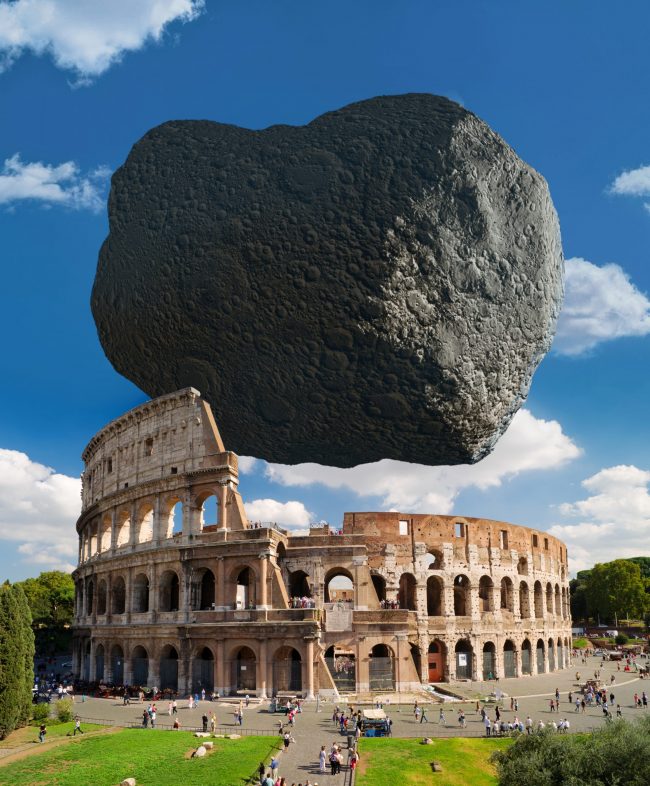
The asteroid Didymos is about a half mile (800 meters) wide. So, that’s about the size of the Golden Gate Bridge. Its little companion, Dimorphos, is about 560 feet (170 meters) in diameter. And that’s about the size of the Great Pyramid. Or compare it to Italy’s Colosseum below.
This graphic compares the size of the asteroid moonlet Dimorphos to the Colosseum in Rome, Italy. Image via ESA.
Bottom line: The Hera mission just got its 1st closeup view of the asteroid Didymos and its little moonlet Dimorphos. Soon it will begin investigating the aftermath of the DART impact.
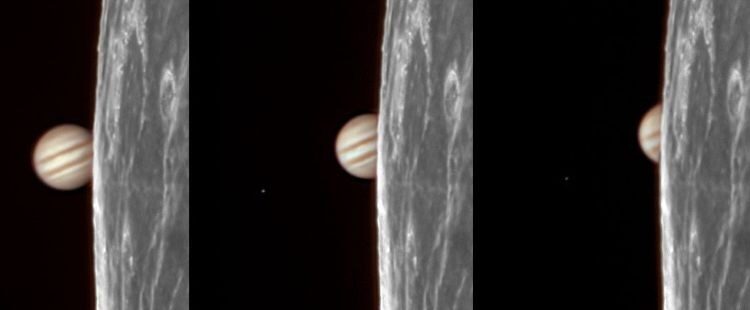
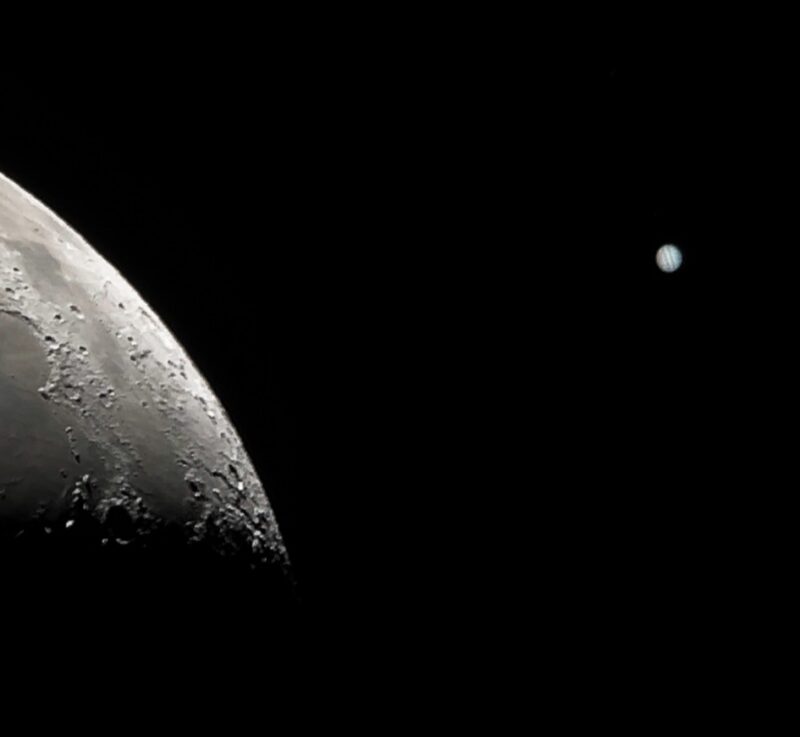
View at EarthSky Community Photos. | Michael Teoh in Ipoh, Perak, Malaysia, captured this view of Jupiter disappearing behind the moon on the morning of November 3, 2026. Thank you, Michael! Read more about these images of the moon and Jupiter below.
The moon and Jupiter play hide-and-seek
On the morning of November 3, 2026, observers in parts of Asia, Australia and New Zealand saw the moon and Jupiter appear so close in the sky that the moon briefly blocked Jupiter from view. Astronomers call this a lunar occultation. And it’ll happen again at the end of the month!
In November, Jupiter is rising very late at night and staying visible until sunrise. The king of the planets is currently close to the red planet, Mars, and the brightest star in Leo the Lion, Regulus. Throughout November, Jupiter and Mars will appear closer and closer on the sky’s dome until they reach their closest on November 15. On that date, they’ll be a little more than two moon-widths apart.
Plus, these planets will be right in front of the radiant point of the Leonid meteor shower! That’s the point which all Leonid meteors appear to shoot from. This shower will reach its peak on November 17-18, not long after Jupiter and Mars reach their closest.
After the Jupiter-Mars conjunction, don’t stop watching! Because even as these worlds slowly pull apart again, Mars will first cross the distance between Jupiter and Regulus to form a tight triplet in the sky, and then the moon will return to the scene.
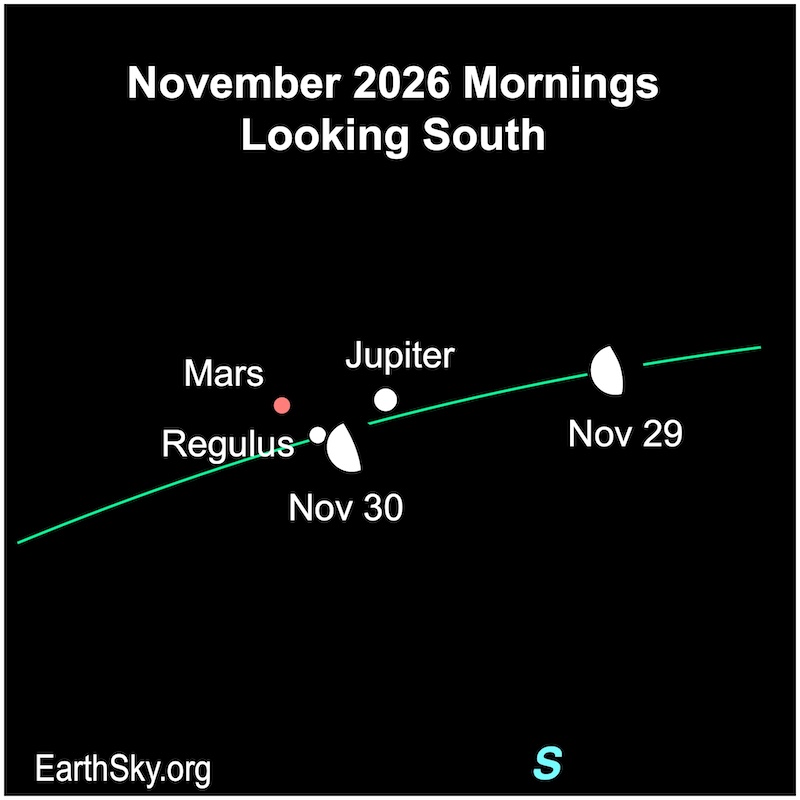
On November 29 and 30, look for the moon close to Jupiter, with Mars and Regulus below. Lucky observers in southern parts of the globe, including southern Argentina and Chile, will see the moon pass in front of Jupiter on November 30.
The moon will be high in the east before dawn on the last 2 mornings of November. Jupiter, Mars and the bright star Regulus will be nearby. On November 30, some observers will see the moon pass in front of Jupiter. Chart via EarthSky.
Jupiter disappearing and reappearing
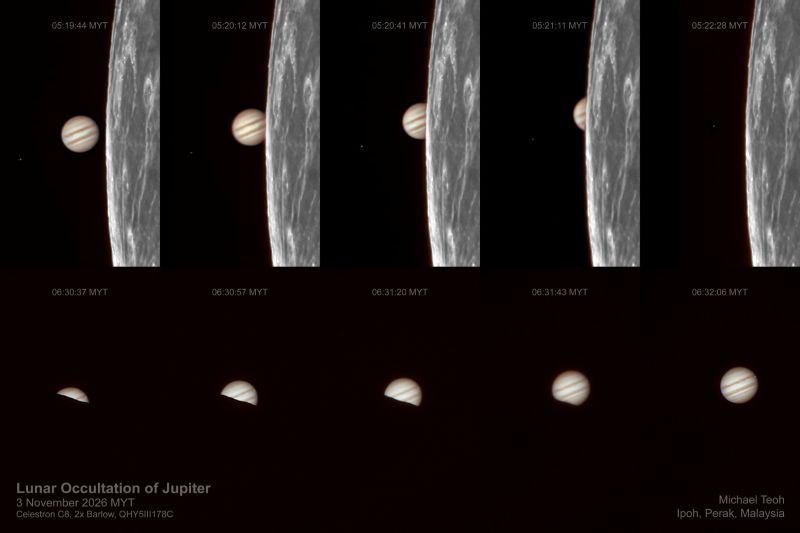
Michael Teoh in Malaysia captured the first lunar occultation of Jupiter in early November. He also managed to captured two of Jupiter’s moons!
View larger at EarthSky Community Photos. | Michael Teoh in Ipoh, Perak, Malaysia, captured this view of Jupiter disappearing and then reappearing from behind the moon on the morning of November 3, 2026. Michael wrote: “During this lunar occultation of Jupiter, 2 Galilean moons were visible. At the ingress phase (top row), Io trails to the west of Jupiter, while Europa transits across the surface of Jupiter. But at this point, Europa wasn’t visible due to the limitation of the resolution, poor seeing conditions and low contrast against the Jovian disk. At the egress phase (bottom row), the trailing Io was still blocked by the moon, while Europa appears exiting the eastern limb of Jupiter, thanks to the much improved seeing condition and better contrast against the darker Jovian limb.” Click here to see a larger version. Thank you, Michael!
More EarthSky Community Photos
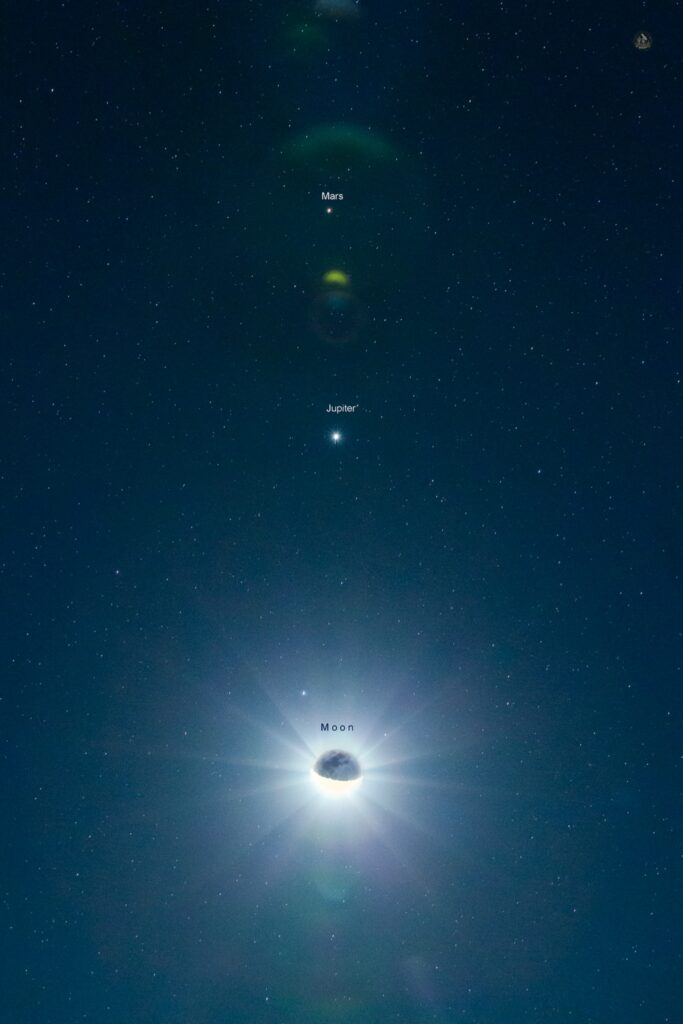
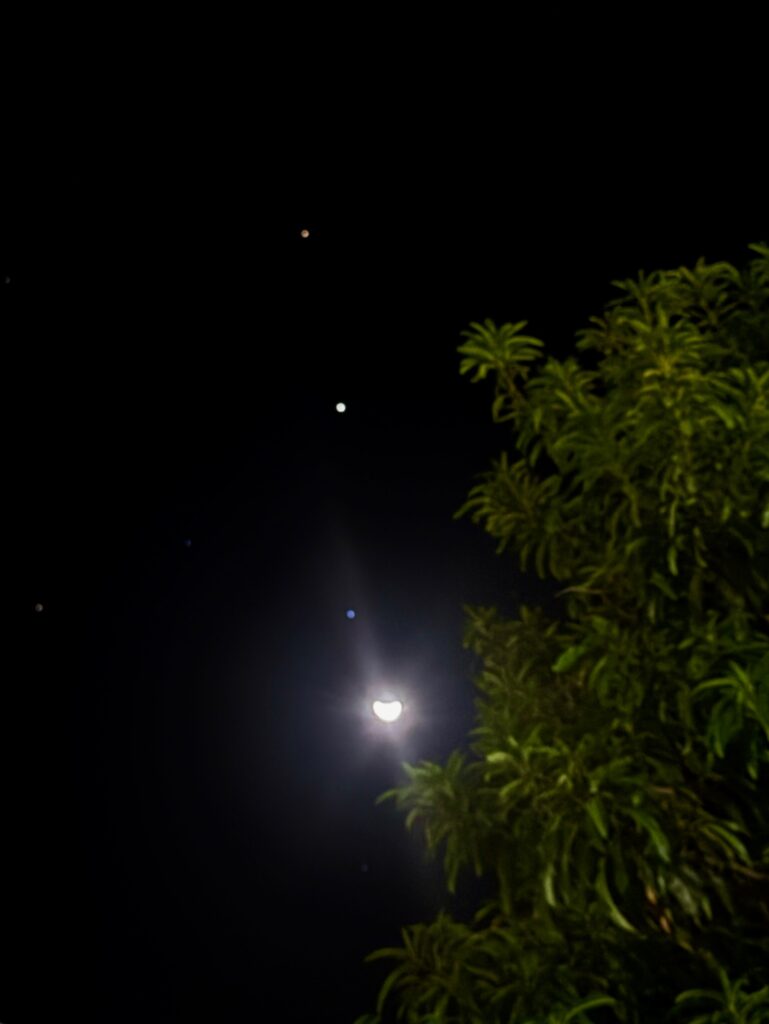
View at EarthSky Community Photos. | Atharva Maurya captured this stunning close-up from Bhadohi, India. Thank you, Atharva!View at EarthSky Community Photos. | Jelieta Walinski in the Desert Bloom Observatory, Arizona, captured the moon, Jupiter and Mars. She wrote: “Sometimes, astrophotography teaches us that capturing the universe is not always about magnification. Sometimes, we must widen our perspective to appreciate the bigger picture.” Thank you, Jelieta!View at EarthSky Community Photos. | Look at those colors! Gail Gunstone in Loreto, Mexico, wrote: “Mars, Jupiter, Regulus and the moon by my mango tree.” What a delicious photo. Thank you, Gail!
Bottom line: The moon and Jupiter played hide-and-seek on November 3, 2026. And they’ll pair up again at the end of the month! Plus, don’t miss the Jupiter-Mars conjunction mid-month.
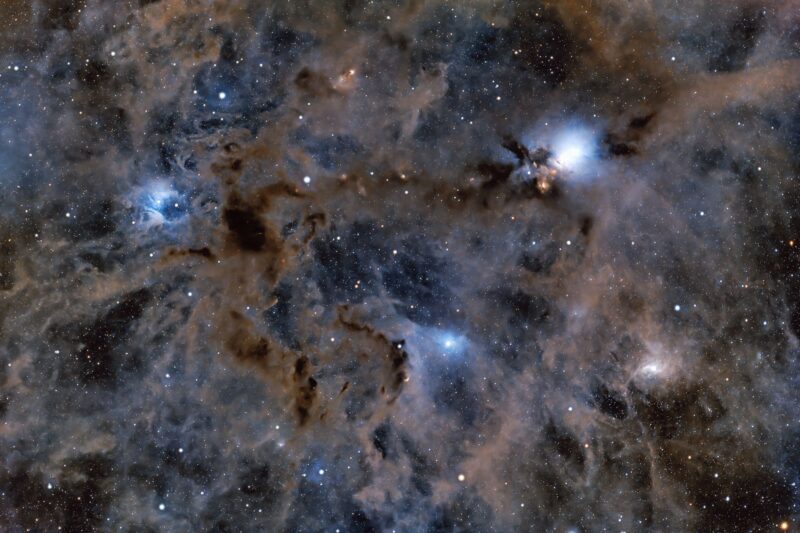
Plunge into the darker side of the night sky and get to know dark nebulae. Dark nebulae — or absorption nebulae — are clouds of gas and dust in space dense enough to block light from background stars.
These vast clouds are mostly composed of molecular hydrogen. And often, they are locations where material is coalescing to form new stars.
American astronomer Edward Emerson Barnard was the first to create a large catalog of 182 dark nebulae in the year 1919. And since then, hundreds more have been found and charted in our Milky Way galaxy.
Below are some of the best-known dark nebulae, favorites of observers and astrophotographers.
The Great Rift, or Dark Rift, is a structure stargazers can see with the eye alone from a dark-sky site. In northern summer, you can see the starry band of the Milky Way — the edgewise view into our own galaxy — stretched across the night sky. And if you look closely, that starry band appears to be split into two lengthwise by darkened lanes of obscuring dust. This is the Great Rift.
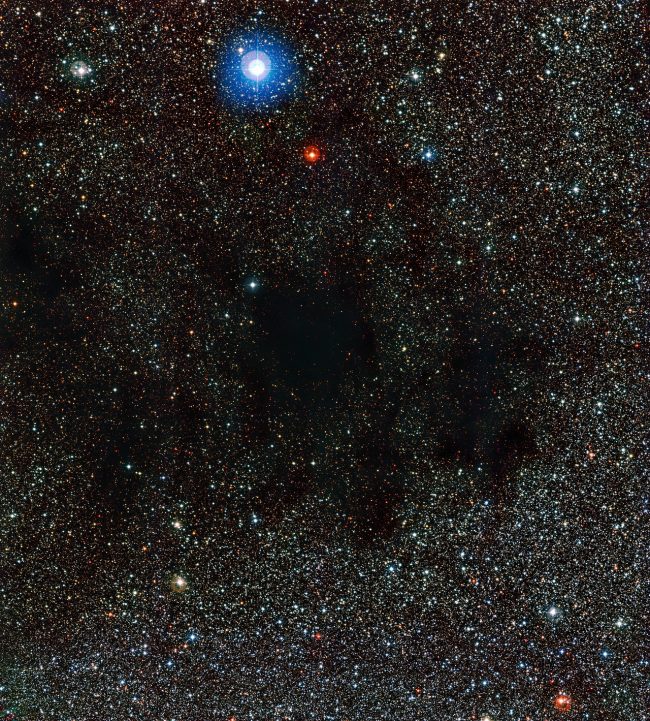
The Coalsack is generally considered the easiest dark nebula to see. However, you have to be in the Southern Hemisphere to see it. To those on the southern half of Earth’s globe, the Coalsack is visible to the unaided eye as a dark, cloudy patch in the Milky Way. It’s located in the famous constellation Crux the Southern Cross.
This is the Coalsack, a huge cloud of gas and dust in space. April and May are some of the best months to see the Coalsack in the constellation Crux the Southern Cross in the Southern Hemisphere. Image via ESO.
Watch this video and note the many dark clouds in the Milky Way as you zoom in to see the Coalsack.
The Horsehead Nebula
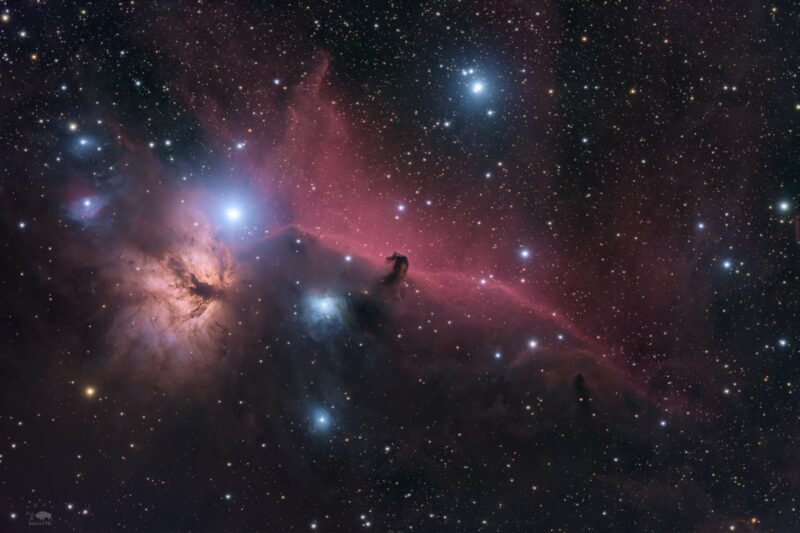
The Horsehead Nebula, or Barnard 33, is striking for its horsehead shape. It lies in the direction of the constellation Orion the Hunter.
Find the Horsehead Nebula by looking for Orion’s Belt, the constellation’s prominent line of three stars. The easternmost belt star (the star farthest left on the belt when looking at Orion in the Northern Hemisphere) is the star Alnitak. And just south of Alnitak is the Horsehead Nebula.
However, while famous, the Horsehead isn’t easy for amateurs to spot. You’ll need excellent seeing conditions, a large telescope and the help of a filter. It’s a great target in winter skies.
View at EarthSky Community Photos. | Ernest Jacobs in North Java, New York, captured the Horsehead Nebula on February 8, 2026. Ernest wrote: “The first clear night in months was Super Bowl Sunday. Temperatures were well below zero. A few of us braved the cold and headed out to our club’s observatory. We captured the Horsehead and Flame Nebulae. The bright star Alnitak (leftmost star of Orion’s Belt) is the bright star above the Flame Nebula.” Thank you, Ernest!
The Snake Nebula
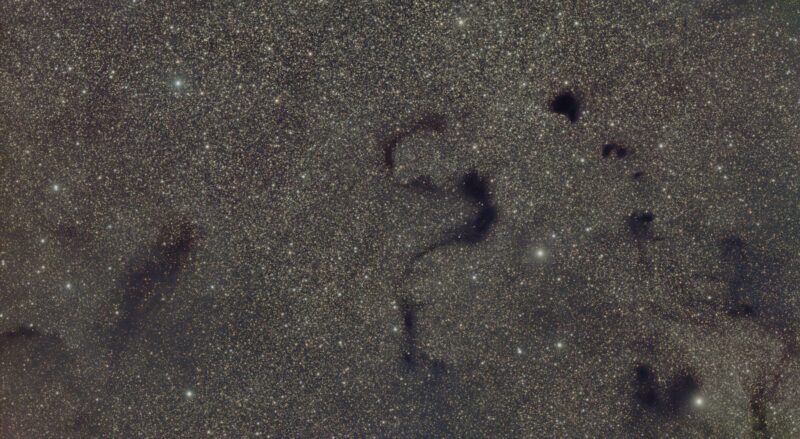
The Snake Nebula, or Barnard 72, is an S-shaped dark nebula in the constellation Ophiuchus the Serpent Bearer. The dark blobs below the Snake Nebula are a type of dark nebulae with the name of Bok globules.
View at EarthSky Community Photos. | Thomas Sorensen took this image from Tremonton, Utah, on March 25, 2025. Thanks, Thomas! This image shows some Milky Way stars’ light being blocked by a thick collection of gas and dust shaped like a snake or letter S. They are called dark nebulae.
Bok globules
Smaller, isolated dark nebulae get their own designation: Bok globules. Bok globules are cool clouds of gas and dust that look like drops of black paint. Usually, multiple star systems are forming inside.
Dutch-American astronomer Bart Bok gets credit for the discovery of Bok globules. But he had long been collaborating with astronomer Priscilla Fairfield, who he married in 1929. The Royal Astronomical society said:
It is difficult and pointless to separate his achievements from hers.
An example of a Bok globule is Barnard 68. This dark absorption nebula of molecular gas is within the Milky Way galaxy. It lies in the direction of the constellation Ophiuchus at a distance of 500 light-years.
Barnard 68 is a Bok globule close to the Snake nebula in the constellation Ophiuchus. It’s also at its best in June and July. Can you spot Barnard 68 in the image of the Snake nebula above? Image via ESO/ Wikimedia Commons (CC BY 4.0).
Dark nebulae in other galaxies
You can see dark nebulae in distant galaxies where a dark, dust lane obscures part of a spiral arm or the bulge, such as in the Black Eye Galaxy. The Black Eye galaxy, or M64, also has the nickname of the Evil Eye galaxy. This spiral with huge swaths of absorbing dust lies in the direction of the constellation Coma Berenices. This galaxy lies 17 million light-years away.
The Black Eye Galaxy displays great swaths of dark, obscuring clouds in its spiral form. The Black Eye galaxy lies toward the constellation Coma Berenices, a good target in May skies. Image via the Hubble Space Telescope/ Wikimedia Commons.
Bottom line: A dark nebula is a cloud of interstellar gas and dust that blocks light from background stars and other luminous objects. The Horsehead Nebula is a famous dark nebula.