aads

The enormous oarfish could inspire new ways to explore the ocean

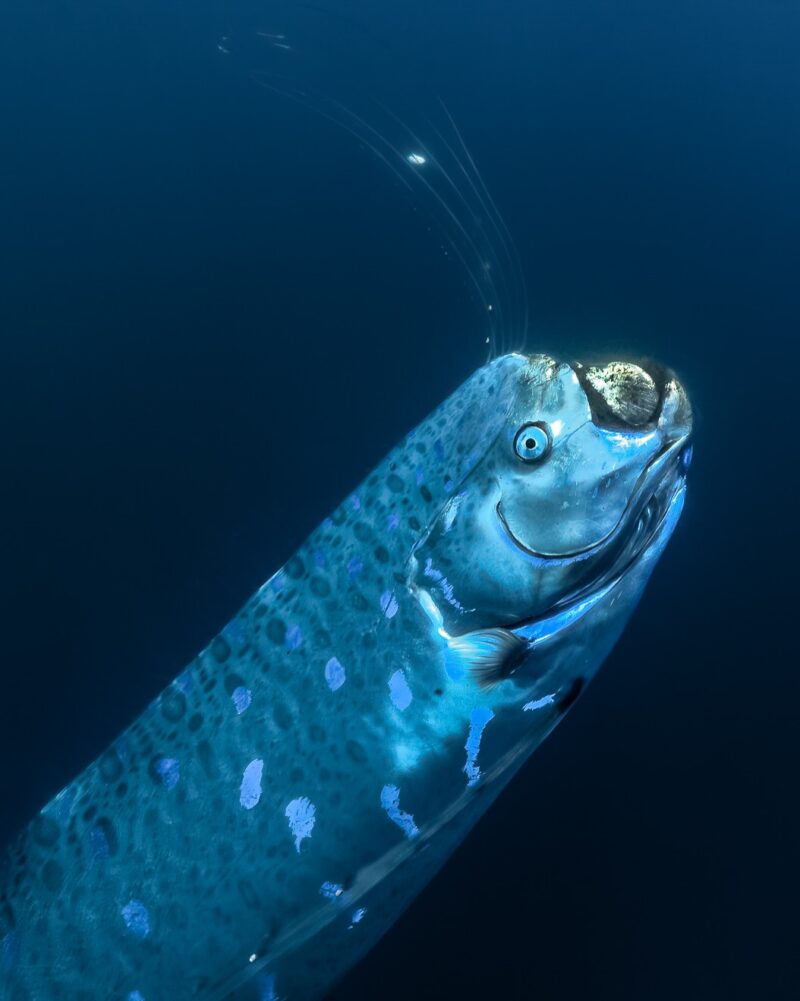
A long, spotted deep-sea fish with glowing white spots and long filaments on its head.
Scientists have uncovered some of the mysteries of the oarfish, one of the ocean’s largest yet most elusive inhabitants. Image via Isabelleandthesea.

The giant oarfish

If you’re fascinated by extraordinary creatures like the Loch Ness Monster, get ready to meet a real-life giant. But forget about the Scottish lochs. The oarfish inhabits the ocean’s depths, a dark world where sunlight barely reaches.

Few people have been lucky enough to see this magnificent animal in its vast natural habitat. And even fewer have had the chance to study it in depth. But late last month, a team of scientists discovered something fascinating. They unlocked the intricate mechanics behind this creature’s movement.

Could the oarfish’s remarkably efficient and stealthy swimming, powered by its long dorsal fin, hold the key to new advances in underwater robotics? Scientists hope these nature-inspired innovations could one day let us explore the ocean’s hidden wonders while leaving its inhabitants undisturbed.

The researchers published their study in the peer-reviewed journal BioOne on September 30, 2026.

The oarfish’s fin inspires underwater robotics

The giant oarfish can reach around 26 feet (8 meters) in length, making it a true ocean colossus. Its body is long and slender, with a ribbon-like shape that gradually tapers toward the rear. Just to give you an idea of how enormous it is, it took no fewer than 15 people to hold a specimen measuring 23 feet (7 meters)!

And its appearance is just as striking. This creature has no scales; instead, its sides shimmer with a brilliant silvery sheen thanks to a covering that contains guanine.

This smooth, metallic surface contrasts with its vivid red and orange dorsal fin. The fin runs along almost the entire length of its back. The first few fin rays are especially long, forming a striking crest above its head, as if the fish were wearing a crown of fire.

But its long dorsal fin is far more than decoration. It plays a major role in the fish’s movement. It generates waves along the fin without requiring large side-to-side movements of the body.

This raises a fascinating question: how does the fish coordinate such a long structure, made up of numerous fin rays, to produce such fluid motion? To understand this, researchers must look beyond its striking silhouette. They must examine how the muscles, joints and skeletal elements of its fin are arranged.

This is where a research project begins to connect the biology of the fish with a very different field: underwater robotics.
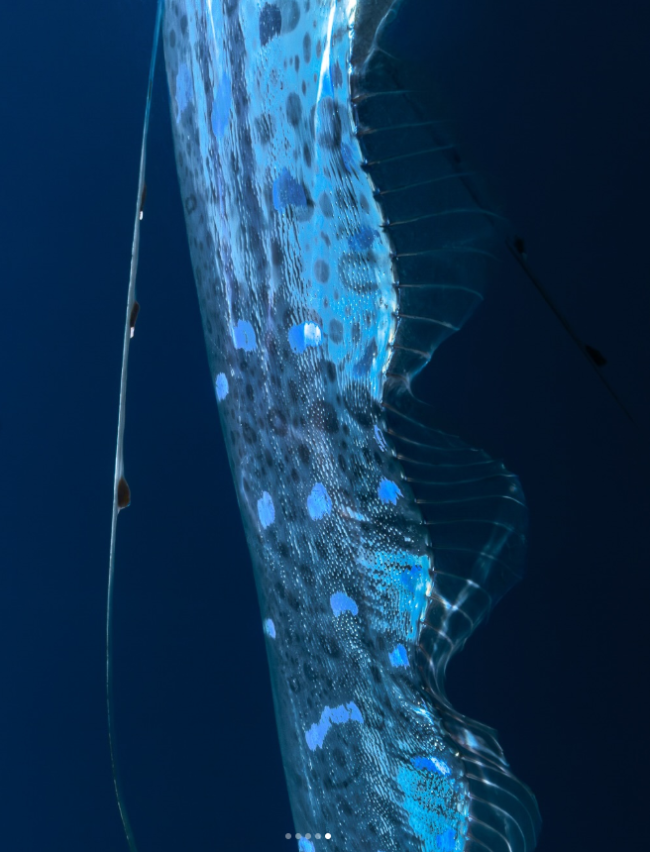
A long oarfish with a wavy dorsal fin along its back and ribbon-like pelvic fins.
The oarfish’s dorsal fin plays a key role in its remarkably efficient and stealthy swimming. Image via Isabelleandthesea.

The oarfish: Inspired by nature, designed to explore

Unlike many fish, the oarfish propels itself by sending waves along its dorsal fin while keeping its body relatively steady. Scientists already knew it swam this way. But they still needed to understand how it controls such a long, complex structure with such precise coordination.

To investigate, a research team led by Gabriel Vinícius Felix Afonso, a Ph.D. student at the Virginia Institute of Marine Science, studied the anatomy of the dorsal fin in detail. They examined specimens, using imaging techniques and analyzing videos of oarfish in the wild. They studied how the muscles, joints and fin rays are arranged and how they work together to produce movement.

The findings revealed a surprising mechanism: a group of six muscles controls each fin ray, which attach to it at 12 points. The joint also works much like a ball-and-socket joint, similar to the one in the human shoulder, allowing it to rotate in every direction through a full 360 degrees. Together, these muscles and joints help explain how the fish coordinates its fin movements to generate waves along its length.

Where does the name oarfish come from?

Interestingly, the oarfish’s name does not come from its striking dorsal fin, but from its unusually long pelvic fins. Located beneath the front part of its body, each of these fins consists of a single ray that resembles a little oar. But despite inspiring the fish’s name, these pelvic fins are not primarily responsible for its distinctive swimming motion. That role belongs to the dorsal fin, whose precisely coordinated movements allow waves to travel along the fish’s body.

We asked Felix Afonso about why the oarfish inspired him to think about aquatic robotics. He said:

If you look at large species of fish that live in the open ocean, you will see fish with spindle-like shapes, such as tunas and billfish, as well as round shapes, such as sunfish and opahs. Unlike those species, the oarfish has an unusual body shape for an open-ocean fish. Interestingly, the oarfish does not swim by undulating its body like an eel. Instead, the oarfish keeps its body rigid while only its long dorsal fin undulates. This combination of an unusual body shape and an unexpected swimming mode attracted our attention, prompting us to study the oarfish’s functional morphology for future biomimetic robotic applications.

4 images showing fish bones, muscles and tendons that control fin movement.
Imaging reveals the intricate anatomy of the oarfish’s dorsal fin, including the muscles and joints that allow its fin rays to move with remarkable precision. Image via Afonso et al. 2026.

An inhabitant of the deep

Despite its unforgettable size, shimmering appearance, super-long pelvic fins and hypnotic dorsal fin motion, the oarfish remains one of the lesser-known inhabitants of the deep ocean.

The oarfish is found throughout the world’s oceans, particularly in tropical and temperate waters. But it lives mainly in open water, far from shore and at depths where sunlight grows increasingly faint.

It is typically found hundreds of feet below the surface, with records reaching depths of around 3,280 feet (1,000 meters). There, in an environment that is difficult to observe directly, much of its life unfolds beyond our view, leaving researchers with many unanswered questions.

In addition, sightings near the surface are unusual and sometimes involve animals that are weakened or in distress. This makes their behavior difficult to study. Finding a stranded specimen or one close to shore allows scientists to examine its anatomy, but it is not the same as observing how it lives and behaves in its natural environment.

Watch how the oarfish propels itself using nothing but waves traveling along its nearly transparent dorsal fin, while the rest of its body stays almost perfectly still. Video via Isabelleandthesea.

A giant that feeds on tiny prey

You might expect an animal this size to feed like a formidable predator, but the reality is quite different. The oarfish feeds mainly on small organisms, including krill and other planktonic crustaceans. Small fish and squid have also been reported among its possible prey.

Its head is relatively small compared with the length of its body and ends in a short, protrusible mouth that can extend forward to capture food. But it doesn’t need powerful jaws or an impressive set of teeth: its gill structures help trap tiny organisms as water passes through its mouth. Rather than chasing large prey, it makes use of much smaller food sources suspended in the water.

It’s remarkable that a fish capable of growing many feet long gets much of its nourishment from such tiny creatures. It’s also a reminder of just how diverse feeding strategies can be among marine animals.

The oarfish has also been observed swimming vertically, with its head pointing upward. Scientists believe this posture may help it spot prey silhouetted against the light filtering down from the surface. It may also make the fish less visible to predators looking down from above.

Shimmering like liquid silver, the oarfish reveals its striking appearance from every angle, whether seen up close or gliding in the distance. Video via Isabelleandthesea.

Nature’s lessons for safe ocean exploration

Over millions of years, animals have evolved remarkable ways to move, feed and adapt to their surroundings. Studying these abilities allows us to better understand the natural world, revealing just how much there is still to learn from the creatures with which we share our planet.

What we learn from them can also inspire new technologies. In the case of the oarfish, understanding how it swims could help researchers develop quieter underwater robots, opening up new ways to explore the ocean and observe marine life while causing as little disturbance as possible.

The more we learn about animals and the environments they depend on, the better we can protect them. By combining scientific discovery with more respectful ways of exploring, we can uncover some of the ocean’s secrets while helping preserve the remarkable life it sustains.

Take a closer look at oarfish larvae and watch as one extends its protrusible mouth in this fascinating close-up. Video via Bobtec.

Love wildlife and the natural world? Get the latest animal stories — as well as space and night sky updates delivered to your inbox.

Bottom line: The giant oarfish has a remarkable fin that could inspire quieter underwater robots and open new possibilities for ocean exploration and conservation.

Source: Dorsal-Fin Musculoskeletal System of Oarfishes (Regalecidae): Fin Rays as Rotating Elements in an Undulatory System

Via Cornell University

Read more:

Ocean sunfish are odd, gentle giants: Lifeform of the week

Anglerfish are our mysterious, deep-sea lifeform of the week

Seahorses are tiny, ravenous creatures: Lifeform of the week

The post The enormous oarfish could inspire new ways to explore the ocean first appeared on EarthSky.


from EarthSky https://ift.tt/G1Ur4ZK
A long, spotted deep-sea fish with glowing white spots and long filaments on its head.
Scientists have uncovered some of the mysteries of the oarfish, one of the ocean’s largest yet most elusive inhabitants. Image via Isabelleandthesea.

The giant oarfish

If you’re fascinated by extraordinary creatures like the Loch Ness Monster, get ready to meet a real-life giant. But forget about the Scottish lochs. The oarfish inhabits the ocean’s depths, a dark world where sunlight barely reaches.

Few people have been lucky enough to see this magnificent animal in its vast natural habitat. And even fewer have had the chance to study it in depth. But late last month, a team of scientists discovered something fascinating. They unlocked the intricate mechanics behind this creature’s movement.

Could the oarfish’s remarkably efficient and stealthy swimming, powered by its long dorsal fin, hold the key to new advances in underwater robotics? Scientists hope these nature-inspired innovations could one day let us explore the ocean’s hidden wonders while leaving its inhabitants undisturbed.

The researchers published their study in the peer-reviewed journal BioOne on September 30, 2026.

The oarfish’s fin inspires underwater robotics

The giant oarfish can reach around 26 feet (8 meters) in length, making it a true ocean colossus. Its body is long and slender, with a ribbon-like shape that gradually tapers toward the rear. Just to give you an idea of how enormous it is, it took no fewer than 15 people to hold a specimen measuring 23 feet (7 meters)!

And its appearance is just as striking. This creature has no scales; instead, its sides shimmer with a brilliant silvery sheen thanks to a covering that contains guanine.

This smooth, metallic surface contrasts with its vivid red and orange dorsal fin. The fin runs along almost the entire length of its back. The first few fin rays are especially long, forming a striking crest above its head, as if the fish were wearing a crown of fire.

But its long dorsal fin is far more than decoration. It plays a major role in the fish’s movement. It generates waves along the fin without requiring large side-to-side movements of the body.

This raises a fascinating question: how does the fish coordinate such a long structure, made up of numerous fin rays, to produce such fluid motion? To understand this, researchers must look beyond its striking silhouette. They must examine how the muscles, joints and skeletal elements of its fin are arranged.

This is where a research project begins to connect the biology of the fish with a very different field: underwater robotics.

A long oarfish with a wavy dorsal fin along its back and ribbon-like pelvic fins.
The oarfish’s dorsal fin plays a key role in its remarkably efficient and stealthy swimming. Image via Isabelleandthesea.

The oarfish: Inspired by nature, designed to explore

Unlike many fish, the oarfish propels itself by sending waves along its dorsal fin while keeping its body relatively steady. Scientists already knew it swam this way. But they still needed to understand how it controls such a long, complex structure with such precise coordination.

To investigate, a research team led by Gabriel Vinícius Felix Afonso, a Ph.D. student at the Virginia Institute of Marine Science, studied the anatomy of the dorsal fin in detail. They examined specimens, using imaging techniques and analyzing videos of oarfish in the wild. They studied how the muscles, joints and fin rays are arranged and how they work together to produce movement.

The findings revealed a surprising mechanism: a group of six muscles controls each fin ray, which attach to it at 12 points. The joint also works much like a ball-and-socket joint, similar to the one in the human shoulder, allowing it to rotate in every direction through a full 360 degrees. Together, these muscles and joints help explain how the fish coordinates its fin movements to generate waves along its length.

Where does the name oarfish come from?

Interestingly, the oarfish’s name does not come from its striking dorsal fin, but from its unusually long pelvic fins. Located beneath the front part of its body, each of these fins consists of a single ray that resembles a little oar. But despite inspiring the fish’s name, these pelvic fins are not primarily responsible for its distinctive swimming motion. That role belongs to the dorsal fin, whose precisely coordinated movements allow waves to travel along the fish’s body.

We asked Felix Afonso about why the oarfish inspired him to think about aquatic robotics. He said:

If you look at large species of fish that live in the open ocean, you will see fish with spindle-like shapes, such as tunas and billfish, as well as round shapes, such as sunfish and opahs. Unlike those species, the oarfish has an unusual body shape for an open-ocean fish. Interestingly, the oarfish does not swim by undulating its body like an eel. Instead, the oarfish keeps its body rigid while only its long dorsal fin undulates. This combination of an unusual body shape and an unexpected swimming mode attracted our attention, prompting us to study the oarfish’s functional morphology for future biomimetic robotic applications.

4 images showing fish bones, muscles and tendons that control fin movement.
Imaging reveals the intricate anatomy of the oarfish’s dorsal fin, including the muscles and joints that allow its fin rays to move with remarkable precision. Image via Afonso et al. 2026.

An inhabitant of the deep

Despite its unforgettable size, shimmering appearance, super-long pelvic fins and hypnotic dorsal fin motion, the oarfish remains one of the lesser-known inhabitants of the deep ocean.

The oarfish is found throughout the world’s oceans, particularly in tropical and temperate waters. But it lives mainly in open water, far from shore and at depths where sunlight grows increasingly faint.

It is typically found hundreds of feet below the surface, with records reaching depths of around 3,280 feet (1,000 meters). There, in an environment that is difficult to observe directly, much of its life unfolds beyond our view, leaving researchers with many unanswered questions.

In addition, sightings near the surface are unusual and sometimes involve animals that are weakened or in distress. This makes their behavior difficult to study. Finding a stranded specimen or one close to shore allows scientists to examine its anatomy, but it is not the same as observing how it lives and behaves in its natural environment.

Watch how the oarfish propels itself using nothing but waves traveling along its nearly transparent dorsal fin, while the rest of its body stays almost perfectly still. Video via Isabelleandthesea.

A giant that feeds on tiny prey

You might expect an animal this size to feed like a formidable predator, but the reality is quite different. The oarfish feeds mainly on small organisms, including krill and other planktonic crustaceans. Small fish and squid have also been reported among its possible prey.

Its head is relatively small compared with the length of its body and ends in a short, protrusible mouth that can extend forward to capture food. But it doesn’t need powerful jaws or an impressive set of teeth: its gill structures help trap tiny organisms as water passes through its mouth. Rather than chasing large prey, it makes use of much smaller food sources suspended in the water.

It’s remarkable that a fish capable of growing many feet long gets much of its nourishment from such tiny creatures. It’s also a reminder of just how diverse feeding strategies can be among marine animals.

The oarfish has also been observed swimming vertically, with its head pointing upward. Scientists believe this posture may help it spot prey silhouetted against the light filtering down from the surface. It may also make the fish less visible to predators looking down from above.

Shimmering like liquid silver, the oarfish reveals its striking appearance from every angle, whether seen up close or gliding in the distance. Video via Isabelleandthesea.

Nature’s lessons for safe ocean exploration

Over millions of years, animals have evolved remarkable ways to move, feed and adapt to their surroundings. Studying these abilities allows us to better understand the natural world, revealing just how much there is still to learn from the creatures with which we share our planet.

What we learn from them can also inspire new technologies. In the case of the oarfish, understanding how it swims could help researchers develop quieter underwater robots, opening up new ways to explore the ocean and observe marine life while causing as little disturbance as possible.

The more we learn about animals and the environments they depend on, the better we can protect them. By combining scientific discovery with more respectful ways of exploring, we can uncover some of the ocean’s secrets while helping preserve the remarkable life it sustains.

Take a closer look at oarfish larvae and watch as one extends its protrusible mouth in this fascinating close-up. Video via Bobtec.

Love wildlife and the natural world? Get the latest animal stories — as well as space and night sky updates delivered to your inbox.

Bottom line: The giant oarfish has a remarkable fin that could inspire quieter underwater robots and open new possibilities for ocean exploration and conservation.

Source: Dorsal-Fin Musculoskeletal System of Oarfishes (Regalecidae): Fin Rays as Rotating Elements in an Undulatory System

Via Cornell University

Read more:

Ocean sunfish are odd, gentle giants: Lifeform of the week

Anglerfish are our mysterious, deep-sea lifeform of the week

Seahorses are tiny, ravenous creatures: Lifeform of the week

The post The enormous oarfish could inspire new ways to explore the ocean first appeared on EarthSky.


from EarthSky https://ift.tt/G1Ur4ZK

Algol the Demon Star, named for its strange behavior

Why did our ancestors come to see Algol as the Demon Star? EarthSky’s Will Triggs explains in this video. Watch above or on YouTube.

Algol the Demon Star

Get ready to meet the scariest star in the sky! Its name is Algol, and it lies in the constellation Perseus the Hero. Early astronomers nicknamed it Algol the Demon Star. A demon star looking down from above … Creepy! But how did this star get this name?

When you look at Algol, it doesn’t appear any scarier than any other star. But, in skylore, the star is associated with the mythical Gorgon Medusa, who had snakes in place of hair. It’s said that her appearance was so terrifying that anyone who looked at her would turn to stone.

But why did the early stargazers connect the star Algol to the Gorgon Medusa? It seems they might have associated this star’s constantly shifting brightness with the evil, winking eye of the Medusa.

The star name Algol comes from an Arabic word meaning the Demon’s Head or, literally the Ghoul. It represents Medusa’s terrifying snaky head.

Algol the Demon Star: Painting of the head of dead Medusa, in the center of a shield, with snakes in place of hair and wide-open mouth.
The Gorgon Medusa had snakes in place of hair. Eek! She is associated with Algol the Demon Star. Image via Caravaggio/ Wikimedia Commons.

What’s so scary about it?

In skylore, Perseus was a great hero, often depicted mounted on Pegasus the Flying Horse. In the mythology of the skies, Perseus slew Medusa. Then, he used Medusa’s head to his advantage. In a struggle with Cetus the Whale, he pulled Medusa’s head from a bag … and turned the whale to stone.

These stars and constellations — the Hero, the Flying Horse, the Whale and the Gorgon Medusa’s winking eye — are all in the sky at this time of year.

And here’s the secret to Algol the Demon Star’s name. This star is what’s known as a variable star. It waxes and wanes in brightness.

The early stargazers surely knew about its brightness change. Scholars believe that Algol’s variability led these stargazers to name the strangely-behaving star for a mythological demon.

Animation: An orange blob circling a yellow-orange sphere, alternately going in front of and behind it.
Algol is a triple star system. The inner pair, seen here, take 2.87 days to orbit around each other once. They’re an eclipsing binary system, meaning that they pass in front of each other from our perspective. This animation was assembled from 55 images taken by the CHARA interferometer. Image via Fabien Baron/ Wikipedia.

Algol is a variable star

Nowadays, there are many variable stars known throughout the heavens. But Algol the Demon Star is one of the most famous. That’s in part because the Demon Star brightens and dims with clock-like regularity. It completes one cycle in 2 days, 20 hours and 49 minutes.

And you can see track its entire cycle with your eye alone.

At its brightest, Algol shines about three times more brightly than at its faintest. When it reaches maximum brilliance, Algol matches the brightness of the nearby 2nd-magnitude star Almach.

At minimum, Algol’s light output fades to that of the star Epsilon Persei.

Modern-day astronomy has unlocked the secret of Algol’s mood swings. It’s a triple star system (Algol A, B and C) where Algol A is regularly eclipsed by Algol B every 2.87 days. So those two stars are what’s known as an eclipsing binary.

From Earth, we see the orbital plane of this binary pair almost exactly edge-on. When the dimmer of the two stars swings in front of the brighter star, we see Algol at minimum brightness.

Animation: stars rotate around each other with graph of brightness as 1 passes behind and in front of the other.
Animation of an eclipsing binary star. The brightness drops when the small star is in front of the large one as seen from Earth. Image via Wikimedia Commons.

How to find Algol the Demon Star

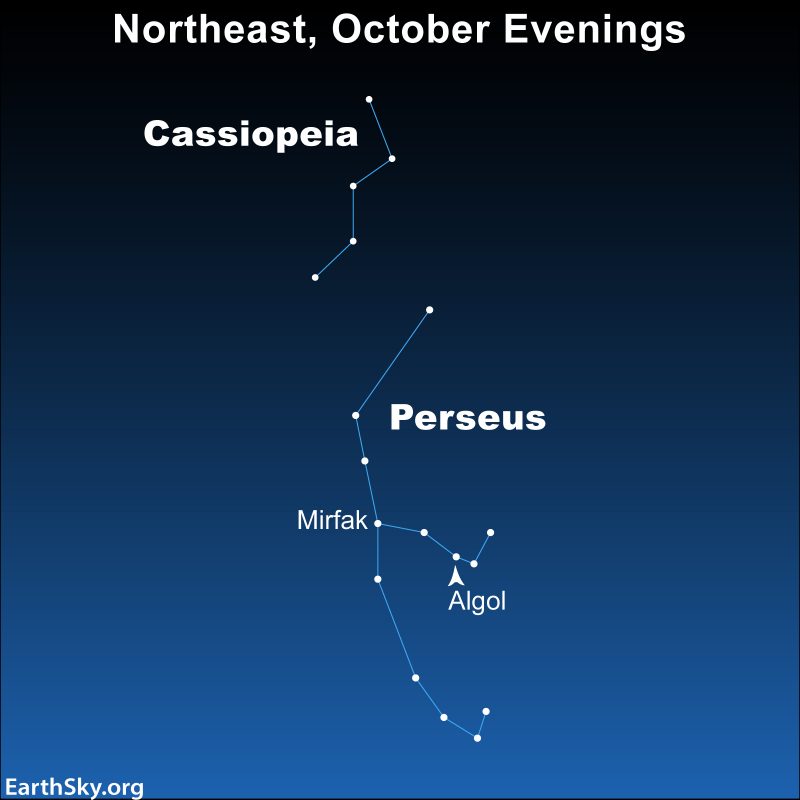
Want to see it? Algol the Demon Star is easy to find. Our sky chart shows the northeastern sky for autumn evenings, especially around Halloween.

To find Algol, first look for the conspicuous W or M-shaped constellation Cassiopeia the Queen. You can starhop from there to Algol’s home constellation, Perseus the Hero. Look below Cassiopeia toward the horizon to spot Perseus. Algol is one of the brightest stars in Perseus.

Algol the demon star: Star chart showing Cassiopeia and Perseus constellations with some stars labeled.
Find Algol the Demon Star in the constellation Perseus on autumn evenings. Perseus lies below the easy-to-recognize W-shaped constellation Cassiopeia.

When to see it

At mid-northern latitudes, Algol the Demon Star appears for at least part of the night all year round. But it’s best seen in the evening sky from autumn to spring. It’s visible in the northeast sky in autumn, shines high overhead in winter, then swings to the northwest sky by spring.

Visit Sky & Telescope to calculate Algol’s minimum brightness for your location.

Antique star chart etching with helmeted Greek hero with sword in one hand and Medusa's head in the other.
Perseus and Medusa from Uranographia by Johannes Hevelius. Image via Wikimedia Commons.

Bottom line: What’s the scariest star in all the heavens? It’s Algol the Demon Star, and you can see it on autumn evenings. Learn the secret of Algol’s creepiness!

Don’t miss the next unmissable night sky event. Sign up to our free newsletter for daily night sky updates, as well as the latest science news.

The post Algol the Demon Star, named for its strange behavior first appeared on EarthSky.


from EarthSky https://ift.tt/mcqX9aR

Spooky ghost lights: Believe in them if you dare

Ghost lights: Night scene. Four small light spots at the horizon, labeled Marfa lights, and one marked as not a Marfa light.
View larger. | A famous example of ghost lights near the town of Marfa, Texas. They’re called the Marfa lights, and you can see some in this photo via Manny Ruiz/ Papiblogger.com. Used with permission.

Ghost lights used to be called will-o’-the-wisps. They were a weird glow over swamps or bogs. Nowadays, people report strange lights in the sky and in all sorts of places, often over highways.

Some are more famous than others. The ghost lights closest to EarthSky’s hometown of Austin are in the desert-like Davis Mountains near Marfa, Texas: the famous Marfa lights. But people also report strange lights seen from along the Blue Ridge Parkway near Brown Mountain in North Carolina, near the small town of St. Louis in Saskatchewan, Canada, along famous U.S. Route 66, and in other places in North America.

There are modern, very ordinary explanations for some of these lights. Yet people still love to try to spot them. Explore some of the well-known mysterious North American ghost lights below.

The Marfa lights

Nowadays people sometimes travel long distances to seek out ghostly lights in the sky. A famous example in the state of Texas is the Marfa lights. People have spotted them for years near the tiny and remote (and, in recent decades, hip) West Texas town of Marfa.

I’ve never seen them from the viewing platform near Marfa. But an astronomer pointed them out to me in the late 1970s, on the first of many visits to the McDonald Observatory near Fort Davis, Texas. We were standing outside at night, on a catwalk of one of the large telescope domes. And we saw them across a great distance: two unmoving lights, a brighter one and a fainter one above the horizon, in a place where no bright stars should be.

Reports from some other eyewitnesses are much more elaborate than mine. Supposedly, the lights are “brightly glowing”, “basketball-sized spheres”, “shining in many different colors”, “hovering at about shoulder height” … Or sometimes, people say, they shoot around rapidly in any direction. Or they appear in pairs or groups. Or they may divide into pairs or merge, disappear, reappear, and sometimes move in patterns that seem regular.

The town of Marfa loves them, and has placed highway markers indicating where on-lookers can pull over to watch for the lights.

Map of Texas with a red dot in a big county in the west part of the state.
The red dot indicates the location of Marfa, Texas. It’s remote! Image via Wikipedia.
Twilight view of a white building with an open dome, with a mountain in the background.
McDonald Observatory Otto Struve Telescope, completed in 1938. I saw my first Marfa lights from the catwalk of this telescope dome. Inside the dome, by the way, there’s an old library, which is a not un-creepy place to be alone at 3 a.m. No offense, Otto. Image via Marty Harris/ McDonald Observatory.

Eyewitness account of the Marfa lights

Papiblogger.com has a nice account of his family’s viewing of the Marfa lights.

After several driving delays and a huge gas shortage scare, we finally arrived in Marfa past dinner time at night … From our kids’ perspective, Marfa’s big draw, of course, are the Mystery Lights, a Texas version of Alaska’s aurora borealis. To make things interesting I brought a professional digital camera and a tripod and took time-lapse images of the Marfa lights from the observation deck where everyone normally sees them.

If you look at my un-doctored photos, you will notice a red light surrounded by other brighter lights. All appear to be around the same size but what’s interesting is that the white lights surrounding the red one clearly have some movement. For the record, I don’t believe there’s anything magical or alien-related to the lights. But I do find them interesting, especially knowing that many experts and some documentaries have studied them and no one knows what to say they are.

Where to go to see Marfa lights

They’re said to be seen, typically, south of U.S. Route 90 and east of U.S. Route 67, 5 to 15 miles (8 to 24 km) southeast of Marfa. As mentioned above, there’s a city-sanctioned viewing area. Best thing to do is go to Marfa, Texas, and ask … well, anyone. Marfa is only about an 8-hour drive from the city of Austin, if you don’t stop for lunch. And if you do stop for lunch, I recommend La Familia in Junction, Texas. Have fun!

Marfa lights according to skeptics

The most credible explanation is that they are simply car headlights, seen from a great distance and distorted by temperature gradients. Critics of this explanation quickly point out that people have been reporting sightings of the Marfa Lights for over 100 years, since before cars existed. Meanwhile, Brian Dunning of the podcast Skeptoid disagrees, saying:

Well, apparently, the Marfa lights have not been around all that long, after all. The earliest accounts come from a rancher named Robert Ellison in 1883. However, upon closer inspection, it appears that there is no actual record that Robert Ellison ever saw such a thing.

There are reports from his descendants that Ellison said he saw lights, but there is no written record, not even when he wrote his memoirs about his life in the region in 1937. Curious that he would leave that out. Apparently, all evidence that the lights existed prior to the arrival of automobile highways in the region is purely anecdotal.

I know that – from Mount Locke, where McDonald Observatory is located – I’ve seen lots of “jumpy” lights low in the sky, while looking across the long, flat distances like those you find in West Texas. Once I saw a very bright light in the east, not long before dawn, moving in a strikingly erratic way in the sky: up, down, sideways, really strange-looking!

But, as I stood and watched for 20 minutes or so – and as Earth turned beneath me – the light rose higher in the sky and revealed itself as the brightest planet, Venus.

More ghost lights: Brown Mountain lights

From the Blue Ridge Parkway near Brown Mountain in North Carolina, people sometimes say they see mysterious circular red lights. An early account of them dates back to a report by a fisherman in the September 24, 1913, Charlotte Daily Observer. He said he saw:

… mysterious lights seen just above the horizon every night.

Where to go to see Brown Mountain lights

If you want to see them, try this advice from Wikipedia:

Try the overlooks at mile posts 310 (Brown Mountain Light overlook) and 301 (Green Mountain overlook) and from the Brown Mountain Overlook on North Carolina Highway 181 between Morganton, North Carolina, and Linville, North Carolina. Additionally, good sightings of the [Brown Mountain] Lights have been reported from the top of Table Rock, outside of Morganton, North Carolina. One of the best vantage points, Wisemans View, is about 4 miles (6 km) from Linville Falls, North Carolina. The best time of the year to see them is reportedly September through early November.

Brown Mountain lights according to skeptics

A USGS employee, D.B. Stewart, later studied the area and said the fisherman had seen train lights. Brian Dunning of the podcast Skeptoid agrees. On the other hand, in 2016, a scientist and an engineer – Daniel Caton and R. Lee Hawkins – both at Appalachian State University, announced that they had video evidence of the Brown Mountain Lights.

The St. Louis light

Apparently, there used to be train tracks near the small town of St. Louis in Saskatchewan, Canada. We read they were taken out after a passenger train derailed. Now it’s said that a ghostly railway man, holding a lantern, haunts the tracks, looking for a baby that died in the accident. It’s said the light appears in the distance along the track bed but has no easily identifiable source.

Where to go to see St. Louis lights

St. Louis is south of Prince Albert, Saskatchewan. The light sightings near the old railroad tracks happen about 5 miles (8 km) north of St. Louis. By all accounts, the gravel road that leads to the place is unmarked and hard to find. Best bet: Go to St. Louis, and ask someone.

St. Louis lights according to skeptics

Alysha and Shannon were in the 12th grade, living in northern Saskatchewan, when they won science fair gold medals for investigating and eventually duplicating the St. Louis light phenomenon. Their project suggested that the lights of distant vehicle lights is diffracted. Read about their science project here.

By the way, before beginning this project, Shannon told VirtualSaskatchewan that she believes in the paranormal, while Alysha claimed to be the skeptical type. The project apparently started when Shannon told Alysha how she and a group of friends “freaked out” when they spotted the ghost train during a road trip to St. Louis, and Alysha scoffed.

The Hornet Spook light on Route 66

The Hornet Spook light is a strange phenomenon observed off Route 66, along a 4-mile (6 km) gravel road near a small town, Quapaw, Oklahoma. The nearest large city is Joplin, Missouri. Most report a glowing ball of orange light along this road known as the Devil’s Promenade. Reports of the glowing orb have come in for over 100 years.

Observers describe the strange lights as bouncing and spinning balls of light ranging from baseball to basketball size. They glow with different intensity while racing down the road at high speed and changing colors. They also come and go and sometimes bounce like a ball thrown up in the air. The light seems to dance through trees, or over the top of fields. Yet, if a driver tries to approach the light, it disappears.

Reports say the light most often travels from east to west along the 4-mile gravel road. Locals say the most likely time to see the spook light is from 10 p.m. until around midnight. They also say it seems to stay away from loud noises and large groups.

Where to go to see the Hornet Spook light

The MarkoZen Blog has a great story about the Route 66 Spook lights:

On a 4-mile rural road eerily nicknamed the Devil’s Promenade, just off the old Route 66 in the northeast corner of Oklahoma, a paranormal mystery has puzzled spirit seekers for more than 100 years. The Hornet Spook light – a mysterious, basketball-sized glowing orb named for the former town of Hornet – has been appearing in the night sky here since 1881. No one knows what this peculiar, smoldering ball of light signifies, where it comes from or what it’s composed of. Even the Army Corps of Engineers have concluded that it’s a ‘mysterious light of unknown origin.’

Hornet Spook light according to skeptics

One explanation for the Hornet Spook light is they are lights from automobiles or billboards on the nearby highway. Swamp gas or ball lightning are also frequently brought up to explain the eerie phenomenon. Another suggested cause is they come from electrical atmospheric charges generated in the ground from the New Madrid fault line running through the area. In fact, several severe earthquakes hit the area in the early 1800’s from this fault line.

Joplin Spook light

Ghost lights in history

In English folklore, a will-o’-the-wisp was a distantly viewed lantern or torch carried by a fairy or other mischievous spirit. And if travelers approached them, these ghostly lights were said to recede so that the bone-tired wayfarers were drawn farther and farther into the bog.

Our modern-day carved pumpkin at Halloween is associated with this old story and tradition. Will-o’-the-wisp and jack-o’-lantern meant the same thing in old England. On the festival of Samhain, people made turnip lanterns, sometimes with faces carved into them. Samhain took place around the same time as our Halloween, a time when fairies and spirits were said to inhabit the night.

Remember, Halloween comes at a time of the year when the nights are growing longer. We in the electric light era don’t fully appreciate the primal fear to be had from this daily increasing darkness. It’s said that turnip lanterns were used to light one’s way outdoors on a Samhain night. The lantern might have represented the spirits and otherworldly beings, as in I’m with you guys.

But we’re so much more sophisticated than that today. Aren’t we?

Ghost lights: Horrid face carved into a purple-skinned yellow turnip with 2 eyes and a mouth with teeth.
Ghost lights and will-o’-the-wisps are associated with our modern-day jack-o’-lanterns. Here’s a traditional Cornish jack-o’-lantern made from a turnip. Image via Wikimedia Commons.

Bottom line: Ghost lights are strange lights seen over swamps or bogs. Here are some popular places known for ghost lights. Believe in them … if you dare!

Enjoying EarthSky? Sign up for our free daily newsletter today!

Read more: Halloween is an astronomical holiday

The post Spooky ghost lights: Believe in them if you dare first appeared on EarthSky.


from EarthSky https://ift.tt/tRmxeP0

Goblin sharks, ghost crabs and vampire bats, oh my!

Goblins sharks: Two preserved heads of large fish with very toothy jaws and a long spike protruding from the forehead.
Portrait of a goblin shark. Goblin sharks are perfect to get you in the spirit for Halloween this week. Image via Wikimedia Commons.

To get you in the Halloween spirit for the creepy, ghoulish and grotesque, we present to you animals with some of the most spooky-sounding names: goblin sharks, ghost crabs and vampire bats. Learn how these creatures got their spine-chilling names.

Love wildlife and the natural world? Get the latest animal stories — as well as space and night sky updates delivered to your inbox.

Goblin sharks

The Goblin shark is a rare and unusual looking species that lives in the deep sea. The sharks have long, flattened snouts, protrusible jaws and sharp, narrow teeth.

Their snouts are covered with numerous jelly-filled pores that act as electroreceptors to help them detect prey in the dark depths of the ocean. When a fish, squid or crustacean — favorite prey of the goblin shark — swims too close, the shark’s jaw snaps outward at a lightning-fast speed to grab the unsuspecting animal.

Not to worry, goblin sharks do not pose any threat to humans because of the depths at which they live.

Goblin sharks also look unusual because they are pinkish in color, which is caused by blood vessels that lie close to the surface of their skin.

Goblin sharks grow to an average size of 10 to 13 feet (3 to 4 meters), but larger individuals have been found, including an 18 to 20 feet (5 to 6 meter) long female that was discovered in the Gulf of Mexico in 2000. They inhabit all of the world’s major oceans.

The name goblin shark comes from a translation of its Japanese name, tenguzame. In Japanese mythology, tengu are beings that have long noses and red faces.

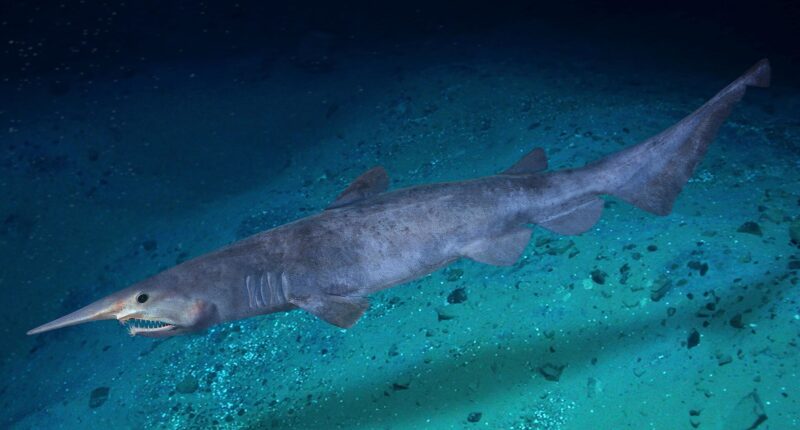
A grey shark with a long, flat snout and sharp teeth swims near the sea floor.
Closeup of a goblin shark. Image via Michigan State University/ USFWS/ Wikimedia Commons.

Ghost crabs

Ghost crabs are common crabs that live on the sandy shores of tropical and subtropical beaches. They are most active at night and have large eyes located on the tips of stalks, which allows them 360-degree view.

Another characteristic of ghost crabs is that one of their claws is larger than the other, although this feature is not as pronounced as it is in their close relative, the fiddler crab.

Ghost crabs dig deep burrows in the sand. This helps them avoid predators and stay cool in the summer and warm in the winter. They periodically emerge from their burrows to feed and wet their gills in seawater. They also enter the ocean on occasion to release eggs.

Front view of pale yellow crab with 8 spiky legs and 2 big white claws, and bright black eyes up on stalks.
Ghost crabs live on the sandy beaches. They are most active at night. The name ghost crab comes from the crab’s pale color and nocturnal behavior. Image via Adrien Stachowiak/ Unsplash.

The name ghost crab comes from the crab’s pale color and nocturnal behavior. Their scientific name Ocypode means swift-foot in reference to the fast speed at which they can dash around on the beach. Typically, these crabs move around on four pairs of walking legs, but at high speeds they run using only the first and second pairs.

Vampire bats

Of course, a Halloween science blog about spooky-sounding animal names wouldn’t be complete without mentioning the vampire bat.

Furry brown and gray bad with beady eyes, hanging from a rocky wall, looking at the camera.
This is a common vampire bat. Instead of a pointy, long nose, it has a flat nose. This way, it can easily lick blood. Image via Acatenazzi/ Wikipedia.

Vampire bats range from Central to South America. They feed on the blood of livestock and other forest animals, hence their name. These bats have a short muzzle and razor-sharp teeth, which they use to make a small incision in sleeping prey. They then lap up the blood that flows out of the wound. Their saliva contains special anticoagulants that prevent the blood from clotting. While creepy, the loss of blood does not usually harm the prey.

And although there are more than 1,500 species of bats in the world, only three species feed exclusively on blood.

Vampire bats live in large colonies in dark places such as caves or hollow trees. These bats form strong social bonds. If one bat is starving, other bats will sometimes regurgitate their blood meal to help feed the hungry bat.

Bottom line: Goblin sharks, ghost crabs and vampire bats: how did these spooky-sounding animals get their names? Learn about them here.

Read more stories about Halloween and science:

Halloween derived from ancient Celtic cross-quarter day

Bats, a spooky season icon, are our lifeform of the week

Find the Ghoul Star of Perseus

The post Goblin sharks, ghost crabs and vampire bats, oh my! first appeared on EarthSky.


from EarthSky https://ift.tt/06X2QOG

Lake Powell rises more than 10 feet after heavy rains

Satellite view of a snaky river with widened areas and spurs.
This is the latest imagery of Lake Powell from Copernicus, on October 23, 2026. Over the past week, heavy rains in the area caused flooding and added more than 10 feet of water to the lake. Image via European Union/ Copernicus/ Sentinel-2.

Lake Powell rises after heavy rains, still a long way to go

The Four Corners region of the U.S. — where Arizona, Utah, Colorado and New Mexico meet — has been suffering from long-term drought. This summer we told you that Lake Powell in the Glen Canyon National Recreation Area of Utah was shrinking. Lake Powell reached its record-low elevation in September 2026 of 3,516.62 feet.

And then came the October rains. Last week, rain began falling on the region, bringing major flooding to areas such as Hurricane, Utah, and the San Juan River. And now, as of October 27, 2026, Lake Powell is up to 3,527.51 ft. Plus, more water is still flowing into Lake Powell from upstream. And forecasters are eyeing another storm system that should move into the area this week.

Even so, this water is a drop in the bucket for Lake Powell. Full pool level is 3,700 ft. Lake Powell hasn’t been at full pool since 1983.

At full capacity, the lake holds more than 23 million acre-feet of water (28 billion cubic meters).

It’s not a natural lake

Lake Powell is a human-made reservoir on the Colorado River that runs from Arizona into Utah. The completion of Glen Canyon Dam on the Colorado River in 1963 created Lake Powell. When full, it’s the 2nd-largest reservoir in the United States, behind Lake Mead. But drought over the past decades has caused Lake Powell to shrink.

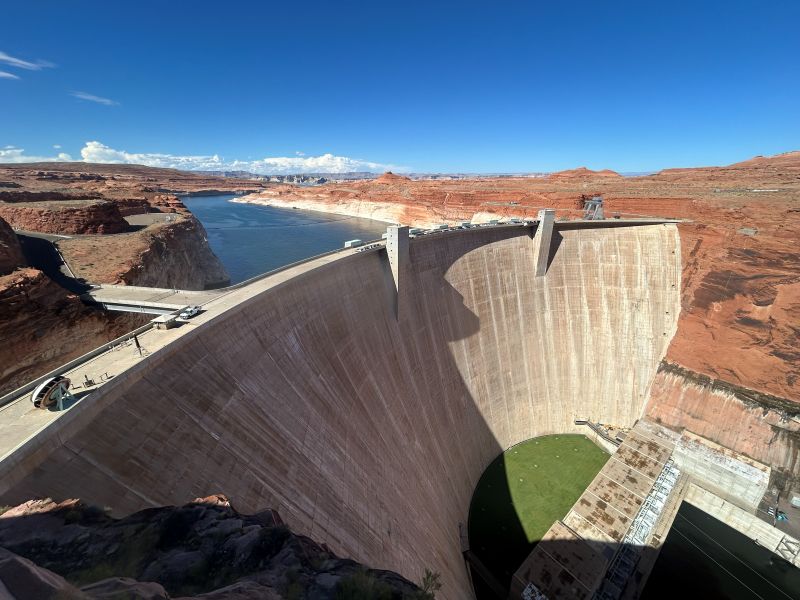
Huge arc-shaped concrete dam with water backed up behind it, in a desert.
This was the view from the visitor center at Glen Canyon Dam in August of 2024. This dam created the reservoir known as Lake Powell, which extends from Arizona into Utah. Image via Lucy Whitt. Used with permission.

How will El Niño impact the region?

El Niño could bring even more rain to the area in the coming weeks and months. We are not only in an El Niño year, but very likely a supercharged one. The question is how much will it bring to the rivers and lakes, and will these rains cause even more destruction as they pummel arid lands ill-prepared for capturing the excess?

Even though monsoon season in the American Southwest just ended, the rains from El Niño appearing to be starting to make their biggest splash now. The end of this week could see more rain for the region.

Unfortunately, rain that hits the arid Southwest often runs off the hard, packed ground, causing flash flooding conditions.

Map of US with some white and areas of yellow, orange and red show degree of drought conditions.
This is the U.S. Drought Monitor map with data through October 20, 2026. Many areas of the western US are in short- and long-term drought conditions. Image via NOAA.

Why had Lake Powell been shrinking?

There are a number of factors that have been stressing bodies of water such as Lake Powell, Lake Mead and the Colorado River. One is the increased demand as our population grows. The water downstream is used for drinking, but the majority of it is used in farming. And climate change has also been another big factor, leading to hotter weather, more evaporation, less precipitation and smaller snowpack. Plus, one major factor for the low water level this year is the incredibly dry winter this region of the country experienced in 2025-2026.

A water supply crisis

Lake Mead and Lake Powell hold nearly 60% of the Colorado River Basin’s water. Some 40 million people rely on this water. But those lakes are at their lowest level in about 70 years. As the July report said:

Lake Powell and Lake Mead essentially comprise one gigantic reservoir, separated into two parts by the Grand Canyon.

2 alternating orbital views of a large lake inlet, one with it thin, one with it wide.
The Bullfrog Basin portion of Lake Powell in the Glen Canyon National Recreation Area of Utah. This pair of images from ESA’s Copernicus shows how low the water level has gotten in the past decade. Image via ESA/ Copernicus.

What is dead pool?

There had been fears that Lake Powell could reach dead pool. Dead pool is when water in a reservoir drops so low that it can’t flow downstream from the dam.

That would have serious consequences for the people and farmland downstream. There is also a turbine at the base of Glen Canyon Dam. If the water level were to drop low enough, the turbine would lose capacity to produce power.

A July report from the Bureau of Reclamation had said Lake Powell could hit dead pool in spring 2027. Will this rain be enough to give Lake Powell a cushion from that spring date? Time will tell.

Bottom line: After heavy rains in October, Lake Powell has risen more than 10 feet. But it still has a long way to go to recover from decades of drought.

Source: A Significant Moment in the Colorado River Water Supply Crisis

Read more: Will Lake Mead – largest US reservoir – reach record lows?

The post Lake Powell rises more than 10 feet after heavy rains first appeared on EarthSky.


from EarthSky https://ift.tt/mCwqfs8

Lacerta the Lizard, home to a blazar

Star chart of Lacerta, with image of lizard in gray and arrangement of stars shaped like a kite.
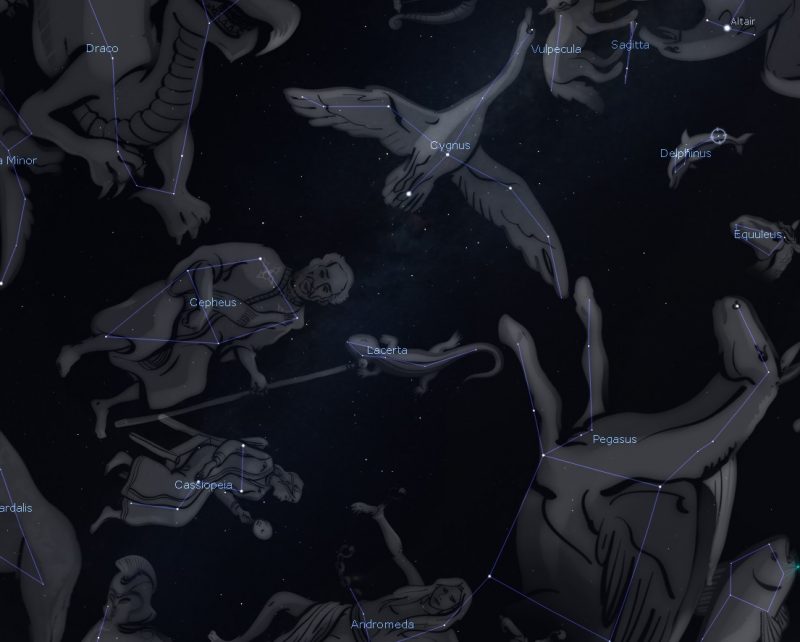
View larger. | The faint stars of Lacerta the Lizard form the blue-lined pattern in this sky chart. The lizard illustration helps you picture the constellation, but you’ll need a dark sky to spot its stars on northern autumn evenings. Image via Stellarium.

Finding the constellation Lacerta the Lizard

Lacerta the Lizard is a small, faint constellation in the northern sky. It’s best seen on autumn evenings, when it climbs high above the horizon. But this unassuming patch of sky holds something extraordinary: BL Lacertae, a blazar powered by a supermassive black hole in a distant galaxy. One of its powerful jets jets points nearly toward us, making it appear unusually bright, giving astronomers a powerful way to study the black hole’s activity.

BL Lacertae looks like a faint, variable star, but it’s actually the bright center of an active galaxy. Its brightness changes over time, and astronomers have named an entire class of objects after it: BL Lacertae objects.

Lacerta isn’t an ancient constellation. Astronomer Johannes Hevelius created it in the late 1600s. Its name means lizard in Latin.

Do you know how to spot the Great Square of Pegasus, the W-shaped Cassiopeia, the house-shaped Cepheus, or Cygnus the Swan? If you do, you can find Lacerta in the dark patch of sky surrounded by these four constellations.

Some people refer to Lacerta as the “little W,” due to its shape. The “big W” is, of course, Cassiopeia. Can you see the Big and Little Ws next to each other in the sky? Others see Lacerta in the shape of a skinny kite. Perhaps you can spot the form of a lizard among its stars.

Lacerta is a fairly small constellation, only taking up 200 square degrees in size. It’s the 68th largest of the 88 constellations.

Star chart with images of constellations, a small lizard among them.
View larger. | Look for the faint constellation Lacerta the Lizard between Cepheus and Pegasus, below Cygnus and above Cassiopeia in this sky chart. Image via Stellarium.

The stars of the Lizard

Only one star within the constellation’s borders is brighter than magnitude 4: Alpha Lacertae at -3.76.

Lacerta now has several officially named stars. Its brightest star, Alpha Lacertae, received the name Stellio in 2024. Alpha Lacertae lies 102 light-years away.

To find Alpha Lacertae, start with Cassiopeia, the W- or M-shaped constellation. Then look toward Cygnus the Swan, between them is Lacerta the Lizard. Use the star chart to pinpoint Alpha Lacertae, but you will need to get away from bright streetlights to see the faint little lizard shape!

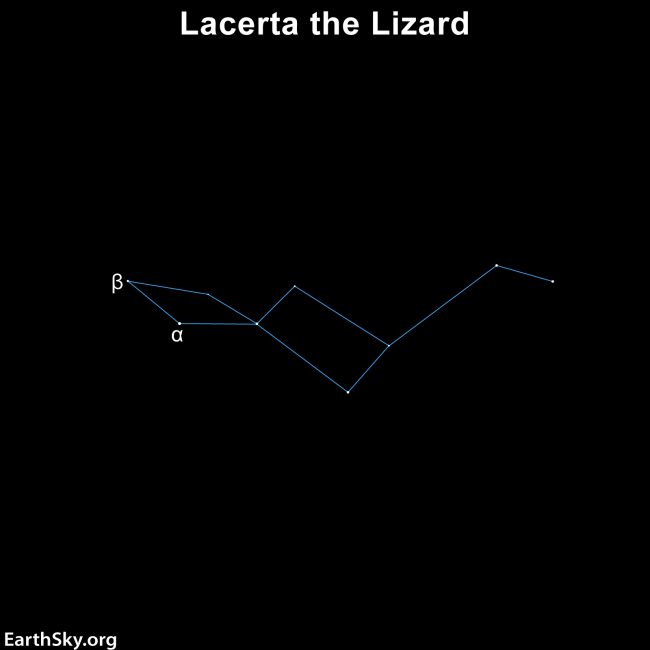
Stars of 4th magnitude lie on all sides of Alpha Lacertae. The star in the direction of Polaris from Alpha Lacertae is Beta Lacertae. Beta Lacertae is another star in the constellation identified by a Greek letter. It has a magnitude of 4.42 and lies 170 light-years away.

Sky chart showing the constellation Lacerta the Lizard with Alpha and Beta stars labeled.
Lacerta the Lizard’s star pattern, with Alpha (?) and Beta (?) Lacertae marked on the left. Look for these two stars to help you locate this faint constellation.

Star clusters in Lacerta

The majority of the constellation Lacerta lies within the swath of the Milky Way. Yet, there are no Messier objects within it. The brightest star cluster in Lacerta is NGC 7243, which lies 2.5 degrees from Alpha Lacertae in the direction of Cygnus. NGC 7243 is magnitude 6.4, meaning that you can spot it in a pair of binoculars. It lies about 2,800 light-years away and displays some large foreground stars juxtaposed over the hazy Milky Way.

The next brightest cluster lies on the border of Cygnus and Lacerta. This cluster, NGC 7209, is magnitude 6.7 and has the nickname the Star Lizard Cluster. This loose, spread-out cluster lies a similar distance from Earth as NGC 7243.

Draw a line from Alpha through Beta Lacertae and extend it for an equal distance as Alpha and Beta are apart. You will arrive at two star clusters, NGC 7245 and IC 1442. IC 1442 is 9th magnitude and NGC 7245 is magnitude 9.19. So they are best viewed through a telescope. This pair lies only 20 arcminutes apart.

Exoplanet in Lacerta the Lizard

Several stars in Lacerta are known to host exoplanets.

One example is HD 213472 b, a gas giant discovered in 2021. The planet has about 3.5 times Jupiter’s mass and orbits its star at an average distance of approximately 13 astronomical units (AU). It takes about 46.6 Earth years to complete one orbit. The exoplanet and its star lie 210 light-years from Earth.

An antique star chart showing constellations Lacerta, Cygnus, Lyra and Vulpecula.
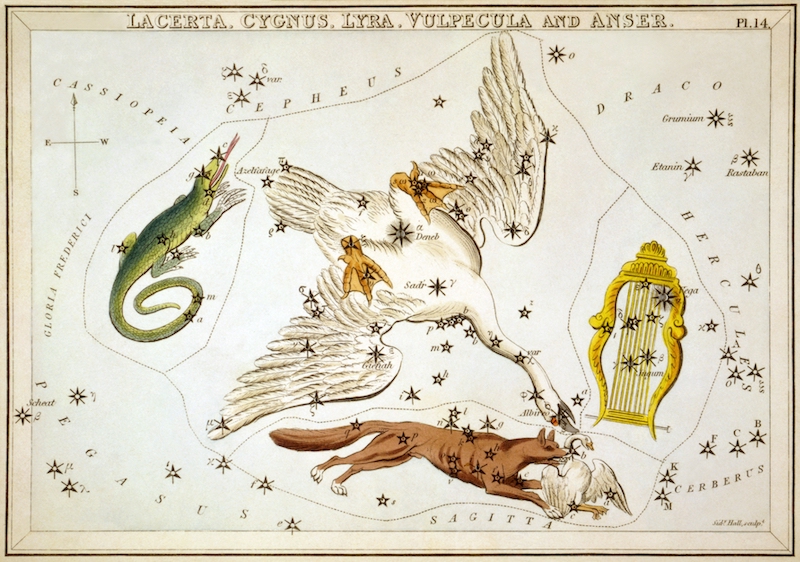
The constellation Lacerta the Lizard lies just behind the tail feathers of Cygnus the Swan. This star chart is from Urania’s Mirror, a set of celestial cards by Sidney Hall published in 1825. Image via Wikipedia.

Bottom line: Lacerta the Lizard is a small, dim constellation in the fall sky that contains a blazar, an active galactic nucleus with a jet aimed toward Earth.

The post Lacerta the Lizard, home to a blazar first appeared on EarthSky.


from EarthSky https://earthsky.org/constellations/lacerta-the-lizard-blazar/

Why do dolls creep us out? It’s the uncanny valley effect

Side view of a baby doll sitting on a chair in a darkened room, looking like it is staring at something.
Scientists say the reason dolls creep us out might be related to the uncanny valley effect. This is the term for when something looks close to real life but not quite right, giving people an uneasy feeling. Image via Sandman TSM/ Pixabay.

Why do dolls creep us out?

You walk into a room and feel like you’re being watched. But there’s no one in the room with you except for some harmless dolls. Still, the presence of the dolls makes your heart rate quicken and the room spin, and all you want to do is leave. This fear of dolls is called pediophobia. And the prevalence of creepy dolls filling stores and lawns around Halloween can make your pediophobia hard to escape. But why do dolls creep us out?

Scientists at Northeastern University said on October 7, 2025, that our fear of dolls might come from something called the uncanny valley effect. A scientist named Masahiro Mori first described the effect in the 1970s. Mori used the term to describe the eerie feeling of encountering a humanlike robot. Around this time, lifelike robots were becoming popular in movies and TV. Applied psychology professor Christie Rizzo of Northeastern University said:

When robots were looking very robot-like and not very human-like, people had a very positive kind of connection. They thought they were cool. But when robots started looking more human, there was a point where people started to be put off by the robot’s look and maybe creeped out.

That reaction took place in this really narrow place scientists called the ‘uncanny valley,’ between where the robot was sort of human-looking but things weren’t quite right.

The uncanny valley effect

Mathew Yarossi, an expert in biomechanics and movement neuroscience at Northeastern, explained the uncanny valley effect this way:

When something looks almost human but is not quite, sometimes we find it repulsive. Sometimes we just find it strange.

There’s an area of the brain that is specific for the recognition of the faces of humans. The firing is different for things in the uncanny valley.

Part of the unease might be because dolls can violate our expectations. At first glance we think what we’re seeing is human, but then we realize our mistake. Leanne Chukoskie, director of the Playful Mind Lab at Northeastern, said:

We place a high priority around being able to predict or categorize and know what’s coming next. We try to predict to make sense of the world.

You deserve a daily dose of good news. For the latest in science and the night sky, subscribe to EarthSky’s free daily newsletter.

The influence of movies and pop culture

Research shows children under age 9 don’t experience the uncanny valley effect. So younger kids tend not to have uneasy feelings around dolls. Adults are the ones more likely to have pediophobia.

This delay in the onset of the phobia could partly be the fault of scary movies that feature dolls, such as Chucky or the possessed doll Annabelle. Rizzo said:

If you see a movie like that at the right time, you can actually develop an ongoing fear of those things.

A plastic doll head with a weird film on its deeply-set eyes and tiny bright red lips.
Children age 9 and under tend not to have uneasy feelings around dolls. Image via Nancy Hughes/ Unsplash.

Dolls creep us out in Halloween decor, too

Dolls are becoming more popular in Halloween decor. And that might be thanks to aging Baby Boomers. Dolls were abundant in their childhoods and now many are cleaning house. So dolls are a common and inexpensive item at your local thrift store. And they can make for great creepy Halloween displays, like this one of a parade of dolls disposing of a body wrapped in a garbage bag.

Part of the challenge of Halloween is learning to laugh at things that scare us. And the fear of death is a fundamental human fear. Ajay Satpute, Northeastern associate professor of psychology and director of the Affective and Brain Sciences Lab, said:

Some have argued that the uncanny valley between humans and robots is really about recognizing our own humanness, which might make us feel our sense of mortality and lead to a fear of death.

Shelves of dolls, doll heads and stacks of dolls with only the legs visible looking dismembered.
Dolls were prolific during the childhoods of the Baby Boomer generation. And now many of those dolls are turning up in thrift stores. They make for inexpensive Halloween decor. Image via Magda Ehlers/ Pexels.

Watch this funny and sweet TikTok of a little girl with no fear of dolls. Not even of Michael Myers from the Halloween movie franchise.

Bottom line: For many of us, dolls creep us out. Their lifelike – but not quite human – aspect can trigger the uncanny valley effect. Hear more from scientists about this effect.

Via Northeastern University

Goblin sharks, ghost crabs and vampire bats, oh my!

Witch Head Nebula is perfect on October nights

The post Why do dolls creep us out? It’s the uncanny valley effect first appeared on EarthSky.


from EarthSky https://ift.tt/XBxspl8

adds 2