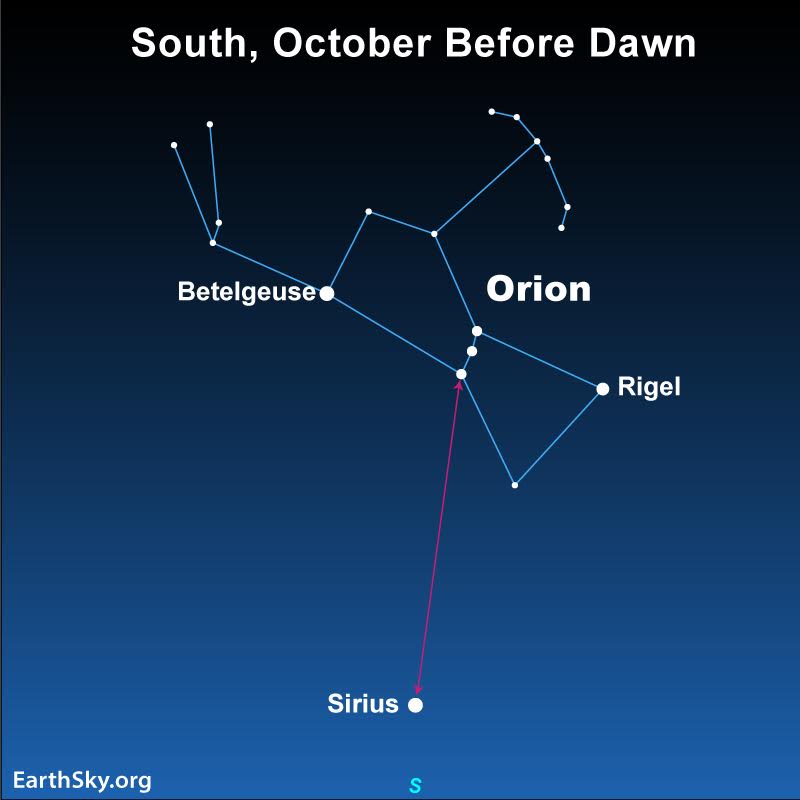
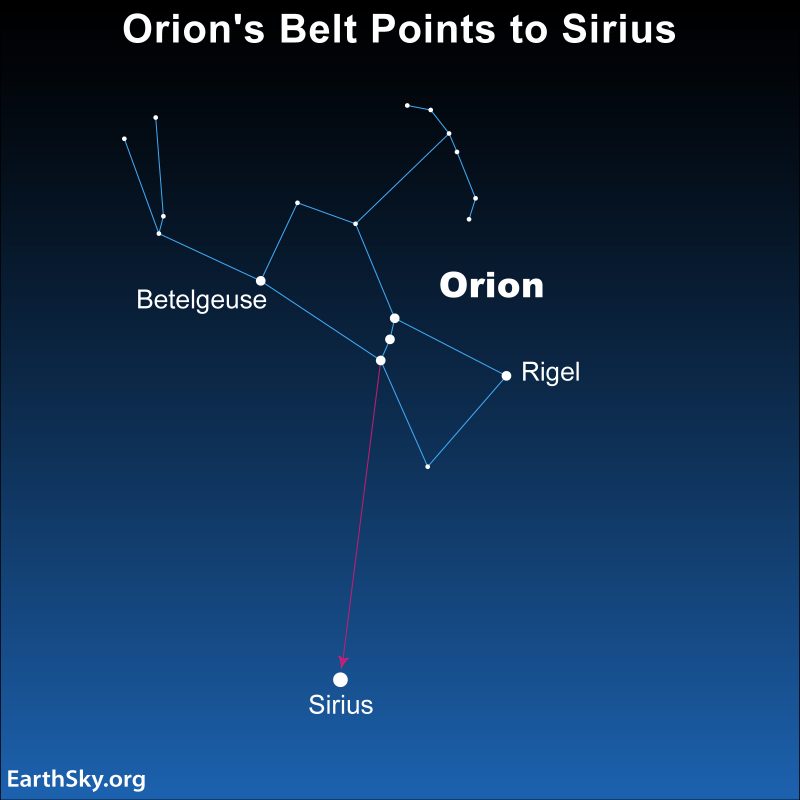
No matter when you see it in the sky, Orion’s Belt always points to the sky’s brightest star, Sirius. On northern autumn mornings – or southern spring mornings – Sirius and Orion can be found in the south before dawn. Chart via EarthSky.
Watch for the brightest star, Sirius
Bright Jupiter outshines all the stars in the morning sky right now, but our brightest star is there too.
At this time of the year we always get questions about another bright object in the dawn sky. Andy wrote:
Early this morning, looking south, I saw a beautiful star, bright and multicolored … Can you identify it for me?
And Paula wrote:
This morning two of us got up early. We found a pulsing star straight down the sky below Orion’s Belt. It was pulsing the colors of green, yellow, blue and red like a strobe light. I will search for it every morning as it was so enchanting.
So if you’re up before daybreak, take a moment to look for Sirius, which is the sky’s brightest star. It’s so brilliant that you can even see it from a light-polluted city. And you can see it if you stay up late, too! It’s rising in the middle of the night now, as seen from around the globe, and is high in the sky – at its best – by dawn.
Want a specific view from your location on the globe? Visit Stellarium and enter your location.
What is that bright twinkling star?
This star is enchanting, so much so that – every year, beginning in Northern Hemisphere autumn – we get many, many questions about a multicolored star twinkling in the southeastern to southern sky after midnight. This star typically turns out to be Sirius, which is in the constellation Canis Major the Greater Dog and is sometimes called the Dog Star.
Why does Sirius twinkle so much?
Sirius appears to flash different colors when it’s low in the sky. Really, all the stars are flashing different colors, because light is composed of all the colors of a rainbow, and the journey through our atmosphere breaks starlight into its component colors via refraction.
But you don’t notice the colors of the other stars much, because they’re not as bright as Sirius. Sirius is the brightest star visible from anywhere on Earth.
Since our atmosphere is causing the light to break into its colors, and since Sirius is often seen low in the sky now (where you are peering at it through a thicker layer of atmosphere than when it’s overhead), the flashing colors of Sirius are very obvious. When Sirius is higher in the sky – which it is close to dawn in the month of October and November – or in the evening sky in January and February – you’ll find that Sirius shines with a steadier, whiter light.
So, on these October and November mornings, watch as Sirius winks at you in the wee hours before dawn!
View at EarthSky Community Photos. | Sergei Timofeevski shared this image from November 13, 2023. Sergei wrote: “The constellation Orion the Hunter and the star Sirius rising just above the eastern horizon in the Anza-Borrego Desert State Park, California.” Thank you, Sergei! Note bright Sirius is on the bottom, and Orion’s Belt pointing to it.
Bottom line: We get many questions about a bright, colorful, twinkling star on these October mornings. It’s the brightest star, Sirius, in the constellation Canis Major. You’ll know it’s Sirius, because Orion’s Belt always points to it.
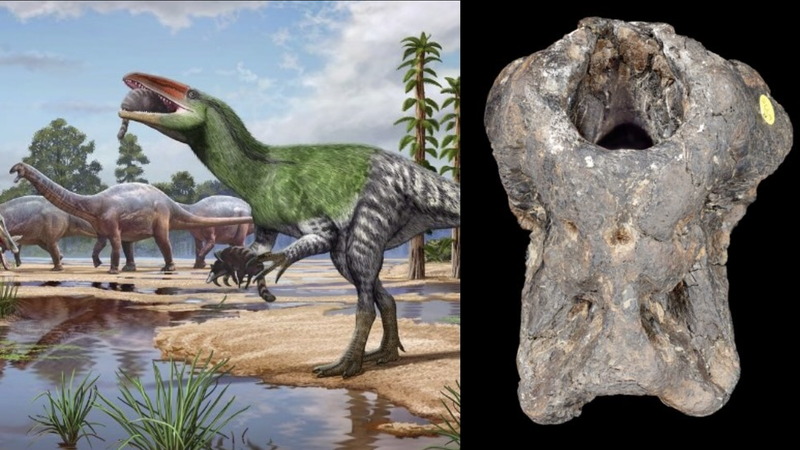
Artist’s concept of the new dinosaur species Invictibellatrix amberina, along with the fossil from which it was identified. The fossil had been sitting in a drawer for 100 years, until researchers pulled it out and became curious. Image via Sergey Krasovskiy and Pedro Salas/ Natural History Museum London.
More than 100 years ago on the Isle of Wight, off the south coast of England, amateur paleontologist Reginald Walter Tooley found a dinosaur fossil. And, in 1924 — after Tooley’s death — the fossil came to the Natural History Museum in London. It was one of a batch of some 1,000 unstudied specimens. The fossil then sat in a drawer for a century. No one knew it would bring to light a new dinosaur species.
Fast forward 100 years. Two paleontologists — Cassius Morrison and his student Charlie Scherer of University College London Earth Sciences — pulled the long-overlooked specimen out of storage. They wondered if it could be reevaluated using modern diagnostic techniques.
The researchers used CT scanning to get a better understanding of the fossil. And they used 3D modeling to show what this dinosaur would have been like when it roamed what’s now the Isle of Wight some 120 million years ago.
They published their peer-reviewed research in the journal Royal Society Open Science on October 14, 2026. They said they’d named this newly recognized dinosaur species Invictibellatrix amberina.
Morrison commented:
It’s a real mystery that this fossil was overlooked for so long, sitting in a drawer for nearly 100 years. Lots of bones are found on the Isle of Wight. Who knows what else is waiting to be discovered.
Meet Charlie Scherer and Cassius Morrison of UCL Earth Sciences, authors of the study about the new dinosaur species. Morrison holds the fossil that led to the discovery. Image via UCL.
What’s in a name?
The word amberina primarily honors the amber embedded within the plant debris beds of the Wessex Formation on the Isle of Wight, where the 120-million-year-old fossil was originally collected.
Invictibellatrix, meanwhle, translates from Latin as unconquered female warrior.
The researchers said this dinosaur would have been about as tall as a human. It stood on two legs, ate meat, and likely had feathers, they said. It would have used its arms and giant claws to attack smaller prey. such as smaller dinos, lizards and mammals.
They found that the skull has an oval hole where the brain and spinal cord would have met. The hour-glass-shaped crest was also distinctive; this crest was what led to the classification as a new species.
This is the fossil that led to the discovery of a new dinosaur species. The hole at the top is where the dinosaur’s brain would have been. Image via UCL.
It might have been gigantic, but wasn’t
The new dinosaur species belonged to a group of two-legged dinos called the megaraptorans. A species of megaraptoran had never been discovered to exist in Europe until now.
Megaraptorans could be gigantic, as big as a T-rex. But the new human-sized dinosaur is the smallest megaraptoran yet found. While it would have stood around the height of a human, at about 5 feet (1.5 meters), it would have been long from its head to its tail, spanning about 10-13 feet (3-4 meters). And those large, curved claws were likely around 4-8 inches (10-20 cm). These estimates are based on what we know of Invictibellatrix‘s closest relatives, the scientists said.
It would have eaten small dinosaurs, lizards and mammals, occupying a similar role in the food chain to the hyena today.
And while humans didn’t yet exist while Invictibellatrix was on Earth, Morrison said:
It was not the apex predator of its time, but for humans this dinosaur would have been more dangerous than a T. rex. We would have been perfectly sized prey, about 1/3 of their body weight. They definitely would have chased us. A T. rex would not have bothered, as we would have been too small.
Where might the new dinosaur species have lived?
Invictibellatrix amberina is the first member of the megaraptoran family known to live in Europe. Researchers think megaraptorans originated in Asia. Later, they traveled through Europe. The larger carnivorous species became apex predators in areas of what is today Africa, South America and Antarctica. Scherer commented:
This new species is the first proof we have that megaraptorans were also present in Europe and that they reached Gondwana this way rather than island-hopping further south.
The larger megaraptorans came later and lived farther south. Researchers think the smaller megaraptorans who lived farther north died out earlier.
Bottom line: Researchers have identified a new dinosaur species from a fossil found on Isle of Wight in the U.K. The carnivorous dino would have stood about as tall as a human.
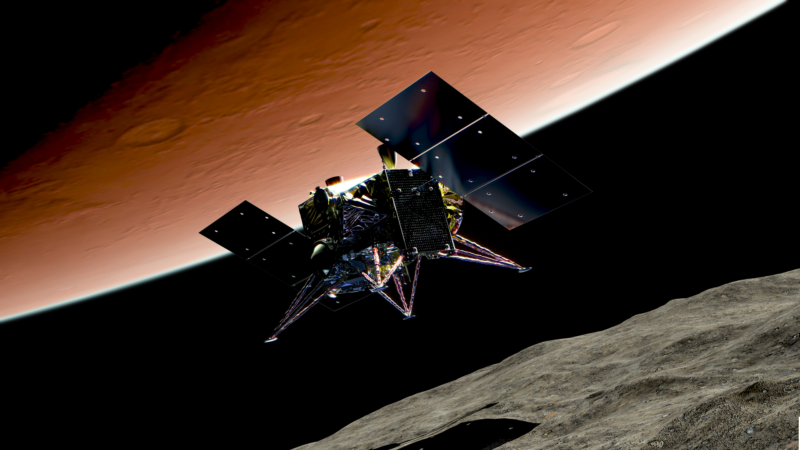
Artist’s illustration of Japan’s MMX spacecraft at Phobos, the larger of Mars’ two small moons. MMX will land on Phobos, collect a soil sample and bring it back to Earth in 2031. Image via ESA/JAXA.
Japan plans to launchits MMX mission to Mars’ moons on October 19.
The spacecraft will explore Phobos and Deimos and collect a sample from Phobos.
The mission aims to return the sample to Earth in 2031.
MMX mission will travel to Phobos and bring a sample home
Japan is about to launch a new mission to Mars’ two moons, Phobos and Deimos, on October 19. Its main goal is to collect soil from Phobos and bring it back to Earth, where scientists hope it will reveal where the moons came from.
The Japan Aerospace Exploration Agency (JAXA) is preparing to launch its Martian Moons eXploration (MMX) mission from Tanegashima Space Center in Japan at 19:41 UTC (2:41 p.m. CDT) on October 19, 2026. That’s 4:41 a.m. Japan Standard Time on October 20.
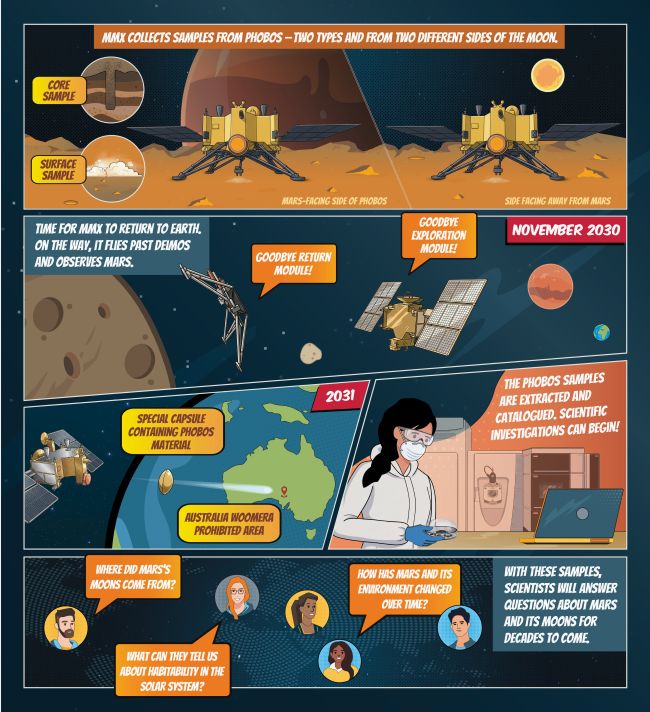
After a journey of about 10 months, the spacecraft will reach Mars and its moons Phobos and Deimos. There, the mission will deploy a rover to land on and explore Phobos. After taking a sample of Phobos’ soil, it will return to Earth in 2031, depositing its precious cargo in Australia for retrieval.
Phobos — which means fear — and Deimos — which means terror — are the only two known moons of Mars, which takes its name from the Roman god of war. Astronomers long assumed these potato-shaped moons were captured asteroids that veered too close to Mars. However, astronomers have recently wondered if these nuggets are pieces of Mars that an impact flung into space. In fact, some think Phobos might once have been a ring around Mars … and it might one day break apart to become a ring once again.
How MMX will reach and sample Phobos
These graphics show the major phases in the MMX mission from launch in October 2026 to samples returning to Earth in 2031. Images via X/ ESA.
The components of the MMX mission
The MMX spacecraft has three parts. The propulsion module is what will get the spacecraft to Mars. Once there, the exploration module will visit Phobos’ surface with a rover and do soil sampling. Finally, the return module will journey back toward Earth and release a capsule that will target Australia.
Japan modeled the MMX mission after the highly successful Hayabusa2 mission that visited the asteroid Ryugu and returned samples to Earth. The Hayabusa2 mission discovered that Ryugu’s soil contained the building blocks of life.
We can’t wait to see what MMX discovers.
Bottom line: The MMX mission launches October 19 to explore Mars’ two moons. It will land on Phobos, collect a sample and bring it back to Earth in 2031.
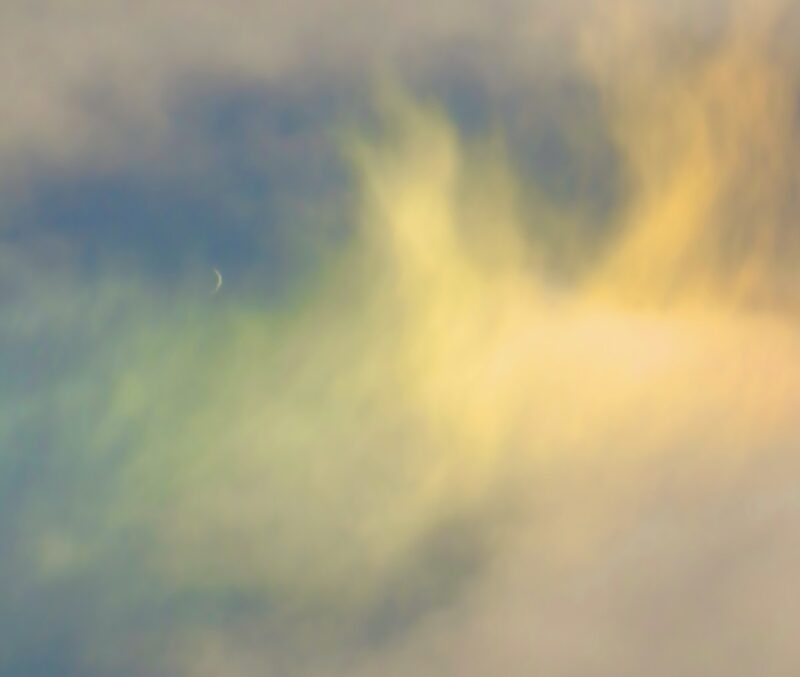
View at EarthSky Community Photos. | Be sure to view this one larger! It’s a beautiful closeup of a colorful sundog, or parhelion, with a thin crescent Venus in its midst. See Venus? It’s in the blue patch in the upper left. EarthSky friend Paolo Palma caught it from Rome, Italy, last week. What a feat, Paolo! Thank you. He wrote: “The image captures one of those rare moments when the planet of love, peeking out from behind the white, wind-swept clouds, appears alongside tufts of cirrus clouds fleetingly colored by atmospheric refraction.” Venus has been in our evening sky. But it’s now just a week away from becoming a morning planet.
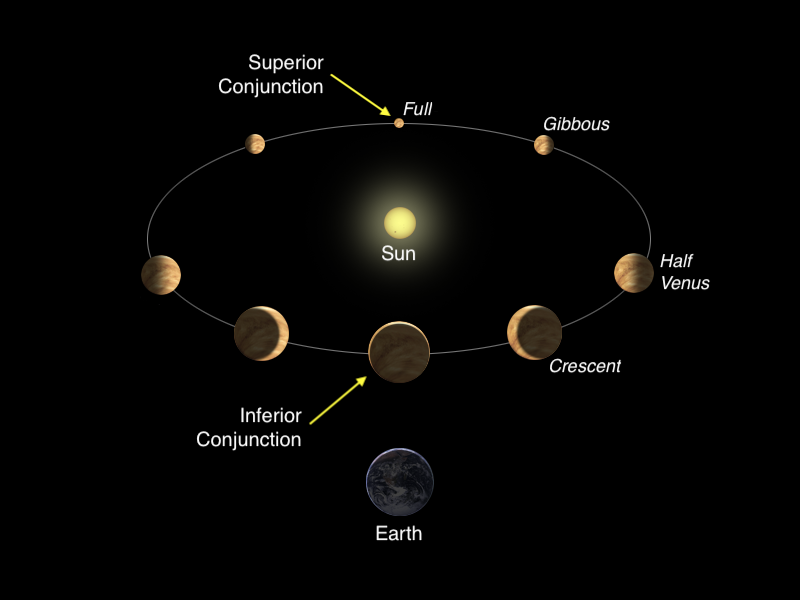
Venus travels one step inward from Earth in orbit around the sun. Its orbit is smaller than Earth’s. It has less distance to cover. And it moves faster in orbit (about 35 km/s or 78,300 mph in contrast to about 30 km/s or 67,000 mph for Earth). So – because Earth travels fast, too – Venus manages to gain a lap on us, going between us and the sun, about every 19.5 months. And, at such times, earthly astronomers say Venus is in inferior conjunction with the sun. Venus reaches inferior conjunction in 2026 at 4 UTC on Saturday, October 24, 2026. That’s 11 p.m. on October 23 CDT.
Will you see Venus on the day of inferior conjunction? It’s not likely, unless you’re an extremely careful and experienced telescopic and/or photographic observer. After all, on the day of inferior conjunction, Venus will be crossing the sky – as a slender crescent – with the sun during the day. And sometimes it’s closer to the sun than others. Please do not attempt to observe Venus near the sun unless you’re an experienced sun observer.
Venus moves to the morning sky
So, in a casual way, we say Venus goes between us and the sun on October 24, 2026. But it doesn’t go directly between. If it did, there’d be a transit of Venus. Venus – our closest planetary neighbor and the brightest planet in our sky – passes between the Earth and the sun about every 19 months (1.6 years). So inferior conjunction for Venus happens that often.
But transits of Venus are rare. And they happen in pairs. The last transits of Venus were on June 8, 2004 … and June 5-6, 2012. The previous pair of transits were in December 1874 and December 1882. The next transits of Venus will take place on December 10-11, 2117, and December 8, 2125.
The phases of Venus – and its locations at inferior conjunction and superior conjunction – as viewed from Earth. Adapted from an image by NASA/ Chmee2/ Wikimedia Commons (CC BY-SA 3.0).
The 2026 inferior conjunction of Venus
In 2026 – moving through the constellation Virgo the Maiden – Venus will pass south of the sun in our sky at the moment of inferior conjunction, at a distance of 6.6 degrees.
At the moment of inferior conjunction, Venus will officially shift from the evening to the morning sky for all observers on Earth.
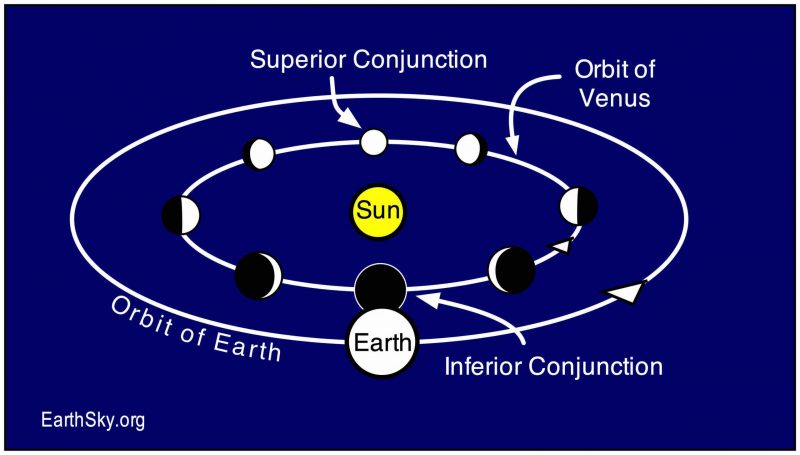
View larger. | As seen from the north side of the solar system, Venus (and all the planets) travel counterclockwise around the sun. Inferior conjunction – when Venus sweeps between the sun and Earth – happened last on March 23, 2025. It happens in 2026 on October 24 (UTC). And it happens next on June 2, 2028 (UTC). Illustration by EarthSky.
When will you next see Venus?
So, when you can expect to see Venus come back to the morning sky? Around mid-month in November, look east about 20-30 minutes before sunrise. Since Venus is the brightest planet, you’ll be able to spot it low in the east, near the sunrise point, not long before the sun comes up. Venus will surprise you with its brightness so low in the sky! It’ll quickly become a bright morning “star” in November. In fact, by the middle of November, Venus will be heading for another greatest brilliancy around November 29.
Cycles of Venus
The 1.6-year period – after which the position of Venus relative to the sun repeats, as seen from Earth – is called its synodic period.
Notice that five synodic periods of Venus add up to eight years (just 2 1/2 days short). And so we have a cycle: inferior conjunctions of Venus that are eight years apart happen at the same time of year, in the same part of the sky, with Venus at a similar angular distance from the sun, that is, the same apparent distance from the sun on the sky’s dome. Over time, this 2 1/2-day variance will accumulate, so that the conjunctions “jump” into the previous month.
So inferior conjunctions of Venus strongly resemble each other on an 8-year cycle.
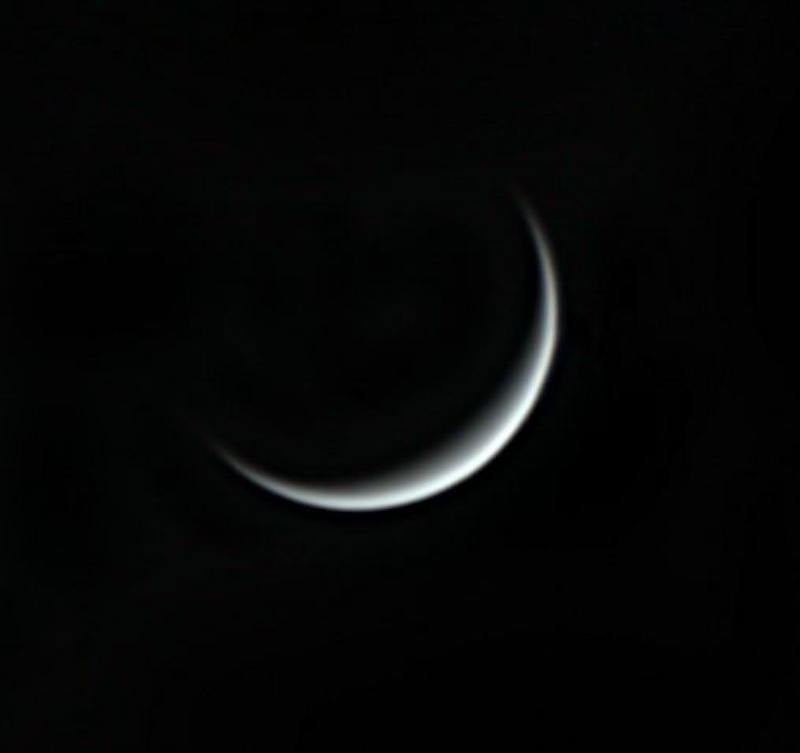
In early March 2025, Venus was going, going … almost gone between us and the sun. Astronomers call this an inferior conjunction of Venus. And Aurelian Neacsu of Romania captured this image on March 4, 2025, of Venus through a telescope. Its lighted face was turned mostly away from us in this photo, and Venus – the brightest planet seen from Earth – appeared as a waning crescent. It got thinner and thinner each day as it raced toward inferior conjunction. View at EarthSky Community Photos. Thank you, Aurelian!
June transits of Venus
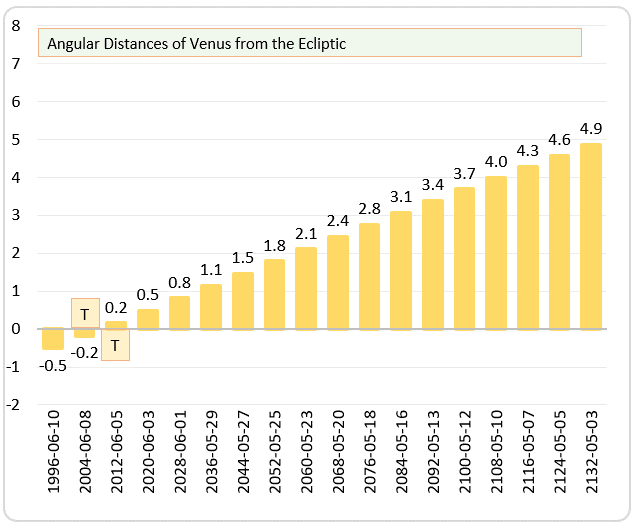
The June 3, 2020, passage of Venus nearly between us and the sun was quite dramatic. Venus appeared in our sky within “touching distance” of our star. Venus missed the solar disk in 2020 by only a quarter of a degree.
So, in 2020, Venus fell short of transiting, or crossing, the solar disk as it had done eight years earlier, on June 5, 2012 (and also eight years before that, on June 8, 2004).
With the conjunctions of 2004 and 2012 resulting in transits, and the one in 2020 resulting in a near-miss, one could correctly conclude that the angular distance from the sun during these (currently) June series of inferior conjunctions is slowly but steadily increasing. And so they are. The June-May inferior conjunctions of Venus will not result in any more transits for many centuries.
Angular distances from Venus to the ecliptic (sun’s path in our sky) during June-May series of inferior conjunctions of Venus between years 1996 and 2132. The distances are shown in degrees. Bars with a “T” mark the transits of Venus in 2004 and 2012. You can see that, in the June-May series, the angular distance between Venus and the sun is increasing. Hence there will be no Venus transits to expect in June or May for centuries to come. Image via Milan B.
January transits of Venus
The last inferior conjunction on January 8-9, 2022, did not carry the drama of its predecessor in June 2020.
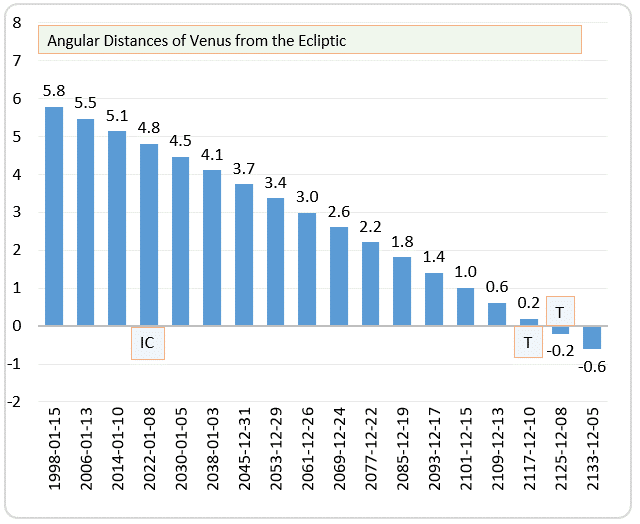
During the previous January inferior conjunction on January 10, 2014, Venus was around 1/3 of a degree farther from the sun than it was at the January 8-9, 2022, event. The next January conjunction, in 2030, will fall even closer than 2022, at just 4.5 degrees. So one might assume that this January series is slowly inching (in astronomical terms) towards the sun.
And that would be a correct assumption. Venus is currently getting closer and closer to the sun on the sky’s dome at the January inferior conjunctions.
What’s more, as the conjunction of 2022 fell on the 8th day of January, the 2 1/2 day shift will cause this January series to shift into December relatively soon, in 2045. From that moment, the now-December series will result in closer and closer approaches to the sun in the second half of the century and in the early 22nd century. The angular distance with the sun at the December inferior conjunction series will have decreased so much that it will bring us another pair of transits in years 2117 and 2125.
Some children alive today will likely live to see the Venus transits of the early 22nd century.
Angular distances from Venus to the ecliptic (sun’s path in our sky) during the January-December series of inferior conjunctions of Venus between years 1998 and 2133. The distances are shown in degrees. The bar marked “IC” indicates the last inferior conjunction on January 8-9, 2022. “T” bars mark upcoming transits of Venus in 2117 and 2125. Image via Milan B.
For experts, seeing Venus at inferior conjunction
Please do not attempt to observe Venus near the sun unless you’re an experienced sun observer.
Keen observers – depending on your location – might be able to see Venus through a telescope at – or near inferior conjunction – when it passes 6.6 degrees south of the sun on October 23-24, 2026. It’ll shine at -3.9 magnitude. And it’ll be a razor-thin crescent, only 61.12 arcseconds across.
Bottom line: Venus reaches inferior conjunction – passing between Earth and the sun – in 2026 at 4 UTC on October 24. Then Venus emerges in the morning sky.
Earth orbit is getting more crowded, and the consequences could be serious. The European Space Agency’s 2026 Space Environment Report warns that debris collisions could trigger a runaway chain reaction, making some orbital regions unsafe or unusable. Space hazards expert Jonathan McDowell joins EarthSky to explain what the report reveals, how dangerous conditions in space have become, and what we can do about it. Watch in the player above.
Space is getting crowded. Let’s look at the numbers
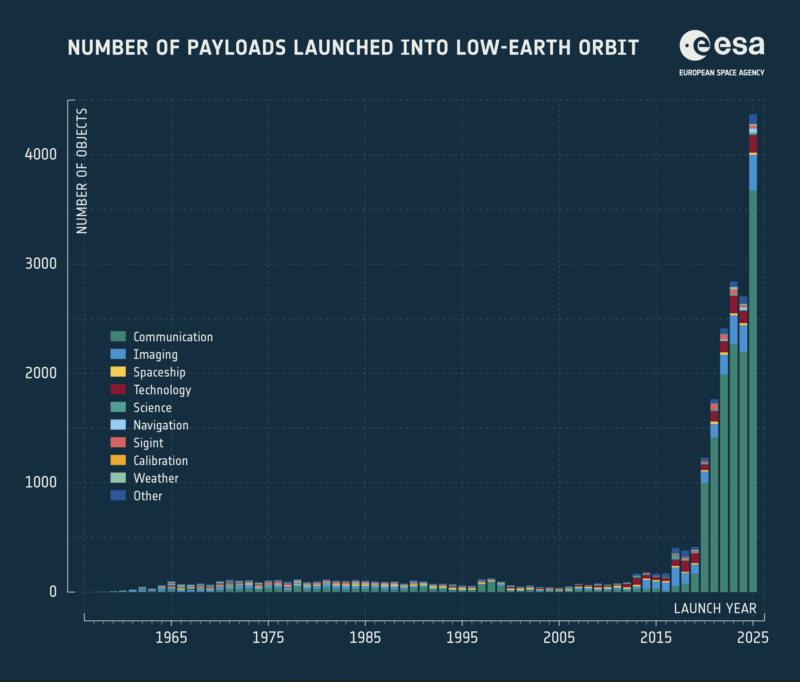
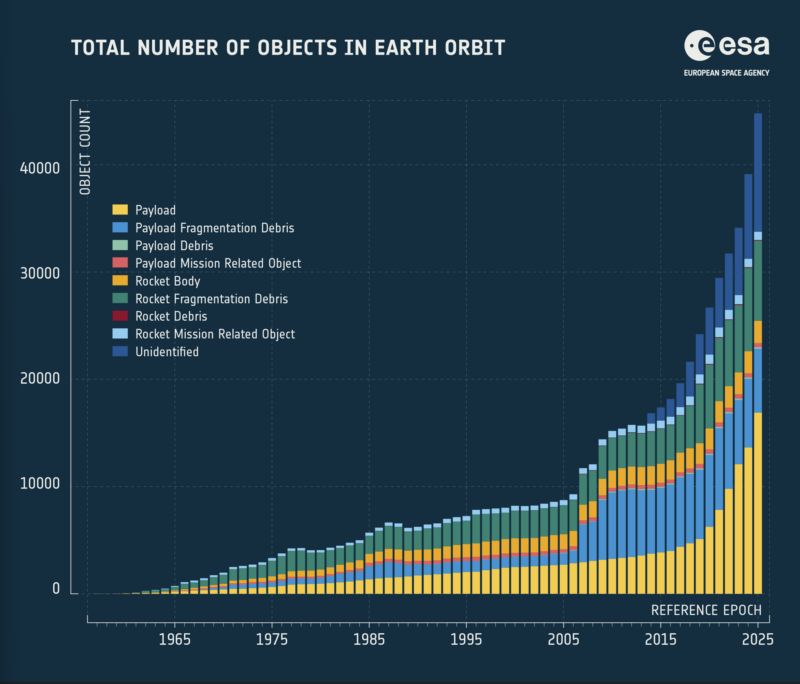
In September 2026, ESA’s Space Debris Office published its annual Space Environment Report. And, as you might suspect, the news is that space — in particular low Earth orbit — is getting more crowded. Here’s a look at the basic numbers as of October 2026 from OrbitalRadar.com:
31,000+ total tracked objects in low Earth orbit
18,600+ payloads in orbit, working and nonworking
15,800+ of those are working satellites
10,000+ of the working satellites are Starlink
And, according to ESA, the only place those numbers are going to go is up. ESA, which based its report on data through 2025, outlined some of the biggest concerns:
The number and scale of commercial satellite constellations continue to increase each year.
Not enough satellites leave heavily congested orbits at the end of their lives, creating a growing collision risk. The expected number of objects and collisions in low-Earth orbit are skyrocketing in a runaway effect. (Read more: The Kessler syndrome)
In 2026, ESA added an on-ground casualty risk of reentries. While the risk is still very low, the chance is still increasing every year due to increased traffic.
Let’s visualize the numbers
Here are some graphics from ESA to help us visualize the numbers of satellites in orbit and being added to orbit.
This graph from ESA shows how in the last 5 years the number of satellites launched into low Earth orbit has skyrocketed. Image via ESA.According to ESA, the overall number of objects in low Earth orbit is rapidly increasing. That includes working payloads along with nonworking satellites and debris from collisions. Image via ESA.
The pluses and minuses of reentry
Because there are now so many satellites in low Earth orbit, it’s important that they get removed from orbit when they’ve reached the end of their lives. And one of the positive findings of ESA’s 2026 report was that there are more controlled reentries now. That means companies and governments are conducting planned end-of-life disposal of their satellites.
And then, of course, there’s the new metric ESA introduced this year: the risk of casualties on the ground. While you are still much more likely to be injured or killed in a car or on a staircase, the risk of harm from satellite reentry has naturally gone up as the number of reentering satellites goes up. More controlled reentries would help to mitigate this risk.
What goes up must come down … eventually. This ESA graph shows how the number of reentering satellites has sharply increased in the last few years. Image via ESA.While the risk of death or injury from a reentering satellite or rocket body that lifted the satellite into orbit is still extremely low, the numbers are rising nonetheless. Image via ESA.
Space is getting crowded: What are the real risks?
The biggest immediate concern, as we send more and more satellites into low Earth orbit, is that the rising population seems unstoppable. That is, until collisions cascade into more collisions and make the environment unusable.
This idea that satellites will collide and create debris that produces more collisions until we have a runaway cascading effect is called the Kessler syndrome.
As recently as October 5, 2026, LeoLabs detected a satellite breakup in a crowded low-Earth environment. LeoLabs spotted multiple objects near the inactive Meteor 2-7 satellite after it passed over a radar station in Western Australia. Followup observations from other radars confirmed that a debris-generating event occurred. The company called it a:
… worrying trend for space safety and security.
But ESA — along with other space organizations — is working on ways to reduce the risk. This will involve cleaning up orbits and working toward a zero debris solution.
Bottom line: ESA has put out an annual report documenting the state of low Earth orbit. The number of satellites in orbit is skyrocketing, along with the chance for collisions and on-ground casualties.
The constellation Cassiopeia the Queen can be found high in the sky on October and November evenings, not far from Polaris, the North Star. And at any time of year, you can use the Big Dipper to find Cassiopeia. These two star formations are like riders on opposite sides of a Ferris wheel. In fact, they’re part of a great spinning wheel of stars seen moving counterclockwise around Polaris, the North Star, once each day. Whenever Cassiopeia rises upward, the Big Dipper plunges downward, and vice versa.
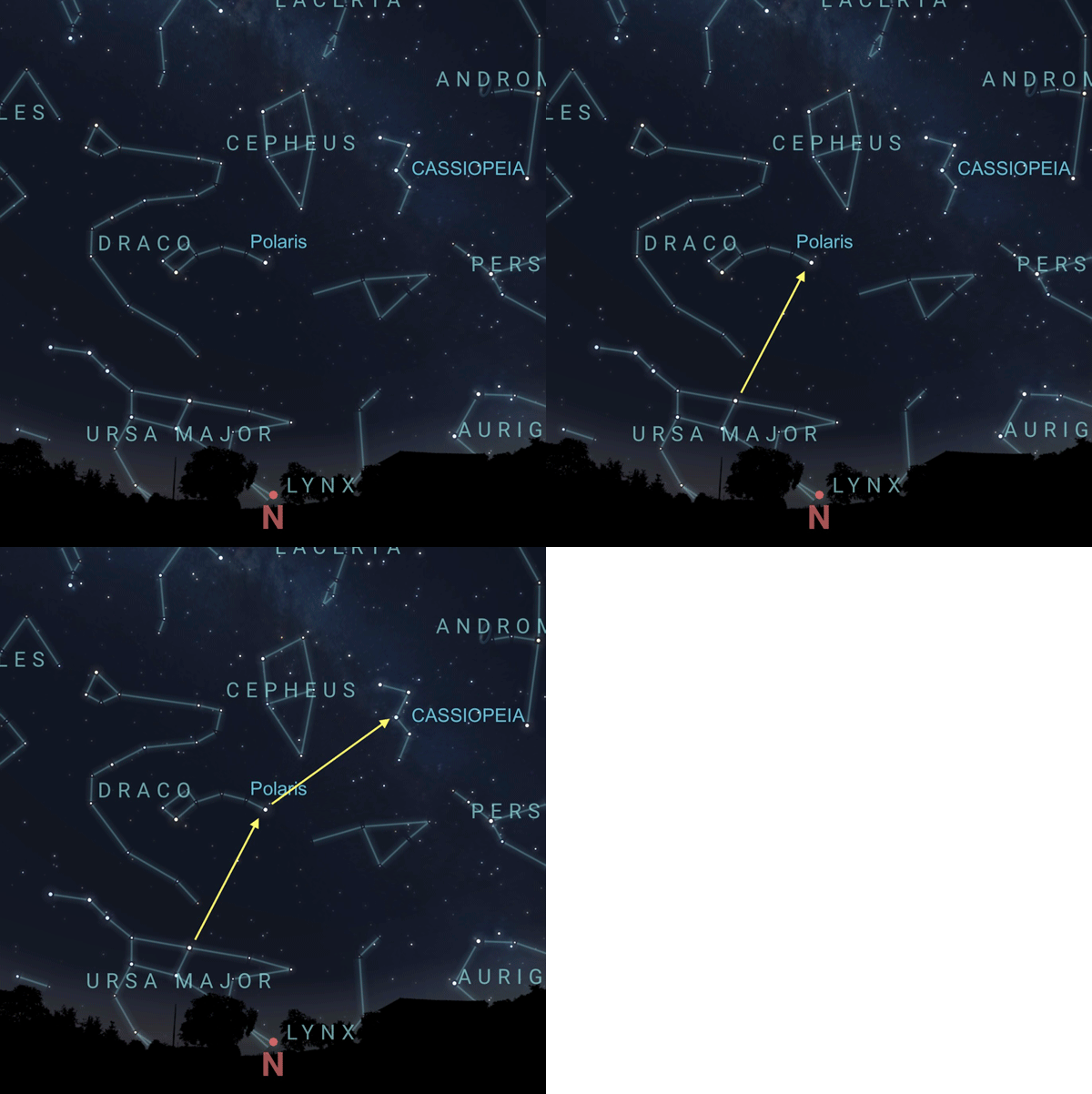
Some of you know how to star-hop to Polaris, the North Star, by using the Big Dipper’s pointer stars, as displayed on the sky chart below. That’s because the Big Dipper’s handle and Cassiopeia shine on opposite sides of Polaris, an imaginary line from any star on the Big Dipper handle through Polaris reliably points to Cassiopeia.
You can find Cassiopeia somewhere in the north for much of the year, and much of the night. And here it is on autumn evenings relative to Polaris, the North Star. But no matter the time of year, you can use the Big Dipper and Polaris to find Cassiopeia. Chart via Stellarium.org. Used with permission.
Cassiopeia is bright and easy to pick out in the sky
However, you won’t need the Big Dipper and Polaris to find Cassiopeia. That’s because Cassiopeia is very easy to pick out. Even thought it’s small and compact, it has a distinctive pattern. As you can see, it looks like the letter M or W, depending on the time of night and time of year.
Like the Big Dipper, Cassiopeia is visible even on moonlit nights.
Plus, there’s a bonus for you if you live north of about 40 degrees north latitude, about the latitude of New York City! From that latitude and farther north, the Big Dipper and Cassiopeia are both circumpolar. So that means they’re always above the horizon at any time of night, all year round.
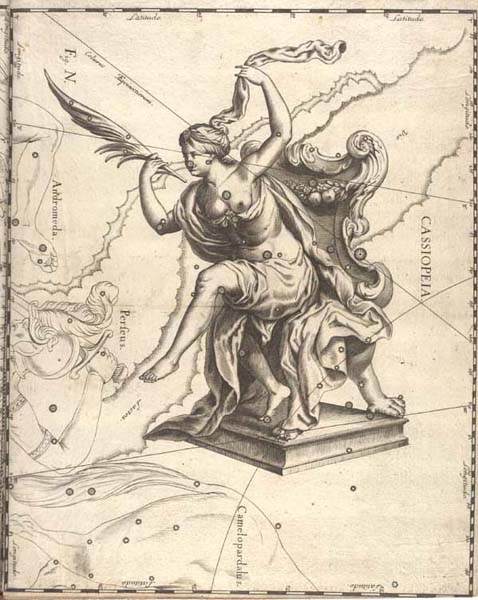
Chart of the constellation Cassiopeia the Queen. Obviously spotting a pattern of stars shaped as a M or W makes Cassiopeia an easy constellation to find. Chart via IAU. Used with permission.
Star lore of Cassiopeia
Cassiopeia used to be known among astronomers and skywatchers alike as Cassiopeia’s Chair. In the 1930s, the International Astronomical Union gave this constellation the official name of Cassiopeia the Queen.
Cassiopeia was a queen in ancient Greek mythology. According to legend, she boasted she was more beautiful than the sea nymphs called the Nereids. Her boast angered Poseidon, god of the sea, who sent a sea monster, Cetus, to ravage the kingdom. To pacify the monster, Cassiopeia’s daughter, Princess Andromeda, was left tied to a rock by the sea. Cetus was about to devour her when Perseus the Hero looked down upon her from Pegasus, the Flying Horse. Perseus rescued the Princess, and all lived happily.
The gods were so pleased, they elevated all these characters to the heavens as stars. However, Cassiopeia suffered an indignity; her vanity caused her to be bound to a chair and placed in the heavens so that, as she revolves around the north celestial pole, she is sometimes in an upside-down position.
Bottom line: Spot the constellation Cassiopeia the Queen somewhere in the northern sky during much of the year, and throughout much of the night. It’s high overhead now.
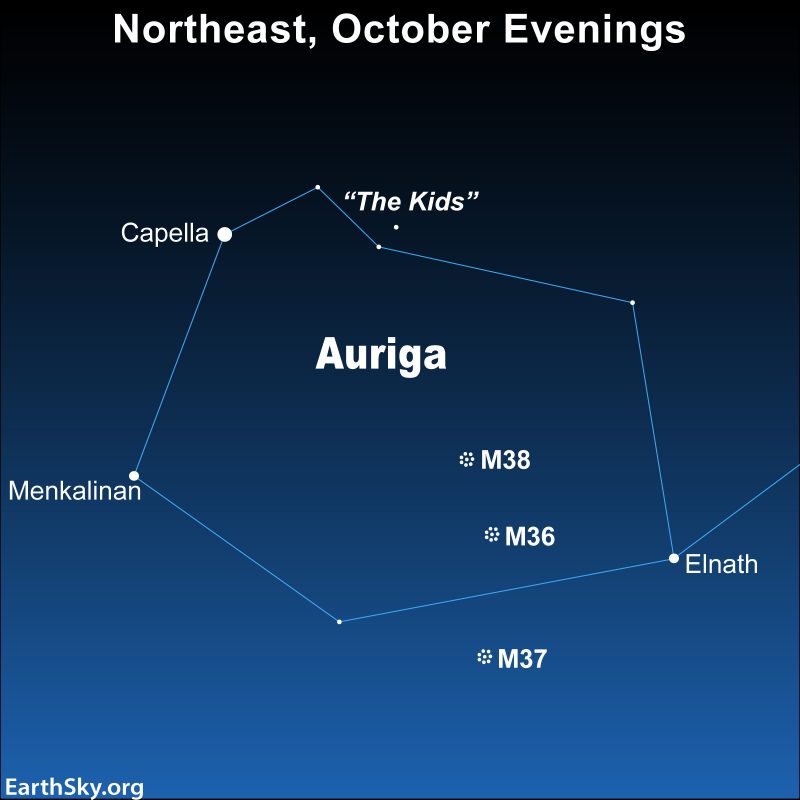
The bright star Capella in the constellation Auriga the Charioteer flashes red, green and blue in the northeast on northern autumn evenings. Around October in the Northern Hemisphere, many people look at this star and wonder if they’re seeing a UFO. To be sure you’ve found Capella, look for a little triangle of stars next to it. This little triangular asterism is called The Kids.
Capella is the colorful, twinkling star in the northeast
This evening, check out one of the flashiest stars in the sky. It’s the brightest star in the northeast this month. It’s so bright that every year in northern autumn, we get questions from people in the Northern Hemisphere who see a star twinkling with colorful flashes. It lies low in the northeastern sky in early evening as seen from mid-northern locations. That star is Capella.
The reason it’s so flashy is because it’s a bright star shining near the horizon. That means its light is coming to us through our thick atmosphere. The wavering air makes its point of light jump around, split into colors and appear to flash.
If you could travel to it in space, you’d find that Capella is really two golden stars, both with roughly the same surface temperature as our local star, the sun … but both larger and brighter.
Capella is in the constellation Auriga the Charioteer. Since antiquity, Capella’s nickname has been the Goat Star. You might pick it out just by gazing northeastward from a Northern Hemisphere latitude during the evening hours in October. Capella climbs upward throughout the night, and this month soars high overhead in the wee hours before dawn.
Why stars twinkle or flash
So, Capella is a golden point of light that flashes red and green when it’s low in the sky. Why does it do that?
The reality is that every star in the sky undergoes the same process as Capella when it twinkles. That is, every star’s light must shine through Earth’s atmosphere before reaching our eyes. But not every star flashes as noticeably as Capella. The flashes happen because Capella is low in the sky in the evening at this time of the year. And, when you look at an object low in the sky, you’re looking through more atmosphere than when the same object is overhead.
The atmosphere splits or refracts the star’s light, just as a prism splits sunlight.
So that’s where Capella’s red and green flashes are coming from — not from the star itself, but from the refraction of its light by our atmosphere. When you see Capella higher in the sky, you’ll find that these glints of color will disappear.
By the way, why are these flashes of color so especially noticeable with Capella? The reason is simply that it’s a very bright star. It’s the sixth brightest star in Earth’s sky, not including our sun.
Here are 2 other flashing stars of autumn
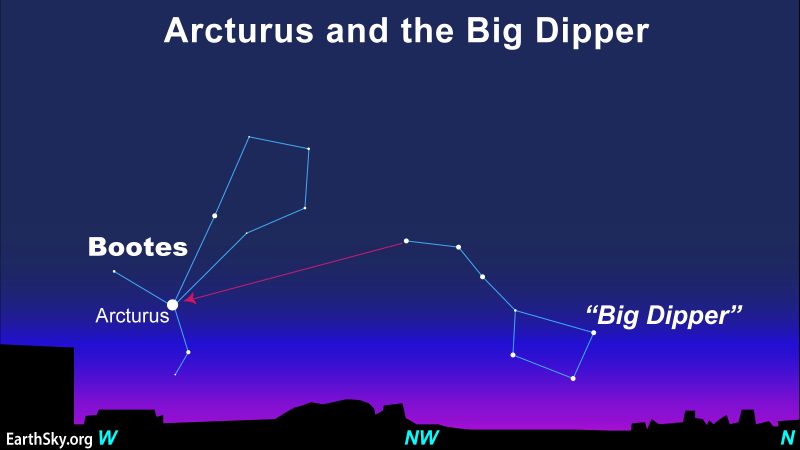
If the flashy star you’re seeing doesn’t seem to be Capella (wrong time, wrong location), here are a couple of other options. Arcturus is in the northwest at this time of year. Follow the curving handle of the Big Dipper toward the horizon, and if it hits the star you’re wondering about, then you’re looking at Arcturus in Boötes.
Another option is Sirius. If you’re waking before dawn this time of the year, you’ll find Sirius toward the south. Check out the maps below to see which star is twinkling at you.
Look northwest soon after sunset in October to find the star Arcturus in the constellation Boötes and the Big Dipper asterism. The curve in the Dipper’s handle always points to Arcturus, one of autumn’s 3 flashiest stars. Just be sure to look not long after nightfall. Unlike Capella, which ascends in the northeastern sky throughout the evening, Arcturus sets not long after sunset.
Look southward before dawn to see the star Sirius in October. At this time of the year, we get many, many questions about a multicolored star twinkling in the southeastern to southern sky after midnight. This star typically turns out to be Sirius, which is in the constellation Canis Major the Greater Dog and is sometimes called the Dog Star. Notice that a line from Orion’s Belt points to Sirius.
Bottom line: If you’re in Earth’s Northern Hemisphere and see a bright star twinkling with red and green flashes low in the northeast on October evenings, it’s probably Capella.