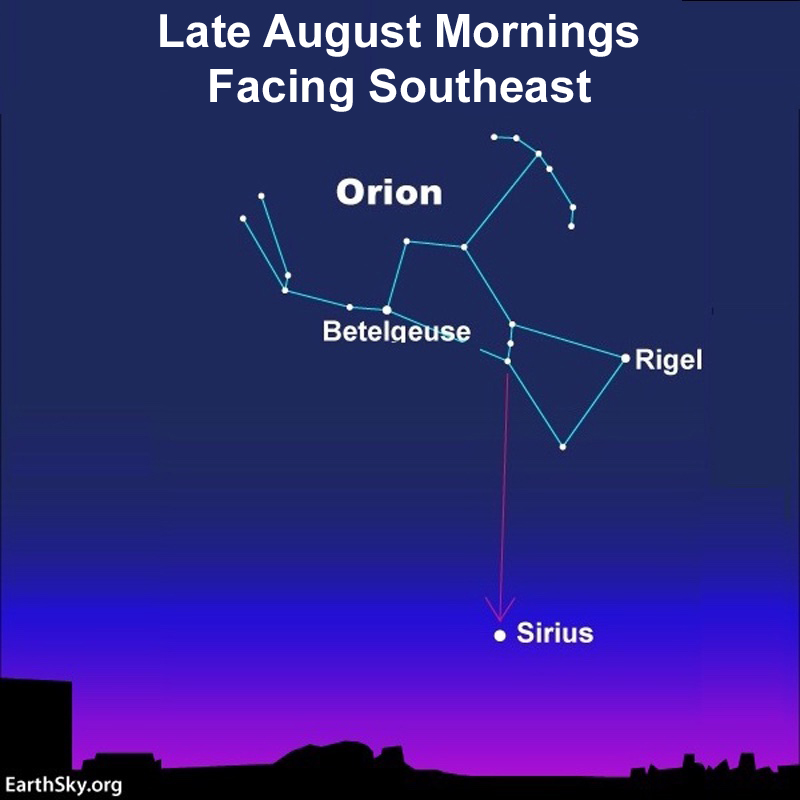
Here’s an early morning sight you won’t want to miss. The return of Sirius and the winter constellations to the morning sky heralds a change of season. Chart via EarthSky.
In late August and early September, look for two hints of the changing season in the predawn sky: Orion the Hunter and Sirius the Dog Star.
Orion is easily recognizable by the short straight line of three bright stars that make up his Belt. The constellation rises before dawn at this time of year. And the sky’s brightest star, Sirius – also known as the Dog Star, in the constellation Canis Major the Greater Dog – follows Orion into the sky as the predawn darkness gives way to dawn.
Have you noticed a very bright, madly twinkling star in this part of the early morning sky? Many do at this time of year. That star is Sirius. It’s so bright that, when it’s low in the sky, it shines with glints of red and flashes of blue. That’s the effect of our thick atmosphere causing its light to twinkle.
You won’t see Orion and Sirius in the evening sky until northern winter (or southern summer). But presently, the Hunter and the Dog Star lord over the sky at dawn.
Stars and constellations pass behind the sun
Orion was low in the west after sunset around March and April. By June of each year, the Hunter lies behind the sun as seen from Earth. Orion only returned to visibility in Earth’s sky about a month ago. Once a constellation becomes visible again, after being behind the sun, it always appears in the east before sunrise.
That’s because – as Earth moves around the sun – all stars rise two hours earlier with each passing month. So Orion is now higher at dawn than it was a month ago.
As seen from the Northern Hemisphere, Orion precedes Sirius into the sky. After Orion first appears at dawn, you can count on Sirius to appear in the morning sky a few weeks later.
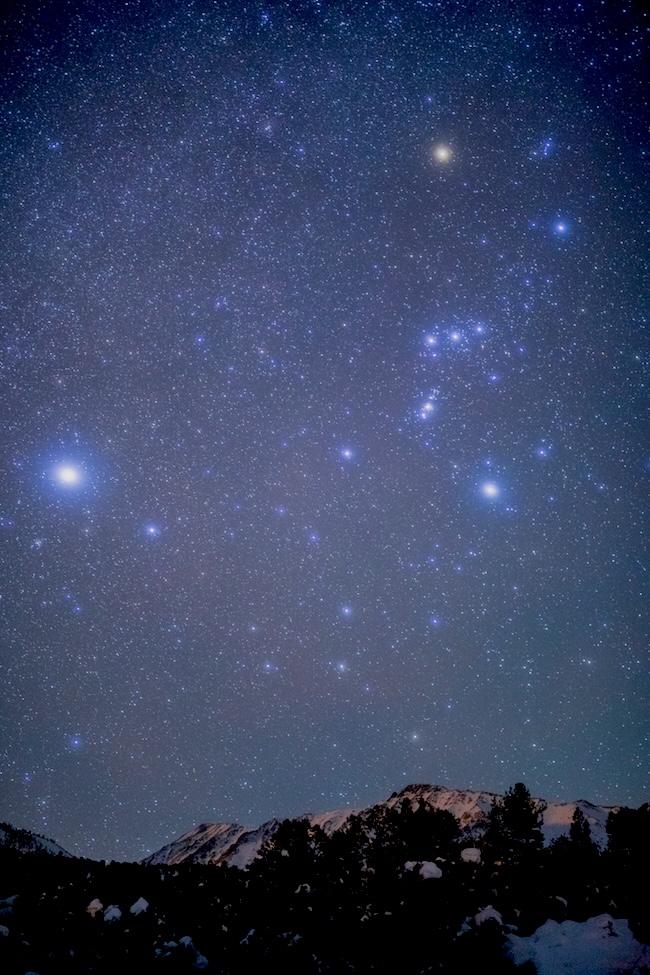
View at EarthSky Community Photos. | Jeremy Evans caught this image on January 22, 2026, in California and wrote: “Orion and Sirius over the Sierra Nevada around midnight. Cold foggy night, temperature was 8 degrees F. Taken from backyard using snowshoes to get to the photo spot.” Note the brightest star at the left is Sirius. Thank you, Jeremy!
The heliacal rising of Sirius
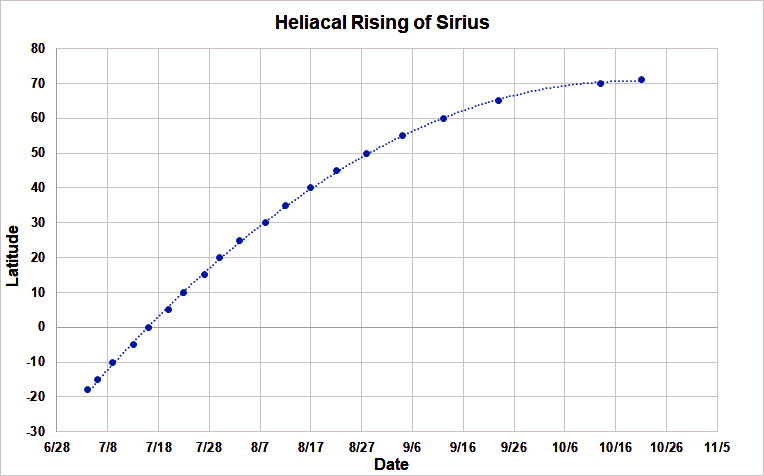
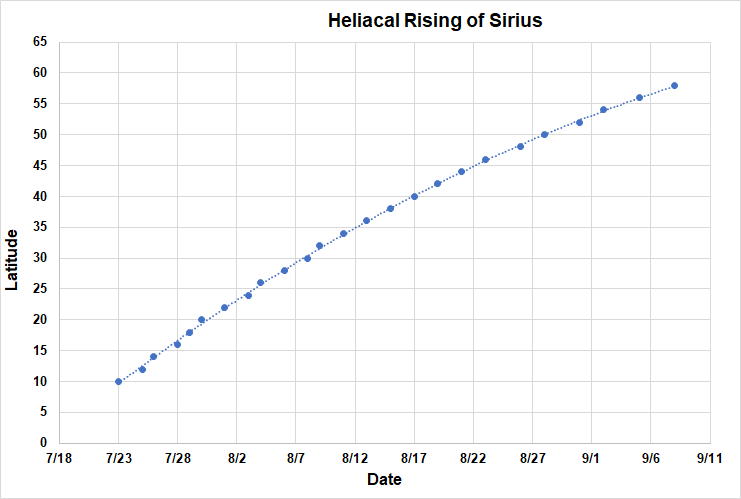
Now will be a good time to look for the heliacal rising of Sirius. In other words, what is the first date that you can see Sirius, with the unaided eye, in your morning sky? It depends on your latitude.
Below are a couple of graphs showing when you can expect to first see Sirius in your eastern predawn sky. They are designed for average eyesight, average weather and from near sea level.
The heliacal rising of Sirius from latitudes 20 degrees south to 70 degrees north. Philadelphia, for example, is at 40 degrees north latitude, so it will see Sirius reappear in the morning sky around August 17. Based on calculations by Culture Diff’. Graph via Don Machholz.The heliacal rising of Sirius from north latitudes 10 degrees to 60 degrees. Based on calculations by Culture Diff’. Graph via Don Machholz.
The return of Sirius and the colors of the stars
With Sirius and the stars of Orion low in your sky, you might notice that their light shimmers in various colors. But it’s not the stars that are changing; this is the prismatic effect of Earth’s atmosphere. As seen through a greater-than-usual thickness of atmosphere in the direction of the horizon, the mostly white light of Sirius can be broken up into striking colors on a summer morning.
But stars can be intrinsically colorful, too. Be sure to notice the reddish color of Betelgeuse when you watch Orion rise in these late summer months.
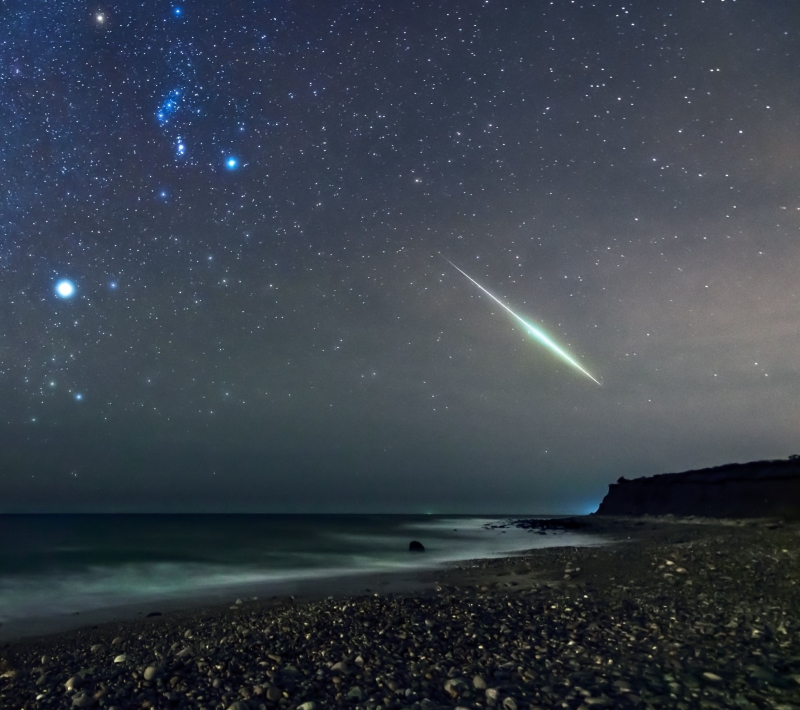
View at EarthSky Community Photos. | Daniel Friedman captured this beautiful shot from Montauk, New York, in December 2020. Note how bright Sirius is on the left, and how its color contrasts with the star Betelgeuse in the top left corner. Daniel wrote: “Out on the beach late with no one around for miles. Never captured a bolt like this and have been chasing meteor showers for years and years.” Thank you, Daniel!
Bottom line: A sign of the changing season is the return of Sirius before sunup. Be the first from your latitude to see Sirius in the morning sky.
Here’s an early morning sight you won’t want to miss. The return of Sirius and the winter constellations to the morning sky heralds a change of season. Chart via EarthSky.
In late August and early September, look for two hints of the changing season in the predawn sky: Orion the Hunter and Sirius the Dog Star.
Orion is easily recognizable by the short straight line of three bright stars that make up his Belt. The constellation rises before dawn at this time of year. And the sky’s brightest star, Sirius – also known as the Dog Star, in the constellation Canis Major the Greater Dog – follows Orion into the sky as the predawn darkness gives way to dawn.
Have you noticed a very bright, madly twinkling star in this part of the early morning sky? Many do at this time of year. That star is Sirius. It’s so bright that, when it’s low in the sky, it shines with glints of red and flashes of blue. That’s the effect of our thick atmosphere causing its light to twinkle.
You won’t see Orion and Sirius in the evening sky until northern winter (or southern summer). But presently, the Hunter and the Dog Star lord over the sky at dawn.
Stars and constellations pass behind the sun
Orion was low in the west after sunset around March and April. By June of each year, the Hunter lies behind the sun as seen from Earth. Orion only returned to visibility in Earth’s sky about a month ago. Once a constellation becomes visible again, after being behind the sun, it always appears in the east before sunrise.
That’s because – as Earth moves around the sun – all stars rise two hours earlier with each passing month. So Orion is now higher at dawn than it was a month ago.
As seen from the Northern Hemisphere, Orion precedes Sirius into the sky. After Orion first appears at dawn, you can count on Sirius to appear in the morning sky a few weeks later.
View at EarthSky Community Photos. | Jeremy Evans caught this image on January 22, 2026, in California and wrote: “Orion and Sirius over the Sierra Nevada around midnight. Cold foggy night, temperature was 8 degrees F. Taken from backyard using snowshoes to get to the photo spot.” Note the brightest star at the left is Sirius. Thank you, Jeremy!
The heliacal rising of Sirius
Now will be a good time to look for the heliacal rising of Sirius. In other words, what is the first date that you can see Sirius, with the unaided eye, in your morning sky? It depends on your latitude.
Below are a couple of graphs showing when you can expect to first see Sirius in your eastern predawn sky. They are designed for average eyesight, average weather and from near sea level.
The heliacal rising of Sirius from latitudes 20 degrees south to 70 degrees north. Philadelphia, for example, is at 40 degrees north latitude, so it will see Sirius reappear in the morning sky around August 17. Based on calculations by Culture Diff’. Graph via Don Machholz.The heliacal rising of Sirius from north latitudes 10 degrees to 60 degrees. Based on calculations by Culture Diff’. Graph via Don Machholz.
The return of Sirius and the colors of the stars
With Sirius and the stars of Orion low in your sky, you might notice that their light shimmers in various colors. But it’s not the stars that are changing; this is the prismatic effect of Earth’s atmosphere. As seen through a greater-than-usual thickness of atmosphere in the direction of the horizon, the mostly white light of Sirius can be broken up into striking colors on a summer morning.
But stars can be intrinsically colorful, too. Be sure to notice the reddish color of Betelgeuse when you watch Orion rise in these late summer months.
View at EarthSky Community Photos. | Daniel Friedman captured this beautiful shot from Montauk, New York, in December 2020. Note how bright Sirius is on the left, and how its color contrasts with the star Betelgeuse in the top left corner. Daniel wrote: “Out on the beach late with no one around for miles. Never captured a bolt like this and have been chasing meteor showers for years and years.” Thank you, Daniel!
Bottom line: A sign of the changing season is the return of Sirius before sunup. Be the first from your latitude to see Sirius in the morning sky.
On June 21, 2026, the Nancy Grace Roman Space Telescope arrived at Florida’s Kennedy Space Center on NASA’s enormous Pegasus barge (left) in preparation for its August 30 launch. Image via Amber Jean Notvest/ NASA.
The Nancy Grace Roman Space Telescope launches on Sunday
The Nancy Grace Roman Space Telescope is set to launch no earlier than 6:26 a.m. CDT on Sunday, August 30, 2026. The launch will be on a SpaceX Falcon Heavy rocket from Launch Complex 39A at Kennedy Space Center. Amazingly, the space telescope is eight months ahead of schedule!
On June 21, 2026, the Nancy Grace Roman Space Telescope arrived at Kennedy Space Center in Florida ahead of its launch. It completed testing at NASA’s Goddard Space Flight Center in Greenbelt, Maryland, before being loaded on NASA’s Pegasus barge for its shipment to Florida. After additional testing at Kennedy Space Center, the telescope is ready for its journey to L2, or the second sun-Earth Lagrange point.
You may already be familiar with this location because the James Webb Space Telescope is also there, sending back infrared images of the universe. The Roman telescope also has infrared eyes. NASA said:
Roman’s wide field of view and rapid survey capabilities will reveal billions of galaxies, hundreds of thousands of new exoplanets, hundreds of black holes, and will provide vast volumes of daily data for astronomers to study.
The Nancy Grace Roman Space Telescope is complete
NASA said back on December 4, 2025, that the construction of the Nancy Grace Roman Space Telescope was complete. Julie McEnery, Roman’s senior project scientist at NASA Goddard, said:
With Roman’s construction complete, we are poised at the brink of unfathomable scientific discovery. In the mission’s first five years, it’s expected to unveil more than 100,000 distant worlds, hundreds of millions of stars, and billions of galaxies. We stand to learn a tremendous amount of new information about the universe very rapidly after Roman launches.
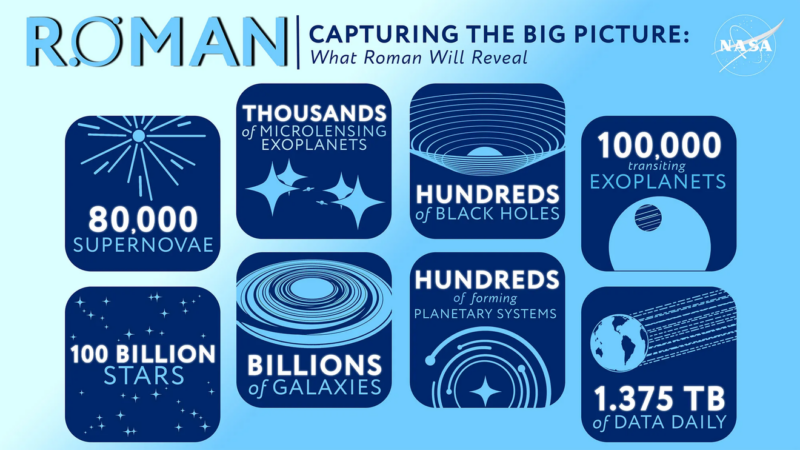
The fully assembled Nancy Grace Roman Space Telescope. Image via Jolearra Tshiteya/ NASA.The Nancy Grace Roman Space Telescope by the numbers. Graphic via NASA/ Goddard Space Flight Center.
Meet the Nancy Grace Roman Space Telescope
Remember what astronomical images were like before we had the Hubble Space Telescope? Hubble was the first large optical telescope to be launched into space, above Earth’s obscuring atmosphere. And it fundamentally changed our view of the cosmos. Astronomers say the Nancy Grace Roman Space Telescope will do that, too, giving us a view of the universe we’ve never had before. The telescope will have a primary mirror of 7.9 feet in diameter (2.4 meters). That’s the same size as Hubble. But a single image from the Nancy Grace Roman Space Telescope will equal the sky coverage of 100 Hubble images.
Scientists expect the telescope to answer fundamental questions about distant planets orbiting stars in our Milky Way galaxy, about the dark energy we haven’t yet detected directly but believe makes up a substantial portion of our cosmos … and about what astronomers call the cosmic dawn.
The telescope’s Wide Field Instrument (WFI), its primary instrument, will have a field of view 100 times greater than Hubble’s infrared instrument. Roman’s large field of view means it can capture more sky in less time. The Wide Field Instrument will scan the Milky Way for exoplanets, or planets orbiting distant stars. Over the past 30 years, since the early 1990s until now, we’ve discovered more than 5,000 exoplanets. The Nancy Grace Roman Space Telescope is expected to increase that number to some 100,000 exoplanets in the next five years.
Roman’s other instrument is the Coronagraph Instrument. The Coronagraph Instrument will perform high-contrast imaging and spectroscopy to gather more knowledge of individual exoplanets. More on the coronagraph below.
Interview with Néstor Espinoza
Watch this 52-second clip of astronomer Néstor Espinoza of the Space Telescope Science Institute talking with EarthSky’s Deborah Byrd. Néstor told us this telescope should increase the number of known exoplanets – or planets orbiting distant suns – from 5,000 now to 100,000 in just 5 years!
The Roman telescope’s 100,000 new exoplanets
The Roman space telescope will survey our galaxy, taking observations every 15 minutes for more than a year. What a mass of data it’ll collect in just that first year! The data will enable astronomers to track the brightness changes in stars, which could lead to discoveries of exoplanets, rogue planets, isolated black holes and more.
So how will the Roman space telescope find its 100,000 exoplanets? With the aid of the Roman Coronagraph, the first high-contrast active wavefront-control coronagraph to fly in space. NASA said:
The Roman Coronagraph will advance scientists’ ability to directly image planets and disks around other stars. Coronagraphs work by blocking light from a bright object, like a star, so that the observer can more easily see a faint object, like a planet [next to the bright object].
The Roman Coronagraph is designed to detect planets 100 million times fainter than their stars, or 100 to 1,000 times better than existing space-based coronagraphs.
The Roman Coronagraph will be capable of directly imaging reflected starlight from a planet akin to Jupiter in size, temperature and distance from its parent star.
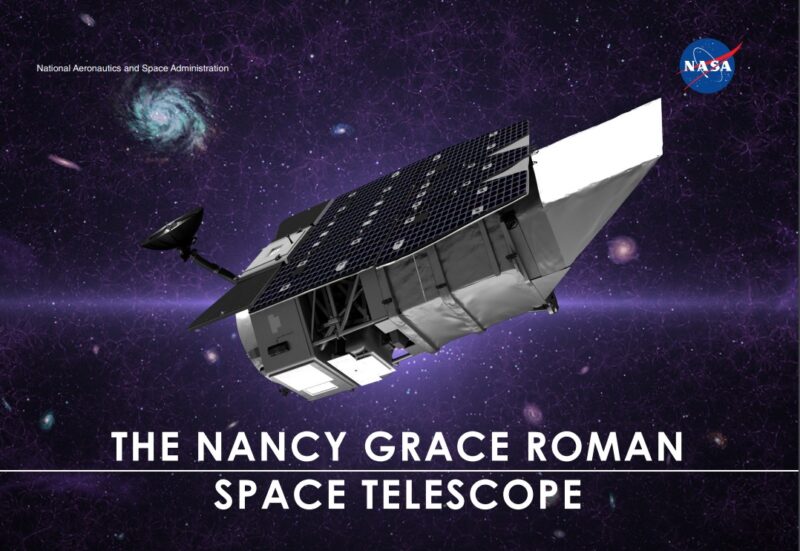
Artist’s concept of the Nancy Grace Roman Space Telescope. Image via NASA.
The Roman telescope and the cosmic dawn
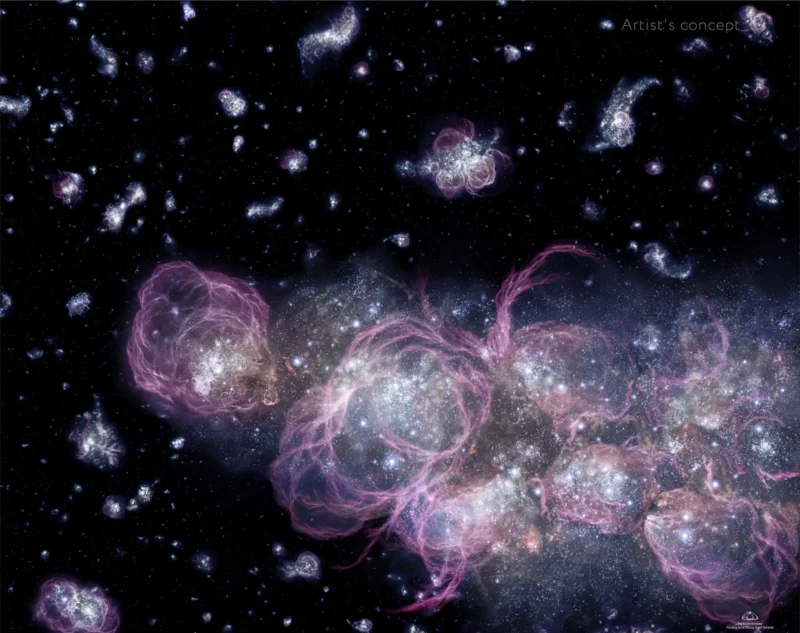
After the Big Bang that set our universe into motion, the cosmos was dark for some 380,000 to 200 million years. Yes, dark. Even though stars had already begun to shine, neutral atoms would absorb their light, leaving the cosmos in a kind of obscuring fog. Then neutral atoms began to break apart, and the fog began to lift. The light of stars broke through and began traveling throughout space. Astronomers call this transition from dark to light the cosmic dawn. Takahiro Morishita of Caltech said:
Roman will excel at finding the building blocks of cosmic structures like galaxy clusters that later form. It will quickly identify the densest regions, where more ‘fog’ is being cleared, making Roman a key mission to probe early galaxy evolution and the cosmic dawn.
Roman’s wide field of view will help determine how common quasars are and whether certain types of galaxies played a larger role in clearing the fog. It will also look for “cosmic daybreakers” that illuminated our universe.
Artist’s concept of the cosmic dawn. This is how the universe may have looked at less than a billion years old. Image via NASA/ ESA/ A. Schaller (for STScI).
The Roman space telescope and dark energy
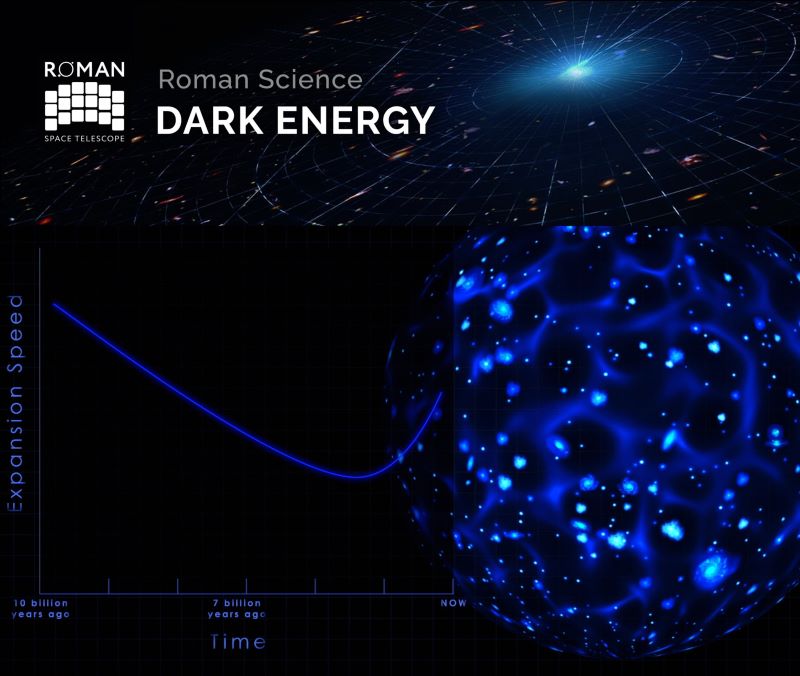
Dark energy is a mysterious force that makes up about 68% of the total energy content of our universe. Dark energy is responsible for the acceleration of our expanding universe. Roman will help astronomers understand just what dark energy is by taking a closer look at how the universe has evolved. Roman’s wide field will allow us a bigger picture of the universe. Mapping the distribution of matter and measuring distant supernovae will help show how dark energy might have changed over time.
In the universe’s past, expansion occurred at a slower rate than we see in our universe today. Dark energy is behind the accelerated expansion. Image via NASA Scientific Visualization Studio.
Who was Nancy Grace Roman?
Nancy Grace Roman has the honorary title of Mother of the Hubble Space Telescope. Born in 1925, Roman became one of the few female astronomers in a male-dominated science. Among other accomplishments, she became the first female executive at NASA and NASA’s first Chief of Astronomy. She earned her nickname by helping get the Hubble Space Telescope approved by Congress. Roman was most excited for Hubble’s discoveries on dark energy. The telescope that will now bear Roman’s name will increase our understanding of dark energy, the universe and our place in it.
Nancy Grace Roman, “mother of the Hubble space telescope,” during her career at NASA. Image via NASA.
Bottom line: The launch of the Nancy Grace Roman Space Telescope is scheduled for launch Sunday morning, August 30, from the Kennedy Space Center. The mission is eight months ahead of schedule.
On June 21, 2026, the Nancy Grace Roman Space Telescope arrived at Florida’s Kennedy Space Center on NASA’s enormous Pegasus barge (left) in preparation for its August 30 launch. Image via Amber Jean Notvest/ NASA.
The Nancy Grace Roman Space Telescope launches on Sunday
The Nancy Grace Roman Space Telescope is set to launch no earlier than 6:26 a.m. CDT on Sunday, August 30, 2026. The launch will be on a SpaceX Falcon Heavy rocket from Launch Complex 39A at Kennedy Space Center. Amazingly, the space telescope is eight months ahead of schedule!
On June 21, 2026, the Nancy Grace Roman Space Telescope arrived at Kennedy Space Center in Florida ahead of its launch. It completed testing at NASA’s Goddard Space Flight Center in Greenbelt, Maryland, before being loaded on NASA’s Pegasus barge for its shipment to Florida. After additional testing at Kennedy Space Center, the telescope is ready for its journey to L2, or the second sun-Earth Lagrange point.
You may already be familiar with this location because the James Webb Space Telescope is also there, sending back infrared images of the universe. The Roman telescope also has infrared eyes. NASA said:
Roman’s wide field of view and rapid survey capabilities will reveal billions of galaxies, hundreds of thousands of new exoplanets, hundreds of black holes, and will provide vast volumes of daily data for astronomers to study.
The Nancy Grace Roman Space Telescope is complete
NASA said back on December 4, 2025, that the construction of the Nancy Grace Roman Space Telescope was complete. Julie McEnery, Roman’s senior project scientist at NASA Goddard, said:
With Roman’s construction complete, we are poised at the brink of unfathomable scientific discovery. In the mission’s first five years, it’s expected to unveil more than 100,000 distant worlds, hundreds of millions of stars, and billions of galaxies. We stand to learn a tremendous amount of new information about the universe very rapidly after Roman launches.
The fully assembled Nancy Grace Roman Space Telescope. Image via Jolearra Tshiteya/ NASA.The Nancy Grace Roman Space Telescope by the numbers. Graphic via NASA/ Goddard Space Flight Center.
Meet the Nancy Grace Roman Space Telescope
Remember what astronomical images were like before we had the Hubble Space Telescope? Hubble was the first large optical telescope to be launched into space, above Earth’s obscuring atmosphere. And it fundamentally changed our view of the cosmos. Astronomers say the Nancy Grace Roman Space Telescope will do that, too, giving us a view of the universe we’ve never had before. The telescope will have a primary mirror of 7.9 feet in diameter (2.4 meters). That’s the same size as Hubble. But a single image from the Nancy Grace Roman Space Telescope will equal the sky coverage of 100 Hubble images.
Scientists expect the telescope to answer fundamental questions about distant planets orbiting stars in our Milky Way galaxy, about the dark energy we haven’t yet detected directly but believe makes up a substantial portion of our cosmos … and about what astronomers call the cosmic dawn.
The telescope’s Wide Field Instrument (WFI), its primary instrument, will have a field of view 100 times greater than Hubble’s infrared instrument. Roman’s large field of view means it can capture more sky in less time. The Wide Field Instrument will scan the Milky Way for exoplanets, or planets orbiting distant stars. Over the past 30 years, since the early 1990s until now, we’ve discovered more than 5,000 exoplanets. The Nancy Grace Roman Space Telescope is expected to increase that number to some 100,000 exoplanets in the next five years.
Roman’s other instrument is the Coronagraph Instrument. The Coronagraph Instrument will perform high-contrast imaging and spectroscopy to gather more knowledge of individual exoplanets. More on the coronagraph below.
Interview with Néstor Espinoza
Watch this 52-second clip of astronomer Néstor Espinoza of the Space Telescope Science Institute talking with EarthSky’s Deborah Byrd. Néstor told us this telescope should increase the number of known exoplanets – or planets orbiting distant suns – from 5,000 now to 100,000 in just 5 years!
The Roman telescope’s 100,000 new exoplanets
The Roman space telescope will survey our galaxy, taking observations every 15 minutes for more than a year. What a mass of data it’ll collect in just that first year! The data will enable astronomers to track the brightness changes in stars, which could lead to discoveries of exoplanets, rogue planets, isolated black holes and more.
So how will the Roman space telescope find its 100,000 exoplanets? With the aid of the Roman Coronagraph, the first high-contrast active wavefront-control coronagraph to fly in space. NASA said:
The Roman Coronagraph will advance scientists’ ability to directly image planets and disks around other stars. Coronagraphs work by blocking light from a bright object, like a star, so that the observer can more easily see a faint object, like a planet [next to the bright object].
The Roman Coronagraph is designed to detect planets 100 million times fainter than their stars, or 100 to 1,000 times better than existing space-based coronagraphs.
The Roman Coronagraph will be capable of directly imaging reflected starlight from a planet akin to Jupiter in size, temperature and distance from its parent star.
Artist’s concept of the Nancy Grace Roman Space Telescope. Image via NASA.
The Roman telescope and the cosmic dawn
After the Big Bang that set our universe into motion, the cosmos was dark for some 380,000 to 200 million years. Yes, dark. Even though stars had already begun to shine, neutral atoms would absorb their light, leaving the cosmos in a kind of obscuring fog. Then neutral atoms began to break apart, and the fog began to lift. The light of stars broke through and began traveling throughout space. Astronomers call this transition from dark to light the cosmic dawn. Takahiro Morishita of Caltech said:
Roman will excel at finding the building blocks of cosmic structures like galaxy clusters that later form. It will quickly identify the densest regions, where more ‘fog’ is being cleared, making Roman a key mission to probe early galaxy evolution and the cosmic dawn.
Roman’s wide field of view will help determine how common quasars are and whether certain types of galaxies played a larger role in clearing the fog. It will also look for “cosmic daybreakers” that illuminated our universe.
Artist’s concept of the cosmic dawn. This is how the universe may have looked at less than a billion years old. Image via NASA/ ESA/ A. Schaller (for STScI).
The Roman space telescope and dark energy
Dark energy is a mysterious force that makes up about 68% of the total energy content of our universe. Dark energy is responsible for the acceleration of our expanding universe. Roman will help astronomers understand just what dark energy is by taking a closer look at how the universe has evolved. Roman’s wide field will allow us a bigger picture of the universe. Mapping the distribution of matter and measuring distant supernovae will help show how dark energy might have changed over time.
In the universe’s past, expansion occurred at a slower rate than we see in our universe today. Dark energy is behind the accelerated expansion. Image via NASA Scientific Visualization Studio.
Who was Nancy Grace Roman?
Nancy Grace Roman has the honorary title of Mother of the Hubble Space Telescope. Born in 1925, Roman became one of the few female astronomers in a male-dominated science. Among other accomplishments, she became the first female executive at NASA and NASA’s first Chief of Astronomy. She earned her nickname by helping get the Hubble Space Telescope approved by Congress. Roman was most excited for Hubble’s discoveries on dark energy. The telescope that will now bear Roman’s name will increase our understanding of dark energy, the universe and our place in it.
Nancy Grace Roman, “mother of the Hubble space telescope,” during her career at NASA. Image via NASA.
Bottom line: The launch of the Nancy Grace Roman Space Telescope is scheduled for launch Sunday morning, August 30, from the Kennedy Space Center. The mission is eight months ahead of schedule.
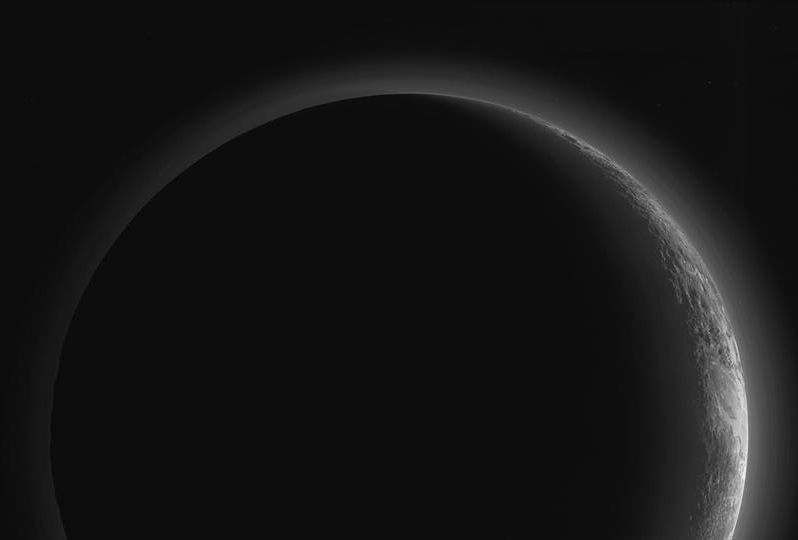
Pluto backlit, via New Horizons spacecraft on July 14, 2015. Image via NASA/ JHUAPL/ SwRI.
Dwarf planet Pluto
On August 24, 2006, the International Astronomical Union (IAU) announced it had re-classified Pluto as a dwarf planet. From 1930 until that day, Pluto had been considered a normal planet, and the outermost world of the solar system. As technology advanced, though, astronomers began to see fainter and fainter objects in our neighborhood. That led them to recognize Pluto as only the largest of many small bodies in the outer solar system.
Now Pluto is known as a dwarf planet, and Neptune – 8th world from the sun – is considered the outermost major planet. It all came about because the IAU had formulated a new definition of what it means to be a planet.
The public and even some astronomers didn’t initially take it lightly. Some declared they would still consider Pluto a planet. The word ‘plutoed‘ – meaning to demote or devalue something – entered the global lexicon. Nowadays, though, it seems most have accepted the logic of Pluto’s re-classification… or, at least, we don’t hear as much of an uproar about it as we used to.
Why did Pluto change status?
Prior to 2006, astronomers hadn’t gotten around to establishing clear standards for categorizing a solar system “planet” versus a “dwarf planet.”
They began to see a need when many small bodies – such as Haumea and Makemake – began to be discovered in the outer solar system. Eris, also considered a dwarf planet, has even more mass than Pluto (though it’s not quite as large). So if Pluto is a planet, why shouldn’t Eris be granted planet status as well? That was the question the IAU asked itself, which led to its formation of a Planet Definition Committee and ultimately the 2006 decision.
The committee had a few possible roads to travel down. One would be to choose a size or mass limit that would make Pluto remain a planet. That would mean that Eris and Ceres – the largest body in the inner solar system’s asteroid belt – would become planets, too. This was the solution of some IAU committee members, and it looked like it might be implemented for a while.
Another option for the IAU might have been to define the concept of a planet without any specific logic: Earth is a planet, Pluto is a planet, but Eris is not just because. But would that have been very scientific?
Meet the The Planet Definition Committee of the International Astronomical Union. This group made the final decision to “demote” Pluto to dwarf planet status. But, even within the committee, not all initially agreed. Image via IAU.
New planetary classifications
On August 24, 2006, the IAU announced its solution. It decided to create a scientific definition of what it means to be a planet. And that definition excluded Pluto from major planet status. Here’s the definition:
A planet is a celestial body that
(a) is in orbit around the Sun,
(b) has sufficient mass for its self-gravity to overcome rigid body forces so that it assumes a hydrostatic equilibrium (nearly round) shape, and
(c) has cleared the neighborhood around its orbit.
It’s “c” that causes Pluto to fail as a planet, according to the IAU. For an object to be a major planet, according to this definition, it must be the dominant gravitational object in its orbit. It must either sling other objects away or merge with them.
Pluto is only 0.07 times the mass of the objects in its orbit. Meanwhile, Earth is 1.7 million times the mass of the objects in its orbit.
When Pluto lost its full planet status, it was revealed as one of the world’s most beloved astronomical objects. So it was fitting that New Horizons – the first spacecraft ever to visit Pluto – discovered a heart-shaped region on it in 2015. Image taken 280,000 miles (450,000 km) from Pluto, via NASA/ JHUAPL/ SwRI.
Pluto hasn’t cleared its neighborhood
On that fateful day – August 24, 2006 – the IAU also created a new category of celestial objects for Pluto and all Pluto-like objects:
A “dwarf planet” is a celestial body that
(a) is in orbit around the sun,
(b) has sufficient mass for its self-gravity to overcome rigid body forces so that it assumes a hydrostatic equilibrium (nearly round) shape,
(c) has not cleared the neighborhood around its orbit, and
(d) is not a satellite.
10 objects which are nearly certainly dwarf planets,
27 objects which are highly likely to be dwarf planets,
68 objects which are likely to be dwarf planets,
130 objects which are probably dwarf planets, and
741 objects which are possibly dwarf planets.
New Horizons captured this image just 15 minutes after its closest approach to Pluto on July 14, 2015, as the spacecraft looked back toward the sun. This near-sunset view shows Pluto’s rugged, icy mountains and flat ice plains, plus haze layers in Pluto’s tenuous but distended atmosphere. The image was taken from a distance of 11,000 miles (18,000 km); the scene is 780 miles (1,250 km) wide. Image via NASA/ JHUAPL/ SwRI.
Hundreds of dwarf planets?
Astronomers believe there may be hundreds more undiscovered dwarf planets in the Kuiper Belt of the outer solar system. There may be up to 10,000 in the region beyond.
By the way, it’s not common knowledge that many astronomers started out being quite careful about their use of the word “planet” with respect to Pluto. In 1932, for example, only two years after American astronomer Clyde Tombaugh discovered Pluto, another astronomer, Armin Otto Leuschner, wrote in a journal article:
You may observe that with extreme conservatism I am still referring to Pluto as an object rather than as a planet. There is every probability that it is a planet, as is now universally concluded, from available material … So far only an upper limit for the mass of Pluto … has been established, and such a mass is believed from gravitational considerations to be too small to affect the motions of Uranus and Neptune sufficiently … There is also a remote chance that later investigations will render its mass comparable to that of comets.
Pluto might never have been called a planet at all
Recall why astronomers began searching for Pluto in the first place. They expected to find an object large enough to gravitationally disturb the orbit of Neptune. If Pluto had been discovered a decade or so later, when Edgeworth speculated about the existence of the Kuiper Belt, it might have never been awarded the status of planet.
Bottom line: August 24 is the anniversary of Pluto’s demotion to dwarf planet status. The International Astronomical Union demoted Pluto largely because it is has not “cleared the neighborhood around its orbit.”
Pluto backlit, via New Horizons spacecraft on July 14, 2015. Image via NASA/ JHUAPL/ SwRI.
Dwarf planet Pluto
On August 24, 2006, the International Astronomical Union (IAU) announced it had re-classified Pluto as a dwarf planet. From 1930 until that day, Pluto had been considered a normal planet, and the outermost world of the solar system. As technology advanced, though, astronomers began to see fainter and fainter objects in our neighborhood. That led them to recognize Pluto as only the largest of many small bodies in the outer solar system.
Now Pluto is known as a dwarf planet, and Neptune – 8th world from the sun – is considered the outermost major planet. It all came about because the IAU had formulated a new definition of what it means to be a planet.
The public and even some astronomers didn’t initially take it lightly. Some declared they would still consider Pluto a planet. The word ‘plutoed‘ – meaning to demote or devalue something – entered the global lexicon. Nowadays, though, it seems most have accepted the logic of Pluto’s re-classification… or, at least, we don’t hear as much of an uproar about it as we used to.
Why did Pluto change status?
Prior to 2006, astronomers hadn’t gotten around to establishing clear standards for categorizing a solar system “planet” versus a “dwarf planet.”
They began to see a need when many small bodies – such as Haumea and Makemake – began to be discovered in the outer solar system. Eris, also considered a dwarf planet, has even more mass than Pluto (though it’s not quite as large). So if Pluto is a planet, why shouldn’t Eris be granted planet status as well? That was the question the IAU asked itself, which led to its formation of a Planet Definition Committee and ultimately the 2006 decision.
The committee had a few possible roads to travel down. One would be to choose a size or mass limit that would make Pluto remain a planet. That would mean that Eris and Ceres – the largest body in the inner solar system’s asteroid belt – would become planets, too. This was the solution of some IAU committee members, and it looked like it might be implemented for a while.
Another option for the IAU might have been to define the concept of a planet without any specific logic: Earth is a planet, Pluto is a planet, but Eris is not just because. But would that have been very scientific?
Meet the The Planet Definition Committee of the International Astronomical Union. This group made the final decision to “demote” Pluto to dwarf planet status. But, even within the committee, not all initially agreed. Image via IAU.
New planetary classifications
On August 24, 2006, the IAU announced its solution. It decided to create a scientific definition of what it means to be a planet. And that definition excluded Pluto from major planet status. Here’s the definition:
A planet is a celestial body that
(a) is in orbit around the Sun,
(b) has sufficient mass for its self-gravity to overcome rigid body forces so that it assumes a hydrostatic equilibrium (nearly round) shape, and
(c) has cleared the neighborhood around its orbit.
It’s “c” that causes Pluto to fail as a planet, according to the IAU. For an object to be a major planet, according to this definition, it must be the dominant gravitational object in its orbit. It must either sling other objects away or merge with them.
Pluto is only 0.07 times the mass of the objects in its orbit. Meanwhile, Earth is 1.7 million times the mass of the objects in its orbit.
When Pluto lost its full planet status, it was revealed as one of the world’s most beloved astronomical objects. So it was fitting that New Horizons – the first spacecraft ever to visit Pluto – discovered a heart-shaped region on it in 2015. Image taken 280,000 miles (450,000 km) from Pluto, via NASA/ JHUAPL/ SwRI.
Pluto hasn’t cleared its neighborhood
On that fateful day – August 24, 2006 – the IAU also created a new category of celestial objects for Pluto and all Pluto-like objects:
A “dwarf planet” is a celestial body that
(a) is in orbit around the sun,
(b) has sufficient mass for its self-gravity to overcome rigid body forces so that it assumes a hydrostatic equilibrium (nearly round) shape,
(c) has not cleared the neighborhood around its orbit, and
(d) is not a satellite.
10 objects which are nearly certainly dwarf planets,
27 objects which are highly likely to be dwarf planets,
68 objects which are likely to be dwarf planets,
130 objects which are probably dwarf planets, and
741 objects which are possibly dwarf planets.
New Horizons captured this image just 15 minutes after its closest approach to Pluto on July 14, 2015, as the spacecraft looked back toward the sun. This near-sunset view shows Pluto’s rugged, icy mountains and flat ice plains, plus haze layers in Pluto’s tenuous but distended atmosphere. The image was taken from a distance of 11,000 miles (18,000 km); the scene is 780 miles (1,250 km) wide. Image via NASA/ JHUAPL/ SwRI.
Hundreds of dwarf planets?
Astronomers believe there may be hundreds more undiscovered dwarf planets in the Kuiper Belt of the outer solar system. There may be up to 10,000 in the region beyond.
By the way, it’s not common knowledge that many astronomers started out being quite careful about their use of the word “planet” with respect to Pluto. In 1932, for example, only two years after American astronomer Clyde Tombaugh discovered Pluto, another astronomer, Armin Otto Leuschner, wrote in a journal article:
You may observe that with extreme conservatism I am still referring to Pluto as an object rather than as a planet. There is every probability that it is a planet, as is now universally concluded, from available material … So far only an upper limit for the mass of Pluto … has been established, and such a mass is believed from gravitational considerations to be too small to affect the motions of Uranus and Neptune sufficiently … There is also a remote chance that later investigations will render its mass comparable to that of comets.
Pluto might never have been called a planet at all
Recall why astronomers began searching for Pluto in the first place. They expected to find an object large enough to gravitationally disturb the orbit of Neptune. If Pluto had been discovered a decade or so later, when Edgeworth speculated about the existence of the Kuiper Belt, it might have never been awarded the status of planet.
Bottom line: August 24 is the anniversary of Pluto’s demotion to dwarf planet status. The International Astronomical Union demoted Pluto largely because it is has not “cleared the neighborhood around its orbit.”
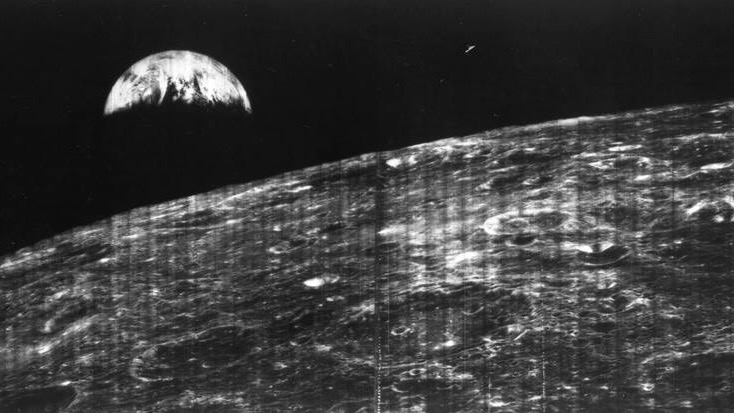
Lunar Orbiter 1 captured this 1st photo of Earth from the moon on August 23, 1966. See a version of this image restored with modern photographic techniques, below. Image via NASA/Lunar Orbiter 1.
On August 23, 1966, Lunar Orbiter 1 took the 1st-ever photo of the Earth from the moon. It shows half of Earth, shot with 1960s technology, seen from the moon’s distance of 236,000 miles (380,000 km). And in the image, you can see the Earth from Istanbul to Cape Town with areas east shrouded in night. The image isn’t very detailed. But it’s mind-boggling to think about. What a contrast with NASA’s recent Artemis 2 mission that sent astronauts to orbit the moon for the first time in over 50 years! See Artemis 2 images here.
Lunar Orbiter 1 was one of five Lunar Orbiters that NASA sent to the moon in the 1960s. The Lunar Orbiter’s priority was to take photographs of the moon. That’s because NASA was preparing for the first manned Apollo mission, which came three years later. Read about the Lunar Orbiter missions, 1966-1967.
As you can see, the photo taken in 1966 reveals no detail on Earth’s surface.
But, surely, this photo stunned those on Earth who finally saw our home planet from the moon.
Years later, a digitally enhanced version
Then, in 2008, NASA released a newly restored version of the original 1966 image of Earth. NASA used refurbished machinery and modern digital technology. Consequently, the new image is higher resolution than what was possible when it was originally taken. Wow! What a difference.
The impressive restored image of the Earth from the moon is below.
In 2008, NASA restored this 1st image of Earth from the moon. Lunar Orbiter 1 took the original image. NASA used photographic techniques that were not available when that early spacecraft originally acquired this historic photo. Read more about this photo from NASA.
Bottom line: As NASA plans to land astronauts on the moon with the Artemis IV mission in 2028, it’s fun to see this 1st-ever photo of Earth from the moon, taken on August 23, 1966.
Lunar Orbiter 1 captured this 1st photo of Earth from the moon on August 23, 1966. See a version of this image restored with modern photographic techniques, below. Image via NASA/Lunar Orbiter 1.
On August 23, 1966, Lunar Orbiter 1 took the 1st-ever photo of the Earth from the moon. It shows half of Earth, shot with 1960s technology, seen from the moon’s distance of 236,000 miles (380,000 km). And in the image, you can see the Earth from Istanbul to Cape Town with areas east shrouded in night. The image isn’t very detailed. But it’s mind-boggling to think about. What a contrast with NASA’s recent Artemis 2 mission that sent astronauts to orbit the moon for the first time in over 50 years! See Artemis 2 images here.
Lunar Orbiter 1 was one of five Lunar Orbiters that NASA sent to the moon in the 1960s. The Lunar Orbiter’s priority was to take photographs of the moon. That’s because NASA was preparing for the first manned Apollo mission, which came three years later. Read about the Lunar Orbiter missions, 1966-1967.
As you can see, the photo taken in 1966 reveals no detail on Earth’s surface.
But, surely, this photo stunned those on Earth who finally saw our home planet from the moon.
Years later, a digitally enhanced version
Then, in 2008, NASA released a newly restored version of the original 1966 image of Earth. NASA used refurbished machinery and modern digital technology. Consequently, the new image is higher resolution than what was possible when it was originally taken. Wow! What a difference.
The impressive restored image of the Earth from the moon is below.
In 2008, NASA restored this 1st image of Earth from the moon. Lunar Orbiter 1 took the original image. NASA used photographic techniques that were not available when that early spacecraft originally acquired this historic photo. Read more about this photo from NASA.
Bottom line: As NASA plans to land astronauts on the moon with the Artemis IV mission in 2028, it’s fun to see this 1st-ever photo of Earth from the moon, taken on August 23, 1966.
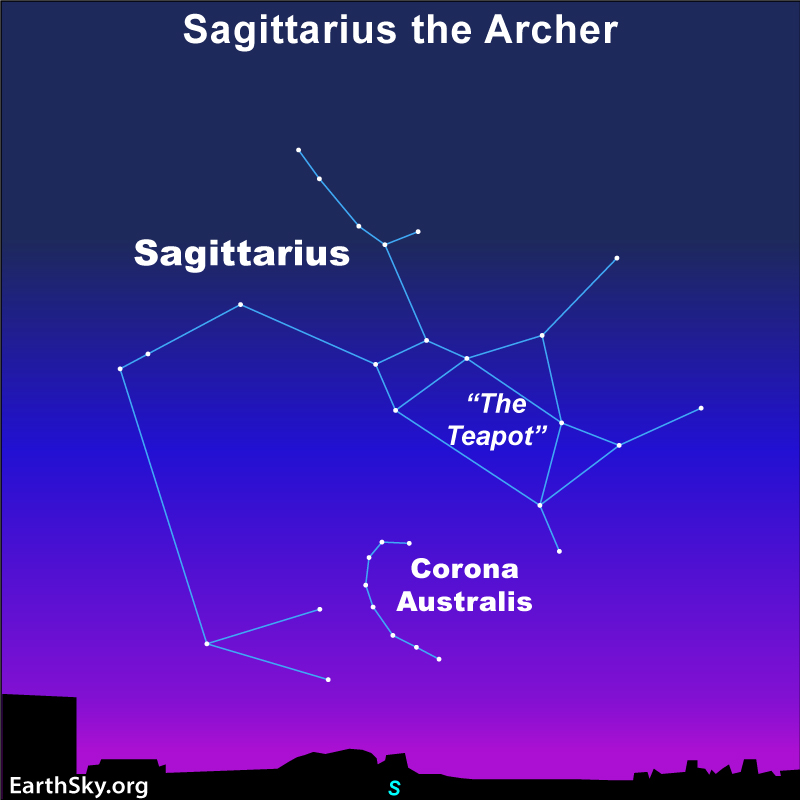
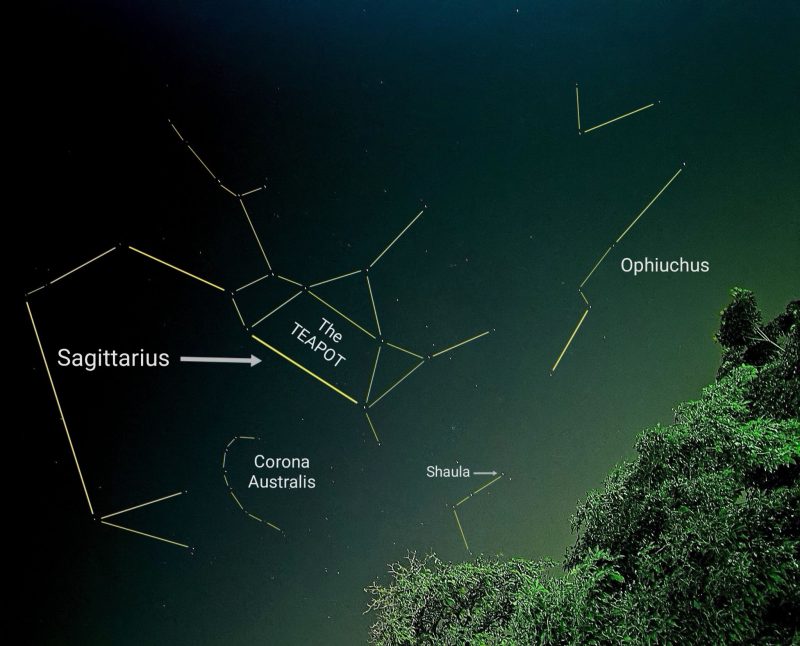
Sagittarius the Archer contains a Teapot shape. It’s located in the direction of the center of our Milky Way galaxy. If you live far enough south – say at least at latitudes like those in the southern U.S., or farther south – you might spot the arcing shape of Corona Australis near Sagittarius. Image via EarthSky.
If you’re outside on an August or September evening, you can glimpse the zodiacal constellation Sagittarius the Archer. From our northerly latitudes, it never climbs high in the sky. Yet when you’re looking toward Sagittarius, you’re looking in the direction of one of the most wondrous places we can imagine: the center of our own Milky Way galaxy.
Plus, Sagittarius is fairly easy to spot if you have a dark sky. Its brightest stars form an asterism in the distinctive shape of a Teapot.
You’ll want a dark, rural location to see and enjoy Sagittarius. In August or September, when you’re outside camping or ending a picnic on a summer evening – any place away from light pollution – simply look up. You’ll notice the starlit band of the Milky Way. It’ll appear as a hazy band stretching all the way across the sky. The haze is really countless stars.
From the Northern Hemisphere, the starlit trail of the Milky Way seems to bulge just before it reaches the southern horizon (from the Southern Hemipshere, this bulge is high in the sky). This bulge marks the approximate location of the Milky Way’s center.
Here’s another way to find Sagittarius. If you’re familiar with the Summer Triangle asterism, draw an imaginary line from the star Deneb and through the star Altair to locate Sagittarius near the horizon. At mid-northern latitudes, the Summer Triangle hangs high in the south to overhead on late summer and autumn evenings.
Deep-sky wonders in the Archer
So Sagittarius points to the heart of our Milky Way galaxy. But we can’t see all the way to the center. Why not? Because it’s so far away, 26,000 light-years. And because of the huge plethora of stars, star clusters, nebulae and dust that block our view.
On the other hand, the stars, star clusters, nebulae and dust are themselves worth viewing! And you don’t need to know what you’re seeing to enjoy them. Just take binoculars with you, next time you know you’ll have access to a dark sky on an August or September evening. Look up! And aim your binoculars along the starry path of the Milky Way.
Sharp-eyed people can even see these deep-sky objects with the unaided eye. Binoculars let you see them better. And a small telescope would give you a beautiful view.
Modern stargazers have difficulty making out the Centaur in Sagittarius. But the Teapot is easy to see, once you learn to look for it. Find the Teapot, and it’ll help you on your star-hopping adventures to deep-sky marvels.
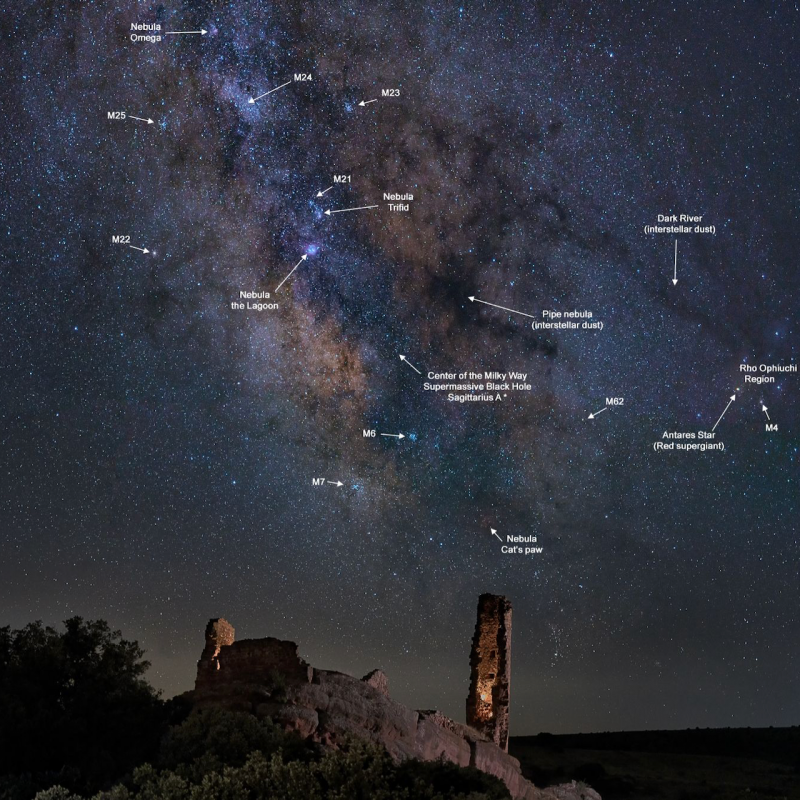
View at EarthSky Community Photos. | Miguel Sala at the Ruins of Ares Castle in Teruel, Spain, captured this photo of the Milky Way on July 10, 2021. Notice near the center of the photo that he has marked the direction of the star-rich center of our galaxy. When we look in this direction, we’re looking toward a sky crowded with star clusters and nebulae. The famous Teapot in Sagittarius – a visual guide to the galaxy’s center – is also in this direction (and on the left side of this photo). Thank you, Miguel!
Photos of the Teapot
The Teapot is the central region of Sagittarius. Once you’ve learned to trace the Teapot’s shape in the sky, it’ll become easier to spot. Check out the photos below to learn its shape and then try to spot it yourself.
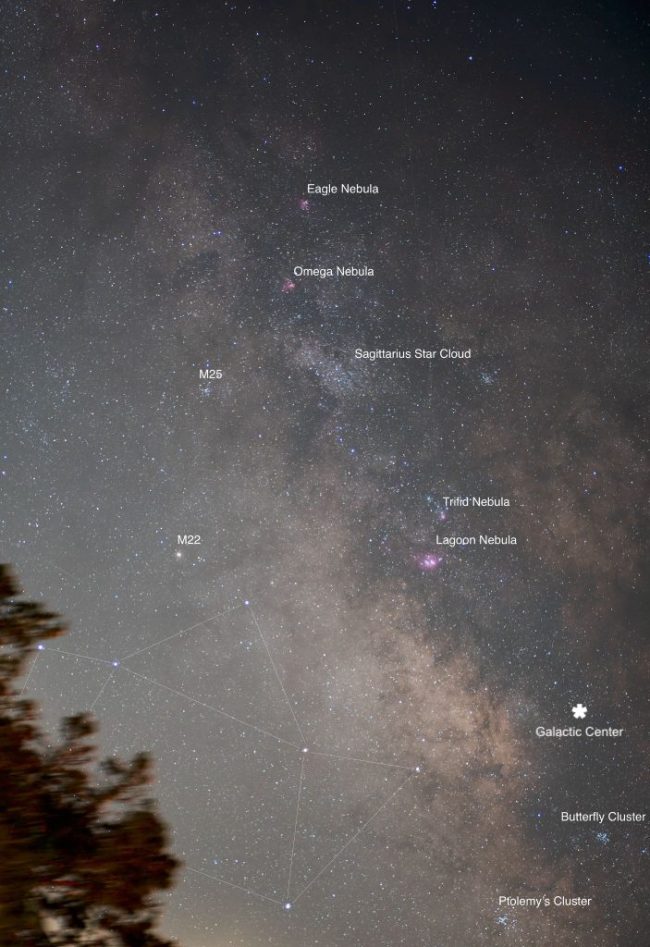
View at EarthSky Community Photos. | Catherine Hyde in Cambria, California, captured this photo of the Milky Way on July 10, 2023. Catherine wrote: “This is the Teapot asterism rising from behind a tree. I’ve heard if you can capture the galactic center (Milky Way) behind it, it looks like steam coming out of the spout. I was surprised by how many deep-sky objects I had captured, so I annotated the image.” Thank you, Catherine!View at EarthSky Community Photos. | Kannan A in Singapore took this photo on May 20, 2021. Kannan wrote: “Sagittarius may look like a teapot, but he is in fact an archer – and a four-legged one to boot: a centaur, to be specific – half horse, half man. The front of the teapot is the bow he pulls back, the spout is the tip of his arrow he aims westward at Scorpius. The remainder of the teapot are stars marking the centaur’s upper body and pulled-back arm; fainter stars southeastward sketch out his lower horsey half.” Thank you, Kannan!
The stars of Sagittarius
The brightest star in Sagittarius is the star marking the bottom right corner of the teapot, Kaus Australis. Also known as Epsilon Sagittarii, this magnitude 1.8 star lies 143 light-years away.
The next brightest star is at the opposite end of the teapot, the top star in the handle, Nunki. Also known as Sigma Sagittarii, this 2.1-magnitude star shines from a distance of 228 light-years.
Most of the other stars in Sagittarius are of 2nd and 3rd magnitude. The star marking the top of the teapot’s lid is Kaus Borealis, a magnitude 2.82 star lying 77 light-years away. The stars marking the top of the spout are Alnasl, which marks the tip of the spout at magnitude 2.98 and is 96 light-years away, and Kaus Media, which marks the spout’s connection to the pot at magnitude 2.72 and is 306 light-years away. The star at the bottom of the handle where it connects to the pot is Ascella, a magnitude 2.60 star lying 89 light-years away.
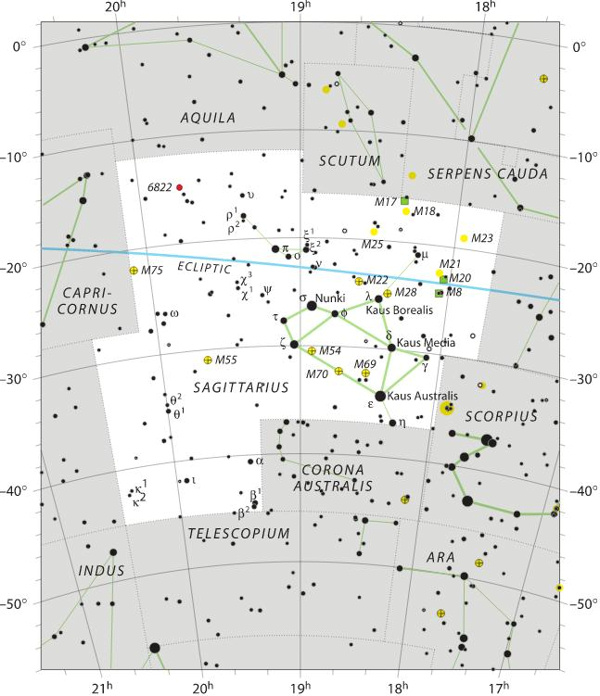
The constellation Sagittarius, with the Teapot asterism outlined in green. Chart via IAU/ Wikipedia.
Sagittarius in mythology
The constellations Sagittarius and Centaurus are both supposed to represent a centaur, a creature with the upper torso of a man and the body and legs of a horse. Historically, centaurs might have really been like cowboys, using horses to round up cattle in ancient Greece.
According to Greek myth, the centaurs were the offspring of Ixion and the cloud nymph Nephele. Apparently, Sagittarius’ drawn-out bow and arrow originated from the Mesopotamian archer god. So this constellation might not have always represented the centaur Chiron.
It’s said that the Greeks associated Sagittarius with Crotus the satyr, another type of monstrosity, a man with horse ears and tail and goat legs. Quite possibly, the Romans first identified the constellation Sagittarius with Chiron, the wise and kindly centaur.
Here’s something that distinguishes Sagittarius the Archer from the other 13 constellations of the zodiac. The sun shines in front of this constellation on the December 21 solstice.
Also, the ecliptic – the sun’s yearly pathway in front of the backdrop stars – intersects the galactic equator in Sagittarius.
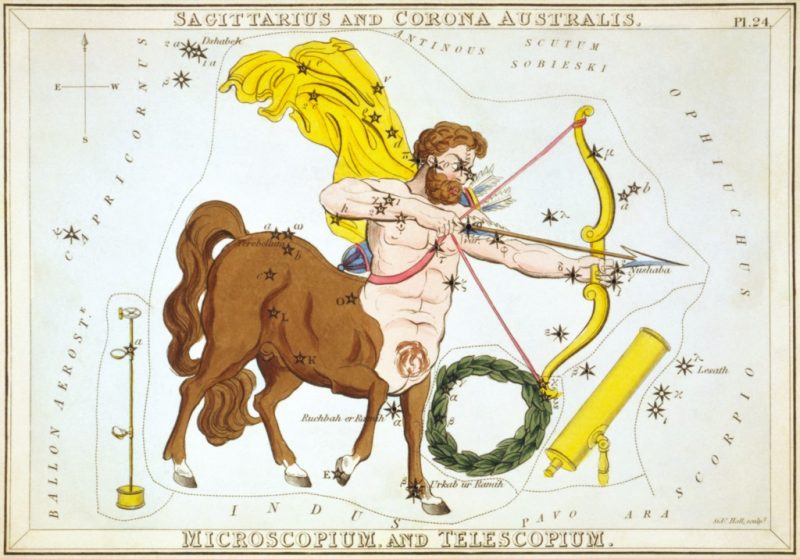
Sagittarius as depicted in Urania’s Mirror, a set of constellation cards published in London in 1825. Image via Wikimedia.
The constellation versus the sign
In our modern times, the sun passes in front of the constellation Sagittarius from about December 18 to January 20. These dates are off by about a month from what you read on the horoscope page. The sun moves through the sign Sagittarius from about November 21 to December 21.
Yes, there is a difference between an astronomical constellation and an astrological sign! Keep in mind that we’re talking about the constellation Sagittarius in this article. The horoscope is referring to the sign Sagittarius.
By definition, the sun enters the sign Sagittarius whenever the sun is precisely 30 degrees west of the December solstice point. Then, on the December solstice, the sun enters the sign Capricorn.
While the signs remain fixed relative to the solstices and equinoxes, the solstices and equinox points move 30 degrees westward in front of the constellations – or backdrop stars – in about 2,160 years.
The constellation boundaries were formally defined by the International Astronomical Union (IAU) in 1930. Based on the present IAU boundaries, the December solstice point moved into the constellation Sagittarius in the year 131 BCE and will move into the constellation Ophiuchus in 2269 CE.
Bottom line: Look for the constellation Sagittarius on an August or September evening. The brightest stars in Sagittarius form the distinctive shape of a teapot. And the spout of the Teapot points to the center of the Milky Way galaxy.
Sagittarius the Archer contains a Teapot shape. It’s located in the direction of the center of our Milky Way galaxy. If you live far enough south – say at least at latitudes like those in the southern U.S., or farther south – you might spot the arcing shape of Corona Australis near Sagittarius. Image via EarthSky.
If you’re outside on an August or September evening, you can glimpse the zodiacal constellation Sagittarius the Archer. From our northerly latitudes, it never climbs high in the sky. Yet when you’re looking toward Sagittarius, you’re looking in the direction of one of the most wondrous places we can imagine: the center of our own Milky Way galaxy.
Plus, Sagittarius is fairly easy to spot if you have a dark sky. Its brightest stars form an asterism in the distinctive shape of a Teapot.
You’ll want a dark, rural location to see and enjoy Sagittarius. In August or September, when you’re outside camping or ending a picnic on a summer evening – any place away from light pollution – simply look up. You’ll notice the starlit band of the Milky Way. It’ll appear as a hazy band stretching all the way across the sky. The haze is really countless stars.
From the Northern Hemisphere, the starlit trail of the Milky Way seems to bulge just before it reaches the southern horizon (from the Southern Hemipshere, this bulge is high in the sky). This bulge marks the approximate location of the Milky Way’s center.
Here’s another way to find Sagittarius. If you’re familiar with the Summer Triangle asterism, draw an imaginary line from the star Deneb and through the star Altair to locate Sagittarius near the horizon. At mid-northern latitudes, the Summer Triangle hangs high in the south to overhead on late summer and autumn evenings.
Deep-sky wonders in the Archer
So Sagittarius points to the heart of our Milky Way galaxy. But we can’t see all the way to the center. Why not? Because it’s so far away, 26,000 light-years. And because of the huge plethora of stars, star clusters, nebulae and dust that block our view.
On the other hand, the stars, star clusters, nebulae and dust are themselves worth viewing! And you don’t need to know what you’re seeing to enjoy them. Just take binoculars with you, next time you know you’ll have access to a dark sky on an August or September evening. Look up! And aim your binoculars along the starry path of the Milky Way.
Sharp-eyed people can even see these deep-sky objects with the unaided eye. Binoculars let you see them better. And a small telescope would give you a beautiful view.
Modern stargazers have difficulty making out the Centaur in Sagittarius. But the Teapot is easy to see, once you learn to look for it. Find the Teapot, and it’ll help you on your star-hopping adventures to deep-sky marvels.
View at EarthSky Community Photos. | Miguel Sala at the Ruins of Ares Castle in Teruel, Spain, captured this photo of the Milky Way on July 10, 2021. Notice near the center of the photo that he has marked the direction of the star-rich center of our galaxy. When we look in this direction, we’re looking toward a sky crowded with star clusters and nebulae. The famous Teapot in Sagittarius – a visual guide to the galaxy’s center – is also in this direction (and on the left side of this photo). Thank you, Miguel!
Photos of the Teapot
The Teapot is the central region of Sagittarius. Once you’ve learned to trace the Teapot’s shape in the sky, it’ll become easier to spot. Check out the photos below to learn its shape and then try to spot it yourself.
View at EarthSky Community Photos. | Catherine Hyde in Cambria, California, captured this photo of the Milky Way on July 10, 2023. Catherine wrote: “This is the Teapot asterism rising from behind a tree. I’ve heard if you can capture the galactic center (Milky Way) behind it, it looks like steam coming out of the spout. I was surprised by how many deep-sky objects I had captured, so I annotated the image.” Thank you, Catherine!View at EarthSky Community Photos. | Kannan A in Singapore took this photo on May 20, 2021. Kannan wrote: “Sagittarius may look like a teapot, but he is in fact an archer – and a four-legged one to boot: a centaur, to be specific – half horse, half man. The front of the teapot is the bow he pulls back, the spout is the tip of his arrow he aims westward at Scorpius. The remainder of the teapot are stars marking the centaur’s upper body and pulled-back arm; fainter stars southeastward sketch out his lower horsey half.” Thank you, Kannan!
The stars of Sagittarius
The brightest star in Sagittarius is the star marking the bottom right corner of the teapot, Kaus Australis. Also known as Epsilon Sagittarii, this magnitude 1.8 star lies 143 light-years away.
The next brightest star is at the opposite end of the teapot, the top star in the handle, Nunki. Also known as Sigma Sagittarii, this 2.1-magnitude star shines from a distance of 228 light-years.
Most of the other stars in Sagittarius are of 2nd and 3rd magnitude. The star marking the top of the teapot’s lid is Kaus Borealis, a magnitude 2.82 star lying 77 light-years away. The stars marking the top of the spout are Alnasl, which marks the tip of the spout at magnitude 2.98 and is 96 light-years away, and Kaus Media, which marks the spout’s connection to the pot at magnitude 2.72 and is 306 light-years away. The star at the bottom of the handle where it connects to the pot is Ascella, a magnitude 2.60 star lying 89 light-years away.
The constellation Sagittarius, with the Teapot asterism outlined in green. Chart via IAU/ Wikipedia.
Sagittarius in mythology
The constellations Sagittarius and Centaurus are both supposed to represent a centaur, a creature with the upper torso of a man and the body and legs of a horse. Historically, centaurs might have really been like cowboys, using horses to round up cattle in ancient Greece.
According to Greek myth, the centaurs were the offspring of Ixion and the cloud nymph Nephele. Apparently, Sagittarius’ drawn-out bow and arrow originated from the Mesopotamian archer god. So this constellation might not have always represented the centaur Chiron.
It’s said that the Greeks associated Sagittarius with Crotus the satyr, another type of monstrosity, a man with horse ears and tail and goat legs. Quite possibly, the Romans first identified the constellation Sagittarius with Chiron, the wise and kindly centaur.
Here’s something that distinguishes Sagittarius the Archer from the other 13 constellations of the zodiac. The sun shines in front of this constellation on the December 21 solstice.
Also, the ecliptic – the sun’s yearly pathway in front of the backdrop stars – intersects the galactic equator in Sagittarius.
Sagittarius as depicted in Urania’s Mirror, a set of constellation cards published in London in 1825. Image via Wikimedia.
The constellation versus the sign
In our modern times, the sun passes in front of the constellation Sagittarius from about December 18 to January 20. These dates are off by about a month from what you read on the horoscope page. The sun moves through the sign Sagittarius from about November 21 to December 21.
Yes, there is a difference between an astronomical constellation and an astrological sign! Keep in mind that we’re talking about the constellation Sagittarius in this article. The horoscope is referring to the sign Sagittarius.
By definition, the sun enters the sign Sagittarius whenever the sun is precisely 30 degrees west of the December solstice point. Then, on the December solstice, the sun enters the sign Capricorn.
While the signs remain fixed relative to the solstices and equinoxes, the solstices and equinox points move 30 degrees westward in front of the constellations – or backdrop stars – in about 2,160 years.
The constellation boundaries were formally defined by the International Astronomical Union (IAU) in 1930. Based on the present IAU boundaries, the December solstice point moved into the constellation Sagittarius in the year 131 BCE and will move into the constellation Ophiuchus in 2269 CE.
Bottom line: Look for the constellation Sagittarius on an August or September evening. The brightest stars in Sagittarius form the distinctive shape of a teapot. And the spout of the Teapot points to the center of the Milky Way galaxy.
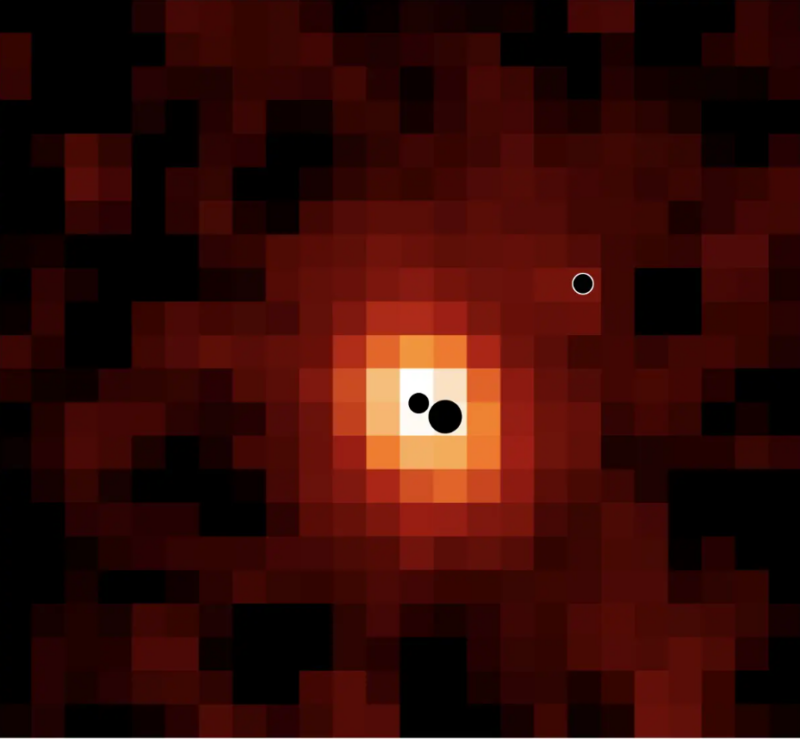
This is distant galaxy J0148-4214. The black circles show the locations of 3 supermassive black holes (not to scale). This Webb image marks the first ever observation of 3 supermassive black holes in a single galaxy. Image via Hannah Übler/ MPE.
Scientists think most large galaxies have supermassive black holes at their hearts. And, earlier this year, astronomers from the Max Planck Institute for Radio Astronomy said they’ve detected the first pair of supermassive black holes at the center of a galaxy … two monster black holes so close they could merge. Now, on August 12, 2026, astronomers from the Max Planck Institute for Extraterrestrial Physics announced that – for the first time – they’ve detected three supermassive black holes in one galaxy.
Two of these black hole triplets lie near one another and the center of their galaxy. They are only 620 light-years apart. One of these two is the most massive of the three at 80 million solar masses (a single solar mass is a unit of measurement in astronomy). The other central black hole is the least massive with just 600,000 solar masses. The third black hole looms on the galaxy’s outskirts, about 5,500 light-years from the center, with 2 million times the mass of our sun.
The galactic home of these three black holes is called J0148-4214. It lies 12.5 billion light-years away from us, in the very early universe. So we’re seeing it as it appeared about 1.2 billion years after the Big Bang, the initiation of our universe.
The researchers published their peer-reviewed study in the journal Astronomy & Astrophysics on August 12, 2026.
Black holes in the early universe
These early-universe black holes are hungry! All three are actively accreting, or consuming nearby material in a disk. That’s unlike the supermassive black hole at the center of our own Milky Way galaxy, and other galaxies near us in space. Their older supermassive black holes appear more quiescent.
So the researchers say these early active black holes can provide insight into how our universe grew into what we see today.
Hannah Übler of the Max Planck Institute for Extraterrestrial Physics led the new triple-black-hole study. Übler said:
This is the first evidence of three active black holes in a single galaxy in the distant universe.
It suggests that processes in the early universe were efficient at bringing massive black holes together, setting the stage for the massive black hole mergers we expect to detect with future gravitational wave observatories.
Scientists have long thought that black hole mergers in the early universe are what allowed supermassive black holes to grow so big so quickly. And now, finding three supermassive black holes in one galaxy strengthens that theory.
Seeing the 3 supermassive black holes
So these three black holes have 80 million, 2 million and 6 thousand times the mass of our sun. And while you might think the most massive of the three is the greediest gobbler of nearby gas and dust, analysis suggests that the smallest of the black holes is actually accreting (gaining material) at the fastest rate. In fact, the hungry little black hole is:
… exceeding the maximum accretion rate predicted by basic theories of black hole growth (the Eddington limit).
So … another mystery!
How did the scientists spot these three black holes? They used the Webb space telescope’s NIRSpec instrument to examine the galaxy’s spectral signature. This breakdown in the wavelengths of light allowed them to see hydrogen moving at high velocities. Without this tool, the scientists would not have been able to see the black holes as separate objects. So they likely would only have identified one black hole in the galaxy.
A merger in the making
The data from Webb allowed the scientists to identify three black holes and discover their masses. Co-author Giovanni Mazzolari of MPE said:
The JWST data allowed us not only to identify the three black holes, but also to estimate their masses, accretion rates, and the stellar mass of the galaxy. We find a total stellar mass of about 1.3 billion suns, and the black holes represent a significant fraction of that.
And the scientists say the central two black holes are on a collision course. They expect them to merge within the next few hundred million years. Co-author Roberto Maiolino of the University of Cambridge said:
These results are extremely exciting. They suggest that black hole merging may be an additional, fast route for their rapid growth in the early universe.
What about the third black hole? Astronomers have two scenarios. It could someday merge with the central black holes. Or it could have already been kicked out of the inner circle during a previous merger of black holes.
Bottom line: For the first time, astronomers have discovered three supermassive black holes in a single galaxy in the early universe. The two central black holes may merge in a few hundred million years.
This is distant galaxy J0148-4214. The black circles show the locations of 3 supermassive black holes (not to scale). This Webb image marks the first ever observation of 3 supermassive black holes in a single galaxy. Image via Hannah Übler/ MPE.
Scientists think most large galaxies have supermassive black holes at their hearts. And, earlier this year, astronomers from the Max Planck Institute for Radio Astronomy said they’ve detected the first pair of supermassive black holes at the center of a galaxy … two monster black holes so close they could merge. Now, on August 12, 2026, astronomers from the Max Planck Institute for Extraterrestrial Physics announced that – for the first time – they’ve detected three supermassive black holes in one galaxy.
Two of these black hole triplets lie near one another and the center of their galaxy. They are only 620 light-years apart. One of these two is the most massive of the three at 80 million solar masses (a single solar mass is a unit of measurement in astronomy). The other central black hole is the least massive with just 600,000 solar masses. The third black hole looms on the galaxy’s outskirts, about 5,500 light-years from the center, with 2 million times the mass of our sun.
The galactic home of these three black holes is called J0148-4214. It lies 12.5 billion light-years away from us, in the very early universe. So we’re seeing it as it appeared about 1.2 billion years after the Big Bang, the initiation of our universe.
The researchers published their peer-reviewed study in the journal Astronomy & Astrophysics on August 12, 2026.
Black holes in the early universe
These early-universe black holes are hungry! All three are actively accreting, or consuming nearby material in a disk. That’s unlike the supermassive black hole at the center of our own Milky Way galaxy, and other galaxies near us in space. Their older supermassive black holes appear more quiescent.
So the researchers say these early active black holes can provide insight into how our universe grew into what we see today.
Hannah Übler of the Max Planck Institute for Extraterrestrial Physics led the new triple-black-hole study. Übler said:
This is the first evidence of three active black holes in a single galaxy in the distant universe.
It suggests that processes in the early universe were efficient at bringing massive black holes together, setting the stage for the massive black hole mergers we expect to detect with future gravitational wave observatories.
Scientists have long thought that black hole mergers in the early universe are what allowed supermassive black holes to grow so big so quickly. And now, finding three supermassive black holes in one galaxy strengthens that theory.
Seeing the 3 supermassive black holes
So these three black holes have 80 million, 2 million and 6 thousand times the mass of our sun. And while you might think the most massive of the three is the greediest gobbler of nearby gas and dust, analysis suggests that the smallest of the black holes is actually accreting (gaining material) at the fastest rate. In fact, the hungry little black hole is:
… exceeding the maximum accretion rate predicted by basic theories of black hole growth (the Eddington limit).
So … another mystery!
How did the scientists spot these three black holes? They used the Webb space telescope’s NIRSpec instrument to examine the galaxy’s spectral signature. This breakdown in the wavelengths of light allowed them to see hydrogen moving at high velocities. Without this tool, the scientists would not have been able to see the black holes as separate objects. So they likely would only have identified one black hole in the galaxy.
A merger in the making
The data from Webb allowed the scientists to identify three black holes and discover their masses. Co-author Giovanni Mazzolari of MPE said:
The JWST data allowed us not only to identify the three black holes, but also to estimate their masses, accretion rates, and the stellar mass of the galaxy. We find a total stellar mass of about 1.3 billion suns, and the black holes represent a significant fraction of that.
And the scientists say the central two black holes are on a collision course. They expect them to merge within the next few hundred million years. Co-author Roberto Maiolino of the University of Cambridge said:
These results are extremely exciting. They suggest that black hole merging may be an additional, fast route for their rapid growth in the early universe.
What about the third black hole? Astronomers have two scenarios. It could someday merge with the central black holes. Or it could have already been kicked out of the inner circle during a previous merger of black holes.
Bottom line: For the first time, astronomers have discovered three supermassive black holes in a single galaxy in the early universe. The two central black holes may merge in a few hundred million years.
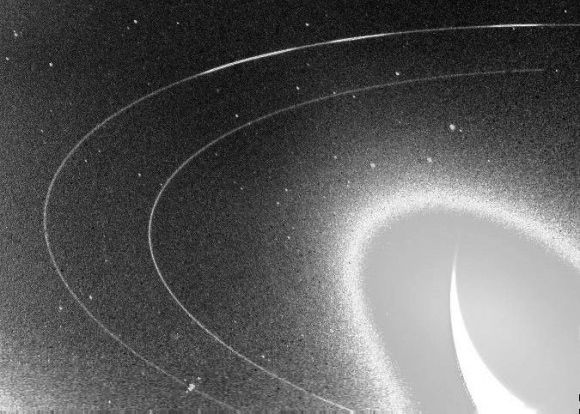
This brightened Voyager 2 image reveals the faint and continuous rings of Neptune. Voyager 2 confirmed the existence of Neptune’s rings on August 22, 1989. Image via NASA/ JPL.
By the late 1980s, astronomers suspected that there are rings around Neptune, our solar system’s outermost major planet. After all, the next planet inward, Uranus, has rings (found in 1977). So does Jupiter (found in 1979) and Saturn (first glimpsed through early telescopes in the 1600s).
Then, watching from Earth in 1984, astronomers recorded extra blinks before and after Neptune passed in front of a distant star. That added to the evidence that Neptune had at least a partial ring system. But it was NASA’s Voyager 2 spacecraft that provided the first photographic proof of the existence of Neptune’s rings on August 22, 1989.
At the time, the spacecraft was a few days out from its closest encounter with the planet on August 25, 1989. As Neptune began looming large in Voyager’s cameras, the spacecraft photographed a faint but continuous ring system encircling the planet. The images of Neptune’s rings confirmed astronomers’ long-held suspicions.
Names for Neptunian rings
Today, Voyager 2 remains the only earthly spacecraft to have encountered Neptune. But since Voyager’s 1989 flyby, the Hubble Space Telescope, the James Webb Space Telescope, and Earth-based telescopes have imaged the two brightest rings of Neptune. Astronomers named those two Neptunian rings Adams and Le Verrier. They’re named for John Couch Adams and Urbain Jean Joseph Le Verrier, whose independent calculations helped find Neptune’s position in the sky – and thus led to its discovery – in 1846.
There are also three more rings around Neptune: Galle, Lassell, Arago. So moving outward from near the planet, the main rings are Galle, Leverrier, Lassell, Arago, and Adams.
Peculiar ring arcs
Today, we know that Neptune has at least five main rings. Plus, it has four prominent ring arcs. The arcs are peculiar clumps of dust. Astronomers struggled to understand their existence, because the laws of motion predict these arcs should spread out into a uniform ring over short timescales. Scientists now believe the gravitational effects of Galatea, a moon just inward from the ring, confine the arcs.
Also, four of the prominent arcs have names. Astronomers call them Liberté (Liberty), Egalité (Equality), Fraternité (Fraternity), and Courage. They’re located in the outermost ring, Adams.
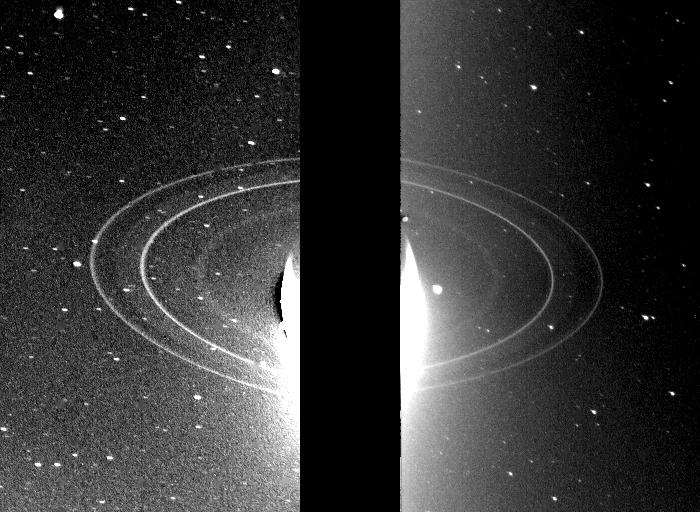
By blocking out Neptune the backlit rings shine through. The wide-angle camera on Voyager 2 made this image from two 591-second exposures of the rings taken on August 26, 1989, from 175,000 miles (281,000 km) away. Image via NASA/ JPL.
Bottom line: NASA’s Voyager 2 spacecraft confirmed the discovery of Neptune’s rings on August 22, 1989, when it took images of a faint, continuous ring system around the planet.
This brightened Voyager 2 image reveals the faint and continuous rings of Neptune. Voyager 2 confirmed the existence of Neptune’s rings on August 22, 1989. Image via NASA/ JPL.
By the late 1980s, astronomers suspected that there are rings around Neptune, our solar system’s outermost major planet. After all, the next planet inward, Uranus, has rings (found in 1977). So does Jupiter (found in 1979) and Saturn (first glimpsed through early telescopes in the 1600s).
Then, watching from Earth in 1984, astronomers recorded extra blinks before and after Neptune passed in front of a distant star. That added to the evidence that Neptune had at least a partial ring system. But it was NASA’s Voyager 2 spacecraft that provided the first photographic proof of the existence of Neptune’s rings on August 22, 1989.
At the time, the spacecraft was a few days out from its closest encounter with the planet on August 25, 1989. As Neptune began looming large in Voyager’s cameras, the spacecraft photographed a faint but continuous ring system encircling the planet. The images of Neptune’s rings confirmed astronomers’ long-held suspicions.
Names for Neptunian rings
Today, Voyager 2 remains the only earthly spacecraft to have encountered Neptune. But since Voyager’s 1989 flyby, the Hubble Space Telescope, the James Webb Space Telescope, and Earth-based telescopes have imaged the two brightest rings of Neptune. Astronomers named those two Neptunian rings Adams and Le Verrier. They’re named for John Couch Adams and Urbain Jean Joseph Le Verrier, whose independent calculations helped find Neptune’s position in the sky – and thus led to its discovery – in 1846.
There are also three more rings around Neptune: Galle, Lassell, Arago. So moving outward from near the planet, the main rings are Galle, Leverrier, Lassell, Arago, and Adams.
Peculiar ring arcs
Today, we know that Neptune has at least five main rings. Plus, it has four prominent ring arcs. The arcs are peculiar clumps of dust. Astronomers struggled to understand their existence, because the laws of motion predict these arcs should spread out into a uniform ring over short timescales. Scientists now believe the gravitational effects of Galatea, a moon just inward from the ring, confine the arcs.
Also, four of the prominent arcs have names. Astronomers call them Liberté (Liberty), Egalité (Equality), Fraternité (Fraternity), and Courage. They’re located in the outermost ring, Adams.
By blocking out Neptune the backlit rings shine through. The wide-angle camera on Voyager 2 made this image from two 591-second exposures of the rings taken on August 26, 1989, from 175,000 miles (281,000 km) away. Image via NASA/ JPL.
Bottom line: NASA’s Voyager 2 spacecraft confirmed the discovery of Neptune’s rings on August 22, 1989, when it took images of a faint, continuous ring system around the planet.