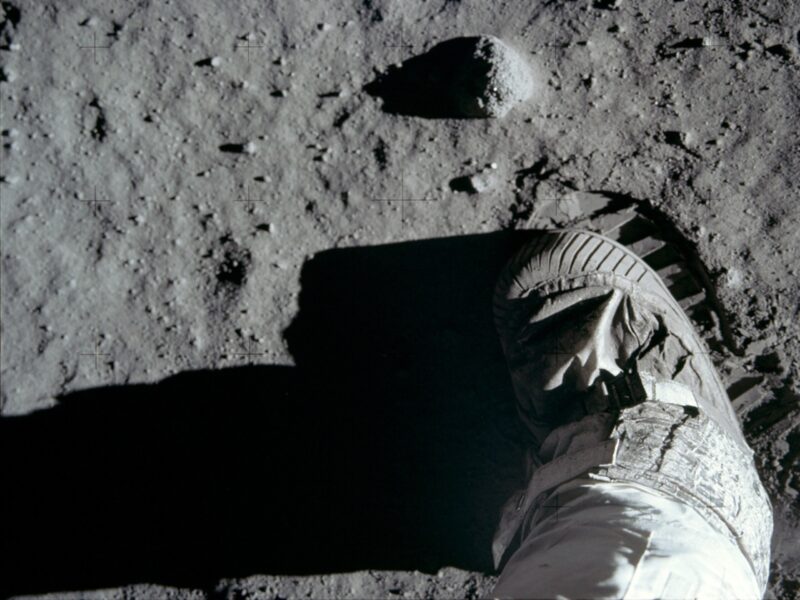
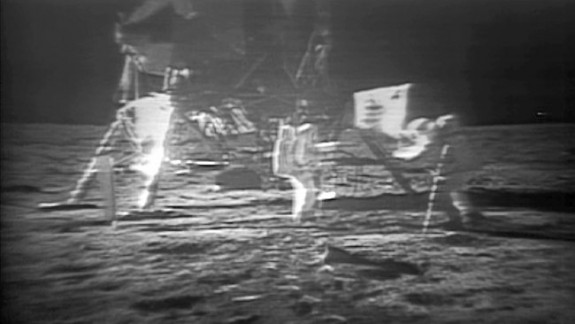
The world watched on television as Neil Armstrong from Apollo 11 was the 1st human to leave footsteps on the moon on July 20, 1969. It was the 1st time humans walked on another world as he stepped onto the lunar surface, Armstrong said: “That is one small step for [a] man, one giant leap for mankind.” Still image via NASA video.
Read all about the 1st footsteps on the moon – 57 years ago – and celebrate International Moon Day.
The Eagle has landed and footsteps on the moon
On July 20, 1969, Apollo 11 astronauts Buzz Aldrin and Neil Armstrong landed their lunar module on a broad dark lunar lava flow, called the Sea of Tranquility. And six hours later, Neil Armstrong became the first human being to walk on the surface of a world beyond Earth.
In the video below, you can hear the excitement in Armstrong’s voice at the successful landing of Eagle on the moon’s surface as he says:
Tranquility Base here. The Eagle has landed.
The 1st footsteps on the moon, leaving human footprints on the moon. Image via NASA.
Altogether, Armstrong and Aldrin spent 21 1/2 hours on the moon’s surface. Furthermore, they collected 47.5 pounds (21.5 kg) of moon rocks for return to Earth. And then they blasted off in their module from the lunar surface to meet up with Michael Collins in the command module orbiting overhead.
Finally, they returned safely to Earth and landed in the Pacific Ocean on July 24, 1969.
The Apollo 11 launch
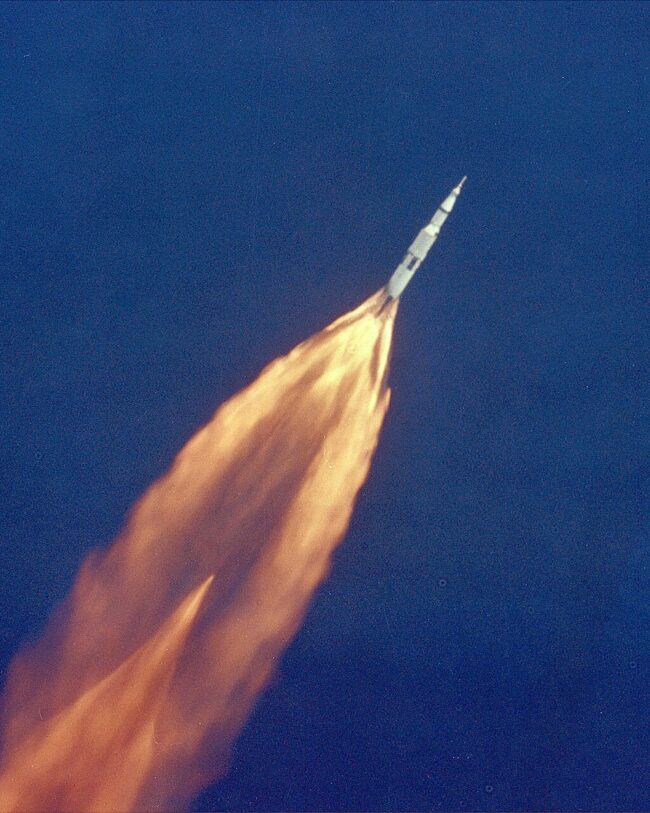
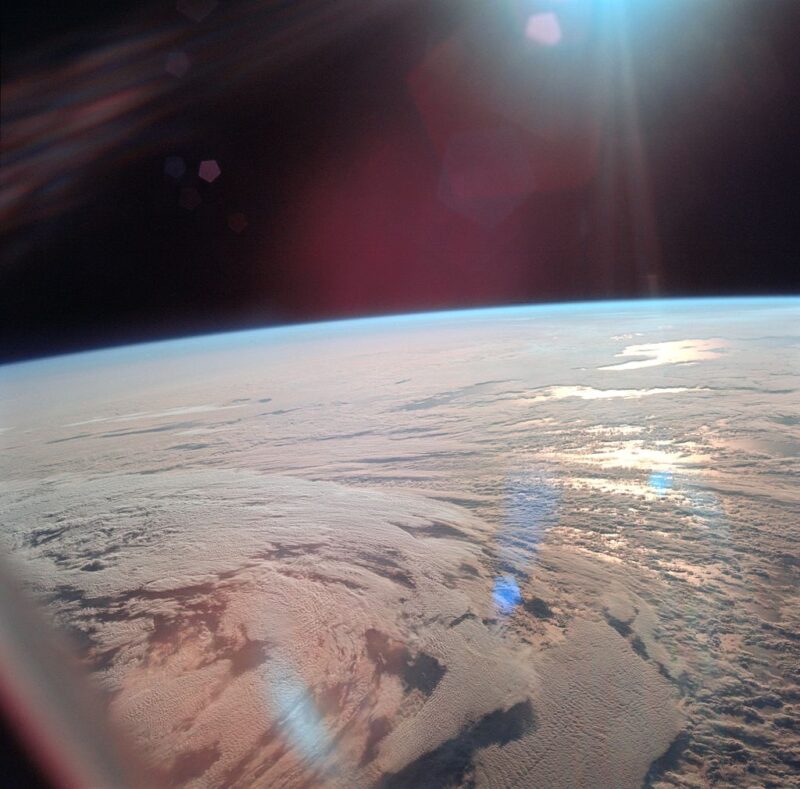
Apollo 11 launched at 13:32 UTC (9:32 a.m. EDT local time) on July 16, 1969. Astronauts Neil A. Armstrong, Michael Collins and Edwin E. “Buzz” Aldrin, Jr., were aboard. Image via NASA/ Wikipedia.Apollo 11 left Earth via a type of rocket no longer in use, called Saturn V. The giant Saturn V rocket was 111 meters (363 feet) tall, about the height of a 36-story-tall building. Read more about the Saturn V rocket. Image via Wikimedia.Apollo 11 orbited Earth 1 1/2 times. Twelve minutes after launch, it separated from the Saturn V rocket as a propulsion maneuver sent it on a path toward the moon. Meanwhile, here is a view of Earth from Apollo 11 shortly after it left Earth orbit. Image via NASA/ Wikimedia Commons.
Apollo 11: Watching from mission control
Happy Apollo 11 mission officials in the Launch Control Center following the successful Apollo 11 liftoff on July 16, 1969. That is the famous German rocket engineer Wernher von Braun, 4th from left (with binoculars). Read more about Wernher von Braun. Image via NASA/ Wikipedia.
Oh, what a view for the Apollo 11 astronauts
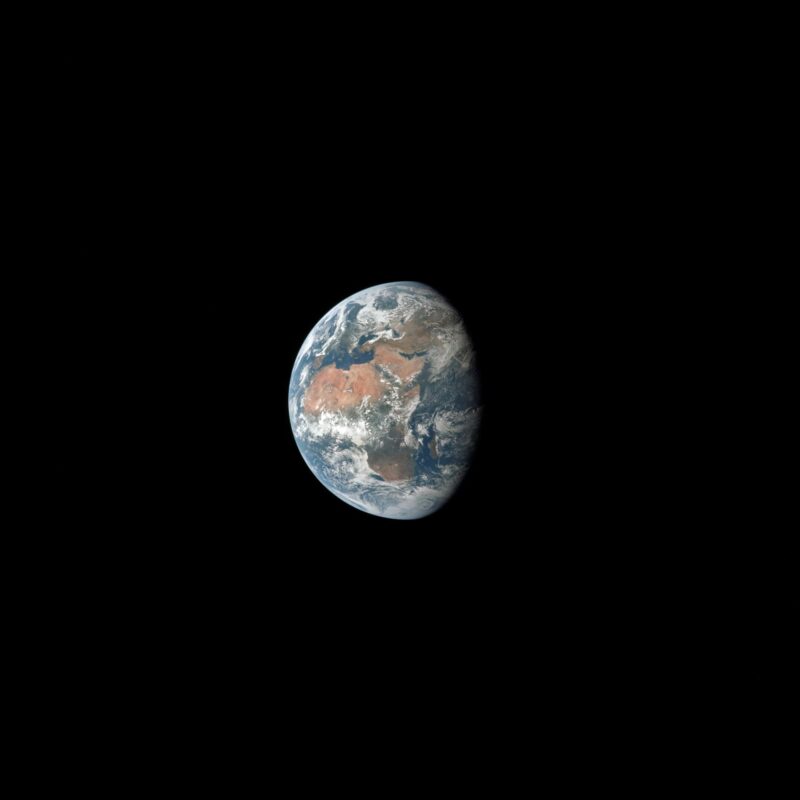
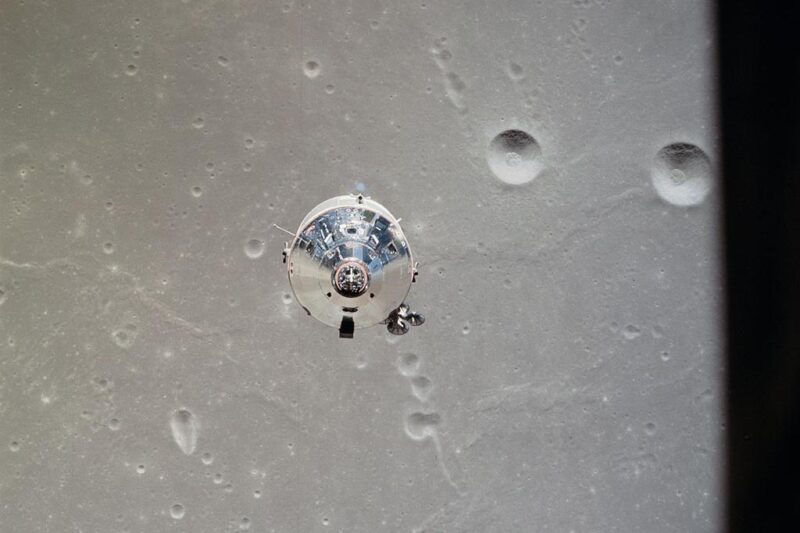
Buzz Aldrin looks into a TV camera during the 3rd broadcast from space on the way to the moon. Image via NASA/ Wikimedia Commons.Earth seen by Apollo 11 astronauts on their way to the moon. Image via NASA.The Eagle lunar module captured this image of the Columbia command module in lunar orbit. Meanwhile Columbia stayed in lunar orbit with Michael Collins aboard during Eagle’s descent and landing. Image via NASA/ Wikipedia.
The lunar module and Saturn V
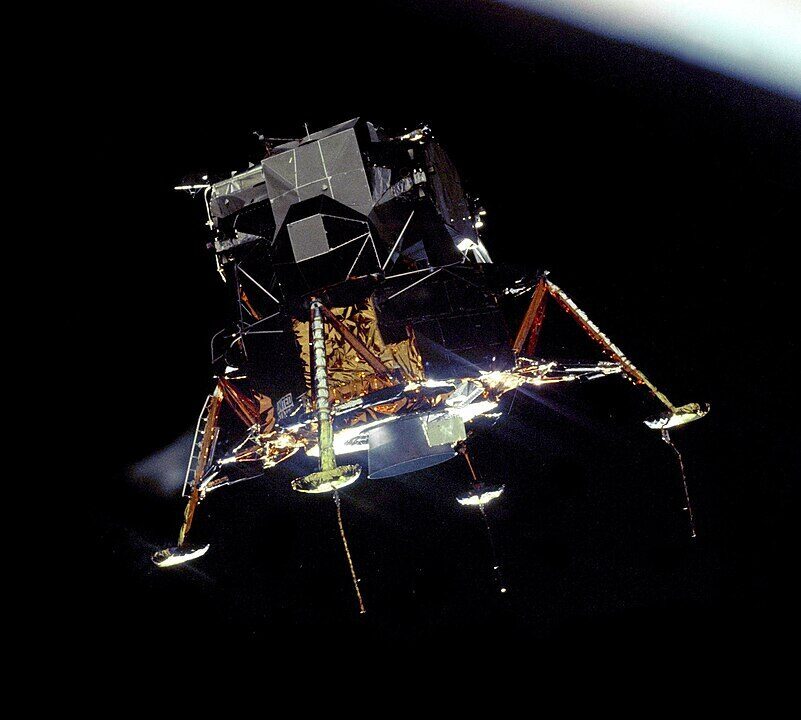
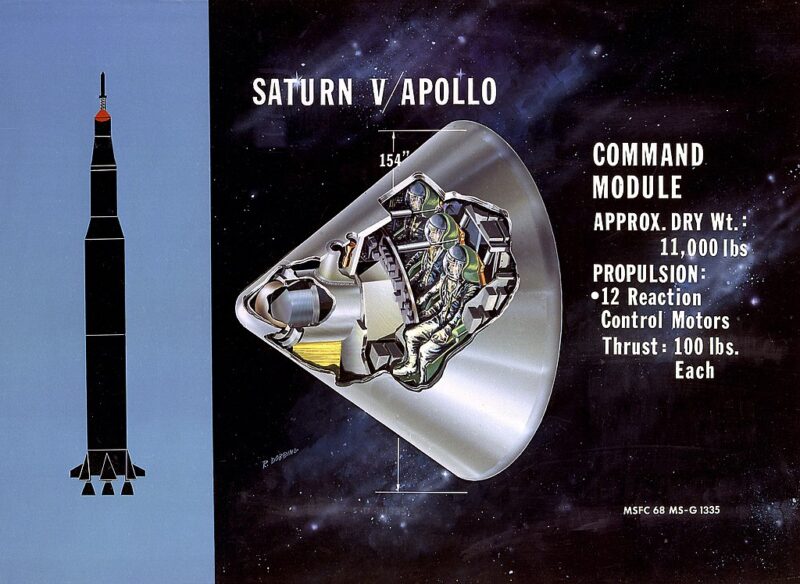
Here is the Apollo 11 lunar module, the vehicle that would carry Neil Armstrong and Buzz Aldrin to the moon’s surface. It was called “Eagle.” This photo also shows the module in its landing configuration, photographed in lunar orbit from the command module, which was called “Columbia.” Astronaut Michael Collins, alone aboard Columbia, inspected Eagle as it pirouetted before him to ensure the craft was not damaged. Image via NASA/ Wikipedia.The Apollo command module’s position atop the Saturn V at launch. The lunar module – the craft that descended to the moon’s surface – is positioned just below the command module in this diagram. Image via NASA/ Wikipedia.
There are now two heavy lift rockets, either of which could be used for moon missions. Read about SLS vs. Starship.
Concerns about the surface for footsteps on the moon
An early concern of space engineers had been that the lunar regolith, the fine soil covering the moon, would be soft like quicksand. There was some fear that the Eagle lunar module would sink after landing. Hence Armstrong’s comment about the depth of the footpads in the lunar soil as he descended the ladder before stepping onto the moon.
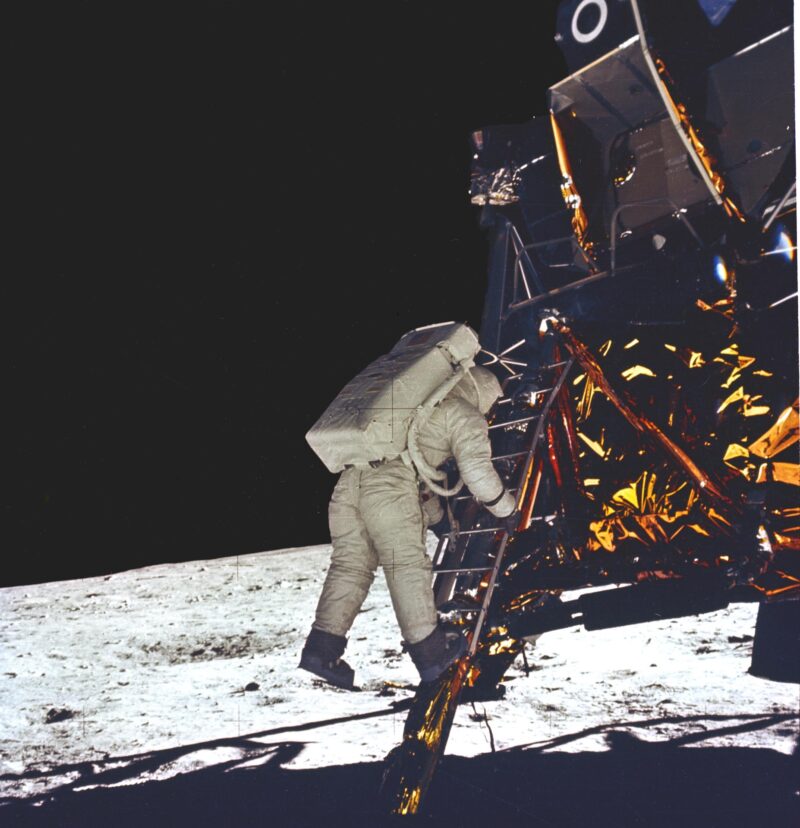
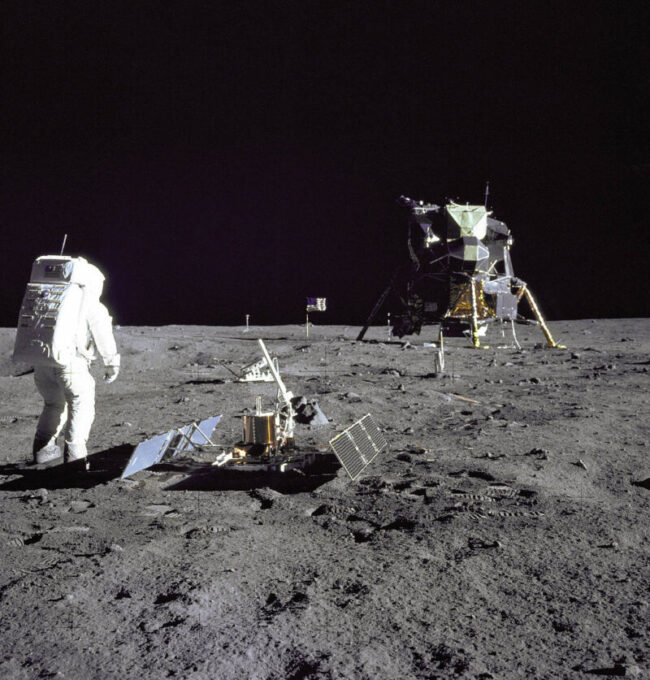
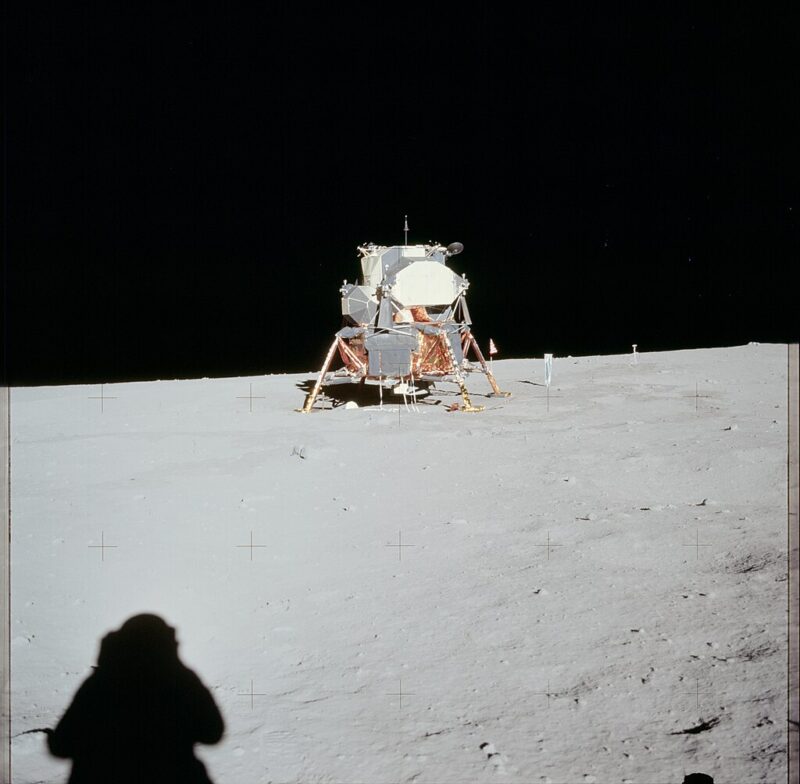
Buzz Aldrin descends the steps of the lunar module ladder as he becomes the 2nd human being to walk on the moon. Image via NASA.Armstrong and Aldrin beginning work on the moon. This included deploying a U.S. flag, performing several science experiments, and collecting moon rocks. Still image via NASA video.Here is Buzz Aldrin, who piloted the lunar module Eagle to the moon’s surface, with the LR-3, a reflecting array designed to bounce laser beams fired from Earth back to Earth. This experiment helped refine our knowledge of the moon’s distance and the shape of its orbit around Earth. Image via NASA.Lastly, the lunar module Eagle on the surface of the moon. Image via NASA/ Wikimedia Commons.
Holding down the fort with a great view
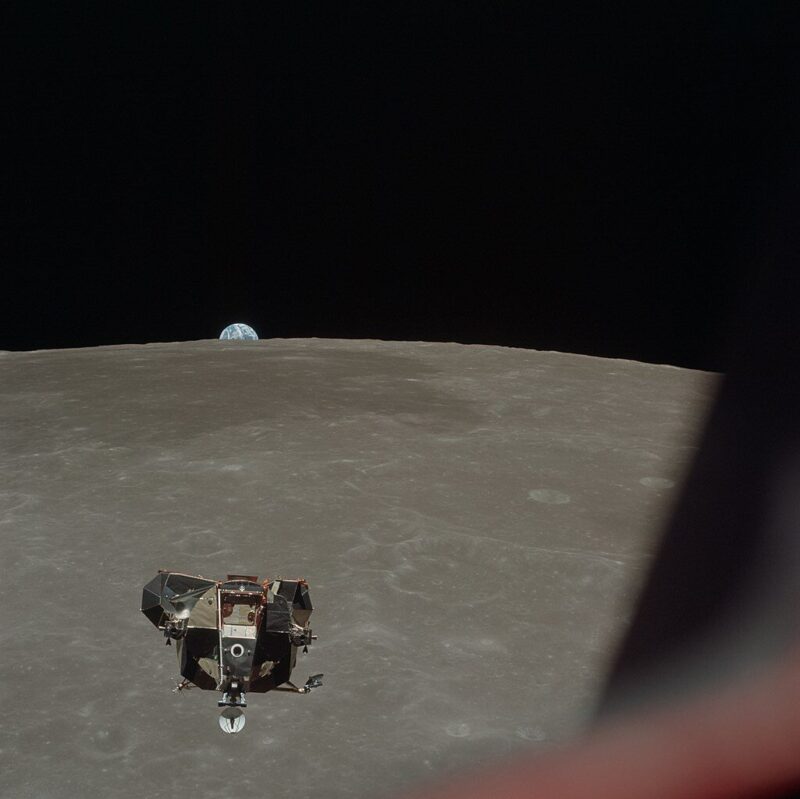
Michael Collins caught this photo of the lunar module with Armstrong and Aldrin inside – and with Earth in the distance – as the module ascended from the moon’s surface to rejoin the command module. The lunar module docked with the orbiting command module, and, shortly afterwards, the astronauts began their journey back to Earth. Image via NASA/ Wikimedia Commons.Neil Armstrong in the lunar module Eagle shortly after his historic 1st moonwalk, when he became the 1st human to set foot on a world besides Earth. Image via NASA/ Wikipedia.
Splashdown and celebrations for a successful return
There were no runway landings in those days. Splashdown for the 3 astronauts was in the Pacific Ocean. Here, they await pickup by a helicopter from the USS Hornet. Image via NASA/ Wikipedia.Celebration at Mission Control as Apollo 11 draws to a successful end. Image via NASA.Ticker-tape parade for the Apollo 11 astronauts in New York City on August 13, 1969. This section of Broadway is known as the Canyon of Heroes. Image via NASA/ Wikimedia Commons.
A bounty of moon rocks brought back to Earth
The Apollo astronauts brought the 1st moon rocks back to Earth. Here is a sample.
This lunar sample, known as 10057, was collected during Apollo 11 and later sliced into pieces. Image via NASA.
Experience the Apollo 11 landing site as it appears today, in this video:
And to celebrate this historical event, it’s International Moon Day
International Moon Day marks the anniversary of the first landing by humans on the moon as part of the Apollo 11 lunar mission in 1969.
The celebrations will also consider the achievements of all States in the exploration of the moon and raise public awareness of sustainable Moon exploration and utilization.
Bottom line: Tomorrow is the 57th anniversary of humanity’s historic Apollo moon landing and the first human footsteps on the moon. The story in pictures, here. And to celebrate, it’s International Moon Day.
The world watched on television as Neil Armstrong from Apollo 11 was the 1st human to leave footsteps on the moon on July 20, 1969. It was the 1st time humans walked on another world as he stepped onto the lunar surface, Armstrong said: “That is one small step for [a] man, one giant leap for mankind.” Still image via NASA video.
Read all about the 1st footsteps on the moon – 57 years ago – and celebrate International Moon Day.
The Eagle has landed and footsteps on the moon
On July 20, 1969, Apollo 11 astronauts Buzz Aldrin and Neil Armstrong landed their lunar module on a broad dark lunar lava flow, called the Sea of Tranquility. And six hours later, Neil Armstrong became the first human being to walk on the surface of a world beyond Earth.
In the video below, you can hear the excitement in Armstrong’s voice at the successful landing of Eagle on the moon’s surface as he says:
Tranquility Base here. The Eagle has landed.
The 1st footsteps on the moon, leaving human footprints on the moon. Image via NASA.
Altogether, Armstrong and Aldrin spent 21 1/2 hours on the moon’s surface. Furthermore, they collected 47.5 pounds (21.5 kg) of moon rocks for return to Earth. And then they blasted off in their module from the lunar surface to meet up with Michael Collins in the command module orbiting overhead.
Finally, they returned safely to Earth and landed in the Pacific Ocean on July 24, 1969.
The Apollo 11 launch
Apollo 11 launched at 13:32 UTC (9:32 a.m. EDT local time) on July 16, 1969. Astronauts Neil A. Armstrong, Michael Collins and Edwin E. “Buzz” Aldrin, Jr., were aboard. Image via NASA/ Wikipedia.Apollo 11 left Earth via a type of rocket no longer in use, called Saturn V. The giant Saturn V rocket was 111 meters (363 feet) tall, about the height of a 36-story-tall building. Read more about the Saturn V rocket. Image via Wikimedia.Apollo 11 orbited Earth 1 1/2 times. Twelve minutes after launch, it separated from the Saturn V rocket as a propulsion maneuver sent it on a path toward the moon. Meanwhile, here is a view of Earth from Apollo 11 shortly after it left Earth orbit. Image via NASA/ Wikimedia Commons.
Apollo 11: Watching from mission control
Happy Apollo 11 mission officials in the Launch Control Center following the successful Apollo 11 liftoff on July 16, 1969. That is the famous German rocket engineer Wernher von Braun, 4th from left (with binoculars). Read more about Wernher von Braun. Image via NASA/ Wikipedia.
Oh, what a view for the Apollo 11 astronauts
Buzz Aldrin looks into a TV camera during the 3rd broadcast from space on the way to the moon. Image via NASA/ Wikimedia Commons.Earth seen by Apollo 11 astronauts on their way to the moon. Image via NASA.The Eagle lunar module captured this image of the Columbia command module in lunar orbit. Meanwhile Columbia stayed in lunar orbit with Michael Collins aboard during Eagle’s descent and landing. Image via NASA/ Wikipedia.
The lunar module and Saturn V
Here is the Apollo 11 lunar module, the vehicle that would carry Neil Armstrong and Buzz Aldrin to the moon’s surface. It was called “Eagle.” This photo also shows the module in its landing configuration, photographed in lunar orbit from the command module, which was called “Columbia.” Astronaut Michael Collins, alone aboard Columbia, inspected Eagle as it pirouetted before him to ensure the craft was not damaged. Image via NASA/ Wikipedia.The Apollo command module’s position atop the Saturn V at launch. The lunar module – the craft that descended to the moon’s surface – is positioned just below the command module in this diagram. Image via NASA/ Wikipedia.
There are now two heavy lift rockets, either of which could be used for moon missions. Read about SLS vs. Starship.
Concerns about the surface for footsteps on the moon
An early concern of space engineers had been that the lunar regolith, the fine soil covering the moon, would be soft like quicksand. There was some fear that the Eagle lunar module would sink after landing. Hence Armstrong’s comment about the depth of the footpads in the lunar soil as he descended the ladder before stepping onto the moon.
Buzz Aldrin descends the steps of the lunar module ladder as he becomes the 2nd human being to walk on the moon. Image via NASA.Armstrong and Aldrin beginning work on the moon. This included deploying a U.S. flag, performing several science experiments, and collecting moon rocks. Still image via NASA video.Here is Buzz Aldrin, who piloted the lunar module Eagle to the moon’s surface, with the LR-3, a reflecting array designed to bounce laser beams fired from Earth back to Earth. This experiment helped refine our knowledge of the moon’s distance and the shape of its orbit around Earth. Image via NASA.Lastly, the lunar module Eagle on the surface of the moon. Image via NASA/ Wikimedia Commons.
Holding down the fort with a great view
Michael Collins caught this photo of the lunar module with Armstrong and Aldrin inside – and with Earth in the distance – as the module ascended from the moon’s surface to rejoin the command module. The lunar module docked with the orbiting command module, and, shortly afterwards, the astronauts began their journey back to Earth. Image via NASA/ Wikimedia Commons.Neil Armstrong in the lunar module Eagle shortly after his historic 1st moonwalk, when he became the 1st human to set foot on a world besides Earth. Image via NASA/ Wikipedia.
Splashdown and celebrations for a successful return
There were no runway landings in those days. Splashdown for the 3 astronauts was in the Pacific Ocean. Here, they await pickup by a helicopter from the USS Hornet. Image via NASA/ Wikipedia.Celebration at Mission Control as Apollo 11 draws to a successful end. Image via NASA.Ticker-tape parade for the Apollo 11 astronauts in New York City on August 13, 1969. This section of Broadway is known as the Canyon of Heroes. Image via NASA/ Wikimedia Commons.
A bounty of moon rocks brought back to Earth
The Apollo astronauts brought the 1st moon rocks back to Earth. Here is a sample.
This lunar sample, known as 10057, was collected during Apollo 11 and later sliced into pieces. Image via NASA.
Experience the Apollo 11 landing site as it appears today, in this video:
And to celebrate this historical event, it’s International Moon Day
International Moon Day marks the anniversary of the first landing by humans on the moon as part of the Apollo 11 lunar mission in 1969.
The celebrations will also consider the achievements of all States in the exploration of the moon and raise public awareness of sustainable Moon exploration and utilization.
Bottom line: Tomorrow is the 57th anniversary of humanity’s historic Apollo moon landing and the first human footsteps on the moon. The story in pictures, here. And to celebrate, it’s International Moon Day.
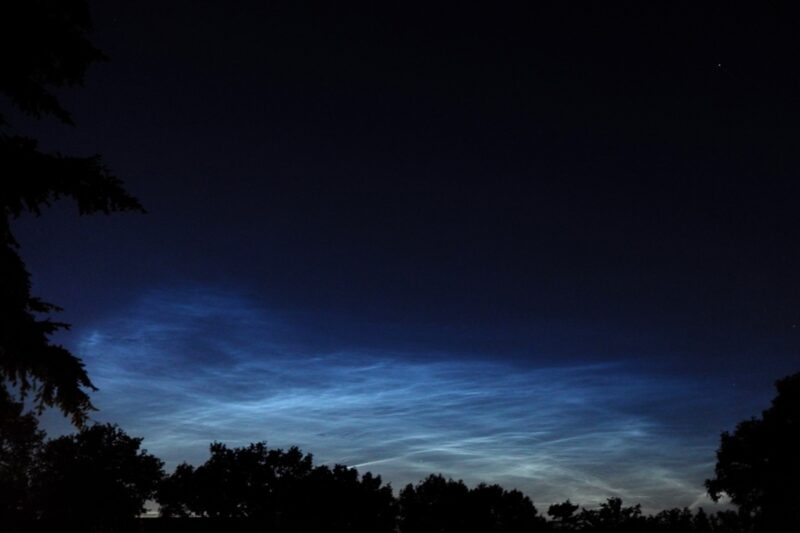
There was a nice display of noctilucent clouds last night. Here's the view from the North York Moors, overlooking Teesside at 23:11 UT. #NoctilucentClouds #Noctilucent #NLCs
Noctilucent clouds, or night-shining clouds, are thin clouds high up in Earth’s atmosphere – the mesosphere – as much as 50 miles (80 km) above Earth’s surface. Scientists think they’re made of ice crystals that form on fine dust particles, often from meteors. They can only form when temperatures are incredibly low and when there’s water available to form ice crystals.
So, why do these clouds – which require such cold temperatures – form in the summer? It’s because of the strange dynamics of the atmosphere. At that height in the mesosphere, you actually get the coldest temperatures of the year near the poles in summer. Read on to find out why.
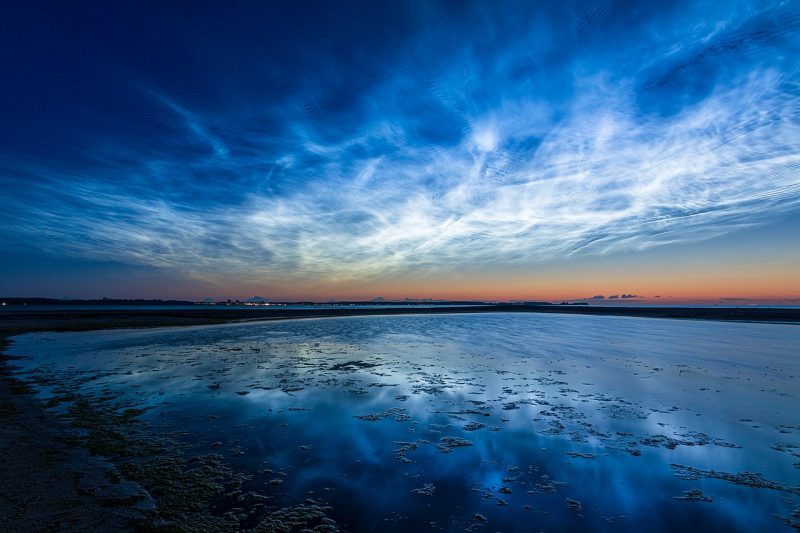
Photo of noctilucent clouds taken in Laboe, Germany, on June 21, 2019. Image by Matthias Süßen/ Wikipedia.
What causes noctilucent clouds?
Here’s how it works: during summer, air close to the ground heats up and rises. Since atmospheric pressure decreases with altitude, the rising air expands. But, when the air expands, it also cools down. This, along with other processes in the upper atmosphere, drives the air even higher causing it to cool even more. As a result, temperatures in the mesosphere can plunge to as low as -225 degrees Fahrenheit (-143 C).
In the Northern Hemisphere, the mesosphere reaches these temperatures by mid-May in most years.
We see noctilucent clouds when most of the sky has grown dark, but the rays from the sun can still reach and reflect off these ethereal, electric-blue clouds. When satellites or astronauts view them from space, they’re referred to as polar mesospheric clouds.
If you want to see them for yourself, now’s the time to look!
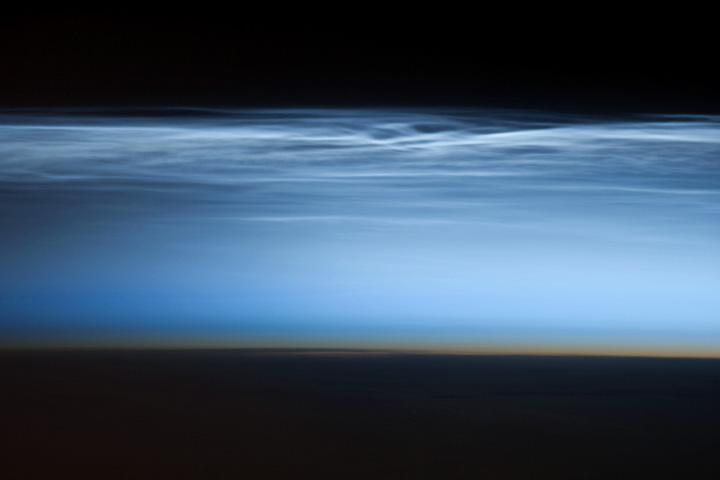
Astronauts in the International Space Station (ISS) took this photo on January 5, 2013, when the ISS was over the Pacific Ocean south of French Polynesia. The pale orange band below the brightly lit noctilucent clouds is the stratosphere. Image via NASA.
It’s noctilucent cloud season
The season for noctilucent clouds at northerly latitudes is now. People at high latitudes report seeing noctilucent clouds. This happens every year, from about May through August in the Northern Hemisphere, and from November through February in the Southern Hemisphere.
Sighting them at lower latitudes might be due to a couple of things. According to Royal Museums Greenwich:
In the Northern Hemisphere noctilucent clouds have been seen at much lower latitudes than expected. Scientists believe this is a result of climate change, but it could also be due to other factors, such as rocket launches expelling particles into the atmosphere which go on to form noctilucent clouds.
How to see these night-shining clouds
To see noctilucent clouds, you’ll need certain conditions in your favor. One factor is when to look. Right about now – June to July – is typically when noctilucent clouds are most widespread.
You’ll also want to be positioned as far north as possible during the Northern Hemisphere’s peak season. Canada and the U.K. are two locations where you’ll have a better chance to spot night-shining clouds.
Then, look west about 30 minutes after sunset. The farther north you are, the longer throughout the night you can see them. That’s because the sun doesn’t dip as far below your horizon.
Noctilucent clouds look like electric, luminous tendrils of blue-white light. They are the clouds that glow after other clouds have darkened.
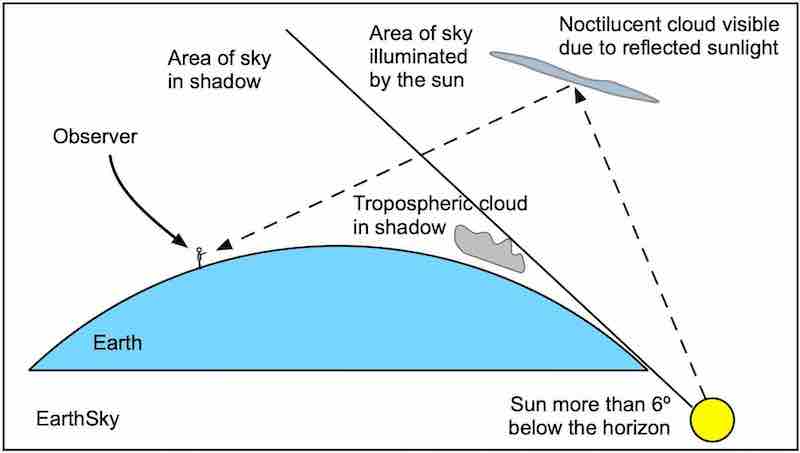
Noctilucent clouds are night-shining clouds because they are so high up that after other clouds are dark, the sun can still reach them. These polar mesospheric clouds appear as eerily blue in a mostly darkened sky. Chart via EarthSky.
What noctilucent clouds can teach us
Noctilucent clouds are sensitive to atmospheric temperatures. Therefore, they can act as a proxy for information about the wind circulation that causes these temperatures. First of all, they can tell scientists that the circulation exists. They can also tell us something about the strength of the circulation.
Scientists studying these clouds got help from NASA’s Aeronomy of Ice in the Mesosphere (AIM) satellite. This satellite, launched in 2007, observed noctilucent clouds using several onboard instruments to collect information such as temperature, atmospheric gases, ice crystal size and changes in the clouds. It even accounted for the amount of meteoric space dust that enters the atmosphere. The AIM spacecraft re-entered Earth’s atmosphere and burned up in August 2024.
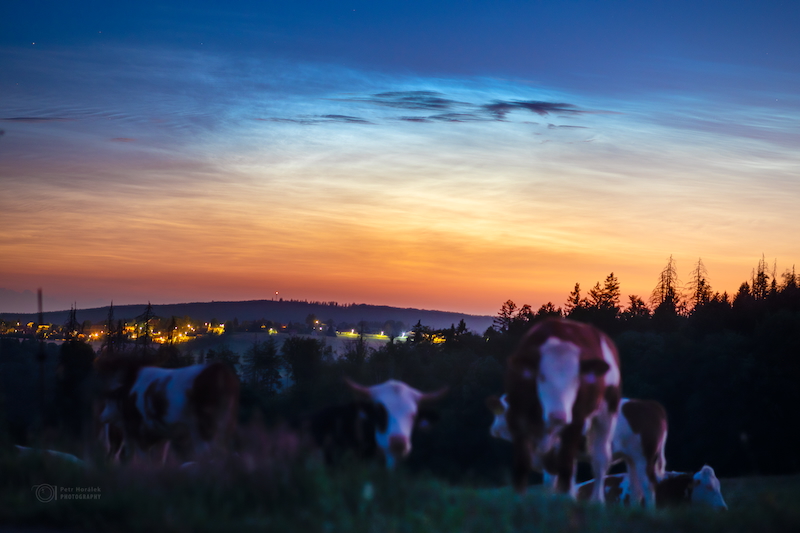
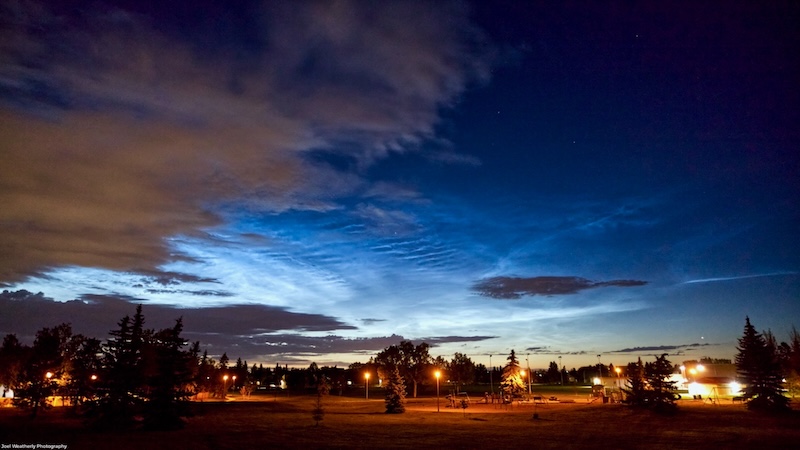
View at EarthSky Community Photos. | Petr Horálek braved a cow pasture to get this view of noctilucent clouds on July 3, 2025. Petr wrote: “This early morning, the bright NLCs appeared over Central Europe. I found a great spot by Prosec u Sece, Czech Republic. When I started shooting, I found out that cows are close … and a bull too. I was pretty scared of the bull, as he seemed very aggressive, but I managed to make at least one shot before he decided to check me out. So the shot is truly spontaneous and a result of small drama, too.” Thank you, Petr!View at EarthSky Community Photos. | Joel Weatherly captured noctilucent clouds from Edmonton, Alberta, Canada, on July 1, 2025. Joel wrote: “Last night we had a significant outbreak of noctilucent clouds. These shimmering NLCs showcased brilliant waves and ripples.” Thank you, Joel!
Noctilucent clouds in 2024
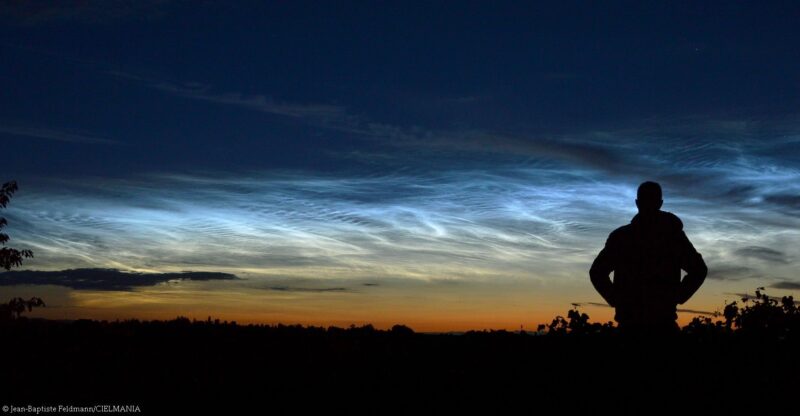
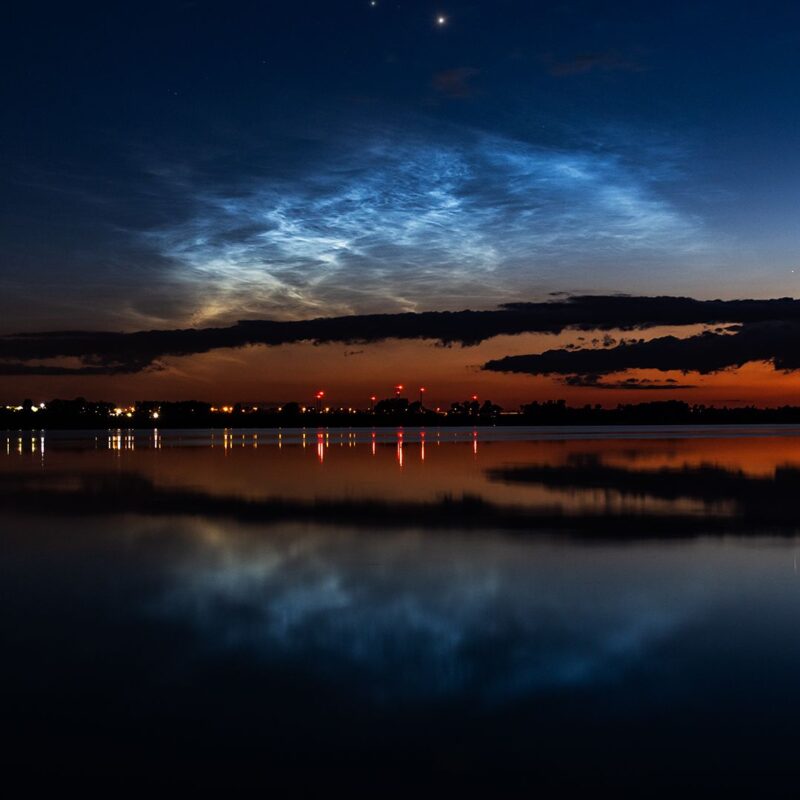
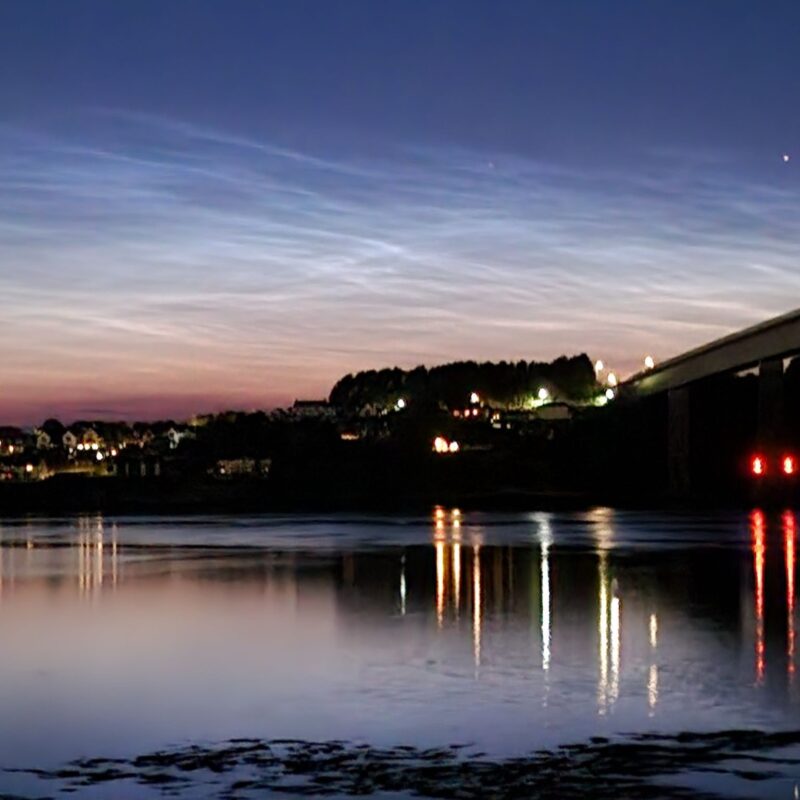
View at EarthSky Community Photos. | Jean-Baptiste Feldmann in Gleizé, France, captured these noctilucent – or night-shining – clouds on July 13, 2024. Jean-Baptiste wrote: “Impressive festival of noctilucent clouds a little before 5 in the morning, while I was finishing my planetary observations with the telescope. I had never seen noctilucent with such intensity before. A real treat!” Thank you, Jean-Baptiste!View at EarthSky Community Photos. | Marek Nikodem caught these noctilucent clouds on June 14, 2024, from near Szubin, Poland. Thank you, Marek!View at EarthSky Community Photos. | Lorraine Osullivan was in Pembrokeshire, Wales, when she took this image of night-shining clouds on June 25, 2024. Lorraine wrote: “I was on holiday when I took this photo, it is taken from our balcony at our cottage.” Thank you, Lorraine!View at EarthSky Community Photos. | Lea Proicheva in Gennep, the Netherlands, captured this image on June 28, 2024. Lea wrote: “This time of year the sun goes down very late and twilight lasts for a long time.” Thank you, Lea!
There was a nice display of noctilucent clouds last night. Here's the view from the North York Moors, overlooking Teesside at 23:11 UT. #NoctilucentClouds #Noctilucent #NLCs
Noctilucent clouds, or night-shining clouds, are thin clouds high up in Earth’s atmosphere – the mesosphere – as much as 50 miles (80 km) above Earth’s surface. Scientists think they’re made of ice crystals that form on fine dust particles, often from meteors. They can only form when temperatures are incredibly low and when there’s water available to form ice crystals.
So, why do these clouds – which require such cold temperatures – form in the summer? It’s because of the strange dynamics of the atmosphere. At that height in the mesosphere, you actually get the coldest temperatures of the year near the poles in summer. Read on to find out why.
Photo of noctilucent clouds taken in Laboe, Germany, on June 21, 2019. Image by Matthias Süßen/ Wikipedia.
What causes noctilucent clouds?
Here’s how it works: during summer, air close to the ground heats up and rises. Since atmospheric pressure decreases with altitude, the rising air expands. But, when the air expands, it also cools down. This, along with other processes in the upper atmosphere, drives the air even higher causing it to cool even more. As a result, temperatures in the mesosphere can plunge to as low as -225 degrees Fahrenheit (-143 C).
In the Northern Hemisphere, the mesosphere reaches these temperatures by mid-May in most years.
We see noctilucent clouds when most of the sky has grown dark, but the rays from the sun can still reach and reflect off these ethereal, electric-blue clouds. When satellites or astronauts view them from space, they’re referred to as polar mesospheric clouds.
If you want to see them for yourself, now’s the time to look!
Astronauts in the International Space Station (ISS) took this photo on January 5, 2013, when the ISS was over the Pacific Ocean south of French Polynesia. The pale orange band below the brightly lit noctilucent clouds is the stratosphere. Image via NASA.
It’s noctilucent cloud season
The season for noctilucent clouds at northerly latitudes is now. People at high latitudes report seeing noctilucent clouds. This happens every year, from about May through August in the Northern Hemisphere, and from November through February in the Southern Hemisphere.
Sighting them at lower latitudes might be due to a couple of things. According to Royal Museums Greenwich:
In the Northern Hemisphere noctilucent clouds have been seen at much lower latitudes than expected. Scientists believe this is a result of climate change, but it could also be due to other factors, such as rocket launches expelling particles into the atmosphere which go on to form noctilucent clouds.
How to see these night-shining clouds
To see noctilucent clouds, you’ll need certain conditions in your favor. One factor is when to look. Right about now – June to July – is typically when noctilucent clouds are most widespread.
You’ll also want to be positioned as far north as possible during the Northern Hemisphere’s peak season. Canada and the U.K. are two locations where you’ll have a better chance to spot night-shining clouds.
Then, look west about 30 minutes after sunset. The farther north you are, the longer throughout the night you can see them. That’s because the sun doesn’t dip as far below your horizon.
Noctilucent clouds look like electric, luminous tendrils of blue-white light. They are the clouds that glow after other clouds have darkened.
Noctilucent clouds are night-shining clouds because they are so high up that after other clouds are dark, the sun can still reach them. These polar mesospheric clouds appear as eerily blue in a mostly darkened sky. Chart via EarthSky.
What noctilucent clouds can teach us
Noctilucent clouds are sensitive to atmospheric temperatures. Therefore, they can act as a proxy for information about the wind circulation that causes these temperatures. First of all, they can tell scientists that the circulation exists. They can also tell us something about the strength of the circulation.
Scientists studying these clouds got help from NASA’s Aeronomy of Ice in the Mesosphere (AIM) satellite. This satellite, launched in 2007, observed noctilucent clouds using several onboard instruments to collect information such as temperature, atmospheric gases, ice crystal size and changes in the clouds. It even accounted for the amount of meteoric space dust that enters the atmosphere. The AIM spacecraft re-entered Earth’s atmosphere and burned up in August 2024.
View at EarthSky Community Photos. | Petr Horálek braved a cow pasture to get this view of noctilucent clouds on July 3, 2025. Petr wrote: “This early morning, the bright NLCs appeared over Central Europe. I found a great spot by Prosec u Sece, Czech Republic. When I started shooting, I found out that cows are close … and a bull too. I was pretty scared of the bull, as he seemed very aggressive, but I managed to make at least one shot before he decided to check me out. So the shot is truly spontaneous and a result of small drama, too.” Thank you, Petr!View at EarthSky Community Photos. | Joel Weatherly captured noctilucent clouds from Edmonton, Alberta, Canada, on July 1, 2025. Joel wrote: “Last night we had a significant outbreak of noctilucent clouds. These shimmering NLCs showcased brilliant waves and ripples.” Thank you, Joel!
Noctilucent clouds in 2024
View at EarthSky Community Photos. | Jean-Baptiste Feldmann in Gleizé, France, captured these noctilucent – or night-shining – clouds on July 13, 2024. Jean-Baptiste wrote: “Impressive festival of noctilucent clouds a little before 5 in the morning, while I was finishing my planetary observations with the telescope. I had never seen noctilucent with such intensity before. A real treat!” Thank you, Jean-Baptiste!View at EarthSky Community Photos. | Marek Nikodem caught these noctilucent clouds on June 14, 2024, from near Szubin, Poland. Thank you, Marek!View at EarthSky Community Photos. | Lorraine Osullivan was in Pembrokeshire, Wales, when she took this image of night-shining clouds on June 25, 2024. Lorraine wrote: “I was on holiday when I took this photo, it is taken from our balcony at our cottage.” Thank you, Lorraine!View at EarthSky Community Photos. | Lea Proicheva in Gennep, the Netherlands, captured this image on June 28, 2024. Lea wrote: “This time of year the sun goes down very late and twilight lasts for a long time.” Thank you, Lea!
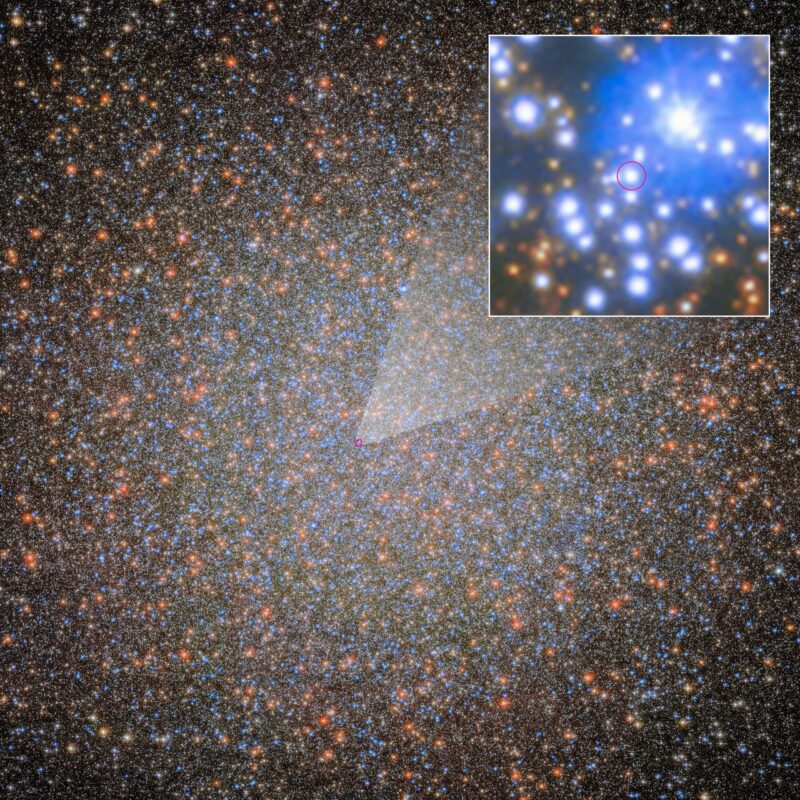
View larger. | This star in the Omega Centauri globular cluster is the first astronomers have found to orbit a stellar-mass black hole. Astronomers think there should be 10,000 black holes of that size in this star cluster, but they’ve never found one … until now. Image via ESA/Hubble & NASA, M. Häberle (MPIA).
10,000 black holes are missing from this star cluster
Astronomers know of three different categories of black holes. There are the supermassive black holes, which are the beasts that lurk at the centers of galaxies. There are stellar-mass black holes, which form after huge stars die. And then there are intermediate-mass black holes that fill the gap between those two.
Astronomers think the Omega Centauri globular cluster – a huge collection of 10 million stars that orbits our Milky Way galaxy – should be home to some 10,000 stellar-mass black holes. But they’d never found any stellar-mass black holes in the cluster … until now.
On July 13, 2026, ESA said observations with the Hubble and Webb space telescopes have revealed evidence for a stellar-mass black hole in the massive star cluster. The data from these two telescopes allowed astronomers to track a star orbiting a companion for more than 20 years in the cluster. And the star’s invisible dance partner is so heavy that astronomers concluded it must be a black hole. They’ve named the newly found black hole oMEGACat BH-2.
The researchers published their peer-reviewed paper in The Astrophysical Journal Letters on July 13, 2026.
Finding a stellar-mass black hole
Astronomers had searched for stellar-mass black holes in the globular cluster before. Their previous methods of detection included looking for emissions from material falling into the black hole and something called the radial velocity method. This method looks at how fast stars are moving toward or away from us. It can reveal the presence of nearby objects. But these methods never turned up a black hole in Omega Centauri.
Enter astrometry. This is a method where astronomers measure precise locations and movements of stars over time. More than 20 years of data allowed astronomers to get a collection of the precise movements and wiggles of stars in Omega Centauri. And one star revealed it not only had a companion, but the companion was more massive than any star.
Astronomers calculated the companion was too heavy to be something like a neutron star (the dense core of a dead star). But at the same time, it was a bit lighter than they were expecting for a black hole. Co-author Anil Seth of the University of Utah said:
While we already knew that the star was 0.78 solar masses, we can now calculate the black hole’s mass, which is 4.46 solar masses and therefore too heavy to be a neutron star. However, its mass is actually much lower than would be expected in a metal-poor environment like Omega Centauri. This is surprising and exciting. We now know that a metal-poor star should be able to form a black hole like this, and we need to figure out how that happens.
More insights into the black hole
The astronomers learned that the visible star orbits the black hole – oMEGACat BH-2 – once every 94 years. That’s the longest-known period for a star and its black hole.
But the star and black hole don’t appear to be original dance partners. The astronomers said the binary pair likely found each other in the crowded environment of the cluster.
And they won’t remain together forever. Calculations show the star and black hole will stay a pair for less than a billion years before other stars in the cluster tear them apart. It’s not easy being on a packed dance floor.
Insight into gravitational waves
This black hole and its stellar companion could give astronomers insight into gravitational waves. Gravitational waves are ripples in spacetime. They’re triggered by explosive events in the universe, such as exploding stars or black hole mergers. And the formation of black holes and their influence on companions, like oMEGACat BH-2 and its star, could provide insight into the physics of these events. Seth said:
It’s important to understand black hole populations in globular clusters, because there’s uncertainty about their physics and formation. More specifically, understanding the process of forming black holes and then dynamically forming binaries is vital, because it affects our ability to interpret and understand gravitational wave events. Environments like Omega Centauri are the primary places where we think binaries are merging and creating these waves.
Not the only black hole in Omega Centauri
While this is the first detection of a stellar-mass black hole in Omega Centauri, astronomers believe they’ve already identified an intermediate-mass black hole in the cluster. In 2024, a team of astronomers detected seven fast-moving stars in the innermost region of Omega Centauri. In fact, they’re moving so fast they should escape the cluster. So their existence and speed suggests a massive object – an intermediate black hole – is pulling on them. Read more about the intermediate-mass black hole in Omega Centauri here.
This video from the Max Planck Institute for Astronomy shows the 7 fast stars in the globular cluster Omega Centauri that should not be there. They provide evidence for a long-predicted intermediate-mass black hole. And now astronomers said they’ve also detected a stellar-mass black hole in Omega Centauri, which is 17,700 light-years away.
Bottom line: Astronomers think the Omega Centauri globular cluster should be home to 10,000 black holes of a stellar-mass size. But they’ve never found one … until now.
View larger. | This star in the Omega Centauri globular cluster is the first astronomers have found to orbit a stellar-mass black hole. Astronomers think there should be 10,000 black holes of that size in this star cluster, but they’ve never found one … until now. Image via ESA/Hubble & NASA, M. Häberle (MPIA).
10,000 black holes are missing from this star cluster
Astronomers know of three different categories of black holes. There are the supermassive black holes, which are the beasts that lurk at the centers of galaxies. There are stellar-mass black holes, which form after huge stars die. And then there are intermediate-mass black holes that fill the gap between those two.
Astronomers think the Omega Centauri globular cluster – a huge collection of 10 million stars that orbits our Milky Way galaxy – should be home to some 10,000 stellar-mass black holes. But they’d never found any stellar-mass black holes in the cluster … until now.
On July 13, 2026, ESA said observations with the Hubble and Webb space telescopes have revealed evidence for a stellar-mass black hole in the massive star cluster. The data from these two telescopes allowed astronomers to track a star orbiting a companion for more than 20 years in the cluster. And the star’s invisible dance partner is so heavy that astronomers concluded it must be a black hole. They’ve named the newly found black hole oMEGACat BH-2.
The researchers published their peer-reviewed paper in The Astrophysical Journal Letters on July 13, 2026.
Finding a stellar-mass black hole
Astronomers had searched for stellar-mass black holes in the globular cluster before. Their previous methods of detection included looking for emissions from material falling into the black hole and something called the radial velocity method. This method looks at how fast stars are moving toward or away from us. It can reveal the presence of nearby objects. But these methods never turned up a black hole in Omega Centauri.
Enter astrometry. This is a method where astronomers measure precise locations and movements of stars over time. More than 20 years of data allowed astronomers to get a collection of the precise movements and wiggles of stars in Omega Centauri. And one star revealed it not only had a companion, but the companion was more massive than any star.
Astronomers calculated the companion was too heavy to be something like a neutron star (the dense core of a dead star). But at the same time, it was a bit lighter than they were expecting for a black hole. Co-author Anil Seth of the University of Utah said:
While we already knew that the star was 0.78 solar masses, we can now calculate the black hole’s mass, which is 4.46 solar masses and therefore too heavy to be a neutron star. However, its mass is actually much lower than would be expected in a metal-poor environment like Omega Centauri. This is surprising and exciting. We now know that a metal-poor star should be able to form a black hole like this, and we need to figure out how that happens.
More insights into the black hole
The astronomers learned that the visible star orbits the black hole – oMEGACat BH-2 – once every 94 years. That’s the longest-known period for a star and its black hole.
But the star and black hole don’t appear to be original dance partners. The astronomers said the binary pair likely found each other in the crowded environment of the cluster.
And they won’t remain together forever. Calculations show the star and black hole will stay a pair for less than a billion years before other stars in the cluster tear them apart. It’s not easy being on a packed dance floor.
Insight into gravitational waves
This black hole and its stellar companion could give astronomers insight into gravitational waves. Gravitational waves are ripples in spacetime. They’re triggered by explosive events in the universe, such as exploding stars or black hole mergers. And the formation of black holes and their influence on companions, like oMEGACat BH-2 and its star, could provide insight into the physics of these events. Seth said:
It’s important to understand black hole populations in globular clusters, because there’s uncertainty about their physics and formation. More specifically, understanding the process of forming black holes and then dynamically forming binaries is vital, because it affects our ability to interpret and understand gravitational wave events. Environments like Omega Centauri are the primary places where we think binaries are merging and creating these waves.
Not the only black hole in Omega Centauri
While this is the first detection of a stellar-mass black hole in Omega Centauri, astronomers believe they’ve already identified an intermediate-mass black hole in the cluster. In 2024, a team of astronomers detected seven fast-moving stars in the innermost region of Omega Centauri. In fact, they’re moving so fast they should escape the cluster. So their existence and speed suggests a massive object – an intermediate black hole – is pulling on them. Read more about the intermediate-mass black hole in Omega Centauri here.
This video from the Max Planck Institute for Astronomy shows the 7 fast stars in the globular cluster Omega Centauri that should not be there. They provide evidence for a long-predicted intermediate-mass black hole. And now astronomers said they’ve also detected a stellar-mass black hole in Omega Centauri, which is 17,700 light-years away.
Bottom line: Astronomers think the Omega Centauri globular cluster should be home to 10,000 black holes of a stellar-mass size. But they’ve never found one … until now.
View larger. | An astronaut examines rocks on Mars in this artist’s concept. A new thesis has explored how some earthly pathogenic – disease-causing – microbes on Mars could survive … and the effects they could have on future human astronauts. Image via NASA/ Wikimedia Commons.
Mars is a harsh and deadly place. But could any earthly microbes survive there?
A new thesis shows how disease-causing earthly microbes could not only survive, but thrive.
The infectious microbes could potentially become more deadly after adapting to the environment. That’s not good news for future astronauts.
Mars is a harsh and unforgiving place. But, eventually, human astronauts are expected to go there. And when they do, they’ll have companions: pathogenic (disease-causing) microbes that live in and on the human body. Could some of them survive?
Tommaso Zaccaria at Radboud University in the Netherlands has written a new thesis about how some of these organisms could live in the Martian environment … or not.
Evaluating how microorganisms respond and tolerate space conditions is essential to ensure the safe access and exploration of space. This thesis investigates the risks associated with the contamination of other planets with microbes originating from Earth, and how the human immune system responds to infections in space.
Andy Tomaswick wrote about the thesis for Universe Today on June 30, 2026.
The first part of the thesis deals with four pathogens – infectious microorganisms – from Earth. For instance, one is the pathogen that causes pneumonia.
The four pathogens were added to a simulated Martian environment in the laboratory. The conditions were harsh: extremely low pressure, dessication (extreme dryness), high ultraviolet radiation and high-concentration brines (highly salty water) that contained the highly toxic substance perchlorate.
Any of these could be deadly on their own. But together, they are ultra-deadly.
The experiments tested the microbes in each of the various conditions noted above. And some of the microbes did indeed survive. Some endured 16 days of desiccation, in fact. But the thesis considered all of the above conditions at the same time, as would be found on Mars itself. In that scenario, the survival of the microbes dropped from 16 days to only one.
There is a caveat, though. The regolith – the Martian version of “soil” composed of bits of rock and dust – might actually help microbes. It could be a place for traces of water to hide. It could also help protect microbes from the deadly ultraviolet radiation from the sun.
On the other hand, the regolith also contains perchlorate. That compound is extremely toxic to most life as we know it.
Shrinking microbes
One of the most interesting aspects of the experiments from the first section was that the microbes shrank in size. They became almost invisible to human immune systems. And in another experiment, the microbes were exposed to a human immune cell called peripheral blood mononuclear cells (PBMCs).
As a result, the cells produced fewer cytokines (small proteins) and reactive oxygen species (highly reactive chemicals formed from oxygen molecules (O2), water and hydrogen peroxide).
The bacteria that survived adapted to the cells. And in doing so, they could potentially become even more pathogenic than they already were. Not good news for any future astronauts.
Tommaso Zaccaria at Radboud University in the Netherlands wrote the new thesis about pathogenic microbes surviving on Mars. Image via LinkedIn.
How regolith affects astronauts
In the second part of the thesis, Zaccaria examines how Mars’ regolith – Martian “soil” – might affect the health of the astronauts. He exposed the cells found in a human’s airway and living mice to mockups of both regolith on Mars and the moon.
The human cells experienced local tissue inflammation and neutrophilia, which is an increase in white blood cell activity due to damaged tissue. There was also increased activity in genes that control mucus production and lung fibroids, both precursors to chronic respiratory disease. Again, not good for astronauts.
The lunar dust was even worse in some ways. It was more damaging than the Martian simulant that was laced with perchlorates.
View larger. | Cultures of Rhodotorula frigidialcoholis yeast (not related to the new study). The yeast stalled its own growth cycle so it could focus on repairing its damaged DNA. Image via Touchette et al./ ResearchGate.
Planetary protection protocols
The third section of the thesis deals with planetary protection protocols, specifically the ones that NASA and other space agencies use for their robotic probes to other planets and moons. In these experiments, microbes were tested to see if they could survive a journey to Jupiter or Saturn.
One type of yeast, Rhodotorula frigidalcoholis, fared particularly well. It actually stalled its own growth cycle so it could focus on repairing its damaged DNA.
The thesis synopsis concludes:
The studies of this thesis have showed how the selected microorganisms can tolerate space conditions, and how genes in the selected yeast are regulated under extreme conditions. As a whole this work provides new microbial survival data and aims to improve the healthy access to space for humans.
Bottom line: A new thesis examines how earthly pathogens on Mars could survive and potentially become even more dangerous for future astronauts.
View larger. | An astronaut examines rocks on Mars in this artist’s concept. A new thesis has explored how some earthly pathogenic – disease-causing – microbes on Mars could survive … and the effects they could have on future human astronauts. Image via NASA/ Wikimedia Commons.
Mars is a harsh and deadly place. But could any earthly microbes survive there?
A new thesis shows how disease-causing earthly microbes could not only survive, but thrive.
The infectious microbes could potentially become more deadly after adapting to the environment. That’s not good news for future astronauts.
Mars is a harsh and unforgiving place. But, eventually, human astronauts are expected to go there. And when they do, they’ll have companions: pathogenic (disease-causing) microbes that live in and on the human body. Could some of them survive?
Tommaso Zaccaria at Radboud University in the Netherlands has written a new thesis about how some of these organisms could live in the Martian environment … or not.
Evaluating how microorganisms respond and tolerate space conditions is essential to ensure the safe access and exploration of space. This thesis investigates the risks associated with the contamination of other planets with microbes originating from Earth, and how the human immune system responds to infections in space.
Andy Tomaswick wrote about the thesis for Universe Today on June 30, 2026.
The first part of the thesis deals with four pathogens – infectious microorganisms – from Earth. For instance, one is the pathogen that causes pneumonia.
The four pathogens were added to a simulated Martian environment in the laboratory. The conditions were harsh: extremely low pressure, dessication (extreme dryness), high ultraviolet radiation and high-concentration brines (highly salty water) that contained the highly toxic substance perchlorate.
Any of these could be deadly on their own. But together, they are ultra-deadly.
The experiments tested the microbes in each of the various conditions noted above. And some of the microbes did indeed survive. Some endured 16 days of desiccation, in fact. But the thesis considered all of the above conditions at the same time, as would be found on Mars itself. In that scenario, the survival of the microbes dropped from 16 days to only one.
There is a caveat, though. The regolith – the Martian version of “soil” composed of bits of rock and dust – might actually help microbes. It could be a place for traces of water to hide. It could also help protect microbes from the deadly ultraviolet radiation from the sun.
On the other hand, the regolith also contains perchlorate. That compound is extremely toxic to most life as we know it.
Shrinking microbes
One of the most interesting aspects of the experiments from the first section was that the microbes shrank in size. They became almost invisible to human immune systems. And in another experiment, the microbes were exposed to a human immune cell called peripheral blood mononuclear cells (PBMCs).
As a result, the cells produced fewer cytokines (small proteins) and reactive oxygen species (highly reactive chemicals formed from oxygen molecules (O2), water and hydrogen peroxide).
The bacteria that survived adapted to the cells. And in doing so, they could potentially become even more pathogenic than they already were. Not good news for any future astronauts.
Tommaso Zaccaria at Radboud University in the Netherlands wrote the new thesis about pathogenic microbes surviving on Mars. Image via LinkedIn.
How regolith affects astronauts
In the second part of the thesis, Zaccaria examines how Mars’ regolith – Martian “soil” – might affect the health of the astronauts. He exposed the cells found in a human’s airway and living mice to mockups of both regolith on Mars and the moon.
The human cells experienced local tissue inflammation and neutrophilia, which is an increase in white blood cell activity due to damaged tissue. There was also increased activity in genes that control mucus production and lung fibroids, both precursors to chronic respiratory disease. Again, not good for astronauts.
The lunar dust was even worse in some ways. It was more damaging than the Martian simulant that was laced with perchlorates.
View larger. | Cultures of Rhodotorula frigidialcoholis yeast (not related to the new study). The yeast stalled its own growth cycle so it could focus on repairing its damaged DNA. Image via Touchette et al./ ResearchGate.
Planetary protection protocols
The third section of the thesis deals with planetary protection protocols, specifically the ones that NASA and other space agencies use for their robotic probes to other planets and moons. In these experiments, microbes were tested to see if they could survive a journey to Jupiter or Saturn.
One type of yeast, Rhodotorula frigidalcoholis, fared particularly well. It actually stalled its own growth cycle so it could focus on repairing its damaged DNA.
The thesis synopsis concludes:
The studies of this thesis have showed how the selected microorganisms can tolerate space conditions, and how genes in the selected yeast are regulated under extreme conditions. As a whole this work provides new microbial survival data and aims to improve the healthy access to space for humans.
Bottom line: A new thesis examines how earthly pathogens on Mars could survive and potentially become even more dangerous for future astronauts.
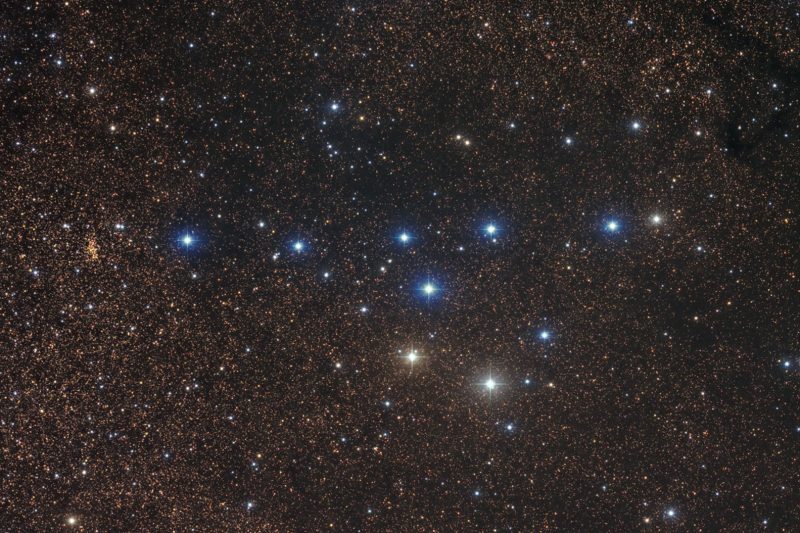
On any evening from July until about November – if you have a dark sky – you can look within the famous Summer Triangle for a tiny but recognizable cluster of stars. Most people call it the Coathanger cluster. Two other names are Brocchi’s cluster and Collinder 399. The Coathanger is a tiny asterism, or pattern of stars within a larger constellation.
It isn’t a true open star cluster, where the stars are loosely bound together by gravity. Instead, these stars only appear close from our perspective. In reality, they’re physically unrelated.
The Coathanger cluster does look like its namesake, making it easy to spot with binoculars and a dark sky. But you have to know just where to look. It’s visible from both the Northern and Southern Hemispheres.
Coathanger cluster within the Summer Triangle
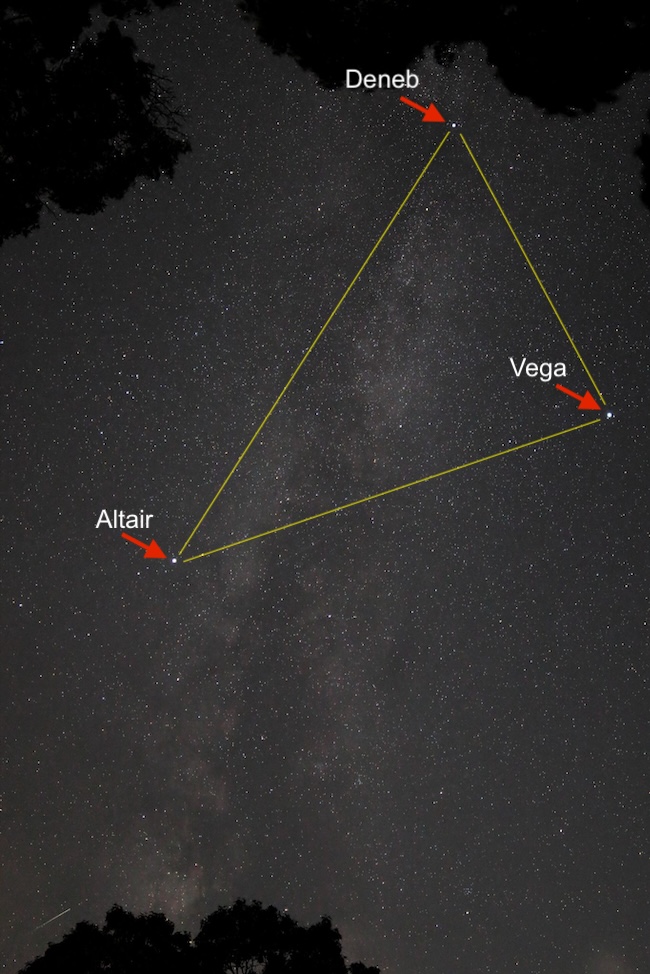
Do you already know the Summer Triangle stars? If not, click here. The Summer Triangle is easy to spot as a large triangle in the east on northern summer evenings. Three bright stars mark its corners: Deneb in the constellation Cygnus the Swan, Vega in Lyra the Harp, and Altair in Aquila the Eagle.
The Milky Way – the edgewise view into the flat disk of our galaxy – runs right through the Summer Triangle. So there are many beautiful little clusters here, plus, of course, the great and glorious Dark Rift of the Milky Way.
If you can find the Summer Triangle, you can find the Coathanger. Just be sure to look from a dark rural location, and have some binoculars handy. The cluster is located along a line between two Triangle stars, Vega and Altair. The image below illustrates the view.
View at EarthSky Community Photos. | Steven Bellavia captured this image from New York on September 1, 2024, and wrote: “The Milky Way, the Summer Triangle and a shooting star.” Thank you, Steven.
Albireo can help you find the Coathanger
To find the Coathanger, you first need to find a slightly fainter star: beloved Albireo. This star is located in the midst of the Summer Triangle. It’s also seen as the bottom of a second asterism within the Summer Triangle, called the Northern Cross.
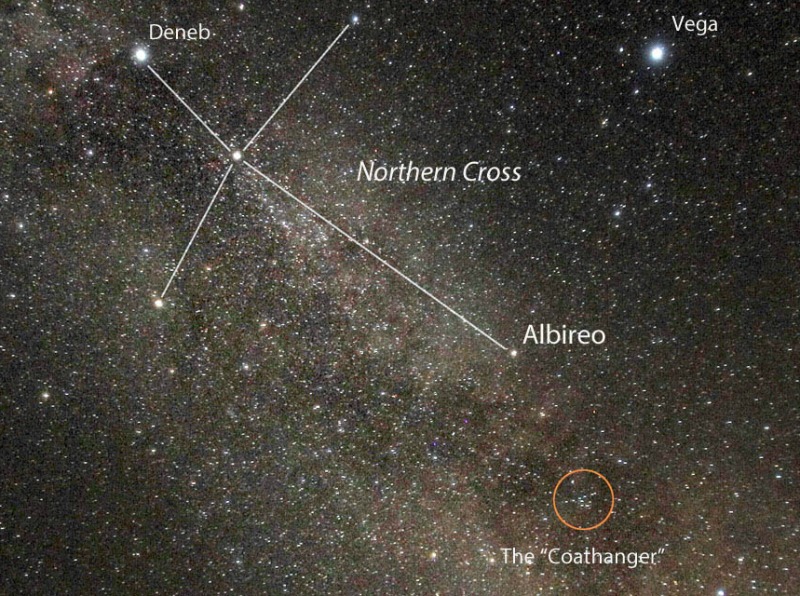
Albireo is found at the base of the Northern Cross. See it, in the photo below?
The Northern Cross, with the beloved double star Albireo at its base. The little Coathanger cluster is nearby. Image via Bob King/ Astro Bob. Used with permission.
Albireo to Alpha Vulpeculae to the Coathanger
Got Albireo? Now for some specifics on finding the Coathanger. With binoculars, look for the brightest star in the vicinity of Albireo. That star is called Alpha Vulpeculae, which appears as a double star through binoculars (though the two stars are not gravitationally bound).
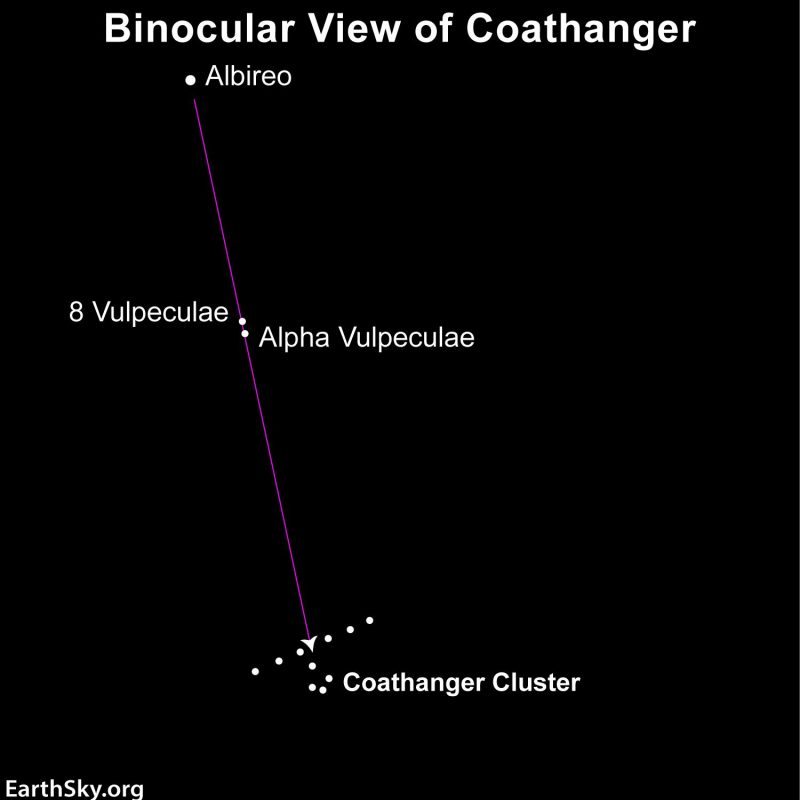
Draw an imaginary line from Albireo through Alpha Vulpeculae to locate the Coathanger. In most binoculars, Alpha Vulpeculae and the Coathanger fit within the same binocular field of view, though just barely.
Notice that six stars form the bar of the Coathanger, while four stars make up the hook. From mid-northern latitudes, the Coathanger often appears upside-down. That’s why some people call it the Ski Lift.
Star-hop from the star Albireo to Alpha Vulpeculae to the Coathanger cluster.An imaginary line – drawn in purple on this chart – from the star Albireo and through the star Alpha Vulpeculae takes you to the Coathanger. Image via IAU. Used with permission.
When should you look?
Our sky chart above shows the stars as they appear from the Northern Hemisphere in middle July around midnight (1 a.m. daylight saving time).
Because the stars return to the same place in the sky some two hours earlier with each passing month, this sky chart also shows star positions for about 10 p.m. (11 p.m. daylight time) in mid-August, 8 p.m. (9 p.m. daylight time) in mid-September and 6 p.m (7 p.m daylight time) in mid-October.
Since these stars shine from south to overhead at these times (as seen from the Northern Hemisphere), you might want to sprawl out on a reclining lawn chair, with your feet pointing southward. A reclining position saves neck strain.
The Coathanger’s position is RA: 19h 26.47′; Dec: 20o 11.93′
Bottom line: Star-hop to the Coathanger – a tiny asterism that really looks like its namesake – via the stars Albireo and Alpha Vulpeculae.
On any evening from July until about November – if you have a dark sky – you can look within the famous Summer Triangle for a tiny but recognizable cluster of stars. Most people call it the Coathanger cluster. Two other names are Brocchi’s cluster and Collinder 399. The Coathanger is a tiny asterism, or pattern of stars within a larger constellation.
It isn’t a true open star cluster, where the stars are loosely bound together by gravity. Instead, these stars only appear close from our perspective. In reality, they’re physically unrelated.
The Coathanger cluster does look like its namesake, making it easy to spot with binoculars and a dark sky. But you have to know just where to look. It’s visible from both the Northern and Southern Hemispheres.
Coathanger cluster within the Summer Triangle
Do you already know the Summer Triangle stars? If not, click here. The Summer Triangle is easy to spot as a large triangle in the east on northern summer evenings. Three bright stars mark its corners: Deneb in the constellation Cygnus the Swan, Vega in Lyra the Harp, and Altair in Aquila the Eagle.
The Milky Way – the edgewise view into the flat disk of our galaxy – runs right through the Summer Triangle. So there are many beautiful little clusters here, plus, of course, the great and glorious Dark Rift of the Milky Way.
If you can find the Summer Triangle, you can find the Coathanger. Just be sure to look from a dark rural location, and have some binoculars handy. The cluster is located along a line between two Triangle stars, Vega and Altair. The image below illustrates the view.
View at EarthSky Community Photos. | Steven Bellavia captured this image from New York on September 1, 2024, and wrote: “The Milky Way, the Summer Triangle and a shooting star.” Thank you, Steven.
Albireo can help you find the Coathanger
To find the Coathanger, you first need to find a slightly fainter star: beloved Albireo. This star is located in the midst of the Summer Triangle. It’s also seen as the bottom of a second asterism within the Summer Triangle, called the Northern Cross.
Albireo is found at the base of the Northern Cross. See it, in the photo below?
The Northern Cross, with the beloved double star Albireo at its base. The little Coathanger cluster is nearby. Image via Bob King/ Astro Bob. Used with permission.
Albireo to Alpha Vulpeculae to the Coathanger
Got Albireo? Now for some specifics on finding the Coathanger. With binoculars, look for the brightest star in the vicinity of Albireo. That star is called Alpha Vulpeculae, which appears as a double star through binoculars (though the two stars are not gravitationally bound).
Draw an imaginary line from Albireo through Alpha Vulpeculae to locate the Coathanger. In most binoculars, Alpha Vulpeculae and the Coathanger fit within the same binocular field of view, though just barely.
Notice that six stars form the bar of the Coathanger, while four stars make up the hook. From mid-northern latitudes, the Coathanger often appears upside-down. That’s why some people call it the Ski Lift.
Star-hop from the star Albireo to Alpha Vulpeculae to the Coathanger cluster.An imaginary line – drawn in purple on this chart – from the star Albireo and through the star Alpha Vulpeculae takes you to the Coathanger. Image via IAU. Used with permission.
When should you look?
Our sky chart above shows the stars as they appear from the Northern Hemisphere in middle July around midnight (1 a.m. daylight saving time).
Because the stars return to the same place in the sky some two hours earlier with each passing month, this sky chart also shows star positions for about 10 p.m. (11 p.m. daylight time) in mid-August, 8 p.m. (9 p.m. daylight time) in mid-September and 6 p.m (7 p.m daylight time) in mid-October.
Since these stars shine from south to overhead at these times (as seen from the Northern Hemisphere), you might want to sprawl out on a reclining lawn chair, with your feet pointing southward. A reclining position saves neck strain.
The Coathanger’s position is RA: 19h 26.47′; Dec: 20o 11.93′
Bottom line: Star-hop to the Coathanger – a tiny asterism that really looks like its namesake – via the stars Albireo and Alpha Vulpeculae.
Astronomers have found a hidden planet orbiting the star Beta Pictoris. This star, 63 light-years away in the southern constellation Pictor, was already known to have 2 planets. This 3rd planet is now the faintest ever imaged from Earth. Video via ESO.
Beta Pictoris is famous as a star system with planets, comets and asteroids still in the process of forming. It’s a young star system, about 20 million years old, which first came to astronomers’ attention because of the thick debris disk around it. Then, in 2008, astronomers discovered the first planet orbiting Beta Pictoris, followed by a second planet in 2019. And in 2024, astronomers said they found evidence of a giant asteroid collision around the star.
Now, on July 15, 2026, the European Southern Observatory has said that astronomers found a third planet around Beta Pictoris that has been hiding in our images all along.
The team of astronomers found the planet using the European Southern Observatory’s Very Large Telescope in Chile. The planet is named Beta Pictoris d (the first two being named Beta Pictoris b and Beta Pictoris c). The discovery was a surprise to astronomers, who were just trying to take a closer look at Beta Pictoris b. The newly discovered planet is 100 times fainter than Beta Pictoris b. And that makes it the faintest planet ever imaged from Earth.
This was a serendipitous discovery. We initially wanted to look more at a known planet in the system, Beta Pictoris b, to see how it changed over time.
The astronomers published their peer-reviewed paper in The Astrophysical Journal Letters on July 15, 2026.
A surprise at Beta Pictoris
There’s something else there, did you see it?
That was what co-author Markus Bonse of ESO said when he saw the data from Beta Pictoris. But to confirm their “eureka” moment, the team didn’t need to take new observations. Astronomers have already well-documented the Beta Pictoris system. So they simply went back to older images from observatories such as SPHERE and the Webb space telescope. They spotted Beta Pictoris d in images going back 11 years.
Co-author Jayne Birkby of the University of Oxford said:
Planet d, it seems, has been playing a game of hide-and-seek with us for over a decade and only now can we say ‘found you!’
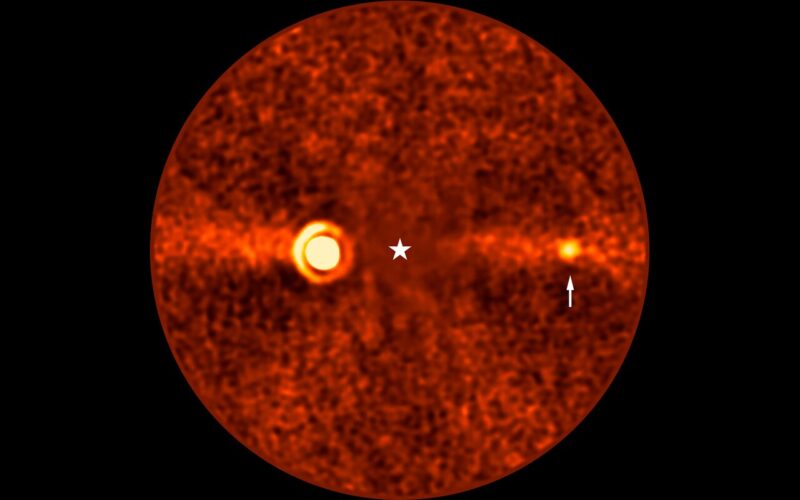
This is the hidden planet (indicated by arrow) around the star Beta Pictoris. The star icon marks the spot where astronomers blocked the star’s light. The larger mass of light at the left is the planet Beta Pictoris b. Another planet, Beta Pictoris c, is too close to the star to see in this image. The background noise in the image is because the star is surrounded by a large disk of material leftover from the formation of its planets. Image via ESO/ B. Sutlieff, M. Bonse et al.
What is the new planet like?
The star system Beta Pictoris lies 63 light-years away in the southern constellation Pictor. The two previously known planets are both gas giant planets with about 10 times the mass of Jupiter.
The new planet, Beta Pictoris d, is also a gas giant. But this planet is only 2.4 times more massive than Jupiter. It’s farther from its home star than planets b and c, and therefore it’s cold and faint.
Directly imaging multiple planets at this star is a big deal. In fact, it’s only the second star system that has had more than two planets directly imaged. The other star system with this honor is HR 8799.
Sutlieff said:
Systems with multiple directly imaged exoplanets are the ‘holy grails’ of discoveries, because they can teach us a lot about what different exoplanets are like in the same formation environment.
The discovery helps solve a mystery at Beta Pictoris. Previously, astronomers had trouble explaining the shape of the debris disk leftover from planets forming around this star. But the new planet has exactly the right mass and position to account for the shape of the debris disk.
What’s next? Perhaps more hidden planets will come to light in other star systems. The researchers think there are likely more planets hiding within archival images.
Bottom line: Astronomers have found a hidden planet orbiting the star Beta Pictoris. This previously unseen world is now the faintest planet ever imaged from Earth.
Astronomers have found a hidden planet orbiting the star Beta Pictoris. This star, 63 light-years away in the southern constellation Pictor, was already known to have 2 planets. This 3rd planet is now the faintest ever imaged from Earth. Video via ESO.
Beta Pictoris is famous as a star system with planets, comets and asteroids still in the process of forming. It’s a young star system, about 20 million years old, which first came to astronomers’ attention because of the thick debris disk around it. Then, in 2008, astronomers discovered the first planet orbiting Beta Pictoris, followed by a second planet in 2019. And in 2024, astronomers said they found evidence of a giant asteroid collision around the star.
Now, on July 15, 2026, the European Southern Observatory has said that astronomers found a third planet around Beta Pictoris that has been hiding in our images all along.
The team of astronomers found the planet using the European Southern Observatory’s Very Large Telescope in Chile. The planet is named Beta Pictoris d (the first two being named Beta Pictoris b and Beta Pictoris c). The discovery was a surprise to astronomers, who were just trying to take a closer look at Beta Pictoris b. The newly discovered planet is 100 times fainter than Beta Pictoris b. And that makes it the faintest planet ever imaged from Earth.
This was a serendipitous discovery. We initially wanted to look more at a known planet in the system, Beta Pictoris b, to see how it changed over time.
The astronomers published their peer-reviewed paper in The Astrophysical Journal Letters on July 15, 2026.
A surprise at Beta Pictoris
There’s something else there, did you see it?
That was what co-author Markus Bonse of ESO said when he saw the data from Beta Pictoris. But to confirm their “eureka” moment, the team didn’t need to take new observations. Astronomers have already well-documented the Beta Pictoris system. So they simply went back to older images from observatories such as SPHERE and the Webb space telescope. They spotted Beta Pictoris d in images going back 11 years.
Co-author Jayne Birkby of the University of Oxford said:
Planet d, it seems, has been playing a game of hide-and-seek with us for over a decade and only now can we say ‘found you!’
This is the hidden planet (indicated by arrow) around the star Beta Pictoris. The star icon marks the spot where astronomers blocked the star’s light. The larger mass of light at the left is the planet Beta Pictoris b. Another planet, Beta Pictoris c, is too close to the star to see in this image. The background noise in the image is because the star is surrounded by a large disk of material leftover from the formation of its planets. Image via ESO/ B. Sutlieff, M. Bonse et al.
What is the new planet like?
The star system Beta Pictoris lies 63 light-years away in the southern constellation Pictor. The two previously known planets are both gas giant planets with about 10 times the mass of Jupiter.
The new planet, Beta Pictoris d, is also a gas giant. But this planet is only 2.4 times more massive than Jupiter. It’s farther from its home star than planets b and c, and therefore it’s cold and faint.
Directly imaging multiple planets at this star is a big deal. In fact, it’s only the second star system that has had more than two planets directly imaged. The other star system with this honor is HR 8799.
Sutlieff said:
Systems with multiple directly imaged exoplanets are the ‘holy grails’ of discoveries, because they can teach us a lot about what different exoplanets are like in the same formation environment.
The discovery helps solve a mystery at Beta Pictoris. Previously, astronomers had trouble explaining the shape of the debris disk leftover from planets forming around this star. But the new planet has exactly the right mass and position to account for the shape of the debris disk.
What’s next? Perhaps more hidden planets will come to light in other star systems. The researchers think there are likely more planets hiding within archival images.
Bottom line: Astronomers have found a hidden planet orbiting the star Beta Pictoris. This previously unseen world is now the faintest planet ever imaged from Earth.

Wildfire smoke from Canada and northern Minnesota flowed eastward on Wednesday, July 15, 2026. Skies turned gray and even orange. Forecasters expect smoky skies to continue into the weekend. Image via NOAA/ CIRA.
Wildfire smoke is choking Canada, Great Lakes and Northeast
Canadian wildfires had a slow start in 2026, but now they’re making up for their quiet stretch. According to NOAA:
On July 13, 2026, numerous wildfires exploded in far northern Minnesota and western Ontario, threatening many communities in the state and province. Thick wildfire smoke billowed out from the flames and spread across the skies over North America during the following days. This smoke has caused air quality issues in the United States and Canada, with thick haze enveloping the skies above major cities such as Toronto, Boston and New York City.
There are currently more than 800 wildfires burning across Canada. The smoke started pouring into northern tier states in earnest on Wednesday. Live cams from places such as Mackinac Island in Michigan and Niagara Falls showed areas choking with smoke.
The smoke should become more widespread on Thursday, pushing into northeastern states along with dropping southward. And weather models show the smoke should continue into Friday and Saturday as well.
Air quality forecast map for Thursday, July 16, 2026. Image via EPA/ Airnow.gov.
How is the air near you?
To see what the air quality index, or AQI, is in the United States, you can visit Airnow.gov. On Tuesday night, Marquette, Michigan, had an AQI of 795. Hazardous conditions start at 300. Duluth, Minnesota, had 682.
If you’re in Canada, you can find out your air quality index at IQair.com.
Exposure to wildfire smoke can cause coughing, shortness of breath and asthma attacks. It also can put a strain on your heart. To protect yourself from wildfire smoke, limit your time outdoors. If possible, stay inside with the doors and windows shut. Find more tips here.
The high temperatures are exacerbating the problem for those seeking relief. If you do not have air conditioning and are facing poor air quality, look for a cooling shelter near you.
3/ When wildfire smoke occurs during heatwaves in areas where a portion of the population doesn't have access to air conditioning, people face the dilemma of opening their windows to avoid heatstroke, but searing their lungs with smoke. Smoke + heat can become even deadlier than either alone.
There were scenes on social media of fires threatening people in Canada along with views of gray and orange skies in the U.S. See some of the scenes below.
Wow! This footage shows the view from inside a train as it becomes surrounded by raging wildfire flames near Armstrong, Ontario. Canadian National Railway says the crew all got out safely.
The air in my hometown right now. Ontario has some of the worst air quality in the world due to wildfire smoke. It is unnatural lighting outside at the moment. Stay inside if you can. The air is crunchy and smells like wood smoke. Take care, all.????
Bottom line: Wildfire smoke is pouring across Canada and into the U.S. in the Great Lakes region and northeastern states. These areas will continue to see poor air quality into the weekend.
Wildfire smoke from Canada and northern Minnesota flowed eastward on Wednesday, July 15, 2026. Skies turned gray and even orange. Forecasters expect smoky skies to continue into the weekend. Image via NOAA/ CIRA.
Wildfire smoke is choking Canada, Great Lakes and Northeast
Canadian wildfires had a slow start in 2026, but now they’re making up for their quiet stretch. According to NOAA:
On July 13, 2026, numerous wildfires exploded in far northern Minnesota and western Ontario, threatening many communities in the state and province. Thick wildfire smoke billowed out from the flames and spread across the skies over North America during the following days. This smoke has caused air quality issues in the United States and Canada, with thick haze enveloping the skies above major cities such as Toronto, Boston and New York City.
There are currently more than 800 wildfires burning across Canada. The smoke started pouring into northern tier states in earnest on Wednesday. Live cams from places such as Mackinac Island in Michigan and Niagara Falls showed areas choking with smoke.
The smoke should become more widespread on Thursday, pushing into northeastern states along with dropping southward. And weather models show the smoke should continue into Friday and Saturday as well.
Air quality forecast map for Thursday, July 16, 2026. Image via EPA/ Airnow.gov.
How is the air near you?
To see what the air quality index, or AQI, is in the United States, you can visit Airnow.gov. On Tuesday night, Marquette, Michigan, had an AQI of 795. Hazardous conditions start at 300. Duluth, Minnesota, had 682.
If you’re in Canada, you can find out your air quality index at IQair.com.
Exposure to wildfire smoke can cause coughing, shortness of breath and asthma attacks. It also can put a strain on your heart. To protect yourself from wildfire smoke, limit your time outdoors. If possible, stay inside with the doors and windows shut. Find more tips here.
The high temperatures are exacerbating the problem for those seeking relief. If you do not have air conditioning and are facing poor air quality, look for a cooling shelter near you.
3/ When wildfire smoke occurs during heatwaves in areas where a portion of the population doesn't have access to air conditioning, people face the dilemma of opening their windows to avoid heatstroke, but searing their lungs with smoke. Smoke + heat can become even deadlier than either alone.
There were scenes on social media of fires threatening people in Canada along with views of gray and orange skies in the U.S. See some of the scenes below.
Wow! This footage shows the view from inside a train as it becomes surrounded by raging wildfire flames near Armstrong, Ontario. Canadian National Railway says the crew all got out safely.
The air in my hometown right now. Ontario has some of the worst air quality in the world due to wildfire smoke. It is unnatural lighting outside at the moment. Stay inside if you can. The air is crunchy and smells like wood smoke. Take care, all.????
Bottom line: Wildfire smoke is pouring across Canada and into the U.S. in the Great Lakes region and northeastern states. These areas will continue to see poor air quality into the weekend.