On Earth, nothing could feel as familiar as the passing of our seasons. And our days are steady, too — 24 hours, over and over, all our lives. But not so on Mars. Different world, just one step outward from Earth. Same laws of nature … but alien all the same. In this livestream, EarthSky’s Deborah Byrd explores the seasons on the Red Planet — and how even small differences in time and orbit can reshape our perception of a world. Watch in the player above or on YouTube.
Summer solstice in Mars’ southern hemisphere
Earth’s next solstice will fall at 8:25 UTC on June 21, 2026. It’ll be a summer solstice for the Northern Hemisphere (and a winter solstice for the Southern Hemisphere). It’ll happen when Earth’s south pole is tilted most toward the sun.
Like Earth, Mars tilts on its axis with respect to its orbit around the sun. It tilts by about 25 degrees, in contrast to Earth’s 23.5 degrees. So Mars has equinoxes and solstices as well. And Mars’ summer solstice for its southern hemisphere arrives on April 25, 2026.
Like Earth, Mars has 4 seasons
Mars takes 687 Earth-days to orbit the sun once. That’s almost 2 Earth-years. So each season on Mars – winter, spring, summer, fall – lasts roughly twice as long as a season on Earth.
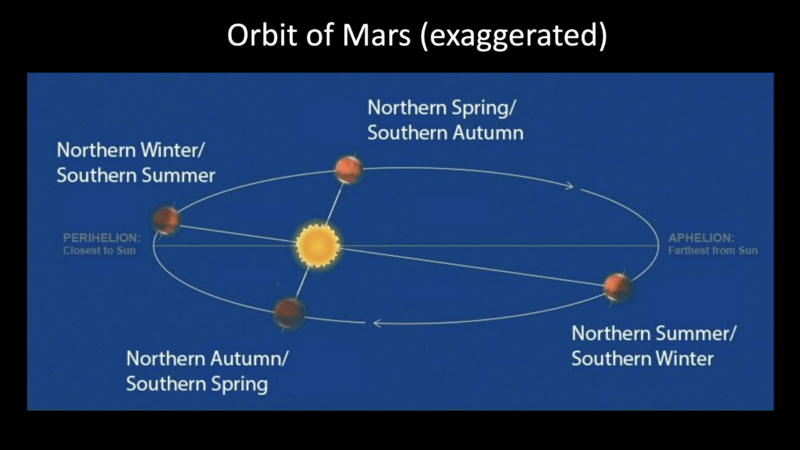
And, meanwhile, although the image below is exaggerated, the orbit of Mars is more squashed than that of Earth. Astronomers say it’s more elliptical. Mars is farther from the sun during southern winter … and closer during southern summer. So the Mars southern hemisphere has shorter, hotter, more extreme seasons.
So – now, in April 2026, as Mars’ northern hemisphere of is tipping into the deepest part of winter – its southern hemisphere is celebrating summer. Of course, nothing is blooming. To date, scientists haven’t confirmed life on Mars, today or in the past. But there’s still seasonal change, just as there is in the most Mars-like places on Earth … Antarctica, for example.
Mars has 4 seasons, just as Earth does. But the Mars seasons last twice as long, because Mars takes 2 years to orbit the sun once. Summer solstice for Mars southern hemisphere falls on April 25, 2026. And the southern hemisphere has “harsher” seasons than in the north. During southern winter, Mars is farthest away from the sun in its elliptical orbit. Winter in Mars’ southern hemisphere is colder, because then Mars is the farthest away from the sun, moving more slowly in its orbit. Going from a winter to warmer spring can be quite dramatic. Spring for the rovers on Mars is the start of the dust season. By summer, global dust storms can blanket the whole planet. Image via NASA.
The season of dust
And on Mars, the seasons aren’t equal. That’s because Mars’ seasons are more lopsided than on Earth. Mars’ orbit is more squashed (more elliptical) than Earth’s. So its closest points to the sun are relatively closer than Earth’s. And Mars’ closest point to the sun – its perihelion – always happens near the Mars southern summer. In 2026, perihelion for Mars happened in late March.
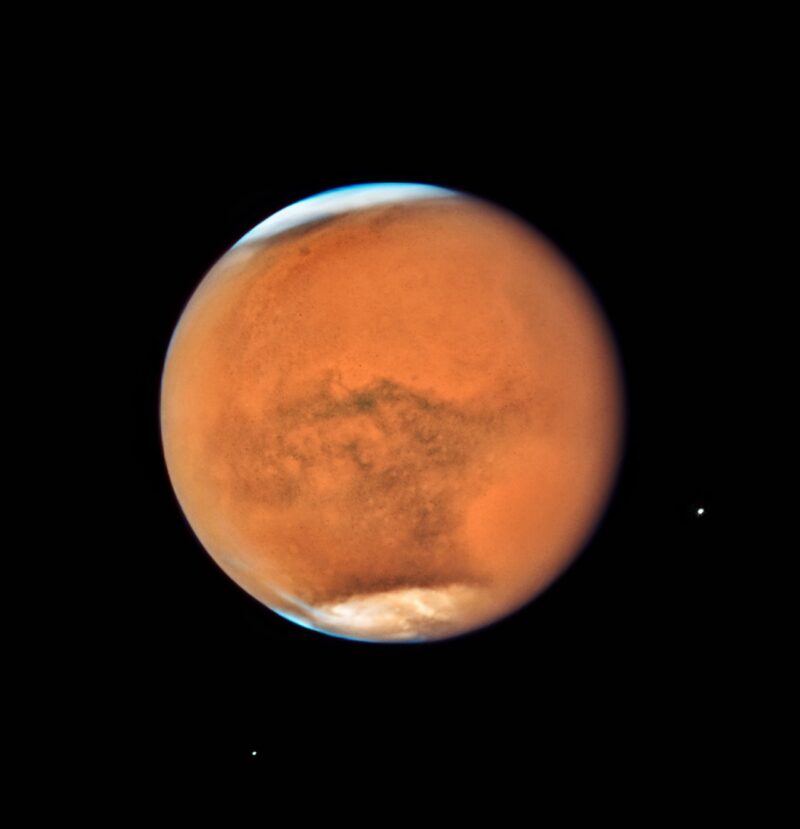
So Mars is relatively closest to the sun, moving fastest in orbit, around the time of late spring or early summer in its southern hemisphere. That’s why the Mars southern summers are shorter, hotter, and more volatile than in the north. That’s when dust storms can kick up, sometimes growing large enough to wrap around the entire planet. In the image below – from the Hubble Space Telescope in 2018 – you can see what that looks like. No surface features are visible because – for some months in 2018, centered on the Martian southern summer – Mars was shrouded in dust.
In mid-July 2018, the NASA/ESA Hubble Space Telescope observed Mars, only 13 days before the planet made its closest approach to Earth. While previous images showed detailed surface features of the planet, this image is dominated by a gigantic sandstorm enshrouding the entire planet. Each Martian year, moderately large dust storms cover continent-sized areas and last for weeks at a time. Global dust storms — lasting for weeks or months — tend to happen during the spring and summer in the southern hemisphere, when Mars is closest to the Sun and heating is at a maximum, leading to greater generation of winds. While spacecraft orbiting Mars can study the storm’s behaviour at lower altitudes, Hubble observations allow astronomers to study changes in the higher atmosphere. The combined observations will help planetary scientists to build a better understanding of how these global storms arise. Image via ESA/Hubble.
What’s happening on Mars now?
As of April 2026, atmospheric conditions on the Red Planet are relatively clear.
Current Martian weather stats – formed from recent data from the Perseverance and Curiosity rovers (the only two rovers active on Mars now) indicate “very dusty conditions” locally at certain craters. But these are localized events. And Mars is now entering a season where localized dust activity typically increases.
On average, global storms happen once every 3 to 4 Mars-years. That’s about every 5-and-a-half to 8 Earth-years. We haven’t had a a truly huge, global Mars dust storm since 2018.
So the “watch” is officially on for Mars dust in 2026.
And the current Martian season – summer in the southern hemisphere, officially starting on April 25, 2026 – is the primary reason for anticipation.
Bottom line: The summer solstice on Mars’ southern hemisphere happens on April 25, 2026. At that time, the south pole of Mars is pointed most directly toward the sun.
On Earth, nothing could feel as familiar as the passing of our seasons. And our days are steady, too — 24 hours, over and over, all our lives. But not so on Mars. Different world, just one step outward from Earth. Same laws of nature … but alien all the same. In this livestream, EarthSky’s Deborah Byrd explores the seasons on the Red Planet — and how even small differences in time and orbit can reshape our perception of a world. Watch in the player above or on YouTube.
Summer solstice in Mars’ southern hemisphere
Earth’s next solstice will fall at 8:25 UTC on June 21, 2026. It’ll be a summer solstice for the Northern Hemisphere (and a winter solstice for the Southern Hemisphere). It’ll happen when Earth’s south pole is tilted most toward the sun.
Like Earth, Mars tilts on its axis with respect to its orbit around the sun. It tilts by about 25 degrees, in contrast to Earth’s 23.5 degrees. So Mars has equinoxes and solstices as well. And Mars’ summer solstice for its southern hemisphere arrives on April 25, 2026.
Like Earth, Mars has 4 seasons
Mars takes 687 Earth-days to orbit the sun once. That’s almost 2 Earth-years. So each season on Mars – winter, spring, summer, fall – lasts roughly twice as long as a season on Earth.
And, meanwhile, although the image below is exaggerated, the orbit of Mars is more squashed than that of Earth. Astronomers say it’s more elliptical. Mars is farther from the sun during southern winter … and closer during southern summer. So the Mars southern hemisphere has shorter, hotter, more extreme seasons.
So – now, in April 2026, as Mars’ northern hemisphere of is tipping into the deepest part of winter – its southern hemisphere is celebrating summer. Of course, nothing is blooming. To date, scientists haven’t confirmed life on Mars, today or in the past. But there’s still seasonal change, just as there is in the most Mars-like places on Earth … Antarctica, for example.
Mars has 4 seasons, just as Earth does. But the Mars seasons last twice as long, because Mars takes 2 years to orbit the sun once. Summer solstice for Mars southern hemisphere falls on April 25, 2026. And the southern hemisphere has “harsher” seasons than in the north. During southern winter, Mars is farthest away from the sun in its elliptical orbit. Winter in Mars’ southern hemisphere is colder, because then Mars is the farthest away from the sun, moving more slowly in its orbit. Going from a winter to warmer spring can be quite dramatic. Spring for the rovers on Mars is the start of the dust season. By summer, global dust storms can blanket the whole planet. Image via NASA.
The season of dust
And on Mars, the seasons aren’t equal. That’s because Mars’ seasons are more lopsided than on Earth. Mars’ orbit is more squashed (more elliptical) than Earth’s. So its closest points to the sun are relatively closer than Earth’s. And Mars’ closest point to the sun – its perihelion – always happens near the Mars southern summer. In 2026, perihelion for Mars happened in late March.
So Mars is relatively closest to the sun, moving fastest in orbit, around the time of late spring or early summer in its southern hemisphere. That’s why the Mars southern summers are shorter, hotter, and more volatile than in the north. That’s when dust storms can kick up, sometimes growing large enough to wrap around the entire planet. In the image below – from the Hubble Space Telescope in 2018 – you can see what that looks like. No surface features are visible because – for some months in 2018, centered on the Martian southern summer – Mars was shrouded in dust.
In mid-July 2018, the NASA/ESA Hubble Space Telescope observed Mars, only 13 days before the planet made its closest approach to Earth. While previous images showed detailed surface features of the planet, this image is dominated by a gigantic sandstorm enshrouding the entire planet. Each Martian year, moderately large dust storms cover continent-sized areas and last for weeks at a time. Global dust storms — lasting for weeks or months — tend to happen during the spring and summer in the southern hemisphere, when Mars is closest to the Sun and heating is at a maximum, leading to greater generation of winds. While spacecraft orbiting Mars can study the storm’s behaviour at lower altitudes, Hubble observations allow astronomers to study changes in the higher atmosphere. The combined observations will help planetary scientists to build a better understanding of how these global storms arise. Image via ESA/Hubble.
What’s happening on Mars now?
As of April 2026, atmospheric conditions on the Red Planet are relatively clear.
Current Martian weather stats – formed from recent data from the Perseverance and Curiosity rovers (the only two rovers active on Mars now) indicate “very dusty conditions” locally at certain craters. But these are localized events. And Mars is now entering a season where localized dust activity typically increases.
On average, global storms happen once every 3 to 4 Mars-years. That’s about every 5-and-a-half to 8 Earth-years. We haven’t had a a truly huge, global Mars dust storm since 2018.
So the “watch” is officially on for Mars dust in 2026.
And the current Martian season – summer in the southern hemisphere, officially starting on April 25, 2026 – is the primary reason for anticipation.
Bottom line: The summer solstice on Mars’ southern hemisphere happens on April 25, 2026. At that time, the south pole of Mars is pointed most directly toward the sun.
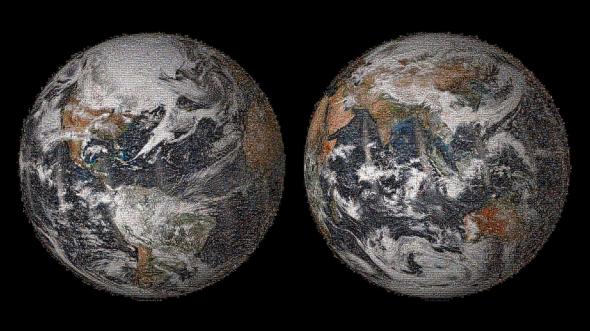
This is NASA’s massive 3.2 gigapixel mosaic of … us. And we look good. It contains more than 36,000 individual photographs from the more than 50,000 images posted around the world on Earth Day, April 22, 2014. Image via NASA.
The first Earth Day – April 22, 1970 – is sometimes said to have marked the beginning of the modern environmental movement.
It predates the U.S. Environmental Protection Agency, for example. It may be hard to imagine it now, but the first Earth Day was a revelation to many. It was a way not only of raising consciousness about environmental issues, but also of bringing together different groups that had been fighting separately against issues including oil spills, pollution from factories and power plants, raw sewage, toxic dumps, pesticides, the loss of wilderness, air pollution and more. At the first Earth Day in 1970, an estimated 20 million Americans participated. They took to the streets, parks and auditoriums to demonstrate for a healthy environment and to participate in teach-ins.
The April 22 date was selected in part because it fell between colleges’ spring break and final exams. And it was also when Arbor Day was observed, a day when people are encouraged to plant trees, which began in Nebraska in 1872.
Since 1970, many important environmental events have happened on Earth Day, including the signing of the Paris Agreement on April 22, 2016.
J. Sterling Morton was a Nebraska pioneer, a writer and editor for Nebraska’s first newspaper, and later secretary of the Nebraska Territory. He advocated planting trees in what was then a dusty and treeless prairie. At a State Board of Agriculture meeting in January 1872, Morton proposed that Nebraska citizens set aside April 10 as a day to plant trees. He suggested offering prizes as incentives for communities and organizations that planted the most trees. It’s said that Nebraskans planted about 1 million trees on that first Arbor Day in 1872. Planting trees remains a common practice in celebrating Earth Day today.
Ten years later, in 1882, Nebraska declared Arbor Day a legal holiday and the date was changed to Morton’s birthday, April 22. Arbor Day became a national observance, and it seemed natural to schedule April 22, 1970 – Arbor Day – as the first Earth Day.
Arbor Day celebration at N.Y. Public School #4, 173rd St. & Fulton Ave., New York. Date unknown. Image via Library of Congress.
Uniting for environmental change
Kathleen Rogers is a former environmental attorney who has led the Earth Day Network since 2001. She frequently comments on environmental issues in the media (CNN, Fox News, NPR, Time, Washington Post, Los Angeles Times). She wrote of Earth Day:
Earth Day is now a global event each year, and we believe that more than 1 billion people in 192 countries now take part in what is the largest civic-focused day of action in the world.
It is a day of political action and civic participation. People march, sign petitions, meet with their elected officials, plant trees, clean up their towns and roads. Corporations and governments use it to make pledges and announce sustainability measures. Faith leaders connect Earth Day with protecting God’s greatest creations, humans, biodiversity, and the planet that we all live on.
Bottom line: Why do we celebrate Earth Day on April 22? The date stems from an earlier observance, Arbor Day. This year’s focus is “Our Power, Our Planet.”
This is NASA’s massive 3.2 gigapixel mosaic of … us. And we look good. It contains more than 36,000 individual photographs from the more than 50,000 images posted around the world on Earth Day, April 22, 2014. Image via NASA.
The first Earth Day – April 22, 1970 – is sometimes said to have marked the beginning of the modern environmental movement.
It predates the U.S. Environmental Protection Agency, for example. It may be hard to imagine it now, but the first Earth Day was a revelation to many. It was a way not only of raising consciousness about environmental issues, but also of bringing together different groups that had been fighting separately against issues including oil spills, pollution from factories and power plants, raw sewage, toxic dumps, pesticides, the loss of wilderness, air pollution and more. At the first Earth Day in 1970, an estimated 20 million Americans participated. They took to the streets, parks and auditoriums to demonstrate for a healthy environment and to participate in teach-ins.
The April 22 date was selected in part because it fell between colleges’ spring break and final exams. And it was also when Arbor Day was observed, a day when people are encouraged to plant trees, which began in Nebraska in 1872.
Since 1970, many important environmental events have happened on Earth Day, including the signing of the Paris Agreement on April 22, 2016.
J. Sterling Morton was a Nebraska pioneer, a writer and editor for Nebraska’s first newspaper, and later secretary of the Nebraska Territory. He advocated planting trees in what was then a dusty and treeless prairie. At a State Board of Agriculture meeting in January 1872, Morton proposed that Nebraska citizens set aside April 10 as a day to plant trees. He suggested offering prizes as incentives for communities and organizations that planted the most trees. It’s said that Nebraskans planted about 1 million trees on that first Arbor Day in 1872. Planting trees remains a common practice in celebrating Earth Day today.
Ten years later, in 1882, Nebraska declared Arbor Day a legal holiday and the date was changed to Morton’s birthday, April 22. Arbor Day became a national observance, and it seemed natural to schedule April 22, 1970 – Arbor Day – as the first Earth Day.
Arbor Day celebration at N.Y. Public School #4, 173rd St. & Fulton Ave., New York. Date unknown. Image via Library of Congress.
Uniting for environmental change
Kathleen Rogers is a former environmental attorney who has led the Earth Day Network since 2001. She frequently comments on environmental issues in the media (CNN, Fox News, NPR, Time, Washington Post, Los Angeles Times). She wrote of Earth Day:
Earth Day is now a global event each year, and we believe that more than 1 billion people in 192 countries now take part in what is the largest civic-focused day of action in the world.
It is a day of political action and civic participation. People march, sign petitions, meet with their elected officials, plant trees, clean up their towns and roads. Corporations and governments use it to make pledges and announce sustainability measures. Faith leaders connect Earth Day with protecting God’s greatest creations, humans, biodiversity, and the planet that we all live on.
Bottom line: Why do we celebrate Earth Day on April 22? The date stems from an earlier observance, Arbor Day. This year’s focus is “Our Power, Our Planet.”
NASA’s Lunar Orbiter 1 took the first Earth image as seen from the vicinity of the moon in 1966. Forty-two years later, NASA released this much higher resolution version reprocessed from the original analog data tapes. Image via Wikimedia. See more Earth images from space below.
To celebrate Earth Day today, enjoy these incredible Earth images from space.
It suddenly struck me that that tiny pea, pretty and blue, was the Earth. I put up my thumb and shut one eye, and my thumb blotted out the planet Earth. I didn’t feel like a giant. I felt very, very small.
– Neil Armstrong, Apollo 11
1. Voyager 1: At 7.2 million miles … and 4 billion miles
Voyager 1’s image of Earth and the moon, September 18, 1977. Image via NASA/ JPL.The famous pale blue dot from Voyager 1 on February 14, 1990. Image via NASA/ JPL.
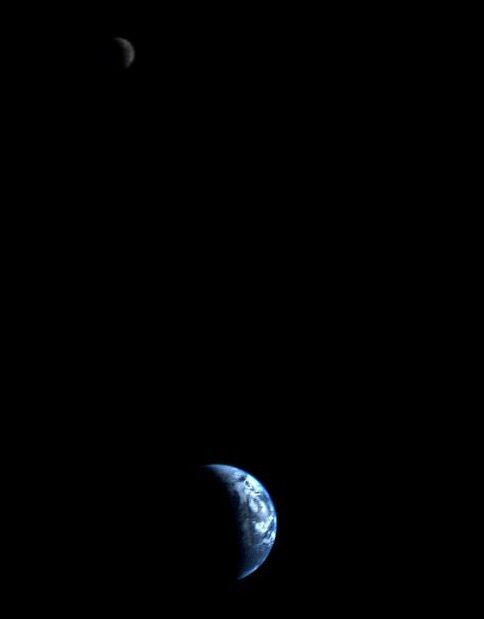
Voyager famously captured two unique views of our home world from afar. The upper image, taken in 1977 from a distance of 7.3 million miles (11.7 million km), showed the full Earth and full moon in a single frame for the first time in history.
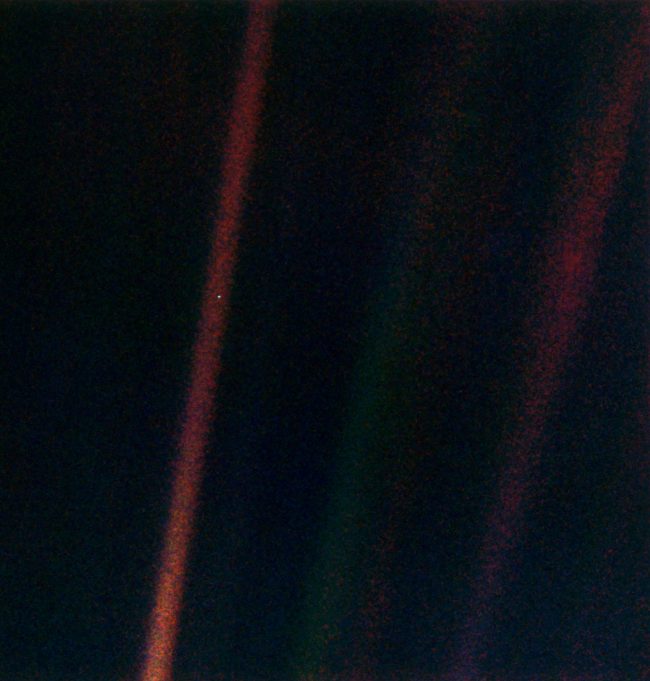
The second image, taken in 1990 as part of a family portrait of our solar system from 4 billion miles (6.4 billion km), shows Earth as a tiny blue speck in a ray of sunlight. This is the famous “Pale Blue Dot” image immortalized by Carl Sagan.
Sagan’s widow, Ann Druyan, said of the image:
This was our willingness to see the Earth as a 1-pixel object in a far greater cosmos. It’s that humility that science gives us. That weans us from our childhood need to be the center of things. And Voyager gave us that image of the Earth that is so heart tugging because you can’t look at that image and not think of how fragile, how fragile our world is. How much we have in common with everyone with whom we share it; our relationship, our relatedness, to everyone on this tiny pixel.
2. Kepler: A bright flashlight in a dark sea of stars
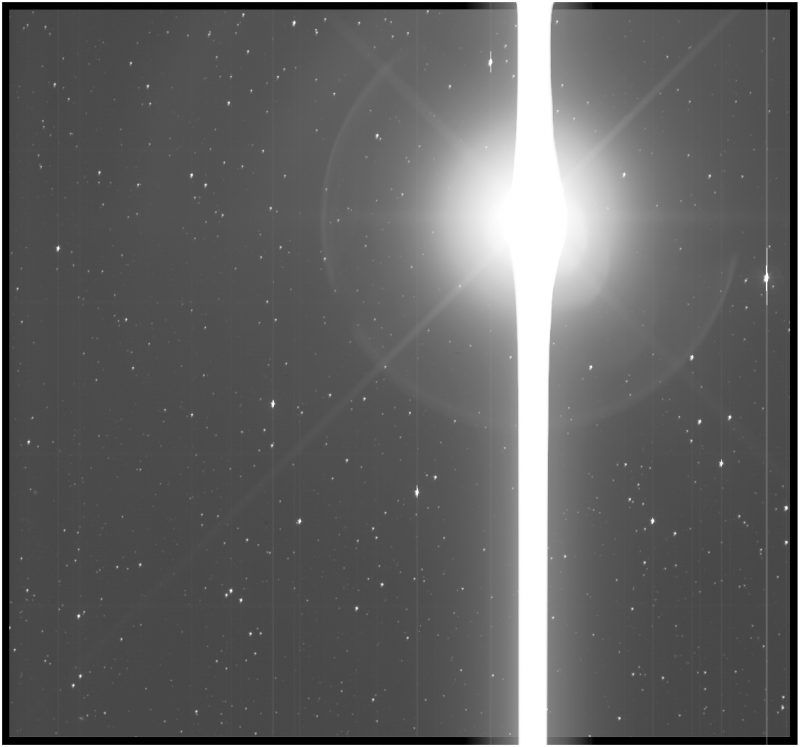
NASA’s Kepler mission captured Earth’s image as it slipped past at a distance of 94 million miles (151 million km). The reflection was so extraordinarily bright that it created a saber-like saturation bleed across the instrument’s sensors, obscuring the neighboring moon.
3. Cassini: Hello and goodbye
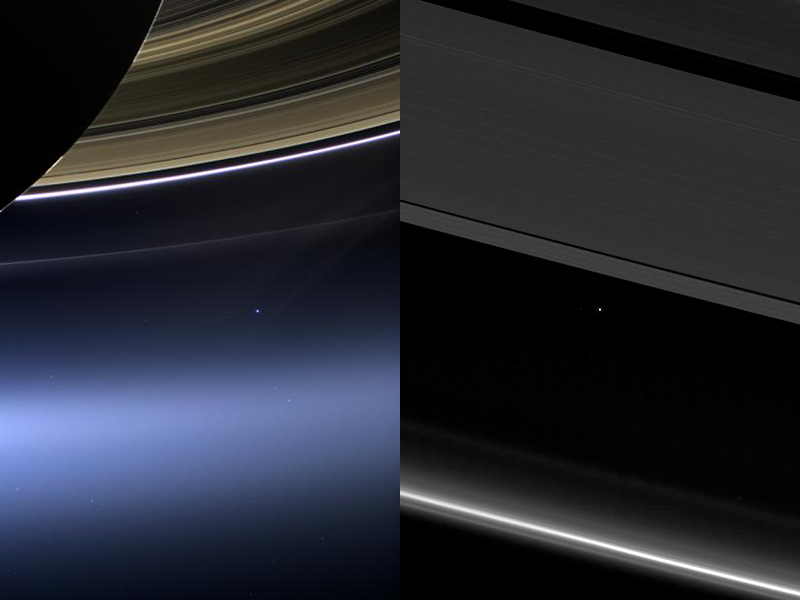
Right, Cassini’s view in 2013. Left, a final look between the rings in 2017. Image via NASA.
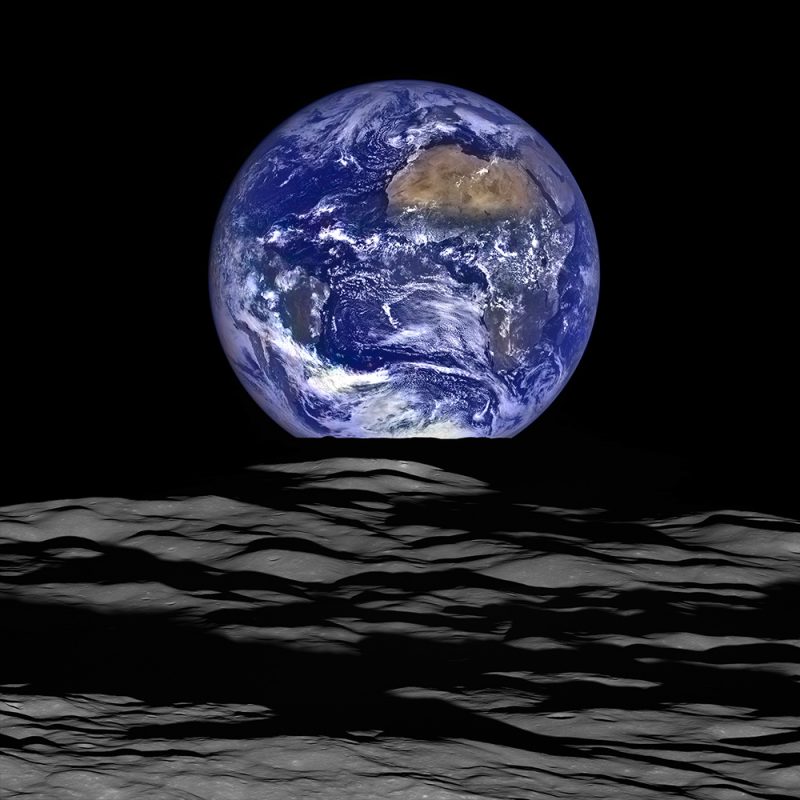
NASA’s Lunar Reconnaissance Orbiter (LRO) captured a unique view of Earth from the spacecraft’s vantage point in orbit around the moon on October 12, 2015. Image via NASA/ Goddard/ Arizona State University.
The image is simply stunning. The image of the Earth evokes the famous Blue Marble image taken by astronaut Harrison Schmitt during Apollo 17 … which also showed Africa prominently in the picture.
NASA’s OSIRIS-REx spacecraft captured this image of the Earth and moon. Image via NASA.
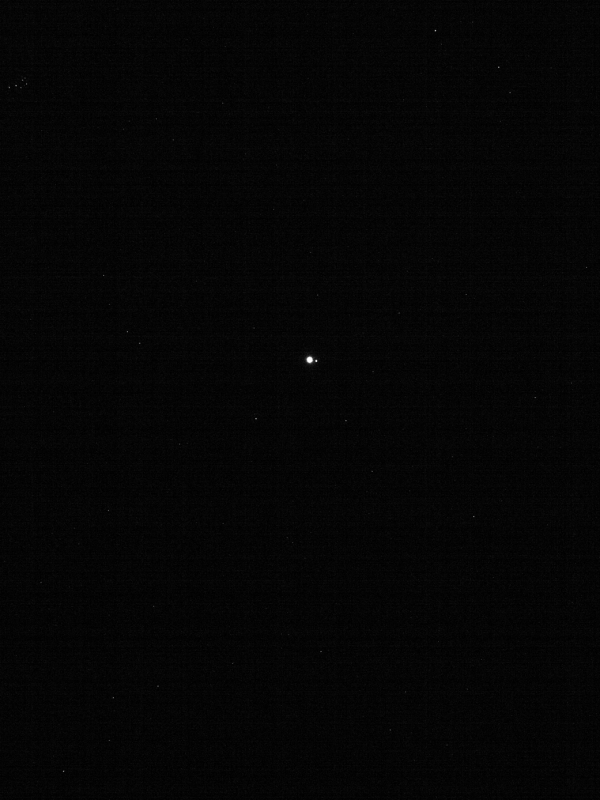
As part of an engineering test, NASA’s OSIRIS-REx spacecraft captured this image of Earth and the moon in January 2018 from a distance of 39.5 million miles (63.6 million km). When the camera acquired the image, the spacecraft was moving away from our home planet at a speed of 19,000 miles per hour (8.5 km per second). Earth is the largest, brightest spot in the center of the image, with the smaller, dimmer moon appearing to the right. Several constellations are also visible in the surrounding space.
6. Curiosity: The view from Mars
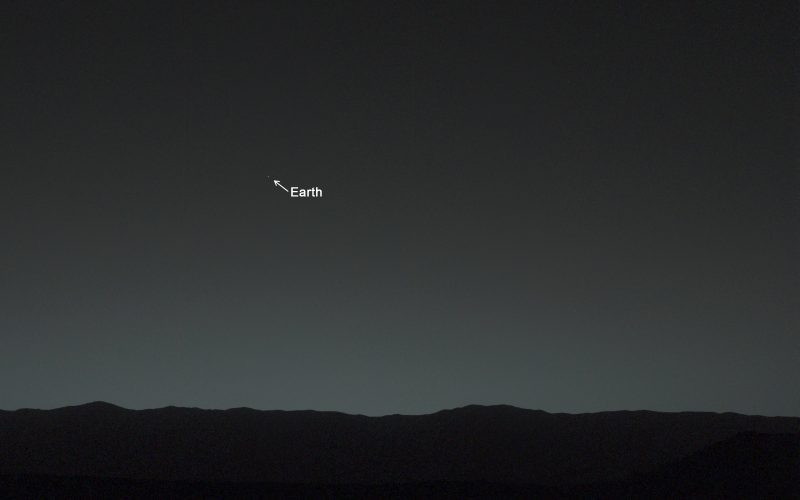
This view of the twilight sky and Martian horizon taken by NASA’s Mars Curiosity rover includes Earth as the brightest point of light in the night sky. Image via NASA/ JPL-Caltech/ MSSS/ TAMU.
Earth and moon from a million miles out. Image via NASA/ NOAA.
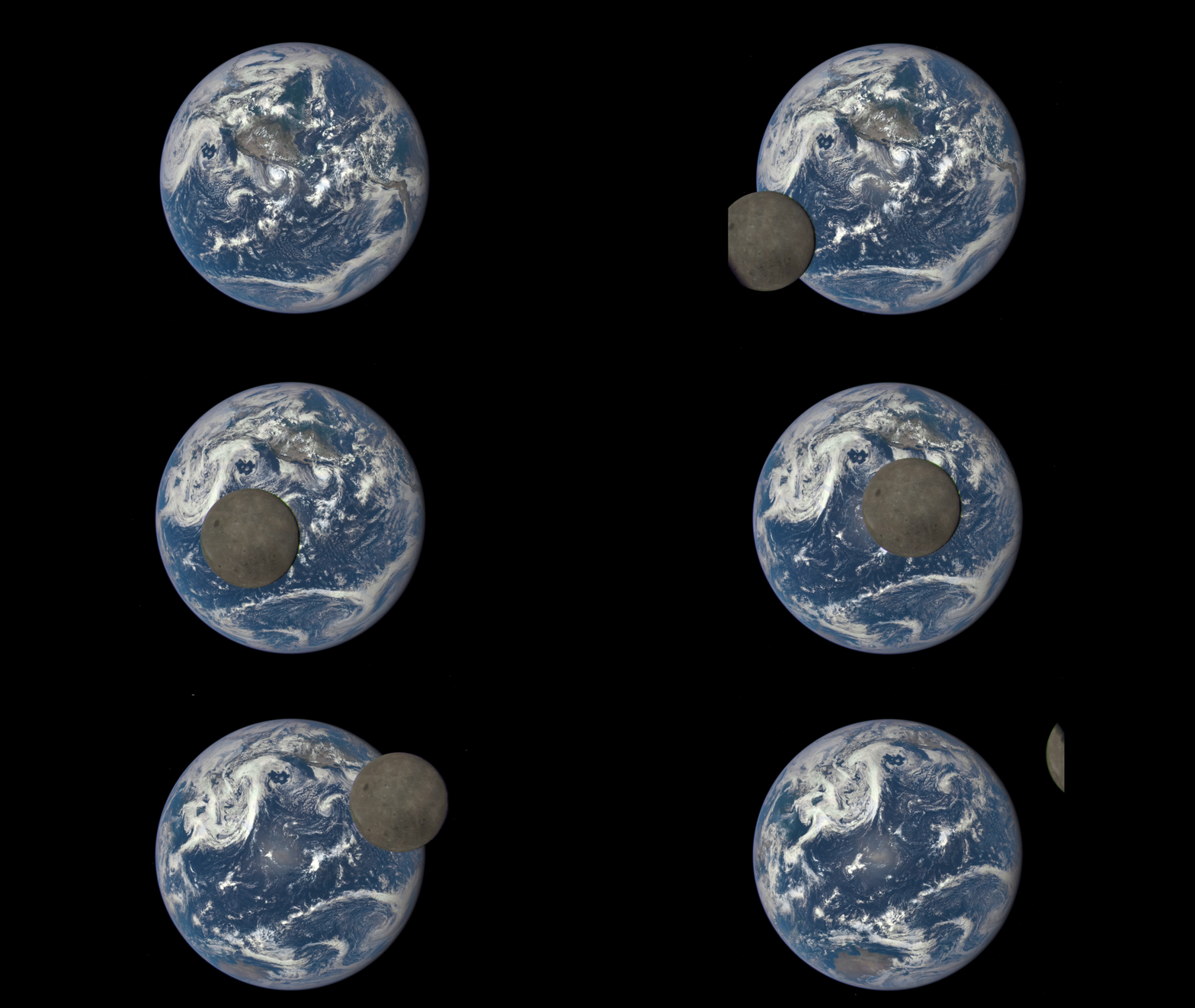
This image from the Deep Space Climate Observatory (DSCOVR) satellite captured a unique view of the moon as it moved in front of the sunlit side of Earth in 2015. It provides a view of the far side of the moon, which is never directly visible to us here on Earth. I found this perspective profoundly moving and only through our satellite views could this have been shared.
– Michael Freilich, Director of NASA’s Earth Science Division
8. Galileo: 8 days out
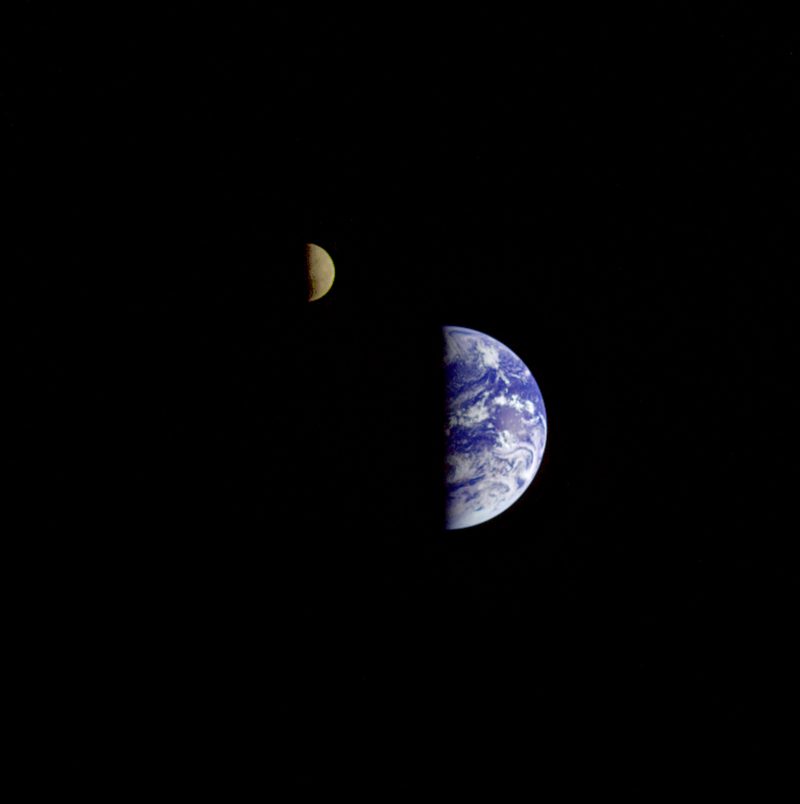
The Galileo spacecraft’s view as it departed Earth. Image via NASA.
Eight days after its final encounter with Earth – the second of two gravitational assists from Earth that helped boost the spacecraft to Jupiter – the Galileo spacecraft looked back and captured this remarkable view of our planet and its moon. The image was taken from a distance of about 3.9 million miles (6.2 million km).
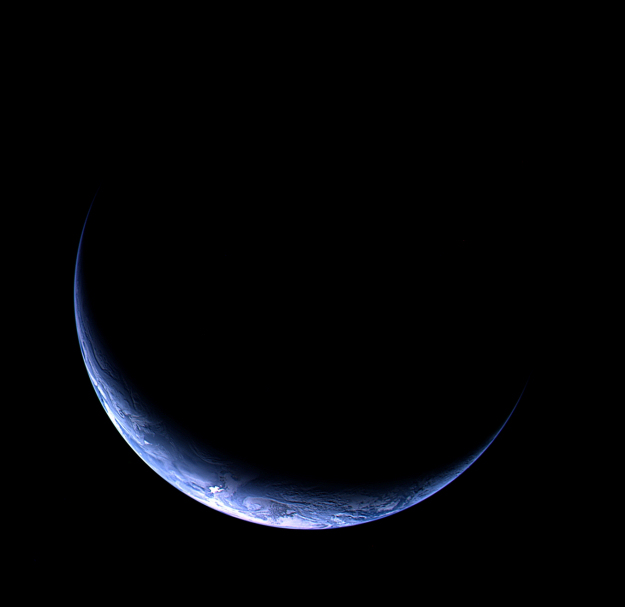
Earth from about 393,000 miles (633,000 km) away, as seen by the European Space Agency’s comet-bound Rosetta spacecraft during its 3rd and final swing-by of our home planet in 2009.
10. MESSENGER: So long
MESSENGER’s view departing Earth. Image via NASA/ JHUAPL/ Carnegie Institution of Washington.
The Mercury-bound MESSENGER spacecraft captured several stunning images of Earth during a gravity assist swing-by of its home planet on August 2, 2005.
Bottom line: Ten amazing images of Earth from space.
NASA’s Lunar Orbiter 1 took the first Earth image as seen from the vicinity of the moon in 1966. Forty-two years later, NASA released this much higher resolution version reprocessed from the original analog data tapes. Image via Wikimedia. See more Earth images from space below.
To celebrate Earth Day today, enjoy these incredible Earth images from space.
It suddenly struck me that that tiny pea, pretty and blue, was the Earth. I put up my thumb and shut one eye, and my thumb blotted out the planet Earth. I didn’t feel like a giant. I felt very, very small.
– Neil Armstrong, Apollo 11
1. Voyager 1: At 7.2 million miles … and 4 billion miles
Voyager 1’s image of Earth and the moon, September 18, 1977. Image via NASA/ JPL.The famous pale blue dot from Voyager 1 on February 14, 1990. Image via NASA/ JPL.
Voyager famously captured two unique views of our home world from afar. The upper image, taken in 1977 from a distance of 7.3 million miles (11.7 million km), showed the full Earth and full moon in a single frame for the first time in history.
The second image, taken in 1990 as part of a family portrait of our solar system from 4 billion miles (6.4 billion km), shows Earth as a tiny blue speck in a ray of sunlight. This is the famous “Pale Blue Dot” image immortalized by Carl Sagan.
Sagan’s widow, Ann Druyan, said of the image:
This was our willingness to see the Earth as a 1-pixel object in a far greater cosmos. It’s that humility that science gives us. That weans us from our childhood need to be the center of things. And Voyager gave us that image of the Earth that is so heart tugging because you can’t look at that image and not think of how fragile, how fragile our world is. How much we have in common with everyone with whom we share it; our relationship, our relatedness, to everyone on this tiny pixel.
2. Kepler: A bright flashlight in a dark sea of stars
NASA’s Kepler mission captured Earth’s image as it slipped past at a distance of 94 million miles (151 million km). The reflection was so extraordinarily bright that it created a saber-like saturation bleed across the instrument’s sensors, obscuring the neighboring moon.
3. Cassini: Hello and goodbye
Right, Cassini’s view in 2013. Left, a final look between the rings in 2017. Image via NASA.
NASA’s Lunar Reconnaissance Orbiter (LRO) captured a unique view of Earth from the spacecraft’s vantage point in orbit around the moon on October 12, 2015. Image via NASA/ Goddard/ Arizona State University.
The image is simply stunning. The image of the Earth evokes the famous Blue Marble image taken by astronaut Harrison Schmitt during Apollo 17 … which also showed Africa prominently in the picture.
NASA’s OSIRIS-REx spacecraft captured this image of the Earth and moon. Image via NASA.
As part of an engineering test, NASA’s OSIRIS-REx spacecraft captured this image of Earth and the moon in January 2018 from a distance of 39.5 million miles (63.6 million km). When the camera acquired the image, the spacecraft was moving away from our home planet at a speed of 19,000 miles per hour (8.5 km per second). Earth is the largest, brightest spot in the center of the image, with the smaller, dimmer moon appearing to the right. Several constellations are also visible in the surrounding space.
6. Curiosity: The view from Mars
This view of the twilight sky and Martian horizon taken by NASA’s Mars Curiosity rover includes Earth as the brightest point of light in the night sky. Image via NASA/ JPL-Caltech/ MSSS/ TAMU.
Earth and moon from a million miles out. Image via NASA/ NOAA.
This image from the Deep Space Climate Observatory (DSCOVR) satellite captured a unique view of the moon as it moved in front of the sunlit side of Earth in 2015. It provides a view of the far side of the moon, which is never directly visible to us here on Earth. I found this perspective profoundly moving and only through our satellite views could this have been shared.
– Michael Freilich, Director of NASA’s Earth Science Division
8. Galileo: 8 days out
The Galileo spacecraft’s view as it departed Earth. Image via NASA.
Eight days after its final encounter with Earth – the second of two gravitational assists from Earth that helped boost the spacecraft to Jupiter – the Galileo spacecraft looked back and captured this remarkable view of our planet and its moon. The image was taken from a distance of about 3.9 million miles (6.2 million km).
Earth from about 393,000 miles (633,000 km) away, as seen by the European Space Agency’s comet-bound Rosetta spacecraft during its 3rd and final swing-by of our home planet in 2009.
10. MESSENGER: So long
MESSENGER’s view departing Earth. Image via NASA/ JHUAPL/ Carnegie Institution of Washington.
The Mercury-bound MESSENGER spacecraft captured several stunning images of Earth during a gravity assist swing-by of its home planet on August 2, 2005.
Bottom line: Ten amazing images of Earth from space.
View at EarthSky Community Photos. | Amrinderjit Singh in Vaatalya, Himachal Pradesh, India, captured this pileus cloud on April 18, 2026. A pileus cloud is a curved cap on top of a towering cumulus cloud. Amrinderjit wrote: “Pileus clouds are formed by strong updrafts (small-scale currents of rising air) within the cloud at lower altitudes. They are short-lived clouds and indicate severe weather ahead.” Thank you, Amrinderjit!
A pileus cloud is a sign of bad weather
Have you ever seen a bubbling, towering cloud wearing a curved white cap on its head? These cap clouds – or pileus clouds – are a sign of bad weather. They form above vigorously growing cumulus or cumulonimbus clouds. If you see one, be prepared for storms.
Cumulus clouds are serene, fluffy clouds. When most people are asked to draw a cloud, a cumulus cloud is the kind they will sketch. Cumulus clouds can start as fair-weather clouds, but if conditions are right they can become cumulonimbus clouds, or thunderheads. In a moist, unstable atmosphere, updrafts can cause cumulus clouds to grow, blossoming into the giant cauliflower shapes of cumulonimbus. Their bases grow dark as they grow thicker, because sunlight cannot penetrate them.
As these towering clouds push higher and higher into the atmosphere, they can bump into a stable layer of humid air. As the cloud continues to billow upward, it lifts that humid air above its dew point. The dew point is the temperature the air must cool to in order to become saturated with water vapor. At this point, the air cannot hold more moisture, so it condenses into clouds, resulting in the curved cloud cap on top of the thunderhead.
If you see one, snap a pic, because they won’t last long! The rising air continues its upward motion, mixing the air and merging the cap with the growing cloud.
More pics of pileus clouds
View at EarthSky Community Photos. | Helio C. Vital in Saquarem, Rio de Janeiro, Brazil, captured this unusually thick pileus cloud on February 13, 2024. Helio wrote: “The pileus cloud formed as air quickly rose inside a cumulus cloud and condensed at its top, yielding a smooth umbrella shape. It lasted for some 5 minutes and then suddenly collapsed, swallowed by the mother cloud.” Thank you, Helio!View at EarthSky Community Photos. | Peter Lowenstein in Mutare, Zimbabwe, captured this iridescent pileus cloud on January 8, 2020. Peter wrote: “Uprising moisture condensed on top of some cumulus clouds to form tiny ice crystals, which refracted sunlight to produce characteristic shining pileus caps. These only persisted for a few minutes, with early ones remaining colorless and later ones developing rainbow colors as the sun descended in the sky.” Thank you, Peter!
Bottom line: A pileus cloud looks like a curved, white cap on the top of a towering cumulus cloud. Pileus clouds are a sign that bad weather is on the way.
View at EarthSky Community Photos. | Amrinderjit Singh in Vaatalya, Himachal Pradesh, India, captured this pileus cloud on April 18, 2026. A pileus cloud is a curved cap on top of a towering cumulus cloud. Amrinderjit wrote: “Pileus clouds are formed by strong updrafts (small-scale currents of rising air) within the cloud at lower altitudes. They are short-lived clouds and indicate severe weather ahead.” Thank you, Amrinderjit!
A pileus cloud is a sign of bad weather
Have you ever seen a bubbling, towering cloud wearing a curved white cap on its head? These cap clouds – or pileus clouds – are a sign of bad weather. They form above vigorously growing cumulus or cumulonimbus clouds. If you see one, be prepared for storms.
Cumulus clouds are serene, fluffy clouds. When most people are asked to draw a cloud, a cumulus cloud is the kind they will sketch. Cumulus clouds can start as fair-weather clouds, but if conditions are right they can become cumulonimbus clouds, or thunderheads. In a moist, unstable atmosphere, updrafts can cause cumulus clouds to grow, blossoming into the giant cauliflower shapes of cumulonimbus. Their bases grow dark as they grow thicker, because sunlight cannot penetrate them.
As these towering clouds push higher and higher into the atmosphere, they can bump into a stable layer of humid air. As the cloud continues to billow upward, it lifts that humid air above its dew point. The dew point is the temperature the air must cool to in order to become saturated with water vapor. At this point, the air cannot hold more moisture, so it condenses into clouds, resulting in the curved cloud cap on top of the thunderhead.
If you see one, snap a pic, because they won’t last long! The rising air continues its upward motion, mixing the air and merging the cap with the growing cloud.
More pics of pileus clouds
View at EarthSky Community Photos. | Helio C. Vital in Saquarem, Rio de Janeiro, Brazil, captured this unusually thick pileus cloud on February 13, 2024. Helio wrote: “The pileus cloud formed as air quickly rose inside a cumulus cloud and condensed at its top, yielding a smooth umbrella shape. It lasted for some 5 minutes and then suddenly collapsed, swallowed by the mother cloud.” Thank you, Helio!View at EarthSky Community Photos. | Peter Lowenstein in Mutare, Zimbabwe, captured this iridescent pileus cloud on January 8, 2020. Peter wrote: “Uprising moisture condensed on top of some cumulus clouds to form tiny ice crystals, which refracted sunlight to produce characteristic shining pileus caps. These only persisted for a few minutes, with early ones remaining colorless and later ones developing rainbow colors as the sun descended in the sky.” Thank you, Peter!
Bottom line: A pileus cloud looks like a curved, white cap on the top of a towering cumulus cloud. Pileus clouds are a sign that bad weather is on the way.
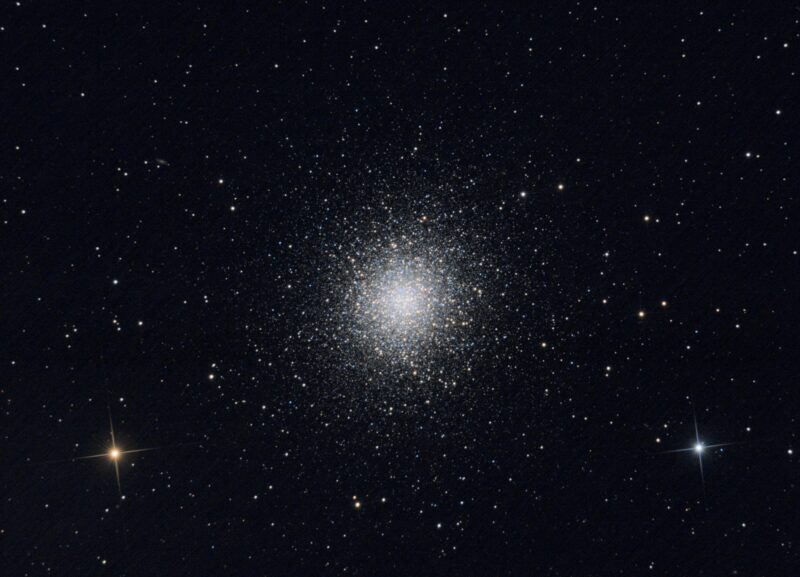
View at EarthSky Community Photos. | Gwen Forrester in DeKalb County, Tennessee, captured this telescopic view of Messier 13 (M13), the Great Hercules Cluster, on May 23, 2025. Thank you, Gwen!
The Great Cluster in the constellation Hercules – also known as Messier 13, or M13 – is the finest globular cluster in the northern half of the heavens. More specifically, you can find it in a star pattern called the Keystone, a lopsided square within the constellation Hercules. This constellation is located between the two brightest stars of northern spring and summer, Vega and Arcturus.
Under constant observation
From mid-northern latitudes, the M13 cluster is in the sky for at least part of the night all year round. As you read this, someone, somewhere, is observing M13. It’s rising a few hours after sunset in April. Then, it’s above the horizon all night long in May, June and July. In August, September and October, the Hercules Cluster is still very much a night owl, staying up till after midnight. Then, in November and December, you can see it in your western evening sky and in your eastern morning sky. It is in the morning sky from January through April.
Moreover, when you gaze at M13 or other globular star clusters, you are looking at stars that are some 12 to 13 billion years old. That’s almost as old as the universe.
M13 is easy to find
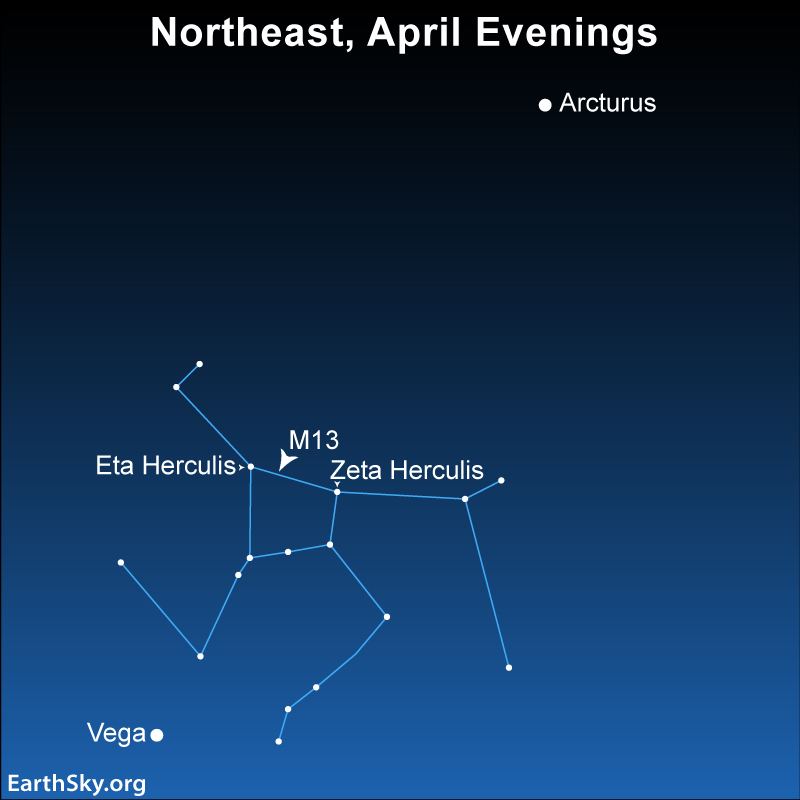
The constellation Hercules is where you’ll find M13. Hercules is between summertime’s two brightest stars, Vega in Lyra the Harp and Arcturus in Boötes the Herdsman.
About 1/3 of the way from Vega to Arcturus, locate the four modestly bright stars forming the squarish Keystone of Hercules. On the Arcturus side of the Keystone, M13 lies between the stars Eta Herculis and Zeta Herculis.
A typical binocular field is about 5 to 7 degrees in diameter, and the Hercules cluster is found about 2.5 degrees south of Eta Herculis.
The Hercules cluster’s position is Right Ascension: 16h 41.7m; Declination: 36 degrees 28′ north.
The bright star Vega in the constellation Lyra the Harp and the orange star Arcturus in the constellation Boötes the Herdsman are located on either side of the constellation Hercules. Then look for the squarish pattern within Hercules. This pattern is called the Keystone. M13 is located along one of the borders of the Keystone.
What to expect from M13
On a dark, clear night, the unaided eye barely perceives the Hercules cluster as a faint and fuzzy point of light. Indeed, this fuzzy “star” is much easier to make out in binoculars. The cluster shines at magnitude 5.8 and is about 20 arcminutes in size, about 2/3 the diameter of the full moon.
The best way to see M13 – or any globular cluster – is through telescopes with large apertures (light-gathering capability). Smaller telescopes will show this globular cluster, but they will not resolve the cluster into individual stars. However, if you don’t have a telescope, or are unfamiliar with how to use one, try attending a public star party. That way you can view M13 through an assortment of telescopes.
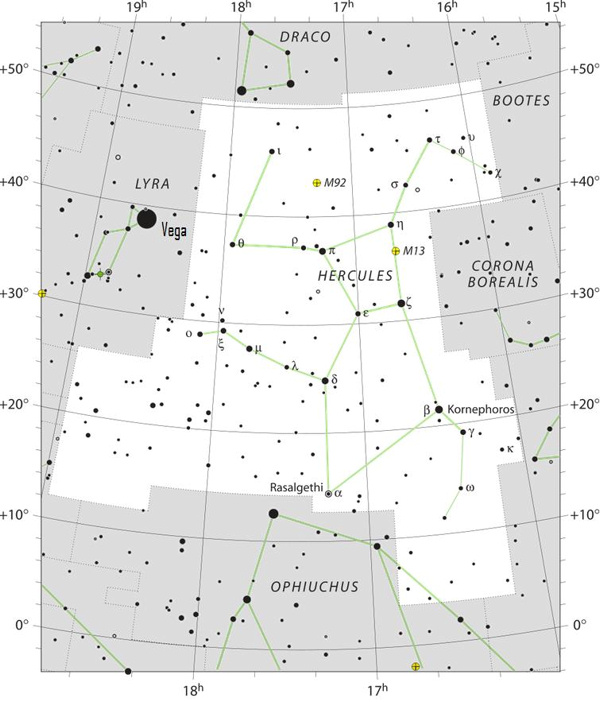
Sky chart of the constellation Hercules, showing the whereabouts of Messier 13, the Hercules cluster. Image via IAU/ Sky and Telescope/ Wikimedia Commons (CC BY 3.0).
What’s that propeller doing in this cluster?
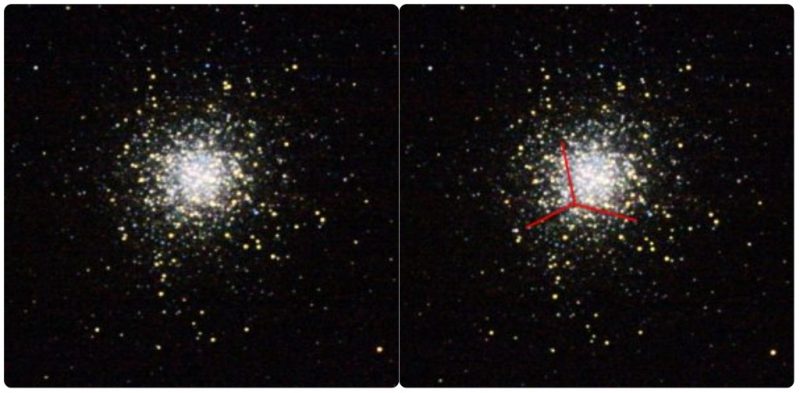
Now that we have M13 in our telescope, let’s look for an oddity unique to this globular cluster. Look for what appears to be three dark lanes that form the shape of an airplane propeller. Bindon Blood Stoney, assistant to the Earl of Rosse in the 1850s, was the first to notice this odd feature. It is a pattern caused by the lack of stars along this particular line of sight.
M13 and the propeller. Here, north is up, east is to the left. Image via Phil Harrington, from his book: Cosmic Challenge. Used with permission.
Walter Scott Houston, who wrote a monthly column called “Deep-Sky Wonders” for Sky and Telescope magazine, mentioned M13’s propeller in 1953. From time to time he would mention it again; still, none of his readers reported ever seeing it. Finally, in 1980, American amateur astronomer John Bortle wrote that he saw it, and it is located on the southeast corner of the cluster. Aperture and magnification help in seeing it, because a large telescope and at least 200 magnification is necessary to bring it out from the background. Most photographs overexpose the area, and therefore the propeller disappears.
Counting stars
M13 is very far away, 25,000 light-years. This is several times farther away than the farthest stars you can see with the unaided eye. And the cluster is large, about 165 light-years across.
Overall, how many stars does M13 have? About 300,000, and perhaps as many as a half million. In fact, that is about 100 times more than the number of stars you can see with your eyes alone in our sky at night.
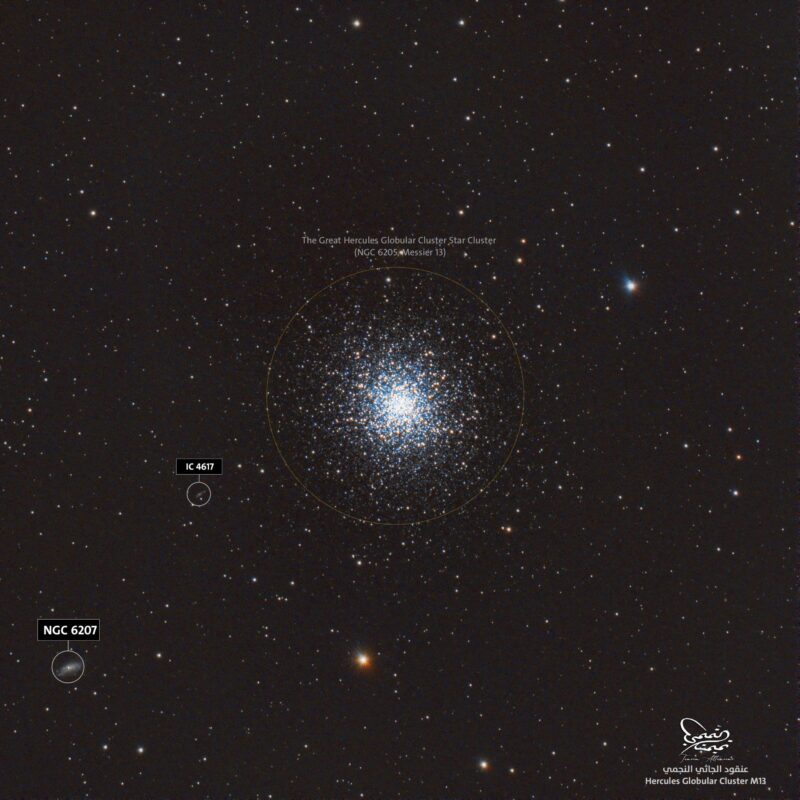
View at EarthSky Community Photos. | Tameem Altameemi in the United Arab Emirates shared this image on April 26, 2025, and wrote: “This image features the beautiful globular cluster Messier 13. In the same field of view, the spiral galaxy NGC 6207 and the faint active galaxy IC 4617 are visible.” Thank you, Tameem!
Talking to a globular cluster
On November 16, 1974, the Arecibo radio telescope in Puerto Rico sent a radio message to M13. This was the first message deliberately sent toward a target in outer space. Designed by a team led by Frank Drake, the message communicated information about our world. Read more about the message here. It will take 25,000 years for the message to reach the cluster. Correspondingly, any response will take another 25,000 years to reach us.
M13 is a globular star cluster, a huge globe-shaped stellar city teeming with hundreds of thousands of stars. Globular clusters orbit the Milky Way Galaxy outside the galactic disk at tens of thousands of light-years away. In contrast, the relatively nearby Pleiades and Hyades are open star clusters that reside within the galactic disk. In general, they usually harbor a few hundred to a thousand stars.
The discovery of M13
Englishman Edmond Halley discovered this cluster in 1714 “by help of the telescope.” He stated:
This is but a little patch, but it shows itself to the [unaided] eye when the sky is serene and the moon absent.
On June 1, 1764, the famous French comet hunter Charles Messier (1730-1817) listed this object as number 13 in his catalog of nebulous objects. He described it as:
… A nebula which I am sure contains no star. Round and brilliant, center brighter than the edges.
Messier’s telescope, however, was not powerful enough to show the individual stars.
In the centuries since then, M13 has become the most observed globular cluster in the Northern Hemisphere.
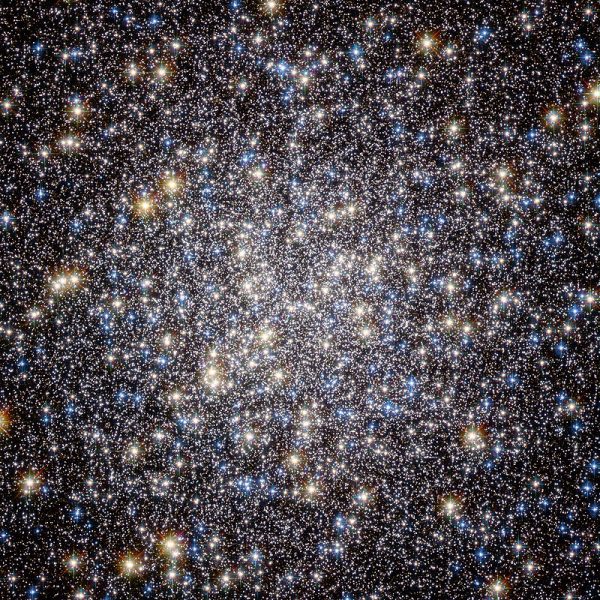
View larger. | The heart of M13, aka the Great Cluster in Hercules, a globular star cluster and one of our Milky Way Galaxy’s oldest inhabitants. Image via the Advanced Camera for Surveys on the Hubble Space Telescope.
Bottom line: Meet M13, the Great Cluster, in Hercules. Peering at this globular cluster is a wonderful way to start your spring or summer evening.
View at EarthSky Community Photos. | Gwen Forrester in DeKalb County, Tennessee, captured this telescopic view of Messier 13 (M13), the Great Hercules Cluster, on May 23, 2025. Thank you, Gwen!
The Great Cluster in the constellation Hercules – also known as Messier 13, or M13 – is the finest globular cluster in the northern half of the heavens. More specifically, you can find it in a star pattern called the Keystone, a lopsided square within the constellation Hercules. This constellation is located between the two brightest stars of northern spring and summer, Vega and Arcturus.
Under constant observation
From mid-northern latitudes, the M13 cluster is in the sky for at least part of the night all year round. As you read this, someone, somewhere, is observing M13. It’s rising a few hours after sunset in April. Then, it’s above the horizon all night long in May, June and July. In August, September and October, the Hercules Cluster is still very much a night owl, staying up till after midnight. Then, in November and December, you can see it in your western evening sky and in your eastern morning sky. It is in the morning sky from January through April.
Moreover, when you gaze at M13 or other globular star clusters, you are looking at stars that are some 12 to 13 billion years old. That’s almost as old as the universe.
M13 is easy to find
The constellation Hercules is where you’ll find M13. Hercules is between summertime’s two brightest stars, Vega in Lyra the Harp and Arcturus in Boötes the Herdsman.
About 1/3 of the way from Vega to Arcturus, locate the four modestly bright stars forming the squarish Keystone of Hercules. On the Arcturus side of the Keystone, M13 lies between the stars Eta Herculis and Zeta Herculis.
A typical binocular field is about 5 to 7 degrees in diameter, and the Hercules cluster is found about 2.5 degrees south of Eta Herculis.
The Hercules cluster’s position is Right Ascension: 16h 41.7m; Declination: 36 degrees 28′ north.
The bright star Vega in the constellation Lyra the Harp and the orange star Arcturus in the constellation Boötes the Herdsman are located on either side of the constellation Hercules. Then look for the squarish pattern within Hercules. This pattern is called the Keystone. M13 is located along one of the borders of the Keystone.
What to expect from M13
On a dark, clear night, the unaided eye barely perceives the Hercules cluster as a faint and fuzzy point of light. Indeed, this fuzzy “star” is much easier to make out in binoculars. The cluster shines at magnitude 5.8 and is about 20 arcminutes in size, about 2/3 the diameter of the full moon.
The best way to see M13 – or any globular cluster – is through telescopes with large apertures (light-gathering capability). Smaller telescopes will show this globular cluster, but they will not resolve the cluster into individual stars. However, if you don’t have a telescope, or are unfamiliar with how to use one, try attending a public star party. That way you can view M13 through an assortment of telescopes.
Sky chart of the constellation Hercules, showing the whereabouts of Messier 13, the Hercules cluster. Image via IAU/ Sky and Telescope/ Wikimedia Commons (CC BY 3.0).
What’s that propeller doing in this cluster?
Now that we have M13 in our telescope, let’s look for an oddity unique to this globular cluster. Look for what appears to be three dark lanes that form the shape of an airplane propeller. Bindon Blood Stoney, assistant to the Earl of Rosse in the 1850s, was the first to notice this odd feature. It is a pattern caused by the lack of stars along this particular line of sight.
M13 and the propeller. Here, north is up, east is to the left. Image via Phil Harrington, from his book: Cosmic Challenge. Used with permission.
Walter Scott Houston, who wrote a monthly column called “Deep-Sky Wonders” for Sky and Telescope magazine, mentioned M13’s propeller in 1953. From time to time he would mention it again; still, none of his readers reported ever seeing it. Finally, in 1980, American amateur astronomer John Bortle wrote that he saw it, and it is located on the southeast corner of the cluster. Aperture and magnification help in seeing it, because a large telescope and at least 200 magnification is necessary to bring it out from the background. Most photographs overexpose the area, and therefore the propeller disappears.
Counting stars
M13 is very far away, 25,000 light-years. This is several times farther away than the farthest stars you can see with the unaided eye. And the cluster is large, about 165 light-years across.
Overall, how many stars does M13 have? About 300,000, and perhaps as many as a half million. In fact, that is about 100 times more than the number of stars you can see with your eyes alone in our sky at night.
View at EarthSky Community Photos. | Tameem Altameemi in the United Arab Emirates shared this image on April 26, 2025, and wrote: “This image features the beautiful globular cluster Messier 13. In the same field of view, the spiral galaxy NGC 6207 and the faint active galaxy IC 4617 are visible.” Thank you, Tameem!
Talking to a globular cluster
On November 16, 1974, the Arecibo radio telescope in Puerto Rico sent a radio message to M13. This was the first message deliberately sent toward a target in outer space. Designed by a team led by Frank Drake, the message communicated information about our world. Read more about the message here. It will take 25,000 years for the message to reach the cluster. Correspondingly, any response will take another 25,000 years to reach us.
M13 is a globular star cluster, a huge globe-shaped stellar city teeming with hundreds of thousands of stars. Globular clusters orbit the Milky Way Galaxy outside the galactic disk at tens of thousands of light-years away. In contrast, the relatively nearby Pleiades and Hyades are open star clusters that reside within the galactic disk. In general, they usually harbor a few hundred to a thousand stars.
The discovery of M13
Englishman Edmond Halley discovered this cluster in 1714 “by help of the telescope.” He stated:
This is but a little patch, but it shows itself to the [unaided] eye when the sky is serene and the moon absent.
On June 1, 1764, the famous French comet hunter Charles Messier (1730-1817) listed this object as number 13 in his catalog of nebulous objects. He described it as:
… A nebula which I am sure contains no star. Round and brilliant, center brighter than the edges.
Messier’s telescope, however, was not powerful enough to show the individual stars.
In the centuries since then, M13 has become the most observed globular cluster in the Northern Hemisphere.
View larger. | The heart of M13, aka the Great Cluster in Hercules, a globular star cluster and one of our Milky Way Galaxy’s oldest inhabitants. Image via the Advanced Camera for Surveys on the Hubble Space Telescope.
Bottom line: Meet M13, the Great Cluster, in Hercules. Peering at this globular cluster is a wonderful way to start your spring or summer evening.
Small cone ants clean a much larger harvester ant. Scientists said this behavior marks the first known case of interspecies ant grooming. Image via Mark Moffett/ Minden Pictures (used with permission).
Small ants clean larger ants
Scientists have discovered a unique interaction between two ant species: smaller ants cleaning much larger ones. It’s the first known case of this behavior in insects, said entomologist Mark Moffett of the Smithsonian National Museum of Natural History on April 13, 2026.
Moffett observed and documented this phenomenon while studying ant behavior in the Chiricahua Mountains of southeastern Arizona. During his research, he noticed that harvester ants actively seek out cone ants and allow them to groom their bodies.
Moffet published his discovery on April 12, 2026, in the peer-reviewed journal Ecology and Evolution.
1st known case of interspecies ant grooming
The behavior begins when a harvester ant leaves its nest and approaches a cone ant colony. Instead of showing aggression or defensive behavior, the large ant stops abruptly, often standing still with its mandibles open and its body held high.
Within seconds, cone ants emerge from the nest and climb onto the harvester ant’s body. They move quickly across its surface, using their mouthparts to lick and scrape tiny particles from its exoskeleton. The cleaning is deliberate and methodical, covering the head, legs and even sensitive areas near the mandibles.
These interactions vary widely in duration. Some last less than 15 seconds, while others continue for several minutes. In more intense encounters, multiple cone ants work simultaneously on a single harvester ant, creating a coordinated cleaning session. Remarkably, even when cone ants enter the open jaws of the larger ant, no aggression occurs. Moffett said:
The potentially dangerous harvester ants even permit the visitors to groom between their open jaws.
Once the interaction ends, the harvester ant suddenly jerks its body and dislodges the smaller ants with force before resuming its normal activities.
Here’s a harvester ant on a nest, waiting for cone ants to arrive. Image via Mark Moffett/ Minden Pictures (used with permission).
Why do small ants clean larger ants?
Scientists are still working to understand the evolutionary logic behind this unusual relationship. But early evidence suggests both species may gain specific benefits from the interaction.
Cone ants appear to consume microscopic particles found on the surface of harvester ants. These particles may include fragments of seed material or organic debris collected during foraging. Interestingly, cone ants only engage in this behavior with living harvester ants and completely ignore dead individuals placed near their nests. This suggests the interaction depends on chemical cues or movement from the host ant.
For harvester ants, the benefit may lie in improved hygiene. While they already perform mutual grooming within their own colonies, cone ants can access regions of the body that are difficult for nestmates to reach. This may help reduce parasites, fungal spores or bacterial buildup that could otherwise affect colony health. Moffett said:
Given the usual tendencies of ants, I first assumed that I was observing aggression. But the larger ants seemed to seek the attention of the smaller ants by first visiting their nests and then allowing the small ants to lick and nibble all over them.
Harvester ants collect seeds as part of their foraging routine, sometimes becoming hosts for smaller cone ants that feed on microscopic debris from their bodies. Image via Mark Moffett/ Minden Pictures/ Smithsonian.
A discovery that mirrors ocean life
This interaction strongly resembles cleaning systems found in marine environments, where small fish and shrimp remove parasites from much larger fish, including predators like sharks. Moffett commented:
This new ant species is the insect equivalent of cleaner fish in the ocean.
The similarity raises interesting questions about whether such cooperative behavior evolves independently in different environments. In both cases, a smaller species gains food while a larger species receives hygiene benefits.
Cone ant workers carefully clean harvester ants. Because they are smaller, they can reach places other nestmates can’t. Image via Mark Moffett/ Minden Pictures (used with permission).There’s nothing to fear, as both species get benefits. Here’s a cone ant exploring between the mandibles of a harvester ant worker. Image via Mark Moffett/ Minden Pictures (used with permission).
What this means for insect research
Moffett emphasizes that this discovery highlights how much remains unknown about insect behavior in natural environments. He argues that field observation continues to play a crucial role in uncovering complex ecological relationships that laboratory studies might miss. Moffett said:
All kinds of amazing discoveries are still there to be made outside of the lab. Finding new species and behaviors in nature often requires us to pay close attention to the small things — including the ants.
He also notes that the behavior was easy to overlook at first, as it occurs quickly and in a remote desert environment. However, repeated observations confirmed that it was not accidental but a consistent pattern.
The finding opens new research directions, including whether similar interspecies grooming systems exist elsewhere and how widespread this type of cooperation might be among insects.
Cone ants get food from microscopic debris on harvester ants, while harvester ants gain external cleaning that may reduce parasites and improve hygiene. Here’s a harvester worker that has thrown herself onto her back to remove the cone ants that were cleaning her after an extended period of time. Team work! Image via Mark Moffett/ Minden Pictures (used with permission).
Bottom line: Small ants clean larger ants in the first known case of interspecies grooming between ants. A researcher spotted this rare behavior in Arizona.
Small cone ants clean a much larger harvester ant. Scientists said this behavior marks the first known case of interspecies ant grooming. Image via Mark Moffett/ Minden Pictures (used with permission).
Small ants clean larger ants
Scientists have discovered a unique interaction between two ant species: smaller ants cleaning much larger ones. It’s the first known case of this behavior in insects, said entomologist Mark Moffett of the Smithsonian National Museum of Natural History on April 13, 2026.
Moffett observed and documented this phenomenon while studying ant behavior in the Chiricahua Mountains of southeastern Arizona. During his research, he noticed that harvester ants actively seek out cone ants and allow them to groom their bodies.
Moffet published his discovery on April 12, 2026, in the peer-reviewed journal Ecology and Evolution.
1st known case of interspecies ant grooming
The behavior begins when a harvester ant leaves its nest and approaches a cone ant colony. Instead of showing aggression or defensive behavior, the large ant stops abruptly, often standing still with its mandibles open and its body held high.
Within seconds, cone ants emerge from the nest and climb onto the harvester ant’s body. They move quickly across its surface, using their mouthparts to lick and scrape tiny particles from its exoskeleton. The cleaning is deliberate and methodical, covering the head, legs and even sensitive areas near the mandibles.
These interactions vary widely in duration. Some last less than 15 seconds, while others continue for several minutes. In more intense encounters, multiple cone ants work simultaneously on a single harvester ant, creating a coordinated cleaning session. Remarkably, even when cone ants enter the open jaws of the larger ant, no aggression occurs. Moffett said:
The potentially dangerous harvester ants even permit the visitors to groom between their open jaws.
Once the interaction ends, the harvester ant suddenly jerks its body and dislodges the smaller ants with force before resuming its normal activities.
Here’s a harvester ant on a nest, waiting for cone ants to arrive. Image via Mark Moffett/ Minden Pictures (used with permission).
Why do small ants clean larger ants?
Scientists are still working to understand the evolutionary logic behind this unusual relationship. But early evidence suggests both species may gain specific benefits from the interaction.
Cone ants appear to consume microscopic particles found on the surface of harvester ants. These particles may include fragments of seed material or organic debris collected during foraging. Interestingly, cone ants only engage in this behavior with living harvester ants and completely ignore dead individuals placed near their nests. This suggests the interaction depends on chemical cues or movement from the host ant.
For harvester ants, the benefit may lie in improved hygiene. While they already perform mutual grooming within their own colonies, cone ants can access regions of the body that are difficult for nestmates to reach. This may help reduce parasites, fungal spores or bacterial buildup that could otherwise affect colony health. Moffett said:
Given the usual tendencies of ants, I first assumed that I was observing aggression. But the larger ants seemed to seek the attention of the smaller ants by first visiting their nests and then allowing the small ants to lick and nibble all over them.
Harvester ants collect seeds as part of their foraging routine, sometimes becoming hosts for smaller cone ants that feed on microscopic debris from their bodies. Image via Mark Moffett/ Minden Pictures/ Smithsonian.
A discovery that mirrors ocean life
This interaction strongly resembles cleaning systems found in marine environments, where small fish and shrimp remove parasites from much larger fish, including predators like sharks. Moffett commented:
This new ant species is the insect equivalent of cleaner fish in the ocean.
The similarity raises interesting questions about whether such cooperative behavior evolves independently in different environments. In both cases, a smaller species gains food while a larger species receives hygiene benefits.
Cone ant workers carefully clean harvester ants. Because they are smaller, they can reach places other nestmates can’t. Image via Mark Moffett/ Minden Pictures (used with permission).There’s nothing to fear, as both species get benefits. Here’s a cone ant exploring between the mandibles of a harvester ant worker. Image via Mark Moffett/ Minden Pictures (used with permission).
What this means for insect research
Moffett emphasizes that this discovery highlights how much remains unknown about insect behavior in natural environments. He argues that field observation continues to play a crucial role in uncovering complex ecological relationships that laboratory studies might miss. Moffett said:
All kinds of amazing discoveries are still there to be made outside of the lab. Finding new species and behaviors in nature often requires us to pay close attention to the small things — including the ants.
He also notes that the behavior was easy to overlook at first, as it occurs quickly and in a remote desert environment. However, repeated observations confirmed that it was not accidental but a consistent pattern.
The finding opens new research directions, including whether similar interspecies grooming systems exist elsewhere and how widespread this type of cooperation might be among insects.
Cone ants get food from microscopic debris on harvester ants, while harvester ants gain external cleaning that may reduce parasites and improve hygiene. Here’s a harvester worker that has thrown herself onto her back to remove the cone ants that were cleaning her after an extended period of time. Team work! Image via Mark Moffett/ Minden Pictures (used with permission).
Bottom line: Small ants clean larger ants in the first known case of interspecies grooming between ants. A researcher spotted this rare behavior in Arizona.
So, how can you optimize your chances of seeing a great meteor display? Follow the tips below.
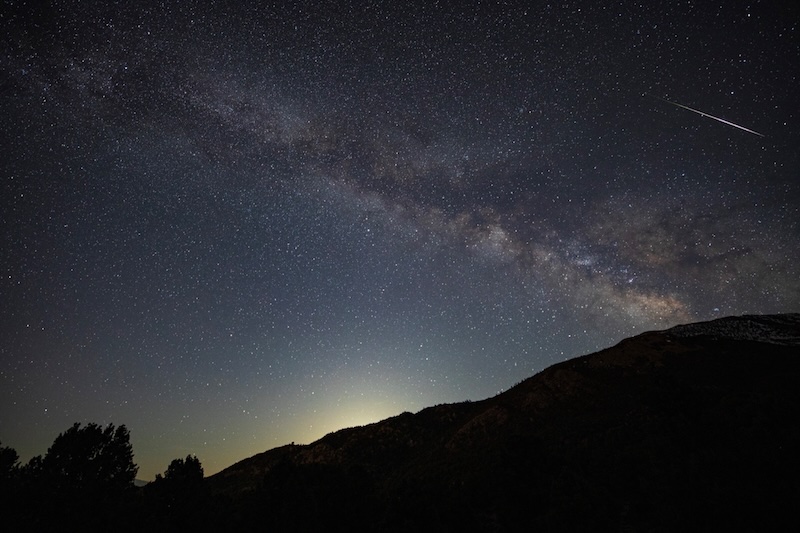
View at EarthSky Community Photos. | Jeremy Evans of California captured a Lyrid meteor zipping along the Milky Way on April 22, 2025. Jeremy wrote: “Lyrid meteor shower at peak activity. It was a quiet shower this year. I had my camera going all night and only caught one meteor. This single frame is from an all-night 1,200 frame time lapse on my front deck. I’m very fortunate to live under dark Bortle 2 skies. The glow on the horizon is from the last quarter moon just before rising. This meteor also left smoke trails.” Thank you, Jeremy.
1. Know the peak time
Generally, meteor showers happen over many days as Earth encounters a wide stream of icy particles in space. These particles are debris left behind by a comet. So the peak is a point in time when Earth is expected to encounter the greatest number of comet particles. To find the peak dates of meteor showers, check EarthSky’s meteor guide.
And here’s the catch … the peak of the shower comes at the same time for all of us on Earth. Meanwhile, our clocks are saying different times. You’ll often need to adjust from UTC to your local time.
However, the predictions are not always right on the money. And remember … it’s possible to see nice meteor displays in the hours – even days – before or after the predicted peak.
Also, keep in mind that meteor showers are part of nature. So naturally, they often defy prediction.
And … you need a wide-open view of the sky. A farmer’s field? Maybe a stretch of country road? Or a campsite with a clear view in one or more directions? That’s because an open sky will increase your chances of seeing some meteors.
3. Oh no! The moon is out
During a meteor shower, a bright moon is not your friend. In fact, nothing dampens the display of a meteor shower more effectively than a bright moon.
If the moon is out, look at areas of the sky away from the moon. Anything in the moon’s vicinity – including meteors – will likely be washed out by its bright light. And, another tip for watching in moonlight: place some object between yourself and the moon. Observing from the shadow of a barn, or vehicle, even a tree, can help you see more meteors. Basically, place yourself somewhere in the moon’s shadow.
4. Know the expected rate
Here, we touch on a topic that sometimes leads to some disappointment, especially among novice meteor-watchers: the rate.
Tables of meteor showers almost always list what is known as the zenithal hourly rate (ZHR) for each shower.
So the ZHR is the number of meteors you’ll see if you’re watching in a very dark sky, with the radiant overhead, when the shower is at its peak. In other words, the ZHR represents the number of meteors you might see per hour given the very best observing conditions during the shower’s maximum.
If the peak occurs when it’s still daylight at your location, if most of the meteors are predominantly faint, if a bright moon is out or if you’re located in a light-polluted area, the total number of meteors you see will be considerably reduced.
5. Don’t worry too much about radiant points
You don’t need to stare all night in a single direction – or even locate the radiant point – to have fun watching the shower. The meteors will appear all over the sky.
But … although you can see meteors shoot up from the horizon before a shower’s radiant rises, you’ll see more meteors after it rises. And you’ll see the most when the radiant is highest in the sky. So, find out the radiant point’s rising time. Then you can pinpoint the best time of night to watch the shower.
And … the radiant point is interesting. If you track meteors backward on the sky’s dome, you’ll find them streaming from their radiant point, a single point within a given constellation. Hence the meteor shower’s name.
6. Watch for an hour or more
Meteor showers will be better if you let your eyes adapt to the dark. That can take as long as 20 minutes. Plus, the meteors tend to come in spurts, followed by lulls. So, be patient! You’ll see some.
7. Notice the meteors’ speeds and colors
The Leonids are the swiftest meteors and the Taurids are the slowest meteors. The nice thing about a slow or medium speed meteor shower – such as the Lyrids – is if you see one and yell “meteor,” other people can catch it as well.
In fact, of the upcoming meteor showers … the Lyrids and the Delta Aquariids are medium speed showers. The Eta Aquariids and Perseids are swift meteors.
Plus, the April Lyrids, the December Geminids, and the August Perseids, can be colorful.
8. Watch for meteor trains
A meteor train is a persistent glow in the air left by some meteors after they have faded from view. Trains are from luminous ionized matter left in the wake of this incoming space debris. Some of the bright Lyrid meteors leave a persistent train. So you you might be lucky and see one.
9. Bring a blanket, a buddy, a hot drink and a lawn chair
A reclining lawn chair helps you lie back in comfort for an hour or more of meteor-watching.
If several of you are watching, take different parts of the sky. If you see one, shout “Meteor!” Dress warmly; the nights can be cool or cold, even during the summer months. You’ll probably appreciate that blanket and warm drink in the wee hours of the morning. Also, leave your laptops and tablets home; even using the nighttime dark mode will ruin your night vision. And this will be tough on some people: leave your cell phone in your pocket or the car. It can also ruin your night vision.
10. Enjoy nature
Relax and enjoy the night sky. Not every meteor shower is a winner. Sometimes, you may come away from a shower seeing only one meteor. But if that one meteor is bright, and takes a slow path across a starry night sky … it’ll be worth it.
To be successful at observing any meteor shower, you need to get into a kind of zen state, waiting and expecting the meteors to come to you, if you place yourself in a good position (country location, wide open sky) to see them.
Or forget the zen state, and let yourself be guided by this old meteor watcher’s motto:
You might see a lot or you might not see many, but if you stay in the house, you won’t see any.
Photos of meteors from EarthSky’s community
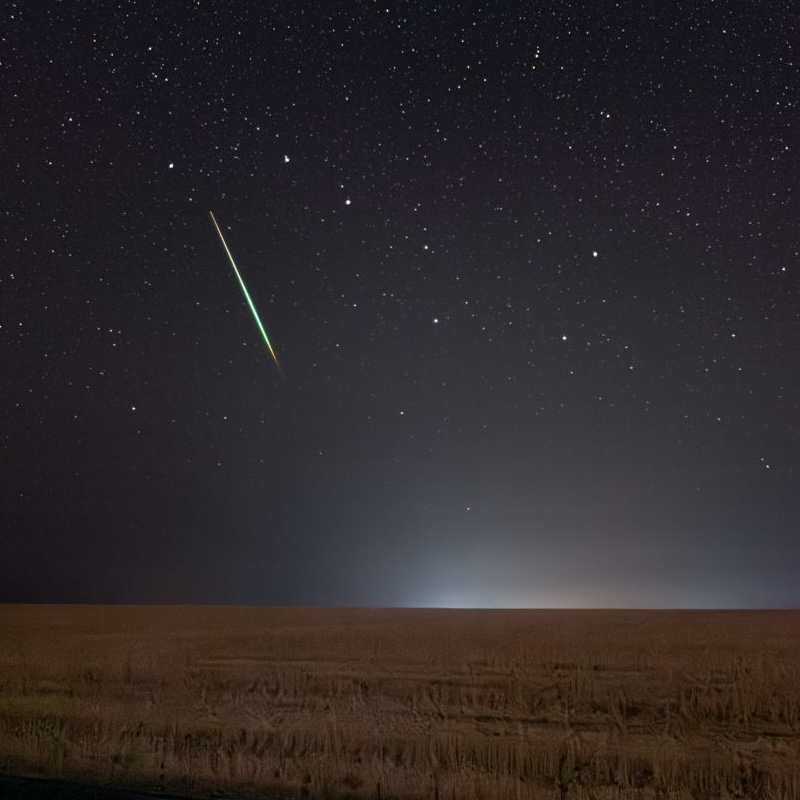
View at EarthSky Community Photos. | Tameem Altameemi of United Arab Emirates submitted this photo on December 14, 2024, and wrote: “My brother and I decided to go to an area away from light pollution between the mountains in UAE, and despite the moonlight that filled the place, we were able to see and photograph many meteors and fireballs. A special and completely clear night.” Thank you, Tameem!View at EarthSky Community Photos. | Jeff Berkes in Assateague Island National Seashore, Maryland, shared this stunning image of a Geminid meteor he captured on December 14, 2024. Jeff wrote: “The wind was really blowing off the ocean, kicking up some nice waves, which created some minor erosion along the shoreline. I never let the moon or the cold keep me in for the Geminids!” Well done, Jeff!View at EarthSky Community Photos. | Some of the stars of the Big Dipper are part of an open cluster called the Ursa Major Moving Group. On September 6, 2024, Susan Jensen captured this image and wrote: “Right place, right time! Standing on a gravel road in the middle of nowhere, looking across a stubble field. This slow-moving, vibrant meteor stopped me in my tracks! I was shooting the Big Dipper with the shutter locked to catch multiple frames for stacking when this monster did a slow flyby. How lucky that I was able to capture it!” Thank you, Susan!
Bottom line: Meteor showers are unpredictable but always a fun and relaxing time. Optimize your viewing with these tips.
So, how can you optimize your chances of seeing a great meteor display? Follow the tips below.
View at EarthSky Community Photos. | Jeremy Evans of California captured a Lyrid meteor zipping along the Milky Way on April 22, 2025. Jeremy wrote: “Lyrid meteor shower at peak activity. It was a quiet shower this year. I had my camera going all night and only caught one meteor. This single frame is from an all-night 1,200 frame time lapse on my front deck. I’m very fortunate to live under dark Bortle 2 skies. The glow on the horizon is from the last quarter moon just before rising. This meteor also left smoke trails.” Thank you, Jeremy.
1. Know the peak time
Generally, meteor showers happen over many days as Earth encounters a wide stream of icy particles in space. These particles are debris left behind by a comet. So the peak is a point in time when Earth is expected to encounter the greatest number of comet particles. To find the peak dates of meteor showers, check EarthSky’s meteor guide.
And here’s the catch … the peak of the shower comes at the same time for all of us on Earth. Meanwhile, our clocks are saying different times. You’ll often need to adjust from UTC to your local time.
However, the predictions are not always right on the money. And remember … it’s possible to see nice meteor displays in the hours – even days – before or after the predicted peak.
Also, keep in mind that meteor showers are part of nature. So naturally, they often defy prediction.
And … you need a wide-open view of the sky. A farmer’s field? Maybe a stretch of country road? Or a campsite with a clear view in one or more directions? That’s because an open sky will increase your chances of seeing some meteors.
3. Oh no! The moon is out
During a meteor shower, a bright moon is not your friend. In fact, nothing dampens the display of a meteor shower more effectively than a bright moon.
If the moon is out, look at areas of the sky away from the moon. Anything in the moon’s vicinity – including meteors – will likely be washed out by its bright light. And, another tip for watching in moonlight: place some object between yourself and the moon. Observing from the shadow of a barn, or vehicle, even a tree, can help you see more meteors. Basically, place yourself somewhere in the moon’s shadow.
4. Know the expected rate
Here, we touch on a topic that sometimes leads to some disappointment, especially among novice meteor-watchers: the rate.
Tables of meteor showers almost always list what is known as the zenithal hourly rate (ZHR) for each shower.
So the ZHR is the number of meteors you’ll see if you’re watching in a very dark sky, with the radiant overhead, when the shower is at its peak. In other words, the ZHR represents the number of meteors you might see per hour given the very best observing conditions during the shower’s maximum.
If the peak occurs when it’s still daylight at your location, if most of the meteors are predominantly faint, if a bright moon is out or if you’re located in a light-polluted area, the total number of meteors you see will be considerably reduced.
5. Don’t worry too much about radiant points
You don’t need to stare all night in a single direction – or even locate the radiant point – to have fun watching the shower. The meteors will appear all over the sky.
But … although you can see meteors shoot up from the horizon before a shower’s radiant rises, you’ll see more meteors after it rises. And you’ll see the most when the radiant is highest in the sky. So, find out the radiant point’s rising time. Then you can pinpoint the best time of night to watch the shower.
And … the radiant point is interesting. If you track meteors backward on the sky’s dome, you’ll find them streaming from their radiant point, a single point within a given constellation. Hence the meteor shower’s name.
6. Watch for an hour or more
Meteor showers will be better if you let your eyes adapt to the dark. That can take as long as 20 minutes. Plus, the meteors tend to come in spurts, followed by lulls. So, be patient! You’ll see some.
7. Notice the meteors’ speeds and colors
The Leonids are the swiftest meteors and the Taurids are the slowest meteors. The nice thing about a slow or medium speed meteor shower – such as the Lyrids – is if you see one and yell “meteor,” other people can catch it as well.
In fact, of the upcoming meteor showers … the Lyrids and the Delta Aquariids are medium speed showers. The Eta Aquariids and Perseids are swift meteors.
Plus, the April Lyrids, the December Geminids, and the August Perseids, can be colorful.
8. Watch for meteor trains
A meteor train is a persistent glow in the air left by some meteors after they have faded from view. Trains are from luminous ionized matter left in the wake of this incoming space debris. Some of the bright Lyrid meteors leave a persistent train. So you you might be lucky and see one.
9. Bring a blanket, a buddy, a hot drink and a lawn chair
A reclining lawn chair helps you lie back in comfort for an hour or more of meteor-watching.
If several of you are watching, take different parts of the sky. If you see one, shout “Meteor!” Dress warmly; the nights can be cool or cold, even during the summer months. You’ll probably appreciate that blanket and warm drink in the wee hours of the morning. Also, leave your laptops and tablets home; even using the nighttime dark mode will ruin your night vision. And this will be tough on some people: leave your cell phone in your pocket or the car. It can also ruin your night vision.
10. Enjoy nature
Relax and enjoy the night sky. Not every meteor shower is a winner. Sometimes, you may come away from a shower seeing only one meteor. But if that one meteor is bright, and takes a slow path across a starry night sky … it’ll be worth it.
To be successful at observing any meteor shower, you need to get into a kind of zen state, waiting and expecting the meteors to come to you, if you place yourself in a good position (country location, wide open sky) to see them.
Or forget the zen state, and let yourself be guided by this old meteor watcher’s motto:
You might see a lot or you might not see many, but if you stay in the house, you won’t see any.
Photos of meteors from EarthSky’s community
View at EarthSky Community Photos. | Tameem Altameemi of United Arab Emirates submitted this photo on December 14, 2024, and wrote: “My brother and I decided to go to an area away from light pollution between the mountains in UAE, and despite the moonlight that filled the place, we were able to see and photograph many meteors and fireballs. A special and completely clear night.” Thank you, Tameem!View at EarthSky Community Photos. | Jeff Berkes in Assateague Island National Seashore, Maryland, shared this stunning image of a Geminid meteor he captured on December 14, 2024. Jeff wrote: “The wind was really blowing off the ocean, kicking up some nice waves, which created some minor erosion along the shoreline. I never let the moon or the cold keep me in for the Geminids!” Well done, Jeff!View at EarthSky Community Photos. | Some of the stars of the Big Dipper are part of an open cluster called the Ursa Major Moving Group. On September 6, 2024, Susan Jensen captured this image and wrote: “Right place, right time! Standing on a gravel road in the middle of nowhere, looking across a stubble field. This slow-moving, vibrant meteor stopped me in my tracks! I was shooting the Big Dipper with the shutter locked to catch multiple frames for stacking when this monster did a slow flyby. How lucky that I was able to capture it!” Thank you, Susan!
Bottom line: Meteor showers are unpredictable but always a fun and relaxing time. Optimize your viewing with these tips.