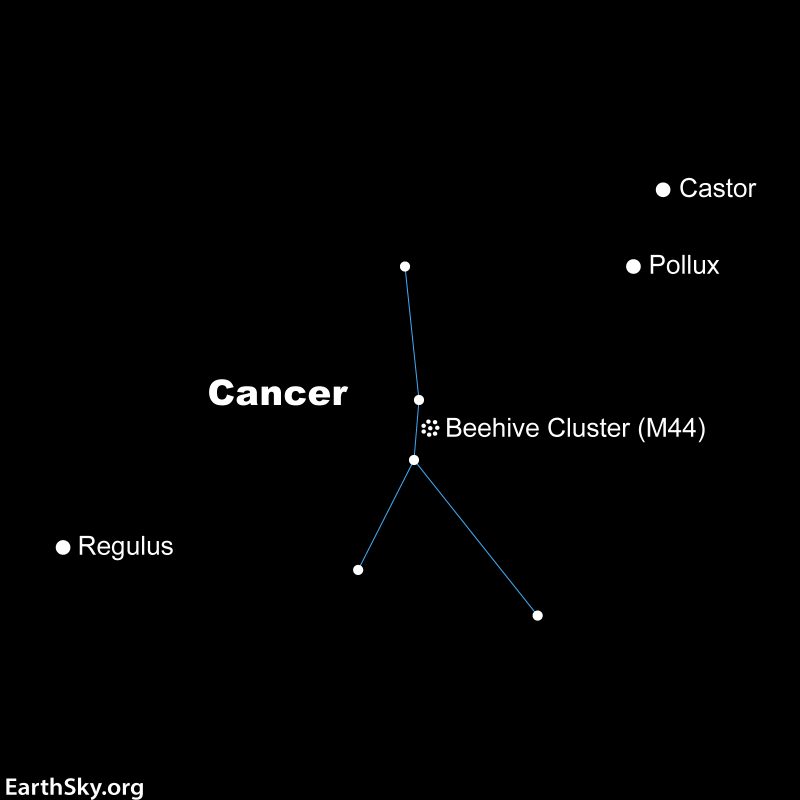
Cancer the Crab, with its Beehive star cluster, needs a dark sky to be seen. It lies between the Gemini stars Castor and Pollux, and the bright star Regulus in Leo. Chart via EarthSky.
There’s a good chance that you’ve never seen Cancer the Crab. It’s the faintest of the 12 constellations of the zodiac. To see Cancer, you need to look between Gemini‘s two brightest stars Castor and Pollux, and Leo the Lion’s brightest star Regulus. And in 2026, finding Gemini – and Pollux and Castor – is easy because bright Jupiter shines nearby.
Once you’ve found Cancer – if your sky is dark – you can see the wonderful open star cluster called the Beehive. It contains some 1,000 stars.
So, let’s suppose you have identified the star Regulus in Leo, and the stars Castor and Pollux in Gemini. You look between them for Cancer and see, well, nothing much. Remember, Cancer is faint. Our advice, therefore, is to look for it in a dark country sky. But, on a moonless night, Cancer is surprisingly easy to see in a dark country sky.
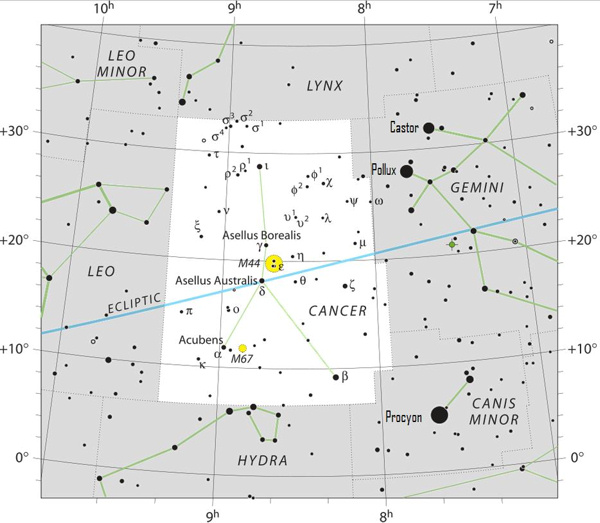
Star chart for Cancer the Crab. Image via International Astronomical Union/ Wikimedia Commons (CC BY 3.0).
When to look for Cancer the Crab
From the Northern Hemisphere, Cancer is well placed for viewing in March, April and May. Eventually, it starts to descend into the sunset glare in June.
In early March every year, look for the constellation Cancer to be due south and highest up in the sky around 10 p.m. your local time. (From the tropics, Cancer shines high overhead, and from temperate latitudes in the Southern Hemisphere, Cancer appears due north.)
Also, since the stars return to the same place in the sky about four minutes earlier each day, or 1/2 hour earlier weekly. So by early April, Cancer reaches its high point for the night at 8 p.m. your local time (9 p.m. local daylight saving time). And by early May, Cancer is high in the western sky.
To summarize, in the Northern Hemisphere, Cancer is best seen in the evening sky in late winter and early spring. After that, it’s lost in the sun’s glare in July and August, and then is found in the morning sky starting in September. If you’re up before dawn during a Northern Hemisphere autumn, try finding Cancer and its Beehive star cluster before sunrise.
From the Southern Hemisphere, the best viewing for Cancer the Crab and the Beehive Cluster is during autumn evenings (March and April), looking towards the northern sky. In March, it’s high in the sky around 10 p.m. local time. And it remains visible through May.
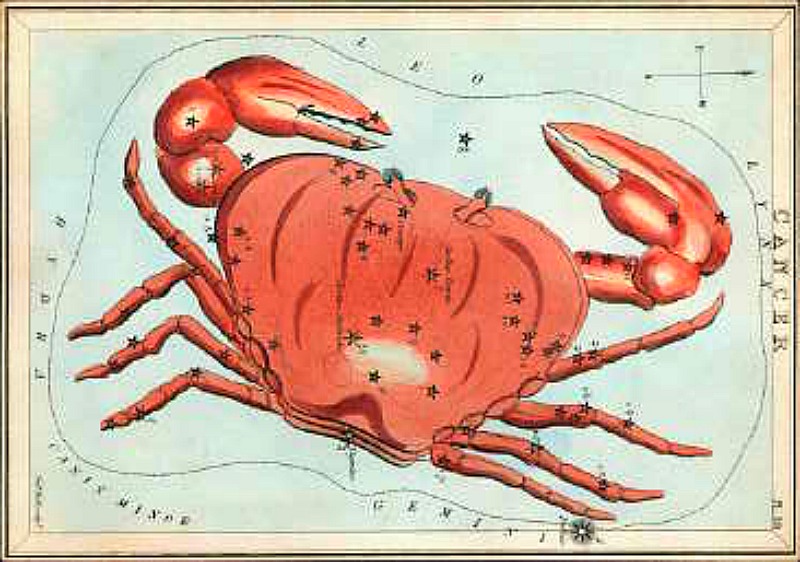
Cancer the Crab from Urania’s Mirror, an antique set of constellation cards. Image via Wikipedia (public domain).
Cancer’s famous Beehive star cluster
Cancer makes up for its lackluster stars by having within its boundaries one of the sky’s brightest star clusters, the Beehive cluster, also known as M44. Another name for the Beehive is Praesepe (Latin for manger).
In a dark sky, the Beehive looks like a tiny faint cloud to the unaided eye. As seen through ordinary binoculars, though, this nebulous patch of haze instantly turns into a sparkling city of stars. It is an open cluster, one of the nearest to our solar system at 577 light-years away. The Beehive contains a larger star population than most other nearby clusters.
The Beehive’s stars appear to be similar in age and proper motion to the stars of the V-shaped Hyades open star cluster. It’s possible the two clusters were born from two parts of a single vast cloud of gas and dust in space.
And sometimes the Beehive gets a visitor. It could be the moon or one of the planets in our solar system. In June 2026, brilliant Venus will pass within two full-moon widths of the Beehive. Then in October 2026, Mars will pass in front of the Beehive star cluster.
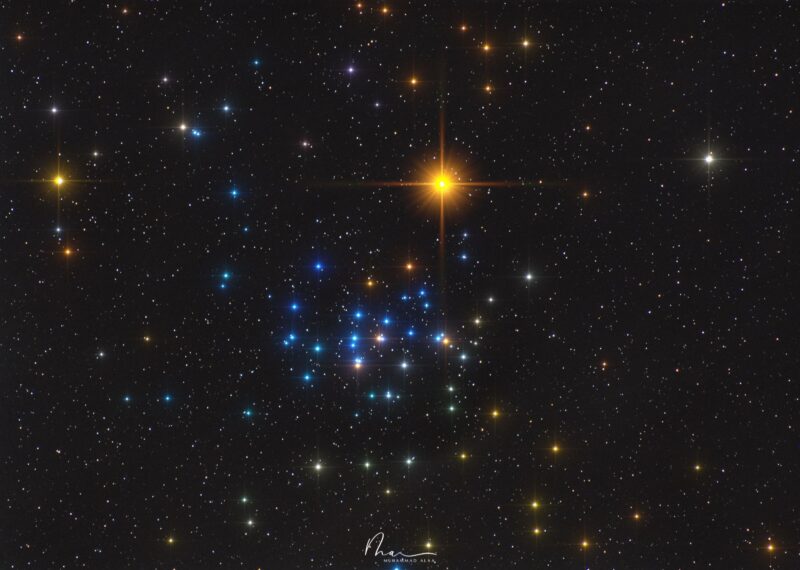
View at EarthSky Community Photos. | Muhammad Alaa in Egypt, captured this view of the open cluster Messier 44 (with the planet Mars passing by) in the constellation Cancer on May 6, 2025. Muhammad wrote: “One of the most beautiful open star clusters in the night sky, located in the constellation Cancer. It’s about 580 light-years away and contains over 1,000 stars! This cluster is one of the closest open clusters to Earth and appears as a faint ‘cloudy patch’ in dark skies to the naked eye. But through a telescope or even simple binoculars, you’ll see a stunning spread of bright stars. Its name ‘Beehive’ comes from its scattered appearance, resembling bees buzzing around a hive.” Thank you, Muhammad!
A member of the zodiac
Cancer’s stature as a constellation of the zodiac has remained steadfast over the millennia. In fact, more than 2,000 years ago, the sun shone in front of the constellation Cancer during the Northern Hemisphere’s summer solstice. That’s not the case today, however. Today, the sun resides in front of the constellation Taurus when the summer solstice sun reaches its northernmost point for the year on or near June 21.
Nonetheless, Cancer still seems to symbolize the height and glory of the summer sun. To this day, we say the sun shines over the Tropic of Cancer – not the “Tropic of Taurus” – on the June solstice. That’s in spite of the fact that the sun in our time passes in front of the constellation Cancer from about July 21 until August 10.
Nowadays, the sun doesn’t enter the constellation Cancer until about a month after the Northern Hemisphere’s summer solstice.
The sun shines directly overhead at noon for those located along the Tropic of Cancer at the Northern Hemisphere’s summer solstice. Image via CIA/ Wikipedia (public domain).
Cancer the Crab of myth
In Greek mythology, Cancer was the crab that bit the foot of the Greek hero Heracles (or the Roman Hercules). Heracles killed the crab and then the goddess Hera, who saw Heracles as her enemy, placed the crab in the heavens.
In ancient Chaldean and Platonic philosophy, Cancer was called the Gate of Men. It was through this portal that souls descend from the heavens above and into the bodies of the newly born.
Around 2,700 years ago, the sun passed in front of the Beehive cluster on the Northern Hemisphere’s summer solstice. Back then, this cluster stood at the apex of the zodiac, so perhaps it was this heavenly nebulosity that marked the Gate of Men. At present, the sun has its annual conjunction with the Beehive cluster in late July or early August.
In olden times, before the advent of light pollution, the ancients referred to the Beehive as a little cloud. The Roman author Pliny reported that when the Praesepe (the Beehive cluster) is invisible in an otherwise clear sky, it’s a sure sign of impending storm. So the Beehive cluster once served as a celestial weather station.
Although Cancer may be the faintest constellation of the zodiac, its legacy remains intact. On a dark, moonless night, look for Cancer’s faint grouping of stars to spring out between the more conspicuous constellations Gemini and Leo.
Bottom line: Cancer the Crab is one of the 12 constellations of the zodiac. Learn how to find it in your sky, plus its star cluster, mythology and more.
Cancer the Crab, with its Beehive star cluster, needs a dark sky to be seen. It lies between the Gemini stars Castor and Pollux, and the bright star Regulus in Leo. Chart via EarthSky.
There’s a good chance that you’ve never seen Cancer the Crab. It’s the faintest of the 12 constellations of the zodiac. To see Cancer, you need to look between Gemini‘s two brightest stars Castor and Pollux, and Leo the Lion’s brightest star Regulus. And in 2026, finding Gemini – and Pollux and Castor – is easy because bright Jupiter shines nearby.
Once you’ve found Cancer – if your sky is dark – you can see the wonderful open star cluster called the Beehive. It contains some 1,000 stars.
So, let’s suppose you have identified the star Regulus in Leo, and the stars Castor and Pollux in Gemini. You look between them for Cancer and see, well, nothing much. Remember, Cancer is faint. Our advice, therefore, is to look for it in a dark country sky. But, on a moonless night, Cancer is surprisingly easy to see in a dark country sky.
Star chart for Cancer the Crab. Image via International Astronomical Union/ Wikimedia Commons (CC BY 3.0).
When to look for Cancer the Crab
From the Northern Hemisphere, Cancer is well placed for viewing in March, April and May. Eventually, it starts to descend into the sunset glare in June.
In early March every year, look for the constellation Cancer to be due south and highest up in the sky around 10 p.m. your local time. (From the tropics, Cancer shines high overhead, and from temperate latitudes in the Southern Hemisphere, Cancer appears due north.)
Also, since the stars return to the same place in the sky about four minutes earlier each day, or 1/2 hour earlier weekly. So by early April, Cancer reaches its high point for the night at 8 p.m. your local time (9 p.m. local daylight saving time). And by early May, Cancer is high in the western sky.
To summarize, in the Northern Hemisphere, Cancer is best seen in the evening sky in late winter and early spring. After that, it’s lost in the sun’s glare in July and August, and then is found in the morning sky starting in September. If you’re up before dawn during a Northern Hemisphere autumn, try finding Cancer and its Beehive star cluster before sunrise.
From the Southern Hemisphere, the best viewing for Cancer the Crab and the Beehive Cluster is during autumn evenings (March and April), looking towards the northern sky. In March, it’s high in the sky around 10 p.m. local time. And it remains visible through May.
Cancer the Crab from Urania’s Mirror, an antique set of constellation cards. Image via Wikipedia (public domain).
Cancer’s famous Beehive star cluster
Cancer makes up for its lackluster stars by having within its boundaries one of the sky’s brightest star clusters, the Beehive cluster, also known as M44. Another name for the Beehive is Praesepe (Latin for manger).
In a dark sky, the Beehive looks like a tiny faint cloud to the unaided eye. As seen through ordinary binoculars, though, this nebulous patch of haze instantly turns into a sparkling city of stars. It is an open cluster, one of the nearest to our solar system at 577 light-years away. The Beehive contains a larger star population than most other nearby clusters.
The Beehive’s stars appear to be similar in age and proper motion to the stars of the V-shaped Hyades open star cluster. It’s possible the two clusters were born from two parts of a single vast cloud of gas and dust in space.
And sometimes the Beehive gets a visitor. It could be the moon or one of the planets in our solar system. In June 2026, brilliant Venus will pass within two full-moon widths of the Beehive. Then in October 2026, Mars will pass in front of the Beehive star cluster.
View at EarthSky Community Photos. | Muhammad Alaa in Egypt, captured this view of the open cluster Messier 44 (with the planet Mars passing by) in the constellation Cancer on May 6, 2025. Muhammad wrote: “One of the most beautiful open star clusters in the night sky, located in the constellation Cancer. It’s about 580 light-years away and contains over 1,000 stars! This cluster is one of the closest open clusters to Earth and appears as a faint ‘cloudy patch’ in dark skies to the naked eye. But through a telescope or even simple binoculars, you’ll see a stunning spread of bright stars. Its name ‘Beehive’ comes from its scattered appearance, resembling bees buzzing around a hive.” Thank you, Muhammad!
A member of the zodiac
Cancer’s stature as a constellation of the zodiac has remained steadfast over the millennia. In fact, more than 2,000 years ago, the sun shone in front of the constellation Cancer during the Northern Hemisphere’s summer solstice. That’s not the case today, however. Today, the sun resides in front of the constellation Taurus when the summer solstice sun reaches its northernmost point for the year on or near June 21.
Nonetheless, Cancer still seems to symbolize the height and glory of the summer sun. To this day, we say the sun shines over the Tropic of Cancer – not the “Tropic of Taurus” – on the June solstice. That’s in spite of the fact that the sun in our time passes in front of the constellation Cancer from about July 21 until August 10.
Nowadays, the sun doesn’t enter the constellation Cancer until about a month after the Northern Hemisphere’s summer solstice.
The sun shines directly overhead at noon for those located along the Tropic of Cancer at the Northern Hemisphere’s summer solstice. Image via CIA/ Wikipedia (public domain).
Cancer the Crab of myth
In Greek mythology, Cancer was the crab that bit the foot of the Greek hero Heracles (or the Roman Hercules). Heracles killed the crab and then the goddess Hera, who saw Heracles as her enemy, placed the crab in the heavens.
In ancient Chaldean and Platonic philosophy, Cancer was called the Gate of Men. It was through this portal that souls descend from the heavens above and into the bodies of the newly born.
Around 2,700 years ago, the sun passed in front of the Beehive cluster on the Northern Hemisphere’s summer solstice. Back then, this cluster stood at the apex of the zodiac, so perhaps it was this heavenly nebulosity that marked the Gate of Men. At present, the sun has its annual conjunction with the Beehive cluster in late July or early August.
In olden times, before the advent of light pollution, the ancients referred to the Beehive as a little cloud. The Roman author Pliny reported that when the Praesepe (the Beehive cluster) is invisible in an otherwise clear sky, it’s a sure sign of impending storm. So the Beehive cluster once served as a celestial weather station.
Although Cancer may be the faintest constellation of the zodiac, its legacy remains intact. On a dark, moonless night, look for Cancer’s faint grouping of stars to spring out between the more conspicuous constellations Gemini and Leo.
Bottom line: Cancer the Crab is one of the 12 constellations of the zodiac. Learn how to find it in your sky, plus its star cluster, mythology and more.
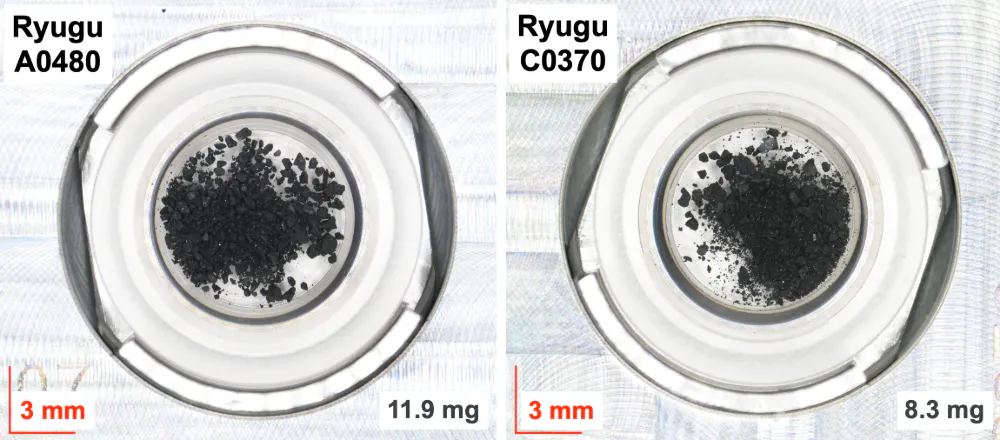
This is a sample of the asteroid Ryugu. The Japanese mission Hayabusa2 brought it back to Earth in 2020. A new study found all 5 fundamental units of life’s genetic code in this asteroid sample. Image via JAXA.
Scientists analyzing samples from asteroid Ryugu have detected all five of the building blocks that make up DNA and RNA.
The discovery shows that key ingredients for life can form naturally in space.
These compounds may have been delivered to early Earth by meteorites. Did life on Earth get a kickstart from an asteroid?
Life’s genetic code discovered in an asteroid sample
A new study reveals all five fundamental nucleobases – the molecular letters of life – have been detected in samples from the asteroid Ryugu.
Asteroid particles offer a glimpse into the chemical ingredients that may have helped kindle life on Earth. Japan Aerospace Exploration Agency’s (JAXA) Hayabusa2 mission returned the Ryugu samples from space in 2020.
In 2023, an international team reported they had found one of the nucleobases in these samples: uracil. On March 16, 2026, in a study published in Nature Astronomy, a team of Japanese scientists has confirmed all five nucleobases are present in this pristine asteroid material.
This means these ingredients for life may have been widespread throughout the solar system in its early years.
Why look for nucleobases?
Nucleobases are nitrogen-containing organic molecules. They form the “letters” of genetic information in DNA and RNA. The five main nucleobases are adenine and guanine (known as purines), as well as cytosine, thymine and uracil (known as pyrimidines).
These molecules combine with sugars and phosphates to yield nucleotides: the building blocks of genetic material. Without nucleobases, the genetic code that allows organisms to grow, reproduce and evolve would not exist.
By studying purines and pyrimidines in Ryugu samples, scientists can reconstruct the chemical history of primitive asteroids. In turn, this gives us a better understanding of how the building blocks of life may have been formed and existed across the solar system.
Hayabusa2 delivered a total of 5.4 grams of pristine asteroid material. Researchers have to use ultra-clean lab conditions to avoid contaminating it. They extracted organic molecules using water and hydrochloric acid. Then they purified them for further detection.
They found all five nucleobases in the two Ryugu samples they analyzed, in roughly similar amounts.
Microscope images of Ryugu samples collected from the first and second touchdown sites of the Hayabusa2 mission. Image via JAXA/ JAMSTEC.
Key components of genetic material … in space
The new results align with previous findings on space rocks. The Murchison meteorite that fell in Australia in 1969 and the Orgueil meteorite in France in 1864 have previously yielded a rich variety of organic molecules, including nucleobases.
Of course, meteorites that land on Earth can be contaminated by their journey and landing. But pristine samples from NASA’s mission to asteroid Bennu also yielded all five nucleobases in 2025.
Asteroids such as Ryugu, Bennu, and the parent body of the Orgueil meteorite are remnants of the early Solar System. They can preserve materials largely unchanged for about 4.5 billion years.
Interestingly, these asteroids show chemical differences. Murchison is enriched in purines, while Bennu and Orgueil contain more pyrimidines. It is thought ammonia may influence this balance. Ammonia is a key molecule that can shape which nucleobases can form.
By peering into Ryugu’s relatively pristine samples and comparing them with meteorites like Murchison and Orgueil, researchers are tracing the cosmic journey of life’s probable molecular ingredients.
Their results suggest key components of genetic material may have formed in space and later delivered to the early Earth. In other words, the story of life on our planet may be deeply connected to the chemistry of such ancient asteroids.
A colored view of 162173 Ryugu taken by JAXA’s space probe Hayabusa2 in 2018. Image via JAXA/ Hayabusa2.
A path for the ingredients of life
Together, these discoveries show that carbon-rich asteroids throughout the solar system contain diverse prebiotic chemistry. However, the precise mixture of molecules – such as the balance between purines and pyrimidines – varies depending on the asteroid’s chemical environment and history.
Because the Ryugu samples were collected directly in space and protected from Earth’s contamination, they provide one of the clearest views of ancient solar system chemistry.
The discovery of all five nucleobases on Ryugu suggests the molecular ingredients of life may have been already forming in space billions of years ago. Asteroids may have helped deliver those ingredients to the early Earth … making the origin of life part of a much larger cosmic chemical story.
Bottom line: Scientists found all 5 fundamental units of life’s genetic code in asteroid Ryugu. It suggests life’s building blocks can form in space and could have been delivered to early Earth.
This is a sample of the asteroid Ryugu. The Japanese mission Hayabusa2 brought it back to Earth in 2020. A new study found all 5 fundamental units of life’s genetic code in this asteroid sample. Image via JAXA.
Scientists analyzing samples from asteroid Ryugu have detected all five of the building blocks that make up DNA and RNA.
The discovery shows that key ingredients for life can form naturally in space.
These compounds may have been delivered to early Earth by meteorites. Did life on Earth get a kickstart from an asteroid?
Life’s genetic code discovered in an asteroid sample
A new study reveals all five fundamental nucleobases – the molecular letters of life – have been detected in samples from the asteroid Ryugu.
Asteroid particles offer a glimpse into the chemical ingredients that may have helped kindle life on Earth. Japan Aerospace Exploration Agency’s (JAXA) Hayabusa2 mission returned the Ryugu samples from space in 2020.
In 2023, an international team reported they had found one of the nucleobases in these samples: uracil. On March 16, 2026, in a study published in Nature Astronomy, a team of Japanese scientists has confirmed all five nucleobases are present in this pristine asteroid material.
This means these ingredients for life may have been widespread throughout the solar system in its early years.
Why look for nucleobases?
Nucleobases are nitrogen-containing organic molecules. They form the “letters” of genetic information in DNA and RNA. The five main nucleobases are adenine and guanine (known as purines), as well as cytosine, thymine and uracil (known as pyrimidines).
These molecules combine with sugars and phosphates to yield nucleotides: the building blocks of genetic material. Without nucleobases, the genetic code that allows organisms to grow, reproduce and evolve would not exist.
By studying purines and pyrimidines in Ryugu samples, scientists can reconstruct the chemical history of primitive asteroids. In turn, this gives us a better understanding of how the building blocks of life may have been formed and existed across the solar system.
Hayabusa2 delivered a total of 5.4 grams of pristine asteroid material. Researchers have to use ultra-clean lab conditions to avoid contaminating it. They extracted organic molecules using water and hydrochloric acid. Then they purified them for further detection.
They found all five nucleobases in the two Ryugu samples they analyzed, in roughly similar amounts.
Microscope images of Ryugu samples collected from the first and second touchdown sites of the Hayabusa2 mission. Image via JAXA/ JAMSTEC.
Key components of genetic material … in space
The new results align with previous findings on space rocks. The Murchison meteorite that fell in Australia in 1969 and the Orgueil meteorite in France in 1864 have previously yielded a rich variety of organic molecules, including nucleobases.
Of course, meteorites that land on Earth can be contaminated by their journey and landing. But pristine samples from NASA’s mission to asteroid Bennu also yielded all five nucleobases in 2025.
Asteroids such as Ryugu, Bennu, and the parent body of the Orgueil meteorite are remnants of the early Solar System. They can preserve materials largely unchanged for about 4.5 billion years.
Interestingly, these asteroids show chemical differences. Murchison is enriched in purines, while Bennu and Orgueil contain more pyrimidines. It is thought ammonia may influence this balance. Ammonia is a key molecule that can shape which nucleobases can form.
By peering into Ryugu’s relatively pristine samples and comparing them with meteorites like Murchison and Orgueil, researchers are tracing the cosmic journey of life’s probable molecular ingredients.
Their results suggest key components of genetic material may have formed in space and later delivered to the early Earth. In other words, the story of life on our planet may be deeply connected to the chemistry of such ancient asteroids.
A colored view of 162173 Ryugu taken by JAXA’s space probe Hayabusa2 in 2018. Image via JAXA/ Hayabusa2.
A path for the ingredients of life
Together, these discoveries show that carbon-rich asteroids throughout the solar system contain diverse prebiotic chemistry. However, the precise mixture of molecules – such as the balance between purines and pyrimidines – varies depending on the asteroid’s chemical environment and history.
Because the Ryugu samples were collected directly in space and protected from Earth’s contamination, they provide one of the clearest views of ancient solar system chemistry.
The discovery of all five nucleobases on Ryugu suggests the molecular ingredients of life may have been already forming in space billions of years ago. Asteroids may have helped deliver those ingredients to the early Earth … making the origin of life part of a much larger cosmic chemical story.
Bottom line: Scientists found all 5 fundamental units of life’s genetic code in asteroid Ryugu. It suggests life’s building blocks can form in space and could have been delivered to early Earth.
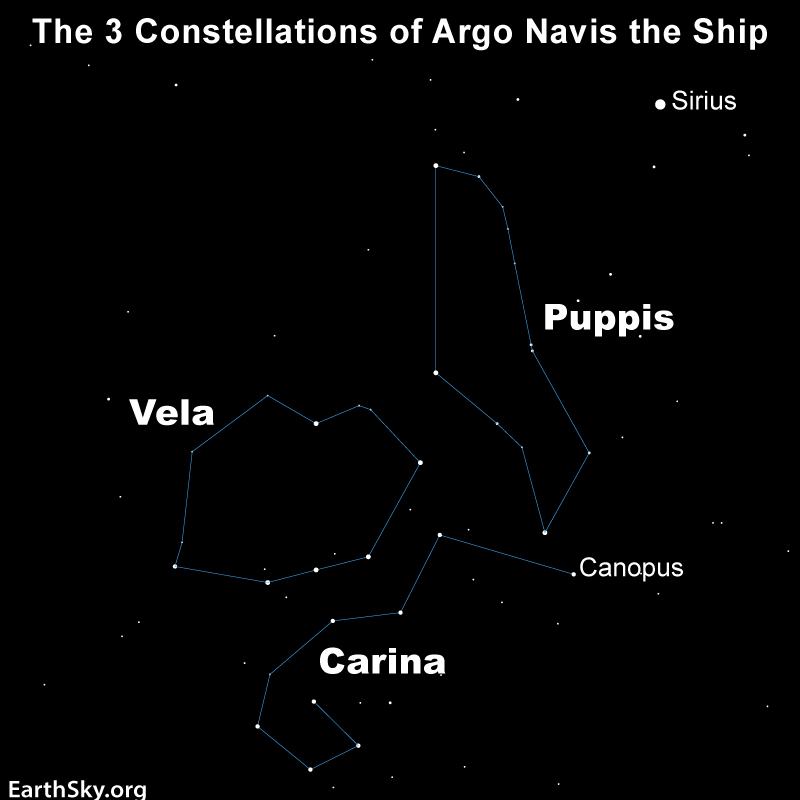
The former constellation of Argo Navis the Ship is now the modern constellations of Puppis the Stern, Vela the Sails and Carina the Keel. You can find these constellations south of Sirius. These constellations are easiest to see from the Southern Hemisphere.
Vela the Sails, a constellation in the Southern Hemisphere, is part of a large ship made up of several constellations. The ship was once a constellation itself, known as Argo Navis. Because of its large size, it has since been broken down into four different, smaller constellations. They include Vela the Sails, Carina the Keel, Puppis the Stern and Pyxis the Compass.
How to locate Vela the Sails
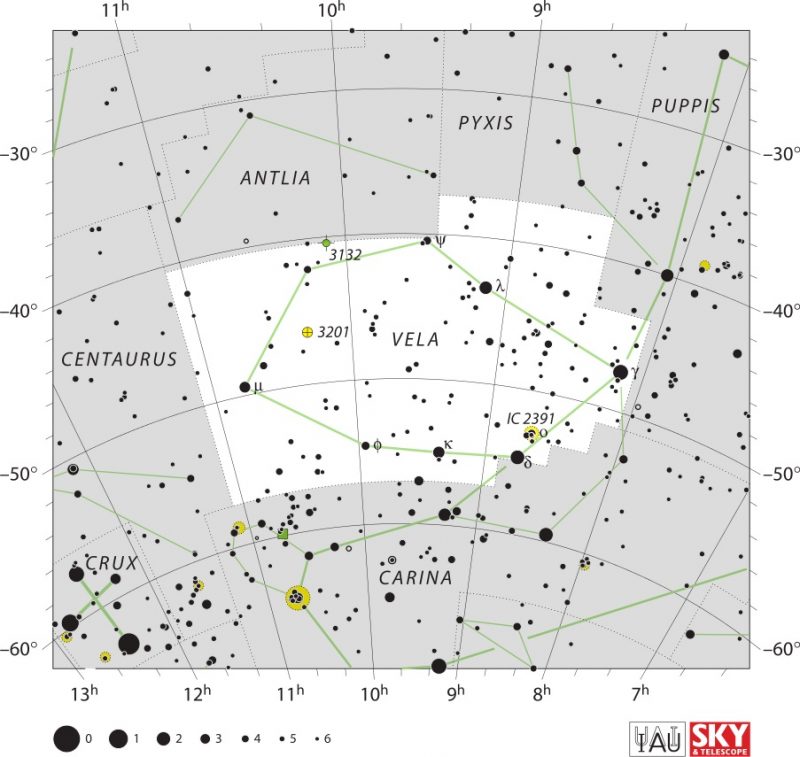
Vela lies north of Carina. It’s halfway between Carina’s incredibly bright star (and the second brightest in the sky) Canopus and the distinctive shape of the Southern Cross, or Crux. Then, it’s just a bit north from a line drawn between these two points. March is the best month to try to spot Vela.
The stars of Vela
The brightest star in Vela is Gamma Velorum, or Regor. It shines at magnitude 1.8 and lies 1,095 light-years from Earth. A little over nine degrees away and similar in brightness is Delta Velorum. At magnitude 1.9, it is only 80 light-years away.
Vela has three other moderately bright stars. The first is about 5 1/2 degrees from the last star, Delta Velorum. This star is Kappa Velorum, which has a magnitude of 2.4 and a distance of 572 light-years. Lambda Velorum, also known as Suhail, shines at magnitude 2.2 from a distance of 545 light-years. Finally is Mu Velorum, which lies on the opposite half of the constellation from the brightest star, Regor. Mu Velorum is magnitude 2.7 and 117 light-years away.
Because Vela lies along the Milky Way, it has a number of star clusters than you can spot in binoculars or average telescopes. The Eight-Burst Nebula (NGC 3132 or Southern Ring Nebula) lies right on the border with Vela and Antlia the Air Pump. The Eight-Burst Nebula is a magnitude-9.8 planetary nebula ring with a central star. Its central star is actually a binary star.
NGC 3201 is a globular cluster about 5 1/2 degrees northwest of Mu Velorum. It shines at magnitude 6.8. Some brighter star clusters lie in the western part of the constellation. Two degrees south of Regor is NGC 2547, at magnitude 4.7. Five degrees east is IC 2395, at magnitude 4. Just less than two degrees northwest of Delta Velorum is IC 2391, a gathering of stars that you can easily see with the unaided eye at magnitude 2. Through binoculars, a second cluster pops into view nearby, NGC 2669.
Vela is a southern delight for those wishing to spy star clusters in the Milky Way.
Bottom line: Vela the Sails is a constellation that was once part of the large Argo Navis the Ship. You can see it best from the Southern Hemisphere on March evenings.
The former constellation of Argo Navis the Ship is now the modern constellations of Puppis the Stern, Vela the Sails and Carina the Keel. You can find these constellations south of Sirius. These constellations are easiest to see from the Southern Hemisphere.
Vela the Sails, a constellation in the Southern Hemisphere, is part of a large ship made up of several constellations. The ship was once a constellation itself, known as Argo Navis. Because of its large size, it has since been broken down into four different, smaller constellations. They include Vela the Sails, Carina the Keel, Puppis the Stern and Pyxis the Compass.
How to locate Vela the Sails
Vela lies north of Carina. It’s halfway between Carina’s incredibly bright star (and the second brightest in the sky) Canopus and the distinctive shape of the Southern Cross, or Crux. Then, it’s just a bit north from a line drawn between these two points. March is the best month to try to spot Vela.
The stars of Vela
The brightest star in Vela is Gamma Velorum, or Regor. It shines at magnitude 1.8 and lies 1,095 light-years from Earth. A little over nine degrees away and similar in brightness is Delta Velorum. At magnitude 1.9, it is only 80 light-years away.
Vela has three other moderately bright stars. The first is about 5 1/2 degrees from the last star, Delta Velorum. This star is Kappa Velorum, which has a magnitude of 2.4 and a distance of 572 light-years. Lambda Velorum, also known as Suhail, shines at magnitude 2.2 from a distance of 545 light-years. Finally is Mu Velorum, which lies on the opposite half of the constellation from the brightest star, Regor. Mu Velorum is magnitude 2.7 and 117 light-years away.
Because Vela lies along the Milky Way, it has a number of star clusters than you can spot in binoculars or average telescopes. The Eight-Burst Nebula (NGC 3132 or Southern Ring Nebula) lies right on the border with Vela and Antlia the Air Pump. The Eight-Burst Nebula is a magnitude-9.8 planetary nebula ring with a central star. Its central star is actually a binary star.
NGC 3201 is a globular cluster about 5 1/2 degrees northwest of Mu Velorum. It shines at magnitude 6.8. Some brighter star clusters lie in the western part of the constellation. Two degrees south of Regor is NGC 2547, at magnitude 4.7. Five degrees east is IC 2395, at magnitude 4. Just less than two degrees northwest of Delta Velorum is IC 2391, a gathering of stars that you can easily see with the unaided eye at magnitude 2. Through binoculars, a second cluster pops into view nearby, NGC 2669.
Vela is a southern delight for those wishing to spy star clusters in the Milky Way.
Bottom line: Vela the Sails is a constellation that was once part of the large Argo Navis the Ship. You can see it best from the Southern Hemisphere on March evenings.
At a press conference on Tuesday morning, March 24, 2026, NASA Administrator Jared Isaacman announced a series of new agency-wide initiatives for the space agency. NASA is calling this realignment by the name Ignition. Led by NASA Administrator Jared Isaacman, the initiative shifts the agency’s focus toward a “mission-first” culture. It’s designed to accelerate the timeline for a permanent lunar base and deep-space exploration. Isaacman said:
NASA is committed to achieving the near-impossible once again, to return to the moon [by early 2029], build a moon base, establish an enduring presence, and do the other things needed to ensure American leadership in space. This is why it is essential we leave an event like Ignition with complete alignment on the national imperative that is our collective mission. The clock is running in this great-power competition, and success or failure will be measured in months, not years
If we concentrate NASA’s extraordinary resources on the objectives of the National Space Policy, clear away needless obstacles that impede progress, and unleash the workforce and industrial might of our nation and partners, then returning to the moon and building a base will seem pale in comparison to what we will be capable of accomplishing in the years ahead.
Today we are aligning NASA around the mission. On the moon, we are shifting to a focused, phased architecture that builds capability landing by landing, incrementally, and in alignment with our industrial and international partners. In low Earth orbit (LEO), we are recognizing where the market is and where it isn’t, recognizing the incredible value of the International Space Station, and building a transition that builds a competitive commercial ecosystem rather than forcing a single outcome the market cannot support.
In our science missions, we are opening the lunar surface to researchers and students nationwide, and with Space Reactor-1 Freedom, we are finally putting nuclear propulsion on a trajectory out of the laboratory and into deep space. And this is all possible by investing in our people, bringing critical skills back into the agency, putting our teams where the machines are being built, and creating real pathways for the next generation of NASA leaders. Our workforce is the jewel of NASA, and from their leaders, they need clear mission goals, the tools to execute, and to get out of their way. This is what Ignition is about.
With humanity’s return to the moon on the way, skeptics have returned to an age-old conspiracy. They’re saying there’s no way humans could survive a journey through the Van Allen radiation belts surrounding our planet. In this short video, EarthSky’s Will Triggs explains why they’re wrong.
Going back to the moon
The announcements build on recent updates to the Artemis program. Artemis 2, which will carry a human crew around the moon and back, might launch as soon as early April. The new initiatives include standardizing the SLS (Space Launch System) rocket configuration, adding an additional mission in 2027, and undertaking at least one surface landing every year thereafter. Artemis 3 – scheduled for 2027 – will focus on testing integrated systems and operational capabilities in Earth orbit in advance of the Artemis 4 lunar landing.
Looking beyond Artemis 5, NASA announced March 24 it will begin to incorporate more commercially procured and reusable hardware to undertake frequent and affordable crewed missions to the lunar surface, initially targeting landings every six months, with the potential to increase cadence as capabilities mature.
To achieve an enduring human presence on the moon, NASA also announced a phased approach to building a lunar base. As part of this strategy, the agency intends to pause Gateway in its current form and shift focus to infrastructure that enables sustained surface operations. Despite challenges with some existing hardware, the agency will repurpose applicable equipment and leverage international partner commitments to support these objectives.
In the coming days, NASA will release Requests for Information (RFIs) and draft Requests for Proposals (RFPs) to ensure continued progress in meeting national objectives.
Building the moon base
NASA’s plan for establishing a sustained lunar presence will roll out in three deliberate phases.
Phase One: Build, Test, Learn
NASA shifts from bespoke, infrequent missions to a repeatable, modular approach. Through CLPS (Commercial Lunar Payload Services) deliveries and the LTV (Lunar Terrain Vehicle) program, the agency will increase the tempo of lunar activity, sending rovers, instruments, and technology demonstrations that advance mobility, power generation (including radioisotope heater units and radioisotope thermoelectric generators), communications, navigation, surface operations, and a wide range of scientific investigations.
Phase Two: Establish Early Infrastructure
With lessons from early missions in hand, NASA moves toward semi-habitable infrastructure and regular logistics. This phase supports recurring astronaut operations on the surface and incorporates major international contributions, including JAXA’s (Japan Aerospace Exploration Agency) pressurized rover, and potentially other partner scientific payloads, rovers, and infrastructure/transportation capabilities.
Phase Three: Enable Long-Duration Human Presence
As cargo-capable human landing systems (HLS) come online, NASA will deliver heavier infrastructure needed for a continuous human foothold on the moon, marking the transition from periodic expeditions to a permanent lunar base. This will include ASI’s (Italian Space Agency) Multi-purpose Habitats (MPH), CSA’s (Canadian Space Agency) Lunar Utility Vehicle, and opportunities for additional contributions in habitation, surface mobility and logistics.
New initiatives in low-Earth orbit
While building a sustainable lunar architecture, NASA is also reaffirming its commitment to low Earth orbit. For more than two decades, the International Space Station has served as a world-class orbital laboratory, enabling more than 4,000 research investigations, supporting more than 5,000 researchers, and hosting visitors from 26 countries. The space station required 37 shuttle flights, 160 spacewalks, two decades, and more than $100 billion to design, develop, and build. The orbital laboratory cannot operate indefinitely. The transition to commercial stations must be thoughtful, deliberate, and structured to support long-term industry success.
NASA is introducing and seeking industry feedback on an additional LEO strategy that preserves all current pathways while adding a phased, International Space Station-anchored approach to avoid any gap in U.S. human presence and mature a robust commercial ecosystem. Under this alternative approach, NASA would procure a government-owned Core Module that attaches to the space station, followed by commercial modules that are validated using International Space Station capabilities and later detach into free flight. After maturing technical and operational capabilities and market demand is realized, the stations would detach and NASA would be one of many customers purchasing commercial services. To stimulate the orbital economy, NASA would expand industry opportunities, including private astronaut missions, commander seat sales, joint missions, multiple module competitions, and prize-based awards.
An industry RFI opens Wednesday, March 25, to inform partnership structures, financing, and risk mitigation.
Advancing world-changing discovery with current, developing science missions
In a Golden Age of exploration and discovery, NASA takes full advantage of every opportunity to get science into space. The James Webb Space Telescope continues to transform our understanding of the early universe, Parker Solar Probe has flown through the atmosphere of the Sun, NASA has shown it can defend the planet by deflecting asteroids, and Earth science data is used extensively by American companies, U.S. agriculture, and disaster relief. On the International Space Station, NASA is conducting groundbreaking experiments in quantum science.
Future opportunities will advance U.S. leadership in space science. The Nancy Grace Roman Space Telescope, launching as early as this fall, will advance our understanding of dark energy, and has created a new standard for the management of large science missions. Dragonfly will launch a nuclear-powered octocopter in 2028, arriving at Saturn’s moon Titan in 2034 to explore its complex, organic-rich environment. In 2028, NASA will launch and deliver ESA’s (European Space Agency) Rosalind Franklin Rover to Mars, with NASA’s contributed mass spectrometer for the Mars Organic Molecule Analyzer (MOMA) instrument, which may result in the most advanced detection and analysis of organic matter ever conducted on Mars. A new Earth science mission launching next year will measure for the first time the evolution of the dynamics within convective storms to improve the prediction of extreme weather events up to six hours before the storm occurs.
The agency detailed how advancements in lunar science also will be afforded by the build out of the moon base and underpin future moon and Mars exploration. With an accelerated CLPS cadence, targeting up to 30 robotic landings starting in 2027, NASA is expediting delivery of science and technology to the lunar surface. There will be many opportunities for payload delivery including rovers, hoppers, and drones with contributions welcomed from industry, academia, and international partners. Near-term payloads include the VIPER rover and the LuSEE-Night mission. An RFI will be released March 24 that calls for payloads capable of supporting NASA’s science and technology goals for additional 2027 and 2028 flights. It will enable students and researchers across the country to work on scientific instruments for use on the surface of the moon in the years ahead. This RFI also will solicit payloads incorporated on future missions to Mars including the Mars Telecom Network (MTN) and a nuclear technology demonstration mission.
The agency intends to partner with philanthropic and privately funded research organizations with shared objectives in space science.
Other RFIs released March 24 will strengthen “Science as a Service” partnerships and commercial capabilities, allowing NASA to streamline legacy operations and focus investment on the transformational missions only the agency can lead.
Finally, NASA will unveil a previously unseen pair of images from the James Webb and Hubble Space Telescopes. These images show the planet Saturn in unprecedented detail in both infrared and visible wavelengths.
Nuclear-powered mission to Mars
In addition to these scientific missions, after decades of study and in response to the National Space Policy, NASA announced a major step forward in bringing nuclear power and propulsion from the lab to space.
NASA will launch the Space Reactor-1 Freedom, the first nuclear powered interplanetary spacecraft, to Mars before the end of 2028, demonstrating advanced nuclear electric propulsion in deep space. Nuclear electric propulsion provides an extraordinary capability for efficient mass transport in deep space and enables high power missions beyond Jupiter where solar arrays are not effective.
When SR-1 Freedom reaches Mars, it will deploy the Skyfall payload of Ingenuity-class helicopters to continue exploring the Red Planet. SR-1 Freedom will establish flight heritage nuclear hardware, set regulatory and launch precedent, and activate the industrial base for future fission power systems across propulsion, surface, and long-duration missions. NASA and its U.S. Department of Energy partner will unlock the capabilities required for sustained exploration beyond the moon and eventual journeys to Mars and the outer solar system.
None of these endeavors can succeed without the NASA workforce. As previously announced, the agency is rebuilding its core competencies, converting thousands of contractor positions to civil service, and restoring the engineering, technical, and operational strengths expected of the world’s premier space organization.
NASA is expanding opportunities for interns and early-career professionals and, in partnership with the U.S. Office of Personnel Management and NASA Force, is creating new pathways for experienced industry talent to serve through term-based appointments. The agency also is seeking to open opportunities for NASA employees to gain valuable experience working within the most technologically advanced space industry in history.
The new NASA initiatives announced on March 24 will be implemented during the coming months, with teams agencywide ensuring a smooth transition while advancing key programs and partnerships.
NASA will embed subject matter experts across the supply chain – at every major vendor, subcontractor, and critical-path component – to challenge assumptions, solve problems, accelerate production, and help ensure the right outcomes are achieved.
Through these reforms, NASA is strengthening its ability to deliver on the President’s National Space Policy and ensure continued American superiority in space.
Bottom line: Moon base and Mars! NASA administrator Jared Isaacman announced them as part of a series of new NASA initiatives on March 24, 2026.
At a press conference on Tuesday morning, March 24, 2026, NASA Administrator Jared Isaacman announced a series of new agency-wide initiatives for the space agency. NASA is calling this realignment by the name Ignition. Led by NASA Administrator Jared Isaacman, the initiative shifts the agency’s focus toward a “mission-first” culture. It’s designed to accelerate the timeline for a permanent lunar base and deep-space exploration. Isaacman said:
NASA is committed to achieving the near-impossible once again, to return to the moon [by early 2029], build a moon base, establish an enduring presence, and do the other things needed to ensure American leadership in space. This is why it is essential we leave an event like Ignition with complete alignment on the national imperative that is our collective mission. The clock is running in this great-power competition, and success or failure will be measured in months, not years
If we concentrate NASA’s extraordinary resources on the objectives of the National Space Policy, clear away needless obstacles that impede progress, and unleash the workforce and industrial might of our nation and partners, then returning to the moon and building a base will seem pale in comparison to what we will be capable of accomplishing in the years ahead.
Today we are aligning NASA around the mission. On the moon, we are shifting to a focused, phased architecture that builds capability landing by landing, incrementally, and in alignment with our industrial and international partners. In low Earth orbit (LEO), we are recognizing where the market is and where it isn’t, recognizing the incredible value of the International Space Station, and building a transition that builds a competitive commercial ecosystem rather than forcing a single outcome the market cannot support.
In our science missions, we are opening the lunar surface to researchers and students nationwide, and with Space Reactor-1 Freedom, we are finally putting nuclear propulsion on a trajectory out of the laboratory and into deep space. And this is all possible by investing in our people, bringing critical skills back into the agency, putting our teams where the machines are being built, and creating real pathways for the next generation of NASA leaders. Our workforce is the jewel of NASA, and from their leaders, they need clear mission goals, the tools to execute, and to get out of their way. This is what Ignition is about.
With humanity’s return to the moon on the way, skeptics have returned to an age-old conspiracy. They’re saying there’s no way humans could survive a journey through the Van Allen radiation belts surrounding our planet. In this short video, EarthSky’s Will Triggs explains why they’re wrong.
Going back to the moon
The announcements build on recent updates to the Artemis program. Artemis 2, which will carry a human crew around the moon and back, might launch as soon as early April. The new initiatives include standardizing the SLS (Space Launch System) rocket configuration, adding an additional mission in 2027, and undertaking at least one surface landing every year thereafter. Artemis 3 – scheduled for 2027 – will focus on testing integrated systems and operational capabilities in Earth orbit in advance of the Artemis 4 lunar landing.
Looking beyond Artemis 5, NASA announced March 24 it will begin to incorporate more commercially procured and reusable hardware to undertake frequent and affordable crewed missions to the lunar surface, initially targeting landings every six months, with the potential to increase cadence as capabilities mature.
To achieve an enduring human presence on the moon, NASA also announced a phased approach to building a lunar base. As part of this strategy, the agency intends to pause Gateway in its current form and shift focus to infrastructure that enables sustained surface operations. Despite challenges with some existing hardware, the agency will repurpose applicable equipment and leverage international partner commitments to support these objectives.
In the coming days, NASA will release Requests for Information (RFIs) and draft Requests for Proposals (RFPs) to ensure continued progress in meeting national objectives.
Building the moon base
NASA’s plan for establishing a sustained lunar presence will roll out in three deliberate phases.
Phase One: Build, Test, Learn
NASA shifts from bespoke, infrequent missions to a repeatable, modular approach. Through CLPS (Commercial Lunar Payload Services) deliveries and the LTV (Lunar Terrain Vehicle) program, the agency will increase the tempo of lunar activity, sending rovers, instruments, and technology demonstrations that advance mobility, power generation (including radioisotope heater units and radioisotope thermoelectric generators), communications, navigation, surface operations, and a wide range of scientific investigations.
Phase Two: Establish Early Infrastructure
With lessons from early missions in hand, NASA moves toward semi-habitable infrastructure and regular logistics. This phase supports recurring astronaut operations on the surface and incorporates major international contributions, including JAXA’s (Japan Aerospace Exploration Agency) pressurized rover, and potentially other partner scientific payloads, rovers, and infrastructure/transportation capabilities.
Phase Three: Enable Long-Duration Human Presence
As cargo-capable human landing systems (HLS) come online, NASA will deliver heavier infrastructure needed for a continuous human foothold on the moon, marking the transition from periodic expeditions to a permanent lunar base. This will include ASI’s (Italian Space Agency) Multi-purpose Habitats (MPH), CSA’s (Canadian Space Agency) Lunar Utility Vehicle, and opportunities for additional contributions in habitation, surface mobility and logistics.
New initiatives in low-Earth orbit
While building a sustainable lunar architecture, NASA is also reaffirming its commitment to low Earth orbit. For more than two decades, the International Space Station has served as a world-class orbital laboratory, enabling more than 4,000 research investigations, supporting more than 5,000 researchers, and hosting visitors from 26 countries. The space station required 37 shuttle flights, 160 spacewalks, two decades, and more than $100 billion to design, develop, and build. The orbital laboratory cannot operate indefinitely. The transition to commercial stations must be thoughtful, deliberate, and structured to support long-term industry success.
NASA is introducing and seeking industry feedback on an additional LEO strategy that preserves all current pathways while adding a phased, International Space Station-anchored approach to avoid any gap in U.S. human presence and mature a robust commercial ecosystem. Under this alternative approach, NASA would procure a government-owned Core Module that attaches to the space station, followed by commercial modules that are validated using International Space Station capabilities and later detach into free flight. After maturing technical and operational capabilities and market demand is realized, the stations would detach and NASA would be one of many customers purchasing commercial services. To stimulate the orbital economy, NASA would expand industry opportunities, including private astronaut missions, commander seat sales, joint missions, multiple module competitions, and prize-based awards.
An industry RFI opens Wednesday, March 25, to inform partnership structures, financing, and risk mitigation.
Advancing world-changing discovery with current, developing science missions
In a Golden Age of exploration and discovery, NASA takes full advantage of every opportunity to get science into space. The James Webb Space Telescope continues to transform our understanding of the early universe, Parker Solar Probe has flown through the atmosphere of the Sun, NASA has shown it can defend the planet by deflecting asteroids, and Earth science data is used extensively by American companies, U.S. agriculture, and disaster relief. On the International Space Station, NASA is conducting groundbreaking experiments in quantum science.
Future opportunities will advance U.S. leadership in space science. The Nancy Grace Roman Space Telescope, launching as early as this fall, will advance our understanding of dark energy, and has created a new standard for the management of large science missions. Dragonfly will launch a nuclear-powered octocopter in 2028, arriving at Saturn’s moon Titan in 2034 to explore its complex, organic-rich environment. In 2028, NASA will launch and deliver ESA’s (European Space Agency) Rosalind Franklin Rover to Mars, with NASA’s contributed mass spectrometer for the Mars Organic Molecule Analyzer (MOMA) instrument, which may result in the most advanced detection and analysis of organic matter ever conducted on Mars. A new Earth science mission launching next year will measure for the first time the evolution of the dynamics within convective storms to improve the prediction of extreme weather events up to six hours before the storm occurs.
The agency detailed how advancements in lunar science also will be afforded by the build out of the moon base and underpin future moon and Mars exploration. With an accelerated CLPS cadence, targeting up to 30 robotic landings starting in 2027, NASA is expediting delivery of science and technology to the lunar surface. There will be many opportunities for payload delivery including rovers, hoppers, and drones with contributions welcomed from industry, academia, and international partners. Near-term payloads include the VIPER rover and the LuSEE-Night mission. An RFI will be released March 24 that calls for payloads capable of supporting NASA’s science and technology goals for additional 2027 and 2028 flights. It will enable students and researchers across the country to work on scientific instruments for use on the surface of the moon in the years ahead. This RFI also will solicit payloads incorporated on future missions to Mars including the Mars Telecom Network (MTN) and a nuclear technology demonstration mission.
The agency intends to partner with philanthropic and privately funded research organizations with shared objectives in space science.
Other RFIs released March 24 will strengthen “Science as a Service” partnerships and commercial capabilities, allowing NASA to streamline legacy operations and focus investment on the transformational missions only the agency can lead.
Finally, NASA will unveil a previously unseen pair of images from the James Webb and Hubble Space Telescopes. These images show the planet Saturn in unprecedented detail in both infrared and visible wavelengths.
Nuclear-powered mission to Mars
In addition to these scientific missions, after decades of study and in response to the National Space Policy, NASA announced a major step forward in bringing nuclear power and propulsion from the lab to space.
NASA will launch the Space Reactor-1 Freedom, the first nuclear powered interplanetary spacecraft, to Mars before the end of 2028, demonstrating advanced nuclear electric propulsion in deep space. Nuclear electric propulsion provides an extraordinary capability for efficient mass transport in deep space and enables high power missions beyond Jupiter where solar arrays are not effective.
When SR-1 Freedom reaches Mars, it will deploy the Skyfall payload of Ingenuity-class helicopters to continue exploring the Red Planet. SR-1 Freedom will establish flight heritage nuclear hardware, set regulatory and launch precedent, and activate the industrial base for future fission power systems across propulsion, surface, and long-duration missions. NASA and its U.S. Department of Energy partner will unlock the capabilities required for sustained exploration beyond the moon and eventual journeys to Mars and the outer solar system.
None of these endeavors can succeed without the NASA workforce. As previously announced, the agency is rebuilding its core competencies, converting thousands of contractor positions to civil service, and restoring the engineering, technical, and operational strengths expected of the world’s premier space organization.
NASA is expanding opportunities for interns and early-career professionals and, in partnership with the U.S. Office of Personnel Management and NASA Force, is creating new pathways for experienced industry talent to serve through term-based appointments. The agency also is seeking to open opportunities for NASA employees to gain valuable experience working within the most technologically advanced space industry in history.
The new NASA initiatives announced on March 24 will be implemented during the coming months, with teams agencywide ensuring a smooth transition while advancing key programs and partnerships.
NASA will embed subject matter experts across the supply chain – at every major vendor, subcontractor, and critical-path component – to challenge assumptions, solve problems, accelerate production, and help ensure the right outcomes are achieved.
Through these reforms, NASA is strengthening its ability to deliver on the President’s National Space Policy and ensure continued American superiority in space.
Bottom line: Moon base and Mars! NASA administrator Jared Isaacman announced them as part of a series of new NASA initiatives on March 24, 2026.
This is an artist’s depiction of the new South Korean juvenile dinosaur, Doolysaurus huhmini. Also in the image are birds and other dinosaurs that lived during the mid-Cretaceous of present-day South Korea. Image via Jun Seong Yi/ University of Texas at Austin.
Scientists discovered a new baby dinosaur in South Korea. They named it Doolysaurus, after a beloved Korean cartoon character.
They scanned the fossil using micro-CT technology, revealing hidden bones and skull parts without disturbing the rock.
The researchers also found over 40 stomach stones with the bones. These suggest Doolysaurus was an omnivore that ate both plants and small animals.
The small, fuzzy, baby dinosaur may have looked like a lamb
Scientists have discovered the fossils of a rather charming baby dinosaur in South Korea. The researchers from the University of Texas at Austin said on March 19, 2026, that it was an omnivorous, turkey-sized youngster, about two years old. And it ran around on its hind feet. Plus, researchers think it might have had a coat of fuzzy hair-like filaments. They named it Doolysaurus huhmini, after a cute and mischievous green baby dinosaur named Dooly. Dooly is a much-loved character in a South Korean cartoon series.
Jongyun Jung, at the University of Texas at Austin, is the lead author of the new paper. Jung said:
Dooly is one of the very famous, iconic dinosaur characters in Korea. Every generation in Korea knows this character. And our specimen is also a juvenile or ‘baby,’ so it’s perfect for our dinosaur species name to honor Dooly.
Julia Clarke, also at the University of Texas at Austin, is a paper co-author. She added:
I think it would have been pretty cute. It might have looked a bit like a little lamb.
A video introduction to Dooly, a beloved baby dinosaur cartoon character in South Korea. The video is in Korean.
A high-tech dinosaur reveal
Researchers have found dinosaur tracks and eggs in Korea before, but dinosaur bones have been rare. In fact, Doolysaurus is the first dinosaur described from fossilized bones in South Korea in 15 years. Paper co-author Hyemin Jo found the fossil in 2023 on Aphae Island, located off the southwestern coast of South Korea.
The fossil was a partial skeleton entombed in hard rock. As a result, scientists had to excavate the rock containing the fossils as a block, with bones still buried inside. A fossil preparator will need several years to gently recover the delicate fossils.
But the scientists did not have to wait that long to find out what was hidden in the block. They scanned its interior using micro computed tomography (micro-CT) at the University of Texas at Austin. This technique uses X-rays to probe the rock, revealing three-dimensional images of what lies within it.
The researchers were delighted to see that the micro-CT scans revealed more bones, including parts of the skull. Jung commented:
When we first found the specimen, we saw some leg bones preserved and some vertebrae. We didn’t expect skull parts and so many more bones. There was a fair amount of excitement when we saw what was hidden inside the block.
This was a significant find because it’s the first dinosaur with parts of its skull, including teeth, that scientists have recovered in South Korea.
This figure shows the probable skeletal anatomy of the juvenile Doolysaurus huhmini. The white shade represents the fossil bones found inside the block. Also, the bones around the skeletal figure are micro-CT scans of each bone. Image via Janet Cañamar, adapted from Jung et al 2026/ University of Texas at Austin.
What we know about Doolysaurus
As previously mentioned, the dinosaur’s genus name, Doolysaurus, celebrates the beloved Korean cartoon dinosaur, Dooly. Meanwhile, its species name, huhmini, honors the prominent Korean paleontologist Min Huh. He founded the Korean Dinosaur Research Center and has studied Korean dinosaurs for more than 30 years.
Scientists found Doolysaurus in rock dating between 113 million to 94 million years ago, placing the dinosaur in the mid-Cretaceous period. It was a juvenile, around two years old, when it died. The researchers were able to determine its approximate age by studying growth markers visible in a thin slice of the dinosaur’s femur (thigh bone). It was the size of a turkey and may have weighed just 18 pounds (8.3 kg). Moreover, the scientists think that an adult Doolysaurus could have been double that size.
The bones also placed Doolysaurus in the Thescelosaurid family of dinosaurs. Scientists have found these types of dinosaurs in East Asia and North America; they were bi-pedal and may have had a coat of fuzzy hair-like filaments.
This is a photo featuring 3 of the paper authors. It also includes the person that the scientists honored with the new dinosaur species name, Doolysaurus huhmini. From left to right: Julia Clarke, Min Huh (partly named in his honor), Hyemin Jo and Jongyun Jung. Image via Jongyun Jung/ University of Texas at Austin.
They also found gastroliths
The scientists also found over 40 pebbles among the bones in the block, ranging in size from 1/16th to 4/10th of an inch (2 to 10 mm). These are gastroliths, also called stomach stones. Herbivorous and omnivorous dinosaurs swallowed pebbles to grind food in their digestive tract. (Some living animals, such as crocodiles, alligators, and herbivorous birds, also carry gastroliths.)
The size and shape of the gastroliths they found suggested that Doolysaurus was an omnivore. It likely fed on plants and small animals including insects. In fact, it was the presence of some gastroliths at the surface of the rock that led the scientists to scan the block to look for additional bones.
Clark remarked:
A little cluster of stomach stones, with two leg bones sticking out, indicates that the animal was not fully pulled apart before it has hit the fossil record. So, I encouraged [Jung and co-authors Minguk Kim and Hyemin Jo] to visit Texas and the University of Texas High-Resolution X-ray Computed Tomography (UTCT) [facility], to try scanning the fossil.
Because the researchers found Doolysaurus largely encased in rock, they hope more dinosaur bones await discovery in South Korea. Jung also hopes to continue using micro-CT technology to expose more hidden fossils.
Bottom line: Scientists discovered a new dinosaur, thought to be two years old, and named it after Dooly, a popular South Korean baby dinosaur cartoon character.
This is an artist’s depiction of the new South Korean juvenile dinosaur, Doolysaurus huhmini. Also in the image are birds and other dinosaurs that lived during the mid-Cretaceous of present-day South Korea. Image via Jun Seong Yi/ University of Texas at Austin.
Scientists discovered a new baby dinosaur in South Korea. They named it Doolysaurus, after a beloved Korean cartoon character.
They scanned the fossil using micro-CT technology, revealing hidden bones and skull parts without disturbing the rock.
The researchers also found over 40 stomach stones with the bones. These suggest Doolysaurus was an omnivore that ate both plants and small animals.
The small, fuzzy, baby dinosaur may have looked like a lamb
Scientists have discovered the fossils of a rather charming baby dinosaur in South Korea. The researchers from the University of Texas at Austin said on March 19, 2026, that it was an omnivorous, turkey-sized youngster, about two years old. And it ran around on its hind feet. Plus, researchers think it might have had a coat of fuzzy hair-like filaments. They named it Doolysaurus huhmini, after a cute and mischievous green baby dinosaur named Dooly. Dooly is a much-loved character in a South Korean cartoon series.
Jongyun Jung, at the University of Texas at Austin, is the lead author of the new paper. Jung said:
Dooly is one of the very famous, iconic dinosaur characters in Korea. Every generation in Korea knows this character. And our specimen is also a juvenile or ‘baby,’ so it’s perfect for our dinosaur species name to honor Dooly.
Julia Clarke, also at the University of Texas at Austin, is a paper co-author. She added:
I think it would have been pretty cute. It might have looked a bit like a little lamb.
A video introduction to Dooly, a beloved baby dinosaur cartoon character in South Korea. The video is in Korean.
A high-tech dinosaur reveal
Researchers have found dinosaur tracks and eggs in Korea before, but dinosaur bones have been rare. In fact, Doolysaurus is the first dinosaur described from fossilized bones in South Korea in 15 years. Paper co-author Hyemin Jo found the fossil in 2023 on Aphae Island, located off the southwestern coast of South Korea.
The fossil was a partial skeleton entombed in hard rock. As a result, scientists had to excavate the rock containing the fossils as a block, with bones still buried inside. A fossil preparator will need several years to gently recover the delicate fossils.
But the scientists did not have to wait that long to find out what was hidden in the block. They scanned its interior using micro computed tomography (micro-CT) at the University of Texas at Austin. This technique uses X-rays to probe the rock, revealing three-dimensional images of what lies within it.
The researchers were delighted to see that the micro-CT scans revealed more bones, including parts of the skull. Jung commented:
When we first found the specimen, we saw some leg bones preserved and some vertebrae. We didn’t expect skull parts and so many more bones. There was a fair amount of excitement when we saw what was hidden inside the block.
This was a significant find because it’s the first dinosaur with parts of its skull, including teeth, that scientists have recovered in South Korea.
This figure shows the probable skeletal anatomy of the juvenile Doolysaurus huhmini. The white shade represents the fossil bones found inside the block. Also, the bones around the skeletal figure are micro-CT scans of each bone. Image via Janet Cañamar, adapted from Jung et al 2026/ University of Texas at Austin.
What we know about Doolysaurus
As previously mentioned, the dinosaur’s genus name, Doolysaurus, celebrates the beloved Korean cartoon dinosaur, Dooly. Meanwhile, its species name, huhmini, honors the prominent Korean paleontologist Min Huh. He founded the Korean Dinosaur Research Center and has studied Korean dinosaurs for more than 30 years.
Scientists found Doolysaurus in rock dating between 113 million to 94 million years ago, placing the dinosaur in the mid-Cretaceous period. It was a juvenile, around two years old, when it died. The researchers were able to determine its approximate age by studying growth markers visible in a thin slice of the dinosaur’s femur (thigh bone). It was the size of a turkey and may have weighed just 18 pounds (8.3 kg). Moreover, the scientists think that an adult Doolysaurus could have been double that size.
The bones also placed Doolysaurus in the Thescelosaurid family of dinosaurs. Scientists have found these types of dinosaurs in East Asia and North America; they were bi-pedal and may have had a coat of fuzzy hair-like filaments.
This is a photo featuring 3 of the paper authors. It also includes the person that the scientists honored with the new dinosaur species name, Doolysaurus huhmini. From left to right: Julia Clarke, Min Huh (partly named in his honor), Hyemin Jo and Jongyun Jung. Image via Jongyun Jung/ University of Texas at Austin.
They also found gastroliths
The scientists also found over 40 pebbles among the bones in the block, ranging in size from 1/16th to 4/10th of an inch (2 to 10 mm). These are gastroliths, also called stomach stones. Herbivorous and omnivorous dinosaurs swallowed pebbles to grind food in their digestive tract. (Some living animals, such as crocodiles, alligators, and herbivorous birds, also carry gastroliths.)
The size and shape of the gastroliths they found suggested that Doolysaurus was an omnivore. It likely fed on plants and small animals including insects. In fact, it was the presence of some gastroliths at the surface of the rock that led the scientists to scan the block to look for additional bones.
Clark remarked:
A little cluster of stomach stones, with two leg bones sticking out, indicates that the animal was not fully pulled apart before it has hit the fossil record. So, I encouraged [Jung and co-authors Minguk Kim and Hyemin Jo] to visit Texas and the University of Texas High-Resolution X-ray Computed Tomography (UTCT) [facility], to try scanning the fossil.
Because the researchers found Doolysaurus largely encased in rock, they hope more dinosaur bones await discovery in South Korea. Jung also hopes to continue using micro-CT technology to expose more hidden fossils.
Bottom line: Scientists discovered a new dinosaur, thought to be two years old, and named it after Dooly, a popular South Korean baby dinosaur cartoon character.
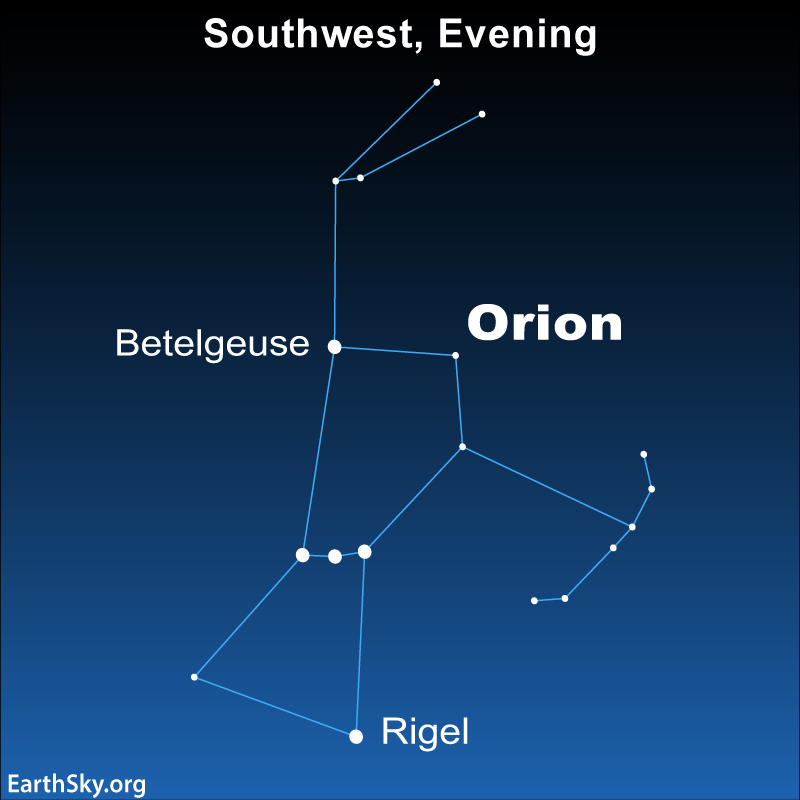
We in the Northern Hemisphere think of Orion as a winter constellation. As our northern spring arrives – around late March and early April – we see Orion shifting into the sunset glare. That’s happening because Earth is a planet, moving in orbit around a star. In fact, all stars and constellations do a westward shift in our sky.
If you’re out on an evening walk in late March or early April, notice this seasonal aspect of the night sky. The famous constellation Orion the Hunter – an easy-to-spot star pattern in January and February – now seems to have moved and turned considerably. It’s very low in the western part of the sky when the sun goes down.
Orion will soon disappear into the sun’s glare. Orion, like all the stars and constellations, shifts westward as the seasons pass. Unless they’re in the far northern or southern sky – and so circumpolar – all stars and constellations spend some portion of each year hidden in the sun’s glare.
In other words, like blooms on trees or certain flowers or even specific animals in your locale, stars have their own seasons of visibility.
All stars move westward in a single night
All the stars and their constellations also move westward in the course of a single night. Orion is no exception. That motion, though, is due to Earth’s spin.
But the seasonal disappearance of Orion – its sinking into the sunset glare during the northern spring months (southern fall months) – is something else. It’s as if we’re riding on a carousel through space – spinning, yes – but also the entire structure is moving. That is, Earth is moving in orbit around the sun. As we move in orbit, our night sky points out in different directions – toward different parts of the Milky Way galaxy – at different times of year.
Earth’s motion in orbit brings the sun between us and Orion at this same time each year.
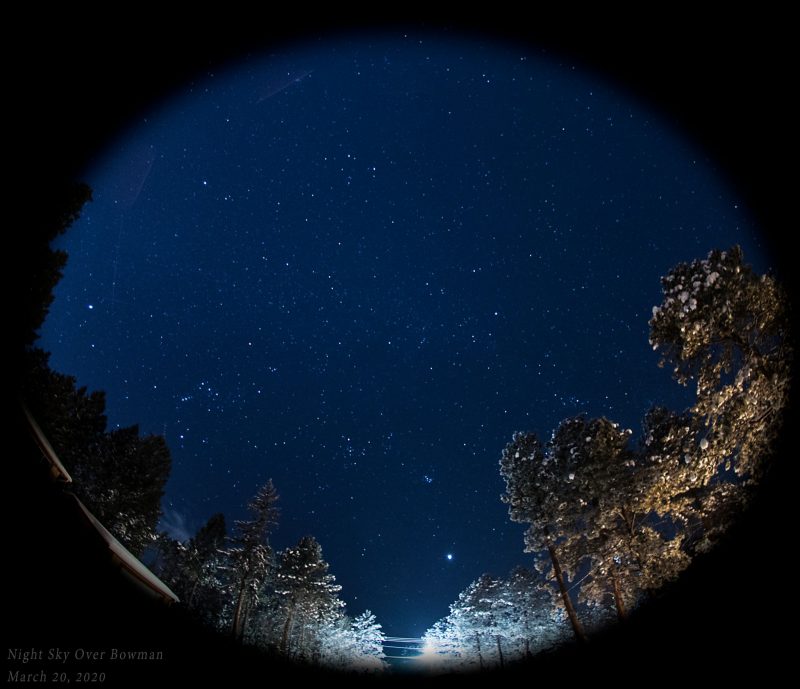
View at EarthSky Community Photos. | Stephanie Longo in Woodland Park, Colorado, went outside around 8 p.m. on March 20, to capture this photo. She wrote: “We’ve had frequent snow storms and bitter cold this winter in the mountains of Colorado so I haven’t been able to get out to my favorite viewing sites, but we have a beautiful view of the western sky on my street … you can clearly see Sirius, Orion, Taurus, the Pleiades, Venus just above the horizon and the Twins and Auriga and part of Perseus above. A truly beautiful night sky over snowy, cold Colorado.” Thank you, Stephanie! Want to identify the stars Stephanie mentioned? Try Stellarium online.
When will you see it last?
Exactly when Orion will disappear from your evening sky – into the sunset – depends on your latitude. The farther south you are, the longer you can see Orion. But for the central U.S., Orion is lost in the sun’s glare by early to mid-May (depending on how carefully you look for it).
And for all of us in the U.S., Orion is gone by the time of the summer solstice in June.
If you want to notice the westward shift of the constellations due to the passage of the seasons, be sure to watch at the same time every night. If you want to watch their westward shift throughout the night, just pull up a lawn chair and watch.
Either way, you can easily notice Orion moving steadily westward.
The westward shift of the sky throughout the night is due to Earth’s spin under the stars. Meanwhile, the westward shift of the stars throughout the seasons is due to Earth’s motion in orbit around the sun. Earth’s motion in orbit causes our night sky to point outward toward an ever-shifting panorama of the galaxy. Image via NASA/ NOAA/ GSFC/ Suomi NPP/ VIIRS/ Norman Kuring.
Bottom line: Why the constellation Orion – and all the stars – shift westward as the seasons pass.
We in the Northern Hemisphere think of Orion as a winter constellation. As our northern spring arrives – around late March and early April – we see Orion shifting into the sunset glare. That’s happening because Earth is a planet, moving in orbit around a star. In fact, all stars and constellations do a westward shift in our sky.
If you’re out on an evening walk in late March or early April, notice this seasonal aspect of the night sky. The famous constellation Orion the Hunter – an easy-to-spot star pattern in January and February – now seems to have moved and turned considerably. It’s very low in the western part of the sky when the sun goes down.
Orion will soon disappear into the sun’s glare. Orion, like all the stars and constellations, shifts westward as the seasons pass. Unless they’re in the far northern or southern sky – and so circumpolar – all stars and constellations spend some portion of each year hidden in the sun’s glare.
In other words, like blooms on trees or certain flowers or even specific animals in your locale, stars have their own seasons of visibility.
All stars move westward in a single night
All the stars and their constellations also move westward in the course of a single night. Orion is no exception. That motion, though, is due to Earth’s spin.
But the seasonal disappearance of Orion – its sinking into the sunset glare during the northern spring months (southern fall months) – is something else. It’s as if we’re riding on a carousel through space – spinning, yes – but also the entire structure is moving. That is, Earth is moving in orbit around the sun. As we move in orbit, our night sky points out in different directions – toward different parts of the Milky Way galaxy – at different times of year.
Earth’s motion in orbit brings the sun between us and Orion at this same time each year.
View at EarthSky Community Photos. | Stephanie Longo in Woodland Park, Colorado, went outside around 8 p.m. on March 20, to capture this photo. She wrote: “We’ve had frequent snow storms and bitter cold this winter in the mountains of Colorado so I haven’t been able to get out to my favorite viewing sites, but we have a beautiful view of the western sky on my street … you can clearly see Sirius, Orion, Taurus, the Pleiades, Venus just above the horizon and the Twins and Auriga and part of Perseus above. A truly beautiful night sky over snowy, cold Colorado.” Thank you, Stephanie! Want to identify the stars Stephanie mentioned? Try Stellarium online.
When will you see it last?
Exactly when Orion will disappear from your evening sky – into the sunset – depends on your latitude. The farther south you are, the longer you can see Orion. But for the central U.S., Orion is lost in the sun’s glare by early to mid-May (depending on how carefully you look for it).
And for all of us in the U.S., Orion is gone by the time of the summer solstice in June.
If you want to notice the westward shift of the constellations due to the passage of the seasons, be sure to watch at the same time every night. If you want to watch their westward shift throughout the night, just pull up a lawn chair and watch.
Either way, you can easily notice Orion moving steadily westward.
The westward shift of the sky throughout the night is due to Earth’s spin under the stars. Meanwhile, the westward shift of the stars throughout the seasons is due to Earth’s motion in orbit around the sun. Earth’s motion in orbit causes our night sky to point outward toward an ever-shifting panorama of the galaxy. Image via NASA/ NOAA/ GSFC/ Suomi NPP/ VIIRS/ Norman Kuring.
Bottom line: Why the constellation Orion – and all the stars – shift westward as the seasons pass.
Snow monkeys soak in hot springs to warm up … and boost their health! Image via Eliot Herman. Used with permission.
Japanese macaques, or snow monkeys, famously soak in hot springs to stay warm in freezing winters. A team at Kyoto University said on January 20, 20206, that they studied macaques at Jigokudani Wild Snow Monkey Park over two winters. They wanted to see if hot spring bathing does more than just keep them cozy. And, indeed, it does! The researchers found soaking in warm waters also influences the monkeys’ parasites and the tiny organisms living in their digestive systems, which play a key role in shaping their health.
The team published the study in the peer reviewed Springer Nature journal Primates on January 19, 2026.
A hidden ecosystem inside every monkey
Researchers observed female macaques at the park over two winters. They compared individuals that bathed regularly with those that did not. The researchers looked at the monkey and also those things that live inside and on the monkey. Therefore, they tracked the monkey’s behavior, checked for parasites such as lice (tiny insects that live in fur) and analyzed gut bacteria.
Scientists use the term holobiont to describe an animal and all the microbes and parasites living with it. So you can think of these monkeys as not just one organism but a whole ecosystem.
Snow monkeys are tiny ecosystems on their own. Researchers tracked how hot spring baths shape their behavior, parasites and gut microbes over 2 winters. Image via Eliot Herman. Used with permission.
Subtle changes with meaningful effects
The results revealed small but important differences. Bathing monkeys showed changes in their lice distribution. This suggests hot water may disrupt parasite activity. In the gut, overall bacterial diversity was similar. However, some bacterial types were more common in non-bathing monkeys. And, surprisingly, sharing hot springs did not increase parasite infections. Bathing monkeys did not show higher parasite levels.
Soaking in hot springs subtly shifts snow monkeys’ parasites and gut microbes. The good news is that sharing the hot spring baths doesn’t raise infection risks. Image via Eliot Herman. Used with permission.
Behavior shapes health
These findings show that natural behaviors can shape health in subtle ways beyond their immediate purpose. In this case, hot spring bathing does more than help monkeys stay warm. It also affects the parasites and microbes living on and inside them. Even small shifts in these communities may play a role in shaping overall health. As lead author Abdullah Langgeng of Kyoto University explained:
Behavior is often treated as a response to the environment, but our results show that this behavior doesn’t just affect thermoregulation or stress: it also alters how macaques interact with parasites and microbes that live on and inside them.
The study also points out that, by analogy, behaviors in other species — including human cultural practices such as bathing — can influence microbial exposure. It challenges the assumption that sharing water necessarily increases disease risk, at least under natural conditions.
Beyond keeping warm, hot spring baths subtly shape snow monkeys’ health. It shows how everyday behaviors can influence microbes and parasites. Image via Eliot Herman. Used with permission.
Snow monkeys as social spa users
Snow monkeys live in large family groups and are the only wild primates known to use hot springs regularly. At Jigokudani, these monkeys walk through deep snow to enter pools that can reach nearly 104° F (40° C). Because it can drop below freezing in winter, the hot springs are a toasty treat. As Langgeng said:
Hot spring bathing is one of the most unusual behaviors seen in nonhuman primates.
The habit is learned socially rather than instinctive. Observations show young monkeys often mimic older group members, particularly their mothers. Furthermore, participation varies with age, sex and social rank. Adult females and juveniles tend to bathe more often. Meanwhile, adult males and lower-ranking monkeys bathe less frequently or remain on dry ground. Because the hot springs are limited in size, dominant individuals may spend more time soaking, while others wait their turn or avoid the pools.
Snow monkeys are the only wild primates to soak regularly in hot springs. They brave freezing winters in steamy pools. Image via Eliot Herman. Used with permission.
How the hot spring baths began
The tradition of bathing in hot springs began in the early 1960s, when a young monkey at Korakukan, a traditional inn in the Jigokudani Valley, reached into an outdoor bath, likely drawn by food dropped into the water. Other monkeys began entering the hot springs to follow the example of human guests and soon realized the warm water was very comfortable in the freezing winter conditions. Gradually, more monkeys joined in, creating a social norm within the troop. Consequently, the behavior became so consistent that in 1964 a dedicated hot spring pool was built for the monkeys. Of course today this area is known as Jigokudani Monkey Park.
Snow monkeys learn to bathe socially. Young monkeys copy elders, and dominant individuals soak the most. Image via Eliot Herman. Used with permission.
How snow monkeys avoid getting cold
Do snow monkeys feel cold after their bath? We have towels and hairdryers, but they don’t! Well, unlike humans, who sweat to regulate temperature and lose heat rapidly when exposed to cold, snow monkeys have relatively few sweat glands and do not rely on sweating. This means they do not experience sudden drops in body temperature after leaving the hot springs.
Their thick winter fur provides excellent insulation. Moreover, their bodies are adapted to extreme cold. Capillary vessels at the ends of their limbs constrict in low temperatures, reducing heat loss from hands and feet. These adaptations allow snow monkeys to step onto snow with bare feet or leave the hot springs without risk of frostbite or sudden chilling.
Snow monkeys can step straight from steaming hot springs onto snow. Their fur and body adaptations keep them perfectly cozy in freezing temperatures. Image via Eliot Herman. Used with permission.
A healthy, steamy dip
So while humans debate the benefits of hot baths and spa days, snow monkeys seem to have figured it out. For them, a soak in a hot spring is not just a way to stay warm. It’s part of a lifestyle that shapes their health, one steamy dip at a time.
When life gives you hot springs … soak like a snow monkey! Image via Eliot Herman. Used with permission.
Special thanks to our friend Eliot Herman, who captured all these amazing images and happily shared them with us. Visit his Flickr page here.
Bottom line: Snow monkeys stay warm in hot spring baths. These baths also affect their parasites and gut microbes. It’s a cozy way to get a health benefit!
Snow monkeys soak in hot springs to warm up … and boost their health! Image via Eliot Herman. Used with permission.
Japanese macaques, or snow monkeys, famously soak in hot springs to stay warm in freezing winters. A team at Kyoto University said on January 20, 20206, that they studied macaques at Jigokudani Wild Snow Monkey Park over two winters. They wanted to see if hot spring bathing does more than just keep them cozy. And, indeed, it does! The researchers found soaking in warm waters also influences the monkeys’ parasites and the tiny organisms living in their digestive systems, which play a key role in shaping their health.
The team published the study in the peer reviewed Springer Nature journal Primates on January 19, 2026.
A hidden ecosystem inside every monkey
Researchers observed female macaques at the park over two winters. They compared individuals that bathed regularly with those that did not. The researchers looked at the monkey and also those things that live inside and on the monkey. Therefore, they tracked the monkey’s behavior, checked for parasites such as lice (tiny insects that live in fur) and analyzed gut bacteria.
Scientists use the term holobiont to describe an animal and all the microbes and parasites living with it. So you can think of these monkeys as not just one organism but a whole ecosystem.
Snow monkeys are tiny ecosystems on their own. Researchers tracked how hot spring baths shape their behavior, parasites and gut microbes over 2 winters. Image via Eliot Herman. Used with permission.
Subtle changes with meaningful effects
The results revealed small but important differences. Bathing monkeys showed changes in their lice distribution. This suggests hot water may disrupt parasite activity. In the gut, overall bacterial diversity was similar. However, some bacterial types were more common in non-bathing monkeys. And, surprisingly, sharing hot springs did not increase parasite infections. Bathing monkeys did not show higher parasite levels.
Soaking in hot springs subtly shifts snow monkeys’ parasites and gut microbes. The good news is that sharing the hot spring baths doesn’t raise infection risks. Image via Eliot Herman. Used with permission.
Behavior shapes health
These findings show that natural behaviors can shape health in subtle ways beyond their immediate purpose. In this case, hot spring bathing does more than help monkeys stay warm. It also affects the parasites and microbes living on and inside them. Even small shifts in these communities may play a role in shaping overall health. As lead author Abdullah Langgeng of Kyoto University explained:
Behavior is often treated as a response to the environment, but our results show that this behavior doesn’t just affect thermoregulation or stress: it also alters how macaques interact with parasites and microbes that live on and inside them.
The study also points out that, by analogy, behaviors in other species — including human cultural practices such as bathing — can influence microbial exposure. It challenges the assumption that sharing water necessarily increases disease risk, at least under natural conditions.
Beyond keeping warm, hot spring baths subtly shape snow monkeys’ health. It shows how everyday behaviors can influence microbes and parasites. Image via Eliot Herman. Used with permission.
Snow monkeys as social spa users
Snow monkeys live in large family groups and are the only wild primates known to use hot springs regularly. At Jigokudani, these monkeys walk through deep snow to enter pools that can reach nearly 104° F (40° C). Because it can drop below freezing in winter, the hot springs are a toasty treat. As Langgeng said:
Hot spring bathing is one of the most unusual behaviors seen in nonhuman primates.
The habit is learned socially rather than instinctive. Observations show young monkeys often mimic older group members, particularly their mothers. Furthermore, participation varies with age, sex and social rank. Adult females and juveniles tend to bathe more often. Meanwhile, adult males and lower-ranking monkeys bathe less frequently or remain on dry ground. Because the hot springs are limited in size, dominant individuals may spend more time soaking, while others wait their turn or avoid the pools.
Snow monkeys are the only wild primates to soak regularly in hot springs. They brave freezing winters in steamy pools. Image via Eliot Herman. Used with permission.
How the hot spring baths began
The tradition of bathing in hot springs began in the early 1960s, when a young monkey at Korakukan, a traditional inn in the Jigokudani Valley, reached into an outdoor bath, likely drawn by food dropped into the water. Other monkeys began entering the hot springs to follow the example of human guests and soon realized the warm water was very comfortable in the freezing winter conditions. Gradually, more monkeys joined in, creating a social norm within the troop. Consequently, the behavior became so consistent that in 1964 a dedicated hot spring pool was built for the monkeys. Of course today this area is known as Jigokudani Monkey Park.
Snow monkeys learn to bathe socially. Young monkeys copy elders, and dominant individuals soak the most. Image via Eliot Herman. Used with permission.
How snow monkeys avoid getting cold
Do snow monkeys feel cold after their bath? We have towels and hairdryers, but they don’t! Well, unlike humans, who sweat to regulate temperature and lose heat rapidly when exposed to cold, snow monkeys have relatively few sweat glands and do not rely on sweating. This means they do not experience sudden drops in body temperature after leaving the hot springs.
Their thick winter fur provides excellent insulation. Moreover, their bodies are adapted to extreme cold. Capillary vessels at the ends of their limbs constrict in low temperatures, reducing heat loss from hands and feet. These adaptations allow snow monkeys to step onto snow with bare feet or leave the hot springs without risk of frostbite or sudden chilling.
Snow monkeys can step straight from steaming hot springs onto snow. Their fur and body adaptations keep them perfectly cozy in freezing temperatures. Image via Eliot Herman. Used with permission.
A healthy, steamy dip
So while humans debate the benefits of hot baths and spa days, snow monkeys seem to have figured it out. For them, a soak in a hot spring is not just a way to stay warm. It’s part of a lifestyle that shapes their health, one steamy dip at a time.
When life gives you hot springs … soak like a snow monkey! Image via Eliot Herman. Used with permission.
Special thanks to our friend Eliot Herman, who captured all these amazing images and happily shared them with us. Visit his Flickr page here.
Bottom line: Snow monkeys stay warm in hot spring baths. These baths also affect their parasites and gut microbes. It’s a cozy way to get a health benefit!