aads

See Sirius, the brightest star in the night sky

Wide array of bright but slightly fuzzy stars, mostly blue-white but one reddish, over dark landscape.
View at EarthSky Community Photos. | Sergei Timofeevski shared this image from November 13, 2023. Sergei wrote: “The constellation Orion the Hunter and the star Sirius rising just above the eastern horizon in the Anza-Borrego Desert State Park, California.” Thank you, Sergei! Note bright Sirius is on the bottom, and Orion’s Belt pointing to it.

The months around February are perfect for both Northern Hemisphere and Southern Hemisphere observers to view the brightest star in the sky: Sirius. But this star is shifting inexorably westward each night, as Earth orbits our sun and our perspective on the galaxy undergoes its subtle, continual change. By early April, Sirius will be moving noticeably toward the sunset glare. See it now. It’s the legendary Dog Star, part of the constellation Canis Major the Greater Dog.

From the Northern Hemisphere now, you’ll find Sirius arcing across in the southern sky in the evening. From the Southern Hemisphere, you’ll find it swinging high overhead at that time of night.

It’s always easy to spot as the brightest point of light in its region of sky … unless a planet happens to be near it, like Jupiter is in 2026. Not sure which object is Sirius and which is bright Jupiter? You’ll always know if you notice that the three Belt stars of Orion always point to Sirius. See the photo above.

It’s a flashy rainbow star

Although white to blue-white in color, Sirius might be called a rainbow star, as it often flickers with many colors. The flickering colors are especially easy to notice when you spot Sirius low in the sky.

The brightness, twinkling and color changes sometimes prompt people to report Sirius as a UFO!

In fact, these changes are simply what happens when such a bright star as Sirius shines through the blanket of Earth’s atmosphere. The varying density and temperature of Earth’s air affect starlight, especially when we’re seeing the star low in the sky.

The shimmering and color changes happen for other stars, too, but these effects are more noticeable for Sirius because Sirius is so bright.

Finding Sirius

From the mid-northern latitudes such as most of the U.S., Sirius rises in the southeast, arcs across the southern sky, and sets in the southwest. From the Southern Hemisphere, Sirius arcs high overhead.

As seen from around the world, Sirius rises in mid-evening in December. By mid-April, Sirius is setting in the southwest in mid-evening.

Sirius is always easy to find. It’s the sky’s brightest star! Plus, anyone familiar with the constellation Orion can simply draw a line through Orion’s Belt to find this star. Sirius is roughly eight times as far from the Belt as the Belt is wide.
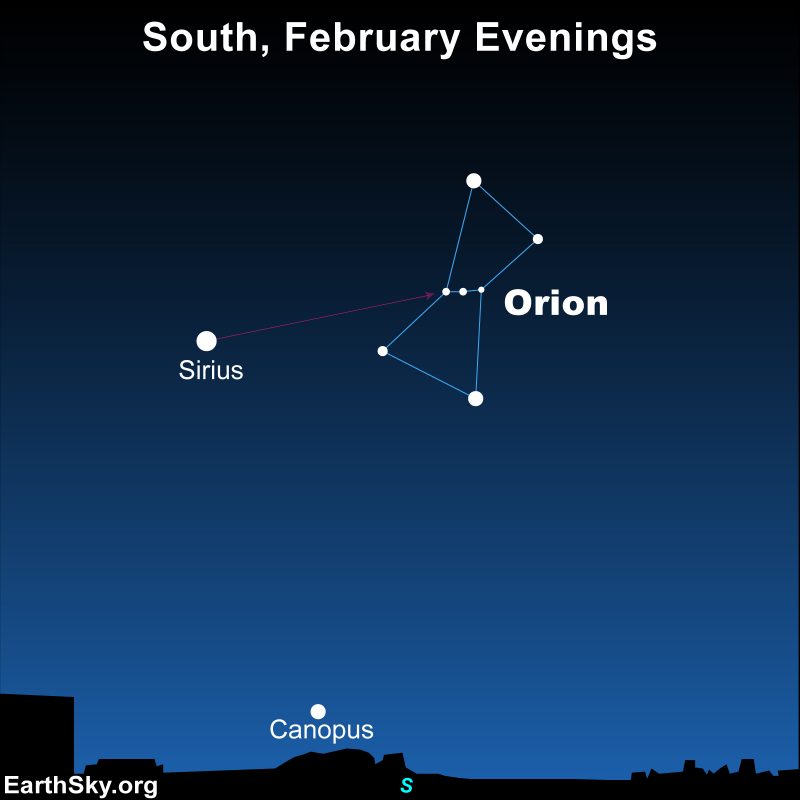
Sky chart showing Sirius, Canopus and Orion.
Sirius is the sky’s brightest star. You’ll always know it’s Sirius because Orion’s Belt – 3 stars in a short, straight row – points to it. Also, as seen from the latitudes like those in Florida, Texas or southern California, Canopus – the 2nd-brightest star – arcs across the south below Sirius on February evenings. From farther south on the sky’s dome, Sirius and Canopus cross higher in the sky, like almost-twin diamonds. Chart via EarthSky.

The mythology of Sirius

Sirius is well known as the Dog Star, because it’s the chief star in the constellation Canis Major the Greater Dog. Have you ever heard anyone speak of the dog days of summer? Sirius is behind the sun as seen from Earth in Northern Hemisphere summer. In late summer, it appears in the east before sunrise, near the sun in our sky. The early stargazers might have imagined the double-whammy of Sirius and the sun caused the hot weather, or dog days.

In ancient Egypt, the name Sirius signified its nature as scorching or sparkling. The star was associated with the Egyptian gods Osiris, Sopdet and other gods. Ancient Egyptians noted that Sirius rose just before the sun each year immediately prior to the annual flooding of the Nile River. Although the floods could bring destruction, they also brought new soil and new life.

Osiris was an Egyptian god of life, death, fertility and rebirth of plant life along the Nile. Sopdet – who might have an even closer association with the star Sirius – began as an agricultural deity in Egypt, also closely associated with the Nile. The Egyptian new year celebration was a festival known as the Coming of Sopdet.

More mythology of the Dog Star

In India, Sirius is sometimes known as Svana, the dog of Prince Yudhisthira. The prince and his four brothers, along with Svana, set out on a long and arduous journey to find the kingdom of heaven. However, one by one the brothers all abandoned the search until only Yudhisthira and his dog, Svana, remained. At long last they came to the gates of heaven. The gatekeeper, Indra, welcomed the prince but denied Svana entrance.

Yudhisthira was aghast and told Indra that he could not forsake his good and faithful servant and friend. His brothers, Yudhisthira said, had abandoned the journey to heaven to follow their hearts’ desires. But Svana, who had given his heart freely, chose to follow none but Yudhisthira. The prince said that, without his dog, he would forsake even heaven. This is what Indra had wanted to hear, and then he welcomed both the prince and the dog through the gates of heaven.

Egyptian wall painting of a tall goddess holding an ankh and having a star atop her head.
Sopdet, the ancient Egyptian personification of the star Sirius. Image via Jeff Dahl/ Wikimedia Commons (CC BY-SA 4.0).

The brightest star

Astronomers express the brightness of stars in terms of stellar magnitude. The smaller the number, the brighter the star.

The visual magnitude of Sirius is -1.44, lower – brighter – than any other star. There are brighter stars than Sirius in terms of actual energy and light output, but they are farther away and hence appear dimmer.

Normally, the only objects that outshine Sirius in our heavens are the sun, moon, Venus, Jupiter, Mars and Mercury (and usually Sirius outshines Mercury, too).

Not counting the sun, the second-brightest star in all of Earth’s sky – next-brightest after Sirius – is Canopus. It is visible from latitudes like those of the southern U.S.

The third-brightest and, as it happens, the closest major star to our sun is Alpha Centauri. However, it’s too far south in the sky to see easily from mid-northern latitudes.

Starry sky with a few brighter stars. There are 3 bluish stars in a line for Orion's Belt.
View at EarthSky Community Photos. | Sirius is the brightest star on the lower left of this picture. And Betelgeuse is the bright red-orange star at the top of this photo by Howard Cohen, who captured it at Chiefland, Florida, on March 22, 2025. Howard wrote: “This photo nicely shows color differences of stars with Betelgeuse notably orangy compared with bluish-white colors of Rigel (right) and Sirius (bottom left).” Thanks, Howard!

The science of Sirius

At 8.6 light-years distance, Sirius is one of the nearest stars to us after the sun. By the way, a light year is nearly 6 trillion miles (9.6 trillion km)!

Sirius is classified by astronomers as an A type star. That means it’s a much hotter star than our sun; its surface temperature is about 17,000 degrees Fahrenheit (9,400 Celsius) in contrast to our sun’s 10,000 F (5,500 C). With slightly more than twice the mass of the sun and just less than twice its diameter, Sirius still puts out 26 times as much energy. It’s a main-sequence star, meaning it produces most of its energy by converting hydrogen into helium through nuclear fusion.

And Sirius has a companion star

Sirius has a small, faint companion star appropriately called Sirius B or the Pup. That name signifies youth, but in fact the companion to Sirius is a white dwarf, a dead star. Once a mighty star, the Pup today is an Earth-sized ember, too faint to be seen without a telescope.

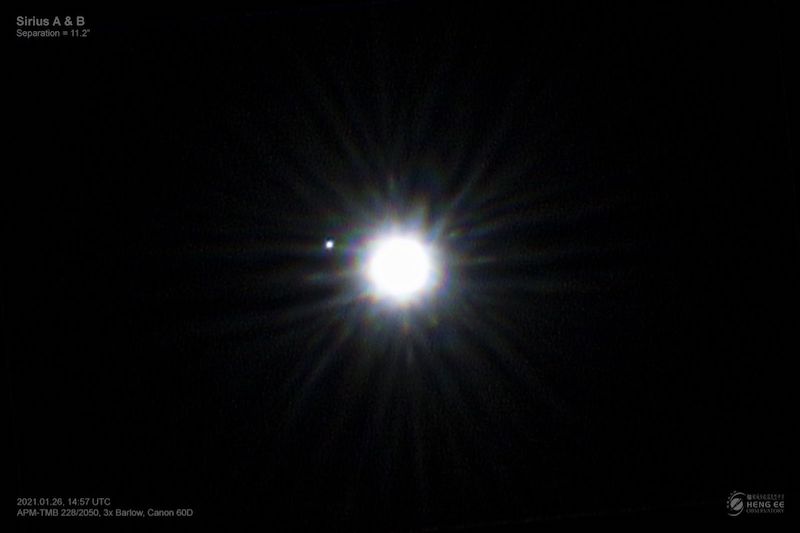
Bright spiked star in the center is Sirius A and a tiny dot to its upper left is its compansion star Sirius B.
View at EarthSky Community Photos. | Steven Bellavia captured this images on February 1, 2026, from Virginia and wrote: “This is my first successful capture of Sirius B, the faint companion star of Sirius A, the brightest star in the Earth’s sky. Using a red filter, to slightly help with atmospheric seeing, combined with 3-D printed vanes to deliberately cause diffraction, thus reducing the encircled energy around the very bright A-star, redistributing that energy into diffraction spikes in the background.” Thank you, Steven!
Black background with one central white spot with spikes, and a tiny white dot on its left side.
View at EarthSky Community Photos. | Michael Teoh at Heng Ee Observatory in Penang, Malaysia, captured this photo of Sirius A and Sirius B (a white dwarf, aka the Pup) on January 26, 2021. He used 30 1-second exposures and stacked them together to make faint Sirius B appear. Thank you, Michael!

The position of Sirius is RA: 06h 45m 08.9s, dec: -16° 42′ 58″.

Bottom line: Sirius is the brightest star in the night sky as seen from Earth and is visible from both hemispheres. And it lies just 8.6 light-years away in the constellation Canis Major the Greater Dog.

The post See Sirius, the brightest star in the night sky first appeared on EarthSky.


from EarthSky https://ift.tt/jaxAyEW
Wide array of bright but slightly fuzzy stars, mostly blue-white but one reddish, over dark landscape.
View at EarthSky Community Photos. | Sergei Timofeevski shared this image from November 13, 2023. Sergei wrote: “The constellation Orion the Hunter and the star Sirius rising just above the eastern horizon in the Anza-Borrego Desert State Park, California.” Thank you, Sergei! Note bright Sirius is on the bottom, and Orion’s Belt pointing to it.

The months around February are perfect for both Northern Hemisphere and Southern Hemisphere observers to view the brightest star in the sky: Sirius. But this star is shifting inexorably westward each night, as Earth orbits our sun and our perspective on the galaxy undergoes its subtle, continual change. By early April, Sirius will be moving noticeably toward the sunset glare. See it now. It’s the legendary Dog Star, part of the constellation Canis Major the Greater Dog.

From the Northern Hemisphere now, you’ll find Sirius arcing across in the southern sky in the evening. From the Southern Hemisphere, you’ll find it swinging high overhead at that time of night.

It’s always easy to spot as the brightest point of light in its region of sky … unless a planet happens to be near it, like Jupiter is in 2026. Not sure which object is Sirius and which is bright Jupiter? You’ll always know if you notice that the three Belt stars of Orion always point to Sirius. See the photo above.

It’s a flashy rainbow star

Although white to blue-white in color, Sirius might be called a rainbow star, as it often flickers with many colors. The flickering colors are especially easy to notice when you spot Sirius low in the sky.

The brightness, twinkling and color changes sometimes prompt people to report Sirius as a UFO!

In fact, these changes are simply what happens when such a bright star as Sirius shines through the blanket of Earth’s atmosphere. The varying density and temperature of Earth’s air affect starlight, especially when we’re seeing the star low in the sky.

The shimmering and color changes happen for other stars, too, but these effects are more noticeable for Sirius because Sirius is so bright.

Finding Sirius

From the mid-northern latitudes such as most of the U.S., Sirius rises in the southeast, arcs across the southern sky, and sets in the southwest. From the Southern Hemisphere, Sirius arcs high overhead.

As seen from around the world, Sirius rises in mid-evening in December. By mid-April, Sirius is setting in the southwest in mid-evening.

Sirius is always easy to find. It’s the sky’s brightest star! Plus, anyone familiar with the constellation Orion can simply draw a line through Orion’s Belt to find this star. Sirius is roughly eight times as far from the Belt as the Belt is wide.

Sky chart showing Sirius, Canopus and Orion.
Sirius is the sky’s brightest star. You’ll always know it’s Sirius because Orion’s Belt – 3 stars in a short, straight row – points to it. Also, as seen from the latitudes like those in Florida, Texas or southern California, Canopus – the 2nd-brightest star – arcs across the south below Sirius on February evenings. From farther south on the sky’s dome, Sirius and Canopus cross higher in the sky, like almost-twin diamonds. Chart via EarthSky.

The mythology of Sirius

Sirius is well known as the Dog Star, because it’s the chief star in the constellation Canis Major the Greater Dog. Have you ever heard anyone speak of the dog days of summer? Sirius is behind the sun as seen from Earth in Northern Hemisphere summer. In late summer, it appears in the east before sunrise, near the sun in our sky. The early stargazers might have imagined the double-whammy of Sirius and the sun caused the hot weather, or dog days.

In ancient Egypt, the name Sirius signified its nature as scorching or sparkling. The star was associated with the Egyptian gods Osiris, Sopdet and other gods. Ancient Egyptians noted that Sirius rose just before the sun each year immediately prior to the annual flooding of the Nile River. Although the floods could bring destruction, they also brought new soil and new life.

Osiris was an Egyptian god of life, death, fertility and rebirth of plant life along the Nile. Sopdet – who might have an even closer association with the star Sirius – began as an agricultural deity in Egypt, also closely associated with the Nile. The Egyptian new year celebration was a festival known as the Coming of Sopdet.

More mythology of the Dog Star

In India, Sirius is sometimes known as Svana, the dog of Prince Yudhisthira. The prince and his four brothers, along with Svana, set out on a long and arduous journey to find the kingdom of heaven. However, one by one the brothers all abandoned the search until only Yudhisthira and his dog, Svana, remained. At long last they came to the gates of heaven. The gatekeeper, Indra, welcomed the prince but denied Svana entrance.

Yudhisthira was aghast and told Indra that he could not forsake his good and faithful servant and friend. His brothers, Yudhisthira said, had abandoned the journey to heaven to follow their hearts’ desires. But Svana, who had given his heart freely, chose to follow none but Yudhisthira. The prince said that, without his dog, he would forsake even heaven. This is what Indra had wanted to hear, and then he welcomed both the prince and the dog through the gates of heaven.

Egyptian wall painting of a tall goddess holding an ankh and having a star atop her head.
Sopdet, the ancient Egyptian personification of the star Sirius. Image via Jeff Dahl/ Wikimedia Commons (CC BY-SA 4.0).

The brightest star

Astronomers express the brightness of stars in terms of stellar magnitude. The smaller the number, the brighter the star.

The visual magnitude of Sirius is -1.44, lower – brighter – than any other star. There are brighter stars than Sirius in terms of actual energy and light output, but they are farther away and hence appear dimmer.

Normally, the only objects that outshine Sirius in our heavens are the sun, moon, Venus, Jupiter, Mars and Mercury (and usually Sirius outshines Mercury, too).

Not counting the sun, the second-brightest star in all of Earth’s sky – next-brightest after Sirius – is Canopus. It is visible from latitudes like those of the southern U.S.

The third-brightest and, as it happens, the closest major star to our sun is Alpha Centauri. However, it’s too far south in the sky to see easily from mid-northern latitudes.

Starry sky with a few brighter stars. There are 3 bluish stars in a line for Orion's Belt.
View at EarthSky Community Photos. | Sirius is the brightest star on the lower left of this picture. And Betelgeuse is the bright red-orange star at the top of this photo by Howard Cohen, who captured it at Chiefland, Florida, on March 22, 2025. Howard wrote: “This photo nicely shows color differences of stars with Betelgeuse notably orangy compared with bluish-white colors of Rigel (right) and Sirius (bottom left).” Thanks, Howard!

The science of Sirius

At 8.6 light-years distance, Sirius is one of the nearest stars to us after the sun. By the way, a light year is nearly 6 trillion miles (9.6 trillion km)!

Sirius is classified by astronomers as an A type star. That means it’s a much hotter star than our sun; its surface temperature is about 17,000 degrees Fahrenheit (9,400 Celsius) in contrast to our sun’s 10,000 F (5,500 C). With slightly more than twice the mass of the sun and just less than twice its diameter, Sirius still puts out 26 times as much energy. It’s a main-sequence star, meaning it produces most of its energy by converting hydrogen into helium through nuclear fusion.

And Sirius has a companion star

Sirius has a small, faint companion star appropriately called Sirius B or the Pup. That name signifies youth, but in fact the companion to Sirius is a white dwarf, a dead star. Once a mighty star, the Pup today is an Earth-sized ember, too faint to be seen without a telescope.

Bright spiked star in the center is Sirius A and a tiny dot to its upper left is its compansion star Sirius B.
View at EarthSky Community Photos. | Steven Bellavia captured this images on February 1, 2026, from Virginia and wrote: “This is my first successful capture of Sirius B, the faint companion star of Sirius A, the brightest star in the Earth’s sky. Using a red filter, to slightly help with atmospheric seeing, combined with 3-D printed vanes to deliberately cause diffraction, thus reducing the encircled energy around the very bright A-star, redistributing that energy into diffraction spikes in the background.” Thank you, Steven!
Black background with one central white spot with spikes, and a tiny white dot on its left side.
View at EarthSky Community Photos. | Michael Teoh at Heng Ee Observatory in Penang, Malaysia, captured this photo of Sirius A and Sirius B (a white dwarf, aka the Pup) on January 26, 2021. He used 30 1-second exposures and stacked them together to make faint Sirius B appear. Thank you, Michael!

The position of Sirius is RA: 06h 45m 08.9s, dec: -16° 42′ 58″.

Bottom line: Sirius is the brightest star in the night sky as seen from Earth and is visible from both hemispheres. And it lies just 8.6 light-years away in the constellation Canis Major the Greater Dog.

The post See Sirius, the brightest star in the night sky first appeared on EarthSky.


from EarthSky https://ift.tt/jaxAyEW
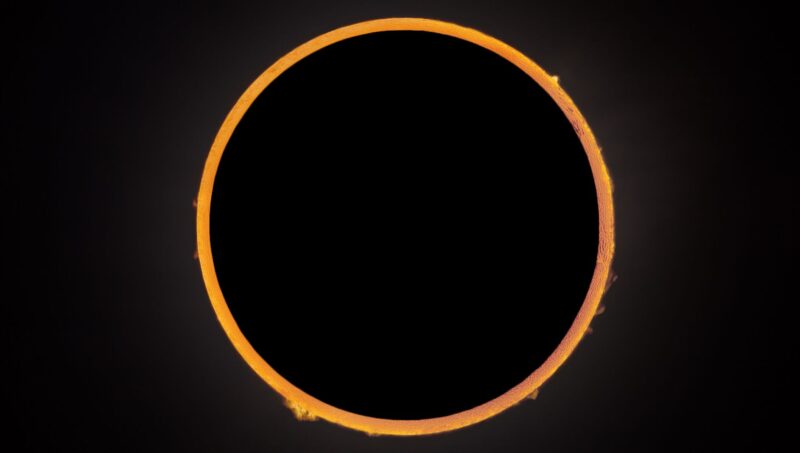
Annular solar eclipse on February 17, 2026

Annular solar eclipse: Orange ring with some little flames coming out of it.
View at EarthSky Community Photos. | Alan Howell from Albuquerque, New Mexico, captured this photo during the annular solar eclipse of October 14, 2023. He wrote: “What an incredible adventure! It took months of planning, gear testing, software and equipment training, booking flights and hotels, car traveling, weather forecast monitoring, and location scouting to produce this colorized H-alpha image of the ‘ring of fire’ eclipse, showing prominences.” Thank you, Alan!

Annular solar eclipse February 17, 2026

The first solar eclipse of 2026 will be an annular – sometimes called a “ring of fire” – solar eclipse on Tuesday, February 17. This annular solar eclipse will be fun to think about. But only a few million of Earth’s 8.3 billion inhabitants will see even the partial phases. The partial eclipse will be visible from areas including the southern tip of South America, southern Africa, the Pacific, Atlantic and Indian Oceans, and most of Antarctica.

Meanwhile, the path of the annular eclipse will cross remote parts of Antarctica and the southern regions of the Southern Ocean. It’ll be viewed mainly from scientific research stations in Antarctica, including the Concordia Research Station (a French-Italian station) and the Russian Mirny Station in Queen Mary Land on the eastern part of the continent of Antarctica. The primary American base in Antarctica is McMurdo Station. McMurdo will see a deep partial eclipse, with the sun 86% blotted out by the moon.

Here are some times for the annular solar eclipse on February 17, 2026:

  • Partial eclipse begins at 9:56 UTC
  • Maximum eclipse begins at 12:12 UTC
  • Partial eclipse ends at 14:27 UTC

NOTE: An annular eclipse is a partial eclipse. You must use eye protection! Warning: This eclipse is not safe to view without some form of protection for your eyes.

For precise timing from your location check timeanddate.com.

Click here to learn to watch a solar eclipse safely.

Animations and seeing the eclipse from your location

Watch an animation of the path of the annular solar eclipse at Timeanddate.com

Watch an animation of the path of the annular eclipse at In-the-sky.org

Another animation of the eclipse at Eclipsewise.com

Information for your location Timeanddate.com

The Solar Eclipse Circumstances Calculator is an interactive web page

Why is it called an annular eclipse?

Astronomers call this an annular eclipse of the sun. In fact, that name comes from the Latin word for ring: annulus. During this eclipse, the moon will be too far away in its orbit to cover the sun completely. At mid-eclipse, the outer surface of the sun will appear in a ring around the moon.

So, though not as dramatic as a total solar eclipse, an annular eclipse is fascinating to view. The sky darkens as the partial phases deepen. Little crescent suns appear all around you, as the tiny gaps between tree leaves act like camera lenses, projecting an inverted image of the sun onto the pavement or walls below.

As for any eclipse, you really only need to know two things. First, how much of the sun will be covered from your location? Second, what time is the eclipse from your location? But again for the February 17, 2026, eclipse, only those at the southernmost part of Earth will see even the partial phases.

Information for your location Timeanddate.com

Overall, the February 17, 2026 annular eclipse will last 271 minutes. At maximum eclipse – for those using safe solar viewing techniques along the central eclipse path – the sun will be 96% covered by the moon. The sky will never turn completely dark. Stars and planets won’t pop into view. But the sun itself will be a mesmerizing sight. The sun will show the “ring of fire” effect for about 2 minutes and 20 seconds.

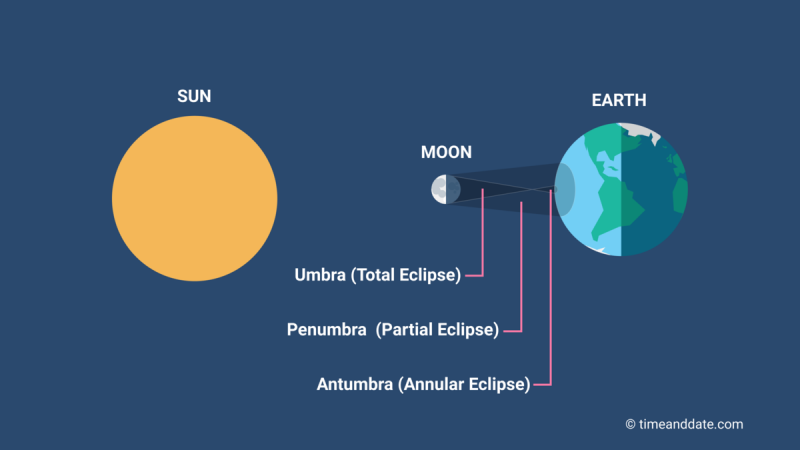
Diagram showing sun, moon, and Earth, with different parts of moon shadow labeled.
The moon’s umbra and antumbra, surrounded by the penumbra. Image via timeanddate.com. Used with permission.

Overview of the February 17 annular solar eclipse

The path of the annular eclipse is visible only over remote parts of Antarctica – and the ocean – and will begin at 11:42 UTC. That’s where the moon’s antumbral shadow first falls on Earth, forming a 383 miles (616 kilometers) wide and 2,661 miles (4,282 kilometers) long path.

Then the annular eclipse sun will reach greatest eclipse at 12:13 UTC with a duration of 2 minutes and 20 seconds. And 96% of the sun will be obscured. Then about an hour later at 12:41 UTC, the annular eclipse will end with the partial eclipse ending at 14:27 UTC.

Meanwhile, those outside the shadow path will see a partial solar eclipse. Important: this is not a total eclipse. And the first thing to remember, at no time during this eclipse will it be safe to look at the sun without proper eye protection.

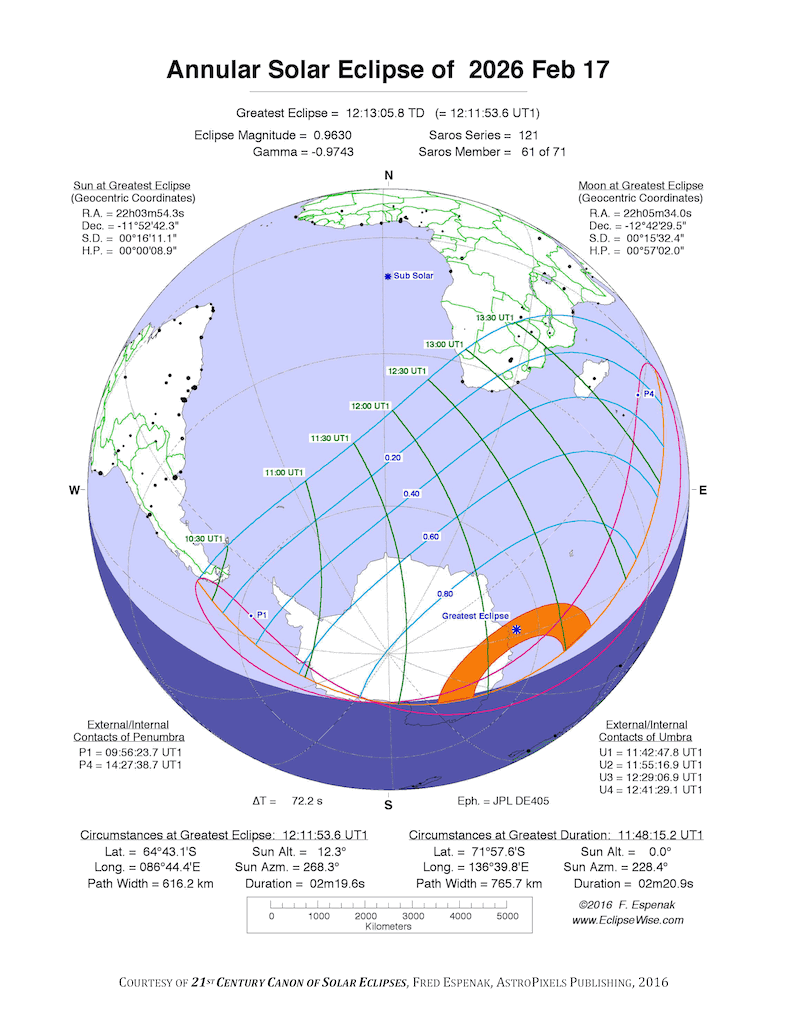
Globe of the Earth showing path of annular solar eclipse across part of Antarctica and the ocean.
View larger. | The orange line shows the path of the February 17, 2026, annular solar eclipse. And those farther from the path will see a partial solar eclipse. Image via Fred Espenak. Used with permission.

Moon, constellation, Saros

Greatest eclipse takes place at 12:11 UTC on February 17, 6.8 days after the moon reaches apogee, its farthest point from Earth for the month. During the February 17, 2026, eclipse, the sun is located in the direction of the constellation Aquarius.

This eclipse has a magnitude of 0.9630.

The Saros catalog describes the periodicity of eclipses. The eclipse belongs to Saros 121. It is number 61 of 71 eclipses in the series. All eclipses in this series occur at the moon’s ascending node. The moon moves southward with respect to the node with each succeeding eclipse in the series.

This is 2026’s 1st solar eclipse

There will be a second solar eclipse in 2026 – on August 12, 2024 – and it’ll be a total solar eclipse whose path of totality passes over the Arctic, Greenland, Iceland and Spain. And observers in much of Western Europe and North America will see a partial eclipse.

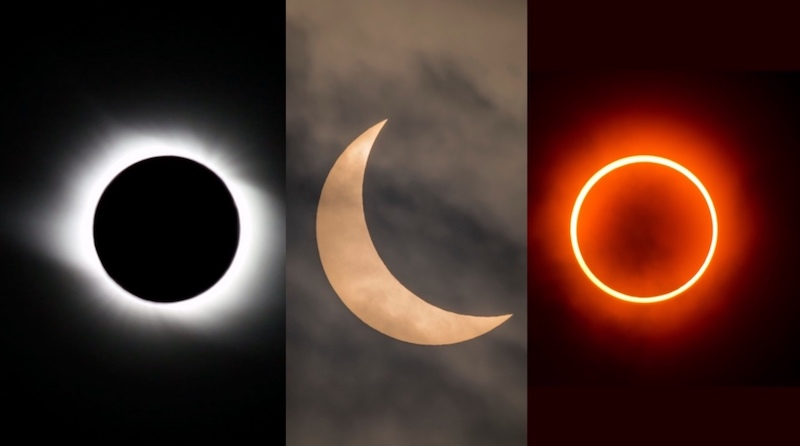
Black circle with fuzzy white rim; bright crescent; thin brilliant ring.
The appearance of a total solar eclipse (left), partial solar eclipse (middle) and annular solar eclipse (right). The one on the right – the annular eclipse – is what those along the eclipse path will see on February 17, 2026. Image via K. Bikos/ timeanddate.com. Used with permission.

Bottom line: On February 17, 2026, an annular solar eclipse will be visible from Antarctica and the Southern Ocean. Also, it’ll be visible as a partial eclipse from areas including the southern tip of South America, southern Africa and most of Antarctica.

Read more: The total solar eclipse of April 8, 2024

Read more by Fred Espenak at EclipseWise.com

The post Annular solar eclipse on February 17, 2026 first appeared on EarthSky.


from EarthSky https://ift.tt/vVJNQHF
Annular solar eclipse: Orange ring with some little flames coming out of it.
View at EarthSky Community Photos. | Alan Howell from Albuquerque, New Mexico, captured this photo during the annular solar eclipse of October 14, 2023. He wrote: “What an incredible adventure! It took months of planning, gear testing, software and equipment training, booking flights and hotels, car traveling, weather forecast monitoring, and location scouting to produce this colorized H-alpha image of the ‘ring of fire’ eclipse, showing prominences.” Thank you, Alan!

Annular solar eclipse February 17, 2026

The first solar eclipse of 2026 will be an annular – sometimes called a “ring of fire” – solar eclipse on Tuesday, February 17. This annular solar eclipse will be fun to think about. But only a few million of Earth’s 8.3 billion inhabitants will see even the partial phases. The partial eclipse will be visible from areas including the southern tip of South America, southern Africa, the Pacific, Atlantic and Indian Oceans, and most of Antarctica.

Meanwhile, the path of the annular eclipse will cross remote parts of Antarctica and the southern regions of the Southern Ocean. It’ll be viewed mainly from scientific research stations in Antarctica, including the Concordia Research Station (a French-Italian station) and the Russian Mirny Station in Queen Mary Land on the eastern part of the continent of Antarctica. The primary American base in Antarctica is McMurdo Station. McMurdo will see a deep partial eclipse, with the sun 86% blotted out by the moon.

Here are some times for the annular solar eclipse on February 17, 2026:

  • Partial eclipse begins at 9:56 UTC
  • Maximum eclipse begins at 12:12 UTC
  • Partial eclipse ends at 14:27 UTC

NOTE: An annular eclipse is a partial eclipse. You must use eye protection! Warning: This eclipse is not safe to view without some form of protection for your eyes.

For precise timing from your location check timeanddate.com.

Click here to learn to watch a solar eclipse safely.

Animations and seeing the eclipse from your location

Watch an animation of the path of the annular solar eclipse at Timeanddate.com

Watch an animation of the path of the annular eclipse at In-the-sky.org

Another animation of the eclipse at Eclipsewise.com

Information for your location Timeanddate.com

The Solar Eclipse Circumstances Calculator is an interactive web page

Why is it called an annular eclipse?

Astronomers call this an annular eclipse of the sun. In fact, that name comes from the Latin word for ring: annulus. During this eclipse, the moon will be too far away in its orbit to cover the sun completely. At mid-eclipse, the outer surface of the sun will appear in a ring around the moon.

So, though not as dramatic as a total solar eclipse, an annular eclipse is fascinating to view. The sky darkens as the partial phases deepen. Little crescent suns appear all around you, as the tiny gaps between tree leaves act like camera lenses, projecting an inverted image of the sun onto the pavement or walls below.

As for any eclipse, you really only need to know two things. First, how much of the sun will be covered from your location? Second, what time is the eclipse from your location? But again for the February 17, 2026, eclipse, only those at the southernmost part of Earth will see even the partial phases.

Information for your location Timeanddate.com

Overall, the February 17, 2026 annular eclipse will last 271 minutes. At maximum eclipse – for those using safe solar viewing techniques along the central eclipse path – the sun will be 96% covered by the moon. The sky will never turn completely dark. Stars and planets won’t pop into view. But the sun itself will be a mesmerizing sight. The sun will show the “ring of fire” effect for about 2 minutes and 20 seconds.

Diagram showing sun, moon, and Earth, with different parts of moon shadow labeled.
The moon’s umbra and antumbra, surrounded by the penumbra. Image via timeanddate.com. Used with permission.

Overview of the February 17 annular solar eclipse

The path of the annular eclipse is visible only over remote parts of Antarctica – and the ocean – and will begin at 11:42 UTC. That’s where the moon’s antumbral shadow first falls on Earth, forming a 383 miles (616 kilometers) wide and 2,661 miles (4,282 kilometers) long path.

Then the annular eclipse sun will reach greatest eclipse at 12:13 UTC with a duration of 2 minutes and 20 seconds. And 96% of the sun will be obscured. Then about an hour later at 12:41 UTC, the annular eclipse will end with the partial eclipse ending at 14:27 UTC.

Meanwhile, those outside the shadow path will see a partial solar eclipse. Important: this is not a total eclipse. And the first thing to remember, at no time during this eclipse will it be safe to look at the sun without proper eye protection.

Globe of the Earth showing path of annular solar eclipse across part of Antarctica and the ocean.
View larger. | The orange line shows the path of the February 17, 2026, annular solar eclipse. And those farther from the path will see a partial solar eclipse. Image via Fred Espenak. Used with permission.

Moon, constellation, Saros

Greatest eclipse takes place at 12:11 UTC on February 17, 6.8 days after the moon reaches apogee, its farthest point from Earth for the month. During the February 17, 2026, eclipse, the sun is located in the direction of the constellation Aquarius.

This eclipse has a magnitude of 0.9630.

The Saros catalog describes the periodicity of eclipses. The eclipse belongs to Saros 121. It is number 61 of 71 eclipses in the series. All eclipses in this series occur at the moon’s ascending node. The moon moves southward with respect to the node with each succeeding eclipse in the series.

This is 2026’s 1st solar eclipse

There will be a second solar eclipse in 2026 – on August 12, 2024 – and it’ll be a total solar eclipse whose path of totality passes over the Arctic, Greenland, Iceland and Spain. And observers in much of Western Europe and North America will see a partial eclipse.

Black circle with fuzzy white rim; bright crescent; thin brilliant ring.
The appearance of a total solar eclipse (left), partial solar eclipse (middle) and annular solar eclipse (right). The one on the right – the annular eclipse – is what those along the eclipse path will see on February 17, 2026. Image via K. Bikos/ timeanddate.com. Used with permission.

Bottom line: On February 17, 2026, an annular solar eclipse will be visible from Antarctica and the Southern Ocean. Also, it’ll be visible as a partial eclipse from areas including the southern tip of South America, southern Africa and most of Antarctica.

Read more: The total solar eclipse of April 8, 2024

Read more by Fred Espenak at EclipseWise.com

The post Annular solar eclipse on February 17, 2026 first appeared on EarthSky.


from EarthSky https://ift.tt/vVJNQHF

Scientists discover these caterpillars hear through hairs

Caterpillars hear: Long, green insect with white lines and dark spots. It has a red "horn" on the tail and many tiny hairs on its body.
A team of scientists has discovered tobacco hornworm caterpillars hear through tiny body hairs. Image via Daniel Schwen/ Wikimedia Commons (CC BY-SA 4.0).

Researchers from Binghamton University in New York have discovered that tobacco hornworm caterpillars (Manduca sexta) can detect airborne sound using microscopic hairs on their bodies. The researchers said on January 28, 2026, that their study shows for the first time how this species, a common garden pest, senses sound despite having no ears.

The study was carried out in Binghamton, New York, inside one of the world’s quietest, echo-free chambers. The researchers presented the information in January 2026 at the 6th Joint Meeting of the Acoustical Society of America and the Acoustical Society of Japan.

Without ears, caterpillars still detect sound

The research began with a long-standing observation by Carol Miles, associate professor of biological sciences at Binghamton University. She noticed that caterpillars startled whenever she spoke near them. Miles said:

Every time I went ‘boo’ at them, they would jump. And so I just sort of filed it away in the back of my head for many years.

The observation raised a question: were the caterpillars reacting to sound in the air, or to vibrations traveling through the plants they rested on?

Caterpillars hear airborne sound, not just vibration

To answer that question, researchers brought caterpillars into Binghamton’s echo-free chamber, a room designed to eliminate echoes and outside noise. They played both low- and high-frequency sounds while carefully controlling surface vibrations. Ronald Miles, distinguished professor of mechanical engineering, explained:

It allows us really extremely accurate control over the sound field. So we can give the animal just sound and no vibration, or just vibration and no sound.

Caterpillars responded 10 to 100 times more strongly to airborne sound than to vibrations through the surface beneath them. Sara Aghazadeh, a PhD candidate in mechanical engineering, added:

We wanted to find out whether they are responding to this airborne sound or just the sound-induced vibration of the base.

Green insect with white lines, dark spots and a red "horn" on its tail. The head is all green.
No ears? No problem! Caterpillars can hear without ears, responding strongly to airborne sounds rather than just vibrations beneath them. Image via Exilpatriot/ Wikipedia (CC BY-SA 4.0).

Microscopic hairs as sensory tools

After confirming that caterpillars detect airborne sound, the researchers identified the sensory structures responsible: tiny hairs covering the caterpillar’s body, particularly on the abdomen and thorax. To test this, the researchers performed hair removal on the caterpillars’ bodies. Afterward, the caterpillars were significantly less able to detect sound. Ronald Miles said:

A lot of other insects respond to sound, because sound causes motion of the air, and they have little hairs that can respond.

The hair removal procedure did not cause pain. Caterpillars lack nervous systems capable of conscious suffering, and the hairs are part of the outer exoskeleton. Removing them temporarily reduces sensory input rather than causing injury, and in many cases the hairs regrow during the next molt.

Caterpillars hear the sound of danger

The frequencies that triggered the strongest responses – around 100 to 200 hertz – match the wingbeat sounds of predatory wasps. According to PhD candidate in biological sciences Aishwarya Sriram:

The wing beat frequencies of these predatory wasps are around 150 or 100 to 200 Hz. So I think the caterpillars think that there is a predatory wasp hovering near or above.

This may explain why caterpillars react with sudden jumps, freezing or twitching when they detect sound.


Watch a video summarizing the new research.

An inspiration for technology

Beyond insect behavior, the findings may inform the design of more sensitive microphones. Ronald Miles said:

There’s an enormous amount of effort and expense on technologies for detecting sound. And the way it’s always been done is to look at what animals do and learn how animals detect sound.

The study shows that a familiar garden caterpillar can reveal new insights into hearing and inspire approaches to microphone design.

A long, green insect with white lines and dark spots hanging from a stem.
Even familiar garden caterpillars can surprise us: their tiny body hairs detect the wingbeats of predatory wasps, a discovery that could inspire next-gen microphones. Image via Brixiv/ Pexels.

Bottom line: Scientists discovered that caterpillars hear airborne sounds using tiny body hairs. This helps them detect predators and can offer insights for advanced sound technology.

Via Binghamton University

Source: Manduca sexta caterpillars hear using hairs

Read more: This amazing hummingbird chick looks like a caterpillar

Read more: Australian bogong moths navigate using starlight, says study

The post Scientists discover these caterpillars hear through hairs first appeared on EarthSky.


from EarthSky https://ift.tt/9pYJyOv
Caterpillars hear: Long, green insect with white lines and dark spots. It has a red "horn" on the tail and many tiny hairs on its body.
A team of scientists has discovered tobacco hornworm caterpillars hear through tiny body hairs. Image via Daniel Schwen/ Wikimedia Commons (CC BY-SA 4.0).

Researchers from Binghamton University in New York have discovered that tobacco hornworm caterpillars (Manduca sexta) can detect airborne sound using microscopic hairs on their bodies. The researchers said on January 28, 2026, that their study shows for the first time how this species, a common garden pest, senses sound despite having no ears.

The study was carried out in Binghamton, New York, inside one of the world’s quietest, echo-free chambers. The researchers presented the information in January 2026 at the 6th Joint Meeting of the Acoustical Society of America and the Acoustical Society of Japan.

Without ears, caterpillars still detect sound

The research began with a long-standing observation by Carol Miles, associate professor of biological sciences at Binghamton University. She noticed that caterpillars startled whenever she spoke near them. Miles said:

Every time I went ‘boo’ at them, they would jump. And so I just sort of filed it away in the back of my head for many years.

The observation raised a question: were the caterpillars reacting to sound in the air, or to vibrations traveling through the plants they rested on?

Caterpillars hear airborne sound, not just vibration

To answer that question, researchers brought caterpillars into Binghamton’s echo-free chamber, a room designed to eliminate echoes and outside noise. They played both low- and high-frequency sounds while carefully controlling surface vibrations. Ronald Miles, distinguished professor of mechanical engineering, explained:

It allows us really extremely accurate control over the sound field. So we can give the animal just sound and no vibration, or just vibration and no sound.

Caterpillars responded 10 to 100 times more strongly to airborne sound than to vibrations through the surface beneath them. Sara Aghazadeh, a PhD candidate in mechanical engineering, added:

We wanted to find out whether they are responding to this airborne sound or just the sound-induced vibration of the base.

Green insect with white lines, dark spots and a red "horn" on its tail. The head is all green.
No ears? No problem! Caterpillars can hear without ears, responding strongly to airborne sounds rather than just vibrations beneath them. Image via Exilpatriot/ Wikipedia (CC BY-SA 4.0).

Microscopic hairs as sensory tools

After confirming that caterpillars detect airborne sound, the researchers identified the sensory structures responsible: tiny hairs covering the caterpillar’s body, particularly on the abdomen and thorax. To test this, the researchers performed hair removal on the caterpillars’ bodies. Afterward, the caterpillars were significantly less able to detect sound. Ronald Miles said:

A lot of other insects respond to sound, because sound causes motion of the air, and they have little hairs that can respond.

The hair removal procedure did not cause pain. Caterpillars lack nervous systems capable of conscious suffering, and the hairs are part of the outer exoskeleton. Removing them temporarily reduces sensory input rather than causing injury, and in many cases the hairs regrow during the next molt.

Caterpillars hear the sound of danger

The frequencies that triggered the strongest responses – around 100 to 200 hertz – match the wingbeat sounds of predatory wasps. According to PhD candidate in biological sciences Aishwarya Sriram:

The wing beat frequencies of these predatory wasps are around 150 or 100 to 200 Hz. So I think the caterpillars think that there is a predatory wasp hovering near or above.

This may explain why caterpillars react with sudden jumps, freezing or twitching when they detect sound.


Watch a video summarizing the new research.

An inspiration for technology

Beyond insect behavior, the findings may inform the design of more sensitive microphones. Ronald Miles said:

There’s an enormous amount of effort and expense on technologies for detecting sound. And the way it’s always been done is to look at what animals do and learn how animals detect sound.

The study shows that a familiar garden caterpillar can reveal new insights into hearing and inspire approaches to microphone design.

A long, green insect with white lines and dark spots hanging from a stem.
Even familiar garden caterpillars can surprise us: their tiny body hairs detect the wingbeats of predatory wasps, a discovery that could inspire next-gen microphones. Image via Brixiv/ Pexels.

Bottom line: Scientists discovered that caterpillars hear airborne sounds using tiny body hairs. This helps them detect predators and can offer insights for advanced sound technology.

Via Binghamton University

Source: Manduca sexta caterpillars hear using hairs

Read more: This amazing hummingbird chick looks like a caterpillar

Read more: Australian bogong moths navigate using starlight, says study

The post Scientists discover these caterpillars hear through hairs first appeared on EarthSky.


from EarthSky https://ift.tt/9pYJyOv

Is the whole universe just a simulation? Possibly!

Whole universe: Sphere with points of light and dim impression of continents behind.
Could Earth, and everything on it and beyond — even our entire universe — be a simulation running on a giant computer? Image via Pixabay/ Geralt.

EarthSky’s 2026 lunar calendar shows the moon phase for every day of the year. Get yours today!

  • Are we living in a simulation? Is Earth, and the whole universe, just a part of a computer simulation?
  • It’s commonly though that one day we will be able to simulate our world and everything in it to a great degree. As technology improves, so will our ability to create realistic simulations.
  • So someday there will be possibly trillions of simulations of Earth. What are the odds that we live in the original version versus a simulation?

By Zeb Rocklin, Georgia Institute of Technology

Is the whole universe just a simulation?

How do you know anything is real? Some things you can see directly, like your fingers. Other things, like your chin, you need a mirror or a camera to see. Other things can’t be seen, but you believe in them because someone told you, or you read it in a book.

As a physicist, I use sensitive scientific instruments and complicated math to try to figure out what’s real and what’s not. But none of these sources of information is entirely reliable: Scientific measurements can be wrong, my calculations can have errors, even your eyes can deceive you, like the dress that broke the internet because nobody could agree on what colors it was.

Because every source of information can trick you some of the time, some people have always wondered whether we can ever trust any information.

If you can’t trust anything, are you sure you’re awake? Thousands of years ago, Chinese philosopher Zhuangzi dreamed he was a butterfly and realized that he might actually be a butterfly dreaming he was a human. Plato wondered whether all we see could just be shadows of true objects. Maybe the world we live in our whole lives inside isn’t the real one, maybe it’s more like a big video game, or the movie The Matrix.

screenshot of a landscape in a cartoonish video game
Are we living in a very sophisticated version of Minecraft? Image via Tofli IV/ Wikimedia Commons (CC BY-SA 4.0).

The simulation hypothesis

The simulation hypothesis is a modern attempt to use logic and observations about technology to finally answer these questions and prove that we’re probably living in something like a giant video game. Twenty years ago, a philosopher named Nick Bostrom made such an argument based on the fact that video games, virtual reality and artificial intelligence were improving rapidly. That trend has continued, so that today people can jump into immersive virtual reality or talk to seemingly conscious artificial beings.

Bostrom projected these technological trends into the future and imagined a world in which we’d be able to realistically simulate trillions of human beings. He also suggested that if someone could create a simulation of you that seemed just like you from the outside, it would feel just like you inside, with all of your thoughts and feelings.

If the whole universe is a simulation …

Suppose that’s right. Suppose that sometime in, say, the 31st century, humanity will be able to simulate whatever they want. Some of them will probably be fans of the 21st century and will run many different simulations of our world so that they can learn about us, or just be amused.

Here’s Bostrom’s shocking logical argument: If the 21st century planet Earth only ever existed one time, but it will eventually get simulated trillions of times, and if the simulations are so good that the people in the simulation feel just like real people, then you’re probably living on one of the trillions of simulations of the Earth, not on the one original Earth.

This argument would be even more convincing if you actually could run powerful simulations today, but as long as you believe that people will run those simulations someday, then you logically should believe that you’re probably living in one today.

Scientist Neil deGrasse Tyson explains the simulation hypothesis and why he thinks the odds are about 50-50 we’re part of a virtual reality.

Signs we’re living in a simulation …

If we are living in a simulation, does that explain anything? Maybe the simulation has glitches, and that’s why your phone wasn’t where you were sure you left it, or how you knew something was going to happen before it did, or why that dress on the internet looked so weird.

There are more fundamental ways in which our world resembles a simulation. There is a particular length, much smaller than an atom, beyond which physicists’ theories about the universe break down. And we can’t see anything more than about 50 billion light-years away because the light hasn’t had time to reach us since the Big Bang. That sounds suspiciously like a computer game where you can’t see anything smaller than a pixel or anything beyond the edge of the screen.

Or maybe not …

Of course, there are other explanations for all of that stuff. Let’s face it: You might have misremembered where you put your phone. But Bostrom’s argument doesn’t require any scientific proof. It’s logically true as long as you really believe that many powerful simulations will exist in the future. That’s why famous scientists like Neil deGrasse Tyson and tech titans like Elon Musk have been convinced of it, though Tyson now puts the odds at 50-50.

Others of us are more skeptical. The technology required to run such large and realistic simulations is so powerful that Bostrom describes such simulators as godlike, and he admits that humanity may never get that good at simulations. Even though it is far from being resolved, the simulation hypothesis is an impressive logical and philosophical argument that has challenged our fundamental notions of reality and captured the imaginations of millions.

Zeb Rocklin, Associate Professor of Physics, Georgia Institute of Technology

This article is republished from The Conversation under a Creative Commons license. Read the original article.

Bottom line: Are we living in a simulation? Is Earth, and the whole universe, a simulation? It might be more likely than you think!

Read more: Why is there something rather than nothing?

The Conversation

The post Is the whole universe just a simulation? Possibly! first appeared on EarthSky.


from EarthSky https://ift.tt/cxFZC0W
Whole universe: Sphere with points of light and dim impression of continents behind.
Could Earth, and everything on it and beyond — even our entire universe — be a simulation running on a giant computer? Image via Pixabay/ Geralt.

EarthSky’s 2026 lunar calendar shows the moon phase for every day of the year. Get yours today!

  • Are we living in a simulation? Is Earth, and the whole universe, just a part of a computer simulation?
  • It’s commonly though that one day we will be able to simulate our world and everything in it to a great degree. As technology improves, so will our ability to create realistic simulations.
  • So someday there will be possibly trillions of simulations of Earth. What are the odds that we live in the original version versus a simulation?

By Zeb Rocklin, Georgia Institute of Technology

Is the whole universe just a simulation?

How do you know anything is real? Some things you can see directly, like your fingers. Other things, like your chin, you need a mirror or a camera to see. Other things can’t be seen, but you believe in them because someone told you, or you read it in a book.

As a physicist, I use sensitive scientific instruments and complicated math to try to figure out what’s real and what’s not. But none of these sources of information is entirely reliable: Scientific measurements can be wrong, my calculations can have errors, even your eyes can deceive you, like the dress that broke the internet because nobody could agree on what colors it was.

Because every source of information can trick you some of the time, some people have always wondered whether we can ever trust any information.

If you can’t trust anything, are you sure you’re awake? Thousands of years ago, Chinese philosopher Zhuangzi dreamed he was a butterfly and realized that he might actually be a butterfly dreaming he was a human. Plato wondered whether all we see could just be shadows of true objects. Maybe the world we live in our whole lives inside isn’t the real one, maybe it’s more like a big video game, or the movie The Matrix.

screenshot of a landscape in a cartoonish video game
Are we living in a very sophisticated version of Minecraft? Image via Tofli IV/ Wikimedia Commons (CC BY-SA 4.0).

The simulation hypothesis

The simulation hypothesis is a modern attempt to use logic and observations about technology to finally answer these questions and prove that we’re probably living in something like a giant video game. Twenty years ago, a philosopher named Nick Bostrom made such an argument based on the fact that video games, virtual reality and artificial intelligence were improving rapidly. That trend has continued, so that today people can jump into immersive virtual reality or talk to seemingly conscious artificial beings.

Bostrom projected these technological trends into the future and imagined a world in which we’d be able to realistically simulate trillions of human beings. He also suggested that if someone could create a simulation of you that seemed just like you from the outside, it would feel just like you inside, with all of your thoughts and feelings.

If the whole universe is a simulation …

Suppose that’s right. Suppose that sometime in, say, the 31st century, humanity will be able to simulate whatever they want. Some of them will probably be fans of the 21st century and will run many different simulations of our world so that they can learn about us, or just be amused.

Here’s Bostrom’s shocking logical argument: If the 21st century planet Earth only ever existed one time, but it will eventually get simulated trillions of times, and if the simulations are so good that the people in the simulation feel just like real people, then you’re probably living on one of the trillions of simulations of the Earth, not on the one original Earth.

This argument would be even more convincing if you actually could run powerful simulations today, but as long as you believe that people will run those simulations someday, then you logically should believe that you’re probably living in one today.

Scientist Neil deGrasse Tyson explains the simulation hypothesis and why he thinks the odds are about 50-50 we’re part of a virtual reality.

Signs we’re living in a simulation …

If we are living in a simulation, does that explain anything? Maybe the simulation has glitches, and that’s why your phone wasn’t where you were sure you left it, or how you knew something was going to happen before it did, or why that dress on the internet looked so weird.

There are more fundamental ways in which our world resembles a simulation. There is a particular length, much smaller than an atom, beyond which physicists’ theories about the universe break down. And we can’t see anything more than about 50 billion light-years away because the light hasn’t had time to reach us since the Big Bang. That sounds suspiciously like a computer game where you can’t see anything smaller than a pixel or anything beyond the edge of the screen.

Or maybe not …

Of course, there are other explanations for all of that stuff. Let’s face it: You might have misremembered where you put your phone. But Bostrom’s argument doesn’t require any scientific proof. It’s logically true as long as you really believe that many powerful simulations will exist in the future. That’s why famous scientists like Neil deGrasse Tyson and tech titans like Elon Musk have been convinced of it, though Tyson now puts the odds at 50-50.

Others of us are more skeptical. The technology required to run such large and realistic simulations is so powerful that Bostrom describes such simulators as godlike, and he admits that humanity may never get that good at simulations. Even though it is far from being resolved, the simulation hypothesis is an impressive logical and philosophical argument that has challenged our fundamental notions of reality and captured the imaginations of millions.

Zeb Rocklin, Associate Professor of Physics, Georgia Institute of Technology

This article is republished from The Conversation under a Creative Commons license. Read the original article.

Bottom line: Are we living in a simulation? Is Earth, and the whole universe, a simulation? It might be more likely than you think!

Read more: Why is there something rather than nothing?

The Conversation

The post Is the whole universe just a simulation? Possibly! first appeared on EarthSky.


from EarthSky https://ift.tt/cxFZC0W

New discovery of ammonia on Europa hints at active geology

Ammonia on Europa: Large rectangle showing gray surface from above, with long, dark cracks and small red and purple pixelated shapes. A moon, Europa, with long cracks on its surface is to the left of the rectangle. It is connected to the rectangle by 2 thin white lines.
View larger. | Composite image showing location of some of the ammonia-bearing compounds on Jupiter’s moon Europa (red pixels). Scientists found them near large fractures in the icy surface crust. The discovery of ammonia on Europa supports the possibility that Europa’s subsurface ocean is habitable. Image via NASA/ JPL-Caltech.

EarthSky’s 2026 lunar calendar shows the moon phase for every day of the year. Get yours today!

  • Scientists have found ammonia compounds on the surface of Jupiter’s moon Europa. Why is this significant?
  • The compounds likely came up from the ocean below, through cracks in the icy surface. They could be evidence for active geology in the crust and habitable conditions in the ocean.
  • New analysis of old images from the Galileo mission revealed the ammonia deposits near large fractures in the crust.

Ammonia on Europa: Active geology and life?

The debate about whether Jupiter’s moon Europa could support life in its hidden ocean continues. One key is active geology, which might serve as an life-engine on a world like Europa by connecting this world’s internal chemistry to its ocean. But one recent study said Europa’s seafloor might not be geologically active enough to support life. And then another study found the chemical nutrients needed could still come from Europa’s icy crust. Maybe they seep down into the ocean, and life gets a boost that way. Now, there’s a new piece of evidence. NASA said on January 29, 2026, that new analysis of data from the old Galileo mission has found, for the first time, ammonia-bearing compounds on Europa’s surface. Ammonia is a nitrogen-bearing molecule, and nitrogen is a foundational building block for life.

The ammonia deposits are located near large fractures on the surface. This is where liquid water – either from the ocean itself or smaller lakes within the ice crust – could come up to the surface.

Al Emran at NASA’s Jet Propulsion Laboratory in California is the author of the new peer-reviewed paper, published in The Planetary Science Journal on November 7, 2025.

NASA’s Galileo Mission Points to Ammonia at Europa, Recent Study Showsastrobiology.com/2026/01/nasa… #Astrobiology @NASAScience_

Astrobiology (@astrobiology.bsky.social) 2026-01-29T20:38:40.483Z

Old images from Galileo reveal ammonia on Europa

Emran found the ammonia-bearing compound deposits in old images from the Galileo mission. Galileo explored Jupiter and its moons from 1995 to 2003. No one had noticed the ammonia (NH3) deposits before. But now, new advanced reanalysis of the images revealed the deposits. The image at the top zooms in on an area about 250 miles (400 km) wide. Galileo obtained it during its 11th orbit of Jupiter in 1997.

The pixelated shapes are representations of data from Galileo’s Near-Infrared Mapping Spectrometer (NIMS) instrument. The red pixels show locations of the ammonia (aka NH3) compounds, while the purple pixels indicate no detections.

The paper states:

The presence of NH3-bearing components on icy planetary bodies has important implications for their geology and potential habitability. Here, I report the detection of a characteristic NH3 absorption feature on Europa, identified in an observation from the Galileo Near Infrared Mapping Spectrometer. Spectral modeling and band position indicate that NH3 hydrate and NH4 chloride are the most plausible candidates.

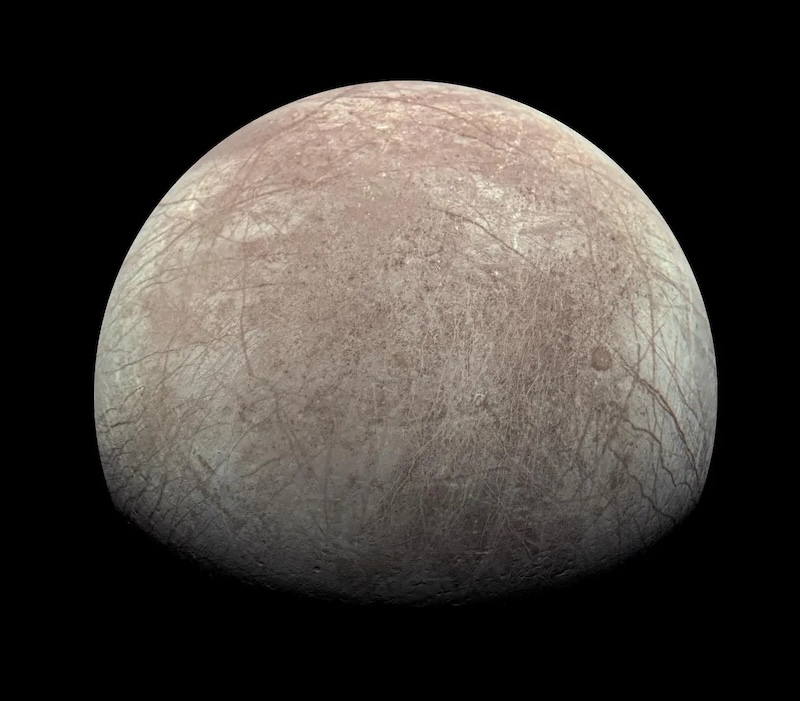
Smooth grayish-white planet-like sphere, with many thin cracks on its surface.
View larger. | View of Europa from NASA’s Juno spacecraft on September 29, 2022. Image via NASA/ JPL-Caltech/ SwRI/ MSSS /Image processing: Kevin M. Gill (CC BY 3.0).
Many criss-crossing reddish bands and cracks on lighter-colored surface.
A closer look at some of the cracks in Europa’s otherwise smooth surface. It’s through these cracks that scientists think water can come up to the surface and leave the brownish deposits around the cracks. The Galileo spacecraft took this image on September 26, 1998. Image via NASA/ JPL-Caltech/ SETI Institute.

Is the ammonia from the subsurface ocean?

The paper suggests the most likely source of the ammonia compounds is the subsurface ocean or other water reservoirs within the ice crust. The compounds could reach the surface through cryovolcanism, a form of volcanism with icy materials instead of hot magma. Ammonia can’t last long in space – or exposed on Europa’s virtually airless surface – so its presence suggests it came up to the surface relatively recently geologically. The paper says:

I posit that ammonia-bearing materials were transported to the surface via effusive cryovolcanism or similar mechanisms during Europa’s recent geological past.

The transport of ammonia-bearing material from subsurface sources provides insight into the composition and chemistry of Europa’s interior, suggesting a chemically reduced high-pH and thicker subsurface ocean beneath a comparatively thinner ice shell. Nonetheless, the detection of ammonia-bearing components in this study provides the first evidence of nitrogen-bearing species on Europa, an observation of considerable astrobiological significance due to nitrogen’s foundational role in the molecular basis of life.

Smiling man with brown hair and dark complexion.
Al Emran at NASA’s Jet Propulsion Laboratory in California is the author of the new paper about ammonia on Europa. Image via Jet Propulsion Laboratory.

Implications for habitability

The discovery of ammonia provides another important clue about the potential habitability of Europa’s ocean. Ammonia contains one nitrogen and three hydrogen atoms. It can be produced both biologically and abiotically (without life).

The fact that it contains nitrogen makes it even more interesting. Nitrogen is one of the key molecules required for life as we know it. It assists in the formation of amino acids, DNA, chlorophyll and proteins.

Ammonia also lowers the freezing point of water. This means that water containing ammonia can stay liquid at lower freezing temperatures than usual. This could be important in the case of Europa or other moons with subsurface oceans, even though scientists have found ammonia on quite a few other icy bodies in the solar system, both with oceans and without.

It will be interesting to see what NASA’s Europa Clipper finds when it reaches Europa in 2030. It will study both Europa’s surface and interior in unprecedented detail. Will it show that Europa is a habitable world?

Bottom line: A new analysis of images from the Galileo mission has revealed deposits of ammonia on Jupiter’s moon Europa. It could mean a geologically active crust and habitable ocean.

Source: Detection of an NH3 Absorption Band at 2.2 um on Europa

Via NASA

Via NASA

Read more: Strange ‘spider’ on Europa hints at water lurking below

Read more: Juno images of Europa reveal a complex, active surface

The post New discovery of ammonia on Europa hints at active geology first appeared on EarthSky.


from EarthSky https://ift.tt/4MpXLiO
Ammonia on Europa: Large rectangle showing gray surface from above, with long, dark cracks and small red and purple pixelated shapes. A moon, Europa, with long cracks on its surface is to the left of the rectangle. It is connected to the rectangle by 2 thin white lines.
View larger. | Composite image showing location of some of the ammonia-bearing compounds on Jupiter’s moon Europa (red pixels). Scientists found them near large fractures in the icy surface crust. The discovery of ammonia on Europa supports the possibility that Europa’s subsurface ocean is habitable. Image via NASA/ JPL-Caltech.

EarthSky’s 2026 lunar calendar shows the moon phase for every day of the year. Get yours today!

  • Scientists have found ammonia compounds on the surface of Jupiter’s moon Europa. Why is this significant?
  • The compounds likely came up from the ocean below, through cracks in the icy surface. They could be evidence for active geology in the crust and habitable conditions in the ocean.
  • New analysis of old images from the Galileo mission revealed the ammonia deposits near large fractures in the crust.

Ammonia on Europa: Active geology and life?

The debate about whether Jupiter’s moon Europa could support life in its hidden ocean continues. One key is active geology, which might serve as an life-engine on a world like Europa by connecting this world’s internal chemistry to its ocean. But one recent study said Europa’s seafloor might not be geologically active enough to support life. And then another study found the chemical nutrients needed could still come from Europa’s icy crust. Maybe they seep down into the ocean, and life gets a boost that way. Now, there’s a new piece of evidence. NASA said on January 29, 2026, that new analysis of data from the old Galileo mission has found, for the first time, ammonia-bearing compounds on Europa’s surface. Ammonia is a nitrogen-bearing molecule, and nitrogen is a foundational building block for life.

The ammonia deposits are located near large fractures on the surface. This is where liquid water – either from the ocean itself or smaller lakes within the ice crust – could come up to the surface.

Al Emran at NASA’s Jet Propulsion Laboratory in California is the author of the new peer-reviewed paper, published in The Planetary Science Journal on November 7, 2025.

NASA’s Galileo Mission Points to Ammonia at Europa, Recent Study Showsastrobiology.com/2026/01/nasa… #Astrobiology @NASAScience_

Astrobiology (@astrobiology.bsky.social) 2026-01-29T20:38:40.483Z

Old images from Galileo reveal ammonia on Europa

Emran found the ammonia-bearing compound deposits in old images from the Galileo mission. Galileo explored Jupiter and its moons from 1995 to 2003. No one had noticed the ammonia (NH3) deposits before. But now, new advanced reanalysis of the images revealed the deposits. The image at the top zooms in on an area about 250 miles (400 km) wide. Galileo obtained it during its 11th orbit of Jupiter in 1997.

The pixelated shapes are representations of data from Galileo’s Near-Infrared Mapping Spectrometer (NIMS) instrument. The red pixels show locations of the ammonia (aka NH3) compounds, while the purple pixels indicate no detections.

The paper states:

The presence of NH3-bearing components on icy planetary bodies has important implications for their geology and potential habitability. Here, I report the detection of a characteristic NH3 absorption feature on Europa, identified in an observation from the Galileo Near Infrared Mapping Spectrometer. Spectral modeling and band position indicate that NH3 hydrate and NH4 chloride are the most plausible candidates.

Smooth grayish-white planet-like sphere, with many thin cracks on its surface.
View larger. | View of Europa from NASA’s Juno spacecraft on September 29, 2022. Image via NASA/ JPL-Caltech/ SwRI/ MSSS /Image processing: Kevin M. Gill (CC BY 3.0).
Many criss-crossing reddish bands and cracks on lighter-colored surface.
A closer look at some of the cracks in Europa’s otherwise smooth surface. It’s through these cracks that scientists think water can come up to the surface and leave the brownish deposits around the cracks. The Galileo spacecraft took this image on September 26, 1998. Image via NASA/ JPL-Caltech/ SETI Institute.

Is the ammonia from the subsurface ocean?

The paper suggests the most likely source of the ammonia compounds is the subsurface ocean or other water reservoirs within the ice crust. The compounds could reach the surface through cryovolcanism, a form of volcanism with icy materials instead of hot magma. Ammonia can’t last long in space – or exposed on Europa’s virtually airless surface – so its presence suggests it came up to the surface relatively recently geologically. The paper says:

I posit that ammonia-bearing materials were transported to the surface via effusive cryovolcanism or similar mechanisms during Europa’s recent geological past.

The transport of ammonia-bearing material from subsurface sources provides insight into the composition and chemistry of Europa’s interior, suggesting a chemically reduced high-pH and thicker subsurface ocean beneath a comparatively thinner ice shell. Nonetheless, the detection of ammonia-bearing components in this study provides the first evidence of nitrogen-bearing species on Europa, an observation of considerable astrobiological significance due to nitrogen’s foundational role in the molecular basis of life.

Smiling man with brown hair and dark complexion.
Al Emran at NASA’s Jet Propulsion Laboratory in California is the author of the new paper about ammonia on Europa. Image via Jet Propulsion Laboratory.

Implications for habitability

The discovery of ammonia provides another important clue about the potential habitability of Europa’s ocean. Ammonia contains one nitrogen and three hydrogen atoms. It can be produced both biologically and abiotically (without life).

The fact that it contains nitrogen makes it even more interesting. Nitrogen is one of the key molecules required for life as we know it. It assists in the formation of amino acids, DNA, chlorophyll and proteins.

Ammonia also lowers the freezing point of water. This means that water containing ammonia can stay liquid at lower freezing temperatures than usual. This could be important in the case of Europa or other moons with subsurface oceans, even though scientists have found ammonia on quite a few other icy bodies in the solar system, both with oceans and without.

It will be interesting to see what NASA’s Europa Clipper finds when it reaches Europa in 2030. It will study both Europa’s surface and interior in unprecedented detail. Will it show that Europa is a habitable world?

Bottom line: A new analysis of images from the Galileo mission has revealed deposits of ammonia on Jupiter’s moon Europa. It could mean a geologically active crust and habitable ocean.

Source: Detection of an NH3 Absorption Band at 2.2 um on Europa

Via NASA

Via NASA

Read more: Strange ‘spider’ on Europa hints at water lurking below

Read more: Juno images of Europa reveal a complex, active surface

The post New discovery of ammonia on Europa hints at active geology first appeared on EarthSky.


from EarthSky https://ift.tt/4MpXLiO

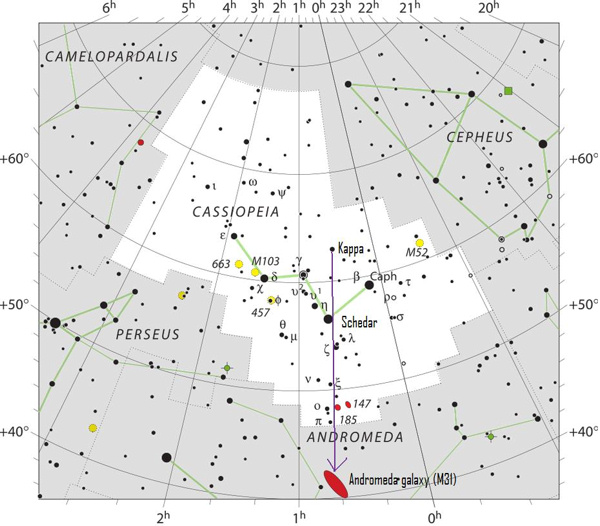
Find the Andromeda Galaxy using Cassiopeia

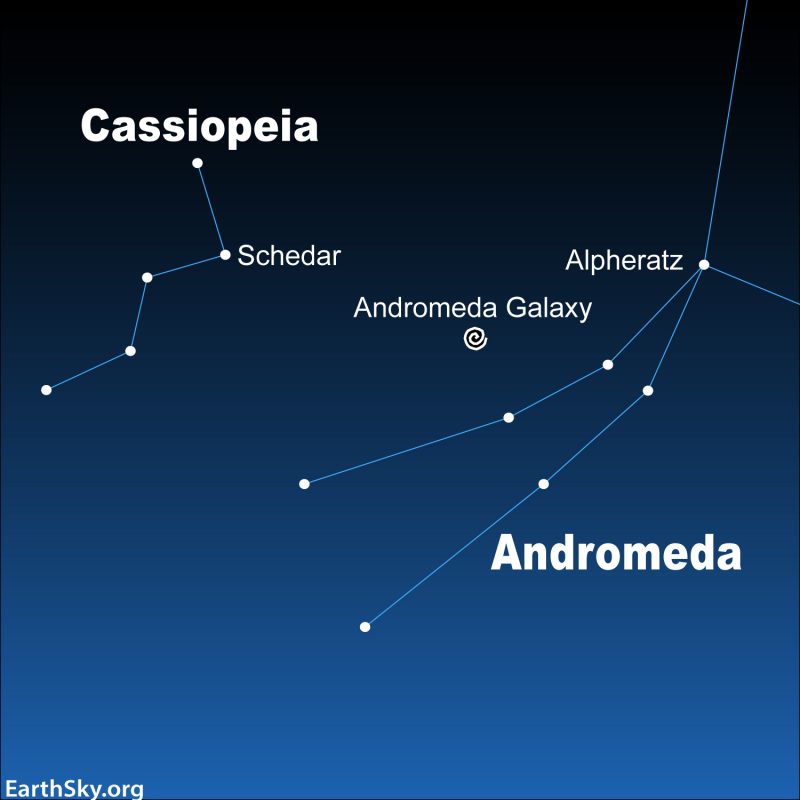
Star chart of constellations Cassiopeia and Andromeda with labeled Andromeda galaxy between them.
Here’s the technique some people use to find the Andromeda Galaxy aka M31. But be sure you’re looking in a dark sky. Look northward for the M – or W – shaped constellation Cassiopeia the Queen. Then locate the star Schedar in Cassiopeia. It’s the constellation’s brightest star, and it points to the Andromeda Galaxy. Chart via EarthSky.

The Andromeda Galaxy

The Andromeda galaxy, aka Messier 31 (M31), is the nearest large spiral galaxy to our Milky Way. It’s about 2.5 million light-years away, teeming with hundreds of billions of stars. In fact, it’s considered the farthest object you can see with the unaided eye.

Read more: The Andromeda Galaxy: All you need to know

Use Cassiopeia to find the Andromeda Galaxy

Tonight, if you have a dark sky, try star-hopping to the Andromeda Galaxy from the constellation Cassiopeia the Queen. If your sky is dark, you might even spot this hazy patch of light with no optical aid, as the ancient stargazers did before the days of city lights.

But what if you aren’t under a dark sky, and you can’t find the Andromeda Galaxy with the eyes alone? Well, some stargazers use binoculars and star-hop to the Andromeda Galaxy via this W- or M-shaped constellation.

Cassiopeia appears in high in the sky at nightfall and early evening, then swings downward as evening deepens into late night. Then in the wee hours before dawn, Cassiopeia is found climbing in the east. Note that one half of the W is more deeply notched than the other half. This deeper V is your “arrow” in the sky, pointing to the Andromeda Galaxy.

To see a precise view – and time – from your location, try Stellarium Online.

Images of the Andromeda Galaxy

Members of the EarthSky community have captured gorgeous images of this neighboring spiral galaxy.

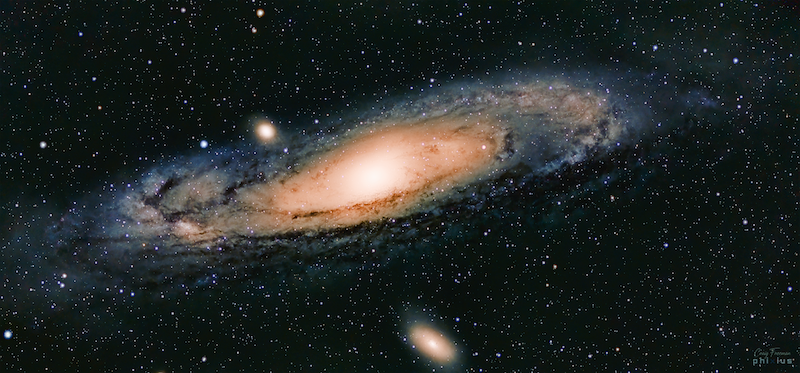
A very detailed glowing spiral in space seen obliquely in a starfield.
View at EarthSky Community Photos. | Craig Freeman imaged the Andromeda Galaxy from Mansfield, Ohio, on October 5, 2025. Beautiful! Thank you, Craig.
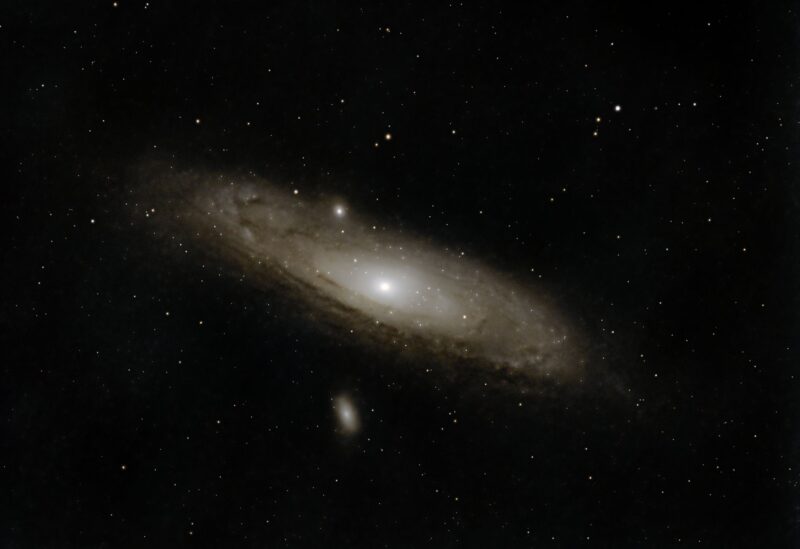
A vast, yellowish disk with sparse foreground stars.
View at EarthSky Community Photos. | Aquib Ali Ansari in Jaipur, Rajasthan, India, captured Messier 31, the Andromeda Galaxy, on September 26, 2025. Thank you, Aquib!
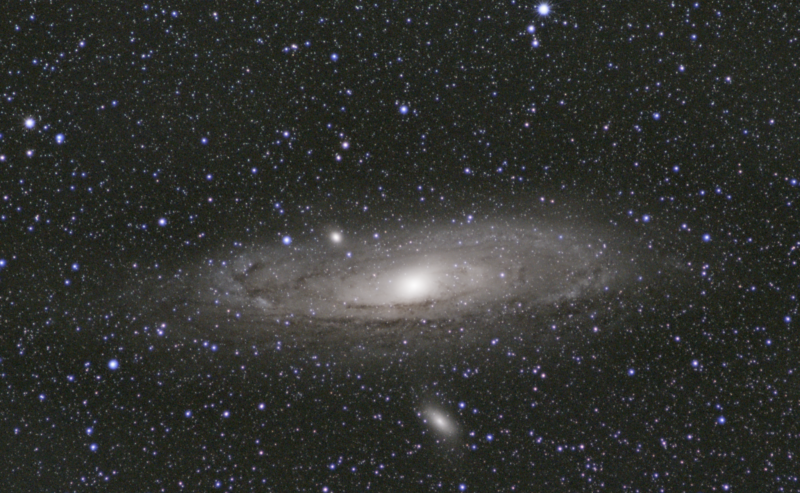
Oblique view of a large disk with a bright nucleus, dark lanes and thousands of foreground stars.
View at EarthSky Community Photos. | Jan Curtis in Cheyenne, Wyoming, caught Messier 31, the Andromeda Galaxy, on September 25, 2024. Jan wrote: “M31 is well-placed this time of year for all-night viewing.” Thank you, Jan!

Finder chart for the Andromeda Galaxy

Star chart of constellation Cassiopeia and arrow pointing to Andromeda Galaxy below it.
Draw an imaginary line from the star Kappa Cassiopeiae (abbreviated Kappa) through the star Schedar, then go about 3 times the Kappa-Schedar distance to locate the Andromeda Galaxy (Messier 31). Image via Wikimedia Commons (CC BY 3.0).

Binoculars enhance the view

Binoculars are an excellent choice for beginners to observe the Andromeda Galaxy, because they are so easy to point. As you stand beneath a dark sky, locate the galaxy with your eye first. Then slowly bring the binoculars up to your eyes so that the galaxy comes into binocular view. If that doesn’t work for you, try sweeping the area with your binoculars. Go slowly, and be sure your eyes are dark-adapted. The galaxy will appear as a fuzzy patch to the eye. Naturally, it’ll appear brighter in binoculars. And can you see its central region is brighter and more concentrated?

But remember, with the eye, binoculars, or with a backyard telescope, the Andromeda Galaxy won’t look like the images from famous telescopes and observatories. But it will be beautiful. Plus, it’ll take your breath away. And just think, you’re looking at a galaxy over 2 million light-years away. Wow!

Bottom line: You can find the Andromeda Galaxy using the constellation Cassiopeia as a guide. Remember, on a dark night, this galaxy will look like a faint smudge of light. And once you’ve found it with the unaided eye or binoculars, look at it with a telescope if you have one.

Read more: Andromeda Galaxy: Find it by star-hopping from Pegasus

Read more: Andromeda Galaxy stuns in new images and sounds!

The post Find the Andromeda Galaxy using Cassiopeia first appeared on EarthSky.


from EarthSky https://ift.tt/rTRsZM8
Star chart of constellations Cassiopeia and Andromeda with labeled Andromeda galaxy between them.
Here’s the technique some people use to find the Andromeda Galaxy aka M31. But be sure you’re looking in a dark sky. Look northward for the M – or W – shaped constellation Cassiopeia the Queen. Then locate the star Schedar in Cassiopeia. It’s the constellation’s brightest star, and it points to the Andromeda Galaxy. Chart via EarthSky.

The Andromeda Galaxy

The Andromeda galaxy, aka Messier 31 (M31), is the nearest large spiral galaxy to our Milky Way. It’s about 2.5 million light-years away, teeming with hundreds of billions of stars. In fact, it’s considered the farthest object you can see with the unaided eye.

Read more: The Andromeda Galaxy: All you need to know

Use Cassiopeia to find the Andromeda Galaxy

Tonight, if you have a dark sky, try star-hopping to the Andromeda Galaxy from the constellation Cassiopeia the Queen. If your sky is dark, you might even spot this hazy patch of light with no optical aid, as the ancient stargazers did before the days of city lights.

But what if you aren’t under a dark sky, and you can’t find the Andromeda Galaxy with the eyes alone? Well, some stargazers use binoculars and star-hop to the Andromeda Galaxy via this W- or M-shaped constellation.

Cassiopeia appears in high in the sky at nightfall and early evening, then swings downward as evening deepens into late night. Then in the wee hours before dawn, Cassiopeia is found climbing in the east. Note that one half of the W is more deeply notched than the other half. This deeper V is your “arrow” in the sky, pointing to the Andromeda Galaxy.

To see a precise view – and time – from your location, try Stellarium Online.

Images of the Andromeda Galaxy

Members of the EarthSky community have captured gorgeous images of this neighboring spiral galaxy.

A very detailed glowing spiral in space seen obliquely in a starfield.
View at EarthSky Community Photos. | Craig Freeman imaged the Andromeda Galaxy from Mansfield, Ohio, on October 5, 2025. Beautiful! Thank you, Craig.
A vast, yellowish disk with sparse foreground stars.
View at EarthSky Community Photos. | Aquib Ali Ansari in Jaipur, Rajasthan, India, captured Messier 31, the Andromeda Galaxy, on September 26, 2025. Thank you, Aquib!
Oblique view of a large disk with a bright nucleus, dark lanes and thousands of foreground stars.
View at EarthSky Community Photos. | Jan Curtis in Cheyenne, Wyoming, caught Messier 31, the Andromeda Galaxy, on September 25, 2024. Jan wrote: “M31 is well-placed this time of year for all-night viewing.” Thank you, Jan!

Finder chart for the Andromeda Galaxy

Star chart of constellation Cassiopeia and arrow pointing to Andromeda Galaxy below it.
Draw an imaginary line from the star Kappa Cassiopeiae (abbreviated Kappa) through the star Schedar, then go about 3 times the Kappa-Schedar distance to locate the Andromeda Galaxy (Messier 31). Image via Wikimedia Commons (CC BY 3.0).

Binoculars enhance the view

Binoculars are an excellent choice for beginners to observe the Andromeda Galaxy, because they are so easy to point. As you stand beneath a dark sky, locate the galaxy with your eye first. Then slowly bring the binoculars up to your eyes so that the galaxy comes into binocular view. If that doesn’t work for you, try sweeping the area with your binoculars. Go slowly, and be sure your eyes are dark-adapted. The galaxy will appear as a fuzzy patch to the eye. Naturally, it’ll appear brighter in binoculars. And can you see its central region is brighter and more concentrated?

But remember, with the eye, binoculars, or with a backyard telescope, the Andromeda Galaxy won’t look like the images from famous telescopes and observatories. But it will be beautiful. Plus, it’ll take your breath away. And just think, you’re looking at a galaxy over 2 million light-years away. Wow!

Bottom line: You can find the Andromeda Galaxy using the constellation Cassiopeia as a guide. Remember, on a dark night, this galaxy will look like a faint smudge of light. And once you’ve found it with the unaided eye or binoculars, look at it with a telescope if you have one.

Read more: Andromeda Galaxy: Find it by star-hopping from Pegasus

Read more: Andromeda Galaxy stuns in new images and sounds!

The post Find the Andromeda Galaxy using Cassiopeia first appeared on EarthSky.


from EarthSky https://ift.tt/rTRsZM8

Did we see a black hole explode? If so, it could explain a lot

Many small round reddish rings with black centers floating through space.
Did we just see a black hole explode? UMass Amherst’s physicists think so. This artist’s concept takes a fanciful approach to imagining small primordial black holes. Image via NASA/ Goddard Space Flight Center.

EarthSky’s 2026 lunar calendar shows the moon phase for every day of the year. Available now. Get yours today!

  • An “impossible” ultra-high-energy neutrino – detected in 2023 – might have come from the explosion of a tiny primordial black hole.
  • This led astronomers to a new dark-charge model. This model of primordial black holes could explain why one detector saw the high-energy event while another didn’t.
  • If confirmed, such explosions could reveal new particles, help verify Hawking radiation and potentially explain the nature of dark matter.

The University of Massachusetts Amherst published this original article on February 3, 2026. Edits by EarthSky.

Did we see a black hole explode?

In 2023, a subatomic particle called a neutrino crashed into Earth with an impossibly huge amount of energy. In fact, no known sources anywhere in the universe can produce that much energy, 100,000 times more than the highest-energy particle ever produced by the largest earthly particle accelerators.

In 2023, a subatomic particle called a neutrino crashed into Earth with an impossibly huge amount of energy. In fact, no known sources anywhere in the universe can produce that much energy, 100,000 times more than the highest-energy particle ever produced by the Large Hadron Collider, Earth’s most powerful particle accelerator. However, a team of physicists at the University of Massachusetts Amherst recently hypothesized that something like this could happen when a special kind of black hole, called a quasi-extremal primordial black hole, explodes.

The journal Physical Review Letters published the new research on December 18, 2025. The team not only accounts for the otherwise impossible neutrino but shows that the elementary particle could reveal the fundamental nature of the universe.

Primordial black holes

Black holes exist, and we have a good understanding of their life cycle: an old, large star runs out of fuel, implodes in a massively powerful supernova, and leaves behind an area of spacetime with such intense gravity that nothing, not even light, can escape. These black holes are incredibly heavy and are essentially stable.

But, as physicist Stephen Hawking pointed out in 1970, another kind of black hole – a primordial black hole – could be created not by the collapse of a star, but from the universe’s primordial conditions shortly after the Big Bang. Primordial black holes exist only in theory so far. And, like standard black holes, they’re so massively dense that almost nothing can escape them … which is what makes them black. However, despite their density, primordial black holes could be much lighter than the black holes we have so far observed. Furthermore, Hawking showed that primordial black holes could slowly emit particles via what is now known as Hawking radiation if they got hot enough.

Andrea Thamm, co-author of the new research and assistant professor of physics at UMass Amherst, said:

The lighter a black hole is, the hotter it should be and the more particles it will emit. As primordial black holes evaporate, they become ever lighter, and so hotter, emitting even more radiation in a runaway process until explosion. It’s that Hawking radiation that our telescopes can detect.

A young woman with long blonde hair smiling at the camera.
Andrea Thamm of the University of Massachusetts Amherst is a co-author of the new study. Image via University of Massachusetts Amherst.

Observing a black hole explode

If such an explosion were to be observed, it would give us a definitive catalog of all the subatomic particles in existence. That would include the ones we have observed, such as electrons, quarks and Higgs bosons. And also the ones that we have only hypothesized, like dark matter particles, as well as everything else that is, so far, entirely unknown to science. The UMass Amherst team has previously shown that such explosions could happen with surprising frequency – every decade or so – and if we were to pay attention, our current cosmos-observing instruments could register these explosions.

So far, so theoretical.

Then, in 2023, an experiment called the KM3NeT Collaboration captured that impossible neutrino. It was exactly the kind of evidence the UMass Amherst team hypothesized we might soon see.

But there was a hitch: A similar experiment, called IceCube, also set up to capture high-energy cosmic neutrinos, didn’t register the event. Not only that, but it had never clocked anything with even one hundredth of its power. If the universe is relatively thick with primordial black holes, and they are exploding frequently, shouldn’t we be showered in high-energy neutrinos? What can explain the discrepancy?

The missing link

Co-author Joaquim Iguaz Juan, a postdoctoral researcher in physics at UMass Amherst, said:

We think that primordial black holes with a ‘dark charge’ – what we call quasi-extremal primordial black holes – are the missing link.

The dark charge is essentially a copy of the usual electric force as we know it. But it includes a very heavy, hypothesized version of the electron, which the team calls a dark electron.

Co-author Michael Baker, an assistant professor of physics at UMass Amherst, said:

There are other, simpler models of primordial black holes out there. Our dark-charge model is more complex, which means it may provide a more accurate model of reality. What’s so cool is to see that our model can explain this otherwise unexplainable phenomenon.

Thamm added:

A primordial black hole with a dark charge has unique properties and behaves in ways that are different from other, simpler primordial black hole models. We have shown that this can provide an explanation of all of the seemingly inconsistent experimental data.

Dark matter explained?

The team is confident that, not only can their dark-charge model primordial black holes explain the neutrino, it can also answer the mystery of dark matter. Baker said:

Observations of galaxies and the cosmic microwave background suggest that some kind of dark matter exists.

Iguaz Juan added:

If our hypothesized dark charge is true, then we believe there could be a significant population of primordial black holes, which would be consistent with other astrophysical observations, and account for all the missing dark matter in the universe.

Baker concluded:

Observing the high-energy neutrino was an incredible event. It gave us a new window on the universe. But we could now be on the cusp of experimentally verifying Hawking radiation, obtaining evidence for both primordial black holes and new particles beyond the Standard Model, and explaining the mystery of dark matter.

Bottom line: Did we just witness a black hole explode? Astronomers observed a strange particle collide with Earth that could have been the result of a black hole exploding. It could help reveal new particles, help verify Hawking radiation and potentially explain the nature of dark matter.

Source: Explaining the PeV neutrino fluxes at KM3NeT and IceCube with quasiextremal primordial black holes

Via University of Massachusetts Amherst

The post Did we see a black hole explode? If so, it could explain a lot first appeared on EarthSky.


from EarthSky https://ift.tt/W2mXaSN
Many small round reddish rings with black centers floating through space.
Did we just see a black hole explode? UMass Amherst’s physicists think so. This artist’s concept takes a fanciful approach to imagining small primordial black holes. Image via NASA/ Goddard Space Flight Center.

EarthSky’s 2026 lunar calendar shows the moon phase for every day of the year. Available now. Get yours today!

  • An “impossible” ultra-high-energy neutrino – detected in 2023 – might have come from the explosion of a tiny primordial black hole.
  • This led astronomers to a new dark-charge model. This model of primordial black holes could explain why one detector saw the high-energy event while another didn’t.
  • If confirmed, such explosions could reveal new particles, help verify Hawking radiation and potentially explain the nature of dark matter.

The University of Massachusetts Amherst published this original article on February 3, 2026. Edits by EarthSky.

Did we see a black hole explode?

In 2023, a subatomic particle called a neutrino crashed into Earth with an impossibly huge amount of energy. In fact, no known sources anywhere in the universe can produce that much energy, 100,000 times more than the highest-energy particle ever produced by the largest earthly particle accelerators.

In 2023, a subatomic particle called a neutrino crashed into Earth with an impossibly huge amount of energy. In fact, no known sources anywhere in the universe can produce that much energy, 100,000 times more than the highest-energy particle ever produced by the Large Hadron Collider, Earth’s most powerful particle accelerator. However, a team of physicists at the University of Massachusetts Amherst recently hypothesized that something like this could happen when a special kind of black hole, called a quasi-extremal primordial black hole, explodes.

The journal Physical Review Letters published the new research on December 18, 2025. The team not only accounts for the otherwise impossible neutrino but shows that the elementary particle could reveal the fundamental nature of the universe.

Primordial black holes

Black holes exist, and we have a good understanding of their life cycle: an old, large star runs out of fuel, implodes in a massively powerful supernova, and leaves behind an area of spacetime with such intense gravity that nothing, not even light, can escape. These black holes are incredibly heavy and are essentially stable.

But, as physicist Stephen Hawking pointed out in 1970, another kind of black hole – a primordial black hole – could be created not by the collapse of a star, but from the universe’s primordial conditions shortly after the Big Bang. Primordial black holes exist only in theory so far. And, like standard black holes, they’re so massively dense that almost nothing can escape them … which is what makes them black. However, despite their density, primordial black holes could be much lighter than the black holes we have so far observed. Furthermore, Hawking showed that primordial black holes could slowly emit particles via what is now known as Hawking radiation if they got hot enough.

Andrea Thamm, co-author of the new research and assistant professor of physics at UMass Amherst, said:

The lighter a black hole is, the hotter it should be and the more particles it will emit. As primordial black holes evaporate, they become ever lighter, and so hotter, emitting even more radiation in a runaway process until explosion. It’s that Hawking radiation that our telescopes can detect.

A young woman with long blonde hair smiling at the camera.
Andrea Thamm of the University of Massachusetts Amherst is a co-author of the new study. Image via University of Massachusetts Amherst.

Observing a black hole explode

If such an explosion were to be observed, it would give us a definitive catalog of all the subatomic particles in existence. That would include the ones we have observed, such as electrons, quarks and Higgs bosons. And also the ones that we have only hypothesized, like dark matter particles, as well as everything else that is, so far, entirely unknown to science. The UMass Amherst team has previously shown that such explosions could happen with surprising frequency – every decade or so – and if we were to pay attention, our current cosmos-observing instruments could register these explosions.

So far, so theoretical.

Then, in 2023, an experiment called the KM3NeT Collaboration captured that impossible neutrino. It was exactly the kind of evidence the UMass Amherst team hypothesized we might soon see.

But there was a hitch: A similar experiment, called IceCube, also set up to capture high-energy cosmic neutrinos, didn’t register the event. Not only that, but it had never clocked anything with even one hundredth of its power. If the universe is relatively thick with primordial black holes, and they are exploding frequently, shouldn’t we be showered in high-energy neutrinos? What can explain the discrepancy?

The missing link

Co-author Joaquim Iguaz Juan, a postdoctoral researcher in physics at UMass Amherst, said:

We think that primordial black holes with a ‘dark charge’ – what we call quasi-extremal primordial black holes – are the missing link.

The dark charge is essentially a copy of the usual electric force as we know it. But it includes a very heavy, hypothesized version of the electron, which the team calls a dark electron.

Co-author Michael Baker, an assistant professor of physics at UMass Amherst, said:

There are other, simpler models of primordial black holes out there. Our dark-charge model is more complex, which means it may provide a more accurate model of reality. What’s so cool is to see that our model can explain this otherwise unexplainable phenomenon.

Thamm added:

A primordial black hole with a dark charge has unique properties and behaves in ways that are different from other, simpler primordial black hole models. We have shown that this can provide an explanation of all of the seemingly inconsistent experimental data.

Dark matter explained?

The team is confident that, not only can their dark-charge model primordial black holes explain the neutrino, it can also answer the mystery of dark matter. Baker said:

Observations of galaxies and the cosmic microwave background suggest that some kind of dark matter exists.

Iguaz Juan added:

If our hypothesized dark charge is true, then we believe there could be a significant population of primordial black holes, which would be consistent with other astrophysical observations, and account for all the missing dark matter in the universe.

Baker concluded:

Observing the high-energy neutrino was an incredible event. It gave us a new window on the universe. But we could now be on the cusp of experimentally verifying Hawking radiation, obtaining evidence for both primordial black holes and new particles beyond the Standard Model, and explaining the mystery of dark matter.

Bottom line: Did we just witness a black hole explode? Astronomers observed a strange particle collide with Earth that could have been the result of a black hole exploding. It could help reveal new particles, help verify Hawking radiation and potentially explain the nature of dark matter.

Source: Explaining the PeV neutrino fluxes at KM3NeT and IceCube with quasiextremal primordial black holes

Via University of Massachusetts Amherst

The post Did we see a black hole explode? If so, it could explain a lot first appeared on EarthSky.


from EarthSky https://ift.tt/W2mXaSN

adds 2