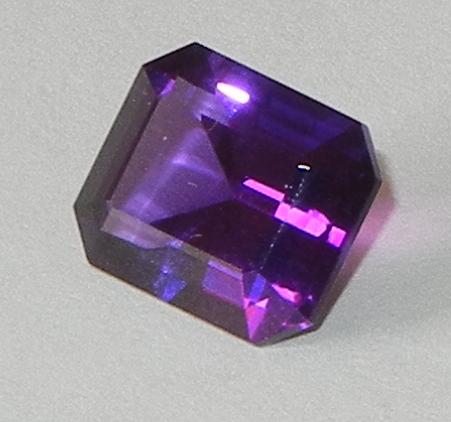
February babies have amethyst – a lovely purple gemstone – as their birthstone. Amethysts contain the second most abundant mineral found in Earth’s crust: quartz. And quartz often forms the lining inside geodes, which form near sites of volcanic activity. So it’s no wonder that geodes sometimes contain amethysts, and some amethyst geodes are amazingly large.
Like quartz, amethysts are a transparent form of silicon dioxide (SiO2). An amethyst’s color can range from a faint mauve to a rich purple. But where does the color come from? Some scientists believe the purple color arises from the amethysts’ iron oxide content, while others attribute the color to manganese or hydrocarbons.
Also, amethysts are very sensitive to heat. When heated to about 750 to 900 degrees Fahrenheit (400 or 500 degrees Celsius), an amethyst’s color changes to brownish-yellow or red. Then, under some circumstances, the stones turn green when heated. In fact, heat may even transform an amethyst into a naturally rare yellow mineral called citrine. And even without heating, the violet color of amethyst may fade over time.
Commercial sources of amethyst are Brazil and Uruguay, and Arizona and North Carolina are the source of gem quality amethyst.
The amethyst has a rich history of lore and legend, traceable back 25,000 years in France, where it was a decorative stone used by prehistoric humans. In fact, it appears among the remains from the Neolithic era.
According to legend, the signet ring worn by Cleopatra was an amethyst engraved with the figure of Mithra, a Persian deity symbolizing the Divine Idea, Source of Light and Life.
Saint Valentine supposedly wore an amethyst engraved with the figure of his assistant, Cupid. Also, Saint Valentine’s Day is in February.
The early Egyptians believed that the amethyst possessed good powers and placed the stones in the tombs of pharaohs. During the Middle Ages, people believed that an amethyst amulet would dispel sleep, sharpen intellect, and protect the wearer from sorcery. And it was thought to bring victory in battle. In Arabian mythology, amethyst supposedly protected the wearer from bad dreams and gout.
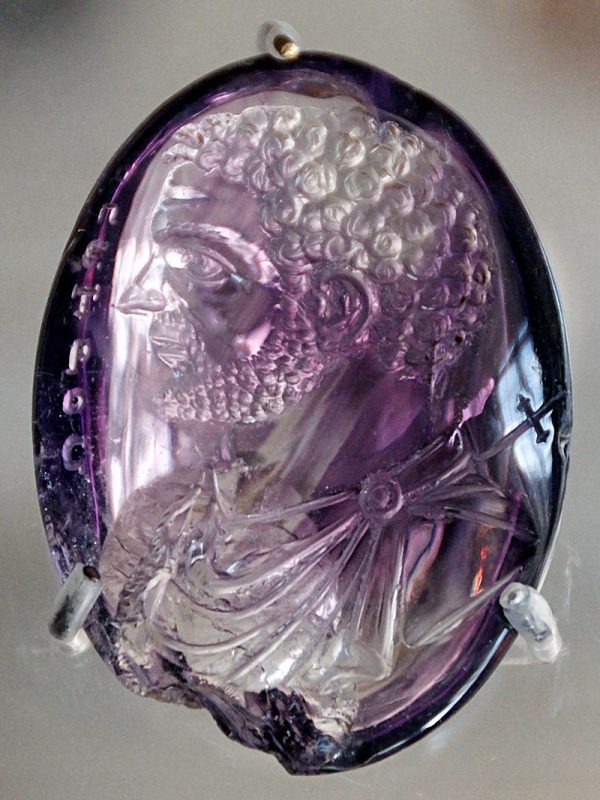
Roman intaglio engraved gem of Caracalla in amethyst, once in the Treasury of Sainte-Chapelle. Image via Marie-Lan Nguyen/ Wikipedia.
Amethyst means not drunk
As a matter of fact, the word amethyst comes from the Greek word “amethystos,” meaning “not drunk,” and so myths say it prevents its wearers from becoming intoxicated. According to the following story from Greco-Roman mythology, as quoted from Birthstones by Willard Heaps:
Bacchus, the god of wine in classical mythology, was offended by Diana the Huntress. Determined on revenge, he declared that the first person he met as he went through the forest would be eaten by his tigers. As it happened, the first person to cross his path was the beautiful maiden Amethyst on her way to worship at the shrine of Diana. In terror, she called upon the goddess to save her, and before his eyes, Bacchus observed the maiden changed to a pure white, sparkling image of stone.
Realizing his guilt and repenting his cruelty, Bacchus poured grape wine over her, thus giving the stone the exquisite violet hue of the amethyst. The carryover to non-intoxication was quite logical, and in ancient Rome, amethyst cups were used for wine, so drinkers would have no fear of overindulgence.
February babies have amethyst – a lovely purple gemstone – as their birthstone. Amethysts contain the second most abundant mineral found in Earth’s crust: quartz. And quartz often forms the lining inside geodes, which form near sites of volcanic activity. So it’s no wonder that geodes sometimes contain amethysts, and some amethyst geodes are amazingly large.
Like quartz, amethysts are a transparent form of silicon dioxide (SiO2). An amethyst’s color can range from a faint mauve to a rich purple. But where does the color come from? Some scientists believe the purple color arises from the amethysts’ iron oxide content, while others attribute the color to manganese or hydrocarbons.
Also, amethysts are very sensitive to heat. When heated to about 750 to 900 degrees Fahrenheit (400 or 500 degrees Celsius), an amethyst’s color changes to brownish-yellow or red. Then, under some circumstances, the stones turn green when heated. In fact, heat may even transform an amethyst into a naturally rare yellow mineral called citrine. And even without heating, the violet color of amethyst may fade over time.
Commercial sources of amethyst are Brazil and Uruguay, and Arizona and North Carolina are the source of gem quality amethyst.
The amethyst has a rich history of lore and legend, traceable back 25,000 years in France, where it was a decorative stone used by prehistoric humans. In fact, it appears among the remains from the Neolithic era.
According to legend, the signet ring worn by Cleopatra was an amethyst engraved with the figure of Mithra, a Persian deity symbolizing the Divine Idea, Source of Light and Life.
Saint Valentine supposedly wore an amethyst engraved with the figure of his assistant, Cupid. Also, Saint Valentine’s Day is in February.
The early Egyptians believed that the amethyst possessed good powers and placed the stones in the tombs of pharaohs. During the Middle Ages, people believed that an amethyst amulet would dispel sleep, sharpen intellect, and protect the wearer from sorcery. And it was thought to bring victory in battle. In Arabian mythology, amethyst supposedly protected the wearer from bad dreams and gout.
Roman intaglio engraved gem of Caracalla in amethyst, once in the Treasury of Sainte-Chapelle. Image via Marie-Lan Nguyen/ Wikipedia.
Amethyst means not drunk
As a matter of fact, the word amethyst comes from the Greek word “amethystos,” meaning “not drunk,” and so myths say it prevents its wearers from becoming intoxicated. According to the following story from Greco-Roman mythology, as quoted from Birthstones by Willard Heaps:
Bacchus, the god of wine in classical mythology, was offended by Diana the Huntress. Determined on revenge, he declared that the first person he met as he went through the forest would be eaten by his tigers. As it happened, the first person to cross his path was the beautiful maiden Amethyst on her way to worship at the shrine of Diana. In terror, she called upon the goddess to save her, and before his eyes, Bacchus observed the maiden changed to a pure white, sparkling image of stone.
Realizing his guilt and repenting his cruelty, Bacchus poured grape wine over her, thus giving the stone the exquisite violet hue of the amethyst. The carryover to non-intoxication was quite logical, and in ancient Rome, amethyst cups were used for wine, so drinkers would have no fear of overindulgence.
View larger. | Artist’s concept of a massive exomoon orbiting a gas giant exoplanet. A team of astronomers says it might have detected a huge exomoon orbiting the gas giant exoplanet HD 206893 B, 133 light-years from Earth. Image via NASA/ ESA/ L. Hustak (STScI).
Do exoplanets have exomoons? There are a growing number of candidates, but no distant planet has yet been confirmed to have an orbiting moon.
A gas giant exoplanet 133 light-years away – HD 206893 B – might have a huge exomoon, a team of astronomers says.
The possible exomoon has a mass 40% that of Jupiter, or nine times the mass of Neptune. It still needs to be confirmed, however.
A massive exomoon 133 light-years away?
We know that there are many exoplanets out there orbiting distant stars. Current models and observational data suggest between 100 billion and 400 billion exoplanets in our Milky Way galaxy. But what about exomoons? On January 29, 2026, a team of astronomers said they’ve detected another potential exomoon. And this one is big. The planet, HD 206893 B, is a gas giant about 28 times as massive as Jupiter, 133 light-years away. The suspected moon is about 40% the mass of Jupiter, or nine times the mass of Neptune.
If the discovery is confirmed, and the size estimate proves correct, we’ll have found an exomoon far larger and more massive than Jupiter’s moon Ganymede, the largest moon in our solar system.
For now, this discovery is one of a small but growing number of candidate exomoons. No exomoon has been confirmed yet. The new work comes from astronomers using the GRAVITY instrument on the Very Large Telescope (VLT) in the Atacama desert in Chile. The researchers found the suspected moon by measuring “wobbles” in the motion of its planet.
Robert Lea wrote about the potentially exciting discovery at Space.com on January 22, 2026.
The researchers’ new paper has been accepted for publication in Astronomy & Astrophysics, and is available as a preprint on arXiv (November 25, 2025).
Wobbling exoplanet
The researchers examined the orbit of HD 206893 B. They found that the planet exhibited a small “wobble” as it orbited its star. As lead author Quentin Kral at the University of Cambridge in the U.K. and the Paris Observatory mentioned to Space.com:
What we found is that HD 206893 B doesn’t just follow a smooth orbit around its star. On top of that motion, it shows a small but measurable back-and-forth ‘wobble.’ The wobble has a period of about nine months and a size comparable to the Earth–moon distance. This kind of signal is exactly what you would expect if the object were being tugged by an unseen companion, such as a large moon, making this system a particularly intriguing candidate for hosting an exomoon.
Cool discovery! If the exomoon interpretation is right, this object is enormous ! It orbits HD 206893 B at ~0.22 AU on a highly tilted orbit (~60°), blurring the line between a giant exomoon and a low-mass companion. Frontier science in action. observatoiredeparis.psl.eu/un-signal-in…
The researchers used the GRAVITY instrument on the Very Large Telescope to make the detection. GRAVITY measures the positions of stars and other objects in space using astrometry. Astrometry makes precise measurements of the positions and movements of stars and other celestial bodies. As Kral explained:
This technique has previously been used to measure the long, slow orbits of massive exoplanets and brown dwarfs, where observations spaced years apart are sufficient. In our study, we pushed this approach much further by monitoring the object over much shorter timescales, from days to months. What we found is that HD 206893 B doesn’t just follow a smooth orbit around its star. On top of that motion, it shows a small but measurable back-and-forth ‘wobble.’
Exomoons are difficult to detect because they produce signals that are extremely small compared to those of planets, and those signals depend very strongly on both the observing technique and the system’s geometry.
Quentin Kral at the University of Cambridge and the Paris Observatory led the new observations of the possible giant exomoon. Image via ResearchGate.
Transit method vs astrometry
Astronomers have used the transit method to detect many exoplanets. That’s when a planet transits – passes in front of – its star as seen from Earth. It’s not as useful for finding exomoons, however. Technically, it can find them, but is more suitable for planets that orbit very close to their stars. And those planets are the least likely to have moons. Kral said:
The transit method which has been the most successful technique for finding exoplanets can, in principle, detect moons comparable in size to Jupiter’s largest moons. However, it is most sensitive to planets orbiting very close to their stars, and theoretical studies suggest that such close-in planets are unlikely to retain large moons over long periods of time.
Astrometry is better suited for detecting exomoons around planets farther from their stars. As Kral explained:
Astrometry, the technique we use, is sensitive to longer-period moons orbiting planets or substellar companions far from their stars. This makes it particularly promising for detecting exomoons in regions where they are expected to be stable, at least for the most massive moons, which are likely to be the first ones we can find.
Questioning the definition of ‘moon’
The results of GRAVITY’s measurements suggest something amazing. HD 206893 B has a moon. But this moon is huge! If real, it is about 40% the mass of Jupiter. That’s nine times the mass of Neptune: a moon the size of some of the larger planets in our solar system. It orbits its planet about once every nine months at about 0.22 astronomical units, or 1/5 the distance between Earth and the sun. In addition, its orbit is tilted around 60 degrees to the orbital plane of the planet.
If confirmed, such a giant moon could call into question our current definition of what a moon is. Is this a moon and planet, or a double planet system?
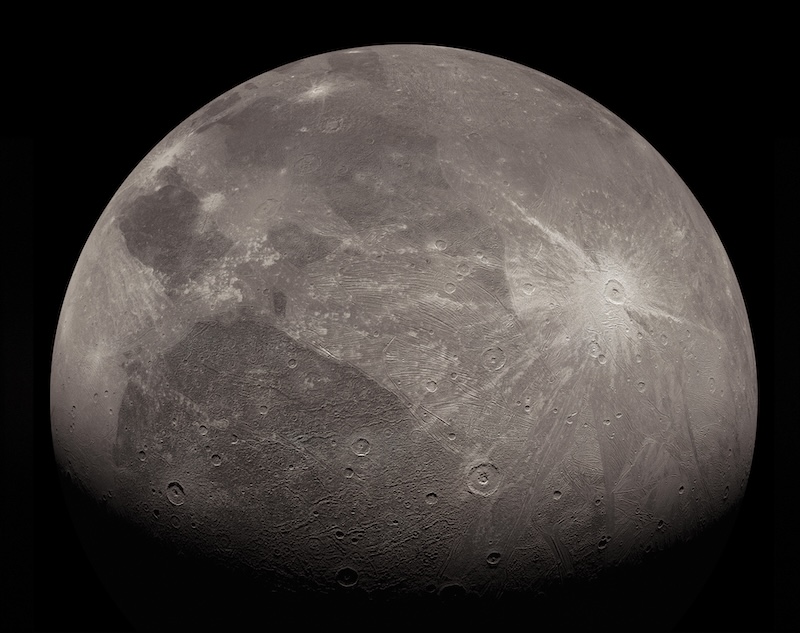
View larger. | Jupiter’s moon Ganymede is the largest moon in our solar system. But the possible moon orbiting HD 206893 B would be much larger and more massive, about 40% the mass of Jupiter or 9 times the mass of Neptune. NASA’s Juno spacecraft captured this view of Ganymede on June 7, 2021. Image via NASA/ JPL-Caltech/ SwRI/ MSSS/ Kalleheikki Kannisto.
Comparison to Ganymede
The largest and most massive moon in our solar system is Ganymede, a moon of Jupiter. At 3,270 miles (5,260 kilometers) in diameter, it is larger than both Mercury and Pluto. But it pales in comparison to the possible moon of HD 206893 B. The potential exomoon would be about nine times the mass of Neptune, and Ganymede is thousands of times less massive than Neptune. Kral said at Space.com:
In our solar system, the most massive moon is Ganymede, which is still extremely small compared to what we are inferring here. Ganymede is thousands of times less massive than Neptune, so there is an enormous gap in mass between the largest moons we know and this potential exomoon candidate.
This naturally raises the question of whether such an object should even be called a moon. At these masses, the distinction between a massive moon and a very low-mass companion becomes blurred. However, there is currently no official definition of an exomoon, and in practice, astronomers generally refer to any object orbiting a planet or substellar companion as a moon.
View larger. | Artist’s concept of WASP-49 b, another gas giant exoplanet with a possible exomoon. This one might be highly volcanic. Image via NASA/ JPL/ Caltech.
We will find exomoons
Kral is optimistic about being able to confirm exomoons:
It’s important to keep in mind that we are likely only seeing the tip of the iceberg. Just as the first exoplanets discovered were the most massive ones orbiting very close to their stars – simply because they were the easiest to detect – the first exomoons we identify are expected to be the most massive and extreme examples.
As observational techniques improve, our definitions and understanding of what constitutes a moon will almost certainly evolve.
Bottom line: Astronomers using the Very Large Telescope might have found a massive exomoon – 40% the mass of Jupiter – orbiting a giant exoplanet 133 light-years away.
View larger. | Artist’s concept of a massive exomoon orbiting a gas giant exoplanet. A team of astronomers says it might have detected a huge exomoon orbiting the gas giant exoplanet HD 206893 B, 133 light-years from Earth. Image via NASA/ ESA/ L. Hustak (STScI).
Do exoplanets have exomoons? There are a growing number of candidates, but no distant planet has yet been confirmed to have an orbiting moon.
A gas giant exoplanet 133 light-years away – HD 206893 B – might have a huge exomoon, a team of astronomers says.
The possible exomoon has a mass 40% that of Jupiter, or nine times the mass of Neptune. It still needs to be confirmed, however.
A massive exomoon 133 light-years away?
We know that there are many exoplanets out there orbiting distant stars. Current models and observational data suggest between 100 billion and 400 billion exoplanets in our Milky Way galaxy. But what about exomoons? On January 29, 2026, a team of astronomers said they’ve detected another potential exomoon. And this one is big. The planet, HD 206893 B, is a gas giant about 28 times as massive as Jupiter, 133 light-years away. The suspected moon is about 40% the mass of Jupiter, or nine times the mass of Neptune.
If the discovery is confirmed, and the size estimate proves correct, we’ll have found an exomoon far larger and more massive than Jupiter’s moon Ganymede, the largest moon in our solar system.
For now, this discovery is one of a small but growing number of candidate exomoons. No exomoon has been confirmed yet. The new work comes from astronomers using the GRAVITY instrument on the Very Large Telescope (VLT) in the Atacama desert in Chile. The researchers found the suspected moon by measuring “wobbles” in the motion of its planet.
Robert Lea wrote about the potentially exciting discovery at Space.com on January 22, 2026.
The researchers’ new paper has been accepted for publication in Astronomy & Astrophysics, and is available as a preprint on arXiv (November 25, 2025).
Wobbling exoplanet
The researchers examined the orbit of HD 206893 B. They found that the planet exhibited a small “wobble” as it orbited its star. As lead author Quentin Kral at the University of Cambridge in the U.K. and the Paris Observatory mentioned to Space.com:
What we found is that HD 206893 B doesn’t just follow a smooth orbit around its star. On top of that motion, it shows a small but measurable back-and-forth ‘wobble.’ The wobble has a period of about nine months and a size comparable to the Earth–moon distance. This kind of signal is exactly what you would expect if the object were being tugged by an unseen companion, such as a large moon, making this system a particularly intriguing candidate for hosting an exomoon.
Cool discovery! If the exomoon interpretation is right, this object is enormous ! It orbits HD 206893 B at ~0.22 AU on a highly tilted orbit (~60°), blurring the line between a giant exomoon and a low-mass companion. Frontier science in action. observatoiredeparis.psl.eu/un-signal-in…
The researchers used the GRAVITY instrument on the Very Large Telescope to make the detection. GRAVITY measures the positions of stars and other objects in space using astrometry. Astrometry makes precise measurements of the positions and movements of stars and other celestial bodies. As Kral explained:
This technique has previously been used to measure the long, slow orbits of massive exoplanets and brown dwarfs, where observations spaced years apart are sufficient. In our study, we pushed this approach much further by monitoring the object over much shorter timescales, from days to months. What we found is that HD 206893 B doesn’t just follow a smooth orbit around its star. On top of that motion, it shows a small but measurable back-and-forth ‘wobble.’
Exomoons are difficult to detect because they produce signals that are extremely small compared to those of planets, and those signals depend very strongly on both the observing technique and the system’s geometry.
Quentin Kral at the University of Cambridge and the Paris Observatory led the new observations of the possible giant exomoon. Image via ResearchGate.
Transit method vs astrometry
Astronomers have used the transit method to detect many exoplanets. That’s when a planet transits – passes in front of – its star as seen from Earth. It’s not as useful for finding exomoons, however. Technically, it can find them, but is more suitable for planets that orbit very close to their stars. And those planets are the least likely to have moons. Kral said:
The transit method which has been the most successful technique for finding exoplanets can, in principle, detect moons comparable in size to Jupiter’s largest moons. However, it is most sensitive to planets orbiting very close to their stars, and theoretical studies suggest that such close-in planets are unlikely to retain large moons over long periods of time.
Astrometry is better suited for detecting exomoons around planets farther from their stars. As Kral explained:
Astrometry, the technique we use, is sensitive to longer-period moons orbiting planets or substellar companions far from their stars. This makes it particularly promising for detecting exomoons in regions where they are expected to be stable, at least for the most massive moons, which are likely to be the first ones we can find.
Questioning the definition of ‘moon’
The results of GRAVITY’s measurements suggest something amazing. HD 206893 B has a moon. But this moon is huge! If real, it is about 40% the mass of Jupiter. That’s nine times the mass of Neptune: a moon the size of some of the larger planets in our solar system. It orbits its planet about once every nine months at about 0.22 astronomical units, or 1/5 the distance between Earth and the sun. In addition, its orbit is tilted around 60 degrees to the orbital plane of the planet.
If confirmed, such a giant moon could call into question our current definition of what a moon is. Is this a moon and planet, or a double planet system?
View larger. | Jupiter’s moon Ganymede is the largest moon in our solar system. But the possible moon orbiting HD 206893 B would be much larger and more massive, about 40% the mass of Jupiter or 9 times the mass of Neptune. NASA’s Juno spacecraft captured this view of Ganymede on June 7, 2021. Image via NASA/ JPL-Caltech/ SwRI/ MSSS/ Kalleheikki Kannisto.
Comparison to Ganymede
The largest and most massive moon in our solar system is Ganymede, a moon of Jupiter. At 3,270 miles (5,260 kilometers) in diameter, it is larger than both Mercury and Pluto. But it pales in comparison to the possible moon of HD 206893 B. The potential exomoon would be about nine times the mass of Neptune, and Ganymede is thousands of times less massive than Neptune. Kral said at Space.com:
In our solar system, the most massive moon is Ganymede, which is still extremely small compared to what we are inferring here. Ganymede is thousands of times less massive than Neptune, so there is an enormous gap in mass between the largest moons we know and this potential exomoon candidate.
This naturally raises the question of whether such an object should even be called a moon. At these masses, the distinction between a massive moon and a very low-mass companion becomes blurred. However, there is currently no official definition of an exomoon, and in practice, astronomers generally refer to any object orbiting a planet or substellar companion as a moon.
View larger. | Artist’s concept of WASP-49 b, another gas giant exoplanet with a possible exomoon. This one might be highly volcanic. Image via NASA/ JPL/ Caltech.
We will find exomoons
Kral is optimistic about being able to confirm exomoons:
It’s important to keep in mind that we are likely only seeing the tip of the iceberg. Just as the first exoplanets discovered were the most massive ones orbiting very close to their stars – simply because they were the easiest to detect – the first exomoons we identify are expected to be the most massive and extreme examples.
As observational techniques improve, our definitions and understanding of what constitutes a moon will almost certainly evolve.
Bottom line: Astronomers using the Very Large Telescope might have found a massive exomoon – 40% the mass of Jupiter – orbiting a giant exoplanet 133 light-years away.
ESA’s Proba-3 spacecraft captured this image of our star. The sun’s dazzling body is blocked by 1 of the 2 satellites making up Proba-3, leaving the other satellite free to image the our star’s wispy outer atmosphere. Now, a new mission proposes to use the moon, rather than a second spacecraft, to create artificial solar eclipses like these. See more of the images here. Image via ESA/ Proba-3/ ASPIICS/ WOW algorithm.
New mission could create artificial solar eclipses in space
When a solar storm strikes Earth, it can disrupt technology that’s vital for our daily lives. Solar storms occur when magnetic fields and electrically charged particles collide with the Earth’s magnetic field. This type of event falls into the category known as “space weather”.
An international team of researchers (including us, the authors of this article) is working on a spacecraft mission that would enable researchers to study the conditions that create solar storms, leading to improved forecasts of space weather.
The proposed mission, known as Mesom (Moon-Enabled Sun Occultation Mission), aims to create total solar eclipses in space. It would use the moon to view the sun’s atmosphere in more detail than ever before.
Why are artificial solar eclipses necessary?
The need for a better understanding of solar storms is evident from looking at past disruptions. In 1989, for example, the sun sent the Canadian province of Quebec into a nine-hour blackout. The cause was a coronal mass ejection (CME); a huge burst of hot plasma and magnetic fields thrown off from the sun’s atmosphere towards space.
The event is estimated to have cost tens of millions of US and Canadian dollars. That’s both in lost business productivity and the need to replace damaged power equipment.
In May 2024, a succession of similar solar eruptions caused thousands of satellites in low-Earth orbit to abruptly drop in altitude. GPS outages cost US farmers alone an estimated US$500 million.
But these storms were significantly weaker than one in 1859, also the result of a CME, which is known as the Carrington Event. Electrical currents flowing through telegraph wires caused operators to receive electric shocks and even started fires in telegraph offices. Today, a Carrington-like event would have far more dramatic consequences on our technology-dependent world.
Yet, our view of the sun’s outer atmosphere, the solar corona – from which CMEs originate – remains dazzled by the bright light of the sun itself. A new UK-led spacecraft mission aims to change that by creating artificial solar eclipses in space.
Artist’s concept of activity on the sun traveling across space to interact with Earth’s magnetic field. Not to scale. Image via NASA/ Wikimedia Commons.
Better forecasting
During total solar eclipses, the light coming from the surface of the sun is occulted (covered) by the moon. That leaves behind only a faint glow of light coming from the outer layers of the sun’s atmosphere, the corona.
Observing the physical processes in the corona at different timescales and wavelengths is key to enabling better forecasting of space weather. Plus, it could help solve longstanding mysteries of our star. These include how the sun’s evolving magnetic fields confine and release the hot plasma of its volatile atmosphere.
Unfortunately, total solar eclipses are predictable yet rare events that only last for a few minutes. All total eclipses in the 21st century will last less than seven minutes each, and will occur only once every 18 months on average.
Total solar eclipse measurements from the ground are also subject to weather conditions. Plus, Earth’s atmosphere causes observations to suffer from distortions and loss of detail.
A new take on the coronagraph
For decades, scientists and engineers have observed the corona by artificially covering the sun. They do so using clever optics and instrument design inspired by the pioneering work of Bernard Lyot, a French astronomer who first come up with the idea of a “coronagraph”.
Coronagraphs are telescopes equipped with an occulting disk to block out the overwhelming light coming from the visible surface a star.
In a coronagraph, the faint coronal light can be picked up and translated into digital signals. This is the working principle of the Large Angle and Spectrometric Coronagraph (LASCO) onboard the Solar and Heliospheric Observatory (SOHO) spacecraft, which has returned stunning images of the sun’s corona since its launch in 1995.
However, even ground-based and space-based coronagraphs cannot capture images of the deepest layers of the sun’s atmosphere. That’s due to artifacts – artificial effects such as streaks of light that appear in images – and instrument limitations that significantly degrade the quality of the measurements closer to the sun’s surface.
And while the recently launched Proba-3 coronagraph has improved this, it is still unable to image the solar atmosphere’s deepest layers. Proba-3 is a European Space Agency-led technology demonstration mission that relies on a pair of satellites flying in a close formation (up to 150 meters, or 490 feet, apart during observations) to produce artificial solar eclipses in space.
Artist’s illustration of the 2-part Proba-3 spacecraft, which launched on December 5, 2024. The pair of satellites are aligned so that one satellite blocks the sun’s glare for the other. This allows the second satellite to image the sun’s otherwise invisible atmosphere. Image via ESA/ P. Carril.
Celestial occulters
UK Airbus engineers Steve Eckersley and Stephen Kemble have proposed an alternative approach. They advocate the use of celestial bodies as natural occulters (covers).
The idea is to fly a spacecraft mission in a celestial object’s shadow to enable prolonged and high-quality measurements of the corona down to the sun’s chromosphere. That is, the layer of the sun’s atmosphere located just below the corona. This would effectively recreate the same total solar eclipse conditions we experience occasionally on Earth, but without the degradations that our planet’s atmosphere causes.
Our celestial neighbour, the moon, is a near-perfect sphere and does not have a thick atmosphere. That makes it among the best natural occulting disks found in the solar system.
A pool of engineers at the Surrey Space Centre has investigated the possibility of using the moon as a natural occulting disk for studying the solar corona, and came up with the Mesom concept.
Mesom is a mini-satellite mission that capitalises on the chaotic dynamics of the sun-Earth-moon system to collect high-quality measurements of the inner solar corona once a month, for observation windows as long as 48 minutes. That’s much longer than the sporadic total solar eclipses on Earth.
Hopes for the future
Funded by the UK Space Agency, the feasibility study of Mesom has grown into a wider international consortium led by UCL’s Mullard Space Science Laboratory and including the Universities of Surrey and Aberystwyth, plus partners from Spain, the US and Australia.
The project has recently been submitted to the European Space Agency for consideration as a future mission. The current mission design proposes a launch in the 2030s, returning at least 400 minutes of high-resolution, low-altitude coronal observations during its two-year nominal science operations.
To collect the same amount of data on Earth, eclipse hunters would have to wait for more than 80 years. This makes Mesom a once-in-a-lifetime opportunity to unravel some of the secrets of the sun’s atmosphere.
Bottom line: A team of researchers is working on a spacecraft mission that would use the moon to create artificial solar eclipses, aiding with space weather monitoring.
ESA’s Proba-3 spacecraft captured this image of our star. The sun’s dazzling body is blocked by 1 of the 2 satellites making up Proba-3, leaving the other satellite free to image the our star’s wispy outer atmosphere. Now, a new mission proposes to use the moon, rather than a second spacecraft, to create artificial solar eclipses like these. See more of the images here. Image via ESA/ Proba-3/ ASPIICS/ WOW algorithm.
New mission could create artificial solar eclipses in space
When a solar storm strikes Earth, it can disrupt technology that’s vital for our daily lives. Solar storms occur when magnetic fields and electrically charged particles collide with the Earth’s magnetic field. This type of event falls into the category known as “space weather”.
An international team of researchers (including us, the authors of this article) is working on a spacecraft mission that would enable researchers to study the conditions that create solar storms, leading to improved forecasts of space weather.
The proposed mission, known as Mesom (Moon-Enabled Sun Occultation Mission), aims to create total solar eclipses in space. It would use the moon to view the sun’s atmosphere in more detail than ever before.
Why are artificial solar eclipses necessary?
The need for a better understanding of solar storms is evident from looking at past disruptions. In 1989, for example, the sun sent the Canadian province of Quebec into a nine-hour blackout. The cause was a coronal mass ejection (CME); a huge burst of hot plasma and magnetic fields thrown off from the sun’s atmosphere towards space.
The event is estimated to have cost tens of millions of US and Canadian dollars. That’s both in lost business productivity and the need to replace damaged power equipment.
In May 2024, a succession of similar solar eruptions caused thousands of satellites in low-Earth orbit to abruptly drop in altitude. GPS outages cost US farmers alone an estimated US$500 million.
But these storms were significantly weaker than one in 1859, also the result of a CME, which is known as the Carrington Event. Electrical currents flowing through telegraph wires caused operators to receive electric shocks and even started fires in telegraph offices. Today, a Carrington-like event would have far more dramatic consequences on our technology-dependent world.
Yet, our view of the sun’s outer atmosphere, the solar corona – from which CMEs originate – remains dazzled by the bright light of the sun itself. A new UK-led spacecraft mission aims to change that by creating artificial solar eclipses in space.
Artist’s concept of activity on the sun traveling across space to interact with Earth’s magnetic field. Not to scale. Image via NASA/ Wikimedia Commons.
Better forecasting
During total solar eclipses, the light coming from the surface of the sun is occulted (covered) by the moon. That leaves behind only a faint glow of light coming from the outer layers of the sun’s atmosphere, the corona.
Observing the physical processes in the corona at different timescales and wavelengths is key to enabling better forecasting of space weather. Plus, it could help solve longstanding mysteries of our star. These include how the sun’s evolving magnetic fields confine and release the hot plasma of its volatile atmosphere.
Unfortunately, total solar eclipses are predictable yet rare events that only last for a few minutes. All total eclipses in the 21st century will last less than seven minutes each, and will occur only once every 18 months on average.
Total solar eclipse measurements from the ground are also subject to weather conditions. Plus, Earth’s atmosphere causes observations to suffer from distortions and loss of detail.
A new take on the coronagraph
For decades, scientists and engineers have observed the corona by artificially covering the sun. They do so using clever optics and instrument design inspired by the pioneering work of Bernard Lyot, a French astronomer who first come up with the idea of a “coronagraph”.
Coronagraphs are telescopes equipped with an occulting disk to block out the overwhelming light coming from the visible surface a star.
In a coronagraph, the faint coronal light can be picked up and translated into digital signals. This is the working principle of the Large Angle and Spectrometric Coronagraph (LASCO) onboard the Solar and Heliospheric Observatory (SOHO) spacecraft, which has returned stunning images of the sun’s corona since its launch in 1995.
However, even ground-based and space-based coronagraphs cannot capture images of the deepest layers of the sun’s atmosphere. That’s due to artifacts – artificial effects such as streaks of light that appear in images – and instrument limitations that significantly degrade the quality of the measurements closer to the sun’s surface.
And while the recently launched Proba-3 coronagraph has improved this, it is still unable to image the solar atmosphere’s deepest layers. Proba-3 is a European Space Agency-led technology demonstration mission that relies on a pair of satellites flying in a close formation (up to 150 meters, or 490 feet, apart during observations) to produce artificial solar eclipses in space.
Artist’s illustration of the 2-part Proba-3 spacecraft, which launched on December 5, 2024. The pair of satellites are aligned so that one satellite blocks the sun’s glare for the other. This allows the second satellite to image the sun’s otherwise invisible atmosphere. Image via ESA/ P. Carril.
Celestial occulters
UK Airbus engineers Steve Eckersley and Stephen Kemble have proposed an alternative approach. They advocate the use of celestial bodies as natural occulters (covers).
The idea is to fly a spacecraft mission in a celestial object’s shadow to enable prolonged and high-quality measurements of the corona down to the sun’s chromosphere. That is, the layer of the sun’s atmosphere located just below the corona. This would effectively recreate the same total solar eclipse conditions we experience occasionally on Earth, but without the degradations that our planet’s atmosphere causes.
Our celestial neighbour, the moon, is a near-perfect sphere and does not have a thick atmosphere. That makes it among the best natural occulting disks found in the solar system.
A pool of engineers at the Surrey Space Centre has investigated the possibility of using the moon as a natural occulting disk for studying the solar corona, and came up with the Mesom concept.
Mesom is a mini-satellite mission that capitalises on the chaotic dynamics of the sun-Earth-moon system to collect high-quality measurements of the inner solar corona once a month, for observation windows as long as 48 minutes. That’s much longer than the sporadic total solar eclipses on Earth.
Hopes for the future
Funded by the UK Space Agency, the feasibility study of Mesom has grown into a wider international consortium led by UCL’s Mullard Space Science Laboratory and including the Universities of Surrey and Aberystwyth, plus partners from Spain, the US and Australia.
The project has recently been submitted to the European Space Agency for consideration as a future mission. The current mission design proposes a launch in the 2030s, returning at least 400 minutes of high-resolution, low-altitude coronal observations during its two-year nominal science operations.
To collect the same amount of data on Earth, eclipse hunters would have to wait for more than 80 years. This makes Mesom a once-in-a-lifetime opportunity to unravel some of the secrets of the sun’s atmosphere.
Bottom line: A team of researchers is working on a spacecraft mission that would use the moon to create artificial solar eclipses, aiding with space weather monitoring.
The smooth, rounded glow is an elliptical galaxy made of roughly a trillion stars: the giant galaxy M87. The blue stream is its black hole jet — a relativistic outflow of particles launched from near the galaxy’s central supermassive black hole and extending about 3,000 light-years into space. The Event Horizon Telescope has now probed the jet’s source. Image via A Hubble Space Telescope/ NASA/ ESA/ STScI/ Alec Lessing (Stanford University)/ Michael Shara (AMNH).
New Event Horizon Telescope (EHT) observations have traced the origin of the powerful jet back in the galaxy M87 to near the galaxy’s central supermassive black hole.
Including more telescopes at large distances from each other – especially the ALMA telescope in Chile – provided crucial detail.
These results bring scientists closer to understanding how black holes launchrelativistic jets, powerful jets of radiation and particles thousands of light-years long and traveling close to the speed of light.
Astronomers using the Atacama Large Millimeter/submillimeter Array (ALMA) and other radio telescopes in the Event Horizon Telescope (EHT) network have taken a major step toward pinpointing where the powerful jet from the supermassive black hole in galaxy M87 originates. Their study connects the black hole’s famous ring of light to a compact region that marks the likely base of the jet. And this finding brings scientists closer to understanding how black holes power some of the brightest beacons in the universe.
The giant elliptical galaxy M87, is located about 55 million light-years from Earth. Additionally, it hosts a supermassive black hole with a mass roughly six billion times that of our sun. This black hole generates a bright, narrow jet of particles that blasts out of the galaxy’s core. And this jet stretches for about 3,000 light-years into space.
Event Horizon Telescope is global
To study small regions this small so far away, astronomers linked radio telescopes around the globe into a virtual Earth-sized telescope. It’s known as the Event Horizon Telescope (EHT). One of them ALMA, is a partner of the U.S. National Science Foundation National Radio Astronomy Observatory (NSF NRAO). Alma is one of the most sensitive and critical stations in this network. It enabled the EHT’s ability to detect fine details in the gas and jet close to the black hole.
By using EHT observations of M87 from 2021, the team was able to compare how bright the radio emission appears on different spatial scales. As a result, they found that the glowing ring around the black hole cannot explain all of its radio light. However, they found an additional compact source, about 0.09 light-years from the black hole. And it matches the predicted location of the jet’s base.
So by using ALMA as a baseline and connecting it with other observatories, other structures were revealed that link the black hole’s immediate surroundings to the larger-scale jet. Thus, astronomers bridged the gap between the ring and the jet and used computer models to test how jets are launched.
Future studies are needed
Naturally, future EHT observations that include ALMA and additional telescopes. For example, the Large Millimeter Telescope in Mexico, will sharpen its view even further. Researchers hope to determine the base of the jet from their studies. Plus, they aim to directly image the region where matter near the black hole is funneled into the jet. This would increase our knowledge and understanding of black hole physics.
Bottom line: New observations with the Event Horizon Telescope trace the M87 black hole jet back to its likely source, linking to the famous ring of light at the jet’s base.
The smooth, rounded glow is an elliptical galaxy made of roughly a trillion stars: the giant galaxy M87. The blue stream is its black hole jet — a relativistic outflow of particles launched from near the galaxy’s central supermassive black hole and extending about 3,000 light-years into space. The Event Horizon Telescope has now probed the jet’s source. Image via A Hubble Space Telescope/ NASA/ ESA/ STScI/ Alec Lessing (Stanford University)/ Michael Shara (AMNH).
New Event Horizon Telescope (EHT) observations have traced the origin of the powerful jet back in the galaxy M87 to near the galaxy’s central supermassive black hole.
Including more telescopes at large distances from each other – especially the ALMA telescope in Chile – provided crucial detail.
These results bring scientists closer to understanding how black holes launchrelativistic jets, powerful jets of radiation and particles thousands of light-years long and traveling close to the speed of light.
Astronomers using the Atacama Large Millimeter/submillimeter Array (ALMA) and other radio telescopes in the Event Horizon Telescope (EHT) network have taken a major step toward pinpointing where the powerful jet from the supermassive black hole in galaxy M87 originates. Their study connects the black hole’s famous ring of light to a compact region that marks the likely base of the jet. And this finding brings scientists closer to understanding how black holes power some of the brightest beacons in the universe.
The giant elliptical galaxy M87, is located about 55 million light-years from Earth. Additionally, it hosts a supermassive black hole with a mass roughly six billion times that of our sun. This black hole generates a bright, narrow jet of particles that blasts out of the galaxy’s core. And this jet stretches for about 3,000 light-years into space.
Event Horizon Telescope is global
To study small regions this small so far away, astronomers linked radio telescopes around the globe into a virtual Earth-sized telescope. It’s known as the Event Horizon Telescope (EHT). One of them ALMA, is a partner of the U.S. National Science Foundation National Radio Astronomy Observatory (NSF NRAO). Alma is one of the most sensitive and critical stations in this network. It enabled the EHT’s ability to detect fine details in the gas and jet close to the black hole.
By using EHT observations of M87 from 2021, the team was able to compare how bright the radio emission appears on different spatial scales. As a result, they found that the glowing ring around the black hole cannot explain all of its radio light. However, they found an additional compact source, about 0.09 light-years from the black hole. And it matches the predicted location of the jet’s base.
So by using ALMA as a baseline and connecting it with other observatories, other structures were revealed that link the black hole’s immediate surroundings to the larger-scale jet. Thus, astronomers bridged the gap between the ring and the jet and used computer models to test how jets are launched.
Future studies are needed
Naturally, future EHT observations that include ALMA and additional telescopes. For example, the Large Millimeter Telescope in Mexico, will sharpen its view even further. Researchers hope to determine the base of the jet from their studies. Plus, they aim to directly image the region where matter near the black hole is funneled into the jet. This would increase our knowledge and understanding of black hole physics.
Bottom line: New observations with the Event Horizon Telescope trace the M87 black hole jet back to its likely source, linking to the famous ring of light at the jet’s base.
About 67,800 years ago, someone coated their hand in a pigment and pressed it against a cave wall. Amazingly, this has survived the erosive effects of time, and remains faintly visible in a cave in Muna, an island off Sulawesi, Indonesia.
On January 22, 2026, scientists announced that this remarkable hand stencil is the oldest known rock art in the world. Moreover, it provides new clues about the migration of modern humans (Homo sapiens) through southern Southeast Asia on their way to Australia.
In addition, the scientists reported that ancient humans had been repeatedly creating art on the walls of this cave until 20,000 years ago. Maxime Aubert of Griffith University is a co-author of the paper on this study. He said in a statement:
It is now evident from our new phase of research that Sulawesi was home to one of the world’s richest and most longstanding artistic cultures, one with origins in the earliest history of human occupation of the island at least 67,800 years ago.
The researchers published their findings in the peer-reviewed journal Nature on January 21, 2026.
The faint 67,800 yr old rock art – a hand stencil – is barely visible between 2 more recent, but also old, rock art figures. Image via Griffith University.
An unusual feature of the hand stencil
The research team dated the ancient hand stencil by analyzing minute calcium carbonate deposits that accumulated on top of the rock art, using a technique called uranium-series dating.
The 67,800-year-old hand stencil, labeled LMET2, is the faint orange marking between 2 more recent figures that are also ancient. There is another marking, labeled LMET1, dated to 60,900 years ago. The section labeled “b” shows a digital tracing of the rock art. Image via Oktaviana, A. A., et al./ Nature (CC BY-NC-ND 4.0)
The ancient hand stencil pigment, significantly faded by time, showed parts of the fingers and adjoining palm area. Notably, at least one finger appeared to have been deliberately narrowed by the artist. As a result, it appeared like a claw-like hand.
What was the symbolic significance of that alteration? Adam Brumm of Griffith University speculated:
This art could symbolize the idea that humans and animals were closely connected, something we already seem to see in the very early painted art of Sulawesi, with at least one instance of a scene portraying figures that we interpret as representations of part-human, part-animal beings.
What this rock art says about early human migration
Several Indonesian islands have some of the oldest rock art in the world. In fact, people have found figures and hand stencils in caves at Sulawesi and Kalimantan, ranging from 17,000 to 51,000 years old.
Now, the 67,800-year-old hand stencil sets a new record. The researchers think that this artwork in the Muna cave was created by people closely associated with the ancestors of indigenous Australians.
Archaic hominins – other types of human species – may have also been present in Sulawesi. However, the team thinks that modern humans made this oldest rock art. They wrote in their paper:
We attribute the earliest cave art of Muna to H. sapiens based on the added technical and stylistic complexity of the intentionally modified fingers on the hand stencil and the close fit with the known arrival time of our species in the region.
It is very likely that the people who made these paintings in Sulawesi were part of the broader population that would later spread through the region and ultimately reach Australia.
Some of the scientists who discovered the oldest rock art: Maxime Aubert, Budianto Hakim, Adam Brumm and Adhi Agus Oktaviana. Image via Griffith University.
The debate over when humans arrived in Australia
The first modern humans to venture towards Australia used a combination of land migration, when sea levels were low, and sea voyages, to make their journey. During the latter part of the Pleistocene (2.6 million to 11,700 years ago), there was a landmass called Sahul that joined Australia and New Guinea. Fluctuating sea levels, during glacial cycles, submerged and exposed parts of this landmass.
However, researchers had been divided over when modern humans made their way to Sahul. Was it 50,000 years ago or 65,000 years ago?
Oktaviana said:
This discovery strongly supports the idea that the ancestors of the First Australians were in Sahul by 65,000 years ago.
Clues to how early modern humans reached Australia
Scientists think there were two possible routes that led to Sahul. In one scenario, humans took a northern path to the New Guinea section of Sahul. This involved island-hopping through Sulawesi and the Maluku islands. However, there’s also a southerly option where sea voyagers went directly to the Australian mainland through Timor and nearby islands.
This map shows the current view of southern Southeast Asia. The areas shaded in grey are exposed land when the sea level was low. The red arrows show the northern route, through Sulawesi, towards Australia. The blue arrow shows another proposed southern route. According to the scientists, the new rock art strongly suggests that early modern humans took the northern route to Australia. Image via Oktaviana, A. A., et al./ Nature (CC BY-NC-ND 4.0)
With the dating of this extremely ancient rock art in Sulawesi, we now have the oldest direct evidence for the presence of modern humans along this northern migration corridor into Sahul.
The researchers are continuing to search for signs of early modern human habitation in the islands along the northern route. Aubert remarked:
These discoveries underscore the archaeological importance of the many other Indonesian islands between Sulawesi and westernmost New Guinea.
Bottom line: Scientists discovered the oldest known rock art in a cave on an island off Sulawesi, Indonesia. The 67,800-year-old art provides new clues to human migration to Australia.
About 67,800 years ago, someone coated their hand in a pigment and pressed it against a cave wall. Amazingly, this has survived the erosive effects of time, and remains faintly visible in a cave in Muna, an island off Sulawesi, Indonesia.
On January 22, 2026, scientists announced that this remarkable hand stencil is the oldest known rock art in the world. Moreover, it provides new clues about the migration of modern humans (Homo sapiens) through southern Southeast Asia on their way to Australia.
In addition, the scientists reported that ancient humans had been repeatedly creating art on the walls of this cave until 20,000 years ago. Maxime Aubert of Griffith University is a co-author of the paper on this study. He said in a statement:
It is now evident from our new phase of research that Sulawesi was home to one of the world’s richest and most longstanding artistic cultures, one with origins in the earliest history of human occupation of the island at least 67,800 years ago.
The researchers published their findings in the peer-reviewed journal Nature on January 21, 2026.
The faint 67,800 yr old rock art – a hand stencil – is barely visible between 2 more recent, but also old, rock art figures. Image via Griffith University.
An unusual feature of the hand stencil
The research team dated the ancient hand stencil by analyzing minute calcium carbonate deposits that accumulated on top of the rock art, using a technique called uranium-series dating.
The 67,800-year-old hand stencil, labeled LMET2, is the faint orange marking between 2 more recent figures that are also ancient. There is another marking, labeled LMET1, dated to 60,900 years ago. The section labeled “b” shows a digital tracing of the rock art. Image via Oktaviana, A. A., et al./ Nature (CC BY-NC-ND 4.0)
The ancient hand stencil pigment, significantly faded by time, showed parts of the fingers and adjoining palm area. Notably, at least one finger appeared to have been deliberately narrowed by the artist. As a result, it appeared like a claw-like hand.
What was the symbolic significance of that alteration? Adam Brumm of Griffith University speculated:
This art could symbolize the idea that humans and animals were closely connected, something we already seem to see in the very early painted art of Sulawesi, with at least one instance of a scene portraying figures that we interpret as representations of part-human, part-animal beings.
What this rock art says about early human migration
Several Indonesian islands have some of the oldest rock art in the world. In fact, people have found figures and hand stencils in caves at Sulawesi and Kalimantan, ranging from 17,000 to 51,000 years old.
Now, the 67,800-year-old hand stencil sets a new record. The researchers think that this artwork in the Muna cave was created by people closely associated with the ancestors of indigenous Australians.
Archaic hominins – other types of human species – may have also been present in Sulawesi. However, the team thinks that modern humans made this oldest rock art. They wrote in their paper:
We attribute the earliest cave art of Muna to H. sapiens based on the added technical and stylistic complexity of the intentionally modified fingers on the hand stencil and the close fit with the known arrival time of our species in the region.
It is very likely that the people who made these paintings in Sulawesi were part of the broader population that would later spread through the region and ultimately reach Australia.
Some of the scientists who discovered the oldest rock art: Maxime Aubert, Budianto Hakim, Adam Brumm and Adhi Agus Oktaviana. Image via Griffith University.
The debate over when humans arrived in Australia
The first modern humans to venture towards Australia used a combination of land migration, when sea levels were low, and sea voyages, to make their journey. During the latter part of the Pleistocene (2.6 million to 11,700 years ago), there was a landmass called Sahul that joined Australia and New Guinea. Fluctuating sea levels, during glacial cycles, submerged and exposed parts of this landmass.
However, researchers had been divided over when modern humans made their way to Sahul. Was it 50,000 years ago or 65,000 years ago?
Oktaviana said:
This discovery strongly supports the idea that the ancestors of the First Australians were in Sahul by 65,000 years ago.
Clues to how early modern humans reached Australia
Scientists think there were two possible routes that led to Sahul. In one scenario, humans took a northern path to the New Guinea section of Sahul. This involved island-hopping through Sulawesi and the Maluku islands. However, there’s also a southerly option where sea voyagers went directly to the Australian mainland through Timor and nearby islands.
This map shows the current view of southern Southeast Asia. The areas shaded in grey are exposed land when the sea level was low. The red arrows show the northern route, through Sulawesi, towards Australia. The blue arrow shows another proposed southern route. According to the scientists, the new rock art strongly suggests that early modern humans took the northern route to Australia. Image via Oktaviana, A. A., et al./ Nature (CC BY-NC-ND 4.0)
With the dating of this extremely ancient rock art in Sulawesi, we now have the oldest direct evidence for the presence of modern humans along this northern migration corridor into Sahul.
The researchers are continuing to search for signs of early modern human habitation in the islands along the northern route. Aubert remarked:
These discoveries underscore the archaeological importance of the many other Indonesian islands between Sulawesi and westernmost New Guinea.
Bottom line: Scientists discovered the oldest known rock art in a cave on an island off Sulawesi, Indonesia. The 67,800-year-old art provides new clues to human migration to Australia.
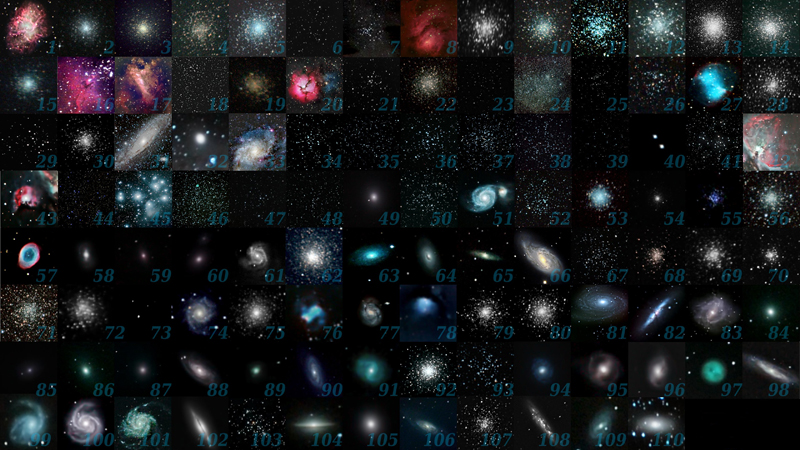
View larger. | What are Messier objects? Here are all 110 Messier objects with their respective M numbers. Image via Wikipedia (CC BY 4.0).
The complete list of 110 Messier objects is called the Messier Catalog. And they are classified in three broad categories, as either nebulae, star clusters or galaxies.
The Messier list starts with 103 deep-sky objects observed by the 18th century French astronomer Charles Messier. Seven more objects added in the 20th century bring the list up to 110 objects. Specifically, these deep-sky objects refer to astronomical bodies other than stars or planets. The Messier objects all appear as fuzzy, nebulous patches in the sky.
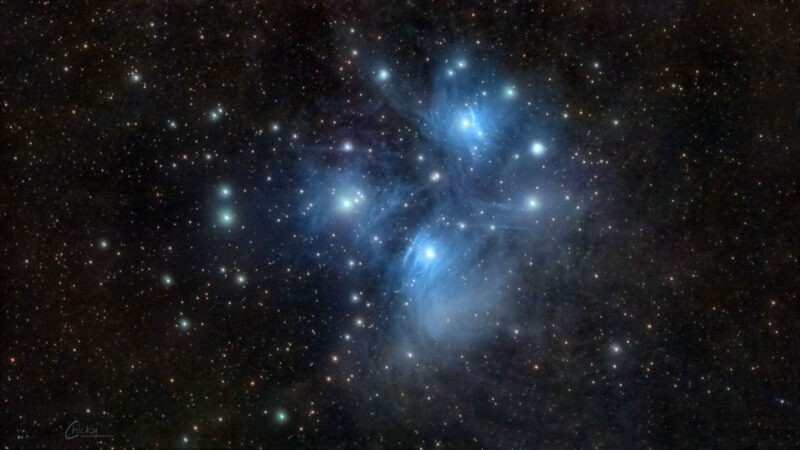
The names of Messier objects come from their number in the original catalog by Charles Messier. For example, the Pleiades star cluster is number 45, Messier 45 or simply M45. In addition to their numbers, many Messier objects have common names, such as the Pleiades, aka the 7 Sisters.
A small telescope can easily observe Messier objects. And a few are visible using only binoculars or even just the eye alone.
Since all the Messier objects are fairly bright, finding Messier objects is an ideal project for the beginning stargazer.
A Messier marathon: See all Messier objects
In addition, every year in March, all 110 Messier objects are visible during a single night. Stargazers around the world take advantage of this coincidence and plan a so-called Messier marathon. Basically, participants use telescopes or binoculars and attempt to see as many Messier objects as possible throughout 12 continuous hours of darkness. In order to see them all, observations must start at sunset and end at sunrise the following morning. Anyone observing 100 or more objects is happy with their results.
However, remember a few Messier objects are hard to catch because they are only visible very close to the horizon. For best results, use a Messier marathon search sequence list and hunt down the objects in order. First, right after sunset, find the galaxies M77 and M74. Last, just before dawn, catch the globular clusters M72 and M30 plus the asterism M73. The date for a Messier marathon is always on the new moon nearest the spring equinox. You can relax off and on during the night while waiting for the next batch of Messier objects to rise. Or enjoy other wonderful deep-sky objects keeping you busy all night.
A bit of history
Ironically, Charles Messier never intended to compile a list of deep-sky objects. Because Messier was a comet hunter, he began cataloging nebulous objects that are often mistaken for comets. In short, those nebulous objects also appear as visually diffuse bodies, just like a comet. Comets were important in the 18th century because astronomers were tracking their orbits. That data successfully validated Newton’s theory of universal gravitation. Messier is credited with discovering 13 comets. However, Messier is remembered more for his Messier catalog than for his comet discoveries.
Out of the 110 Messier objects, 41 are Messier’s observations. The first edition of the catalog came out in 1774, containing only 45 objects. Successive editions expanded the list, with another edition appearing in 1781 bringing the total to 103 objects. Astronomy writer Camille Flammarion – also a Frenchman – added object number 104 from Messier’s notes. Finally, some astronomers published a revised version in 1967, bringing the total up to 110 Messier objects.
Messier lived and worked in Paris, France, at a latitude of 49 degrees north. Hence, he only could observe the entire northern celestial hemisphere, and about half of the southern sky. Consequently, this explains why some notable southern objects, like the globular cluster Omega Centauri, are not on the list. Plus, the bright Eta Carinae nebula is not a Messier object. Also, the very obvious Perseus Double Cluster in the northern celestial hemisphere is not included on the list.
Messier 45, the Pleiades
View at EarthSky Community Photos. | Chicky Leclair in Helotes, Texas, completed this long exposure of the Pleiades star cluster on December 25, 2025. Chicky wrote: “This image is a mega-stack combining data capture across 11 sessions with a total of 4,623 images equating to nearly 50 hours of data. Thanks to a great community of software script developers and YouTube educators who freely share their tools and knowledge. I spent several hours learning how to use some of these new tools over the past 2 weeks and tried out my new process on this image. Definitely a keeper. Incredible results for a compact, smart telescope.” Thank you, Chicky!
Messier 31, the Andromeda galaxy
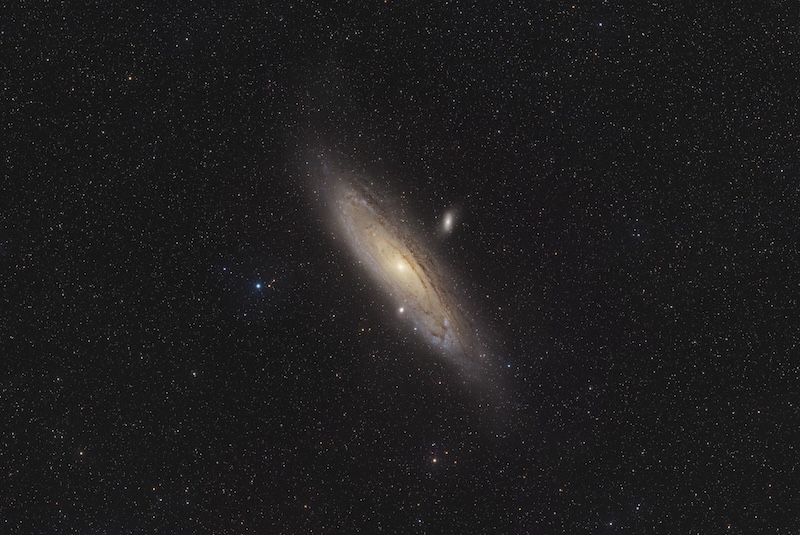
View at EarthSky Community Photos. | Ernest Jacobs captured this image of the Andromeda galaxy (M31) from New York on September 20, 2025, and wrote: “Hard to believe it has been just over 100 years since humanity established that the spiral nebulae they were observing were in fact other galaxies. Edwin Hubble provided the critical evidence observations of M31. This is a favorite target for visual observation as well as imaging.” Thank you, Ernest!
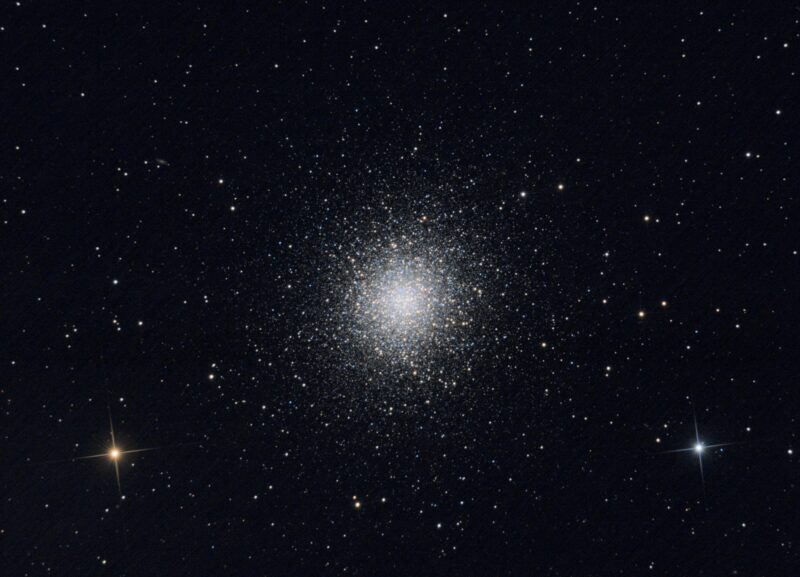
Messier 13, The great globular cluster in Hercules
A nice reference for stargazers with a telescope is a book titled Deep-Sky Companions: The Messier objects, now in its second edition. Written by the renowned amateur astronomer Stephen James O’Meara, this book includes over 100 drawings from pencil illustrating the true visual appearance of Messier objects, as viewed from Hawaii with a small refracting telescope.
View larger. | What are Messier objects? Here are all 110 Messier objects with their respective M numbers. Image via Wikipedia (CC BY 4.0).
The complete list of 110 Messier objects is called the Messier Catalog. And they are classified in three broad categories, as either nebulae, star clusters or galaxies.
The Messier list starts with 103 deep-sky objects observed by the 18th century French astronomer Charles Messier. Seven more objects added in the 20th century bring the list up to 110 objects. Specifically, these deep-sky objects refer to astronomical bodies other than stars or planets. The Messier objects all appear as fuzzy, nebulous patches in the sky.
The names of Messier objects come from their number in the original catalog by Charles Messier. For example, the Pleiades star cluster is number 45, Messier 45 or simply M45. In addition to their numbers, many Messier objects have common names, such as the Pleiades, aka the 7 Sisters.
A small telescope can easily observe Messier objects. And a few are visible using only binoculars or even just the eye alone.
Since all the Messier objects are fairly bright, finding Messier objects is an ideal project for the beginning stargazer.
A Messier marathon: See all Messier objects
In addition, every year in March, all 110 Messier objects are visible during a single night. Stargazers around the world take advantage of this coincidence and plan a so-called Messier marathon. Basically, participants use telescopes or binoculars and attempt to see as many Messier objects as possible throughout 12 continuous hours of darkness. In order to see them all, observations must start at sunset and end at sunrise the following morning. Anyone observing 100 or more objects is happy with their results.
However, remember a few Messier objects are hard to catch because they are only visible very close to the horizon. For best results, use a Messier marathon search sequence list and hunt down the objects in order. First, right after sunset, find the galaxies M77 and M74. Last, just before dawn, catch the globular clusters M72 and M30 plus the asterism M73. The date for a Messier marathon is always on the new moon nearest the spring equinox. You can relax off and on during the night while waiting for the next batch of Messier objects to rise. Or enjoy other wonderful deep-sky objects keeping you busy all night.
A bit of history
Ironically, Charles Messier never intended to compile a list of deep-sky objects. Because Messier was a comet hunter, he began cataloging nebulous objects that are often mistaken for comets. In short, those nebulous objects also appear as visually diffuse bodies, just like a comet. Comets were important in the 18th century because astronomers were tracking their orbits. That data successfully validated Newton’s theory of universal gravitation. Messier is credited with discovering 13 comets. However, Messier is remembered more for his Messier catalog than for his comet discoveries.
Out of the 110 Messier objects, 41 are Messier’s observations. The first edition of the catalog came out in 1774, containing only 45 objects. Successive editions expanded the list, with another edition appearing in 1781 bringing the total to 103 objects. Astronomy writer Camille Flammarion – also a Frenchman – added object number 104 from Messier’s notes. Finally, some astronomers published a revised version in 1967, bringing the total up to 110 Messier objects.
Messier lived and worked in Paris, France, at a latitude of 49 degrees north. Hence, he only could observe the entire northern celestial hemisphere, and about half of the southern sky. Consequently, this explains why some notable southern objects, like the globular cluster Omega Centauri, are not on the list. Plus, the bright Eta Carinae nebula is not a Messier object. Also, the very obvious Perseus Double Cluster in the northern celestial hemisphere is not included on the list.
Messier 45, the Pleiades
View at EarthSky Community Photos. | Chicky Leclair in Helotes, Texas, completed this long exposure of the Pleiades star cluster on December 25, 2025. Chicky wrote: “This image is a mega-stack combining data capture across 11 sessions with a total of 4,623 images equating to nearly 50 hours of data. Thanks to a great community of software script developers and YouTube educators who freely share their tools and knowledge. I spent several hours learning how to use some of these new tools over the past 2 weeks and tried out my new process on this image. Definitely a keeper. Incredible results for a compact, smart telescope.” Thank you, Chicky!
Messier 31, the Andromeda galaxy
View at EarthSky Community Photos. | Ernest Jacobs captured this image of the Andromeda galaxy (M31) from New York on September 20, 2025, and wrote: “Hard to believe it has been just over 100 years since humanity established that the spiral nebulae they were observing were in fact other galaxies. Edwin Hubble provided the critical evidence observations of M31. This is a favorite target for visual observation as well as imaging.” Thank you, Ernest!
Messier 13, The great globular cluster in Hercules
A nice reference for stargazers with a telescope is a book titled Deep-Sky Companions: The Messier objects, now in its second edition. Written by the renowned amateur astronomer Stephen James O’Meara, this book includes over 100 drawings from pencil illustrating the true visual appearance of Messier objects, as viewed from Hawaii with a small refracting telescope.
Heiligenschein – which means holy light in German – is a phenomenon that appears when you look down at your shadow and see a glowing light surrounding your head. This can happen when the ground is wet, such as when there is dew on the grass. But it can also happen when the ground is bone dry. It can even happen on other worlds!
The phenomenon of heiligenschein also goes by many other names, including shadow hiding, opposition surge and also the Seeliger effect.
The most common form of heiligenschein occurs when you look down at your shadow on a day when the grass is wet with dew. You might see a slight brightening around your head, like a halo reflected back up at you. So what’s happening? In this case, the sun is behind you, and bright sunlight is passing through those dew droplets and reflecting back the way it came, at the observer.
In the video below, notice the shadow of the videographer’s head and camera below the golfer. There’s a brightening around their head, giving them a subtle halo. This is an example of heiligenschein.
Dry heiligenschein
So how can you see a similar effect of a halo around your head when you’re looking at your shadow on dry ground? A more precise term for this is dry heiligenschein. In the book Weather by Storm Dunlop, he describes the effect as follows:
A similar effect occurs on dry grass, trees and other rough surfaces. Looking in the same direction as a ray of sunlight, a blade of grass (for example) hides its own shadow, but looking to the side, the shadows of other blades of grass (or leaves) begin to be visible. This hot spot may often be seen from an aircraft, apparently gliding over the surface of the fields and woods below.
What this means is that when there is a source of light directly behind you, like the sun, the ground in front of you is devoid of shadows. But just a bit farther away, objects start to have shadows again. So the spot straight out from your point of view without any shadows is brighter, creating a halo-like phenomenon.
If this sounds a bit like the phenomenon of a glory, that’s because they are created similarly. Glories are not just a bright spot but a rainbow-hued ring around the antisolar point.
I’ve seen both the dry heiligenschein and glories from airplanes. The first time I saw the dry heiligenschein, I was flying over Chicago and noticed how a sparkle would reflect back at my eye from cars and buildings and other objects below. This sparkling spot traveled along with me.
More images
You can see the Heiligenschein around the basket of the hot air balloon. Image via N. Thomas / Wikimedia Commons.The best explanation (as always) is from Les Cowley’s website Atmospheric Optics.
Halos on other worlds
But you can even see the heiligenschein phenomenon on other worlds! That’s because, of course, the physics of light works the same throughout our solar system.
Buzz Aldrin takes a photo of Neil Armstrong on the moon. In the image, we can see heiligenschein around the shadow of Buzz Aldrin’s head. Image via NASA/ Wikimedia Commons.
As seen above, astronauts on the moon took images in which the dry heiligenschein appeared. And the Japanese spacecraft Hayabusa2 captured a remarkable image of its own shadow on the asteroid Ryugu during its visit, along with heiligenschein. These are places in the solar system with no or nearly no moisture. But the source of light behind the observer and the dry, dusty soil still produces the halo effect.
The Japanese spacecraft Hayabusa2 saw its own shadow on the asteroid Ryugu during a visit on March 8, 2019. The glow around the spacecraft is thanks to the dry heiligenschein effect. Image via JAXA.
Bottom line: Have you ever looked down at your shadow and noticed it looks like you have a bright halo around your head? That’s heiligenschein.
Heiligenschein – which means holy light in German – is a phenomenon that appears when you look down at your shadow and see a glowing light surrounding your head. This can happen when the ground is wet, such as when there is dew on the grass. But it can also happen when the ground is bone dry. It can even happen on other worlds!
The phenomenon of heiligenschein also goes by many other names, including shadow hiding, opposition surge and also the Seeliger effect.
The most common form of heiligenschein occurs when you look down at your shadow on a day when the grass is wet with dew. You might see a slight brightening around your head, like a halo reflected back up at you. So what’s happening? In this case, the sun is behind you, and bright sunlight is passing through those dew droplets and reflecting back the way it came, at the observer.
In the video below, notice the shadow of the videographer’s head and camera below the golfer. There’s a brightening around their head, giving them a subtle halo. This is an example of heiligenschein.
Dry heiligenschein
So how can you see a similar effect of a halo around your head when you’re looking at your shadow on dry ground? A more precise term for this is dry heiligenschein. In the book Weather by Storm Dunlop, he describes the effect as follows:
A similar effect occurs on dry grass, trees and other rough surfaces. Looking in the same direction as a ray of sunlight, a blade of grass (for example) hides its own shadow, but looking to the side, the shadows of other blades of grass (or leaves) begin to be visible. This hot spot may often be seen from an aircraft, apparently gliding over the surface of the fields and woods below.
What this means is that when there is a source of light directly behind you, like the sun, the ground in front of you is devoid of shadows. But just a bit farther away, objects start to have shadows again. So the spot straight out from your point of view without any shadows is brighter, creating a halo-like phenomenon.
If this sounds a bit like the phenomenon of a glory, that’s because they are created similarly. Glories are not just a bright spot but a rainbow-hued ring around the antisolar point.
I’ve seen both the dry heiligenschein and glories from airplanes. The first time I saw the dry heiligenschein, I was flying over Chicago and noticed how a sparkle would reflect back at my eye from cars and buildings and other objects below. This sparkling spot traveled along with me.
More images
You can see the Heiligenschein around the basket of the hot air balloon. Image via N. Thomas / Wikimedia Commons.The best explanation (as always) is from Les Cowley’s website Atmospheric Optics.
Halos on other worlds
But you can even see the heiligenschein phenomenon on other worlds! That’s because, of course, the physics of light works the same throughout our solar system.
Buzz Aldrin takes a photo of Neil Armstrong on the moon. In the image, we can see heiligenschein around the shadow of Buzz Aldrin’s head. Image via NASA/ Wikimedia Commons.
As seen above, astronauts on the moon took images in which the dry heiligenschein appeared. And the Japanese spacecraft Hayabusa2 captured a remarkable image of its own shadow on the asteroid Ryugu during its visit, along with heiligenschein. These are places in the solar system with no or nearly no moisture. But the source of light behind the observer and the dry, dusty soil still produces the halo effect.
The Japanese spacecraft Hayabusa2 saw its own shadow on the asteroid Ryugu during a visit on March 8, 2019. The glow around the spacecraft is thanks to the dry heiligenschein effect. Image via JAXA.
Bottom line: Have you ever looked down at your shadow and noticed it looks like you have a bright halo around your head? That’s heiligenschein.