aads

Feel awe over these national park timelapse videos


This is Giants of Yosemite, by Gavin Heffernan. Heffernan has shared 4 timelapse videos from U.S. national parks with EarthSky. They’re a part of his PARKLIGHT project, meant to inspire people to protect our parklands. See the other national park timelapse videos below.

Science news, night sky events and beautiful photos, all in one place. Click here to subscribe to EarthSky’s free daily newsletter.

Awe-inspiring national park timelapse videos

Watch Taurus the Bull rise above Half Dome in Yosemite. Gaze at the red-rock monoliths of Zion as day turns to night. See the Blood Moon eclipse over Joshua Tree. And witness a curious fox at Channel Islands. These national park timelapse videos celebrate the beauty of the U.S. national park system.

Gavin Heffernan is a dark-sky advocate who shot these timelapse videos. His new series PARKLIGHT focuses on the U.S. national parks. Heffernan hopes his videos will inspire people to support the parks.

Starstorm Zion

Heffernan told EarthSky:

The fun part about PARKLIGHT is that each park is a unique experience with its own character and personality. There are commonalities, but every shoot is a totally different adventure, which is a big part of the magic of the national parks. Every visitor’s experience is a unique journey they get to have in their own way. But I try my best to capture the essence of each place and how it made me feel while I was there: the suspense of a beautiful sunset leading into a mysterious night, the intensity of a violent thunderstorm over Zion, the peace and quiet of a serene stream, the howl of coyotes echoing across the canyons at Joshua Tree.

I’m hoping that sharing these experiences helps other people get excited about the parks and inspires them to plan their own visit or find ways to help out. But, truthfully, I also make them as postcards to myself, so I can look back years later and remember not just what these parks looked like, but more importantly, what the experience felt like.


This is Starstorm Zion, by Gavin Heffernan. In this timelapse, you’ll see day turn to night in Utah’s Zion National Park. Watch as the Pleiades star cluster appears above the red cliffs and the Milky Way arcs across the sky as planes zip by. A brief thunderstorm clouds out the stars with lightning flashes before the serene stars appear again.

Eclipse Joshua Tree

Heffernan described to EarthSky how the parks connect him with the night sky:

The beauty of long-exposure night sky photography is that it allows you to see more than you would with your unaided eye. So it enhances that magical, surreal feeling that I always get in these locations and really helps amplify how special they are. The parks aren’t just nature refuges, they’re gateways to the universe and the stars we’ve lost. The parks are portals to unlocking your imagination and getting more perspective on life … and what a miracle it is we’re even here in the first place.

With the rapid advance of urban light pollution across the continent and the world, the parks have never been more important than they are now. They’ve become true sanctuaries of the stars. So, because of that, the night sky is often a central piece of these shorts.


This is Eclipse Joshua Tree, by Gavin Heffernan. The pastels colors of a desert sunset lead into a lunar eclipse. The reddened moon floats behind spiky Joshua trees, then brightens once more as star trails imitate falling meteors.

Channel Light

Heffernan also captures his landscapes under the beauty of sunlight. The last video showcases a day at Channel Islands National Park off the coast of California.


This is Channel Light, by Gavin Heffernan. See the sunny beauty of Channel Islands National Park as waves lap against the shore. Hikers take in an observation point and a Santa Cruz Island fox chews at scraps. The wind ruffles grasses and branches in this peaceful landscape.

National park timelapse videos meant to inspire

Spending a lot of time in the national parks has also given Heffernan an appreciation for the rangers and park service. His appreciation of both the park and park workers runs deep. Heffernan told EarthSky:

Like a lot of things in life, some of the most important stuff is the easiest to take for granted. I think the national parks are a good example of this. Because of the timeless nature of these locations, they often seem invulnerable, or that they will take care of themselves somehow. Nature does do a lot of the work, but a few hours at any park makes it clear how crucial the NPS staff are to protect and preserve these locations, especially the most popular parks that receive such a heavy human footprint.

It’s a mutually beneficial symbiotic collaboration between humans and nature that really is beautiful to see. But it doesn’t happen without support. The inspiration for starting this project was the government shutdown that was putting an extreme strain on park workers and therefore the parks themselves. Even though that situation has somewhat resolved, the parks are still woefully underfunded and need constant attention and care. We can’t take them for granted, especially as the rest of the world gets covered in concrete and the skies are blown out with lights, pollution and endless satellites littering the night.

A man with sunglasses sits at the edge of the Grand Canyon with cameras on tripods behind him.
Gavin Heffernan is the creator behind the PARKLIGHT series. Image via Gavin Heffernan.

Bottom line: Enjoy four national park timelapse videos from Gavin Heffernan. The views include both starscapes and landscapes of Yosemite, Zion, Joshua Tree and Channel Islands.

Via Gavin Heffernan

Read more: Moonlight Mojave: The desert under starry skies

Read more: See the best Milky Way photos of 2025 here

The post Feel awe over these national park timelapse videos first appeared on EarthSky.


from EarthSky https://ift.tt/mCTg94D


This is Giants of Yosemite, by Gavin Heffernan. Heffernan has shared 4 timelapse videos from U.S. national parks with EarthSky. They’re a part of his PARKLIGHT project, meant to inspire people to protect our parklands. See the other national park timelapse videos below.

Science news, night sky events and beautiful photos, all in one place. Click here to subscribe to EarthSky’s free daily newsletter.

Awe-inspiring national park timelapse videos

Watch Taurus the Bull rise above Half Dome in Yosemite. Gaze at the red-rock monoliths of Zion as day turns to night. See the Blood Moon eclipse over Joshua Tree. And witness a curious fox at Channel Islands. These national park timelapse videos celebrate the beauty of the U.S. national park system.

Gavin Heffernan is a dark-sky advocate who shot these timelapse videos. His new series PARKLIGHT focuses on the U.S. national parks. Heffernan hopes his videos will inspire people to support the parks.

Starstorm Zion

Heffernan told EarthSky:

The fun part about PARKLIGHT is that each park is a unique experience with its own character and personality. There are commonalities, but every shoot is a totally different adventure, which is a big part of the magic of the national parks. Every visitor’s experience is a unique journey they get to have in their own way. But I try my best to capture the essence of each place and how it made me feel while I was there: the suspense of a beautiful sunset leading into a mysterious night, the intensity of a violent thunderstorm over Zion, the peace and quiet of a serene stream, the howl of coyotes echoing across the canyons at Joshua Tree.

I’m hoping that sharing these experiences helps other people get excited about the parks and inspires them to plan their own visit or find ways to help out. But, truthfully, I also make them as postcards to myself, so I can look back years later and remember not just what these parks looked like, but more importantly, what the experience felt like.


This is Starstorm Zion, by Gavin Heffernan. In this timelapse, you’ll see day turn to night in Utah’s Zion National Park. Watch as the Pleiades star cluster appears above the red cliffs and the Milky Way arcs across the sky as planes zip by. A brief thunderstorm clouds out the stars with lightning flashes before the serene stars appear again.

Eclipse Joshua Tree

Heffernan described to EarthSky how the parks connect him with the night sky:

The beauty of long-exposure night sky photography is that it allows you to see more than you would with your unaided eye. So it enhances that magical, surreal feeling that I always get in these locations and really helps amplify how special they are. The parks aren’t just nature refuges, they’re gateways to the universe and the stars we’ve lost. The parks are portals to unlocking your imagination and getting more perspective on life … and what a miracle it is we’re even here in the first place.

With the rapid advance of urban light pollution across the continent and the world, the parks have never been more important than they are now. They’ve become true sanctuaries of the stars. So, because of that, the night sky is often a central piece of these shorts.


This is Eclipse Joshua Tree, by Gavin Heffernan. The pastels colors of a desert sunset lead into a lunar eclipse. The reddened moon floats behind spiky Joshua trees, then brightens once more as star trails imitate falling meteors.

Channel Light

Heffernan also captures his landscapes under the beauty of sunlight. The last video showcases a day at Channel Islands National Park off the coast of California.


This is Channel Light, by Gavin Heffernan. See the sunny beauty of Channel Islands National Park as waves lap against the shore. Hikers take in an observation point and a Santa Cruz Island fox chews at scraps. The wind ruffles grasses and branches in this peaceful landscape.

National park timelapse videos meant to inspire

Spending a lot of time in the national parks has also given Heffernan an appreciation for the rangers and park service. His appreciation of both the park and park workers runs deep. Heffernan told EarthSky:

Like a lot of things in life, some of the most important stuff is the easiest to take for granted. I think the national parks are a good example of this. Because of the timeless nature of these locations, they often seem invulnerable, or that they will take care of themselves somehow. Nature does do a lot of the work, but a few hours at any park makes it clear how crucial the NPS staff are to protect and preserve these locations, especially the most popular parks that receive such a heavy human footprint.

It’s a mutually beneficial symbiotic collaboration between humans and nature that really is beautiful to see. But it doesn’t happen without support. The inspiration for starting this project was the government shutdown that was putting an extreme strain on park workers and therefore the parks themselves. Even though that situation has somewhat resolved, the parks are still woefully underfunded and need constant attention and care. We can’t take them for granted, especially as the rest of the world gets covered in concrete and the skies are blown out with lights, pollution and endless satellites littering the night.

A man with sunglasses sits at the edge of the Grand Canyon with cameras on tripods behind him.
Gavin Heffernan is the creator behind the PARKLIGHT series. Image via Gavin Heffernan.

Bottom line: Enjoy four national park timelapse videos from Gavin Heffernan. The views include both starscapes and landscapes of Yosemite, Zion, Joshua Tree and Channel Islands.

Via Gavin Heffernan

Read more: Moonlight Mojave: The desert under starry skies

Read more: See the best Milky Way photos of 2025 here

The post Feel awe over these national park timelapse videos first appeared on EarthSky.


from EarthSky https://ift.tt/mCTg94D
The Big and Little Dipper: How to find them in the spring

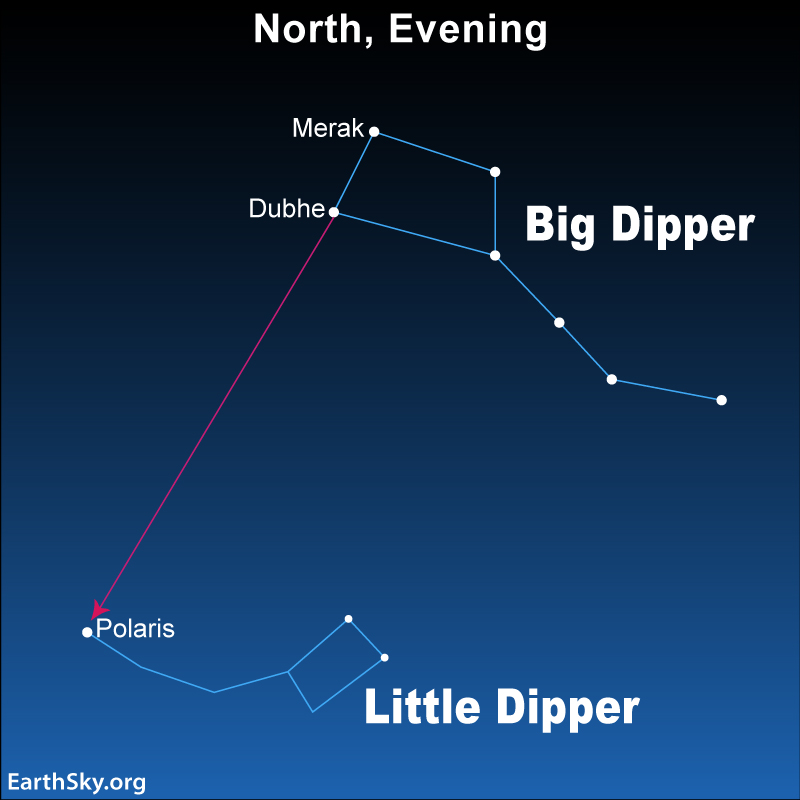
Star chart: The Big and Little Dipper with arrow showing how 2 stars from the Big Dipper point to Polaris.
Look for the Big and Little Dipper high in the northern sky on spring evenings. This view is for the Northern Hemisphere. The 2 outer stars in the bowl of the Dipper point to Polaris, the North Star. Polaris marks the end of the handle of the Little Dipper. Chart via EarthSky.

The Big and Little Dipper

The Big Dipper is one of the easiest star patterns to locate in Earth’s sky. It’s visible just about every clear night in the Northern Hemisphere, looking like a big dot-to-dot of a kitchen ladle. As Earth spins, the Big Dipper and its sky neighbor, the Little Dipper, rotate around the North Star, also known as Polaris.

From the northern part of the Northern Hemisphere, the Big and Little Dippers are in the sky continuously. In fact, they are always above your horizon, circling endlessly around Polaris. So given an unobstructed horizon, latitudes north of the 35th parallel (the approximate location of the Mediterranean Sea, Tennessee’s southern border and Kyoto, Japan) can expect to see the Big Dipper at any hour of the night every day of the year.

As for the Little Dipper, it’s circumpolar – always above the horizon – as far south as the Tropic of Cancer (23.5 degrees north latitude).

If you can spot the Big Dipper, then you’re on your way to finding the Little Dipper and the North Star, Polaris, too.

The Big Dipper rotates around Polaris every night and changes by season

Just remember the old saying: spring up and fall down. So on spring and summer evenings in the Northern Hemisphere, the Big Dipper shines at its highest in the evening sky. Then, on autumn and winter evenings, the Big Dipper sweeps closer to the horizon.

Animation of the Big Dipper at 4 locations around Polaris in a starry sky.
This animation shows the Big Dipper by seasons from mid-northern latitudes. The Big Dipper is shown at the same time – mid-evening – on the days of the solstices and equinoxes. Charts via Stellarium. Animation by EarthSky. Used with permission.

Here’s how to find Polaris and the Little Dipper

Notice that the Big Dipper has two parts, a bowl and a handle. Next, look for the two outer stars in the bowl of the Big Dipper. They are called Dubhe and Merak, and they’re known as The Pointers. An imaginary line drawn between them points to Polaris, the North Star. Polaris marks the end of the Little Dipper’s Handle. So, once you have Polaris, you can find the Little Dipper, too … if your sky is dark enough.

So why isn’t the Little Dipper as easy to pick out as the Big Dipper? That’s because the stars between Polaris and the outer bowl stars – Kochab and Pherkad – are rather dim. As a matter of fact, you’ll need a dark country sky to see all seven of the Little Dipper’s stars.

The Big and Little Dippers are not constellations

Also, the Big Dipper isn’t a constellation. It’s an asterism, or noticeable pattern of stars. The Big Dipper is a clipped version of the constellation Ursa Major the Greater Bear. And the stars of the Big Dipper outline the Bear’s tail and hindquarters.

The Little Dipper is also an asterism. These stars belong to the constellation Ursa Minor the Little Bear.

The Big Dipper will change over time

Astronomers sometimes speak of the fixed stars, but the stars aren’t truly fixed. Stars move in space. Thus the star patterns that we see today as the Big and Little Dippers will, slowly but surely, drift apart over time.

But even 25,000 years from now, the Big Dipper pattern will look nearly the same as it does today. Astronomers have found that the stars of the Big Dipper (excepting the pointer star, Dubhe, and the handle star, Alkaid) belong to an association of stars known as the Ursa Major Moving Cluster. These stars, loosely bound by gravity, drift in the same direction in space.

In 100,000 years, this pattern of Big Dipper stars (minus Dubhe and Alkaid) will appear much as it does today! But there will be some differences, as illustrated in the video below:

Star lore behind the Big and Little Dipper

In the star lore of the Mi’kmaq nation in northern Canada, the Big Dipper is also associated with a bear, but with a twist. The Mi’kmaq see the bowl of the Big Dipper as a Celestial Bear, and the three stars of the handle as hunters chasing the Bear. In the Mi’kmaq tale of the Celestial Bear, in autumn the hunters finally catch up with the Bear, and it’s said that the blood from the Bear colors the autumn landscape

In another version of the story, the Celestial Bear hits its nose when coming down to Earth, with its bloody nose giving color to autumn leaves. When the Celestial Bear is seen right on the northern horizon on late fall and early winter evenings, it’s a sure sign that the hibernation season is upon us.

In ancient times, the Little Dipper formed the wings of the constellation Draco the Dragon. But when the seafaring Phoenicians met with the Greek astronomer Thales around 600 BCE, they showed him how to use the Little Dipper stars to navigate. Thereby, Thales clipped Draco’s wings, to create a constellation that gave Greek sailors a new way to steer by the stars.

In Thales’ day, the stars Kochab and Pherkad (rather than Polaris) marked the approximate direction of the north celestial pole. That’s the point in the sky that is directly above the Earth’s North Pole.

To this day, Kochab and Pherkad are still known as the Guardians of the Pole.

Bottom line: You can find the Big Dipper and Little Dipper in the northern sky at any time of year. On spring evenings, the Big Dipper is high in the sky. The North Star, Polaris, is located at the end of the Little Dipper’s handle.

The post The Big and Little Dipper: How to find them in the spring first appeared on EarthSky.


from EarthSky https://ift.tt/GKTZOFh
Star chart: The Big and Little Dipper with arrow showing how 2 stars from the Big Dipper point to Polaris.
Look for the Big and Little Dipper high in the northern sky on spring evenings. This view is for the Northern Hemisphere. The 2 outer stars in the bowl of the Dipper point to Polaris, the North Star. Polaris marks the end of the handle of the Little Dipper. Chart via EarthSky.

The Big and Little Dipper

The Big Dipper is one of the easiest star patterns to locate in Earth’s sky. It’s visible just about every clear night in the Northern Hemisphere, looking like a big dot-to-dot of a kitchen ladle. As Earth spins, the Big Dipper and its sky neighbor, the Little Dipper, rotate around the North Star, also known as Polaris.

From the northern part of the Northern Hemisphere, the Big and Little Dippers are in the sky continuously. In fact, they are always above your horizon, circling endlessly around Polaris. So given an unobstructed horizon, latitudes north of the 35th parallel (the approximate location of the Mediterranean Sea, Tennessee’s southern border and Kyoto, Japan) can expect to see the Big Dipper at any hour of the night every day of the year.

As for the Little Dipper, it’s circumpolar – always above the horizon – as far south as the Tropic of Cancer (23.5 degrees north latitude).

If you can spot the Big Dipper, then you’re on your way to finding the Little Dipper and the North Star, Polaris, too.

The Big Dipper rotates around Polaris every night and changes by season

Just remember the old saying: spring up and fall down. So on spring and summer evenings in the Northern Hemisphere, the Big Dipper shines at its highest in the evening sky. Then, on autumn and winter evenings, the Big Dipper sweeps closer to the horizon.

Animation of the Big Dipper at 4 locations around Polaris in a starry sky.
This animation shows the Big Dipper by seasons from mid-northern latitudes. The Big Dipper is shown at the same time – mid-evening – on the days of the solstices and equinoxes. Charts via Stellarium. Animation by EarthSky. Used with permission.

Here’s how to find Polaris and the Little Dipper

Notice that the Big Dipper has two parts, a bowl and a handle. Next, look for the two outer stars in the bowl of the Big Dipper. They are called Dubhe and Merak, and they’re known as The Pointers. An imaginary line drawn between them points to Polaris, the North Star. Polaris marks the end of the Little Dipper’s Handle. So, once you have Polaris, you can find the Little Dipper, too … if your sky is dark enough.

So why isn’t the Little Dipper as easy to pick out as the Big Dipper? That’s because the stars between Polaris and the outer bowl stars – Kochab and Pherkad – are rather dim. As a matter of fact, you’ll need a dark country sky to see all seven of the Little Dipper’s stars.

The Big and Little Dippers are not constellations

Also, the Big Dipper isn’t a constellation. It’s an asterism, or noticeable pattern of stars. The Big Dipper is a clipped version of the constellation Ursa Major the Greater Bear. And the stars of the Big Dipper outline the Bear’s tail and hindquarters.

The Little Dipper is also an asterism. These stars belong to the constellation Ursa Minor the Little Bear.

The Big Dipper will change over time

Astronomers sometimes speak of the fixed stars, but the stars aren’t truly fixed. Stars move in space. Thus the star patterns that we see today as the Big and Little Dippers will, slowly but surely, drift apart over time.

But even 25,000 years from now, the Big Dipper pattern will look nearly the same as it does today. Astronomers have found that the stars of the Big Dipper (excepting the pointer star, Dubhe, and the handle star, Alkaid) belong to an association of stars known as the Ursa Major Moving Cluster. These stars, loosely bound by gravity, drift in the same direction in space.

In 100,000 years, this pattern of Big Dipper stars (minus Dubhe and Alkaid) will appear much as it does today! But there will be some differences, as illustrated in the video below:

Star lore behind the Big and Little Dipper

In the star lore of the Mi’kmaq nation in northern Canada, the Big Dipper is also associated with a bear, but with a twist. The Mi’kmaq see the bowl of the Big Dipper as a Celestial Bear, and the three stars of the handle as hunters chasing the Bear. In the Mi’kmaq tale of the Celestial Bear, in autumn the hunters finally catch up with the Bear, and it’s said that the blood from the Bear colors the autumn landscape

In another version of the story, the Celestial Bear hits its nose when coming down to Earth, with its bloody nose giving color to autumn leaves. When the Celestial Bear is seen right on the northern horizon on late fall and early winter evenings, it’s a sure sign that the hibernation season is upon us.

In ancient times, the Little Dipper formed the wings of the constellation Draco the Dragon. But when the seafaring Phoenicians met with the Greek astronomer Thales around 600 BCE, they showed him how to use the Little Dipper stars to navigate. Thereby, Thales clipped Draco’s wings, to create a constellation that gave Greek sailors a new way to steer by the stars.

In Thales’ day, the stars Kochab and Pherkad (rather than Polaris) marked the approximate direction of the north celestial pole. That’s the point in the sky that is directly above the Earth’s North Pole.

To this day, Kochab and Pherkad are still known as the Guardians of the Pole.

Bottom line: You can find the Big Dipper and Little Dipper in the northern sky at any time of year. On spring evenings, the Big Dipper is high in the sky. The North Star, Polaris, is located at the end of the Little Dipper’s handle.

The post The Big and Little Dipper: How to find them in the spring first appeared on EarthSky.


from EarthSky https://ift.tt/GKTZOFh

Can animals sense earthquakes? Science investigates

A lanky red hound dog with its head tilted like as if it is listening.
Can animals sense earthquakes? For years there have been reports of animals acting differently leading up to earthquakes. Science investigates. Image via vizslafotozas/ Pixabay.
  • Some animals show unusual behavior before earthquakes. Are they sensing subtle signals such as vibrations, gas releases or electrical changes?
  • Scientific evidence is inconsistent, and no behavior pattern reliably predicts when or where a quake will strike.
  • Researchers continue studying animal behavior. In the meantime, modern detection continues to rely on instruments.

By Rachel Grant, London South Bank University

You deserve a daily dose of good news. For the latest in science and the night sky, click here to subscribe to our free daily newsletter.

Can animals sense earthquakes?

For centuries, people around the world have reported unusual animal behavior before earthquakes. Observations included livestock becoming restless, wildlife disappearing and snakes emerging from hibernation in the middle of winter. For a long time, scientists dismissed such observations as folklore.

In recent years, however, systematic research has begun to explore whether animals genuinely respond to environmental changes preceding major earthquakes. Although earthquakes are hard to predict even for humans, several studies suggest intriguing patterns in animal behavior before seismic events.

As the world population increases, more people will be affected when earthquakes happen, making this research more important than ever.

Observations of when animals sense earthquakes

My own research journey began with a serendipitous observation in Italy. I was studying the effects of moon phases on toad reproduction at San Ruffino Lake in 2009, when the toads disappeared for five days. They returned only after a magnitude 6.3 earthquake struck the city of L’Aquila, about 50 miles (80 km) away.

This observation formed the basis of my 2010 study. My study showed that 96% of common toads abandoned their breeding site five days before the 2009 L’Aquila earthquake. It was one of the first studies to quantify a shift in wild amphibian behavior before seismic activity. Amphibians’ permeable skin makes them especially sensitive to changes in water chemistry. And that could make their behavior a potential early warning of seismic activity.

Animal activity before an earthquake

I also conducted a multi-species study of Yanachaga National Park, Peru, before a major earthquake in 2011. A charity called Wildlife Insights (formerly Team Network) places cameras in many locations in national parks for conservation monitoring. I looked for parks where a large earthquake had occurred. Then I analyzed the charity’s photographs for Yanachaga National Park.

The motion-activated cameras recorded a sharp decline in animal activity in the weeks leading up to the quake. Daily counts fell from typical values of around five to 15 separate animal records per day to fewer than five. This was across all seven orders of vertebrates in the forest. In the final 24 hours before the quake, animal movements completely ceased.

I compared records from around the time of the earthquake to seismically quiet periods in the same season. I found that during less seismically active times, animal numbers stayed constant.

In Peru, the steep decline in activity was pronounced not only in small- and medium-sized rodents such as pacas and capybaras. But activity also declined in bigger animals like long-nosed armadillos. This “silencing” of the forest suggests that earthquake-related cues affect entire animal communities rather than just one species.

It’s not just wildlife

Research has shown that livestock around the world, particularly cows, also show signs of pre-seismic behavioral and physiological change.

There are numerous reports of cows panicking and wandering around in areas where they would not normally be seen. For example, there are stories that cows converged on San Francisco’s Chinatown in 1906 prior to a large earthquake that killed 3,000 people. In 2012, a blog post circulated on the internet showing photographs of cows entering a suburb of Malaysia’s capital city, Kuala Lumpur, and feeding in gardens, two days prior to a magnitude 8.6 earthquake off the coast of Sumatra.

Several Japanese studies have monitored dairy cows using automated milking and activity systems. These studies have reported modest but statistically significant reductions in milk yield and changes in rumination or restlessness in the days preceding some local earthquakes.

Animals sense earthquakes: 3 cows with cream-colored coats look at the camera while standing in a misty field.
Cows’ behavior changes before an earthquake. Image via JanTemmel/ Pixabay.

Your pets may react, too

Pets seem to be affected too. In 2011, a massive magnitude 9.1 earthquake struck off the northeast coast of Honshu in Japan. It generated a tsunami that disabled three nuclear reactors. Post-earthquake questionnaires surveyed 1,259 dog owners and 703 cat owners about their pets’ behavior before the earthquake. About 19% of dog owners and 16% of cat owners reported unusual behavior. Restiveness was a dominant behavior in both species, usually within one day prior to the quake.

It’s important to note though, that post-event recollections are not considered as scientifically robust as data collected in real time.

A gray-striped tabby cat looking pensive by a chain link fence.
It seems that pets might react differently before an earthquake, too. Image via miezekieze/ Pixabay.

What might animals be sensing?

The key question is not whether animals behave differently, but why.

One leading hypothesis, proposed by Friedemann Freund (a scientist for NASA), focuses on environmental changes. These changes are caused by stress building up in rocks as tectonic plates shift, prior to large earthquakes, releasing electrically charged particles.

These particles can alter the properties of air and soil in the area by increasing the number of positive airborne ions (electrically charged molecules). And they appear to affect stress levels and behavior in animals (including humans). More research is needed. But the phenomenon may help explain the changes in animal behavior before the Italian and Peruvian earthquakes.

However, there are many other cues that could contribute to unusual animal behavior before earthquakes. Some examples are vibrations, disturbances to the local electromagnetic field or sounds outside of human hearing range. We still don’t know exactly which signals, or combination of cues, explain the behavior.

Despite growing evidence that animals can sense environmental changes preceding earthquakes, the scientific community remains cautious. Several studies have found unusual animal behavior before earthquakes could later be explained by normal seasonal activity.

Then there’s the fact that earthquakes are rare, which makes the phenomenon difficult to study. I believe animals simply move away from unpleasant or unusual environmental changes, rather than “predicting” earthquakes.

Of ants and earthquakes

There are ongoing studies that may help us learn more about animal behavior and earthquakes. A systematic trial called Animal Alerts is underway in Lima, Peru, an area with a high level of seismic activity. Researchers have fitted dogs with smart collars that record their heart rate, movement and other parameters in real time.

A 2013 study carried out long-term observations of red wood ant mounds on active faults (cracks in the Earth’s crust that have recently moved and may cause earthquakes). The researchers reported alterations in daily activity rhythms of the ants living on these fault lines. Building on this work, my postgraduate research student, Shanza, is studying earthquake precursors for her master’s degree. She aims to identify which animal species are most likely to respond to early earthquake signals such as positive ions or magnetic field fluctuations. She then plans to simulate some of these conditions in the lab, using ants as a model species.

Animal data alone are unlikely to give reliable earthquake warnings. But the more we can combine animal data with environmental measurements, the closer we will come to reliable forecasts of earthquake hazard risk.

Rachel Grant, Senior Lecturer in Bioscience, London South Bank University

This article is republished from The Conversation under a Creative Commons license. Read the original article.

Bottom line: For years there have been reports that animals sense earthquakes as they change their behavior before the ground rocks. Science takes a look at this behavior.

The Conversation

The post Can animals sense earthquakes? Science investigates first appeared on EarthSky.


from EarthSky https://ift.tt/1m6NGxv
A lanky red hound dog with its head tilted like as if it is listening.
Can animals sense earthquakes? For years there have been reports of animals acting differently leading up to earthquakes. Science investigates. Image via vizslafotozas/ Pixabay.
  • Some animals show unusual behavior before earthquakes. Are they sensing subtle signals such as vibrations, gas releases or electrical changes?
  • Scientific evidence is inconsistent, and no behavior pattern reliably predicts when or where a quake will strike.
  • Researchers continue studying animal behavior. In the meantime, modern detection continues to rely on instruments.

By Rachel Grant, London South Bank University

You deserve a daily dose of good news. For the latest in science and the night sky, click here to subscribe to our free daily newsletter.

Can animals sense earthquakes?

For centuries, people around the world have reported unusual animal behavior before earthquakes. Observations included livestock becoming restless, wildlife disappearing and snakes emerging from hibernation in the middle of winter. For a long time, scientists dismissed such observations as folklore.

In recent years, however, systematic research has begun to explore whether animals genuinely respond to environmental changes preceding major earthquakes. Although earthquakes are hard to predict even for humans, several studies suggest intriguing patterns in animal behavior before seismic events.

As the world population increases, more people will be affected when earthquakes happen, making this research more important than ever.

Observations of when animals sense earthquakes

My own research journey began with a serendipitous observation in Italy. I was studying the effects of moon phases on toad reproduction at San Ruffino Lake in 2009, when the toads disappeared for five days. They returned only after a magnitude 6.3 earthquake struck the city of L’Aquila, about 50 miles (80 km) away.

This observation formed the basis of my 2010 study. My study showed that 96% of common toads abandoned their breeding site five days before the 2009 L’Aquila earthquake. It was one of the first studies to quantify a shift in wild amphibian behavior before seismic activity. Amphibians’ permeable skin makes them especially sensitive to changes in water chemistry. And that could make their behavior a potential early warning of seismic activity.

Animal activity before an earthquake

I also conducted a multi-species study of Yanachaga National Park, Peru, before a major earthquake in 2011. A charity called Wildlife Insights (formerly Team Network) places cameras in many locations in national parks for conservation monitoring. I looked for parks where a large earthquake had occurred. Then I analyzed the charity’s photographs for Yanachaga National Park.

The motion-activated cameras recorded a sharp decline in animal activity in the weeks leading up to the quake. Daily counts fell from typical values of around five to 15 separate animal records per day to fewer than five. This was across all seven orders of vertebrates in the forest. In the final 24 hours before the quake, animal movements completely ceased.

I compared records from around the time of the earthquake to seismically quiet periods in the same season. I found that during less seismically active times, animal numbers stayed constant.

In Peru, the steep decline in activity was pronounced not only in small- and medium-sized rodents such as pacas and capybaras. But activity also declined in bigger animals like long-nosed armadillos. This “silencing” of the forest suggests that earthquake-related cues affect entire animal communities rather than just one species.

It’s not just wildlife

Research has shown that livestock around the world, particularly cows, also show signs of pre-seismic behavioral and physiological change.

There are numerous reports of cows panicking and wandering around in areas where they would not normally be seen. For example, there are stories that cows converged on San Francisco’s Chinatown in 1906 prior to a large earthquake that killed 3,000 people. In 2012, a blog post circulated on the internet showing photographs of cows entering a suburb of Malaysia’s capital city, Kuala Lumpur, and feeding in gardens, two days prior to a magnitude 8.6 earthquake off the coast of Sumatra.

Several Japanese studies have monitored dairy cows using automated milking and activity systems. These studies have reported modest but statistically significant reductions in milk yield and changes in rumination or restlessness in the days preceding some local earthquakes.

Animals sense earthquakes: 3 cows with cream-colored coats look at the camera while standing in a misty field.
Cows’ behavior changes before an earthquake. Image via JanTemmel/ Pixabay.

Your pets may react, too

Pets seem to be affected too. In 2011, a massive magnitude 9.1 earthquake struck off the northeast coast of Honshu in Japan. It generated a tsunami that disabled three nuclear reactors. Post-earthquake questionnaires surveyed 1,259 dog owners and 703 cat owners about their pets’ behavior before the earthquake. About 19% of dog owners and 16% of cat owners reported unusual behavior. Restiveness was a dominant behavior in both species, usually within one day prior to the quake.

It’s important to note though, that post-event recollections are not considered as scientifically robust as data collected in real time.

A gray-striped tabby cat looking pensive by a chain link fence.
It seems that pets might react differently before an earthquake, too. Image via miezekieze/ Pixabay.

What might animals be sensing?

The key question is not whether animals behave differently, but why.

One leading hypothesis, proposed by Friedemann Freund (a scientist for NASA), focuses on environmental changes. These changes are caused by stress building up in rocks as tectonic plates shift, prior to large earthquakes, releasing electrically charged particles.

These particles can alter the properties of air and soil in the area by increasing the number of positive airborne ions (electrically charged molecules). And they appear to affect stress levels and behavior in animals (including humans). More research is needed. But the phenomenon may help explain the changes in animal behavior before the Italian and Peruvian earthquakes.

However, there are many other cues that could contribute to unusual animal behavior before earthquakes. Some examples are vibrations, disturbances to the local electromagnetic field or sounds outside of human hearing range. We still don’t know exactly which signals, or combination of cues, explain the behavior.

Despite growing evidence that animals can sense environmental changes preceding earthquakes, the scientific community remains cautious. Several studies have found unusual animal behavior before earthquakes could later be explained by normal seasonal activity.

Then there’s the fact that earthquakes are rare, which makes the phenomenon difficult to study. I believe animals simply move away from unpleasant or unusual environmental changes, rather than “predicting” earthquakes.

Of ants and earthquakes

There are ongoing studies that may help us learn more about animal behavior and earthquakes. A systematic trial called Animal Alerts is underway in Lima, Peru, an area with a high level of seismic activity. Researchers have fitted dogs with smart collars that record their heart rate, movement and other parameters in real time.

A 2013 study carried out long-term observations of red wood ant mounds on active faults (cracks in the Earth’s crust that have recently moved and may cause earthquakes). The researchers reported alterations in daily activity rhythms of the ants living on these fault lines. Building on this work, my postgraduate research student, Shanza, is studying earthquake precursors for her master’s degree. She aims to identify which animal species are most likely to respond to early earthquake signals such as positive ions or magnetic field fluctuations. She then plans to simulate some of these conditions in the lab, using ants as a model species.

Animal data alone are unlikely to give reliable earthquake warnings. But the more we can combine animal data with environmental measurements, the closer we will come to reliable forecasts of earthquake hazard risk.

Rachel Grant, Senior Lecturer in Bioscience, London South Bank University

This article is republished from The Conversation under a Creative Commons license. Read the original article.

Bottom line: For years there have been reports that animals sense earthquakes as they change their behavior before the ground rocks. Science takes a look at this behavior.

The Conversation

The post Can animals sense earthquakes? Science investigates first appeared on EarthSky.


from EarthSky https://ift.tt/1m6NGxv

Lonely Alphard is the brightest star in Hydra

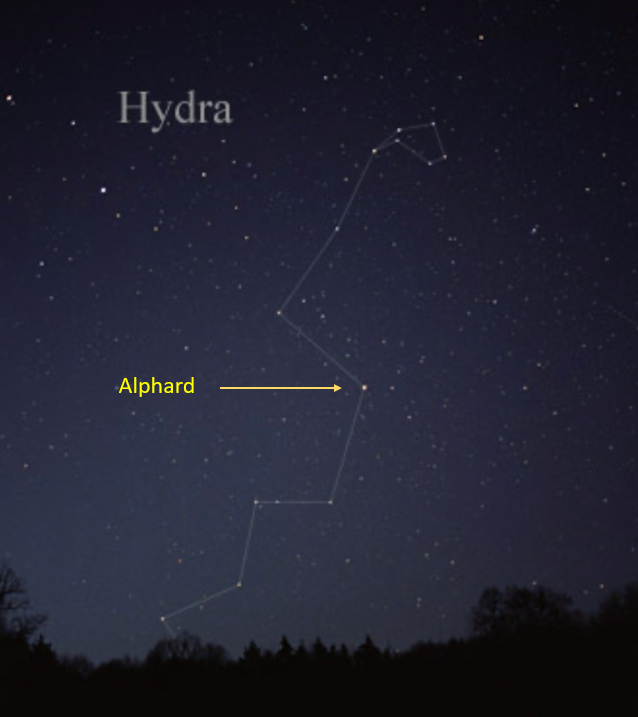
A long string of stars rising over a horizon, linked by lines, with a bright, orange star in the middle.
On northern spring evenings – and southern autumn evenings – you’ll find Hydra the Water Snake ascending in the east. It is the longest constellation in the sky. And it isn’t fully up until late evenings in April for the Northern Hemisphere. Alphard – sometimes called Cor Hydrae or Hydra’s Heart – is the brightest star in Hydra. Photo copyright by Till Credner/ AlltheSky.com/ Wikimedia Commons (CC BY-SA 3.0).

Alphard (Alpha Hydrae) is the brightest star in the largest constellation in the sky, Hydra the Water Snake. Despite its long length, Hydra’s stars are mostly dim except for Alphard. You will need a very dark sky to see them. Meanwhile, Alphard shines at 2nd magnitude. So it’s about as bright as the stars of the Big Dipper.

Known as the Heart of the Snake, Alphard is a precursor of spring for us in the Northern Hemisphere.

Alphard brings a new season

Alphard’s warm orange color and location in the constellation’s core makes it a good representative for the Snake’s Heart. There is something about Alphard – some combination of its orange color and not-too-showy brightness – that looks friendly.

Like so many skywatchers before you, you’ll love seeing Alphard ascend in the early evening in late February and March as it ushers in a new season. Alphard is located in the upper part of the Water Snake. It has risen when darkness falls by the time of the March equinox.

The constellation is so long that the entire snake doesn’t rise until after midnight in March. Alphard heralds the rest of the snake, which ascends in the sky like a cobra from a snake charmer’s basket. On March, April and May evenings, this great star pattern stretches across a huge portion of the sky, from southeast to southwest above the Milky Way.

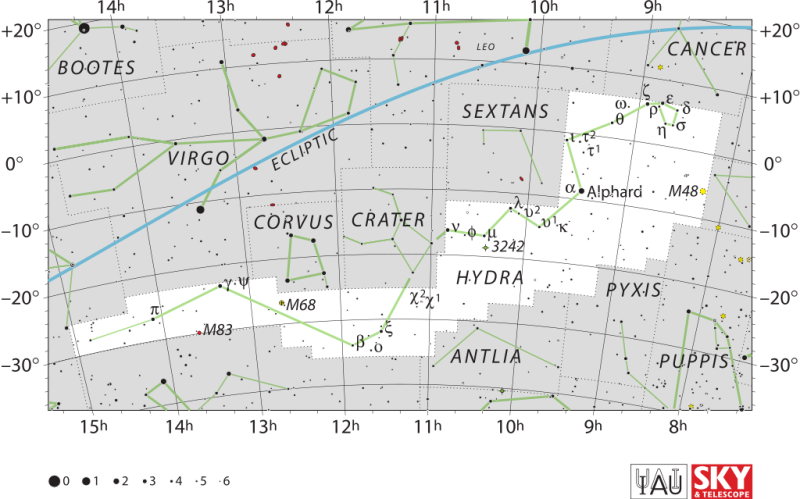
White chart with black dots for stars and long crooked line for constellation Hydra
Hydra the Water Snake is the longest of the 88 constellations. It extends all the way from Cancer the Crab, below Leo the Lion, to the end of Virgo the Maiden. Image via IAU/ Wikimedia Commons (CC BY 3.0).

How to find Hydra and Alphard

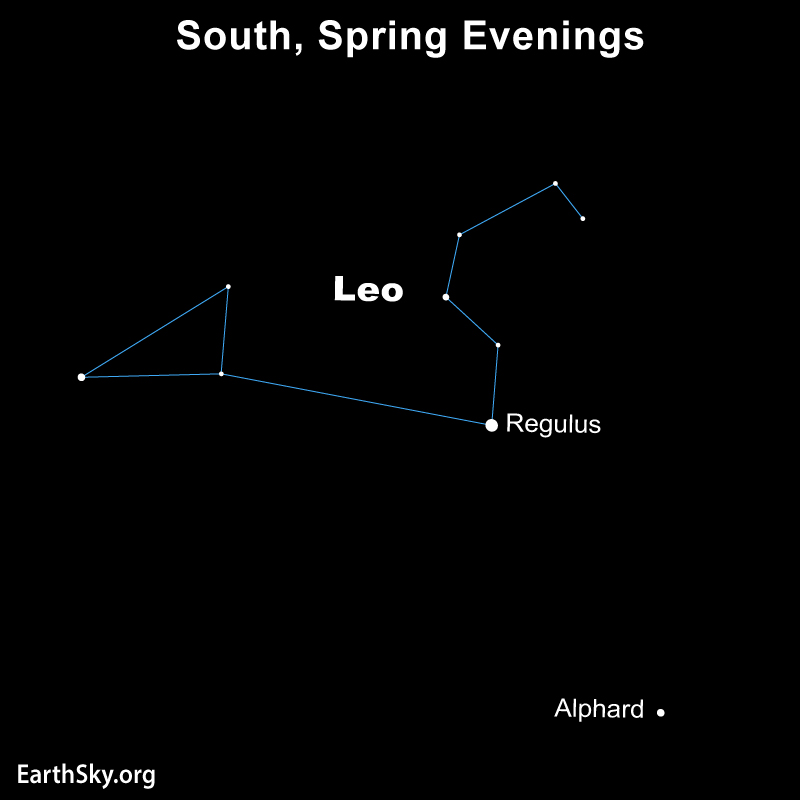
Do you know the constellation Leo the Lion and its famous asterism – the Sickle – shaped like a backward question mark? If so – on an evening in March, April, or May – look for the distinctive backward question mark shape of its head and the triangle body.

You’ll find Alphard not far from Regulus, Leo’s brightest star. Alphard is not as bright as Regulus, but it’s a distinctive orange color. Both Alphard and Regulus are known as the “heart” of their respective animal constellations.

So from Northern Hemisphere locations, look southward to Leo’s lower right to find Alphard. From the Southern Hemisphere, Regulus will be following Alphard across the night sky.

Dots and lines outlining lion-shaped constellation with star Alphard lower right.
If you’re in the Northern Hemisphere – and you stand facing southward on a spring evening – Leo the Lion will be over your head. Alphard will be to the lower right of Regulus, Leo’s brightest star.

The solitary one

Much like Fomalhaut six months from now, Alphard is said to be a lonely star. It beams as the sole bright light in a sea of dim stars in its part of the sky. The Arabic name Alphard translates as the Solitary One.

Look at Alphard with binoculars to discern its orange color. Alphard’s color shows that it is entering into the autumn of its years, like the color of the orange stars Pollux and Arcturus, and the ruddy star Aldebaran. Old stars’ colors are reminiscent of the orange color of autumn leaves. Like Pollux, Arcturus and Aldebaran, Alphard will shed its outer layers someday soon (by astronomical standards) and shrink into a dead white dwarf star.

Pollux, Arcturus and Aldebaran appear brighter in our sky than Alphard, but that’s because they are so much closer to us. Alphard is intrinsically brighter than any of these stars. Yet it appears fainter, because it lies some 177 light-years away, while Pollux, Arcturus and Aldebaran reside at 34, 37, and 65 light-years away, respectively.

Bottom line: Alphard is the “heart” and brightest star in the constellation Hydra, and it represents a welcome sign of spring for the Northern Hemisphere.

Enjoying EarthSky so far? Sign up for our free daily newsletter today!

The post Lonely Alphard is the brightest star in Hydra first appeared on EarthSky.


from EarthSky https://ift.tt/bComPNG
A long string of stars rising over a horizon, linked by lines, with a bright, orange star in the middle.
On northern spring evenings – and southern autumn evenings – you’ll find Hydra the Water Snake ascending in the east. It is the longest constellation in the sky. And it isn’t fully up until late evenings in April for the Northern Hemisphere. Alphard – sometimes called Cor Hydrae or Hydra’s Heart – is the brightest star in Hydra. Photo copyright by Till Credner/ AlltheSky.com/ Wikimedia Commons (CC BY-SA 3.0).

Alphard (Alpha Hydrae) is the brightest star in the largest constellation in the sky, Hydra the Water Snake. Despite its long length, Hydra’s stars are mostly dim except for Alphard. You will need a very dark sky to see them. Meanwhile, Alphard shines at 2nd magnitude. So it’s about as bright as the stars of the Big Dipper.

Known as the Heart of the Snake, Alphard is a precursor of spring for us in the Northern Hemisphere.

Alphard brings a new season

Alphard’s warm orange color and location in the constellation’s core makes it a good representative for the Snake’s Heart. There is something about Alphard – some combination of its orange color and not-too-showy brightness – that looks friendly.

Like so many skywatchers before you, you’ll love seeing Alphard ascend in the early evening in late February and March as it ushers in a new season. Alphard is located in the upper part of the Water Snake. It has risen when darkness falls by the time of the March equinox.

The constellation is so long that the entire snake doesn’t rise until after midnight in March. Alphard heralds the rest of the snake, which ascends in the sky like a cobra from a snake charmer’s basket. On March, April and May evenings, this great star pattern stretches across a huge portion of the sky, from southeast to southwest above the Milky Way.

White chart with black dots for stars and long crooked line for constellation Hydra
Hydra the Water Snake is the longest of the 88 constellations. It extends all the way from Cancer the Crab, below Leo the Lion, to the end of Virgo the Maiden. Image via IAU/ Wikimedia Commons (CC BY 3.0).

How to find Hydra and Alphard

Do you know the constellation Leo the Lion and its famous asterism – the Sickle – shaped like a backward question mark? If so – on an evening in March, April, or May – look for the distinctive backward question mark shape of its head and the triangle body.

You’ll find Alphard not far from Regulus, Leo’s brightest star. Alphard is not as bright as Regulus, but it’s a distinctive orange color. Both Alphard and Regulus are known as the “heart” of their respective animal constellations.

So from Northern Hemisphere locations, look southward to Leo’s lower right to find Alphard. From the Southern Hemisphere, Regulus will be following Alphard across the night sky.

Dots and lines outlining lion-shaped constellation with star Alphard lower right.
If you’re in the Northern Hemisphere – and you stand facing southward on a spring evening – Leo the Lion will be over your head. Alphard will be to the lower right of Regulus, Leo’s brightest star.

The solitary one

Much like Fomalhaut six months from now, Alphard is said to be a lonely star. It beams as the sole bright light in a sea of dim stars in its part of the sky. The Arabic name Alphard translates as the Solitary One.

Look at Alphard with binoculars to discern its orange color. Alphard’s color shows that it is entering into the autumn of its years, like the color of the orange stars Pollux and Arcturus, and the ruddy star Aldebaran. Old stars’ colors are reminiscent of the orange color of autumn leaves. Like Pollux, Arcturus and Aldebaran, Alphard will shed its outer layers someday soon (by astronomical standards) and shrink into a dead white dwarf star.

Pollux, Arcturus and Aldebaran appear brighter in our sky than Alphard, but that’s because they are so much closer to us. Alphard is intrinsically brighter than any of these stars. Yet it appears fainter, because it lies some 177 light-years away, while Pollux, Arcturus and Aldebaran reside at 34, 37, and 65 light-years away, respectively.

Bottom line: Alphard is the “heart” and brightest star in the constellation Hydra, and it represents a welcome sign of spring for the Northern Hemisphere.

Enjoying EarthSky so far? Sign up for our free daily newsletter today!

The post Lonely Alphard is the brightest star in Hydra first appeared on EarthSky.


from EarthSky https://ift.tt/bComPNG

Look for Mercury farthest from the morning sun on April 3

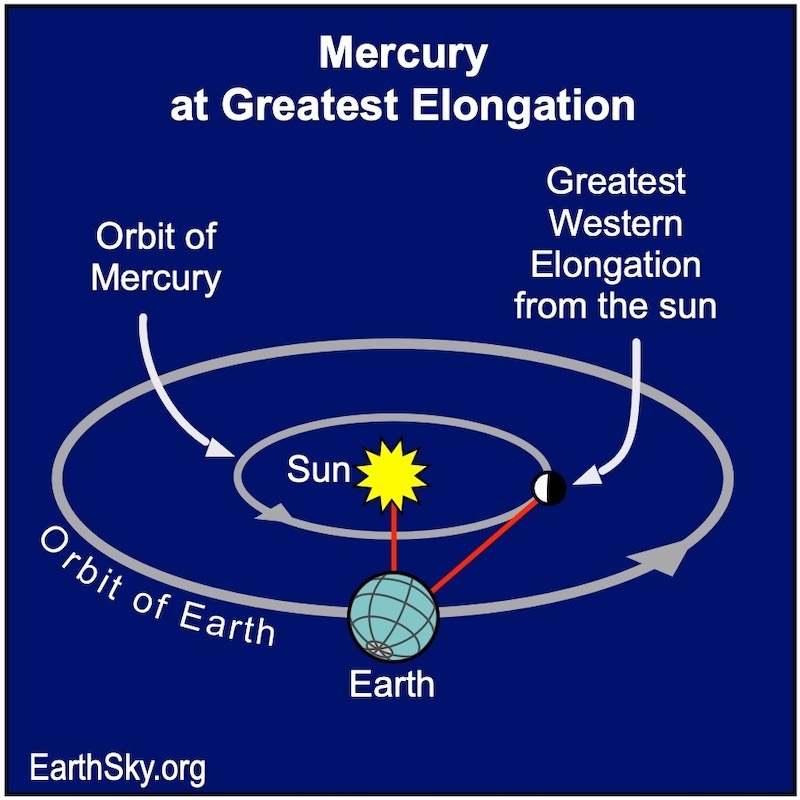
Diagram: Orbits of Earth and Mercury with sun in center, and lines showing line of sight from Earth to Mercury.
At greatest elongation on April 3, 2026, Mercury will lie to one side of the sun as seen from Earth. That’s when it’s at its greatest distance from the sun before sunrise on our sky’s dome. Chart via EarthSky.

Mercury farthest from the sunrise on April 3

The innermost planet Mercury orbits the sun every 88 days. And Earth is moving, too. So Mercury goes between us and the sun pretty often, about every 116 days. It did this last at 11 UTC on March 7, 2026, reaching the point astronomers call inferior conjunction. And since then, Mercury has been speeding ahead of Earth in orbit. It re-emerged into our eastern morning sky in mid-March. Look for it in the sunrise direction. Mercury will reach its greatest morning elongation – its greatest apparent distance from the rising sun – on April 3, 2026. This morning apparition favors the Southern Hemisphere.

Mercury greatest elongation, April 2026

When to watch: Officially, Mercury emerged in mid-March in the morning sky. Look for it shortly before sunrise. At greatest elongation – April 3, 2026 – Mercury is farthest from the sunrise on our sky’s dome. And after that, when it’ll be edging back toward the sunrise, it’ll brighten a little bit more, making Mercury easier to spot in the morning twilight. It’ll be low in the sky! This is the best morning apparition of Mercury for the Southern Hemisphere in 2026.
Where to look: Look in the sunrise direction as the sky is getting lighter.
Greatest elongation – marking Mercury’s farthest point from the sunrise glare – is on April 3, 2026 at 23 UTC (6:00 p.m. CDT). Mercury will shine at magnitude +0.4 that morning. At that time, Mercury will be 28 degrees from the sun on our sky’s dome.
Through a telescope on and around April 3, Mercury appears 50% illuminated, in a quarter phase, and 7.64 arcseconds across.
Note: After April 3, Mercury brightens a bit to magnitude -0.3 (bright, but competing with the morning twilight) until late April or early May. Around that time, it’ll slip away in the morning twilight.
Mercury, Saturn and Mars conjunction: About 30 minutes before sunrise on April 20, look for Mercury, Saturn and Mars to lie near each other in the morning twilight. Binoculars might help spot the trio of planets.

By the way, this Mercury elongation – due to the high angle of the ecliptic to the horizon – favors the Southern Hemisphere.

After greatest elongation on April 3, the innermost planet – named for the fleet-footed messenger god of the ancient Romans – will be visible for a few more weeks, especially from the Southern Hemisphere.

For precise sun and Mercury rising times at your location:

Old Farmer’s Almanac (U.S. and Canada)
timeanddate.com (worldwide)
Stellarium (online planetarium)

Mercury events in 2026

Note: Times are in UTC

Jan 21, 2026: Superior conjunction (passes behind sun from Earth)
Feb 19, 2026: Greatest elongation (evening)
Mar 7, 2026: Inferior conjunction (races between Earth and sun)
Apr 3, 2026: Greatest elongation (morning)
May 14, 2026: Superior conjunction (passes behind sun from Earth)
Jun 15, 2026: Greatest elongation (evening)
Jul 13, 2026: Inferior conjunction (races between Earth and sun)
Aug 2, 2026: Greatest elongation (morning)
Aug 27, 2026: Superior conjunction (passes behind sun from Earth)
Oct 12, 2026: Greatest elongation (evening)
Nov 4, 2026: Inferior conjunction (races between Earth and sun)
Nov 21, 2026: Greatest elongation (morning)

Mercury charts from Guy Ottewell

Sky chart with arc-shaped dotted planet paths, and sky objects labeled.
Mercury’s greatest morning elongations in 2026 from the Northern Hemisphere as viewed through a powerful telescope. The planet images are at the 1st, 11th, and 21st of each month. Dots show the actual positions of the planet for every day. Chart via Guy Ottewell’s 2026 Astronomical Calendar. Used with permission.
Sky chart with arc-shaped dotted planet paths, and sky objects labeled.
Mercury’s greatest morning elongations in 2026 from the Southern Hemisphere as viewed through a powerful telescope. The planet images are at the 1st, 11th, and 21st of each month. Dots show the actual positions of the planet for every day. Chart via Guy Ottewell’s 2026 Astronomical Calendar. Used with permission.

A comparison of elongations

Mercury’s greatest elongations are not equal. Indeed, some are “greater” than others. For example, the distance of Mercury from the sun on our sky’s dome varies from about 28 degrees (maximum) to 18 degrees (minimum).

Also, Mercury’s elongations are better or worse depending on the time of the year they occur and your location on Earth. So, for both hemispheres, spring evenings and autumn mornings are best.

As an illustration, the chart below – from a Northern Hemisphere perspective – might help you visualize these differences.

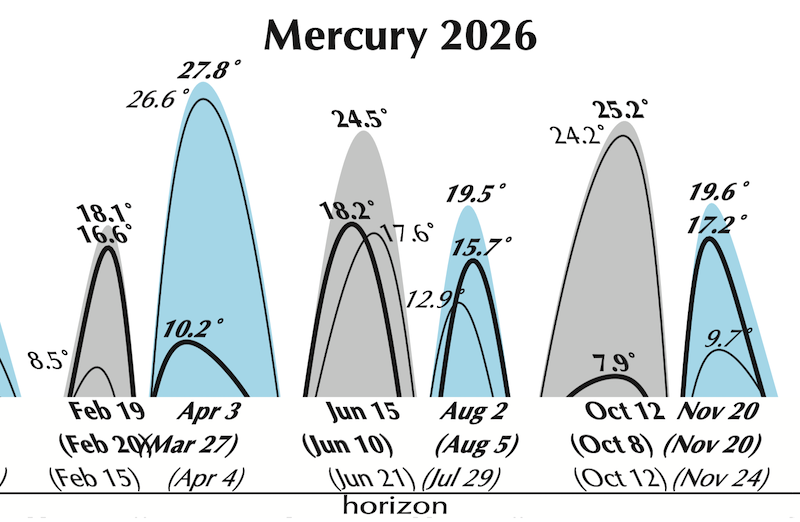
Chart with row of steep, alternating light blue and gray arcs, each with a date and height in degrees.
Mercury elongations compared. Here, gray areas represent evening apparitions (eastward elongation). Blue areas represent morning apparitions (westward elongation). The top figures are the maximum elongations, reached at the top dates shown beneath. Curves show the altitude of the planet above the horizon at sunrise or sunset, for latitude 40 degrees north (thick line) and 35 degrees south (thin line). Likewise, maxima are reached at the parenthesized dates below (40 degrees north in bold). Chart via Guy Ottewell’s 2026 Astronomical Calendar. Used with permission.

Heliocentric solar system, April 2026

Circle with sun at center, planets around, and zodiac names on outer edge.
Heliocentric view of solar system, April 2026. Chart via Guy Ottewell’s 2026 Astronomical Calendar. Used with permission. Plus Guy Ottewell explains heliocentric charts here.

Seasons make a difference

So, in the autumn for either hemisphere, the ecliptic – or path of the sun, moon and planets – makes a narrow angle to the horizon in the evening. Conversely, it makes a steep slant, nearly perpendicular, in the morning. So – in autumn from either hemisphere – morning elongations of Mercury are best. Then, Mercury appears higher above the horizon and farther from the glow of the sun. Conversely, evening elongations in autumn are harder to see.

On the other hand, in the spring for either hemisphere, the situation reverses. Then, the ecliptic and the horizon meet at a sharper angle on spring evenings and at a narrower angle on spring mornings. So, in springtime for either hemisphere, evening elongations of Mercury are best. Meanwhile, morning elongations in springtime are harder to see.

Bottom line: Mercury will reach its greatest elongation – greatest distance from the sunrise – on April 3, 2026. Look east at dawn. It’ll disappear from the morning sky in late April.

Do you love twilight? The 3 stages explained

Visible planets and night sky guide for December

The post Look for Mercury farthest from the morning sun on April 3 first appeared on EarthSky.


from EarthSky https://ift.tt/a80yokf
Diagram: Orbits of Earth and Mercury with sun in center, and lines showing line of sight from Earth to Mercury.
At greatest elongation on April 3, 2026, Mercury will lie to one side of the sun as seen from Earth. That’s when it’s at its greatest distance from the sun before sunrise on our sky’s dome. Chart via EarthSky.

Mercury farthest from the sunrise on April 3

The innermost planet Mercury orbits the sun every 88 days. And Earth is moving, too. So Mercury goes between us and the sun pretty often, about every 116 days. It did this last at 11 UTC on March 7, 2026, reaching the point astronomers call inferior conjunction. And since then, Mercury has been speeding ahead of Earth in orbit. It re-emerged into our eastern morning sky in mid-March. Look for it in the sunrise direction. Mercury will reach its greatest morning elongation – its greatest apparent distance from the rising sun – on April 3, 2026. This morning apparition favors the Southern Hemisphere.

Mercury greatest elongation, April 2026

When to watch: Officially, Mercury emerged in mid-March in the morning sky. Look for it shortly before sunrise. At greatest elongation – April 3, 2026 – Mercury is farthest from the sunrise on our sky’s dome. And after that, when it’ll be edging back toward the sunrise, it’ll brighten a little bit more, making Mercury easier to spot in the morning twilight. It’ll be low in the sky! This is the best morning apparition of Mercury for the Southern Hemisphere in 2026.
Where to look: Look in the sunrise direction as the sky is getting lighter.
Greatest elongation – marking Mercury’s farthest point from the sunrise glare – is on April 3, 2026 at 23 UTC (6:00 p.m. CDT). Mercury will shine at magnitude +0.4 that morning. At that time, Mercury will be 28 degrees from the sun on our sky’s dome.
Through a telescope on and around April 3, Mercury appears 50% illuminated, in a quarter phase, and 7.64 arcseconds across.
Note: After April 3, Mercury brightens a bit to magnitude -0.3 (bright, but competing with the morning twilight) until late April or early May. Around that time, it’ll slip away in the morning twilight.
Mercury, Saturn and Mars conjunction: About 30 minutes before sunrise on April 20, look for Mercury, Saturn and Mars to lie near each other in the morning twilight. Binoculars might help spot the trio of planets.

By the way, this Mercury elongation – due to the high angle of the ecliptic to the horizon – favors the Southern Hemisphere.

After greatest elongation on April 3, the innermost planet – named for the fleet-footed messenger god of the ancient Romans – will be visible for a few more weeks, especially from the Southern Hemisphere.

For precise sun and Mercury rising times at your location:

Old Farmer’s Almanac (U.S. and Canada)
timeanddate.com (worldwide)
Stellarium (online planetarium)

Mercury events in 2026

Note: Times are in UTC

Jan 21, 2026: Superior conjunction (passes behind sun from Earth)
Feb 19, 2026: Greatest elongation (evening)
Mar 7, 2026: Inferior conjunction (races between Earth and sun)
Apr 3, 2026: Greatest elongation (morning)
May 14, 2026: Superior conjunction (passes behind sun from Earth)
Jun 15, 2026: Greatest elongation (evening)
Jul 13, 2026: Inferior conjunction (races between Earth and sun)
Aug 2, 2026: Greatest elongation (morning)
Aug 27, 2026: Superior conjunction (passes behind sun from Earth)
Oct 12, 2026: Greatest elongation (evening)
Nov 4, 2026: Inferior conjunction (races between Earth and sun)
Nov 21, 2026: Greatest elongation (morning)

Mercury charts from Guy Ottewell

Sky chart with arc-shaped dotted planet paths, and sky objects labeled.
Mercury’s greatest morning elongations in 2026 from the Northern Hemisphere as viewed through a powerful telescope. The planet images are at the 1st, 11th, and 21st of each month. Dots show the actual positions of the planet for every day. Chart via Guy Ottewell’s 2026 Astronomical Calendar. Used with permission.
Sky chart with arc-shaped dotted planet paths, and sky objects labeled.
Mercury’s greatest morning elongations in 2026 from the Southern Hemisphere as viewed through a powerful telescope. The planet images are at the 1st, 11th, and 21st of each month. Dots show the actual positions of the planet for every day. Chart via Guy Ottewell’s 2026 Astronomical Calendar. Used with permission.

A comparison of elongations

Mercury’s greatest elongations are not equal. Indeed, some are “greater” than others. For example, the distance of Mercury from the sun on our sky’s dome varies from about 28 degrees (maximum) to 18 degrees (minimum).

Also, Mercury’s elongations are better or worse depending on the time of the year they occur and your location on Earth. So, for both hemispheres, spring evenings and autumn mornings are best.

As an illustration, the chart below – from a Northern Hemisphere perspective – might help you visualize these differences.

Chart with row of steep, alternating light blue and gray arcs, each with a date and height in degrees.
Mercury elongations compared. Here, gray areas represent evening apparitions (eastward elongation). Blue areas represent morning apparitions (westward elongation). The top figures are the maximum elongations, reached at the top dates shown beneath. Curves show the altitude of the planet above the horizon at sunrise or sunset, for latitude 40 degrees north (thick line) and 35 degrees south (thin line). Likewise, maxima are reached at the parenthesized dates below (40 degrees north in bold). Chart via Guy Ottewell’s 2026 Astronomical Calendar. Used with permission.

Heliocentric solar system, April 2026

Circle with sun at center, planets around, and zodiac names on outer edge.
Heliocentric view of solar system, April 2026. Chart via Guy Ottewell’s 2026 Astronomical Calendar. Used with permission. Plus Guy Ottewell explains heliocentric charts here.

Seasons make a difference

So, in the autumn for either hemisphere, the ecliptic – or path of the sun, moon and planets – makes a narrow angle to the horizon in the evening. Conversely, it makes a steep slant, nearly perpendicular, in the morning. So – in autumn from either hemisphere – morning elongations of Mercury are best. Then, Mercury appears higher above the horizon and farther from the glow of the sun. Conversely, evening elongations in autumn are harder to see.

On the other hand, in the spring for either hemisphere, the situation reverses. Then, the ecliptic and the horizon meet at a sharper angle on spring evenings and at a narrower angle on spring mornings. So, in springtime for either hemisphere, evening elongations of Mercury are best. Meanwhile, morning elongations in springtime are harder to see.

Bottom line: Mercury will reach its greatest elongation – greatest distance from the sunrise – on April 3, 2026. Look east at dawn. It’ll disappear from the morning sky in late April.

Do you love twilight? The 3 stages explained

Visible planets and night sky guide for December

The post Look for Mercury farthest from the morning sun on April 3 first appeared on EarthSky.


from EarthSky https://ift.tt/a80yokf

Biggest earthquake in North America 62 years ago today

Science news, night sky events and beautiful photos, all in one place. Click here to subscribe to our free daily newsletter.

The earthquake strikes

Today in science: March 27, 1964. On this date, the most powerful earthquake ever recorded in North America struck in the Prince William Sound southeast of Anchorage, Alaska, at 5:36 p.m. local time. The 9.2-magnitude earthquake rocked the state for more than four minutes, spawning a tsunami that reached all the way to Hawaii and Northern California.

The massive quake is known as the Great Alaska Earthquake or the Good Friday Earthquake. According to the U.S. Geological Survey (USGS), it holds the record for the 2nd-largest earthquake ever recorded on Earth, behind the 1960 Chile quake (which had a magnitude of about 9.5).

On that day, it had been a relatively warm day in Anchorage, Alaska’s largest city, about 75 miles (120 km) from the quake’s epicenter. Luckily, schools were closed for Good Friday, along with many offices. As the quake began, dozens of blocks of buildings were leveled or heavily damaged in Anchorage.

Valdez was completely destroyed

The city of Valdez, closest to the epicenter, was completely destroyed.

Biggest earthquake: Street with many huge cracks, a large section about a man's height lower than the rest.
Damage to Fourth Avenue in Anchorage, Alaska, caused by the Good Friday Earthquake, the biggest earthquake ever in North America. The sidewalk on the left started out at the level of the street on the right. Image via USGS/ Wikimedia Commons.

The prolonged shaking resulted in many natural changes as well. For example, according to the Alaska Earthquake Center, the Latouche Island area moved to the southeast by nearly 60 feet (20 meters).

Now the USGS estimates the earthquake and its accompanying tsunami caused $311 million in damages across the state of Alaska (over $2 billion in today’s dollars).

Ground torn into huge tumbled chunks with evergreen trees pointing every direction.
During the 1964 Good Friday Earthquake in Alaska, both human and natural areas sustained damage. This image is from the Turnagain Heights neighborhood of Anchorage, Alaska. Image via NOAA/ Wikimedia Commons.
Aerial view of houses and trees tumbled down a long hillside with many large, deep cracks.
Landslide damage in the Turnagain Heights neighborhood of Anchorage, Alaska. Image via USGS/ Wikimedia Commons.

There were some fatalities

All things considered, the loss of human life was relatively small from such a strong earthquake. In the end, 130 people were killed. The UAF Alaska Earthquake Center said the low death rate was:

… due to low population density, the time of day and the fact that it was a holiday, and the type of material used to construct many buildings (wood).

Map in bright colors of Alaska south coast, with uplift and subsidence areas outlined.
View larger. | Map of southern Alaska showing the epicenter of the 1964 Good Friday Earthquake (red star). Image via USGS.

Despite the tragic loss of life from the 1964 Great Alaska Earthquake, it didn’t come close to the fatalities from two slightly smaller and more recent quakes: the December 26, 2004, Indian Ocean 9.1-magnitude earthquake and tsunami (third-largest earthquake recorded on a seismograph, with over 230,000 people killed in 14 countries) and the March 11, 2011, 9.0-magnitude earthquake in Japan (fifth-largest earthquake recorded on a seismograph, with nearly 16,000 deaths).

Luckily, in 1964, Alaska was sparsely populated. Today’s Alaska has a larger human population. If and when a similar quake strikes again, the death toll might be higher.

Click here for more 1964 Alaska earthquake photos.

Aerial view of shoreline with miles of flattened structures.
The waterfront in Seward, Alaska, a few months after the 1964 Good Friday earthquake. Image via USGS/ Wikimedia Commons.

Bottom line: The most powerful earthquake ever recorded to strike North America rocked south-central Alaska on Good Friday, March 27, 1964, and registered a magnitude 9.2 on the Richter scale.

The post Biggest earthquake in North America 62 years ago today first appeared on EarthSky.


from EarthSky https://ift.tt/u0jqOLI

Science news, night sky events and beautiful photos, all in one place. Click here to subscribe to our free daily newsletter.

The earthquake strikes

Today in science: March 27, 1964. On this date, the most powerful earthquake ever recorded in North America struck in the Prince William Sound southeast of Anchorage, Alaska, at 5:36 p.m. local time. The 9.2-magnitude earthquake rocked the state for more than four minutes, spawning a tsunami that reached all the way to Hawaii and Northern California.

The massive quake is known as the Great Alaska Earthquake or the Good Friday Earthquake. According to the U.S. Geological Survey (USGS), it holds the record for the 2nd-largest earthquake ever recorded on Earth, behind the 1960 Chile quake (which had a magnitude of about 9.5).

On that day, it had been a relatively warm day in Anchorage, Alaska’s largest city, about 75 miles (120 km) from the quake’s epicenter. Luckily, schools were closed for Good Friday, along with many offices. As the quake began, dozens of blocks of buildings were leveled or heavily damaged in Anchorage.

Valdez was completely destroyed

The city of Valdez, closest to the epicenter, was completely destroyed.

Biggest earthquake: Street with many huge cracks, a large section about a man's height lower than the rest.
Damage to Fourth Avenue in Anchorage, Alaska, caused by the Good Friday Earthquake, the biggest earthquake ever in North America. The sidewalk on the left started out at the level of the street on the right. Image via USGS/ Wikimedia Commons.

The prolonged shaking resulted in many natural changes as well. For example, according to the Alaska Earthquake Center, the Latouche Island area moved to the southeast by nearly 60 feet (20 meters).

Now the USGS estimates the earthquake and its accompanying tsunami caused $311 million in damages across the state of Alaska (over $2 billion in today’s dollars).

Ground torn into huge tumbled chunks with evergreen trees pointing every direction.
During the 1964 Good Friday Earthquake in Alaska, both human and natural areas sustained damage. This image is from the Turnagain Heights neighborhood of Anchorage, Alaska. Image via NOAA/ Wikimedia Commons.
Aerial view of houses and trees tumbled down a long hillside with many large, deep cracks.
Landslide damage in the Turnagain Heights neighborhood of Anchorage, Alaska. Image via USGS/ Wikimedia Commons.

There were some fatalities

All things considered, the loss of human life was relatively small from such a strong earthquake. In the end, 130 people were killed. The UAF Alaska Earthquake Center said the low death rate was:

… due to low population density, the time of day and the fact that it was a holiday, and the type of material used to construct many buildings (wood).

Map in bright colors of Alaska south coast, with uplift and subsidence areas outlined.
View larger. | Map of southern Alaska showing the epicenter of the 1964 Good Friday Earthquake (red star). Image via USGS.

Despite the tragic loss of life from the 1964 Great Alaska Earthquake, it didn’t come close to the fatalities from two slightly smaller and more recent quakes: the December 26, 2004, Indian Ocean 9.1-magnitude earthquake and tsunami (third-largest earthquake recorded on a seismograph, with over 230,000 people killed in 14 countries) and the March 11, 2011, 9.0-magnitude earthquake in Japan (fifth-largest earthquake recorded on a seismograph, with nearly 16,000 deaths).

Luckily, in 1964, Alaska was sparsely populated. Today’s Alaska has a larger human population. If and when a similar quake strikes again, the death toll might be higher.

Click here for more 1964 Alaska earthquake photos.

Aerial view of shoreline with miles of flattened structures.
The waterfront in Seward, Alaska, a few months after the 1964 Good Friday earthquake. Image via USGS/ Wikimedia Commons.

Bottom line: The most powerful earthquake ever recorded to strike North America rocked south-central Alaska on Good Friday, March 27, 1964, and registered a magnitude 9.2 on the Richter scale.

The post Biggest earthquake in North America 62 years ago today first appeared on EarthSky.


from EarthSky https://ift.tt/u0jqOLI

A flurry of fireballs! Is there a reason for the uptick?

Flurry of fireballs: Cars driving down a highway with a flash of a meteor heading downward.
A driver captured this video with their dashcam as a fireball entered the atmosphere over Texas on March 21, 2026. Image via AMS. We’ve seen a flurry of fireballs in March 2026. Is something going on? The American Meteor Society investigated. Read on for the results.

A flurry of fireballs has people wondering what’s happening

We’ve seen a flurry of fireballs lighting up the skies over the past few weeks. On March 3, 2026, a meteor entered Earth’s atmosphere over Vancouver and Washington, breaking the sound barrier and causing a sonic boom. Then, western Europe saw fireballs on March 8 and again on March 11. And on March 17, another meteor with its associated sonic boom rocked residents of Ohio. Two days later came two fireballs over California, and a day after that were fireballs over Michigan and Georgia. And on March 21, a fireball over Texas dropped a rock through the roof of a house in Houston.

What’s going on?

Enough people have been asking this question that the American Meteor Society (AMS) said:

The first quarter of 2026 has produced what appears to be a significant surge in large fireball events. The data, drawn from the AMS database going back to 2011, shows a pattern that warrants serious investigation.

The organization reported the findings of that investigation on March 24, 2026. Its main findings were that there is no evidence of an impact threat. The objects were in the normal size range of those that regularly impact Earth. But what has changed is the volume of reports it has received across several categories, including witness counts, sonic boom rates, long-duration sighting volume and the distribution of event sizes. The AMS said:

Whether this reflects a genuine change in the near-Earth meteoroid environment, an amplification of reporting through AI and social media, or some combination of both—we cannot yet say definitively. What we can say is that the question deserves both public awareness and scientific attention.

An uptick in fireballs, or reports?

First, what are fireballs? They are especially bright meteors that light up the night sky as they streak across the atmosphere. They can even glow brightly enough to be seen in the daytime. Astronomers call bright meteors like this bolides.

And now it seems people are reporting fireballs like never before. The AMS has had a reporting system in place since 2005. It looked back through the data to see if it could pinpoint anything that has changed, and why.

In the first quarter of 2026, the AMS found 2,046 total events. There were 38 events that had more than 50 reports each. The average per quarter is 18 events with greater than 50 reports. And 14 of those events had more than 100 reports each, compared to the average of 7 events.

But while the AMS found the number of events (2,046) is the highest on record, it’s only slightly above the other highs of 2,037 events in 2022 and 1,947 events in 2021. It said:

The signal is still at the top of the distribution.

What it did find is there are a larger number of reports. Again, from the AMS:

What has changed is that a large fraction of events that would normally draw 25–49 witnesses instead drew 50, 100, or even 200+ witnesses. The distribution didn’t broaden—it shifted upward. Almost half of all March 2026 events with 10+ reports were seen by 50 or more people.

Dana Jason Wood captured the St. Patrick’s Day fireball from Munhall, Pennsylvania, and submitted it to the American Meteor Society.

More sonic booms

But the AMS noted that the change cannot only be attributed to more people reporting fireballs. Because that doesn’t explain for the increase in sonic booms. When a meteor enters Earth’s atmosphere, it burns up due to friction. Meteors can zip through the air at 25,000 to 160,000 miles per hour (11 to 72 km per second). Usually, these small space rocks, the size of pebbles, burn up completely and never reach the ground.

But larger space rocks can survive longer in the atmosphere, penetrating deep enough to produce pressure waves and, thus, sonic booms. They can even be large enough to deposit meteorites onto the landscape below, as we’ve seen in Ohio and Texas.

And the recent meteors have been remarkable in that 30 of the 38 events that had more than 50 witness reports included sonic booms. As the AMS said:

Thirty large fireball events producing audible booms in a single quarter means roughly one every three days.

Where are these meteors coming from?

Meteors that come from regular showers, such as the Lyrids, all emanate from a single source. That is, if you trace the path of the meteor backward, they all appear to come from the same general area, which astronomers call the radiant. The radiant for the Lyrid meteor shower is in the constellation Lyra. The meteors aren’t actually coming from that constellation, of course. They are bits of rock, usually left behind by comets that release debris in their orbits as they round the sun. Then Earth plows into those trails of debris, and we see the result as meteors.

So are these recent fireballs related? Do they come from the same region of sky? Could it be a new meteor shower?

The AMS found that the recent events did have enhanced activity from two directions. One is the direction opposite the sun, which astronomers call the anthelion. The other is meteors that came in at a steep angle, not in alignment with the plane of our solar system. And astronomers call this a high-declination radiant. Referring to the high-declination meteors, the AMS said:

An enhancement in this population is unusual and warrants further study.

Interestingly, two of the meteorite falls in March were of a rare type of meteorite. These were achondrites, specifically in the subgroup of eucrites. It is thought that eucrites come from the asteroid Vesta. And yet these two meteorite falls, in Ohio and Germany, entered at near opposite angles from each other.

What the increase isn’t

The AMS concluded with a long list of possibilities for the uptick that it said it has ruled out. These include:

  • Increased reporting or smartphone adoption
  • A new meteor shower
  • The February fireballs seasonal effect
  • Time-of-day or geographic bias

The AMS also said these fireballs are not of alien origin. Also, the meteorites recovered in Ohio and Germany show they are consistent with extraterrestrial rocks and are not “artificial”.

Something the AMS is still unsure of is if AI is helping to drive the reporting numbers. It said:

When someone witnesses a fireball today, they may ask ChatGPT, Siri, or Google’s AI “I just saw a fireball—where do I report it?” and be directed to the AMS. This would inflate witness counts per event without changing the actual number of fireballs—which is, notably, the exact pattern we observe: normal total event counts but elevated reports per event at the high end. We cannot quantify this effect with the data currently available, but it is a plausible partial explanation for the upward shift in the witness-count distribution. It would not, however, account for the elevated sonic boom rates or the recovered meteorite falls.

Meanwhile, the AMS will continue to track fireballs and look for patterns and explanations.

Will the flurry of fireballs continue? No one knows. Keep your eyes, and your ears, open! And if you see a fireball, report it to the AMS here.

Plus, if you capture a photo of a fireball, submit it to us!

Bottom line: We’ve seen a flurry of fireballs, particularly in March, with reports from Europe to Canada and the U.S. Is there a reason for the uptick? The American Meteor Society investigates.

Via AMS

The post A flurry of fireballs! Is there a reason for the uptick? first appeared on EarthSky.


from EarthSky https://ift.tt/PgxMihp
Flurry of fireballs: Cars driving down a highway with a flash of a meteor heading downward.
A driver captured this video with their dashcam as a fireball entered the atmosphere over Texas on March 21, 2026. Image via AMS. We’ve seen a flurry of fireballs in March 2026. Is something going on? The American Meteor Society investigated. Read on for the results.

A flurry of fireballs has people wondering what’s happening

We’ve seen a flurry of fireballs lighting up the skies over the past few weeks. On March 3, 2026, a meteor entered Earth’s atmosphere over Vancouver and Washington, breaking the sound barrier and causing a sonic boom. Then, western Europe saw fireballs on March 8 and again on March 11. And on March 17, another meteor with its associated sonic boom rocked residents of Ohio. Two days later came two fireballs over California, and a day after that were fireballs over Michigan and Georgia. And on March 21, a fireball over Texas dropped a rock through the roof of a house in Houston.

What’s going on?

Enough people have been asking this question that the American Meteor Society (AMS) said:

The first quarter of 2026 has produced what appears to be a significant surge in large fireball events. The data, drawn from the AMS database going back to 2011, shows a pattern that warrants serious investigation.

The organization reported the findings of that investigation on March 24, 2026. Its main findings were that there is no evidence of an impact threat. The objects were in the normal size range of those that regularly impact Earth. But what has changed is the volume of reports it has received across several categories, including witness counts, sonic boom rates, long-duration sighting volume and the distribution of event sizes. The AMS said:

Whether this reflects a genuine change in the near-Earth meteoroid environment, an amplification of reporting through AI and social media, or some combination of both—we cannot yet say definitively. What we can say is that the question deserves both public awareness and scientific attention.

An uptick in fireballs, or reports?

First, what are fireballs? They are especially bright meteors that light up the night sky as they streak across the atmosphere. They can even glow brightly enough to be seen in the daytime. Astronomers call bright meteors like this bolides.

And now it seems people are reporting fireballs like never before. The AMS has had a reporting system in place since 2005. It looked back through the data to see if it could pinpoint anything that has changed, and why.

In the first quarter of 2026, the AMS found 2,046 total events. There were 38 events that had more than 50 reports each. The average per quarter is 18 events with greater than 50 reports. And 14 of those events had more than 100 reports each, compared to the average of 7 events.

But while the AMS found the number of events (2,046) is the highest on record, it’s only slightly above the other highs of 2,037 events in 2022 and 1,947 events in 2021. It said:

The signal is still at the top of the distribution.

What it did find is there are a larger number of reports. Again, from the AMS:

What has changed is that a large fraction of events that would normally draw 25–49 witnesses instead drew 50, 100, or even 200+ witnesses. The distribution didn’t broaden—it shifted upward. Almost half of all March 2026 events with 10+ reports were seen by 50 or more people.

Dana Jason Wood captured the St. Patrick’s Day fireball from Munhall, Pennsylvania, and submitted it to the American Meteor Society.

More sonic booms

But the AMS noted that the change cannot only be attributed to more people reporting fireballs. Because that doesn’t explain for the increase in sonic booms. When a meteor enters Earth’s atmosphere, it burns up due to friction. Meteors can zip through the air at 25,000 to 160,000 miles per hour (11 to 72 km per second). Usually, these small space rocks, the size of pebbles, burn up completely and never reach the ground.

But larger space rocks can survive longer in the atmosphere, penetrating deep enough to produce pressure waves and, thus, sonic booms. They can even be large enough to deposit meteorites onto the landscape below, as we’ve seen in Ohio and Texas.

And the recent meteors have been remarkable in that 30 of the 38 events that had more than 50 witness reports included sonic booms. As the AMS said:

Thirty large fireball events producing audible booms in a single quarter means roughly one every three days.

Where are these meteors coming from?

Meteors that come from regular showers, such as the Lyrids, all emanate from a single source. That is, if you trace the path of the meteor backward, they all appear to come from the same general area, which astronomers call the radiant. The radiant for the Lyrid meteor shower is in the constellation Lyra. The meteors aren’t actually coming from that constellation, of course. They are bits of rock, usually left behind by comets that release debris in their orbits as they round the sun. Then Earth plows into those trails of debris, and we see the result as meteors.

So are these recent fireballs related? Do they come from the same region of sky? Could it be a new meteor shower?

The AMS found that the recent events did have enhanced activity from two directions. One is the direction opposite the sun, which astronomers call the anthelion. The other is meteors that came in at a steep angle, not in alignment with the plane of our solar system. And astronomers call this a high-declination radiant. Referring to the high-declination meteors, the AMS said:

An enhancement in this population is unusual and warrants further study.

Interestingly, two of the meteorite falls in March were of a rare type of meteorite. These were achondrites, specifically in the subgroup of eucrites. It is thought that eucrites come from the asteroid Vesta. And yet these two meteorite falls, in Ohio and Germany, entered at near opposite angles from each other.

What the increase isn’t

The AMS concluded with a long list of possibilities for the uptick that it said it has ruled out. These include:

  • Increased reporting or smartphone adoption
  • A new meteor shower
  • The February fireballs seasonal effect
  • Time-of-day or geographic bias

The AMS also said these fireballs are not of alien origin. Also, the meteorites recovered in Ohio and Germany show they are consistent with extraterrestrial rocks and are not “artificial”.

Something the AMS is still unsure of is if AI is helping to drive the reporting numbers. It said:

When someone witnesses a fireball today, they may ask ChatGPT, Siri, or Google’s AI “I just saw a fireball—where do I report it?” and be directed to the AMS. This would inflate witness counts per event without changing the actual number of fireballs—which is, notably, the exact pattern we observe: normal total event counts but elevated reports per event at the high end. We cannot quantify this effect with the data currently available, but it is a plausible partial explanation for the upward shift in the witness-count distribution. It would not, however, account for the elevated sonic boom rates or the recovered meteorite falls.

Meanwhile, the AMS will continue to track fireballs and look for patterns and explanations.

Will the flurry of fireballs continue? No one knows. Keep your eyes, and your ears, open! And if you see a fireball, report it to the AMS here.

Plus, if you capture a photo of a fireball, submit it to us!

Bottom line: We’ve seen a flurry of fireballs, particularly in March, with reports from Europe to Canada and the U.S. Is there a reason for the uptick? The American Meteor Society investigates.

Via AMS

The post A flurry of fireballs! Is there a reason for the uptick? first appeared on EarthSky.


from EarthSky https://ift.tt/PgxMihp

adds 2