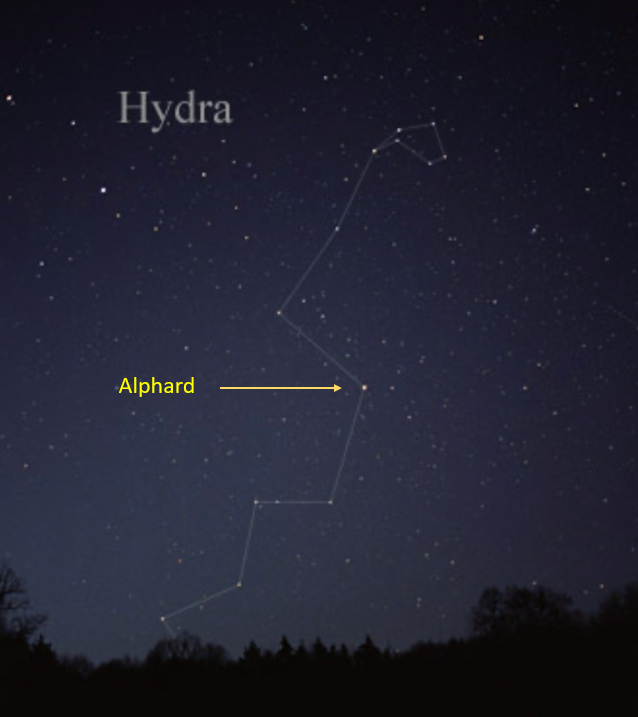
On northern spring evenings – and southern autumn evenings – you’ll find Hydra the Water Snake ascending in the east. It is the longest constellation in the sky. And it isn’t fully up until late evenings in April for the Northern Hemisphere. Alphard – sometimes called Cor Hydrae or Hydra’s Heart – is the brightest star in Hydra. Photo copyright by Till Credner/ AlltheSky.com/ Wikimedia Commons (CC BY-SA 3.0).
Alphard (Alpha Hydrae) is the brightest star in the largest constellation in the sky, Hydra the Water Snake. Despite its long length, Hydra’s stars are mostly dim except for Alphard. You will need a very dark sky to see them. Meanwhile, Alphard shines at 2nd magnitude. So it’s about as bright as the stars of the Big Dipper.
Known as the Heart of the Snake, Alphard is a precursor of spring for us in the Northern Hemisphere.
Alphard brings a new season
Alphard’s warm orange color and location in the constellation’s core makes it a good representative for the Snake’s Heart. There is something about Alphard – some combination of its orange color and not-too-showy brightness – that looks friendly.
Like so many skywatchers before you, you’ll love seeing Alphard ascend in the early evening in late February and March as it ushers in a new season. Alphard is located in the upper part of the Water Snake. It has risen when darkness falls by the time of the March equinox.
The constellation is so long that the entire snake doesn’t rise until after midnight in March. Alphard heralds the rest of the snake, which ascends in the sky like a cobra from a snake charmer’s basket. On March, April and May evenings, this great star pattern stretches across a huge portion of the sky, from southeast to southwest above the Milky Way.
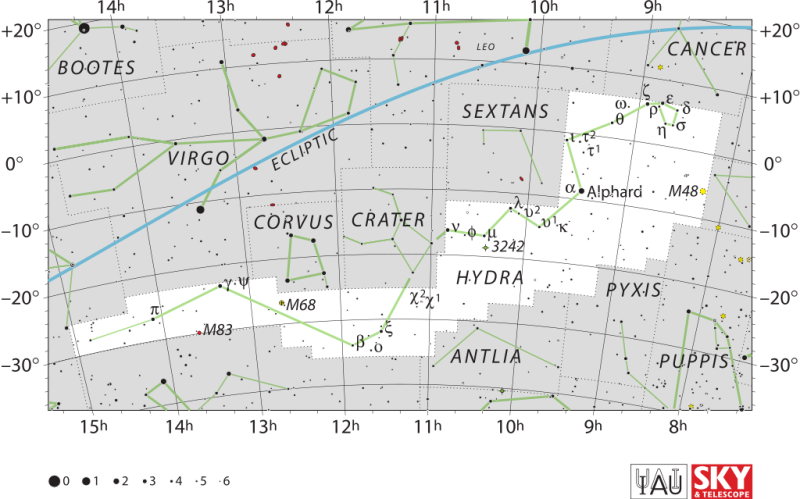
Hydra the Water Snake is the longest of the 88 constellations. It extends all the way from Cancer the Crab, below Leo the Lion, to the end of Virgo the Maiden. Image via IAU/ Wikimedia Commons (CC BY 3.0).
How to find Hydra and Alphard
Do you know the constellation Leo the Lion and its famous asterism – the Sickle – shaped like a backward question mark? If so – on an evening in March, April, or May – look for the distinctive backward question mark shape of its head and the triangle body.
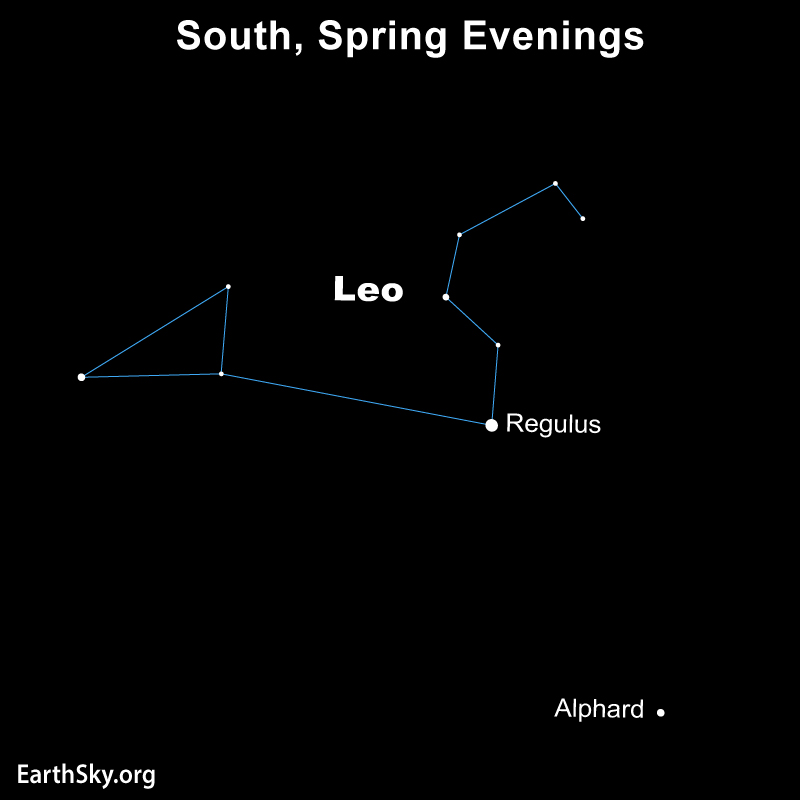
You’ll find Alphard not far from Regulus, Leo’s brightest star. Alphard is not as bright as Regulus, but it’s a distinctive orange color. Both Alphard and Regulus are known as the “heart” of their respective animal constellations.
So from Northern Hemisphere locations, look southward to Leo’s lower right to find Alphard. From the Southern Hemisphere, Regulus will be following Alphard across the night sky.
If you’re in the Northern Hemisphere – and you stand facing southward on a spring evening – Leo the Lion will be over your head. Alphard will be to the lower right of Regulus, Leo’s brightest star.
The solitary one
Much like Fomalhaut six months from now, Alphard is said to be a lonely star. It beams as the sole bright light in a sea of dim stars in its part of the sky. The Arabic name Alphard translates as the Solitary One.
Look at Alphard with binoculars to discern its orange color. Alphard’s color shows that it is entering into the autumn of its years, like the color of the orange stars Pollux and Arcturus, and the ruddy star Aldebaran. Old stars’ colors are reminiscent of the orange color of autumn leaves. Like Pollux, Arcturus and Aldebaran, Alphard will shed its outer layers someday soon (by astronomical standards) and shrink into a dead white dwarf star.
Pollux, Arcturus and Aldebaran appear brighter in our sky than Alphard, but that’s because they are so much closer to us. Alphard is intrinsically brighter than any of these stars. Yet it appears fainter, because it lies some 177 light-years away, while Pollux, Arcturus and Aldebaran reside at 34, 37, and 65 light-years away, respectively.
Bottom line: Alphard is the “heart” and brightest star in the constellation Hydra, and it represents a welcome sign of spring for the Northern Hemisphere.
On northern spring evenings – and southern autumn evenings – you’ll find Hydra the Water Snake ascending in the east. It is the longest constellation in the sky. And it isn’t fully up until late evenings in April for the Northern Hemisphere. Alphard – sometimes called Cor Hydrae or Hydra’s Heart – is the brightest star in Hydra. Photo copyright by Till Credner/ AlltheSky.com/ Wikimedia Commons (CC BY-SA 3.0).
Alphard (Alpha Hydrae) is the brightest star in the largest constellation in the sky, Hydra the Water Snake. Despite its long length, Hydra’s stars are mostly dim except for Alphard. You will need a very dark sky to see them. Meanwhile, Alphard shines at 2nd magnitude. So it’s about as bright as the stars of the Big Dipper.
Known as the Heart of the Snake, Alphard is a precursor of spring for us in the Northern Hemisphere.
Alphard brings a new season
Alphard’s warm orange color and location in the constellation’s core makes it a good representative for the Snake’s Heart. There is something about Alphard – some combination of its orange color and not-too-showy brightness – that looks friendly.
Like so many skywatchers before you, you’ll love seeing Alphard ascend in the early evening in late February and March as it ushers in a new season. Alphard is located in the upper part of the Water Snake. It has risen when darkness falls by the time of the March equinox.
The constellation is so long that the entire snake doesn’t rise until after midnight in March. Alphard heralds the rest of the snake, which ascends in the sky like a cobra from a snake charmer’s basket. On March, April and May evenings, this great star pattern stretches across a huge portion of the sky, from southeast to southwest above the Milky Way.
Hydra the Water Snake is the longest of the 88 constellations. It extends all the way from Cancer the Crab, below Leo the Lion, to the end of Virgo the Maiden. Image via IAU/ Wikimedia Commons (CC BY 3.0).
How to find Hydra and Alphard
Do you know the constellation Leo the Lion and its famous asterism – the Sickle – shaped like a backward question mark? If so – on an evening in March, April, or May – look for the distinctive backward question mark shape of its head and the triangle body.
You’ll find Alphard not far from Regulus, Leo’s brightest star. Alphard is not as bright as Regulus, but it’s a distinctive orange color. Both Alphard and Regulus are known as the “heart” of their respective animal constellations.
So from Northern Hemisphere locations, look southward to Leo’s lower right to find Alphard. From the Southern Hemisphere, Regulus will be following Alphard across the night sky.
If you’re in the Northern Hemisphere – and you stand facing southward on a spring evening – Leo the Lion will be over your head. Alphard will be to the lower right of Regulus, Leo’s brightest star.
The solitary one
Much like Fomalhaut six months from now, Alphard is said to be a lonely star. It beams as the sole bright light in a sea of dim stars in its part of the sky. The Arabic name Alphard translates as the Solitary One.
Look at Alphard with binoculars to discern its orange color. Alphard’s color shows that it is entering into the autumn of its years, like the color of the orange stars Pollux and Arcturus, and the ruddy star Aldebaran. Old stars’ colors are reminiscent of the orange color of autumn leaves. Like Pollux, Arcturus and Aldebaran, Alphard will shed its outer layers someday soon (by astronomical standards) and shrink into a dead white dwarf star.
Pollux, Arcturus and Aldebaran appear brighter in our sky than Alphard, but that’s because they are so much closer to us. Alphard is intrinsically brighter than any of these stars. Yet it appears fainter, because it lies some 177 light-years away, while Pollux, Arcturus and Aldebaran reside at 34, 37, and 65 light-years away, respectively.
Bottom line: Alphard is the “heart” and brightest star in the constellation Hydra, and it represents a welcome sign of spring for the Northern Hemisphere.
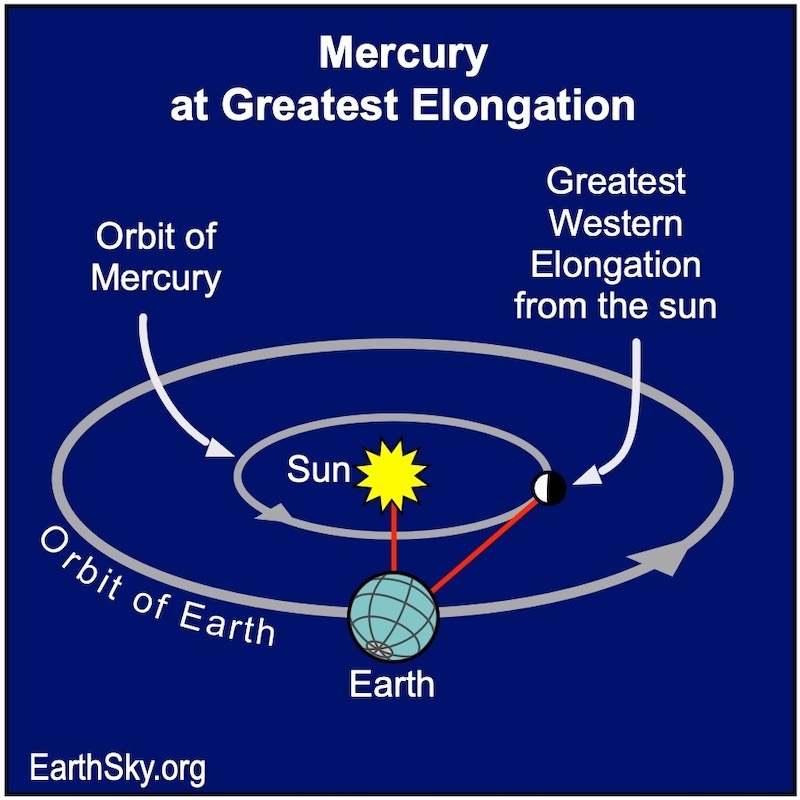
At greatest elongation on April 3, 2026, Mercury will lie to one side of the sun as seen from Earth. That’s when it’s at its greatest distance from the sun before sunrise on our sky’s dome. Chart via EarthSky.
Mercury farthest from the sunrise on April 3
The innermost planet Mercury orbits the sun every 88 days. And Earth is moving, too. So Mercury goes between us and the sun pretty often, about every 116 days. It did this last at 11 UTC on March 7, 2026, reaching the point astronomers call inferior conjunction. And since then, Mercury has been speeding ahead of Earth in orbit. It re-emerged into our eastern morning sky in mid-March. Look for it in the sunrise direction. Mercury will reach its greatest morning elongation – its greatest apparent distance from the rising sun – on April 3, 2026. This morning apparition favors the Southern Hemisphere.
Mercury greatest elongation, April 2026
When to watch: Officially, Mercury emerged in mid-March in the morning sky. Look for it shortly before sunrise. At greatest elongation – April 3, 2026 – Mercury is farthest from the sunrise on our sky’s dome. And after that, when it’ll be edging back toward the sunrise, it’ll brighten a little bit more, making Mercury easier to spot in the morning twilight. It’ll be low in the sky! This is the best morning apparition of Mercury for the Southern Hemisphere in 2026. Where to look: Look in the sunrise direction as the sky is getting lighter. Greatest elongation – marking Mercury’s farthest point from the sunrise glare – is on April 3, 2026 at 23 UTC (6:00 p.m. CDT). Mercury will shine at magnitude +0.4 that morning. At that time, Mercury will be 28 degrees from the sun on our sky’s dome. Through a telescope on and around April 3, Mercury appears 50% illuminated, in a quarter phase, and 7.64 arcseconds across. Note: After April 3, Mercury brightens a bit to magnitude -0.3 (bright, but competing with the morning twilight) until late April or early May. Around that time, it’ll slip away in the morning twilight. Mercury, Saturn and Mars conjunction: About 30 minutes before sunrise on April 20, look for Mercury, Saturn and Mars to lie near each other in the morning twilight. Binoculars might help spot the trio of planets.
By the way, this Mercury elongation – due to the high angle of the ecliptic to the horizon – favors the Southern Hemisphere.
After greatest elongation on April 3, the innermost planet – named for the fleet-footed messenger god of the ancient Romans – will be visible for a few more weeks, especially from the Southern Hemisphere.
For precise sun and Mercury rising times at your location:
Jan 21, 2026: Superior conjunction (passes behind sun from Earth) Feb 19, 2026: Greatest elongation (evening) Mar 7, 2026: Inferior conjunction (races between Earth and sun) Apr 3, 2026: Greatest elongation (morning) May 14, 2026: Superior conjunction (passes behind sun from Earth) Jun 15, 2026: Greatest elongation (evening) Jul 13, 2026: Inferior conjunction (races between Earth and sun) Aug 2, 2026: Greatest elongation (morning) Aug 27, 2026: Superior conjunction (passes behind sun from Earth) Oct 12, 2026: Greatest elongation (evening) Nov 4, 2026: Inferior conjunction (races between Earth and sun) Nov 21, 2026: Greatest elongation (morning)
Mercury charts from Guy Ottewell
Mercury’s greatest morning elongations in 2026 from the Northern Hemisphere as viewed through a powerful telescope. The planet images are at the 1st, 11th, and 21st of each month. Dots show the actual positions of the planet for every day. Chart via Guy Ottewell’s 2026 Astronomical Calendar. Used with permission.Mercury’s greatest morning elongations in 2026 from the Southern Hemisphere as viewed through a powerful telescope. The planet images are at the 1st, 11th, and 21st of each month. Dots show the actual positions of the planet for every day. Chart via Guy Ottewell’s 2026 Astronomical Calendar. Used with permission.
A comparison of elongations
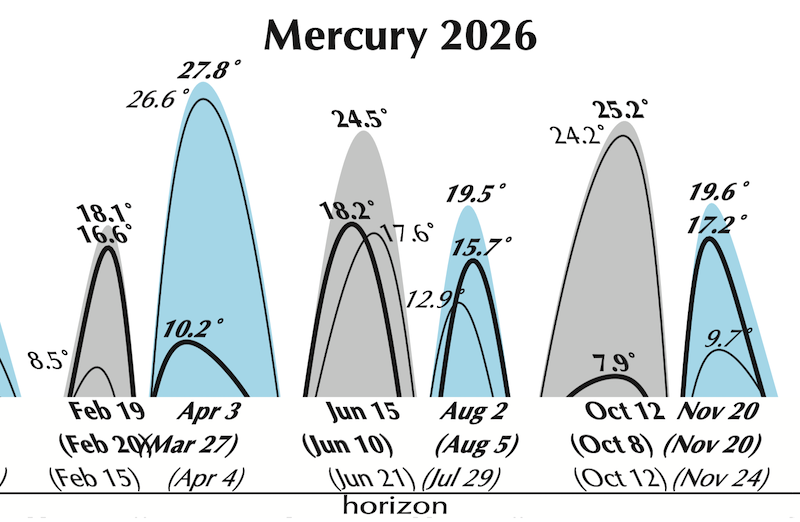
Mercury’s greatest elongations are not equal. Indeed, some are “greater” than others. For example, the distance of Mercury from the sun on our sky’s dome varies from about 28 degrees (maximum) to 18 degrees (minimum).
Also, Mercury’s elongations are better or worse depending on the time of the year they occur and your location on Earth. So, for both hemispheres, spring evenings and autumn mornings are best.
As an illustration, the chart below – from a Northern Hemisphere perspective – might help you visualize these differences.
Mercury elongations compared. Here, gray areas represent evening apparitions (eastward elongation). Blue areas represent morning apparitions (westward elongation). The top figures are the maximum elongations, reached at the top dates shown beneath. Curves show the altitude of the planet above the horizon at sunrise or sunset, for latitude 40 degrees north (thick line) and 35 degrees south (thin line). Likewise, maxima are reached at the parenthesized dates below (40 degrees north in bold). Chart via Guy Ottewell’s 2026 Astronomical Calendar. Used with permission.
So, in the autumn for either hemisphere, the ecliptic – or path of the sun, moon and planets – makes a narrow angle to the horizon in the evening. Conversely, it makes a steep slant, nearly perpendicular, in the morning. So – in autumn from either hemisphere – morning elongations of Mercury are best. Then, Mercury appears higher above the horizon and farther from the glow of the sun. Conversely, evening elongations in autumn are harder to see.
On the other hand, in the spring for either hemisphere, the situation reverses. Then, the ecliptic and the horizon meet at a sharper angle on spring evenings and at a narrower angle on spring mornings. So, in springtime for either hemisphere, evening elongations of Mercury are best. Meanwhile, morning elongations in springtime are harder to see.
Bottom line: Mercury will reach its greatest elongation – greatest distance from the sunrise – on April 3, 2026. Look east at dawn. It’ll disappear from the morning sky in late April.
At greatest elongation on April 3, 2026, Mercury will lie to one side of the sun as seen from Earth. That’s when it’s at its greatest distance from the sun before sunrise on our sky’s dome. Chart via EarthSky.
Mercury farthest from the sunrise on April 3
The innermost planet Mercury orbits the sun every 88 days. And Earth is moving, too. So Mercury goes between us and the sun pretty often, about every 116 days. It did this last at 11 UTC on March 7, 2026, reaching the point astronomers call inferior conjunction. And since then, Mercury has been speeding ahead of Earth in orbit. It re-emerged into our eastern morning sky in mid-March. Look for it in the sunrise direction. Mercury will reach its greatest morning elongation – its greatest apparent distance from the rising sun – on April 3, 2026. This morning apparition favors the Southern Hemisphere.
Mercury greatest elongation, April 2026
When to watch: Officially, Mercury emerged in mid-March in the morning sky. Look for it shortly before sunrise. At greatest elongation – April 3, 2026 – Mercury is farthest from the sunrise on our sky’s dome. And after that, when it’ll be edging back toward the sunrise, it’ll brighten a little bit more, making Mercury easier to spot in the morning twilight. It’ll be low in the sky! This is the best morning apparition of Mercury for the Southern Hemisphere in 2026. Where to look: Look in the sunrise direction as the sky is getting lighter. Greatest elongation – marking Mercury’s farthest point from the sunrise glare – is on April 3, 2026 at 23 UTC (6:00 p.m. CDT). Mercury will shine at magnitude +0.4 that morning. At that time, Mercury will be 28 degrees from the sun on our sky’s dome. Through a telescope on and around April 3, Mercury appears 50% illuminated, in a quarter phase, and 7.64 arcseconds across. Note: After April 3, Mercury brightens a bit to magnitude -0.3 (bright, but competing with the morning twilight) until late April or early May. Around that time, it’ll slip away in the morning twilight. Mercury, Saturn and Mars conjunction: About 30 minutes before sunrise on April 20, look for Mercury, Saturn and Mars to lie near each other in the morning twilight. Binoculars might help spot the trio of planets.
By the way, this Mercury elongation – due to the high angle of the ecliptic to the horizon – favors the Southern Hemisphere.
After greatest elongation on April 3, the innermost planet – named for the fleet-footed messenger god of the ancient Romans – will be visible for a few more weeks, especially from the Southern Hemisphere.
For precise sun and Mercury rising times at your location:
Jan 21, 2026: Superior conjunction (passes behind sun from Earth) Feb 19, 2026: Greatest elongation (evening) Mar 7, 2026: Inferior conjunction (races between Earth and sun) Apr 3, 2026: Greatest elongation (morning) May 14, 2026: Superior conjunction (passes behind sun from Earth) Jun 15, 2026: Greatest elongation (evening) Jul 13, 2026: Inferior conjunction (races between Earth and sun) Aug 2, 2026: Greatest elongation (morning) Aug 27, 2026: Superior conjunction (passes behind sun from Earth) Oct 12, 2026: Greatest elongation (evening) Nov 4, 2026: Inferior conjunction (races between Earth and sun) Nov 21, 2026: Greatest elongation (morning)
Mercury charts from Guy Ottewell
Mercury’s greatest morning elongations in 2026 from the Northern Hemisphere as viewed through a powerful telescope. The planet images are at the 1st, 11th, and 21st of each month. Dots show the actual positions of the planet for every day. Chart via Guy Ottewell’s 2026 Astronomical Calendar. Used with permission.Mercury’s greatest morning elongations in 2026 from the Southern Hemisphere as viewed through a powerful telescope. The planet images are at the 1st, 11th, and 21st of each month. Dots show the actual positions of the planet for every day. Chart via Guy Ottewell’s 2026 Astronomical Calendar. Used with permission.
A comparison of elongations
Mercury’s greatest elongations are not equal. Indeed, some are “greater” than others. For example, the distance of Mercury from the sun on our sky’s dome varies from about 28 degrees (maximum) to 18 degrees (minimum).
Also, Mercury’s elongations are better or worse depending on the time of the year they occur and your location on Earth. So, for both hemispheres, spring evenings and autumn mornings are best.
As an illustration, the chart below – from a Northern Hemisphere perspective – might help you visualize these differences.
Mercury elongations compared. Here, gray areas represent evening apparitions (eastward elongation). Blue areas represent morning apparitions (westward elongation). The top figures are the maximum elongations, reached at the top dates shown beneath. Curves show the altitude of the planet above the horizon at sunrise or sunset, for latitude 40 degrees north (thick line) and 35 degrees south (thin line). Likewise, maxima are reached at the parenthesized dates below (40 degrees north in bold). Chart via Guy Ottewell’s 2026 Astronomical Calendar. Used with permission.
So, in the autumn for either hemisphere, the ecliptic – or path of the sun, moon and planets – makes a narrow angle to the horizon in the evening. Conversely, it makes a steep slant, nearly perpendicular, in the morning. So – in autumn from either hemisphere – morning elongations of Mercury are best. Then, Mercury appears higher above the horizon and farther from the glow of the sun. Conversely, evening elongations in autumn are harder to see.
On the other hand, in the spring for either hemisphere, the situation reverses. Then, the ecliptic and the horizon meet at a sharper angle on spring evenings and at a narrower angle on spring mornings. So, in springtime for either hemisphere, evening elongations of Mercury are best. Meanwhile, morning elongations in springtime are harder to see.
Bottom line: Mercury will reach its greatest elongation – greatest distance from the sunrise – on April 3, 2026. Look east at dawn. It’ll disappear from the morning sky in late April.
Today in science: March 27, 1964. On this date, the most powerful earthquake ever recorded in North America struck in the Prince William Sound southeast of Anchorage, Alaska, at 5:36 p.m. local time. The 9.2-magnitude earthquake rocked the state for more than four minutes, spawning a tsunami that reached all the way to Hawaii and Northern California.
The massive quake is known as the Great Alaska Earthquake or the Good Friday Earthquake. According to the U.S. Geological Survey (USGS), it holds the record for the 2nd-largest earthquake ever recorded on Earth, behind the 1960 Chile quake (which had a magnitude of about 9.5).
On that day, it had been a relatively warm day in Anchorage, Alaska’s largest city, about 75 miles (120 km) from the quake’s epicenter. Luckily, schools were closed for Good Friday, along with many offices. As the quake began, dozens of blocks of buildings were leveled or heavily damaged in Anchorage.
Valdez was completely destroyed
The city of Valdez, closest to the epicenter, was completely destroyed.
Damage to Fourth Avenue in Anchorage, Alaska, caused by the Good Friday Earthquake, the biggest earthquake ever in North America. The sidewalk on the left started out at the level of the street on the right. Image via USGS/ Wikimedia Commons.
The prolonged shaking resulted in many natural changes as well. For example, according to the Alaska Earthquake Center, the Latouche Island area moved to the southeast by nearly 60 feet (20 meters).
Now the USGS estimates the earthquake and its accompanying tsunami caused $311 million in damages across the state of Alaska (over $2 billion in today’s dollars).
During the 1964 Good Friday Earthquake in Alaska, both human and natural areas sustained damage. This image is from the Turnagain Heights neighborhood of Anchorage, Alaska. Image via NOAA/ Wikimedia Commons.Landslide damage in the Turnagain Heights neighborhood of Anchorage, Alaska. Image via USGS/ Wikimedia Commons.
There were some fatalities
All things considered, the loss of human life was relatively small from such a strong earthquake. In the end, 130 people were killed. The UAF Alaska Earthquake Center said the low death rate was:
… due to low population density, the time of day and the fact that it was a holiday, and the type of material used to construct many buildings (wood).
View larger. | Map of southern Alaska showing the epicenter of the 1964 Good Friday Earthquake (red star). Image via USGS.
Despite the tragic loss of life from the 1964 Great Alaska Earthquake, it didn’t come close to the fatalities from two slightly smaller and more recent quakes: the December 26, 2004, Indian Ocean 9.1-magnitude earthquake and tsunami (third-largest earthquake recorded on a seismograph, with over 230,000 people killed in 14 countries) and the March 11, 2011, 9.0-magnitude earthquake in Japan (fifth-largest earthquake recorded on a seismograph, with nearly 16,000 deaths).
Luckily, in 1964, Alaska was sparsely populated. Today’s Alaska has a larger human population. If and when a similar quake strikes again, the death toll might be higher.
The waterfront in Seward, Alaska, a few months after the 1964 Good Friday earthquake. Image via USGS/ Wikimedia Commons.
Bottom line: The most powerful earthquake ever recorded to strike North America rocked south-central Alaska on Good Friday, March 27, 1964, and registered a magnitude 9.2 on the Richter scale.
Today in science: March 27, 1964. On this date, the most powerful earthquake ever recorded in North America struck in the Prince William Sound southeast of Anchorage, Alaska, at 5:36 p.m. local time. The 9.2-magnitude earthquake rocked the state for more than four minutes, spawning a tsunami that reached all the way to Hawaii and Northern California.
The massive quake is known as the Great Alaska Earthquake or the Good Friday Earthquake. According to the U.S. Geological Survey (USGS), it holds the record for the 2nd-largest earthquake ever recorded on Earth, behind the 1960 Chile quake (which had a magnitude of about 9.5).
On that day, it had been a relatively warm day in Anchorage, Alaska’s largest city, about 75 miles (120 km) from the quake’s epicenter. Luckily, schools were closed for Good Friday, along with many offices. As the quake began, dozens of blocks of buildings were leveled or heavily damaged in Anchorage.
Valdez was completely destroyed
The city of Valdez, closest to the epicenter, was completely destroyed.
Damage to Fourth Avenue in Anchorage, Alaska, caused by the Good Friday Earthquake, the biggest earthquake ever in North America. The sidewalk on the left started out at the level of the street on the right. Image via USGS/ Wikimedia Commons.
The prolonged shaking resulted in many natural changes as well. For example, according to the Alaska Earthquake Center, the Latouche Island area moved to the southeast by nearly 60 feet (20 meters).
Now the USGS estimates the earthquake and its accompanying tsunami caused $311 million in damages across the state of Alaska (over $2 billion in today’s dollars).
During the 1964 Good Friday Earthquake in Alaska, both human and natural areas sustained damage. This image is from the Turnagain Heights neighborhood of Anchorage, Alaska. Image via NOAA/ Wikimedia Commons.Landslide damage in the Turnagain Heights neighborhood of Anchorage, Alaska. Image via USGS/ Wikimedia Commons.
There were some fatalities
All things considered, the loss of human life was relatively small from such a strong earthquake. In the end, 130 people were killed. The UAF Alaska Earthquake Center said the low death rate was:
… due to low population density, the time of day and the fact that it was a holiday, and the type of material used to construct many buildings (wood).
View larger. | Map of southern Alaska showing the epicenter of the 1964 Good Friday Earthquake (red star). Image via USGS.
Despite the tragic loss of life from the 1964 Great Alaska Earthquake, it didn’t come close to the fatalities from two slightly smaller and more recent quakes: the December 26, 2004, Indian Ocean 9.1-magnitude earthquake and tsunami (third-largest earthquake recorded on a seismograph, with over 230,000 people killed in 14 countries) and the March 11, 2011, 9.0-magnitude earthquake in Japan (fifth-largest earthquake recorded on a seismograph, with nearly 16,000 deaths).
Luckily, in 1964, Alaska was sparsely populated. Today’s Alaska has a larger human population. If and when a similar quake strikes again, the death toll might be higher.
The waterfront in Seward, Alaska, a few months after the 1964 Good Friday earthquake. Image via USGS/ Wikimedia Commons.
Bottom line: The most powerful earthquake ever recorded to strike North America rocked south-central Alaska on Good Friday, March 27, 1964, and registered a magnitude 9.2 on the Richter scale.
A driver captured this video with their dashcam as a fireball entered the atmosphere over Texas on March 21, 2026. Image via AMS. We’ve seen a flurry of fireballs in March 2026. Is something going on? The American Meteor Society investigated. Read on for the results.
A flurry of fireballs has people wondering what’s happening
We’ve seen a flurry of fireballs lighting up the skies over the past few weeks. On March 3, 2026, a meteor entered Earth’s atmosphere over Vancouver and Washington, breaking the sound barrier and causing a sonic boom. Then, western Europe saw fireballs on March 8 and again on March 11. And on March 17, another meteor with its associated sonic boom rocked residents of Ohio. Two days later came two fireballs over California, and a day after that were fireballs over Michigan and Georgia. And on March 21, a fireball over Texas dropped a rock through the roof of a house in Houston.
What’s going on?
Enough people have been asking this question that the American Meteor Society (AMS) said:
The first quarter of 2026 has produced what appears to be a significant surge in large fireball events. The data, drawn from the AMS database going back to 2011, shows a pattern that warrants serious investigation.
The organization reported the findings of that investigation on March 24, 2026. Its main findings were that there is no evidence of an impact threat. The objects were in the normal size range of those that regularly impact Earth. But what has changed is the volume of reports it has received across several categories, including witness counts, sonic boom rates, long-duration sighting volume and the distribution of event sizes. The AMS said:
Whether this reflects a genuine change in the near-Earth meteoroid environment, an amplification of reporting through AI and social media, or some combination of both—we cannot yet say definitively. What we can say is that the question deserves both public awareness and scientific attention.
An uptick in fireballs, or reports?
First, what are fireballs? They are especially bright meteors that light up the night sky as they streak across the atmosphere. They can even glow brightly enough to be seen in the daytime. Astronomers call bright meteors like this bolides.
And now it seems people are reporting fireballs like never before. The AMS has had a reporting system in place since 2005. It looked back through the data to see if it could pinpoint anything that has changed, and why.
In the first quarter of 2026, the AMS found 2,046 total events. There were 38 events that had more than 50 reports each. The average per quarter is 18 events with greater than 50 reports. And 14 of those events had more than 100 reports each, compared to the average of 7 events.
But while the AMS found the number of events (2,046) is the highest on record, it’s only slightly above the other highs of 2,037 events in 2022 and 1,947 events in 2021. It said:
The signal is still at the top of the distribution.
What it did find is there are a larger number of reports. Again, from the AMS:
What has changed is that a large fraction of events that would normally draw 25–49 witnesses instead drew 50, 100, or even 200+ witnesses. The distribution didn’t broaden—it shifted upward. Almost half of all March 2026 events with 10+ reports were seen by 50 or more people.
Dana Jason Wood captured the St. Patrick’s Day fireball from Munhall, Pennsylvania, and submitted it to the American Meteor Society.
More sonic booms
But the AMS noted that the change cannot only be attributed to more people reporting fireballs. Because that doesn’t explain for the increase in sonic booms. When a meteor enters Earth’s atmosphere, it burns up due to friction. Meteors can zip through the air at 25,000 to 160,000 miles per hour (11 to 72 km per second). Usually, these small space rocks, the size of pebbles, burn up completely and never reach the ground.
But larger space rocks can survive longer in the atmosphere, penetrating deep enough to produce pressure waves and, thus, sonic booms. They can even be large enough to deposit meteorites onto the landscape below, as we’ve seen in Ohio and Texas.
And the recent meteors have been remarkable in that 30 of the 38 events that had more than 50 witness reports included sonic booms. As the AMS said:
Thirty large fireball events producing audible booms in a single quarter means roughly one every three days.
Where are these meteors coming from?
Meteors that come from regular showers, such as the Lyrids, all emanate from a single source. That is, if you trace the path of the meteor backward, they all appear to come from the same general area, which astronomers call the radiant. The radiant for the Lyrid meteor shower is in the constellation Lyra. The meteors aren’t actually coming from that constellation, of course. They are bits of rock, usually left behind by comets that release debris in their orbits as they round the sun. Then Earth plows into those trails of debris, and we see the result as meteors.
So are these recent fireballs related? Do they come from the same region of sky? Could it be a new meteor shower?
The AMS found that the recent events did have enhanced activity from two directions. One is the direction opposite the sun, which astronomers call the anthelion. The other is meteors that came in at a steep angle, not in alignment with the plane of our solar system. And astronomers call this a high-declination radiant. Referring to the high-declination meteors, the AMS said:
An enhancement in this population is unusual and warrants further study.
Interestingly, two of the meteorite falls in March were of a rare type of meteorite. These were achondrites, specifically in the subgroup of eucrites. It is thought that eucrites come from the asteroid Vesta. And yet these two meteorite falls, in Ohio and Germany, entered at near opposite angles from each other.
What the increase isn’t
The AMS concluded with a long list of possibilities for the uptick that it said it has ruled out. These include:
The AMS also said these fireballs are not of alien origin. Also, the meteorites recovered in Ohio and Germany show they are consistent with extraterrestrial rocks and are not “artificial”.
Something the AMS is still unsure of is if AI is helping to drive the reporting numbers. It said:
When someone witnesses a fireball today, they may ask ChatGPT, Siri, or Google’s AI “I just saw a fireball—where do I report it?” and be directed to the AMS. This would inflate witness counts per event without changing the actual number of fireballs—which is, notably, the exact pattern we observe: normal total event counts but elevated reports per event at the high end. We cannot quantify this effect with the data currently available, but it is a plausible partial explanation for the upward shift in the witness-count distribution. It would not, however, account for the elevated sonic boom rates or the recovered meteorite falls.
Meanwhile, the AMS will continue to track fireballs and look for patterns and explanations.
Will the flurry of fireballs continue? No one knows. Keep your eyes, and your ears, open! And if you see a fireball, report it to the AMS here.
Bottom line: We’ve seen a flurry of fireballs, particularly in March, with reports from Europe to Canada and the U.S. Is there a reason for the uptick? The American Meteor Society investigates.
A driver captured this video with their dashcam as a fireball entered the atmosphere over Texas on March 21, 2026. Image via AMS. We’ve seen a flurry of fireballs in March 2026. Is something going on? The American Meteor Society investigated. Read on for the results.
A flurry of fireballs has people wondering what’s happening
We’ve seen a flurry of fireballs lighting up the skies over the past few weeks. On March 3, 2026, a meteor entered Earth’s atmosphere over Vancouver and Washington, breaking the sound barrier and causing a sonic boom. Then, western Europe saw fireballs on March 8 and again on March 11. And on March 17, another meteor with its associated sonic boom rocked residents of Ohio. Two days later came two fireballs over California, and a day after that were fireballs over Michigan and Georgia. And on March 21, a fireball over Texas dropped a rock through the roof of a house in Houston.
What’s going on?
Enough people have been asking this question that the American Meteor Society (AMS) said:
The first quarter of 2026 has produced what appears to be a significant surge in large fireball events. The data, drawn from the AMS database going back to 2011, shows a pattern that warrants serious investigation.
The organization reported the findings of that investigation on March 24, 2026. Its main findings were that there is no evidence of an impact threat. The objects were in the normal size range of those that regularly impact Earth. But what has changed is the volume of reports it has received across several categories, including witness counts, sonic boom rates, long-duration sighting volume and the distribution of event sizes. The AMS said:
Whether this reflects a genuine change in the near-Earth meteoroid environment, an amplification of reporting through AI and social media, or some combination of both—we cannot yet say definitively. What we can say is that the question deserves both public awareness and scientific attention.
An uptick in fireballs, or reports?
First, what are fireballs? They are especially bright meteors that light up the night sky as they streak across the atmosphere. They can even glow brightly enough to be seen in the daytime. Astronomers call bright meteors like this bolides.
And now it seems people are reporting fireballs like never before. The AMS has had a reporting system in place since 2005. It looked back through the data to see if it could pinpoint anything that has changed, and why.
In the first quarter of 2026, the AMS found 2,046 total events. There were 38 events that had more than 50 reports each. The average per quarter is 18 events with greater than 50 reports. And 14 of those events had more than 100 reports each, compared to the average of 7 events.
But while the AMS found the number of events (2,046) is the highest on record, it’s only slightly above the other highs of 2,037 events in 2022 and 1,947 events in 2021. It said:
The signal is still at the top of the distribution.
What it did find is there are a larger number of reports. Again, from the AMS:
What has changed is that a large fraction of events that would normally draw 25–49 witnesses instead drew 50, 100, or even 200+ witnesses. The distribution didn’t broaden—it shifted upward. Almost half of all March 2026 events with 10+ reports were seen by 50 or more people.
Dana Jason Wood captured the St. Patrick’s Day fireball from Munhall, Pennsylvania, and submitted it to the American Meteor Society.
More sonic booms
But the AMS noted that the change cannot only be attributed to more people reporting fireballs. Because that doesn’t explain for the increase in sonic booms. When a meteor enters Earth’s atmosphere, it burns up due to friction. Meteors can zip through the air at 25,000 to 160,000 miles per hour (11 to 72 km per second). Usually, these small space rocks, the size of pebbles, burn up completely and never reach the ground.
But larger space rocks can survive longer in the atmosphere, penetrating deep enough to produce pressure waves and, thus, sonic booms. They can even be large enough to deposit meteorites onto the landscape below, as we’ve seen in Ohio and Texas.
And the recent meteors have been remarkable in that 30 of the 38 events that had more than 50 witness reports included sonic booms. As the AMS said:
Thirty large fireball events producing audible booms in a single quarter means roughly one every three days.
Where are these meteors coming from?
Meteors that come from regular showers, such as the Lyrids, all emanate from a single source. That is, if you trace the path of the meteor backward, they all appear to come from the same general area, which astronomers call the radiant. The radiant for the Lyrid meteor shower is in the constellation Lyra. The meteors aren’t actually coming from that constellation, of course. They are bits of rock, usually left behind by comets that release debris in their orbits as they round the sun. Then Earth plows into those trails of debris, and we see the result as meteors.
So are these recent fireballs related? Do they come from the same region of sky? Could it be a new meteor shower?
The AMS found that the recent events did have enhanced activity from two directions. One is the direction opposite the sun, which astronomers call the anthelion. The other is meteors that came in at a steep angle, not in alignment with the plane of our solar system. And astronomers call this a high-declination radiant. Referring to the high-declination meteors, the AMS said:
An enhancement in this population is unusual and warrants further study.
Interestingly, two of the meteorite falls in March were of a rare type of meteorite. These were achondrites, specifically in the subgroup of eucrites. It is thought that eucrites come from the asteroid Vesta. And yet these two meteorite falls, in Ohio and Germany, entered at near opposite angles from each other.
What the increase isn’t
The AMS concluded with a long list of possibilities for the uptick that it said it has ruled out. These include:
The AMS also said these fireballs are not of alien origin. Also, the meteorites recovered in Ohio and Germany show they are consistent with extraterrestrial rocks and are not “artificial”.
Something the AMS is still unsure of is if AI is helping to drive the reporting numbers. It said:
When someone witnesses a fireball today, they may ask ChatGPT, Siri, or Google’s AI “I just saw a fireball—where do I report it?” and be directed to the AMS. This would inflate witness counts per event without changing the actual number of fireballs—which is, notably, the exact pattern we observe: normal total event counts but elevated reports per event at the high end. We cannot quantify this effect with the data currently available, but it is a plausible partial explanation for the upward shift in the witness-count distribution. It would not, however, account for the elevated sonic boom rates or the recovered meteorite falls.
Meanwhile, the AMS will continue to track fireballs and look for patterns and explanations.
Will the flurry of fireballs continue? No one knows. Keep your eyes, and your ears, open! And if you see a fireball, report it to the AMS here.
Bottom line: We’ve seen a flurry of fireballs, particularly in March, with reports from Europe to Canada and the U.S. Is there a reason for the uptick? The American Meteor Society investigates.
This composite image from ESO’s Very Large Telescope (VLT) shows 2 planets forming in the disk of dust around the young star WISPIT 2. Astronomers discovered the outermost planet, WISPIT 2b, in 2025. And now they’ve confirmed the existence of WISPIT 2c, which orbits much closer to the star. Image via ESO/ C. Lawlor, R. F. van Capelleveen et al.
Astronomers have discovered a 2nd planet forming around the young star WISPIT 2, some 437 light-years away.
It orbits far closer to its star than fellow planet WISPIT 2b, which astronomers detected in 2025.
The findings suggest the WISPIT 2 system might resemble a much younger version of our own solar system.
Astronomers spot 2 planets forming around young star
Astronomers have observed two planets forming in the disk around a young star named WISPIT 2, some 437 light-years away.
Having detected the 1st planet in 2025, the team has now employed European Southern Observatory (ESO) telescopes to confirm the presence of another. These observations, and the unique structure of the disk around the star, indicate that the WISPIT 2 system could resemble a young version of our own solar system.
WISPIT 2 is the best look into our own past that we have to date.
Lawlor and her team revealed the results in a peer-reviewed study published on March 24, 2026, in The Astrophysical Journal Letters.
A closeup of the newly discovered exoplanet WISPIT 2c, which orbits far closer to its star than WISPIT 2b. Image via ESO/ C. Lawlor, R. F. van Capelleveen et al.
The system is only the 2nd known, after PDS 70, where two planets have been directly observed in the process of forming around their host star. But unlike PDS 70, however, WISPIT 2 has a very extended planet-forming disk with distinctive gaps and rings. As Lawlor explained:
These structures suggest that more planets are currently forming, which we will eventually detect.
WISPIT 2 gives us a critical laboratory not just to observe the formation of a single planet but an entire planetary system.
Now, with such observations, astronomers aim to better understand how baby planetary systems develop into mature ones, like our own.
A 2nd planet for WISPIT 2
Astronomers detected the system’s 1st newborn planet – named WISPIT 2b – last year. It has a mass almost five times that of Jupiter, and orbits the central star at around 60 times the distance between Earth and the sun.
Later, after astronomers then spotted an additional object near the star, observations with ESO’s Very Large Telescope (VLT) and the VLT Interferometer (VLTI) confirmed that it’s a planet. The VLTI’s GRAVITY+ instrument was crucial, explained study co-author Guillaume Bourdarot:
Critically, our study made use of the recent upgrade to GRAVITY+, without which we would not have been able to get such a clear detection of the planet so close to its star.
The new planet – WISPIT 2c – is four times closer to the central star and twice as massive as WISPIT 2b. And both planets are gas giants, like the outer planets in our solar system.
Planets forming in a young dust disk
Both planets in WISPIT 2 appear in clear gaps within the disk of dust and gas circling the young star. These gaps result from each planet’s development. As particles in the disk accumulate, their gravity pulls in more material until an embryo planet forms. The remaining material, around each gap, then creates distinctive dust rings in the disk.
In addition, besides the gaps that the two planets were found in, there is at least one smaller gap farther out in the WISPIT 2 disk. Lawlor said:
We suspect there may be a 3rd planet carving out this gap, potentially of Saturn mass, owing to the gap being much narrower and shallower.
The team is eager to make follow-up observations, with Ginski noting:
With ESO’s upcoming Extremely Large Telescope, we may be able to directly image such a planet.
Bottom line: Astronomers have spotted two planets forming in the disk around a young star named WISPIT 2, which resembles a young version of our solar system.
This composite image from ESO’s Very Large Telescope (VLT) shows 2 planets forming in the disk of dust around the young star WISPIT 2. Astronomers discovered the outermost planet, WISPIT 2b, in 2025. And now they’ve confirmed the existence of WISPIT 2c, which orbits much closer to the star. Image via ESO/ C. Lawlor, R. F. van Capelleveen et al.
Astronomers have discovered a 2nd planet forming around the young star WISPIT 2, some 437 light-years away.
It orbits far closer to its star than fellow planet WISPIT 2b, which astronomers detected in 2025.
The findings suggest the WISPIT 2 system might resemble a much younger version of our own solar system.
Astronomers spot 2 planets forming around young star
Astronomers have observed two planets forming in the disk around a young star named WISPIT 2, some 437 light-years away.
Having detected the 1st planet in 2025, the team has now employed European Southern Observatory (ESO) telescopes to confirm the presence of another. These observations, and the unique structure of the disk around the star, indicate that the WISPIT 2 system could resemble a young version of our own solar system.
WISPIT 2 is the best look into our own past that we have to date.
Lawlor and her team revealed the results in a peer-reviewed study published on March 24, 2026, in The Astrophysical Journal Letters.
A closeup of the newly discovered exoplanet WISPIT 2c, which orbits far closer to its star than WISPIT 2b. Image via ESO/ C. Lawlor, R. F. van Capelleveen et al.
The system is only the 2nd known, after PDS 70, where two planets have been directly observed in the process of forming around their host star. But unlike PDS 70, however, WISPIT 2 has a very extended planet-forming disk with distinctive gaps and rings. As Lawlor explained:
These structures suggest that more planets are currently forming, which we will eventually detect.
WISPIT 2 gives us a critical laboratory not just to observe the formation of a single planet but an entire planetary system.
Now, with such observations, astronomers aim to better understand how baby planetary systems develop into mature ones, like our own.
A 2nd planet for WISPIT 2
Astronomers detected the system’s 1st newborn planet – named WISPIT 2b – last year. It has a mass almost five times that of Jupiter, and orbits the central star at around 60 times the distance between Earth and the sun.
Later, after astronomers then spotted an additional object near the star, observations with ESO’s Very Large Telescope (VLT) and the VLT Interferometer (VLTI) confirmed that it’s a planet. The VLTI’s GRAVITY+ instrument was crucial, explained study co-author Guillaume Bourdarot:
Critically, our study made use of the recent upgrade to GRAVITY+, without which we would not have been able to get such a clear detection of the planet so close to its star.
The new planet – WISPIT 2c – is four times closer to the central star and twice as massive as WISPIT 2b. And both planets are gas giants, like the outer planets in our solar system.
Planets forming in a young dust disk
Both planets in WISPIT 2 appear in clear gaps within the disk of dust and gas circling the young star. These gaps result from each planet’s development. As particles in the disk accumulate, their gravity pulls in more material until an embryo planet forms. The remaining material, around each gap, then creates distinctive dust rings in the disk.
In addition, besides the gaps that the two planets were found in, there is at least one smaller gap farther out in the WISPIT 2 disk. Lawlor said:
We suspect there may be a 3rd planet carving out this gap, potentially of Saturn mass, owing to the gap being much narrower and shallower.
The team is eager to make follow-up observations, with Ginski noting:
With ESO’s upcoming Extremely Large Telescope, we may be able to directly image such a planet.
Bottom line: Astronomers have spotted two planets forming in the disk around a young star named WISPIT 2, which resembles a young version of our solar system.
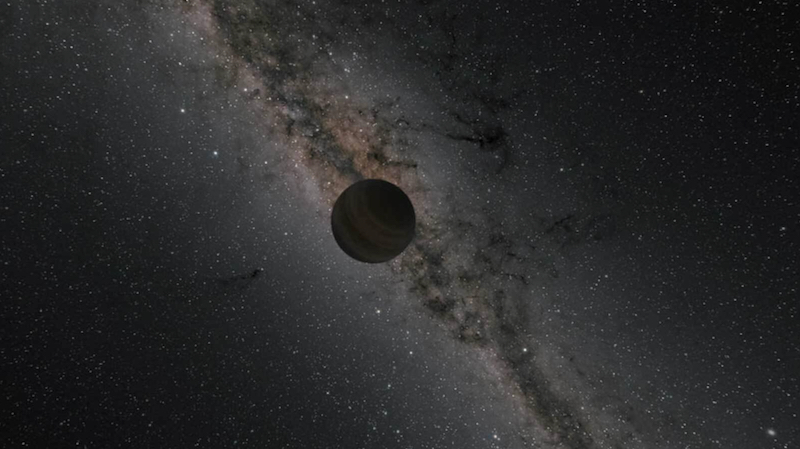
View larger. | Artist’s concept of an Earth-like exomoon orbiting a rogue Saturn-like exoplanet. A new study led by Ludwig Maximilian University of Munich in Germany looked at moons of rogue planets that have been ejected from their planetary systems. The study said these moons could still have oceans and be potentially habitable, if they have hydrogen atmospheres. Image via Frizaven/ Wikipedia (Celestia/GNU General Public License).
Rogue planets float free in space, not bound to any stars. Some of them might have moons. Could those moons be habitable?
A moon of a rogue planet could be habitable if it has a hydrogen atmosphere. That’s what a team of researchers led by Ludwig Maximilian University of Munich said in a new study.
The hydrogen atmosphere could create a greenhouse effect, keeping the moon warm enough for oceans or perhaps even life. And that’s even without the heat of a nearby star.
Astronomers have found a growing number of exoplanets that don’t orbit any stars. They are rogue – or free-floating – worlds in the ocean of space. So could any of them be habitable? Or any of their moons? A team of researchers led by Ludwig Maximilian University of Munich in Germany said it’s possible. On March 11, 2026, the researchers said that moons orbiting large free-floating planets could maintain water if they have hydrogen atmospheres. And they could stay habitable for billions of years.
These moons would likely have highly elliptical orbits. That’s due to the planets being ejected from their planetary system out into interstellar space. But those orbits could generate enough internal heating for water to exist on the moons. Plus, a hydrogen atmosphere would create a greenhouse effect. That would also help keep the surfaces of the moons warm enough for water, maybe even oceans. And if there’s water, then there’s the possibility for habitability and even life. Incredibly, all of this is possible without any stars being nearby to heat the moons.
Astronomers have discovered a surprising number of free-floating planets in recent years. How did they become starless? Scientists think some might just form that way. But sometimes if a “regular” planet gets too close to its star, the star’s gravity could fling it out of the planetary system. They could also go rogue due to gravitational interactions between the planet and other planets.
Now, the new study shows that if a large planet – like Jupiter, for example – is ejected into interstellar space, it might not lose all its moons in the process. If it has any, of course.
But the orbits of those moons would likely be significantly affected by the ejection. They would become highly elliptical instead of more circular. That might be a good thing, however.
David Dahlbüdding: “We discovered a clear connection between these distant moons and the early Earth, where high concentrations of hydrogen through asteroid impacts could have created the conditions for life.” https://ift.tt/mds79U4…
A moon with a highly elongated orbit around its planet would be subject to strong tidal forces. As the moon gets close to the planet and then far away again, the planet’s gravity squeezes and pulls at its interior. And that can generate a lot of heat inside the moon.
That’s what happens with Jupiter’s volcanic moon Io. It also happens to the moons with oceans beneath their icy crusts.
The deformation caused by these tidal forces creates wet-dry cycles. That’s when water evaporates and then later recondenses in an on-going cycle. This helps complex molecules to form, including those essential to life.
View larger. | Artist’s concept of a massive exomoon orbiting a gas giant exoplanet. Image via NASA/ ESA/ L. Hustak (STScI).View larger. | Artist’s concept of a rogue exoplanet drifting in the darkness of space among the stars. Watch a NASA animation. Image via NASA/ JPL-Caltech/ R. Hurt (Caltech-IPAC).
Hydrogen atmospheres and habitability
If a moon was fairly large and still had a primordial (original) hydrogen atmosphere, it could maintain an ocean. Indeed, there are some hints of large moons – even as large as Earth – orbiting giant exoplanets, although scientists are still trying to confirm them.
A hydrogen atmosphere could create a greenhouse effect on the moon. So the greenhouse effect would keep heat in the moon’s atmosphere. And that’s even without the help of a nearby star. Also, a hydrogen atmosphere should remain stable.
Unlike hydrogen, a carbon dioxide atmosphere can trap heat but not indefinitely. On Venus, this leads to a runaway greenhouse effect on the surface. In space, the carbon dioxide would eventually condense in the surrounding cold, allowing heat to escape.
Astronomers now estimate there are billions of rogue planets in our galaxy, at least as many rogue planets as there are planets bound to stars. If so, then there could be an enormous number of rogue moons out there as well!
The postulated conditions on moons of rogue planets have similarities to the early Earth several billion years ago as well. Dahlbüdding said:
We discovered a clear connection between these distant moons and the early Earth, where high concentrations of hydrogen through asteroid impacts could have created the conditions for life.
Bottom line: Could moons of rogue planets support life? A new study led by researchers in Germany shows they could, if they have hydrogen atmospheres.
View larger. | Artist’s concept of an Earth-like exomoon orbiting a rogue Saturn-like exoplanet. A new study led by Ludwig Maximilian University of Munich in Germany looked at moons of rogue planets that have been ejected from their planetary systems. The study said these moons could still have oceans and be potentially habitable, if they have hydrogen atmospheres. Image via Frizaven/ Wikipedia (Celestia/GNU General Public License).
Rogue planets float free in space, not bound to any stars. Some of them might have moons. Could those moons be habitable?
A moon of a rogue planet could be habitable if it has a hydrogen atmosphere. That’s what a team of researchers led by Ludwig Maximilian University of Munich said in a new study.
The hydrogen atmosphere could create a greenhouse effect, keeping the moon warm enough for oceans or perhaps even life. And that’s even without the heat of a nearby star.
Astronomers have found a growing number of exoplanets that don’t orbit any stars. They are rogue – or free-floating – worlds in the ocean of space. So could any of them be habitable? Or any of their moons? A team of researchers led by Ludwig Maximilian University of Munich in Germany said it’s possible. On March 11, 2026, the researchers said that moons orbiting large free-floating planets could maintain water if they have hydrogen atmospheres. And they could stay habitable for billions of years.
These moons would likely have highly elliptical orbits. That’s due to the planets being ejected from their planetary system out into interstellar space. But those orbits could generate enough internal heating for water to exist on the moons. Plus, a hydrogen atmosphere would create a greenhouse effect. That would also help keep the surfaces of the moons warm enough for water, maybe even oceans. And if there’s water, then there’s the possibility for habitability and even life. Incredibly, all of this is possible without any stars being nearby to heat the moons.
Astronomers have discovered a surprising number of free-floating planets in recent years. How did they become starless? Scientists think some might just form that way. But sometimes if a “regular” planet gets too close to its star, the star’s gravity could fling it out of the planetary system. They could also go rogue due to gravitational interactions between the planet and other planets.
Now, the new study shows that if a large planet – like Jupiter, for example – is ejected into interstellar space, it might not lose all its moons in the process. If it has any, of course.
But the orbits of those moons would likely be significantly affected by the ejection. They would become highly elliptical instead of more circular. That might be a good thing, however.
David Dahlbüdding: “We discovered a clear connection between these distant moons and the early Earth, where high concentrations of hydrogen through asteroid impacts could have created the conditions for life.” https://ift.tt/mds79U4…
A moon with a highly elongated orbit around its planet would be subject to strong tidal forces. As the moon gets close to the planet and then far away again, the planet’s gravity squeezes and pulls at its interior. And that can generate a lot of heat inside the moon.
That’s what happens with Jupiter’s volcanic moon Io. It also happens to the moons with oceans beneath their icy crusts.
The deformation caused by these tidal forces creates wet-dry cycles. That’s when water evaporates and then later recondenses in an on-going cycle. This helps complex molecules to form, including those essential to life.
View larger. | Artist’s concept of a massive exomoon orbiting a gas giant exoplanet. Image via NASA/ ESA/ L. Hustak (STScI).View larger. | Artist’s concept of a rogue exoplanet drifting in the darkness of space among the stars. Watch a NASA animation. Image via NASA/ JPL-Caltech/ R. Hurt (Caltech-IPAC).
Hydrogen atmospheres and habitability
If a moon was fairly large and still had a primordial (original) hydrogen atmosphere, it could maintain an ocean. Indeed, there are some hints of large moons – even as large as Earth – orbiting giant exoplanets, although scientists are still trying to confirm them.
A hydrogen atmosphere could create a greenhouse effect on the moon. So the greenhouse effect would keep heat in the moon’s atmosphere. And that’s even without the help of a nearby star. Also, a hydrogen atmosphere should remain stable.
Unlike hydrogen, a carbon dioxide atmosphere can trap heat but not indefinitely. On Venus, this leads to a runaway greenhouse effect on the surface. In space, the carbon dioxide would eventually condense in the surrounding cold, allowing heat to escape.
Astronomers now estimate there are billions of rogue planets in our galaxy, at least as many rogue planets as there are planets bound to stars. If so, then there could be an enormous number of rogue moons out there as well!
The postulated conditions on moons of rogue planets have similarities to the early Earth several billion years ago as well. Dahlbüdding said:
We discovered a clear connection between these distant moons and the early Earth, where high concentrations of hydrogen through asteroid impacts could have created the conditions for life.
Bottom line: Could moons of rogue planets support life? A new study led by researchers in Germany shows they could, if they have hydrogen atmospheres.
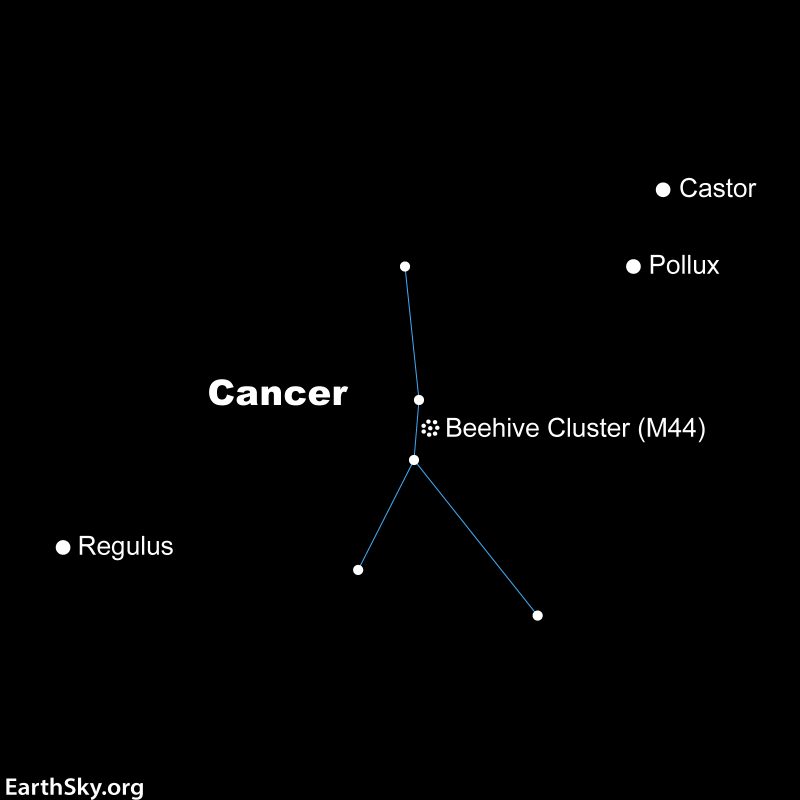
Cancer the Crab, with its Beehive star cluster, needs a dark sky to be seen. It lies between the Gemini stars Castor and Pollux, and the bright star Regulus in Leo. Chart via EarthSky.
There’s a good chance that you’ve never seen Cancer the Crab. It’s the faintest of the 12 constellations of the zodiac. To see Cancer, you need to look between Gemini‘s two brightest stars Castor and Pollux, and Leo the Lion’s brightest star Regulus. And in 2026, finding Gemini – and Pollux and Castor – is easy because bright Jupiter shines nearby.
Once you’ve found Cancer – if your sky is dark – you can see the wonderful open star cluster called the Beehive. It contains some 1,000 stars.
So, let’s suppose you have identified the star Regulus in Leo, and the stars Castor and Pollux in Gemini. You look between them for Cancer and see, well, nothing much. Remember, Cancer is faint. Our advice, therefore, is to look for it in a dark country sky. But, on a moonless night, Cancer is surprisingly easy to see in a dark country sky.
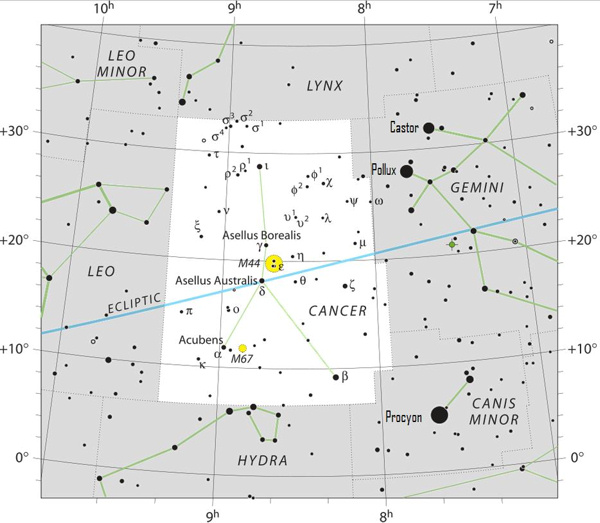
Star chart for Cancer the Crab. Image via International Astronomical Union/ Wikimedia Commons (CC BY 3.0).
When to look for Cancer the Crab
From the Northern Hemisphere, Cancer is well placed for viewing in March, April and May. Eventually, it starts to descend into the sunset glare in June.
In early March every year, look for the constellation Cancer to be due south and highest up in the sky around 10 p.m. your local time. (From the tropics, Cancer shines high overhead, and from temperate latitudes in the Southern Hemisphere, Cancer appears due north.)
Also, since the stars return to the same place in the sky about four minutes earlier each day, or 1/2 hour earlier weekly. So by early April, Cancer reaches its high point for the night at 8 p.m. your local time (9 p.m. local daylight saving time). And by early May, Cancer is high in the western sky.
To summarize, in the Northern Hemisphere, Cancer is best seen in the evening sky in late winter and early spring. After that, it’s lost in the sun’s glare in July and August, and then is found in the morning sky starting in September. If you’re up before dawn during a Northern Hemisphere autumn, try finding Cancer and its Beehive star cluster before sunrise.
From the Southern Hemisphere, the best viewing for Cancer the Crab and the Beehive Cluster is during autumn evenings (March and April), looking towards the northern sky. In March, it’s high in the sky around 10 p.m. local time. And it remains visible through May.
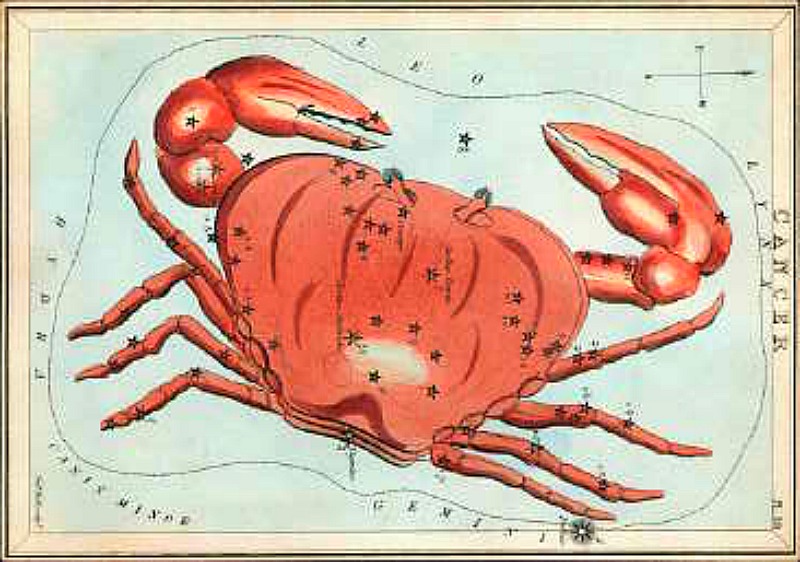
Cancer the Crab from Urania’s Mirror, an antique set of constellation cards. Image via Wikipedia (public domain).
Cancer’s famous Beehive star cluster
Cancer makes up for its lackluster stars by having within its boundaries one of the sky’s brightest star clusters, the Beehive cluster, also known as M44. Another name for the Beehive is Praesepe (Latin for manger).
In a dark sky, the Beehive looks like a tiny faint cloud to the unaided eye. As seen through ordinary binoculars, though, this nebulous patch of haze instantly turns into a sparkling city of stars. It is an open cluster, one of the nearest to our solar system at 577 light-years away. The Beehive contains a larger star population than most other nearby clusters.
The Beehive’s stars appear to be similar in age and proper motion to the stars of the V-shaped Hyades open star cluster. It’s possible the two clusters were born from two parts of a single vast cloud of gas and dust in space.
And sometimes the Beehive gets a visitor. It could be the moon or one of the planets in our solar system. In June 2026, brilliant Venus will pass within two full-moon widths of the Beehive. Then in October 2026, Mars will pass in front of the Beehive star cluster.
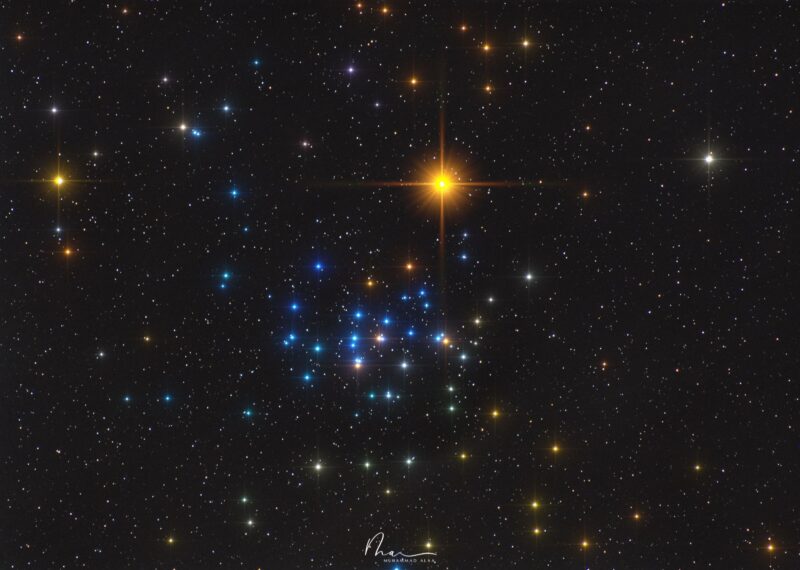
View at EarthSky Community Photos. | Muhammad Alaa in Egypt, captured this view of the open cluster Messier 44 (with the planet Mars passing by) in the constellation Cancer on May 6, 2025. Muhammad wrote: “One of the most beautiful open star clusters in the night sky, located in the constellation Cancer. It’s about 580 light-years away and contains over 1,000 stars! This cluster is one of the closest open clusters to Earth and appears as a faint ‘cloudy patch’ in dark skies to the naked eye. But through a telescope or even simple binoculars, you’ll see a stunning spread of bright stars. Its name ‘Beehive’ comes from its scattered appearance, resembling bees buzzing around a hive.” Thank you, Muhammad!
A member of the zodiac
Cancer’s stature as a constellation of the zodiac has remained steadfast over the millennia. In fact, more than 2,000 years ago, the sun shone in front of the constellation Cancer during the Northern Hemisphere’s summer solstice. That’s not the case today, however. Today, the sun resides in front of the constellation Taurus when the summer solstice sun reaches its northernmost point for the year on or near June 21.
Nonetheless, Cancer still seems to symbolize the height and glory of the summer sun. To this day, we say the sun shines over the Tropic of Cancer – not the “Tropic of Taurus” – on the June solstice. That’s in spite of the fact that the sun in our time passes in front of the constellation Cancer from about July 21 until August 10.
Nowadays, the sun doesn’t enter the constellation Cancer until about a month after the Northern Hemisphere’s summer solstice.
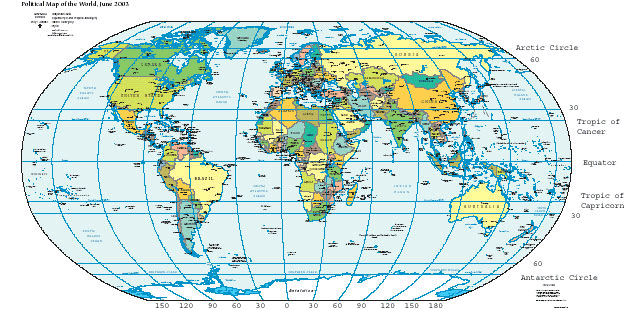
The sun shines directly overhead at noon for those located along the Tropic of Cancer at the Northern Hemisphere’s summer solstice. Image via CIA/ Wikipedia (public domain).
Cancer the Crab of myth
In Greek mythology, Cancer was the crab that bit the foot of the Greek hero Heracles (or the Roman Hercules). Heracles killed the crab and then the goddess Hera, who saw Heracles as her enemy, placed the crab in the heavens.
In ancient Chaldean and Platonic philosophy, Cancer was called the Gate of Men. It was through this portal that souls descend from the heavens above and into the bodies of the newly born.
Around 2,700 years ago, the sun passed in front of the Beehive cluster on the Northern Hemisphere’s summer solstice. Back then, this cluster stood at the apex of the zodiac, so perhaps it was this heavenly nebulosity that marked the Gate of Men. At present, the sun has its annual conjunction with the Beehive cluster in late July or early August.
In olden times, before the advent of light pollution, the ancients referred to the Beehive as a little cloud. The Roman author Pliny reported that when the Praesepe (the Beehive cluster) is invisible in an otherwise clear sky, it’s a sure sign of impending storm. So the Beehive cluster once served as a celestial weather station.
Although Cancer may be the faintest constellation of the zodiac, its legacy remains intact. On a dark, moonless night, look for Cancer’s faint grouping of stars to spring out between the more conspicuous constellations Gemini and Leo.
Bottom line: Cancer the Crab is one of the 12 constellations of the zodiac. Learn how to find it in your sky, plus its star cluster, mythology and more.
Cancer the Crab, with its Beehive star cluster, needs a dark sky to be seen. It lies between the Gemini stars Castor and Pollux, and the bright star Regulus in Leo. Chart via EarthSky.
There’s a good chance that you’ve never seen Cancer the Crab. It’s the faintest of the 12 constellations of the zodiac. To see Cancer, you need to look between Gemini‘s two brightest stars Castor and Pollux, and Leo the Lion’s brightest star Regulus. And in 2026, finding Gemini – and Pollux and Castor – is easy because bright Jupiter shines nearby.
Once you’ve found Cancer – if your sky is dark – you can see the wonderful open star cluster called the Beehive. It contains some 1,000 stars.
So, let’s suppose you have identified the star Regulus in Leo, and the stars Castor and Pollux in Gemini. You look between them for Cancer and see, well, nothing much. Remember, Cancer is faint. Our advice, therefore, is to look for it in a dark country sky. But, on a moonless night, Cancer is surprisingly easy to see in a dark country sky.
Star chart for Cancer the Crab. Image via International Astronomical Union/ Wikimedia Commons (CC BY 3.0).
When to look for Cancer the Crab
From the Northern Hemisphere, Cancer is well placed for viewing in March, April and May. Eventually, it starts to descend into the sunset glare in June.
In early March every year, look for the constellation Cancer to be due south and highest up in the sky around 10 p.m. your local time. (From the tropics, Cancer shines high overhead, and from temperate latitudes in the Southern Hemisphere, Cancer appears due north.)
Also, since the stars return to the same place in the sky about four minutes earlier each day, or 1/2 hour earlier weekly. So by early April, Cancer reaches its high point for the night at 8 p.m. your local time (9 p.m. local daylight saving time). And by early May, Cancer is high in the western sky.
To summarize, in the Northern Hemisphere, Cancer is best seen in the evening sky in late winter and early spring. After that, it’s lost in the sun’s glare in July and August, and then is found in the morning sky starting in September. If you’re up before dawn during a Northern Hemisphere autumn, try finding Cancer and its Beehive star cluster before sunrise.
From the Southern Hemisphere, the best viewing for Cancer the Crab and the Beehive Cluster is during autumn evenings (March and April), looking towards the northern sky. In March, it’s high in the sky around 10 p.m. local time. And it remains visible through May.
Cancer the Crab from Urania’s Mirror, an antique set of constellation cards. Image via Wikipedia (public domain).
Cancer’s famous Beehive star cluster
Cancer makes up for its lackluster stars by having within its boundaries one of the sky’s brightest star clusters, the Beehive cluster, also known as M44. Another name for the Beehive is Praesepe (Latin for manger).
In a dark sky, the Beehive looks like a tiny faint cloud to the unaided eye. As seen through ordinary binoculars, though, this nebulous patch of haze instantly turns into a sparkling city of stars. It is an open cluster, one of the nearest to our solar system at 577 light-years away. The Beehive contains a larger star population than most other nearby clusters.
The Beehive’s stars appear to be similar in age and proper motion to the stars of the V-shaped Hyades open star cluster. It’s possible the two clusters were born from two parts of a single vast cloud of gas and dust in space.
And sometimes the Beehive gets a visitor. It could be the moon or one of the planets in our solar system. In June 2026, brilliant Venus will pass within two full-moon widths of the Beehive. Then in October 2026, Mars will pass in front of the Beehive star cluster.
View at EarthSky Community Photos. | Muhammad Alaa in Egypt, captured this view of the open cluster Messier 44 (with the planet Mars passing by) in the constellation Cancer on May 6, 2025. Muhammad wrote: “One of the most beautiful open star clusters in the night sky, located in the constellation Cancer. It’s about 580 light-years away and contains over 1,000 stars! This cluster is one of the closest open clusters to Earth and appears as a faint ‘cloudy patch’ in dark skies to the naked eye. But through a telescope or even simple binoculars, you’ll see a stunning spread of bright stars. Its name ‘Beehive’ comes from its scattered appearance, resembling bees buzzing around a hive.” Thank you, Muhammad!
A member of the zodiac
Cancer’s stature as a constellation of the zodiac has remained steadfast over the millennia. In fact, more than 2,000 years ago, the sun shone in front of the constellation Cancer during the Northern Hemisphere’s summer solstice. That’s not the case today, however. Today, the sun resides in front of the constellation Taurus when the summer solstice sun reaches its northernmost point for the year on or near June 21.
Nonetheless, Cancer still seems to symbolize the height and glory of the summer sun. To this day, we say the sun shines over the Tropic of Cancer – not the “Tropic of Taurus” – on the June solstice. That’s in spite of the fact that the sun in our time passes in front of the constellation Cancer from about July 21 until August 10.
Nowadays, the sun doesn’t enter the constellation Cancer until about a month after the Northern Hemisphere’s summer solstice.
The sun shines directly overhead at noon for those located along the Tropic of Cancer at the Northern Hemisphere’s summer solstice. Image via CIA/ Wikipedia (public domain).
Cancer the Crab of myth
In Greek mythology, Cancer was the crab that bit the foot of the Greek hero Heracles (or the Roman Hercules). Heracles killed the crab and then the goddess Hera, who saw Heracles as her enemy, placed the crab in the heavens.
In ancient Chaldean and Platonic philosophy, Cancer was called the Gate of Men. It was through this portal that souls descend from the heavens above and into the bodies of the newly born.
Around 2,700 years ago, the sun passed in front of the Beehive cluster on the Northern Hemisphere’s summer solstice. Back then, this cluster stood at the apex of the zodiac, so perhaps it was this heavenly nebulosity that marked the Gate of Men. At present, the sun has its annual conjunction with the Beehive cluster in late July or early August.
In olden times, before the advent of light pollution, the ancients referred to the Beehive as a little cloud. The Roman author Pliny reported that when the Praesepe (the Beehive cluster) is invisible in an otherwise clear sky, it’s a sure sign of impending storm. So the Beehive cluster once served as a celestial weather station.
Although Cancer may be the faintest constellation of the zodiac, its legacy remains intact. On a dark, moonless night, look for Cancer’s faint grouping of stars to spring out between the more conspicuous constellations Gemini and Leo.
Bottom line: Cancer the Crab is one of the 12 constellations of the zodiac. Learn how to find it in your sky, plus its star cluster, mythology and more.