aads

What happened when a solar superstorm hit Mars?

Solar superstorm hit Mars: Sun, with 2 huge blasts coming off it.
In May 2024, a hyperactive sunspot region blasted an X2.9 flare. When the solar superstorm hit Mars, it resulted in a large amount of material spewing outward (to the left in this image), then pummeling both Earth and Mars. New research shows spacecraft at the red planet glitched, and the Martian atmosphere become supercharged. P.S. The 2 bright white spots by the sun are Jupiter and Venus. Image via SOHO (ESA & NASA), NASA/SDO/AIA/ JHelioviewer/ D. Müller.
  • In May 2024, a solar superstorm hit Mars. Two European Space Agency spacecraft at Mars observed the impacts, and now a new study has been released.
  • The storm triggered the largest electron surge ever recorded in Mars’ upper atmosphere. It dramatically boosted charged particles.
  • Both orbiters also recorded glitches in their computers. This is an expected result of solar storms that also affect satellites in Earth orbit.

Science news, night sky events and beautiful photos, all in one place. Click here to subscribe to our free daily newsletter.

ESA published this original story on March 5, 2026. Edits by EarthSky.

What happened when a solar superstorm hit Mars?

In May 2024, Earth was hit by the biggest solar storm recorded in over 20 years. It sent our planet’s atmosphere into overdrive, triggering shimmering auroras that were seen as far south as Mexico. This storm also hit Mars. And the European Space Agency’s two Mars orbiters – Mars Express and ExoMars Trace Gas Orbiter (TGO) – were in the right place at the right time. A radiation monitor aboard TGO picked up a dose equivalent to 200 ‘normal’ days in just 64 hours.

A new peer-reviewed study published on March 5, 2026, in the journal Nature Communications now reveals in greater depth how this intense, stormy activity affected the red planet.

ESA Research Fellow Jacob Parrott was the lead author of the study. Parrott said:

The impact was remarkable: Mars’ upper atmosphere was flooded by electrons. It was the biggest response to a solar storm we’ve ever seen at Mars.

The superstorm caused a dramatic increase in electrons in two distinct layers of Mars’ atmosphere. This occurred at altitudes of around 110 and 130 km (68 and 80 miles), with numbers rising by 45% and a whopping 278%, respectively. This is the most electrons we’ve ever seen in this layer of Martian atmosphere. Parrott added:

The storm also caused computer errors for both orbiters. It’s a typical peril of space weather, as the particles involved are so energetic and hard to predict. Luckily, the spacecraft were designed with this in mind, and built with radiation-resistant components and specific systems for detecting and fixing these errors. They recovered fast.

Pioneering a new technique

To investigate the superstorm’s impact on Mars, Parrott and colleagues used a technique ESA is currently pioneering. It’s known as radio occultation.

First, Mars Express beamed a radio signal to TGO at the very moment it was disappearing over the Martian horizon. As TGO vanished, the radio signal was bent (refracted) by the various layers of Mars’ atmosphere before being picked up by the orbiter. This allowed scientists to glean more about each layer. The researchers also used observations from NASA’s MAVEN mission to confirm the electron densities.

Colin Wilson is an ESA project scientist for Mars Express and TGO, and co-author of the study. Wilson said:

This technique has actually been used for decades to explore the solar system, but using signals beamed from a spacecraft to Earth. It’s only in the past five years or so that we’ve started using it at Mars between two spacecraft, such as Mars Express and TGO, which usually use those radios to beam data between orbiters and rovers. It’s great to see it in action.

ESA uses orbiter-to-orbiter radio occultation routinely at Earth. And it plans to use it more regularly in future planetary missions.

Diagram: Mars with 2 orbiters and a red dotted line showing a radio signal path between them.
To study Mars’ atmosphere, ESA’s 2 Mars orbiters use the radio occultation technique. Mars Express beams a radio signal toward ExoMars TGO, as TGO is about to ‘set’ behind Mars. Thus, the radio signal travels through Mars’s upper atmosphere, causing it to bend. By measuring how much the signal bends, we discover what makes up the different layers of atmosphere. Image via ESA (CC BY-SA 3.0).

Different worlds, different weather

Earth and Mars experienced this superstorm differently, and it highlights the differences between the two worlds.

At Earth, the response of the upper atmosphere was more muted, thanks to the shielding effect of Earth’s magnetic field. As well as deflecting a lot of solar storm particles away from Earth, the magnetic field also diverted some toward Earth’s poles, where they caused the sky to light up with auroras.

While their differences can make it tricky to compare planets directly, understanding how solar activity impacts the residents of the solar system – in other words, space weather forecasting – is hugely important. At Earth, solar storms can be dangerous and damaging for astronauts and equipment up in space. Plus, they can disrupt our satellites and systems (power, radio, navigation) further down.

However, studying space weather is difficult, as the sun throws out radiation and material erratically, making targeted measurements largely opportunistic. Parrot said:

Fortunately, we were able to use this new technique with Mars Express and TGO just 10 minutes after a large solar flare hit Mars. Currently we’re only performing two observations per week at Mars, so the timing was extremely lucky.

Analyzing the aftermath

Parrott and colleagues captured the aftermath of three solar events. They were all part of the same storm, but different in terms of what they throw out into space and how they do it. One was a flare of radiation, one was a burst of high-energy particles, and one was an eruption of material known as a coronal mass ejection (CME).

Together, these events sent fast-moving, energetic, magnetized plasma and X-rays flooding towards Mars. When this barrage of material hit the planet’s upper atmosphere, it collided with neutral atoms and stripped away their electrons, causing the region to fill up with electrons and charged particles. Wilson said:

The results improve our understanding of Mars by revealing how solar storms deposit energy and particles into Mars’s atmosphere. It’s important as we know the planet has lost both huge amounts of water and most of its atmosphere to space, most likely driven by the continual wind of particles streaming out from the sun.

But there’s another side to it: the structure and contents of a planet’s atmosphere influence how radio signals travel through space. If Mars’s upper atmosphere is packed full of electrons, this could block the signals we use to explore the planet’s surface via radar, making it a key consideration in our mission planning … and impacting our ability to investigate other worlds.

Bottom line: What happened when a solar superstorm hit Mars? In May 2024, the sun released a powerful X flare that caused spacecraft to glitch … and more. Read all about it here.

Source: Martian ionospheric response during the may 2024 solar superstorm

Via ESA

The post What happened when a solar superstorm hit Mars? first appeared on EarthSky.


from EarthSky https://ift.tt/Fgy4S1I
Solar superstorm hit Mars: Sun, with 2 huge blasts coming off it.
In May 2024, a hyperactive sunspot region blasted an X2.9 flare. When the solar superstorm hit Mars, it resulted in a large amount of material spewing outward (to the left in this image), then pummeling both Earth and Mars. New research shows spacecraft at the red planet glitched, and the Martian atmosphere become supercharged. P.S. The 2 bright white spots by the sun are Jupiter and Venus. Image via SOHO (ESA & NASA), NASA/SDO/AIA/ JHelioviewer/ D. Müller.
  • In May 2024, a solar superstorm hit Mars. Two European Space Agency spacecraft at Mars observed the impacts, and now a new study has been released.
  • The storm triggered the largest electron surge ever recorded in Mars’ upper atmosphere. It dramatically boosted charged particles.
  • Both orbiters also recorded glitches in their computers. This is an expected result of solar storms that also affect satellites in Earth orbit.

Science news, night sky events and beautiful photos, all in one place. Click here to subscribe to our free daily newsletter.

ESA published this original story on March 5, 2026. Edits by EarthSky.

What happened when a solar superstorm hit Mars?

In May 2024, Earth was hit by the biggest solar storm recorded in over 20 years. It sent our planet’s atmosphere into overdrive, triggering shimmering auroras that were seen as far south as Mexico. This storm also hit Mars. And the European Space Agency’s two Mars orbiters – Mars Express and ExoMars Trace Gas Orbiter (TGO) – were in the right place at the right time. A radiation monitor aboard TGO picked up a dose equivalent to 200 ‘normal’ days in just 64 hours.

A new peer-reviewed study published on March 5, 2026, in the journal Nature Communications now reveals in greater depth how this intense, stormy activity affected the red planet.

ESA Research Fellow Jacob Parrott was the lead author of the study. Parrott said:

The impact was remarkable: Mars’ upper atmosphere was flooded by electrons. It was the biggest response to a solar storm we’ve ever seen at Mars.

The superstorm caused a dramatic increase in electrons in two distinct layers of Mars’ atmosphere. This occurred at altitudes of around 110 and 130 km (68 and 80 miles), with numbers rising by 45% and a whopping 278%, respectively. This is the most electrons we’ve ever seen in this layer of Martian atmosphere. Parrott added:

The storm also caused computer errors for both orbiters. It’s a typical peril of space weather, as the particles involved are so energetic and hard to predict. Luckily, the spacecraft were designed with this in mind, and built with radiation-resistant components and specific systems for detecting and fixing these errors. They recovered fast.

Pioneering a new technique

To investigate the superstorm’s impact on Mars, Parrott and colleagues used a technique ESA is currently pioneering. It’s known as radio occultation.

First, Mars Express beamed a radio signal to TGO at the very moment it was disappearing over the Martian horizon. As TGO vanished, the radio signal was bent (refracted) by the various layers of Mars’ atmosphere before being picked up by the orbiter. This allowed scientists to glean more about each layer. The researchers also used observations from NASA’s MAVEN mission to confirm the electron densities.

Colin Wilson is an ESA project scientist for Mars Express and TGO, and co-author of the study. Wilson said:

This technique has actually been used for decades to explore the solar system, but using signals beamed from a spacecraft to Earth. It’s only in the past five years or so that we’ve started using it at Mars between two spacecraft, such as Mars Express and TGO, which usually use those radios to beam data between orbiters and rovers. It’s great to see it in action.

ESA uses orbiter-to-orbiter radio occultation routinely at Earth. And it plans to use it more regularly in future planetary missions.

Diagram: Mars with 2 orbiters and a red dotted line showing a radio signal path between them.
To study Mars’ atmosphere, ESA’s 2 Mars orbiters use the radio occultation technique. Mars Express beams a radio signal toward ExoMars TGO, as TGO is about to ‘set’ behind Mars. Thus, the radio signal travels through Mars’s upper atmosphere, causing it to bend. By measuring how much the signal bends, we discover what makes up the different layers of atmosphere. Image via ESA (CC BY-SA 3.0).

Different worlds, different weather

Earth and Mars experienced this superstorm differently, and it highlights the differences between the two worlds.

At Earth, the response of the upper atmosphere was more muted, thanks to the shielding effect of Earth’s magnetic field. As well as deflecting a lot of solar storm particles away from Earth, the magnetic field also diverted some toward Earth’s poles, where they caused the sky to light up with auroras.

While their differences can make it tricky to compare planets directly, understanding how solar activity impacts the residents of the solar system – in other words, space weather forecasting – is hugely important. At Earth, solar storms can be dangerous and damaging for astronauts and equipment up in space. Plus, they can disrupt our satellites and systems (power, radio, navigation) further down.

However, studying space weather is difficult, as the sun throws out radiation and material erratically, making targeted measurements largely opportunistic. Parrot said:

Fortunately, we were able to use this new technique with Mars Express and TGO just 10 minutes after a large solar flare hit Mars. Currently we’re only performing two observations per week at Mars, so the timing was extremely lucky.

Analyzing the aftermath

Parrott and colleagues captured the aftermath of three solar events. They were all part of the same storm, but different in terms of what they throw out into space and how they do it. One was a flare of radiation, one was a burst of high-energy particles, and one was an eruption of material known as a coronal mass ejection (CME).

Together, these events sent fast-moving, energetic, magnetized plasma and X-rays flooding towards Mars. When this barrage of material hit the planet’s upper atmosphere, it collided with neutral atoms and stripped away their electrons, causing the region to fill up with electrons and charged particles. Wilson said:

The results improve our understanding of Mars by revealing how solar storms deposit energy and particles into Mars’s atmosphere. It’s important as we know the planet has lost both huge amounts of water and most of its atmosphere to space, most likely driven by the continual wind of particles streaming out from the sun.

But there’s another side to it: the structure and contents of a planet’s atmosphere influence how radio signals travel through space. If Mars’s upper atmosphere is packed full of electrons, this could block the signals we use to explore the planet’s surface via radar, making it a key consideration in our mission planning … and impacting our ability to investigate other worlds.

Bottom line: What happened when a solar superstorm hit Mars? In May 2024, the sun released a powerful X flare that caused spacecraft to glitch … and more. Read all about it here.

Source: Martian ionospheric response during the may 2024 solar superstorm

Via ESA

The post What happened when a solar superstorm hit Mars? first appeared on EarthSky.


from EarthSky https://ift.tt/Fgy4S1I

Daylight saving time starts: 9 tips for the coming week

Woman wakes up and stretches with alarm clock by bed.
Daylight saving time (DST) began at 2 a.m. on March 8, 2026. Image via Miriam Alonso/ Pexels.

Daylight saving time begins Sunday

At 2 a.m. today – Sunday, March 8, 2026 – clocks in most U.S. states and many Canadian provinces leapt forward one hour. Daylight saving time (DST) began. The memory tool for your clocks is spring forward. Easy to do with clocks. Less easy – for many – with our own bodies. We hear that the number of car crashes increases with the start of daylight saving time. More people have heart attacks. Many report feeling groggy or off-kilter in the week following. Here are some tips that might help.

  1. Eat some good breakfasts this week!
  2. Get some sunlight.
  3. 3Keep up your exercise schedule.
  4. Drink extra water and limit caffeine, alcohol, and sugar.
  5. Manage your stress with whatever stress-busting techniques work for you.
  6. Go to sleep a few minutes earlier.
  7. Sleep in complete darkness, in a not-too-warm room.
  8. Get up at your usual time, no matter what the sunrise is doing.
  9. Don’t think in terms of what time it really is. As your alarm goes off at 6 a.m. Monday morning, try not to think it’s really only 5 a.m. Good luck!
World map with areas in green indicating places that have daylight saving time at some point in 2026.
Areas in green change to daylight saving time in 2026. Image via timeanddate.com. Used with permission.

You deserve a daily dose of good news. For the latest in science and the night sky, click here to subscribe to our free daily newsletter.

Permanent DST starts now for parts of Canada

The province of British Columbia – Canada’s westernmost province, with the Pacific Ocean to its west and the Rocky Mountains to its east – announced a week ago that March 8, 2026, will be its final clock change. After springing forward today, officials say the province will remain on permanent daylight saving time and will not “fall back” in November.

So British Columbia joins the Canadian Yukon, which has observed permanent DST since 2020.

Meanwhile, elsewhere in Canada, clocks don’t change, and standard time is the norm throughout the year. That includes most of Saskatchewan (including Regina and Saskatoon). And it includes specific pockets such as eastern Quebec, Southampton Island in Nunavut, and certain communities in Ontario. Those areas do not change their clocks.

The U.S. has tried permanent DST, too

During World War II, the U.S. observed year-round daylight saving time from February 1942 to September 1945. It was known as “war time.”

The U.S. again tried year-round daylight saving time in 1974, during an “energy crisis” experiment. It was a response to the 1973 oil embargo. President Richard Nixon signed the Emergency Daylight Saving Time Energy Conservation Act, which put the U.S. on year-round DST starting on January 6, 1974.

The initial reaction was excellent, with a 79% approval rating in December 1973. But, once winter set in, the reality of pitch-black mornings became a major issue. In some areas, the sun didn’t rise until after 9 a.m. Public outcry grew over the safety of children waiting for school buses in the dark. After several high-profile accidents involving students, approval plummeted to 42% by February. So the experiment, originally intended to last two years, was cut short. President Gerald Ford signed a repeal, and the U.S. returned to standard time on October 27, 1974.

Today, most of the U.S. does make the switch to daylight saving time, with a few notable exceptions that stay on Standard Time year-round. Most of Arizona does not observe DST (the Navajo Nation is the exception and does change clocks). Hawaii does not observe DST. And many U.S. territories do not observe DST, including American Samoa, Guam, Puerto Rico, the Northern Mariana Islands, and the U.S. Virgin Islands.

The inventor of DST

Victorian-looking man with a mustache.
Don’t like daylight saving time? Blame New Zealand entomologist G.V. Hudson. He 1st proposed a system resembling our modern one to the Wellington Philosophical Society in 1895. He valued those extra daylight hours after work as a time to gather insects. Be glad we didn’t use Hudson’s original proposal for a 2-hour leap! Image via Wikimedia Commons.

Bottom line: Daylight saving time in the U.S. and Canada begins March 8, 2026. Here are some suggestions for coping with the time change.

The post Daylight saving time starts: 9 tips for the coming week first appeared on EarthSky.


from EarthSky https://ift.tt/AqYhTwg
Woman wakes up and stretches with alarm clock by bed.
Daylight saving time (DST) began at 2 a.m. on March 8, 2026. Image via Miriam Alonso/ Pexels.

Daylight saving time begins Sunday

At 2 a.m. today – Sunday, March 8, 2026 – clocks in most U.S. states and many Canadian provinces leapt forward one hour. Daylight saving time (DST) began. The memory tool for your clocks is spring forward. Easy to do with clocks. Less easy – for many – with our own bodies. We hear that the number of car crashes increases with the start of daylight saving time. More people have heart attacks. Many report feeling groggy or off-kilter in the week following. Here are some tips that might help.

  1. Eat some good breakfasts this week!
  2. Get some sunlight.
  3. 3Keep up your exercise schedule.
  4. Drink extra water and limit caffeine, alcohol, and sugar.
  5. Manage your stress with whatever stress-busting techniques work for you.
  6. Go to sleep a few minutes earlier.
  7. Sleep in complete darkness, in a not-too-warm room.
  8. Get up at your usual time, no matter what the sunrise is doing.
  9. Don’t think in terms of what time it really is. As your alarm goes off at 6 a.m. Monday morning, try not to think it’s really only 5 a.m. Good luck!
World map with areas in green indicating places that have daylight saving time at some point in 2026.
Areas in green change to daylight saving time in 2026. Image via timeanddate.com. Used with permission.

You deserve a daily dose of good news. For the latest in science and the night sky, click here to subscribe to our free daily newsletter.

Permanent DST starts now for parts of Canada

The province of British Columbia – Canada’s westernmost province, with the Pacific Ocean to its west and the Rocky Mountains to its east – announced a week ago that March 8, 2026, will be its final clock change. After springing forward today, officials say the province will remain on permanent daylight saving time and will not “fall back” in November.

So British Columbia joins the Canadian Yukon, which has observed permanent DST since 2020.

Meanwhile, elsewhere in Canada, clocks don’t change, and standard time is the norm throughout the year. That includes most of Saskatchewan (including Regina and Saskatoon). And it includes specific pockets such as eastern Quebec, Southampton Island in Nunavut, and certain communities in Ontario. Those areas do not change their clocks.

The U.S. has tried permanent DST, too

During World War II, the U.S. observed year-round daylight saving time from February 1942 to September 1945. It was known as “war time.”

The U.S. again tried year-round daylight saving time in 1974, during an “energy crisis” experiment. It was a response to the 1973 oil embargo. President Richard Nixon signed the Emergency Daylight Saving Time Energy Conservation Act, which put the U.S. on year-round DST starting on January 6, 1974.

The initial reaction was excellent, with a 79% approval rating in December 1973. But, once winter set in, the reality of pitch-black mornings became a major issue. In some areas, the sun didn’t rise until after 9 a.m. Public outcry grew over the safety of children waiting for school buses in the dark. After several high-profile accidents involving students, approval plummeted to 42% by February. So the experiment, originally intended to last two years, was cut short. President Gerald Ford signed a repeal, and the U.S. returned to standard time on October 27, 1974.

Today, most of the U.S. does make the switch to daylight saving time, with a few notable exceptions that stay on Standard Time year-round. Most of Arizona does not observe DST (the Navajo Nation is the exception and does change clocks). Hawaii does not observe DST. And many U.S. territories do not observe DST, including American Samoa, Guam, Puerto Rico, the Northern Mariana Islands, and the U.S. Virgin Islands.

The inventor of DST

Victorian-looking man with a mustache.
Don’t like daylight saving time? Blame New Zealand entomologist G.V. Hudson. He 1st proposed a system resembling our modern one to the Wellington Philosophical Society in 1895. He valued those extra daylight hours after work as a time to gather insects. Be glad we didn’t use Hudson’s original proposal for a 2-hour leap! Image via Wikimedia Commons.

Bottom line: Daylight saving time in the U.S. and Canada begins March 8, 2026. Here are some suggestions for coping with the time change.

The post Daylight saving time starts: 9 tips for the coming week first appeared on EarthSky.


from EarthSky https://ift.tt/AqYhTwg

Puppis the Stern, adrift on the Milky Way

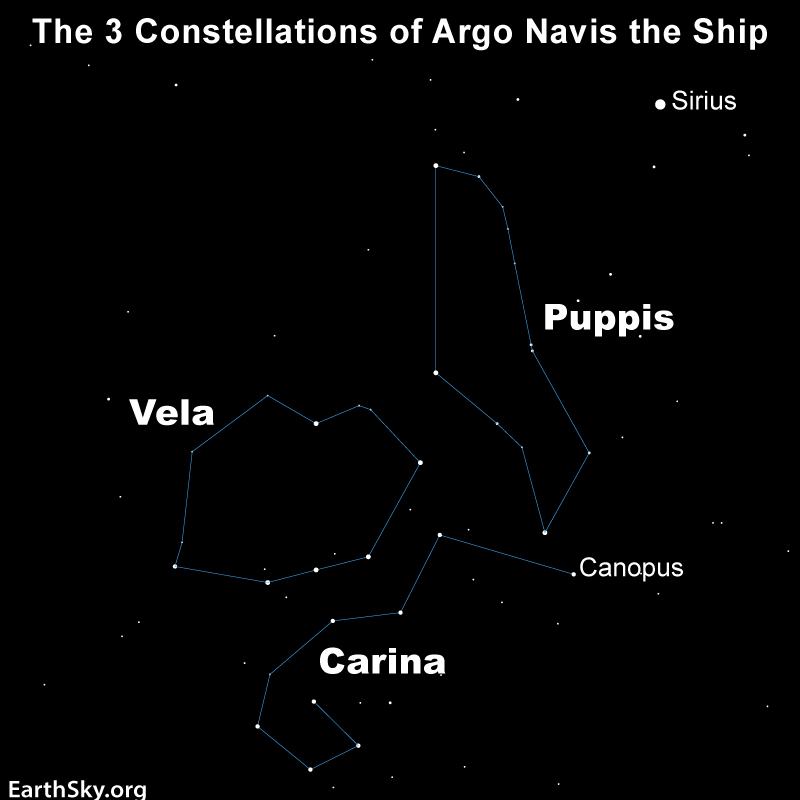
Star chart: White dot for Sirius at top right, three irregular shapes outlined and labeled below.
The former constellation Argo Navis the Ship is now the modern constellations Puppis the Stern, Vela the Sails and Carina the Keel. You can find these constellations south of Sirius. So they are easiest to see from the Southern Hemisphere.

The constellation Puppis was once part of a much larger constellation named Argo Navis, the Ship. In the 1700s, Nicolas Louis de Lacaille divided the Ship into three constellations. They are Puppis the Stern, Carina the Keel and Vela the Sails. Sometimes Pyxis the Compass is also included as part of the former Ship. Puppis is the largest of these “new” constellations and the 20th largest in the sky. So you can imagine just how much territory Argo used to inhabit. The constellation of the Stern sails atop the flowing river of the Milky Way and holds many deep-sky delights.

Science news, night sky events and beautiful photos, all in one place. Click here to subscribe to our free daily newsletter.

Locating the constellation Puppis

Puppis is far enough south that observers can only see the entire constellation if they live around the latitude of Nashville, Tenn., 36 degrees north parallel, or farther south. However, if you’re north of this line, you can still see the northern portion of the constellation, which happens to contain three Messier objects. Messier objects are the brighter deep-sky targets – either star clusters, nebulae or galaxies – that are fun to view through binoculars or a telescope.

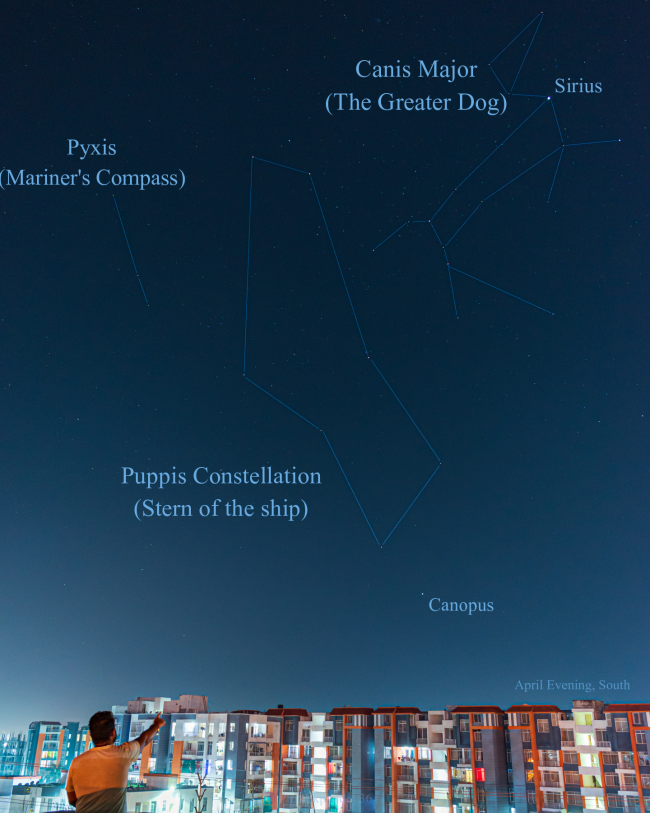
Look for Puppis in March after the sky gets truly dark. You should spot it close to the southern horizon. If you’re in the Southern Hemisphere, it will pass overhead, near zenith. Look for the brightest star in the sky, Sirius, in its constellation Canis Major. Puppis is immediately south-southeast of Canis Major.

3 constellations outlined on dark blue sky with a man standing in front of a city, pointing to the sky.
View at EarthSky Community Photos. | Prateek Pandey in Bhopal, India, captured this photo of Pyxis the Compass, Canis Major and Puppis on April 4, 2021. He wrote: “The evening show of the brightest stars.” Thank you, Prateek!

The stars of Puppis the Stern

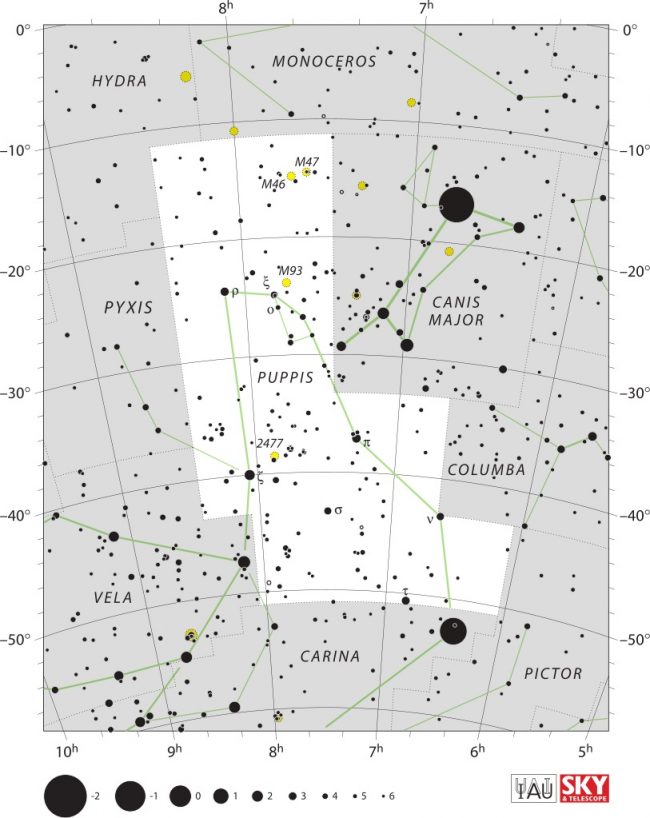
Let’s find the brightest star in Puppis. Focus first on Sirius, the brightest star in the sky in the constellation Canis Major. Trace a line from here down the Dog’s back, past his hind star and tail star, and then straight out toward a star almost 15 degrees away. (Measure 15 degrees by extending your arm and sticking your pinky finger and index finger out. The distance between them is roughly 15 degrees.) This leads you to Naos, or Zeta Puppis. At magnitude 2.2, it’s the brightest star in the constellation. It lies nearly 1,400 light-years away from Earth.

Heading almost 10 degrees (a fist width at arm’s length) in the direction of Canis Major’s hind legs, you’ll run into Pi Puppis. This star (actually a binary, or two stars) goes by the name Ahadi. This is the 2nd brightest star in the constellation. Pi Puppis has a magnitude of 2.7 and lies around 800 light-years away.

If you can only see the northernmost part of Puppis, the brightest star here is Rho Puppis. Rho Puppis’ other name, Tureis, means diminutive. You can find it lying about 11 degrees away from the brighter hind stars in Canis Major. Rho Puppis shines at magnitude 2.8 from a distance of 63 light-years.

One other star of note is L2 Puppis. Scientists say this star is like the sun but in the final stages of life, and it has a planet in orbit about the same distance from it as Earth is from the sun. This system could be a glimpse of our future.

White chart with black dots showing stars of Puppis. Larger dots show brighter stars.
The constellation Puppis the Stern has two bright neighboring stars. In fact, Sirius to the north and Canopus to the south are the 1st and 2nd brightest stars in the night sky, respectively. Image via Wikipedis (CC BY 3.0).

Going deeper in Puppis

If you have binoculars or a telescope, you can explore Puppis more deeply. It lies right on the Milky Way and is home to some sparking star clusters. The brightest of these lie in the northern half of the constellation, helpful for those in the Northern Hemisphere who want a peek. Here’s a brief look at some of its best targets.

M93 is magnitude 6.2 and lies 3,600 light-years away. It’s five degrees from Rho Puppis, toward Canis Major.

M46 lies almost 10 degrees north of M93 and about one degree from the next object, M47. M46 is magnitude 6.1 and includes a bonus object, a small nebula. Scientists think the nebula (NGC 2438, with a magnitude of 10.8) is a foreground object and not truly a part of the cluster. M46 is about 5,400 light-years away, and NGC 2438 is about 2,900 light-years away.

M47 lies next door to M46, closer to Canis Major. It’s a brighter star cluster at magnitude 4.4 and about 1,600 light-years away.

Puppis is a great location to simply sweep the sky slowly with binoculars or a telescope and look for additional clusters.

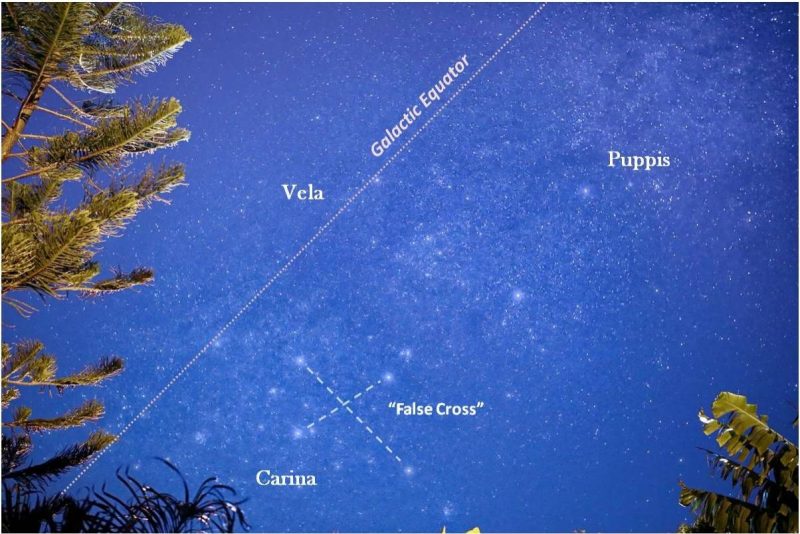
Swath of stars in blue sky with constellations labeled.
View at EarthSky Community Photos. | Dr Ski at Valencia Observatory took this photo on December 2, 2019, and wrote: “The Milky Way south of Canis Major is rotating into view now in the early morning. Ancient Greeks saw Vela (the Sail), Puppis (the Stern) and Carina (the Keel) as Argo Navis, the ship that Jason and the Argonauts sailed to fetch the Golden Fleece. The ‘False Cross’ is often mistaken for the Southern Cross. This section of the southern sky is replete with open clusters. Give me a pair of binoculars and I’m like a bull in a candy shop. Or is it a kid in a China shop?” Thank you, Dr Ski!

Bottom line: Puppis the Stern was once part of a larger constellation known as Argo Navis the Ship. Northerners can spot Puppis far to the south on March evenings.

The post Puppis the Stern, adrift on the Milky Way first appeared on EarthSky.


from EarthSky https://ift.tt/3RQ7LrG
Star chart: White dot for Sirius at top right, three irregular shapes outlined and labeled below.
The former constellation Argo Navis the Ship is now the modern constellations Puppis the Stern, Vela the Sails and Carina the Keel. You can find these constellations south of Sirius. So they are easiest to see from the Southern Hemisphere.

The constellation Puppis was once part of a much larger constellation named Argo Navis, the Ship. In the 1700s, Nicolas Louis de Lacaille divided the Ship into three constellations. They are Puppis the Stern, Carina the Keel and Vela the Sails. Sometimes Pyxis the Compass is also included as part of the former Ship. Puppis is the largest of these “new” constellations and the 20th largest in the sky. So you can imagine just how much territory Argo used to inhabit. The constellation of the Stern sails atop the flowing river of the Milky Way and holds many deep-sky delights.

Science news, night sky events and beautiful photos, all in one place. Click here to subscribe to our free daily newsletter.

Locating the constellation Puppis

Puppis is far enough south that observers can only see the entire constellation if they live around the latitude of Nashville, Tenn., 36 degrees north parallel, or farther south. However, if you’re north of this line, you can still see the northern portion of the constellation, which happens to contain three Messier objects. Messier objects are the brighter deep-sky targets – either star clusters, nebulae or galaxies – that are fun to view through binoculars or a telescope.

Look for Puppis in March after the sky gets truly dark. You should spot it close to the southern horizon. If you’re in the Southern Hemisphere, it will pass overhead, near zenith. Look for the brightest star in the sky, Sirius, in its constellation Canis Major. Puppis is immediately south-southeast of Canis Major.

3 constellations outlined on dark blue sky with a man standing in front of a city, pointing to the sky.
View at EarthSky Community Photos. | Prateek Pandey in Bhopal, India, captured this photo of Pyxis the Compass, Canis Major and Puppis on April 4, 2021. He wrote: “The evening show of the brightest stars.” Thank you, Prateek!

The stars of Puppis the Stern

Let’s find the brightest star in Puppis. Focus first on Sirius, the brightest star in the sky in the constellation Canis Major. Trace a line from here down the Dog’s back, past his hind star and tail star, and then straight out toward a star almost 15 degrees away. (Measure 15 degrees by extending your arm and sticking your pinky finger and index finger out. The distance between them is roughly 15 degrees.) This leads you to Naos, or Zeta Puppis. At magnitude 2.2, it’s the brightest star in the constellation. It lies nearly 1,400 light-years away from Earth.

Heading almost 10 degrees (a fist width at arm’s length) in the direction of Canis Major’s hind legs, you’ll run into Pi Puppis. This star (actually a binary, or two stars) goes by the name Ahadi. This is the 2nd brightest star in the constellation. Pi Puppis has a magnitude of 2.7 and lies around 800 light-years away.

If you can only see the northernmost part of Puppis, the brightest star here is Rho Puppis. Rho Puppis’ other name, Tureis, means diminutive. You can find it lying about 11 degrees away from the brighter hind stars in Canis Major. Rho Puppis shines at magnitude 2.8 from a distance of 63 light-years.

One other star of note is L2 Puppis. Scientists say this star is like the sun but in the final stages of life, and it has a planet in orbit about the same distance from it as Earth is from the sun. This system could be a glimpse of our future.

White chart with black dots showing stars of Puppis. Larger dots show brighter stars.
The constellation Puppis the Stern has two bright neighboring stars. In fact, Sirius to the north and Canopus to the south are the 1st and 2nd brightest stars in the night sky, respectively. Image via Wikipedis (CC BY 3.0).

Going deeper in Puppis

If you have binoculars or a telescope, you can explore Puppis more deeply. It lies right on the Milky Way and is home to some sparking star clusters. The brightest of these lie in the northern half of the constellation, helpful for those in the Northern Hemisphere who want a peek. Here’s a brief look at some of its best targets.

M93 is magnitude 6.2 and lies 3,600 light-years away. It’s five degrees from Rho Puppis, toward Canis Major.

M46 lies almost 10 degrees north of M93 and about one degree from the next object, M47. M46 is magnitude 6.1 and includes a bonus object, a small nebula. Scientists think the nebula (NGC 2438, with a magnitude of 10.8) is a foreground object and not truly a part of the cluster. M46 is about 5,400 light-years away, and NGC 2438 is about 2,900 light-years away.

M47 lies next door to M46, closer to Canis Major. It’s a brighter star cluster at magnitude 4.4 and about 1,600 light-years away.

Puppis is a great location to simply sweep the sky slowly with binoculars or a telescope and look for additional clusters.

Swath of stars in blue sky with constellations labeled.
View at EarthSky Community Photos. | Dr Ski at Valencia Observatory took this photo on December 2, 2019, and wrote: “The Milky Way south of Canis Major is rotating into view now in the early morning. Ancient Greeks saw Vela (the Sail), Puppis (the Stern) and Carina (the Keel) as Argo Navis, the ship that Jason and the Argonauts sailed to fetch the Golden Fleece. The ‘False Cross’ is often mistaken for the Southern Cross. This section of the southern sky is replete with open clusters. Give me a pair of binoculars and I’m like a bull in a candy shop. Or is it a kid in a China shop?” Thank you, Dr Ski!

Bottom line: Puppis the Stern was once part of a larger constellation known as Argo Navis the Ship. Northerners can spot Puppis far to the south on March evenings.

The post Puppis the Stern, adrift on the Milky Way first appeared on EarthSky.


from EarthSky https://ift.tt/3RQ7LrG

New moon map reveals areas of recent tectonic activity

Oval map of near side of the moon. The yellow spots mark ridge-adjacent small mare ridges and the red spots mark standalone small mare ridges.
View larger. | This new moon map shows a global view of small mare ridges in maria on the moon’s near side. A new study said these small ridges are evidence of recent tectonic activity. Image via NASA/ GSFC/ Arizona State University/ The Planetary Science Journal (Open Access/ CC BY 4.0).
  • The moon is known to be tectonically active, although the tectonic forces are different from those on Earth.
  • Small mare ridges in the lunar maria – the large, dark volcanic plains – are evidence of tectonics, said researchers. A new global map shows they are geologically young and widespread across the maria.
  • The ridges could be a source of moonquakes, which could affect where future astronauts land on the lunar surface.

Recent active tectonics on the moon

The moon might look geologically dead, but in some ways it is still active. A team of scientists led by the Smithsonian Institution have found new evidence of recent tectonic activity on the moon. The researchers said on February 12, 2026, that small mare ridges are young and widespread on the dark, flat volcanic plains called lunar maria (or mare). The researchers produced a new global map of these ridges.

The mare ridges could also be sources of moonquakes, the lunar version of earthquakes. Such moonquakes might pose a potential danger for future astronauts on the moon.

The researchers published the peer-reviewed study in The Planetary Science Journal on December 24, 2025.

A new global map of small mare ridges indicates recent tectonic activity is more widespread on the moon than previously recognized, expanding potential sources of moonquakes. doi.org/hbppb7

Science X / Phys.org (@sciencex.bsky.social) 2026-02-17T10:40:48-05:00

You deserve a daily dose of good news. For the latest in science and the night sky, click here to subscribe to our free daily newsletter.

Lobate scarps and ridges

The moon doesn’t have tectonic plates like Earth does. However, stresses in the crust can still produce distinctive landforms. For example, lobate scarps form due to compression in the crust. This pushes material up from below, along a fault, which then creates a ridge.

These scarps and ridges are located in the lunar highlands, not the maria. They formed within the last billion years.

New moon map: View from above of flat gray landscape with small craters and a long, meandering ridge going from left to right.
View larger. | NASA’s Lunar Reconnaissance Orbiter took this image of a small mare ridge in the northeast part of the lunar plain Mare Imbrium. A new moon map and study of these small mare ridges reveals recent active tectonics on the moon. Image via NASA/ GSFC/ Arizona State University/ Smithsonian Institution.
A pockmarked grey surface with rough, wavy crags stretching diagonally across.
View larger. | Apollo 12 captured this view of wrinkle ridges in the largest of the lunar maria, Oceanus Procellarum, in 1969. Image via NASA/ Wikimedia Commons.

Small mare ridges

The small mare ridges, however, are located only in the lunar maria. Those are the large, dark and flat regions on the moon that you can even see with your unaided eye. Research geologist and lead author Cole Nypaver at the National Air and Space Museum Center for Earth and Planetary Studies at the Smithsonian Institution said:

Since the Apollo era, we’ve known about the prevalence of lobate scarps throughout the lunar highlands, but this is the first time scientists have documented the widespread prevalence of similar features throughout the lunar mare. This work helps us gain a globally complete perspective on recent lunar tectonism on the moon, which will lead to a greater understanding of its interior and its thermal and seismic history, and the potential for future moonquakes.

Smiling man wearing a baseball cap standing next to a large crater in the desert.
Research geologist and lead author Cole Nypaver at the National Air and Space Museum Center for Earth and Planetary Studies at the Smithsonian Institution. Image via National Air and Space Museum/ Smithsonian Institution.

1st catalog of small mare ridges

The researchers have produced the first-ever comprehensive catalog of small mare ridges. Scientists knew about some of these ridges before, but the catalog now adds many more. 1,114 new ridges have been added to the count, for a new total of 2,634. The new ridges are in lunar maria on the near side of the moon, the side that always faces Earth.

In addition, the research team determined that the average age of a small mare ridge is 124 million years. This is similar to the other lobate scarps, which have an average age of 105 million years. That sounds old, but in geologic terms it’s actually very young.

The ridges share another commonality with the lobate scarps, too. They both formed from the same type of geologic faults. This suggests a similar origin for both types of formations.

The presence of many such ridges in both the highlands and mare shows that the moon has been recently geologically active. Co-author Tom Watters said:

Our detection of young, small ridges in the maria, and our discovery of their cause, completes a global picture of a dynamic, contracting moon.

Astronaut on the moon. The lander is in the background and a small device with 2 solar panels is beside the astronaut.
View larger. | Astronaut Buzz Aldrin deploys a seismic experiment during the Apollo 11 moonwalk to detect possible moonquakes. The experiment contained 4 seismometers powered by 2 panels of solar cells. Moonquakes could present a danger to future astronauts. Image via NASA.

Danger of moonquakes

The moon is seismically active, just as Earth is. On the moon, those shaking events are called moonquakes instead of earthquakes. Knowing where moonquakes could occur will help decide where future astronauts should land, in order to avoid them. As Nypaver noted:

We are in a very exciting time for lunar science and exploration. Upcoming lunar exploration programs, such as Artemis, will provide a wealth of new information about our moon. A better understanding of lunar tectonics and seismic activity will directly benefit the safety and scientific success of those and future missions.

Bottom line: A new moon map and study from the Smithsonian Institution reveals ridges in the dark lunar plains showing evidence for recent tectonic activity on the moon.

Source: A New Global Perspective on Recent Tectonism in the Lunar Maria

Via Smithsonian Institution

Read more: Shrinking moon might be generating moonquakes

Read more: Is the moon geologically dead? Maybe not, says new evidence

The post New moon map reveals areas of recent tectonic activity first appeared on EarthSky.


from EarthSky https://ift.tt/SgPZHFx
Oval map of near side of the moon. The yellow spots mark ridge-adjacent small mare ridges and the red spots mark standalone small mare ridges.
View larger. | This new moon map shows a global view of small mare ridges in maria on the moon’s near side. A new study said these small ridges are evidence of recent tectonic activity. Image via NASA/ GSFC/ Arizona State University/ The Planetary Science Journal (Open Access/ CC BY 4.0).
  • The moon is known to be tectonically active, although the tectonic forces are different from those on Earth.
  • Small mare ridges in the lunar maria – the large, dark volcanic plains – are evidence of tectonics, said researchers. A new global map shows they are geologically young and widespread across the maria.
  • The ridges could be a source of moonquakes, which could affect where future astronauts land on the lunar surface.

Recent active tectonics on the moon

The moon might look geologically dead, but in some ways it is still active. A team of scientists led by the Smithsonian Institution have found new evidence of recent tectonic activity on the moon. The researchers said on February 12, 2026, that small mare ridges are young and widespread on the dark, flat volcanic plains called lunar maria (or mare). The researchers produced a new global map of these ridges.

The mare ridges could also be sources of moonquakes, the lunar version of earthquakes. Such moonquakes might pose a potential danger for future astronauts on the moon.

The researchers published the peer-reviewed study in The Planetary Science Journal on December 24, 2025.

A new global map of small mare ridges indicates recent tectonic activity is more widespread on the moon than previously recognized, expanding potential sources of moonquakes. doi.org/hbppb7

Science X / Phys.org (@sciencex.bsky.social) 2026-02-17T10:40:48-05:00

You deserve a daily dose of good news. For the latest in science and the night sky, click here to subscribe to our free daily newsletter.

Lobate scarps and ridges

The moon doesn’t have tectonic plates like Earth does. However, stresses in the crust can still produce distinctive landforms. For example, lobate scarps form due to compression in the crust. This pushes material up from below, along a fault, which then creates a ridge.

These scarps and ridges are located in the lunar highlands, not the maria. They formed within the last billion years.

New moon map: View from above of flat gray landscape with small craters and a long, meandering ridge going from left to right.
View larger. | NASA’s Lunar Reconnaissance Orbiter took this image of a small mare ridge in the northeast part of the lunar plain Mare Imbrium. A new moon map and study of these small mare ridges reveals recent active tectonics on the moon. Image via NASA/ GSFC/ Arizona State University/ Smithsonian Institution.
A pockmarked grey surface with rough, wavy crags stretching diagonally across.
View larger. | Apollo 12 captured this view of wrinkle ridges in the largest of the lunar maria, Oceanus Procellarum, in 1969. Image via NASA/ Wikimedia Commons.

Small mare ridges

The small mare ridges, however, are located only in the lunar maria. Those are the large, dark and flat regions on the moon that you can even see with your unaided eye. Research geologist and lead author Cole Nypaver at the National Air and Space Museum Center for Earth and Planetary Studies at the Smithsonian Institution said:

Since the Apollo era, we’ve known about the prevalence of lobate scarps throughout the lunar highlands, but this is the first time scientists have documented the widespread prevalence of similar features throughout the lunar mare. This work helps us gain a globally complete perspective on recent lunar tectonism on the moon, which will lead to a greater understanding of its interior and its thermal and seismic history, and the potential for future moonquakes.

Smiling man wearing a baseball cap standing next to a large crater in the desert.
Research geologist and lead author Cole Nypaver at the National Air and Space Museum Center for Earth and Planetary Studies at the Smithsonian Institution. Image via National Air and Space Museum/ Smithsonian Institution.

1st catalog of small mare ridges

The researchers have produced the first-ever comprehensive catalog of small mare ridges. Scientists knew about some of these ridges before, but the catalog now adds many more. 1,114 new ridges have been added to the count, for a new total of 2,634. The new ridges are in lunar maria on the near side of the moon, the side that always faces Earth.

In addition, the research team determined that the average age of a small mare ridge is 124 million years. This is similar to the other lobate scarps, which have an average age of 105 million years. That sounds old, but in geologic terms it’s actually very young.

The ridges share another commonality with the lobate scarps, too. They both formed from the same type of geologic faults. This suggests a similar origin for both types of formations.

The presence of many such ridges in both the highlands and mare shows that the moon has been recently geologically active. Co-author Tom Watters said:

Our detection of young, small ridges in the maria, and our discovery of their cause, completes a global picture of a dynamic, contracting moon.

Astronaut on the moon. The lander is in the background and a small device with 2 solar panels is beside the astronaut.
View larger. | Astronaut Buzz Aldrin deploys a seismic experiment during the Apollo 11 moonwalk to detect possible moonquakes. The experiment contained 4 seismometers powered by 2 panels of solar cells. Moonquakes could present a danger to future astronauts. Image via NASA.

Danger of moonquakes

The moon is seismically active, just as Earth is. On the moon, those shaking events are called moonquakes instead of earthquakes. Knowing where moonquakes could occur will help decide where future astronauts should land, in order to avoid them. As Nypaver noted:

We are in a very exciting time for lunar science and exploration. Upcoming lunar exploration programs, such as Artemis, will provide a wealth of new information about our moon. A better understanding of lunar tectonics and seismic activity will directly benefit the safety and scientific success of those and future missions.

Bottom line: A new moon map and study from the Smithsonian Institution reveals ridges in the dark lunar plains showing evidence for recent tectonic activity on the moon.

Source: A New Global Perspective on Recent Tectonism in the Lunar Maria

Via Smithsonian Institution

Read more: Shrinking moon might be generating moonquakes

Read more: Is the moon geologically dead? Maybe not, says new evidence

The post New moon map reveals areas of recent tectonic activity first appeared on EarthSky.


from EarthSky https://ift.tt/SgPZHFx

See the best deep-sky photos of February 2026

Deep-sky photos: Large and bright cocoon of gas in violet and yellow, over a multitude of distant stars.
View at EarthSky Community Photos. | Andrew Stone in Cave Creek, Arizona, captured the Jellyfish Nebula on February 15, 2026. Andrew wrote: “IC 443, the Jellyfish Nebula, is a galactic supernova remnant in the constellation Gemini, roughly 5,000 light-years from Earth. It is a massive star explosion that occurred between 3,000 and 30,000 years ago. It spans about 70 light-years and features a neutron pulsar star at its center.” Thank you, Andrew! See more deep-sky photos from February 2026 below.

Stunning deep-sky photos from our community

The EarthSky community has many talented astrophotographers who capture stunning images of the deep sky. We gathered some of our favorite deep-sky photos we received in February 2026 for you to enjoy. Do you have some of your own images to share? You can submit them to us here. We would love to see them!

You deserve a daily dose of good news. For the latest in science and the night sky, click here to subscribe to our free daily newsletter.

Deep-sky photos of diffuse nebulae

A large, orange, H-shaped cloud of gas, plus numerous faint stars.
View at EarthSky Community Photos. | Tameem Altameemi in the United Arab Emirates captured Thor’s Helmet in Canis Major on February 20, 2026. Tameem wrote: “This is an emission nebula shaped by the intense stellar winds of a massive Wolf-Rayet star. The powerful outflows from this evolved star collide with surrounding interstellar material, sculpting a complex bubble-like structure that resembles a celestial helmet floating in space. The glowing gases, dominated by hydrogen and oxygen emissions, unveil turbulent arcs and filaments that trace the energetic history of the star.” Thank you, Tameem!
Two billowing structures of red gas overlaid with small dark patches, with numerous background stars.
View at EarthSky Community Photos. | Aquib Ali Ansari in Jaipur, Rajasthan, India, caught nebulae in Orion on February 11, 2026. Aquib wrote: “This wide-field astrophotograph captures 2 striking deep-sky objects within a single frame. The Monkey Head and Jellyfish Nebulae highlight both stellar birth and stellar death. Although these nebulae appear close together in the night sky, they are separated by vast distances. The Jellyfish Nebula lies about 5,000 light-years from Earth. Meanwhile, the Monkey Head Nebula is located farther away at roughly 6,400 light-years.” Thank you, Aquib!
Multiple swirling red clouds over a faint starfield.
View at EarthSky Community Photos. | Tameem Altameemi in the United Arab Emirates captured nebulae in Auriga on February 22, 2026. Tameem wrote: “The bright emission nebula IC 417, aka the Spider Nebula, is an active star-forming region where ionized hydrogen gas glows under the radiation of young massive stars. Nearby lies NGC 1931, aka the Fly Nebula, a compact nebula containing both emission and reflection components surrounding a young stellar cluster. The wide field also includes 2 open star clusters, Messier 38 and NGC 1907, adding depth and stellar context to this rich galactic region.” Thank you, Tameem!

The Orion Nebula and the Horsehead Nebula

Large swirls of red, yellow and blue nebulosity over a background of bright blue stars.
View at EarthSky Community Photos. | Gene Robinson in Goodyear, Arizona, captured the Orion Nebula and its surroundings on February 1, 2026. Gene wrote: “Running Man Nebula (NGC 1977), Orion Nebula (M42), and open star cluster NGC 1980 and Iota Orionis.” Thank you, Gene!
Large semicircular swirl of bright red nebulosity wrapped loosely around part of constellation Orion.
View at EarthSky Community Photos. | Mohammed Abdallah in Whales Valley, Fayoum, Egypt, caught the Orion Molecular Complex on February 13, 2026. Mohammed wrote: “This wide-field view of Orion shows the most notable nebulae including Barnard’s loop, Orion Nebula, the Horsehead, the Flame and a very faint Witch’s Head.” Thank you, Mohammed!
Large swirls of wispy red clouds, with a small dark area resembling the head of a horse.
View at EarthSky Community Photos. | Eric Jensen in Milwaukee, Wisconsin, captured the Horsehead Nebula and its surroundings on February 11, 2026. Eric wrote: “I finally got enough clear skies this winter to be able to spend enough time on an iconic deep sky object. Using the dual narrow-band filter really allowed the hydrogen gases to pop!” Thank you, Eric!
A purple nebula with a horse-shaped dark indentation, with some bright and many faint stars.
View at EarthSky Community Photos. | Ernest Jacobs in North Java, New York, captured the Horsehead Nebula on February 8, 2026. Ernest wrote: “The first clear night in months was Super Bowl Sunday. Temperatures were well below zero. A few of us braved the cold and headed out to our club’s observatory. We captured the Horsehead and Flame Nebulae. The bright star Alnitak (leftmost star of Orion’s Belt) is the bright star above the Flame Nebula.” Thank you, Ernest!

Reflection nebulae in Orion

Multiple reddish clouds with dark lanes, plus numerous faint stars.
View at EarthSky Community Photos. | Tameem Altameemi in the United Arab Emirates captured nebulae in Orion on February 20, 2026. Tameem wrote: “This image features the reflection-nebula complex surrounding Messier 78, along with NGC 2064, NGC 2067 and NGC 2071. They’re all embedded within the Orion Molecular Cloud environment. Unlike emission nebulae, these objects shine primarily by scattering and reflecting starlight off interstellar dust, producing the characteristic bluish glow of reflection nebulae.” Thank you, Tameem!

Deep-sky photos of distant galaxies

A large, whitish nebulous spiral with a large eye-shaped darkening in its center.
View at EarthSky Community Photos. | Jelieta Walinski at Desert Bloom Observatory in St. David, Arizona, caught the Black Eye Galaxy on February 9, 2026. Jelieta wrote: “In Coma Berenices lies Messier 64, a spiral galaxy whose beauty carries a striking imperfection. A dark band of absorbing dust sweeps across its luminous core. But this ‘black eye’ is not an injury: it is evidence of cosmic history. The gas in its outer regions rotates in the opposite direction of the inner stars. This unusual motion strongly suggests that M64 absorbed a smaller galaxy long ago.” Thank you, Jelieta!
Large, pinkish, spiral-shaped object with hundreds of foreground stars.
View at EarthSky Community Photos. | Jelieta Walinski in St. David, Arizona, captured the Triangulum Galaxy on February 5, 2026. Jelieta wrote: “Floating nearly 2.7 million light-years away in the modest constellation of Triangulum lies the Triangulum Galaxy. It’s smaller than the Andromeda Galaxy and our own Milky Way. But the Triangulum Galaxy is rich with sprawling hydrogen regions, luminous star-forming knots and delicate, loosely wound spiral arms that breathe with stellar birth.” Thank you, Jelieta!
A dozen small, yellowish patches of nebulosity, overlaid with a rich background of stars.
View at EarthSky Community Photos. | Jelieta Walinski in St. David, Arizona, captured Markarian’s Chain of galaxies in Virgo on February 12, 2026. Jelieta wrote: “This ‘chain’ of galaxies is not a true physical line. Rather, it’s a perspective view of galaxies embedded within the gravitational architecture of the Virgo Cluster.” Thank you, Jelieta!

Bottom line: Without a doubt, you’ll enjoy this gallery of deep-sky photos for February 2026 from our EarthSky community. If you have a great photo to share, send it in, too. We love to see them!

Share your recent Earth or sky photo at EarthSky Community Photos.

Read more: Messier objects are fuzzy patches in the night sky

The post See the best deep-sky photos of February 2026 first appeared on EarthSky.


from EarthSky https://ift.tt/xP8NeBJ
Deep-sky photos: Large and bright cocoon of gas in violet and yellow, over a multitude of distant stars.
View at EarthSky Community Photos. | Andrew Stone in Cave Creek, Arizona, captured the Jellyfish Nebula on February 15, 2026. Andrew wrote: “IC 443, the Jellyfish Nebula, is a galactic supernova remnant in the constellation Gemini, roughly 5,000 light-years from Earth. It is a massive star explosion that occurred between 3,000 and 30,000 years ago. It spans about 70 light-years and features a neutron pulsar star at its center.” Thank you, Andrew! See more deep-sky photos from February 2026 below.

Stunning deep-sky photos from our community

The EarthSky community has many talented astrophotographers who capture stunning images of the deep sky. We gathered some of our favorite deep-sky photos we received in February 2026 for you to enjoy. Do you have some of your own images to share? You can submit them to us here. We would love to see them!

You deserve a daily dose of good news. For the latest in science and the night sky, click here to subscribe to our free daily newsletter.

Deep-sky photos of diffuse nebulae

A large, orange, H-shaped cloud of gas, plus numerous faint stars.
View at EarthSky Community Photos. | Tameem Altameemi in the United Arab Emirates captured Thor’s Helmet in Canis Major on February 20, 2026. Tameem wrote: “This is an emission nebula shaped by the intense stellar winds of a massive Wolf-Rayet star. The powerful outflows from this evolved star collide with surrounding interstellar material, sculpting a complex bubble-like structure that resembles a celestial helmet floating in space. The glowing gases, dominated by hydrogen and oxygen emissions, unveil turbulent arcs and filaments that trace the energetic history of the star.” Thank you, Tameem!
Two billowing structures of red gas overlaid with small dark patches, with numerous background stars.
View at EarthSky Community Photos. | Aquib Ali Ansari in Jaipur, Rajasthan, India, caught nebulae in Orion on February 11, 2026. Aquib wrote: “This wide-field astrophotograph captures 2 striking deep-sky objects within a single frame. The Monkey Head and Jellyfish Nebulae highlight both stellar birth and stellar death. Although these nebulae appear close together in the night sky, they are separated by vast distances. The Jellyfish Nebula lies about 5,000 light-years from Earth. Meanwhile, the Monkey Head Nebula is located farther away at roughly 6,400 light-years.” Thank you, Aquib!
Multiple swirling red clouds over a faint starfield.
View at EarthSky Community Photos. | Tameem Altameemi in the United Arab Emirates captured nebulae in Auriga on February 22, 2026. Tameem wrote: “The bright emission nebula IC 417, aka the Spider Nebula, is an active star-forming region where ionized hydrogen gas glows under the radiation of young massive stars. Nearby lies NGC 1931, aka the Fly Nebula, a compact nebula containing both emission and reflection components surrounding a young stellar cluster. The wide field also includes 2 open star clusters, Messier 38 and NGC 1907, adding depth and stellar context to this rich galactic region.” Thank you, Tameem!

The Orion Nebula and the Horsehead Nebula

Large swirls of red, yellow and blue nebulosity over a background of bright blue stars.
View at EarthSky Community Photos. | Gene Robinson in Goodyear, Arizona, captured the Orion Nebula and its surroundings on February 1, 2026. Gene wrote: “Running Man Nebula (NGC 1977), Orion Nebula (M42), and open star cluster NGC 1980 and Iota Orionis.” Thank you, Gene!
Large semicircular swirl of bright red nebulosity wrapped loosely around part of constellation Orion.
View at EarthSky Community Photos. | Mohammed Abdallah in Whales Valley, Fayoum, Egypt, caught the Orion Molecular Complex on February 13, 2026. Mohammed wrote: “This wide-field view of Orion shows the most notable nebulae including Barnard’s loop, Orion Nebula, the Horsehead, the Flame and a very faint Witch’s Head.” Thank you, Mohammed!
Large swirls of wispy red clouds, with a small dark area resembling the head of a horse.
View at EarthSky Community Photos. | Eric Jensen in Milwaukee, Wisconsin, captured the Horsehead Nebula and its surroundings on February 11, 2026. Eric wrote: “I finally got enough clear skies this winter to be able to spend enough time on an iconic deep sky object. Using the dual narrow-band filter really allowed the hydrogen gases to pop!” Thank you, Eric!
A purple nebula with a horse-shaped dark indentation, with some bright and many faint stars.
View at EarthSky Community Photos. | Ernest Jacobs in North Java, New York, captured the Horsehead Nebula on February 8, 2026. Ernest wrote: “The first clear night in months was Super Bowl Sunday. Temperatures were well below zero. A few of us braved the cold and headed out to our club’s observatory. We captured the Horsehead and Flame Nebulae. The bright star Alnitak (leftmost star of Orion’s Belt) is the bright star above the Flame Nebula.” Thank you, Ernest!

Reflection nebulae in Orion

Multiple reddish clouds with dark lanes, plus numerous faint stars.
View at EarthSky Community Photos. | Tameem Altameemi in the United Arab Emirates captured nebulae in Orion on February 20, 2026. Tameem wrote: “This image features the reflection-nebula complex surrounding Messier 78, along with NGC 2064, NGC 2067 and NGC 2071. They’re all embedded within the Orion Molecular Cloud environment. Unlike emission nebulae, these objects shine primarily by scattering and reflecting starlight off interstellar dust, producing the characteristic bluish glow of reflection nebulae.” Thank you, Tameem!

Deep-sky photos of distant galaxies

A large, whitish nebulous spiral with a large eye-shaped darkening in its center.
View at EarthSky Community Photos. | Jelieta Walinski at Desert Bloom Observatory in St. David, Arizona, caught the Black Eye Galaxy on February 9, 2026. Jelieta wrote: “In Coma Berenices lies Messier 64, a spiral galaxy whose beauty carries a striking imperfection. A dark band of absorbing dust sweeps across its luminous core. But this ‘black eye’ is not an injury: it is evidence of cosmic history. The gas in its outer regions rotates in the opposite direction of the inner stars. This unusual motion strongly suggests that M64 absorbed a smaller galaxy long ago.” Thank you, Jelieta!
Large, pinkish, spiral-shaped object with hundreds of foreground stars.
View at EarthSky Community Photos. | Jelieta Walinski in St. David, Arizona, captured the Triangulum Galaxy on February 5, 2026. Jelieta wrote: “Floating nearly 2.7 million light-years away in the modest constellation of Triangulum lies the Triangulum Galaxy. It’s smaller than the Andromeda Galaxy and our own Milky Way. But the Triangulum Galaxy is rich with sprawling hydrogen regions, luminous star-forming knots and delicate, loosely wound spiral arms that breathe with stellar birth.” Thank you, Jelieta!
A dozen small, yellowish patches of nebulosity, overlaid with a rich background of stars.
View at EarthSky Community Photos. | Jelieta Walinski in St. David, Arizona, captured Markarian’s Chain of galaxies in Virgo on February 12, 2026. Jelieta wrote: “This ‘chain’ of galaxies is not a true physical line. Rather, it’s a perspective view of galaxies embedded within the gravitational architecture of the Virgo Cluster.” Thank you, Jelieta!

Bottom line: Without a doubt, you’ll enjoy this gallery of deep-sky photos for February 2026 from our EarthSky community. If you have a great photo to share, send it in, too. We love to see them!

Share your recent Earth or sky photo at EarthSky Community Photos.

Read more: Messier objects are fuzzy patches in the night sky

The post See the best deep-sky photos of February 2026 first appeared on EarthSky.


from EarthSky https://ift.tt/xP8NeBJ

Water bears on Mars: Tardiguardians of the Galaxy?

Water bears on Mars: Wrinkly, cylindrical creature with no eyes and 6 stubby legs with claws against a spacey background.
Artist’s concept of a tardigrade, or water bear, floating in space. These creatures are small, about the size of the period at the end of this sentence. But a new study says water bears might help future astronauts adapt to and survive on Mars … or elsewhere beyond Earth. That’s why they’re calling them Tardiguardians of the Galaxy. Image via Terranaut/ Pixabay.
  • Tardigrades – also known as water bears – are tiny animals about 1 mm or less in size. They’re known for being able to survive in extreme environments.
  • Tardigrades can survive in simulated Martian regolith, researchers found … if you rinse it with water first.
  • Future astronauts could use tardigrades to help grow plants and survive in habitats on Mars.

Tardiguardians of the Galaxy

You’ve probably heard of tardigrades – commonly known as water bears – microscopic creatures that look like chubby, cute bears. A new study from researchers in the U.S., Poland and the U.K. shows how these critters might help future astronauts survive on Mars. The researchers said on February 27, 2026, that tardigrades could survive in Mars’ regolith and help grow plants in Martian greenhouses. The regolith would simply need to be washed with water first.

The study shows how humans can use tardigrades to help us adapt extraterrestrial resources to support the exploration of Mars or other locations in the solar system. It suggests tardigrades might also be able to help protect against contaminants that human astronauts would bring with them.

The researchers proposed a fun nickname for these tiny creatures: Tardiguardians of the Galaxy.

They published their peer-reviewed study in the International Journal of Astrobiology on December 5, 2025.

7 small images showing translucent, cylindrical animals with 6 small stubby legs among grains of sand.
View larger. | These images show active tardigrades on Earth (top row) and in the Mars simulation (bottom row). The arrows point to mineral interactions. Image via Corien Bakermans/ Penn State.

Water bears on Mars

Mars is covered in regolith – loose, rocky debris and dust – instead of regular soil as we think of it on Earth. With this in mind, the researchers created two kinds of simulated Martian regolith. Both of them were based on regolith seen by the Curiosity rover at Rocknest in Gale Crater. The first one, MGS-1, represented the regolith on Mars in general. The second, OUCM-1, was more specific to the Rocknest location.

The researchers added living tardigrades to each simulant. They kept an eye on the tiny creatures using microscopes. Surprisingly, the first simulant affected the tardigrades much more than the second one. In fact, the tardigrades no longer showed any activity after only two days of exposure to the simulant. Altoona Professor of Microbiology Corien Bakermans at Penn State is the first author of the new paper. She said:

We know a lot about bacteria and fungi in simulated regolith, but very little about how they impact animals, even microscopic animals, like tardigrades. We investigated the specific, isolated impact of the regolith on tardigrades.

For the MGS-1 simulant, we saw significant inhibition – reduced activity – within two days. It was very damaging compared to OUCM-1, which was still inhibitory but much less so.

Woman with short silver hair wearing a long black and white scarf and pendant. Some trees are behind her.
Corien Bakermans is the Altoona Professor of Microbiology at Penn State. She is the 1st author of the new study about tardigrades on Mars. Image via Penn State.

Short-term Survival Of Tardigrades In Martian Regolith Simulantsastrobiology.com/2026/02/shor… #astrobiology #Tardigrade #Mars

Astrobiology (@astrobiology.bsky.social) 2026-02-28T18:46:07.886Z

Just add water

Why was the first simulant more damaging than the second one? Was there some kind of toxic chemical that killed the tardigrades? If so, the researchers suggested that perhaps it was something that could simply be washed off with water. Bakermans said:

We were a little surprised by how damaging MGS-1 was. We theorized that there might be something specific in the simulant that could be washed away.

To test this idea, the research team rinsed the simulant with water. They then added new tardigrades. And surprise … the tardigrades survived! There was almost no reduction in their activity. The researchers’ hunch seemed to be correct, Bakermans noted:

It seems that there’s something very damaging in MGS-1 that can dissolve in water, maybe salts or some other compound. That was unexpected, but it’s good in a sense, because it means that the regolith’s defense mechanism could stop contaminants. At the same time, it can be washed to help support plant growth or prevent damage to humans who come in contact with it.

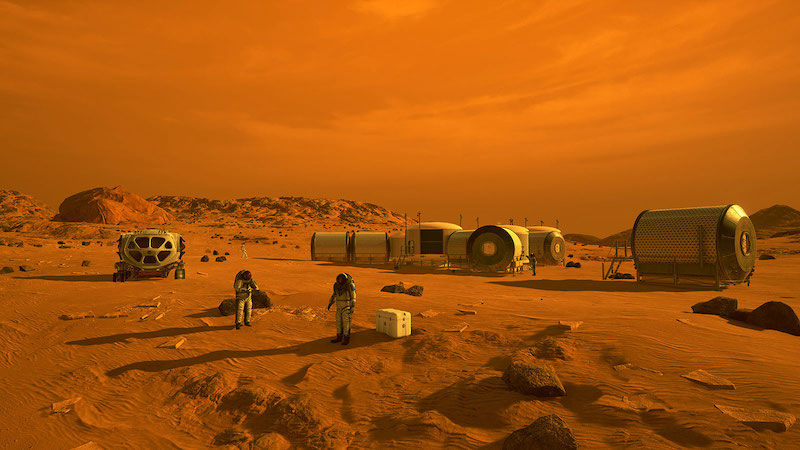
Astronauts and several small cylindrical modular buildings on orange landscape under an orange sky.
View larger. | Concept of a future human base on Mars. With help from tardigrades, plants could grow in Martian greenhouses. Image via NASA.

Future astronauts and water bears on Mars

The results show that water bears could help future astronauts survive on Mars. The tardigrades would be useful for growing plants in the Martian regolith, in a contained greenhouse though, of course. And the toxic regolith on its own – without water bears added – would help defend against contamination by earthly microbes that might have hitched a ride on the astronauts.

The paper cautions that more study is need though, saying:

These experiments have ramifications for the choice of species for functional soils to support plants and humans on Mars and for the limitations of terrestrial life; however, more testing is necessary to fully understand the potential habitability and dangers of Martian regolith.

Bottom line: Scientists at Penn State said tiny water bears on Mars could help future astronauts survive there. They nicknamed them Tardiguardians of the Galaxy.

You deserve a daily dose of good news. For the latest in science and the night sky, click here to subscribe to our free daily newsletter.

Source: Short-term survival of tardigrades (Ramazzottius cf. varieornatus and Hypsibius exemplaris) in martian regolith simulants (MGS-1 and OUCM-1)

Via Penn State

Read more: Why NASA sent tiny water bears into space

Read more: Did these tardigrades survive crash-landing on the moon?

The post Water bears on Mars: Tardiguardians of the Galaxy? first appeared on EarthSky.


from EarthSky https://ift.tt/NJ0m5DT
Water bears on Mars: Wrinkly, cylindrical creature with no eyes and 6 stubby legs with claws against a spacey background.
Artist’s concept of a tardigrade, or water bear, floating in space. These creatures are small, about the size of the period at the end of this sentence. But a new study says water bears might help future astronauts adapt to and survive on Mars … or elsewhere beyond Earth. That’s why they’re calling them Tardiguardians of the Galaxy. Image via Terranaut/ Pixabay.
  • Tardigrades – also known as water bears – are tiny animals about 1 mm or less in size. They’re known for being able to survive in extreme environments.
  • Tardigrades can survive in simulated Martian regolith, researchers found … if you rinse it with water first.
  • Future astronauts could use tardigrades to help grow plants and survive in habitats on Mars.

Tardiguardians of the Galaxy

You’ve probably heard of tardigrades – commonly known as water bears – microscopic creatures that look like chubby, cute bears. A new study from researchers in the U.S., Poland and the U.K. shows how these critters might help future astronauts survive on Mars. The researchers said on February 27, 2026, that tardigrades could survive in Mars’ regolith and help grow plants in Martian greenhouses. The regolith would simply need to be washed with water first.

The study shows how humans can use tardigrades to help us adapt extraterrestrial resources to support the exploration of Mars or other locations in the solar system. It suggests tardigrades might also be able to help protect against contaminants that human astronauts would bring with them.

The researchers proposed a fun nickname for these tiny creatures: Tardiguardians of the Galaxy.

They published their peer-reviewed study in the International Journal of Astrobiology on December 5, 2025.

7 small images showing translucent, cylindrical animals with 6 small stubby legs among grains of sand.
View larger. | These images show active tardigrades on Earth (top row) and in the Mars simulation (bottom row). The arrows point to mineral interactions. Image via Corien Bakermans/ Penn State.

Water bears on Mars

Mars is covered in regolith – loose, rocky debris and dust – instead of regular soil as we think of it on Earth. With this in mind, the researchers created two kinds of simulated Martian regolith. Both of them were based on regolith seen by the Curiosity rover at Rocknest in Gale Crater. The first one, MGS-1, represented the regolith on Mars in general. The second, OUCM-1, was more specific to the Rocknest location.

The researchers added living tardigrades to each simulant. They kept an eye on the tiny creatures using microscopes. Surprisingly, the first simulant affected the tardigrades much more than the second one. In fact, the tardigrades no longer showed any activity after only two days of exposure to the simulant. Altoona Professor of Microbiology Corien Bakermans at Penn State is the first author of the new paper. She said:

We know a lot about bacteria and fungi in simulated regolith, but very little about how they impact animals, even microscopic animals, like tardigrades. We investigated the specific, isolated impact of the regolith on tardigrades.

For the MGS-1 simulant, we saw significant inhibition – reduced activity – within two days. It was very damaging compared to OUCM-1, which was still inhibitory but much less so.

Woman with short silver hair wearing a long black and white scarf and pendant. Some trees are behind her.
Corien Bakermans is the Altoona Professor of Microbiology at Penn State. She is the 1st author of the new study about tardigrades on Mars. Image via Penn State.

Short-term Survival Of Tardigrades In Martian Regolith Simulantsastrobiology.com/2026/02/shor… #astrobiology #Tardigrade #Mars

Astrobiology (@astrobiology.bsky.social) 2026-02-28T18:46:07.886Z

Just add water

Why was the first simulant more damaging than the second one? Was there some kind of toxic chemical that killed the tardigrades? If so, the researchers suggested that perhaps it was something that could simply be washed off with water. Bakermans said:

We were a little surprised by how damaging MGS-1 was. We theorized that there might be something specific in the simulant that could be washed away.

To test this idea, the research team rinsed the simulant with water. They then added new tardigrades. And surprise … the tardigrades survived! There was almost no reduction in their activity. The researchers’ hunch seemed to be correct, Bakermans noted:

It seems that there’s something very damaging in MGS-1 that can dissolve in water, maybe salts or some other compound. That was unexpected, but it’s good in a sense, because it means that the regolith’s defense mechanism could stop contaminants. At the same time, it can be washed to help support plant growth or prevent damage to humans who come in contact with it.

Astronauts and several small cylindrical modular buildings on orange landscape under an orange sky.
View larger. | Concept of a future human base on Mars. With help from tardigrades, plants could grow in Martian greenhouses. Image via NASA.

Future astronauts and water bears on Mars

The results show that water bears could help future astronauts survive on Mars. The tardigrades would be useful for growing plants in the Martian regolith, in a contained greenhouse though, of course. And the toxic regolith on its own – without water bears added – would help defend against contamination by earthly microbes that might have hitched a ride on the astronauts.

The paper cautions that more study is need though, saying:

These experiments have ramifications for the choice of species for functional soils to support plants and humans on Mars and for the limitations of terrestrial life; however, more testing is necessary to fully understand the potential habitability and dangers of Martian regolith.

Bottom line: Scientists at Penn State said tiny water bears on Mars could help future astronauts survive there. They nicknamed them Tardiguardians of the Galaxy.

You deserve a daily dose of good news. For the latest in science and the night sky, click here to subscribe to our free daily newsletter.

Source: Short-term survival of tardigrades (Ramazzottius cf. varieornatus and Hypsibius exemplaris) in martian regolith simulants (MGS-1 and OUCM-1)

Via Penn State

Read more: Why NASA sent tiny water bears into space

Read more: Did these tardigrades survive crash-landing on the moon?

The post Water bears on Mars: Tardiguardians of the Galaxy? first appeared on EarthSky.


from EarthSky https://ift.tt/NJ0m5DT

Fish doorbell season is back! Help by ringing the bell


Here’s how you ring the fish doorbell to help fish migrate in the Netherlands.

Ring the fish doorbell!

Spring is returning to the Northern Hemisphere, and fish in the Netherlands are swimming upstream to their spawning grounds. But in the city of Utrecht, a boat lock is keeping the fish from reaching their destinations. That’s where you come in. There’s a camera at the bottom of the boat lock that livestreams the activity there. Watch the livestream, and when you see a fish, ring the doorbell! That will alert the lock operator to open the lock and let the fish swim through.

The less time the fish have to wait at the lock, the more likely they are to survive to their spawning grounds. Otherwise, predators – such as grebes and cormorants – can dip down to dine on the fish as they pile up and wait for the lock to open.

An underwater closeup of a fish apparently peering at the camera, surrounded by a yellow haze.
Knock, knock! This fish would like to pass through the lock in Utrecht, the Netherlands. Ring the fish doorbell to help the fish move on to its spawning grounds. Image via Fish Doorbell.

How to see the fish

Currently, the waters are still a bit cold, so not many fish are migrating. But that should change as spring warms up. The best time of day to spot a fish is at night or around dawn. That’s because it’s safer for fish to travel at night to avoid predators.

So when is night or dawn in the Netherlands? Utrecht is in Central European Time, which is currently UTC +1. So, for example, in Utrecht the sun is rising around 7 a.m. at this time of year, which would be midnight CST in the U.S.

March is when the activity starts, but it really picks up in April, when you’re most likely to spot fish waiting for you to let them through.

The ecologists running the program will keep a journal on YouTube as well. So follow along with the journal here.

Underwater closeup of a fish head end with an eyeball staring at the camera and a greenish background.
“Hey, you there. I know you can see me. Let me in!” Image via Fish Doorbell.

Livestreaming the stream life

In these early spring days, there are more people watching the fish doorbell livestream than there are fish. At any one time, it appears there are hundreds of people watching the livestream. But at the moment, fish are scarce.

And if you tune in to the livestream at a time when it’s too crowded, the doorbell won’t be available. You can still watch for the fish, and there’s a checklist where you can keep track of the species you’ve spotted. You can also try again at a less crowded time for a chance to ring the doorbell.

Underwater closeup of a bird with a long, curved neck and long sharp beak in murky water.
Uh-oh, there’s a predator hunting for fish! Image via Fish Doorbell.

Ding dong! Other fish doorbell benefits

The fish doorbell is not only important to the fish but to the quality of the rivers and canals. A healthy fish population plays a key role in keeping the water clean.

The fish doorbell is a project by the Municipality of Utrecht, Waterboard De Stichtse Rijnlanden and Water Authority Amstel, Gooi and Vecht. These groups want locals and visitors to realize how much life is in the famous Dutch canals. And the images from the doorbell cam provide insight into the species and number of fish that use Utrecht’s waterways. All of this information can help to improve the water quality and freshwater marine life in these ecosystems.

Bottom line: It’s time for the fish in the Netherlands to migrate. But how do they get through the lock? Well, you can help by ringing the fish doorbell to let them through! Here’s how.

Via Visdeurbel

The post Fish doorbell season is back! Help by ringing the bell first appeared on EarthSky.


from EarthSky https://ift.tt/flmUwGT


Here’s how you ring the fish doorbell to help fish migrate in the Netherlands.

Ring the fish doorbell!

Spring is returning to the Northern Hemisphere, and fish in the Netherlands are swimming upstream to their spawning grounds. But in the city of Utrecht, a boat lock is keeping the fish from reaching their destinations. That’s where you come in. There’s a camera at the bottom of the boat lock that livestreams the activity there. Watch the livestream, and when you see a fish, ring the doorbell! That will alert the lock operator to open the lock and let the fish swim through.

The less time the fish have to wait at the lock, the more likely they are to survive to their spawning grounds. Otherwise, predators – such as grebes and cormorants – can dip down to dine on the fish as they pile up and wait for the lock to open.

An underwater closeup of a fish apparently peering at the camera, surrounded by a yellow haze.
Knock, knock! This fish would like to pass through the lock in Utrecht, the Netherlands. Ring the fish doorbell to help the fish move on to its spawning grounds. Image via Fish Doorbell.

How to see the fish

Currently, the waters are still a bit cold, so not many fish are migrating. But that should change as spring warms up. The best time of day to spot a fish is at night or around dawn. That’s because it’s safer for fish to travel at night to avoid predators.

So when is night or dawn in the Netherlands? Utrecht is in Central European Time, which is currently UTC +1. So, for example, in Utrecht the sun is rising around 7 a.m. at this time of year, which would be midnight CST in the U.S.

March is when the activity starts, but it really picks up in April, when you’re most likely to spot fish waiting for you to let them through.

The ecologists running the program will keep a journal on YouTube as well. So follow along with the journal here.

Underwater closeup of a fish head end with an eyeball staring at the camera and a greenish background.
“Hey, you there. I know you can see me. Let me in!” Image via Fish Doorbell.

Livestreaming the stream life

In these early spring days, there are more people watching the fish doorbell livestream than there are fish. At any one time, it appears there are hundreds of people watching the livestream. But at the moment, fish are scarce.

And if you tune in to the livestream at a time when it’s too crowded, the doorbell won’t be available. You can still watch for the fish, and there’s a checklist where you can keep track of the species you’ve spotted. You can also try again at a less crowded time for a chance to ring the doorbell.

Underwater closeup of a bird with a long, curved neck and long sharp beak in murky water.
Uh-oh, there’s a predator hunting for fish! Image via Fish Doorbell.

Ding dong! Other fish doorbell benefits

The fish doorbell is not only important to the fish but to the quality of the rivers and canals. A healthy fish population plays a key role in keeping the water clean.

The fish doorbell is a project by the Municipality of Utrecht, Waterboard De Stichtse Rijnlanden and Water Authority Amstel, Gooi and Vecht. These groups want locals and visitors to realize how much life is in the famous Dutch canals. And the images from the doorbell cam provide insight into the species and number of fish that use Utrecht’s waterways. All of this information can help to improve the water quality and freshwater marine life in these ecosystems.

Bottom line: It’s time for the fish in the Netherlands to migrate. But how do they get through the lock? Well, you can help by ringing the fish doorbell to let them through! Here’s how.

Via Visdeurbel

The post Fish doorbell season is back! Help by ringing the bell first appeared on EarthSky.


from EarthSky https://ift.tt/flmUwGT

adds 2