aads

Ice-free oases on Snowball Earth sheltered early life

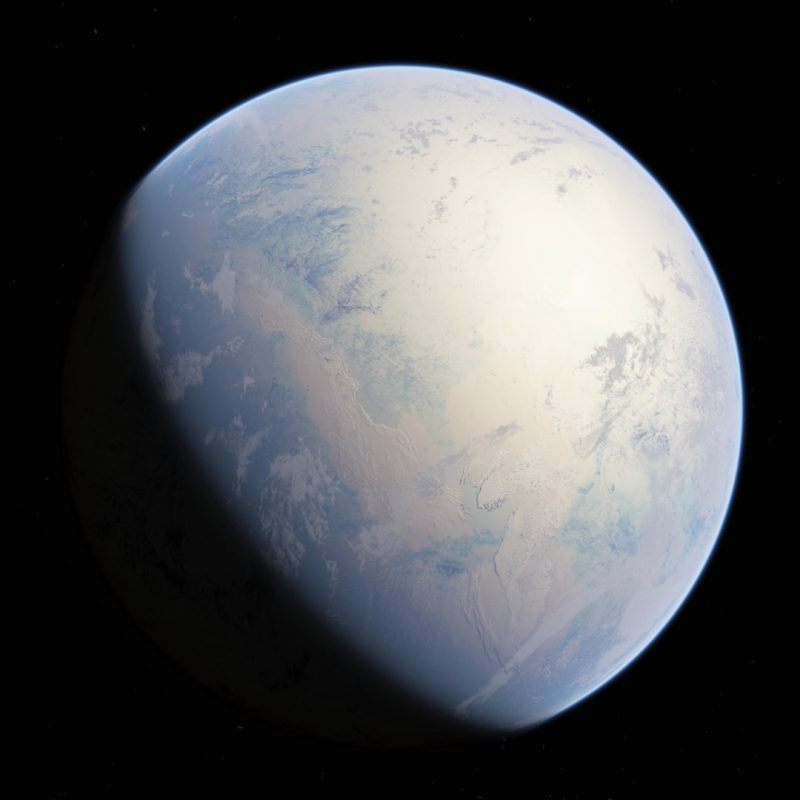
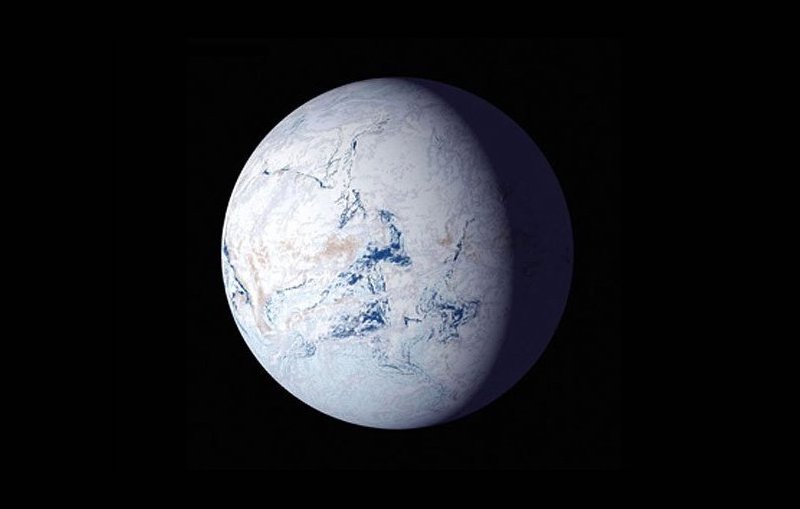
Planet completely covered by blue-white ice with some whiter clouds.
Artist’s concept of our planet during a period of widespread snow and ice, known as a Snowball Earth period. A new study says Snowball Earth wasn’t fully frozen. Instead, ice-free oases might have existed, providing safe havens for early complex life. Image via Oleg Kuznetsov/ Wikimedia Commons (CC BY-SA 4.0).

EarthSky’s 2026 lunar calendar shows the moon phase for every day of the year. Get yours today!

By Chloe Griffin and Thomas Gernon, University of Southampton

Ice-free oases on Snowball Earth sheltered early life

To an astronaut today, the Earth looks like a vibrant blue marble from space. But 700 million years ago, it would have looked like a blinding white snowball. This seems an unlikely cradle for life. Yet new evidence suggests the frozen ocean featured ice-free oases, providing a lifeline for our earliest complex ancestors.

During the Cryogenian period, from 720 million to 635 million years ago, massive ice sheets covered Earth from the poles to the tropics. Surface temperatures were as low as -50° C (-58° F).

Because the bright white surface of the planet reflected (rather than absorbed) the sun’s energy – a phenomenon known as the albedo effect – the Earth remained locked in this extreme climate state, dubbed “Snowball Earth,” for tens of millions of years.

Scientists have long thought that when the ocean is sealed under a kilometer-thick (.6 mile) shell of ice, the usual connection between the atmosphere and oceans would be prevented, muting climate variability. That is, normal short-term variations in temperature, precipitation, or wind patterns would be limited.

However, our new research, published in Earth and Planetary Science Letters, challenges this status quo. By forensically decoding ancient rocks, we’ve discovered that the climate became briefly more dynamic than normally expected on Snowball Earth. In fact, it even oscillated to a rhythm strikingly like our own today.

Decoding climate cycles on Snowball Earth

The breakthrough came from the Garvellach Islands off the west coast of Scotland. These rocks formed during the Sturtian glaciation (720–660 million years ago), the first of two Snowball Earth events. The second was the Marinoan (650–635 million years ago). The Scottish islands contain a unique, exquisitely preserved archive of Snowball Earth, locking in the secrets of this weird ancient world.

Specifically, laminated sedimentary rocks, or varves, act as natural data loggers. Picture a lake today: sediment settles quietly through the water column and on to the lake bed. Over time, these layers of sediment build up at the bottom of the lake. Thousands or millions of years later, geologists can use the physical, chemical and biological information trapped in the now ancient lake sediments to track how environmental conditions – including climatic ones – changed over time.

While modern sediments like this are easy to find, detailed climate archives from deep time are vanishingly rare. That has left us in the dark about how our planet’s climate behaved during Snowball Earth … until now.

Small, barren islands with clearly defined rock layers.
The remote Garvellach Islands off the west coast of Scotland, where the researchers found their clues to Snowball Earth’s true nature. Image via Nick R/ Wikipedia (CC BY-SA 2.0).

The new study

We investigated a unique pile of rocks six meters (20 feet) thick, containing around 2,600 such varves, on the Garvellach Islands. What they revealed was, quite frankly, jaw-dropping. Microscopic and statistical analysis showed that these layers weren’t uniform, as you might expect locked in a Snowball state.

Instead, they conform to predictable cycles occurring over timescales of a few years to centuries. Perhaps yet more surprising is that almost the full suite of climate rhythms we know from today are preserved; from annual seasons to modern phenomena like El Niño (a climate pattern of warming sea surface temperatures in parts of the Pacific Ocean), and longer-term cycles linked to solar activity lasting decades to centuries.

We certainly wouldn’t have expected El Niño cycles, which happen every two to seven years today. This requires a seamless communication between the atmosphere and oceans, which is hard to envision on an ice-covered world.
RPlanet covered in ice and snow except for some equatorial patches of blue.
Another artist’s concept of Snowball Earth. Image via NASA/ University of Washington.

A (partially) ice-free ocean?

The cycles in these ancient sediments do raise an intriguing possibility: could parts of the ocean have been ice-free during Snowball Earth?

To get to the bottom of this, we used computer climate simulations to test different climate scenarios. Put simply, that means seeing how changing the amount of ice on the oceans changes the patterns of surface temperature across the globe. We found that when the ocean was frozen completely solid, climate oscillations were largely suppressed.

Our simulations also showed that vast areas of open water weren’t needed to restart these oscillations; if just a small fraction of the ocean surface was ice free – say, 15% or so – atmosphere ocean interactions could have resumed.

Comparing the simulated climate records to the patterns we decoded in the rock record, we think these sediments most likely document a patch of open water in the tropics, sometimes called an oasis. Many scientists use such oases to reconcile the survival of life with the near-global glaciation.

Interestingly, several other lines of evidence suggest a partially ice-free ocean at roughly the same time. So, could our rocks provide evidence for temporary warming during Snowball Earth?

While they confirm temporary patches of warmth in the surface ocean, these rocks represent a snapshot of around 3,000 years in a multi-million-year glaciation; that is, likely a fleeting “Slushball” state within an otherwise frozen world. Another recent study even argues that liquid water could have persisted at 5° F (-15° C), but only if it were extremely salty.

Oases for life?

Crucially though, our new analysis shows that the climate system has an inherent tendency to oscillate, even under the most extreme conditions. Could these oases in the sea have been life-rafts for the earliest complex animals?

Perhaps the biggest paradox of Snowball Earth is that this hostile deep-freeze triggered a biological revolution. Around this time, the diversity and abundance of multicellular life exploded. Phosphorus-rich dust ground up by the very glaciers that threatened to extinguish it fuelled this event. Scientists think this happened during the warm interval between the two Snowball glaciations.

But for life to thrive after the ice, it first had to survive the second (Marinoan) glaciation. Our study offers a viable solution to this puzzle: if tropical oceans weren’t entirely frozen over, but held pockets of open water, these oases would have acted as habitable refuges.

Rather than a planet frozen solid, our work paints a picture of an “oscillating” world where thin cracks in the ice or more expansive patches of open water formed habitats that allowed – even encouraged – the colonization of life.

By maintaining biodiversity during Earth’s most extreme ice age, these oases ensured that when the ice finally melted away, life was ready to bloom into the complex ecosystems we see today, eventually leading to us.

Chloe Griffin, Research Fellow, School of Ocean & Earth Science, and Thomas Gernon, Professor in Earth & Climate Science, University of Southampton.

This article is republished from The Conversation under a Creative Commons license. Read the original article.

Bottom line: Scientists have found evidence for ice-free oases on Snowball Earth, which might have provided a lifeline for early complex life.

Read more: Enormous glaciers on Snowball Earth helped life evolve

The post Ice-free oases on Snowball Earth sheltered early life first appeared on EarthSky.


from EarthSky https://ift.tt/IgSrNAs
Planet completely covered by blue-white ice with some whiter clouds.
Artist’s concept of our planet during a period of widespread snow and ice, known as a Snowball Earth period. A new study says Snowball Earth wasn’t fully frozen. Instead, ice-free oases might have existed, providing safe havens for early complex life. Image via Oleg Kuznetsov/ Wikimedia Commons (CC BY-SA 4.0).

EarthSky’s 2026 lunar calendar shows the moon phase for every day of the year. Get yours today!

By Chloe Griffin and Thomas Gernon, University of Southampton

Ice-free oases on Snowball Earth sheltered early life

To an astronaut today, the Earth looks like a vibrant blue marble from space. But 700 million years ago, it would have looked like a blinding white snowball. This seems an unlikely cradle for life. Yet new evidence suggests the frozen ocean featured ice-free oases, providing a lifeline for our earliest complex ancestors.

During the Cryogenian period, from 720 million to 635 million years ago, massive ice sheets covered Earth from the poles to the tropics. Surface temperatures were as low as -50° C (-58° F).

Because the bright white surface of the planet reflected (rather than absorbed) the sun’s energy – a phenomenon known as the albedo effect – the Earth remained locked in this extreme climate state, dubbed “Snowball Earth,” for tens of millions of years.

Scientists have long thought that when the ocean is sealed under a kilometer-thick (.6 mile) shell of ice, the usual connection between the atmosphere and oceans would be prevented, muting climate variability. That is, normal short-term variations in temperature, precipitation, or wind patterns would be limited.

However, our new research, published in Earth and Planetary Science Letters, challenges this status quo. By forensically decoding ancient rocks, we’ve discovered that the climate became briefly more dynamic than normally expected on Snowball Earth. In fact, it even oscillated to a rhythm strikingly like our own today.

Decoding climate cycles on Snowball Earth

The breakthrough came from the Garvellach Islands off the west coast of Scotland. These rocks formed during the Sturtian glaciation (720–660 million years ago), the first of two Snowball Earth events. The second was the Marinoan (650–635 million years ago). The Scottish islands contain a unique, exquisitely preserved archive of Snowball Earth, locking in the secrets of this weird ancient world.

Specifically, laminated sedimentary rocks, or varves, act as natural data loggers. Picture a lake today: sediment settles quietly through the water column and on to the lake bed. Over time, these layers of sediment build up at the bottom of the lake. Thousands or millions of years later, geologists can use the physical, chemical and biological information trapped in the now ancient lake sediments to track how environmental conditions – including climatic ones – changed over time.

While modern sediments like this are easy to find, detailed climate archives from deep time are vanishingly rare. That has left us in the dark about how our planet’s climate behaved during Snowball Earth … until now.

Small, barren islands with clearly defined rock layers.
The remote Garvellach Islands off the west coast of Scotland, where the researchers found their clues to Snowball Earth’s true nature. Image via Nick R/ Wikipedia (CC BY-SA 2.0).

The new study

We investigated a unique pile of rocks six meters (20 feet) thick, containing around 2,600 such varves, on the Garvellach Islands. What they revealed was, quite frankly, jaw-dropping. Microscopic and statistical analysis showed that these layers weren’t uniform, as you might expect locked in a Snowball state.

Instead, they conform to predictable cycles occurring over timescales of a few years to centuries. Perhaps yet more surprising is that almost the full suite of climate rhythms we know from today are preserved; from annual seasons to modern phenomena like El Niño (a climate pattern of warming sea surface temperatures in parts of the Pacific Ocean), and longer-term cycles linked to solar activity lasting decades to centuries.

We certainly wouldn’t have expected El Niño cycles, which happen every two to seven years today. This requires a seamless communication between the atmosphere and oceans, which is hard to envision on an ice-covered world.

RPlanet covered in ice and snow except for some equatorial patches of blue.
Another artist’s concept of Snowball Earth. Image via NASA/ University of Washington.

A (partially) ice-free ocean?

The cycles in these ancient sediments do raise an intriguing possibility: could parts of the ocean have been ice-free during Snowball Earth?

To get to the bottom of this, we used computer climate simulations to test different climate scenarios. Put simply, that means seeing how changing the amount of ice on the oceans changes the patterns of surface temperature across the globe. We found that when the ocean was frozen completely solid, climate oscillations were largely suppressed.

Our simulations also showed that vast areas of open water weren’t needed to restart these oscillations; if just a small fraction of the ocean surface was ice free – say, 15% or so – atmosphere ocean interactions could have resumed.

Comparing the simulated climate records to the patterns we decoded in the rock record, we think these sediments most likely document a patch of open water in the tropics, sometimes called an oasis. Many scientists use such oases to reconcile the survival of life with the near-global glaciation.

Interestingly, several other lines of evidence suggest a partially ice-free ocean at roughly the same time. So, could our rocks provide evidence for temporary warming during Snowball Earth?

While they confirm temporary patches of warmth in the surface ocean, these rocks represent a snapshot of around 3,000 years in a multi-million-year glaciation; that is, likely a fleeting “Slushball” state within an otherwise frozen world. Another recent study even argues that liquid water could have persisted at 5° F (-15° C), but only if it were extremely salty.

Oases for life?

Crucially though, our new analysis shows that the climate system has an inherent tendency to oscillate, even under the most extreme conditions. Could these oases in the sea have been life-rafts for the earliest complex animals?

Perhaps the biggest paradox of Snowball Earth is that this hostile deep-freeze triggered a biological revolution. Around this time, the diversity and abundance of multicellular life exploded. Phosphorus-rich dust ground up by the very glaciers that threatened to extinguish it fuelled this event. Scientists think this happened during the warm interval between the two Snowball glaciations.

But for life to thrive after the ice, it first had to survive the second (Marinoan) glaciation. Our study offers a viable solution to this puzzle: if tropical oceans weren’t entirely frozen over, but held pockets of open water, these oases would have acted as habitable refuges.

Rather than a planet frozen solid, our work paints a picture of an “oscillating” world where thin cracks in the ice or more expansive patches of open water formed habitats that allowed – even encouraged – the colonization of life.

By maintaining biodiversity during Earth’s most extreme ice age, these oases ensured that when the ice finally melted away, life was ready to bloom into the complex ecosystems we see today, eventually leading to us.

Chloe Griffin, Research Fellow, School of Ocean & Earth Science, and Thomas Gernon, Professor in Earth & Climate Science, University of Southampton.

This article is republished from The Conversation under a Creative Commons license. Read the original article.

Bottom line: Scientists have found evidence for ice-free oases on Snowball Earth, which might have provided a lifeline for early complex life.

Read more: Enormous glaciers on Snowball Earth helped life evolve

The post Ice-free oases on Snowball Earth sheltered early life first appeared on EarthSky.


from EarthSky https://ift.tt/IgSrNAs

Too many satellites? Is Earth’s orbit headed for catastrophe?

Too many satellites: Dozens of white streaks on a dark starry background, with 1 large star.
Here’s an astronomer’s view of a star obscured by streaks from Starlink satellites. Are there too many satellites in orbit around Earth? Image via Rafael Schmall/ NOIRLab.
  • The number of satellites is growing rapidly with tens of thousands active and potentially over a million proposed. This raises risks of orbital crowding, collisions, light pollution, environmental harm and long-term damage to the night sky.
  • Major cultural, environmental and cumulative impacts go largely unaddressed by current regulations. This is despite the rising risks, like debris cascades and atmospheric pollution from launches and reentries.
  • Catastrophe isn’t inevitable. Governments and industry could require broader dark skies impact assessments, better global coordination and design changes to limit satellite numbers and reduce harm.

By Gregory Radisic, Bond University and Samantha Lawler, University of Regina

1 million satellites in orbit?

On January 30, 2026, SpaceX filed an application with the US Federal Communications Commission (FCC) for a megaconstellation of up to one million satellites to power data centers in space.

The proposal envisions satellites operating between 300 and 1,200 miles (500 and 2,000 km) in low Earth orbit. Some of the orbits are designed for near-constant exposure to sunlight. The public can currently submit comments on this proposal to the FCC.

SpaceX’s filing is just the latest among exponentially growing satellite megaconstellation proposals. Such satellites operate with a single purpose and have short replacement life cycles of about five years.

As of February 2026, approximately 14,000 active satellites are in orbit. An additional 1.23 million proposed satellite projects are in various stages of development. The approval process for these satellites focuses almost entirely on the limited technical info companies have to submit to regulators.

Cultural, spiritual and most environmental impacts aren’t taken into account. Should they be? Tell us your thoughts in the comments below.

EarthSky’s 2026 lunar calendar is available now. Get yours today! Makes a great gift.

Too many satellites

At this scale of growth, the night sky will change globally and for generations to come.

Satellites in low-Earth orbit reflect sunlight for about two hours after sunset and before sunrise. Despite engineering efforts to make them less bright, truck-sized satellites from many megaconstellations look like moving points in the night sky. Projections show future satellites will significantly increase this light pollution.

In 2021, astronomers estimated that in less than a decade, one in every 15 points of light in the night sky would be a moving satellite. That estimate only included the 65,000 megaconstellation satellites proposed at the time.

Once deployed at a scale of millions, the impacts on the night sky may not be easily reversed.

While the average satellite only lasts about five years, companies design these megaconstellations for nearly continuous replacement and expansion. This locks in a continuous, industrialized presence in the night sky.

Graph: nearly flat numbers 1960-2020 then extremely steep, high upward curve.
This graph breaks down the satellite launches per year by country. Image via ESA/ The Conversation.

All this is causing a space-based shifting baseline syndrome, where each new generation accepts a progressively more degraded night sky. Criss-crossing satellites become the new normal.

And for the first time in human history, this shifting baseline means kids today won’t grow up with the same night sky every previous generation of humanity had access to.

A 6-panel graphic with a few satellites on 4 Earths and very many on Earths labeled 2024 and Now.
Visual representation of the increasing number of satellites. Image via The Conversation (CC BY-SA 4.0).

Houston, we have a ‘mega’ problem

Concerns over the sheer volume of proposed satellites come from many sides.

Scientific concerns include bright reflections and radio emissions from satellites that will disrupt astronomy. Industry experts also note traffic management and logistical concerns. There’s currently no form of unified space traffic management in the same way that exists in aviation, for example.

Megaconstellations also increase the risk of Kessler syndrome, a runaway chain reaction of collisions. There are already 50,000 pieces of debris in orbit that are 4 inches (10 cm) or larger. If satellites stopped all collision avoidance maneuvers, the latest data shows we can expect a major collision in 3.8 days.

Major cultural concerns abound, too. Satellite light pollution will negatively impact Indigenous uses of the night sky for long-standing oral traditions, navigation, hunting and spiritual traditions.

Launching so many satellites uses up vast amounts of fossil fuels, damaging the ozone layer. After the satellites have served their purpose, the end-of-life plan is to burn them up in the atmosphere. This poses another environmental concern as it deposits vast quantities of metals into the stratosphere, causing ozone depletion and other potentially harmful chemical reactions.

All this feeds into legal concerns. Under international space law, countries – not companies – are liable for harm caused by their space objects. Space lawyers are increasingly trying to understand if international space law can actually hold corporations or private individuals accountable. This is especially important as the risk of damage, death or permanent environmental damage grows.

We can no longer ignore the gaps in regulation

Currently, the main regulations concerning satellite proposals are technical, such as deciding which radio frequencies they will use. At national levels, regulators focus on launch safety, lessening environmental impacts on Earth, and liability if something goes wrong.

What these regulations don’t capture is how hundreds of thousands of bright satellites change the night sky for scientific study, navigation, Indigenous teaching and ceremony, and cultural continuity. These are not traditional “environmental” harms, nor are they technical engineering concerns. They’re cultural impacts that fall into a regulatory blind spot.

This is why the world needs a Dark Skies Impact Assessment, as proposed by space lawyers Gregory Radisic and Natalie Gillespie. It’s a systematic way to identify, document, and meaningfully consider all the impacts of a proposed satellite constellation before it goes ahead.

How would a Dark Sky Impact Assessment work?

First, evidence must be gathered from all stakeholders. Astronomers (both amateur and professional), atmospheric scientists, environmental researchers, cultural scholars, affected communities and industry all bring their perspectives.

Second, it’s essential to model any cumulative effects of the satellites. Assessments should analyze how constellations will change night sky visibility and skyglow, orbital congestion and the risk of casualties on the ground.

Third, it will define clear criteria for when unobstructed sky visibility is critical for science, navigation, education, cultural practice and shared human heritage.

Fourth, it must include mitigation pathways such as brightness reduction, orbital design changes and deployment adjustments to lessen harm. This should include incentives for using as few satellites as possible for a given project.

Finally, the findings must be transparent, independently reviewable and directly tied to licensing and policy decisions.


Spaceflight expert Jonathan McDowell discusses the hazards and consequences of overcrowding Earth’s near space with too many satellites and not enough regulation.

Dark Sky Impact Assessment is not a veto tool

A Dark Skies Impact Assessment doesn’t prevent space development. It clarifies trade-offs and improves decision making. It can lead to design choices that reduce brightness and visual interference, orbital configurations that lessen cultural impact, earlier and more meaningful consultation, and cultural considerations where harm can’t be avoided.

Most importantly, it ensures that communities affected by satellite constellations aren’t finding out about them after approval has already been granted and bright lights crawl across their skies.

The question is not whether the night sky will change. It’s already changing. Now is the time for governments and international institutions to design fair processes before those changes become permanent.

Gregory Radisic, fellow at the Centre for Space, Cyberspace and Data Law; Senior Teaching Fellow, Faculty of Law, Bond University

Samantha Lawler, Associate Professor of Astronomy, University of Regina

This article is republished from The Conversation under a Creative Commons license. Read the original article.

Bottom line: The growing number of satellites poses an under-regulated threat of disaster for spaceflight. But it’s not too late to act!

Read more: 1 to 2 Starlink satellites are falling back to Earth each day

The Conversation

The post Too many satellites? Is Earth’s orbit headed for catastrophe? first appeared on EarthSky.


from EarthSky https://ift.tt/P48wBSC
Too many satellites: Dozens of white streaks on a dark starry background, with 1 large star.
Here’s an astronomer’s view of a star obscured by streaks from Starlink satellites. Are there too many satellites in orbit around Earth? Image via Rafael Schmall/ NOIRLab.
  • The number of satellites is growing rapidly with tens of thousands active and potentially over a million proposed. This raises risks of orbital crowding, collisions, light pollution, environmental harm and long-term damage to the night sky.
  • Major cultural, environmental and cumulative impacts go largely unaddressed by current regulations. This is despite the rising risks, like debris cascades and atmospheric pollution from launches and reentries.
  • Catastrophe isn’t inevitable. Governments and industry could require broader dark skies impact assessments, better global coordination and design changes to limit satellite numbers and reduce harm.

By Gregory Radisic, Bond University and Samantha Lawler, University of Regina

1 million satellites in orbit?

On January 30, 2026, SpaceX filed an application with the US Federal Communications Commission (FCC) for a megaconstellation of up to one million satellites to power data centers in space.

The proposal envisions satellites operating between 300 and 1,200 miles (500 and 2,000 km) in low Earth orbit. Some of the orbits are designed for near-constant exposure to sunlight. The public can currently submit comments on this proposal to the FCC.

SpaceX’s filing is just the latest among exponentially growing satellite megaconstellation proposals. Such satellites operate with a single purpose and have short replacement life cycles of about five years.

As of February 2026, approximately 14,000 active satellites are in orbit. An additional 1.23 million proposed satellite projects are in various stages of development. The approval process for these satellites focuses almost entirely on the limited technical info companies have to submit to regulators.

Cultural, spiritual and most environmental impacts aren’t taken into account. Should they be? Tell us your thoughts in the comments below.

EarthSky’s 2026 lunar calendar is available now. Get yours today! Makes a great gift.

Too many satellites

At this scale of growth, the night sky will change globally and for generations to come.

Satellites in low-Earth orbit reflect sunlight for about two hours after sunset and before sunrise. Despite engineering efforts to make them less bright, truck-sized satellites from many megaconstellations look like moving points in the night sky. Projections show future satellites will significantly increase this light pollution.

In 2021, astronomers estimated that in less than a decade, one in every 15 points of light in the night sky would be a moving satellite. That estimate only included the 65,000 megaconstellation satellites proposed at the time.

Once deployed at a scale of millions, the impacts on the night sky may not be easily reversed.

While the average satellite only lasts about five years, companies design these megaconstellations for nearly continuous replacement and expansion. This locks in a continuous, industrialized presence in the night sky.

Graph: nearly flat numbers 1960-2020 then extremely steep, high upward curve.
This graph breaks down the satellite launches per year by country. Image via ESA/ The Conversation.

All this is causing a space-based shifting baseline syndrome, where each new generation accepts a progressively more degraded night sky. Criss-crossing satellites become the new normal.

And for the first time in human history, this shifting baseline means kids today won’t grow up with the same night sky every previous generation of humanity had access to.

A 6-panel graphic with a few satellites on 4 Earths and very many on Earths labeled 2024 and Now.
Visual representation of the increasing number of satellites. Image via The Conversation (CC BY-SA 4.0).

Houston, we have a ‘mega’ problem

Concerns over the sheer volume of proposed satellites come from many sides.

Scientific concerns include bright reflections and radio emissions from satellites that will disrupt astronomy. Industry experts also note traffic management and logistical concerns. There’s currently no form of unified space traffic management in the same way that exists in aviation, for example.

Megaconstellations also increase the risk of Kessler syndrome, a runaway chain reaction of collisions. There are already 50,000 pieces of debris in orbit that are 4 inches (10 cm) or larger. If satellites stopped all collision avoidance maneuvers, the latest data shows we can expect a major collision in 3.8 days.

Major cultural concerns abound, too. Satellite light pollution will negatively impact Indigenous uses of the night sky for long-standing oral traditions, navigation, hunting and spiritual traditions.

Launching so many satellites uses up vast amounts of fossil fuels, damaging the ozone layer. After the satellites have served their purpose, the end-of-life plan is to burn them up in the atmosphere. This poses another environmental concern as it deposits vast quantities of metals into the stratosphere, causing ozone depletion and other potentially harmful chemical reactions.

All this feeds into legal concerns. Under international space law, countries – not companies – are liable for harm caused by their space objects. Space lawyers are increasingly trying to understand if international space law can actually hold corporations or private individuals accountable. This is especially important as the risk of damage, death or permanent environmental damage grows.

We can no longer ignore the gaps in regulation

Currently, the main regulations concerning satellite proposals are technical, such as deciding which radio frequencies they will use. At national levels, regulators focus on launch safety, lessening environmental impacts on Earth, and liability if something goes wrong.

What these regulations don’t capture is how hundreds of thousands of bright satellites change the night sky for scientific study, navigation, Indigenous teaching and ceremony, and cultural continuity. These are not traditional “environmental” harms, nor are they technical engineering concerns. They’re cultural impacts that fall into a regulatory blind spot.

This is why the world needs a Dark Skies Impact Assessment, as proposed by space lawyers Gregory Radisic and Natalie Gillespie. It’s a systematic way to identify, document, and meaningfully consider all the impacts of a proposed satellite constellation before it goes ahead.

How would a Dark Sky Impact Assessment work?

First, evidence must be gathered from all stakeholders. Astronomers (both amateur and professional), atmospheric scientists, environmental researchers, cultural scholars, affected communities and industry all bring their perspectives.

Second, it’s essential to model any cumulative effects of the satellites. Assessments should analyze how constellations will change night sky visibility and skyglow, orbital congestion and the risk of casualties on the ground.

Third, it will define clear criteria for when unobstructed sky visibility is critical for science, navigation, education, cultural practice and shared human heritage.

Fourth, it must include mitigation pathways such as brightness reduction, orbital design changes and deployment adjustments to lessen harm. This should include incentives for using as few satellites as possible for a given project.

Finally, the findings must be transparent, independently reviewable and directly tied to licensing and policy decisions.


Spaceflight expert Jonathan McDowell discusses the hazards and consequences of overcrowding Earth’s near space with too many satellites and not enough regulation.

Dark Sky Impact Assessment is not a veto tool

A Dark Skies Impact Assessment doesn’t prevent space development. It clarifies trade-offs and improves decision making. It can lead to design choices that reduce brightness and visual interference, orbital configurations that lessen cultural impact, earlier and more meaningful consultation, and cultural considerations where harm can’t be avoided.

Most importantly, it ensures that communities affected by satellite constellations aren’t finding out about them after approval has already been granted and bright lights crawl across their skies.

The question is not whether the night sky will change. It’s already changing. Now is the time for governments and international institutions to design fair processes before those changes become permanent.

Gregory Radisic, fellow at the Centre for Space, Cyberspace and Data Law; Senior Teaching Fellow, Faculty of Law, Bond University

Samantha Lawler, Associate Professor of Astronomy, University of Regina

This article is republished from The Conversation under a Creative Commons license. Read the original article.

Bottom line: The growing number of satellites poses an under-regulated threat of disaster for spaceflight. But it’s not too late to act!

Read more: 1 to 2 Starlink satellites are falling back to Earth each day

The Conversation

The post Too many satellites? Is Earth’s orbit headed for catastrophe? first appeared on EarthSky.


from EarthSky https://ift.tt/P48wBSC

Meet Gemini the Twins, home to Jupiter and 2 bright stars

Sky chart: the constellation Gemini, with stars labeled, and Jupiter in it on the green ecliptic line.
The constellation Gemini the Twins is high in the February evening sky. And in February 2026, the bright planet Jupiter is near the 2 brightest stars of Gemini. These stars are golden Pollux and white Castor. Pollux is the slightly brighter one. But Jupiter outshines them both! Chart via EarthSky.

EarthSky’s 2026 lunar calendar is available now. Get yours today! Makes a great gift.

Gemini, the constellation of the Twins

Most people see the constellation Gemini as just two bright stars – Castor and Pollux – sometimes called the Gemini twins. These two stars aren’t really twins. Pollux is brighter and more golden in color. Castor is slightly fainter and white. But both stars are bright, and they’re noticeable for being close together on the sky’s dome. From time immemorial, people have thought they looked like brother stars.

And in 2026, the bright planet Jupiter is among the stars of Gemini and near the twin stars. It’ll remain in Gemini through June when it moves in front of the constellation of Cancer the Crab.

Best viewing for this constellation

January, February and March are great for observing these stars. Then Gemini is well up in the east at nightfall. In early February, Gemini climbs highest in the sky around 10 p.m. local time. By the end of February, the constellation is highest around 9 p.m. That’s local time, the time on your clock, no matter where you live around the globe.

Gemini stays in view in the evening sky until around May. By late May and June, Gemini is found low in the west at nightfall, and Gemini’s two brightest stars – Castor and Pollux – fade into the sunset before the June 21 summer solstice. The sun annually passes in front of Gemini from about June 21 until July 20.

There’s also a fine star cluster visible in binoculars

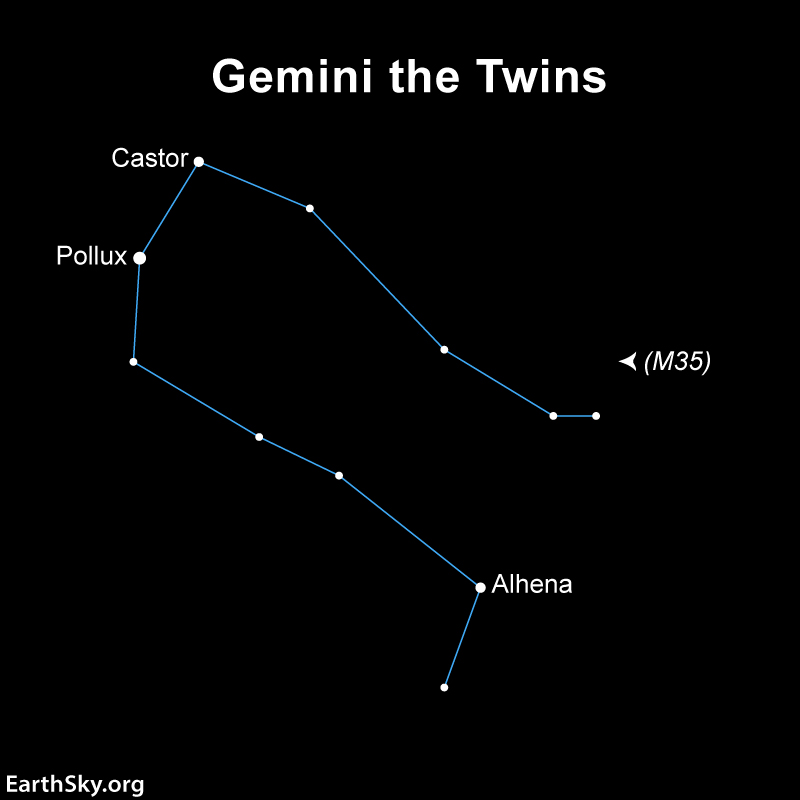
Star chart showing the stars of the constellation Gemini the Twins, with Castor, Pollux, Alhena and M35 marked.
The constellation Gemini the Twins. Castor and Pollux are considered the “twin” stars in the constellation. Nearby M35 is an open star cluster easily spotted in binoculars. Image via EarthSky.

Myths and lore

In skylore, Castor and Pollux were the sons of a mortal mother, Leda. Castor was the mortal brother, son of Tyndareus, and Pollux the immortal brother, son of Zeus. Castor and Pollux were joyfully united in spirit, yet sorrowfully divided by circumstance. When Castor was slain in battle, Pollux was inconsolable and begged Zeus to relieve him of the bonds of immortality. Zeus granted his request, and, to this day, Pollux and Castor stand reunited in the heavens, a tribute to the redemptive power of brotherly love.

Thus, the Greek myth of Castor and Pollux explores the inherit duality of life, of mortality and immortality forever intertwined.

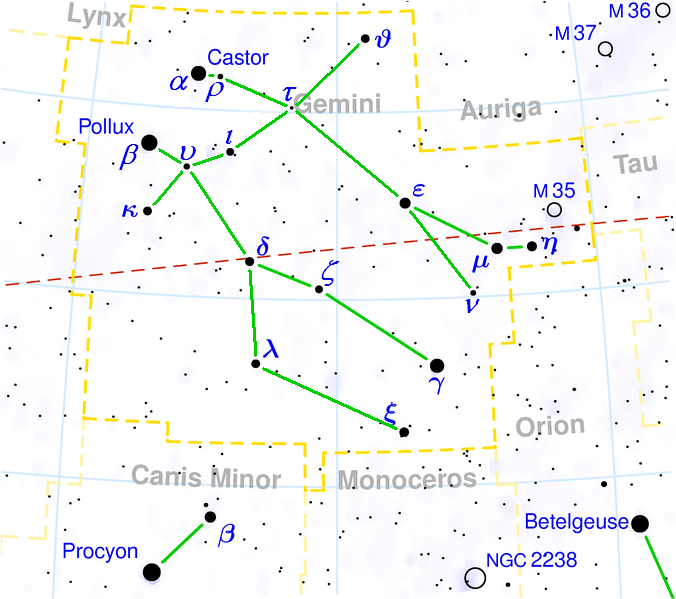
Colorful star chart with Gemini twins' stars labeled and M35 marked.
The 2 bright stars Castor and Pollux each mark a starry eye of a Gemini Twin. If you have binoculars and a dark sky, be sure to check out Gemini’s beautiful star cluster, Messier 35, or M35, in western Gemini near the Taurus border. See it, at the foot of Castor? Image via AugPi/ Wikimedia Commons/ GFDL.

How to find Gemini from Orion

If you can pick out just one noticeable sky pattern in the February night sky, it’s probably the constellation Orion the Hunter. On February evenings, from the Northern Hemisphere, Orion is high in the south.

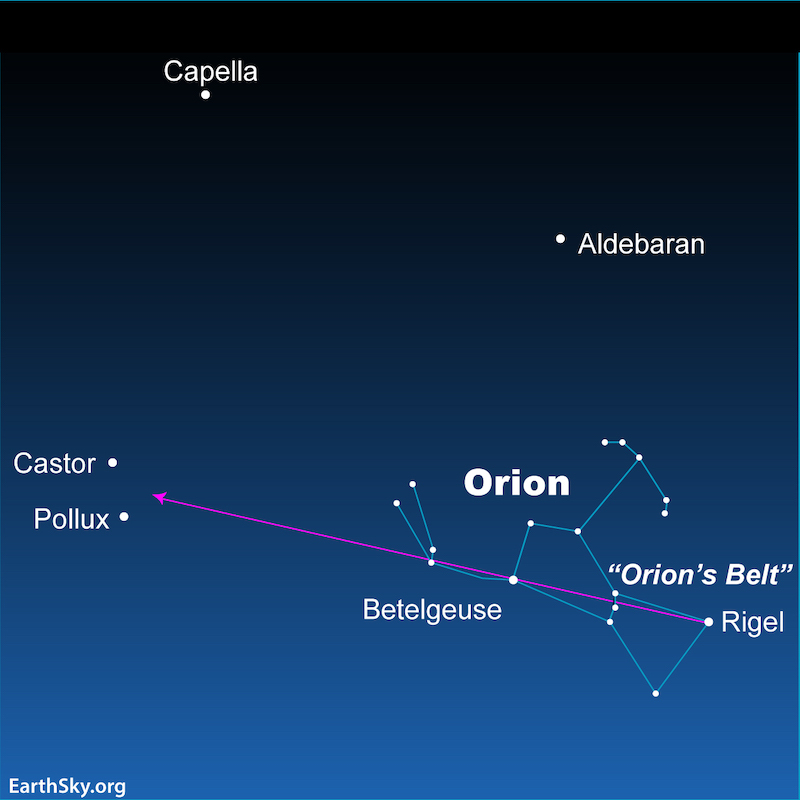
Orion is noticeable for its Belt stars, a short, straight row of three medium-bright stars. Look below Orion’s Belt for the very bright blue-white star Rigel. Now look above Orion’s Belt for the reddish star Betelgeuse. You can draw an imaginary line from Rigel through Betelgeuse to locate Castor and Pollux. Remember, you’ll be looking for two bright stars that are noticeably close together.

Star chart with Orion and Gemini, with a magenta arrow from Rigel to Betelgeuse pointing towards Castor and Pollux.
Facing south to southwest (from Northern Hemisphere locations) on January, February and March evenings, draw an imaginary line from Orion’s 2 bright stars – Rigel through Betelgeuse – to star-hop to Castor and Pollux. For a specific location and time of year, try Stellarium. Image via EarthSky.

How to find Gemini using the Big Dipper

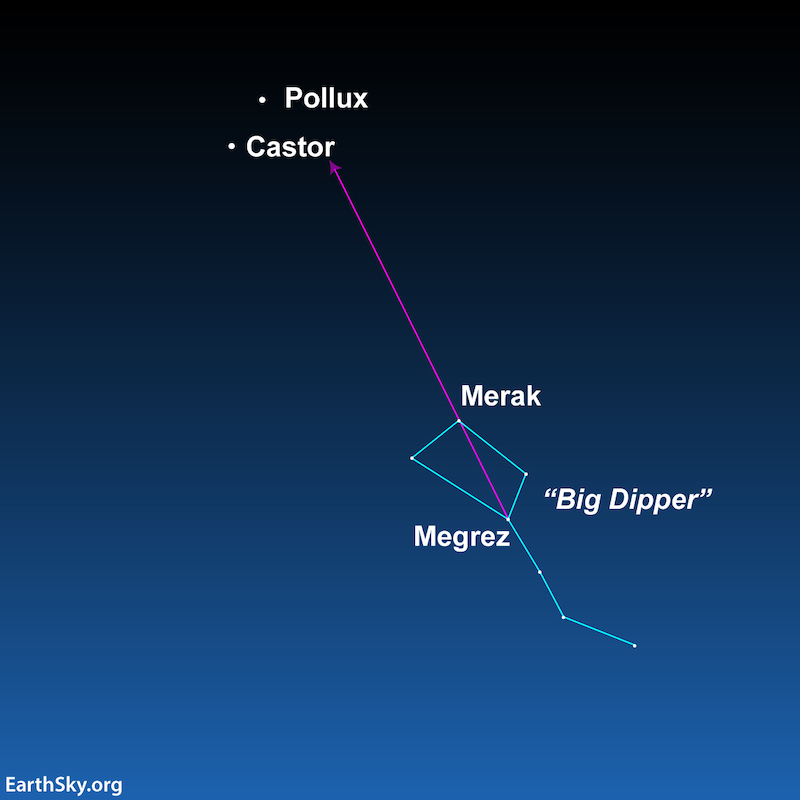
The Big Dipper is an asterism, not a true constellation, but a very clear dipper-shaped pattern of stars. The Big Dipper is always located generally northward on the sky’s dome. Draw an imaginary line diagonally through the bowl of the Big Dipper, from the star Megrez through the star Merak. You are going in the direction opposite the Big Dipper handle. This line will point to Castor and Pollux.

Star chart: Castor, Pollux, and Big Dipper, with arrow from two stars in the Big Dipper bowl pointing to the twin stars.
Facing north (from Northern Hemisphere locations) on late evenings in January and February, and evenings in March. Draw an imaginary line diagonally through the Big Dipper bowl to locate Castor and Pollux. For a specific location and time of year, try Stellarium. Image via EarthSky.

Or use the moon to find Gemini

As the moon swings full circle through the constellations of the zodiac, it passes through Gemini for a few days each month. Check EarthSky Tonight – especially in the months of January, February and March – for posts showing you the moon near Castor and Pollux on specific dates.

Or play around with the online planetarium program, Stellarium. It can show you when the moon moves through Gemini every month (except during those months when Gemini is behind the sun).

Spotting Sirius when Gemini is high in the sky

By the way, Gemini and the nighttime’s brightest star, Sirius, reach their highest points in the sky at roughly the same time. At middle latitudes in the Northern Hemisphere, we see Gemini’s brightest stars, Castor and Pollux, nearly overhead while Sirius sparkles quite low in our southern sky. (Sirius is always fairly low in the sky of northerners.) South of the equator, it’s the opposite: Sirius shines way up high while Gemini sits low in the northern sky.

Bottom line: The constellation Gemini the Twins is home to Castor and Pollux. Learn more about these bright stars, which you can see on northern winter nights.

Meet Taurus the Bull in the evening sky
Gemini the Twins, home to 2 bright stars
Meet Cancer the Crab and its Beehive Cluster
Leo the Lion and its backward question mark
Virgo the Maiden in northern spring skies
Meet Libra the Scales, a zodiacal constellation
Scorpius? Here’s your constellation
Sagittarius? Here’s your constellation
Capricornus the Sea-goat has an arrowhead shape
Aquarius? Here’s your constellation
Meet Pisces the Fish, 1st constellation of the zodiac
Say hello to Aries the Ram
Born under the sign of Ophiuchus?

The post Meet Gemini the Twins, home to Jupiter and 2 bright stars first appeared on EarthSky.


from EarthSky https://ift.tt/4YyU5SD
Sky chart: the constellation Gemini, with stars labeled, and Jupiter in it on the green ecliptic line.
The constellation Gemini the Twins is high in the February evening sky. And in February 2026, the bright planet Jupiter is near the 2 brightest stars of Gemini. These stars are golden Pollux and white Castor. Pollux is the slightly brighter one. But Jupiter outshines them both! Chart via EarthSky.

EarthSky’s 2026 lunar calendar is available now. Get yours today! Makes a great gift.

Gemini, the constellation of the Twins

Most people see the constellation Gemini as just two bright stars – Castor and Pollux – sometimes called the Gemini twins. These two stars aren’t really twins. Pollux is brighter and more golden in color. Castor is slightly fainter and white. But both stars are bright, and they’re noticeable for being close together on the sky’s dome. From time immemorial, people have thought they looked like brother stars.

And in 2026, the bright planet Jupiter is among the stars of Gemini and near the twin stars. It’ll remain in Gemini through June when it moves in front of the constellation of Cancer the Crab.

Best viewing for this constellation

January, February and March are great for observing these stars. Then Gemini is well up in the east at nightfall. In early February, Gemini climbs highest in the sky around 10 p.m. local time. By the end of February, the constellation is highest around 9 p.m. That’s local time, the time on your clock, no matter where you live around the globe.

Gemini stays in view in the evening sky until around May. By late May and June, Gemini is found low in the west at nightfall, and Gemini’s two brightest stars – Castor and Pollux – fade into the sunset before the June 21 summer solstice. The sun annually passes in front of Gemini from about June 21 until July 20.

There’s also a fine star cluster visible in binoculars

Star chart showing the stars of the constellation Gemini the Twins, with Castor, Pollux, Alhena and M35 marked.
The constellation Gemini the Twins. Castor and Pollux are considered the “twin” stars in the constellation. Nearby M35 is an open star cluster easily spotted in binoculars. Image via EarthSky.

Myths and lore

In skylore, Castor and Pollux were the sons of a mortal mother, Leda. Castor was the mortal brother, son of Tyndareus, and Pollux the immortal brother, son of Zeus. Castor and Pollux were joyfully united in spirit, yet sorrowfully divided by circumstance. When Castor was slain in battle, Pollux was inconsolable and begged Zeus to relieve him of the bonds of immortality. Zeus granted his request, and, to this day, Pollux and Castor stand reunited in the heavens, a tribute to the redemptive power of brotherly love.

Thus, the Greek myth of Castor and Pollux explores the inherit duality of life, of mortality and immortality forever intertwined.

Colorful star chart with Gemini twins' stars labeled and M35 marked.
The 2 bright stars Castor and Pollux each mark a starry eye of a Gemini Twin. If you have binoculars and a dark sky, be sure to check out Gemini’s beautiful star cluster, Messier 35, or M35, in western Gemini near the Taurus border. See it, at the foot of Castor? Image via AugPi/ Wikimedia Commons/ GFDL.

How to find Gemini from Orion

If you can pick out just one noticeable sky pattern in the February night sky, it’s probably the constellation Orion the Hunter. On February evenings, from the Northern Hemisphere, Orion is high in the south.

Orion is noticeable for its Belt stars, a short, straight row of three medium-bright stars. Look below Orion’s Belt for the very bright blue-white star Rigel. Now look above Orion’s Belt for the reddish star Betelgeuse. You can draw an imaginary line from Rigel through Betelgeuse to locate Castor and Pollux. Remember, you’ll be looking for two bright stars that are noticeably close together.

Star chart with Orion and Gemini, with a magenta arrow from Rigel to Betelgeuse pointing towards Castor and Pollux.
Facing south to southwest (from Northern Hemisphere locations) on January, February and March evenings, draw an imaginary line from Orion’s 2 bright stars – Rigel through Betelgeuse – to star-hop to Castor and Pollux. For a specific location and time of year, try Stellarium. Image via EarthSky.

How to find Gemini using the Big Dipper

The Big Dipper is an asterism, not a true constellation, but a very clear dipper-shaped pattern of stars. The Big Dipper is always located generally northward on the sky’s dome. Draw an imaginary line diagonally through the bowl of the Big Dipper, from the star Megrez through the star Merak. You are going in the direction opposite the Big Dipper handle. This line will point to Castor and Pollux.

Star chart: Castor, Pollux, and Big Dipper, with arrow from two stars in the Big Dipper bowl pointing to the twin stars.
Facing north (from Northern Hemisphere locations) on late evenings in January and February, and evenings in March. Draw an imaginary line diagonally through the Big Dipper bowl to locate Castor and Pollux. For a specific location and time of year, try Stellarium. Image via EarthSky.

Or use the moon to find Gemini

As the moon swings full circle through the constellations of the zodiac, it passes through Gemini for a few days each month. Check EarthSky Tonight – especially in the months of January, February and March – for posts showing you the moon near Castor and Pollux on specific dates.

Or play around with the online planetarium program, Stellarium. It can show you when the moon moves through Gemini every month (except during those months when Gemini is behind the sun).

Spotting Sirius when Gemini is high in the sky

By the way, Gemini and the nighttime’s brightest star, Sirius, reach their highest points in the sky at roughly the same time. At middle latitudes in the Northern Hemisphere, we see Gemini’s brightest stars, Castor and Pollux, nearly overhead while Sirius sparkles quite low in our southern sky. (Sirius is always fairly low in the sky of northerners.) South of the equator, it’s the opposite: Sirius shines way up high while Gemini sits low in the northern sky.

Bottom line: The constellation Gemini the Twins is home to Castor and Pollux. Learn more about these bright stars, which you can see on northern winter nights.

Meet Taurus the Bull in the evening sky
Gemini the Twins, home to 2 bright stars
Meet Cancer the Crab and its Beehive Cluster
Leo the Lion and its backward question mark
Virgo the Maiden in northern spring skies
Meet Libra the Scales, a zodiacal constellation
Scorpius? Here’s your constellation
Sagittarius? Here’s your constellation
Capricornus the Sea-goat has an arrowhead shape
Aquarius? Here’s your constellation
Meet Pisces the Fish, 1st constellation of the zodiac
Say hello to Aries the Ram
Born under the sign of Ophiuchus?

The post Meet Gemini the Twins, home to Jupiter and 2 bright stars first appeared on EarthSky.


from EarthSky https://ift.tt/4YyU5SD

John Glenn 1st American in orbit 64 years ago today

John Glenn: Black and white photo of a smiling man in space suit standing next to a conical one-person space capsule.
John Glenn became the 1st American in orbit on February 20, 1962. Astronaut Glenn sits outside the space capsule Friendship 7. Image via NASA.

EarthSky’s 2026 lunar calendar is available now. Get yours today! Makes a great gift.

John Glenn orbited Earth 64 years ago today

John Glenn became the first American to orbit Earth on February 20, 1962, 64 years ago today. During 4 hours and 55 minutes, he circled the globe three times in his space capsule Friendship 7. The feat made Glenn a national hero and a household name.

It was the ’60s, and the space race was on. The U.S. and the Soviet Union competed to achieve important firsts in space.

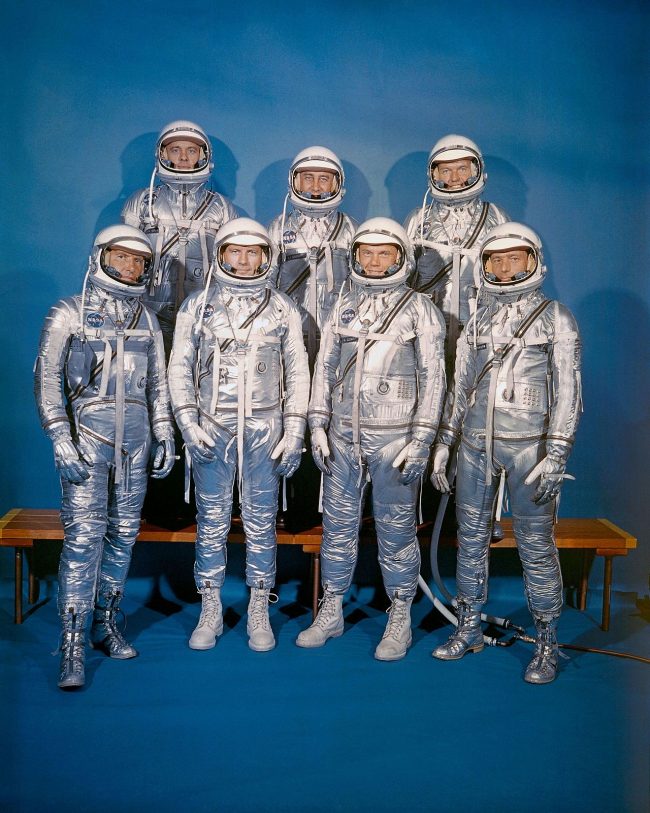
Glenn was one of the first American astronauts, a member of the group NASA called the Mercury 7. Author Tom Wolfe immortalized them in his masterly 1979 book The Right Stuff. Glenn and his fellow astronauts rode cramped Mercury space capsules into the unknown.

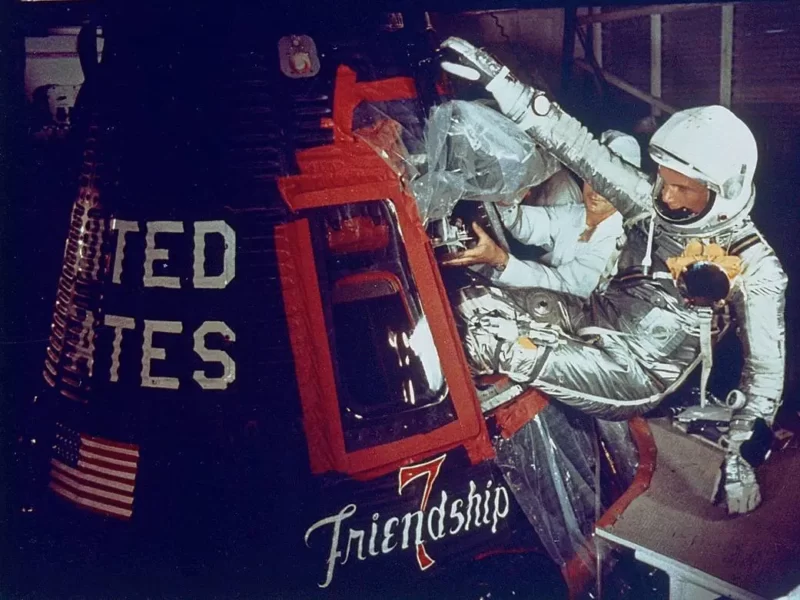
In those days, NASA astronauts gave personal nicknames to their space capsules. Glenn and his family decided on the word Friendship, adding the number 7 to honor his fellow Mercury astronauts. But NASA’s official name for Glenn’s mission was Mercury-Atlas 6: Mercury for the Roman god of speed and Atlas 6 to indicate that this was the sixth mission to launch atop the powerful Atlas rocket.

Group portrait of seven men in old-timey silver spacesuits, standing in two rows.
NASA introduced its 1st astronauts – the Mercury 7 – on April 9, 1959. LIFE magazine photographer Ralph Morse took this image on March 17, 1960. Front row, left to right: Walter M. Schirra Jr., Donald K. “Deke” Slayton, John H. Glenn Jr., and M. Scott Carpenter. Back row: Alan B. Shepard Jr., Virgil I. “Gus” Grissom, and L. Gordon Cooper Jr. Image via NASA.

“Godspeed, John Glenn”

Atlas rocket and weather problems forced NASA to postpone Glenn’s orbital launch four times. Finally, with the weather cooperating and the Atlas problems resolved, Glenn strapped into Friendship 7 early on the morning of February 20, 1962. Schoolchildren (including me) watched on television as the countdown ended and Glenn blasted into space. As History.com explained:

As mission control performed its final system checks, test conductor Tom O’Malley initiated the launch sequence, adding a personal prayer, ‘May the good Lord ride all the way,’ to which Carpenter, the backup astronaut for the mission, added, ‘Godspeed, John Glenn.’ Carpenter later explained that he had come up with the phrase on the spot, but it did hold significance for most test pilots and astronauts: ‘In those days, speed was magic … and nobody had gone that fast. If you can get that speed, you’re home-free.’

In other words, to attain even a low Earth orbit, the challenge is to reach a fast-enough speed. The mean orbital velocity needed to maintain a stable low Earth orbit is about 17,000 miles per hour (27,000 kilometers per hour, or 7.8 kilometers per second). Glenn reached that speed, a first for any American.

Glenn wasn’t the first American in space. He was third, after the short suborbital flights of Alan Shepard (May 1961) and Virgil “Gus” Grissom (July 1961). And he wasn’t the first earthling to orbit Earth. Again, he came in third, following two Russian cosmonauts: Yuri Gagarin (April 1961) and Gherman Titov (August 1961). Glenn’s orbital flight meant that the U.S. was catching up to the Soviet Union in the space race.

Man in silver suit writhing feet first into small space capsule with Friendship 7 written on the side.
John Glenn climbs into the Friendship 7 space capsule just before making his first trip into space on February 20, 1962. Image via NASA.

Heat shield danger

John Glenn’s flight wasn’t without its scary moments. As History.com explained:

During his second orbit, Mission Control noticed a sensor was issuing a warning that Friendship 7’s heat shield and landing bag were not secure, putting the mission and Glenn in danger. Officials did not immediately inform Glenn of the potential problem, instead asking him to run a series of small tests on the system to see if that resolved the issue, which eventually clued Glenn in to their concerns. After a series of discussions, it was decided that rather than following standard procedures to discard the retrorocket (an engine designed to slow down the capsule upon reentry), Glenn would keep the rocket in place to help secure the heat shield.

In fact, all was well. Glenn successfully reentered the Earth’s atmosphere and splashed down in the Atlantic Ocean. Ships, helicopters and frogmen successfully recovered him 800 miles (1,300 km) southeast of Bermuda. Later, when engineers inspected the recovered capsule, they found that the heat shield was fine. A faulty sensor had detected a problem that didn’t exist.

John Glenn was inspirational

John Glenn’s flight made him an instant national hero. He rode his fame to a long career in politics that included 25 years in the Senate and a presidential bid in 1984. Glenn returned to space at age 77 aboard the space shuttle Discovery in 1998. His mission’s primary scientific aim was to study the effects of spaceflight on seniors. Glenn passed away at age 95 on December 8, 2016.

The space race is history, but Glenn’s flight 64 years ago continues to inspire. Shortly before his death, Hollywood commemorated his mission and the many people who made it possible in the popular 2016 film Hidden Figures.

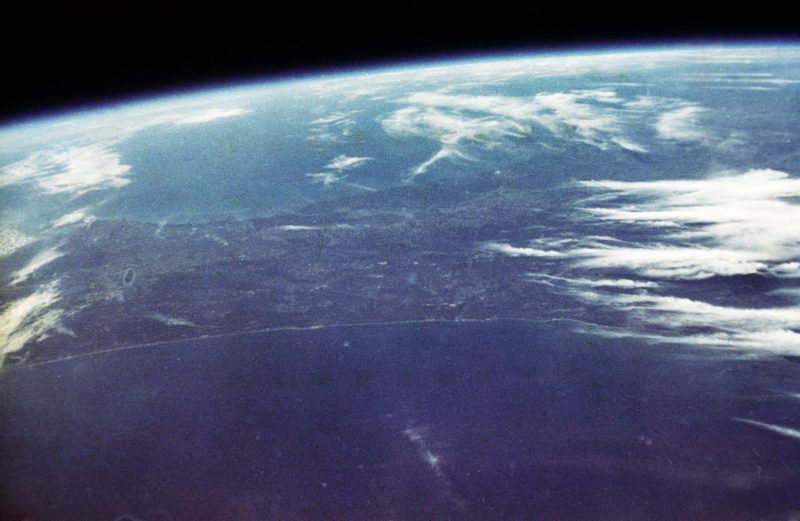
Orbital view of Earth taken by John Glenn, mostly blue sea with some white clouds, some darker land.
View larger. | Here’s what John Glenn saw on February 20, 1962. Just 5 minutes and 44 seconds after launch, Glenn offered his 1st words about the view through his tiny porthole: “This is Friendship 7. Can see clear back; a big cloud pattern way back across towards the Cape. Beautiful sight.” Three hours later, at the beginning of his 3rd orbit, Glenn photographed this panoramic view of Florida from the Georgia border (right, under clouds) to just north of Cape Canaveral. His American homeland was 162 miles (260 kilometers) below. “I have the Cape in sight down there,” he noted to mission controllers. “It looks real fine from up here. I can see the whole state of Florida just laid out like on a map. Beautiful.” Image via NASA.

Bottom line: John Glenn became the first American to orbit Earth on February 20, 1962, 64 years ago today. His space capsule was the Friendship 7.

Read more from NASA: Glenn orbits Earth

Read more from History.com: 7 things you may not know about John Glenn

The post John Glenn 1st American in orbit 64 years ago today first appeared on EarthSky.


from EarthSky https://ift.tt/7bdAVGX
John Glenn: Black and white photo of a smiling man in space suit standing next to a conical one-person space capsule.
John Glenn became the 1st American in orbit on February 20, 1962. Astronaut Glenn sits outside the space capsule Friendship 7. Image via NASA.

EarthSky’s 2026 lunar calendar is available now. Get yours today! Makes a great gift.

John Glenn orbited Earth 64 years ago today

John Glenn became the first American to orbit Earth on February 20, 1962, 64 years ago today. During 4 hours and 55 minutes, he circled the globe three times in his space capsule Friendship 7. The feat made Glenn a national hero and a household name.

It was the ’60s, and the space race was on. The U.S. and the Soviet Union competed to achieve important firsts in space.

Glenn was one of the first American astronauts, a member of the group NASA called the Mercury 7. Author Tom Wolfe immortalized them in his masterly 1979 book The Right Stuff. Glenn and his fellow astronauts rode cramped Mercury space capsules into the unknown.

In those days, NASA astronauts gave personal nicknames to their space capsules. Glenn and his family decided on the word Friendship, adding the number 7 to honor his fellow Mercury astronauts. But NASA’s official name for Glenn’s mission was Mercury-Atlas 6: Mercury for the Roman god of speed and Atlas 6 to indicate that this was the sixth mission to launch atop the powerful Atlas rocket.

Group portrait of seven men in old-timey silver spacesuits, standing in two rows.
NASA introduced its 1st astronauts – the Mercury 7 – on April 9, 1959. LIFE magazine photographer Ralph Morse took this image on March 17, 1960. Front row, left to right: Walter M. Schirra Jr., Donald K. “Deke” Slayton, John H. Glenn Jr., and M. Scott Carpenter. Back row: Alan B. Shepard Jr., Virgil I. “Gus” Grissom, and L. Gordon Cooper Jr. Image via NASA.

“Godspeed, John Glenn”

Atlas rocket and weather problems forced NASA to postpone Glenn’s orbital launch four times. Finally, with the weather cooperating and the Atlas problems resolved, Glenn strapped into Friendship 7 early on the morning of February 20, 1962. Schoolchildren (including me) watched on television as the countdown ended and Glenn blasted into space. As History.com explained:

As mission control performed its final system checks, test conductor Tom O’Malley initiated the launch sequence, adding a personal prayer, ‘May the good Lord ride all the way,’ to which Carpenter, the backup astronaut for the mission, added, ‘Godspeed, John Glenn.’ Carpenter later explained that he had come up with the phrase on the spot, but it did hold significance for most test pilots and astronauts: ‘In those days, speed was magic … and nobody had gone that fast. If you can get that speed, you’re home-free.’

In other words, to attain even a low Earth orbit, the challenge is to reach a fast-enough speed. The mean orbital velocity needed to maintain a stable low Earth orbit is about 17,000 miles per hour (27,000 kilometers per hour, or 7.8 kilometers per second). Glenn reached that speed, a first for any American.

Glenn wasn’t the first American in space. He was third, after the short suborbital flights of Alan Shepard (May 1961) and Virgil “Gus” Grissom (July 1961). And he wasn’t the first earthling to orbit Earth. Again, he came in third, following two Russian cosmonauts: Yuri Gagarin (April 1961) and Gherman Titov (August 1961). Glenn’s orbital flight meant that the U.S. was catching up to the Soviet Union in the space race.

Man in silver suit writhing feet first into small space capsule with Friendship 7 written on the side.
John Glenn climbs into the Friendship 7 space capsule just before making his first trip into space on February 20, 1962. Image via NASA.

Heat shield danger

John Glenn’s flight wasn’t without its scary moments. As History.com explained:

During his second orbit, Mission Control noticed a sensor was issuing a warning that Friendship 7’s heat shield and landing bag were not secure, putting the mission and Glenn in danger. Officials did not immediately inform Glenn of the potential problem, instead asking him to run a series of small tests on the system to see if that resolved the issue, which eventually clued Glenn in to their concerns. After a series of discussions, it was decided that rather than following standard procedures to discard the retrorocket (an engine designed to slow down the capsule upon reentry), Glenn would keep the rocket in place to help secure the heat shield.

In fact, all was well. Glenn successfully reentered the Earth’s atmosphere and splashed down in the Atlantic Ocean. Ships, helicopters and frogmen successfully recovered him 800 miles (1,300 km) southeast of Bermuda. Later, when engineers inspected the recovered capsule, they found that the heat shield was fine. A faulty sensor had detected a problem that didn’t exist.

John Glenn was inspirational

John Glenn’s flight made him an instant national hero. He rode his fame to a long career in politics that included 25 years in the Senate and a presidential bid in 1984. Glenn returned to space at age 77 aboard the space shuttle Discovery in 1998. His mission’s primary scientific aim was to study the effects of spaceflight on seniors. Glenn passed away at age 95 on December 8, 2016.

The space race is history, but Glenn’s flight 64 years ago continues to inspire. Shortly before his death, Hollywood commemorated his mission and the many people who made it possible in the popular 2016 film Hidden Figures.

Orbital view of Earth taken by John Glenn, mostly blue sea with some white clouds, some darker land.
View larger. | Here’s what John Glenn saw on February 20, 1962. Just 5 minutes and 44 seconds after launch, Glenn offered his 1st words about the view through his tiny porthole: “This is Friendship 7. Can see clear back; a big cloud pattern way back across towards the Cape. Beautiful sight.” Three hours later, at the beginning of his 3rd orbit, Glenn photographed this panoramic view of Florida from the Georgia border (right, under clouds) to just north of Cape Canaveral. His American homeland was 162 miles (260 kilometers) below. “I have the Cape in sight down there,” he noted to mission controllers. “It looks real fine from up here. I can see the whole state of Florida just laid out like on a map. Beautiful.” Image via NASA.

Bottom line: John Glenn became the first American to orbit Earth on February 20, 1962, 64 years ago today. His space capsule was the Friendship 7.

Read more from NASA: Glenn orbits Earth

Read more from History.com: 7 things you may not know about John Glenn

The post John Glenn 1st American in orbit 64 years ago today first appeared on EarthSky.


from EarthSky https://ift.tt/7bdAVGX

Nicolaus Copernicus born 553 years ago today

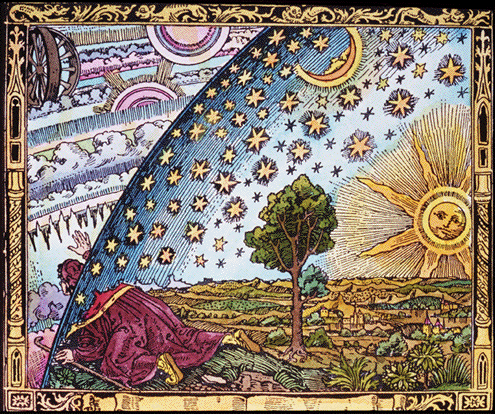
Complex engraving of robed man breaking out through the starry sky into a realm of orbits, wheels, and cosmic objects.
This 1888 engraving – Empedocles Breaks through the Crystal Spheres – is reminiscent of the revolution in thought brought about by Nicolaus Copernicus, who was born 553 years ago today. The engraving 1st appeared in a book by Camille Flammarion with the caption: “A missionary of the Middle Ages tells that he had found the point where the sky and the Earth touch.” Image via Raven/ Wikimedia Commons (CC BY-SA 4.0).

EarthSky’s 2026 lunar calendar is available now. Get yours today! Makes a great gift.

Happy 550th birthday, Nicolaus Copernicus!

Renaissance astronomer and mathematician Nicolaus Copernicus was born in Torun, Poland, 553 years ago today. At a time when deeply entrenched beliefs placed the Earth at the center of the universe – nested within crystal spheres – he proposed the revolutionary idea that Earth revolves around the sun. Can you picture the leap of imagination required for him to conceive of a sun-centered universe?

Copernicus’ famous book – “De revolutionibus orbium coelestium” (On the Revolutions of the Celestial Spheres) – was published just before his death in 1543. In fact, it set the stage for all of modern astronomy.

Indeed, people today now speak of his work as the Copernican Revolution.

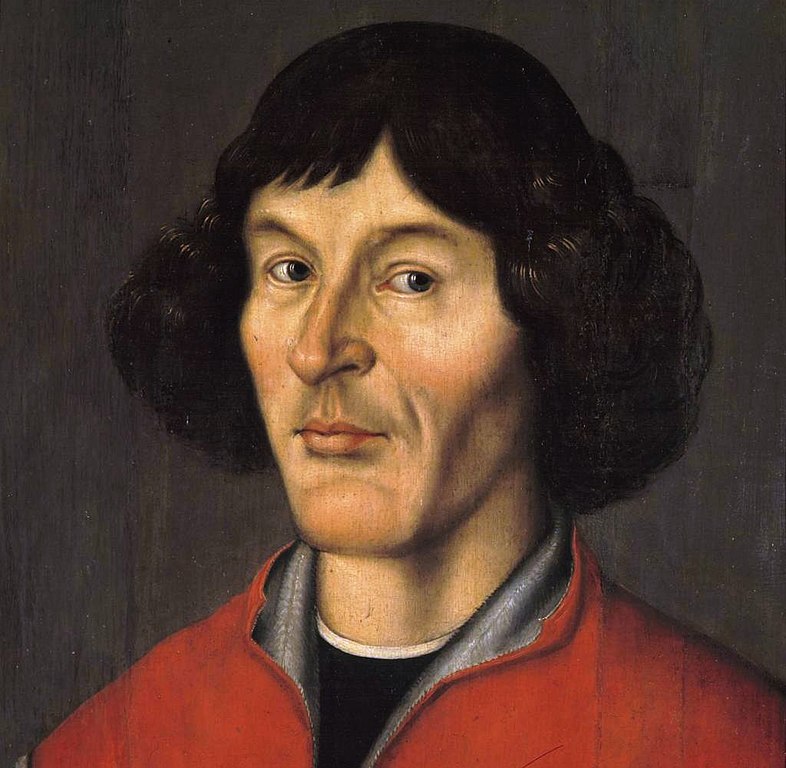
Nicolaus Copernicus: Man with chin-length dark hair and long angular face.
Nicolaus Copernicus – born on February 19, 1473 – started the scientific revolution with his novel ideas. Image via Wikimedia Commons.

Ancient Greek views of the universe

Copernicus wasn’t the first to conceive of a sun-centered universe, however. Early Greek and Mesopotamian philosophers also spoke of it.

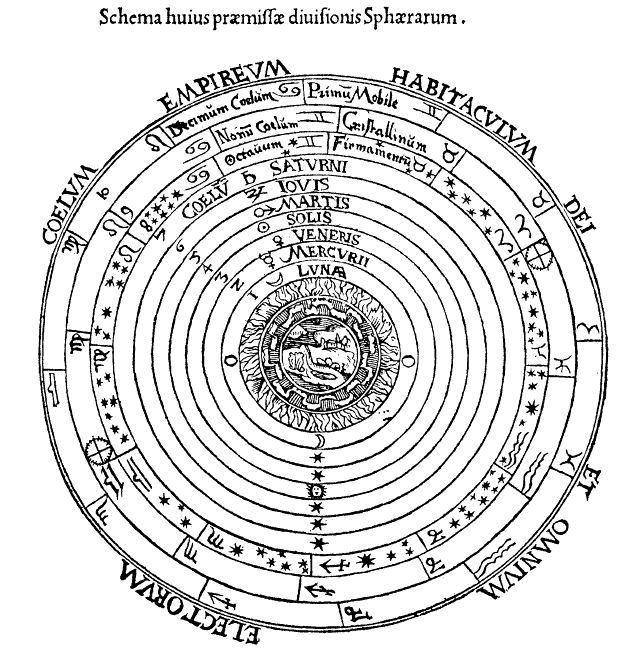
It was the Greek philosopher Aristotle, however, who proposed that the heavens comprised 55 concentric, crystalline spheres. He said that celestial objects were attached to these spheres.

In Aristotle’s model, Earth lay at the center of these spheres.

Antique etching of concentric circles for the moon, sun, and planets, with the Earth in the middle.
Aristotle’s Earth-centered model of the universe. In the medieval world, people thought Earth lay enclosed within crystal spheres. Read more about about medieval astronomy here. Image via Wikimedia Commons.

Nicolaus Copernicus broke the ‘crystal spheres’

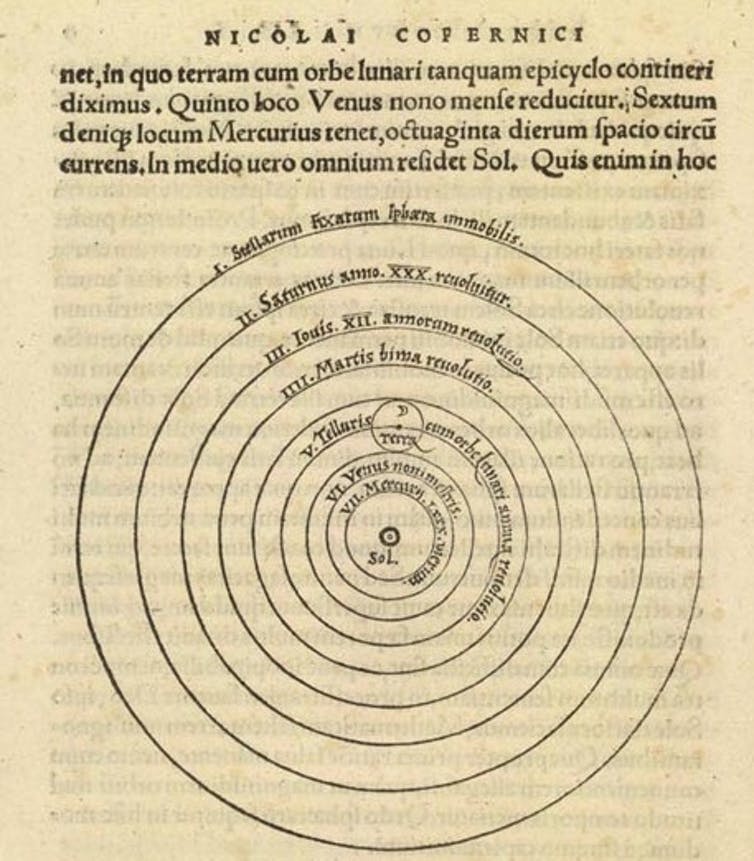
So, Earth lay – fixed and enclosed – until Copernicus published his version of a heliocentric, or sun-centered, universe. Copernicus’s ideas and ground-shaking book moved the Earth and replaced it with the sun.

Read more: Copernicus’ revolution and Galileo’s vision, in pictures.

Concentric circles for each planet with sun in middle and orbit of moon shown around Earth, with Latin text.
This is Copernicus’ version of a heliocentric – or sun-centered – universe. Image via Library of Congress.

Bottom line: Today is the 553rd birthday of Nicolaus Copernicus, who removed Earth from the center of the universe and set off a revolution.

The post Nicolaus Copernicus born 553 years ago today first appeared on EarthSky.


from EarthSky https://ift.tt/ThDofi0
Complex engraving of robed man breaking out through the starry sky into a realm of orbits, wheels, and cosmic objects.
This 1888 engraving – Empedocles Breaks through the Crystal Spheres – is reminiscent of the revolution in thought brought about by Nicolaus Copernicus, who was born 553 years ago today. The engraving 1st appeared in a book by Camille Flammarion with the caption: “A missionary of the Middle Ages tells that he had found the point where the sky and the Earth touch.” Image via Raven/ Wikimedia Commons (CC BY-SA 4.0).

EarthSky’s 2026 lunar calendar is available now. Get yours today! Makes a great gift.

Happy 550th birthday, Nicolaus Copernicus!

Renaissance astronomer and mathematician Nicolaus Copernicus was born in Torun, Poland, 553 years ago today. At a time when deeply entrenched beliefs placed the Earth at the center of the universe – nested within crystal spheres – he proposed the revolutionary idea that Earth revolves around the sun. Can you picture the leap of imagination required for him to conceive of a sun-centered universe?

Copernicus’ famous book – “De revolutionibus orbium coelestium” (On the Revolutions of the Celestial Spheres) – was published just before his death in 1543. In fact, it set the stage for all of modern astronomy.

Indeed, people today now speak of his work as the Copernican Revolution.

Nicolaus Copernicus: Man with chin-length dark hair and long angular face.
Nicolaus Copernicus – born on February 19, 1473 – started the scientific revolution with his novel ideas. Image via Wikimedia Commons.

Ancient Greek views of the universe

Copernicus wasn’t the first to conceive of a sun-centered universe, however. Early Greek and Mesopotamian philosophers also spoke of it.

It was the Greek philosopher Aristotle, however, who proposed that the heavens comprised 55 concentric, crystalline spheres. He said that celestial objects were attached to these spheres.

In Aristotle’s model, Earth lay at the center of these spheres.

Antique etching of concentric circles for the moon, sun, and planets, with the Earth in the middle.
Aristotle’s Earth-centered model of the universe. In the medieval world, people thought Earth lay enclosed within crystal spheres. Read more about about medieval astronomy here. Image via Wikimedia Commons.

Nicolaus Copernicus broke the ‘crystal spheres’

So, Earth lay – fixed and enclosed – until Copernicus published his version of a heliocentric, or sun-centered, universe. Copernicus’s ideas and ground-shaking book moved the Earth and replaced it with the sun.

Read more: Copernicus’ revolution and Galileo’s vision, in pictures.

Concentric circles for each planet with sun in middle and orbit of moon shown around Earth, with Latin text.
This is Copernicus’ version of a heliocentric – or sun-centered – universe. Image via Library of Congress.

Bottom line: Today is the 553rd birthday of Nicolaus Copernicus, who removed Earth from the center of the universe and set off a revolution.

The post Nicolaus Copernicus born 553 years ago today first appeared on EarthSky.


from EarthSky https://ift.tt/ThDofi0

Bird guano created wealth for ancient Peruvian community

Sea with high, steep shore rocks covered in a white material (bird guano), with birds flying around.
This is Islas Ballestas off the coast of the Chincha and Pisco valleys of Peru. It is an important location for several seabird species. The white substance on the cliffs is bird guano. There is less of it today because seabird populations are in decline. Image via Jo Osborn/ University of Sydney.

EarthSky’s 2026 lunar calendar is available now. Get yours today! Makes a great gift.

  • The Chincha Kingdom in southern Peru, which existed 1,000 years ago, prospered because farmers used bird guano as fertilizer to grow high maize yields.
  • Scientists found high nitrogen levels in ancient maize, showing guano from the nearby Chincha Islands boosted crop production.
  • Increased food production created wealth, as well as strengthened trade and political power, helping the Chincha form alliances with the Inca Empire.

Bird guano boosted agricultural yields for Chincha Kingdom

The Chincha Kingdom was an ancient community that flourished in southern Peru from 900 CE to 1,450 CE (1,126 to 576 years ago). They were wealthy largely because farmers produced high maize yields, a primary food staple. On February 12, 2026, scientists at the University of Sydney said Chincha Kingdom farmers were able to get those high yields because they used bird guano (accumulated bird droppings) as fertilizer. The researchers discovered this when they ran chemical analyses on maize from ancient tombs, where they found high levels of nitrogen that could only have come from the guano.

Jacob Bongers, of the University of Sydney, is the lead author of the study. He said:

Seabird guano may seem trivial, yet our study suggests this potent resource could have significantly contributed to sociopolitical and economic change in the Peruvian Andes.

Guano dramatically boosted the production of maize (corn), and this agricultural surplus crucially helped fuel the Chincha Kingdom’s economy, driving their trade, wealth, population growth and regional influence, and shaped their strategic alliance with the Inca Empire.

In ancient Andean cultures, fertilizer was power.

The scientists published their study in the peer-reviewed journal PLOS One on February 11, 2026.

A man wearing a suit with medium-length curly black hair and glasses.
Jacob Bongers of the University of Sydney is the lead author of the new study. Image via Jacob Bongers/ Stefanie Zingsheim/ University of Sydney.

An ancient community of farmers and seafarers

The Chincha Valley, on the Pacific coast of Peru, was once home to about 100,000 people. Even though that region was largely arid, agriculture was possible because the Chincha River, originating from the Andes, flowed through the valley.

By the 11th century, the Chincha Kingdom had developed agricultural systems, including irrigation and field fertilization with bird guano. In addition, they were also a seafaring people who built large rafts with sails that carried cargo and people.

In 1534, Spanish conquerors came to Chincha Valley. Then, not long after, the Chincha population steeply declined over several decades, their demise mostly due to political turmoil and new diseases brought by the Spanish.

Uncovering the connection between agriculture and bird guano

The scientists studied the biochemical signatures in 35 samples of maize, found in burial tombs in the Chincha Valley. As a result, they found very high levels of nitrogen in the maize, far more than was naturally available in the soil.

Indeed, this finding proved that ancient Chincha Valley farmers fertilized their maize using seabird guano. That’s because guano is quite high in nitrogen, due to the seabirds’ fish diet.

Bongers said:

The guano was most likely harvested from the nearby Chincha Islands, renowned for their abundant and high-quality guano deposits. Colonial era writings we studied report that communities across coastal Peru and northern Chile sailed to several nearby islands on rafts to collect seabird droppings for fertilization.

Emily Milton of the Smithsonian Institution, a paper co-author, added:

The historical records documenting how bird guano was applied to maize fields helped us interpret the chemical data and understand the regional importance of this practice.

Our work extends the known geographic extent of guano fertilization, echoing recent findings in northern Chile, and suggests soil management began at least around 800 years ago in Peru.

Three seabird species in a panel.
These birds are the primary bird guano producers today on the islands off southern Peru. Left: Peruvian booby (Sula variegata); center: Peruvian pelican (Pelecanus thagus) and right: Guanay cormorant (Leucocarbo bougainvilliorum). Images via Alexis Williams, DickDaniels and Bruno Girin/ iNaturalist, Wikimedia Commons. (CC BY 4.0, CC BY-SA 4.0, CC BY-SA 2.0)

Bird guano created power in an inhospitable region

Farming was not easy along the coast of Peru. That’s because conditions are very dry and irrigated soil can quickly lose nutrients. However, in the Chincha Valley, the irrigation system and fertilizing with guano enabled farmers to grow crops, especially their staple food, maize. Consequently, the ripple effect of an abundant maize supply supported other endeavors, such as trade and fishing.

Bongers commented:

We know the Chincha were extraordinarily wealthy and one of the most powerful coastal societies of their time. But what underpinned that prosperity? Previous research often pointed to spondylus shells, the spiny oyster, as the key driver of merchant wealth.

Our evidence suggests guano was central to the Chincha Kingdom’s success, with the Chincha’s maritime knowledge and access to the Chincha Islands likely reframing their strategic importance in the region.

Incas prized maize from the Chincha Valley

The Inca Empire, a highly developed civilization in the Andes Mountains, valued maize. They used it to make a ceremonial beer called chicha. However, they could not grow maize at their high altitude.

Bongers said:

Guano was a highly sought-after resource the Incas would have wanted access to, playing an important role in the diplomatic arrangements between the Inca and the Chincha communities.

It expanded Chincha’s agricultural productivity and mercantile influence, leading to exchanges of resources and power.

Later, around 1480, the Chincha Kingdom became part of the Inca Empire.

Archaeological artifacts reflect Chincha Valley culture

The artwork of the Chincha people reflected strong ties to their livelihoods. For instance, pottery, ceramics and textiles featured sprouting maize, fish and seabirds.

Left image show a long wooden flat digging stick with orange artwork around the handle. The second image is a closeup of the handle.
The image on the left is a ceremonial digging stick. Next to it is a closeup of the handle. On this handle is a variety of artwork including seabirds and possible maize sprouting from abstracted fish. A Chincha artist created this ceremonial digging stick sometime between 1,200 CE and 1,535 CE. Image via The Metropolitan Museum of Art. (CC0)

Bongers observed:

Together, the chemical and material evidence we studied confirms earlier scholarship showing that guano was deliberately collected and used as a fertilizer.

But it also points to a deeper cultural significance, suggesting people recognized the exceptional power of this fertilizer and actively celebrated, protected and even ritualized the vital relationship between seabirds and agriculture.

Co-author Jo Osborn of Texas A&M University added:

The true power of the Chincha wasn’t just access to a resource; it was their mastery of a complex ecological system. They possessed the traditional knowledge to see the connection between marine and terrestrial life, and they turned that knowledge into the agricultural surplus that built their kingdom. Their art celebrates this connection, showing us that their power was rooted in ecological wisdom, not just gold or silver.

Bottom line: The ancient Chincha Kingdom of Peru prospered thanks to high maize yields, made possible by bird guano from nearby islands.

Source: Seabirds shaped the expansion of pre-Inca society in Peru

Via University of Sydney

Read more: Ancient Peruvian culture predating Nazcas used desert lines to guide people to solstice festivities

The post Bird guano created wealth for ancient Peruvian community first appeared on EarthSky.


from EarthSky https://ift.tt/HMBpqGw
Sea with high, steep shore rocks covered in a white material (bird guano), with birds flying around.
This is Islas Ballestas off the coast of the Chincha and Pisco valleys of Peru. It is an important location for several seabird species. The white substance on the cliffs is bird guano. There is less of it today because seabird populations are in decline. Image via Jo Osborn/ University of Sydney.

EarthSky’s 2026 lunar calendar is available now. Get yours today! Makes a great gift.

  • The Chincha Kingdom in southern Peru, which existed 1,000 years ago, prospered because farmers used bird guano as fertilizer to grow high maize yields.
  • Scientists found high nitrogen levels in ancient maize, showing guano from the nearby Chincha Islands boosted crop production.
  • Increased food production created wealth, as well as strengthened trade and political power, helping the Chincha form alliances with the Inca Empire.

Bird guano boosted agricultural yields for Chincha Kingdom

The Chincha Kingdom was an ancient community that flourished in southern Peru from 900 CE to 1,450 CE (1,126 to 576 years ago). They were wealthy largely because farmers produced high maize yields, a primary food staple. On February 12, 2026, scientists at the University of Sydney said Chincha Kingdom farmers were able to get those high yields because they used bird guano (accumulated bird droppings) as fertilizer. The researchers discovered this when they ran chemical analyses on maize from ancient tombs, where they found high levels of nitrogen that could only have come from the guano.

Jacob Bongers, of the University of Sydney, is the lead author of the study. He said:

Seabird guano may seem trivial, yet our study suggests this potent resource could have significantly contributed to sociopolitical and economic change in the Peruvian Andes.

Guano dramatically boosted the production of maize (corn), and this agricultural surplus crucially helped fuel the Chincha Kingdom’s economy, driving their trade, wealth, population growth and regional influence, and shaped their strategic alliance with the Inca Empire.

In ancient Andean cultures, fertilizer was power.

The scientists published their study in the peer-reviewed journal PLOS One on February 11, 2026.

A man wearing a suit with medium-length curly black hair and glasses.
Jacob Bongers of the University of Sydney is the lead author of the new study. Image via Jacob Bongers/ Stefanie Zingsheim/ University of Sydney.

An ancient community of farmers and seafarers

The Chincha Valley, on the Pacific coast of Peru, was once home to about 100,000 people. Even though that region was largely arid, agriculture was possible because the Chincha River, originating from the Andes, flowed through the valley.

By the 11th century, the Chincha Kingdom had developed agricultural systems, including irrigation and field fertilization with bird guano. In addition, they were also a seafaring people who built large rafts with sails that carried cargo and people.

In 1534, Spanish conquerors came to Chincha Valley. Then, not long after, the Chincha population steeply declined over several decades, their demise mostly due to political turmoil and new diseases brought by the Spanish.

Uncovering the connection between agriculture and bird guano

The scientists studied the biochemical signatures in 35 samples of maize, found in burial tombs in the Chincha Valley. As a result, they found very high levels of nitrogen in the maize, far more than was naturally available in the soil.

Indeed, this finding proved that ancient Chincha Valley farmers fertilized their maize using seabird guano. That’s because guano is quite high in nitrogen, due to the seabirds’ fish diet.

Bongers said:

The guano was most likely harvested from the nearby Chincha Islands, renowned for their abundant and high-quality guano deposits. Colonial era writings we studied report that communities across coastal Peru and northern Chile sailed to several nearby islands on rafts to collect seabird droppings for fertilization.

Emily Milton of the Smithsonian Institution, a paper co-author, added:

The historical records documenting how bird guano was applied to maize fields helped us interpret the chemical data and understand the regional importance of this practice.

Our work extends the known geographic extent of guano fertilization, echoing recent findings in northern Chile, and suggests soil management began at least around 800 years ago in Peru.

Three seabird species in a panel.
These birds are the primary bird guano producers today on the islands off southern Peru. Left: Peruvian booby (Sula variegata); center: Peruvian pelican (Pelecanus thagus) and right: Guanay cormorant (Leucocarbo bougainvilliorum). Images via Alexis Williams, DickDaniels and Bruno Girin/ iNaturalist, Wikimedia Commons. (CC BY 4.0, CC BY-SA 4.0, CC BY-SA 2.0)

Bird guano created power in an inhospitable region

Farming was not easy along the coast of Peru. That’s because conditions are very dry and irrigated soil can quickly lose nutrients. However, in the Chincha Valley, the irrigation system and fertilizing with guano enabled farmers to grow crops, especially their staple food, maize. Consequently, the ripple effect of an abundant maize supply supported other endeavors, such as trade and fishing.

Bongers commented:

We know the Chincha were extraordinarily wealthy and one of the most powerful coastal societies of their time. But what underpinned that prosperity? Previous research often pointed to spondylus shells, the spiny oyster, as the key driver of merchant wealth.

Our evidence suggests guano was central to the Chincha Kingdom’s success, with the Chincha’s maritime knowledge and access to the Chincha Islands likely reframing their strategic importance in the region.

Incas prized maize from the Chincha Valley

The Inca Empire, a highly developed civilization in the Andes Mountains, valued maize. They used it to make a ceremonial beer called chicha. However, they could not grow maize at their high altitude.

Bongers said:

Guano was a highly sought-after resource the Incas would have wanted access to, playing an important role in the diplomatic arrangements between the Inca and the Chincha communities.

It expanded Chincha’s agricultural productivity and mercantile influence, leading to exchanges of resources and power.

Later, around 1480, the Chincha Kingdom became part of the Inca Empire.

Archaeological artifacts reflect Chincha Valley culture

The artwork of the Chincha people reflected strong ties to their livelihoods. For instance, pottery, ceramics and textiles featured sprouting maize, fish and seabirds.

Left image show a long wooden flat digging stick with orange artwork around the handle. The second image is a closeup of the handle.
The image on the left is a ceremonial digging stick. Next to it is a closeup of the handle. On this handle is a variety of artwork including seabirds and possible maize sprouting from abstracted fish. A Chincha artist created this ceremonial digging stick sometime between 1,200 CE and 1,535 CE. Image via The Metropolitan Museum of Art. (CC0)

Bongers observed:

Together, the chemical and material evidence we studied confirms earlier scholarship showing that guano was deliberately collected and used as a fertilizer.

But it also points to a deeper cultural significance, suggesting people recognized the exceptional power of this fertilizer and actively celebrated, protected and even ritualized the vital relationship between seabirds and agriculture.

Co-author Jo Osborn of Texas A&M University added:

The true power of the Chincha wasn’t just access to a resource; it was their mastery of a complex ecological system. They possessed the traditional knowledge to see the connection between marine and terrestrial life, and they turned that knowledge into the agricultural surplus that built their kingdom. Their art celebrates this connection, showing us that their power was rooted in ecological wisdom, not just gold or silver.

Bottom line: The ancient Chincha Kingdom of Peru prospered thanks to high maize yields, made possible by bird guano from nearby islands.

Source: Seabirds shaped the expansion of pre-Inca society in Peru

Via University of Sydney

Read more: Ancient Peruvian culture predating Nazcas used desert lines to guide people to solstice festivities

The post Bird guano created wealth for ancient Peruvian community first appeared on EarthSky.


from EarthSky https://ift.tt/HMBpqGw

Look for the colors of the stars in the night sky

Colors of the stars: Hundreds of multicolored donut shapes of different sizes inside a circle on a black background.
View at EarthSky Community Photos. | Paolo Palma in Naples, Italy, created this composite of the colors of the stars with images of individual stars taken over the course of 2 years, which he calls Kaleidocosmo. He captured all the stars he could see from Naples – up to +5 magnitude and brighter – some 1,250 stars! Then, he imaged each star out of focus to capture its color and created this composite, with the size of each star based on how bright it is. He wrote: “Kaleidocosmo can reveal how much the starry sky is more colorful than we imagine …” In addition, he also set his kaleidocosmo to music, which you can download here. Thank you, Paolo!

EarthSky’s 2026 lunar calendar is available now. Get yours today! Makes a great gift.

Tonight, go outside, and let your eyes adjust to the dark. Then note the subtle differences in the colors of the stars. Let’s explore some of the stars that you’ll see flickering against the black backdrop of night in winter. In fact, there’s a whole spectrum of star colors sparkling up there, from cool red stars to middle-range yellow stars to hot blue-white stars.

But in 2026, watch out for bright Jupiter among the stars of Gemini.

The colors of the stars

First, look high overhead in the winter evening sky for a bright star with the name of Capella. Capella’s nickname is the Little She-Goat, and it lies in the constellation Auriga the Charioteer.

So can you spot Capella? Once you find it, notice that it’s a golden star. The fact is, a star’s color indicates its spectral type. More about spectral types of stars below.

Star chart showing big roundish constellation Auriga with stars and other objects labeled.
The bright star Capella in the constellation Auriga the Charioteer is overhead on winter evenings. To be certain you’ve found Capella, look for a little triangle of stars nearby. Capella is sometimes called the Goat Star, and the little triangle of stars is an asterism called The Kids.

Compare the different colors of the stars you see

Now try contrasting golden Capella with some of the stars in nearby Taurus the Bull. First, find the reddish star Aldebaran, the Eye of the Bull, and the bluish stars of the misty Pleiades cluster. Do you see the difference?

Two-pronged fork made with dots and lines, small dot cluster at top right.
Taurus the Bull contains 2 star clusters that are easy to spot, the Pleiades and the Hyades. Aldebaran appears as part of the Hyades cluster.
A multitude of blue stars with 2 bright, reddish, star-like objects and 2 little bunches of blue stars.
View at EarthSky Community Photos. | Jeremy Likness in Monroe, Washington, used a regular camera lens to capture this view of a bright red planet, Mars, on January 8, 2023. Plus he captured the reddish star Aldebaran in the Hyades star cluster (part of Taurus the Bull). And this photo shows the bluish, dipper-shaped Pleiades star cluster, also in Taurus. Thank you, Jeremy!

What about Sirius?

Sirius in the constellation Canis Major the Greater Dog is our sky’s brightest star, after the sun. It’s usually described as a white star.

So Capella is golden, and Sirius is white. Besides appearing so bright, Capella and Sirius often flicker deliriously when low in the sky. This effect has nothing to do with the colors of the stars themselves but rather is caused by Earth’s turbulent atmosphere. The twinkling effect is particularly prominent with the stars Capella and Sirius because they are so bright.

Star chart: Constellation Orion (looks like an hourglass), bright star Sirius, and star Canopus next to horizon.
Sirius is the sky’s brightest star. You’ll always know it’s Sirius because Orion’s Belt – 3 stars in a short, straight row – points to it. Also, as seen from latitudes like those in Florida, Texas or southern California, Canopus – the 2nd-brightest star – arcs across the south below Sirius on February evenings. From farther south on the sky’s dome, Sirius and Canopus cross higher in the sky, like almost-twin diamonds. Chart via EarthSky.

Next, check out Orion

Orion the Hunter, a prominent constellation in the winter sky, sports a noticeably red star and a vivid blue star. The red star is Betelgeuse marking one shoulder, while the blue star is Rigel marking the opposite knee.

Notice the shades of red and orange of Betelgeuse in Paolo Palma’s creative collage below.

Constellation Orion: 4 bright stars at the corners (one reddish) with a prominent row of 3 in the middle.
View at EarthSky Community Photos. | Amr Elsayed in Fayoum, Egypt, captured this image of Orion on December 6, 2024. Orion the Hunter is a great place to see the different colors of the stars. Rigel appears in the lower right of the constellation. Contrast its bluish-white light with that of reddish Betelgeuse in the upper left. Most of Orion’s stars are hot blue-white stars.
A scattering of different-sized small donut shapes, in various colors, and a guide to the colors at the top.
View at EarthSky Community Photos. | Paolo Palma of Italy submitted this mosaic of the stars visible to the unaided eye in Orion and shot deliberately out of focus to capture their nuances and their apparent magnitude. Paolo wrote: “Orion the Hunter is probably the most beautiful constellation in the sky and its bright stars make it easily recognizable to anyone. This is how it would look if we could also see the colors of all the stars. Also shown are stars that can represent spectral classes, a beautiful color scale that can reveal the relationship between color and spectral class (temperature) of stars.” Thank you, Paolo!

The true colors of stars

And you don’t even have to know any star names or any constellations. Just glance around the sky, and notice the subtle color differences in the stars.

It’s helpful to know that a star’s true colors are more apparent as the star climbs higher in the sky, moving above the turbulence of Earth’s atmosphere. So, if you have good eyesight and a dark, clear sky, you should be able to detect hints of color within the brighter stars.

And if you have difficulty discerning star colors with the unaided eye, look at the bright stars through binoculars. A useful trick is to put the star out of focus in your binoculars so the color will become more obvious.

Why do stars have different colors?

The light of a star reveals many things, including the star’s surface temperature. The yellowish color of Capella indicates a mid-range surface temperature, much like our sun. The red of Aldebaran is typical of the lower surface temperature of an older star, whereas the blue of the Pleiades reveals their high surface temperatures and young age.

In fact, the surface temperature – or color – of a star determines its spectral class. On the Hertzsprung-Russell diagram below, you can see the different spectral classes listed across the bottom of the chart with temperatures going from hottest to coolest. Also, it shows the colors of stars associated with each spectral class and temperature.

So what are the spectral classes of Capella, Aldebaran, Sirius, Betelgeuse, Rigel and the Pleiades? Capella is a G star. Our sun is also a G star. Both our sun and Capella shine with a golden light. Aldebaran and Betelgeuse are cool stars and appear reddish. Aldebaran is a K type star and Betelgeuse is an M type star. Sirius is an A type star and appears white. Rigel and the stars of Pleiades are type B stars.

Chart with swaths of colors from upper left to lower right, and labeled stars along them.
View larger. | A star that is blue or blue-white in color, such as Spica at the upper left, has a high surface temperature. In contrast, a red-colored star (such as Antares and Betelgeuse at the upper right), has a lower surface temperature. Image of Hertzsprung-Russell diagram via Chandra/ NASA.

Bottom line: Winter is the perfect season for noticing the colors of the stars. Have you ever noticed them? By all means, go check them out tonight! And now you also can tell the temperature of a star by its color.

The post Look for the colors of the stars in the night sky first appeared on EarthSky.


from EarthSky https://ift.tt/kHTcdZL
Colors of the stars: Hundreds of multicolored donut shapes of different sizes inside a circle on a black background.
View at EarthSky Community Photos. | Paolo Palma in Naples, Italy, created this composite of the colors of the stars with images of individual stars taken over the course of 2 years, which he calls Kaleidocosmo. He captured all the stars he could see from Naples – up to +5 magnitude and brighter – some 1,250 stars! Then, he imaged each star out of focus to capture its color and created this composite, with the size of each star based on how bright it is. He wrote: “Kaleidocosmo can reveal how much the starry sky is more colorful than we imagine …” In addition, he also set his kaleidocosmo to music, which you can download here. Thank you, Paolo!

EarthSky’s 2026 lunar calendar is available now. Get yours today! Makes a great gift.

Tonight, go outside, and let your eyes adjust to the dark. Then note the subtle differences in the colors of the stars. Let’s explore some of the stars that you’ll see flickering against the black backdrop of night in winter. In fact, there’s a whole spectrum of star colors sparkling up there, from cool red stars to middle-range yellow stars to hot blue-white stars.

But in 2026, watch out for bright Jupiter among the stars of Gemini.

The colors of the stars

First, look high overhead in the winter evening sky for a bright star with the name of Capella. Capella’s nickname is the Little She-Goat, and it lies in the constellation Auriga the Charioteer.

So can you spot Capella? Once you find it, notice that it’s a golden star. The fact is, a star’s color indicates its spectral type. More about spectral types of stars below.

Star chart showing big roundish constellation Auriga with stars and other objects labeled.
The bright star Capella in the constellation Auriga the Charioteer is overhead on winter evenings. To be certain you’ve found Capella, look for a little triangle of stars nearby. Capella is sometimes called the Goat Star, and the little triangle of stars is an asterism called The Kids.

Compare the different colors of the stars you see

Now try contrasting golden Capella with some of the stars in nearby Taurus the Bull. First, find the reddish star Aldebaran, the Eye of the Bull, and the bluish stars of the misty Pleiades cluster. Do you see the difference?

Two-pronged fork made with dots and lines, small dot cluster at top right.
Taurus the Bull contains 2 star clusters that are easy to spot, the Pleiades and the Hyades. Aldebaran appears as part of the Hyades cluster.
A multitude of blue stars with 2 bright, reddish, star-like objects and 2 little bunches of blue stars.
View at EarthSky Community Photos. | Jeremy Likness in Monroe, Washington, used a regular camera lens to capture this view of a bright red planet, Mars, on January 8, 2023. Plus he captured the reddish star Aldebaran in the Hyades star cluster (part of Taurus the Bull). And this photo shows the bluish, dipper-shaped Pleiades star cluster, also in Taurus. Thank you, Jeremy!

What about Sirius?

Sirius in the constellation Canis Major the Greater Dog is our sky’s brightest star, after the sun. It’s usually described as a white star.

So Capella is golden, and Sirius is white. Besides appearing so bright, Capella and Sirius often flicker deliriously when low in the sky. This effect has nothing to do with the colors of the stars themselves but rather is caused by Earth’s turbulent atmosphere. The twinkling effect is particularly prominent with the stars Capella and Sirius because they are so bright.

Star chart: Constellation Orion (looks like an hourglass), bright star Sirius, and star Canopus next to horizon.
Sirius is the sky’s brightest star. You’ll always know it’s Sirius because Orion’s Belt – 3 stars in a short, straight row – points to it. Also, as seen from latitudes like those in Florida, Texas or southern California, Canopus – the 2nd-brightest star – arcs across the south below Sirius on February evenings. From farther south on the sky’s dome, Sirius and Canopus cross higher in the sky, like almost-twin diamonds. Chart via EarthSky.

Next, check out Orion

Orion the Hunter, a prominent constellation in the winter sky, sports a noticeably red star and a vivid blue star. The red star is Betelgeuse marking one shoulder, while the blue star is Rigel marking the opposite knee.

Notice the shades of red and orange of Betelgeuse in Paolo Palma’s creative collage below.

Constellation Orion: 4 bright stars at the corners (one reddish) with a prominent row of 3 in the middle.
View at EarthSky Community Photos. | Amr Elsayed in Fayoum, Egypt, captured this image of Orion on December 6, 2024. Orion the Hunter is a great place to see the different colors of the stars. Rigel appears in the lower right of the constellation. Contrast its bluish-white light with that of reddish Betelgeuse in the upper left. Most of Orion’s stars are hot blue-white stars.
A scattering of different-sized small donut shapes, in various colors, and a guide to the colors at the top.
View at EarthSky Community Photos. | Paolo Palma of Italy submitted this mosaic of the stars visible to the unaided eye in Orion and shot deliberately out of focus to capture their nuances and their apparent magnitude. Paolo wrote: “Orion the Hunter is probably the most beautiful constellation in the sky and its bright stars make it easily recognizable to anyone. This is how it would look if we could also see the colors of all the stars. Also shown are stars that can represent spectral classes, a beautiful color scale that can reveal the relationship between color and spectral class (temperature) of stars.” Thank you, Paolo!

The true colors of stars

And you don’t even have to know any star names or any constellations. Just glance around the sky, and notice the subtle color differences in the stars.

It’s helpful to know that a star’s true colors are more apparent as the star climbs higher in the sky, moving above the turbulence of Earth’s atmosphere. So, if you have good eyesight and a dark, clear sky, you should be able to detect hints of color within the brighter stars.

And if you have difficulty discerning star colors with the unaided eye, look at the bright stars through binoculars. A useful trick is to put the star out of focus in your binoculars so the color will become more obvious.

Why do stars have different colors?

The light of a star reveals many things, including the star’s surface temperature. The yellowish color of Capella indicates a mid-range surface temperature, much like our sun. The red of Aldebaran is typical of the lower surface temperature of an older star, whereas the blue of the Pleiades reveals their high surface temperatures and young age.

In fact, the surface temperature – or color – of a star determines its spectral class. On the Hertzsprung-Russell diagram below, you can see the different spectral classes listed across the bottom of the chart with temperatures going from hottest to coolest. Also, it shows the colors of stars associated with each spectral class and temperature.

So what are the spectral classes of Capella, Aldebaran, Sirius, Betelgeuse, Rigel and the Pleiades? Capella is a G star. Our sun is also a G star. Both our sun and Capella shine with a golden light. Aldebaran and Betelgeuse are cool stars and appear reddish. Aldebaran is a K type star and Betelgeuse is an M type star. Sirius is an A type star and appears white. Rigel and the stars of Pleiades are type B stars.

Chart with swaths of colors from upper left to lower right, and labeled stars along them.
View larger. | A star that is blue or blue-white in color, such as Spica at the upper left, has a high surface temperature. In contrast, a red-colored star (such as Antares and Betelgeuse at the upper right), has a lower surface temperature. Image of Hertzsprung-Russell diagram via Chandra/ NASA.

Bottom line: Winter is the perfect season for noticing the colors of the stars. Have you ever noticed them? By all means, go check them out tonight! And now you also can tell the temperature of a star by its color.

The post Look for the colors of the stars in the night sky first appeared on EarthSky.


from EarthSky https://ift.tt/kHTcdZL

adds 2