The 29th annual Great Backyard Bird Count is set to take place February 13-16, 2026. During this popular community science event, people from all over the world head outdoors to count birds. Scientists use the data to track the health of bird populations.
Watching birds can be a pleasant activity to engage in, and participating in the bird count is free and easy. You just have to commit to counting birds for as little as 15 minutes (or as long as you wish) on one or more days of the four-day event, and report your sightings online at the event’s website. Anyone can take part in the Great Backyard Bird Count, from beginning bird watchers to experts, and you can do the count from your backyard or anywhere in the world. It’s a great way to burn off some of those of extra calories from eating chocolate on Valentine’s Day. Learn more about how to participate here.
A dark-eyed junco seen in Cambridge, Ontario, Canada. Image via Ryan Hodnett/ Wikimedia.
About the Great Backyard Bird Count
The Great Backyard Bird Count is a joint project of the Cornell Lab of Ornithology, National Audubon Society and Birds Canada, and support is provided in part by founding sponsor Wild Birds Unlimited. Chad Wilsey, chief scientist at the National Audubon Society, commented on the value of this event for both birds and people:
By participating in the Great Backyard Bird Count, community scientists contribute data that we use to protect birds and the places they need, today and tomorrow. In return, studies tell us that pausing to observe birds, their sounds and movements and improve human health. Participating in the Great Backyard Bird Count is a win-win for birds and people.
View at EarthSky Community Photos. | Mark Wralstad of Virginia Beach, Virginia, captured this image on January 20, 2025, and wrote: “My Feathersnap bird feeder has captured some great bird shots since I installed it this month but this is one of the brightest visitors I have captured so far! This male Northern Cardinal has become a regular guest.” Thank you, Mark!
How to participate
If you would like to join the 2026 Great Backyard Bird Count, please follow these three easy steps.
2. Spend some time counting birds on the weekend of the event at the location of your choice, such as your backyard or a local park. The minimum amount of time required is 15 minutes, but you can count for longer if you wish. During your count, simply record the start and end time, location and number and types of birds that you see. You can perform counts in multiple locations too. Just be sure to submit separate checklists for each location.
And, not to worry if you can’t identify the birds you see at first. Just take good notes about their prominent features such as their size, shape, color and unusual markings, or you can try to snap a closeup picture. Then, you can use a bird guide to look them up later. All About Birds and What Bird are two good online bird identification guides that are free and easy to use.
Additionally, the free Merlin Bird ID app can be downloaded to your smartphone and used offline. Merlin will ask you five simple questions about the bird you are trying to identify and suggest matches for you. Plus, you can even upload a picture to Merlin and let the app try to identify it.
3. The last step involves sending your data to the event’s website. This step usually only takes a few minutes to complete. While you’re visiting the website, check out the live map that displays dots in the various locations where people have submitted a checklist. It’s fun to watch the data pour in from all over the world.
There’s a photo contest too
As an added bonus, there is a photo contest for those who want to submit pictures of the birds that they see during the event. You can even submit photos of yourself bird watching. If you do shoot some good photos, please share them with us at EarthSky Community Photos. We love birding photos!
View at EarthSky Community Photos. | Lynzie Flynn of Fountain Valley, California, submitted this image on December 22, 2024, and wrote: “This is an adult male Vermilion Flycatcher. It was flying from tree to tree and posing for me. It’s such a colorful bird and one of the few colorful birds we see in my area. They are always a treat to see and photograph.” Thank you. Lynzie! Find out more about the Great Backyard Bird Count below.
2025 bird count
During the 2025 count, more than 217 countries and regions reported approximately 8,078 species out of the estimated 10,000 bird species that live on Earth today. Wow!
Use the hashtag #GBBC to follow Great Backyard Bird Count conversations on social media.
The first annual Great Backyard Bird Count was held in 1998, and the event has continued to grow year after year. Hopefully, 2026 will be another record breaker.
View at EarthSky Community Photos. | Stephanie Becker in the San Francisco Bay Area, California, gets a gold star for capturing this photo of a sparrow. She wrote: “In looking forward to the Great Backyard Bird Count, I’ve been observing birds in our backyard. This one is a golden-crowned sparrow enjoying a Golden Delicious apple.” Thanks, Stephanie!
Bottom line: The annual Great Backyard Bird Count runs from February 13-16, 2026. This popular community science project helps scientists keep track of the health of bird populations. Participating is free and easy, so why not give it a try?
The 29th annual Great Backyard Bird Count is set to take place February 13-16, 2026. During this popular community science event, people from all over the world head outdoors to count birds. Scientists use the data to track the health of bird populations.
Watching birds can be a pleasant activity to engage in, and participating in the bird count is free and easy. You just have to commit to counting birds for as little as 15 minutes (or as long as you wish) on one or more days of the four-day event, and report your sightings online at the event’s website. Anyone can take part in the Great Backyard Bird Count, from beginning bird watchers to experts, and you can do the count from your backyard or anywhere in the world. It’s a great way to burn off some of those of extra calories from eating chocolate on Valentine’s Day. Learn more about how to participate here.
A dark-eyed junco seen in Cambridge, Ontario, Canada. Image via Ryan Hodnett/ Wikimedia.
About the Great Backyard Bird Count
The Great Backyard Bird Count is a joint project of the Cornell Lab of Ornithology, National Audubon Society and Birds Canada, and support is provided in part by founding sponsor Wild Birds Unlimited. Chad Wilsey, chief scientist at the National Audubon Society, commented on the value of this event for both birds and people:
By participating in the Great Backyard Bird Count, community scientists contribute data that we use to protect birds and the places they need, today and tomorrow. In return, studies tell us that pausing to observe birds, their sounds and movements and improve human health. Participating in the Great Backyard Bird Count is a win-win for birds and people.
View at EarthSky Community Photos. | Mark Wralstad of Virginia Beach, Virginia, captured this image on January 20, 2025, and wrote: “My Feathersnap bird feeder has captured some great bird shots since I installed it this month but this is one of the brightest visitors I have captured so far! This male Northern Cardinal has become a regular guest.” Thank you, Mark!
How to participate
If you would like to join the 2026 Great Backyard Bird Count, please follow these three easy steps.
2. Spend some time counting birds on the weekend of the event at the location of your choice, such as your backyard or a local park. The minimum amount of time required is 15 minutes, but you can count for longer if you wish. During your count, simply record the start and end time, location and number and types of birds that you see. You can perform counts in multiple locations too. Just be sure to submit separate checklists for each location.
And, not to worry if you can’t identify the birds you see at first. Just take good notes about their prominent features such as their size, shape, color and unusual markings, or you can try to snap a closeup picture. Then, you can use a bird guide to look them up later. All About Birds and What Bird are two good online bird identification guides that are free and easy to use.
Additionally, the free Merlin Bird ID app can be downloaded to your smartphone and used offline. Merlin will ask you five simple questions about the bird you are trying to identify and suggest matches for you. Plus, you can even upload a picture to Merlin and let the app try to identify it.
3. The last step involves sending your data to the event’s website. This step usually only takes a few minutes to complete. While you’re visiting the website, check out the live map that displays dots in the various locations where people have submitted a checklist. It’s fun to watch the data pour in from all over the world.
There’s a photo contest too
As an added bonus, there is a photo contest for those who want to submit pictures of the birds that they see during the event. You can even submit photos of yourself bird watching. If you do shoot some good photos, please share them with us at EarthSky Community Photos. We love birding photos!
View at EarthSky Community Photos. | Lynzie Flynn of Fountain Valley, California, submitted this image on December 22, 2024, and wrote: “This is an adult male Vermilion Flycatcher. It was flying from tree to tree and posing for me. It’s such a colorful bird and one of the few colorful birds we see in my area. They are always a treat to see and photograph.” Thank you. Lynzie! Find out more about the Great Backyard Bird Count below.
2025 bird count
During the 2025 count, more than 217 countries and regions reported approximately 8,078 species out of the estimated 10,000 bird species that live on Earth today. Wow!
Use the hashtag #GBBC to follow Great Backyard Bird Count conversations on social media.
The first annual Great Backyard Bird Count was held in 1998, and the event has continued to grow year after year. Hopefully, 2026 will be another record breaker.
View at EarthSky Community Photos. | Stephanie Becker in the San Francisco Bay Area, California, gets a gold star for capturing this photo of a sparrow. She wrote: “In looking forward to the Great Backyard Bird Count, I’ve been observing birds in our backyard. This one is a golden-crowned sparrow enjoying a Golden Delicious apple.” Thanks, Stephanie!
Bottom line: The annual Great Backyard Bird Count runs from February 13-16, 2026. This popular community science project helps scientists keep track of the health of bird populations. Participating is free and easy, so why not give it a try?
In 2026, there are 3 Friday the 13ths. They are in February, March and November. Do you believe Friday the 13th is a bad day? An unlucky day? See below to explore the myths and the legacy behind Friday the 13th. Image via Wikimedia Commons (CC BY-SA 3.0).
February 13, 2026, is a Friday, ushering in Act I of this year’s epic Friday the 13th trilogy. Plus, we’ll also have a Friday the 13th in March and November. To start things off, we’ll have a Friday the 13th in February, exactly 4 weeks before Friday, March 13, 2026!
Not that we at EarthSky suffer from friggatriskaidekaphobia – an irrational fear of Friday the 13th – but, gosh darn, it’s Friday the 13th three times over in 2026. What’s more, last year’s lone Friday the 13th on June 13, 2025, occurred exactly 39 weeks (3 x 13 weeks) before the Friday the 13th in March 2026. And next year’s lone Friday the 13th on August 13, 2027, will happen exactly 39 weeks (3 x 13 weeks) after the Friday the 13th in November 2026. Follow the links below to learn more about why some people fear this day and about 2015’s three Friday the 13ths.
Gioachino Rossini, a 19th century Italian composer. Folklorists say there’s no written evidence that Friday the 13th was considered unlucky before the 19th century. The earliest known documented reference in English appears to be in Henry Sutherland Edwards’ 1869 biography of Rossini. Image via Wikimedia Commons. Public domain.
Scary coincidence or super unlucky?
It’s neither a scary coincidence or super unlucky. It’s just a quirk of our calendar, as you’ll see if you keep reading.
The fact is that, according to folklorists, there’s no written evidence that Friday the 13th was considered unlucky before the 19th century. The earliest known documented reference in English appears to be in Henry Sutherland Edwards’ 1869 biography of Gioachino Rossini. His portrait is above. He doesn’t look scary.
And indeed, Friday has always gotten a bad rap. In the Middle Ages, people would not marry – or set out on a journey – on a Friday.
There are also some links between Christianity and an ill association with either Fridays or the number 13. Jesus was said to be crucified on a Friday. Seating 13 people at a table was seen as bad luck because Judas Iscariot, the disciple who betrayed Jesus, is said to have been the 13th guest at the Last Supper. Meanwhile, our word for Friday comes from Frigga, an ancient Scandinavian fertility and love goddess. Christians called Frigga a witch and Friday the witches’ Sabbath.
In modern times, the slasher-movie franchise Friday the 13th has helped keep friggatriskaidekaphobia alive.
The Friday the 13th slasher-movie franchise helped keep this day maintain its notoriety. Image via Wikimedia Commons
In 2026, blame Thursday
In 2026, you can blame Thursday because the year started on a Thursday. Whenever a common year of 365 days starts on a Thursday, it’s inevitable that the months of February, March and November will start on a Sunday. And any month starting on a Sunday always has a Friday the 13th.
Of course, February has exactly four weeks in a non-leap year. So, for that reason, the days of the week have to match up with the same dates in both February and March during any common year. And in any year, the days of the week always fall on the same dates in both March and November. In short, because the year 2026 started on a Thursday, that means February, March and November all have to start on a Sunday and all must have a Friday the 13th.
The February-March-November Friday the 13th trilogy repeats …
How often does the February-March-November Friday the 13th trilogy repeat? More often than you might imagine! The last February-March-November Friday the 13th year happened 11 years ago, in 2015, for the second time in the 21st century (2001-2100). It will next happen eleven years from now, in 2037. After that, the following February-March-November Friday the 13th year will happen six years after 2037, in the year 2043.
A grand total of eleven February-March-November Friday the 13th years takes place in the 21st century (2001-2100):
And because the Gregorian calendar has a 400-year cycle, we also know the February-March-November Friday the 13th years will repeat exactly 400 years later in the 25th century (2401-2500):
Calendar for the year 2026. There are 3 Friday the 13ths. They are in February, March and November. Calendar via EarthSky.
The rhyme and reason of the Friday the 13th cycle
Is there any rhyme and reason to the Friday the 13th cycle? Yes, it does make sense. Within the 21st century (2001-2100), note that the February-March-November Friday the 13th years repeat in 28-year cycles (going crosswise):
Because the Gregorian calendar suppresses the leap year in 2100, the cycle is perturbed, meaning that all eleven February-March-November Friday the 13th years in the 22nd century (2101-2200) come four years earlier than in the 21st century:
Friday-the-13th-year repetitions within 28-year cycle
Some of you, who might not yet be dazed by calendar numerology, may wonder if some formula governs how a given Friday the 13th year repeats within the 28-year cycle. The answer is a definite yes. Keep in mind that this particular February-March-November Friday the 13th year can only happen in a common year of 365 days, and when January 1 falls on a Thursday.
Therefore, if this threefold Friday the 13th year comes one year after a leap year, the days again match up with the dates in 6, 17 and 28 years afterward. For example, take the year 2009, which comes one year after a leap year:
2009, 2015, 2026, 2037
However, if this triple Friday the 13th year falls two years after a leap year, the days and dates realign in 11, 17 and 28 years. Take the year 2026, which takes place two years after a leap year:
2026, 2037, 2043, 2054
Finally, if this trio of Friday the 13ths happens three years after a leap year, the days recur with the same dates in 11, 22 and 28 years. The year 2015 happens three years after a leap year:
2015, 2026, 2037, 2043
It appears as though cycles of 372 and 400 years prevail over the long course of centuries. Take the year 2015, for instance:
What about three Friday the 13ths in a leap year? Yes, a leap year can harbor three Friday the 13ths (January 13 – April 13 – July 13) if the leap year starts on a Sunday, which last happened in 2012. However, given that this particular Friday the 13th year happens in a leap year, and a leap year only, it recurs only in periods of 28 years. So the last January-April-July Friday the 13th year happened in 1984, and will next happen in 2040.
If a common year starts on a Thursday, there are three Friday the 13ths; and if a leap year begins on a Sunday, there are three Friday the 13ths. So these are the two scenarios whereby three Friday the 13ths can occur in single calendar year.
Bottom line: From what we have been able to gather, the 400-year cycle displayed by Gregorian calendar features 59 years with three Friday the 13ths, consisting of 44 common years (February – March – November Friday the 13ths) and 15 leap years (January – April – July Friday the 13ths).
In 2026, there are 3 Friday the 13ths. They are in February, March and November. Do you believe Friday the 13th is a bad day? An unlucky day? See below to explore the myths and the legacy behind Friday the 13th. Image via Wikimedia Commons (CC BY-SA 3.0).
February 13, 2026, is a Friday, ushering in Act I of this year’s epic Friday the 13th trilogy. Plus, we’ll also have a Friday the 13th in March and November. To start things off, we’ll have a Friday the 13th in February, exactly 4 weeks before Friday, March 13, 2026!
Not that we at EarthSky suffer from friggatriskaidekaphobia – an irrational fear of Friday the 13th – but, gosh darn, it’s Friday the 13th three times over in 2026. What’s more, last year’s lone Friday the 13th on June 13, 2025, occurred exactly 39 weeks (3 x 13 weeks) before the Friday the 13th in March 2026. And next year’s lone Friday the 13th on August 13, 2027, will happen exactly 39 weeks (3 x 13 weeks) after the Friday the 13th in November 2026. Follow the links below to learn more about why some people fear this day and about 2015’s three Friday the 13ths.
Gioachino Rossini, a 19th century Italian composer. Folklorists say there’s no written evidence that Friday the 13th was considered unlucky before the 19th century. The earliest known documented reference in English appears to be in Henry Sutherland Edwards’ 1869 biography of Rossini. Image via Wikimedia Commons. Public domain.
Scary coincidence or super unlucky?
It’s neither a scary coincidence or super unlucky. It’s just a quirk of our calendar, as you’ll see if you keep reading.
The fact is that, according to folklorists, there’s no written evidence that Friday the 13th was considered unlucky before the 19th century. The earliest known documented reference in English appears to be in Henry Sutherland Edwards’ 1869 biography of Gioachino Rossini. His portrait is above. He doesn’t look scary.
And indeed, Friday has always gotten a bad rap. In the Middle Ages, people would not marry – or set out on a journey – on a Friday.
There are also some links between Christianity and an ill association with either Fridays or the number 13. Jesus was said to be crucified on a Friday. Seating 13 people at a table was seen as bad luck because Judas Iscariot, the disciple who betrayed Jesus, is said to have been the 13th guest at the Last Supper. Meanwhile, our word for Friday comes from Frigga, an ancient Scandinavian fertility and love goddess. Christians called Frigga a witch and Friday the witches’ Sabbath.
In modern times, the slasher-movie franchise Friday the 13th has helped keep friggatriskaidekaphobia alive.
The Friday the 13th slasher-movie franchise helped keep this day maintain its notoriety. Image via Wikimedia Commons
In 2026, blame Thursday
In 2026, you can blame Thursday because the year started on a Thursday. Whenever a common year of 365 days starts on a Thursday, it’s inevitable that the months of February, March and November will start on a Sunday. And any month starting on a Sunday always has a Friday the 13th.
Of course, February has exactly four weeks in a non-leap year. So, for that reason, the days of the week have to match up with the same dates in both February and March during any common year. And in any year, the days of the week always fall on the same dates in both March and November. In short, because the year 2026 started on a Thursday, that means February, March and November all have to start on a Sunday and all must have a Friday the 13th.
The February-March-November Friday the 13th trilogy repeats …
How often does the February-March-November Friday the 13th trilogy repeat? More often than you might imagine! The last February-March-November Friday the 13th year happened 11 years ago, in 2015, for the second time in the 21st century (2001-2100). It will next happen eleven years from now, in 2037. After that, the following February-March-November Friday the 13th year will happen six years after 2037, in the year 2043.
A grand total of eleven February-March-November Friday the 13th years takes place in the 21st century (2001-2100):
And because the Gregorian calendar has a 400-year cycle, we also know the February-March-November Friday the 13th years will repeat exactly 400 years later in the 25th century (2401-2500):
Calendar for the year 2026. There are 3 Friday the 13ths. They are in February, March and November. Calendar via EarthSky.
The rhyme and reason of the Friday the 13th cycle
Is there any rhyme and reason to the Friday the 13th cycle? Yes, it does make sense. Within the 21st century (2001-2100), note that the February-March-November Friday the 13th years repeat in 28-year cycles (going crosswise):
Because the Gregorian calendar suppresses the leap year in 2100, the cycle is perturbed, meaning that all eleven February-March-November Friday the 13th years in the 22nd century (2101-2200) come four years earlier than in the 21st century:
Friday-the-13th-year repetitions within 28-year cycle
Some of you, who might not yet be dazed by calendar numerology, may wonder if some formula governs how a given Friday the 13th year repeats within the 28-year cycle. The answer is a definite yes. Keep in mind that this particular February-March-November Friday the 13th year can only happen in a common year of 365 days, and when January 1 falls on a Thursday.
Therefore, if this threefold Friday the 13th year comes one year after a leap year, the days again match up with the dates in 6, 17 and 28 years afterward. For example, take the year 2009, which comes one year after a leap year:
2009, 2015, 2026, 2037
However, if this triple Friday the 13th year falls two years after a leap year, the days and dates realign in 11, 17 and 28 years. Take the year 2026, which takes place two years after a leap year:
2026, 2037, 2043, 2054
Finally, if this trio of Friday the 13ths happens three years after a leap year, the days recur with the same dates in 11, 22 and 28 years. The year 2015 happens three years after a leap year:
2015, 2026, 2037, 2043
It appears as though cycles of 372 and 400 years prevail over the long course of centuries. Take the year 2015, for instance:
What about three Friday the 13ths in a leap year? Yes, a leap year can harbor three Friday the 13ths (January 13 – April 13 – July 13) if the leap year starts on a Sunday, which last happened in 2012. However, given that this particular Friday the 13th year happens in a leap year, and a leap year only, it recurs only in periods of 28 years. So the last January-April-July Friday the 13th year happened in 1984, and will next happen in 2040.
If a common year starts on a Thursday, there are three Friday the 13ths; and if a leap year begins on a Sunday, there are three Friday the 13ths. So these are the two scenarios whereby three Friday the 13ths can occur in single calendar year.
Bottom line: From what we have been able to gather, the 400-year cycle displayed by Gregorian calendar features 59 years with three Friday the 13ths, consisting of 44 common years (February – March – November Friday the 13ths) and 15 leap years (January – April – July Friday the 13ths).
Artist’s concept of a planet – the black dot – orbiting a pair of stars in a binary star system. A new study says Einstein’s general theory of relativity can explain why these Tatooine exoplanets seem to be rarer than 1st thought. Image via NASA/ Goddard Space Flight Center.
Tatooine planets are exoplanets that orbit two stars instead of just one. The name comes from the fictional arid desert world in “Star Wars.”
These planets seem to be rarer than first thought, although they do exist.
Einstein’s general theory of relativity – specifically the gravitational effects of the two stars – is to blame for their rarity, according to a new study.
In “Star Wars,” the planet Tatooine was remarkable because it orbited a pair of stars, not just one. And astronomers have found real examples of Tatooine worlds, called circumbinary planets. But they seem to be rare. Why? On January 30, 2026, scientists said Einstein’s general theory of relativity is to blame. Over time, the orbits of the two stars around each other shrink. As a consequence, the planet’s orbit becomes wildly elongated. Ultimately, the planet will either be consumed by one of the stars or get ejected from the system entirely.
The theory of general relativity basically says the observed gravitational effect between masses – such as a pair of binary stars – results from their warping of spacetime. It interprets gravity as a warping of the fabric of spacetime by a mass, similar to how a person on a trampoline warps the surface and makes other objects on the trampoline fall inward toward the person.
Astrophysicists at the University of California, Berkeley and the American University of Beirut in Lebanon published their peer-reviewed findings in The Astrophysical Journal Letters on December 8, 2025.
University of California, Berkeley: Why Are Tatooine Planets Rare? Blame General Relativity. news.berkeley.edu/2026/01/30/w…
Astronomers had found massive exoplanets – like Jupiter and Saturn in our solar system – around 10% of single, sunlike stars. These were in the datasets from the Kepler and TESS space telescopes, about 300 planets overall. They had expected to find similar numbers orbiting binary stars also. However, they only found 47 candidate planets and 14 confirmed planets. Lead author Mohammad Farhat, a Miller Postdoctoral Fellow at UC Berkeley, said:
You have a scarcity of circumbinary planets in general and you have an absolute desert around binaries with orbital periods of seven days or less. The overwhelming majority of eclipsing binaries are tight binaries and are precisely the systems around which we most expect to find transiting circumbinary planets.
View larger. | This diagram shows the step-by-step explanation for why planets that orbit binary stars eventually enter an unstable orbit and disappear from the system. Image via Mohammad Farhat/ UC Berkeley.
The instability zone
Binary star systems have an instability zone. This is a region where no planet can survive for long, and it ties in with the theory of relativity. The gravitational interactions of a planet and both stars can be chaotic. As a result, the planet will either be consumed or shredded by one of the stars, or it will be expelled from the system altogether. Indeed, 12 of the 14 confirmed planets orbiting close binary stars orbit just beyond the edge of this instability zone. This is why they are still safe. As Farhat explained:
Planets form from the bottom up, by sticking small-scale planetesimals together. But forming a planet at the edge of the instability zone would be like trying to stick snowflakes together in a hurricane.
General theory of relativity is to blame
The researchers found general relativity had a significant effect on planets orbiting binary stars. They calculated that eight out of 10 such planets would be disrupted in their orbits. And 75% of those would end up being destroyed. Why does this happen?
In binary star systems, the stars usually have similar, but not identical, masses. They orbit each other in elongated, egg-shaped orbits. If there is a planet orbiting both stars, the gravity from the stars will cause the planet’s orbit to precess, similar to how the axis of a spinning top wobbles. Precession is the slow gyration of the rotation axis of a spinning body around another line intersecting it.
The orbit of the planet Mercury also experiences precession. In fact, it’s slightly higher than predicted by the earlier theory of gravity by Isaac Newton. The additional precession is explained by the general theory of relativity.
Mohammad Farhat, a Miller Postdoctoral Fellow at University of California, Berkeley, is the lead author of the new study about Tatooine planets orbiting binary stars and Einstein’s general theory of relativity. Image via University of California, Berkeley.
2 possible fates of Tatooine exoplanets
The orbits of the two binary stars also undergo precession, due mostly to general relativity. The distance between the two stars gradually shrinks over time. As the precession rate of the stars increases, the precession rate of the planet slows down. Eventually, the two precession rates will match and become in resonance. As a result, the planet’s orbit becomes even more elongated. As Farhat explained, there are then two possible outcomes for the planet, neither of which are good:
Two things can happen: Either the planet gets very, very close to the binary, suffering tidal disruption or being engulfed by one of the stars, or its orbit gets significantly perturbed by the binary to be eventually ejected from the system. In both cases, you get rid of the planet.
Co-author Jihad Touma, a physics professor at the American University of Beirut, added:
A planet caught in resonance finds its orbit deformed to higher and higher eccentricities, precessing faster and faster while staying in tune with the orbit of the binary, which is shrinking. And on the route, it encounters that instability zone around binaries, where three-body effects kick into place and gravitationally clear out the zone.
View larger. | Artist’s concept of an alien sunset from a planet with 2 suns. Image via NASA/ JPL-Caltech/ University of Arizona.
Opposite effects of general relativity
Curiously, general relativity could stabilize some planetary systems, like Mercury, yet destabilize others, as Touma noted:
Interestingly enough, nearly a century following Einstein’s calculations, computer simulations showed how relativistic effects may have saved Mercury from chaotic diffusion out of the solar system. Here we see related effects at work disrupting planetary systems. General relativity is stabilizing systems in some ways and disturbing them in other ways.
Bottom line: Tatooine exoplanets – planets orbiting two stars – are less common than scientists first thought. A new study says Einstein’s general theory of relativity is to blame for their rarity.
Artist’s concept of a planet – the black dot – orbiting a pair of stars in a binary star system. A new study says Einstein’s general theory of relativity can explain why these Tatooine exoplanets seem to be rarer than 1st thought. Image via NASA/ Goddard Space Flight Center.
Tatooine planets are exoplanets that orbit two stars instead of just one. The name comes from the fictional arid desert world in “Star Wars.”
These planets seem to be rarer than first thought, although they do exist.
Einstein’s general theory of relativity – specifically the gravitational effects of the two stars – is to blame for their rarity, according to a new study.
In “Star Wars,” the planet Tatooine was remarkable because it orbited a pair of stars, not just one. And astronomers have found real examples of Tatooine worlds, called circumbinary planets. But they seem to be rare. Why? On January 30, 2026, scientists said Einstein’s general theory of relativity is to blame. Over time, the orbits of the two stars around each other shrink. As a consequence, the planet’s orbit becomes wildly elongated. Ultimately, the planet will either be consumed by one of the stars or get ejected from the system entirely.
The theory of general relativity basically says the observed gravitational effect between masses – such as a pair of binary stars – results from their warping of spacetime. It interprets gravity as a warping of the fabric of spacetime by a mass, similar to how a person on a trampoline warps the surface and makes other objects on the trampoline fall inward toward the person.
Astrophysicists at the University of California, Berkeley and the American University of Beirut in Lebanon published their peer-reviewed findings in The Astrophysical Journal Letters on December 8, 2025.
University of California, Berkeley: Why Are Tatooine Planets Rare? Blame General Relativity. news.berkeley.edu/2026/01/30/w…
Astronomers had found massive exoplanets – like Jupiter and Saturn in our solar system – around 10% of single, sunlike stars. These were in the datasets from the Kepler and TESS space telescopes, about 300 planets overall. They had expected to find similar numbers orbiting binary stars also. However, they only found 47 candidate planets and 14 confirmed planets. Lead author Mohammad Farhat, a Miller Postdoctoral Fellow at UC Berkeley, said:
You have a scarcity of circumbinary planets in general and you have an absolute desert around binaries with orbital periods of seven days or less. The overwhelming majority of eclipsing binaries are tight binaries and are precisely the systems around which we most expect to find transiting circumbinary planets.
View larger. | This diagram shows the step-by-step explanation for why planets that orbit binary stars eventually enter an unstable orbit and disappear from the system. Image via Mohammad Farhat/ UC Berkeley.
The instability zone
Binary star systems have an instability zone. This is a region where no planet can survive for long, and it ties in with the theory of relativity. The gravitational interactions of a planet and both stars can be chaotic. As a result, the planet will either be consumed or shredded by one of the stars, or it will be expelled from the system altogether. Indeed, 12 of the 14 confirmed planets orbiting close binary stars orbit just beyond the edge of this instability zone. This is why they are still safe. As Farhat explained:
Planets form from the bottom up, by sticking small-scale planetesimals together. But forming a planet at the edge of the instability zone would be like trying to stick snowflakes together in a hurricane.
General theory of relativity is to blame
The researchers found general relativity had a significant effect on planets orbiting binary stars. They calculated that eight out of 10 such planets would be disrupted in their orbits. And 75% of those would end up being destroyed. Why does this happen?
In binary star systems, the stars usually have similar, but not identical, masses. They orbit each other in elongated, egg-shaped orbits. If there is a planet orbiting both stars, the gravity from the stars will cause the planet’s orbit to precess, similar to how the axis of a spinning top wobbles. Precession is the slow gyration of the rotation axis of a spinning body around another line intersecting it.
The orbit of the planet Mercury also experiences precession. In fact, it’s slightly higher than predicted by the earlier theory of gravity by Isaac Newton. The additional precession is explained by the general theory of relativity.
Mohammad Farhat, a Miller Postdoctoral Fellow at University of California, Berkeley, is the lead author of the new study about Tatooine planets orbiting binary stars and Einstein’s general theory of relativity. Image via University of California, Berkeley.
2 possible fates of Tatooine exoplanets
The orbits of the two binary stars also undergo precession, due mostly to general relativity. The distance between the two stars gradually shrinks over time. As the precession rate of the stars increases, the precession rate of the planet slows down. Eventually, the two precession rates will match and become in resonance. As a result, the planet’s orbit becomes even more elongated. As Farhat explained, there are then two possible outcomes for the planet, neither of which are good:
Two things can happen: Either the planet gets very, very close to the binary, suffering tidal disruption or being engulfed by one of the stars, or its orbit gets significantly perturbed by the binary to be eventually ejected from the system. In both cases, you get rid of the planet.
Co-author Jihad Touma, a physics professor at the American University of Beirut, added:
A planet caught in resonance finds its orbit deformed to higher and higher eccentricities, precessing faster and faster while staying in tune with the orbit of the binary, which is shrinking. And on the route, it encounters that instability zone around binaries, where three-body effects kick into place and gravitationally clear out the zone.
View larger. | Artist’s concept of an alien sunset from a planet with 2 suns. Image via NASA/ JPL-Caltech/ University of Arizona.
Opposite effects of general relativity
Curiously, general relativity could stabilize some planetary systems, like Mercury, yet destabilize others, as Touma noted:
Interestingly enough, nearly a century following Einstein’s calculations, computer simulations showed how relativistic effects may have saved Mercury from chaotic diffusion out of the solar system. Here we see related effects at work disrupting planetary systems. General relativity is stabilizing systems in some ways and disturbing them in other ways.
Bottom line: Tatooine exoplanets – planets orbiting two stars – are less common than scientists first thought. A new study says Einstein’s general theory of relativity is to blame for their rarity.
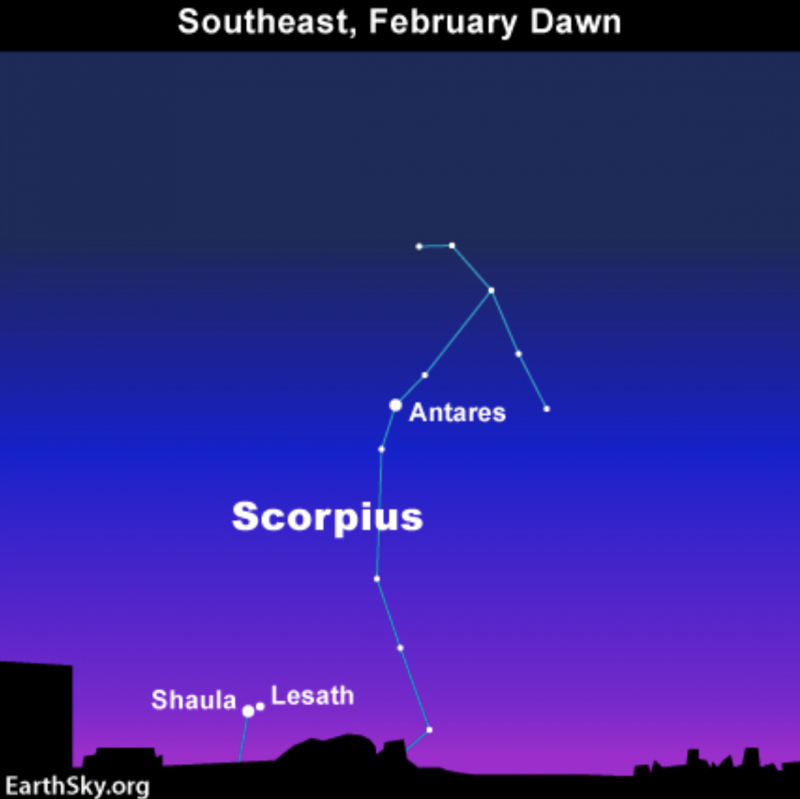
If you’re in the Northern Hemisphere, Shaula and Lesath will come over your southeastern horizon before dawn sometime this month. They’re a hopeful sign that spring is coming.
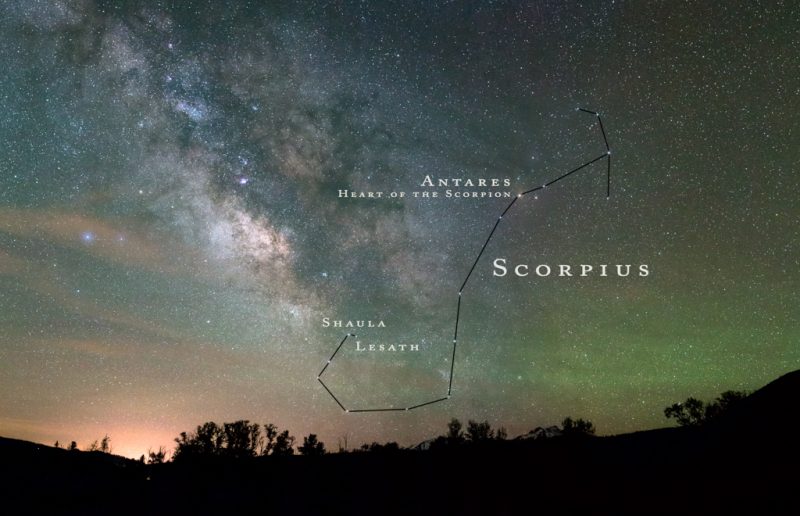
How do you recognize the coming of spring? Maybe you spot a first returning robin. Or tune into news about a groundhog looking for its shadow. For stargazers, one sign of spring is the early-morning sighting of a pretty pair of stars in the constellation Scorpius the Scorpion. Those stars, known as Shaula and Lesath, are part of the Stinger of the Scorpion. They are located at the end of the Scorpion’s curved Tail.
Shaula and Lesath in Pawnee lore
The Pawnee – once the largest group of people living on the U.S. Central Plains – viewed the sky as a calendar. Different stars foretold the change of seasons. Many of their seasonal rituals occurred according to their observations of stars and planets. The most important of these was the Spring Awakening ceremony, tied to the observation of Shaula and Lesath on cold February mornings. The American anthropologist Gene Weltfish wrote in her 1977 book The Lost Universe: Pawnee Life and Culture:
The position of the stars was an important guide to the time when this ceremony should be held. The earth-lodge served as an astronomical observatory and as the priests sat inside at the west, they could observe the stars in certain positions through the smokehole and through the long east-oriented entranceway. They also kept careful watch of the horizon right after sunset and just before dawn to note the order and position of the stars.
The ceremony must be held at exactly the right time of year, when the priest first tracked two small twinkling stars known as the Swimming Ducks in the … horizon near the Milky Way.
When the Swimming Ducks came into view in the southeast – before daybreak in the month of February – the Pawnee recognized that it was time to begin planting ceremonies. The return of the celestial ducks to open water on the river of the Milky Way signaled the first stirrings of the great plains from hibernation.
Shaula and Lesath’s presence over the horizon was symbolic of waterfowl breaking through the ice. These stars were a sign of hope that spring was on its way.
You can see this harbinger of spring for yourself as Shaula and Lesath come into view at or shortly before dawn. You’ll need a clear, unobstructed view to the south to southeast to spot these stars, flickering by the horizon. If you view the constellation of Scorpius as a tilted J, the pair of stars is found at the end of the J shape. Daybreak may make them difficult to find, but keep looking throughout February. Eventually you’ll spot them low along the horizon.
As we approach the end of winter, Shaula and Lesath will appear higher each morning in the southeast before dawn. Their morning appearance tells us that spring is not far away.
Bottom line: The early Pawnee of the U.S. Central Plains regarded the stars Shaula and Lesath – in the Stinger of Scorpius the Scorpion – as Swimming Ducks. When the Swimming Ducks appeared before dawn in winter, the Pawnee knew spring was near and would begin planting ceremonies. So in some respects, these stars were a Pawnee version of Groundhog Day.
If you’re in the Northern Hemisphere, Shaula and Lesath will come over your southeastern horizon before dawn sometime this month. They’re a hopeful sign that spring is coming.
How do you recognize the coming of spring? Maybe you spot a first returning robin. Or tune into news about a groundhog looking for its shadow. For stargazers, one sign of spring is the early-morning sighting of a pretty pair of stars in the constellation Scorpius the Scorpion. Those stars, known as Shaula and Lesath, are part of the Stinger of the Scorpion. They are located at the end of the Scorpion’s curved Tail.
Shaula and Lesath in Pawnee lore
The Pawnee – once the largest group of people living on the U.S. Central Plains – viewed the sky as a calendar. Different stars foretold the change of seasons. Many of their seasonal rituals occurred according to their observations of stars and planets. The most important of these was the Spring Awakening ceremony, tied to the observation of Shaula and Lesath on cold February mornings. The American anthropologist Gene Weltfish wrote in her 1977 book The Lost Universe: Pawnee Life and Culture:
The position of the stars was an important guide to the time when this ceremony should be held. The earth-lodge served as an astronomical observatory and as the priests sat inside at the west, they could observe the stars in certain positions through the smokehole and through the long east-oriented entranceway. They also kept careful watch of the horizon right after sunset and just before dawn to note the order and position of the stars.
The ceremony must be held at exactly the right time of year, when the priest first tracked two small twinkling stars known as the Swimming Ducks in the … horizon near the Milky Way.
When the Swimming Ducks came into view in the southeast – before daybreak in the month of February – the Pawnee recognized that it was time to begin planting ceremonies. The return of the celestial ducks to open water on the river of the Milky Way signaled the first stirrings of the great plains from hibernation.
Shaula and Lesath’s presence over the horizon was symbolic of waterfowl breaking through the ice. These stars were a sign of hope that spring was on its way.
You can see this harbinger of spring for yourself as Shaula and Lesath come into view at or shortly before dawn. You’ll need a clear, unobstructed view to the south to southeast to spot these stars, flickering by the horizon. If you view the constellation of Scorpius as a tilted J, the pair of stars is found at the end of the J shape. Daybreak may make them difficult to find, but keep looking throughout February. Eventually you’ll spot them low along the horizon.
As we approach the end of winter, Shaula and Lesath will appear higher each morning in the southeast before dawn. Their morning appearance tells us that spring is not far away.
Bottom line: The early Pawnee of the U.S. Central Plains regarded the stars Shaula and Lesath – in the Stinger of Scorpius the Scorpion – as Swimming Ducks. When the Swimming Ducks appeared before dawn in winter, the Pawnee knew spring was near and would begin planting ceremonies. So in some respects, these stars were a Pawnee version of Groundhog Day.
Spotted by NASA’s James Webb Space Telescope, the galaxy MoM-z14 is currently the farthest galaxy ever detected. We see MoM-z14 as it appeared in the distant past, only 280 million years after the universe began in the Big Bang. Its light has traveled through space for more than 13 billion years. Image via NASA/ ESA/ CSA/ STScI/ Rohan Naidu (MIT)/ Joseph DePasquale (STScI).
Ancient Galaxy MoM-z14 confirmed as most distant object ever seen
Astronomers have confirmed that the galaxy MoM-z14 is the most distant object yet measured. This galaxy’s light has been traveling to us for 13.53 billion years, meaning we see MoM-z14 as it appeared just 280 million years after the Big Bang. And, thanks to the universe’s expansion, the galaxy is currently 33.8 billion light-years away.
An anomaly from the universe’s infancy, MoM-z14 isn’t at all what astronomers expected to find when they peered into the deepest depths of space.
It’s one of a group of extremely ancient but oddly well-developed galaxies imaged by the James Webb Space Telescope. They appear to be up to 13.5 billion years old, and are far more complex than cosmological theory says they should be. That’s why there have been doubts over whether the galaxies are truly that old. Have gravitational distortions been giving us a false picture?
To answer the question, astronomers designed and ran the “Mirage or Miracle” (MoM) survey. A group of dozens of international researchers used Webb’s spectroscopic instruments – tools that measure the chemical signatures hidden in light – to confirm that the light coming from MoM-z14 has, indeed, travelled for 13.53 billion years. That means MoM-z14 is about 97.8% as old as the universe.
The peer-reviewed findings from the survey were reported in the Open Journal of Astrophysics on January 28.
Is Galaxy MoM-z14 normal or unique?
The earliest galaxies imaged by Webb are more developed than theories predicted. Plus, there are too many of them. The newly published research sought, firstly, to discover if objects like MoM-z14 are actually as distant as they appear. Secondly, researchers wanted to find out if their unexpected structures are peculiar or commonplace. Lead author Rohan Naidu of MIT’s Kavli Institute for Astrophysics and Space Research said:
With Webb, we are able to see farther than humans ever have before, and it looks nothing like what we predicted, which is both challenging and exciting.
Before Webb began observation, cosmological theory predicted there would be only a few developed galaxies so soon after the Big Bang. Instead, initial imagery revealed about 100 times more such objects than expected, including the galaxy MoM-z14. Data from Webb’s spectrographic camera allowed researchers to confirm whether these objects were as old as they appear, said Pascal Oesch of the University of Geneva, co-principal investigator of the survey:
We can estimate the distance of galaxies from images, but it’s really important to follow up and confirm with more detailed spectroscopy so that we know exactly what we are seeing, and when.
The objects really are from an era 280 million years after the beginning of everything. And that’s a discovery that prompts more exploration, said Jacob Shen, a postdoctoral researcher at MIT and a member of the research team:
There is a growing chasm between theory and observation related to the early universe, which presents compelling questions to be explored going forward.
Expect more discoveries from the more distant past
The data Webb has already returned are showing that the nature of early stars isn’t what we thought either. Stars in MoMz-14 appear to have more nitrogen than expected. Naidu said:
We can take a page from archeology and look at these ancient stars in our own galaxy like fossils from the early universe, except in astronomy we are lucky enough to have Webb seeing so far that we also have direct information about galaxies during that time. It turns out we are seeing some of the same features, like this unusual nitrogen enrichment.
Since there shouldn’t have been enough time to produce the amount of nitrogen seen in early stars, researchers are already reworking their theories on how it got there. They speculate there might have been enough dense gas to form nitrogen-generating supergiant stars very early.
More to come
More data are needed to unravel these mysteries of the early universe. And new astronomical instruments like the Nancy Grace Roman Space Telescope will help provide that information. Yijia Li, a graduate student at the Pennsylvania State University and a member of the research team, said:
To figure out what is going on in the early universe, we really need more information — more detailed observations with Webb, and more galaxies to see where the common features are, which Roman will be able to provide. It’s an incredibly exciting time, with Webb revealing the early universe like never before and showing us how much there still is to discover.
That means Galaxy MoM-z14’s hold on the title of most distant object ever observed likely won’t last long. Roman is set to launch in May 2026. As it and Webb continue to explore the earliest era of the universe, more distant – and, therefore, older – objects will almost certainly be discovered.
Bottom line: Galaxy MoM-z14 – a bright galaxy that existed 280 million years after the Big Bang – is for now the most distant object ever measured by astronomers. It is currently 33.8 billion light years away.
Spotted by NASA’s James Webb Space Telescope, the galaxy MoM-z14 is currently the farthest galaxy ever detected. We see MoM-z14 as it appeared in the distant past, only 280 million years after the universe began in the Big Bang. Its light has traveled through space for more than 13 billion years. Image via NASA/ ESA/ CSA/ STScI/ Rohan Naidu (MIT)/ Joseph DePasquale (STScI).
Ancient Galaxy MoM-z14 confirmed as most distant object ever seen
Astronomers have confirmed that the galaxy MoM-z14 is the most distant object yet measured. This galaxy’s light has been traveling to us for 13.53 billion years, meaning we see MoM-z14 as it appeared just 280 million years after the Big Bang. And, thanks to the universe’s expansion, the galaxy is currently 33.8 billion light-years away.
An anomaly from the universe’s infancy, MoM-z14 isn’t at all what astronomers expected to find when they peered into the deepest depths of space.
It’s one of a group of extremely ancient but oddly well-developed galaxies imaged by the James Webb Space Telescope. They appear to be up to 13.5 billion years old, and are far more complex than cosmological theory says they should be. That’s why there have been doubts over whether the galaxies are truly that old. Have gravitational distortions been giving us a false picture?
To answer the question, astronomers designed and ran the “Mirage or Miracle” (MoM) survey. A group of dozens of international researchers used Webb’s spectroscopic instruments – tools that measure the chemical signatures hidden in light – to confirm that the light coming from MoM-z14 has, indeed, travelled for 13.53 billion years. That means MoM-z14 is about 97.8% as old as the universe.
The peer-reviewed findings from the survey were reported in the Open Journal of Astrophysics on January 28.
Is Galaxy MoM-z14 normal or unique?
The earliest galaxies imaged by Webb are more developed than theories predicted. Plus, there are too many of them. The newly published research sought, firstly, to discover if objects like MoM-z14 are actually as distant as they appear. Secondly, researchers wanted to find out if their unexpected structures are peculiar or commonplace. Lead author Rohan Naidu of MIT’s Kavli Institute for Astrophysics and Space Research said:
With Webb, we are able to see farther than humans ever have before, and it looks nothing like what we predicted, which is both challenging and exciting.
Before Webb began observation, cosmological theory predicted there would be only a few developed galaxies so soon after the Big Bang. Instead, initial imagery revealed about 100 times more such objects than expected, including the galaxy MoM-z14. Data from Webb’s spectrographic camera allowed researchers to confirm whether these objects were as old as they appear, said Pascal Oesch of the University of Geneva, co-principal investigator of the survey:
We can estimate the distance of galaxies from images, but it’s really important to follow up and confirm with more detailed spectroscopy so that we know exactly what we are seeing, and when.
The objects really are from an era 280 million years after the beginning of everything. And that’s a discovery that prompts more exploration, said Jacob Shen, a postdoctoral researcher at MIT and a member of the research team:
There is a growing chasm between theory and observation related to the early universe, which presents compelling questions to be explored going forward.
Expect more discoveries from the more distant past
The data Webb has already returned are showing that the nature of early stars isn’t what we thought either. Stars in MoMz-14 appear to have more nitrogen than expected. Naidu said:
We can take a page from archeology and look at these ancient stars in our own galaxy like fossils from the early universe, except in astronomy we are lucky enough to have Webb seeing so far that we also have direct information about galaxies during that time. It turns out we are seeing some of the same features, like this unusual nitrogen enrichment.
Since there shouldn’t have been enough time to produce the amount of nitrogen seen in early stars, researchers are already reworking their theories on how it got there. They speculate there might have been enough dense gas to form nitrogen-generating supergiant stars very early.
More to come
More data are needed to unravel these mysteries of the early universe. And new astronomical instruments like the Nancy Grace Roman Space Telescope will help provide that information. Yijia Li, a graduate student at the Pennsylvania State University and a member of the research team, said:
To figure out what is going on in the early universe, we really need more information — more detailed observations with Webb, and more galaxies to see where the common features are, which Roman will be able to provide. It’s an incredibly exciting time, with Webb revealing the early universe like never before and showing us how much there still is to discover.
That means Galaxy MoM-z14’s hold on the title of most distant object ever observed likely won’t last long. Roman is set to launch in May 2026. As it and Webb continue to explore the earliest era of the universe, more distant – and, therefore, older – objects will almost certainly be discovered.
Bottom line: Galaxy MoM-z14 – a bright galaxy that existed 280 million years after the Big Bang – is for now the most distant object ever measured by astronomers. It is currently 33.8 billion light years away.
View at EarthSky Community Photos. | Steven Bellavia captured this images on February 1, 2026, from Virginia and wrote: “This is my first successful capture of Sirius B, the faint companion star of Sirius A, the brightest star in the Earth’s sky. Using a red filter, to slightly help with atmospheric seeing, combined with 3-D printed vanes to deliberately cause diffraction, thus reducing the encircled energy around very bright Sirius, then redistributing that energy into diffraction spikes in the background.” Thank you, Steven!
The brightest star in our sky, Sirius, and its white dwarf companion, Sirius B, are currently farthest apart from our perspective. The two stars orbit each other with a period of about 50 years, and they’re having their maximum separation of 11 arcseconds now. While it’s always a challenge to see dim Sirius B next to brilliant Sirius, presently you have a bit of an advantage. Learn how to see Sirius B, below.
Sirius the Dog Star is the brightest star in the night sky, visible anywhere on Earth except the far north. If you live in the Northern Hemisphere at a temperate latitude, Sirius is the very bright white star due south every winter in the evening. But did you know that Sirius is also a double star? The companion, Sirius B, also known as the Pup, is a very small star orbiting the primary. You can see it using even small amateur telescopes. It’s not easy to spot but can be done if you follow certain guidelines. Here’s how to do it.
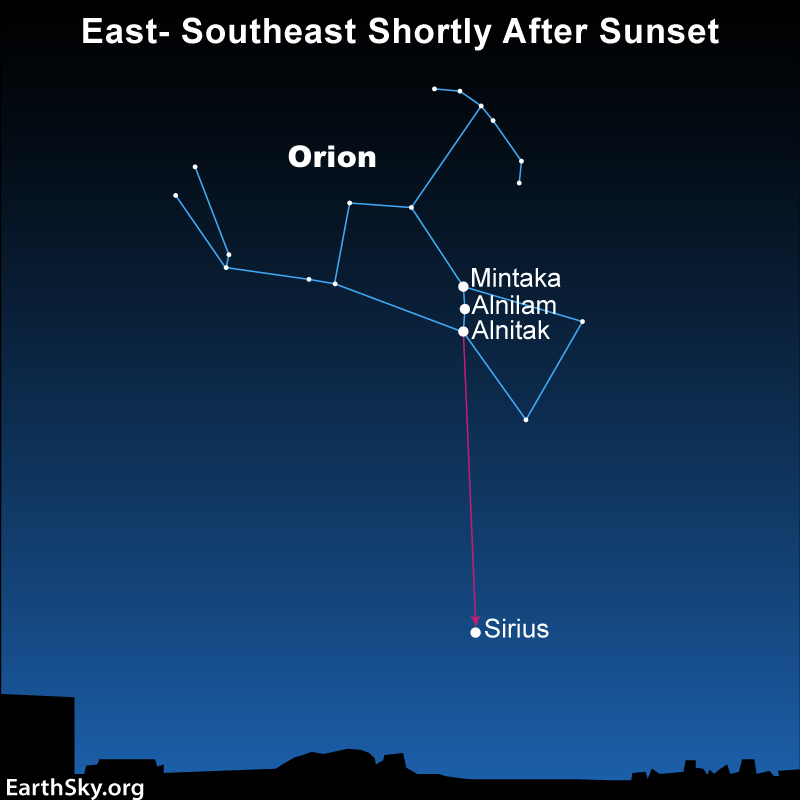
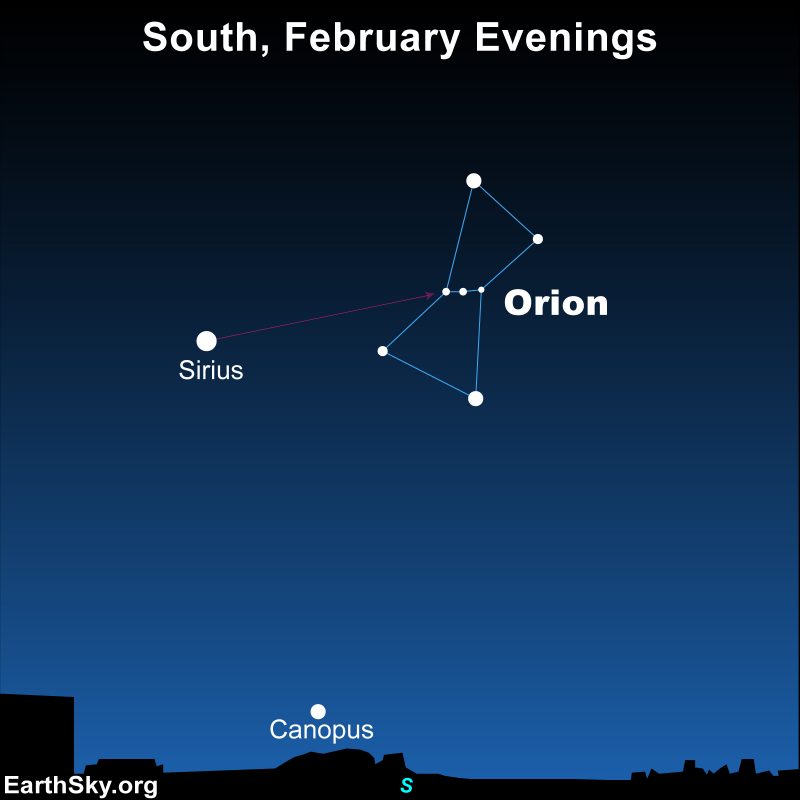
You can use the 3 stars of Orion’s Belt to find bright Sirius in the sky. The angle of Orion will vary during the night and with your latitude; this is how it looks in January/February early in the evening toward the southeast in the Northern Hemisphere. Chart via EarthSky.
Sirius A and B
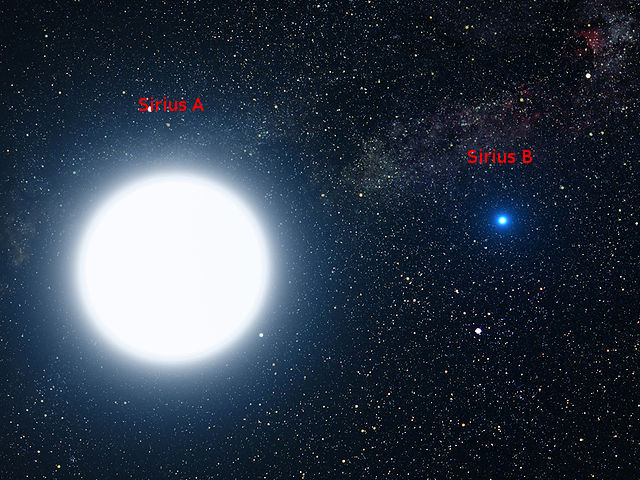
While Sirius A, the main component, is a large white star twice as massive as the sun, Sirius B, the companion, is a white dwarf. Sirius B is about as massive as the sun, but very small at about the same volume as Earth. Around 120 million years ago, Sirius B was a large white star five times as massive as the sun, but it has since passed through the red giant phase. Now, it’s the dead remnant of a formerly active star.
Currently, Sirius B is not generating any new heat, as the fusion reactions in its core have stopped. It is steadily cooling down, a process that will take a very long time, because it’s still pretty hot as of now: 25,200 Kelvin (44,900 degrees F or 24,900 C). Basically, Sirius B is the white-hot dead body of a formerly large and very active star. While B is twice as hot as the primary (Sirius A), its very small size makes it much less bright. Sirius B’s luminosity is about 10,000 times less than that of Sirius A.
Artist’s concept of Sirius A and B. Image via NASA, ESA and G. Bacon.
Tracking the orbit of Sirius B
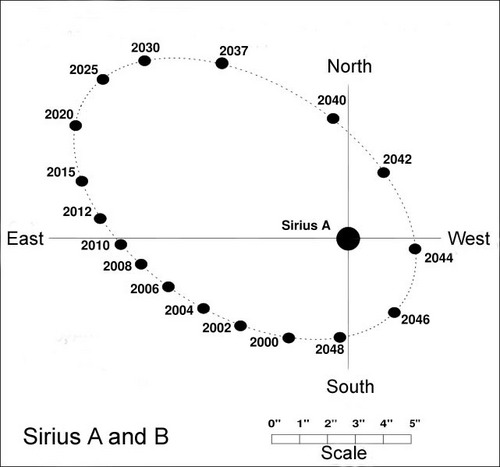
The two stars, the main component and the companion, orbit each other at a distance of approximately 20 astronomical units (AU). That is about the same as the distance between the sun and Uranus. As a result, when we observe them from Earth, Sirius B appears to describe an ellipse around Sirius A with a period of 50 years.
From Earth, the separation between Sirius A and B varies between 3 and 11 arcseconds on a 50 year cycle. Image via FrancescoA/ Wikimedia Commons.
Seen from Earth, the separation between Sirius A and B varies between 3 and 11 arcseconds on a 50 year cycle. And now they’re at 11 arcseconds apart, so it’s a great time to look for Sirius B. But you have to follow certain rules, since this is not an easy target.
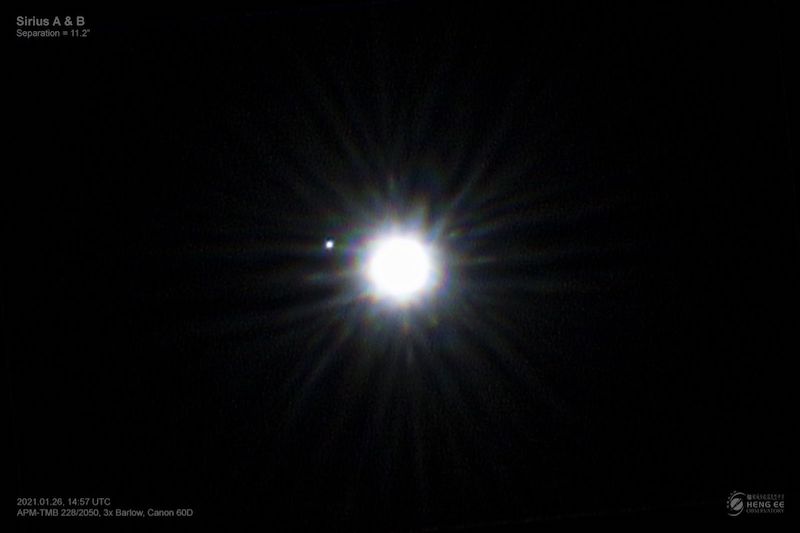
View at EarthSky Community Photos. | Michael Teoh at Heng Ee Observatory in Penang, Malaysia, captured this photo of Sirius A (center) and Sirius B (a white dwarf on the left) on January 26, 2021. He used 30 1-second exposures and stacked them together to make faint Sirius B appear. Thank you, Michael!
Why this is a difficult observation
Sirius is a double star, with pretty good separation, but with a very large difference in brightness between its stars. Based on separation alone (3 to 11 arcseconds), it should be an easy double to split. But the brightness imbalance is staggering. Sirius B is often lost in Sirius A’s tremendous glare, so you have to take special measures to make B visible.
If you’re an experienced astronomer, you can probably skip some of the following recommendations, as they are probably a matter of your daily routine. But if you’re a beginner, keep reading.
In any case, don’t worry. Sirius B is definitely visible even in a small amateur telescope throughout the 2020s and 2030s. A good 100mm (4-inch) scope or larger should split it in the upcoming years. You can do it. Just play by the rules and be persistent. You will likely not succeed on your first or second attempt. But keep trying, and eventually you’ll see it.
Best time to see Sirius B, and corresponding location on the sky
If you live in the Northern Hemisphere, in the temperate zone, the best time to attempt observing Sirius B is in winter, January and February for the most part. This is when Sirius is at its highest in the sky at a convenient early hour. December is also fine if you don’t mind staying up late, or November if you’re basically a night owl. In March, you want to be ready as soon as the sky is dark enough. It is important that the star is not too low in the sky, as seeing (turbulence) becomes much worse close to the horizon, and seeing is absolutely crucial for this observation.
At the 1st of February, you should be outside and already observing around 10 p.m. New Year’s Day, the best time (when Sirius is at the highest point) is around midnight. The 1st of March, the best time is 8 p.m. Come April 1st, Sirius already begins to descend after sunset, so the best observational season is coming to an end.
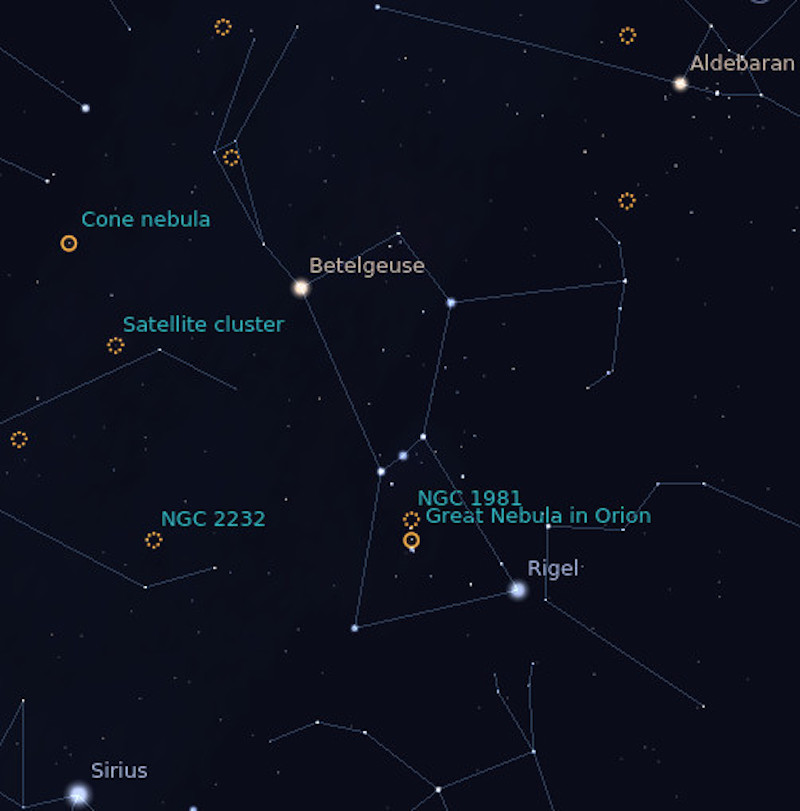
After you know what time to observe, go outside and look south. That very bright white star not too high in the sky is Sirius. To its right (west), you can see the great constellation of Orion, with bright red Betelgeuse near the top, then the Belt of three stars, then white Rigel at the base.
The importance of seeing
What we in astronomy call seeing is what others call turbulence. Seeing (or air turbulence) blurs the image whenever you’re attempting a high-resolution observation from Earth. It depends on the weather, location and a number of other factors. It is predictable to some extent.
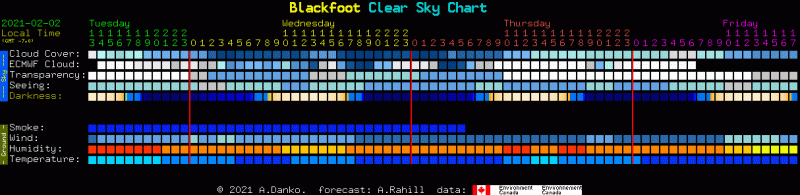
First, go to the Clear Sky Chart site to find the outlook near you. Then, choose a location nearest your place. Next, look at the fourth row in the chart, the one called “Seeing.” When the chart is dark blue, that means good seeing. When the chart is white or light blue, the prediction for seeing is bad.
The Clear Sky Chart is an astronomers’ forecast. It shows at a glance when, in the next 84 hours, you might expect clear and dark skies for one specific observing site. There are many locations, but the example above is for Blackfoot, a park in Alberta, Canada.
Excellent seeing is crucial to this observation. It is the most important factor. To see Sirius B, nothing short of excellent seeing will work. Yet, even if the seeing forecast is merely “good,” you should still attempt an observation. Here’s why: There can be brief moments when the air becomes very still even during more vigorous turbulence, and that’s enough to get a short glimpse of Sirius B. But if the forecast is bad, there’s probably no point in trying.
Telescope considerations for seeing Sirius B
Is the primary mirror clean enough?
If your telescope is an open reflector (such as a Dobsonian), dust accumulating on the primary mirror will increase light scattering. If you have cleaned the mirror in the last few months, then feel free to ignore this part. But if it’s been a year or more since the last mirror clean-up, it’s time to give it a bath.
Be very gentle. Use your sense of touch to detect when you hit a dust mote lodged on the surface and avoid dragging it across. Or use cotton balls if your fingers are less sensitive and you’re afraid you’ll scratch the mirror. But apply almost no pressure with the cotton.
At the end, rinse it with plenty of distilled water, then leave it alone and don’t touch it with anything afterward.
It’s recommended you do this procedure once a year.
Are the eyepieces clean enough?
The eye-facing lens of any eyepiece is contaminated by grease from eyelashes within seconds of starting an observation. This creates a haze that reduces contrast. It is recommended to clean the lens before any difficult observation. This is the best method.
Use high-concentration alcohol (90% or better) and Q-tips. Make sure the Q-tips are not soaked; if the Q-tip is just a bit wet, that’s when cleaning is most successful. If the Q-tip makes a puddle of alcohol on the lens that persists for a long time, you’re using too much liquid.
Is the telescope collimated?
Collimation is crucial for any high-resolution observation. If previously you’ve only done superficial collimation, now it’s time to get down to business and do it right. There are many techniques and tools for collimation. Here’s a good primer for Newtonian reflectors (such as Dobsonians) using simple tools.
Collimation is a vast topic: you could literally write a whole book discussing nothing but collimation, so keep learning and apply what you learn.
When seeing is good, you could plug a high-power eyepiece into your scope and do a star test to verify collimation. The star test is the ultimate authority for telescope performance, so at least learn the basics.
Is the telescope cooled down?
To deliver peak performance, a telescope must be at thermal equilibrium with the environment. Read about thermal issues at here and here.
Even if you don’t have a mirror fan, at least take the scope outside one hour before you start the observation, and let it cool down to ambient temperature. This should be enough to reap most benefits of thermal equilibrium.
Okay, now go ahead and look for Sirius B
Seeing is great, Sirius is high in the sky, the telescope is in perfect shape … now it’s time to look at Sirius, right?
Not so fast. Before that, take a look to the west (to the right) of Sirius, and observe the large constellation of Orion.
On the above map, Betelgeuse is on top, bright and red. In the middle, there’s the Belt made of 3 stars. Then at the bottom there’s Rigel, a bright white star.
Rigel itself is a double star. The separation between Rigel A and B is similar to the separation between Sirius A and B. Except the brightness difference between Rigel A and B is much less than the difference between Sirius A and B, which makes Rigel a much easier double to split.
So grab a high-power eyepiece, plug it into the scope, and point the instrument at Rigel. You’ll see a bright white star, and nearby a much smaller star, which is supposed to be white but looks quite yellow to me. Try to memorize the distance between Rigel A and B, because it’s similar to the current distance between Sirius A and B.
If you can’t see Rigel B, either seeing is so bad or your scope is out of whack, and there’s no point to even try to see Sirius B.
Time to actually describe the observation of Sirius B
You should use very high magnification. Forget what you’ve heard on forums or from word-of-mouth about “magnification limits;” just plug in a strong eyepiece. For a 150mm (6-inch) scope, 300x is not too much; for a 200mm (8-inch) scope, up to 400x; for a 300mm (12-inch) scope, up to 600x. Try the highest magnification available, then back off a little if things are too fuzzy. You should not use less than half the magnifications indicated above: In other words, for a 200mm (8-inch) scope, stay between 200x and 400x.
Point the scope at Sirius, turn off tracking (if your scope has it), and let the star drift across the field. Sirius B is currently close to due east from A (east-northeast), so it should be trailing the primary star, following the primary a little bit off to the side of A’s trajectory.
A comfortable chair helps you relax and breathe slowly. Keep looking at the primary star and be mindful of the surrounding area trailing the star as it drifts across the field. There will be a lot of light scattered from the primary, making it hard to see anything in the vicinity. Just relax and keep watching.
Sometimes the eye is covered in excess fluid (tears, basically) which blurs the image. Back off from the eyepiece a few millimeters and blink slowly and firmly a couple times (but don’t squeeze it shut too hard), then resume.
How Sirius B appears
In theory, Sirius B should be just outside the bundle of shimmering brightness centered on Sirius A, but – being pretty weak – it’s hidden by the tremendous glare from the primary. Once in a while, something will coalesce out of nothing, and you’ll see the unmistakable round pattern of a star.
Even in good seeing, it’ll wink in and out of existence. Or you’ll see it for a few moments, then it’ll vanish again for a long time. Don’t confuse it with a diffraction artifact from the primary. Stars are round, whereas artifacts are typically more linear or oddly shaped.
Only when seeing is very good will you be able to see Sirius B for extended periods of time. Usually it’s more elusive than that.
When your eyes are tired, take a break, go observe the Great Orion Nebula or Rigel A/B again. Then get back to hunting Sirius B.
If you fail at your first attempt, well, that’s normal. Try again tomorrow. It’s hard to catch the perfect seeing required, so persistence is important. Perfect seeing, a telescope in perfect shape, high magnification, and persistence: That’s how it’s done.
Good luck, and clear skies.
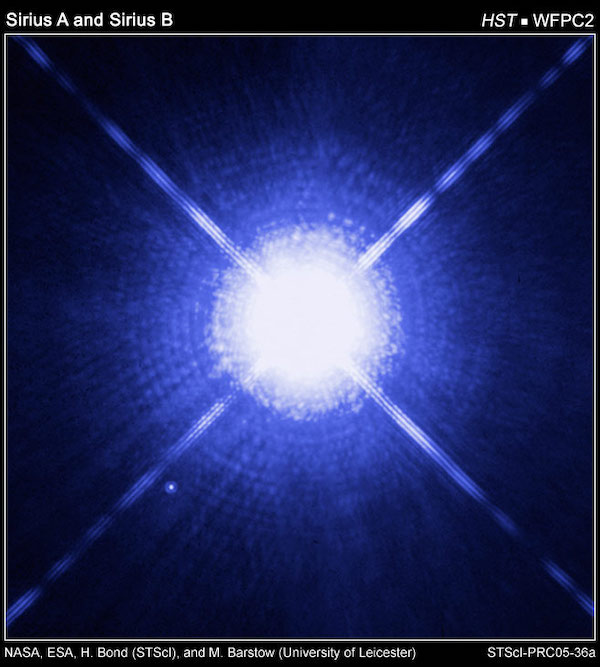
This is how the Hubble Telescope sees Sirius A and B. The Pup is that tiny dot of light near the bottom-left spike. Now you see why Sirius B is so hard to see in amateur ground-based telescopes. Image via Hubblesite.
Bottom line: Now is a great time to see Sirius’ dim companion, the white dwarf Sirius B. The two are currently at their maximum separation of 11 arcseconds, as viewed from Earth.
View at EarthSky Community Photos. | Steven Bellavia captured this images on February 1, 2026, from Virginia and wrote: “This is my first successful capture of Sirius B, the faint companion star of Sirius A, the brightest star in the Earth’s sky. Using a red filter, to slightly help with atmospheric seeing, combined with 3-D printed vanes to deliberately cause diffraction, thus reducing the encircled energy around very bright Sirius, then redistributing that energy into diffraction spikes in the background.” Thank you, Steven!
The brightest star in our sky, Sirius, and its white dwarf companion, Sirius B, are currently farthest apart from our perspective. The two stars orbit each other with a period of about 50 years, and they’re having their maximum separation of 11 arcseconds now. While it’s always a challenge to see dim Sirius B next to brilliant Sirius, presently you have a bit of an advantage. Learn how to see Sirius B, below.
Sirius the Dog Star is the brightest star in the night sky, visible anywhere on Earth except the far north. If you live in the Northern Hemisphere at a temperate latitude, Sirius is the very bright white star due south every winter in the evening. But did you know that Sirius is also a double star? The companion, Sirius B, also known as the Pup, is a very small star orbiting the primary. You can see it using even small amateur telescopes. It’s not easy to spot but can be done if you follow certain guidelines. Here’s how to do it.
You can use the 3 stars of Orion’s Belt to find bright Sirius in the sky. The angle of Orion will vary during the night and with your latitude; this is how it looks in January/February early in the evening toward the southeast in the Northern Hemisphere. Chart via EarthSky.
Sirius A and B
While Sirius A, the main component, is a large white star twice as massive as the sun, Sirius B, the companion, is a white dwarf. Sirius B is about as massive as the sun, but very small at about the same volume as Earth. Around 120 million years ago, Sirius B was a large white star five times as massive as the sun, but it has since passed through the red giant phase. Now, it’s the dead remnant of a formerly active star.
Currently, Sirius B is not generating any new heat, as the fusion reactions in its core have stopped. It is steadily cooling down, a process that will take a very long time, because it’s still pretty hot as of now: 25,200 Kelvin (44,900 degrees F or 24,900 C). Basically, Sirius B is the white-hot dead body of a formerly large and very active star. While B is twice as hot as the primary (Sirius A), its very small size makes it much less bright. Sirius B’s luminosity is about 10,000 times less than that of Sirius A.
Artist’s concept of Sirius A and B. Image via NASA, ESA and G. Bacon.
Tracking the orbit of Sirius B
The two stars, the main component and the companion, orbit each other at a distance of approximately 20 astronomical units (AU). That is about the same as the distance between the sun and Uranus. As a result, when we observe them from Earth, Sirius B appears to describe an ellipse around Sirius A with a period of 50 years.
From Earth, the separation between Sirius A and B varies between 3 and 11 arcseconds on a 50 year cycle. Image via FrancescoA/ Wikimedia Commons.
Seen from Earth, the separation between Sirius A and B varies between 3 and 11 arcseconds on a 50 year cycle. And now they’re at 11 arcseconds apart, so it’s a great time to look for Sirius B. But you have to follow certain rules, since this is not an easy target.
View at EarthSky Community Photos. | Michael Teoh at Heng Ee Observatory in Penang, Malaysia, captured this photo of Sirius A (center) and Sirius B (a white dwarf on the left) on January 26, 2021. He used 30 1-second exposures and stacked them together to make faint Sirius B appear. Thank you, Michael!
Why this is a difficult observation
Sirius is a double star, with pretty good separation, but with a very large difference in brightness between its stars. Based on separation alone (3 to 11 arcseconds), it should be an easy double to split. But the brightness imbalance is staggering. Sirius B is often lost in Sirius A’s tremendous glare, so you have to take special measures to make B visible.
If you’re an experienced astronomer, you can probably skip some of the following recommendations, as they are probably a matter of your daily routine. But if you’re a beginner, keep reading.
In any case, don’t worry. Sirius B is definitely visible even in a small amateur telescope throughout the 2020s and 2030s. A good 100mm (4-inch) scope or larger should split it in the upcoming years. You can do it. Just play by the rules and be persistent. You will likely not succeed on your first or second attempt. But keep trying, and eventually you’ll see it.
Best time to see Sirius B, and corresponding location on the sky
If you live in the Northern Hemisphere, in the temperate zone, the best time to attempt observing Sirius B is in winter, January and February for the most part. This is when Sirius is at its highest in the sky at a convenient early hour. December is also fine if you don’t mind staying up late, or November if you’re basically a night owl. In March, you want to be ready as soon as the sky is dark enough. It is important that the star is not too low in the sky, as seeing (turbulence) becomes much worse close to the horizon, and seeing is absolutely crucial for this observation.
At the 1st of February, you should be outside and already observing around 10 p.m. New Year’s Day, the best time (when Sirius is at the highest point) is around midnight. The 1st of March, the best time is 8 p.m. Come April 1st, Sirius already begins to descend after sunset, so the best observational season is coming to an end.
After you know what time to observe, go outside and look south. That very bright white star not too high in the sky is Sirius. To its right (west), you can see the great constellation of Orion, with bright red Betelgeuse near the top, then the Belt of three stars, then white Rigel at the base.
The importance of seeing
What we in astronomy call seeing is what others call turbulence. Seeing (or air turbulence) blurs the image whenever you’re attempting a high-resolution observation from Earth. It depends on the weather, location and a number of other factors. It is predictable to some extent.
First, go to the Clear Sky Chart site to find the outlook near you. Then, choose a location nearest your place. Next, look at the fourth row in the chart, the one called “Seeing.” When the chart is dark blue, that means good seeing. When the chart is white or light blue, the prediction for seeing is bad.
The Clear Sky Chart is an astronomers’ forecast. It shows at a glance when, in the next 84 hours, you might expect clear and dark skies for one specific observing site. There are many locations, but the example above is for Blackfoot, a park in Alberta, Canada.
Excellent seeing is crucial to this observation. It is the most important factor. To see Sirius B, nothing short of excellent seeing will work. Yet, even if the seeing forecast is merely “good,” you should still attempt an observation. Here’s why: There can be brief moments when the air becomes very still even during more vigorous turbulence, and that’s enough to get a short glimpse of Sirius B. But if the forecast is bad, there’s probably no point in trying.
Telescope considerations for seeing Sirius B
Is the primary mirror clean enough?
If your telescope is an open reflector (such as a Dobsonian), dust accumulating on the primary mirror will increase light scattering. If you have cleaned the mirror in the last few months, then feel free to ignore this part. But if it’s been a year or more since the last mirror clean-up, it’s time to give it a bath.
Be very gentle. Use your sense of touch to detect when you hit a dust mote lodged on the surface and avoid dragging it across. Or use cotton balls if your fingers are less sensitive and you’re afraid you’ll scratch the mirror. But apply almost no pressure with the cotton.
At the end, rinse it with plenty of distilled water, then leave it alone and don’t touch it with anything afterward.
It’s recommended you do this procedure once a year.
Are the eyepieces clean enough?
The eye-facing lens of any eyepiece is contaminated by grease from eyelashes within seconds of starting an observation. This creates a haze that reduces contrast. It is recommended to clean the lens before any difficult observation. This is the best method.
Use high-concentration alcohol (90% or better) and Q-tips. Make sure the Q-tips are not soaked; if the Q-tip is just a bit wet, that’s when cleaning is most successful. If the Q-tip makes a puddle of alcohol on the lens that persists for a long time, you’re using too much liquid.
Is the telescope collimated?
Collimation is crucial for any high-resolution observation. If previously you’ve only done superficial collimation, now it’s time to get down to business and do it right. There are many techniques and tools for collimation. Here’s a good primer for Newtonian reflectors (such as Dobsonians) using simple tools.
Collimation is a vast topic: you could literally write a whole book discussing nothing but collimation, so keep learning and apply what you learn.
When seeing is good, you could plug a high-power eyepiece into your scope and do a star test to verify collimation. The star test is the ultimate authority for telescope performance, so at least learn the basics.
Is the telescope cooled down?
To deliver peak performance, a telescope must be at thermal equilibrium with the environment. Read about thermal issues at here and here.
Even if you don’t have a mirror fan, at least take the scope outside one hour before you start the observation, and let it cool down to ambient temperature. This should be enough to reap most benefits of thermal equilibrium.
Okay, now go ahead and look for Sirius B
Seeing is great, Sirius is high in the sky, the telescope is in perfect shape … now it’s time to look at Sirius, right?
Not so fast. Before that, take a look to the west (to the right) of Sirius, and observe the large constellation of Orion.
On the above map, Betelgeuse is on top, bright and red. In the middle, there’s the Belt made of 3 stars. Then at the bottom there’s Rigel, a bright white star.
Rigel itself is a double star. The separation between Rigel A and B is similar to the separation between Sirius A and B. Except the brightness difference between Rigel A and B is much less than the difference between Sirius A and B, which makes Rigel a much easier double to split.
So grab a high-power eyepiece, plug it into the scope, and point the instrument at Rigel. You’ll see a bright white star, and nearby a much smaller star, which is supposed to be white but looks quite yellow to me. Try to memorize the distance between Rigel A and B, because it’s similar to the current distance between Sirius A and B.
If you can’t see Rigel B, either seeing is so bad or your scope is out of whack, and there’s no point to even try to see Sirius B.
Time to actually describe the observation of Sirius B
You should use very high magnification. Forget what you’ve heard on forums or from word-of-mouth about “magnification limits;” just plug in a strong eyepiece. For a 150mm (6-inch) scope, 300x is not too much; for a 200mm (8-inch) scope, up to 400x; for a 300mm (12-inch) scope, up to 600x. Try the highest magnification available, then back off a little if things are too fuzzy. You should not use less than half the magnifications indicated above: In other words, for a 200mm (8-inch) scope, stay between 200x and 400x.
Point the scope at Sirius, turn off tracking (if your scope has it), and let the star drift across the field. Sirius B is currently close to due east from A (east-northeast), so it should be trailing the primary star, following the primary a little bit off to the side of A’s trajectory.
A comfortable chair helps you relax and breathe slowly. Keep looking at the primary star and be mindful of the surrounding area trailing the star as it drifts across the field. There will be a lot of light scattered from the primary, making it hard to see anything in the vicinity. Just relax and keep watching.
Sometimes the eye is covered in excess fluid (tears, basically) which blurs the image. Back off from the eyepiece a few millimeters and blink slowly and firmly a couple times (but don’t squeeze it shut too hard), then resume.
How Sirius B appears
In theory, Sirius B should be just outside the bundle of shimmering brightness centered on Sirius A, but – being pretty weak – it’s hidden by the tremendous glare from the primary. Once in a while, something will coalesce out of nothing, and you’ll see the unmistakable round pattern of a star.
Even in good seeing, it’ll wink in and out of existence. Or you’ll see it for a few moments, then it’ll vanish again for a long time. Don’t confuse it with a diffraction artifact from the primary. Stars are round, whereas artifacts are typically more linear or oddly shaped.
Only when seeing is very good will you be able to see Sirius B for extended periods of time. Usually it’s more elusive than that.
When your eyes are tired, take a break, go observe the Great Orion Nebula or Rigel A/B again. Then get back to hunting Sirius B.
If you fail at your first attempt, well, that’s normal. Try again tomorrow. It’s hard to catch the perfect seeing required, so persistence is important. Perfect seeing, a telescope in perfect shape, high magnification, and persistence: That’s how it’s done.
Good luck, and clear skies.
This is how the Hubble Telescope sees Sirius A and B. The Pup is that tiny dot of light near the bottom-left spike. Now you see why Sirius B is so hard to see in amateur ground-based telescopes. Image via Hubblesite.
Bottom line: Now is a great time to see Sirius’ dim companion, the white dwarf Sirius B. The two are currently at their maximum separation of 11 arcseconds, as viewed from Earth.
View at EarthSky Community Photos. | Sergei Timofeevski shared this image from November 13, 2023. Sergei wrote: “The constellation Orion the Hunter and the star Sirius rising just above the eastern horizon in the Anza-Borrego Desert State Park, California.” Thank you, Sergei! Note bright Sirius is on the bottom, and Orion’s Belt pointing to it.
The months around February are perfect for both Northern Hemisphere and Southern Hemisphere observers to view the brightest star in the sky: Sirius. But this star is shifting inexorably westward each night, as Earth orbits our sun and our perspective on the galaxy undergoes its subtle, continual change. By early April, Sirius will be moving noticeably toward the sunset glare. See it now. It’s the legendary Dog Star, part of the constellation Canis Major the Greater Dog.
From the Northern Hemisphere now, you’ll find Sirius arcing across in the southern sky in the evening. From the Southern Hemisphere, you’ll find it swinging high overhead at that time of night.
It’s always easy to spot as the brightest point of light in its region of sky … unless a planet happens to be near it, like Jupiter is in 2026. Not sure which object is Sirius and which is bright Jupiter? You’ll always know if you notice that the three Belt stars of Orion always point to Sirius. See the photo above.
It’s a flashy rainbow star
Although white to blue-white in color, Sirius might be called a rainbow star, as it often flickers with many colors. The flickering colors are especially easy to notice when you spot Sirius low in the sky.
The brightness, twinkling and color changes sometimes prompt people to report Sirius as a UFO!
In fact, these changes are simply what happens when such a bright star as Sirius shines through the blanket of Earth’s atmosphere. The varying density and temperature of Earth’s air affect starlight, especially when we’re seeing the star low in the sky.
The shimmering and color changes happen for other stars, too, but these effects are more noticeable for Sirius because Sirius is so bright.
Finding Sirius
From the mid-northern latitudes such as most of the U.S., Sirius rises in the southeast, arcs across the southern sky, and sets in the southwest. From the Southern Hemisphere, Sirius arcs high overhead.
As seen from around the world, Sirius rises in mid-evening in December. By mid-April, Sirius is setting in the southwest in mid-evening.
Sirius is always easy to find. It’s the sky’s brightest star! Plus, anyone familiar with the constellation Orion can simply draw a line through Orion’s Belt to find this star. Sirius is roughly eight times as far from the Belt as the Belt is wide.
Sirius is the sky’s brightest star. You’ll always know it’s Sirius because Orion’s Belt – 3 stars in a short, straight row – points to it. Also, as seen from the latitudes like those in Florida, Texas or southern California, Canopus – the 2nd-brightest star – arcs across the south below Sirius on February evenings. From farther south on the sky’s dome, Sirius and Canopus cross higher in the sky, like almost-twin diamonds. Chart via EarthSky.
The mythology of Sirius
Sirius is well known as the Dog Star, because it’s the chief star in the constellation Canis Major the Greater Dog. Have you ever heard anyone speak of the dog days of summer? Sirius is behind the sun as seen from Earth in Northern Hemisphere summer. In late summer, it appears in the east before sunrise, near the sun in our sky. The early stargazers might have imagined the double-whammy of Sirius and the sun caused the hot weather, or dog days.
In ancient Egypt, the name Sirius signified its nature as scorching or sparkling. The star was associated with the Egyptian gods Osiris, Sopdet and other gods. Ancient Egyptians noted that Sirius rose just before the sun each year immediately prior to the annual flooding of the Nile River. Although the floods could bring destruction, they also brought new soil and new life.
Osiris was an Egyptian god of life, death, fertility and rebirth of plant life along the Nile. Sopdet – who might have an even closer association with the star Sirius – began as an agricultural deity in Egypt, also closely associated with the Nile. The Egyptian new year celebration was a festival known as the Coming of Sopdet.
More mythology of the Dog Star
In India, Sirius is sometimes known as Svana, the dog of Prince Yudhisthira. The prince and his four brothers, along with Svana, set out on a long and arduous journey to find the kingdom of heaven. However, one by one the brothers all abandoned the search until only Yudhisthira and his dog, Svana, remained. At long last they came to the gates of heaven. The gatekeeper, Indra, welcomed the prince but denied Svana entrance.
Yudhisthira was aghast and told Indra that he could not forsake his good and faithful servant and friend. His brothers, Yudhisthira said, had abandoned the journey to heaven to follow their hearts’ desires. But Svana, who had given his heart freely, chose to follow none but Yudhisthira. The prince said that, without his dog, he would forsake even heaven. This is what Indra had wanted to hear, and then he welcomed both the prince and the dog through the gates of heaven.
Sopdet, the ancient Egyptian personification of the star Sirius. Image via Jeff Dahl/ Wikimedia Commons (CC BY-SA 4.0).
The brightest star
Astronomers express the brightness of stars in terms of stellar magnitude. The smaller the number, the brighter the star.
The visual magnitude of Sirius is -1.44, lower – brighter – than any other star. There are brighter stars than Sirius in terms of actual energy and light output, but they are farther away and hence appear dimmer.
Normally, the only objects that outshine Sirius in our heavens are the sun, moon, Venus, Jupiter, Mars and Mercury (and usually Sirius outshines Mercury, too).
Not counting the sun, the second-brightest star in all of Earth’s sky – next-brightest after Sirius – is Canopus. It is visible from latitudes like those of the southern U.S.
The third-brightest and, as it happens, the closest major star to our sun is Alpha Centauri. However, it’s too far south in the sky to see easily from mid-northern latitudes.
View at EarthSky Community Photos. | Sirius is the brightest star on the lower left of this picture. And Betelgeuse is the bright red-orange star at the top of this photo by Howard Cohen, who captured it at Chiefland, Florida, on March 22, 2025. Howard wrote: “This photo nicely shows color differences of stars with Betelgeuse notably orangy compared with bluish-white colors of Rigel (right) and Sirius (bottom left).” Thanks, Howard!
The science of Sirius
At 8.6 light-years distance, Sirius is one of the nearest stars to us after the sun. By the way, a light year is nearly 6 trillion miles (9.6 trillion km)!
Sirius is classified by astronomers as an A type star. That means it’s a much hotter star than our sun; its surface temperature is about 17,000 degrees Fahrenheit (9,400 Celsius) in contrast to our sun’s 10,000 F (5,500 C). With slightly more than twice the mass of the sun and just less than twice its diameter, Sirius still puts out 26 times as much energy. It’s a main-sequence star, meaning it produces most of its energy by converting hydrogen into helium through nuclear fusion.
And Sirius has a companion star
Sirius has a small, faint companion star appropriately called Sirius B or the Pup. That name signifies youth, but in fact the companion to Sirius is a white dwarf, a dead star. Once a mighty star, the Pup today is an Earth-sized ember, too faint to be seen without a telescope.
View at EarthSky Community Photos. | Steven Bellavia captured this images on February 1, 2026, from Virginia and wrote: “This is my first successful capture of Sirius B, the faint companion star of Sirius A, the brightest star in the Earth’s sky. Using a red filter, to slightly help with atmospheric seeing, combined with 3-D printed vanes to deliberately cause diffraction, thus reducing the encircled energy around the very bright A-star, redistributing that energy into diffraction spikes in the background.” Thank you, Steven!View at EarthSky Community Photos. | Michael Teoh at Heng Ee Observatory in Penang, Malaysia, captured this photo of Sirius A and Sirius B (a white dwarf, aka the Pup) on January 26, 2021. He used 30 1-second exposures and stacked them together to make faint Sirius B appear. Thank you, Michael!
The position of Sirius is RA: 06h 45m 08.9s, dec: -16° 42′ 58″.
Bottom line: Sirius is the brightest star in the night sky as seen from Earth and is visible from both hemispheres. And it lies just 8.6 light-years away in the constellation Canis Major the Greater Dog.
View at EarthSky Community Photos. | Sergei Timofeevski shared this image from November 13, 2023. Sergei wrote: “The constellation Orion the Hunter and the star Sirius rising just above the eastern horizon in the Anza-Borrego Desert State Park, California.” Thank you, Sergei! Note bright Sirius is on the bottom, and Orion’s Belt pointing to it.
The months around February are perfect for both Northern Hemisphere and Southern Hemisphere observers to view the brightest star in the sky: Sirius. But this star is shifting inexorably westward each night, as Earth orbits our sun and our perspective on the galaxy undergoes its subtle, continual change. By early April, Sirius will be moving noticeably toward the sunset glare. See it now. It’s the legendary Dog Star, part of the constellation Canis Major the Greater Dog.
From the Northern Hemisphere now, you’ll find Sirius arcing across in the southern sky in the evening. From the Southern Hemisphere, you’ll find it swinging high overhead at that time of night.
It’s always easy to spot as the brightest point of light in its region of sky … unless a planet happens to be near it, like Jupiter is in 2026. Not sure which object is Sirius and which is bright Jupiter? You’ll always know if you notice that the three Belt stars of Orion always point to Sirius. See the photo above.
It’s a flashy rainbow star
Although white to blue-white in color, Sirius might be called a rainbow star, as it often flickers with many colors. The flickering colors are especially easy to notice when you spot Sirius low in the sky.
The brightness, twinkling and color changes sometimes prompt people to report Sirius as a UFO!
In fact, these changes are simply what happens when such a bright star as Sirius shines through the blanket of Earth’s atmosphere. The varying density and temperature of Earth’s air affect starlight, especially when we’re seeing the star low in the sky.
The shimmering and color changes happen for other stars, too, but these effects are more noticeable for Sirius because Sirius is so bright.
Finding Sirius
From the mid-northern latitudes such as most of the U.S., Sirius rises in the southeast, arcs across the southern sky, and sets in the southwest. From the Southern Hemisphere, Sirius arcs high overhead.
As seen from around the world, Sirius rises in mid-evening in December. By mid-April, Sirius is setting in the southwest in mid-evening.
Sirius is always easy to find. It’s the sky’s brightest star! Plus, anyone familiar with the constellation Orion can simply draw a line through Orion’s Belt to find this star. Sirius is roughly eight times as far from the Belt as the Belt is wide.
Sirius is the sky’s brightest star. You’ll always know it’s Sirius because Orion’s Belt – 3 stars in a short, straight row – points to it. Also, as seen from the latitudes like those in Florida, Texas or southern California, Canopus – the 2nd-brightest star – arcs across the south below Sirius on February evenings. From farther south on the sky’s dome, Sirius and Canopus cross higher in the sky, like almost-twin diamonds. Chart via EarthSky.
The mythology of Sirius
Sirius is well known as the Dog Star, because it’s the chief star in the constellation Canis Major the Greater Dog. Have you ever heard anyone speak of the dog days of summer? Sirius is behind the sun as seen from Earth in Northern Hemisphere summer. In late summer, it appears in the east before sunrise, near the sun in our sky. The early stargazers might have imagined the double-whammy of Sirius and the sun caused the hot weather, or dog days.
In ancient Egypt, the name Sirius signified its nature as scorching or sparkling. The star was associated with the Egyptian gods Osiris, Sopdet and other gods. Ancient Egyptians noted that Sirius rose just before the sun each year immediately prior to the annual flooding of the Nile River. Although the floods could bring destruction, they also brought new soil and new life.
Osiris was an Egyptian god of life, death, fertility and rebirth of plant life along the Nile. Sopdet – who might have an even closer association with the star Sirius – began as an agricultural deity in Egypt, also closely associated with the Nile. The Egyptian new year celebration was a festival known as the Coming of Sopdet.
More mythology of the Dog Star
In India, Sirius is sometimes known as Svana, the dog of Prince Yudhisthira. The prince and his four brothers, along with Svana, set out on a long and arduous journey to find the kingdom of heaven. However, one by one the brothers all abandoned the search until only Yudhisthira and his dog, Svana, remained. At long last they came to the gates of heaven. The gatekeeper, Indra, welcomed the prince but denied Svana entrance.
Yudhisthira was aghast and told Indra that he could not forsake his good and faithful servant and friend. His brothers, Yudhisthira said, had abandoned the journey to heaven to follow their hearts’ desires. But Svana, who had given his heart freely, chose to follow none but Yudhisthira. The prince said that, without his dog, he would forsake even heaven. This is what Indra had wanted to hear, and then he welcomed both the prince and the dog through the gates of heaven.
Sopdet, the ancient Egyptian personification of the star Sirius. Image via Jeff Dahl/ Wikimedia Commons (CC BY-SA 4.0).
The brightest star
Astronomers express the brightness of stars in terms of stellar magnitude. The smaller the number, the brighter the star.
The visual magnitude of Sirius is -1.44, lower – brighter – than any other star. There are brighter stars than Sirius in terms of actual energy and light output, but they are farther away and hence appear dimmer.
Normally, the only objects that outshine Sirius in our heavens are the sun, moon, Venus, Jupiter, Mars and Mercury (and usually Sirius outshines Mercury, too).
Not counting the sun, the second-brightest star in all of Earth’s sky – next-brightest after Sirius – is Canopus. It is visible from latitudes like those of the southern U.S.
The third-brightest and, as it happens, the closest major star to our sun is Alpha Centauri. However, it’s too far south in the sky to see easily from mid-northern latitudes.
View at EarthSky Community Photos. | Sirius is the brightest star on the lower left of this picture. And Betelgeuse is the bright red-orange star at the top of this photo by Howard Cohen, who captured it at Chiefland, Florida, on March 22, 2025. Howard wrote: “This photo nicely shows color differences of stars with Betelgeuse notably orangy compared with bluish-white colors of Rigel (right) and Sirius (bottom left).” Thanks, Howard!
The science of Sirius
At 8.6 light-years distance, Sirius is one of the nearest stars to us after the sun. By the way, a light year is nearly 6 trillion miles (9.6 trillion km)!
Sirius is classified by astronomers as an A type star. That means it’s a much hotter star than our sun; its surface temperature is about 17,000 degrees Fahrenheit (9,400 Celsius) in contrast to our sun’s 10,000 F (5,500 C). With slightly more than twice the mass of the sun and just less than twice its diameter, Sirius still puts out 26 times as much energy. It’s a main-sequence star, meaning it produces most of its energy by converting hydrogen into helium through nuclear fusion.
And Sirius has a companion star
Sirius has a small, faint companion star appropriately called Sirius B or the Pup. That name signifies youth, but in fact the companion to Sirius is a white dwarf, a dead star. Once a mighty star, the Pup today is an Earth-sized ember, too faint to be seen without a telescope.
View at EarthSky Community Photos. | Steven Bellavia captured this images on February 1, 2026, from Virginia and wrote: “This is my first successful capture of Sirius B, the faint companion star of Sirius A, the brightest star in the Earth’s sky. Using a red filter, to slightly help with atmospheric seeing, combined with 3-D printed vanes to deliberately cause diffraction, thus reducing the encircled energy around the very bright A-star, redistributing that energy into diffraction spikes in the background.” Thank you, Steven!View at EarthSky Community Photos. | Michael Teoh at Heng Ee Observatory in Penang, Malaysia, captured this photo of Sirius A and Sirius B (a white dwarf, aka the Pup) on January 26, 2021. He used 30 1-second exposures and stacked them together to make faint Sirius B appear. Thank you, Michael!
The position of Sirius is RA: 06h 45m 08.9s, dec: -16° 42′ 58″.
Bottom line: Sirius is the brightest star in the night sky as seen from Earth and is visible from both hemispheres. And it lies just 8.6 light-years away in the constellation Canis Major the Greater Dog.