aads

UFOs in Canada? Official new report


UFOs in Canada: Canada’s top scientists are recommending the creation of a new federal body to standardize, collect and investigate unidentified aerial phenomena. Video via CTV News.

  • The Office of the Chief Science Advisor of Canada, headed by Mona Nemer, has released a new report about UAP (UFOs) in Canada.
  • The report aims to standardize reporting and investigative procedures among various government agencies, including the Canadian Space Agency.
  • While most UAP sightings are explainable, the report – as others before it – notes that some cases are difficult to explain.

UFOs in Canada: New government report

We’ve been hearing a lot lately about UAP (Unidentified Anomalous Phenomena, aka UFOs). That’s largely because of a renewed discussion in the U.S. Congress. But Canada has been involved as well. The Office of the Chief Science Advisor of Canada (headed by Mona Nemer) has released a long-awaited new report on UAP. The office said on July 14, 2025, that the report recommends the creation of a new federal body to standardize, collect and investigate UAP reports.

Previously, the office had launched its own research initiative in 2022, known as the Sky Canada Project.

The government had released a preliminary version of the report last January. Nemer, a cardiovascular scientist, has been Canada’s chief science advisor since 2017. The focus of this particular report was not to investigate UAP sightings specifically. Rather, it is to improve the reporting mechanisms among various government departments and agencies.

The report does not specifically address the question of what unexplained UAP might be. As the report states:

The project was not meant to prove or disprove the existence of extraterrestrial life or extraterrestrial visitors. The collection or analysis of 1st-hand data such as photos, videos or individual UAP sighting reports was not part of the project.

The report, “Management of Public Reporting of Unidentified Aerial Phenomena in Canada,” is available on the Government of Canada website.

Canada needs agency to manage public UFO sightings, says new federal reportWhether you're a believer, skeptic or fall somewhere in between, a new federally-commissioned report recommends a government agency be tasked with responding to UFO reports …#cbc #cbc-canada-news #Canada

CBC Bot posting select CBC RSS Feeds (@scrubfire84.bsky.social) 2025-07-17T14:38:46.825293+00:00

Establishing a dedicated reporting service for UFOs in Canada

The purpose of the report was not to investigate specific UAP sightings or make any conclusions about UAP. Instead, it recommends improvements in how such reports are handled by government departments and agencies. To this end, the Office of the Chief Science Advisor of Canada recommends the creation of a new federal body to standardize the process. The report states:

The mystery of unidentified phenomena in the sky has long fascinated humanity, capturing the public imagination and arousing both skepticism and curiosity. Together, the analysis presented in this report suggests that Canada would benefit from an improved process for reporting, collecting, and studying UAP sightings.

Our goal was to find the current resources and processes in place for handling and following up on UAP reports, to compare them with the best practices in other countries, and to make recommendations for potential improvements. The preparation of this report has garnered more public anticipation than any project in the history of this office.

A federal department or agency responsible for managing public UAP data should be identified. This service would collect testimonies, investigate cases and post its analyses publicly.

Nemer told CTV News:

The Sky Canada Project recommendations provide a realistic framework for the consistent and efficient management of UAP sightings in Canada. I am confident that our leaders will take these recommendations seriously.
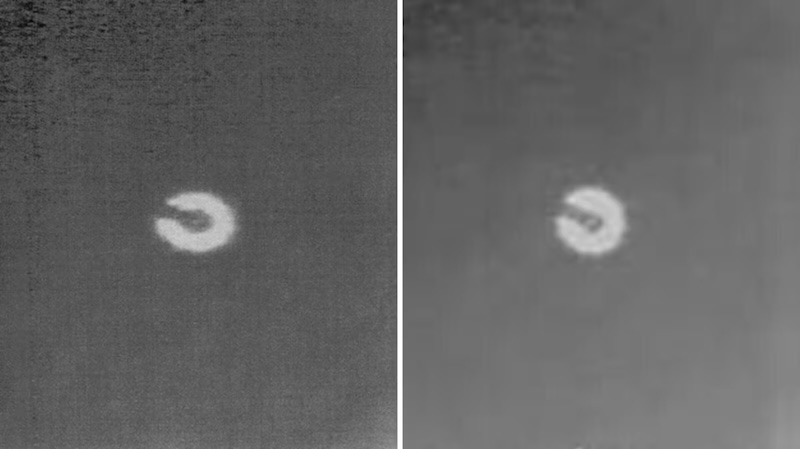
UFOs in Canada: 2 images of a white horseshoe-shaped object.
View larger. | 2 slightly different views of a UAP over Yukon, Canada, in February 2023. A Royal Canadian Air Force CP-140 Aurora long-range patrol aircraft obtained the images and video during an attempted shootdown of this and 2 other objects by military aircraft. The Department of National Defense has still not released the video of this incident. Image via Department of National Defence/ CTV News.

Canadian Space Agency and other government agencies

The report specifies various government agencies that should be involved, and recommends the Canadian Space Agency to lead the effort. It also names Transport Canada, the Department of National Defense and the Royal Canadian Mounted Police. According to CTV News, Transport Canada and the Canadian Space Agency have both shown interest, but need more time to determine what actions they should take. The Canadian Space Agency told CTV News:

The [Canadian Space Agency] is pleased to be recognized in the report as a trusted and respected scientific institution that regularly engages with the public on space-related matters. Although the [Canadian Space Agency] is not currently involved in the management of unidentified anomalous phenomena, it acknowledges the opportunity for coordinated action across federal departments and civilian organizations.

In regard to sightings by pilots and other aviation personnel, the report notes:

Transport Canada should encourage pilots, cabin crews and air traffic controllers to report UAP sightings without fear of stigmatization.

Additional recommendations

The report also makes other recommendations. These include new tools for data collection, such as a bilingual (English/French) mobile reporting app, providing the public with more access to UAP records and data and finding ways to combat disinformation.

The report says:

Improved data from public reports will enable more comprehensive and accurate research analyses. Investigating UAP reports may also enhance airspace security by identifying threats, thus strengthening national security through the proactive mitigation of risks from UAPs.

Smiling woman with wavy blonde hair, wearing a light-colored blazer with silver necklace.
Mona Nemer, Ph.D., is the Chief Science Advisor of Canada. Image via Office of the Chief Science Advisor of Canada/ Government of Canada.

Following the lead of other countries

Some other countries already have official government UAP bodies. These include the All-domain Anomaly Resolution Office (AARO) in the U.S., established in 2022, and the Unidentified Aerospace Phenomenon Research and Information Group (GEIPAN) in France, which has been active since 1977.

Chile and China also have active government UAP investigation bodies.

Canada’s Sky Canada Project is just the latest. It remains to be seen, however, how the various government agencies implement the new recommendations. For the most part, UAP reports typically fall outside their official mandates.

And just like many other countries, Canada has a long history of UAP sightings. You can find out more from Chris Rutkowski, a leading Canadian researcher in Winnipeg, Manitoba, NARCAP Canada and MUFON Canada, among others.

Some UAP cases remain unexplained

As in other countries, most UAP reports in Canada are found to have prosaic explanations. This has been the case ever since reports of sightings started becoming widespread in the 1940s (and in some cases earlier). It’s the few remaining percent that have intrigued the public and even a growing number of scientists. As has been shown even by AARO and earlier government investigations, some cases remain stubbornly difficult to explain, even with adequate data available. The report says:

UFOs are by their very definition unidentified but this does not imply that they are of extraterrestrial origin, that they defy natural or scientific explanation, or that they would not be identifiable with access to additional or better data and tools. Nonetheless, some UAP sightings – for which data exist – remain unexplained even after investigation.

… some remain unsolved, suggesting the need for further analysis using advanced analytical tools.

Paul Delaney, an emeritus professor of physics and astronomy at York University in Toronto, added:

Determining once and for all that UAP sightings are of an extraterrestrial origin or not is of deep interest to people everywhere. While the overwhelming results of UAP reports turn out to have terrestrial explanations some 1 to 2% remain truly unidentified and that remaining percent needs clarity, not speculation or disinformation.

Bottom line: The Chief Science Advisor of Canada has released a new report about UFOs in Canada. It provides guidelines to standardize UAP reports for government agencies.

Source: Management of Public Reporting of Unidentified Aerial Phenomena in Canada

Via CTV News

Read more: UAP and science: Testing new methods of scientific analysis

Read more: New UAP study: This one is from NASA

The post UFOs in Canada? Official new report first appeared on EarthSky.


from EarthSky https://ift.tt/FoubOeK


UFOs in Canada: Canada’s top scientists are recommending the creation of a new federal body to standardize, collect and investigate unidentified aerial phenomena. Video via CTV News.

  • The Office of the Chief Science Advisor of Canada, headed by Mona Nemer, has released a new report about UAP (UFOs) in Canada.
  • The report aims to standardize reporting and investigative procedures among various government agencies, including the Canadian Space Agency.
  • While most UAP sightings are explainable, the report – as others before it – notes that some cases are difficult to explain.

UFOs in Canada: New government report

We’ve been hearing a lot lately about UAP (Unidentified Anomalous Phenomena, aka UFOs). That’s largely because of a renewed discussion in the U.S. Congress. But Canada has been involved as well. The Office of the Chief Science Advisor of Canada (headed by Mona Nemer) has released a long-awaited new report on UAP. The office said on July 14, 2025, that the report recommends the creation of a new federal body to standardize, collect and investigate UAP reports.

Previously, the office had launched its own research initiative in 2022, known as the Sky Canada Project.

The government had released a preliminary version of the report last January. Nemer, a cardiovascular scientist, has been Canada’s chief science advisor since 2017. The focus of this particular report was not to investigate UAP sightings specifically. Rather, it is to improve the reporting mechanisms among various government departments and agencies.

The report does not specifically address the question of what unexplained UAP might be. As the report states:

The project was not meant to prove or disprove the existence of extraterrestrial life or extraterrestrial visitors. The collection or analysis of 1st-hand data such as photos, videos or individual UAP sighting reports was not part of the project.

The report, “Management of Public Reporting of Unidentified Aerial Phenomena in Canada,” is available on the Government of Canada website.

Canada needs agency to manage public UFO sightings, says new federal reportWhether you're a believer, skeptic or fall somewhere in between, a new federally-commissioned report recommends a government agency be tasked with responding to UFO reports …#cbc #cbc-canada-news #Canada

CBC Bot posting select CBC RSS Feeds (@scrubfire84.bsky.social) 2025-07-17T14:38:46.825293+00:00

Establishing a dedicated reporting service for UFOs in Canada

The purpose of the report was not to investigate specific UAP sightings or make any conclusions about UAP. Instead, it recommends improvements in how such reports are handled by government departments and agencies. To this end, the Office of the Chief Science Advisor of Canada recommends the creation of a new federal body to standardize the process. The report states:

The mystery of unidentified phenomena in the sky has long fascinated humanity, capturing the public imagination and arousing both skepticism and curiosity. Together, the analysis presented in this report suggests that Canada would benefit from an improved process for reporting, collecting, and studying UAP sightings.

Our goal was to find the current resources and processes in place for handling and following up on UAP reports, to compare them with the best practices in other countries, and to make recommendations for potential improvements. The preparation of this report has garnered more public anticipation than any project in the history of this office.

A federal department or agency responsible for managing public UAP data should be identified. This service would collect testimonies, investigate cases and post its analyses publicly.

Nemer told CTV News:

The Sky Canada Project recommendations provide a realistic framework for the consistent and efficient management of UAP sightings in Canada. I am confident that our leaders will take these recommendations seriously.

UFOs in Canada: 2 images of a white horseshoe-shaped object.
View larger. | 2 slightly different views of a UAP over Yukon, Canada, in February 2023. A Royal Canadian Air Force CP-140 Aurora long-range patrol aircraft obtained the images and video during an attempted shootdown of this and 2 other objects by military aircraft. The Department of National Defense has still not released the video of this incident. Image via Department of National Defence/ CTV News.

Canadian Space Agency and other government agencies

The report specifies various government agencies that should be involved, and recommends the Canadian Space Agency to lead the effort. It also names Transport Canada, the Department of National Defense and the Royal Canadian Mounted Police. According to CTV News, Transport Canada and the Canadian Space Agency have both shown interest, but need more time to determine what actions they should take. The Canadian Space Agency told CTV News:

The [Canadian Space Agency] is pleased to be recognized in the report as a trusted and respected scientific institution that regularly engages with the public on space-related matters. Although the [Canadian Space Agency] is not currently involved in the management of unidentified anomalous phenomena, it acknowledges the opportunity for coordinated action across federal departments and civilian organizations.

In regard to sightings by pilots and other aviation personnel, the report notes:

Transport Canada should encourage pilots, cabin crews and air traffic controllers to report UAP sightings without fear of stigmatization.

Additional recommendations

The report also makes other recommendations. These include new tools for data collection, such as a bilingual (English/French) mobile reporting app, providing the public with more access to UAP records and data and finding ways to combat disinformation.

The report says:

Improved data from public reports will enable more comprehensive and accurate research analyses. Investigating UAP reports may also enhance airspace security by identifying threats, thus strengthening national security through the proactive mitigation of risks from UAPs.

Smiling woman with wavy blonde hair, wearing a light-colored blazer with silver necklace.
Mona Nemer, Ph.D., is the Chief Science Advisor of Canada. Image via Office of the Chief Science Advisor of Canada/ Government of Canada.

Following the lead of other countries

Some other countries already have official government UAP bodies. These include the All-domain Anomaly Resolution Office (AARO) in the U.S., established in 2022, and the Unidentified Aerospace Phenomenon Research and Information Group (GEIPAN) in France, which has been active since 1977.

Chile and China also have active government UAP investigation bodies.

Canada’s Sky Canada Project is just the latest. It remains to be seen, however, how the various government agencies implement the new recommendations. For the most part, UAP reports typically fall outside their official mandates.

And just like many other countries, Canada has a long history of UAP sightings. You can find out more from Chris Rutkowski, a leading Canadian researcher in Winnipeg, Manitoba, NARCAP Canada and MUFON Canada, among others.

Some UAP cases remain unexplained

As in other countries, most UAP reports in Canada are found to have prosaic explanations. This has been the case ever since reports of sightings started becoming widespread in the 1940s (and in some cases earlier). It’s the few remaining percent that have intrigued the public and even a growing number of scientists. As has been shown even by AARO and earlier government investigations, some cases remain stubbornly difficult to explain, even with adequate data available. The report says:

UFOs are by their very definition unidentified but this does not imply that they are of extraterrestrial origin, that they defy natural or scientific explanation, or that they would not be identifiable with access to additional or better data and tools. Nonetheless, some UAP sightings – for which data exist – remain unexplained even after investigation.

… some remain unsolved, suggesting the need for further analysis using advanced analytical tools.

Paul Delaney, an emeritus professor of physics and astronomy at York University in Toronto, added:

Determining once and for all that UAP sightings are of an extraterrestrial origin or not is of deep interest to people everywhere. While the overwhelming results of UAP reports turn out to have terrestrial explanations some 1 to 2% remain truly unidentified and that remaining percent needs clarity, not speculation or disinformation.

Bottom line: The Chief Science Advisor of Canada has released a new report about UFOs in Canada. It provides guidelines to standardize UAP reports for government agencies.

Source: Management of Public Reporting of Unidentified Aerial Phenomena in Canada

Via CTV News

Read more: UAP and science: Testing new methods of scientific analysis

Read more: New UAP study: This one is from NASA

The post UFOs in Canada? Official new report first appeared on EarthSky.


from EarthSky https://ift.tt/FoubOeK
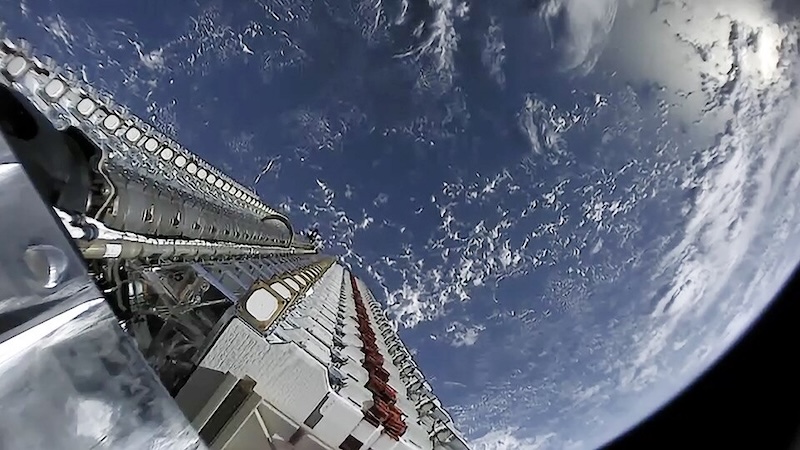
Study: Starlink disrupts radio astronomy, too

An array of Starlink satellites in a rocket cargo bay with the Earth in the background.
There are 60 Starlink satellites nestled in the cargo bay of this Falcon 9 rocket, which is about to enter orbit. Image via SpaceX/ Wikimedia Commons, (CC0 1.0 Universal).
  • SpaceX’s Starlink satellites are a major source of radio emissions that disrupt radio astronomy observations, especially in protected frequencies.
  • Starlink satellites leak radio waves from internal electronics, overpowering faint signals from celestial objects.
  • Astronomers want updated international regulations to manage unintended satellite emissions and ensure radio astronomy can thrive alongside satellite technology.
  • Radio astronomers increasingly concerned about Starlink radio emissions

    In radio astronomy, astronomers use radio telescopes to observe radio waves emitted by planets, stars and galaxies, as well as interstellar gas and dust. However, radio emissions from satellites often contaminate their data. As the orbital real estate around our planet gets more crowded, this problem is getting worse. On July 23, 2025, astronomers in Australia said they’ve conducted the biggest survey yet of such satellite radio emissions. As a result, they found Space X’s Starlink satellites were the biggest culprit, causing significant disruption to radio astronomy observations.

    Satellites such as Starlink have always impinged in some way on astronomers’ optical, infrared and radio observations. But only as the numbers of satellites increase does the situation become particularly dire. In 2021, there were still less than 5,000 functional satellite in orbit. As of July 2025, there are more than 8,000 Starlink satellites alone in orbit. And there are more than 12,000 total active satellites as of mid-2025. Their bright trails passing in front of dim background objects in our universe degrade astronomers’ data.

    And it should be noted that Starlink does not deliberately emit radio waves. Instead, they leak out of internal satellite electronics.

    Dylan Grigg, a PhD student at Curtin University, led the new study, published in the peer-reviewed journal Astronomy and Astrophysics on July 17, 2025. Grigg said:

    Starlink is the most immediate and frequent source of potential interference for radio astronomy: it launched 477 satellites during this study’s four-month data collection period alone.

    In some datasets, we found up to 30% of our images showed interference from a Starlink satellite.

    Radio astronomy and interference from human radio sources

    Radio astronomers use a wide range of radio frequencies, from 3 kilohertz to 900 gigahertz. Some of the radio bands in that range are protected, so astronomers can use them to study celestial objects. This means that under international law, human-made devices cannot emit radio waves in those frequencies. Moreover, the locations of many radio telescopes are in remote areas to minimize interference from radio transmitters and other radio sources.

    But it is hard for radio telescopes to avoid radio sources from satellites passing overhead, as those satellites leak protected radio frequencies that interfere with astronomical observations. And since Starlink has the largest number of satellites in low-earth orbit, this new study focused on the impact of their radio emissions on radio astronomy.

    Tracking radio emissions from Starlink satellites

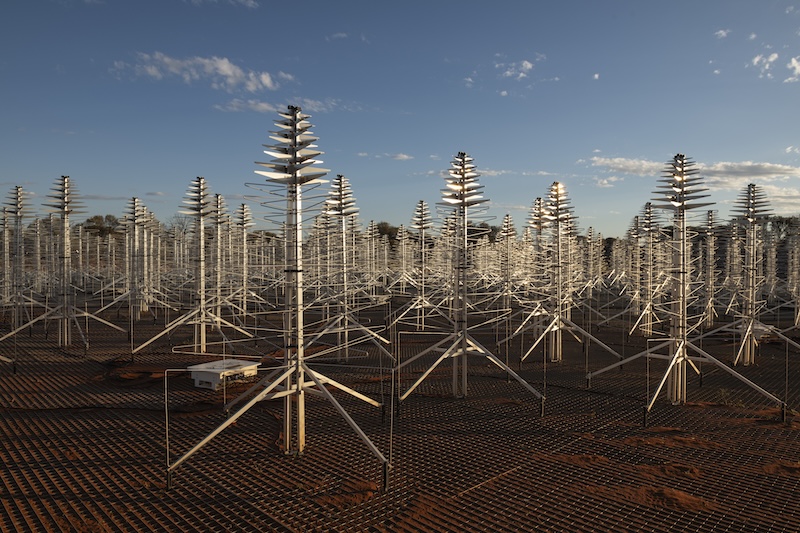
    The astronomers used a radio telescope called the Engineering Development Array version 2 (EDA2). It is an engineering prototype for a very large radio telescope, called SKA-Low, which is currently under construction in a remote section of Western Australia.

    They conducted a survey of the sky across the radio frequencies 50 to 350 MHz, the frequency range of the future SKA-Low observatory. In all, the astronomers analyzed 76 million images, captured over 29 days.

    The team reported 112,534 detections from 1,806 unique Starlink satellites. And it’s no surprise that Starlink dominated the detections over other satellites. In recent years, SpaceX has launched thousands of Starlink satellites to facilitate global internet connections, a service particularly important to remote parts of the world.

    A large array of antennas under a blue sky with a few clouds.
    Some of the many antennas that make up the SKA-Low radio telescope, currently under construction in Western Australia. Image via Max Alexander /SKAO.

    The impact of Starlink radio emissions

    But Grigg said it wasn’t just the number of satellites they encountered that concerned them. They are also worried about the strength of those signals against the weaker radio signatures of celestial objects. Moreover, those radio emissions were coming from frequencies protected for radio astronomy. He commented:

    Some satellites were detected emitting in bands where no signals are supposed to be present at all, such as the 703 satellites we identified at 150.8 MHz, which is meant to be protected for radio astronomy.

    Because they may come from components like onboard electronics and they’re not part of an intentional signal, astronomers can’t easily predict them or filter them out.

    The need for improved regulations on satellite radio emissions

    Co-author Steven Tingay remarked about the need for regulatory improvements to keep satellites from interfering with radio astronomy observations. He said:

    Current International Telecommunication Union regulations focus on intentional transmissions and do not cover this type of unintended emission.

    Starlink isn’t the only satellite network, but it is by far the biggest, and its emissions are now increasingly prominent in our data.

    We hope this study adds support for international efforts to update policies that regulate the impact of this technology on radio astronomy research that are currently underway.

    It is important to note that Starlink is not violating current regulations, so is doing nothing wrong. Discussions we have had with SpaceX on the topic have been constructive.

    Looking for a solution for the satellite problem in radio astronomy

    Tingray said satellite technology and radio astronomy are both important and need a way to coexist harmoniously. He commented:

    We’re standing on the edge of a golden era where the SKA will help answer the biggest questions in science: how the first stars formed, what dark matter is and even test Einstein’s theories.

    But it needs radio silence to succeed. We recognize the deep benefits of global connectivity, but we need balance, and that starts with an understanding of the problem, which is the goal of our work.

    Bottom line: A recent survey studied the impact of satellite radio emissions on radio astronomy observations. It found Starlink satellites were the main culprit.

    Source: The growing impact of unintended Starlink broadband emission on radio astronomy in the SKA-Low frequency range

    Via Curtin University

    Read more: How satellites harm astronomy: what’s being done

    The post Study: Starlink disrupts radio astronomy, too first appeared on EarthSky.


    from EarthSky https://ift.tt/Albp54W
    An array of Starlink satellites in a rocket cargo bay with the Earth in the background.
    There are 60 Starlink satellites nestled in the cargo bay of this Falcon 9 rocket, which is about to enter orbit. Image via SpaceX/ Wikimedia Commons, (CC0 1.0 Universal).
  • SpaceX’s Starlink satellites are a major source of radio emissions that disrupt radio astronomy observations, especially in protected frequencies.
  • Starlink satellites leak radio waves from internal electronics, overpowering faint signals from celestial objects.
  • Astronomers want updated international regulations to manage unintended satellite emissions and ensure radio astronomy can thrive alongside satellite technology.
  • Radio astronomers increasingly concerned about Starlink radio emissions

    In radio astronomy, astronomers use radio telescopes to observe radio waves emitted by planets, stars and galaxies, as well as interstellar gas and dust. However, radio emissions from satellites often contaminate their data. As the orbital real estate around our planet gets more crowded, this problem is getting worse. On July 23, 2025, astronomers in Australia said they’ve conducted the biggest survey yet of such satellite radio emissions. As a result, they found Space X’s Starlink satellites were the biggest culprit, causing significant disruption to radio astronomy observations.

    Satellites such as Starlink have always impinged in some way on astronomers’ optical, infrared and radio observations. But only as the numbers of satellites increase does the situation become particularly dire. In 2021, there were still less than 5,000 functional satellite in orbit. As of July 2025, there are more than 8,000 Starlink satellites alone in orbit. And there are more than 12,000 total active satellites as of mid-2025. Their bright trails passing in front of dim background objects in our universe degrade astronomers’ data.

    And it should be noted that Starlink does not deliberately emit radio waves. Instead, they leak out of internal satellite electronics.

    Dylan Grigg, a PhD student at Curtin University, led the new study, published in the peer-reviewed journal Astronomy and Astrophysics on July 17, 2025. Grigg said:

    Starlink is the most immediate and frequent source of potential interference for radio astronomy: it launched 477 satellites during this study’s four-month data collection period alone.

    In some datasets, we found up to 30% of our images showed interference from a Starlink satellite.

    Radio astronomy and interference from human radio sources

    Radio astronomers use a wide range of radio frequencies, from 3 kilohertz to 900 gigahertz. Some of the radio bands in that range are protected, so astronomers can use them to study celestial objects. This means that under international law, human-made devices cannot emit radio waves in those frequencies. Moreover, the locations of many radio telescopes are in remote areas to minimize interference from radio transmitters and other radio sources.

    But it is hard for radio telescopes to avoid radio sources from satellites passing overhead, as those satellites leak protected radio frequencies that interfere with astronomical observations. And since Starlink has the largest number of satellites in low-earth orbit, this new study focused on the impact of their radio emissions on radio astronomy.

    Tracking radio emissions from Starlink satellites

    The astronomers used a radio telescope called the Engineering Development Array version 2 (EDA2). It is an engineering prototype for a very large radio telescope, called SKA-Low, which is currently under construction in a remote section of Western Australia.

    They conducted a survey of the sky across the radio frequencies 50 to 350 MHz, the frequency range of the future SKA-Low observatory. In all, the astronomers analyzed 76 million images, captured over 29 days.

    The team reported 112,534 detections from 1,806 unique Starlink satellites. And it’s no surprise that Starlink dominated the detections over other satellites. In recent years, SpaceX has launched thousands of Starlink satellites to facilitate global internet connections, a service particularly important to remote parts of the world.

    A large array of antennas under a blue sky with a few clouds.
    Some of the many antennas that make up the SKA-Low radio telescope, currently under construction in Western Australia. Image via Max Alexander /SKAO.

    The impact of Starlink radio emissions

    But Grigg said it wasn’t just the number of satellites they encountered that concerned them. They are also worried about the strength of those signals against the weaker radio signatures of celestial objects. Moreover, those radio emissions were coming from frequencies protected for radio astronomy. He commented:

    Some satellites were detected emitting in bands where no signals are supposed to be present at all, such as the 703 satellites we identified at 150.8 MHz, which is meant to be protected for radio astronomy.

    Because they may come from components like onboard electronics and they’re not part of an intentional signal, astronomers can’t easily predict them or filter them out.

    The need for improved regulations on satellite radio emissions

    Co-author Steven Tingay remarked about the need for regulatory improvements to keep satellites from interfering with radio astronomy observations. He said:

    Current International Telecommunication Union regulations focus on intentional transmissions and do not cover this type of unintended emission.

    Starlink isn’t the only satellite network, but it is by far the biggest, and its emissions are now increasingly prominent in our data.

    We hope this study adds support for international efforts to update policies that regulate the impact of this technology on radio astronomy research that are currently underway.

    It is important to note that Starlink is not violating current regulations, so is doing nothing wrong. Discussions we have had with SpaceX on the topic have been constructive.

    Looking for a solution for the satellite problem in radio astronomy

    Tingray said satellite technology and radio astronomy are both important and need a way to coexist harmoniously. He commented:

    We’re standing on the edge of a golden era where the SKA will help answer the biggest questions in science: how the first stars formed, what dark matter is and even test Einstein’s theories.

    But it needs radio silence to succeed. We recognize the deep benefits of global connectivity, but we need balance, and that starts with an understanding of the problem, which is the goal of our work.

    Bottom line: A recent survey studied the impact of satellite radio emissions on radio astronomy observations. It found Starlink satellites were the main culprit.

    Source: The growing impact of unintended Starlink broadband emission on radio astronomy in the SKA-Low frequency range

    Via Curtin University

    Read more: How satellites harm astronomy: what’s being done

    The post Study: Starlink disrupts radio astronomy, too first appeared on EarthSky.


    from EarthSky https://ift.tt/Albp54W

    New 5th planet found in system of remarkably diverse worlds

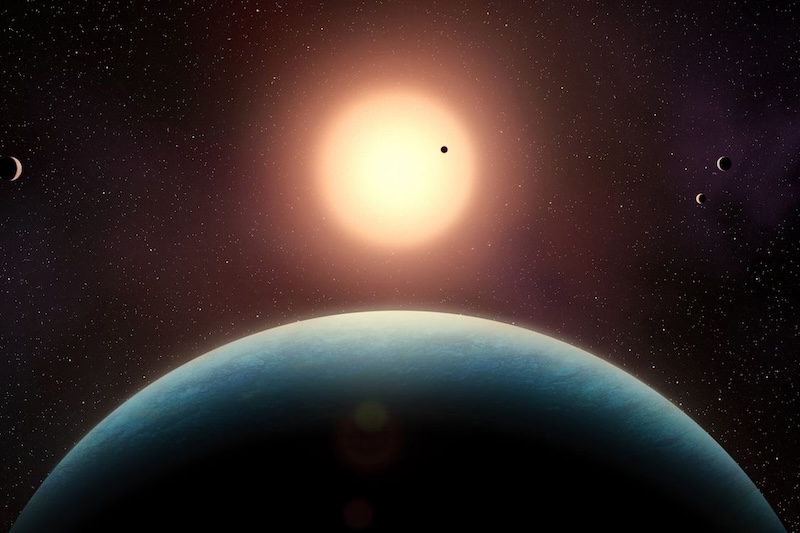
    5th planet: Bluish planet with large nearby reddish star in the background, and 4 other small planets in the distance.
    View larger. | This artist’s concept shows the 5 planets in the L 98-59 system. A team of astronomers led by the Trottier Institute for Research on Exoplanets (IREx) at the University of Montreal has now confirmed the 5th planet orbiting the star, in the star’s habitable zone, where water could exist. Image via Benoit Gougeon/ University of Montreal.
    • L 98-59 is a red dwarf star with several small planets orbiting it. It is only 35 light-years from Earth. Previusly, astronomers knew of four planets in the system.
    • Now, astronomers have discovered a fifth planet, in the habitable zone of the star. They found it by re-analyzing older data from both ground and space-based telescopes.
    • The planets of L 98-59 are remarkably diverse. The two closest to the star might be highly volcanic, like Jupiter’s moon Io. Meanwhile, the third and least dense planet might be a water world.

    A 5th planet for L 98-59

    L 98-59 is a fascinating planetary system only 35 light-years from Earth. Astronomers previously found four small exoplanets orbiting the red dwarf star. And now a research team led by the Trottier Institute for Research on Exoplanets (IREx) at the University of Montreal in Canada has confirmed a fifth planet. The researchers said on July 22, 2025, that the planet – L 98-59 f – is orbiting in the star’s habitable zone, where water could potentially exist. In addition, the research team has determined the sizes and masses of all the planets with unprecedented precision.

    They used an archive of data from NASA’s TESS space telescope, the European Southern Observatory’s HARPS and ESPRESSO spectrographs in Chile, and NASA’s James Webb Space Telescope (JWST).

    Previously, NASA’s TESS space telescope discovered the first three planets in 2019, and the fourth planet was found in 2021. This is now the fifth known planet orbiting L 98-59.

    The researchers have submitted their new peer-reviewed paper to The Astronomical Journal. Meanwhile, a preprint version is currently available on arXiv, submitted on July 12, 2025.

    5th planet is in the habitable zone

    The astronomers found the fifth planet – called L 98-59 f – using the radial velocity method. Basically, it’s when the gravity of a planet slightly tugs on its host star as it orbits. Consequently, astronomers can then detect those very slight variations in the motion of the star. The team used data from the HARPS (High Accuracy Radial velocity Planet Searcher) spectrograph on the ESO 3.6-meter telescope and the ESPRESSO spectrograph at the Very Large Telescope (VLT), both in Chile.

    Although this planet, like the others, orbits close to its star, it is within the star’s habitable zone. This is the region where temperatures could allow liquid water. This is possible because the star is smaller and cooler than our sun. Its habitable zone, therefore, is closer to the star than our sun’s habitable zone. In fact, L 98-59 receives about the same amount of stellar energy as Earth does from the sun. Lead author Charles Cadieux at the University of Montreal said:

    Finding a temperate planet in such a compact system makes this discovery particularly exciting. It highlights the remarkable diversity of exoplanetary systems and strengthens the case for studying potentially habitable worlds around low-mass stars.

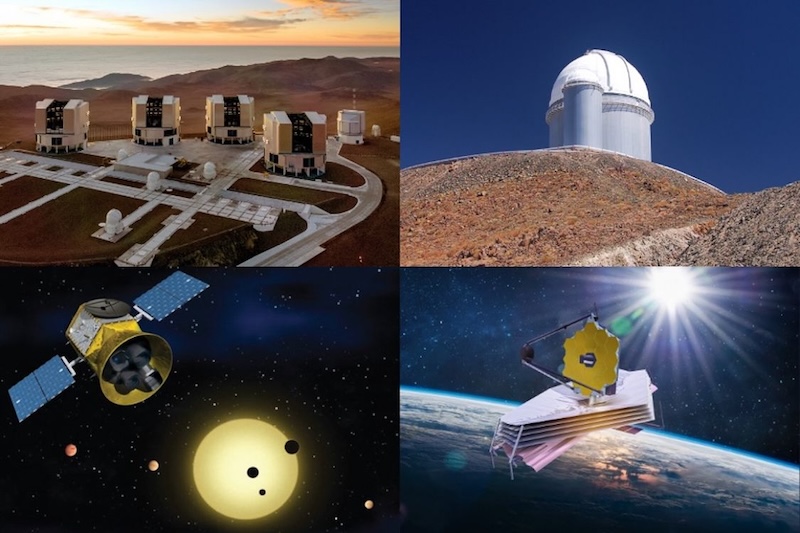
    4 images showing 2 ground telescopes in the top row and 2 space telescopes in the bottom row.
    View larger. | The researchers analyzed archived data from the Very Large Telescope (top left), ESO 3.6-meter telescope (top right), TESS space telescope (bottom left) and James Webb Space Telescope (bottom right). Together, they helped astronomers confirm the 5th planet and determine the sizes and masses of all the planets. Image via NASA/ ESO/ G. Hüdepohl/ University of Montreal.

    A diverse system of rocky worlds

    The new discovery adds to the intrigue of this planetary system. Indeed, astronomers already knew the first four planets were a diverse and fascinating collection of worlds. Now, the new observations have helped the researchers determine their sizes and masses with even greater accuracy. Cadieux said:

    These new results paint the most complete picture we’ve ever had of the fascinating L 98-59 system. It’s a powerful demonstration of what we can achieve by combining data from space telescopes and high-precision instruments on Earth, and it gives us key targets for future atmospheric studies with the James Webb Space Telescope.

    At least four of the planets are rocky, like Earth. Scientists call those terrestrial planets. The third planet from the star, L 98-59 d, has a lower density than the others, however. It might be a water world, a rocky planet completely covered in water, or even a planet composed mostly of water without a solid surface. Previously, another study in 2024 suggested it might be a volcanic world with a sulfur-rich atmosphere.

    In addition, the two closest planets to the star might experience significant volcanic activity, due to tidal heating from the star. This is similar to how Jupiter’s gravity heats the interior of its moon Io. Io is the most volcanically active body in our solar system. The closest planet to the star, L 98-59 b, is 84% the size of Earth and only half of Earth’s mass.

    A unique natural laboratory

    Co-author René Doyon, the director of the Trottier Institute for Research on Exoplanets at the University of Montreal, added:

    With its diversity of rocky worlds and range of planetary compositions, L 98-59 offers a unique laboratory to address some of the field’s most pressing questions: What are super-Earths and sub-Neptunes made of? Do planets form differently around small stars? Can rocky planets around red dwarfs retain atmospheres over time?

    Confirmation Of A Non-transiting Planet In The Habitable Zone Of The Nearby M dwarf L 98-59astrobiology.com/2025/07/conf… #astrobiology #exoplanet

    Astrobiology (@astrobiology.bsky.social) 2025-07-11T15:57:49.542Z

    Improving old data

    Notably, the researchers didn’t find the new planet by conducting new observations of L 98-59. Instead, they searched in older data from NASA’s TESS space telescope, NASA’s James Webb Space Telescope and the HARPS spectrograph on the ESO 3.6-meter telescope and ESPRESSO spectrograph on the Very Large Telescope (VLT), both in Chile. They used an improved version of the radial velocity technique called line-by-line (LBL). IREx researchers first developed the improved technique back in 2022.

    The team combined LBL with an improved technique to measure a star’s temperature. This allowed them to remove excess stellar “noise” from the star to reveal the planet.

    Also, the new analysis of the data doubled the precision of the measurements of the sizes and masses of all the planets.

    Co-author Étienne Artigau at the University of Montreal said:

    We developed these techniques to unlock this kind of hidden potential in archival data. It also highlights how improving analysis tools allow us to improve upon previous discoveries with data that are just waiting to be revisited.

    Man in t-shirt and jeans standing on a large rock with a valley and blue sky with wispy clouds behind him.
    Charles Cadieux with the Trottier Institute for Research on Exoplanets (IREx) at the University of Montreal in Canada is the lead author of the new analysis of the L 98-59 planetary system. Image via University of Montreal.

    An exciting planetary system

    The researchers have also now started additional observations of L 98-59 with the Webb space telescope. And truly, it is a fascinating planetary system of great interest to astronomers. Co-author Alexandrine L’Heureux at the University of Montreal said:

    With these new results, L 98-59 joins the select group of nearby, compact planetary systems that we hope to understand in greater detail over the coming years. It’s exciting to see it stand alongside systems like TRAPPIST-1 in our quest to unlock the nature and formation of small planets orbiting red dwarf stars.

    Bottom line: Astronomers have discovered a fifth planet in the L 98-59 planetary system, in the star’s habitable zone. The system features a diverse range of worlds.

    Source (preprint): Detailed Architecture of the L 98-59 System and Confirmation of a Fifth Planet in the Habitable Zone

    Via University of Montreal

    Read more: Is this a volcanic exoplanet? Hints are in its atmosphere

    Read more: An inner solar system much like ours, 35 light-years away

    The post New 5th planet found in system of remarkably diverse worlds first appeared on EarthSky.


    from EarthSky https://ift.tt/PiAukFy
    5th planet: Bluish planet with large nearby reddish star in the background, and 4 other small planets in the distance.
    View larger. | This artist’s concept shows the 5 planets in the L 98-59 system. A team of astronomers led by the Trottier Institute for Research on Exoplanets (IREx) at the University of Montreal has now confirmed the 5th planet orbiting the star, in the star’s habitable zone, where water could exist. Image via Benoit Gougeon/ University of Montreal.
    • L 98-59 is a red dwarf star with several small planets orbiting it. It is only 35 light-years from Earth. Previusly, astronomers knew of four planets in the system.
    • Now, astronomers have discovered a fifth planet, in the habitable zone of the star. They found it by re-analyzing older data from both ground and space-based telescopes.
    • The planets of L 98-59 are remarkably diverse. The two closest to the star might be highly volcanic, like Jupiter’s moon Io. Meanwhile, the third and least dense planet might be a water world.

    A 5th planet for L 98-59

    L 98-59 is a fascinating planetary system only 35 light-years from Earth. Astronomers previously found four small exoplanets orbiting the red dwarf star. And now a research team led by the Trottier Institute for Research on Exoplanets (IREx) at the University of Montreal in Canada has confirmed a fifth planet. The researchers said on July 22, 2025, that the planet – L 98-59 f – is orbiting in the star’s habitable zone, where water could potentially exist. In addition, the research team has determined the sizes and masses of all the planets with unprecedented precision.

    They used an archive of data from NASA’s TESS space telescope, the European Southern Observatory’s HARPS and ESPRESSO spectrographs in Chile, and NASA’s James Webb Space Telescope (JWST).

    Previously, NASA’s TESS space telescope discovered the first three planets in 2019, and the fourth planet was found in 2021. This is now the fifth known planet orbiting L 98-59.

    The researchers have submitted their new peer-reviewed paper to The Astronomical Journal. Meanwhile, a preprint version is currently available on arXiv, submitted on July 12, 2025.

    5th planet is in the habitable zone

    The astronomers found the fifth planet – called L 98-59 f – using the radial velocity method. Basically, it’s when the gravity of a planet slightly tugs on its host star as it orbits. Consequently, astronomers can then detect those very slight variations in the motion of the star. The team used data from the HARPS (High Accuracy Radial velocity Planet Searcher) spectrograph on the ESO 3.6-meter telescope and the ESPRESSO spectrograph at the Very Large Telescope (VLT), both in Chile.

    Although this planet, like the others, orbits close to its star, it is within the star’s habitable zone. This is the region where temperatures could allow liquid water. This is possible because the star is smaller and cooler than our sun. Its habitable zone, therefore, is closer to the star than our sun’s habitable zone. In fact, L 98-59 receives about the same amount of stellar energy as Earth does from the sun. Lead author Charles Cadieux at the University of Montreal said:

    Finding a temperate planet in such a compact system makes this discovery particularly exciting. It highlights the remarkable diversity of exoplanetary systems and strengthens the case for studying potentially habitable worlds around low-mass stars.

    4 images showing 2 ground telescopes in the top row and 2 space telescopes in the bottom row.
    View larger. | The researchers analyzed archived data from the Very Large Telescope (top left), ESO 3.6-meter telescope (top right), TESS space telescope (bottom left) and James Webb Space Telescope (bottom right). Together, they helped astronomers confirm the 5th planet and determine the sizes and masses of all the planets. Image via NASA/ ESO/ G. Hüdepohl/ University of Montreal.

    A diverse system of rocky worlds

    The new discovery adds to the intrigue of this planetary system. Indeed, astronomers already knew the first four planets were a diverse and fascinating collection of worlds. Now, the new observations have helped the researchers determine their sizes and masses with even greater accuracy. Cadieux said:

    These new results paint the most complete picture we’ve ever had of the fascinating L 98-59 system. It’s a powerful demonstration of what we can achieve by combining data from space telescopes and high-precision instruments on Earth, and it gives us key targets for future atmospheric studies with the James Webb Space Telescope.

    At least four of the planets are rocky, like Earth. Scientists call those terrestrial planets. The third planet from the star, L 98-59 d, has a lower density than the others, however. It might be a water world, a rocky planet completely covered in water, or even a planet composed mostly of water without a solid surface. Previously, another study in 2024 suggested it might be a volcanic world with a sulfur-rich atmosphere.

    In addition, the two closest planets to the star might experience significant volcanic activity, due to tidal heating from the star. This is similar to how Jupiter’s gravity heats the interior of its moon Io. Io is the most volcanically active body in our solar system. The closest planet to the star, L 98-59 b, is 84% the size of Earth and only half of Earth’s mass.

    A unique natural laboratory

    Co-author René Doyon, the director of the Trottier Institute for Research on Exoplanets at the University of Montreal, added:

    With its diversity of rocky worlds and range of planetary compositions, L 98-59 offers a unique laboratory to address some of the field’s most pressing questions: What are super-Earths and sub-Neptunes made of? Do planets form differently around small stars? Can rocky planets around red dwarfs retain atmospheres over time?

    Confirmation Of A Non-transiting Planet In The Habitable Zone Of The Nearby M dwarf L 98-59astrobiology.com/2025/07/conf… #astrobiology #exoplanet

    Astrobiology (@astrobiology.bsky.social) 2025-07-11T15:57:49.542Z

    Improving old data

    Notably, the researchers didn’t find the new planet by conducting new observations of L 98-59. Instead, they searched in older data from NASA’s TESS space telescope, NASA’s James Webb Space Telescope and the HARPS spectrograph on the ESO 3.6-meter telescope and ESPRESSO spectrograph on the Very Large Telescope (VLT), both in Chile. They used an improved version of the radial velocity technique called line-by-line (LBL). IREx researchers first developed the improved technique back in 2022.

    The team combined LBL with an improved technique to measure a star’s temperature. This allowed them to remove excess stellar “noise” from the star to reveal the planet.

    Also, the new analysis of the data doubled the precision of the measurements of the sizes and masses of all the planets.

    Co-author Étienne Artigau at the University of Montreal said:

    We developed these techniques to unlock this kind of hidden potential in archival data. It also highlights how improving analysis tools allow us to improve upon previous discoveries with data that are just waiting to be revisited.

    Man in t-shirt and jeans standing on a large rock with a valley and blue sky with wispy clouds behind him.
    Charles Cadieux with the Trottier Institute for Research on Exoplanets (IREx) at the University of Montreal in Canada is the lead author of the new analysis of the L 98-59 planetary system. Image via University of Montreal.

    An exciting planetary system

    The researchers have also now started additional observations of L 98-59 with the Webb space telescope. And truly, it is a fascinating planetary system of great interest to astronomers. Co-author Alexandrine L’Heureux at the University of Montreal said:

    With these new results, L 98-59 joins the select group of nearby, compact planetary systems that we hope to understand in greater detail over the coming years. It’s exciting to see it stand alongside systems like TRAPPIST-1 in our quest to unlock the nature and formation of small planets orbiting red dwarf stars.

    Bottom line: Astronomers have discovered a fifth planet in the L 98-59 planetary system, in the star’s habitable zone. The system features a diverse range of worlds.

    Source (preprint): Detailed Architecture of the L 98-59 System and Confirmation of a Fifth Planet in the Habitable Zone

    Via University of Montreal

    Read more: Is this a volcanic exoplanet? Hints are in its atmosphere

    Read more: An inner solar system much like ours, 35 light-years away

    The post New 5th planet found in system of remarkably diverse worlds first appeared on EarthSky.


    from EarthSky https://ift.tt/PiAukFy

    NASA’s Crew-11 mission to launch Thursday: Watch here

    Crew-11 mission: 4 people in blue uniforms stand by a sign with their names on it in front of an airplane.
    The 4 crew members of NASA’s Crew-11 mission arrived at the Kennedy Space Center (KSC) Shuttle Landing Facility on July 26, 2025. EarthSky photographer Greg Diesel Walck covered the group after their plane arrived to NASA KSC in Florida.

    Crew-11 mission set to launch on Thursday

    NASAs’ Crew-11 mission is set to launch at 12:09 p.m. EDT on Thursday, July 31, 2025, from Kennedy Space Center in Florida. Four astronauts on board will head to the International Space Station, where they plan to live and work until 2026. NASA astronaut Zena Cardman will lead the mission, flying alongside fellow astronaut Mike Fincke. Japan’s (JAXA) astronaut Kimiya Yui and Roscosmos cosmonaut Oleg Platonov complete the four-person crew.

    Cardman and Platonov are going to space for the first time. Yui will be returning to space for the second time and Fincke for the fourth time.  Fincke has the most distinguished record of the group and formerly held the American record for the most time in space (382 days), until Scott Kelly broke it in 2015. NASA moved this mission up from its previously scheduled August launch window to create more room for the following Cargo Dragon (CRS-33) mission.


    Watch the launch in the player above. Video via NASA/ YouTube.

    New records

    When the Crew Dragon Endeavour capsule rockets into space on Thursday, it will be on its record 6th flight. It has previously flown Demo-2, Crew-2, Axiom-1, Crew-6 and Crew-8. In order to have a 6th flight, the Dragon capsule had to go through a recertification.

    A capsule atop a standing rocket with an arm extending out to it from a gantry.
    A SpaceX Dragon Crew capsule – with access arm – at Pad 39A at Kennedy Space Center. Image via Greg Diesel Walck.

    25th anniversary

    The Crew-11 mission will have the distinction of being onboard when the International Space Station reaches 25 years of operations in October 2025. NASA astronaut Fincke, who helped construct the space station during the shuttle era, remarked:

    I remember when the space station was just pieces here on the ground.

    Bottom line: The Crew-11 mission to the International Space Station is set to launch on Thursday, July 31, 2025. Read more about the mission and watch the launch here.

    Read more: How to see the International Space Station in your sky

    The post NASA’s Crew-11 mission to launch Thursday: Watch here first appeared on EarthSky.


    from EarthSky https://ift.tt/JoFvPQ6
    Crew-11 mission: 4 people in blue uniforms stand by a sign with their names on it in front of an airplane.
    The 4 crew members of NASA’s Crew-11 mission arrived at the Kennedy Space Center (KSC) Shuttle Landing Facility on July 26, 2025. EarthSky photographer Greg Diesel Walck covered the group after their plane arrived to NASA KSC in Florida.

    Crew-11 mission set to launch on Thursday

    NASAs’ Crew-11 mission is set to launch at 12:09 p.m. EDT on Thursday, July 31, 2025, from Kennedy Space Center in Florida. Four astronauts on board will head to the International Space Station, where they plan to live and work until 2026. NASA astronaut Zena Cardman will lead the mission, flying alongside fellow astronaut Mike Fincke. Japan’s (JAXA) astronaut Kimiya Yui and Roscosmos cosmonaut Oleg Platonov complete the four-person crew.

    Cardman and Platonov are going to space for the first time. Yui will be returning to space for the second time and Fincke for the fourth time.  Fincke has the most distinguished record of the group and formerly held the American record for the most time in space (382 days), until Scott Kelly broke it in 2015. NASA moved this mission up from its previously scheduled August launch window to create more room for the following Cargo Dragon (CRS-33) mission.


    Watch the launch in the player above. Video via NASA/ YouTube.

    New records

    When the Crew Dragon Endeavour capsule rockets into space on Thursday, it will be on its record 6th flight. It has previously flown Demo-2, Crew-2, Axiom-1, Crew-6 and Crew-8. In order to have a 6th flight, the Dragon capsule had to go through a recertification.

    A capsule atop a standing rocket with an arm extending out to it from a gantry.
    A SpaceX Dragon Crew capsule – with access arm – at Pad 39A at Kennedy Space Center. Image via Greg Diesel Walck.

    25th anniversary

    The Crew-11 mission will have the distinction of being onboard when the International Space Station reaches 25 years of operations in October 2025. NASA astronaut Fincke, who helped construct the space station during the shuttle era, remarked:

    I remember when the space station was just pieces here on the ground.

    Bottom line: The Crew-11 mission to the International Space Station is set to launch on Thursday, July 31, 2025. Read more about the mission and watch the launch here.

    Read more: How to see the International Space Station in your sky

    The post NASA’s Crew-11 mission to launch Thursday: Watch here first appeared on EarthSky.


    from EarthSky https://ift.tt/JoFvPQ6

    Mammatus clouds are ominous and beautiful

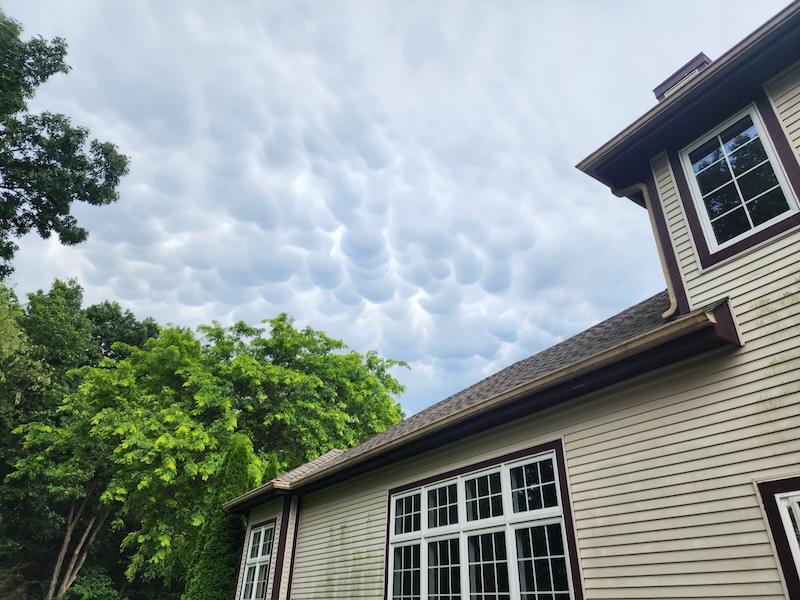
    A house and trees in the foreground with with a sky full of mammatus clouds above.
    View at EarthSky Community Photos. | Michael O’Connor captured this image on July 12, 2025, from Michigan and wrote: “Mammatus clouds. First time ever seeing them.” Thank you, Michael!

    Mammatus clouds: Ominous and beautiful

    Mammatus clouds are pouch-like protrusions hanging from the undersides of clouds. You’ll usually find them under thunderstorm anvil clouds. But you might see them under other types of clouds as well. They’re composed primarily of ice, and groups of them can extend hundreds of miles in any direction. But they’re fleeting, remaining visible in your local sky for perhaps 10 or 15 minutes at a time.

    People associate these cloud pouches with severe weather. And it’s true; they typically appear around, before or after a storm.

    In fact, most clouds are formed by rising air. But mammatus clouds, however, are interesting in part because they’re formed by sinking air.

    They appear ominous. And indeed, they do signify storms. But, in a way that’s so common in nature, their dangerous aspect goes hand-in-hand with a magnificent beauty.

    Beautiful bubbling clouds

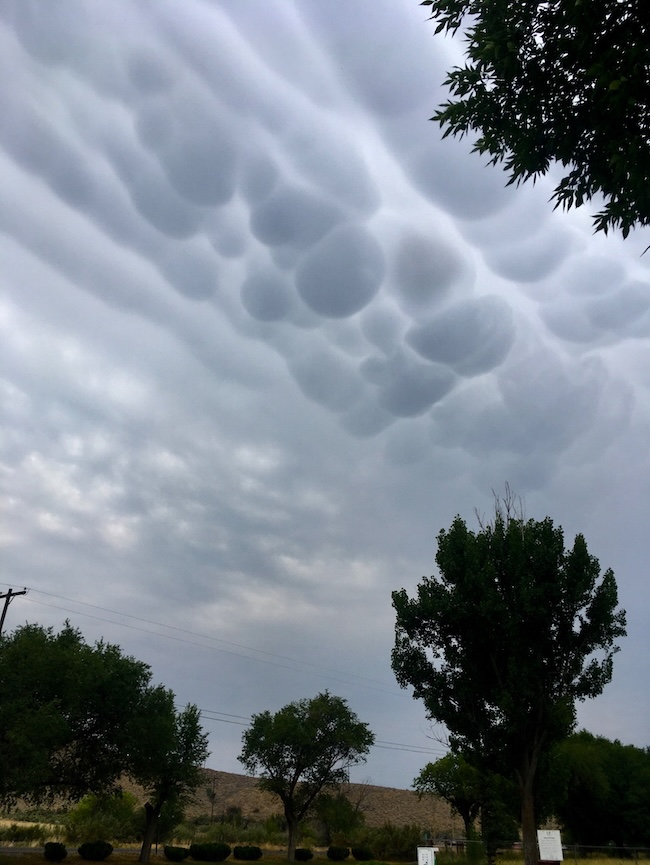
    Trees in the foreground with with bubbling mammatus clouds above.
    View at EarthSky Community Photos. | Aaron Watson captured this image on July 17, 2025, from Colorado and wrote: “Interesting mammatus clouds this morning. It looked like long deep grooves across the sky.” Thank you, Aaron!
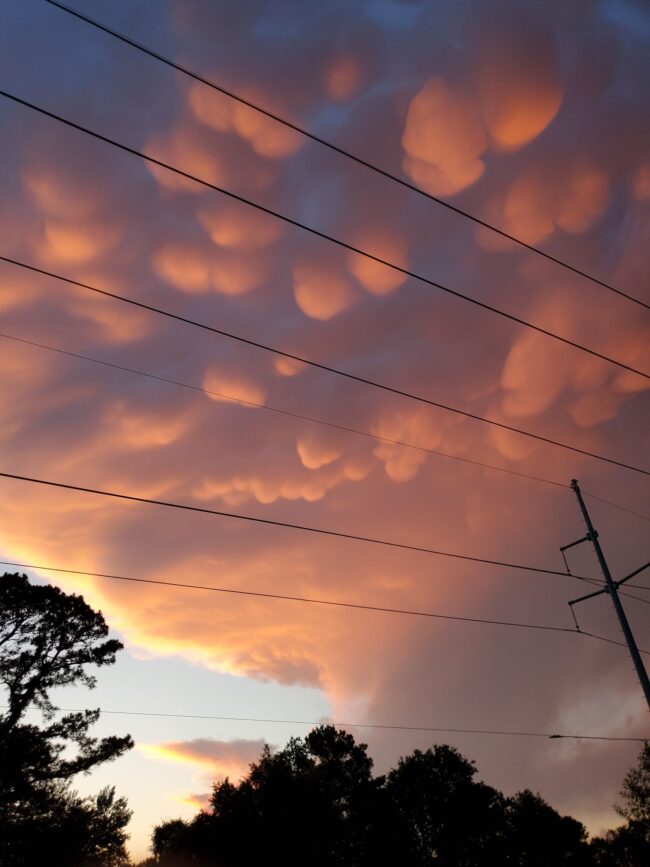
    Cloud bank overhead with orange bubbles and darker blue behind.
    View at EarthSky Community Photos. | Lina Tomlin in Texarkana, Texas, caught these mammatus clouds on April 29, 2024. Lina wrote: “Stepped outside and my jaw dropped. I loved watching this massive storm cell roll by. I saw more ‘bubble’ clouds appear, and as the sun went down they lit up. I’ve never been this close to clouds like that. Thrilling!” Thank you, Lina!

    Beautiful, bubbling clouds from 2023

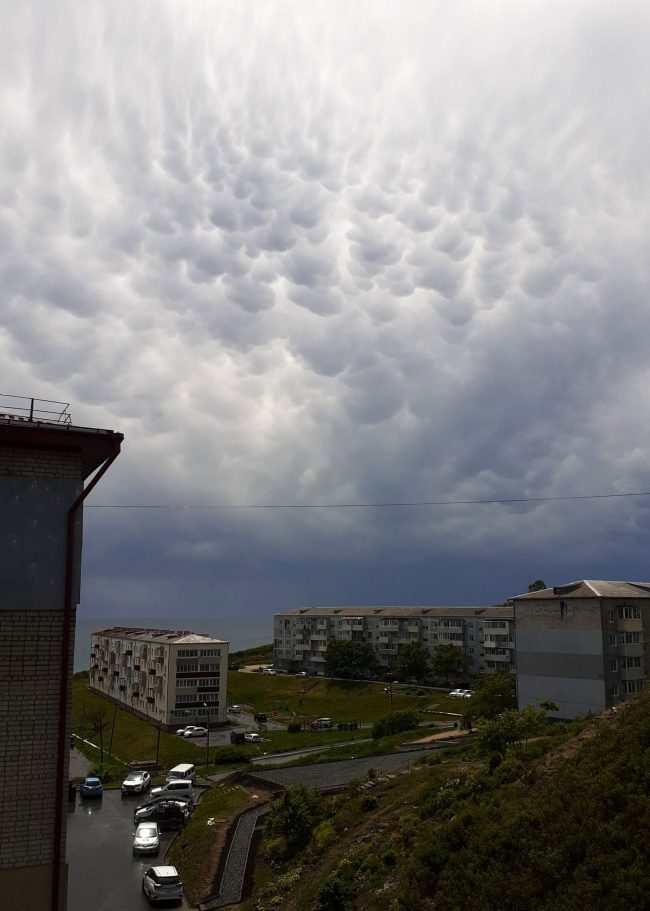
    Apartment-like buildings in foreground with clouds with many roundish downward protrusions.
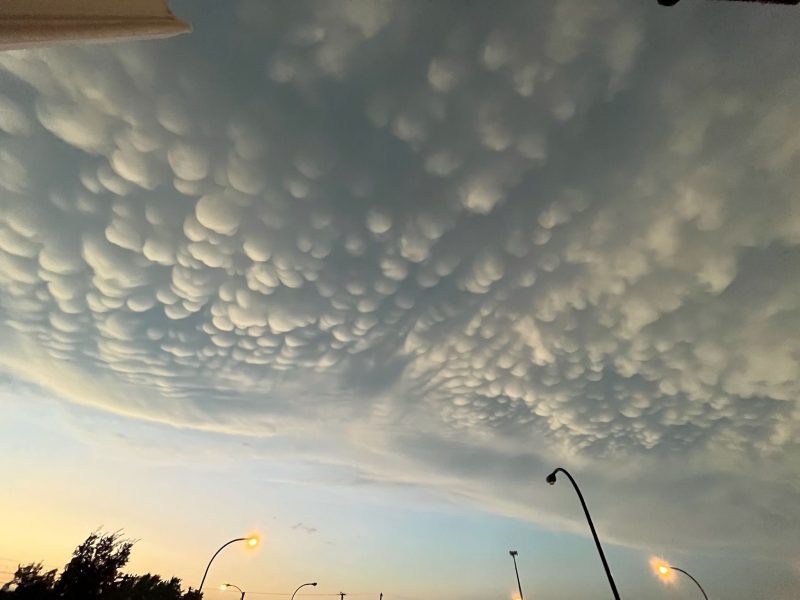
    View at EarthSky Community Photos. | Filipp Romanov in Yuzhno-Morskoy, Russia, captured these mammatus clouds on June 4, 2023. Thank you, Filipp!
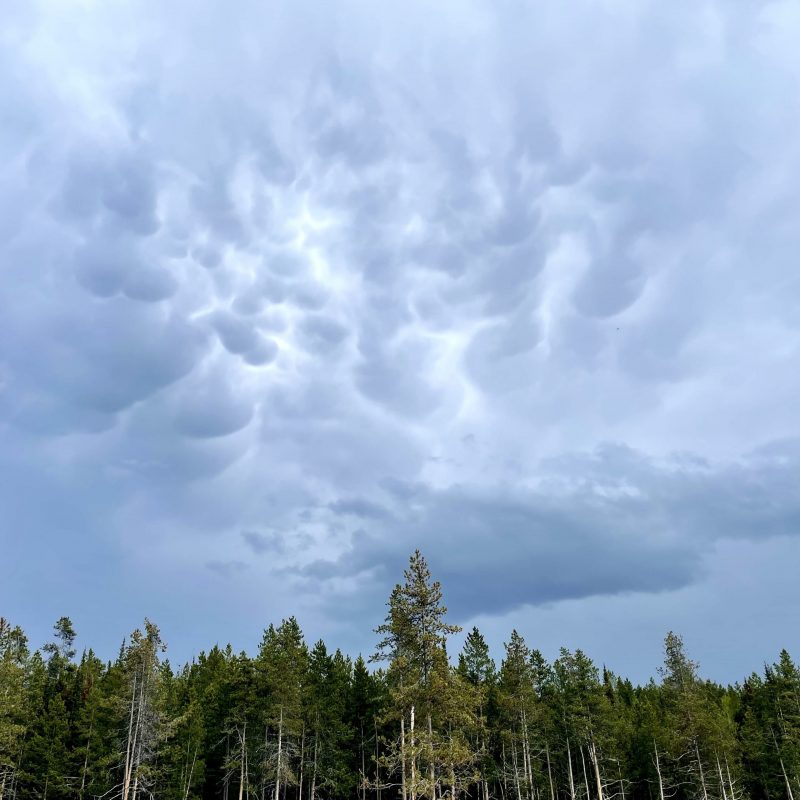
    Pine trees below with bubbling mammatus clouds above.
    EarthSky’s Kelly Kizer Whitt shared this photo of mammatus clouds from Colter Bay in Grand Teton National Park on May 30, 2023. Thank you, Kelly!

    Mammatus clouds from 2022

    Bulbous clouds as seen from below, partly sunlit yellow.
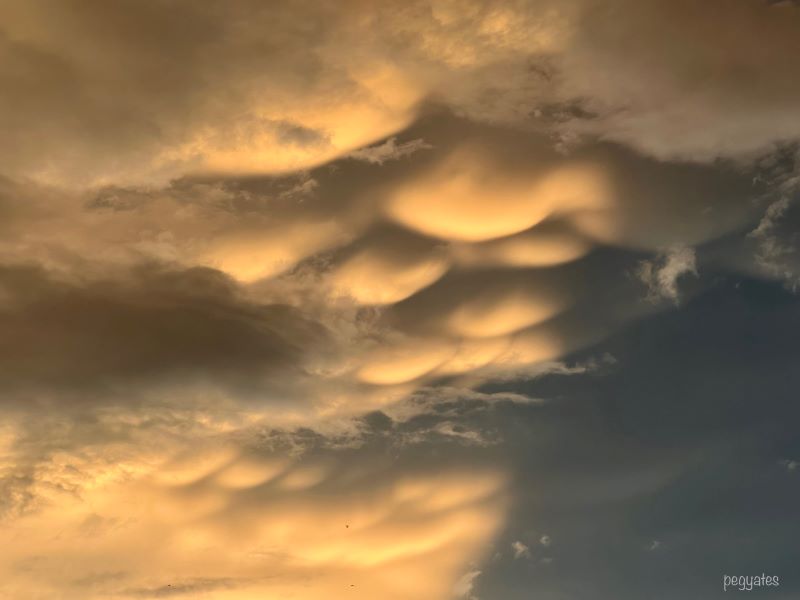
    View at EarthSky Community Photos. | Peg Yates in Woodbridge, Virginia, took this image on August 22, 2022. Peg wrote: “Mammatus clouds in the western sky when the sun was setting.” Thank you, Peg!
    Mammatus clouds: Low-hanging clouds with large rounded bumps hanging down.
    View at EarthSky Community Photos. | Michael Geib caught these mammatus clouds from Akron, Ohio, on July 20, 2022. Thank you, Michael!
    Spreading sheet of white clouds with bumpy spots on underside low and far away, train in foreground.
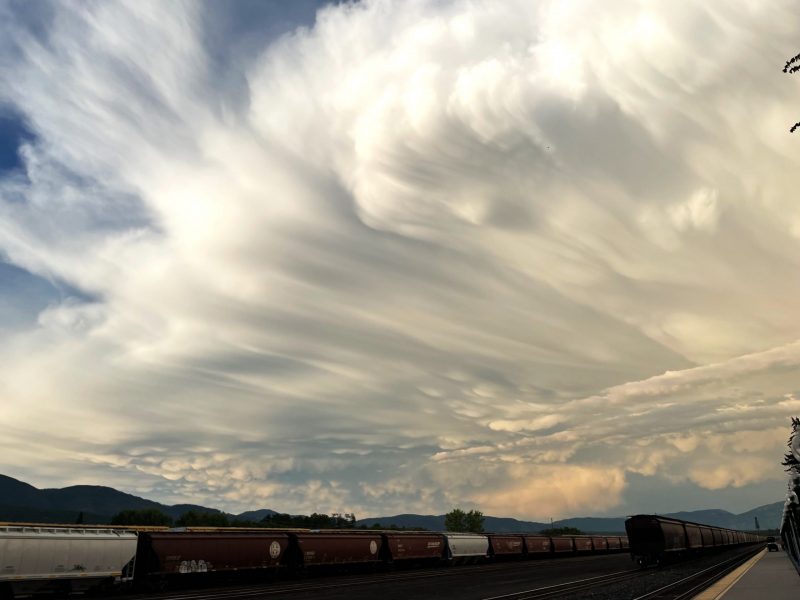
    Mammatus clouds from Kelly Kizer Whitt at the Amtrak station in Whitefish, Montana, on July 7, 2022. See the mammatus clouds on the far underside of the storm? Thank you, Kelly!

    Bottom line: Mammatus clouds look like bubbling, low-hanging clouds. They’re often associated with thunderstorms. Learn more about them here and see photos.

    The post Mammatus clouds are ominous and beautiful first appeared on EarthSky.


    from EarthSky https://ift.tt/rkfCNwa
    A house and trees in the foreground with with a sky full of mammatus clouds above.
    View at EarthSky Community Photos. | Michael O’Connor captured this image on July 12, 2025, from Michigan and wrote: “Mammatus clouds. First time ever seeing them.” Thank you, Michael!

    Mammatus clouds: Ominous and beautiful

    Mammatus clouds are pouch-like protrusions hanging from the undersides of clouds. You’ll usually find them under thunderstorm anvil clouds. But you might see them under other types of clouds as well. They’re composed primarily of ice, and groups of them can extend hundreds of miles in any direction. But they’re fleeting, remaining visible in your local sky for perhaps 10 or 15 minutes at a time.

    People associate these cloud pouches with severe weather. And it’s true; they typically appear around, before or after a storm.

    In fact, most clouds are formed by rising air. But mammatus clouds, however, are interesting in part because they’re formed by sinking air.

    They appear ominous. And indeed, they do signify storms. But, in a way that’s so common in nature, their dangerous aspect goes hand-in-hand with a magnificent beauty.

    Beautiful bubbling clouds

    Trees in the foreground with with bubbling mammatus clouds above.
    View at EarthSky Community Photos. | Aaron Watson captured this image on July 17, 2025, from Colorado and wrote: “Interesting mammatus clouds this morning. It looked like long deep grooves across the sky.” Thank you, Aaron!
    Cloud bank overhead with orange bubbles and darker blue behind.
    View at EarthSky Community Photos. | Lina Tomlin in Texarkana, Texas, caught these mammatus clouds on April 29, 2024. Lina wrote: “Stepped outside and my jaw dropped. I loved watching this massive storm cell roll by. I saw more ‘bubble’ clouds appear, and as the sun went down they lit up. I’ve never been this close to clouds like that. Thrilling!” Thank you, Lina!

    Beautiful, bubbling clouds from 2023

    Apartment-like buildings in foreground with clouds with many roundish downward protrusions.
    View at EarthSky Community Photos. | Filipp Romanov in Yuzhno-Morskoy, Russia, captured these mammatus clouds on June 4, 2023. Thank you, Filipp!
    Pine trees below with bubbling mammatus clouds above.
    EarthSky’s Kelly Kizer Whitt shared this photo of mammatus clouds from Colter Bay in Grand Teton National Park on May 30, 2023. Thank you, Kelly!

    Mammatus clouds from 2022

    Bulbous clouds as seen from below, partly sunlit yellow.
    View at EarthSky Community Photos. | Peg Yates in Woodbridge, Virginia, took this image on August 22, 2022. Peg wrote: “Mammatus clouds in the western sky when the sun was setting.” Thank you, Peg!
    Mammatus clouds: Low-hanging clouds with large rounded bumps hanging down.
    View at EarthSky Community Photos. | Michael Geib caught these mammatus clouds from Akron, Ohio, on July 20, 2022. Thank you, Michael!
    Spreading sheet of white clouds with bumpy spots on underside low and far away, train in foreground.
    Mammatus clouds from Kelly Kizer Whitt at the Amtrak station in Whitefish, Montana, on July 7, 2022. See the mammatus clouds on the far underside of the storm? Thank you, Kelly!

    Bottom line: Mammatus clouds look like bubbling, low-hanging clouds. They’re often associated with thunderstorms. Learn more about them here and see photos.

    The post Mammatus clouds are ominous and beautiful first appeared on EarthSky.


    from EarthSky https://ift.tt/rkfCNwa

    Top 10 cool things about stars that you probably didn’t know

    Here we present 10 cool things about stars!

    1. Every star you see in the night sky is bigger and brighter than our sun

    Of the 5,000 or so stars brighter than magnitude 6 (that is, bright enough to see with the eye), only a handful of very faint stars are approximately the same size and brightness of our sun. And the rest are all bigger and brighter. Of the 500 or so that are brighter than 4th magnitude (which includes essentially every star visible to the unaided eye from an urban location), all are intrinsically bigger and brighter than our sun, many by a large percentage.

    Of the brightest 50 stars visible to the human eye from Earth, the least intrinsically bright star is Alpha Centauri, the closest star system to Earth at 4.2 light-years away. And Alpha Centauri is still more than 1.5 times more luminous than our sun (plus, because it’s so far south on the sky’s dome, it can’t be easily seen from most of the Northern Hemisphere).

    2. You can’t see millions of stars on a dark night

    Despite what you may hear in TV commercials, poems and songs, you cannot see a million stars … anywhere. There simply are not enough stars close enough and bright enough to equal a million. On a really exceptional night, with no moon and far from any source of lights, a person with very good eyesight may be able to see 2,000-2,500 stars at any one time, although counting even this small number still would be difficult. So the next time you hear someone claim to have seen a million stars in the sky, just attribute it to an exuberant exaggeration. It isn’t true and can’t be true!

    3. Red hot and cool ice blue – NOT!

    We are accustomed to referring to things that are red as hot and those that are blue as cool. This is not entirely unreasonable, since a red, glowing fireplace poker is hot and ice, especially in glaciers and polar regions, can have a bluish cast. But we say that only because our everyday experience is limited. In fact, heated objects change color as their temperature changes. And red represents the lowest temperature at which a heated object can glow in visible light. As it gets hotter, the color changes to white and ultimately to blue. So the red stars you see in the sky are the “coolest” (least hot), and the blue stars are the hottest!

    4. Stars are black bodies

    A black body is an object that absorbs 100% of all electromagnetic radiation (that is, light, radio waves and so on) that falls on it. A common image here is that of a brick oven with the interior painted black and the only opening a small window. All light that shines through the window is absorbed by the interior of the oven and none is reflected outside the oven. It is a perfect absorber.

    As it turns out, this definition of being perfect absorbers suits stars very well! But this just says that a black body absorbs all the radiant energy that hits it. And it does not forbid the blackbody from re-emitting the energy. In the case of a star, it absorbs all radiation that falls on it, but it also radiates back into space much more than it absorbs. Thus a star is a black body that glows with great brilliance! An even more perfect black body is a black hole. But, unlike stars, a black hole appears truly black, and radiates no light.

    5. There are no green stars

    There are scattered claims for stars that appear green, including Beta Librae (Zubeneschamali). But most observers do not see green in any stars except as an optical effect from their telescopes, or else an idiosyncratic quirk of personal vision and contrast. Stars emit a spectrum (“rainbow”) of colors, including green.

    But the human eye-brain connection mixes the colors together in a manner that rarely if ever comes out green. One color can dominate the radiation, but within the range of wavelengths and intensities found in stars, greens get mixed with other colors. And in that case the star appears white. For stars, the general colors are, from lower to higher temperatures, red, orange, yellow, white and blue. So as far as the human eye can tell, there are no green stars.

    10 cool things about stars: A glowing green circle with green interior and brighter streaks within it.
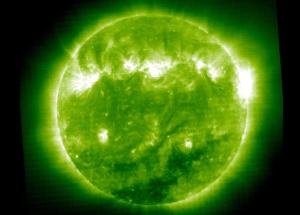
    The sun in extreme ultraviolet, false color green. The human eye cannot see at this wavelength at all. And this is only one of the 10 cool things about stars. Image via NASA/ ESA/ SOHO.

    6. Our sun is a green star

    What was said just above notwithstanding, our sun is a “green” star, or more specifically, a green-blue star, whose peak wavelength lies clearly in the transition area on the spectrum between blue and green. This isn’t just an idle fact, but is important because the temperature of a star is related to the color of its most predominate wavelength of emission (whew!). In the sun’s case, the surface temperature is about 5,800 kelvin (about 5500 Celsius or 10000 Fahrenheit), or 500 nanometers, a green-blue. However, as indicated above, when the human eye factors in the other colors around it, the sun’s apparent color comes out a white or even a yellowish white.

    7. Our sun is a dwarf star

    We are accustomed to think of the sun as a “normal” star, and in many respects, it is. But did you know that it is a “dwarf” star? You may have heard of a “white dwarf,” but that is not a regular star at all, but the corpse of a dead star. Technically, as far as “normal” stars go (that is, astronomical objects that produce their own energy through sustained and stable hydrogen fusion), there are only “dwarfs,” “giants” and “supergiants.” The giants and supergiants represent the terminal (old age) stages of stars. But the vast majority of stars – those in the long, mature stage of evolution (called the main sequence by astronomers) – are all called “dwarfs.” There is quite a bit of range in size here, but they are all much smaller than the giants and supergiants. So technically, the sun is a dwarf star, sometimes called “yellow dwarf” in contradiction to the entry above!

    8. Stars don’t twinkle

    Stars appear to twinkle (“scintillate”), especially when they are near the horizon. The brightest star, Sirius, twinkles, sparkles and flashes so much some times that people actually report it as a UFO. Is twinkling a property of the stars then? No. It’s a property of Earth’s turbulent atmosphere. As the light from a star passes through the atmosphere, especially when the star appears near the horizon, it must pass through many layers of often rapidly differing density. This has the effect of deflecting the light slightly like a ball in a pinball machine. The light eventually gets to your eyes, but every deflection causes it to change slightly in color and intensity. The result is “twinkling.” Above the Earth’s atmosphere, stars do not twinkle.

    9. You can see 20 quadrillion miles, at least

    On a good night, you can see about 19,000,000,000,000,000 miles, easily. That’s 19 quadrillion miles, the approximate distance to the bright star Deneb in Cygnus, which is prominent in the evening skies of summer, fall and winter. Deneb is bright enough to be seen virtually anywhere in the Northern Hemisphere and, in fact, from almost anywhere in the inhabited world. There is another star, Eta Carinae, that is a little more than twice as far away, or about 44 quadrillion miles. But Eta Carinae is faint, and not well placed for observers in most of the Northern Hemisphere. Of course those are stars, but both the Andromeda Galaxy and the Triangulum Galaxy are also visible under certain conditions, and are roughly 15 and 18 quintillion miles away! (One quintillion is 10^18!)

    10. Black holes don’t suck

    Many writers frequently describe black holes as “sucking” in everything around them. And it is a common worry among the ill-informed that the so-far hypothetical “mini” black holes that may be produced by the Large Hadron Collider (LHC) would suck in everything around them in an ever-increasing vortex that would consume the Earth! “Say it ain’t so, Joe!” Well, I am not Shoeless Joe Jackson, but it ain’t so. In the case of the LHC, it isn’t true for a number of reasons, but black holes in general do not “suck.”

    This not just a semantic distinction, but one of process and consequence as well. The word “suck” via suction, as in the way vacuum cleaners work, is not how black holes attract matter. In a vacuum cleaner, the fan produces a partial vacuum (really, just a slightly lower pressure) at the floor end of the vacuum, and regular air pressure outside, being greater, pushes the air into it, carrying along loose dirt and dust.

    In the case of black holes, there is no suction involved. Instead, matter is pulled into the black hole by a very strong gravitational attraction. In one way of visualizing it, it really is a bit like falling into a hole, but not like being hoovered into it. Gravity is a fundamental force of Nature, and all matter has it. When something is pulled into a black hole, the process is more like a fish being reeled in by an angler, rather than being pushed along like a rafter inexorably being dragged over a waterfall.

    The difference may seem trivial, but from a physical standpoint it is fundamental.

    So black holes don’t suck, but they are very cool. Actually, they are cold. Very, very cold. But that’s a story for another time.

    Enjoying EarthSky? Sign up for our free daily newsletter today!

    Bottom line: Here’s a collection of 10 cool things about stars that you probably didn’t know. Big stars, green stars, black holes, stars by the millions, and more!

    The post Top 10 cool things about stars that you probably didn’t know first appeared on EarthSky.


    from EarthSky https://ift.tt/LqSK5vr

    Here we present 10 cool things about stars!

    1. Every star you see in the night sky is bigger and brighter than our sun

    Of the 5,000 or so stars brighter than magnitude 6 (that is, bright enough to see with the eye), only a handful of very faint stars are approximately the same size and brightness of our sun. And the rest are all bigger and brighter. Of the 500 or so that are brighter than 4th magnitude (which includes essentially every star visible to the unaided eye from an urban location), all are intrinsically bigger and brighter than our sun, many by a large percentage.

    Of the brightest 50 stars visible to the human eye from Earth, the least intrinsically bright star is Alpha Centauri, the closest star system to Earth at 4.2 light-years away. And Alpha Centauri is still more than 1.5 times more luminous than our sun (plus, because it’s so far south on the sky’s dome, it can’t be easily seen from most of the Northern Hemisphere).

    2. You can’t see millions of stars on a dark night

    Despite what you may hear in TV commercials, poems and songs, you cannot see a million stars … anywhere. There simply are not enough stars close enough and bright enough to equal a million. On a really exceptional night, with no moon and far from any source of lights, a person with very good eyesight may be able to see 2,000-2,500 stars at any one time, although counting even this small number still would be difficult. So the next time you hear someone claim to have seen a million stars in the sky, just attribute it to an exuberant exaggeration. It isn’t true and can’t be true!

    3. Red hot and cool ice blue – NOT!

    We are accustomed to referring to things that are red as hot and those that are blue as cool. This is not entirely unreasonable, since a red, glowing fireplace poker is hot and ice, especially in glaciers and polar regions, can have a bluish cast. But we say that only because our everyday experience is limited. In fact, heated objects change color as their temperature changes. And red represents the lowest temperature at which a heated object can glow in visible light. As it gets hotter, the color changes to white and ultimately to blue. So the red stars you see in the sky are the “coolest” (least hot), and the blue stars are the hottest!

    4. Stars are black bodies

    A black body is an object that absorbs 100% of all electromagnetic radiation (that is, light, radio waves and so on) that falls on it. A common image here is that of a brick oven with the interior painted black and the only opening a small window. All light that shines through the window is absorbed by the interior of the oven and none is reflected outside the oven. It is a perfect absorber.

    As it turns out, this definition of being perfect absorbers suits stars very well! But this just says that a black body absorbs all the radiant energy that hits it. And it does not forbid the blackbody from re-emitting the energy. In the case of a star, it absorbs all radiation that falls on it, but it also radiates back into space much more than it absorbs. Thus a star is a black body that glows with great brilliance! An even more perfect black body is a black hole. But, unlike stars, a black hole appears truly black, and radiates no light.

    5. There are no green stars

    There are scattered claims for stars that appear green, including Beta Librae (Zubeneschamali). But most observers do not see green in any stars except as an optical effect from their telescopes, or else an idiosyncratic quirk of personal vision and contrast. Stars emit a spectrum (“rainbow”) of colors, including green.

    But the human eye-brain connection mixes the colors together in a manner that rarely if ever comes out green. One color can dominate the radiation, but within the range of wavelengths and intensities found in stars, greens get mixed with other colors. And in that case the star appears white. For stars, the general colors are, from lower to higher temperatures, red, orange, yellow, white and blue. So as far as the human eye can tell, there are no green stars.

    10 cool things about stars: A glowing green circle with green interior and brighter streaks within it.
    The sun in extreme ultraviolet, false color green. The human eye cannot see at this wavelength at all. And this is only one of the 10 cool things about stars. Image via NASA/ ESA/ SOHO.

    6. Our sun is a green star

    What was said just above notwithstanding, our sun is a “green” star, or more specifically, a green-blue star, whose peak wavelength lies clearly in the transition area on the spectrum between blue and green. This isn’t just an idle fact, but is important because the temperature of a star is related to the color of its most predominate wavelength of emission (whew!). In the sun’s case, the surface temperature is about 5,800 kelvin (about 5500 Celsius or 10000 Fahrenheit), or 500 nanometers, a green-blue. However, as indicated above, when the human eye factors in the other colors around it, the sun’s apparent color comes out a white or even a yellowish white.

    7. Our sun is a dwarf star

    We are accustomed to think of the sun as a “normal” star, and in many respects, it is. But did you know that it is a “dwarf” star? You may have heard of a “white dwarf,” but that is not a regular star at all, but the corpse of a dead star. Technically, as far as “normal” stars go (that is, astronomical objects that produce their own energy through sustained and stable hydrogen fusion), there are only “dwarfs,” “giants” and “supergiants.” The giants and supergiants represent the terminal (old age) stages of stars. But the vast majority of stars – those in the long, mature stage of evolution (called the main sequence by astronomers) – are all called “dwarfs.” There is quite a bit of range in size here, but they are all much smaller than the giants and supergiants. So technically, the sun is a dwarf star, sometimes called “yellow dwarf” in contradiction to the entry above!

    8. Stars don’t twinkle

    Stars appear to twinkle (“scintillate”), especially when they are near the horizon. The brightest star, Sirius, twinkles, sparkles and flashes so much some times that people actually report it as a UFO. Is twinkling a property of the stars then? No. It’s a property of Earth’s turbulent atmosphere. As the light from a star passes through the atmosphere, especially when the star appears near the horizon, it must pass through many layers of often rapidly differing density. This has the effect of deflecting the light slightly like a ball in a pinball machine. The light eventually gets to your eyes, but every deflection causes it to change slightly in color and intensity. The result is “twinkling.” Above the Earth’s atmosphere, stars do not twinkle.

    9. You can see 20 quadrillion miles, at least

    On a good night, you can see about 19,000,000,000,000,000 miles, easily. That’s 19 quadrillion miles, the approximate distance to the bright star Deneb in Cygnus, which is prominent in the evening skies of summer, fall and winter. Deneb is bright enough to be seen virtually anywhere in the Northern Hemisphere and, in fact, from almost anywhere in the inhabited world. There is another star, Eta Carinae, that is a little more than twice as far away, or about 44 quadrillion miles. But Eta Carinae is faint, and not well placed for observers in most of the Northern Hemisphere. Of course those are stars, but both the Andromeda Galaxy and the Triangulum Galaxy are also visible under certain conditions, and are roughly 15 and 18 quintillion miles away! (One quintillion is 10^18!)

    10. Black holes don’t suck

    Many writers frequently describe black holes as “sucking” in everything around them. And it is a common worry among the ill-informed that the so-far hypothetical “mini” black holes that may be produced by the Large Hadron Collider (LHC) would suck in everything around them in an ever-increasing vortex that would consume the Earth! “Say it ain’t so, Joe!” Well, I am not Shoeless Joe Jackson, but it ain’t so. In the case of the LHC, it isn’t true for a number of reasons, but black holes in general do not “suck.”

    This not just a semantic distinction, but one of process and consequence as well. The word “suck” via suction, as in the way vacuum cleaners work, is not how black holes attract matter. In a vacuum cleaner, the fan produces a partial vacuum (really, just a slightly lower pressure) at the floor end of the vacuum, and regular air pressure outside, being greater, pushes the air into it, carrying along loose dirt and dust.

    In the case of black holes, there is no suction involved. Instead, matter is pulled into the black hole by a very strong gravitational attraction. In one way of visualizing it, it really is a bit like falling into a hole, but not like being hoovered into it. Gravity is a fundamental force of Nature, and all matter has it. When something is pulled into a black hole, the process is more like a fish being reeled in by an angler, rather than being pushed along like a rafter inexorably being dragged over a waterfall.

    The difference may seem trivial, but from a physical standpoint it is fundamental.

    So black holes don’t suck, but they are very cool. Actually, they are cold. Very, very cold. But that’s a story for another time.

    Enjoying EarthSky? Sign up for our free daily newsletter today!

    Bottom line: Here’s a collection of 10 cool things about stars that you probably didn’t know. Big stars, green stars, black holes, stars by the millions, and more!

    The post Top 10 cool things about stars that you probably didn’t know first appeared on EarthSky.


    from EarthSky https://ift.tt/LqSK5vr

    Meet Apep, a swirling nebula around 2 dying stars

    Apep: A bright swirl at the center with some more tenuous swirling in a ring around, getting thinner as it goes into space.
    This is Apep, a multiple star system in the direction of the small, southern constellation Norma. Apep is named for an ancient Egyptian deity (Apep, aka Apophis), the embodiment of chaos and darkness. Image via NASA/ JWST/ Judy Schmidt.
    • Apep is a multiple star system. Surrounding it is an intricate, swirling nebula that has intrigued scientists.
    • The James Webb Space Telescope has taken a new image of Apep. The image gives astronomers an even better view of what is happening within this star system.
    • Two Wolf-Rayet stars lie at the heart of this system, along with a third companion. And the third star is taking a bite out of their dust shells.

    By Benjamin Pope, Macquarie University

    The twisted world of Apep

    The day before my thesis examination, my friend and radio astronomer Joe Callingham showed me an image we’d been awaiting for five long years. It was an infrared photo of two dying stars we’d requested from the Very Large Telescope in Chile.

    I gasped. The stars were wreathed in a huge spiral of dust, like a snake eating its own tail.

    An orange swirl on a black background with a blue dot in the middle.
    The European Space Observatory’s Very Large Telescope captured the coils of Apep. Image via ESO/Callingham et al., CC BY.

    We named it Apep, for the Egyptian serpent god of destruction. Now, our team has finally been lucky to use NASA’s James Webb Space Telescope to look at Apep.

    If anything could top the first shock of seeing its beautiful spiral nebula, it’s this breathtaking new image (see top). The new Webb data is now analyzed in two papers on arXiv.

    Violent star deaths

    Right before they die as supernovas, the universe’s most massive stars violently shed their outer hydrogen layers, leaving their heavy cores exposed.

    These are Wolf-Rayet stars, named after their discoverers Charles Wolf and Georges Rayet. Wolf and Rayet noticed powerful streams of gas blasting out from these objects, much stronger than the stellar wind from our sun. The Wolf-Rayet stage lasts only millennia – a blink of the eye in cosmic time scales – before they violently explode.

    Unlike our sun, many stars in the universe exist in pairs known as binaries. This is especially true of the most massive stars, such as Wolf-Rayets.

    When the fierce gales from a Wolf-Rayet star clash with their weaker companion’s wind, they compress each other. In the eye of this storm forms a dense, cool environment in which the carbon-rich winds can condense into dust. The earliest carbon dust in the cosmos – the first of the material making up our own bodies – was made this way.

    The dust from the Wolf-Rayet blows out in almost a straight line. And the orbital motion of the stars wraps it into a spiral-shaped nebula. So it appears exactly like water from a sprinkler when viewed from above.

    We expected Apep to look like one of these elegant pinwheel nebulas, discovered by our colleague and co-author Peter Tuthill. To our surprise, it did not.

    A black backfground with a swirling red spiral in the centre that brightens to an orange globe.
    The ‘pinwheel’ nebula of the triple Wolf-Rayet star system WR104. Image via Peter Tuthill.

    Equal rivals

    Webb’s infrared camera took the new image. The camera is like the thermal cameras that hunters or the military use. The image represents hot material as blue and colder material in green to red.

    It turns out Apep isn’t just one powerful star blasting a weaker companion, but two Wolf-Rayet stars. The rivals have near-equal strength winds, and the dust spreads out in a wide cone, wrapping into a wind-sock shape.

    When we originally described Apep in 2018, we noted a third, more distant star, speculating whether it was also part of the system or a chance interloper along the line of sight.

    The dust appeared to be moving much slower than the winds, which was hard to explain. We suggested the dust might be carried on a slow, thick wind from the equator of a fast-spinning star, rare today but common in the early universe.

    The new, much more detailed data from Webb reveals three more dust shells zooming farther out, each cooler and fainter than the last and spaced perfectly evenly, against a background of swirling dust.

    Three shells of dust, looking like coiled snakes, the middle one yellow and the outer ones red against a background of blue stars.
    The Apep nebula in false color, displaying infrared data from Webb’s MIRI camera. Image via Han et al./White et al./Dholakia; NASA/ESA.

    New data on Apep, new knowledge

    Researchers have now published the Webb data, interpreted in a pair of papers. One is led by Caltech astronomer Yinuo Han, and the other by Macquarie University Masters student Ryan White.

    Han’s paper reveals how the nebula’s dust cools, links the background dust to the foreground stars and suggests the stars are farther away from Earth than we thought. This implies they are extraordinarily bright, but weakens our original claim about the slow winds and rapid rotation.

    In White’s paper, he develops a fast computer model for the shape of the nebula and uses this to decode the orbit of the inner stars very precisely.

    He also noticed there’s a “bite” taken out of the dust shells, exactly where the wind of the third star would be chewing into them. This proves the Apep family isn’t just a pair of twins … they have a third sibling.

    An illustration of the cavity carved by the 3rd star companion in the Apep system. Image via White et al. (2025).

    Understanding systems like Apep tells us more about star deaths and the origins of carbon dust. But these systems also have a fascinating beauty that emerges from their seemingly simple geometry.

    The violence of stellar death carves puzzles that would make sense to Newton and Archimedes, and it is a scientific joy to solve them and share them.The Conversation

    Benjamin Pope, Associate Professor, School of Mathematical and Physical Sciences, Macquarie University

    This article is republished from The Conversation under a Creative Commons license. Read the original article.

    Bottom line: The James Webb Space Telescope has captured an image of Apep, which includes the swirling nebula around two dying stars. A scientist explains what we know about it now.

    The post Meet Apep, a swirling nebula around 2 dying stars first appeared on EarthSky.


    from EarthSky https://ift.tt/PIVBHEg
    Apep: A bright swirl at the center with some more tenuous swirling in a ring around, getting thinner as it goes into space.
    This is Apep, a multiple star system in the direction of the small, southern constellation Norma. Apep is named for an ancient Egyptian deity (Apep, aka Apophis), the embodiment of chaos and darkness. Image via NASA/ JWST/ Judy Schmidt.
    • Apep is a multiple star system. Surrounding it is an intricate, swirling nebula that has intrigued scientists.
    • The James Webb Space Telescope has taken a new image of Apep. The image gives astronomers an even better view of what is happening within this star system.
    • Two Wolf-Rayet stars lie at the heart of this system, along with a third companion. And the third star is taking a bite out of their dust shells.

    By Benjamin Pope, Macquarie University

    The twisted world of Apep

    The day before my thesis examination, my friend and radio astronomer Joe Callingham showed me an image we’d been awaiting for five long years. It was an infrared photo of two dying stars we’d requested from the Very Large Telescope in Chile.

    I gasped. The stars were wreathed in a huge spiral of dust, like a snake eating its own tail.

    An orange swirl on a black background with a blue dot in the middle.
    The European Space Observatory’s Very Large Telescope captured the coils of Apep. Image via ESO/Callingham et al., CC BY.

    We named it Apep, for the Egyptian serpent god of destruction. Now, our team has finally been lucky to use NASA’s James Webb Space Telescope to look at Apep.

    If anything could top the first shock of seeing its beautiful spiral nebula, it’s this breathtaking new image (see top). The new Webb data is now analyzed in two papers on arXiv.

    Violent star deaths

    Right before they die as supernovas, the universe’s most massive stars violently shed their outer hydrogen layers, leaving their heavy cores exposed.

    These are Wolf-Rayet stars, named after their discoverers Charles Wolf and Georges Rayet. Wolf and Rayet noticed powerful streams of gas blasting out from these objects, much stronger than the stellar wind from our sun. The Wolf-Rayet stage lasts only millennia – a blink of the eye in cosmic time scales – before they violently explode.

    Unlike our sun, many stars in the universe exist in pairs known as binaries. This is especially true of the most massive stars, such as Wolf-Rayets.

    When the fierce gales from a Wolf-Rayet star clash with their weaker companion’s wind, they compress each other. In the eye of this storm forms a dense, cool environment in which the carbon-rich winds can condense into dust. The earliest carbon dust in the cosmos – the first of the material making up our own bodies – was made this way.

    The dust from the Wolf-Rayet blows out in almost a straight line. And the orbital motion of the stars wraps it into a spiral-shaped nebula. So it appears exactly like water from a sprinkler when viewed from above.

    We expected Apep to look like one of these elegant pinwheel nebulas, discovered by our colleague and co-author Peter Tuthill. To our surprise, it did not.

    A black backfground with a swirling red spiral in the centre that brightens to an orange globe.
    The ‘pinwheel’ nebula of the triple Wolf-Rayet star system WR104. Image via Peter Tuthill.

    Equal rivals

    Webb’s infrared camera took the new image. The camera is like the thermal cameras that hunters or the military use. The image represents hot material as blue and colder material in green to red.

    It turns out Apep isn’t just one powerful star blasting a weaker companion, but two Wolf-Rayet stars. The rivals have near-equal strength winds, and the dust spreads out in a wide cone, wrapping into a wind-sock shape.

    When we originally described Apep in 2018, we noted a third, more distant star, speculating whether it was also part of the system or a chance interloper along the line of sight.

    The dust appeared to be moving much slower than the winds, which was hard to explain. We suggested the dust might be carried on a slow, thick wind from the equator of a fast-spinning star, rare today but common in the early universe.

    The new, much more detailed data from Webb reveals three more dust shells zooming farther out, each cooler and fainter than the last and spaced perfectly evenly, against a background of swirling dust.

    Three shells of dust, looking like coiled snakes, the middle one yellow and the outer ones red against a background of blue stars.
    The Apep nebula in false color, displaying infrared data from Webb’s MIRI camera. Image via Han et al./White et al./Dholakia; NASA/ESA.

    New data on Apep, new knowledge

    Researchers have now published the Webb data, interpreted in a pair of papers. One is led by Caltech astronomer Yinuo Han, and the other by Macquarie University Masters student Ryan White.

    Han’s paper reveals how the nebula’s dust cools, links the background dust to the foreground stars and suggests the stars are farther away from Earth than we thought. This implies they are extraordinarily bright, but weakens our original claim about the slow winds and rapid rotation.

    In White’s paper, he develops a fast computer model for the shape of the nebula and uses this to decode the orbit of the inner stars very precisely.

    He also noticed there’s a “bite” taken out of the dust shells, exactly where the wind of the third star would be chewing into them. This proves the Apep family isn’t just a pair of twins … they have a third sibling.

    An illustration of the cavity carved by the 3rd star companion in the Apep system. Image via White et al. (2025).

    Understanding systems like Apep tells us more about star deaths and the origins of carbon dust. But these systems also have a fascinating beauty that emerges from their seemingly simple geometry.

    The violence of stellar death carves puzzles that would make sense to Newton and Archimedes, and it is a scientific joy to solve them and share them.The Conversation

    Benjamin Pope, Associate Professor, School of Mathematical and Physical Sciences, Macquarie University

    This article is republished from The Conversation under a Creative Commons license. Read the original article.

    Bottom line: The James Webb Space Telescope has captured an image of Apep, which includes the swirling nebula around two dying stars. A scientist explains what we know about it now.

    The post Meet Apep, a swirling nebula around 2 dying stars first appeared on EarthSky.


    from EarthSky https://ift.tt/PIVBHEg

    adds 2