aads

Spotlight on severe weather forecast for central U.S. Easter weekend

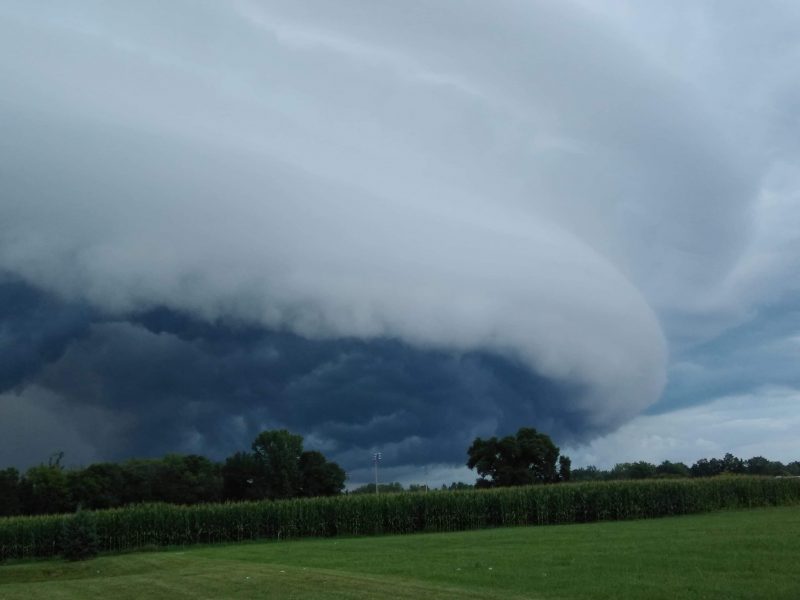
Severe weather forecast: A shelf cloud moving over a green pasture.
View at EarthSky Community Photos. | Sarah Iler in Birch Run, Michigan, submitted this photo of a shelf cloud on August 2, 2020. It’s a shelf cloud, a low-lying, horizontal, wedge-shaped cloud often seen forming the leading edge of a thunderstorm. Thanks, Sarah! There’s severe weather forecast for parts of the central U.S. this Easter weekend.

A strong cold front moving across the middle of the United States is forecast to bring the risk of severe weather for millions Friday, Saturday and Sunday. Large hail and damaging wind gusts are the main threats, but isolated tornadoes are also possible. The Storm Prediction Center has already outlined these next three days for possible severe weather. Plus you can go to the National Weather Service and enter your location. This will give you a complete forecast with what to expect over the next seven days.

Severe weather forecast for Friday

A Slight Risk (level 2 out of 5) for severe weather includes communities from Abilene, Texas through Oklahoma City, Oklahoma, Springfield, Illinois up toward Grand Rapids, Michigan. Warm, moist air will flow north from the Gulf into the middle of the country as a cold front approaches from he west. By Friday evening, thunderstorms with the potential to produce isolated tornadoes, damaging wind gusts and large hail will develop along the front stretching from Texas through the upper Great Lakes. By Friday night, the severe threat moves east.
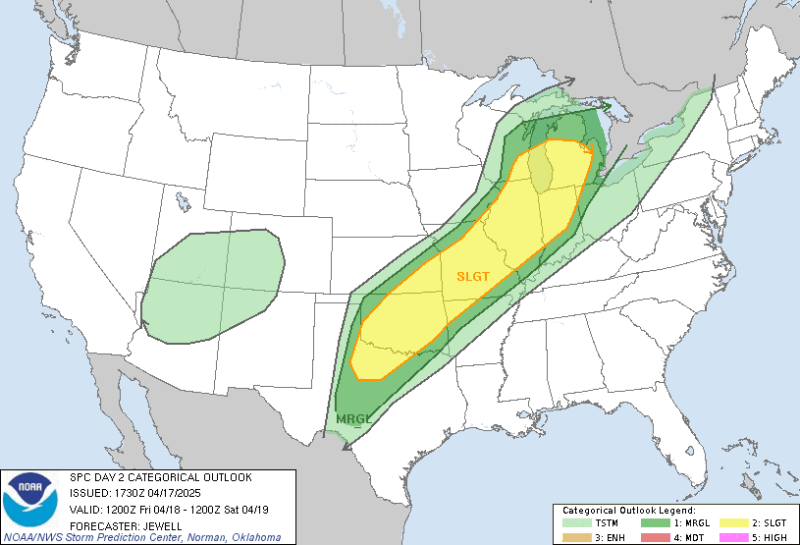
The Storm Prediction Center has outlined north central Texas, central Oklahoma, Missouri, Illinois, central and northwest Indiana and central Michigan in yellow to denote a Slight Risk for severe weather.
Friday, April 18, 2025 Severe Weather Outlook from the Storm Prediction Center

Forecast for Saturday

The severe threat for Saturday shifts slightly south from the day before, focused across central Texas into the Ohio Valley region. Once again a Slight Risk (level 2 out of 5) for severe weather is in place. The cold front that will spark the severe weather Friday will stall out across the middle part of the country. This will keep that warm, moist air from the Gulf positioned over Texas, Oklahoma, Arkansas and Missouri. The storms from Friday night will continue into early Saturday morning along that same cold front, but more storms will redevelop during the afternoon during the peak heating of the day. Warm temperatures are vital for thunderstorms development as it provides energy for the storms to tap into and get stronger. These storms will continue through the night, aided by a feature called a low-level jet, which is a narrow jet stream of strong winds roughly 5,000 feet (1,500 meters) above the ground that moves south to north. This low-level jet will continue to fuel thunderstorms overnight (despite the lack of energy from daytime sun) by continuing to bring up that moisture from the Gulf. These storms have the potential for large hail and damaging wind gusts, but also an isolated tornado.
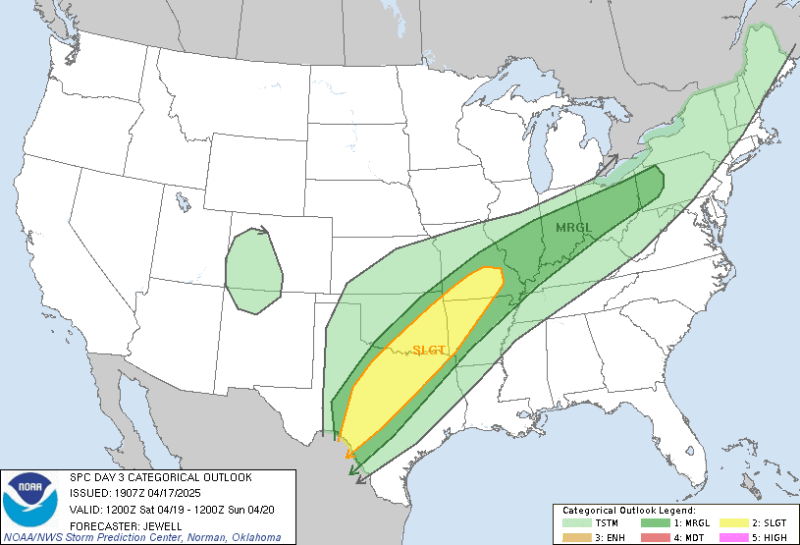
The Storm Prediction Center has outlined central Texas, eastern Oklahoma, northwest Arkansas and south central Missouri in yellow to designate a Slight Risk for severe weather.
Saturday, April 19, 2025 Severe Weather Outlook from the Storm Prediction Center

Forecast for Sunday

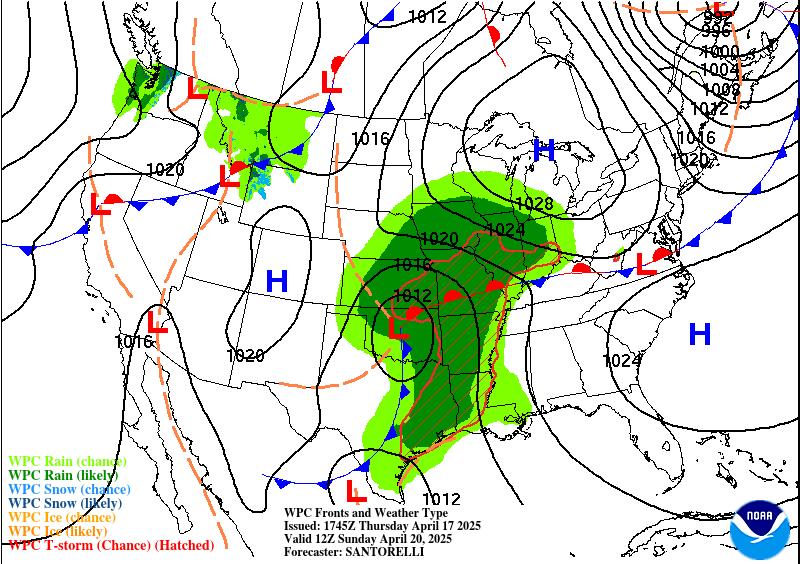
The risk area for Easter Sunday shifts slightly east from Saturday’s risk, but still mainly includes portions of east Texas and the middle to lower Mississippi Valley. A nearly identical storm set-up that has been in place through the weekend will keep that same warm, moist flow moving north from the Gulf. The stalled out cold front will eventually move back north, while another low pressure system with a cold front and warm front develops in central Texas Sunday morning.

This low pressure will move north through the Plains and into the Great Lakes region during the day Sunday. This will create a warm sector that will provide energy and moisture, important ingredients for storm development. The trailing cold front will be the main “initiating” factor for storms to develop Sunday as it moves through the Mississippi Valley by late morning, with more storms developing through the day, moving from west to east.
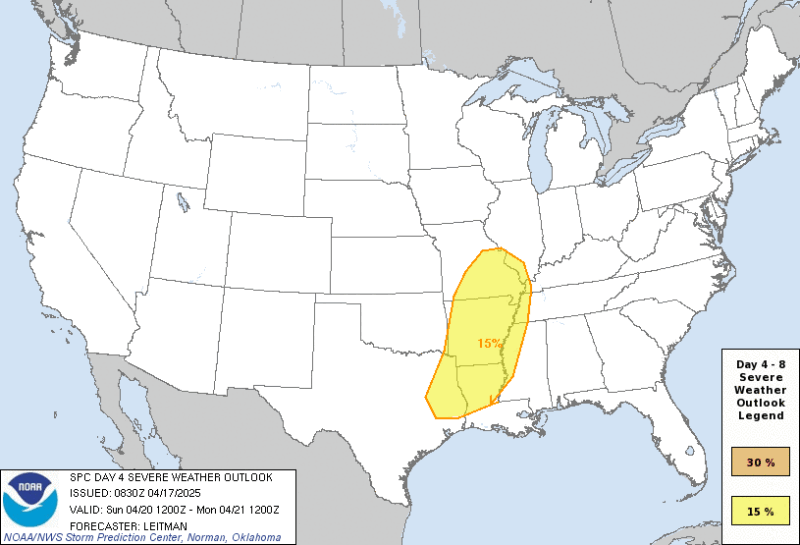
The Storm Prediction Center has outlined an area from east Texas, northern Louisiana, Arkansas, south central and southeast Missouri in yellow to designate a risk for severe weather.
Sunday, April 20, 2025 Severe Weather Outlook from the Storm Prediction Center
A low pressure system with a warm front to the north and a cold front trailing south sits over central Oklahoma. A red hatched area is outlined from Missouri down through Texas which indicates the possibility of severe weather.
The low pressure and associated cold and warm front developing Sunday morning. From the Weather Prediction Center.

Staying safe indoor during severe weather

Spring is a popular time to enjoy the weather outside, and with this weekend being Easter weekend, many people will gather to celebrate the holiday with outdoor services, meals and get togethers. If severe weather impacts your plans, do you know how to stay safe?

Preparation is key! Pay attention to the forecast. Remember, you can go to the National Weather Service and enter your location, for a complete forecast with what to expect over the next seven days.

You should also know where to go should severe weather threaten. If you are at a house or building, get inside away from windows as quickly as possible. If you are at a public park, a shelter will protect you from the rain, but. you will still be at risk of damaging wind and lightning, not to mention a tornado. Find an enclosed structure as soon as possible to wait out the storm. If the storm has no threat of a tornado, you can wait it out inside a vehicle, with the doors closed and windows rolled up. But remember: a car is not a safe place to shelter during a tornado.

Also make sure you have a way to receive weather information or warnings. A trusted weather app on your phone that will alert you to the presence of lightning is a great way to stay ahead of developing or approaching storms, as well as get weather watches and warnings issued by your local National Weather Service office. A NOAA Weather Radio is also an important tool to have, as this weather radio will sound when a weather watch or warning is issued. A weather radio is designed to be loud in order to get your attention, or even wake you up in the middle of the night. Having a weather radio on while preparing for, or enjoying an outdoor gathering is a great way to stay aware and safe during a holiday weekend. You can find more information here on how to properly program your NOAA Weather Radio.

Thunderstorms can escalate quickly. Clear skies can quickly turn dark and ominous, whether due to pop-up thunderstorms or squall lines. Be prepared! Set up a way to get weather warnings on your phone. When alerted to a storm, get inside a sturdy building immediately. Stay away from windows once indoors. If a building isn't nearby, get inside a vehicle.
Stay safe during severe weather! Be prepared by using these tips from the National Weather Service.
Chart listing 6 increasingly sever thunderstorm categories, with small images below each category.
View larger. | A breakdown of the severe thunderstorm risk categories. Chart via the Storm Prediction Center.

Botton line: There’s a severe weather forecast for parts of the central U.S. this Easter weekend. Stay weather aware and know where to take shelter if enjoying the holiday weekend outside.

The post Spotlight on severe weather forecast for central U.S. Easter weekend first appeared on EarthSky.


from EarthSky https://ift.tt/BXGIWdA
Severe weather forecast: A shelf cloud moving over a green pasture.
View at EarthSky Community Photos. | Sarah Iler in Birch Run, Michigan, submitted this photo of a shelf cloud on August 2, 2020. It’s a shelf cloud, a low-lying, horizontal, wedge-shaped cloud often seen forming the leading edge of a thunderstorm. Thanks, Sarah! There’s severe weather forecast for parts of the central U.S. this Easter weekend.

A strong cold front moving across the middle of the United States is forecast to bring the risk of severe weather for millions Friday, Saturday and Sunday. Large hail and damaging wind gusts are the main threats, but isolated tornadoes are also possible. The Storm Prediction Center has already outlined these next three days for possible severe weather. Plus you can go to the National Weather Service and enter your location. This will give you a complete forecast with what to expect over the next seven days.

Severe weather forecast for Friday

A Slight Risk (level 2 out of 5) for severe weather includes communities from Abilene, Texas through Oklahoma City, Oklahoma, Springfield, Illinois up toward Grand Rapids, Michigan. Warm, moist air will flow north from the Gulf into the middle of the country as a cold front approaches from he west. By Friday evening, thunderstorms with the potential to produce isolated tornadoes, damaging wind gusts and large hail will develop along the front stretching from Texas through the upper Great Lakes. By Friday night, the severe threat moves east.

The Storm Prediction Center has outlined north central Texas, central Oklahoma, Missouri, Illinois, central and northwest Indiana and central Michigan in yellow to denote a Slight Risk for severe weather.
Friday, April 18, 2025 Severe Weather Outlook from the Storm Prediction Center

Forecast for Saturday

The severe threat for Saturday shifts slightly south from the day before, focused across central Texas into the Ohio Valley region. Once again a Slight Risk (level 2 out of 5) for severe weather is in place. The cold front that will spark the severe weather Friday will stall out across the middle part of the country. This will keep that warm, moist air from the Gulf positioned over Texas, Oklahoma, Arkansas and Missouri. The storms from Friday night will continue into early Saturday morning along that same cold front, but more storms will redevelop during the afternoon during the peak heating of the day. Warm temperatures are vital for thunderstorms development as it provides energy for the storms to tap into and get stronger. These storms will continue through the night, aided by a feature called a low-level jet, which is a narrow jet stream of strong winds roughly 5,000 feet (1,500 meters) above the ground that moves south to north. This low-level jet will continue to fuel thunderstorms overnight (despite the lack of energy from daytime sun) by continuing to bring up that moisture from the Gulf. These storms have the potential for large hail and damaging wind gusts, but also an isolated tornado.

The Storm Prediction Center has outlined central Texas, eastern Oklahoma, northwest Arkansas and south central Missouri in yellow to designate a Slight Risk for severe weather.
Saturday, April 19, 2025 Severe Weather Outlook from the Storm Prediction Center

Forecast for Sunday

The risk area for Easter Sunday shifts slightly east from Saturday’s risk, but still mainly includes portions of east Texas and the middle to lower Mississippi Valley. A nearly identical storm set-up that has been in place through the weekend will keep that same warm, moist flow moving north from the Gulf. The stalled out cold front will eventually move back north, while another low pressure system with a cold front and warm front develops in central Texas Sunday morning.

This low pressure will move north through the Plains and into the Great Lakes region during the day Sunday. This will create a warm sector that will provide energy and moisture, important ingredients for storm development. The trailing cold front will be the main “initiating” factor for storms to develop Sunday as it moves through the Mississippi Valley by late morning, with more storms developing through the day, moving from west to east.

The Storm Prediction Center has outlined an area from east Texas, northern Louisiana, Arkansas, south central and southeast Missouri in yellow to designate a risk for severe weather.
Sunday, April 20, 2025 Severe Weather Outlook from the Storm Prediction Center
A low pressure system with a warm front to the north and a cold front trailing south sits over central Oklahoma. A red hatched area is outlined from Missouri down through Texas which indicates the possibility of severe weather.
The low pressure and associated cold and warm front developing Sunday morning. From the Weather Prediction Center.

Staying safe indoor during severe weather

Spring is a popular time to enjoy the weather outside, and with this weekend being Easter weekend, many people will gather to celebrate the holiday with outdoor services, meals and get togethers. If severe weather impacts your plans, do you know how to stay safe?

Preparation is key! Pay attention to the forecast. Remember, you can go to the National Weather Service and enter your location, for a complete forecast with what to expect over the next seven days.

You should also know where to go should severe weather threaten. If you are at a house or building, get inside away from windows as quickly as possible. If you are at a public park, a shelter will protect you from the rain, but. you will still be at risk of damaging wind and lightning, not to mention a tornado. Find an enclosed structure as soon as possible to wait out the storm. If the storm has no threat of a tornado, you can wait it out inside a vehicle, with the doors closed and windows rolled up. But remember: a car is not a safe place to shelter during a tornado.

Also make sure you have a way to receive weather information or warnings. A trusted weather app on your phone that will alert you to the presence of lightning is a great way to stay ahead of developing or approaching storms, as well as get weather watches and warnings issued by your local National Weather Service office. A NOAA Weather Radio is also an important tool to have, as this weather radio will sound when a weather watch or warning is issued. A weather radio is designed to be loud in order to get your attention, or even wake you up in the middle of the night. Having a weather radio on while preparing for, or enjoying an outdoor gathering is a great way to stay aware and safe during a holiday weekend. You can find more information here on how to properly program your NOAA Weather Radio.

Thunderstorms can escalate quickly. Clear skies can quickly turn dark and ominous, whether due to pop-up thunderstorms or squall lines. Be prepared! Set up a way to get weather warnings on your phone. When alerted to a storm, get inside a sturdy building immediately. Stay away from windows once indoors. If a building isn't nearby, get inside a vehicle.
Stay safe during severe weather! Be prepared by using these tips from the National Weather Service.
Chart listing 6 increasingly sever thunderstorm categories, with small images below each category.
View larger. | A breakdown of the severe thunderstorm risk categories. Chart via the Storm Prediction Center.

Botton line: There’s a severe weather forecast for parts of the central U.S. this Easter weekend. Stay weather aware and know where to take shelter if enjoying the holiday weekend outside.

The post Spotlight on severe weather forecast for central U.S. Easter weekend first appeared on EarthSky.


from EarthSky https://ift.tt/BXGIWdA

Life on K2-18b? Exciting new results met with skepticism

Life on K2-18b: A planet similar to Earth, with a global ocean and white clouds. A bright reddish star is in the distance.
View larger. | Artist’s concept of K2-18b as a Hycean world with a global ocean and hydrogen atmosphere. Could there be life on K2-18b? The new results from the Webb space telescope are tantalizing but not yet conclusive. And they’ve been met with skepticism from other scientists. Image via A. Smith/ N. Madhusudhan (University of Cambridge).

Science matters. Wonder matters. You matter. Join our 2025 Donation Campaign today.

  • K2-18b is an exoplanet 124 light-years away and is larger and more massive than Earth. Scientists said it might have a deep global ocean under a hydrogen atmosphere. Could it support life?
  • New observations from the Webb space telescope show there is a molecule called dimethyl sulfide in its atmosphere, a possible signature of life. Webb had previously tentatively detected it before, but the new observations show a stronger signal.
  • The results don’t prove there is life on K2-18b, but they are tantalizing. Other scientists are quite skeptical, however.

Life on exoplanet K2-18b?

In 2023, scientists announced they had tentatively identified the gas dimethyl sulfide – a possible biosignature of life – in the atmosphere of K2-18b, an exoplanet 124 light-years away. On April 17, 2025, scientists at the University of Cambridge in the U.K. said they found the gas again with the Webb space telescope, but this time with a stronger signal. They said the amount of dimethyl sulfide appears to be thousands of times more abundant on K2-18b than on Earth. However, more data is needed to fully confirm its presence and whether it is connected to life … or not. And many scientists are still skeptical.

The New York Times first broke the news on April 16, 2025.

The researchers published their peer-reviewed results in The Astrophysical Journal Letters on April 17, 2025.

A hint of dimethyl sulfide

K2-18b is a super-Earth or sub-Neptune world, orbiting in the habitable zone – where liquid water could exist – of its star. Its exact classification is also still a matter of debate among scientists, which has a lot of bearing on the reported discovery. It’s about 8.6 times as massive and 2.6 times larger than Earth, and orbits a red dwarf star about 124 light-years away.

When scientists announced the possible detection of dimethyl sulfide (DMS) in September 2023, using the Webb space telescope, the news spurred much debate. It was a potentially exciting discovery, to be sure. The gas is a potential biosignature, a chemical, molecular or other trace of biological life. But the detection was weak and far from conclusive. Astronomers would need to observe the planet again with Webb to try to determine if the gas really was there or not.

Nikku Madhusudhan, a University of Cambridge astrophysicist, was involved in the previous research and is the lead author of the paper about the latest findings. He said:

We didn’t know for sure whether the signal we saw last time was due to dimethyl sulfide, but just the hint of it was exciting enough for us to have another look with Webb using a different instrument.

Webb had also previously found methane and carbon dioxide in the atmosphere of K2-18b. Those signals were much stronger, however, and considered to be confirmed. The dimethyl sulfide signal was a lot weaker, or of “low statistical significance,” in more scientific terms.

Smiling man with eyeglasses and suit jacket standing in front of a white board with notes written on it.
Nikku Madhusudhan at the University of Cambridge in the U.K. led the new study about K2-18b. Image via Atlantic Studios/ University of Cambridge.

New observations with Webb

For the older initial observations, Webb used its Near-Infrared Imager and Slitless Spectrograph (NIRISS) and Near-Infrared Spectrograph (NIRSpec) instruments. But for the new observations, Webb used its Mid-Infrared Instrument (MIRI) instead. Madhusudhan said:

This is an independent line of evidence, using a different instrument than we did before and a different wavelength range of light, where there is no overlap with the previous observations. The signal came through strong and clear.

Co-author Måns Holmberg at the Space Telescope Science Institute in Baltimore, Maryland, added:

It was an incredible realization seeing the results emerge and remain consistent throughout the extensive independent analyses and robustness tests.

Madhusudhan also discussed the new findings in a livestream that you can replay and watch here:


Video via Cambridge University Astronomy.

More dimethyl sulfide than on Earth?

One big surprise from the results is the apparent amount of dimethyl sulfide in the planet’s atmosphere. If the results are accurate – still to be confirmed – than K2-18b has thousands of times more of the gas in its atmosphere than Earth does. On Earth, it’s less than one part per billion. But on K2-18b, it is an estimated 10 parts per million.

The new observations revealed the tentative existence of a similar gas, dimethyl disulfide. Both molecules are from the same chemical family and could be potential biosignatures.

On Earth, marine organisms such as plankton produce almost all the dimethyl sulfide. But it can also form without life and has been detected in comets and gas clouds in space. So its presence, by itself, isn’t a slam dunk for life. Not yet, anyway.

Is K2-18b a Hycean world?

Some studies suggest that K2-18b is a Hycean world, a rocky planet covered by a global ocean, but with a hydrogen atmosphere. Similar to Earth in some ways, but also utterly alien. As Madhusudhan noted:

Earlier theoretical work had predicted that high levels of sulfur-based gases like dimethyl sulfide and dimethyl disulfide are possible on Hycean worlds. And now we’ve observed it, in line with what was predicted.

But even that is still up for debate among scientists. Other studies say that it might be more of a sub-Neptune, with a deep, dense atmosphere and no solid surface or ocean at all. Whichever scenario is correct has, of course, direct implications for the possibility of life on K2-18b.

Graph with wavy blue line, straight vertical lines with yellow dots and an Earth-like planet in the background.
View larger. | Transmission-spectrum from the Webb space telescope showing the detection of dimethyl sulfide and dimethyl disulfide in the atmosphere of K2-18b. Image via A. Smith/ N. Madhusudhan (University of Cambridge).

Skepticism abounds

Madhusudhan made a strong statement in the Cambridge press release, saying:

Given everything we know about this planet, a Hycean world with an ocean that is teeming with life is the scenario that best fits the data we have.

But at the same time he acknowledges that even the new results are preliminary and are open to debate, saying:

It’s important that we’re deeply skeptical of our own results, because it’s only by testing and testing again that we will be able to reach the point where we’re confident in them. That’s how science has to work.

Co-author Savvas Constantinou at Cambridge’s Institute of Astronomy added:

Our work is the starting point for all the investigations that are now needed to confirm and understand the implications of these exciting findings.

But other scientists are also skeptical, not only about the results but even how the results were obtained. As planetary scientist Sarah Hörst said on Bluesky:

Sarah’s rules of looking for life with only chemical signatures: 1) The smaller the molecule(s) the more likely they can also be produced by abiotic processes. 2) One molecule, if it can be produced by any abiotic process, will never be enough to definitively claim detection of life.

You can read some more detailed threads from Chris Lintott and Ryan MacDonald below:

An astonishing headline reporting on new observations from a team led to Nikku Madhusudhan claims they’ve found ‘hints of life’ on a planet orbiting a dwarf star some 124 light years away. What’s going on? (1/n) https://ift.tt/UuCYJrN… ? ?

Chris Lintott (@chrislintott.bsky.social) 2025-04-17T03:24:30.587Z

??, ? ???????????? ??? ??? ???? ???????? ?? ??-???'? ??????????.K2-18b is back in the news, now with a bold claim that biosignature molecules (DMS and/or DMDS) have been 'detected at 3?'.Most exoplanet astronomers are extremely sceptical about these claims, let's see why (1/n).??? #exoplanet

Dr Ryan MacDonald (@distantworlds.space) 2025-04-17T16:08:01.577Z

So overall, the new results are tantalizing, but still not proof of life on K2-18b. And the reaction from quite a few other scientists shows how such possible evidence must be very carefully vetted.

Bottom line: New observations by the Webb space telescope have reignited the debate about possible life on K2-18b, a potentially habitable exoplanet 124 light-years away.

Source: New Constraints on DMS and DMDS in the Atmosphere of K2-18 b from JWST MIRI

Via University of Cambridge

Read more: Did Webb find signs of life on exoplanet K2-18 b?

Read more: Is K2-18b really a habitable super-Earth?

The post Life on K2-18b? Exciting new results met with skepticism first appeared on EarthSky.


from EarthSky https://ift.tt/EI5JSQB
Life on K2-18b: A planet similar to Earth, with a global ocean and white clouds. A bright reddish star is in the distance.
View larger. | Artist’s concept of K2-18b as a Hycean world with a global ocean and hydrogen atmosphere. Could there be life on K2-18b? The new results from the Webb space telescope are tantalizing but not yet conclusive. And they’ve been met with skepticism from other scientists. Image via A. Smith/ N. Madhusudhan (University of Cambridge).

Science matters. Wonder matters. You matter. Join our 2025 Donation Campaign today.

  • K2-18b is an exoplanet 124 light-years away and is larger and more massive than Earth. Scientists said it might have a deep global ocean under a hydrogen atmosphere. Could it support life?
  • New observations from the Webb space telescope show there is a molecule called dimethyl sulfide in its atmosphere, a possible signature of life. Webb had previously tentatively detected it before, but the new observations show a stronger signal.
  • The results don’t prove there is life on K2-18b, but they are tantalizing. Other scientists are quite skeptical, however.

Life on exoplanet K2-18b?

In 2023, scientists announced they had tentatively identified the gas dimethyl sulfide – a possible biosignature of life – in the atmosphere of K2-18b, an exoplanet 124 light-years away. On April 17, 2025, scientists at the University of Cambridge in the U.K. said they found the gas again with the Webb space telescope, but this time with a stronger signal. They said the amount of dimethyl sulfide appears to be thousands of times more abundant on K2-18b than on Earth. However, more data is needed to fully confirm its presence and whether it is connected to life … or not. And many scientists are still skeptical.

The New York Times first broke the news on April 16, 2025.

The researchers published their peer-reviewed results in The Astrophysical Journal Letters on April 17, 2025.

A hint of dimethyl sulfide

K2-18b is a super-Earth or sub-Neptune world, orbiting in the habitable zone – where liquid water could exist – of its star. Its exact classification is also still a matter of debate among scientists, which has a lot of bearing on the reported discovery. It’s about 8.6 times as massive and 2.6 times larger than Earth, and orbits a red dwarf star about 124 light-years away.

When scientists announced the possible detection of dimethyl sulfide (DMS) in September 2023, using the Webb space telescope, the news spurred much debate. It was a potentially exciting discovery, to be sure. The gas is a potential biosignature, a chemical, molecular or other trace of biological life. But the detection was weak and far from conclusive. Astronomers would need to observe the planet again with Webb to try to determine if the gas really was there or not.

Nikku Madhusudhan, a University of Cambridge astrophysicist, was involved in the previous research and is the lead author of the paper about the latest findings. He said:

We didn’t know for sure whether the signal we saw last time was due to dimethyl sulfide, but just the hint of it was exciting enough for us to have another look with Webb using a different instrument.

Webb had also previously found methane and carbon dioxide in the atmosphere of K2-18b. Those signals were much stronger, however, and considered to be confirmed. The dimethyl sulfide signal was a lot weaker, or of “low statistical significance,” in more scientific terms.

Smiling man with eyeglasses and suit jacket standing in front of a white board with notes written on it.
Nikku Madhusudhan at the University of Cambridge in the U.K. led the new study about K2-18b. Image via Atlantic Studios/ University of Cambridge.

New observations with Webb

For the older initial observations, Webb used its Near-Infrared Imager and Slitless Spectrograph (NIRISS) and Near-Infrared Spectrograph (NIRSpec) instruments. But for the new observations, Webb used its Mid-Infrared Instrument (MIRI) instead. Madhusudhan said:

This is an independent line of evidence, using a different instrument than we did before and a different wavelength range of light, where there is no overlap with the previous observations. The signal came through strong and clear.

Co-author Måns Holmberg at the Space Telescope Science Institute in Baltimore, Maryland, added:

It was an incredible realization seeing the results emerge and remain consistent throughout the extensive independent analyses and robustness tests.

Madhusudhan also discussed the new findings in a livestream that you can replay and watch here:


Video via Cambridge University Astronomy.

More dimethyl sulfide than on Earth?

One big surprise from the results is the apparent amount of dimethyl sulfide in the planet’s atmosphere. If the results are accurate – still to be confirmed – than K2-18b has thousands of times more of the gas in its atmosphere than Earth does. On Earth, it’s less than one part per billion. But on K2-18b, it is an estimated 10 parts per million.

The new observations revealed the tentative existence of a similar gas, dimethyl disulfide. Both molecules are from the same chemical family and could be potential biosignatures.

On Earth, marine organisms such as plankton produce almost all the dimethyl sulfide. But it can also form without life and has been detected in comets and gas clouds in space. So its presence, by itself, isn’t a slam dunk for life. Not yet, anyway.

Is K2-18b a Hycean world?

Some studies suggest that K2-18b is a Hycean world, a rocky planet covered by a global ocean, but with a hydrogen atmosphere. Similar to Earth in some ways, but also utterly alien. As Madhusudhan noted:

Earlier theoretical work had predicted that high levels of sulfur-based gases like dimethyl sulfide and dimethyl disulfide are possible on Hycean worlds. And now we’ve observed it, in line with what was predicted.

But even that is still up for debate among scientists. Other studies say that it might be more of a sub-Neptune, with a deep, dense atmosphere and no solid surface or ocean at all. Whichever scenario is correct has, of course, direct implications for the possibility of life on K2-18b.

Graph with wavy blue line, straight vertical lines with yellow dots and an Earth-like planet in the background.
View larger. | Transmission-spectrum from the Webb space telescope showing the detection of dimethyl sulfide and dimethyl disulfide in the atmosphere of K2-18b. Image via A. Smith/ N. Madhusudhan (University of Cambridge).

Skepticism abounds

Madhusudhan made a strong statement in the Cambridge press release, saying:

Given everything we know about this planet, a Hycean world with an ocean that is teeming with life is the scenario that best fits the data we have.

But at the same time he acknowledges that even the new results are preliminary and are open to debate, saying:

It’s important that we’re deeply skeptical of our own results, because it’s only by testing and testing again that we will be able to reach the point where we’re confident in them. That’s how science has to work.

Co-author Savvas Constantinou at Cambridge’s Institute of Astronomy added:

Our work is the starting point for all the investigations that are now needed to confirm and understand the implications of these exciting findings.

But other scientists are also skeptical, not only about the results but even how the results were obtained. As planetary scientist Sarah Hörst said on Bluesky:

Sarah’s rules of looking for life with only chemical signatures: 1) The smaller the molecule(s) the more likely they can also be produced by abiotic processes. 2) One molecule, if it can be produced by any abiotic process, will never be enough to definitively claim detection of life.

You can read some more detailed threads from Chris Lintott and Ryan MacDonald below:

An astonishing headline reporting on new observations from a team led to Nikku Madhusudhan claims they’ve found ‘hints of life’ on a planet orbiting a dwarf star some 124 light years away. What’s going on? (1/n) https://ift.tt/UuCYJrN… ? ?

Chris Lintott (@chrislintott.bsky.social) 2025-04-17T03:24:30.587Z

??, ? ???????????? ??? ??? ???? ???????? ?? ??-???'? ??????????.K2-18b is back in the news, now with a bold claim that biosignature molecules (DMS and/or DMDS) have been 'detected at 3?'.Most exoplanet astronomers are extremely sceptical about these claims, let's see why (1/n).??? #exoplanet

Dr Ryan MacDonald (@distantworlds.space) 2025-04-17T16:08:01.577Z

So overall, the new results are tantalizing, but still not proof of life on K2-18b. And the reaction from quite a few other scientists shows how such possible evidence must be very carefully vetted.

Bottom line: New observations by the Webb space telescope have reignited the debate about possible life on K2-18b, a potentially habitable exoplanet 124 light-years away.

Source: New Constraints on DMS and DMDS in the Atmosphere of K2-18 b from JWST MIRI

Via University of Cambridge

Read more: Did Webb find signs of life on exoplanet K2-18 b?

Read more: Is K2-18b really a habitable super-Earth?

The post Life on K2-18b? Exciting new results met with skepticism first appeared on EarthSky.


from EarthSky https://ift.tt/EI5JSQB

Easter and Eastern Orthodox Easter are on April 20

Image shows a basket full of eggs painted with colorful designs.
View at EarthSky Community Photos. | Steve Price of Draper, Utah, posted this photo on March 30, 2024. Steve wrote: “These are some of the Ukrainian Pysanky Easter eggs I made. We display them each Easter season.” Thanks, Steve!

Science matters. Wonder matters. You matter. Join our 2025 Donation Campaign today.

When is Easter in 2025?

Here’s the rule for Easter Sunday. It generally falls on the first Sunday after the first full moon on or after the vernal equinox.

And so Easter is a movable feast. Its date is different from year to year. The 2025 equinox was March 20. It marked an unofficial beginning of spring for the Northern Hemisphere and autumn for the Southern Hemisphere. The first full moon after the March equinox was April 12-13, 2025. Voilà! In 2025, Easter is April 20.

Note, generally that date is a little different from Eastern Orthodox Easter, which follows the Julian calendar. However, in 2025, Easter also falls on April 20 this year.

How is Easter determined?

The Council of Nicaea – first ecumenical council of the Christian church – established the date of Easter when it met in Turkey in the year 325 CE. By ecclesiastical rules set centuries ago, there are 35 dates on which Easter can take place.

The earliest possible date for Easter is March 22 and the latest possible date is April 25.

Easter can never come as early as March 21, though. That’s because, by ecclesiastical rules, the vernal equinox is fixed on March 21. That’s in spite of the fact that in the 21st century (2001 to 2100) every March equinox after the year 2007 will fall on March 19 or March 20.

The last time Easter fell on March 22 (earliest possible date) was in 1818, and the next time will be in 2285. The most recent time an Easter came in March was March 27, 2016.

Easter: Basket of eggs intricately painted in many bright colors.
Easter eggs from the Czech Republic. Image via svajcr/ Wikipedia.

More details and dates

The earliest Easter in the 21st century came in the year 2008 (March 23, 2008). Another March 23 Easter won’t come again until the year 2160.

The century’s latest Easter will occur in the year 2038 (April 25, 2038). After that, it will next fall on April 25 in the year 2190.

See dates of Easter from 1700 to 2299 at Thomas Larsen’s list.

One last detail. Most of us celebrate Easter Sunday via a combination of ecclesiastical rules set long ago and real events in our night sky. But these don’t always coincide. For example, an ecclesiastical full moon doesn’t usually happen on the same date as the full moon you see at night. Ecclesiastical full moons are formally fixed as the 14th day of the ecclesiastical lunar month.

So it’s possible for an ecclesiastical Easter and an astronomical Easter to occur on different dates, as well.

Table with columns for earliest dates of Easter in Gregorian and Julian calendars.
Visit timeanddate.com for more about the date of Easter. Chart via timeanddate.com. Used with permission.

Bottom line: How the date of Easter is determined, and some dates of earliest and latest Easters. Happy Easter to all who celebrate!

The post Easter and Eastern Orthodox Easter are on April 20 first appeared on EarthSky.


from EarthSky https://ift.tt/17LqT9W
Image shows a basket full of eggs painted with colorful designs.
View at EarthSky Community Photos. | Steve Price of Draper, Utah, posted this photo on March 30, 2024. Steve wrote: “These are some of the Ukrainian Pysanky Easter eggs I made. We display them each Easter season.” Thanks, Steve!

Science matters. Wonder matters. You matter. Join our 2025 Donation Campaign today.

When is Easter in 2025?

Here’s the rule for Easter Sunday. It generally falls on the first Sunday after the first full moon on or after the vernal equinox.

And so Easter is a movable feast. Its date is different from year to year. The 2025 equinox was March 20. It marked an unofficial beginning of spring for the Northern Hemisphere and autumn for the Southern Hemisphere. The first full moon after the March equinox was April 12-13, 2025. Voilà! In 2025, Easter is April 20.

Note, generally that date is a little different from Eastern Orthodox Easter, which follows the Julian calendar. However, in 2025, Easter also falls on April 20 this year.

How is Easter determined?

The Council of Nicaea – first ecumenical council of the Christian church – established the date of Easter when it met in Turkey in the year 325 CE. By ecclesiastical rules set centuries ago, there are 35 dates on which Easter can take place.

The earliest possible date for Easter is March 22 and the latest possible date is April 25.

Easter can never come as early as March 21, though. That’s because, by ecclesiastical rules, the vernal equinox is fixed on March 21. That’s in spite of the fact that in the 21st century (2001 to 2100) every March equinox after the year 2007 will fall on March 19 or March 20.

The last time Easter fell on March 22 (earliest possible date) was in 1818, and the next time will be in 2285. The most recent time an Easter came in March was March 27, 2016.

Easter: Basket of eggs intricately painted in many bright colors.
Easter eggs from the Czech Republic. Image via svajcr/ Wikipedia.

More details and dates

The earliest Easter in the 21st century came in the year 2008 (March 23, 2008). Another March 23 Easter won’t come again until the year 2160.

The century’s latest Easter will occur in the year 2038 (April 25, 2038). After that, it will next fall on April 25 in the year 2190.

See dates of Easter from 1700 to 2299 at Thomas Larsen’s list.

One last detail. Most of us celebrate Easter Sunday via a combination of ecclesiastical rules set long ago and real events in our night sky. But these don’t always coincide. For example, an ecclesiastical full moon doesn’t usually happen on the same date as the full moon you see at night. Ecclesiastical full moons are formally fixed as the 14th day of the ecclesiastical lunar month.

So it’s possible for an ecclesiastical Easter and an astronomical Easter to occur on different dates, as well.

Table with columns for earliest dates of Easter in Gregorian and Julian calendars.
Visit timeanddate.com for more about the date of Easter. Chart via timeanddate.com. Used with permission.

Bottom line: How the date of Easter is determined, and some dates of earliest and latest Easters. Happy Easter to all who celebrate!

The post Easter and Eastern Orthodox Easter are on April 20 first appeared on EarthSky.


from EarthSky https://ift.tt/17LqT9W

Most meteorites that hit Earth aren’t typical. Why?

Meteorites: Bare tree beside a bright light shooting downward in the background during night.
View at EarthSky Community Photos. | Doug Ingram from Bodalla, Australia, captured this fireball on September 1, 2024. Studies of meteorites that have landed on Earth show most are not made of carbon, even though observations with telescopes show a majority of space rocks are made of carbon. So why are the samples on Earth outliers?

Looking up has never felt more important. Please donate to help EarthSky keep bringing the sky to your screen.

  • Observations and sample-return missions show us that space rocks tend to be rich in water, carbon and organic compounds. Yet most meteorites that have made it to Earth are not. Why?
  • Astronomers long thought the space rock’s journey through our atmosphere filtered out these materials. But a new study published April 14, 2025, found something else.
  • The temperature changes from space rocks traveling back and forth near the sun formed cracks in the rocks. So space rocks lose much of their carbon material before they even make it to Earth.
  • By Patrick M. Shober, NASA

    Meteorites that hit Earth

    Much of what scientists know about the early solar system comes from meteorites. They are ancient rocks that travel through space and survive a fiery plunge through Earth’s atmosphere. Among meteorites, one type – carbonaceous chondrites – stands out as the most primitive. They provide a unique glimpse into the solar system’s infancy.

    The carbonaceous chondrites are rich in water, carbon and organic compounds. They’re hydrated, which means they contain water bound within minerals in the rock. The components of the water are locked into crystal structures. Many researchers believe these ancient rocks played a crucial role in delivering water to early Earth.

    Before hitting Earth, rocks traveling through space are generally referred to as asteroids, meteoroids or comets, depending on their size and composition. If a piece of one of these objects makes it all the way to Earth, it becomes a meteorite.

    From observing asteroids with telescopes, scientists know that most asteroids have water-rich, carbonaceous compositions. Models predict that most meteorites – over half – should also be carbonaceous. But less than 4% of all the meteorites found on Earth are carbonaceous. So why is there such a mismatch?

    In a study published in the journal Nature Astronomy on April 14, 2025, my planetary scientist colleagues and I tried to answer an age-old question: Where are all the carbonaceous chondrites?

    Sample-return missions

    Scientists’ desire to study these ancient rocks has driven recent sample-return space missions. NASA’s OSIRIS-REx and JAXA’s Hayabusa2 missions have transformed what researchers know about primitive, carbon-rich asteroids.

    Meteorites found sitting on the ground are exposed to rain, snow and plants. This can significantly change them and make analysis more difficult. So, the OSIRIS-REx mission ventured to the asteroid Bennu to retrieve an unaltered sample. Retrieving this sample allowed scientists to examine the asteroid’s composition in detail.

    Similarly, Hayabusa2’s journey to the asteroid Ryugu provided pristine samples of another, similarly water-rich asteroid.

    Together these missions have let planetary scientists like me study pristine, fragile carbonaceous material from asteroids. These asteroids are a direct window into the building blocks of our solar system and the origins of life.

    A dusty, rocky asteroid against a dark backdrop.
    NASA’s OSIRIS-REx sample-return spacecraft captured this image of the carbonaceous near-Earth asteroid Bennu. Image via NASA.

    The carbonaceous chondrite puzzle

    For a long time, scientists assumed Earth’s atmosphere filtered out carbonaceous debris.

    When an object hits Earth’s atmosphere, it has to survive significant pressures and high temperatures. Carbonaceous chondrites tend to be weaker and more crumbly than other meteorites. So these objects just don’t stand as much of a chance.

    Meteorites usually start their journey when two asteroids collide. These collisions create a bunch of centimeter- to meter-size rock fragments. These cosmic crumbs streak through the solar system and can, eventually, fall to Earth. When they’re smaller than a meter, scientists call them meteoroids.

    Meteoroids are far too small for researchers to see with a telescope. That’s unless they’re about to hit the Earth, and astronomers get lucky.

    But there is another way scientists can study this population, and, in turn, understand why meteorites have such different compositions.

    Meteor and fireball observation networks

    Our research team used the Earth’s atmosphere as our detector.

    Most of the meteoroids that reach Earth are tiny, sand-sized particles. But occasionally, bodies up to a couple of meters in diameter hit. Researchers estimate that about 5,000 metric tons of micrometeorites land on Earth annually. And, each year, between 4,000 and 10,000 large meteorites – golf ball-sized or larger – land on Earth. That’s more than 20 each day.

    A fireball observed by the FRIPON network in Normandy, France, in 2019.

    Today, digital cameras have rendered round-the-clock observations of the night sky both practical and affordable. Low-cost, high-sensitivity sensors and automated detection software allow researchers to monitor large sections of the night sky for bright flashes, which signal a meteoroid hitting the atmosphere.

    Research teams can sift through these real-time observations using automated analysis techniques – or a very dedicated Ph.D. student – to find invaluable information.

    Our team manages two global systems: FRIPON, a French-led network with stations in 15 countries; and the Global Fireball Observatory, a collaboration started by the team behind the Desert Fireball Network in Australia. Together with other open-access datasets, my colleagues and I used the trajectories of nearly 8,000 impacts observed by 19 observation networks spread across 39 countries.

    A camera, which looks like a glass sphere, attached to a metal stand on a railing overlooking mountains.
    FRIPON camera installed at the Pic du Midi Observatory in the French Pyrenees. Image via FRIPON.

    By comparing all meteoroid impacts recorded in Earth’s atmosphere with those that successfully reach the surface as meteorites, we can pinpoint which asteroids produce fragments that are strong enough to survive the journey. Or, conversely, we can also pinpoint which asteroids produce weak material that do not show up as often on Earth as meteorites.

    A mechanical panel sitting in a desert in Australia
    Desert Fireball Network automated remote observatory in South Australia. Image via The Desert Fireball Network.

    The sun is baking the rocks too much

    Surprisingly, we found that many asteroid pieces don’t even make it to Earth. Something starts removing the weak stuff while the fragment is still in space. The carbonaceous material, which isn’t very durable, likely gets broken down through heat stress when its orbit takes it close to the sun.

    As carbonaceous chondrites orbit close and then away from the sun, the temperature swings form cracks in their material. This process effectively fragments and removes weak, hydrated boulders from the population of objects near the Earth. Anything left over after this thermal cracking then has to survive the atmosphere.

    Only 30% to 50% of the remaining objects survive the atmospheric passage and become meteorites. The debris pieces whose orbits bring them closer to the sun tend to be significantly more durable. This makes them far more likely to survive the difficult passage through Earth’s atmosphere. We call this a survival bias.

    For decades, scientists have presumed that Earth’s atmosphere alone explains the scarcity of carbonaceous meteorites, but our work indicates that much of the removal occurs beforehand in space.

    More studies with meteorites

    Going forward, new scientific advances can help confirm these findings and better identify meteoroid compositions. Scientists need to get better at using telescopes to detect objects right before they hit the Earth. More detailed modeling of how these objects break up in the atmosphere can also help researchers study them.

    Lastly, future studies can come up with better methods to identify what these fireballs are made of using the colors of the meteors.The Conversation

    Patrick M. Shober, Postdoctoral Fellow in Planetary Sciences, NASA

    This article is republished from The Conversation under a Creative Commons license. Read the original article.

    Bottom line: Our observations and sample-return missions show us that space rocks tend to be rich in water, carbon and organic compounds. Yet the meteorites that have made it to Earth rarely have a similar composition. Why?

    The post Most meteorites that hit Earth aren’t typical. Why? first appeared on EarthSky.


    from EarthSky https://ift.tt/kPm3xad
    Meteorites: Bare tree beside a bright light shooting downward in the background during night.
    View at EarthSky Community Photos. | Doug Ingram from Bodalla, Australia, captured this fireball on September 1, 2024. Studies of meteorites that have landed on Earth show most are not made of carbon, even though observations with telescopes show a majority of space rocks are made of carbon. So why are the samples on Earth outliers?

    Looking up has never felt more important. Please donate to help EarthSky keep bringing the sky to your screen.

  • Observations and sample-return missions show us that space rocks tend to be rich in water, carbon and organic compounds. Yet most meteorites that have made it to Earth are not. Why?
  • Astronomers long thought the space rock’s journey through our atmosphere filtered out these materials. But a new study published April 14, 2025, found something else.
  • The temperature changes from space rocks traveling back and forth near the sun formed cracks in the rocks. So space rocks lose much of their carbon material before they even make it to Earth.
  • By Patrick M. Shober, NASA

    Meteorites that hit Earth

    Much of what scientists know about the early solar system comes from meteorites. They are ancient rocks that travel through space and survive a fiery plunge through Earth’s atmosphere. Among meteorites, one type – carbonaceous chondrites – stands out as the most primitive. They provide a unique glimpse into the solar system’s infancy.

    The carbonaceous chondrites are rich in water, carbon and organic compounds. They’re hydrated, which means they contain water bound within minerals in the rock. The components of the water are locked into crystal structures. Many researchers believe these ancient rocks played a crucial role in delivering water to early Earth.

    Before hitting Earth, rocks traveling through space are generally referred to as asteroids, meteoroids or comets, depending on their size and composition. If a piece of one of these objects makes it all the way to Earth, it becomes a meteorite.

    From observing asteroids with telescopes, scientists know that most asteroids have water-rich, carbonaceous compositions. Models predict that most meteorites – over half – should also be carbonaceous. But less than 4% of all the meteorites found on Earth are carbonaceous. So why is there such a mismatch?

    In a study published in the journal Nature Astronomy on April 14, 2025, my planetary scientist colleagues and I tried to answer an age-old question: Where are all the carbonaceous chondrites?

    Sample-return missions

    Scientists’ desire to study these ancient rocks has driven recent sample-return space missions. NASA’s OSIRIS-REx and JAXA’s Hayabusa2 missions have transformed what researchers know about primitive, carbon-rich asteroids.

    Meteorites found sitting on the ground are exposed to rain, snow and plants. This can significantly change them and make analysis more difficult. So, the OSIRIS-REx mission ventured to the asteroid Bennu to retrieve an unaltered sample. Retrieving this sample allowed scientists to examine the asteroid’s composition in detail.

    Similarly, Hayabusa2’s journey to the asteroid Ryugu provided pristine samples of another, similarly water-rich asteroid.

    Together these missions have let planetary scientists like me study pristine, fragile carbonaceous material from asteroids. These asteroids are a direct window into the building blocks of our solar system and the origins of life.

    A dusty, rocky asteroid against a dark backdrop.
    NASA’s OSIRIS-REx sample-return spacecraft captured this image of the carbonaceous near-Earth asteroid Bennu. Image via NASA.

    The carbonaceous chondrite puzzle

    For a long time, scientists assumed Earth’s atmosphere filtered out carbonaceous debris.

    When an object hits Earth’s atmosphere, it has to survive significant pressures and high temperatures. Carbonaceous chondrites tend to be weaker and more crumbly than other meteorites. So these objects just don’t stand as much of a chance.

    Meteorites usually start their journey when two asteroids collide. These collisions create a bunch of centimeter- to meter-size rock fragments. These cosmic crumbs streak through the solar system and can, eventually, fall to Earth. When they’re smaller than a meter, scientists call them meteoroids.

    Meteoroids are far too small for researchers to see with a telescope. That’s unless they’re about to hit the Earth, and astronomers get lucky.

    But there is another way scientists can study this population, and, in turn, understand why meteorites have such different compositions.

    Meteor and fireball observation networks

    Our research team used the Earth’s atmosphere as our detector.

    Most of the meteoroids that reach Earth are tiny, sand-sized particles. But occasionally, bodies up to a couple of meters in diameter hit. Researchers estimate that about 5,000 metric tons of micrometeorites land on Earth annually. And, each year, between 4,000 and 10,000 large meteorites – golf ball-sized or larger – land on Earth. That’s more than 20 each day.

    A fireball observed by the FRIPON network in Normandy, France, in 2019.

    Today, digital cameras have rendered round-the-clock observations of the night sky both practical and affordable. Low-cost, high-sensitivity sensors and automated detection software allow researchers to monitor large sections of the night sky for bright flashes, which signal a meteoroid hitting the atmosphere.

    Research teams can sift through these real-time observations using automated analysis techniques – or a very dedicated Ph.D. student – to find invaluable information.

    Our team manages two global systems: FRIPON, a French-led network with stations in 15 countries; and the Global Fireball Observatory, a collaboration started by the team behind the Desert Fireball Network in Australia. Together with other open-access datasets, my colleagues and I used the trajectories of nearly 8,000 impacts observed by 19 observation networks spread across 39 countries.

    A camera, which looks like a glass sphere, attached to a metal stand on a railing overlooking mountains.
    FRIPON camera installed at the Pic du Midi Observatory in the French Pyrenees. Image via FRIPON.

    By comparing all meteoroid impacts recorded in Earth’s atmosphere with those that successfully reach the surface as meteorites, we can pinpoint which asteroids produce fragments that are strong enough to survive the journey. Or, conversely, we can also pinpoint which asteroids produce weak material that do not show up as often on Earth as meteorites.

    A mechanical panel sitting in a desert in Australia
    Desert Fireball Network automated remote observatory in South Australia. Image via The Desert Fireball Network.

    The sun is baking the rocks too much

    Surprisingly, we found that many asteroid pieces don’t even make it to Earth. Something starts removing the weak stuff while the fragment is still in space. The carbonaceous material, which isn’t very durable, likely gets broken down through heat stress when its orbit takes it close to the sun.

    As carbonaceous chondrites orbit close and then away from the sun, the temperature swings form cracks in their material. This process effectively fragments and removes weak, hydrated boulders from the population of objects near the Earth. Anything left over after this thermal cracking then has to survive the atmosphere.

    Only 30% to 50% of the remaining objects survive the atmospheric passage and become meteorites. The debris pieces whose orbits bring them closer to the sun tend to be significantly more durable. This makes them far more likely to survive the difficult passage through Earth’s atmosphere. We call this a survival bias.

    For decades, scientists have presumed that Earth’s atmosphere alone explains the scarcity of carbonaceous meteorites, but our work indicates that much of the removal occurs beforehand in space.

    More studies with meteorites

    Going forward, new scientific advances can help confirm these findings and better identify meteoroid compositions. Scientists need to get better at using telescopes to detect objects right before they hit the Earth. More detailed modeling of how these objects break up in the atmosphere can also help researchers study them.

    Lastly, future studies can come up with better methods to identify what these fireballs are made of using the colors of the meteors.The Conversation

    Patrick M. Shober, Postdoctoral Fellow in Planetary Sciences, NASA

    This article is republished from The Conversation under a Creative Commons license. Read the original article.

    Bottom line: Our observations and sample-return missions show us that space rocks tend to be rich in water, carbon and organic compounds. Yet the meteorites that have made it to Earth rarely have a similar composition. Why?

    The post Most meteorites that hit Earth aren’t typical. Why? first appeared on EarthSky.


    from EarthSky https://ift.tt/kPm3xad

    Rare Tatooine world has a weird orbit around brown dwarfs


    Strange Tatooine world: A planet in a perpendicular orbit around 2 brown dwarfs. Video via ESO.

    Science matters. Wonder matters. You matter. Join our 2025 Donation Campaign today.

    • Tatooine exoplanets are planets that orbit two or more stars. They are reminiscent of the fictional planet Tatooine in Star Wars.
    • They can also orbit brown dwarfs. Brown dwarfs are unusual objects that are larger than planets but smaller than stars. Astronomers have discovered a new exoplanet orbiting a pair of brown dwarfs.
    • But this planet has a weird orbit. It orbits perpendicular, at a 90 degree angle, to the orbits of the 2 brown dwarfs. It’s the first system of its kind that astronomers have found.

    Rare Tatooine world has a weird orbit

    Just like Tatooine in Star Wars, exoplanets can sometimes orbit two or more stars at once. Now, using the Very Large Telescope in Chile, astronomers in Europe have found another such system, but this one’s a little different. Instead of two regular stars, the planet orbits a pair of brown dwarfs, objects that are larger than planets but smaller than stars. But there’s another twist. On April 16, 2025, the researchers said the orbit of the planet is perpendicular, at 90 degrees, to the orbits of the two brown dwarfs. Astronomers have seen hints of these kinds of orbits before, but this is the first confirmation of this kind of unique planetary system.

    The research team published their new peer-reviewed findings in Science Advances on April 16, 2025.

    Eclipsing brown dwarfs

    The astronomers discovered the exoplanet – named 2M1510 (AB) b – orbiting two binary brown dwarfs, known as 2M1510. Brown dwarfs are unusual objects, larger than planets but smaller than stars. And as is often the case, these two brown dwarfs are a binary pair. That means they orbit each other, similar to binary stars. But these are also eclipsing brown dwarfs, which are more rare. In fact, this is only the second eclipsing brown dwarf system astronomers have found so far. The orbits of the two brown dwarfs happen to be aligned so that they eclipse each other, as seen from Earth. Astronomers call this an eclipsing binary.

    Tatooine world: Large thin reddish ring intersecting 2 smaller bluish rings in space with stars in background. A bright star is at the outer point of each bluish ring.
    View larger. | Artist’s concept of the Tatooine world 2M1510 (AB) b’s unusual orbit around its 2 host brown dwarfs. The planet has a polar orbit, which is perpendicular to the plane in which the 2 stars orbit each other. This is the 1st strong evidence that such a planet actually exists in a polar orbit around 2 stars or brown dwarfs. Image via ESO/ L. Calçada.

    A Tatooine world, with a twist

    This makes the system interesting on its own, but there’s more. The planet itself orbits both brown dwarfs in a larger orbit. Indeed, astronomers have found several other systems like this, where the planet is orbiting a binary pair of stars. Such planets are reminiscent of the fictional world Tatooine in Star Wars.

    Those planets, however, orbit their stars on the same plane that the two stars orbit each other. But 2M1510 (AB) b is an oddball. Its orbit is perpendicular, at 90 degrees, to the orbits of the two brown dwarfs. Scientists call this a polar orbit. Astronomers have found hints of such polar orbits around binary stars before, but this is the first confirmation that these kinds of systems actually exist. It’s the first exoplanet discovered that orbits at right angles to its two host stars (or brown dwarfs). And the fact that this orbit is around two brown dwarfs instead of two regular stars makes it all the more interesting.

    Thomas Baycroft is a PhD student at the University of Birmingham, U.K., and the lead author of the new paper. He said:

    I am particularly excited to be involved in detecting credible evidence that this configuration exists.

    Co-author Amaury Triaud at the University of Birmingham added:

    A planet orbiting not just a binary, but a binary brown dwarf, as well as being on a polar orbit is rather incredible and exciting.

    Thin crescent of a larger planet with 2 reddish stars in the distance. Other stars are in the background.
    View larger. Artist’s concept of an exoplanet orbiting 2 brown dwarfs. Image via ESO/ M. Kornmesser.
    Smiling man with tussled hair and eyeglasses. A black circle with emanating "rays" is behind him.
    Thomas Baycroft at the University of Birmingham in the U.K. is the lead author of the new paper about this unusual exoplanet discovery. Image via GitHub.

    A serendipitous discovery

    The astronomers made the discovery using the Ultraviolet and Visual Echelle Spectrograph (UVES) instrument on the Very Large Telescope (VLT) at the Paranal Observatory in Chile. They noticed that something was “pushing and pulling” the two brown dwarfs in an unexpected way. The researchers tested various scenarios for what might be affecting the brown dwarfs and came to the conclusion it must be a planet, tugging at the brown dwarfs with its gravity. But the planet must be in an orbit at a right angle to the orbits of the brown dwarfs. Baycroft said:

    We reviewed all possible scenarios, and the only one consistent with the data is if a planet is on a polar orbit about this binary.

    He added:

    We had hints that planets on perpendicular orbits around binary stars could exist, but until now we lacked clear evidence of this type of polar planet. We reviewed all possible scenarios, and the only consistent with the data is if a planet is on a polar orbit about this binary.

    The discovery was a surprise for the scientists, as Triaud noted:

    The discovery was serendipitous, in the sense that our observations were not collected to seek such a planet, or orbital configuration. As such, it is a big surprise. Overall, I think this shows to us astronomers, but also to the public at large, what is possible in the fascinating universe we inhabit.

    Bottom line: Astronomers have discovered a Tatooine-like world orbiting two brown dwarfs. But strangely, the planet orbits the brown dwarfs at a 90 degree angle.

    Source: Evidence for a polar circumbinary exoplanet orbiting a pair of eclipsing brown dwarfs

    Via ESO

    Read more: Tatooine exoplanets may be more habitable than we thought

    Read more: After 29 years, first-known brown dwarf revealed as twins

    The post Rare Tatooine world has a weird orbit around brown dwarfs first appeared on EarthSky.


    from EarthSky https://ift.tt/ucDoCLf


    Strange Tatooine world: A planet in a perpendicular orbit around 2 brown dwarfs. Video via ESO.

    Science matters. Wonder matters. You matter. Join our 2025 Donation Campaign today.

    • Tatooine exoplanets are planets that orbit two or more stars. They are reminiscent of the fictional planet Tatooine in Star Wars.
    • They can also orbit brown dwarfs. Brown dwarfs are unusual objects that are larger than planets but smaller than stars. Astronomers have discovered a new exoplanet orbiting a pair of brown dwarfs.
    • But this planet has a weird orbit. It orbits perpendicular, at a 90 degree angle, to the orbits of the 2 brown dwarfs. It’s the first system of its kind that astronomers have found.

    Rare Tatooine world has a weird orbit

    Just like Tatooine in Star Wars, exoplanets can sometimes orbit two or more stars at once. Now, using the Very Large Telescope in Chile, astronomers in Europe have found another such system, but this one’s a little different. Instead of two regular stars, the planet orbits a pair of brown dwarfs, objects that are larger than planets but smaller than stars. But there’s another twist. On April 16, 2025, the researchers said the orbit of the planet is perpendicular, at 90 degrees, to the orbits of the two brown dwarfs. Astronomers have seen hints of these kinds of orbits before, but this is the first confirmation of this kind of unique planetary system.

    The research team published their new peer-reviewed findings in Science Advances on April 16, 2025.

    Eclipsing brown dwarfs

    The astronomers discovered the exoplanet – named 2M1510 (AB) b – orbiting two binary brown dwarfs, known as 2M1510. Brown dwarfs are unusual objects, larger than planets but smaller than stars. And as is often the case, these two brown dwarfs are a binary pair. That means they orbit each other, similar to binary stars. But these are also eclipsing brown dwarfs, which are more rare. In fact, this is only the second eclipsing brown dwarf system astronomers have found so far. The orbits of the two brown dwarfs happen to be aligned so that they eclipse each other, as seen from Earth. Astronomers call this an eclipsing binary.

    Tatooine world: Large thin reddish ring intersecting 2 smaller bluish rings in space with stars in background. A bright star is at the outer point of each bluish ring.
    View larger. | Artist’s concept of the Tatooine world 2M1510 (AB) b’s unusual orbit around its 2 host brown dwarfs. The planet has a polar orbit, which is perpendicular to the plane in which the 2 stars orbit each other. This is the 1st strong evidence that such a planet actually exists in a polar orbit around 2 stars or brown dwarfs. Image via ESO/ L. Calçada.

    A Tatooine world, with a twist

    This makes the system interesting on its own, but there’s more. The planet itself orbits both brown dwarfs in a larger orbit. Indeed, astronomers have found several other systems like this, where the planet is orbiting a binary pair of stars. Such planets are reminiscent of the fictional world Tatooine in Star Wars.

    Those planets, however, orbit their stars on the same plane that the two stars orbit each other. But 2M1510 (AB) b is an oddball. Its orbit is perpendicular, at 90 degrees, to the orbits of the two brown dwarfs. Scientists call this a polar orbit. Astronomers have found hints of such polar orbits around binary stars before, but this is the first confirmation that these kinds of systems actually exist. It’s the first exoplanet discovered that orbits at right angles to its two host stars (or brown dwarfs). And the fact that this orbit is around two brown dwarfs instead of two regular stars makes it all the more interesting.

    Thomas Baycroft is a PhD student at the University of Birmingham, U.K., and the lead author of the new paper. He said:

    I am particularly excited to be involved in detecting credible evidence that this configuration exists.

    Co-author Amaury Triaud at the University of Birmingham added:

    A planet orbiting not just a binary, but a binary brown dwarf, as well as being on a polar orbit is rather incredible and exciting.

    Thin crescent of a larger planet with 2 reddish stars in the distance. Other stars are in the background.
    View larger. Artist’s concept of an exoplanet orbiting 2 brown dwarfs. Image via ESO/ M. Kornmesser.
    Smiling man with tussled hair and eyeglasses. A black circle with emanating "rays" is behind him.
    Thomas Baycroft at the University of Birmingham in the U.K. is the lead author of the new paper about this unusual exoplanet discovery. Image via GitHub.

    A serendipitous discovery

    The astronomers made the discovery using the Ultraviolet and Visual Echelle Spectrograph (UVES) instrument on the Very Large Telescope (VLT) at the Paranal Observatory in Chile. They noticed that something was “pushing and pulling” the two brown dwarfs in an unexpected way. The researchers tested various scenarios for what might be affecting the brown dwarfs and came to the conclusion it must be a planet, tugging at the brown dwarfs with its gravity. But the planet must be in an orbit at a right angle to the orbits of the brown dwarfs. Baycroft said:

    We reviewed all possible scenarios, and the only one consistent with the data is if a planet is on a polar orbit about this binary.

    He added:

    We had hints that planets on perpendicular orbits around binary stars could exist, but until now we lacked clear evidence of this type of polar planet. We reviewed all possible scenarios, and the only consistent with the data is if a planet is on a polar orbit about this binary.

    The discovery was a surprise for the scientists, as Triaud noted:

    The discovery was serendipitous, in the sense that our observations were not collected to seek such a planet, or orbital configuration. As such, it is a big surprise. Overall, I think this shows to us astronomers, but also to the public at large, what is possible in the fascinating universe we inhabit.

    Bottom line: Astronomers have discovered a Tatooine-like world orbiting two brown dwarfs. But strangely, the planet orbits the brown dwarfs at a 90 degree angle.

    Source: Evidence for a polar circumbinary exoplanet orbiting a pair of eclipsing brown dwarfs

    Via ESO

    Read more: Tatooine exoplanets may be more habitable than we thought

    Read more: After 29 years, first-known brown dwarf revealed as twins

    The post Rare Tatooine world has a weird orbit around brown dwarfs first appeared on EarthSky.


    from EarthSky https://ift.tt/ucDoCLf

    Large Magellanic Cloud is ripping apart its smaller neighbor

    Two small, fuzzy white nebulas, one larger, in a starry sky above four domed buildings.
    The Large Magellanic Cloud and the Small Magellanic Cloud from the European Southern Observatory’s Paranal Observatory in Chile. They are 2 small galaxies orbiting our large, spiral Milky Way galaxy. New research indicates that the Large Magellanic Cloud is ripping its smaller neighbor to shreds. Image via J. Colosimo/ ESO (CC BY 4.0).

    Looking up has never felt more important.
    Help EarthSky keep bringing the sky to your screen.

    • The Large Magellanic Cloud is pulling apart the Small Magellanic Cloud with its gravity.
    • Young massive stars in the Small Magellanic Cloud are moving in a manner that shows clear signs of gravitational disruption.
    • These observations offer a glimpse into how small galaxies in the early universe may have interacted and evolved.

    What is happening to the Small Magellanic Cloud?

    The Large and Small Magellanic Clouds are two small galaxies. They’re gravitationally bound to our home galaxy, the Milky Way. And they’re visible to the unaided eye in the Southern Hemisphere’s night sky. This month, scientists in Japan reported that – based on measurements of star movements in the Small Cloud – the Large Cloud appears to be ripping it apart.

    How do we know? Scientists at Nagoya University in Japan tracked the motions of 7,426 massive stars in the Small Magellanic Cloud, using data from the Gaia observatory. This recently decommissioned observatory measured the motions of almost 2 billion stars with unprecedented accuracy.

    Kengo Tachihara is a paper co-author. He said in a statement:

    When we first got this result, we suspected that there might be an error in our method of analysis. However, upon closer examination, the results are indisputable, and we were surprised.

    The stars in the Small Magellanic Cloud were moving in opposite directions on either side of the galaxy, as though they are being pulled apart. Some of these stars are approaching the Large Magellanic Cloud, while others are moving away from it, suggesting the gravitational influence of the larger galaxy. This unexpected movement supports the hypothesis that the Small Magellanic Cloud is being disrupted by the Large Magellanic Cloud, leading to its gradual destruction.

    The researchers reported their findings in the peer-reviewed journal The Astrophysical Journal Supplement Series on April 10, 2025.


    Watch a video on how the Large Magellanic Cloud is affecting the Small Magellanic Cloud. Via lead author of the study, Satoya Nakano.

    Colored blotches representing parts of the Small Magellanic Cloud, all with arrows pointing different directions.
    A new study suggests that the Large Magellanic Cloud is ripping apart the Small Magellanic Cloud.

    More evidence of disruption in the Small Magellanic Cloud

    The scientists looked up the movements of carefully selected young massive stars in the Small Magellanic Cloud. Gaia measured these stars that are more than eight times our sun’s mass.

    These stars are quite young, having recently emerged from the gas clouds in which they formed. They’ve not had time to move far from those clouds, which are mostly composed of hydrogen. Therefore, there’s still a lot of hydrogen in their vicinity.

    Our sun and all stars in the Milky Way galaxy revolve around the center of our galaxy. In the Small Magellanic Cloud, scientists expected to see stars revolving about its center, too. Instead, the data showed no evidence of such movement, further confirming the disruptive effect of the Large Magellanic Cloud on this small galaxy. That also meant that the hydrogen gas associated with these young stars was also not revolving about the center of the Small Magellanic Cloud.

    Satoya Nakano, the paper’s lead author, commented in the statement:

    If the Small Magellanic Cloud is indeed not rotating, previous estimates of its mass and its interaction history with the Milky Way and Large Magellanic Cloud might need to be revised. This could potentially change our understanding of the history of the three-body interaction between the two Magellanic Clouds and the Milky Way.

    Hundreds of short colored arrows on black background, red ones pointing left and blue ones pointing right.
    This diagram illustrates how the Large Magellanic Cloud is gravitationally tearing the Small Magellanic Cloud. Each arrow represents a star that the Gaia observatory measured. The length of an arrow represents the star’s movement, and its color indicates the direction of that movement. Arrows in red represent stars being pulled toward the Large Magellanic Cloud, while those in blue show movement in the opposite direction. Image via Satoya Nakano/ Nagoya University.

    Broader implications of this study

    This new study will influence how scientists study the interactions of neighboring galaxies in the early universe. That’s because the Small Magellanic Cloud has, researchers think, properties of early primordial galaxies.

    The Small Magellanic Cloud has low-metallicity stars. In other words, most elements found in those stars are hydrogen and a little helium. Moreover, there is a very low level of heavier elements in those stars, elements that could only have been created in previous stars.

    The Small Magellanic Cloud also has a low mass and therefore does not have much gravitational force to hold itself tightly. Some scientists think that galaxies in the early universe might have had the same characteristics. (However, observations from the James Webb Space Telescope, revealing massive galaxies in the early universe, may be contradicting that theory.)

    The researchers think that Small and Large Magellanic Cloud dynamics might be similar to how galaxies in the early universe interacted with each other billions of years ago. This in turn helps them understand how galaxies evolved over time.

    Bottom line: Data from the Gaia observatory show that the Large Magellanic Cloud is ripping apart its smaller neighbor, the Small Magellanic Cloud. Both are small satellite galaxies to our Milky Way galaxy.

    Source: Evidence of Galactic Interaction in the Small Magellanic Cloud Probed by Gaia-selected Massive Star Candidates

    Via Nagoya University

    Read more: Farewell to Gaia after 12 successful years

    The post Large Magellanic Cloud is ripping apart its smaller neighbor first appeared on EarthSky.


    from EarthSky https://ift.tt/zZA6ynC
    Two small, fuzzy white nebulas, one larger, in a starry sky above four domed buildings.
    The Large Magellanic Cloud and the Small Magellanic Cloud from the European Southern Observatory’s Paranal Observatory in Chile. They are 2 small galaxies orbiting our large, spiral Milky Way galaxy. New research indicates that the Large Magellanic Cloud is ripping its smaller neighbor to shreds. Image via J. Colosimo/ ESO (CC BY 4.0).

    Looking up has never felt more important.
    Help EarthSky keep bringing the sky to your screen.

    • The Large Magellanic Cloud is pulling apart the Small Magellanic Cloud with its gravity.
    • Young massive stars in the Small Magellanic Cloud are moving in a manner that shows clear signs of gravitational disruption.
    • These observations offer a glimpse into how small galaxies in the early universe may have interacted and evolved.

    What is happening to the Small Magellanic Cloud?

    The Large and Small Magellanic Clouds are two small galaxies. They’re gravitationally bound to our home galaxy, the Milky Way. And they’re visible to the unaided eye in the Southern Hemisphere’s night sky. This month, scientists in Japan reported that – based on measurements of star movements in the Small Cloud – the Large Cloud appears to be ripping it apart.

    How do we know? Scientists at Nagoya University in Japan tracked the motions of 7,426 massive stars in the Small Magellanic Cloud, using data from the Gaia observatory. This recently decommissioned observatory measured the motions of almost 2 billion stars with unprecedented accuracy.

    Kengo Tachihara is a paper co-author. He said in a statement:

    When we first got this result, we suspected that there might be an error in our method of analysis. However, upon closer examination, the results are indisputable, and we were surprised.

    The stars in the Small Magellanic Cloud were moving in opposite directions on either side of the galaxy, as though they are being pulled apart. Some of these stars are approaching the Large Magellanic Cloud, while others are moving away from it, suggesting the gravitational influence of the larger galaxy. This unexpected movement supports the hypothesis that the Small Magellanic Cloud is being disrupted by the Large Magellanic Cloud, leading to its gradual destruction.

    The researchers reported their findings in the peer-reviewed journal The Astrophysical Journal Supplement Series on April 10, 2025.


    Watch a video on how the Large Magellanic Cloud is affecting the Small Magellanic Cloud. Via lead author of the study, Satoya Nakano.

    Colored blotches representing parts of the Small Magellanic Cloud, all with arrows pointing different directions.
    A new study suggests that the Large Magellanic Cloud is ripping apart the Small Magellanic Cloud.

    More evidence of disruption in the Small Magellanic Cloud

    The scientists looked up the movements of carefully selected young massive stars in the Small Magellanic Cloud. Gaia measured these stars that are more than eight times our sun’s mass.

    These stars are quite young, having recently emerged from the gas clouds in which they formed. They’ve not had time to move far from those clouds, which are mostly composed of hydrogen. Therefore, there’s still a lot of hydrogen in their vicinity.

    Our sun and all stars in the Milky Way galaxy revolve around the center of our galaxy. In the Small Magellanic Cloud, scientists expected to see stars revolving about its center, too. Instead, the data showed no evidence of such movement, further confirming the disruptive effect of the Large Magellanic Cloud on this small galaxy. That also meant that the hydrogen gas associated with these young stars was also not revolving about the center of the Small Magellanic Cloud.

    Satoya Nakano, the paper’s lead author, commented in the statement:

    If the Small Magellanic Cloud is indeed not rotating, previous estimates of its mass and its interaction history with the Milky Way and Large Magellanic Cloud might need to be revised. This could potentially change our understanding of the history of the three-body interaction between the two Magellanic Clouds and the Milky Way.

    Hundreds of short colored arrows on black background, red ones pointing left and blue ones pointing right.
    This diagram illustrates how the Large Magellanic Cloud is gravitationally tearing the Small Magellanic Cloud. Each arrow represents a star that the Gaia observatory measured. The length of an arrow represents the star’s movement, and its color indicates the direction of that movement. Arrows in red represent stars being pulled toward the Large Magellanic Cloud, while those in blue show movement in the opposite direction. Image via Satoya Nakano/ Nagoya University.

    Broader implications of this study

    This new study will influence how scientists study the interactions of neighboring galaxies in the early universe. That’s because the Small Magellanic Cloud has, researchers think, properties of early primordial galaxies.

    The Small Magellanic Cloud has low-metallicity stars. In other words, most elements found in those stars are hydrogen and a little helium. Moreover, there is a very low level of heavier elements in those stars, elements that could only have been created in previous stars.

    The Small Magellanic Cloud also has a low mass and therefore does not have much gravitational force to hold itself tightly. Some scientists think that galaxies in the early universe might have had the same characteristics. (However, observations from the James Webb Space Telescope, revealing massive galaxies in the early universe, may be contradicting that theory.)

    The researchers think that Small and Large Magellanic Cloud dynamics might be similar to how galaxies in the early universe interacted with each other billions of years ago. This in turn helps them understand how galaxies evolved over time.

    Bottom line: Data from the Gaia observatory show that the Large Magellanic Cloud is ripping apart its smaller neighbor, the Small Magellanic Cloud. Both are small satellite galaxies to our Milky Way galaxy.

    Source: Evidence of Galactic Interaction in the Small Magellanic Cloud Probed by Gaia-selected Massive Star Candidates

    Via Nagoya University

    Read more: Farewell to Gaia after 12 successful years

    The post Large Magellanic Cloud is ripping apart its smaller neighbor first appeared on EarthSky.


    from EarthSky https://ift.tt/zZA6ynC

    Alpha Centauri, the star system closest to our sun

    Star Alpha Centauri very bright against a backdrop of extremely dense field of fainter stars and dust clouds.
    Alpha Centauri, the 3rd-brightest star in the sky, photographed in Coonabarabran, NSW, Australia. A faint swarm of stars to the right is the star cluster NGC 5617. Across the field, patches of dark interstellar dust clouds obscure stars in our Milky Way galaxy. Image via Alan Dyer/ AmazingSKY. Used with permission.

    Alpha Centauri is the 3rd-brightest star in our night sky – technically a trio of stars – and the nearest star system to our sun. In fact, through a small telescope, the single star we see as Alpha Centauri resolves into a double star. This pair is just 4.37 light-years away from us. Also in orbit around them is Proxima Centauri, but it’s too faint to be visible to the unaided eye. In fact, at 4.25 light-years away, Proxima is the closest-known star to our solar system.

    Science of the Alpha Centauri system

    The two sunlike stars that make up Alpha Centauri are Rigil Kentaurus and Toliman. Rigil Kentaurus, also known as Alpha Centauri A, is a yellowish star, slightly more massive than the sun and about 1.5 times brighter. Toliman, or Alpha Centauri B, has an orangish hue; it’s a bit less massive and half as bright as the sun. Studies of their mass and spectroscopic features indicate that both these stars are about 5 billion years old, slightly older than our sun.

    Alpha Centauri A and B are gravitationally bound together, orbiting about a common center of mass every 79.9 years at a relatively close proximity, varying between 11.2 to 35.6 astronomical units (that is, 11.2 to 35.6 times the distance between the Earth and our sun).

    Meet Proxima Centauri

    In comparison, Proxima Centauri is a bit of an outlier. And this dim reddish star, weighing in at just 12% of the sun’s mass, is currently about 13,000 astronomical units from Alpha Centauri A and B. Recent analysis of ground-and space-based data, published in 2017, has shown that Proxima is gravitationally bound to its bright companions, with about a 550,000-year-long orbital period.

    Proxima Centauri belongs to a class of low mass stars with cooler surface temperatures, known as red dwarfs. Additionally. it’s also what’s known as a flare star, where it randomly displays sudden bursts of brightness due to strong magnetic activity.

    The search for planets

    So, in the past decade, astronomers have been searching for planets around the Alpha Centauri stars; they are, after all, the closest stars to us so the odds of detecting planets, if any existed, would be higher. So far, two planets have been found orbiting Proxima Centauri, one in 2016 and another in 2019. Then a paper published in February 2021 reported tantalizing evidence of a Neptune-sized planet around Alpha Centauri A, but so far, it has not been definitively confirmed.

    Large-appearing bright star with 4 lens-effect bright spikes coming out from it.
    Hubble Space Telescope image of Proxima Centauri, the closest known star to the sun. Image via Hubble/ ESA.
    Extremely dense star field with 2 bright stars and a small red circle around a much smaller one.
    A small red circle indicates the very faint Proxima Centauri, which is gravitationally bound to Alpha Centauri. The two bright stars are Alpha Centauri and Beta Centauri. Image via Skatebiker / Wikimedia Commons (CC BY-SA 3.0).

    How to see Alpha Centauri

    Unluckily for many of us in the Northern Hemisphere, Alpha Centauri is located too far south on the sky’s dome to see. So most North Americans never see it; the cut-off latitude is about 29° north, and anyone north of that is out of luck. So in the U.S. that latitudinal line passes near Houston and Orlando, but even from the Florida Keys, the star never rises more than a few degrees above the southern horizon. Things are a little better in Hawaii and Puerto Rico, where it can get 10° or 11° high.

    But for observers located far enough south in the Northern Hemisphere, Alpha Centauri may be visible at roughly 1 a.m. (local DST) in early May. That is when the star is highest above the southern horizon. By early July, it reaches its highest point to the south at nightfall. Even so, from these vantage points, there are no good pointer stars to Alpha Centauri. For those south of 29° N. latitude, when the bright star Arcturus is high overhead, look to the extreme south for a glimpse of Alpha Centauri.

    Star chart with stars in black on white, of Centaurus with Southern Cross constellation.
    The southern constellation Centaurus. Image via Wikimedia (CC BY 3.0)/ International Astronomical Union/ SkyandTelescope.com.

    Look for the Southern Cross

    Observers in the tropical and subtropical regions of the Northern Hemisphere can find Alpha Centauri by first identifying the distinctive Southern Cross. A short line drawn through the crossbar (Delta and Beta Crucis) eastward first comes to Hadar (Beta Centauri), then Alpha Centauri. Meanwhile, in Australia and much of the Southern Hemisphere, Alpha Centauri is circumpolar, meaning that it never sets.

    A telescope dome at in the foreground with Milky Way and bright stars in the sky.
    In this image taken at the European Southern Observatory’s La Silla Observatory in Chile, the Southern Cross is clearly visible, with the yellowish star, closest to the dome, marking the top of the cross. Drawing a line downward through the crossbar stars takes you to the bluish star Beta Centauri, and then to the yellowish Alpha Centauri. Image via ESO/ Wikimedia Commons (CC BY 4.0).

    The mythology of Alpha Centauri

    Alpha Centauri has played a prominent role in the mythology of cultures across the Southern Hemisphere. For the Ngarrindjeri indigenous people of South Australia, Alpha and Beta Centauri were two sharks pursuing a sting ray represented by stars of the Southern Cross. Some Australian aboriginal cultures also associated stars with family relationships and marriage traditions; for instance, two stars of the Southern Cross were through to be the parents of Alpha Centauri.

    Astronomy and navigation were vital in the lives of ancient seafaring Polynesians as they sailed between islands in the vast expanse of the South Pacific. These ancient mariners navigated using the stars, with cues from nature such as bird movements, waves, and wind direction. Alpha Centauri and nearby Beta Centauri, known as Kamailehope and Kamailemua, respectively, were important signposts used for orientation in the open ocean.

    For ancient Incas, a llama graced the sky, traced out by stars and dark dust lanes in the Milky Way from Scorpius to the Southern Cross, with Alpha Centauri and Beta Centauri representing its eyes.

    Dark-on-light shepherd, mother llama with baby, partridge, toad, and snake.
    A plaque at the Coricancha museum showing Inca constellations. Coricancha, located in Cusco, Peru, was perhaps the most important temple of the Inca empire. Image via Pi3.124 / Wikimedia Commons.

    Ancient Egyptians revered Alpha Centauri, and may have built temples aligned to its rising point. In southern China, it was part of a star group known as the South Gate.

    How it got its name

    Alpha Centauri is the brightest star in the constellation Centaurus, named after the mythical half human, half horse creature. Also, it represented an uncharacteristically wise centaur that figured in the mythology of Heracles and Jason. Hercules accidentally wounded the centaur and placed it in the sky after death by Zeus. Alpha Centauri marked the right front hoof of the centaur, although little is known of its mythological significance, if any.

    Antique etching of half-man-half-horse in field of stars in black on white.
    A depiction of the Centaur by Polish astronomer Johannes Hevelius in his atlas of constellations, Firmamentum Sobiescianum, sive uranographia. Image via Wikimedia Commons (public domain).

    Alpha Centauri’s position is RA: 14h 39m 36s, Dec: -60° 50′ 02″

    Bottom line: Alpha Centauri is two binary stars that are sunlike stars. Plus, there’s a third star that’s gravitationally bound to them named Proxima Centauri. In fact, it’s the closest star to our sun.

    Read more: Alpha Centauri planets? TOLIMAN will search

    The post Alpha Centauri, the star system closest to our sun first appeared on EarthSky.


    from EarthSky https://ift.tt/0UMZ8GS
    Star Alpha Centauri very bright against a backdrop of extremely dense field of fainter stars and dust clouds.
    Alpha Centauri, the 3rd-brightest star in the sky, photographed in Coonabarabran, NSW, Australia. A faint swarm of stars to the right is the star cluster NGC 5617. Across the field, patches of dark interstellar dust clouds obscure stars in our Milky Way galaxy. Image via Alan Dyer/ AmazingSKY. Used with permission.

    Alpha Centauri is the 3rd-brightest star in our night sky – technically a trio of stars – and the nearest star system to our sun. In fact, through a small telescope, the single star we see as Alpha Centauri resolves into a double star. This pair is just 4.37 light-years away from us. Also in orbit around them is Proxima Centauri, but it’s too faint to be visible to the unaided eye. In fact, at 4.25 light-years away, Proxima is the closest-known star to our solar system.

    Science of the Alpha Centauri system

    The two sunlike stars that make up Alpha Centauri are Rigil Kentaurus and Toliman. Rigil Kentaurus, also known as Alpha Centauri A, is a yellowish star, slightly more massive than the sun and about 1.5 times brighter. Toliman, or Alpha Centauri B, has an orangish hue; it’s a bit less massive and half as bright as the sun. Studies of their mass and spectroscopic features indicate that both these stars are about 5 billion years old, slightly older than our sun.

    Alpha Centauri A and B are gravitationally bound together, orbiting about a common center of mass every 79.9 years at a relatively close proximity, varying between 11.2 to 35.6 astronomical units (that is, 11.2 to 35.6 times the distance between the Earth and our sun).

    Meet Proxima Centauri

    In comparison, Proxima Centauri is a bit of an outlier. And this dim reddish star, weighing in at just 12% of the sun’s mass, is currently about 13,000 astronomical units from Alpha Centauri A and B. Recent analysis of ground-and space-based data, published in 2017, has shown that Proxima is gravitationally bound to its bright companions, with about a 550,000-year-long orbital period.

    Proxima Centauri belongs to a class of low mass stars with cooler surface temperatures, known as red dwarfs. Additionally. it’s also what’s known as a flare star, where it randomly displays sudden bursts of brightness due to strong magnetic activity.

    The search for planets

    So, in the past decade, astronomers have been searching for planets around the Alpha Centauri stars; they are, after all, the closest stars to us so the odds of detecting planets, if any existed, would be higher. So far, two planets have been found orbiting Proxima Centauri, one in 2016 and another in 2019. Then a paper published in February 2021 reported tantalizing evidence of a Neptune-sized planet around Alpha Centauri A, but so far, it has not been definitively confirmed.

    Large-appearing bright star with 4 lens-effect bright spikes coming out from it.
    Hubble Space Telescope image of Proxima Centauri, the closest known star to the sun. Image via Hubble/ ESA.
    Extremely dense star field with 2 bright stars and a small red circle around a much smaller one.
    A small red circle indicates the very faint Proxima Centauri, which is gravitationally bound to Alpha Centauri. The two bright stars are Alpha Centauri and Beta Centauri. Image via Skatebiker / Wikimedia Commons (CC BY-SA 3.0).

    How to see Alpha Centauri

    Unluckily for many of us in the Northern Hemisphere, Alpha Centauri is located too far south on the sky’s dome to see. So most North Americans never see it; the cut-off latitude is about 29° north, and anyone north of that is out of luck. So in the U.S. that latitudinal line passes near Houston and Orlando, but even from the Florida Keys, the star never rises more than a few degrees above the southern horizon. Things are a little better in Hawaii and Puerto Rico, where it can get 10° or 11° high.

    But for observers located far enough south in the Northern Hemisphere, Alpha Centauri may be visible at roughly 1 a.m. (local DST) in early May. That is when the star is highest above the southern horizon. By early July, it reaches its highest point to the south at nightfall. Even so, from these vantage points, there are no good pointer stars to Alpha Centauri. For those south of 29° N. latitude, when the bright star Arcturus is high overhead, look to the extreme south for a glimpse of Alpha Centauri.

    Star chart with stars in black on white, of Centaurus with Southern Cross constellation.
    The southern constellation Centaurus. Image via Wikimedia (CC BY 3.0)/ International Astronomical Union/ SkyandTelescope.com.

    Look for the Southern Cross

    Observers in the tropical and subtropical regions of the Northern Hemisphere can find Alpha Centauri by first identifying the distinctive Southern Cross. A short line drawn through the crossbar (Delta and Beta Crucis) eastward first comes to Hadar (Beta Centauri), then Alpha Centauri. Meanwhile, in Australia and much of the Southern Hemisphere, Alpha Centauri is circumpolar, meaning that it never sets.

    A telescope dome at in the foreground with Milky Way and bright stars in the sky.
    In this image taken at the European Southern Observatory’s La Silla Observatory in Chile, the Southern Cross is clearly visible, with the yellowish star, closest to the dome, marking the top of the cross. Drawing a line downward through the crossbar stars takes you to the bluish star Beta Centauri, and then to the yellowish Alpha Centauri. Image via ESO/ Wikimedia Commons (CC BY 4.0).

    The mythology of Alpha Centauri

    Alpha Centauri has played a prominent role in the mythology of cultures across the Southern Hemisphere. For the Ngarrindjeri indigenous people of South Australia, Alpha and Beta Centauri were two sharks pursuing a sting ray represented by stars of the Southern Cross. Some Australian aboriginal cultures also associated stars with family relationships and marriage traditions; for instance, two stars of the Southern Cross were through to be the parents of Alpha Centauri.

    Astronomy and navigation were vital in the lives of ancient seafaring Polynesians as they sailed between islands in the vast expanse of the South Pacific. These ancient mariners navigated using the stars, with cues from nature such as bird movements, waves, and wind direction. Alpha Centauri and nearby Beta Centauri, known as Kamailehope and Kamailemua, respectively, were important signposts used for orientation in the open ocean.

    For ancient Incas, a llama graced the sky, traced out by stars and dark dust lanes in the Milky Way from Scorpius to the Southern Cross, with Alpha Centauri and Beta Centauri representing its eyes.

    Dark-on-light shepherd, mother llama with baby, partridge, toad, and snake.
    A plaque at the Coricancha museum showing Inca constellations. Coricancha, located in Cusco, Peru, was perhaps the most important temple of the Inca empire. Image via Pi3.124 / Wikimedia Commons.

    Ancient Egyptians revered Alpha Centauri, and may have built temples aligned to its rising point. In southern China, it was part of a star group known as the South Gate.

    How it got its name

    Alpha Centauri is the brightest star in the constellation Centaurus, named after the mythical half human, half horse creature. Also, it represented an uncharacteristically wise centaur that figured in the mythology of Heracles and Jason. Hercules accidentally wounded the centaur and placed it in the sky after death by Zeus. Alpha Centauri marked the right front hoof of the centaur, although little is known of its mythological significance, if any.

    Antique etching of half-man-half-horse in field of stars in black on white.
    A depiction of the Centaur by Polish astronomer Johannes Hevelius in his atlas of constellations, Firmamentum Sobiescianum, sive uranographia. Image via Wikimedia Commons (public domain).

    Alpha Centauri’s position is RA: 14h 39m 36s, Dec: -60° 50′ 02″

    Bottom line: Alpha Centauri is two binary stars that are sunlike stars. Plus, there’s a third star that’s gravitationally bound to them named Proxima Centauri. In fact, it’s the closest star to our sun.

    Read more: Alpha Centauri planets? TOLIMAN will search

    The post Alpha Centauri, the star system closest to our sun first appeared on EarthSky.


    from EarthSky https://ift.tt/0UMZ8GS

    adds 2