aads

It’s time to start watching Mars

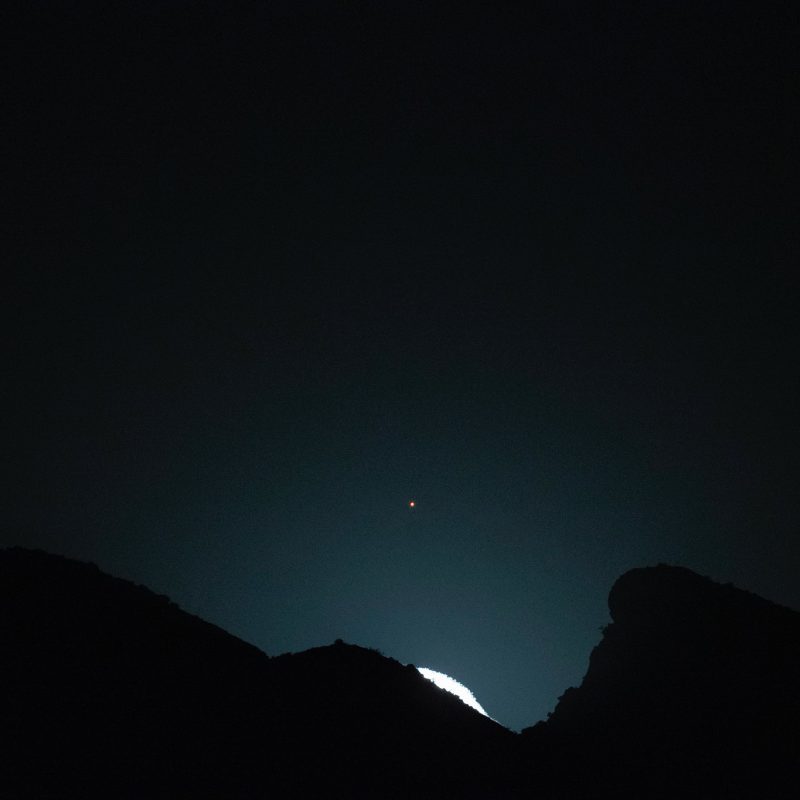
The edge of the bright moon appearing above a ridgeline, with reddish dot of Mars above.

View at EarthSky Community Photos. | Eliot Herman captured this dramatic view of Mars this past weekend, when it was near the moon: “Moon and Mars clearing the ridgeline in Tucson, Arizona. The close conjunction of the moon and bright near-opposition Mars was a striking sight. The terminator of the moon shows the terrain picking up light on the craters and mountains leading to the observed discontinuities [the jagged appearance of the upper edge of the moon].” Thank you, Eliot! See more photos of last weekend’s moon and Mars.

In the year 2018, Mars was brighter than all the stars. It was even brighter than the second-brightest planet, Jupiter. It was a blazing red dot of flame in our night sky for several months. In 2019, Mars was mostly faint. It was barely noticeable in our sky. And now Mars is bright again, brighter than all the stars. It’s not as bright as Jupiter yet, but it will be soon, for about a month surrounding mid-October 2020. Why? Why is Mars bright in some years, but faint in others? And why is Mars brightening so dramatically again now? Keep reading to learn why the appearance of Mars varies so widely in our sky, making Mars one of the most interesting planets to watch! Most importantly, learn how to start watching Mars now, so you can enjoy it for the remainder of this year.

September 2020 is a wonderful time to start watching Mars. It’s rising in the east now not long after the sun goes down. You can’t fail to recognize Mars. It’s very bright, and it’s very red in color. As the weeks go by, Mars will be rising earlier. By mid-October, it’ll be rising in the east as the sun sets in the west. After that, for the remainder of this year, Mars will be in our sky at sunset, fading in brightness as the year draws to a close, but still … a sight to see. To learn how to find Mars in the coming months, bookmark EarthSky’s planet guide.

More than any other bright planet, the appearance of Mars in our night sky changes from year to year. Its dramatic swings in brightness are part of the reason the early stargazers named Mars for their god of war; sometimes, the war god rests, and sometimes he grows fierce! Mars was bright in 2018 and faint again for most of 2019.

Now Mars is bright again.
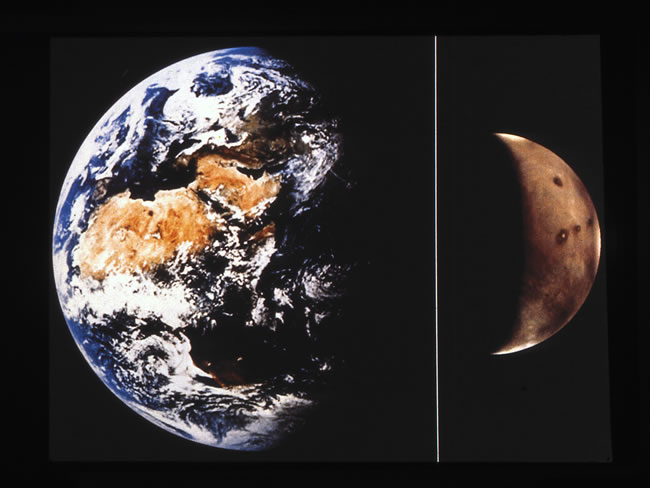
Double photo with large Earth on left and smaller Mars on right, to scale.

Mars isn’t very big, so its brightness – when it is bright – isn’t due to its bigness, as is true of Jupiter. Mars’ brightness, or lack of brightness, is all about how close we are to the red planet. It’s all about where Earth and Mars are, relative to each other, in their respective orbits around the sun. Image via Lunar and Planetary Institute.

Why? Why does Mars sometimes appear very bright, and sometimes very faint?

The first thing to realize is that Mars isn’t a very big world. It’s only 4,219 miles (6,790 km) in diameter, making it only slightly more than half Earth’s size (7,922 miles or 12,750 km in diameter).

The small size of Mars is your first clue to its varying brightness. The small size means that, when Mars is bright, its brightness isn’t due to bigness, as is the case with the largest planet in our solar system, Jupiter.

Instead, the main reason for Mars’ extremes in brightness has to do with its nearness (or lack of nearness) to Earth.
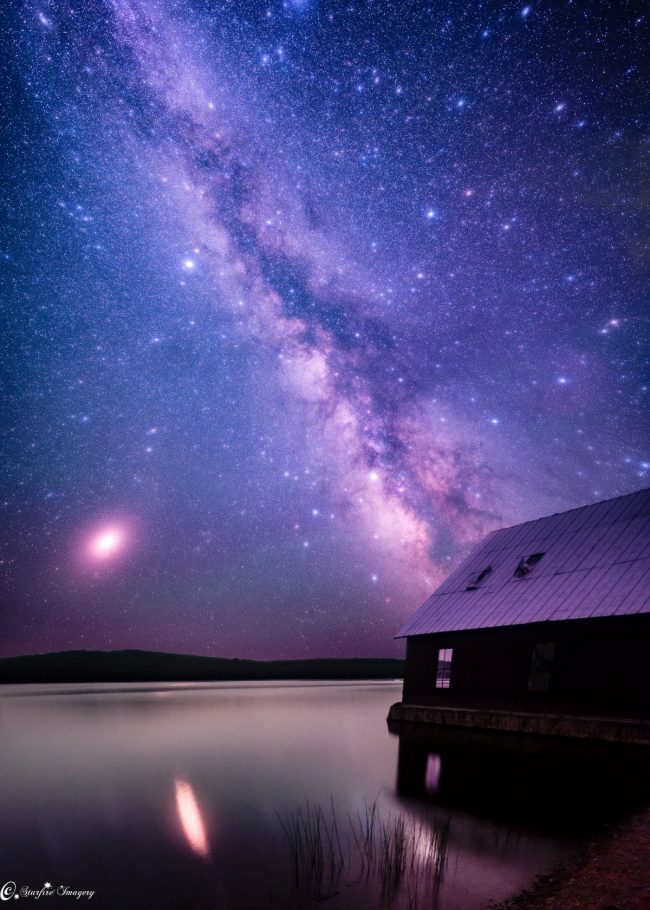
Long exposure with big dot of Mars and its reflection in a lake, and Milky Way soaring above.

Matt Pollack captured Mars from Little Tupper Lake in the Adirondacks of upstate New York in July 2018. Read more about this photo.

Mars orbits the sun one step outward from Earth. The distances between Earth and Mars change as both worlds orbit around the sun. Sometimes Earth and Mars are on the same side of the solar system, and hence near one another. At other times, as it was for much of 2017 and was again for much of 2019, Mars was moving on the opposite side of the solar system from Earth.

Look at the diagrams below, which show Earth and Mars in their respective orbits around the sun in mid-2018 and this month, June 2020 … and then in October 2020, when Earth and Mars will be closest for this two-year period.
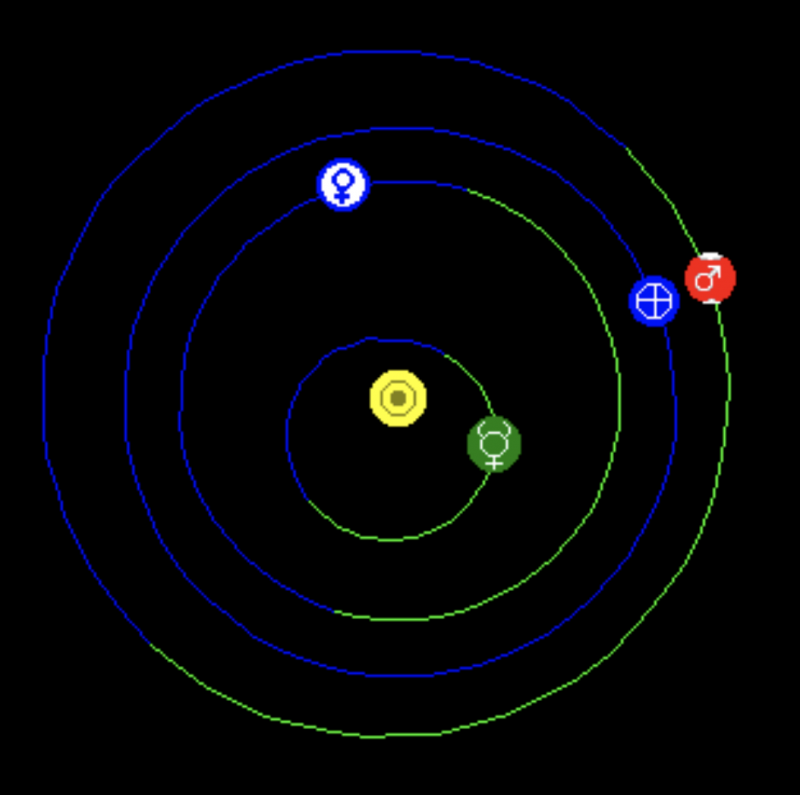
Large heliocentric chart showing concentric planetary orbits with positions of planets October 13, 2020.

This chart shows the relative positions of Earth (blue) and Mars (red) at the time of Mars’ coming opposition on October 13, 2020. Around that time, Mars will appear bright in our sky again – and in the sky all night long – but it won’t be as bright as it was in 2018. Image via Fourmilab.

Earth takes a year to orbit the sun once. Mars takes about two years to orbit once. Opposition for Mars – when Earth passes between Mars and the sun – happens every two years and 50 days.

So Mars’ brightness waxes and wanes in our sky about every two years. Because of this, 2018 was a very, very special year for Mars, when the planet was brighter than it had been since 2003. Astronomers called it a perihelic opposition (or perihelic apparition) of Mars. In other words, in 2018, we went between Mars and the sun – bringing Mars to opposition in our sky – around the same time Mars came closest to the sun. The word perihelion refers to Mars’ closest point to the sun in orbit.

Maybe you can see that – in years when we pass between Mars and the sun, when Mars is also closest to the sun – Earth and Mars are closest. That’s what happened in 2018.

2003 was the previous perihelic opposition for Mars. The red planet came within 34.6 million miles (55.7 million km) of Earth, closer than at any time in over nearly 60,000 years! That was really something.
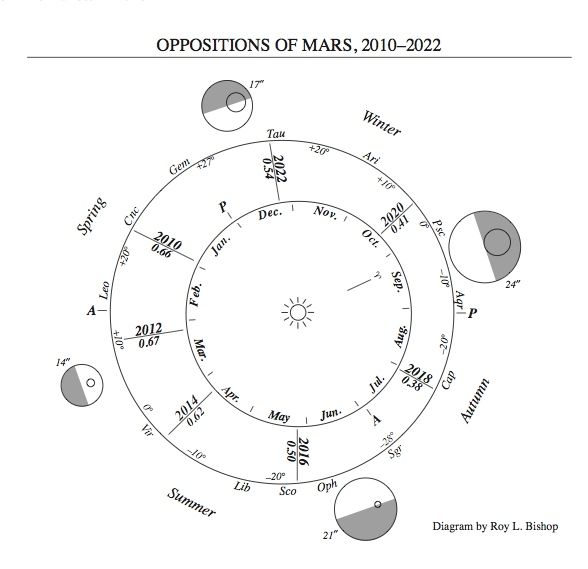
Earth's and Mars' orbits with Mars in different sizes at different points around its orbit.

There’s a 15-year cycle of Mars, whereby the red planet is brighter and fainter at opposition. In July 2018, we were at the peak of the 2-year cycle – and the peak of the 15-year cycle – and Mars was very, very bright! In 2020, we’re at the peak of the 2-year cycle, and Earth and Mars are farther apart at Mars’ opposition than they were in 2018. Still, 2020’s opposition of Mars is excellent. Diagram by Roy L. Bishop. Copyright Royal Astronomical Society of Canada. Used with permission. Visit the RASC estore to purchase the Observer’s Handbook, a necessary tool for all skywatchers. Read more about this image.

And now? Earth will pass between Mars and the sun next on October 13, 2020. The red planet will appear brightest in our sky – very bright indeed and fiery red – around that time.

And thus Mars alternates years in being bright in our sky, or faint. 2019 was a dull year, but 2020 is an exciting one, for Mars!

Now is the time to start watching Mars. When you spot it, keep your eye on its, and enjoy its growing brightness. And think what’s causing the brightness change: our own Earth, rushing along in our smaller, faster orbit, trying to catch up.

Watch for Mars!
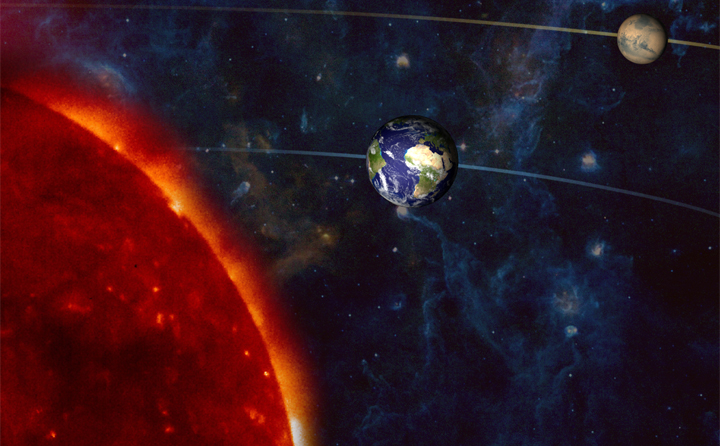
Sun, Earth, Mars lined up with orbits shown.

Artist’s concept of Earth (3rd planet from the sun) passing between the sun and Mars (4th planet from the sun). Not to scale. This is Mars’ opposition, when it appears opposite the sun in our sky. Image via NASA.

Bottom line: Mars alternates years in appearing bright and faint in our night sky. In 2018, our view of Mars was the best since 2003! In 2019, we were in one of Mars’ faint years. But 2020 has brought another bright year for Mars. If you start watching Mars in September 2020, you can see it at its best and enjoy it for the remaining months of this year.

Photos of bright Mars in 2018, from the EarthSky community


from EarthSky https://ift.tt/2Puo0em
The edge of the bright moon appearing above a ridgeline, with reddish dot of Mars above.

View at EarthSky Community Photos. | Eliot Herman captured this dramatic view of Mars this past weekend, when it was near the moon: “Moon and Mars clearing the ridgeline in Tucson, Arizona. The close conjunction of the moon and bright near-opposition Mars was a striking sight. The terminator of the moon shows the terrain picking up light on the craters and mountains leading to the observed discontinuities [the jagged appearance of the upper edge of the moon].” Thank you, Eliot! See more photos of last weekend’s moon and Mars.

In the year 2018, Mars was brighter than all the stars. It was even brighter than the second-brightest planet, Jupiter. It was a blazing red dot of flame in our night sky for several months. In 2019, Mars was mostly faint. It was barely noticeable in our sky. And now Mars is bright again, brighter than all the stars. It’s not as bright as Jupiter yet, but it will be soon, for about a month surrounding mid-October 2020. Why? Why is Mars bright in some years, but faint in others? And why is Mars brightening so dramatically again now? Keep reading to learn why the appearance of Mars varies so widely in our sky, making Mars one of the most interesting planets to watch! Most importantly, learn how to start watching Mars now, so you can enjoy it for the remainder of this year.

September 2020 is a wonderful time to start watching Mars. It’s rising in the east now not long after the sun goes down. You can’t fail to recognize Mars. It’s very bright, and it’s very red in color. As the weeks go by, Mars will be rising earlier. By mid-October, it’ll be rising in the east as the sun sets in the west. After that, for the remainder of this year, Mars will be in our sky at sunset, fading in brightness as the year draws to a close, but still … a sight to see. To learn how to find Mars in the coming months, bookmark EarthSky’s planet guide.

More than any other bright planet, the appearance of Mars in our night sky changes from year to year. Its dramatic swings in brightness are part of the reason the early stargazers named Mars for their god of war; sometimes, the war god rests, and sometimes he grows fierce! Mars was bright in 2018 and faint again for most of 2019.

Now Mars is bright again.

Double photo with large Earth on left and smaller Mars on right, to scale.

Mars isn’t very big, so its brightness – when it is bright – isn’t due to its bigness, as is true of Jupiter. Mars’ brightness, or lack of brightness, is all about how close we are to the red planet. It’s all about where Earth and Mars are, relative to each other, in their respective orbits around the sun. Image via Lunar and Planetary Institute.

Why? Why does Mars sometimes appear very bright, and sometimes very faint?

The first thing to realize is that Mars isn’t a very big world. It’s only 4,219 miles (6,790 km) in diameter, making it only slightly more than half Earth’s size (7,922 miles or 12,750 km in diameter).

The small size of Mars is your first clue to its varying brightness. The small size means that, when Mars is bright, its brightness isn’t due to bigness, as is the case with the largest planet in our solar system, Jupiter.

Instead, the main reason for Mars’ extremes in brightness has to do with its nearness (or lack of nearness) to Earth.

Long exposure with big dot of Mars and its reflection in a lake, and Milky Way soaring above.

Matt Pollack captured Mars from Little Tupper Lake in the Adirondacks of upstate New York in July 2018. Read more about this photo.

Mars orbits the sun one step outward from Earth. The distances between Earth and Mars change as both worlds orbit around the sun. Sometimes Earth and Mars are on the same side of the solar system, and hence near one another. At other times, as it was for much of 2017 and was again for much of 2019, Mars was moving on the opposite side of the solar system from Earth.

Look at the diagrams below, which show Earth and Mars in their respective orbits around the sun in mid-2018 and this month, June 2020 … and then in October 2020, when Earth and Mars will be closest for this two-year period.

Large heliocentric chart showing concentric planetary orbits with positions of planets October 13, 2020.

This chart shows the relative positions of Earth (blue) and Mars (red) at the time of Mars’ coming opposition on October 13, 2020. Around that time, Mars will appear bright in our sky again – and in the sky all night long – but it won’t be as bright as it was in 2018. Image via Fourmilab.

Earth takes a year to orbit the sun once. Mars takes about two years to orbit once. Opposition for Mars – when Earth passes between Mars and the sun – happens every two years and 50 days.

So Mars’ brightness waxes and wanes in our sky about every two years. Because of this, 2018 was a very, very special year for Mars, when the planet was brighter than it had been since 2003. Astronomers called it a perihelic opposition (or perihelic apparition) of Mars. In other words, in 2018, we went between Mars and the sun – bringing Mars to opposition in our sky – around the same time Mars came closest to the sun. The word perihelion refers to Mars’ closest point to the sun in orbit.

Maybe you can see that – in years when we pass between Mars and the sun, when Mars is also closest to the sun – Earth and Mars are closest. That’s what happened in 2018.

2003 was the previous perihelic opposition for Mars. The red planet came within 34.6 million miles (55.7 million km) of Earth, closer than at any time in over nearly 60,000 years! That was really something.

Earth's and Mars' orbits with Mars in different sizes at different points around its orbit.

There’s a 15-year cycle of Mars, whereby the red planet is brighter and fainter at opposition. In July 2018, we were at the peak of the 2-year cycle – and the peak of the 15-year cycle – and Mars was very, very bright! In 2020, we’re at the peak of the 2-year cycle, and Earth and Mars are farther apart at Mars’ opposition than they were in 2018. Still, 2020’s opposition of Mars is excellent. Diagram by Roy L. Bishop. Copyright Royal Astronomical Society of Canada. Used with permission. Visit the RASC estore to purchase the Observer’s Handbook, a necessary tool for all skywatchers. Read more about this image.

And now? Earth will pass between Mars and the sun next on October 13, 2020. The red planet will appear brightest in our sky – very bright indeed and fiery red – around that time.

And thus Mars alternates years in being bright in our sky, or faint. 2019 was a dull year, but 2020 is an exciting one, for Mars!

Now is the time to start watching Mars. When you spot it, keep your eye on its, and enjoy its growing brightness. And think what’s causing the brightness change: our own Earth, rushing along in our smaller, faster orbit, trying to catch up.

Watch for Mars!

Sun, Earth, Mars lined up with orbits shown.

Artist’s concept of Earth (3rd planet from the sun) passing between the sun and Mars (4th planet from the sun). Not to scale. This is Mars’ opposition, when it appears opposite the sun in our sky. Image via NASA.

Bottom line: Mars alternates years in appearing bright and faint in our night sky. In 2018, our view of Mars was the best since 2003! In 2019, we were in one of Mars’ faint years. But 2020 has brought another bright year for Mars. If you start watching Mars in September 2020, you can see it at its best and enjoy it for the remaining months of this year.

Photos of bright Mars in 2018, from the EarthSky community


from EarthSky https://ift.tt/2Puo0em

Moon, Aldebaran, Pleiades late night September 7 to 9

Late at night on September 7, 8 and 9, 2020, watch as the waning gibbous moon sweeps in front of the constellation Taurus the Bull. You’ll be looking around midnight, or afterwards. The bright moon might make it tough to see the starlit figure of the Bull on these nights. But you should be able to make out Aldebaran, Taurus’ brightest star, as well as the tiny, misty, dipper-shaped Pleiades star cluster.

Then, when the moon moves away, look for the V-shaped Face of the Bull itself. The bright star Aldebaran marks one tip of the V.

Taurus is a far-northern constellation of the zodiac. That fact causes these stars to rise at an earlier hour in the Northern Hemisphere than in the Southern Hemisphere. The farther north you live, the earlier Taurus climbs above your northeast horizon. The farther south you live, the later Taurus comes up.

Also, if you’re not one to stay up late, know that you can view the moon in Taurus before sunup on September 8, 9 and 10. Then they will be higher in the sky.

Want to see your specific sky view? Try Stellarium online

Or visit Sunrise Sunset Calendars, being sure to check the moonrise and moonset box, to find out when the moon rises into your sky.

Bright moon, large lunar halo, bright red star and star cluster.

View at EarthSky Community Photos. | Our friend Dr Ski in the Philippines caught the moon and Pleiades (the little cluster in the moon’s glare, at around 8 o’clock) on the morning of September 20, 2019, when they were in conjunction (same right ascension on the celestial sphere). You can also see Aldebaran here, the bright red star at about 5 o’clock. And a lunar halo! Thanks, Dr Ski!

When the moon travels in front of Taurus (or any constellation of the zodiac, for that matter), the moon can travel anywhere from 5 degrees north to 5 degrees south of the ecliptic.

A little over two years ago – on September 3, 2018 – the moon occulted (passed in front of) Aldebaran, presenting the final occultation of a monthly occultation series that started on January 29, 2015. But month by month, for the next few years, the moon’s trajectory will carry the moon farther north of Aldebaran yet closer to Alcyone, the Pleiades’ brightest star.

Then the monthly occultation series involving the moon and the Pleiades star Alcyone will begin on September 5, 2023, and conclude on July 7, 2029.

Sky diagram with arrow pointing from Orion to Aldebaran and the Pleiades.

When the moon moves away, try this. The 3 stars of Orion’s Belt always point to the star Aldebaran and the Pleiades star cluster. Image via Janne/Flickr.

For the Skidi Pawnee in the American Great Plains (Nebraska), the Pleiades cluster served as an important calendar marker. When they saw the Pleiades cluster through the smoke holes of their lodges just before dawn, they knew it was time to harvest the crops.

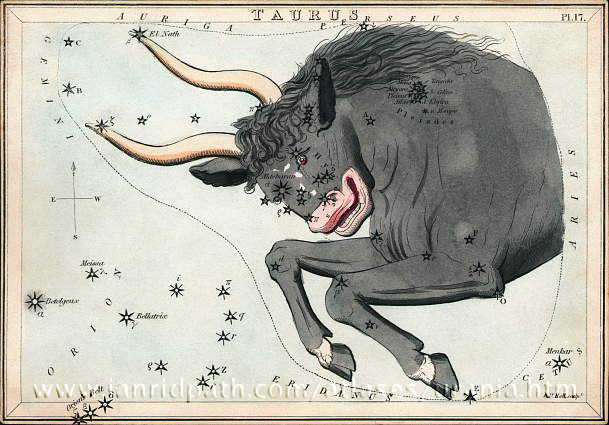
Antique etching of fierce bull with curved horns and stars shown.

Taurus the Bull via Urania’s Mirror/© Ian Ridpath.

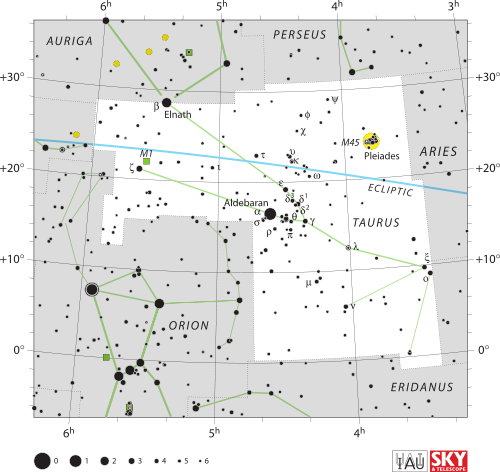
Star chart of constellation Taurus with Aldebaran and Pleiades marked prominently.

The ecliptic – the sun’s yearly path through the constellations of the Zodiac – passes through the constellation Taurus the Bull, to the north of the star Aldebaran and to the south of the Pleiades star cluster. The sun shines in front of Taurus from about May 14 to June 21, every year.

Bottom line: Are you a night owl? Before bedtime on September 7, 8 and 9, 2020, look eastward for the moon, which shines in front of the constellation Taurus the Bull.


from EarthSky https://ift.tt/2M1Icmj

Late at night on September 7, 8 and 9, 2020, watch as the waning gibbous moon sweeps in front of the constellation Taurus the Bull. You’ll be looking around midnight, or afterwards. The bright moon might make it tough to see the starlit figure of the Bull on these nights. But you should be able to make out Aldebaran, Taurus’ brightest star, as well as the tiny, misty, dipper-shaped Pleiades star cluster.

Then, when the moon moves away, look for the V-shaped Face of the Bull itself. The bright star Aldebaran marks one tip of the V.

Taurus is a far-northern constellation of the zodiac. That fact causes these stars to rise at an earlier hour in the Northern Hemisphere than in the Southern Hemisphere. The farther north you live, the earlier Taurus climbs above your northeast horizon. The farther south you live, the later Taurus comes up.

Also, if you’re not one to stay up late, know that you can view the moon in Taurus before sunup on September 8, 9 and 10. Then they will be higher in the sky.

Want to see your specific sky view? Try Stellarium online

Or visit Sunrise Sunset Calendars, being sure to check the moonrise and moonset box, to find out when the moon rises into your sky.

Bright moon, large lunar halo, bright red star and star cluster.

View at EarthSky Community Photos. | Our friend Dr Ski in the Philippines caught the moon and Pleiades (the little cluster in the moon’s glare, at around 8 o’clock) on the morning of September 20, 2019, when they were in conjunction (same right ascension on the celestial sphere). You can also see Aldebaran here, the bright red star at about 5 o’clock. And a lunar halo! Thanks, Dr Ski!

When the moon travels in front of Taurus (or any constellation of the zodiac, for that matter), the moon can travel anywhere from 5 degrees north to 5 degrees south of the ecliptic.

A little over two years ago – on September 3, 2018 – the moon occulted (passed in front of) Aldebaran, presenting the final occultation of a monthly occultation series that started on January 29, 2015. But month by month, for the next few years, the moon’s trajectory will carry the moon farther north of Aldebaran yet closer to Alcyone, the Pleiades’ brightest star.

Then the monthly occultation series involving the moon and the Pleiades star Alcyone will begin on September 5, 2023, and conclude on July 7, 2029.

Sky diagram with arrow pointing from Orion to Aldebaran and the Pleiades.

When the moon moves away, try this. The 3 stars of Orion’s Belt always point to the star Aldebaran and the Pleiades star cluster. Image via Janne/Flickr.

For the Skidi Pawnee in the American Great Plains (Nebraska), the Pleiades cluster served as an important calendar marker. When they saw the Pleiades cluster through the smoke holes of their lodges just before dawn, they knew it was time to harvest the crops.

Antique etching of fierce bull with curved horns and stars shown.

Taurus the Bull via Urania’s Mirror/© Ian Ridpath.

Star chart of constellation Taurus with Aldebaran and Pleiades marked prominently.

The ecliptic – the sun’s yearly path through the constellations of the Zodiac – passes through the constellation Taurus the Bull, to the north of the star Aldebaran and to the south of the Pleiades star cluster. The sun shines in front of Taurus from about May 14 to June 21, every year.

Bottom line: Are you a night owl? Before bedtime on September 7, 8 and 9, 2020, look eastward for the moon, which shines in front of the constellation Taurus the Bull.


from EarthSky https://ift.tt/2M1Icmj

Photos of the moon’s sweep past bright Mars

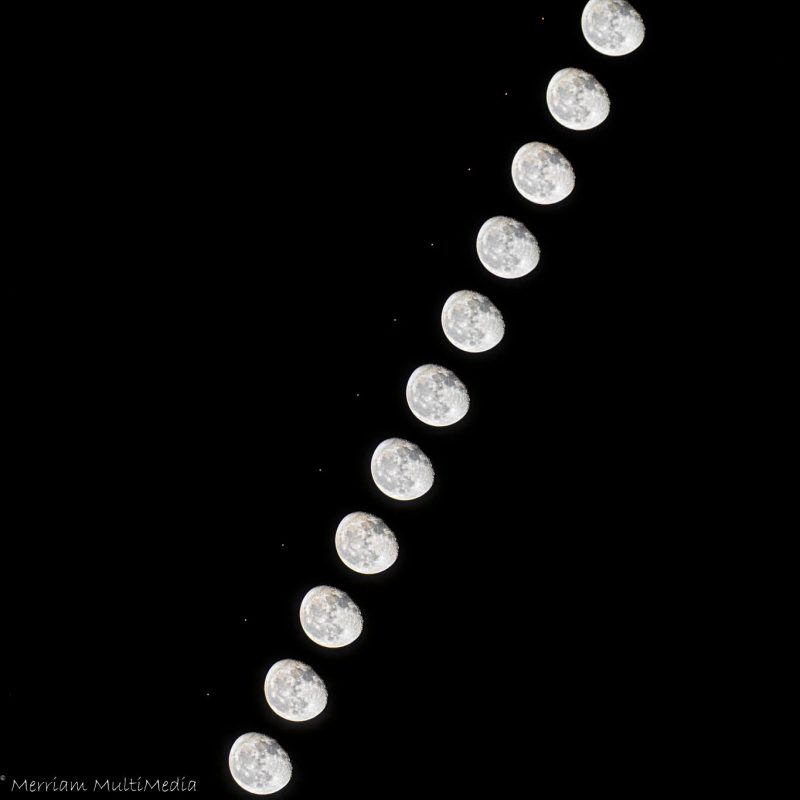
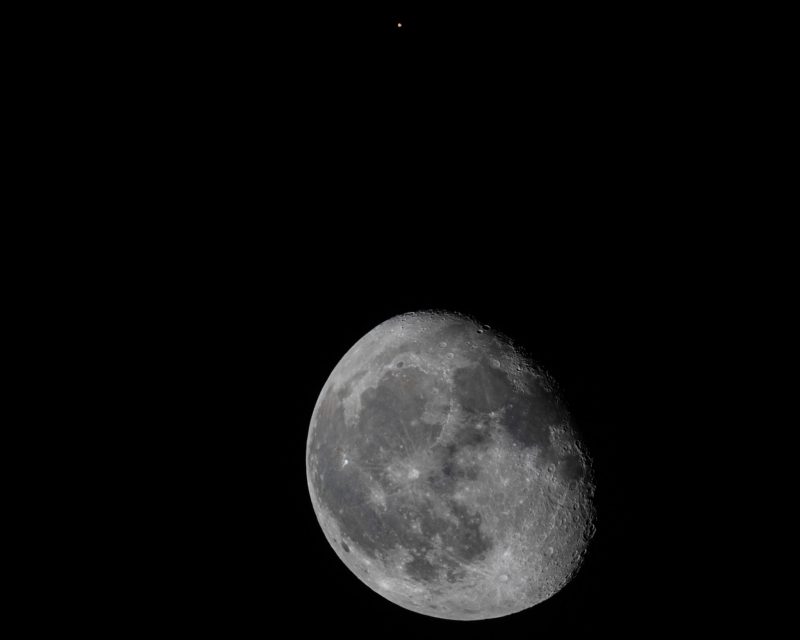
Multiple images of the waning gibbous moon and Mars.

View at EarthSky Community Photos. | John Merriam in St Augustine, Florida captured multiple images of the moon and Mars around midnight on September 6. In these images, Mars is a dot to the left of the moon. John wrote: “Moon and Mars within about 1 degree of one another … This is about a 30-minutes time lapse.” Thank you, John.

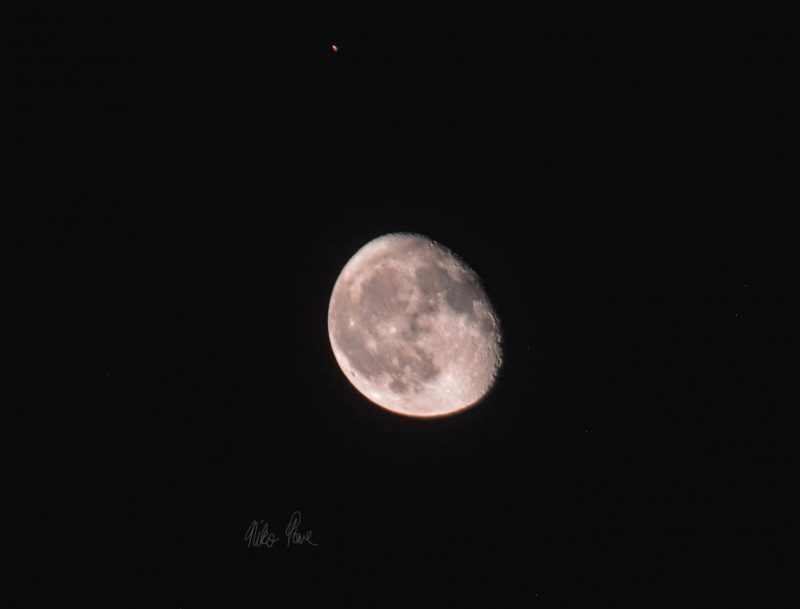
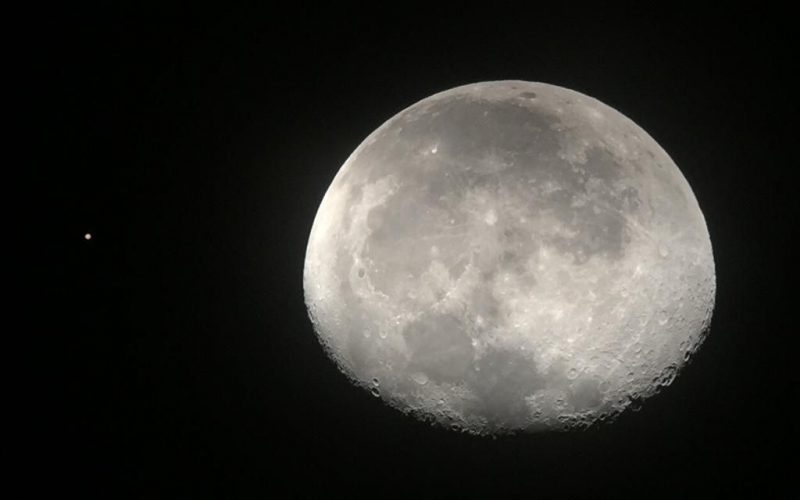
Telescopic image of the waning gibbous moon and Mars.

View at EarthSky Community Photos. | Niko Powe in Kewanee Illinois captured the moon and Mars on September 6 and wrote: “Rising and appeared very close to each other. Commanded that you take a 2nd look! I had to get a shot! Have a blessed day EarthSky Community!” Thank you, Niko!

The moon and Mars over New York City.

View at EarthSky Community Photos. | Alexander Krivenyshev of the website WorldTimeZone.com wrote: “Appulse (very close conjunction) of the moon and Mars over New York City.” Thank you, Alexander.

Telescopic image of the waning gibbous moon and Mars.

View at EarthSky Community Photos. |
Nancy Ricigliano captured the pair just after midnight on September 6, from Long Island, New York. She wrote: “Went in my yard this evening (this morning) to capture Mars close to the moon. It was a perfect night for it.” Thank you, Nancy!

Telescopic image of the waning gibbous moon and Mars.

View at EarthSky Community Photos. | John Van Allen was in Santo Domingo, in the Dominican Republic, when he caught the moon and Mars on September 6. He wrote: “Dodging between clouds, but finally got it.”

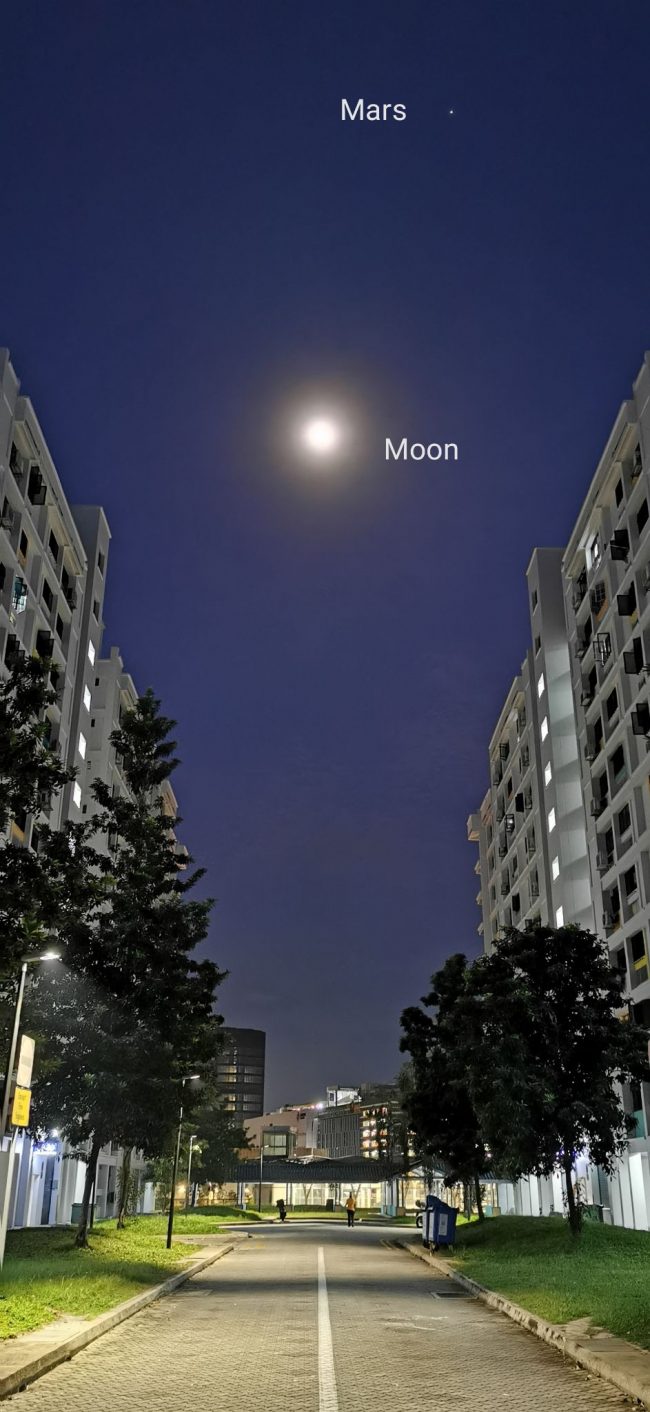
The moon and Mars above buildings in Singapore.

View at EarthSky Community Photos. | Kannan A in Singapore captured the moon and Mars around 6:30 a.m. on September 5, 2020. He wrote: “The waning gibbous moon and planet Mars seen in the morning, descending towards the northwest of Singapore.” Thank you, Kannan A.

Bottom line: Photos of the close sweep of the moon past the red planet Mars on September 5 and 6, 2020. Thanks to all who contributed to EarthSky Community Photos!


from EarthSky https://ift.tt/3bxSruJ
Multiple images of the waning gibbous moon and Mars.

View at EarthSky Community Photos. | John Merriam in St Augustine, Florida captured multiple images of the moon and Mars around midnight on September 6. In these images, Mars is a dot to the left of the moon. John wrote: “Moon and Mars within about 1 degree of one another … This is about a 30-minutes time lapse.” Thank you, John.

Telescopic image of the waning gibbous moon and Mars.

View at EarthSky Community Photos. | Niko Powe in Kewanee Illinois captured the moon and Mars on September 6 and wrote: “Rising and appeared very close to each other. Commanded that you take a 2nd look! I had to get a shot! Have a blessed day EarthSky Community!” Thank you, Niko!

The moon and Mars over New York City.

View at EarthSky Community Photos. | Alexander Krivenyshev of the website WorldTimeZone.com wrote: “Appulse (very close conjunction) of the moon and Mars over New York City.” Thank you, Alexander.

Telescopic image of the waning gibbous moon and Mars.

View at EarthSky Community Photos. |
Nancy Ricigliano captured the pair just after midnight on September 6, from Long Island, New York. She wrote: “Went in my yard this evening (this morning) to capture Mars close to the moon. It was a perfect night for it.” Thank you, Nancy!

Telescopic image of the waning gibbous moon and Mars.

View at EarthSky Community Photos. | John Van Allen was in Santo Domingo, in the Dominican Republic, when he caught the moon and Mars on September 6. He wrote: “Dodging between clouds, but finally got it.”

The moon and Mars above buildings in Singapore.

View at EarthSky Community Photos. | Kannan A in Singapore captured the moon and Mars around 6:30 a.m. on September 5, 2020. He wrote: “The waning gibbous moon and planet Mars seen in the morning, descending towards the northwest of Singapore.” Thank you, Kannan A.

Bottom line: Photos of the close sweep of the moon past the red planet Mars on September 5 and 6, 2020. Thanks to all who contributed to EarthSky Community Photos!


from EarthSky https://ift.tt/3bxSruJ

Cool! Here’s how Venus would look as a water world

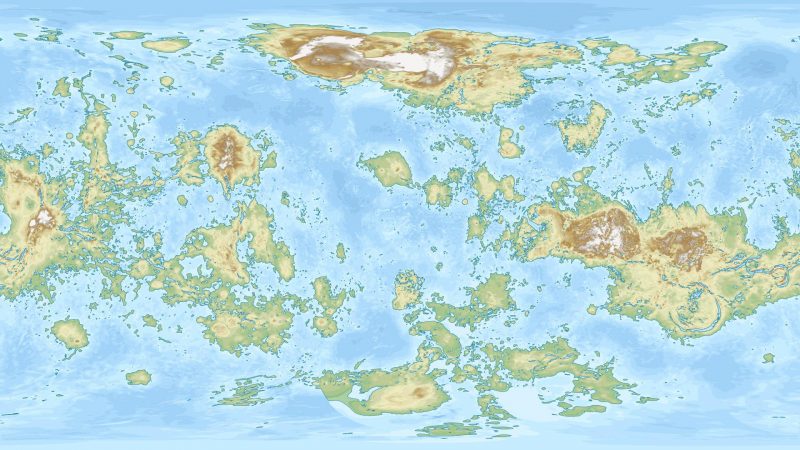
Map with oceans and many small continents and islands.

View larger. | Map by Dragonite-2 on Reddit depicting Venus’ surface as if it had oceans. Image via Dragonite-2/ Reddit.

It’s hot enough on the surface of Venus to melt lead. There are also crushing surface pressures and clouds full of sulfuric acid. So there’s no water on the surface of Venus today. This planet – orbiting next-inward from Earth around the sun – is one of the most inhospitable places in our solar system. But scientists think that, a few billion years ago, Venus might have had oceans, perhaps much like those on Earth. Venus might once have been habitable. Even now, some have suggested terraforming Venus, so that it could become a water world once again in the future. What would Venus look like with water? Reddit user Dragonite-2 has created a map, based on spacecraft data about Venus’ terrain, and posted it to the MapPorn subreddit. It portrays Venus if it were terraformed to become a more Earth-like world, with a similar amount of water to Earth.

The map has now gone viral.

How accurate is it? And what does it show?

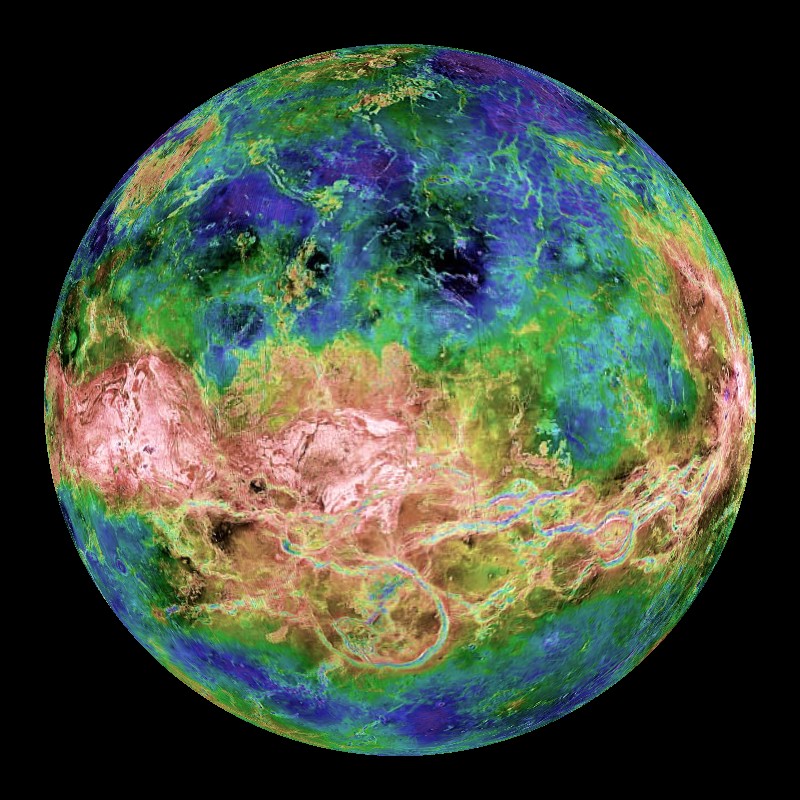
Venus is covered with dense clouds. So we can’t see its surface. But radar – from spacecraft orbiting this world, or (in the early days) from Earth – can penetrate the planet’s clouds and has let scientists make maps of the highs and lows on Venus’ surface. That’s why Venus has a known topography, which Dragonite-2 used to create his map of Venus as a water world. Radar images show us Venus’ mountain ranges, volcanoes, quasi-continental formations and other, flatter regions.

Thus, we’ve known – and now Dragonite-2 has helped us see – that if Venus had an Earth-like quantity of water, it would have one large continent in its northern hemisphere. Scientists have named this continent already; they call it Ishtar Terra. It’s about the size of Australia. The highest point on Venus, the mountain Maxwell Montes, is located on Ishtar Terra. There’s also a second large continent – which scientists call Aphrodite Terra – located along the equator of Venus. It’s the size of South America (if South America were stretched out along Earth’s equator, instead of running perpendicular to it). Dragonite-2’s map also illustrates smaller continents and islands that would be scattered throughout Venus’ global oceans, if Venus were a water world.

False-color map of globe of Venus showing highs and lows of the landscape.

Dragonite-2’s map posted to Reddit is based on spacecraft data. Most of our information about what lies beneath the dense clouds of Venus was obtained by the Soviet space probe missions Venera 15 and 16 and by the American Pioneer Venus and Magellan spacecraft during the period 1978 to 1994. Today we have good information about 98% of the surface of Venus, according to this page from ESO. This map comes from NOAA’s Science on a Sphere. It’s a compilation of Venus radar data, showing Venus’ topography as it’s known today. NOAA wrote: “Most of Venus appears to be covered with gently rolling plains. Two areas rise up above the rest of the surface and are referred to as ‘continents.'”

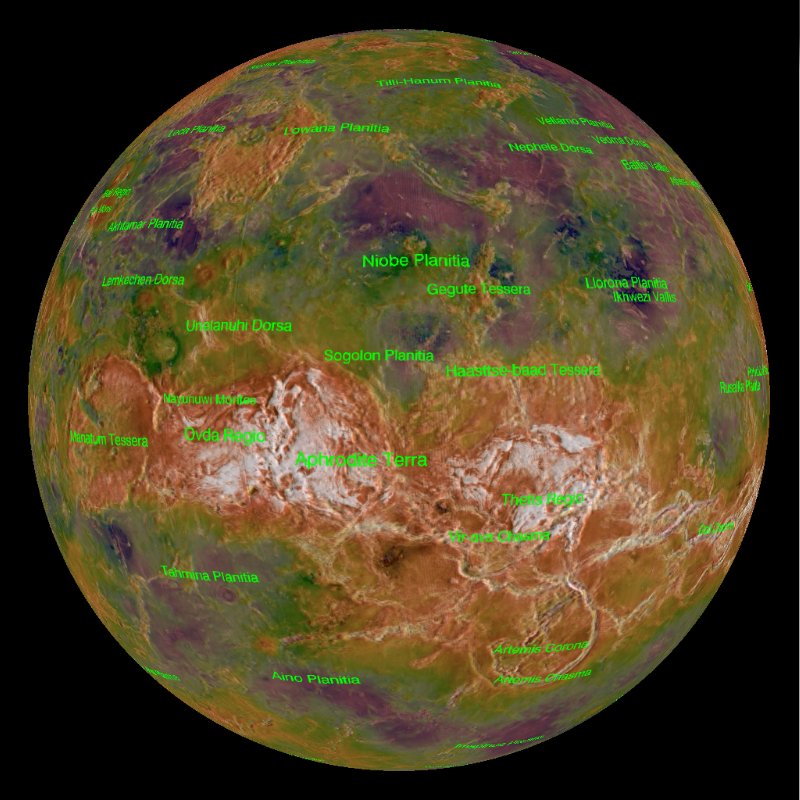
False-color globe of Venus with many features labeled in green showing highs and lows on landscape.

This map of Venus is also via NOAA’s Science on a Sphere. It shows some named features on Venus today, as revealed by radar imaging.

Writing in Inverse on August 29, 2020, Mike Brown described the new Venus-as-water-world map. He quoted an associate professor of planetary sciences at North Carolina State University – Paul Byrne – who told Brown that, in one sense, the map is fairly accurate:

… in that someone has taken the real-world digital elevation model for Venus and added a ‘sea level’ to it.

I don’t know how realistic the ‘if Venus had as much water as Earth’ part is, but I’m guessing that whoever made this map picked an average ocean depth for Earth and ‘flooded’ the Venus topography to that same depth.

However, as Byrne also noted to Brown, the surface would look quite different after erosion by rainfall, rivers and lakes. The map portrays Venus’ surface as-is, without plate tectonics. But a planet with oceans likely would have plate tectonics – the gradual movement of land plates on the planet’s crust, relative to one another – just as Earth does.

And that movement of crustal plates would, of course, affect the configuration of continents and islands.

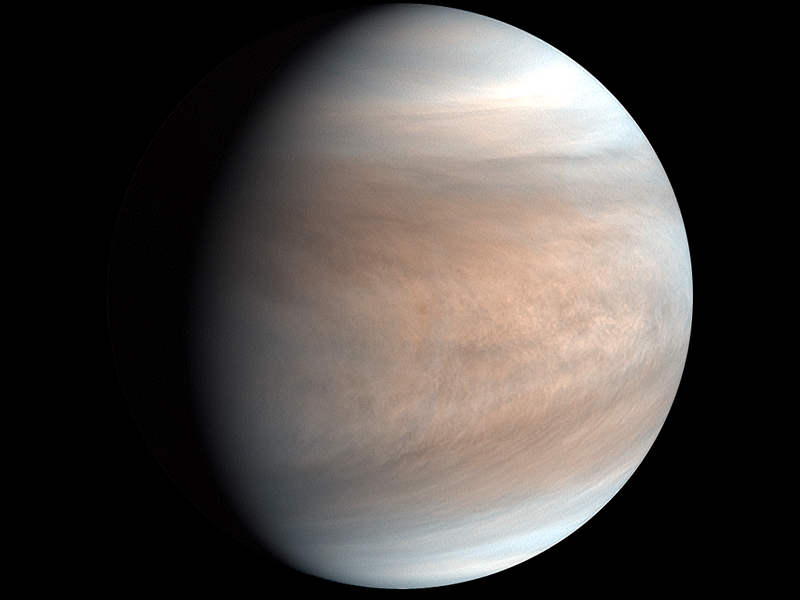
Planet covered by nearly featureless pale pink and gray wispy clouds on black background.

Venus as seen in enhanced color by Japan’s Akatsuki spacecraft. Its surface cannot be seen with the eye alone. It’s completely covered with dense clouds. There’s a wonderful article about real images of Venus via Japan’s Akatsuki spacecraft, at the Planetary Society blog. Akatsuki began orbiting Venus in 2015. The images were put through special processing and released in 2018.

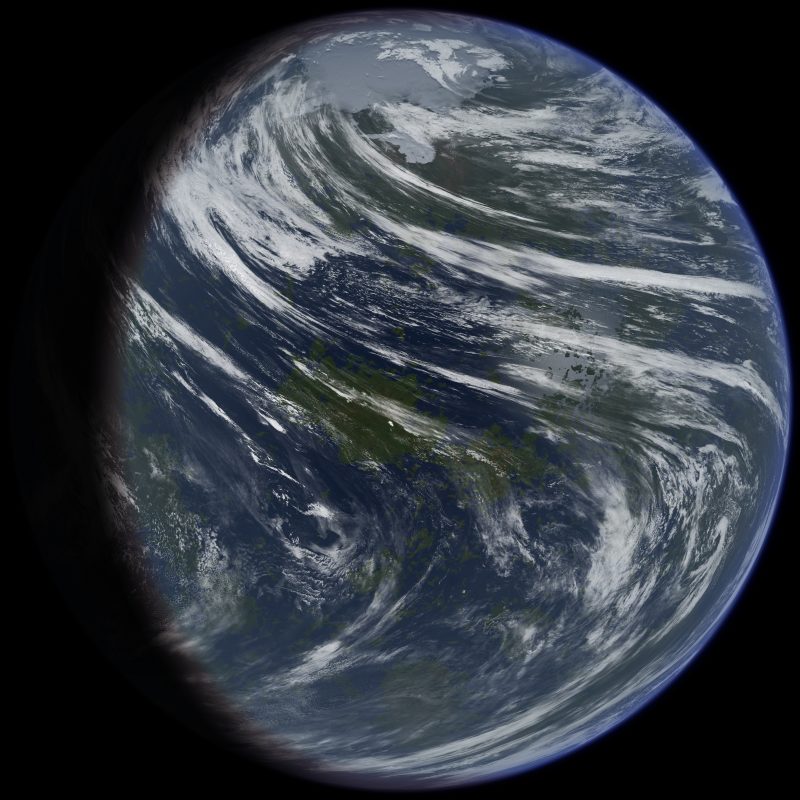
Earth-like planet with white clouds, blue oceans, and dark green continents on black background.

Artist’s concept of what a terraformed Venus might look like, with Earth-like oceans, continents and clouds. Image via Ittiz/ Wikimedia Commons.

But, of course, in another sense, the map of Venus as a water world doesn’t compute under current real-world conditions. As planetary scientist Byrne noted in the Inverse article:

In reality, it’s not remotely realistic.

That’s because of the extreme conditions that exist on Venus today. A watery ocean can’t exist on a world that’s hot enough to melt lead. So the map isn’t accurate in terms of the real planet Venus now. And now is what this map shows. See the contradiction?

Still, Dragonite-2’s map helps us use our imaginations and cast our minds back in time – or forward into the future – when, according to some visionaries, Venus might be a very different place. Byrne was speaking of the past Venus when he said:

Although a Venus with oceans wouldn’t look much like the Reddit image, it is fun to think about what a blue Venus might once have looked like, and why its climate turned into the hellish world it is today.

And we can imagine Venus as a terraformed world, purposely made to be more habitable and Earth-like again. This is a well-known concept for Mars, to transform the dry, cold planet back into a habitable one. Despite the fact that Mars is the most Earthlike world in our solar system, terraforming Mars would be difficult, according to most experts.

But terraforming Venus – a world the same size and density as Earth, but not remotely like Earth on its surface – would be even more difficult.

That hasn’t stopped some people from thinking about it, though. The famed astronomer Carl Sagan was one of the first to propose ways to terraform Venus, back in 1961. Sagan had suggested seeding Venus’ clouds with algae; later, it was determined that wouldn’t work because the atmosphere was found to be too thick. Astronomer Geoffrey Landis mentioned Sagan’s ideas, and the history of terraforming in general, in a paper from 2011.

Below is a short video animation depicting how the surface of Venus might look during a gradual transformation back into a water world:

Of course, the biggest hurdle in terraforming Venus would be in trying to reverse the runaway greenhouse effect that caused the planet to heat up to the extreme temperatures we see today. That wouldn’t be easy. It would require huge amounts of energy and advanced technology. But a terraformed Venus might have some advantages over a terraformed Mars, according to Paul Byrne. As Byrne points out, Venus is almost the same size as Earth, with similar gravity, and it might be easier to remove carbon dioxide – which makes up most of the planet’s atmosphere and causes the greenhouse effect – from its atmosphere to cool the planet, than to add gases to Mars’ thin atmosphere to warm it. Byrne commented:

If we were to terraform anywhere, then I’d pick Venus over Mars. But, to be clear: it’s going to be orders of magnitude more achievable to stop f%#&ing up our own climate here on Earth than trying to make anywhere else even remotely habitable for humans.

Good point.

So – while Dragonite-2’s map in Reddit might not be all that accurate according to scientists – it does give us a reason to think. It provides an interesting glimpse at Venus as we’ve never known it, but which might have existed in the past. And – just maybe – it gives us a vision a world that might exist again in the future.

Not ready to stop thinking about maps and worlds made habitable via terraforming? Dragonite-2 posted another imaginary water-world map on the subreddit MapPorn, a few days after the Venus map. It’s shared below. It shows what Earth’s moon would look like, if it were covered with water. Enjoy!

Another great map that depicts the moon if its had as much water as Earth from r/MapPorn

Bottom line: A cool new map by a Reddit user shows what Venus might look like with oceans on its surface.

Via Reddit’s MapPorn

Via Inverse

Via NOAA’s Science on a Sphere


from EarthSky https://ift.tt/3gZVahD
Map with oceans and many small continents and islands.

View larger. | Map by Dragonite-2 on Reddit depicting Venus’ surface as if it had oceans. Image via Dragonite-2/ Reddit.

It’s hot enough on the surface of Venus to melt lead. There are also crushing surface pressures and clouds full of sulfuric acid. So there’s no water on the surface of Venus today. This planet – orbiting next-inward from Earth around the sun – is one of the most inhospitable places in our solar system. But scientists think that, a few billion years ago, Venus might have had oceans, perhaps much like those on Earth. Venus might once have been habitable. Even now, some have suggested terraforming Venus, so that it could become a water world once again in the future. What would Venus look like with water? Reddit user Dragonite-2 has created a map, based on spacecraft data about Venus’ terrain, and posted it to the MapPorn subreddit. It portrays Venus if it were terraformed to become a more Earth-like world, with a similar amount of water to Earth.

The map has now gone viral.

How accurate is it? And what does it show?

Venus is covered with dense clouds. So we can’t see its surface. But radar – from spacecraft orbiting this world, or (in the early days) from Earth – can penetrate the planet’s clouds and has let scientists make maps of the highs and lows on Venus’ surface. That’s why Venus has a known topography, which Dragonite-2 used to create his map of Venus as a water world. Radar images show us Venus’ mountain ranges, volcanoes, quasi-continental formations and other, flatter regions.

Thus, we’ve known – and now Dragonite-2 has helped us see – that if Venus had an Earth-like quantity of water, it would have one large continent in its northern hemisphere. Scientists have named this continent already; they call it Ishtar Terra. It’s about the size of Australia. The highest point on Venus, the mountain Maxwell Montes, is located on Ishtar Terra. There’s also a second large continent – which scientists call Aphrodite Terra – located along the equator of Venus. It’s the size of South America (if South America were stretched out along Earth’s equator, instead of running perpendicular to it). Dragonite-2’s map also illustrates smaller continents and islands that would be scattered throughout Venus’ global oceans, if Venus were a water world.

False-color map of globe of Venus showing highs and lows of the landscape.

Dragonite-2’s map posted to Reddit is based on spacecraft data. Most of our information about what lies beneath the dense clouds of Venus was obtained by the Soviet space probe missions Venera 15 and 16 and by the American Pioneer Venus and Magellan spacecraft during the period 1978 to 1994. Today we have good information about 98% of the surface of Venus, according to this page from ESO. This map comes from NOAA’s Science on a Sphere. It’s a compilation of Venus radar data, showing Venus’ topography as it’s known today. NOAA wrote: “Most of Venus appears to be covered with gently rolling plains. Two areas rise up above the rest of the surface and are referred to as ‘continents.'”

False-color globe of Venus with many features labeled in green showing highs and lows on landscape.

This map of Venus is also via NOAA’s Science on a Sphere. It shows some named features on Venus today, as revealed by radar imaging.

Writing in Inverse on August 29, 2020, Mike Brown described the new Venus-as-water-world map. He quoted an associate professor of planetary sciences at North Carolina State University – Paul Byrne – who told Brown that, in one sense, the map is fairly accurate:

… in that someone has taken the real-world digital elevation model for Venus and added a ‘sea level’ to it.

I don’t know how realistic the ‘if Venus had as much water as Earth’ part is, but I’m guessing that whoever made this map picked an average ocean depth for Earth and ‘flooded’ the Venus topography to that same depth.

However, as Byrne also noted to Brown, the surface would look quite different after erosion by rainfall, rivers and lakes. The map portrays Venus’ surface as-is, without plate tectonics. But a planet with oceans likely would have plate tectonics – the gradual movement of land plates on the planet’s crust, relative to one another – just as Earth does.

And that movement of crustal plates would, of course, affect the configuration of continents and islands.

Planet covered by nearly featureless pale pink and gray wispy clouds on black background.

Venus as seen in enhanced color by Japan’s Akatsuki spacecraft. Its surface cannot be seen with the eye alone. It’s completely covered with dense clouds. There’s a wonderful article about real images of Venus via Japan’s Akatsuki spacecraft, at the Planetary Society blog. Akatsuki began orbiting Venus in 2015. The images were put through special processing and released in 2018.

Earth-like planet with white clouds, blue oceans, and dark green continents on black background.

Artist’s concept of what a terraformed Venus might look like, with Earth-like oceans, continents and clouds. Image via Ittiz/ Wikimedia Commons.

But, of course, in another sense, the map of Venus as a water world doesn’t compute under current real-world conditions. As planetary scientist Byrne noted in the Inverse article:

In reality, it’s not remotely realistic.

That’s because of the extreme conditions that exist on Venus today. A watery ocean can’t exist on a world that’s hot enough to melt lead. So the map isn’t accurate in terms of the real planet Venus now. And now is what this map shows. See the contradiction?

Still, Dragonite-2’s map helps us use our imaginations and cast our minds back in time – or forward into the future – when, according to some visionaries, Venus might be a very different place. Byrne was speaking of the past Venus when he said:

Although a Venus with oceans wouldn’t look much like the Reddit image, it is fun to think about what a blue Venus might once have looked like, and why its climate turned into the hellish world it is today.

And we can imagine Venus as a terraformed world, purposely made to be more habitable and Earth-like again. This is a well-known concept for Mars, to transform the dry, cold planet back into a habitable one. Despite the fact that Mars is the most Earthlike world in our solar system, terraforming Mars would be difficult, according to most experts.

But terraforming Venus – a world the same size and density as Earth, but not remotely like Earth on its surface – would be even more difficult.

That hasn’t stopped some people from thinking about it, though. The famed astronomer Carl Sagan was one of the first to propose ways to terraform Venus, back in 1961. Sagan had suggested seeding Venus’ clouds with algae; later, it was determined that wouldn’t work because the atmosphere was found to be too thick. Astronomer Geoffrey Landis mentioned Sagan’s ideas, and the history of terraforming in general, in a paper from 2011.

Below is a short video animation depicting how the surface of Venus might look during a gradual transformation back into a water world:

Of course, the biggest hurdle in terraforming Venus would be in trying to reverse the runaway greenhouse effect that caused the planet to heat up to the extreme temperatures we see today. That wouldn’t be easy. It would require huge amounts of energy and advanced technology. But a terraformed Venus might have some advantages over a terraformed Mars, according to Paul Byrne. As Byrne points out, Venus is almost the same size as Earth, with similar gravity, and it might be easier to remove carbon dioxide – which makes up most of the planet’s atmosphere and causes the greenhouse effect – from its atmosphere to cool the planet, than to add gases to Mars’ thin atmosphere to warm it. Byrne commented:

If we were to terraform anywhere, then I’d pick Venus over Mars. But, to be clear: it’s going to be orders of magnitude more achievable to stop f%#&ing up our own climate here on Earth than trying to make anywhere else even remotely habitable for humans.

Good point.

So – while Dragonite-2’s map in Reddit might not be all that accurate according to scientists – it does give us a reason to think. It provides an interesting glimpse at Venus as we’ve never known it, but which might have existed in the past. And – just maybe – it gives us a vision a world that might exist again in the future.

Not ready to stop thinking about maps and worlds made habitable via terraforming? Dragonite-2 posted another imaginary water-world map on the subreddit MapPorn, a few days after the Venus map. It’s shared below. It shows what Earth’s moon would look like, if it were covered with water. Enjoy!

Another great map that depicts the moon if its had as much water as Earth from r/MapPorn

Bottom line: A cool new map by a Reddit user shows what Venus might look like with oceans on its surface.

Via Reddit’s MapPorn

Via Inverse

Via NOAA’s Science on a Sphere


from EarthSky https://ift.tt/3gZVahD

What are brown dwarfs?

Different-sized colored globes with text annotations on black background.

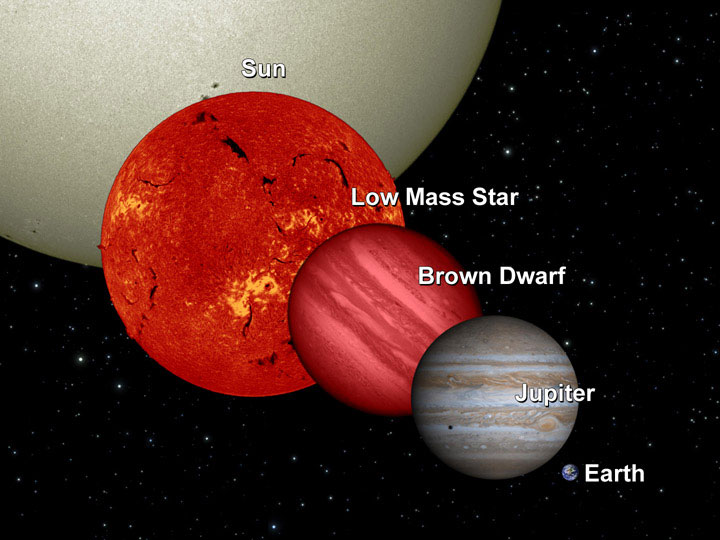
The quality of mass is what separates planets from brown dwarfs from stars. Here’s a general comparison of the masses of each. Image via NASA/ Caltech/ R. Hurt (IPAC).

The amount of mass a star is born with is what determines its fate. Stars are objects born with large masses – and therefore strong self-gravity – so that the star squeezes in on itself, creating high internal temperatures. The high temperatures spark thermonuclear fusion reactions, which enable stars to shine. Planets, on the other hand, have much smaller masses, weaker gravity and no internal fusion; they shine mainly with light reflected from their stars. Brown dwarfs fall somewhere between the masses of giant planets like Saturn and Jupiter, and the smallest stars.

We could speak of brown dwarf masses as fractions of our sun’s mass, but astronomers typically use Jupiter’s mass as a standard measure. A value of 13 Jupiter-masses is considered to be the upper limit for large gas giant planets. Greater than 13 Jupiter-masses, and a simple form of thermonuclear burning (fusing) can occur in the object’s interior – the fusing of deuterium – a rare element leftover from the Big Bang. A value of greater than 80 Jupiter-masses is the lower limit for burning normal hydrogen – the process by which stars are able to shine – and therefore for enabling an object to qualify as a fully-fledged star.

Thus, for convenience and ease of visualization, a brown dwarf is typically defined as any body lying in the range of 13 and 80 Jupiter-masses.

But there’s a lot more to this story …

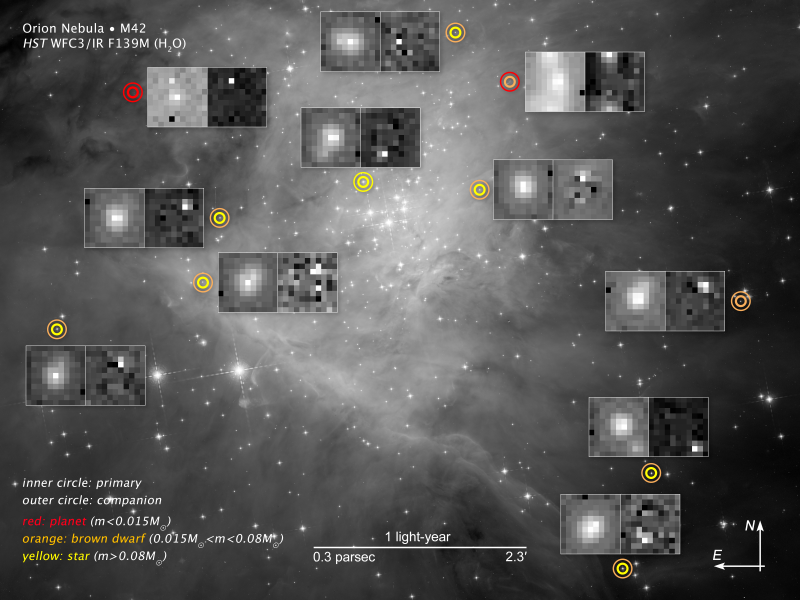
Starry space, with many objects circled and insets showing blown-up views next to them.

View larger. | Brown dwarfs are part of the menagerie of objects found in outer space. This image shows the central portion of the Orion Nebula, a relatively nearby star-forming region in our own Milky Way galaxy. The image shows an area measuring roughly 4 by 3 light-years. Each symbol identifies a pair of objects, seen as a single dot of light in the symbol’s center. The thicker inner circle represents the primary body, and the thinner outer circle indicates the companion. Red indicates a planet; orange a brown dwarf; and yellow a star. Adjacent to each symbol is a pair of Hubble images. The picture on the left is the original image of the primary and companion. The image on the left shows the companion only, with the primary object digitally subtracted through a special image processing technique that separates the images of the objects into binary pairs. Image via HubbleSite.

What is a star?

A star is a large collection of dust and gas that has condensed from a primordial cloud that was disturbed in some way. Various mechanisms can cause the disturbance. For example, the shock wave from a distant supernova – or exploding star – might disturb a primordial cloud in space, centuries or millennia later and many light-years away. The cloud loses its uniformity, and areas with slightly higher density (and thus more gravity) start to attract lighter molecules.

As matter falls into a dense patch in the cloud, it eventually reaches a critical mass; the star starts to fuse deuterium with regular hydrogen, making helium-3 molecules. This occurs at a low temperature (slightly less than 1,000,000 degrees Kelvin or 1,800,000 Fahrenheit).

At the point where fusion begins, we can describe a star differently. Now the star is an object in perfect balance (however temporarily) between the outward-pushing force caused by the fusion reactions in its core, and inward-pushing force of its own self-gravity. Gravity wants to crush a star further, but fusion prevents that from happening. Fusion wants to expand the star, but gravity won’t let it. The result is a fine balance: a star.

If deuterium fusion didn’t take place there would be very few stars in the universe with more than three times the mass of our sun. That’s because – if hydrogen fusion started as soon as the mass and temperature were high enough – the star wouldn’t yet have enough mass for its own self-gravity to resist the outward-pushing pressure of the hydrogen fusion reactions. The star would expand, and this expansion would cause its internal temperature to drop, thus slowing and ultimately ending the hydrogen fusion reactions stars require in order to shine.

Deuterium fusion keeps a star cold enough to allow time for the star to accumulate sufficient mass so that when hydrogen fusion actually starts (around 13,000,000 degrees K or 23,000,000 F), it can continue. By that time, the star is dense enough to have enough self-gravity to resist expansion, so that temperatures stay high in its interior.

Read more: What makes stars shine?

In most cases, you are left with a single major accretion that forms a hydrogen-fusion powered star. It is also possible that in dense clouds a second (binary), third (trinary), or fourth (quaternary) star can evolve. Indeed, there are examples of very complex systems with five, six, and seven stars, called quintenary, sextenary, and septenary, respectively (click each number for examples). These can fall into orbits around each other that (although complex) can still be stable enough to allow planetary formation.

5 differently-colored globes, one immense one labeled sun, three much smaller ones, and one tiny one labeled Earth.

General size comparison between a low mass star, a brown dwarf, and the planet Jupiter. In this image the brown dwarf is shown to be about 15% larger than Jupiter. Image via Wikimedia Commons.

What is a planet?

After stellar formation and the beginning of hydrogen fusion, a solar wind spawns and sweeps the remaining gas out of the system. There will be several minor accretions too bulky to be pushed away by the outward pressure of the solar wind. They will, in fact, fall inward, towards the star.

Since everything in the universe has angular momentum – in other words, since the cloud is rotating or spinning – particles in the initial cloud collecting to form the star will have a tendency to fall in toward the star in a long spiral path. This increases their fall time and thus angular speed, which is why planets end up themselves rotating (spinning) and orbiting their stars generally all in the same direction.

Due to collisions and mutual attractions altering the orbits of the newly forming protoplanets, many will reach an equilibrium point and settle into a stable orbit. These will eventually become true planets – either rocky worlds like Earth or Mars, or gas giants like Jupiter or Saturn – by accreting the remaining small leftovers of the original primordial cloud via their own gravity.

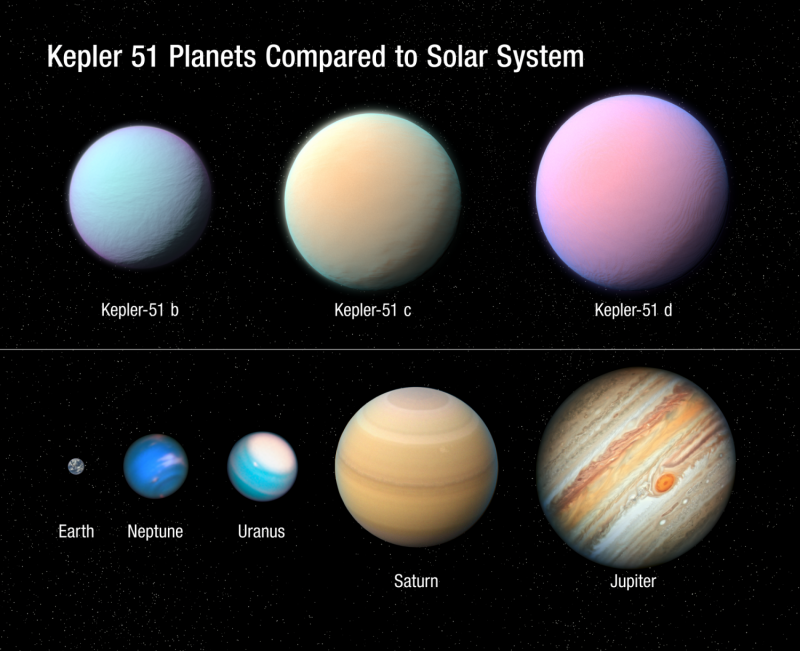
Planets of different sizes and colors on a black background with Earth being much smaller than the others.

Planets are objects with much less mass than stars. Here’s an artist’s concept, showing a comparison of 3 exoplanets in the Kepler-51 system with some of the planets in our own solar system. Image via NASA/ ESA/ STScI/ CU Boulder Today.
What’s the difference between stars and planets?

Stars form from the collapse of gas and dust in a primordial cloud. Consequently, they have a relatively low amount of what astronomers call metals (to astronomers, metallicity refers to any element heavier than hydrogen and helium). Stars usually travel on their own or as part of a loose group of similar objects. They are massive enough to spark hydrogen fusion in their cores.
Planets form by accreting leftovers in the primordial cloud, after the star has collected up the majority of gaseous material. Planets form with much, much less mass than stars, and thus have much weaker gravity. The lighter elements like hydrogen and helium – so common in stars – tend to escape a planet’s weaker gravitational pull. Thus – relative to stars – planets have high metal content. Planets typically orbit stars. By astronomers’ most recent definition of the word planet, they clear their own orbits of debris.

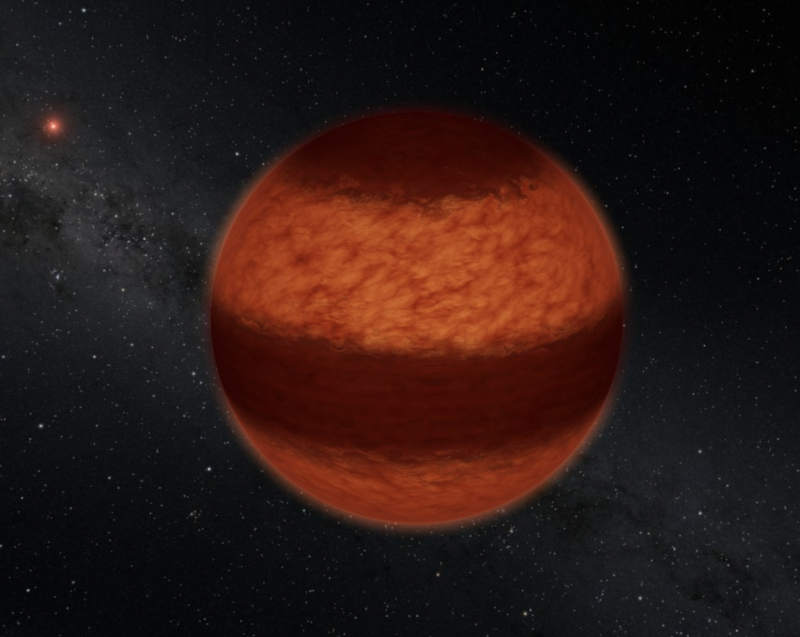
Reddish globe with a wide dark band, and stars in the background.

Of course, we don’t really know what brown dwarfs look like. They’re far away, and we’ve never seen one up close. But here’s an artist’s concept of the brown dwarf called Luhman 16A, basd on recent evidence of Jupiter-like bands on its surface. Image via Caltech/ R. Hurt (IPAC).

Where does that leave brown dwarfs?

Brown dwarfs accumulate material like a star, not like a planet. They condense from a gaseous cloud – and are higher in mass than planets and so have stronger gravity – and thus they hold onto their lighter elements (hydrogen and helium) more effectively than planets and so have a relatively low metal content. Their only failing is that they didn’t collect enough material to begin hydrogen fusion, though they can sustain deuterium fusion until the deuterium is gone, which is actually essential to stellar formation with larger masses, as explained earlier.

Brown dwarfs have been found orbiting other suns at distances of 1,000 astronomical units (AU) or more. One AU = one Earth-sun distance. Not all brown dwarfs orbit far from their stars, however; some have been found orbiting at closer distances, and a few rogue brown dwarfs have been spotted, not orbiting any star, although, of course, these are tough to find!

By contrast, of the known planets in our own solar system, Neptune is the major planet orbiting farthest from our sun at 30 AU.

So brown dwarfs are not planets, and they are failed stars, not massive enough to power hydrogen fusion reactions. Thus they get their own classification.

Why brown?

What we now call brown dwarfs were first proposed to exist in the 1960s by astronomer Shiv S. Kumar, who originally called these objects black dwarfs. He pictured them as dark substellar objects floating freely in space that were not massive enough to sustain hydrogen fusion. The name brown dwarf name was later coined by astronomer and SETI researcher Jill Tarter in her Ph.D. dissertation. She was looking to define an upper limit to the maximum mass an object could possess before beginning hydrogen fusion, and thus becoming a full-fledged star.

Stars are clearly not “brown” and many such objects are in the temperature range of 300 to 500 Kelvin (80 to 440 F, or body temperature for a human being and upwards), so they only radiate in the infrared portion of the electromagnetic spectrum. Since black dwarf was already taken as describing objects at the end point in stellar evolution – and red dwarf also had a role to fulfill, as the name for small, cool stars – brown must have seemed an appropriate compromise.

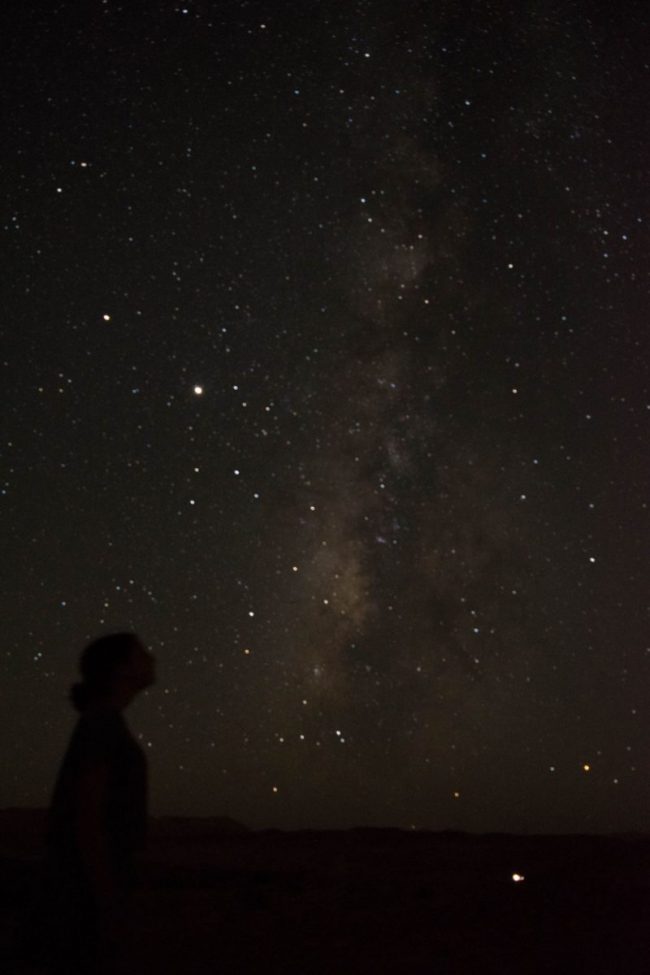
Edgewise view of the summer Milky Way as vertical, pale fuzzy band, on a dark night, with scattered stars.

View at EarthSky Community Photos. | Nisan Gertz captured this image at Ramon Crater, Israel, on August 16, 2020. Thank you, Nisan.

Bottom line: Brown dwarfs are distinct enough to qualify for their own classification. They can be found orbiting fully fledged stars, or other brown dwarfs, or not orbiting any stars. Brown dwarfs must have a certain mass. For convenience and ease of visualization, a brown dwarf is typically defined as any body lying in the range of greater than 13 and less than 80 Jupiter-masses. Now you know!


from EarthSky https://ift.tt/3lPAFrI
Different-sized colored globes with text annotations on black background.

The quality of mass is what separates planets from brown dwarfs from stars. Here’s a general comparison of the masses of each. Image via NASA/ Caltech/ R. Hurt (IPAC).

The amount of mass a star is born with is what determines its fate. Stars are objects born with large masses – and therefore strong self-gravity – so that the star squeezes in on itself, creating high internal temperatures. The high temperatures spark thermonuclear fusion reactions, which enable stars to shine. Planets, on the other hand, have much smaller masses, weaker gravity and no internal fusion; they shine mainly with light reflected from their stars. Brown dwarfs fall somewhere between the masses of giant planets like Saturn and Jupiter, and the smallest stars.

We could speak of brown dwarf masses as fractions of our sun’s mass, but astronomers typically use Jupiter’s mass as a standard measure. A value of 13 Jupiter-masses is considered to be the upper limit for large gas giant planets. Greater than 13 Jupiter-masses, and a simple form of thermonuclear burning (fusing) can occur in the object’s interior – the fusing of deuterium – a rare element leftover from the Big Bang. A value of greater than 80 Jupiter-masses is the lower limit for burning normal hydrogen – the process by which stars are able to shine – and therefore for enabling an object to qualify as a fully-fledged star.

Thus, for convenience and ease of visualization, a brown dwarf is typically defined as any body lying in the range of 13 and 80 Jupiter-masses.

But there’s a lot more to this story …

Starry space, with many objects circled and insets showing blown-up views next to them.

View larger. | Brown dwarfs are part of the menagerie of objects found in outer space. This image shows the central portion of the Orion Nebula, a relatively nearby star-forming region in our own Milky Way galaxy. The image shows an area measuring roughly 4 by 3 light-years. Each symbol identifies a pair of objects, seen as a single dot of light in the symbol’s center. The thicker inner circle represents the primary body, and the thinner outer circle indicates the companion. Red indicates a planet; orange a brown dwarf; and yellow a star. Adjacent to each symbol is a pair of Hubble images. The picture on the left is the original image of the primary and companion. The image on the left shows the companion only, with the primary object digitally subtracted through a special image processing technique that separates the images of the objects into binary pairs. Image via HubbleSite.

What is a star?

A star is a large collection of dust and gas that has condensed from a primordial cloud that was disturbed in some way. Various mechanisms can cause the disturbance. For example, the shock wave from a distant supernova – or exploding star – might disturb a primordial cloud in space, centuries or millennia later and many light-years away. The cloud loses its uniformity, and areas with slightly higher density (and thus more gravity) start to attract lighter molecules.

As matter falls into a dense patch in the cloud, it eventually reaches a critical mass; the star starts to fuse deuterium with regular hydrogen, making helium-3 molecules. This occurs at a low temperature (slightly less than 1,000,000 degrees Kelvin or 1,800,000 Fahrenheit).

At the point where fusion begins, we can describe a star differently. Now the star is an object in perfect balance (however temporarily) between the outward-pushing force caused by the fusion reactions in its core, and inward-pushing force of its own self-gravity. Gravity wants to crush a star further, but fusion prevents that from happening. Fusion wants to expand the star, but gravity won’t let it. The result is a fine balance: a star.

If deuterium fusion didn’t take place there would be very few stars in the universe with more than three times the mass of our sun. That’s because – if hydrogen fusion started as soon as the mass and temperature were high enough – the star wouldn’t yet have enough mass for its own self-gravity to resist the outward-pushing pressure of the hydrogen fusion reactions. The star would expand, and this expansion would cause its internal temperature to drop, thus slowing and ultimately ending the hydrogen fusion reactions stars require in order to shine.

Deuterium fusion keeps a star cold enough to allow time for the star to accumulate sufficient mass so that when hydrogen fusion actually starts (around 13,000,000 degrees K or 23,000,000 F), it can continue. By that time, the star is dense enough to have enough self-gravity to resist expansion, so that temperatures stay high in its interior.

Read more: What makes stars shine?

In most cases, you are left with a single major accretion that forms a hydrogen-fusion powered star. It is also possible that in dense clouds a second (binary), third (trinary), or fourth (quaternary) star can evolve. Indeed, there are examples of very complex systems with five, six, and seven stars, called quintenary, sextenary, and septenary, respectively (click each number for examples). These can fall into orbits around each other that (although complex) can still be stable enough to allow planetary formation.

5 differently-colored globes, one immense one labeled sun, three much smaller ones, and one tiny one labeled Earth.

General size comparison between a low mass star, a brown dwarf, and the planet Jupiter. In this image the brown dwarf is shown to be about 15% larger than Jupiter. Image via Wikimedia Commons.

What is a planet?

After stellar formation and the beginning of hydrogen fusion, a solar wind spawns and sweeps the remaining gas out of the system. There will be several minor accretions too bulky to be pushed away by the outward pressure of the solar wind. They will, in fact, fall inward, towards the star.

Since everything in the universe has angular momentum – in other words, since the cloud is rotating or spinning – particles in the initial cloud collecting to form the star will have a tendency to fall in toward the star in a long spiral path. This increases their fall time and thus angular speed, which is why planets end up themselves rotating (spinning) and orbiting their stars generally all in the same direction.

Due to collisions and mutual attractions altering the orbits of the newly forming protoplanets, many will reach an equilibrium point and settle into a stable orbit. These will eventually become true planets – either rocky worlds like Earth or Mars, or gas giants like Jupiter or Saturn – by accreting the remaining small leftovers of the original primordial cloud via their own gravity.

Planets of different sizes and colors on a black background with Earth being much smaller than the others.

Planets are objects with much less mass than stars. Here’s an artist’s concept, showing a comparison of 3 exoplanets in the Kepler-51 system with some of the planets in our own solar system. Image via NASA/ ESA/ STScI/ CU Boulder Today.

What’s the difference between stars and planets?

Stars form from the collapse of gas and dust in a primordial cloud. Consequently, they have a relatively low amount of what astronomers call metals (to astronomers, metallicity refers to any element heavier than hydrogen and helium). Stars usually travel on their own or as part of a loose group of similar objects. They are massive enough to spark hydrogen fusion in their cores.

Planets form by accreting leftovers in the primordial cloud, after the star has collected up the majority of gaseous material. Planets form with much, much less mass than stars, and thus have much weaker gravity. The lighter elements like hydrogen and helium – so common in stars – tend to escape a planet’s weaker gravitational pull. Thus – relative to stars – planets have high metal content. Planets typically orbit stars. By astronomers’ most recent definition of the word planet, they clear their own orbits of debris.

Reddish globe with a wide dark band, and stars in the background.

Of course, we don’t really know what brown dwarfs look like. They’re far away, and we’ve never seen one up close. But here’s an artist’s concept of the brown dwarf called Luhman 16A, basd on recent evidence of Jupiter-like bands on its surface. Image via Caltech/ R. Hurt (IPAC).

Where does that leave brown dwarfs?

Brown dwarfs accumulate material like a star, not like a planet. They condense from a gaseous cloud – and are higher in mass than planets and so have stronger gravity – and thus they hold onto their lighter elements (hydrogen and helium) more effectively than planets and so have a relatively low metal content. Their only failing is that they didn’t collect enough material to begin hydrogen fusion, though they can sustain deuterium fusion until the deuterium is gone, which is actually essential to stellar formation with larger masses, as explained earlier.

Brown dwarfs have been found orbiting other suns at distances of 1,000 astronomical units (AU) or more. One AU = one Earth-sun distance. Not all brown dwarfs orbit far from their stars, however; some have been found orbiting at closer distances, and a few rogue brown dwarfs have been spotted, not orbiting any star, although, of course, these are tough to find!

By contrast, of the known planets in our own solar system, Neptune is the major planet orbiting farthest from our sun at 30 AU.

So brown dwarfs are not planets, and they are failed stars, not massive enough to power hydrogen fusion reactions. Thus they get their own classification.

Why brown?

What we now call brown dwarfs were first proposed to exist in the 1960s by astronomer Shiv S. Kumar, who originally called these objects black dwarfs. He pictured them as dark substellar objects floating freely in space that were not massive enough to sustain hydrogen fusion. The name brown dwarf name was later coined by astronomer and SETI researcher Jill Tarter in her Ph.D. dissertation. She was looking to define an upper limit to the maximum mass an object could possess before beginning hydrogen fusion, and thus becoming a full-fledged star.

Stars are clearly not “brown” and many such objects are in the temperature range of 300 to 500 Kelvin (80 to 440 F, or body temperature for a human being and upwards), so they only radiate in the infrared portion of the electromagnetic spectrum. Since black dwarf was already taken as describing objects at the end point in stellar evolution – and red dwarf also had a role to fulfill, as the name for small, cool stars – brown must have seemed an appropriate compromise.

Edgewise view of the summer Milky Way as vertical, pale fuzzy band, on a dark night, with scattered stars.

View at EarthSky Community Photos. | Nisan Gertz captured this image at Ramon Crater, Israel, on August 16, 2020. Thank you, Nisan.

Bottom line: Brown dwarfs are distinct enough to qualify for their own classification. They can be found orbiting fully fledged stars, or other brown dwarfs, or not orbiting any stars. Brown dwarfs must have a certain mass. For convenience and ease of visualization, a brown dwarf is typically defined as any body lying in the range of greater than 13 and less than 80 Jupiter-masses. Now you know!


from EarthSky https://ift.tt/3lPAFrI

News digest – larger waistlines and prostate cancer, GP gut instincts and bee venom

Larger waistlines linked to increased risk of dying from prostate cancer 

Men carrying excess weight around their stomach may be more likely to die from prostate cancer, according to new research. The study got a lot of attention in the media this week, but despite many opting forheadlines about ‘beer bellies’, the results have nothing to do with alcohol. Here’s what we had to say:  

“Although the link between obesity and cancer is well established, its role in prostate cancer specifically has been less clear. This large UK study suggests that the body fat around the waist, rather than total body fat could affect the chances of dying from prostate cancer. But both BMI and waist circumference as measures of body fat aren’t perfect, so there’s lots more work to do to untangle this complicated relationship.” – Karis Betts, Cancer Research UK’s health information manager.  

GP intuition ‘key’ in diagnosing cancer 

Many of us will have experienced the familiar sensation of a gut feeling. And new research suggests that GPs may benefit from trusting them, revealing that patients referred to hospital based on their GP’s ‘gut instinct’ were 4 times more likely to have the disease than when no gut feeling was recorded. More on this at The Times (£) and Daily Mail 

Watch cells sniff their way through the Hampton Court Palace maze 

No you’ve not read that wrong – we’re talking about cells in a replica of Hampton Court Palace’s maze. Read more about what our scientists are learning and watch the cells in action at The New Scientist 

World’s major cancer research funders unite  

Great news this week, as we announced a new partnership with the US National Cancer Institute have come to accelerating research into tackling cancer’s greatest challenges. Our press release has more info.  

The changing landscape of children’s cancer treatment  

Head to our blog for the lowdown on two innovative studies dedicated to improving children’s cancer treatment.  

Different cancers go through same genetic mutations 

Some interesting early results from the Francis Crick Institute, as researchers identify how different types of cancer go through some of the same DNA changes over time. The findings could bring scientists closer to understanding how tumours evolve. Read more on this at Daily Mail 

NHS ‘strongly advises’ people to attend cervical screening 

The NHS are reassuring people that it’s safe to take part in screening, after new survey results reveal that women from an ethnic minority background are twice as likely to be worried about contracting coronavirus after attending a doctors surgery than white women. Dr Raj Patel, deputy director of primary care for NHS England, said: “NHS services are safe and people need to come forward for essential care, checks and treatment. I would strongly advise anyone invited for a cervical smear test to attend because screening saves lives.” And if anyone is concerned, it’s worth speaking to your GP practice about COVID safety. The Guardian has the full story.  

And finally 

Honeybees. Or honeybee venom, to be more precise. BBC News have picked up results showing that the venom from honeybees can kill aggressive breast cancer cells in the lab. It’s an exciting development, but scientists caution that it’s early days yet.  

Scarlett Sangster is a writer for PA Media Group


from Cancer Research UK – Science blog https://ift.tt/332CAAq

Larger waistlines linked to increased risk of dying from prostate cancer 

Men carrying excess weight around their stomach may be more likely to die from prostate cancer, according to new research. The study got a lot of attention in the media this week, but despite many opting forheadlines about ‘beer bellies’, the results have nothing to do with alcohol. Here’s what we had to say:  

“Although the link between obesity and cancer is well established, its role in prostate cancer specifically has been less clear. This large UK study suggests that the body fat around the waist, rather than total body fat could affect the chances of dying from prostate cancer. But both BMI and waist circumference as measures of body fat aren’t perfect, so there’s lots more work to do to untangle this complicated relationship.” – Karis Betts, Cancer Research UK’s health information manager.  

GP intuition ‘key’ in diagnosing cancer 

Many of us will have experienced the familiar sensation of a gut feeling. And new research suggests that GPs may benefit from trusting them, revealing that patients referred to hospital based on their GP’s ‘gut instinct’ were 4 times more likely to have the disease than when no gut feeling was recorded. More on this at The Times (£) and Daily Mail 

Watch cells sniff their way through the Hampton Court Palace maze 

No you’ve not read that wrong – we’re talking about cells in a replica of Hampton Court Palace’s maze. Read more about what our scientists are learning and watch the cells in action at The New Scientist 

World’s major cancer research funders unite  

Great news this week, as we announced a new partnership with the US National Cancer Institute have come to accelerating research into tackling cancer’s greatest challenges. Our press release has more info.  

The changing landscape of children’s cancer treatment  

Head to our blog for the lowdown on two innovative studies dedicated to improving children’s cancer treatment.  

Different cancers go through same genetic mutations 

Some interesting early results from the Francis Crick Institute, as researchers identify how different types of cancer go through some of the same DNA changes over time. The findings could bring scientists closer to understanding how tumours evolve. Read more on this at Daily Mail 

NHS ‘strongly advises’ people to attend cervical screening 

The NHS are reassuring people that it’s safe to take part in screening, after new survey results reveal that women from an ethnic minority background are twice as likely to be worried about contracting coronavirus after attending a doctors surgery than white women. Dr Raj Patel, deputy director of primary care for NHS England, said: “NHS services are safe and people need to come forward for essential care, checks and treatment. I would strongly advise anyone invited for a cervical smear test to attend because screening saves lives.” And if anyone is concerned, it’s worth speaking to your GP practice about COVID safety. The Guardian has the full story.  

And finally 

Honeybees. Or honeybee venom, to be more precise. BBC News have picked up results showing that the venom from honeybees can kill aggressive breast cancer cells in the lab. It’s an exciting development, but scientists caution that it’s early days yet.  

Scarlett Sangster is a writer for PA Media Group


from Cancer Research UK – Science blog https://ift.tt/332CAAq

The true polar wander of Jupiter’s moon Europa

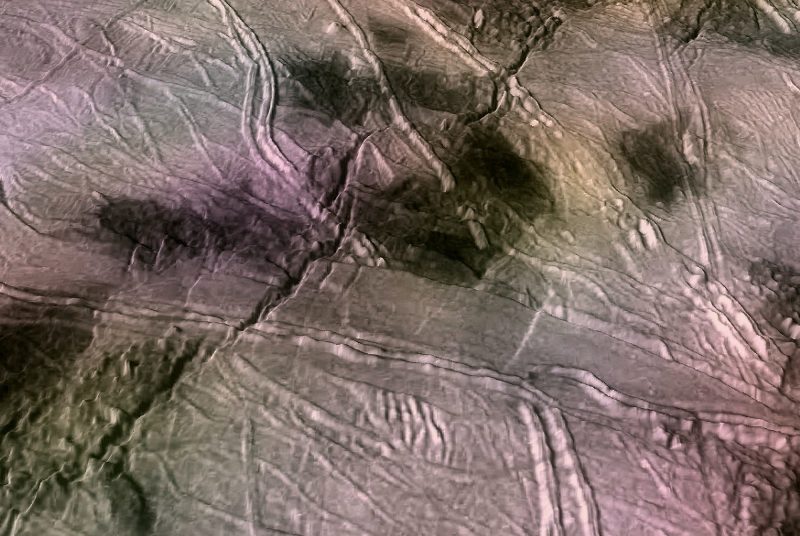
Rough surface covered with cracks and dark blotches.

Fractures on Europa’s icy surface formed during true polar wander. The large crack going from lower left to upper right is about 1.9 miles (3 km) wide and 200 meters deep. Image via P. Schenk/ USRA-LPI.

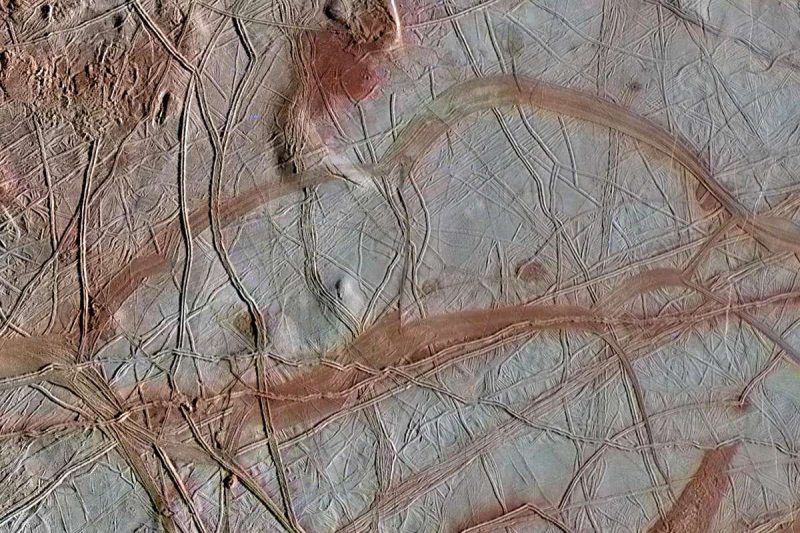
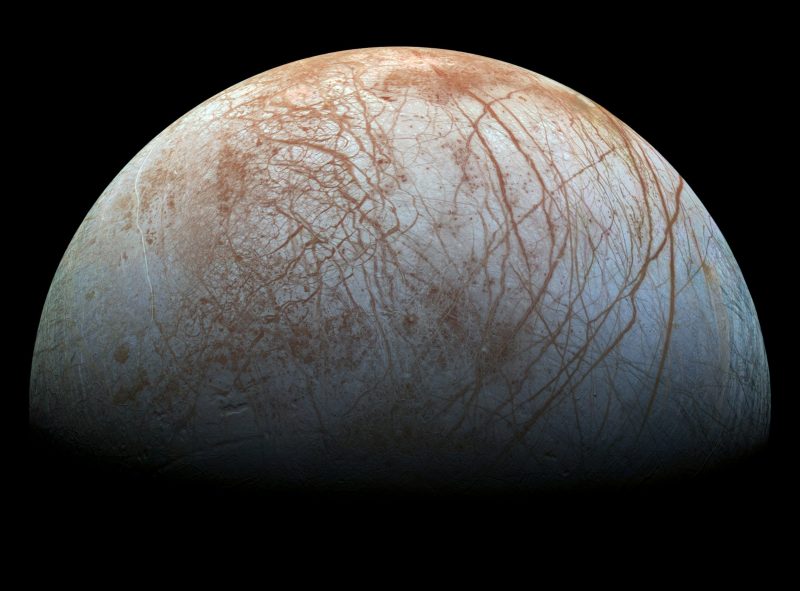
Jupiter’s ocean moon Europa looks a bit like a round cracked egg, with its smooth outer ice crust covered in brownish-stained fissures. Those cracks in Europa’s ice shell record the history of its surface and past geological activity. Now, researchers have announced a new study that’s provided more clues as to how the moon’s surface has changed over the last several million years. Its major finding: Europa’s poles are no longer where they used to be. As a whole, the jovian moon’s icy shell has shifted and re-oriented itself by as much as 70 degrees, close to a quarter of the way around a complete circle. This re-orientation of the outer ice shell is called true polar wander. The researchers say such a shift would be expected of a world whose outer crust lies above a hidden, subsurface ocean.

The conclusion helps confirm earlier hints of shifts in Europa’s crust. The new work is based on an analysis of global-scale circular patterns in Europa’s surface ice. This massive crustal shift is thought to be one of the most recent major geologic events to have occurred on Europa’s young surface.

The intriguing peer-reviewed findings were published on July 29, 2020 in Geophysical Research Letters. The research comes from the Universities Space Research Association – based in Columbia, Maryland – and the Lunar and Planetary Institute in Houston.

As explained in the paper:

The large icy ocean world of Europa has a very young surface that has been highly deformed. Recent evidence for ‘polar wander,’ or reorientation of the floating outer ice shell away from its original orientation, has been confirmed by the recognition that long fissures are part of the polar wander tectonic pattern and are among the youngest features on the planet. This means that polar wander occurred very recently and that older features are no longer in their original locations and will require a complete reassessment of Europa’s tectonic history.

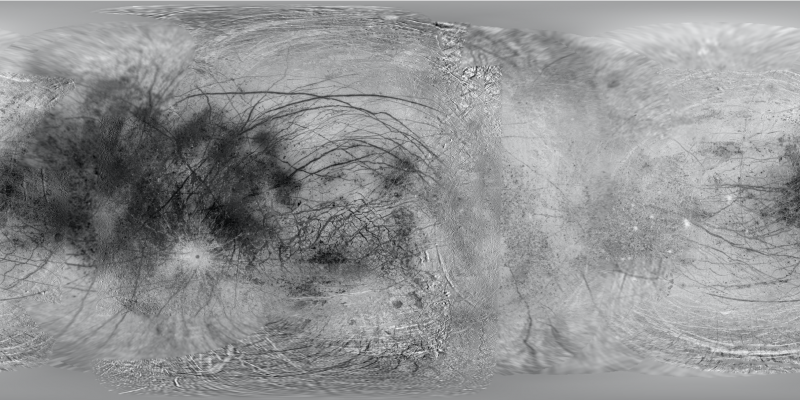
Grayish surface with many dark blotches and jagged lines.

Updated global map of the current surface of Europa. Image via Schenk et al./ Geophysical Research Letters.

Grayish surface covered with many dark blotches and jagged lines.

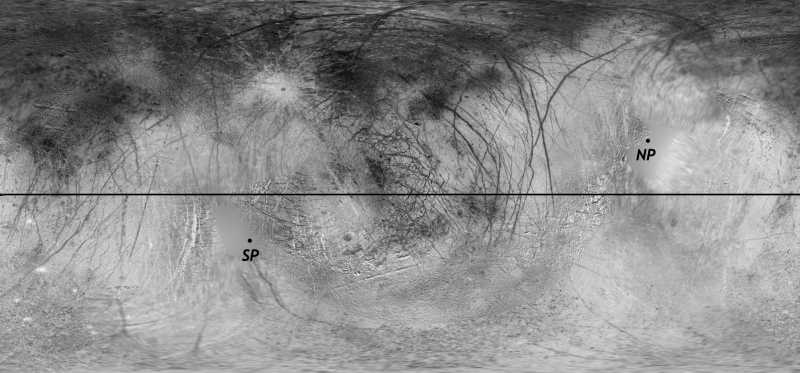
Global map of Europa showing the surface before the re-orientation/true polar wander event. The S and N indicate previous locations of south and north poles. Image via Schenk et al./ Geophysical Research Letters.

The results have implications not only for Europa’s surface, but also its subsurface ocean. They help confirm the existence of the ocean, already known by other data from years of observations, since the only way the ice shell could re-orient itself so dramatically would be if it were uncoupled – freely floating and separated – from the moon’s rocky core by a deep layer of water. As Paul Schenk, lead author of the new paper, said in a statement:

Our key finding is that the fractures associated with true polar wander on Europa cross-cut all terrains. This means that the true polar wander event is very young and that the ice shell and all features formed on it have moved more than 70 degrees of latitude from where they first formed. If true, then the entire recorded history of tectonics on Europa should be reevaluated.

How did the researchers determine that Europa’s ice crust moved so much?

They used a combination of global maps and detailed topographic data from the old Galileo mission to Jupiter in the 1990s and the Voyager missions, which swept past Jupiter in the 1980s. From those early missions, researchers from the Lunar and Planetary Institute, the University of California at Santa Cruz and the University of Arizona were able to correlate some of the large cracks in Europa’s surface with the concentric circular depressions. The global maps have a detailed resolution of about 600 feet (200 meters) per pixel. They revealed that the fractures were part of the other circular patterns caused by the true polar wander process.

Smooth sphere covered by many darker lines and blotches, on black background.

Jupiter’s ocean moon Europa, as seen by the Galileo spacecraft. This image is a combination of images from 1995 and 1998. Image via NASA/ JPL-Caltech/ SETI Institute.

Light and dark terrain covered by many cracks.

A closer look at some of the cracks in Europa’s otherwise smooth surface. Image via NASA/ JPL-Caltech/ SETI Institute.

When the fractures were viewed at highest resolution – about 130 feet (40 meters) per pixel – they were found to be more than 600 feet (200 meters) deep. These huge cracks are like massive wounds on Europa’s surface, cutting through various types of terrain. By studying these fractures, the researchers could tell that the re-orientation of the surface ice was one of the last major geological events to occur on Europa’s surface.

The researchers also say that there is evidence that Europa’s ice crust thickened over time. According to co-investigator Francis Nimmo at the University of California at Santa Cruz:

Another important aspect of this work is that it makes predictions for additional features and ice shell properties which can be tested when the planned Europa Clipper spacecraft starts observing Europa.

Co-investigator Isamu Matsuyama at the University of Arizona added:

In addition to generating global-scale tectonic features, true polar wander also produces global-scale gravity and shape perturbations, which affects gravity and shape constraints on the interior structure.

Smiling man in eyeglasses and striped shirt.

Paul Schenk of the Universities Space Research Association and Lunar and Planetary Institute. He led the new research on Europa. Image via LPI.

Europa Clipper is expected to be launched to Europa in the early 2020s. It will complete the global map of Europa, including high-resolution images and even soundings of these features. These maps will help determine the absolute age of the fractures and depressions and other consequences of the true polar wander event that originally created them.

Last June, NASA scientists announced at the Goldschmidt conference that Europa’s subsurface ocean is likely quite habitable, by earthly standards. The study found that Europa’s ocean would have been mildly acidic at first, with high concentrations of carbon dioxide, calcium and sulfate. But over time, it became chloride-rich, resembling oceans on Earth (seawater on Earth contains 1.94% chloride).

Bottom line: Researchers have found that Europa’s outer ice shell has shifted and re-oriented itself by as much as 70 degrees over the past several million years.

Source: A Very Young Age for True Polar Wander on Europa from Related Fracturing

Via Lunar and Planetary Institute


from EarthSky https://ift.tt/3hUoWFU
Rough surface covered with cracks and dark blotches.

Fractures on Europa’s icy surface formed during true polar wander. The large crack going from lower left to upper right is about 1.9 miles (3 km) wide and 200 meters deep. Image via P. Schenk/ USRA-LPI.

Jupiter’s ocean moon Europa looks a bit like a round cracked egg, with its smooth outer ice crust covered in brownish-stained fissures. Those cracks in Europa’s ice shell record the history of its surface and past geological activity. Now, researchers have announced a new study that’s provided more clues as to how the moon’s surface has changed over the last several million years. Its major finding: Europa’s poles are no longer where they used to be. As a whole, the jovian moon’s icy shell has shifted and re-oriented itself by as much as 70 degrees, close to a quarter of the way around a complete circle. This re-orientation of the outer ice shell is called true polar wander. The researchers say such a shift would be expected of a world whose outer crust lies above a hidden, subsurface ocean.

The conclusion helps confirm earlier hints of shifts in Europa’s crust. The new work is based on an analysis of global-scale circular patterns in Europa’s surface ice. This massive crustal shift is thought to be one of the most recent major geologic events to have occurred on Europa’s young surface.

The intriguing peer-reviewed findings were published on July 29, 2020 in Geophysical Research Letters. The research comes from the Universities Space Research Association – based in Columbia, Maryland – and the Lunar and Planetary Institute in Houston.

As explained in the paper:

The large icy ocean world of Europa has a very young surface that has been highly deformed. Recent evidence for ‘polar wander,’ or reorientation of the floating outer ice shell away from its original orientation, has been confirmed by the recognition that long fissures are part of the polar wander tectonic pattern and are among the youngest features on the planet. This means that polar wander occurred very recently and that older features are no longer in their original locations and will require a complete reassessment of Europa’s tectonic history.

Grayish surface with many dark blotches and jagged lines.

Updated global map of the current surface of Europa. Image via Schenk et al./ Geophysical Research Letters.

Grayish surface covered with many dark blotches and jagged lines.

Global map of Europa showing the surface before the re-orientation/true polar wander event. The S and N indicate previous locations of south and north poles. Image via Schenk et al./ Geophysical Research Letters.

The results have implications not only for Europa’s surface, but also its subsurface ocean. They help confirm the existence of the ocean, already known by other data from years of observations, since the only way the ice shell could re-orient itself so dramatically would be if it were uncoupled – freely floating and separated – from the moon’s rocky core by a deep layer of water. As Paul Schenk, lead author of the new paper, said in a statement:

Our key finding is that the fractures associated with true polar wander on Europa cross-cut all terrains. This means that the true polar wander event is very young and that the ice shell and all features formed on it have moved more than 70 degrees of latitude from where they first formed. If true, then the entire recorded history of tectonics on Europa should be reevaluated.

How did the researchers determine that Europa’s ice crust moved so much?

They used a combination of global maps and detailed topographic data from the old Galileo mission to Jupiter in the 1990s and the Voyager missions, which swept past Jupiter in the 1980s. From those early missions, researchers from the Lunar and Planetary Institute, the University of California at Santa Cruz and the University of Arizona were able to correlate some of the large cracks in Europa’s surface with the concentric circular depressions. The global maps have a detailed resolution of about 600 feet (200 meters) per pixel. They revealed that the fractures were part of the other circular patterns caused by the true polar wander process.

Smooth sphere covered by many darker lines and blotches, on black background.

Jupiter’s ocean moon Europa, as seen by the Galileo spacecraft. This image is a combination of images from 1995 and 1998. Image via NASA/ JPL-Caltech/ SETI Institute.

Light and dark terrain covered by many cracks.

A closer look at some of the cracks in Europa’s otherwise smooth surface. Image via NASA/ JPL-Caltech/ SETI Institute.

When the fractures were viewed at highest resolution – about 130 feet (40 meters) per pixel – they were found to be more than 600 feet (200 meters) deep. These huge cracks are like massive wounds on Europa’s surface, cutting through various types of terrain. By studying these fractures, the researchers could tell that the re-orientation of the surface ice was one of the last major geological events to occur on Europa’s surface.

The researchers also say that there is evidence that Europa’s ice crust thickened over time. According to co-investigator Francis Nimmo at the University of California at Santa Cruz:

Another important aspect of this work is that it makes predictions for additional features and ice shell properties which can be tested when the planned Europa Clipper spacecraft starts observing Europa.

Co-investigator Isamu Matsuyama at the University of Arizona added:

In addition to generating global-scale tectonic features, true polar wander also produces global-scale gravity and shape perturbations, which affects gravity and shape constraints on the interior structure.

Smiling man in eyeglasses and striped shirt.

Paul Schenk of the Universities Space Research Association and Lunar and Planetary Institute. He led the new research on Europa. Image via LPI.

Europa Clipper is expected to be launched to Europa in the early 2020s. It will complete the global map of Europa, including high-resolution images and even soundings of these features. These maps will help determine the absolute age of the fractures and depressions and other consequences of the true polar wander event that originally created them.

Last June, NASA scientists announced at the Goldschmidt conference that Europa’s subsurface ocean is likely quite habitable, by earthly standards. The study found that Europa’s ocean would have been mildly acidic at first, with high concentrations of carbon dioxide, calcium and sulfate. But over time, it became chloride-rich, resembling oceans on Earth (seawater on Earth contains 1.94% chloride).

Bottom line: Researchers have found that Europa’s outer ice shell has shifted and re-oriented itself by as much as 70 degrees over the past several million years.

Source: A Very Young Age for True Polar Wander on Europa from Related Fracturing

Via Lunar and Planetary Institute


from EarthSky https://ift.tt/3hUoWFU

adds 2