aads

Full Corn Moon on September 1-2

Above: Moonrise over Saltsjöbaden, Sweden. Image via Indranil Sinha.

Tonight – September 1-2, 2020 – presents the third and final full moon of our Northern Hemisphere summer (or Southern Hemisphere winter). That is, it’s the third of three full moons to fall between the June 20 solstice and September 22 equinox. Is it the Harvest Moon? No, but it’ll share some characteristics with that famously named moon. The Harvest Moon is the closest full moon to the autumn equinox. It’ll fall in 2020 on October 1 for us in the Northern Hemisphere.

Visit Sunrise Sunset Calendars to know the moonrise time, remembering to check the moonrise and moonset box.

Meanwhile, we in North America will call this September 1-2 full moon by the name Fruit Moon, Corn Moon or Barley Moon.

The moon turns precisely full on September 2, 2020, at 05:22 UTC. At North American and U.S. time zones, that translates to September 2, at 2:22 a.m. ADT, 1:22 a.m. EDT, 12:22 a.m. CDT – yet on September 1, at 11:22 p.m. MDT, 10:22 p.m. PDT, 9:22 p.m. AKDT and 7:22 p.m. HST.

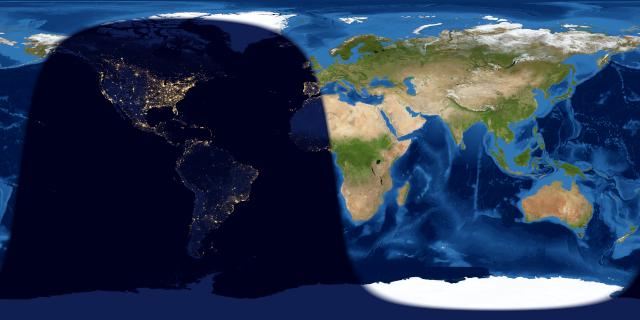
Map of Earth showing day and night side of Earth at full moon.

Day and night sides of Earth at the instant of full moon (September 2, 2020, at 05:22 UTC). The shadow line at right (passing through Europe and Africa) depicts sunrise September 2, and the shadow line at left (going through northwestern North America) represents sunset September 1. Map via Earth View.

What is a Harvest Moon, and how will this September 1-2 full moon resemble the Harvest Moon, even though it doesn’t bear that name? The Harvest Moon – the closest full moon to the autumn equinox – has a reputation for being bigger and brighter and yellower than other full moons. That reputation isn’t deserved; the Harvest Moon is not bigger, it’s not brighter, and it’s not yellower than other full moons. But, in autumn, the ecliptic – or path of the sun, moon and planets – makes a narrow angle with respect to the horizon in the evening hours. On average, the moon rises about 50 minutes later each night, but, due to the autumn angle of the ecliptic, the Harvest Moon comes up near the time of sunset for several evenings in a row around the time of full moon. Around the time of the Harvest Moon, we have what looks like a full moon, rising in or near twilight, for several nights instead of just one.

Tonight’s moon does that, too. There’s a shorter-than-usual time between moonrises on these next few nights. That’s because we’re near the autumn equinox (although not as near as we’ll be at the next full moon, on October 1, when the effect will be even more pronounced).

Check out the custom calendar at Sunrise Sunset Calendars, and be sure to click the box for moonrise times. See if you notice that the moonrise in your location is less than 50 minutes later between the night of September 1 and the night of September 2 or 3 from your location. It will be, if you’re at a temperate latitude in the Northern Hemisphere.

Meanwhile, from temperate latitudes in the Southern Hemisphere, there will be a longer-than usual time between moonrises for the next few evenings.

Astronomically speaking, the full moon occurs at a well-defined instant: when the moon is exactly 180o from the sun in ecliptic longitude (also called celestial longitude). That means the moon stands opposite the sun as measured along the ecliptic, which marks the sun’s annual pathway through constellations of the zodiac. Another way of putting it: at the instant of full moon, the moon-sun elongation equals 180 degrees. Visit Unitarium.com to find out the present moon-sun elongation (if the number is positive, the moon is waxing; if negative, the moon is waning).

Bottom line: Full moon is September 2 at 05:22 UTC. Enjoy the third and final full moon of northern summer (southern winter) tonight.


from EarthSky https://ift.tt/3lxcXjX

Above: Moonrise over Saltsjöbaden, Sweden. Image via Indranil Sinha.

Tonight – September 1-2, 2020 – presents the third and final full moon of our Northern Hemisphere summer (or Southern Hemisphere winter). That is, it’s the third of three full moons to fall between the June 20 solstice and September 22 equinox. Is it the Harvest Moon? No, but it’ll share some characteristics with that famously named moon. The Harvest Moon is the closest full moon to the autumn equinox. It’ll fall in 2020 on October 1 for us in the Northern Hemisphere.

Visit Sunrise Sunset Calendars to know the moonrise time, remembering to check the moonrise and moonset box.

Meanwhile, we in North America will call this September 1-2 full moon by the name Fruit Moon, Corn Moon or Barley Moon.

The moon turns precisely full on September 2, 2020, at 05:22 UTC. At North American and U.S. time zones, that translates to September 2, at 2:22 a.m. ADT, 1:22 a.m. EDT, 12:22 a.m. CDT – yet on September 1, at 11:22 p.m. MDT, 10:22 p.m. PDT, 9:22 p.m. AKDT and 7:22 p.m. HST.

Map of Earth showing day and night side of Earth at full moon.

Day and night sides of Earth at the instant of full moon (September 2, 2020, at 05:22 UTC). The shadow line at right (passing through Europe and Africa) depicts sunrise September 2, and the shadow line at left (going through northwestern North America) represents sunset September 1. Map via Earth View.

What is a Harvest Moon, and how will this September 1-2 full moon resemble the Harvest Moon, even though it doesn’t bear that name? The Harvest Moon – the closest full moon to the autumn equinox – has a reputation for being bigger and brighter and yellower than other full moons. That reputation isn’t deserved; the Harvest Moon is not bigger, it’s not brighter, and it’s not yellower than other full moons. But, in autumn, the ecliptic – or path of the sun, moon and planets – makes a narrow angle with respect to the horizon in the evening hours. On average, the moon rises about 50 minutes later each night, but, due to the autumn angle of the ecliptic, the Harvest Moon comes up near the time of sunset for several evenings in a row around the time of full moon. Around the time of the Harvest Moon, we have what looks like a full moon, rising in or near twilight, for several nights instead of just one.

Tonight’s moon does that, too. There’s a shorter-than-usual time between moonrises on these next few nights. That’s because we’re near the autumn equinox (although not as near as we’ll be at the next full moon, on October 1, when the effect will be even more pronounced).

Check out the custom calendar at Sunrise Sunset Calendars, and be sure to click the box for moonrise times. See if you notice that the moonrise in your location is less than 50 minutes later between the night of September 1 and the night of September 2 or 3 from your location. It will be, if you’re at a temperate latitude in the Northern Hemisphere.

Meanwhile, from temperate latitudes in the Southern Hemisphere, there will be a longer-than usual time between moonrises for the next few evenings.

Astronomically speaking, the full moon occurs at a well-defined instant: when the moon is exactly 180o from the sun in ecliptic longitude (also called celestial longitude). That means the moon stands opposite the sun as measured along the ecliptic, which marks the sun’s annual pathway through constellations of the zodiac. Another way of putting it: at the instant of full moon, the moon-sun elongation equals 180 degrees. Visit Unitarium.com to find out the present moon-sun elongation (if the number is positive, the moon is waxing; if negative, the moon is waning).

Bottom line: Full moon is September 2 at 05:22 UTC. Enjoy the third and final full moon of northern summer (southern winter) tonight.


from EarthSky https://ift.tt/3lxcXjX

September 2020 guide to the bright planets

Click the name of a planet to learn more about its visibility in September 2020: Jupiter, Saturn, Mars, Venus, Mercury

Try Stellarium for a precise view of the planets from your location.

Want precise planet rise and set times? Click here for recommended almanacs
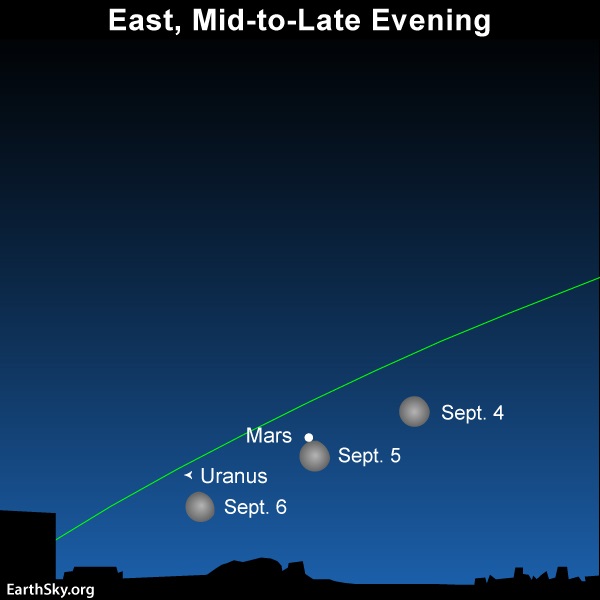
Moon near Mars on September 4, 5 and 6, 2020.

Don’t miss the moon’s sweep past the red planet Mars on September 4, 5 and 6, 2020. Earth will pass between Mars and the sun in October, and, for a month or so, Mars will be even brighter than Jupiter. Mars is the planet to watch this month and next! Read more.
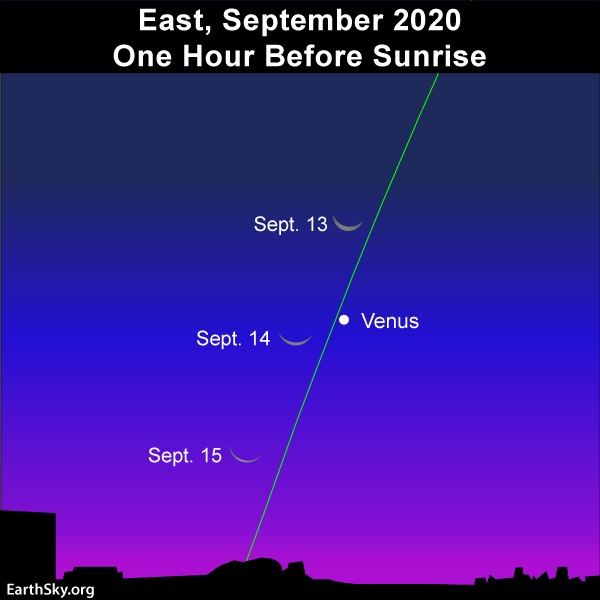
Moon and Venus adorn eastern sky before sunrise September 13, 14 and 15, 2020.

Watch for the waning crescent moon to shine in the vicinity of the brightest planet, Venus, before sunrise on September 13, 14 and 15, 2020. Read more.
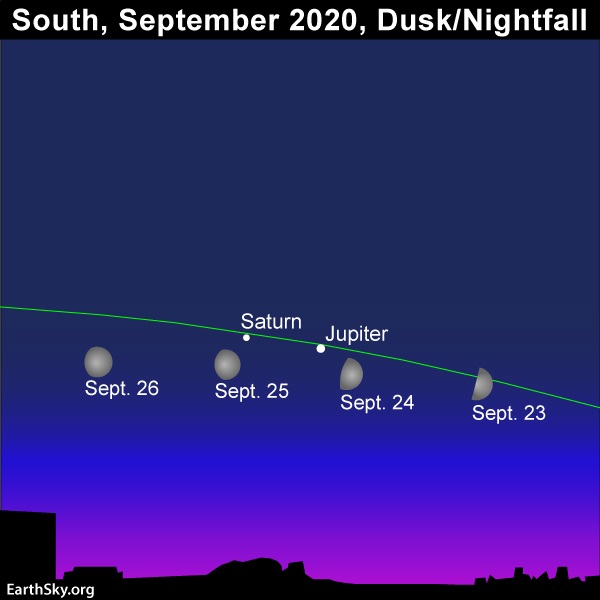
The moon goes by the planets Jupiter and Saturn in the September 2020 evening sky.

Look for the waxing gibbous moon near the planets Jupiter and Saturn for several days, centered around September 24 and 25, 2020. Read more.

View of Mercury from the Southern Hemisphere.

This chart is for the Southern Hemisphere, where people will enjoy the best evening apparition of Mercury for the year in September 2020. As seen from the Northern Hemisphere, Mercury will be deeply submerged in evening twilight and hard to see. Read more.
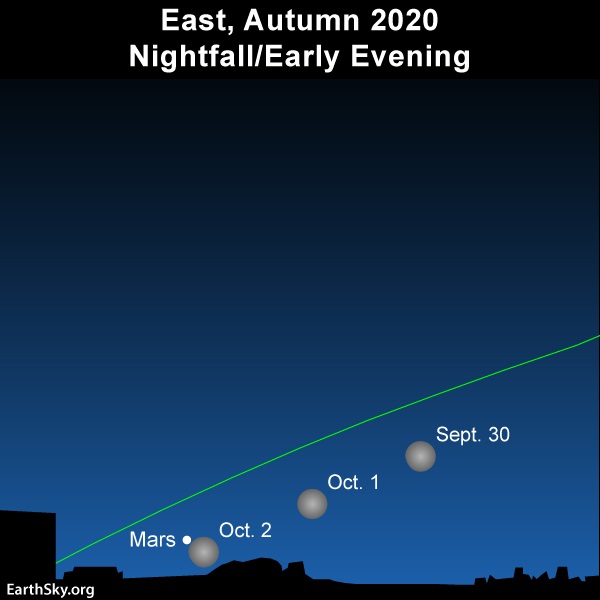
Harvest Moon and the red planet Mars at nightfall.

In late September and early October 2020, the Northern Hemisphere’s Harvest Moon shines in the vicinity of the brilliant red planet Mars! Read more.

Jupiter and Saturn are the planets to watch as darkness falls in September 2020. They are near one another on the sky’s dome, with Saturn following Jupiter westward across the sky from dusk/nightfall until well after midnight. A few months ago, in July 2020, these gas giant worlds, Jupiter and Saturn, reached their yearly opposition.

Earth – in its yearly orbit – swung between these outer worlds and the sun in July 2020. Thus we were closest to Jupiter and Saturn for the year in July. Jupiter and Saturn, in turn, shone at their brightest best and were out all night long.

Read more: Jupiter at opposition on July 13-14

Read more: Saturn at opposition on July 20
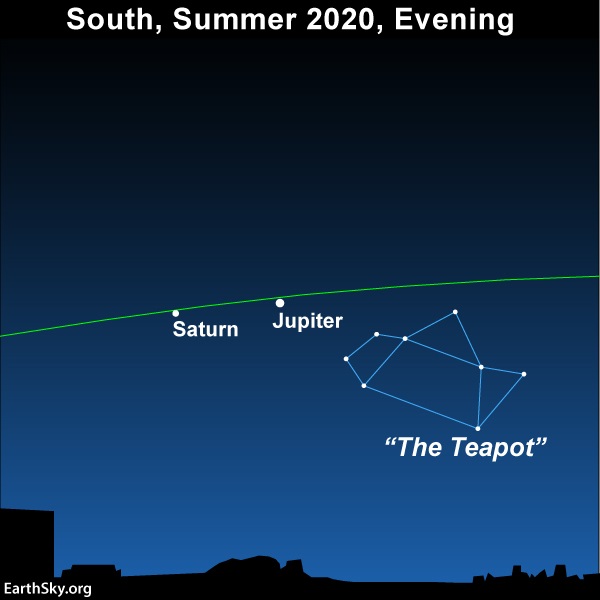
Sky chart: Jupiter, Saturn and the Teapot asterism.

Jupiter and Saturn climb highest up for the night at early evening in early September, and at nightfall by the month’s end. Read more.

In some respects, though, September gives us a better month than July or August for viewing Jupiter and Saturn. That’s because these two worlds remain bright and beautiful throughout September, yet appear highest up for the night right around nightfall.

That’s good news for people with telescopes who don’t want to stay up late. It’s quite convenient to have Jupiter and Saturn highest up for the night as soon as darkness falls. Typically, the view of Jupiter’s four major moons and Saturn’s glorious rings through the telescope is sharper when these worlds are higher up than lower down. The thickness of the Earth’s atmosphere near the horizon tends to blur the view of Jupiter’s moon and Saturn’s rings.

Positions of Jupiter’s moons via Sky & Telescope

Look first for brilliant Jupiter; Saturn is the bright object immediately to Jupiter’s east. Although Saturn is easily as bright as a 1st-magnitude star – as bright as the brightest stars in our sky – the ringed planet can’t compete with the the king planet Jupiter, which outshines Saturn by some 14 times. After all, Jupiter ranks as the fourth brightest celestial object, after the sun, the moon and the planet Venus, respectively.

For the first time since the year 2000, Jupiter and Saturn will showcase their great conjunction in December 2020, for the closest Jupiter-Saturn conjunction since the year 1623. Astronomers use the word conjunction to describe meetings of planets and other objects on our sky’s dome. They use the term great conjunction to describe a meeting of the king planet Jupiter and golden Saturn. The last great Jupiter-Saturn conjunction was May 28, 2000. The next one will be December 21, 2020. But September 2020 presents a fine time to start watching these worlds.

Read more: Before 2020 ends, a great conjunction for Jupiter and Saturn

Watch for the moon in the neighborhood of Jupiter and Saturn for several days, centered on or near September 24.

Mars rises over your eastern horizon by early-to-mid evening, and is coming up earlier daily, heading for its own opposition on October 13, 2020. At that wondrous time, Mars will actually supplant Jupiter as the sky’s fourth-brightest celestial body, after the sun, moon, and the planet Venus. That will be something to see!

In September 2020, you’ll find Mars heading toward that dramatic brightening. This month, Mars is respectably bright, more brilliant even than a 1st-magnitude star, or one of the sky’s brightest stars. Earth is now rushing along in its smaller, faster orbit, gaining on Mars, the fourth planet outward from the sun. Throughout September and the first half of October, watch for Mars to brighten dramatically as Earth closes in on Mars, passing between it and the sun on October 13, 2020.

Around the world, Mars rises about 9 p.m. (10 p.m. daylight saving time) in early September. By the month’s end, Mars will be up around 7 p.m. (8 p.m. daylight saving time).

Let the waning moon help guide your eye to Mars for several days, centered on or near September 5.
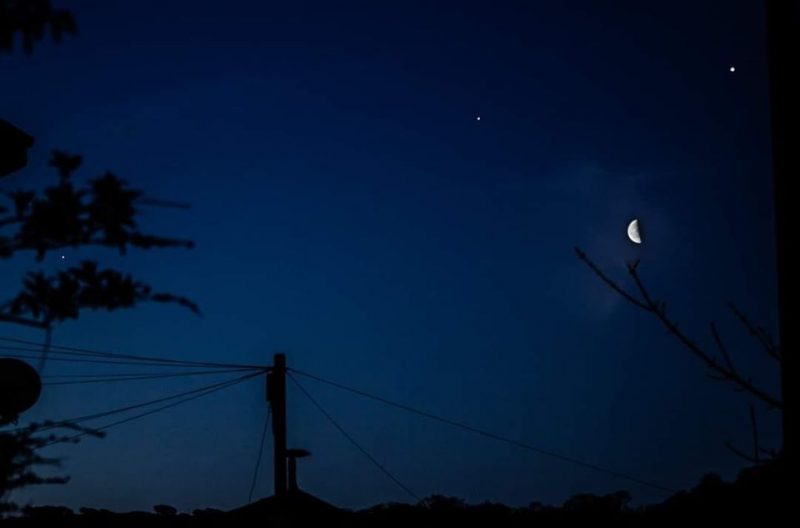
3 dots lined up across photo, crescent moon in deep blue sky above telephone lines before sunup.

View at EarthSky Community Photos. | From Paul Armstrong, who took this photo of Mars, Saturn and Jupiter on the morning of April 15, 2020, from Exmoor, U.K. Jupiter is at the upper right, Mars at center left, with Saturn between them. In May 2020, Jupiter and Saturn were closer together, whereas Mars was farther away from Jupiter and Saturn. Thanks, Paul!

Venus – the brightest planet – reached its greatest elongation from the sun in the morning sky on August 12 or 13 (depending upon your time zone). But dazzling Venus will remain bright and beautiful as a morning “star” for the rest of this year.

At mid-northern latitudes, Venus rises about 3 1/2 hours before the sun throughout September.

At and near the equator, Venus rises 3 hours before the sun in early September, decreasing to 2 1/2 hours near the month’s end.

At temperate latitudes in the Southern Hemisphere, Venus rises about 2 1/2 hours before the sun in early September, tapering to 1 3/4 hours by the month’s end.
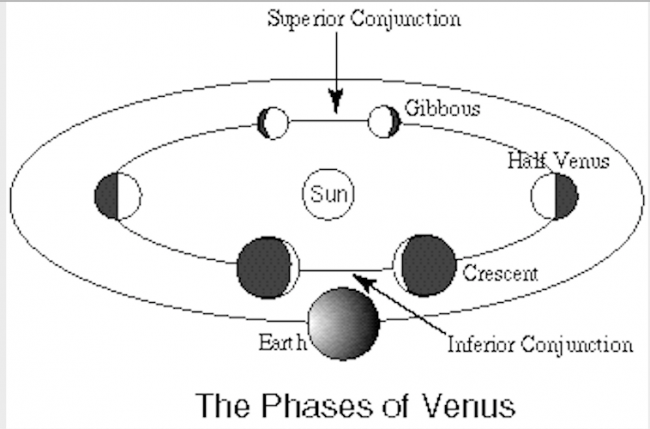
Diagram showing positions of Venus in orbit and its phases at inferior and superior conjunction.

Inferior conjunction – when Venus sweeps between the sun and Earth – happened on June 3, 2020. Some 10 weeks later, Venus reached its greatest elongation in the morning sky on August 13, 2020 (when its disk was about 50% illuminated by sunshine). In September 2020, Venus will start the month about 60% illuminated and then end the month about 71% illuminated. Image via UCLA.

Throughout September, Venus in its faster orbit around the sun will be going farther and farther away from Earth. As viewed through the telescope, Venus’ waxing gibbous phase will widen, yet its overall disk size will shrink. Venus’ disk is 60% illuminated in early September, and 71% illuminated by the month’s end; Venus’ angular diameter, on the other hand, will shrink to 80% of its initial size by late September.

Watch for the waning crescent moon to shine with Venus in the morning sky for several days, centered on or near September 14.

Mercury is an evening planet all month long, though only nominally so at northerly latitudes. September 2020 showcases the best evening apparition of Mercury for the year in the Southern Hemisphere. Mercury will be a whopping 25 degrees east of the sun from September 26 till October 7, 2020. and at its greatest elongation on October 1.

Read more: Mercury in the west after sunset

What do we mean by bright planet? By bright planet, we mean any solar system planet that is easily visible without an optical aid and that has been watched by our ancestors since time immemorial. In their outward order from the sun, the five bright planets are Mercury, Venus, Mars, Jupiter and Saturn. These planets actually do appear bright in our sky. They are typically as bright as – or brighter than – the brightest stars. Plus, these relatively nearby worlds tend to shine with a steadier light than the distant, twinkling stars. You can spot them, and come to know them as faithful friends, if you try.

silhouette of man against the sunset sky with bright planet and crescent moon.

Skywatcher, by Predrag Agatonovic.

Bottom line: September 2020 presents 4 of the 5 bright solar system planets in the evening sky (Mercury only nominally so at northerly latitudes). Catch Jupiter and Saturn at nightfall, Mars at early evening, and Venus in the predawn/dawn sky.

Don’t miss anything. Subscribe to EarthSky News by email

Visit EarthSky’s Best Places to Stargaze, and recommend a place we can all enjoy.

Help EarthSky keep going! Donate now.

Post your planet photos at EarthSky Community Photos


from EarthSky https://ift.tt/1YD00CF

Click the name of a planet to learn more about its visibility in September 2020: Jupiter, Saturn, Mars, Venus, Mercury

Try Stellarium for a precise view of the planets from your location.

Want precise planet rise and set times? Click here for recommended almanacs

Moon near Mars on September 4, 5 and 6, 2020.

Don’t miss the moon’s sweep past the red planet Mars on September 4, 5 and 6, 2020. Earth will pass between Mars and the sun in October, and, for a month or so, Mars will be even brighter than Jupiter. Mars is the planet to watch this month and next! Read more.

Moon and Venus adorn eastern sky before sunrise September 13, 14 and 15, 2020.

Watch for the waning crescent moon to shine in the vicinity of the brightest planet, Venus, before sunrise on September 13, 14 and 15, 2020. Read more.

The moon goes by the planets Jupiter and Saturn in the September 2020 evening sky.

Look for the waxing gibbous moon near the planets Jupiter and Saturn for several days, centered around September 24 and 25, 2020. Read more.

View of Mercury from the Southern Hemisphere.

This chart is for the Southern Hemisphere, where people will enjoy the best evening apparition of Mercury for the year in September 2020. As seen from the Northern Hemisphere, Mercury will be deeply submerged in evening twilight and hard to see. Read more.

Harvest Moon and the red planet Mars at nightfall.

In late September and early October 2020, the Northern Hemisphere’s Harvest Moon shines in the vicinity of the brilliant red planet Mars! Read more.

Jupiter and Saturn are the planets to watch as darkness falls in September 2020. They are near one another on the sky’s dome, with Saturn following Jupiter westward across the sky from dusk/nightfall until well after midnight. A few months ago, in July 2020, these gas giant worlds, Jupiter and Saturn, reached their yearly opposition.

Earth – in its yearly orbit – swung between these outer worlds and the sun in July 2020. Thus we were closest to Jupiter and Saturn for the year in July. Jupiter and Saturn, in turn, shone at their brightest best and were out all night long.

Read more: Jupiter at opposition on July 13-14

Read more: Saturn at opposition on July 20

Sky chart: Jupiter, Saturn and the Teapot asterism.

Jupiter and Saturn climb highest up for the night at early evening in early September, and at nightfall by the month’s end. Read more.

In some respects, though, September gives us a better month than July or August for viewing Jupiter and Saturn. That’s because these two worlds remain bright and beautiful throughout September, yet appear highest up for the night right around nightfall.

That’s good news for people with telescopes who don’t want to stay up late. It’s quite convenient to have Jupiter and Saturn highest up for the night as soon as darkness falls. Typically, the view of Jupiter’s four major moons and Saturn’s glorious rings through the telescope is sharper when these worlds are higher up than lower down. The thickness of the Earth’s atmosphere near the horizon tends to blur the view of Jupiter’s moon and Saturn’s rings.

Positions of Jupiter’s moons via Sky & Telescope

Look first for brilliant Jupiter; Saturn is the bright object immediately to Jupiter’s east. Although Saturn is easily as bright as a 1st-magnitude star – as bright as the brightest stars in our sky – the ringed planet can’t compete with the the king planet Jupiter, which outshines Saturn by some 14 times. After all, Jupiter ranks as the fourth brightest celestial object, after the sun, the moon and the planet Venus, respectively.

For the first time since the year 2000, Jupiter and Saturn will showcase their great conjunction in December 2020, for the closest Jupiter-Saturn conjunction since the year 1623. Astronomers use the word conjunction to describe meetings of planets and other objects on our sky’s dome. They use the term great conjunction to describe a meeting of the king planet Jupiter and golden Saturn. The last great Jupiter-Saturn conjunction was May 28, 2000. The next one will be December 21, 2020. But September 2020 presents a fine time to start watching these worlds.

Read more: Before 2020 ends, a great conjunction for Jupiter and Saturn

Watch for the moon in the neighborhood of Jupiter and Saturn for several days, centered on or near September 24.

Mars rises over your eastern horizon by early-to-mid evening, and is coming up earlier daily, heading for its own opposition on October 13, 2020. At that wondrous time, Mars will actually supplant Jupiter as the sky’s fourth-brightest celestial body, after the sun, moon, and the planet Venus. That will be something to see!

In September 2020, you’ll find Mars heading toward that dramatic brightening. This month, Mars is respectably bright, more brilliant even than a 1st-magnitude star, or one of the sky’s brightest stars. Earth is now rushing along in its smaller, faster orbit, gaining on Mars, the fourth planet outward from the sun. Throughout September and the first half of October, watch for Mars to brighten dramatically as Earth closes in on Mars, passing between it and the sun on October 13, 2020.

Around the world, Mars rises about 9 p.m. (10 p.m. daylight saving time) in early September. By the month’s end, Mars will be up around 7 p.m. (8 p.m. daylight saving time).

Let the waning moon help guide your eye to Mars for several days, centered on or near September 5.

3 dots lined up across photo, crescent moon in deep blue sky above telephone lines before sunup.

View at EarthSky Community Photos. | From Paul Armstrong, who took this photo of Mars, Saturn and Jupiter on the morning of April 15, 2020, from Exmoor, U.K. Jupiter is at the upper right, Mars at center left, with Saturn between them. In May 2020, Jupiter and Saturn were closer together, whereas Mars was farther away from Jupiter and Saturn. Thanks, Paul!

Venus – the brightest planet – reached its greatest elongation from the sun in the morning sky on August 12 or 13 (depending upon your time zone). But dazzling Venus will remain bright and beautiful as a morning “star” for the rest of this year.

At mid-northern latitudes, Venus rises about 3 1/2 hours before the sun throughout September.

At and near the equator, Venus rises 3 hours before the sun in early September, decreasing to 2 1/2 hours near the month’s end.

At temperate latitudes in the Southern Hemisphere, Venus rises about 2 1/2 hours before the sun in early September, tapering to 1 3/4 hours by the month’s end.

Diagram showing positions of Venus in orbit and its phases at inferior and superior conjunction.

Inferior conjunction – when Venus sweeps between the sun and Earth – happened on June 3, 2020. Some 10 weeks later, Venus reached its greatest elongation in the morning sky on August 13, 2020 (when its disk was about 50% illuminated by sunshine). In September 2020, Venus will start the month about 60% illuminated and then end the month about 71% illuminated. Image via UCLA.

Throughout September, Venus in its faster orbit around the sun will be going farther and farther away from Earth. As viewed through the telescope, Venus’ waxing gibbous phase will widen, yet its overall disk size will shrink. Venus’ disk is 60% illuminated in early September, and 71% illuminated by the month’s end; Venus’ angular diameter, on the other hand, will shrink to 80% of its initial size by late September.

Watch for the waning crescent moon to shine with Venus in the morning sky for several days, centered on or near September 14.

Mercury is an evening planet all month long, though only nominally so at northerly latitudes. September 2020 showcases the best evening apparition of Mercury for the year in the Southern Hemisphere. Mercury will be a whopping 25 degrees east of the sun from September 26 till October 7, 2020. and at its greatest elongation on October 1.

Read more: Mercury in the west after sunset

What do we mean by bright planet? By bright planet, we mean any solar system planet that is easily visible without an optical aid and that has been watched by our ancestors since time immemorial. In their outward order from the sun, the five bright planets are Mercury, Venus, Mars, Jupiter and Saturn. These planets actually do appear bright in our sky. They are typically as bright as – or brighter than – the brightest stars. Plus, these relatively nearby worlds tend to shine with a steadier light than the distant, twinkling stars. You can spot them, and come to know them as faithful friends, if you try.

silhouette of man against the sunset sky with bright planet and crescent moon.

Skywatcher, by Predrag Agatonovic.

Bottom line: September 2020 presents 4 of the 5 bright solar system planets in the evening sky (Mercury only nominally so at northerly latitudes). Catch Jupiter and Saturn at nightfall, Mars at early evening, and Venus in the predawn/dawn sky.

Don’t miss anything. Subscribe to EarthSky News by email

Visit EarthSky’s Best Places to Stargaze, and recommend a place we can all enjoy.

Help EarthSky keep going! Donate now.

Post your planet photos at EarthSky Community Photos


from EarthSky https://ift.tt/1YD00CF

Asteroid 2011 ES4 will pass much closer than the moon on September 1

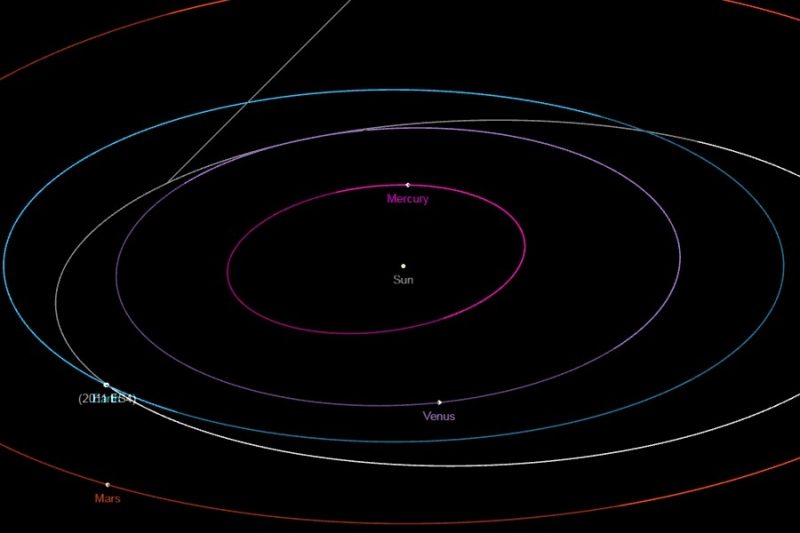
Schematics of orbits in light colors on black.

The orbit of asteroid 2011 ES4 (in white) is slightly similar to Earth’s (in blue) but inclined in relation to our planet’s orbit. The space rock completes an orbit around the sun every 416 days. It nearly intercepts our orbit on September 1, 2020, as seen in this illustration, via NASA/ JPL.

A healthy-sized chunk of space rock will pass closer than the moon on September 1, 2020. Although there is uncertainty in its orbit, scientists say it will not hit our planet. Asteroid 2011 ES4 is expected to pass at about 0.3 or 30% the Earth-moon distance. But it may pass farther, or as close as 0.19 lunar distances, since its orbit is still not completely defined. Our knowledge of this asteroid’s orbit might improve sometime today – or early tomorrow – if it is “recovered” via astronomers’ telescopes prior to closest approach.

The asteroid should pass closest around 16:12 UTC on September 1 (12:12 p.m. EDT; translate UTC to your time).

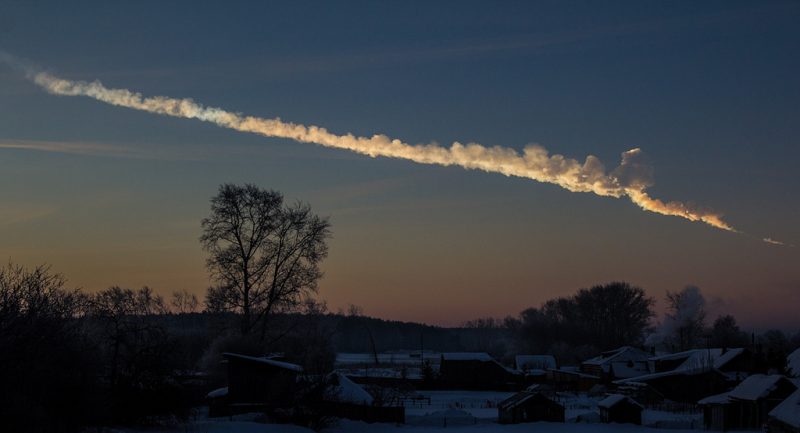
The asteroid has an estimated diameter of 72 to 161 feet (22 to 49 meters). That’s in the range of the Chelyabinsk meteor – around 17 meters (55 feet) in diameter – which swept through Earth’s atmosphere above Russia in February 2013, generating an enormous shock wave that broke windows in six Russian cities and caused some 1,500 people to seek medical treatment, mostly from flying glass.

Long, thick pink smoke trail from meteor, in a twilight sky.

Chelyabinsk meteor smoke trail, February 15, 2013. Image via Alex Alishevskikh., who caught it about a minute after the blast.

But back to asteroid 2011 ES4. The uncertainty about its orbit is due to the fact that observatories were able to track the space rock during only four days after it was detected on March 2, 2011, from the Mount Lemmon Survey in Arizona. After that, the asteroid became too faint to be observed.

Astronomers use an uncertainty scale from 0-9, in which 0 means the orbit is well known, and 9 means great uncertainty. Asteroid 2011 ES4 has an uncertainty of 7.  The uncertainty not only means it may pass farther or closer than expected, but also may cause it to occur a few hours earlier or later than expected.

Asteroid 2011 ES4 is classified as a Near-Earth Object (NEO). But it’s good to know that this Apollo-class asteroid is not classified as a Potentially Hazardous Asteroid. What’s the difference? A Potentially Hazardous Asteroid is defined as an object that passes relatively close to Earth, and also is large enough (more than 150 meters in diameter) to cause significant regional damage, were it to strike Earth.

Thus you may see that asteroid 2011 ES4 has the potential to come rather close. And it’s a healthy size, bigger, for example, than the tiny (truck-sized) asteroid that swept just 2,000 miles (3,000 km) from Earth on August 16, 2020. Yet – as asteroids go – asteroid 2011 ES4 is still relatively small, not large enough to cause significant damage upon impact (and it is not expected to get close enough to enter our atmosphere, much less impact).

So – to all of you worriers – you may all breathe easily now.

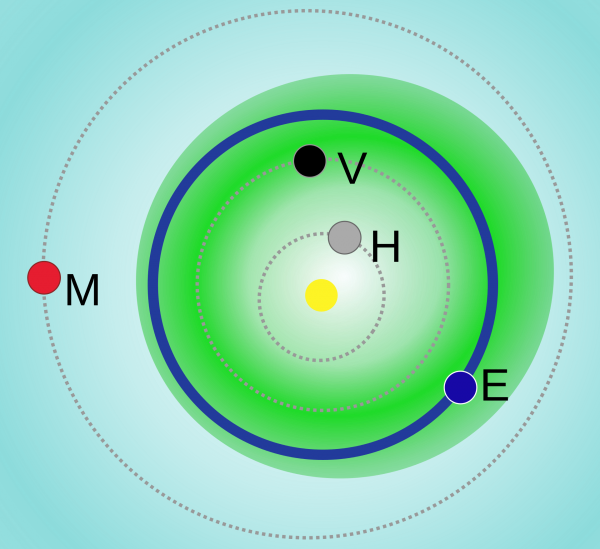
Chart of orbits of inner planets, with green shading - mostly around the orbits of Earth and Venus - showing orbits of Apollo asteroids.

Location of the Apollo asteroids compared to the orbits of the terrestrial planets of our solar system. Image via Wikimedia Commons.

If an asteroid as big as 2011 ES4 were to hit our planet, it wouldn’t be big enough to cause a major impact, much less an extinction-level event. However, a space rock with an average size of 98 ft (30 meters) in diameter, like this one, could cause a huge shock wave if it enters our atmosphere.

Fortunately, even with the margin of errors in calculations, asteroid 2011 ES4 should safely pass by Earth on September 1, 2020.

If asteroid 2011 ES4 is detected in the next few hours or days, it may at first be confused with a “new” asteroid, and get a temporary or provisional designation before models show it definitely has the same trajectory, indicating it’s in fact asteroid 2011 ES4 being “recovered” in our skies. After new observations are made, astronomers may be able to better define the space rock’s orbit.

We may see many news about close passes of asteroids, but most of those are about small space rocks. We don’t have to worry, because if a small asteroid hits our atmosphere, most of the space rock will disintegrate, and since Earth is around 70% covered by oceans, most events will occur over water, probably even unnoticed.

What about any big asteroid approaching Earth? Although there are many small asteroids whose orbit crosses the orbit of Earth, fortunately, there is no known big space rock with a dangerous orbit which poses a threat to our planet.

As part of nature, there will be, however, lots of other significant approaches in the future, including asteroid Apophis on April 13, 2029. That will be an exciting opportunity for scientists. And even for casual observers, the close approach of Apophis will be an amazing event, as the space rock may even be slightly visible to the unaided eye from some areas.

Bottom line: Asteroid 2011 ES4 is expected to pass at about 0.3 or 30% the Earth-moon distance on September 1, 2020. But it might pass farther, or as close as 0.19 lunar distances. The asteroid should pass closest around 16:12 UTC on September 1 (12:12 p.m. EDT; translate UTC to your time).


from EarthSky https://ift.tt/3lBHBsv
Schematics of orbits in light colors on black.

The orbit of asteroid 2011 ES4 (in white) is slightly similar to Earth’s (in blue) but inclined in relation to our planet’s orbit. The space rock completes an orbit around the sun every 416 days. It nearly intercepts our orbit on September 1, 2020, as seen in this illustration, via NASA/ JPL.

A healthy-sized chunk of space rock will pass closer than the moon on September 1, 2020. Although there is uncertainty in its orbit, scientists say it will not hit our planet. Asteroid 2011 ES4 is expected to pass at about 0.3 or 30% the Earth-moon distance. But it may pass farther, or as close as 0.19 lunar distances, since its orbit is still not completely defined. Our knowledge of this asteroid’s orbit might improve sometime today – or early tomorrow – if it is “recovered” via astronomers’ telescopes prior to closest approach.

The asteroid should pass closest around 16:12 UTC on September 1 (12:12 p.m. EDT; translate UTC to your time).

The asteroid has an estimated diameter of 72 to 161 feet (22 to 49 meters). That’s in the range of the Chelyabinsk meteor – around 17 meters (55 feet) in diameter – which swept through Earth’s atmosphere above Russia in February 2013, generating an enormous shock wave that broke windows in six Russian cities and caused some 1,500 people to seek medical treatment, mostly from flying glass.

Long, thick pink smoke trail from meteor, in a twilight sky.

Chelyabinsk meteor smoke trail, February 15, 2013. Image via Alex Alishevskikh., who caught it about a minute after the blast.

But back to asteroid 2011 ES4. The uncertainty about its orbit is due to the fact that observatories were able to track the space rock during only four days after it was detected on March 2, 2011, from the Mount Lemmon Survey in Arizona. After that, the asteroid became too faint to be observed.

Astronomers use an uncertainty scale from 0-9, in which 0 means the orbit is well known, and 9 means great uncertainty. Asteroid 2011 ES4 has an uncertainty of 7.  The uncertainty not only means it may pass farther or closer than expected, but also may cause it to occur a few hours earlier or later than expected.

Asteroid 2011 ES4 is classified as a Near-Earth Object (NEO). But it’s good to know that this Apollo-class asteroid is not classified as a Potentially Hazardous Asteroid. What’s the difference? A Potentially Hazardous Asteroid is defined as an object that passes relatively close to Earth, and also is large enough (more than 150 meters in diameter) to cause significant regional damage, were it to strike Earth.

Thus you may see that asteroid 2011 ES4 has the potential to come rather close. And it’s a healthy size, bigger, for example, than the tiny (truck-sized) asteroid that swept just 2,000 miles (3,000 km) from Earth on August 16, 2020. Yet – as asteroids go – asteroid 2011 ES4 is still relatively small, not large enough to cause significant damage upon impact (and it is not expected to get close enough to enter our atmosphere, much less impact).

So – to all of you worriers – you may all breathe easily now.

Chart of orbits of inner planets, with green shading - mostly around the orbits of Earth and Venus - showing orbits of Apollo asteroids.

Location of the Apollo asteroids compared to the orbits of the terrestrial planets of our solar system. Image via Wikimedia Commons.

If an asteroid as big as 2011 ES4 were to hit our planet, it wouldn’t be big enough to cause a major impact, much less an extinction-level event. However, a space rock with an average size of 98 ft (30 meters) in diameter, like this one, could cause a huge shock wave if it enters our atmosphere.

Fortunately, even with the margin of errors in calculations, asteroid 2011 ES4 should safely pass by Earth on September 1, 2020.

If asteroid 2011 ES4 is detected in the next few hours or days, it may at first be confused with a “new” asteroid, and get a temporary or provisional designation before models show it definitely has the same trajectory, indicating it’s in fact asteroid 2011 ES4 being “recovered” in our skies. After new observations are made, astronomers may be able to better define the space rock’s orbit.

We may see many news about close passes of asteroids, but most of those are about small space rocks. We don’t have to worry, because if a small asteroid hits our atmosphere, most of the space rock will disintegrate, and since Earth is around 70% covered by oceans, most events will occur over water, probably even unnoticed.

What about any big asteroid approaching Earth? Although there are many small asteroids whose orbit crosses the orbit of Earth, fortunately, there is no known big space rock with a dangerous orbit which poses a threat to our planet.

As part of nature, there will be, however, lots of other significant approaches in the future, including asteroid Apophis on April 13, 2029. That will be an exciting opportunity for scientists. And even for casual observers, the close approach of Apophis will be an amazing event, as the space rock may even be slightly visible to the unaided eye from some areas.

Bottom line: Asteroid 2011 ES4 is expected to pass at about 0.3 or 30% the Earth-moon distance on September 1, 2020. But it might pass farther, or as close as 0.19 lunar distances. The asteroid should pass closest around 16:12 UTC on September 1 (12:12 p.m. EDT; translate UTC to your time).


from EarthSky https://ift.tt/3lBHBsv

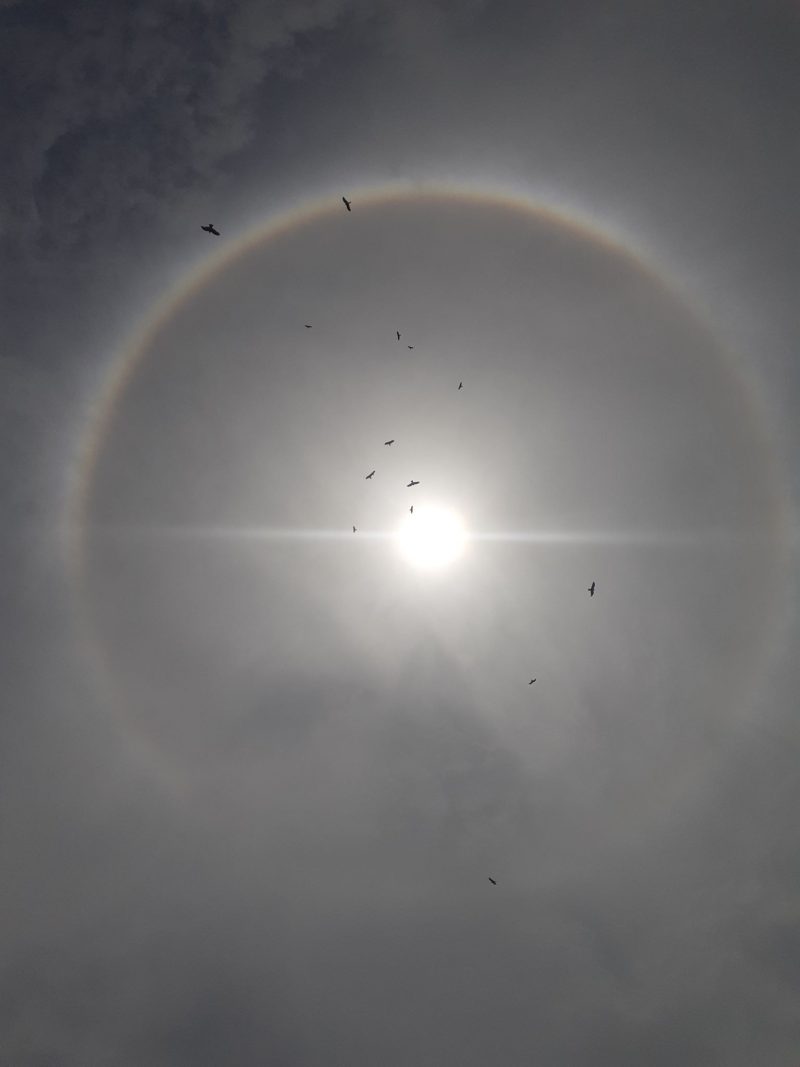
Sun halo with birds

A halo around the sun, with birds flying in the foreground.

View at EarthSky Community Photos. | Jayesh Jayesh J of Vadodara, Gujarat, India caught this beautiful 22-degree halo around the sun on August 29, 2020. Thank you, Jayesh!

Read more: What makes a halo around the sun or moon?


from EarthSky https://ift.tt/3lvhbs5
A halo around the sun, with birds flying in the foreground.

View at EarthSky Community Photos. | Jayesh Jayesh J of Vadodara, Gujarat, India caught this beautiful 22-degree halo around the sun on August 29, 2020. Thank you, Jayesh!

Read more: What makes a halo around the sun or moon?


from EarthSky https://ift.tt/3lvhbs5

Repeating fast radio burst wakes up again right on schedule

Many bright white dots on black background, with squares, lines and text annotations.

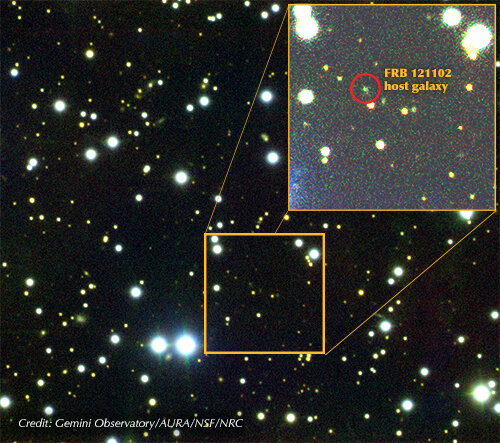
The location of the host galaxy of FRB 121102. Image via Gemini Observatory/ AURA/ NSF/ NRC/ Phys.org.

A repeating fast radio burst (FRB) has woken up again just when scientists had predicted it would, scientists in China have reported. This news supports earlier observations that the FRB being studied – called FRB 121102 – is one of a few so far that have been found to repeat on a regular cycle. FRB 121102 had previously been found to repeat on a 157-day cycle. The new observations also refine that time period a bit more.

The new report on FRB 121102 comes from astronomer Pei Wang of the National Astronomy Observatory of China (NAOC), who used the Five-hundred-meter Aperture Spherical radio Telescope (FAST) – world’s largest dish-type radio telescope – to monitor FRB 121102 on several dates between March and August 2020. Their findings were posted to The Astronomer’s Telegram on August 21, 2020.

As reported in Science Alert on August 24, from mid-March to late July 2020, the FRB had been silent, as expected. Previous observations showed that it would remain in an inactive phase for about 67 days, then “turn on” again for another 90 days, during which time it would repeatedly emit intense radio flares. The 157-day cycle then keeps repeating. On August 17, Wang’s team detected new activity again with FAST, at least 12 bursts, right about when expected.

Jagged beam of light coming from a galaxy to a cluster of radio telescopes.

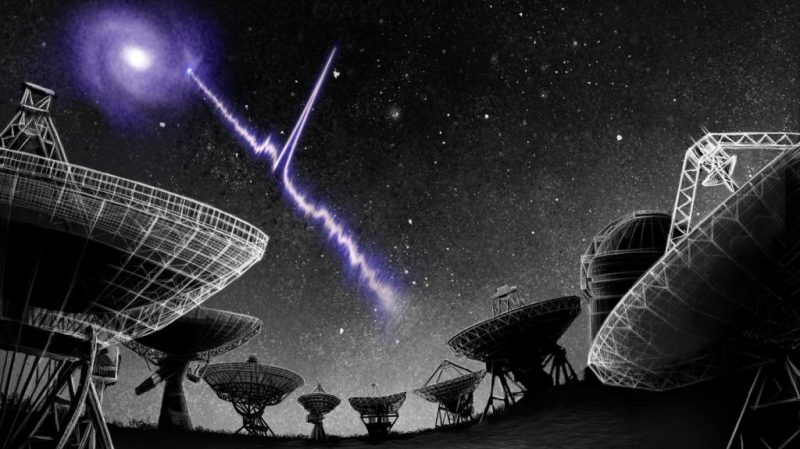
Artist’s illustration of an FRB being detected by radio telescopes on Earth. Image via Danielle Futselaar/ artsource.nl/ Space.com.

The timing supports previous observations from a team led by Marilyn Cruces of the Max Planck Institute for Radio Astronomy, as well as by University of Manchester astronomer Kaustubh Rajwade and his team. It was Rajwade who first discovered the periodicity of FRB 121102. Then, the cycle was calculated to be every 157 days. Cruce’s team, meanwhile, has calculated a cycle of 161 days, and submitted a new pre-print paper to arXiv on August 8, 2020. They detected 36 bursts from FRB 121102 using the Radio Telescope Effelsberg between September 2017 to June 2020.

According to that new paper, the active period for FRB 121102 should be between July 9 and October 14, 2020.

Wang’s team, however, using data from both Cruces and Rajwade, has calculated a periodicity of 156.1 days. Wang said in a statement:

We combine the bursts collected in Rajwade et al. (2020) and Cruces et al. (2020) with these newly detected by FAST in 2019 and 2020, and obtain a new best-fit period of ~156.1 days.

If Wang is right, then the current active phase of FRB 121102 should end sometime between August 31 and September 9, 2020. But if it doesn’t, that would suggest that either the periodicity isn’t actually real, or that it has changed somehow. The calculations may also need a bit of further refinement. As with other FRBs, this one will continue to be monitored. As noted in The Astronomer’s Telegram:

With this putative period, the projected turn-off date is around August 31th – September 9th, 2020. Alternatively, if the source is continuously on after the projected turning-off time, it suggests that the putative period of the source is not real or has evolution. We encourage more follow-up monitoring efforts from other radio observatories.

Large radio telescope dish with five towers around it, surrounded by forest.

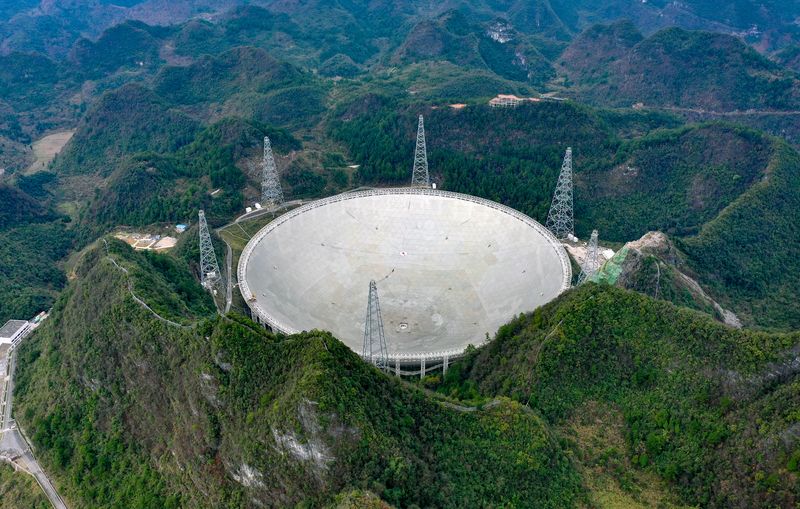
Photo from January 11, 2020 showing the Five-hundred-meter Aperture Spherical radio Telescope (FAST) in southwest China’s Guizhou province. Image via Xinhua/ China.org.cn.

Fast radio bursts are one of the weirdest phenomena yet discovered in our universe. They are very brief but very powerful blasts of radio waves, lasting only a few milliseconds (a millisecond is a thousandth of a second) and scientists don’t yet know what causes them. Most seem to just give off a single burst, and then are never seen again. Others repeat however, and fewer still repeat on a regular basis. A typical FRB can generate as much energy in a single millisecond burst as the sun does in 80 years!

Last February, another repeating FRB was announced, FRB 180916.J0158+65, and this one has a cycle of 16 days. It was observed by scientists using the Canadian Hydrogen Intensity Mapping Experiment (CHIME) radio telescope in British Columbia, Canada. CHIME observed one to two bursts per hour, a process that continued for four days. But then, for the next 12 days or so, there was no activity at all. The cycle then repeated.

Some 28 bursts were recorded by CHIME in total for this FRB, from September 16, 2018, to October 26, 2019. It is in a spiral galaxy 500 million light-years away, the closest known FRB found so far. The identification of the specific location was previously published in Nature on January 6, 2020.

Man with eyeglasses and jacket with shoulder strap.

Pei Wang of the National Astronomy Observatory of China, whose team detected the re-awakening of FRB 121102. Image via ResearchGate.

The first known FRB, called FRB 010724 or the Lorimer Burst, was found in 2007, in data from the Parkes radio telescope in Australia. Over 100 FRBs have been detected so far, originating in distant galaxies. What causes them is still a mystery, but theories include unusual phenomena associated with rapidly rotating neutron stars or merging black holes, or perhaps something that really is completely new to science. There is also still the popular possibility of extraterrestrial intelligence being involved, but so far there is no direct evidence for that, and FRBs appear to be widely distributed among far-flung galaxies, making a natural explanation more likely.

The re-detection of bursts from FRB 121102, as predicted, is more solid evidence that at least some FRBs repeat on a regular basis. This provides valuable clues as to what is really going on with these mysterious objects.

Bottom line: FRB 121102, one of the few known repeating FRBs, has woken up and started bursting radio waves again, just when scientists expected it to.

Source: FRB121102 is active again as revealed by FAST

Source: Repeating behaviour of FRB 121102: periodicity, waiting times and energy distribution

Via Science Alert


from EarthSky https://ift.tt/34OSOQi
Many bright white dots on black background, with squares, lines and text annotations.

The location of the host galaxy of FRB 121102. Image via Gemini Observatory/ AURA/ NSF/ NRC/ Phys.org.

A repeating fast radio burst (FRB) has woken up again just when scientists had predicted it would, scientists in China have reported. This news supports earlier observations that the FRB being studied – called FRB 121102 – is one of a few so far that have been found to repeat on a regular cycle. FRB 121102 had previously been found to repeat on a 157-day cycle. The new observations also refine that time period a bit more.

The new report on FRB 121102 comes from astronomer Pei Wang of the National Astronomy Observatory of China (NAOC), who used the Five-hundred-meter Aperture Spherical radio Telescope (FAST) – world’s largest dish-type radio telescope – to monitor FRB 121102 on several dates between March and August 2020. Their findings were posted to The Astronomer’s Telegram on August 21, 2020.

As reported in Science Alert on August 24, from mid-March to late July 2020, the FRB had been silent, as expected. Previous observations showed that it would remain in an inactive phase for about 67 days, then “turn on” again for another 90 days, during which time it would repeatedly emit intense radio flares. The 157-day cycle then keeps repeating. On August 17, Wang’s team detected new activity again with FAST, at least 12 bursts, right about when expected.

Jagged beam of light coming from a galaxy to a cluster of radio telescopes.

Artist’s illustration of an FRB being detected by radio telescopes on Earth. Image via Danielle Futselaar/ artsource.nl/ Space.com.

The timing supports previous observations from a team led by Marilyn Cruces of the Max Planck Institute for Radio Astronomy, as well as by University of Manchester astronomer Kaustubh Rajwade and his team. It was Rajwade who first discovered the periodicity of FRB 121102. Then, the cycle was calculated to be every 157 days. Cruce’s team, meanwhile, has calculated a cycle of 161 days, and submitted a new pre-print paper to arXiv on August 8, 2020. They detected 36 bursts from FRB 121102 using the Radio Telescope Effelsberg between September 2017 to June 2020.

According to that new paper, the active period for FRB 121102 should be between July 9 and October 14, 2020.

Wang’s team, however, using data from both Cruces and Rajwade, has calculated a periodicity of 156.1 days. Wang said in a statement:

We combine the bursts collected in Rajwade et al. (2020) and Cruces et al. (2020) with these newly detected by FAST in 2019 and 2020, and obtain a new best-fit period of ~156.1 days.

If Wang is right, then the current active phase of FRB 121102 should end sometime between August 31 and September 9, 2020. But if it doesn’t, that would suggest that either the periodicity isn’t actually real, or that it has changed somehow. The calculations may also need a bit of further refinement. As with other FRBs, this one will continue to be monitored. As noted in The Astronomer’s Telegram:

With this putative period, the projected turn-off date is around August 31th – September 9th, 2020. Alternatively, if the source is continuously on after the projected turning-off time, it suggests that the putative period of the source is not real or has evolution. We encourage more follow-up monitoring efforts from other radio observatories.

Large radio telescope dish with five towers around it, surrounded by forest.

Photo from January 11, 2020 showing the Five-hundred-meter Aperture Spherical radio Telescope (FAST) in southwest China’s Guizhou province. Image via Xinhua/ China.org.cn.

Fast radio bursts are one of the weirdest phenomena yet discovered in our universe. They are very brief but very powerful blasts of radio waves, lasting only a few milliseconds (a millisecond is a thousandth of a second) and scientists don’t yet know what causes them. Most seem to just give off a single burst, and then are never seen again. Others repeat however, and fewer still repeat on a regular basis. A typical FRB can generate as much energy in a single millisecond burst as the sun does in 80 years!

Last February, another repeating FRB was announced, FRB 180916.J0158+65, and this one has a cycle of 16 days. It was observed by scientists using the Canadian Hydrogen Intensity Mapping Experiment (CHIME) radio telescope in British Columbia, Canada. CHIME observed one to two bursts per hour, a process that continued for four days. But then, for the next 12 days or so, there was no activity at all. The cycle then repeated.

Some 28 bursts were recorded by CHIME in total for this FRB, from September 16, 2018, to October 26, 2019. It is in a spiral galaxy 500 million light-years away, the closest known FRB found so far. The identification of the specific location was previously published in Nature on January 6, 2020.

Man with eyeglasses and jacket with shoulder strap.

Pei Wang of the National Astronomy Observatory of China, whose team detected the re-awakening of FRB 121102. Image via ResearchGate.

The first known FRB, called FRB 010724 or the Lorimer Burst, was found in 2007, in data from the Parkes radio telescope in Australia. Over 100 FRBs have been detected so far, originating in distant galaxies. What causes them is still a mystery, but theories include unusual phenomena associated with rapidly rotating neutron stars or merging black holes, or perhaps something that really is completely new to science. There is also still the popular possibility of extraterrestrial intelligence being involved, but so far there is no direct evidence for that, and FRBs appear to be widely distributed among far-flung galaxies, making a natural explanation more likely.

The re-detection of bursts from FRB 121102, as predicted, is more solid evidence that at least some FRBs repeat on a regular basis. This provides valuable clues as to what is really going on with these mysterious objects.

Bottom line: FRB 121102, one of the few known repeating FRBs, has woken up and started bursting radio waves again, just when scientists expected it to.

Source: FRB121102 is active again as revealed by FAST

Source: Repeating behaviour of FRB 121102: periodicity, waiting times and energy distribution

Via Science Alert


from EarthSky https://ift.tt/34OSOQi

See the Winter Circle before dawn

Although it’s summer in the Northern Hemisphere, a major sign of winter now looms large in the predawn/dawn sky. The dazzling planet Venus beams in front of the great big lasso of stars known as the Winter Circle. For the next several days, Venus shines at the eastern border of the Winter Circle, midway between the Procyon, the Little Dog Star, and the Gemini stars, Castor and Pollux.

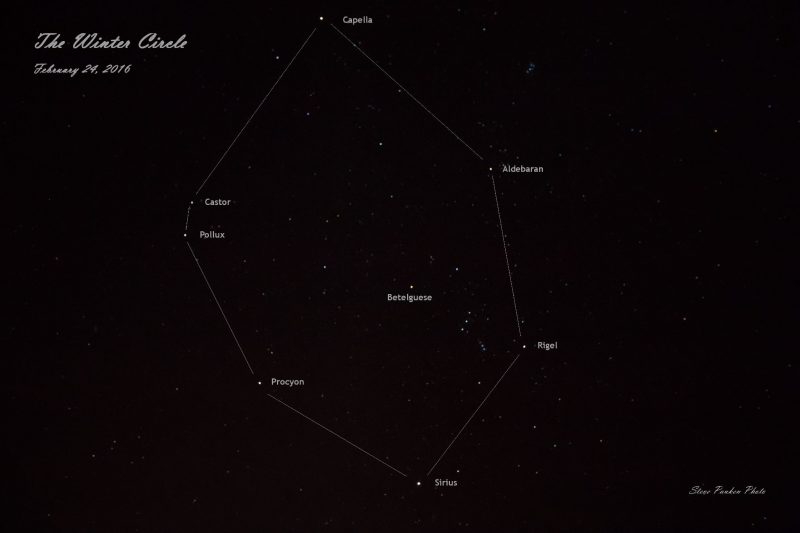
The Winter Circle (sometimes called the Winter Hexagon) is an asterism – a star pattern that is not a recognized constellation. This humongous star formation consists of six 1st-magnitude stars in six different constellations.

Capella of the constellation Auriga the charioteer
Pollux of the constellation Gemini the Twins
Procyon of the constellation Canis Minor the Smaller Dog
Sirius of the constellation Canis Major the Big Dog
Rigel of the constellation Orion the Hunter
Aldebaran in the constellation Taurus the Bull

The star Castor in the constellation Gemini, although not a 1st-magnitude star, counts as the sky’s brightest 2nd-magnitude star.

By the way, are you familiar with the constellation Orion the Hunter? The Winter Circle even dwarfs the Mighty Hunter, which only makes up the southwest (lower right) portion of the Winter Circle. If you’ve never seen the Winter Circle, but are acquainted with Orion, this constellation presents a great jumping off place for circumnavigating this brilliant circle of stars. Best of all, these stars are so bright that the’re even visible in the morning twilight.

Photo of night sky with lines connecting stars of Winter Circle.

Steve Pauken captured the Winter Circle on February 24, 2016, and wrote: “After seeing an illustration in EarthSky, I went out the back door to look for it. It was directly overhead, so I put my camera on the tripod, aimed straight up, and captured the image after a few tweaks for focus.”

The Winter Circle is so named because we in the Northern Hemisphere see this star formation on winter evenings. The Winter Circle is also visible from the Southern Hemisphere, though on their summer evenings.

The green line on the feature sky chart at top depicts the ecliptic, the Earth’s orbital plane projected onto the sky. The ecliptic can also be regarded as the sun’s apparent yearly pathway in front of the constellations of the zodiac. If you could see the stars in the daytime, you’d see the sun directly north of the star Aldebaran around June 1. Thereafter, the sun stays in front of the Winter Circle for about 1 1/2 months. Then the sun passes to the south (below) the Gemini stars, Castor and Pollux, in mid-July (about where you see Venus in late August/early September 2020).

We don’t see the Winter Circle in June and July because it’s lost in the glare of the sun. In late August, the Winter Circle returns to the morning sky. But we still won’t see the Winter Circle in the evening sky for months to come.

Aldebaran is out all night long, from dusk till dawn, around December 1; and the Gemini stars, Castor and Pollux, are out all night long, from dusk till dawn, around mid-January. Hence, we in the Northern Hemisphere associate the Winter Circle with short days and long nights, when these brilliant stars light up the dark months of the year.

Bottom line: These next few days, before daybreak, let Venus, the third-brightest celestial body, after the sun and moon, respectively, serve as your guide to the majestic Winter Circle.


from EarthSky https://ift.tt/3lpZXMO

Although it’s summer in the Northern Hemisphere, a major sign of winter now looms large in the predawn/dawn sky. The dazzling planet Venus beams in front of the great big lasso of stars known as the Winter Circle. For the next several days, Venus shines at the eastern border of the Winter Circle, midway between the Procyon, the Little Dog Star, and the Gemini stars, Castor and Pollux.

The Winter Circle (sometimes called the Winter Hexagon) is an asterism – a star pattern that is not a recognized constellation. This humongous star formation consists of six 1st-magnitude stars in six different constellations.

Capella of the constellation Auriga the charioteer
Pollux of the constellation Gemini the Twins
Procyon of the constellation Canis Minor the Smaller Dog
Sirius of the constellation Canis Major the Big Dog
Rigel of the constellation Orion the Hunter
Aldebaran in the constellation Taurus the Bull

The star Castor in the constellation Gemini, although not a 1st-magnitude star, counts as the sky’s brightest 2nd-magnitude star.

By the way, are you familiar with the constellation Orion the Hunter? The Winter Circle even dwarfs the Mighty Hunter, which only makes up the southwest (lower right) portion of the Winter Circle. If you’ve never seen the Winter Circle, but are acquainted with Orion, this constellation presents a great jumping off place for circumnavigating this brilliant circle of stars. Best of all, these stars are so bright that the’re even visible in the morning twilight.

Photo of night sky with lines connecting stars of Winter Circle.

Steve Pauken captured the Winter Circle on February 24, 2016, and wrote: “After seeing an illustration in EarthSky, I went out the back door to look for it. It was directly overhead, so I put my camera on the tripod, aimed straight up, and captured the image after a few tweaks for focus.”

The Winter Circle is so named because we in the Northern Hemisphere see this star formation on winter evenings. The Winter Circle is also visible from the Southern Hemisphere, though on their summer evenings.

The green line on the feature sky chart at top depicts the ecliptic, the Earth’s orbital plane projected onto the sky. The ecliptic can also be regarded as the sun’s apparent yearly pathway in front of the constellations of the zodiac. If you could see the stars in the daytime, you’d see the sun directly north of the star Aldebaran around June 1. Thereafter, the sun stays in front of the Winter Circle for about 1 1/2 months. Then the sun passes to the south (below) the Gemini stars, Castor and Pollux, in mid-July (about where you see Venus in late August/early September 2020).

We don’t see the Winter Circle in June and July because it’s lost in the glare of the sun. In late August, the Winter Circle returns to the morning sky. But we still won’t see the Winter Circle in the evening sky for months to come.

Aldebaran is out all night long, from dusk till dawn, around December 1; and the Gemini stars, Castor and Pollux, are out all night long, from dusk till dawn, around mid-January. Hence, we in the Northern Hemisphere associate the Winter Circle with short days and long nights, when these brilliant stars light up the dark months of the year.

Bottom line: These next few days, before daybreak, let Venus, the third-brightest celestial body, after the sun and moon, respectively, serve as your guide to the majestic Winter Circle.


from EarthSky https://ift.tt/3lpZXMO

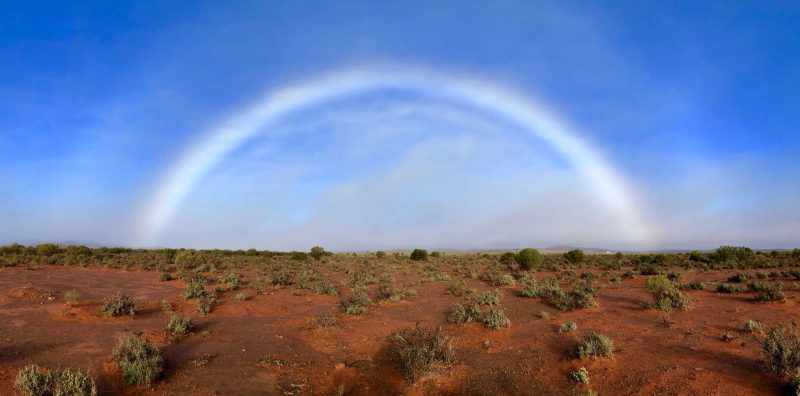
What is a fogbow?

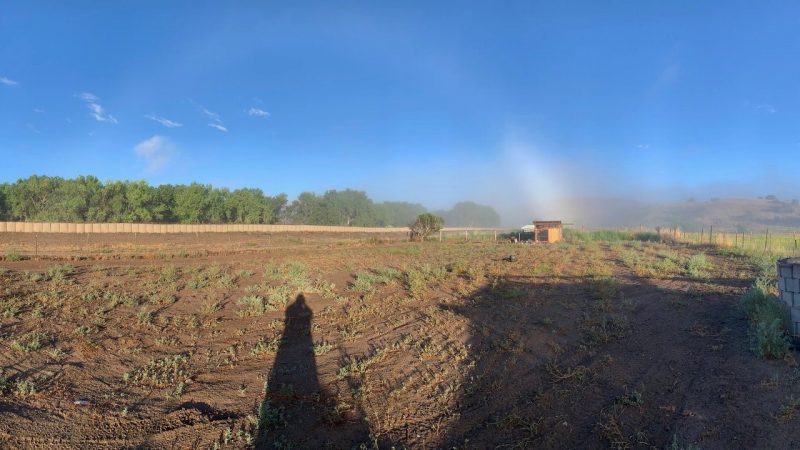
Fogbow over a desert landscape. The photographers shadow is also in the photo.

See the full-sized panorama here. | April Singer wrote on July 28: “This morning we had a little fog here in the high desert of New Mexico, USA. We had rain the last few afternoons and the ground is pretty saturated, and now this morning the sun was out. Perfect recipe for fog – and apparently for a fogbow! First time I’ve captured one. This is a pano with my iPhone. I didn’t realize the bow was there until I saw the picture. Since it’s been cloudy all through the comet viewing period, and I didn’t get any pictures, I’m happy to have something a little interesting to share now.” Lovely, April! Thank you.

Fogbows – sometimes called white rainbows, cloudbows or ghost rainbows – are made much as rainbows are, from the same configuration of sunlight and moisture. Rainbows happen when the air is filled with raindrops, and you always see a rainbow in the direction opposite the sun. Fogbows are much the same, always opposite the sun, but fogbows are caused by the small droplets inside a fog or cloud rather than larger raindrops.

Look for fogbows in a thin fog when the sun is bright. You might see one when the sun breaks through a fog. Or watch for fogbows over the ocean.

Because the water droplets in fog are so small, fogbows have only weak colors or are colorless.

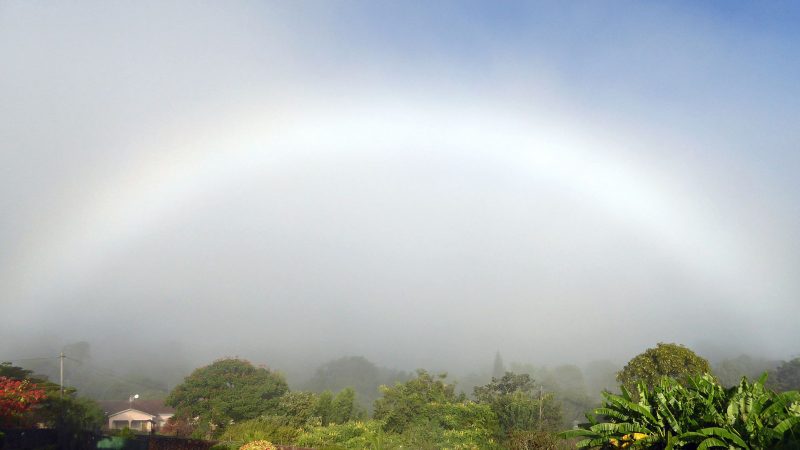
White rainbow in misty air over a wooded landscape.

View larger at EarthSky Community Photos. | Peter Lowenstein caught this fogbow in Mutare, Zimbabwe, on April 29, 2020. He wrote: “Half-an-hour after the Sun rose behind my house on Wednesday, a beautiful fogbow developed in the middle of a misty morning view from my front veranda. All the conditions were right – bright sunshine from the rear with the Sun less than twenty degrees above the horizon and clearing clouds of mist at the antisolar point. The scene was framed by a beautiful flowering Poinsettia to the left, a lush banana grove to the right, and clear blue sky beginning to appear on top!”

Fogbow - aka a white rainbow - over a desert landscape.

View at EarthSky Community Photos. | Alan Nicolle in New South Wales, Australia, captured this image on July 16, 2019. He wrote: “I was out geocaching in the outskirts of Broken Hill, when I turned back to see this fogbow developing. I took quite a few photos with the iPhone, and rode back to the car on my bike, but by the time I got back to the car to use my SLR, it had faded.” Thank you, Alan!

Faint white arc over rolling green landscape and straight country road.

Edith Smith in Aberdeenshire, Scotland, captured this fogbow on November 1, 2018. She wrote: “The camera spotted it before I did with eye, as I was too engrossed in foggy conditions.”

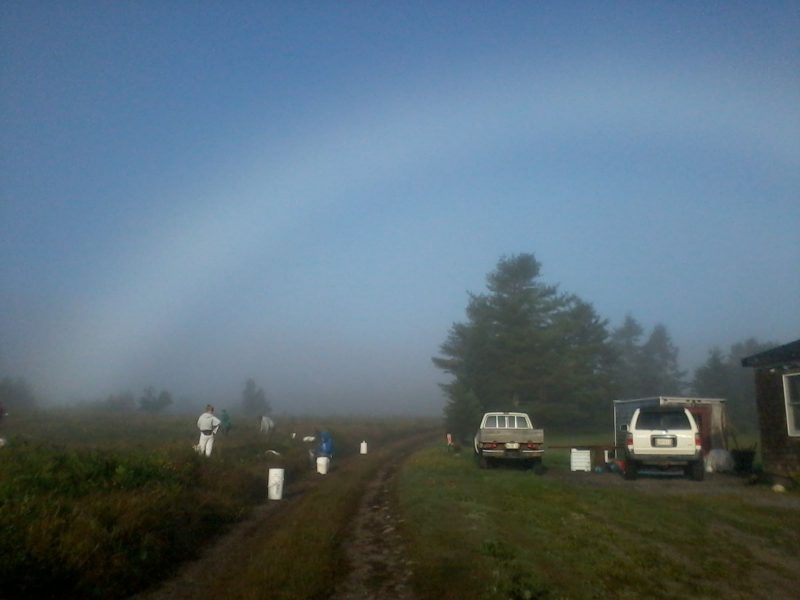
Diffuse white arc above bucolic scene of farmworkers in brushy field near dirt road.

Tommy Johnson captured this early morning fogbow near Jonesport, Maine, in August 2016. He wrote: “Early in the morning and blueberry rakers are starting to fill their buckets with the fruit. I called out to them to look at the fogbow, it was the first time any of us had seen one.”

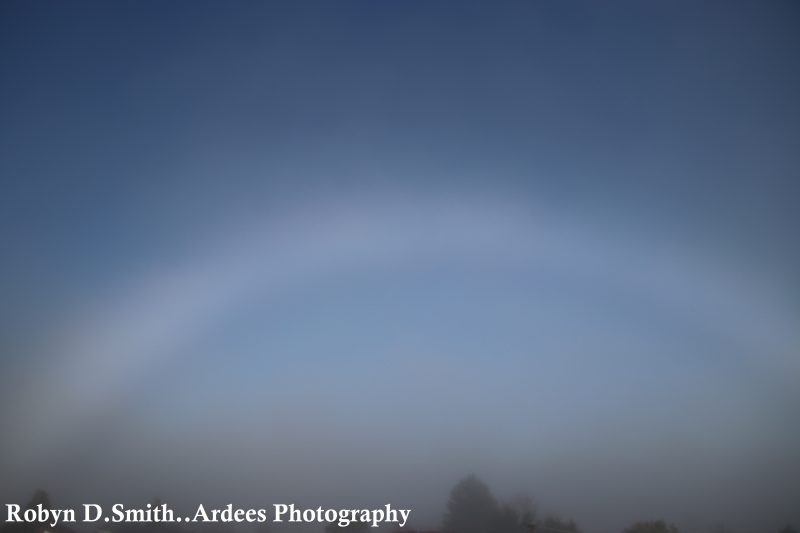
Diffuse white arc in slate blue dawn sky.

Wonderful fogbow caught by Robyn Smith in New Zealand on the morning of September 19, 2017 “… opposite the foggy sunrise.”

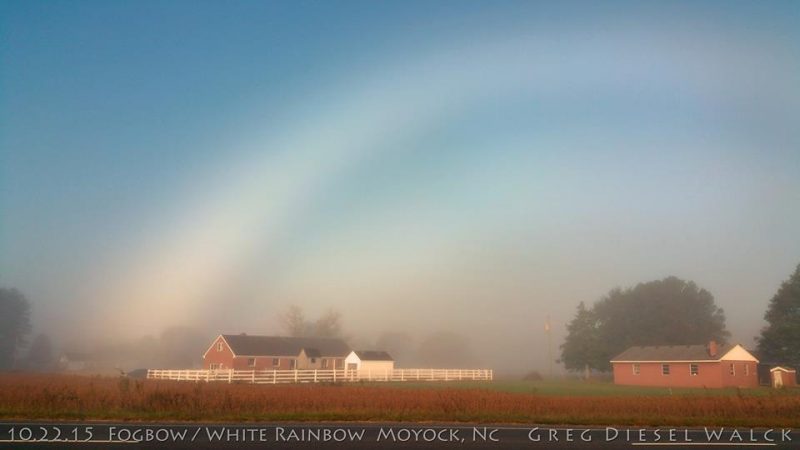
Partial white arc over bucolic scene with white fence and barn in distance.

GregDiesel Landscape Photography wrote in October 2015: “Saw my first fogbow / white rainbow. Photo taken with cell phone. Moyock, North Carolina.”

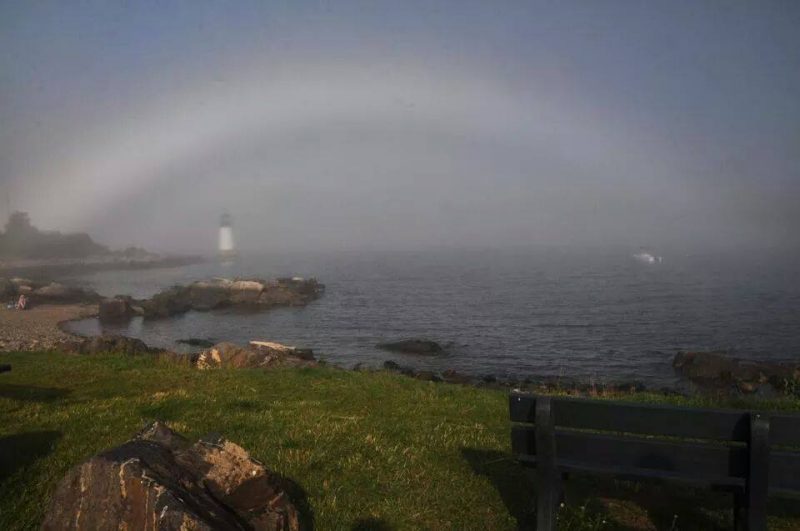
Diffuse white arc over rocky seacoast with white lighthouse in distance.

Katherine Keyes Millet captured this fogbow in July 2014 at Winter Island Park in Salem, Massachusetts.

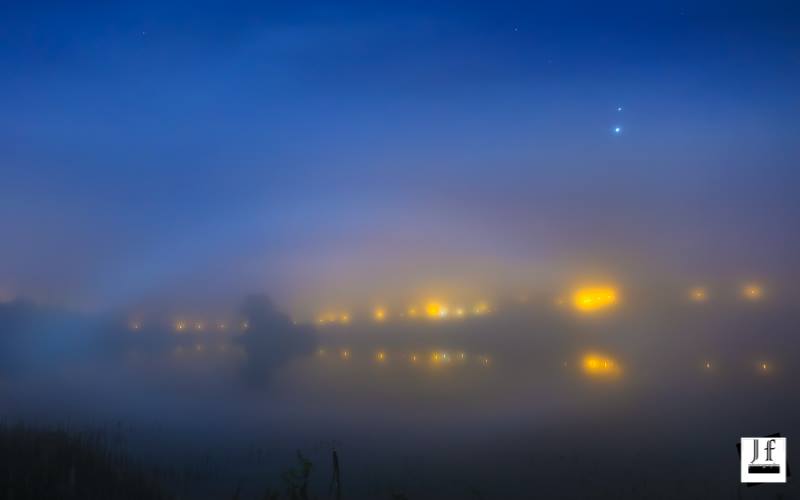
Very diffuse whit arc over blurry gold city lights, 2 bright dots in sky over fogbow.

Venus and Jupiter above a fogbow in Blacklough, Dungannon, Ireland. Mars is up there, too, but tough to see. John Fagan captured them all in October 2015.

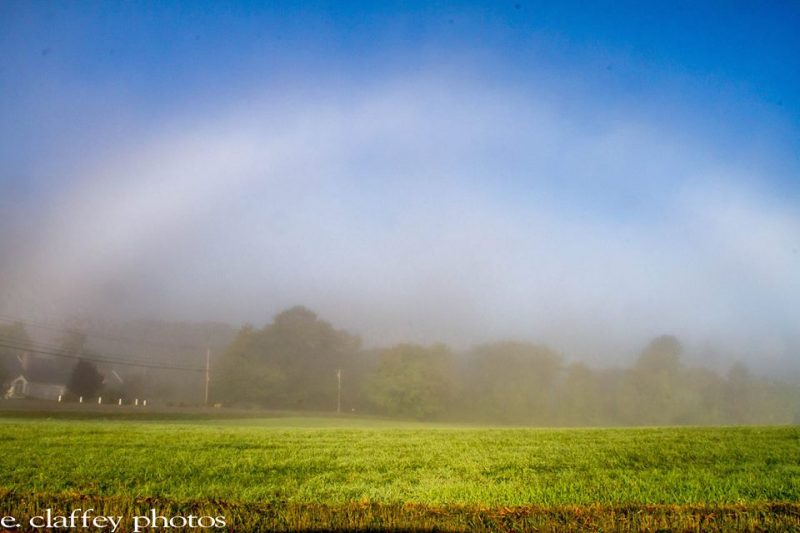
Cloudy-looking white arc over bright green field bordered with trees.

Eileen Claffey in Brookline, Massachusetts, captured this fogbow over a field in September 2014.

Les Cowley of the great website Atmospheric Optics says:

Look away from the sun and at an angle of 35-40 degrees from your shadow which marks the direction of the antisolar point. Some fogbows have very low contrast so look for small brightenings in the misty background. Once caught, they are unmistakable.

The sun must be less than 30-40 degrees high unless you are on a hill or high up on a ship where the mist and fogbow can be viewed from above.

Fogbows are huge, almost as large as a rainbow and much, much broader.

Look here for Les Cowley’s explanation of how fogbows form.

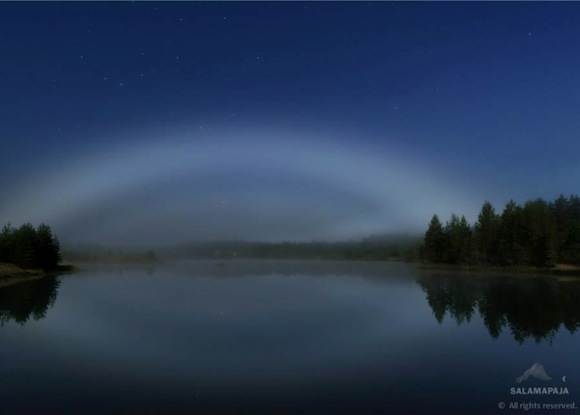
White arc in dark blue sky reflected in a lake.

Thomas Kast in Finland captured this fogbow in 2013. He wrote: “In this rather cold August night (+8C [46F]) there was patchy fog, especially in open fields. This lake remained clear for a long time. At one point I saw this white bow with moon in waning gibbous phase behind me.”

Rocks on seacoast with faintly colored whitish arc nearly touching them on left, higher on right end.

Jim Grant caught this fogbow over Sunset Cliffs in San Diego. He wrote: “The skies were sunny and clear, and then the fog rolled in, and with it this beautiful fogbow.”

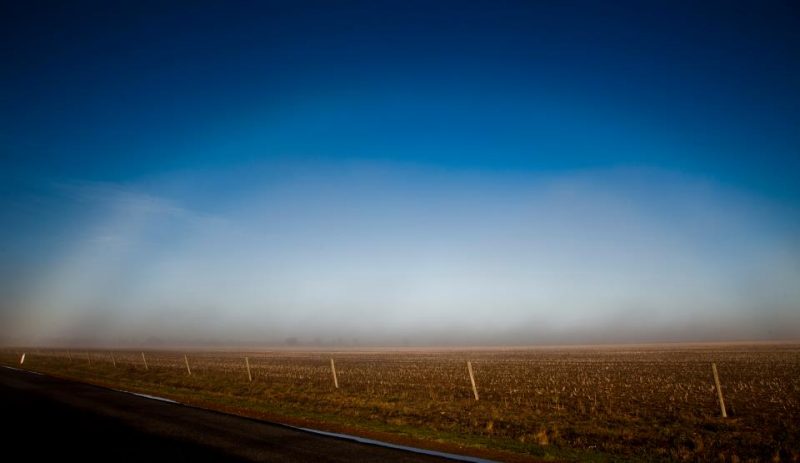
Pale arc over fog over brown stubbly field past a wire fence.

Lynton Brown of Australia captured this fogbow over a barren field in the autumn of 2012.

Bottom line: Fogbows are made by much the same process as rainbows, but with the small water droplets inside a fog instead of larger raindrops. Because the water droplets in fog are so small, fogbows have only weak colors or are colorless.


from EarthSky https://ift.tt/2RuWZ9W
Fogbow over a desert landscape. The photographers shadow is also in the photo.

See the full-sized panorama here. | April Singer wrote on July 28: “This morning we had a little fog here in the high desert of New Mexico, USA. We had rain the last few afternoons and the ground is pretty saturated, and now this morning the sun was out. Perfect recipe for fog – and apparently for a fogbow! First time I’ve captured one. This is a pano with my iPhone. I didn’t realize the bow was there until I saw the picture. Since it’s been cloudy all through the comet viewing period, and I didn’t get any pictures, I’m happy to have something a little interesting to share now.” Lovely, April! Thank you.

Fogbows – sometimes called white rainbows, cloudbows or ghost rainbows – are made much as rainbows are, from the same configuration of sunlight and moisture. Rainbows happen when the air is filled with raindrops, and you always see a rainbow in the direction opposite the sun. Fogbows are much the same, always opposite the sun, but fogbows are caused by the small droplets inside a fog or cloud rather than larger raindrops.

Look for fogbows in a thin fog when the sun is bright. You might see one when the sun breaks through a fog. Or watch for fogbows over the ocean.

Because the water droplets in fog are so small, fogbows have only weak colors or are colorless.

White rainbow in misty air over a wooded landscape.

View larger at EarthSky Community Photos. | Peter Lowenstein caught this fogbow in Mutare, Zimbabwe, on April 29, 2020. He wrote: “Half-an-hour after the Sun rose behind my house on Wednesday, a beautiful fogbow developed in the middle of a misty morning view from my front veranda. All the conditions were right – bright sunshine from the rear with the Sun less than twenty degrees above the horizon and clearing clouds of mist at the antisolar point. The scene was framed by a beautiful flowering Poinsettia to the left, a lush banana grove to the right, and clear blue sky beginning to appear on top!”

Fogbow - aka a white rainbow - over a desert landscape.

View at EarthSky Community Photos. | Alan Nicolle in New South Wales, Australia, captured this image on July 16, 2019. He wrote: “I was out geocaching in the outskirts of Broken Hill, when I turned back to see this fogbow developing. I took quite a few photos with the iPhone, and rode back to the car on my bike, but by the time I got back to the car to use my SLR, it had faded.” Thank you, Alan!

Faint white arc over rolling green landscape and straight country road.

Edith Smith in Aberdeenshire, Scotland, captured this fogbow on November 1, 2018. She wrote: “The camera spotted it before I did with eye, as I was too engrossed in foggy conditions.”

Diffuse white arc above bucolic scene of farmworkers in brushy field near dirt road.

Tommy Johnson captured this early morning fogbow near Jonesport, Maine, in August 2016. He wrote: “Early in the morning and blueberry rakers are starting to fill their buckets with the fruit. I called out to them to look at the fogbow, it was the first time any of us had seen one.”

Diffuse white arc in slate blue dawn sky.

Wonderful fogbow caught by Robyn Smith in New Zealand on the morning of September 19, 2017 “… opposite the foggy sunrise.”

Partial white arc over bucolic scene with white fence and barn in distance.

GregDiesel Landscape Photography wrote in October 2015: “Saw my first fogbow / white rainbow. Photo taken with cell phone. Moyock, North Carolina.”

Diffuse white arc over rocky seacoast with white lighthouse in distance.

Katherine Keyes Millet captured this fogbow in July 2014 at Winter Island Park in Salem, Massachusetts.

Very diffuse whit arc over blurry gold city lights, 2 bright dots in sky over fogbow.

Venus and Jupiter above a fogbow in Blacklough, Dungannon, Ireland. Mars is up there, too, but tough to see. John Fagan captured them all in October 2015.

Cloudy-looking white arc over bright green field bordered with trees.

Eileen Claffey in Brookline, Massachusetts, captured this fogbow over a field in September 2014.

Les Cowley of the great website Atmospheric Optics says:

Look away from the sun and at an angle of 35-40 degrees from your shadow which marks the direction of the antisolar point. Some fogbows have very low contrast so look for small brightenings in the misty background. Once caught, they are unmistakable.

The sun must be less than 30-40 degrees high unless you are on a hill or high up on a ship where the mist and fogbow can be viewed from above.

Fogbows are huge, almost as large as a rainbow and much, much broader.

Look here for Les Cowley’s explanation of how fogbows form.

White arc in dark blue sky reflected in a lake.

Thomas Kast in Finland captured this fogbow in 2013. He wrote: “In this rather cold August night (+8C [46F]) there was patchy fog, especially in open fields. This lake remained clear for a long time. At one point I saw this white bow with moon in waning gibbous phase behind me.”

Rocks on seacoast with faintly colored whitish arc nearly touching them on left, higher on right end.

Jim Grant caught this fogbow over Sunset Cliffs in San Diego. He wrote: “The skies were sunny and clear, and then the fog rolled in, and with it this beautiful fogbow.”

Pale arc over fog over brown stubbly field past a wire fence.

Lynton Brown of Australia captured this fogbow over a barren field in the autumn of 2012.

Bottom line: Fogbows are made by much the same process as rainbows, but with the small water droplets inside a fog instead of larger raindrops. Because the water droplets in fog are so small, fogbows have only weak colors or are colorless.


from EarthSky https://ift.tt/2RuWZ9W

adds 2