aads

Astronomers issue report on the effect of ‘satellite constellations’ on astronomy

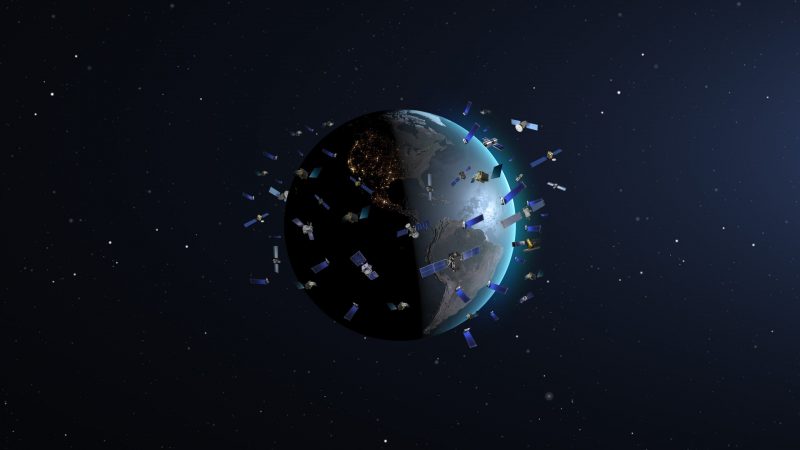
Illustration of Earth in space, surrounded by confetti-like halo of very many orbiting objects.

In May 2019 SpaceX launched its first batch of 60 Starlink communication satellites, which surprised astronomers and laypeople with their appearance in the night sky. Astronomers have only now, a little over a year later, accumulated enough observations of constellation satellites like those being launched by SpaceX and OneWeb to run computer simulations of their likely impact. These simulations will help researchers thoroughly understand the magnitude and complexity of the problem. This research informed the discussion at the Satellite Constellations 1 (SATCON1) workshop and led to recommendations for observatories and constellation operators. The SATCON1 report concludes that the effects on astronomical research and on the human experience of the night sky range from “negligible” to “extreme.” Image via AAS/ NOIRLab/ NSF/ AURA/ P. Marenfeld.

Originally published by the American Astronomical Society on August 25, 2020

A report by experts representing the global astronomical community concludes that large constellations of bright satellites in low Earth orbit will fundamentally change ground-based optical and infrared astronomy and could impact the appearance of the night sky for stargazers worldwide. The report is the outcome of the recent SATCON1 virtual workshop, which brought together more than 250 scientists, engineers, satellite operators, and other stakeholders.

The report from the Satellite Constellations 1 (SATCON1) workshop, organized jointly by NSF’s NOIRLab and the American Astronomical Society (AAS), has been delivered to the National Science Foundation (NSF). Held virtually from 29 June to 2 July 2020, SATCON1 focused on technical aspects of the impact of existing and planned large satellite constellations on optical and infrared astronomy. NSF, which funded the workshop, also finances most of the large ground-based telescopes widely available to researchers in the United States. More than 250 astronomers, engineers, commercial satellite operators, and other stakeholders attended SATCON1. Their goals were to better quantify the scientific impacts of huge ensembles of low-Earth-orbiting satellites (LEOsats) contaminating astronomical observations and to explore possible ways to minimize those impacts.

Read the SATCON1 report

SATCON1 co-chair Connie Walker from NSF’s NOIRLab explained:

Recent technology developments for astronomical research — especially cameras with wide fields of view on large optical-infrared telescopes — are happening at the same time as the rapid deployment of many thousands of LEOsats by companies rolling out new space-based communication technologies.

The report concludes that the effects of large satellite constellations on astronomical research and on the human experience of the night sky range from “negligible” to “extreme.” This new hazard was not on astronomers’ radar in 2010, when New Worlds, New Horizons — the report of the National Academies’ Astro2010 decadal survey of astronomy and astrophysics — was issued. Astro2010’s top recommendation for ground-based optical astronomy, Vera C. Rubin Observatory, will soon begin conducting exactly the type of observations to which Walker refers. When SpaceX launched its first batch of 60 Starlink communication satellites in May 2019 and people all over the world saw them in the sky, astronomers reacted with alarm. Not only were the Starlink satellites brighter than anyone expected, but there could be tens of thousands more like them. As they pass through Rubin’s camera field, they will affect the 8.4-meter (27.6-foot) telescope’s view of the faint celestial objects astronomers hope to study with it.

SATCON1 co-chair Jeff Hall from Lowell Observatory is chair of the AAS Committee on Light Pollution, Radio Interference, and Space Debris. Hall said:

Rubin Observatory and the giant 30-meter telescopes coming online in the next decade will substantially enhance humankind’s understanding of the cosmos. For reasons of expense, maintenance, and instrumentation, such facilities cannot be operated from space. Ground-based astronomy is, and will remain, vital and relevant.

Constellations of LEOsats are designed in part to provide communication services to underserved and remote areas, a goal everyone can support. Recognizing this, astronomers have engaged satellite operators in cooperative discussions about how to achieve that goal without unduly harming ground-based astronomical observations. The SATCON1 workshop is just the latest, and most significant, step in this ongoing dialog.

The report offers two main findings. The first is that LEOsats disproportionately affect science programs that require twilight observations, such as searches for Earth-threatening asteroids and comets, outer solar system objects, and visible-light counterparts of fleeting gravitational-wave sources. During twilight the Sun is below the horizon for observers on the ground, but not for satellites hundreds of kilometers overhead, which are still illuminated. As long as satellites remain below 600 kilometers (not quite 400 miles), their interference with astronomical observations is somewhat limited during the night’s darkest hours. But satellites at higher altitudes, such as the constellation planned by OneWeb that will orbit at 1,200 kilometers (about 750 miles), may be visible all night long during summer and for much of the night in other seasons. These constellations could have serious negative consequences for many research programs at the world’s premier optical observatories. Depending on their altitude and brightness, constellation satellites could also spoil starry nights for amateur astronomers, astrophotographers, and other nature enthusiasts.

The report’s second finding is that there are at least six ways to mitigate harm to astronomy from large satellite constellations:

1. Launch fewer or no LEOsats. However impractical or unlikely, this is the only option identified that can achieve zero astronomical impact.

2. Deploy satellites at orbital altitudes no higher than ~600 km.

3. Darken satellites or use sunshades to shadow their reflective surfaces.

4. Control each satellite’s orientation in space to reflect less sunlight to Earth.

5. Minimize or eventually be able to eliminate the effect of satellite trails during the processing of astronomical images.

6. Make more accurate orbital information available for satellites so that observers can avoid pointing telescopes at them.

Astronomers have only now, a little over a year after the first SpaceX Starlink launch, accumulated enough observations of constellation satellites and run computer simulations of their likely impact when fully deployed to thoroughly understand the magnitude and complexity of the problem. This research informed the discussion at SATCON1 and led to ten recommendations for observatories, constellation operators, and those two groups in collaboration. Some involve actions that can be taken immediately, while others urge further study to develop effective strategies to address problems anticipated as new large telescopes come online and as satellite constellations proliferate.

The SATCON1 workshop was an important step towards managing a challenging future. NOIRLab director Patrick McCarthy said:

I hope that the collegiality and spirit of partnership between astronomers and commercial satellite operators will expand to include more members of both communities and that it will continue to prove useful and productive. I also hope that the findings and recommendations in the SATCON1 report will serve as guidelines for observatories and satellite operators alike as we work towards a more detailed understanding of the impacts and mitigations and we learn to share the sky, one of nature’s priceless treasures.

AAS President Paula Szkody of the University of Washington participated in the workshop. She said:

Our team at the AAS was enthusiastic to partner with NOIRLab and bring representatives of the astronomical and satellite communities together for a very fruitful exchange of ideas. Even though we’re still at an early stage of understanding and addressing the threats posed to astronomy by large satellite constellations, we have made good progress and have plenty of reasons to hope for a positive outcome.

The next workshop, SATCON2, which will tackle the significant issues of policy and regulation, is tentatively planned for early to mid-2021.

Bottom line: A new report by experts concludes that large constellations of bright satellites in low-Earth orbit will fundamentally change ground-based astronomy and impact the appearance of the night sky for stargazers worldwide.


from EarthSky https://ift.tt/3lmY2bV
Illustration of Earth in space, surrounded by confetti-like halo of very many orbiting objects.

In May 2019 SpaceX launched its first batch of 60 Starlink communication satellites, which surprised astronomers and laypeople with their appearance in the night sky. Astronomers have only now, a little over a year later, accumulated enough observations of constellation satellites like those being launched by SpaceX and OneWeb to run computer simulations of their likely impact. These simulations will help researchers thoroughly understand the magnitude and complexity of the problem. This research informed the discussion at the Satellite Constellations 1 (SATCON1) workshop and led to recommendations for observatories and constellation operators. The SATCON1 report concludes that the effects on astronomical research and on the human experience of the night sky range from “negligible” to “extreme.” Image via AAS/ NOIRLab/ NSF/ AURA/ P. Marenfeld.

Originally published by the American Astronomical Society on August 25, 2020

A report by experts representing the global astronomical community concludes that large constellations of bright satellites in low Earth orbit will fundamentally change ground-based optical and infrared astronomy and could impact the appearance of the night sky for stargazers worldwide. The report is the outcome of the recent SATCON1 virtual workshop, which brought together more than 250 scientists, engineers, satellite operators, and other stakeholders.

The report from the Satellite Constellations 1 (SATCON1) workshop, organized jointly by NSF’s NOIRLab and the American Astronomical Society (AAS), has been delivered to the National Science Foundation (NSF). Held virtually from 29 June to 2 July 2020, SATCON1 focused on technical aspects of the impact of existing and planned large satellite constellations on optical and infrared astronomy. NSF, which funded the workshop, also finances most of the large ground-based telescopes widely available to researchers in the United States. More than 250 astronomers, engineers, commercial satellite operators, and other stakeholders attended SATCON1. Their goals were to better quantify the scientific impacts of huge ensembles of low-Earth-orbiting satellites (LEOsats) contaminating astronomical observations and to explore possible ways to minimize those impacts.

Read the SATCON1 report

SATCON1 co-chair Connie Walker from NSF’s NOIRLab explained:

Recent technology developments for astronomical research — especially cameras with wide fields of view on large optical-infrared telescopes — are happening at the same time as the rapid deployment of many thousands of LEOsats by companies rolling out new space-based communication technologies.

The report concludes that the effects of large satellite constellations on astronomical research and on the human experience of the night sky range from “negligible” to “extreme.” This new hazard was not on astronomers’ radar in 2010, when New Worlds, New Horizons — the report of the National Academies’ Astro2010 decadal survey of astronomy and astrophysics — was issued. Astro2010’s top recommendation for ground-based optical astronomy, Vera C. Rubin Observatory, will soon begin conducting exactly the type of observations to which Walker refers. When SpaceX launched its first batch of 60 Starlink communication satellites in May 2019 and people all over the world saw them in the sky, astronomers reacted with alarm. Not only were the Starlink satellites brighter than anyone expected, but there could be tens of thousands more like them. As they pass through Rubin’s camera field, they will affect the 8.4-meter (27.6-foot) telescope’s view of the faint celestial objects astronomers hope to study with it.

SATCON1 co-chair Jeff Hall from Lowell Observatory is chair of the AAS Committee on Light Pollution, Radio Interference, and Space Debris. Hall said:

Rubin Observatory and the giant 30-meter telescopes coming online in the next decade will substantially enhance humankind’s understanding of the cosmos. For reasons of expense, maintenance, and instrumentation, such facilities cannot be operated from space. Ground-based astronomy is, and will remain, vital and relevant.

Constellations of LEOsats are designed in part to provide communication services to underserved and remote areas, a goal everyone can support. Recognizing this, astronomers have engaged satellite operators in cooperative discussions about how to achieve that goal without unduly harming ground-based astronomical observations. The SATCON1 workshop is just the latest, and most significant, step in this ongoing dialog.

The report offers two main findings. The first is that LEOsats disproportionately affect science programs that require twilight observations, such as searches for Earth-threatening asteroids and comets, outer solar system objects, and visible-light counterparts of fleeting gravitational-wave sources. During twilight the Sun is below the horizon for observers on the ground, but not for satellites hundreds of kilometers overhead, which are still illuminated. As long as satellites remain below 600 kilometers (not quite 400 miles), their interference with astronomical observations is somewhat limited during the night’s darkest hours. But satellites at higher altitudes, such as the constellation planned by OneWeb that will orbit at 1,200 kilometers (about 750 miles), may be visible all night long during summer and for much of the night in other seasons. These constellations could have serious negative consequences for many research programs at the world’s premier optical observatories. Depending on their altitude and brightness, constellation satellites could also spoil starry nights for amateur astronomers, astrophotographers, and other nature enthusiasts.

The report’s second finding is that there are at least six ways to mitigate harm to astronomy from large satellite constellations:

1. Launch fewer or no LEOsats. However impractical or unlikely, this is the only option identified that can achieve zero astronomical impact.

2. Deploy satellites at orbital altitudes no higher than ~600 km.

3. Darken satellites or use sunshades to shadow their reflective surfaces.

4. Control each satellite’s orientation in space to reflect less sunlight to Earth.

5. Minimize or eventually be able to eliminate the effect of satellite trails during the processing of astronomical images.

6. Make more accurate orbital information available for satellites so that observers can avoid pointing telescopes at them.

Astronomers have only now, a little over a year after the first SpaceX Starlink launch, accumulated enough observations of constellation satellites and run computer simulations of their likely impact when fully deployed to thoroughly understand the magnitude and complexity of the problem. This research informed the discussion at SATCON1 and led to ten recommendations for observatories, constellation operators, and those two groups in collaboration. Some involve actions that can be taken immediately, while others urge further study to develop effective strategies to address problems anticipated as new large telescopes come online and as satellite constellations proliferate.

The SATCON1 workshop was an important step towards managing a challenging future. NOIRLab director Patrick McCarthy said:

I hope that the collegiality and spirit of partnership between astronomers and commercial satellite operators will expand to include more members of both communities and that it will continue to prove useful and productive. I also hope that the findings and recommendations in the SATCON1 report will serve as guidelines for observatories and satellite operators alike as we work towards a more detailed understanding of the impacts and mitigations and we learn to share the sky, one of nature’s priceless treasures.

AAS President Paula Szkody of the University of Washington participated in the workshop. She said:

Our team at the AAS was enthusiastic to partner with NOIRLab and bring representatives of the astronomical and satellite communities together for a very fruitful exchange of ideas. Even though we’re still at an early stage of understanding and addressing the threats posed to astronomy by large satellite constellations, we have made good progress and have plenty of reasons to hope for a positive outcome.

The next workshop, SATCON2, which will tackle the significant issues of policy and regulation, is tentatively planned for early to mid-2021.

Bottom line: A new report by experts concludes that large constellations of bright satellites in low-Earth orbit will fundamentally change ground-based astronomy and impact the appearance of the night sky for stargazers worldwide.


from EarthSky https://ift.tt/3lmY2bV
Moon, Jupiter, Saturn August 27-29

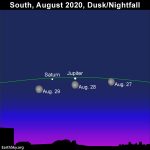
These next several evenings – August 27, 28 and 29, 2020 – watch for the waxing gibbous moon to pass by the 2 biggest planets in our solar system, Jupiter and Saturn. Both worlds are gas giants. Jupiter is by far the brighter planet, shining some 8 times more brilliantly than Saturn. Yet the famous planet of the rings shines as brightly as the brightest stars. Just look up on these nights! You can’t miss these bright worlds near the moon.

Jupiter ranks as the 4th-brightest celestial body to light up the heavens, after the sun, moon and the planet Venus. But there’s no way to mistake Venus for Jupiter, or vice versa, because – at present – Jupiter rules the evening sky while Venus is up at dawn. Around the world, in the wee hours of the morning, Jupiter sets in southwest at roughly the same time that Venus rises in the northeast.

Meanwhile, Saturn – the most distant word that you can see easily with the unaided eye – is twice as bright as the 1st-magnitude star Antares, Heart of the Scorpion. You might have seen the moon in the vicinity of Antares a few days ago.

Live in the US or Canada? Find out when Jupiter sets and Venus rises via Old Farmer’s Almanac.

For virtually anywhere worldwide, find out when Jupiter sets and Venus rises via TimeandDate.

Click on Heaven-Above Moon for the moon’s present position on the zodiac

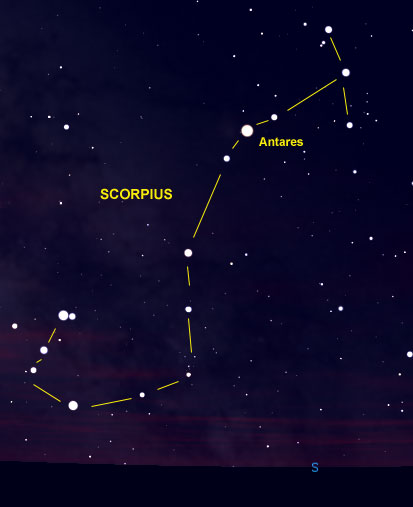
Chart showing the constellation Scorpius and its brightest star, Antares.

Here’s a constellation to look for near the moon, Jupiter and Saturn in the next few days. Scorpius is one of the few constellations that looks like its namesake. The bright red star Antares marks the Scorpion’s Heart. On the night of August 27, an imaginary line drawn from Jupiter and past the moon points to Antares. Also, notice the 2 stars at the tip of the Scorpion’s Tail. These 2 stars – Shaula and Lesath – are known as The Stinger.

There are two reasons for Jupiter and Saturn’s brilliance. First of all, these planets are huge; and, secondly, they have a high albedo (reflectivity). Jupiter has 1,331 times the volume of Earth, whereas Saturn has 764 times the Earth’s volume. Jupiter reflects about 52 percent of the incoming sunlight, while Saturn reflects about 47 percent. In contrast, our moon only reflects about 12 percent of the incoming sunlight.

Unlike the stars, which shine by their own light, Jupiter and Saturn shine by reflecting the light of the sun. Despite Jupiter residing 4.4 astronomical units (AU) from Earth and Saturn at 9.2 AU from Earth right now, these planets still stand out in Earth’s sky. By the way, one AU = one sun/Earth distance.

Find out planetary distances from Earth and the sun via Heavens-Above.

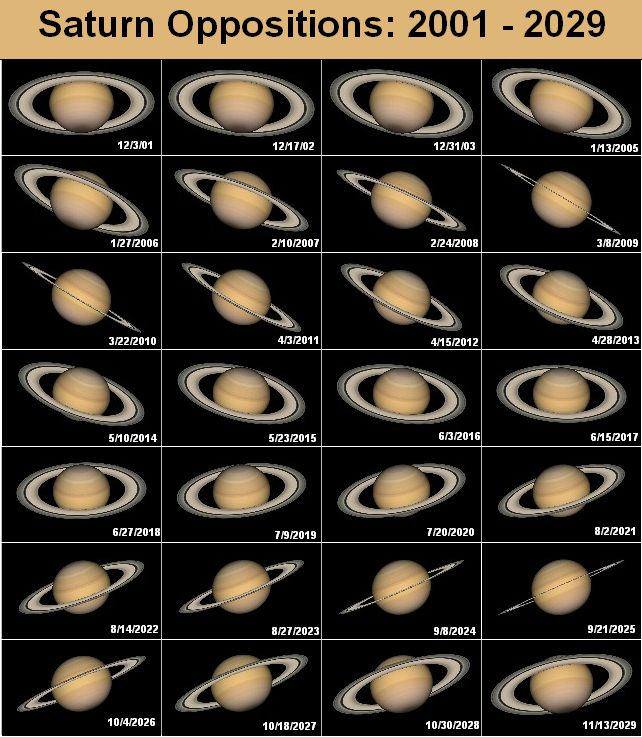
Saturn’s brilliance also depends the tilt of its majestic rings. You need a telescope to view the rings, but their inclination affects the planet’s brightness as seen from Earth, when looking with the eye alone. Saturn appears brightest when the rings are inclined at a maximum of 27 degrees toward Earth, and dimmest when the rings appear edge-on (0 degrees).

Presently, the rings are inclined at little more than 21 degrees, adding to Saturn’s overall brilliance.

Image via Wikimedia Commons. The tilt of Saturn’s rings has a great impact on its overall brightness. In years when Saturn’s rings are edge-on as seen from Earth (2009 and 2025), Saturn appears considerably dimmer than in years when Saturn’s rings a maximally titled toward Earth (2017 and 2032). This year, in 2020, Saturn’s rings are still quite inclined.

Bottom line: On August 25, 26 and 27, 2020, use the moon locate the two largest planets of the solar system, Jupiter and Saturn.


from EarthSky https://ift.tt/2G5rMKp

These next several evenings – August 27, 28 and 29, 2020 – watch for the waxing gibbous moon to pass by the 2 biggest planets in our solar system, Jupiter and Saturn. Both worlds are gas giants. Jupiter is by far the brighter planet, shining some 8 times more brilliantly than Saturn. Yet the famous planet of the rings shines as brightly as the brightest stars. Just look up on these nights! You can’t miss these bright worlds near the moon.

Jupiter ranks as the 4th-brightest celestial body to light up the heavens, after the sun, moon and the planet Venus. But there’s no way to mistake Venus for Jupiter, or vice versa, because – at present – Jupiter rules the evening sky while Venus is up at dawn. Around the world, in the wee hours of the morning, Jupiter sets in southwest at roughly the same time that Venus rises in the northeast.

Meanwhile, Saturn – the most distant word that you can see easily with the unaided eye – is twice as bright as the 1st-magnitude star Antares, Heart of the Scorpion. You might have seen the moon in the vicinity of Antares a few days ago.

Live in the US or Canada? Find out when Jupiter sets and Venus rises via Old Farmer’s Almanac.

For virtually anywhere worldwide, find out when Jupiter sets and Venus rises via TimeandDate.

Click on Heaven-Above Moon for the moon’s present position on the zodiac

Chart showing the constellation Scorpius and its brightest star, Antares.

Here’s a constellation to look for near the moon, Jupiter and Saturn in the next few days. Scorpius is one of the few constellations that looks like its namesake. The bright red star Antares marks the Scorpion’s Heart. On the night of August 27, an imaginary line drawn from Jupiter and past the moon points to Antares. Also, notice the 2 stars at the tip of the Scorpion’s Tail. These 2 stars – Shaula and Lesath – are known as The Stinger.

There are two reasons for Jupiter and Saturn’s brilliance. First of all, these planets are huge; and, secondly, they have a high albedo (reflectivity). Jupiter has 1,331 times the volume of Earth, whereas Saturn has 764 times the Earth’s volume. Jupiter reflects about 52 percent of the incoming sunlight, while Saturn reflects about 47 percent. In contrast, our moon only reflects about 12 percent of the incoming sunlight.

Unlike the stars, which shine by their own light, Jupiter and Saturn shine by reflecting the light of the sun. Despite Jupiter residing 4.4 astronomical units (AU) from Earth and Saturn at 9.2 AU from Earth right now, these planets still stand out in Earth’s sky. By the way, one AU = one sun/Earth distance.

Find out planetary distances from Earth and the sun via Heavens-Above.

Saturn’s brilliance also depends the tilt of its majestic rings. You need a telescope to view the rings, but their inclination affects the planet’s brightness as seen from Earth, when looking with the eye alone. Saturn appears brightest when the rings are inclined at a maximum of 27 degrees toward Earth, and dimmest when the rings appear edge-on (0 degrees).

Presently, the rings are inclined at little more than 21 degrees, adding to Saturn’s overall brilliance.

Image via Wikimedia Commons. The tilt of Saturn’s rings has a great impact on its overall brightness. In years when Saturn’s rings are edge-on as seen from Earth (2009 and 2025), Saturn appears considerably dimmer than in years when Saturn’s rings a maximally titled toward Earth (2017 and 2032). This year, in 2020, Saturn’s rings are still quite inclined.

Bottom line: On August 25, 26 and 27, 2020, use the moon locate the two largest planets of the solar system, Jupiter and Saturn.


from EarthSky https://ift.tt/2G5rMKp

What are cloud streets?

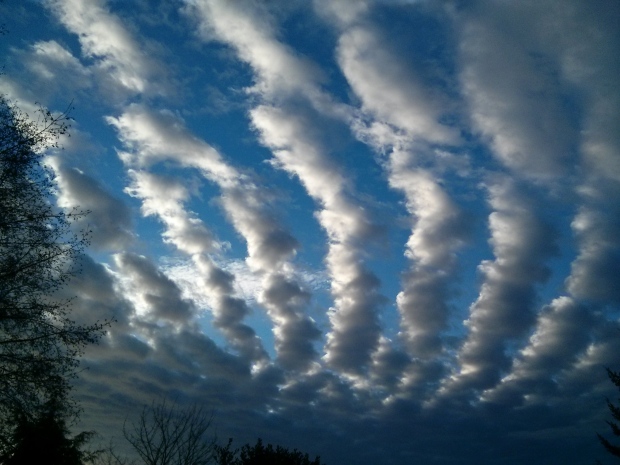
Fanned-out stripes of clouds.

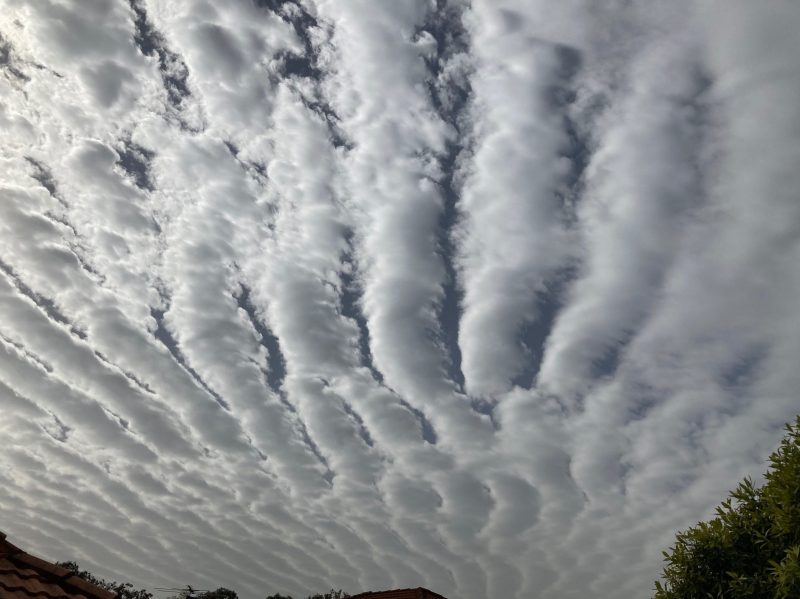
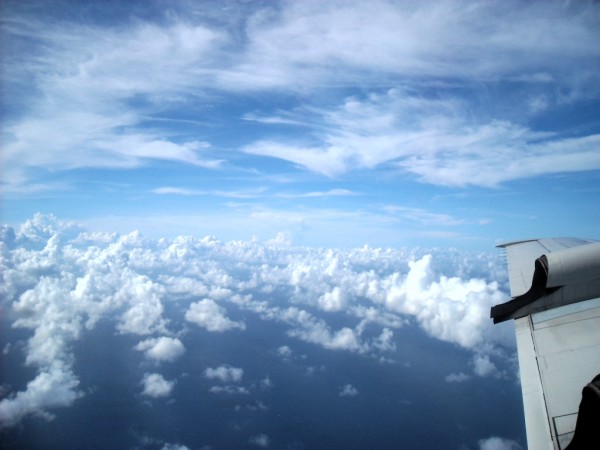
View at EarthSky Community Photos. | Michael Padbury in Wellington Point, Australia captured this image with his iPhone on August 22, 2020. He wrote: “My daughter Hannah pointed out how unusual and beautiful these clouds were last Saturday morning … Not sure what you would call them.” Cloud arrays of this type are called cloud streets. They’re most often captured by satellites, because they tend to form over the ocean. But sometimes – as this photo shows – people see them from the ground, too. Awesome catch, Michael. Thank you, Hannah, too.

Cloud streets are long rows of cumulus clouds that are oriented parallel to the direction of the wind. Over the past decades, they’ve been seen most often in satellite photos; we only rarely see them in photos taken from the ground, as in the photo above. You can recognize cloud streets as rows of puffy cumulus or cumulus-type clouds. They most often straight, but might form patterns when the wind driving the clouds hits an obstacle.

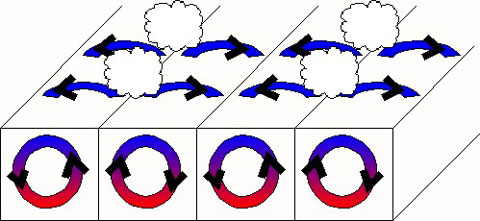
Cloud streets are formed by what are called convection rolls of rising warm air and sinking cool air. Rising warm air cools gradually as it ascends into the atmosphere. When moisture in the warm air mass cools and condenses, it forms clouds.

Meanwhile, sinking cool air on either side of the cloud formation zone creates a cloud-free area. When several of these alternating rising and sinking air masses align with the wind, cloud streets develop.

Cloud streets are technically called horizontal convective rolls.

cloud-street-formation-noaa-480

Convection rolls and the formation of cloud streets. Image via NOAA.

NASA's Aqua satellite captured this image of cloud streets over the Black Sea on January 8, 2015. NASA Earth Observatory image courtesy Jeff Schmaltz LANCE/EOSDIS MODIS Rapid Response Team, GSFC.

The MODIS instrument on NASA’s Aqua satellite captured this image of cloud streets over the Black Sea on January 8, 2015. NASA Earth Observatory image courtesy Jeff Schmaltz LANCE/EOSDIS MODIS Rapid Response Team, GSFC. Read more about this image

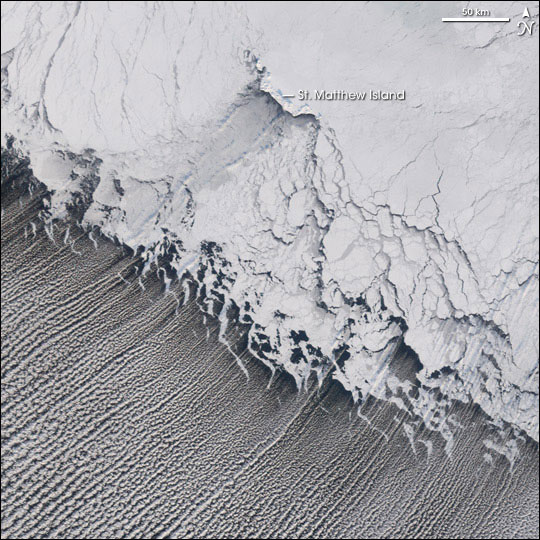
The U.S. National Aeronautics and Space Administration (NASA) has taken some amazing photographs of cloud streets over the past few years with the MODIS (Moderate Resolution Imaging Spectroradiometer) instruments on board the Terra and Aqua satellites. The satellite images on this page are from these instruments.

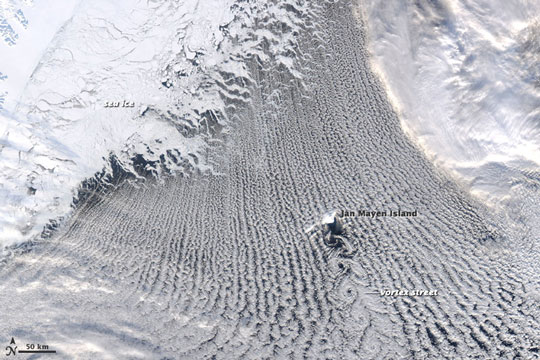
Cloud streets typically form fairly straight lines over large flat areas such as the ocean. When geological features like islands disrupt the flow of the wind, this disruption can create spiral patterns in the cloud streets similar to the way in which large boulders create downstream eddies in rivers. The spiral patterns in clouds are called von Karman vortex streets, were named after Theodore von Kármán, a co-founder of NASA’s Jet Propulsion Laboratory. He was one of the first scientists to describe this type of atmospheric phenomenon.

Meteorological phenomena such as cloud streets and von Karman vortices are a manifestation of Earth’s atmosphere in motion.

cloud-streets-bering-sea-20jan2006-540

The MODIS instrument on NASA’s Terra satellite captured these cloud streets over the Bering Sea on January 20, 2006. Image via Jesse Allen/NASA. Read more about this image.

von-karman-vortex-clouds-nasa-24feb2009-540

The MODIS instrument on NASA’s Aqua satellite acquired this image of a von Karman vortex that formed off the coast of Greenland on February 24, 2009. Image via Jeff Schmaltz, MODIS Rapid Response Team. Read more about this image.

Morning cloud streets over Vancouver Island. Image via CTV News Vancouver Island.

Most photos of cloud streets are taken by satellites orbiting high above Earth. This aerial image comes from Rosimar Rios Berrios, via NOAA's Hurricane Research Division

Clouds streets are most readily seen in satellite photography, but this aerial image comes from Rosimar Rios Berrios, via NOAA’s Hurricane Research Division.

Bottom line: Cloud streets are long rows of cumulus clouds oriented parallel to the direction of the wind.


from EarthSky https://ift.tt/32t4rcP
Fanned-out stripes of clouds.

View at EarthSky Community Photos. | Michael Padbury in Wellington Point, Australia captured this image with his iPhone on August 22, 2020. He wrote: “My daughter Hannah pointed out how unusual and beautiful these clouds were last Saturday morning … Not sure what you would call them.” Cloud arrays of this type are called cloud streets. They’re most often captured by satellites, because they tend to form over the ocean. But sometimes – as this photo shows – people see them from the ground, too. Awesome catch, Michael. Thank you, Hannah, too.

Cloud streets are long rows of cumulus clouds that are oriented parallel to the direction of the wind. Over the past decades, they’ve been seen most often in satellite photos; we only rarely see them in photos taken from the ground, as in the photo above. You can recognize cloud streets as rows of puffy cumulus or cumulus-type clouds. They most often straight, but might form patterns when the wind driving the clouds hits an obstacle.

Cloud streets are formed by what are called convection rolls of rising warm air and sinking cool air. Rising warm air cools gradually as it ascends into the atmosphere. When moisture in the warm air mass cools and condenses, it forms clouds.

Meanwhile, sinking cool air on either side of the cloud formation zone creates a cloud-free area. When several of these alternating rising and sinking air masses align with the wind, cloud streets develop.

Cloud streets are technically called horizontal convective rolls.

cloud-street-formation-noaa-480

Convection rolls and the formation of cloud streets. Image via NOAA.

NASA's Aqua satellite captured this image of cloud streets over the Black Sea on January 8, 2015. NASA Earth Observatory image courtesy Jeff Schmaltz LANCE/EOSDIS MODIS Rapid Response Team, GSFC.

The MODIS instrument on NASA’s Aqua satellite captured this image of cloud streets over the Black Sea on January 8, 2015. NASA Earth Observatory image courtesy Jeff Schmaltz LANCE/EOSDIS MODIS Rapid Response Team, GSFC. Read more about this image

The U.S. National Aeronautics and Space Administration (NASA) has taken some amazing photographs of cloud streets over the past few years with the MODIS (Moderate Resolution Imaging Spectroradiometer) instruments on board the Terra and Aqua satellites. The satellite images on this page are from these instruments.

Cloud streets typically form fairly straight lines over large flat areas such as the ocean. When geological features like islands disrupt the flow of the wind, this disruption can create spiral patterns in the cloud streets similar to the way in which large boulders create downstream eddies in rivers. The spiral patterns in clouds are called von Karman vortex streets, were named after Theodore von Kármán, a co-founder of NASA’s Jet Propulsion Laboratory. He was one of the first scientists to describe this type of atmospheric phenomenon.

Meteorological phenomena such as cloud streets and von Karman vortices are a manifestation of Earth’s atmosphere in motion.

cloud-streets-bering-sea-20jan2006-540

The MODIS instrument on NASA’s Terra satellite captured these cloud streets over the Bering Sea on January 20, 2006. Image via Jesse Allen/NASA. Read more about this image.

von-karman-vortex-clouds-nasa-24feb2009-540

The MODIS instrument on NASA’s Aqua satellite acquired this image of a von Karman vortex that formed off the coast of Greenland on February 24, 2009. Image via Jeff Schmaltz, MODIS Rapid Response Team. Read more about this image.

Morning cloud streets over Vancouver Island. Image via CTV News Vancouver Island.

Most photos of cloud streets are taken by satellites orbiting high above Earth. This aerial image comes from Rosimar Rios Berrios, via NOAA's Hurricane Research Division

Clouds streets are most readily seen in satellite photography, but this aerial image comes from Rosimar Rios Berrios, via NOAA’s Hurricane Research Division.

Bottom line: Cloud streets are long rows of cumulus clouds oriented parallel to the direction of the wind.


from EarthSky https://ift.tt/32t4rcP

Smoke-covered California, from space

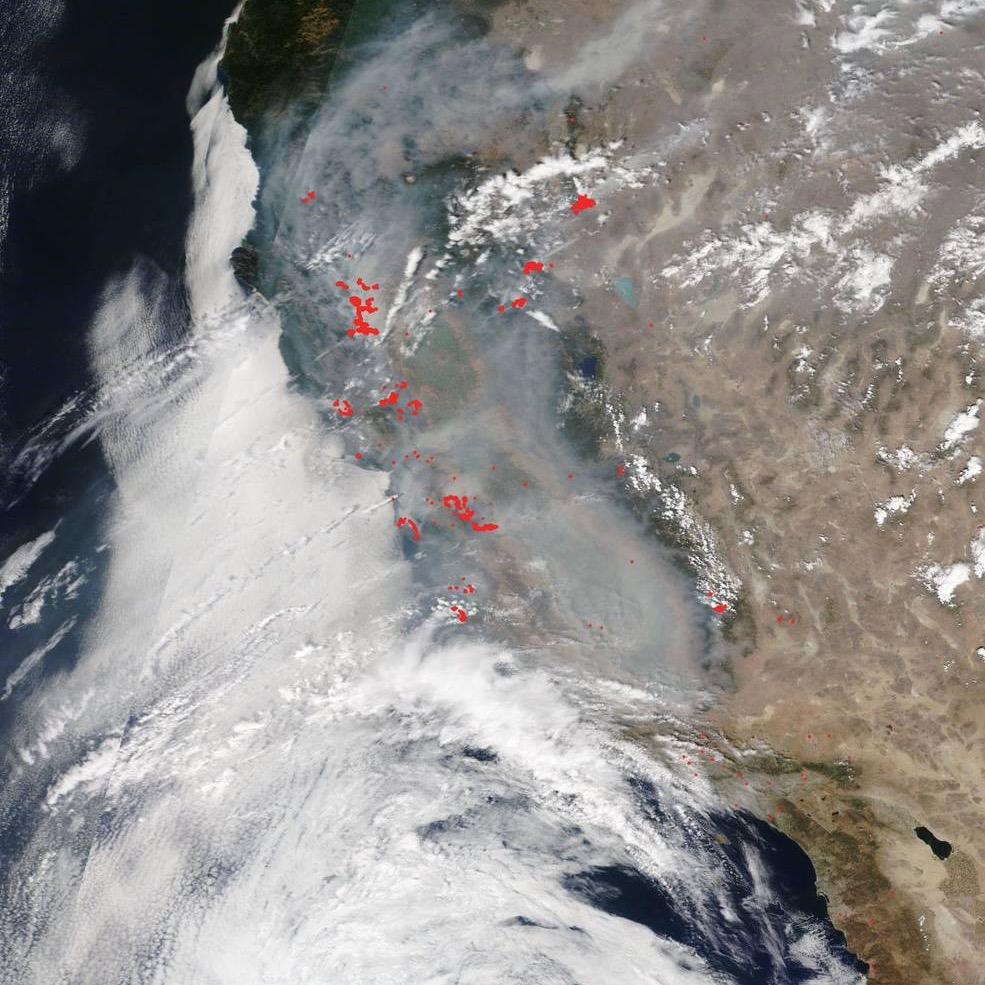
Image via satellite of smoke along the entire U.S. West coast.

As of yesterday, more than 650 fires were blazing in California after unprecedented lightning strikes, storms, and a heatwave that has set new records in the state. Find out more and get updates here. This image is from Monday, from NASA’s Terra satellite; it shows a smoke-covered California. Read more from NASA.


from EarthSky https://ift.tt/3jm64QF
Image via satellite of smoke along the entire U.S. West coast.

As of yesterday, more than 650 fires were blazing in California after unprecedented lightning strikes, storms, and a heatwave that has set new records in the state. Find out more and get updates here. This image is from Monday, from NASA’s Terra satellite; it shows a smoke-covered California. Read more from NASA.


from EarthSky https://ift.tt/3jm64QF

Are there more rogue planets than stars in our galaxy?

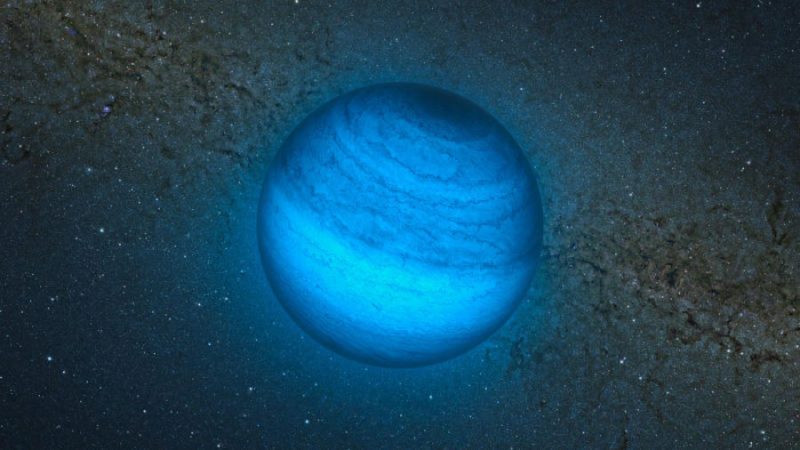
Bluish planet with dark bands and stars in background.

Artist’s concept of rogue planet CFBDSIR J214947.2-040308.9. Researchers now think there could be more such nomadic planets than stars in our galaxy. Image via ESO/ L. Calçada/ P. Delorme/ Nick Risinger (skysurvey.org)/ R. Saito/ VVV Consortium.

There are some 100 to 400 billion stars in our Milky Way galaxy. Scientists now say there may be as many, or more, exoplanets or planets orbiting those distant stars. That’s incredible to ponder, but now consider this. Researchers at Ohio State University just announced a new study suggesting there may be more free-floating rogue planets – planets not orbiting any star – than stars in the Milky Way. Wow!

The theoretical, but fascinating, peer-reviewed conclusions were published in The Astronomical Journal on August 21, 2020.

What more, these scientists say, an upcoming NASA mission, the Nancy Grace Roman Space Telescope, should be able to find hundreds or more of these rogue planets. Astronomer Samson Johnson at Ohio State – lead author of the study – commented:

This gives us a window into these worlds that we would otherwise not have. Imagine our little rocky planet just floating freely in space; that’s what this mission will help us find.

As our view of the universe has expanded, we’ve realized that our solar system may be unusual. Roman will help us learn more about how we fit in the cosmic scheme of things by studying rogue planets.

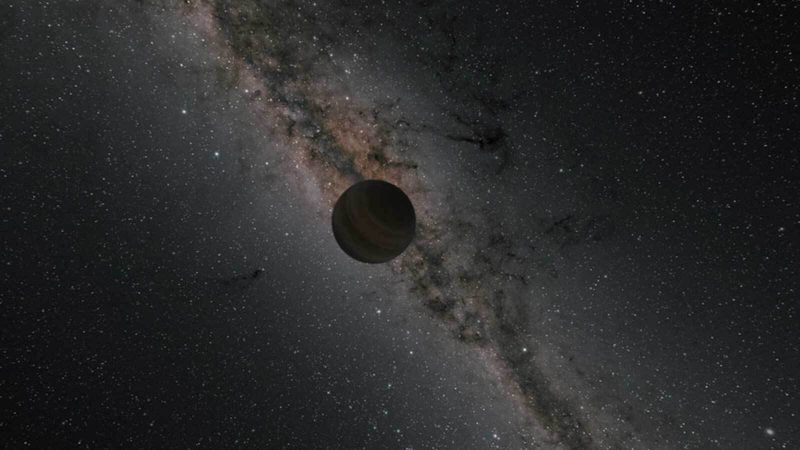
Dark planet with galaxy in the background.

Illustration of a rogue planet floating through space between the stars. Image via NASA/ JPL-Caltech/ R. Hurt (Caltech-IPAC).

These rogue worlds are called free-floating planetary-mass objects (FFPs) and have masses similar to planets that orbit stars. Scientists don’t yet know how they came to be cosmic wanderers, untethered to any stars, but it’s possible that they were once part of regular solar systems, and somehow broke free of their stars’ gravity. Roman should be able to provide more clues, and provide a better idea of how many are out there. According to Scott Gaudi at Ohio State and a co-author of the paper:

The universe could be teeming with rogue planets and we wouldn’t even know it. We would never find out without undertaking a thorough, space-based microlensing survey like Roman is going to do.

If scientists can start to build a census of the numbers of FFPs, that itself would help them figure out how they formed. Do they form around stars just like other planets and then get ejected from those planetary systems? Or do they form from gas and dust independently of stars? It’s also thought that the ejection of planets from their home planetary systems might be more common in denser star clusters, since more frequent encounters between stars in dense clusters will make the planetary systems unstable.

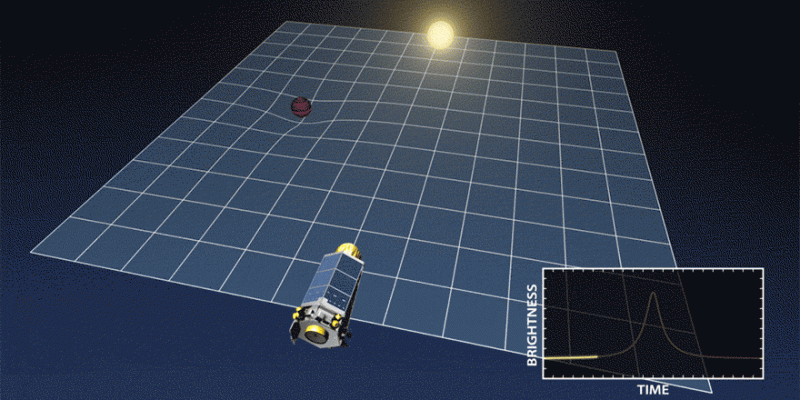
Grid with small moving sphere and graph on black background.

Animation depicting how gravitational microlensing can reveal rogue planets. When an unseen rogue planet passes in front of a more distant star from our vantage point, light from the star bends as it passes through the warped space-time around the planet. The planet acts as a cosmic magnifying glass, amplifying the brightness of the background star. Image via NASA.

Roman will test various theories and models to see which ones come closest to explain these enigmatic worlds.

It is expected that Roman will be 10 times more sensitive in detecting these objects than previous searches. Roman will focus on searching for FFPs between our sun and the center of the galaxy. That search will span about 24,000 light-years in total. Johnson said:

There have been several rogue planets discovered, but to actually get a complete picture, our best bet is something like Roman. This is a totally new frontier.

According to the new paper, it is expected that Roman should find at least 250 FFPs, even ones as small as Mars.

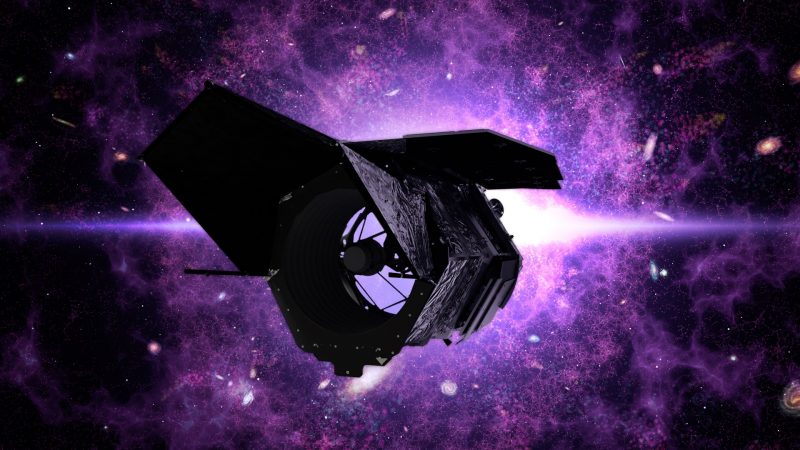
Spacecraft in front of bright star cluster.

Artist’s rendering of NASA’s upcoming Nancy Grace Roman Space Telescope. Image via NASA/ Ohio State News.

Last year, another study estimated that there could be 50 billion such nomad planets in our galaxy. About a dozen or so confirmed rogue planets have been found so far, and two of those were announced last year: OGLE-2012-BLG-1323 and OGLE-2017-BLG-0560. The first is estimated to have a mass between Earth and Neptune, while the other has a mass between Jupiter and a brown dwarf star.

Exoplanets orbiting stars can be difficult to detect, and rogue exoplanets even more so. How will Roman find them? It will use a technique called gravitational lensing, which relies on the gravity of stars and planets to bend and magnify the light coming from stars that pass behind them, from the telescope’s viewpoint. This technique can find exoplanets thousands of light-years from Earth, and is based on Albert Einstein’s theory of General Relativity. According to co-author Matthew Penny at Louisiana State University in Baton Rouge:

The microlensing signal from a rogue planet only lasts between a few hours and a couple of days and then is gone forever. This makes them difficult to observe from Earth, even with multiple telescopes. Roman is a game-changer for rogue planet searches.

Of course, another question is whether any rogue planets could support life. Johnson said it is probably unlikely since they have no stars for heat and energy:

They would probably be extremely cold, because they have no star.

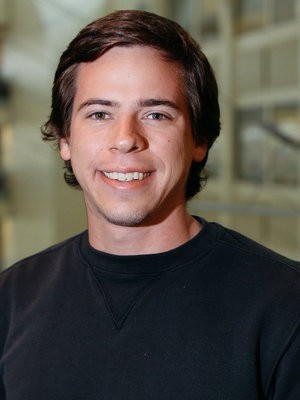
Smiling man in dark shirt with building behind him.

Samson Johnson at The Ohio State University, lead author of the new study. Image via Ohio State News.

Discovering how rogue planets came to be will help astronomers figure out what makes them so unique and also better understand how regular planetary systems form. Johnson said:

If we find a lot of low-mass rogue planets, we’ll know that as stars form planets, they’re probably ejecting a bunch of other stuff out into the galaxy. This helps us get a handle on the formation pathway of planets in general.

Rogue planets are enigmatic objects, essentially planets as we know them but with no stars to call home. And there may be many more of them than ever thought possible.

Bottom line: New research shows that there could be more rogue, free-floating planets than stars in our galaxy.

Source: Predictions of the Nancy Grace Roman Space Telescope Galactic Exoplanet Survey. II. Free-floating Planet Detection Rates*

Via Ohio State News

Via NASA

An upcoming NASA mission, the Nancy Grace Roman Space Telescope, should be able to find hundreds or more of them.


from EarthSky https://ift.tt/2FPGe8X
Bluish planet with dark bands and stars in background.

Artist’s concept of rogue planet CFBDSIR J214947.2-040308.9. Researchers now think there could be more such nomadic planets than stars in our galaxy. Image via ESO/ L. Calçada/ P. Delorme/ Nick Risinger (skysurvey.org)/ R. Saito/ VVV Consortium.

There are some 100 to 400 billion stars in our Milky Way galaxy. Scientists now say there may be as many, or more, exoplanets or planets orbiting those distant stars. That’s incredible to ponder, but now consider this. Researchers at Ohio State University just announced a new study suggesting there may be more free-floating rogue planets – planets not orbiting any star – than stars in the Milky Way. Wow!

The theoretical, but fascinating, peer-reviewed conclusions were published in The Astronomical Journal on August 21, 2020.

What more, these scientists say, an upcoming NASA mission, the Nancy Grace Roman Space Telescope, should be able to find hundreds or more of these rogue planets. Astronomer Samson Johnson at Ohio State – lead author of the study – commented:

This gives us a window into these worlds that we would otherwise not have. Imagine our little rocky planet just floating freely in space; that’s what this mission will help us find.

As our view of the universe has expanded, we’ve realized that our solar system may be unusual. Roman will help us learn more about how we fit in the cosmic scheme of things by studying rogue planets.

Dark planet with galaxy in the background.

Illustration of a rogue planet floating through space between the stars. Image via NASA/ JPL-Caltech/ R. Hurt (Caltech-IPAC).

These rogue worlds are called free-floating planetary-mass objects (FFPs) and have masses similar to planets that orbit stars. Scientists don’t yet know how they came to be cosmic wanderers, untethered to any stars, but it’s possible that they were once part of regular solar systems, and somehow broke free of their stars’ gravity. Roman should be able to provide more clues, and provide a better idea of how many are out there. According to Scott Gaudi at Ohio State and a co-author of the paper:

The universe could be teeming with rogue planets and we wouldn’t even know it. We would never find out without undertaking a thorough, space-based microlensing survey like Roman is going to do.

If scientists can start to build a census of the numbers of FFPs, that itself would help them figure out how they formed. Do they form around stars just like other planets and then get ejected from those planetary systems? Or do they form from gas and dust independently of stars? It’s also thought that the ejection of planets from their home planetary systems might be more common in denser star clusters, since more frequent encounters between stars in dense clusters will make the planetary systems unstable.

Grid with small moving sphere and graph on black background.

Animation depicting how gravitational microlensing can reveal rogue planets. When an unseen rogue planet passes in front of a more distant star from our vantage point, light from the star bends as it passes through the warped space-time around the planet. The planet acts as a cosmic magnifying glass, amplifying the brightness of the background star. Image via NASA.

Roman will test various theories and models to see which ones come closest to explain these enigmatic worlds.

It is expected that Roman will be 10 times more sensitive in detecting these objects than previous searches. Roman will focus on searching for FFPs between our sun and the center of the galaxy. That search will span about 24,000 light-years in total. Johnson said:

There have been several rogue planets discovered, but to actually get a complete picture, our best bet is something like Roman. This is a totally new frontier.

According to the new paper, it is expected that Roman should find at least 250 FFPs, even ones as small as Mars.

Spacecraft in front of bright star cluster.

Artist’s rendering of NASA’s upcoming Nancy Grace Roman Space Telescope. Image via NASA/ Ohio State News.

Last year, another study estimated that there could be 50 billion such nomad planets in our galaxy. About a dozen or so confirmed rogue planets have been found so far, and two of those were announced last year: OGLE-2012-BLG-1323 and OGLE-2017-BLG-0560. The first is estimated to have a mass between Earth and Neptune, while the other has a mass between Jupiter and a brown dwarf star.

Exoplanets orbiting stars can be difficult to detect, and rogue exoplanets even more so. How will Roman find them? It will use a technique called gravitational lensing, which relies on the gravity of stars and planets to bend and magnify the light coming from stars that pass behind them, from the telescope’s viewpoint. This technique can find exoplanets thousands of light-years from Earth, and is based on Albert Einstein’s theory of General Relativity. According to co-author Matthew Penny at Louisiana State University in Baton Rouge:

The microlensing signal from a rogue planet only lasts between a few hours and a couple of days and then is gone forever. This makes them difficult to observe from Earth, even with multiple telescopes. Roman is a game-changer for rogue planet searches.

Of course, another question is whether any rogue planets could support life. Johnson said it is probably unlikely since they have no stars for heat and energy:

They would probably be extremely cold, because they have no star.

Smiling man in dark shirt with building behind him.

Samson Johnson at The Ohio State University, lead author of the new study. Image via Ohio State News.

Discovering how rogue planets came to be will help astronomers figure out what makes them so unique and also better understand how regular planetary systems form. Johnson said:

If we find a lot of low-mass rogue planets, we’ll know that as stars form planets, they’re probably ejecting a bunch of other stuff out into the galaxy. This helps us get a handle on the formation pathway of planets in general.

Rogue planets are enigmatic objects, essentially planets as we know them but with no stars to call home. And there may be many more of them than ever thought possible.

Bottom line: New research shows that there could be more rogue, free-floating planets than stars in our galaxy.

Source: Predictions of the Nancy Grace Roman Space Telescope Galactic Exoplanet Survey. II. Free-floating Planet Detection Rates*

Via Ohio State News

Via NASA

An upcoming NASA mission, the Nancy Grace Roman Space Telescope, should be able to find hundreds or more of them.


from EarthSky https://ift.tt/2FPGe8X

5 myths about lightning debunked

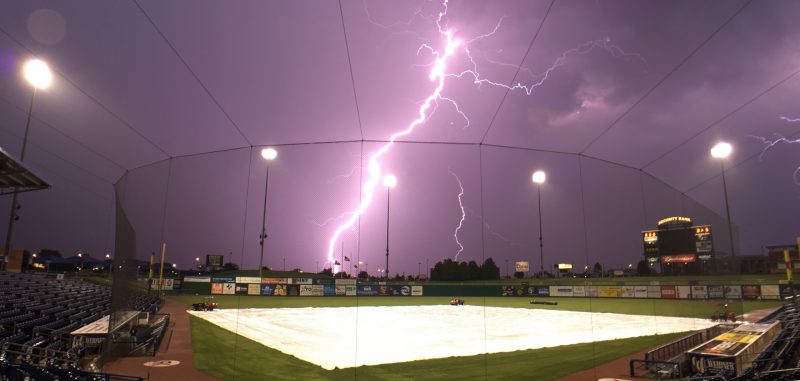
Huge bolt of lighting in a purple sky over a baseball diamond.

Image via NOAA

This article was originally published by NOAA on August 19, 2020.

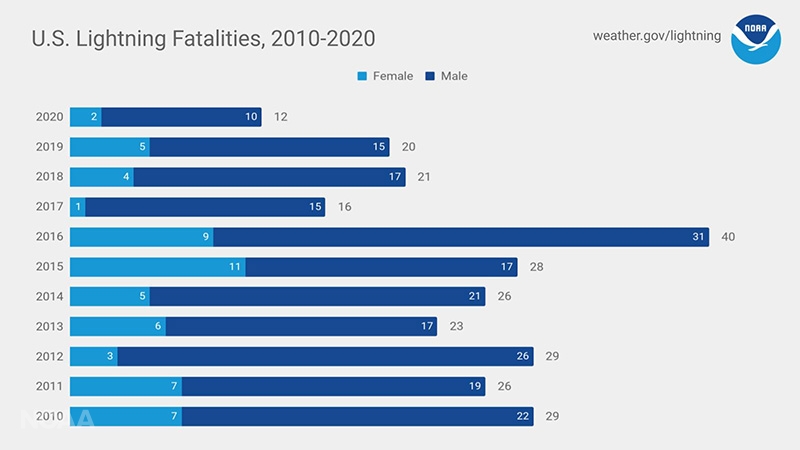
Although lighting can happen at any time of the year, lightning strikes most often during summer months. So far this year, there have been 26 people reported to have been struck by lightning; 12 of those people died.

It might be cool to look at from a safe distance, but lightning kills more than 20 people each year in the United States and injures hundreds more — with some survivors suffering lifelong neurological damage. One thing that is for certain: No place outside is safe during a thunderstorm.

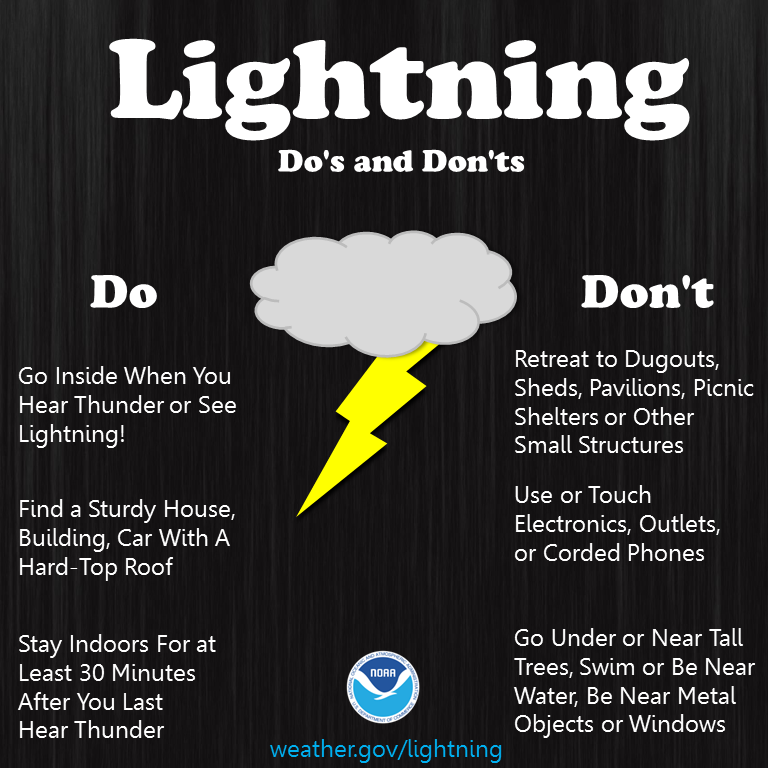
As of August 18, 2020, 12 lightning fatalities have occurred this year. Image via NOAA National Weather Service

What else should you know about this electrical wonder of nature? We debunk 5 popular myths with science-backed facts about this dangerous and often misunderstood phenomenon.

Myth #1: A tree can act as sufficient shelter during a thunderstorm.

Fact: No. Standing underneath or near a tree is the second most dangerous place to be during a thunderstorm; the most dangerous is being outside in an open space. An enclosed building with wiring and plumbing is the safest place to be during a storm. Remember: Trees, sheds, picnic shelters, tents or covered porches will not protect you from lightning.

Myth #2: Lightning victims carry an electrical charge. If you touch them, you can be electrocuted.

Fact: Not true. The human body does not store electricity. If you are able to, you should give a lightning victim first aid and/or immediately call 911. This is the most chilling of lightning myths because it could be the difference between life and death.

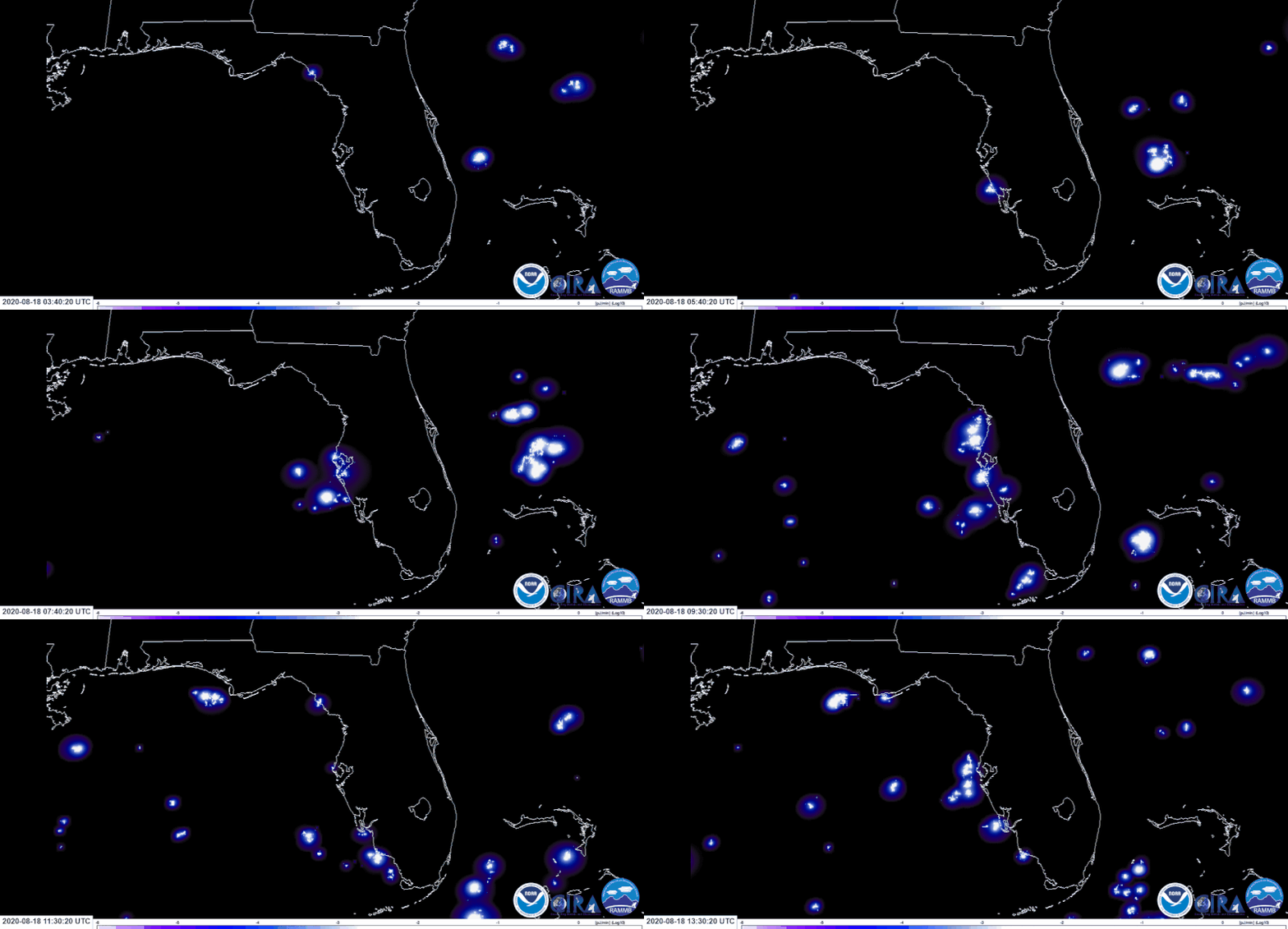
NOAA’s GOES-East (GOES-16) satellite watched 10 hours of lightning in Florida on August 18, 2020, shown in this 3-second time-lapse video.The area spanning Tampa Bay to Titusville, Florida (a.k.a. Lightning Alley) receives the most yearly lightning in the U.S. Image via NOAA

Myth #3: If you are trapped outside during a thunderstorm, crouching down will reduce your risk of being struck by lightning.

Fact: No. Crouching down will not make you any safer. If you are stuck outside during a storm, keep moving toward a safe shelter.

Image via NOAA/ NWS)

Myth #4: Lightning never strikes in one place twice.

Fact: Actually, lightning can, and often does, strike the same place repeatedly — especially if it’s a tall and isolated object. For example, the Empire State Building is hit about 25 times per year.

Here’s more from the National Weather Service:

Myth #5: Lightning cannot strike in an area if it is not raining and skies are clear.

Fact: Not true. Do not wait until a thunderstorm is immediately overhead and for rain to begin to act. If you can hear thunder, lightning is close enough to pose an immediate threat, even if the sky above you is blue. If thunder roars, seek shelter immediately.

Bottom line: NOAA debunks five popular myths about lightning.


from EarthSky https://ift.tt/32tCOAq
Huge bolt of lighting in a purple sky over a baseball diamond.

Image via NOAA

This article was originally published by NOAA on August 19, 2020.

Although lighting can happen at any time of the year, lightning strikes most often during summer months. So far this year, there have been 26 people reported to have been struck by lightning; 12 of those people died.

It might be cool to look at from a safe distance, but lightning kills more than 20 people each year in the United States and injures hundreds more — with some survivors suffering lifelong neurological damage. One thing that is for certain: No place outside is safe during a thunderstorm.

As of August 18, 2020, 12 lightning fatalities have occurred this year. Image via NOAA National Weather Service

What else should you know about this electrical wonder of nature? We debunk 5 popular myths with science-backed facts about this dangerous and often misunderstood phenomenon.

Myth #1: A tree can act as sufficient shelter during a thunderstorm.

Fact: No. Standing underneath or near a tree is the second most dangerous place to be during a thunderstorm; the most dangerous is being outside in an open space. An enclosed building with wiring and plumbing is the safest place to be during a storm. Remember: Trees, sheds, picnic shelters, tents or covered porches will not protect you from lightning.

Myth #2: Lightning victims carry an electrical charge. If you touch them, you can be electrocuted.

Fact: Not true. The human body does not store electricity. If you are able to, you should give a lightning victim first aid and/or immediately call 911. This is the most chilling of lightning myths because it could be the difference between life and death.

NOAA’s GOES-East (GOES-16) satellite watched 10 hours of lightning in Florida on August 18, 2020, shown in this 3-second time-lapse video.The area spanning Tampa Bay to Titusville, Florida (a.k.a. Lightning Alley) receives the most yearly lightning in the U.S. Image via NOAA

Myth #3: If you are trapped outside during a thunderstorm, crouching down will reduce your risk of being struck by lightning.

Fact: No. Crouching down will not make you any safer. If you are stuck outside during a storm, keep moving toward a safe shelter.

Image via NOAA/ NWS)

Myth #4: Lightning never strikes in one place twice.

Fact: Actually, lightning can, and often does, strike the same place repeatedly — especially if it’s a tall and isolated object. For example, the Empire State Building is hit about 25 times per year.

Here’s more from the National Weather Service:

Myth #5: Lightning cannot strike in an area if it is not raining and skies are clear.

Fact: Not true. Do not wait until a thunderstorm is immediately overhead and for rain to begin to act. If you can hear thunder, lightning is close enough to pose an immediate threat, even if the sky above you is blue. If thunder roars, seek shelter immediately.

Bottom line: NOAA debunks five popular myths about lightning.


from EarthSky https://ift.tt/32tCOAq

Ophiuchus is part of the zodiac, too

Tonight – August 26, 2020 – the moon is passing in front of the faint zodiacal constellation Ophiuchus the Serpent Bearer. The above sky chart shows only the southern part of Ophiuchus. We show this constellation in his entirety later on in this post.

From Northern Hemisphere latitudes, you’ll see the Serpent Bearer in the south to southwest on August and September evenings. From the Southern Hemisphere, Ophiuchus is closer to overhead. The bright red star Antares – brightest light in the constellation Scorpius the Scorpion – is also nearby.

Poor Ophiuchus. Nobody ever claims him as a birth sign, despite the fact that the ecliptic runs across him, too, just as it does the 12 better-known constellations of the zodiac. But the sun, moon and planets do regularly move within this constellation’s boundaries. The sun moves in front of Ophiuchus from about November 30 to December 18 each year.

The zodiac – or “pathway of animals” – represents a rather narrow band of of sky astride the ecliptic, which is the plane of Earth’s orbit projected onto the sphere of stars. The signs of the zodiac are familiar to all who read online astrology advice. There are 12 familiar signs of the zodiac: Aries, Taurus, Gemini, Cancer and so on. But … no Ophiuchus.

Read more: Sun in zodiac constellations, 2020

Read more: Sun’s entry into zodiac signs, 2020

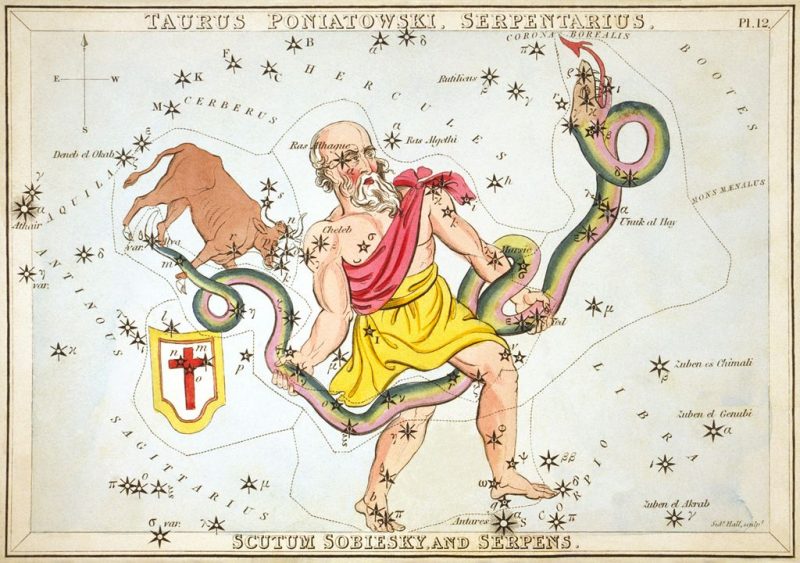
Antique colored etching of bald, bearded old man in ancient Greek garb holding a long snake.

Ophiuchus holding the serpent, Serpens, as depicted in Urania’s Mirror, a set of constellation cards published in London c. 1825. Image via Wikipedia.

On sky maps, Ophiuchus the Serpent Bearer is depicted as holding Serpens the Serpent, which is considered a separate constellation. According to ancient Greek star lore, Ophiuchus is Asclepius, Greek god of medicine and doctors. Asclepius is said to have concocted a healing potion from the venom of Serpens the Serpent, mixing it with a Gorgon’s blood and an unknown herb. This potion gave humans access to immortality, until the god of the underworld, Pluto, appealed to the king of the gods, Zeus, to reconsider the ramifications of the death of death.

Even today, the Staff of Asclepius – symbol of the World Health Organization and other medical organizations – pays tribute to the constellation Ophiuchus the Serpent Bearer.

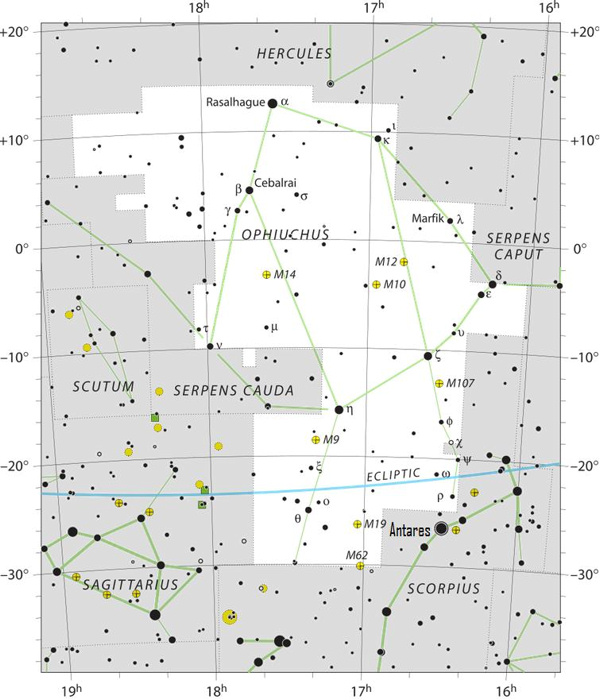
black on white star chart of Ophiuchus with ecliptic line.

View larger. | Ophiuchus the Serpent Bearer.

How can you find this constellation? First of all, you need a dark sky. With the moon waxing now, you won’t have a moonless evening until the end of the first week of September 2020. We show the southernmost portion of Ophiuchus on the chart at top, and the constellation in full on the sky chart below. To see Ophiuchus, stand outside under your light-free sky until your eyes are fully adjusted to the dark. Ophiuchus is faint. But you’ll easily recognize the constellation Scorpius nearby. From our Northern Hemisphere locations, Ophiuchus looms above Scorpius. He’s a mighty figure that your eyes will pick out, if you’re looking for him.

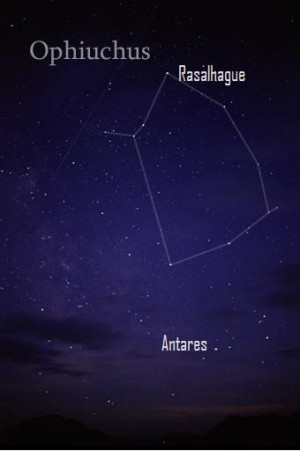
The official boundary lines for all 88 constellations were drawn up by the International Astronomical Union in the 1930s. The photo below of the constellation Ophiuchus labels Ophiuchus’ brightest star, Rasalhague, and Scorpius’ brightest star, Antares. Rasalhague marks the head of Ophiuchus but is nowhere as bright as Antares, the star that depicts the Scorpion’s beating heart.

Constellation drawn on star field with stars Antares and Rasalhague marked.

Photo: Till Credner, AlltheSky.com.

Bottom line: Poor Ophiuchus. Astrologers don’t typically mention him, because he’s a constellation – not a sign – of the zodiac. However, the sun moves in front of this constellation’s stars from about November 30 to December 18, every year. Find Ophiuchus’ location in the sky tonight, and then when the moon moves away from this section of sky, try to envision the Serpent Holder in a dark sky!

Born late November to middle December? Here’s your constellation

Enjoying EarthSky so far? Sign up for our free daily newsletter today!


from EarthSky https://ift.tt/31RDm1j

Tonight – August 26, 2020 – the moon is passing in front of the faint zodiacal constellation Ophiuchus the Serpent Bearer. The above sky chart shows only the southern part of Ophiuchus. We show this constellation in his entirety later on in this post.

From Northern Hemisphere latitudes, you’ll see the Serpent Bearer in the south to southwest on August and September evenings. From the Southern Hemisphere, Ophiuchus is closer to overhead. The bright red star Antares – brightest light in the constellation Scorpius the Scorpion – is also nearby.

Poor Ophiuchus. Nobody ever claims him as a birth sign, despite the fact that the ecliptic runs across him, too, just as it does the 12 better-known constellations of the zodiac. But the sun, moon and planets do regularly move within this constellation’s boundaries. The sun moves in front of Ophiuchus from about November 30 to December 18 each year.

The zodiac – or “pathway of animals” – represents a rather narrow band of of sky astride the ecliptic, which is the plane of Earth’s orbit projected onto the sphere of stars. The signs of the zodiac are familiar to all who read online astrology advice. There are 12 familiar signs of the zodiac: Aries, Taurus, Gemini, Cancer and so on. But … no Ophiuchus.

Read more: Sun in zodiac constellations, 2020

Read more: Sun’s entry into zodiac signs, 2020

Antique colored etching of bald, bearded old man in ancient Greek garb holding a long snake.

Ophiuchus holding the serpent, Serpens, as depicted in Urania’s Mirror, a set of constellation cards published in London c. 1825. Image via Wikipedia.

On sky maps, Ophiuchus the Serpent Bearer is depicted as holding Serpens the Serpent, which is considered a separate constellation. According to ancient Greek star lore, Ophiuchus is Asclepius, Greek god of medicine and doctors. Asclepius is said to have concocted a healing potion from the venom of Serpens the Serpent, mixing it with a Gorgon’s blood and an unknown herb. This potion gave humans access to immortality, until the god of the underworld, Pluto, appealed to the king of the gods, Zeus, to reconsider the ramifications of the death of death.

Even today, the Staff of Asclepius – symbol of the World Health Organization and other medical organizations – pays tribute to the constellation Ophiuchus the Serpent Bearer.

black on white star chart of Ophiuchus with ecliptic line.

View larger. | Ophiuchus the Serpent Bearer.

How can you find this constellation? First of all, you need a dark sky. With the moon waxing now, you won’t have a moonless evening until the end of the first week of September 2020. We show the southernmost portion of Ophiuchus on the chart at top, and the constellation in full on the sky chart below. To see Ophiuchus, stand outside under your light-free sky until your eyes are fully adjusted to the dark. Ophiuchus is faint. But you’ll easily recognize the constellation Scorpius nearby. From our Northern Hemisphere locations, Ophiuchus looms above Scorpius. He’s a mighty figure that your eyes will pick out, if you’re looking for him.

The official boundary lines for all 88 constellations were drawn up by the International Astronomical Union in the 1930s. The photo below of the constellation Ophiuchus labels Ophiuchus’ brightest star, Rasalhague, and Scorpius’ brightest star, Antares. Rasalhague marks the head of Ophiuchus but is nowhere as bright as Antares, the star that depicts the Scorpion’s beating heart.

Constellation drawn on star field with stars Antares and Rasalhague marked.

Photo: Till Credner, AlltheSky.com.

Bottom line: Poor Ophiuchus. Astrologers don’t typically mention him, because he’s a constellation – not a sign – of the zodiac. However, the sun moves in front of this constellation’s stars from about November 30 to December 18, every year. Find Ophiuchus’ location in the sky tonight, and then when the moon moves away from this section of sky, try to envision the Serpent Holder in a dark sky!

Born late November to middle December? Here’s your constellation

Enjoying EarthSky so far? Sign up for our free daily newsletter today!


from EarthSky https://ift.tt/31RDm1j

adds 2