aads

Quarter moon or a half moon?

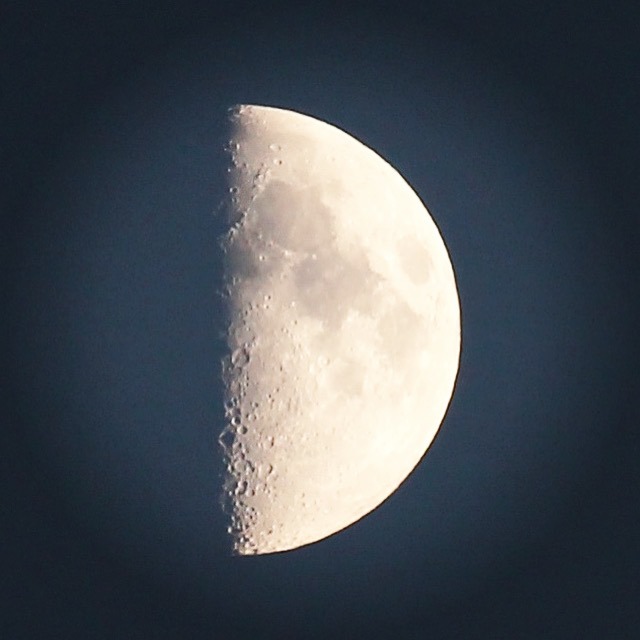
The moon with the left half invisible and the right half illuminated.

July 27, 2020, first quarter moon via EarthSky friend Chili Dcpa. Thanks, Chili!

People sometimes look up and say:

Is that a ‘half’ moon in the sky?

Astronomically, the answer to that question is always no. There’s no half-moon phase, at least not in any official way. Invariably, when referring to a half moon, observers are looking at a quarter moon. You see a moon that looks half-illuminated, like half a pie. It might be first or last quarter moon, but – to astronomers – never a half moon. Why is that?

Let’s talk for a minute about the names for the various moon phases. A new moon is most nearly between the Earth and sun for any given lunar orbit. At such a time, the the moon is considered by astronomers to have entered a new orbital cycle, called a lunation.

Full moon signifies that the full visible surface of the moon – its day side – is fully turned toward Earth.

First quarter moon means we see half of the moon’s day side (a quarter of the whole moon), and the moon is one quarter of the way through the current orbital cycle.

Third or last quarter moon means we see a quarter of the moon’s day side, and the moon is three-quarters of the way through the cycle, as measured from one new moon to the next.

Just realize this. Astronomers recognize four primary moon phases (new, first quarter, full, last quarter) and four interstitial phases (waxing crescent, waxing gibbous, waning gibbous waning crescent). Notice … no half moon.
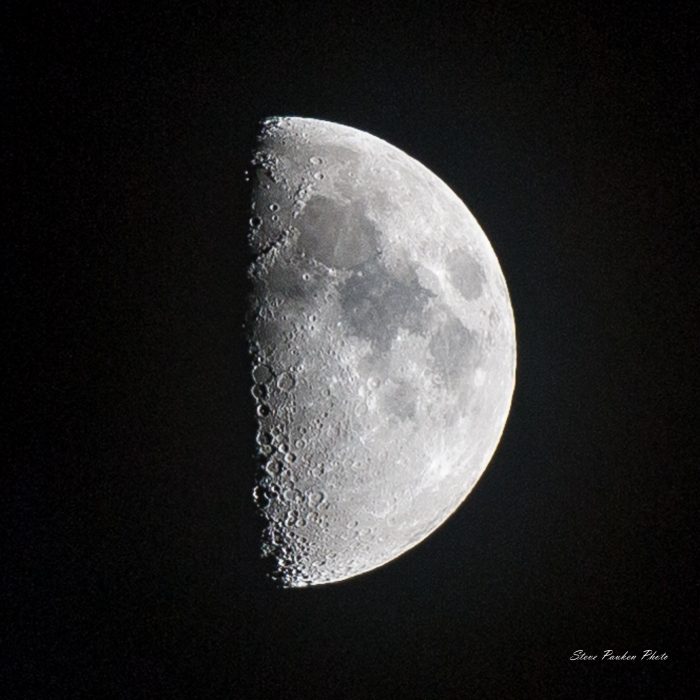
A moon that appears half-illuminated.

EarthSky friend Steve Pauken caught the 1st quarter moon on July 27, 2020, too, from Bisbee, Arizona. Thank you, Steve! See how the terminator line – or line between light and dark on the moon – is straight, dividing the illuminated from the shadowed side of the moon.

People frequently speak of half moons. There are geographical locations (e.g., Half Moon Bay in California), as well as restaurants, resorts and various other attractions and businesses with this moniker.

And so you see that the process of naming things in astronomy isn’t always logical, except perhaps in a very narrow sense. You may think that heavy metal refers to gold or lead, or your favorite band. But, in astronomy, a metal is means any element – even some that normally are gases on Earth – that’s anything other than the two lightest elements, hydrogen and helium. Oxygen and carbon, for example, are metals in the language of astronomers. Seriously.

Or consider the ad hoc definition of a dwarf planet adopted by the International Astronomical Union, and used to dump Pluto, unceremoniously, from full planethood. Astronomers are scientists, and, like all scientists, they use a jargon all their own.

In a couple of senses, though, every time you view the moon, you’re observing a half moon. First, just half the moon always faces us. You can’t see the back side since it’s always turned away from us.

Second, whether you can see it all or not, one half of the entire moon is always illuminated by the sun. In other words, the moon has a dayside, just as Earth does. We see this illuminated half of the moon – the entire dayside of the moon – only at full moon.

By the way, there are some other moon phases that are less well known. The moon is named for its shape, which can be a waxing crescent (growing) or waning crescent (diminishing). And we also have gibbous moons, indicating a shape that is unequally curved outward on both sides, but not full. Gibbous moons also wax and wane depending on its time in the cycle.
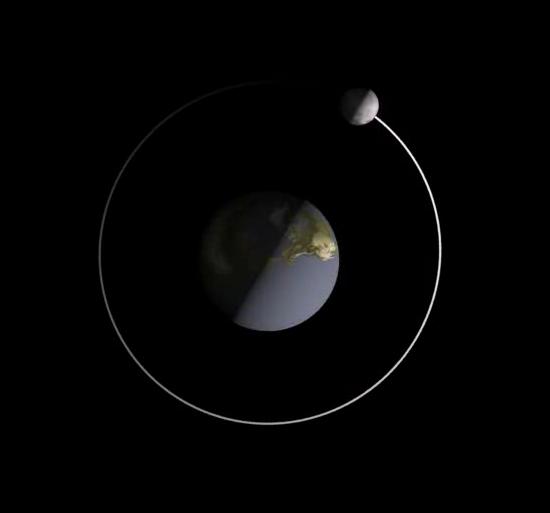
Half-lit Earth from north, and half-lit moon with divisions between dark and light sides lined up.

Click here to see animation. As seen from the north side of the moon’s orbital plane, the Earth rotates counterclockwise on its rotational axis, and the moon revolves counterclockwise around Earth. The terminators of the Earth and moon align at first and last quarter moons, and only the near half of the moon’s day side is visible from Earth.

Learn much more about the various phases of the moon at EarthSky’s article Four keys to understanding moon phases.

Bottom line: You might consider it just a play on words or an oddity of language, but, in the astronomy vocabulary, there are no half moons.


from EarthSky https://ift.tt/3lr0v5g
The moon with the left half invisible and the right half illuminated.

July 27, 2020, first quarter moon via EarthSky friend Chili Dcpa. Thanks, Chili!

People sometimes look up and say:

Is that a ‘half’ moon in the sky?

Astronomically, the answer to that question is always no. There’s no half-moon phase, at least not in any official way. Invariably, when referring to a half moon, observers are looking at a quarter moon. You see a moon that looks half-illuminated, like half a pie. It might be first or last quarter moon, but – to astronomers – never a half moon. Why is that?

Let’s talk for a minute about the names for the various moon phases. A new moon is most nearly between the Earth and sun for any given lunar orbit. At such a time, the the moon is considered by astronomers to have entered a new orbital cycle, called a lunation.

Full moon signifies that the full visible surface of the moon – its day side – is fully turned toward Earth.

First quarter moon means we see half of the moon’s day side (a quarter of the whole moon), and the moon is one quarter of the way through the current orbital cycle.

Third or last quarter moon means we see a quarter of the moon’s day side, and the moon is three-quarters of the way through the cycle, as measured from one new moon to the next.

Just realize this. Astronomers recognize four primary moon phases (new, first quarter, full, last quarter) and four interstitial phases (waxing crescent, waxing gibbous, waning gibbous waning crescent). Notice … no half moon.

A moon that appears half-illuminated.

EarthSky friend Steve Pauken caught the 1st quarter moon on July 27, 2020, too, from Bisbee, Arizona. Thank you, Steve! See how the terminator line – or line between light and dark on the moon – is straight, dividing the illuminated from the shadowed side of the moon.

People frequently speak of half moons. There are geographical locations (e.g., Half Moon Bay in California), as well as restaurants, resorts and various other attractions and businesses with this moniker.

And so you see that the process of naming things in astronomy isn’t always logical, except perhaps in a very narrow sense. You may think that heavy metal refers to gold or lead, or your favorite band. But, in astronomy, a metal is means any element – even some that normally are gases on Earth – that’s anything other than the two lightest elements, hydrogen and helium. Oxygen and carbon, for example, are metals in the language of astronomers. Seriously.

Or consider the ad hoc definition of a dwarf planet adopted by the International Astronomical Union, and used to dump Pluto, unceremoniously, from full planethood. Astronomers are scientists, and, like all scientists, they use a jargon all their own.

In a couple of senses, though, every time you view the moon, you’re observing a half moon. First, just half the moon always faces us. You can’t see the back side since it’s always turned away from us.

Second, whether you can see it all or not, one half of the entire moon is always illuminated by the sun. In other words, the moon has a dayside, just as Earth does. We see this illuminated half of the moon – the entire dayside of the moon – only at full moon.

By the way, there are some other moon phases that are less well known. The moon is named for its shape, which can be a waxing crescent (growing) or waning crescent (diminishing). And we also have gibbous moons, indicating a shape that is unequally curved outward on both sides, but not full. Gibbous moons also wax and wane depending on its time in the cycle.

Half-lit Earth from north, and half-lit moon with divisions between dark and light sides lined up.

Click here to see animation. As seen from the north side of the moon’s orbital plane, the Earth rotates counterclockwise on its rotational axis, and the moon revolves counterclockwise around Earth. The terminators of the Earth and moon align at first and last quarter moons, and only the near half of the moon’s day side is visible from Earth.

Learn much more about the various phases of the moon at EarthSky’s article Four keys to understanding moon phases.

Bottom line: You might consider it just a play on words or an oddity of language, but, in the astronomy vocabulary, there are no half moons.


from EarthSky https://ift.tt/3lr0v5g
Hurricane Hanna shrinks Gulf of Mexico dead zone

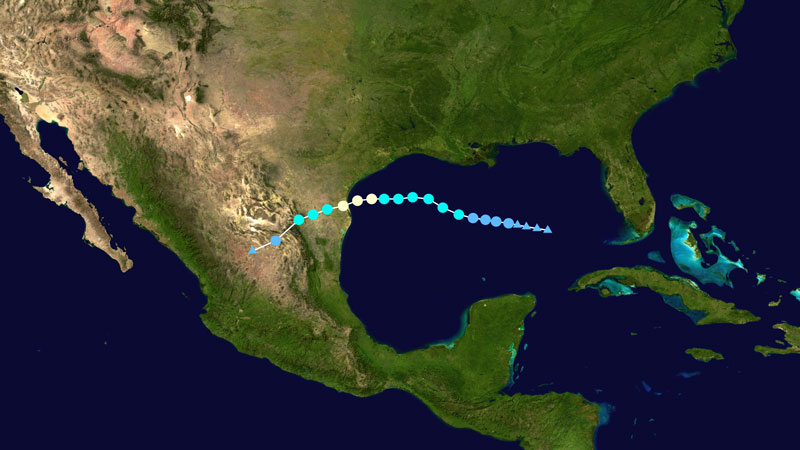
Track of Hurricane Hanna as it crossed over the Gulf of Mexico. Hanna made landfall on July 25, 2020, in Texas as a category 1 hurricane. This image was created by FleurDeOdile with WikiProject Tropical cyclones/Tracks by using NASA imagery and data from NOAA’s National Hurricane Center.

Thanks to Hurricane Hannah, the Gulf of Mexico’s dead zone was much smaller this summer than usual. Researchers say the July storm stirred up the area of low-oxygen water.

Hurricanes are largely thankless affairs with damaging winds and heavy rains that can cause extensive flooding along coastal regions. But for some marine life in the Gulf of Mexico, a hurricane may just mean they get a bit of a reprieve from the dead zone, an area of stagnant, low-oxygen water that forms every summer off the coast.

Scientists have been tracking the Gulf of Mexico dead zone since 1985. This large area of low-oxygen water develops every summer in response to nutrient inputs from the Mississippi River. These nutrients along with warm water and sunlight stimulate the growth of algae, which eventually die-off and are decomposed by bacteria. During the process, the bacteria use up most of the dissolved oxygen in the water, and this creates conditions inhospitable to marine life. The dead zone eventually disappears when cooler weather arrives in the fall.

To help maintain a healthy coastal region and robust fisheries in the Gulf of Mexico, efforts are underway to reduce nutrient runoff into the Mississippi River basin from agricultural lands and other sources. Tracking of the annual size of the dead zone is an important way to monitor the effectiveness of these conservation efforts. Over the past five years, the size of the dead zone has averaged 5,408 square miles (14,007 square kilometers), which is similar to the area of Puerto Rico. This average size is nearly 3 times the goal of the Mississippi River/Gulf of Mexico Hypoxia Task Force, which aims to reduce the running five-year average size of the dead zone to no more than 1,930 square miles (approximately 5,000 square kilometers).

This year’s dead zone measured only 2,116 square miles (5,480 square kilometers), which is much smaller than the typical size. Overall, the dead zone in 2020 ranked as the third smallest in the 34-year historical record. According to the scientists responsible for monitoring the dead zone, Hurricane Hanna passed through the area just prior to the measurements and stirred up the waters, which greatly reduced the size of the dead zone. Because nutrient runoff into the Mississippi River basin remains high, the small size of the dead zone in 2020 can be attributed to the weather and not substantial reductions in nutrient loading to the Gulf.

Changes in the size of the Gulf of Mexico dead zone over the 34-year monitoring period. Image via LUMCON/NOAA.

Nancy Rabalais, a Louisiana State University professor and chief scientist for the Gulf of Mexico dead zone monitoring efforts, commented on the new findings in a statement. She said:

The passage of Tropical Storm/Hurricane Hanna across the central Gulf generated 5- to 6- and occasional 8-foot waves along the inner shelf, and mixed the water column down to about 15 to 20 meters. The consistent winds from the south generated downwelling favorable conditions, and the remaining low oxygen was further offshore, in deeper water than normally. Vertically uniform temperature, salinity and dissolved oxygen data across the broad area mapped is not the norm for a July shelf-wide hypoxia cruise.

Hurricane Hanna was the first such storm of the 2020 hurricane season in the Atlantic basin. It became a tropical storm on July 24 within the Gulf of Mexico and intensified into a hurricane on July 25. The hurricane made landfall in Texas later that day as a category 1 hurricane. This year is expected to be a very active hurricane season. Two more tropical storms are already threatening the coastal areas along the Gulf of Mexico as of mid-August.

In addition to the high winds and waves at the beginning of the research cruise, the crew also faced unique challenges stemming from the COVID-19 pandemic. In particular, advanced SARS-CoV-2 tests were conducted on crew members prior to boarding the vessel and there was a reduced crew size this year.

Jill Tupitza, a graduate student at Louisiana State University, collects water samples from the Gulf of Mexico onboard the R/V Pelican. Image via LUMCON.

Steven Thur, director of NOAA’s National Centers for Coastal Ocean Science, said:

The data collected from this annual, long-term research program is critical to our understanding of a wide range of Gulf issues including hypoxia. Not only is measuring the size of the Gulf of Mexico dead zone vital to informing the best strategy to reduce its size, but also to reduce its impacts on the sustainability and productivity of our coastal resources and economy.

Bottom line: The annual size of the Gulf of Mexico dead zone was much smaller than usual in 2020 because the area of low-oxygen water was stirred up by Hurricane Hanna.


from EarthSky https://ift.tt/3aUxxWl

Track of Hurricane Hanna as it crossed over the Gulf of Mexico. Hanna made landfall on July 25, 2020, in Texas as a category 1 hurricane. This image was created by FleurDeOdile with WikiProject Tropical cyclones/Tracks by using NASA imagery and data from NOAA’s National Hurricane Center.

Thanks to Hurricane Hannah, the Gulf of Mexico’s dead zone was much smaller this summer than usual. Researchers say the July storm stirred up the area of low-oxygen water.

Hurricanes are largely thankless affairs with damaging winds and heavy rains that can cause extensive flooding along coastal regions. But for some marine life in the Gulf of Mexico, a hurricane may just mean they get a bit of a reprieve from the dead zone, an area of stagnant, low-oxygen water that forms every summer off the coast.

Scientists have been tracking the Gulf of Mexico dead zone since 1985. This large area of low-oxygen water develops every summer in response to nutrient inputs from the Mississippi River. These nutrients along with warm water and sunlight stimulate the growth of algae, which eventually die-off and are decomposed by bacteria. During the process, the bacteria use up most of the dissolved oxygen in the water, and this creates conditions inhospitable to marine life. The dead zone eventually disappears when cooler weather arrives in the fall.

To help maintain a healthy coastal region and robust fisheries in the Gulf of Mexico, efforts are underway to reduce nutrient runoff into the Mississippi River basin from agricultural lands and other sources. Tracking of the annual size of the dead zone is an important way to monitor the effectiveness of these conservation efforts. Over the past five years, the size of the dead zone has averaged 5,408 square miles (14,007 square kilometers), which is similar to the area of Puerto Rico. This average size is nearly 3 times the goal of the Mississippi River/Gulf of Mexico Hypoxia Task Force, which aims to reduce the running five-year average size of the dead zone to no more than 1,930 square miles (approximately 5,000 square kilometers).

This year’s dead zone measured only 2,116 square miles (5,480 square kilometers), which is much smaller than the typical size. Overall, the dead zone in 2020 ranked as the third smallest in the 34-year historical record. According to the scientists responsible for monitoring the dead zone, Hurricane Hanna passed through the area just prior to the measurements and stirred up the waters, which greatly reduced the size of the dead zone. Because nutrient runoff into the Mississippi River basin remains high, the small size of the dead zone in 2020 can be attributed to the weather and not substantial reductions in nutrient loading to the Gulf.

Changes in the size of the Gulf of Mexico dead zone over the 34-year monitoring period. Image via LUMCON/NOAA.

Nancy Rabalais, a Louisiana State University professor and chief scientist for the Gulf of Mexico dead zone monitoring efforts, commented on the new findings in a statement. She said:

The passage of Tropical Storm/Hurricane Hanna across the central Gulf generated 5- to 6- and occasional 8-foot waves along the inner shelf, and mixed the water column down to about 15 to 20 meters. The consistent winds from the south generated downwelling favorable conditions, and the remaining low oxygen was further offshore, in deeper water than normally. Vertically uniform temperature, salinity and dissolved oxygen data across the broad area mapped is not the norm for a July shelf-wide hypoxia cruise.

Hurricane Hanna was the first such storm of the 2020 hurricane season in the Atlantic basin. It became a tropical storm on July 24 within the Gulf of Mexico and intensified into a hurricane on July 25. The hurricane made landfall in Texas later that day as a category 1 hurricane. This year is expected to be a very active hurricane season. Two more tropical storms are already threatening the coastal areas along the Gulf of Mexico as of mid-August.

In addition to the high winds and waves at the beginning of the research cruise, the crew also faced unique challenges stemming from the COVID-19 pandemic. In particular, advanced SARS-CoV-2 tests were conducted on crew members prior to boarding the vessel and there was a reduced crew size this year.

Jill Tupitza, a graduate student at Louisiana State University, collects water samples from the Gulf of Mexico onboard the R/V Pelican. Image via LUMCON.

Steven Thur, director of NOAA’s National Centers for Coastal Ocean Science, said:

The data collected from this annual, long-term research program is critical to our understanding of a wide range of Gulf issues including hypoxia. Not only is measuring the size of the Gulf of Mexico dead zone vital to informing the best strategy to reduce its size, but also to reduce its impacts on the sustainability and productivity of our coastal resources and economy.

Bottom line: The annual size of the Gulf of Mexico dead zone was much smaller than usual in 2020 because the area of low-oxygen water was stirred up by Hurricane Hanna.


from EarthSky https://ift.tt/3aUxxWl

Moon and Scorpius on August 25 and 26

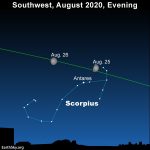
As darkness falls on August 25, 2020, the moon will be at or near its half-illuminated first quarter phase, and close to the star Antares on the sky’s dome. The next night – August 26 – the moon will be farther from Antares, and closer to the graceful curved tail of Scorpius the Scorpion, the constellation in which Antares is the brightest star.

Of course, the moon and these stars are not truly close together in space on these nights. The moon, our closest celestial neighbor, resides at a average distance of 238,885 miles or 384,400 km; yet the sun, our nearest star, lodges some 400 times farther from Earth than our moon.

Meanwhile, Antares is estimated to be 600 light-years away from us. A light-year is about 63,000 times greater than one astronomical unit (sun-Earth distance). So Antares is somewhere around 38 million times the sun’s distance from Earth (600 x 63,000 = 37,800,000 astronomical units).

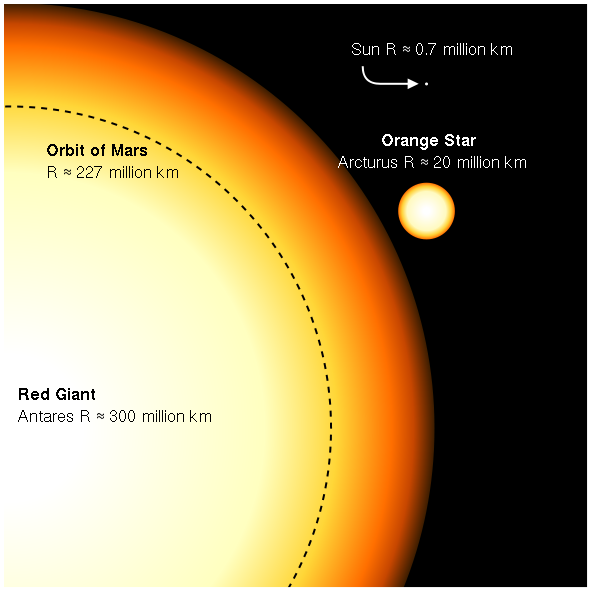
Antares, the brightest star in the constellation Scorpius the Scorpion, represents the Scorpion’s beating heart. This red gem of a star is truly enormous, with a radius in excess of 3 astronomical units (AU). If by some bit of magic Antares were suddenly substituted for our sun, the surface of the star would extend well past the orbit of Mars!

Antares’ ruddy complexion reveals that this star has a low surface temperature. However, Antares’ great size makes up for its low surface temperature to shine at 1st-magnitude brightness in Earth’s sky. That’s in spite of the fact that Antares lies nearly 600 light-years away.

In the visible spectrum, this red supergiant star has the luminosity of about 10,000 suns. But if we could include invisible infrared radiation, Antares might have as much as 60,000 times the sun’s luminosity.

If Antares replaced the sun in our solar system, its circumference would extend beyond the orbit of the fourth planet, Mars. Here, Antares is shown in contrast to another star, Arcturus, and our sun. Image via Wikimedia Commons.

Bottom line: The moon sweeps close to red supergiant star Antares on August 25, 2020. The next night, August 26, the moon is closer to the graceful curved tail of Scorpius the Scorpion, the constellation in which Antares is the brightest star.


from EarthSky https://ift.tt/3gm44pu

As darkness falls on August 25, 2020, the moon will be at or near its half-illuminated first quarter phase, and close to the star Antares on the sky’s dome. The next night – August 26 – the moon will be farther from Antares, and closer to the graceful curved tail of Scorpius the Scorpion, the constellation in which Antares is the brightest star.

Of course, the moon and these stars are not truly close together in space on these nights. The moon, our closest celestial neighbor, resides at a average distance of 238,885 miles or 384,400 km; yet the sun, our nearest star, lodges some 400 times farther from Earth than our moon.

Meanwhile, Antares is estimated to be 600 light-years away from us. A light-year is about 63,000 times greater than one astronomical unit (sun-Earth distance). So Antares is somewhere around 38 million times the sun’s distance from Earth (600 x 63,000 = 37,800,000 astronomical units).

Antares, the brightest star in the constellation Scorpius the Scorpion, represents the Scorpion’s beating heart. This red gem of a star is truly enormous, with a radius in excess of 3 astronomical units (AU). If by some bit of magic Antares were suddenly substituted for our sun, the surface of the star would extend well past the orbit of Mars!

Antares’ ruddy complexion reveals that this star has a low surface temperature. However, Antares’ great size makes up for its low surface temperature to shine at 1st-magnitude brightness in Earth’s sky. That’s in spite of the fact that Antares lies nearly 600 light-years away.

In the visible spectrum, this red supergiant star has the luminosity of about 10,000 suns. But if we could include invisible infrared radiation, Antares might have as much as 60,000 times the sun’s luminosity.

If Antares replaced the sun in our solar system, its circumference would extend beyond the orbit of the fourth planet, Mars. Here, Antares is shown in contrast to another star, Arcturus, and our sun. Image via Wikimedia Commons.

Bottom line: The moon sweeps close to red supergiant star Antares on August 25, 2020. The next night, August 26, the moon is closer to the graceful curved tail of Scorpius the Scorpion, the constellation in which Antares is the brightest star.


from EarthSky https://ift.tt/3gm44pu

Magnetic rivers feed star birth

Many striations (almost straight lines) across a star field with cloudy nebulae.

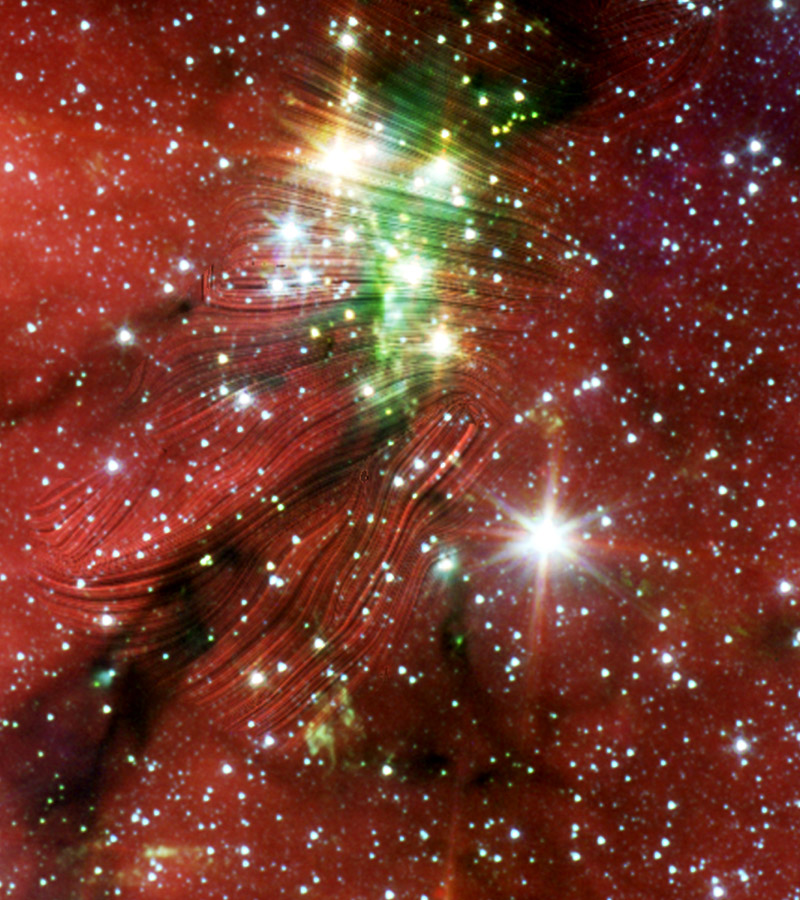
See the lines – called streamlines by scientists – in this composite image of the Serpens South star cluster? They’re from magnetic fields in this great star-forming cloud. Notice the lower left, where magnetic fields have been dragged into alignment with a narrow, dark filament. In that area, astronomers say, material from interstellar space is flowing into the star-forming cloud and fueling star formation. Image via NASA/ SOFIA/ T. Pillai/ JPL-Caltech/ L. Allen/ USRA.

Astronomers have known for decades that stars like our sun form when giant clouds of gas and dust in space – sometimes called molecular clouds – collapse under their own gravity. But how does the material from interstellar space flow into these clouds, and what controls the collapse? The image above helps illustrate an answer to these questions. It’s a composite, made with data from SOFIA – an airborne telescope designed for infrared astronomy – overlaid on an image from the now-retired Spitzer Space Telescope. This composite shows that the pull of gravity can sometimes overcome the strong magnetic fields found in great star-forming clouds in space. And it shows that, when that happens, weakly magnetized gas can flow – as on a conveyor belt – to feed the growth of newly forming star clusters.

A statement from the Max Planck Institute in Bonn, Germany, explained:

A major finding in the last decade has been that extensive networks of filaments permeate every molecular cloud. A picture has emerged that stars like our own sun form preferentially in dense clusters at the intersection of filaments.

Now look back at the image above, which shows the Serpens South star cluster, a star-forming region located some 1,400 light-years from Earth. In that image, you see a dark filament in the lower left. Now notice the “stripes” on the image, which astronomers call streamlines. They represent magnetic structures, discovered by SOFIA. The astronomers said these magnetic structures act like rivers, channeling material into the great star-forming cloud.

As you can see in the image, these magnetic streamlines have been dragged by gravity to align with the narrow, dark filament on the lower left. Astronomers say this configuration helps material from interstellar space flow into the cloud.

This is different from the upper parts of the image, where the magnetic fields are perpendicular to the filaments; in those regions, the magnetic fields in the cloud are opposing gravity.

A beautiful and dignified young woman.

Astrophysicist Thushara Pillai led the study showing that magnetic rivers feed star birth in the Serpens South star-forming region.

The scientists said in a statement from Universities Space Research Association (USRA) that they are:

… studying the dense cloud to learn how magnetic fields, gravity and turbulent gas motions contribute to the creation of stars. Once thought to slow star birth by counteracting gravity, SOFIA’s data reveals magnetic fields may actually be working together with gravity as it pulls the fields into alignment with the filaments, nourishing the birth of stars.

The results were published in the peer-reviewed journal Nature Astronomy on August 17. The lead author of the new study is Thushara Pillai of Boston University and the Max Planck Institute for Radio Astronomy in Bonn, Germany.

In 1835, the French philosopher Auguste Comte wrote of the unknowable nature of stars:

On the subject of stars, all investigations which are not ultimately reducible to simple visual observations are … necessarily denied to us. While we can conceive of the possibility of determining their shapes, their sizes, and their motions, we shall never be able by any means to study their chemical composition or their mineralogical structure … Our knowledge concerning their gaseous envelopes is necessarily limited to their existence, size … and refractive power, we shall not at all be able to determine their chemical composition or even their density…

He was, famously, wrong.

He couldn’t have envisioned the range of tools available to modern astronomers. It’s a beautiful thing that, nowadays, astronomers can not only learn about the compositions of stars via their studies of their spectra, but also probe the deeper mysteries, going all the way to the births of these colossal, self-luminous balls in space.

The Stratospheric Observatory for Infrared Astronomy (SOFIA) is a Boeing 747SP jetliner modified to carry a 106-inch diameter telescope.

SOFIA, the Stratospheric Observatory for Infrared Astronomy. The HAWC+ polarimeter on board SOFIA was used for the observations of the magnetic field in the Serpens South star-forming region. Image via NASA/ C. Thomas/ Max Planck Institute.

Bottom line: Astronomers have learned that the pull of gravity can sometimes overcome the strong magnetic fields found in great star-forming clouds in space. The resulting weakly magnetized gas flow can feed the growth of new stars.

Source: Magnetized filamentary gas flows feeding the young embedded cluster in Serpens South

Via USRA

Via Max Planck Institute.


from EarthSky https://ift.tt/3lcVRHI
Many striations (almost straight lines) across a star field with cloudy nebulae.

See the lines – called streamlines by scientists – in this composite image of the Serpens South star cluster? They’re from magnetic fields in this great star-forming cloud. Notice the lower left, where magnetic fields have been dragged into alignment with a narrow, dark filament. In that area, astronomers say, material from interstellar space is flowing into the star-forming cloud and fueling star formation. Image via NASA/ SOFIA/ T. Pillai/ JPL-Caltech/ L. Allen/ USRA.

Astronomers have known for decades that stars like our sun form when giant clouds of gas and dust in space – sometimes called molecular clouds – collapse under their own gravity. But how does the material from interstellar space flow into these clouds, and what controls the collapse? The image above helps illustrate an answer to these questions. It’s a composite, made with data from SOFIA – an airborne telescope designed for infrared astronomy – overlaid on an image from the now-retired Spitzer Space Telescope. This composite shows that the pull of gravity can sometimes overcome the strong magnetic fields found in great star-forming clouds in space. And it shows that, when that happens, weakly magnetized gas can flow – as on a conveyor belt – to feed the growth of newly forming star clusters.

A statement from the Max Planck Institute in Bonn, Germany, explained:

A major finding in the last decade has been that extensive networks of filaments permeate every molecular cloud. A picture has emerged that stars like our own sun form preferentially in dense clusters at the intersection of filaments.

Now look back at the image above, which shows the Serpens South star cluster, a star-forming region located some 1,400 light-years from Earth. In that image, you see a dark filament in the lower left. Now notice the “stripes” on the image, which astronomers call streamlines. They represent magnetic structures, discovered by SOFIA. The astronomers said these magnetic structures act like rivers, channeling material into the great star-forming cloud.

As you can see in the image, these magnetic streamlines have been dragged by gravity to align with the narrow, dark filament on the lower left. Astronomers say this configuration helps material from interstellar space flow into the cloud.

This is different from the upper parts of the image, where the magnetic fields are perpendicular to the filaments; in those regions, the magnetic fields in the cloud are opposing gravity.

A beautiful and dignified young woman.

Astrophysicist Thushara Pillai led the study showing that magnetic rivers feed star birth in the Serpens South star-forming region.

The scientists said in a statement from Universities Space Research Association (USRA) that they are:

… studying the dense cloud to learn how magnetic fields, gravity and turbulent gas motions contribute to the creation of stars. Once thought to slow star birth by counteracting gravity, SOFIA’s data reveals magnetic fields may actually be working together with gravity as it pulls the fields into alignment with the filaments, nourishing the birth of stars.

The results were published in the peer-reviewed journal Nature Astronomy on August 17. The lead author of the new study is Thushara Pillai of Boston University and the Max Planck Institute for Radio Astronomy in Bonn, Germany.

In 1835, the French philosopher Auguste Comte wrote of the unknowable nature of stars:

On the subject of stars, all investigations which are not ultimately reducible to simple visual observations are … necessarily denied to us. While we can conceive of the possibility of determining their shapes, their sizes, and their motions, we shall never be able by any means to study their chemical composition or their mineralogical structure … Our knowledge concerning their gaseous envelopes is necessarily limited to their existence, size … and refractive power, we shall not at all be able to determine their chemical composition or even their density…

He was, famously, wrong.

He couldn’t have envisioned the range of tools available to modern astronomers. It’s a beautiful thing that, nowadays, astronomers can not only learn about the compositions of stars via their studies of their spectra, but also probe the deeper mysteries, going all the way to the births of these colossal, self-luminous balls in space.

The Stratospheric Observatory for Infrared Astronomy (SOFIA) is a Boeing 747SP jetliner modified to carry a 106-inch diameter telescope.

SOFIA, the Stratospheric Observatory for Infrared Astronomy. The HAWC+ polarimeter on board SOFIA was used for the observations of the magnetic field in the Serpens South star-forming region. Image via NASA/ C. Thomas/ Max Planck Institute.

Bottom line: Astronomers have learned that the pull of gravity can sometimes overcome the strong magnetic fields found in great star-forming clouds in space. The resulting weakly magnetized gas flow can feed the growth of new stars.

Source: Magnetized filamentary gas flows feeding the young embedded cluster in Serpens South

Via USRA

Via Max Planck Institute.


from EarthSky https://ift.tt/3lcVRHI

Looking edgewise into the Milky Way

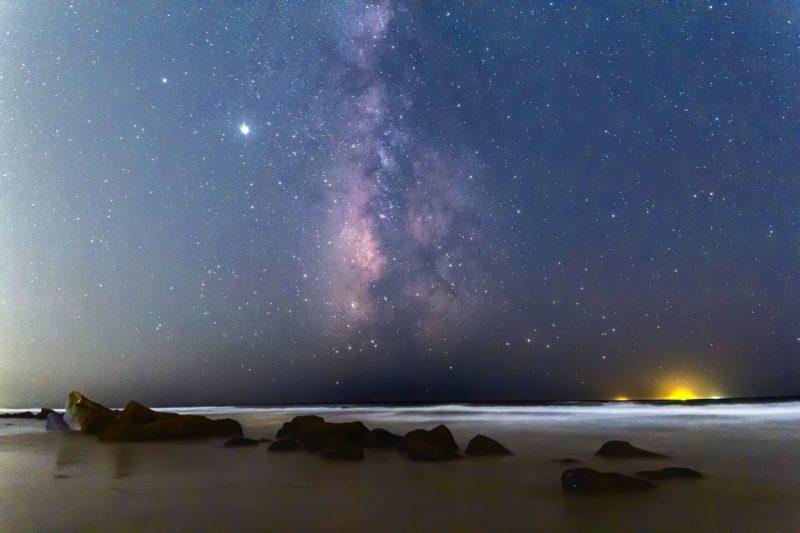
Edgewise view of the summer Milky Way, like a narrow cloud billowing upward, on a dark night.

View at EarthSky Community Photos. | Javier Elias captured this image on August 21, 2020 and wrote: “Milky Way at Costa Ballena Beach in Chipiona, Cadiz, Spain, with Jupiter and Saturn standing out in the picture.” Thank you, Javier.

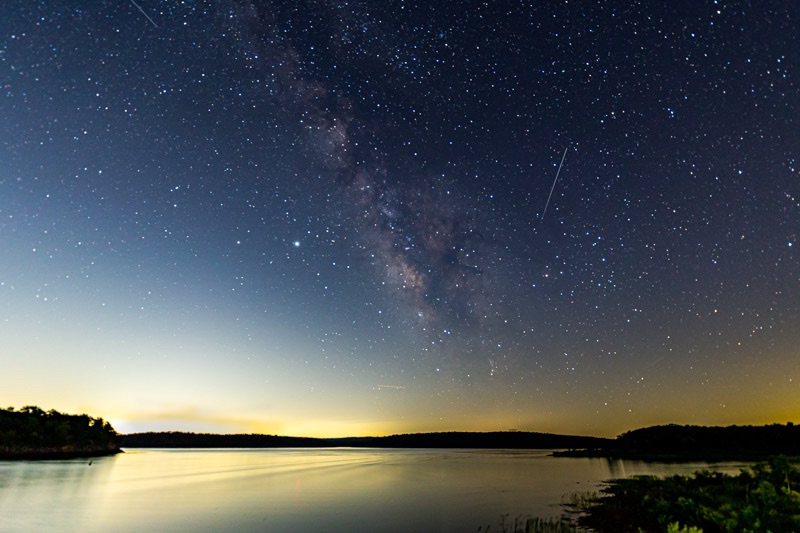
Edgewise view of the summer Milky Way, on a starry night with light near the horizon and thin streaks in the sky.

View at EarthSky Community Photos. | Robert OFerrall caught this image at Skiatook Lake, Oklahoma, on August 19, 2020. “The Milky Way and a couple of Perseid meteors,” he wrote. Thank you, Robert.

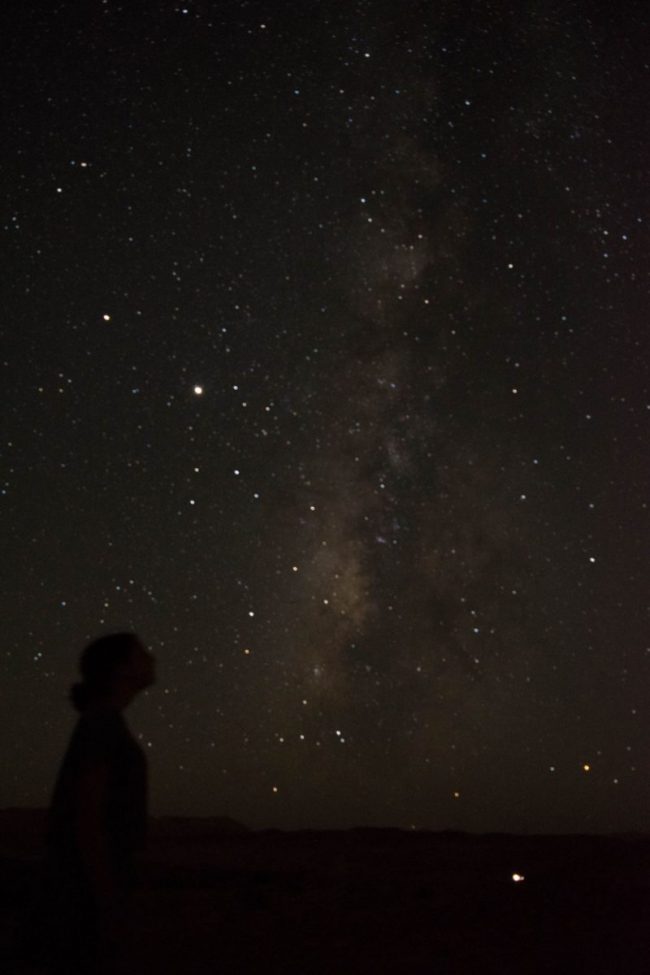
Edgewise view of the summer Milky Way, on a dark night, with scattered stars.

View at EarthSky Community Photos. | Nisan Gertz captured this image at Ramon Crater, Israel, on August 16, 2020. He wrote: “My 14-year-old daughter, Tiffy, looks up at the Milky Way, with Jupiter and Saturn shining brightly above her head. We also saw many meteors in the darkness of the crater. Ramon Crater is the first International Dark Sky Place to be listed by the IDA in the Middle East. An amazing location for great views of the heavens!” Thank you, Nisan.

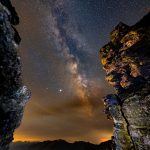
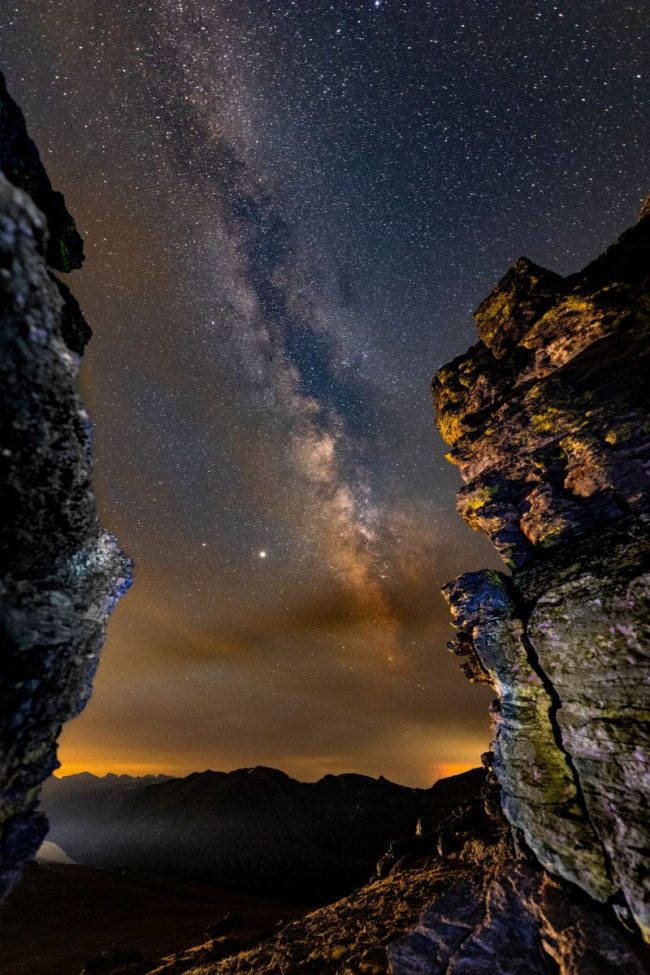
Edgewise view of the summer Milky Way, between two rock cliffs, with red clouds in the distance.

View at EarthSky Community Photos. | William Mathe captured this image on August 15, 2020, and wrote: “Hiked up to the top of Rocky Mountain National Park in Colorado … just below 12,000 feet. Was greeted with a raging forest fire about 10 miles to the west. This is/was the Cameron Peak fire when it was ‘only’ 4,000 acres. It’s now more than triple that size at 17,500 acres … This is the 2nd- or 3rd-largest fire burning right now in Colorado. Took a few snaps of it at sunset with the smoke and ash raining down like a summer snow … hung around long enough to get a couple of snaps of the Milky Way. Super nasty conditions and you can see the brown clouds of smoke hanging in the valley below the rock outcrop on which I was perched.” Thank you, William.

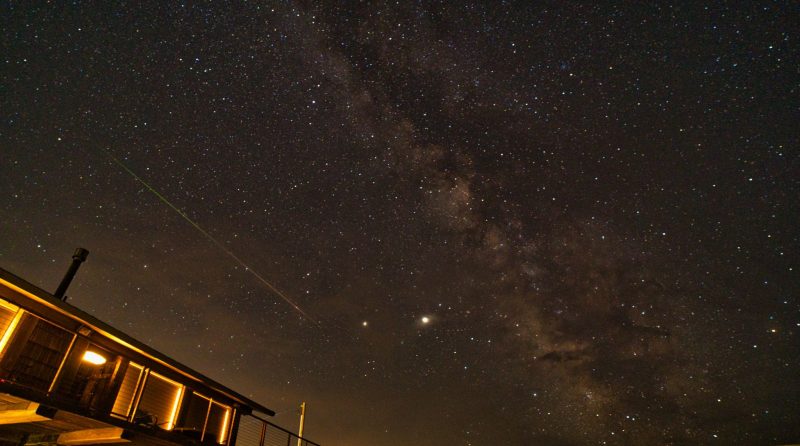
Edgewise view of the summer Milky Way, on a dark night, with a long, thin streak next to it.

View at EarthSky Community Photos. | James Wei was at Fort Bragg, California, on August 13, 2020, when he captured this image. He wrote: “I was very disappointed when, at the peak of the Perseid shower, we were experiencing heavy fog for a few days. But a day later, the fog cleared and we saw a few very long and bright meteors on the following 2 nights. This one was a very lucky shot capturing the meteor with the green tail while I was just taking pictures of the vacation home we are staying and the Milky Way. The meteor came into the picture perfectly as it almost ran parallel to the Milky Way.” Thank you, James.

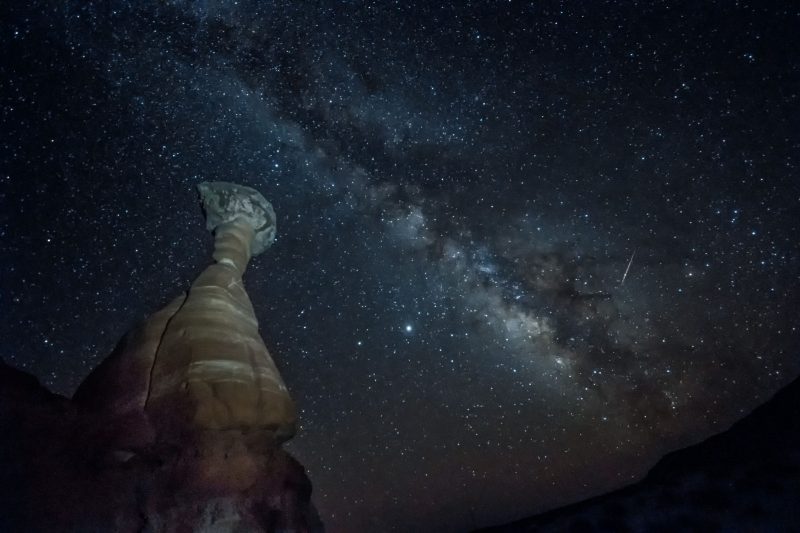
Looking upward along a tall cylindrical rock formation at the Milky Way crossing a dark sky.

View at EarthSky Community Photos. | Bob Kuo caught this image on August 12, 2020, around the peak of the Perseid meteor shower. He wrote: “Not the brightest Perseid meteor fireballs we saw/caught, but it’s a surprisingly fortunate capture as I was busy light painting the famous hoodoo at Toadstool in southern Utah!” Thank you, Bob.

Milky Way and bright planets hanging in the sky above a mountain, and reflected in a lake.

View at EarthSky Community Photos. | Puya Hosseini caught this image on August 12, 2020, and wrote: “Went backpacking in the John Muir Wilderness. This shot was taken at the very end of ‘blue light’ before a terrifically clear, dark night set in. There was no wind, and Duck Lake – up at 11,000 feet elevation – was so glassy calm the Milky Way reflected in the water. Jupiter and Saturn can be seen shining bright next to the galactic core.” Thank you, Puya.

Bottom line: Photos of the summer Milky Way from the EarthSky community.


from EarthSky https://ift.tt/3goiJjW
Edgewise view of the summer Milky Way, like a narrow cloud billowing upward, on a dark night.

View at EarthSky Community Photos. | Javier Elias captured this image on August 21, 2020 and wrote: “Milky Way at Costa Ballena Beach in Chipiona, Cadiz, Spain, with Jupiter and Saturn standing out in the picture.” Thank you, Javier.

Edgewise view of the summer Milky Way, on a starry night with light near the horizon and thin streaks in the sky.

View at EarthSky Community Photos. | Robert OFerrall caught this image at Skiatook Lake, Oklahoma, on August 19, 2020. “The Milky Way and a couple of Perseid meteors,” he wrote. Thank you, Robert.

Edgewise view of the summer Milky Way, on a dark night, with scattered stars.

View at EarthSky Community Photos. | Nisan Gertz captured this image at Ramon Crater, Israel, on August 16, 2020. He wrote: “My 14-year-old daughter, Tiffy, looks up at the Milky Way, with Jupiter and Saturn shining brightly above her head. We also saw many meteors in the darkness of the crater. Ramon Crater is the first International Dark Sky Place to be listed by the IDA in the Middle East. An amazing location for great views of the heavens!” Thank you, Nisan.

Edgewise view of the summer Milky Way, between two rock cliffs, with red clouds in the distance.

View at EarthSky Community Photos. | William Mathe captured this image on August 15, 2020, and wrote: “Hiked up to the top of Rocky Mountain National Park in Colorado … just below 12,000 feet. Was greeted with a raging forest fire about 10 miles to the west. This is/was the Cameron Peak fire when it was ‘only’ 4,000 acres. It’s now more than triple that size at 17,500 acres … This is the 2nd- or 3rd-largest fire burning right now in Colorado. Took a few snaps of it at sunset with the smoke and ash raining down like a summer snow … hung around long enough to get a couple of snaps of the Milky Way. Super nasty conditions and you can see the brown clouds of smoke hanging in the valley below the rock outcrop on which I was perched.” Thank you, William.

Edgewise view of the summer Milky Way, on a dark night, with a long, thin streak next to it.

View at EarthSky Community Photos. | James Wei was at Fort Bragg, California, on August 13, 2020, when he captured this image. He wrote: “I was very disappointed when, at the peak of the Perseid shower, we were experiencing heavy fog for a few days. But a day later, the fog cleared and we saw a few very long and bright meteors on the following 2 nights. This one was a very lucky shot capturing the meteor with the green tail while I was just taking pictures of the vacation home we are staying and the Milky Way. The meteor came into the picture perfectly as it almost ran parallel to the Milky Way.” Thank you, James.

Looking upward along a tall cylindrical rock formation at the Milky Way crossing a dark sky.

View at EarthSky Community Photos. | Bob Kuo caught this image on August 12, 2020, around the peak of the Perseid meteor shower. He wrote: “Not the brightest Perseid meteor fireballs we saw/caught, but it’s a surprisingly fortunate capture as I was busy light painting the famous hoodoo at Toadstool in southern Utah!” Thank you, Bob.

Milky Way and bright planets hanging in the sky above a mountain, and reflected in a lake.

View at EarthSky Community Photos. | Puya Hosseini caught this image on August 12, 2020, and wrote: “Went backpacking in the John Muir Wilderness. This shot was taken at the very end of ‘blue light’ before a terrifically clear, dark night set in. There was no wind, and Duck Lake – up at 11,000 feet elevation – was so glassy calm the Milky Way reflected in the water. Jupiter and Saturn can be seen shining bright next to the galactic core.” Thank you, Puya.

Bottom line: Photos of the summer Milky Way from the EarthSky community.


from EarthSky https://ift.tt/3goiJjW

NASA’s guide to near light speed space travel

Take a couple of minutes to check out this new video from NASA’s Goddard Space Flight Center, released August 14, 2020:

So you’ve somehow rigged up your spaceship to travel almost at the speed of light? … Before you fly off all willy-nilly, however, there are some important things you should probably know about approaching the speed of light.

Enjoy!

If you take a trip at near the speed of light, you won’t just feel younger when you get back. You’ll BE younger! (compared to friends who stayed behind.) See more postcards like this, from NASA.

Bottom line: New animated video from NASA on traveling near the speed of light.

Via NASA’s Goddard Space Flight Center


from EarthSky https://ift.tt/2QlYnx6

Take a couple of minutes to check out this new video from NASA’s Goddard Space Flight Center, released August 14, 2020:

So you’ve somehow rigged up your spaceship to travel almost at the speed of light? … Before you fly off all willy-nilly, however, there are some important things you should probably know about approaching the speed of light.

Enjoy!

If you take a trip at near the speed of light, you won’t just feel younger when you get back. You’ll BE younger! (compared to friends who stayed behind.) See more postcards like this, from NASA.

Bottom line: New animated video from NASA on traveling near the speed of light.

Via NASA’s Goddard Space Flight Center


from EarthSky https://ift.tt/2QlYnx6

Venus, Orion and Sirius the Dog Star

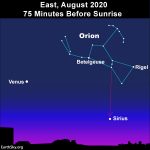
In late August and early September, look for a hint of the changing season in the predawn sky: Orion the Hunter and Sirius the Dog Star. The very noticeable constellation Orion the Hunter rises before dawn at this time of year, recognizable for the short straight line of three stars that make up Orion’s Belt. And the sky’s brightest star Sirius – sometimes called the Dog Star because it’s part of the constellation Canis Major the Greater Dog – follows Orion into the sky as the predawn darkness gives way to dawn. Orion and Sirius are very noticeable in the sky before sunup. In 2020, the dazzling planet Venus can help guide your eye.

Venus shines in the sunrise direction before the sun comes up. Sirius is located to the south of Venus, so it’s to the right of Venus as you stand facing east. Have you noticed a very bright, madly twinkling star in this part of the early morning sky? Many do – around the world – at this time of year. That star is Sirius. It’s so bright that, when it’s low in the sky, it shines with glints of red and flashes of blue – very noticeable!

Orion and the nearby star Sirius will become visible in the evening by northern winter (or southern summer). But presently the Hunter and the Dog Star lord over the sky at dawn’s first light.

EarthSky astronomy kits are perfect for beginners. Order yours from the EarthSky store.

Blue dawn sky with dim stars and constellations outlined.

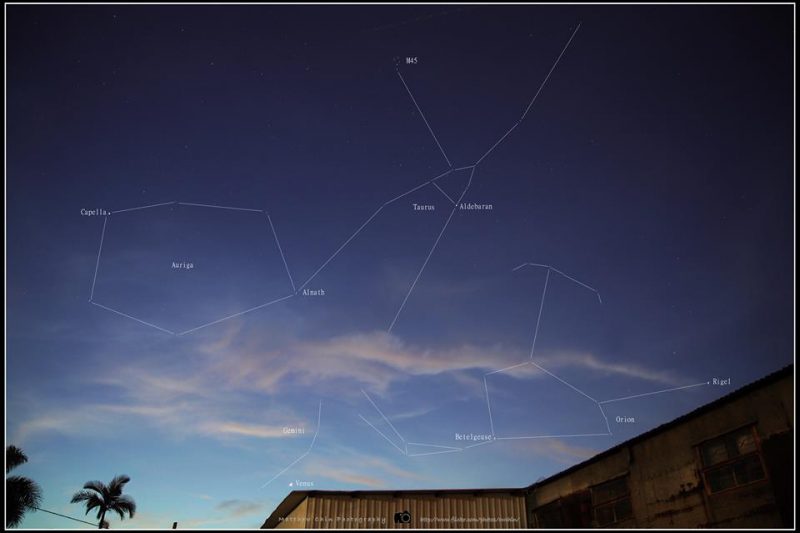
Matthew Chin in Hong Kong caught this photo in late July 2014, showing the stars and constellations that we in the Northern Hemisphere associate with winter. In late August – a full month later – all of these stars will have shifted higher in the east before sunrise. By December, they’ll be ascending in the east in the evening!

Orion was low in the west after sunset around March and April. By June of each year, this constellation lies behind the sun as seen from Earth. Orion only returned to visibility in Earth’s sky about a month ago (see image above). When a constellation becomes visible again, after being behind the sun, it always appears in the east before sunrise.

Because – as Earth orbits the sun – all the stars rise two hours earlier with each passing month, Orion is now higher at dawn than a month ago.

As seen from the Northern Hemisphere, Orion precedes Sirius the Dog Star into the sky. After Orion first appears at morning dawn, you can count on Sirius to appear in the morning sky a few weeks later. You should be able to see Sirius at or before dawn right now – unless you live at far northern latitudes.

But, even from Earth’s far north, you won’t have to wait much longer to see Sirius!

Time lapse photo with line of small, bright multicolored circles. Two more lines of plainer circles.

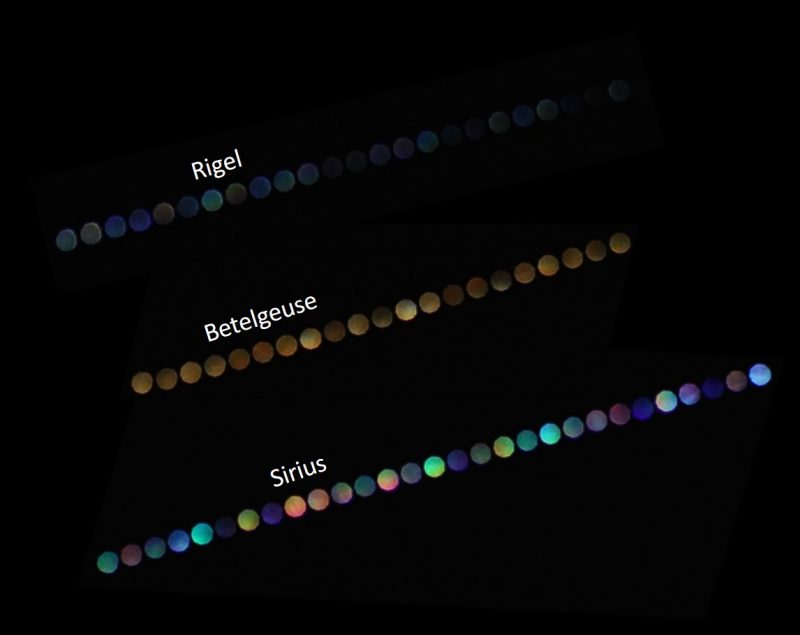
Be sure to notice the colors of Rigel and Betelgeuse in Orion, and of Sirius itself. When seen low in the sky on a summer morning, you might notice bright Sirius flashing in many colors! In fact – although Rigel and Betelgeuse are intrinsically colorful, due to the types of stars they are – Sirius shines mostly white. The colors we see in Sirius when it’s low in the sky are the result of looking at this very bright star through a greater-than-usual thickness of Earth’s atmosphere in the direction of the horizon. Image via Amanda Cross. Read more about this image.

Bottom line: A sign of the changing season, Sirius – the sky’s brightest star – is visible before sunup. You’ll know it’s Sirius if the very noticeable three stars in Orion’s Belt point to it.

Enjoying EarthSky so far? Sign up for our free daily newsletter today!

Help support EarthSky! Check out the EarthSky store for fun astronomy gifts and tools for all ages!


from EarthSky https://ift.tt/2MGTYFs

In late August and early September, look for a hint of the changing season in the predawn sky: Orion the Hunter and Sirius the Dog Star. The very noticeable constellation Orion the Hunter rises before dawn at this time of year, recognizable for the short straight line of three stars that make up Orion’s Belt. And the sky’s brightest star Sirius – sometimes called the Dog Star because it’s part of the constellation Canis Major the Greater Dog – follows Orion into the sky as the predawn darkness gives way to dawn. Orion and Sirius are very noticeable in the sky before sunup. In 2020, the dazzling planet Venus can help guide your eye.

Venus shines in the sunrise direction before the sun comes up. Sirius is located to the south of Venus, so it’s to the right of Venus as you stand facing east. Have you noticed a very bright, madly twinkling star in this part of the early morning sky? Many do – around the world – at this time of year. That star is Sirius. It’s so bright that, when it’s low in the sky, it shines with glints of red and flashes of blue – very noticeable!

Orion and the nearby star Sirius will become visible in the evening by northern winter (or southern summer). But presently the Hunter and the Dog Star lord over the sky at dawn’s first light.

EarthSky astronomy kits are perfect for beginners. Order yours from the EarthSky store.

Blue dawn sky with dim stars and constellations outlined.

Matthew Chin in Hong Kong caught this photo in late July 2014, showing the stars and constellations that we in the Northern Hemisphere associate with winter. In late August – a full month later – all of these stars will have shifted higher in the east before sunrise. By December, they’ll be ascending in the east in the evening!

Orion was low in the west after sunset around March and April. By June of each year, this constellation lies behind the sun as seen from Earth. Orion only returned to visibility in Earth’s sky about a month ago (see image above). When a constellation becomes visible again, after being behind the sun, it always appears in the east before sunrise.

Because – as Earth orbits the sun – all the stars rise two hours earlier with each passing month, Orion is now higher at dawn than a month ago.

As seen from the Northern Hemisphere, Orion precedes Sirius the Dog Star into the sky. After Orion first appears at morning dawn, you can count on Sirius to appear in the morning sky a few weeks later. You should be able to see Sirius at or before dawn right now – unless you live at far northern latitudes.

But, even from Earth’s far north, you won’t have to wait much longer to see Sirius!

Time lapse photo with line of small, bright multicolored circles. Two more lines of plainer circles.

Be sure to notice the colors of Rigel and Betelgeuse in Orion, and of Sirius itself. When seen low in the sky on a summer morning, you might notice bright Sirius flashing in many colors! In fact – although Rigel and Betelgeuse are intrinsically colorful, due to the types of stars they are – Sirius shines mostly white. The colors we see in Sirius when it’s low in the sky are the result of looking at this very bright star through a greater-than-usual thickness of Earth’s atmosphere in the direction of the horizon. Image via Amanda Cross. Read more about this image.

Bottom line: A sign of the changing season, Sirius – the sky’s brightest star – is visible before sunup. You’ll know it’s Sirius if the very noticeable three stars in Orion’s Belt point to it.

Enjoying EarthSky so far? Sign up for our free daily newsletter today!

Help support EarthSky! Check out the EarthSky store for fun astronomy gifts and tools for all ages!


from EarthSky https://ift.tt/2MGTYFs

adds 2