aads

Is it possible to hear meteors?

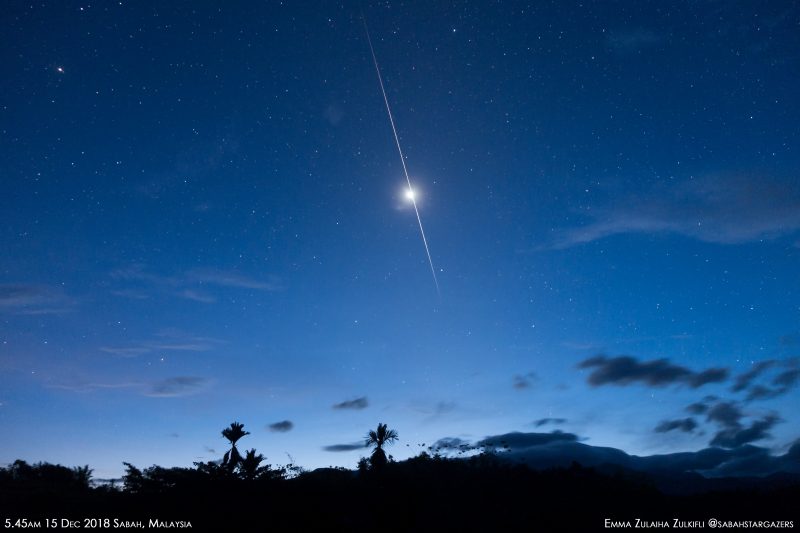
Bright light and elongated flash in dark blue sky with small clouds and stars.

What are the odds?! This amazing image is from Emma Zulaiha Zulkifli in Sabah, on the island of Borneo in Malaysia. She caught a bright meteor streaking right in front of the bright planet Venus on December 15, 2018. She wrote: “Yes, the meteor actually did streak in front of Venus! Only a bit of tweaking on contrast and noise reduction done in Photoshop CC2018.” Fuji X-A1, 18-55mm f2.8 with Tripod, Exif : iso2000, 30?, f2.8. Way to go, Emma!

When is the next meteor shower? EarthSky’s 2020 meteor shower guide

Meteors, and meteor showers in particular, are one of the most amazing sights that you can see when you look at the night sky. Those brief flares of light are a reminder that many small rocky objects and particles – most about the size of a grain of sand – enter Earth’s atmosphere every day and harmlessly burn up. Seeing this is cool enough, but is it possible to actually hear meteors as well?

Sometimes, after a meteor shower, people have reported hearing the meteors as they disintegrated in the atmosphere. Some exceptionally bright meteors have been reported as being accompanied by a low hissing sound – like bacon sizzling. But is that what is actually happening?

Astronomers now think it is.
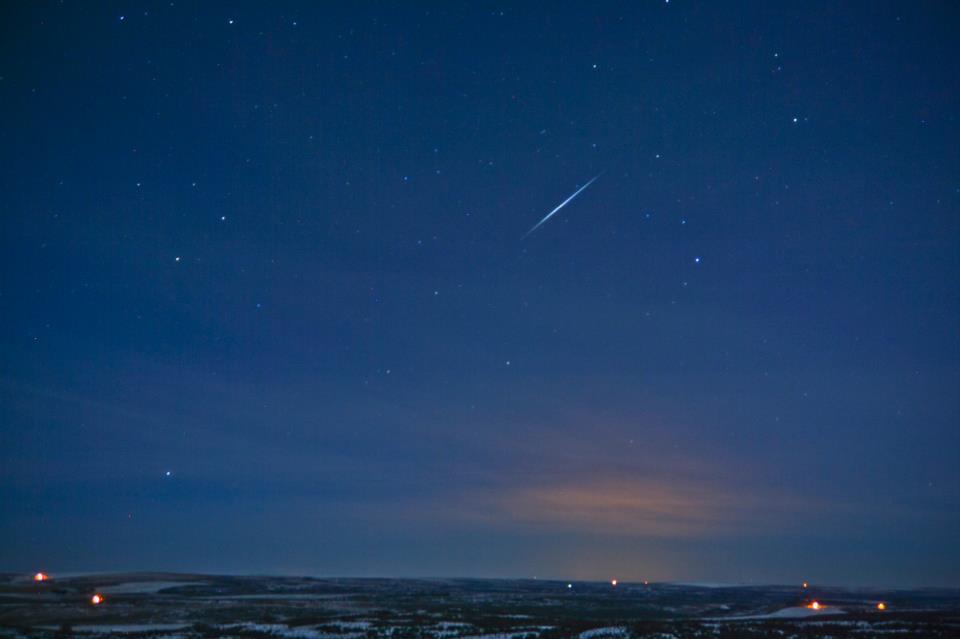
Small flash of light in a dark blue sky with stars.

2013 Quadrantid meteor by EarthSky Facebook friend Susan Jensen in Odessa, Washington.

For years, professional astronomers dismissed the notion of sounds from meteors as fiction. Why? Typically, a meteor burns up about 100 kilometers – or 60 miles – above the Earth’s surface. Because sound travels so much more slowly than light does, the rumblings of a particularly large meteor shouldn’t be heard for several minutes after the meteor’s sighting. Something like hearing thunder after the lightning flashes have already happened. A meteor 100 kilometers high would boom about five minutes after it appears. Such an object is called a “sonic” meteor. The noise it makes is related to the sonic boom caused by a faster-than-sound aircraft.

But sometimes, meteors seem to make a sound at the same time that they are being seen. These meteors would be seen and heard simultaneously. Is this possible? Yes, according to astronomers. There are what astronomers call “electrophonic meteors.”

Basically, the explanation is that these meteors give off very low frequency (VLF) radio waves, which travel at the speed of light. Even though you can’t directly hear radio waves, these waves can cause physical objects on the Earth’s surface to vibrate. The radio waves cause a sound, which our ears might interpret as the sizzle of a meteor shooting by.

As reported by Live Science in 2013, one classic example of people hearing meteors occurred in A.D. 817, as a meteor shower passed over China. Many observers reported hearing buzzing, sizzling or hissing sounds, according to a 1992 report by Colin Keay, a physicist at the University of Newcastle in Australia. Something similar happened in England in 1719.

Bright streak of light over pier on lake, in dark blue sky with stars.

The 2017 Perseid meteor shower peaked in moonlight, but that didn’t stop Hrvoje Crnjak in Šibenik, Croatia, from catching this bright Perseid on the morning of August 12, 2017. Notice the variations in brightness and color throughout, and the little “pop” of brightness toward the bottom. A brightness “pop” like that comes from a clump of vaporizing debris. Thank you, Hrvoje!

According to astronomer Edmond Halley:

Of several accidents that were reported to have attended its passage, many were the effect of pure fantasy, such as the hearing it hiss as it went along, as if it had been near at hand.

It wasn’t until the 1970s and later that these reports began to be taken more seriously. As reported by Keay in the journal Asteroids, Comets, Meteors, people who claimed they could hear meteors were dismissed as crackpots.

But then, hundreds of reports came from the sighting of a large meteor over New South Wales in 1978. Keay analyzed 36 of those reports.

VLF waves travel at the speed of light, so observers would hear them the same time that they saw the meteors pass overhead. But those waves need something physical to act as a transducer and create the sound. Keay found that various objects such as aluminum foil, plant foliage like pine needles, thin wires, dry frizzy hair and wire-framed eyeglasses could all produce those kinds of sounds. That phenomenon is called electrophonics. According to one observer:

When I was out [viewing the Leonid meteor showers in 1999], I had my head back on the ground and heard a sizzling sound. My head was close to grass and leaves and I wear wire-frame glasses as well. The sound was definitely simultaneous with the observation of a rather large streak.
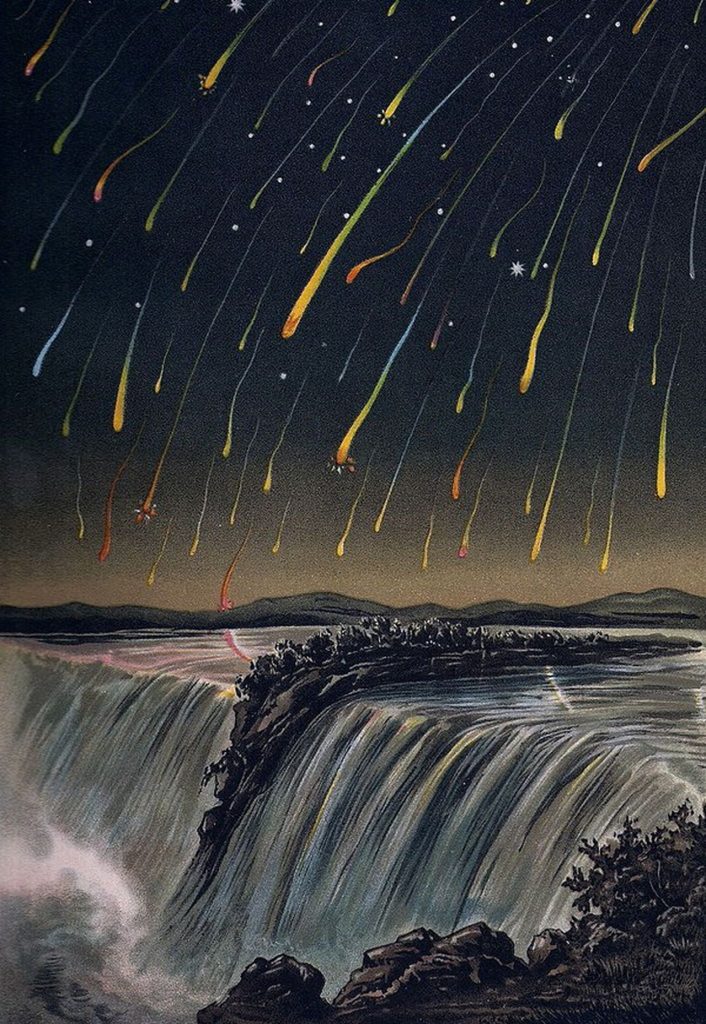
Many streaks of light in sky above a waterfall.

Artist’s illustration of the Leonid meteor shower in 1833, one of the most spectacular in history. Image via NJ.com/ Edmund Weiss.

Keay’s hypothesis was further tested during the Leonid meteor shower of Nov. 18, 1999. The researchers detected distinct VLF sounds, and also found that many of the meteors were not even visible by eye, but were heard. In fact, 50 times more meteors were detected by their VLF signatures than by sight alone. Dennis Gallagher, a space physicist at the NASA Marshall Space Flight Center, said:

What makes this exciting is that we’re talking about a phenomenon that has been experienced by people for perhaps thousands of years. Even in modern times folks who reported hearing such sounds were ridiculed. It was only about 25 years ago that Keay was able to do the research and legitimize the experiences of all those generations of people. It shows there are still wonders in nature yet to be recognized and understood. We should take this experience with meteors as reason to open our minds to what may yet be learned.

Fun fact: when meteoroids – rocky bodies from space that can be as small as dust particles – are burning up in the atmosphere, they are called meteors. When one is large enough to survive entry into the atmosphere and hit the ground, it is called a meteorite.

Bottom line: Can you hear meteors as well as see them? Scientists say yes.


from EarthSky https://ift.tt/3l9Lep3
Bright light and elongated flash in dark blue sky with small clouds and stars.

What are the odds?! This amazing image is from Emma Zulaiha Zulkifli in Sabah, on the island of Borneo in Malaysia. She caught a bright meteor streaking right in front of the bright planet Venus on December 15, 2018. She wrote: “Yes, the meteor actually did streak in front of Venus! Only a bit of tweaking on contrast and noise reduction done in Photoshop CC2018.” Fuji X-A1, 18-55mm f2.8 with Tripod, Exif : iso2000, 30?, f2.8. Way to go, Emma!

When is the next meteor shower? EarthSky’s 2020 meteor shower guide

Meteors, and meteor showers in particular, are one of the most amazing sights that you can see when you look at the night sky. Those brief flares of light are a reminder that many small rocky objects and particles – most about the size of a grain of sand – enter Earth’s atmosphere every day and harmlessly burn up. Seeing this is cool enough, but is it possible to actually hear meteors as well?

Sometimes, after a meteor shower, people have reported hearing the meteors as they disintegrated in the atmosphere. Some exceptionally bright meteors have been reported as being accompanied by a low hissing sound – like bacon sizzling. But is that what is actually happening?

Astronomers now think it is.

Small flash of light in a dark blue sky with stars.

2013 Quadrantid meteor by EarthSky Facebook friend Susan Jensen in Odessa, Washington.

For years, professional astronomers dismissed the notion of sounds from meteors as fiction. Why? Typically, a meteor burns up about 100 kilometers – or 60 miles – above the Earth’s surface. Because sound travels so much more slowly than light does, the rumblings of a particularly large meteor shouldn’t be heard for several minutes after the meteor’s sighting. Something like hearing thunder after the lightning flashes have already happened. A meteor 100 kilometers high would boom about five minutes after it appears. Such an object is called a “sonic” meteor. The noise it makes is related to the sonic boom caused by a faster-than-sound aircraft.

But sometimes, meteors seem to make a sound at the same time that they are being seen. These meteors would be seen and heard simultaneously. Is this possible? Yes, according to astronomers. There are what astronomers call “electrophonic meteors.”

Basically, the explanation is that these meteors give off very low frequency (VLF) radio waves, which travel at the speed of light. Even though you can’t directly hear radio waves, these waves can cause physical objects on the Earth’s surface to vibrate. The radio waves cause a sound, which our ears might interpret as the sizzle of a meteor shooting by.

As reported by Live Science in 2013, one classic example of people hearing meteors occurred in A.D. 817, as a meteor shower passed over China. Many observers reported hearing buzzing, sizzling or hissing sounds, according to a 1992 report by Colin Keay, a physicist at the University of Newcastle in Australia. Something similar happened in England in 1719.

Bright streak of light over pier on lake, in dark blue sky with stars.

The 2017 Perseid meteor shower peaked in moonlight, but that didn’t stop Hrvoje Crnjak in Šibenik, Croatia, from catching this bright Perseid on the morning of August 12, 2017. Notice the variations in brightness and color throughout, and the little “pop” of brightness toward the bottom. A brightness “pop” like that comes from a clump of vaporizing debris. Thank you, Hrvoje!

According to astronomer Edmond Halley:

Of several accidents that were reported to have attended its passage, many were the effect of pure fantasy, such as the hearing it hiss as it went along, as if it had been near at hand.

It wasn’t until the 1970s and later that these reports began to be taken more seriously. As reported by Keay in the journal Asteroids, Comets, Meteors, people who claimed they could hear meteors were dismissed as crackpots.

But then, hundreds of reports came from the sighting of a large meteor over New South Wales in 1978. Keay analyzed 36 of those reports.

VLF waves travel at the speed of light, so observers would hear them the same time that they saw the meteors pass overhead. But those waves need something physical to act as a transducer and create the sound. Keay found that various objects such as aluminum foil, plant foliage like pine needles, thin wires, dry frizzy hair and wire-framed eyeglasses could all produce those kinds of sounds. That phenomenon is called electrophonics. According to one observer:

When I was out [viewing the Leonid meteor showers in 1999], I had my head back on the ground and heard a sizzling sound. My head was close to grass and leaves and I wear wire-frame glasses as well. The sound was definitely simultaneous with the observation of a rather large streak.

Many streaks of light in sky above a waterfall.

Artist’s illustration of the Leonid meteor shower in 1833, one of the most spectacular in history. Image via NJ.com/ Edmund Weiss.

Keay’s hypothesis was further tested during the Leonid meteor shower of Nov. 18, 1999. The researchers detected distinct VLF sounds, and also found that many of the meteors were not even visible by eye, but were heard. In fact, 50 times more meteors were detected by their VLF signatures than by sight alone. Dennis Gallagher, a space physicist at the NASA Marshall Space Flight Center, said:

What makes this exciting is that we’re talking about a phenomenon that has been experienced by people for perhaps thousands of years. Even in modern times folks who reported hearing such sounds were ridiculed. It was only about 25 years ago that Keay was able to do the research and legitimize the experiences of all those generations of people. It shows there are still wonders in nature yet to be recognized and understood. We should take this experience with meteors as reason to open our minds to what may yet be learned.

Fun fact: when meteoroids – rocky bodies from space that can be as small as dust particles – are burning up in the atmosphere, they are called meteors. When one is large enough to survive entry into the atmosphere and hit the ground, it is called a meteorite.

Bottom line: Can you hear meteors as well as see them? Scientists say yes.


from EarthSky https://ift.tt/3l9Lep3
Messier 11 is the Wild Duck Cluster

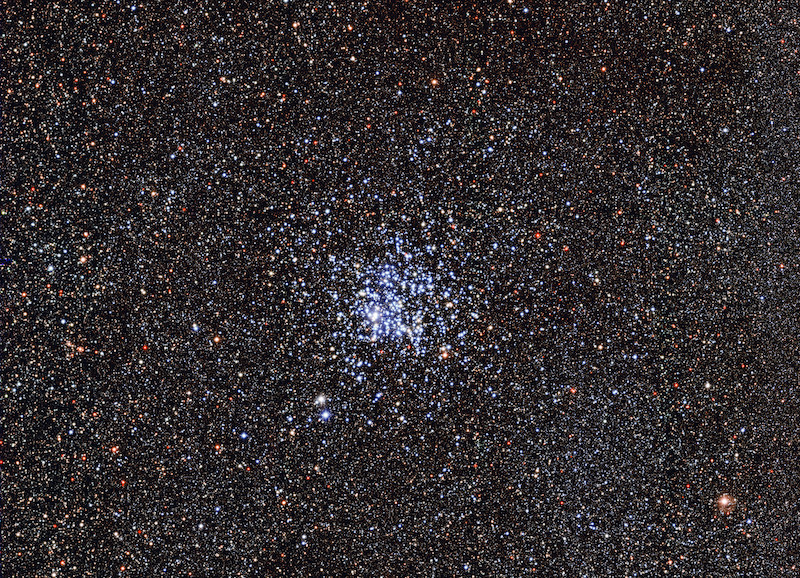
A dense star field with a cluster of many bright blue stars concentrated at the center, and a sparser scattering of fainter reddish, yellow, and blue stars.

Messier 11, imaged by the European Southern Observatory’s 2.2-meter telescope at the La Silla Observatory in Chile. The blue stars near the center of the cluster are young, hot stars. Image via ESO.

The Wild Duck Cluster, also known as Messier 11, is an open star cluster in the direction of our constellation Scutum the Shield. This loose aggregation of stars lies about 6,120 light-years away. It’s quite faint; you’ll need binoculars or a telescope to see it. It consists of sibling stars, born from a cloud of gas and dust in space.

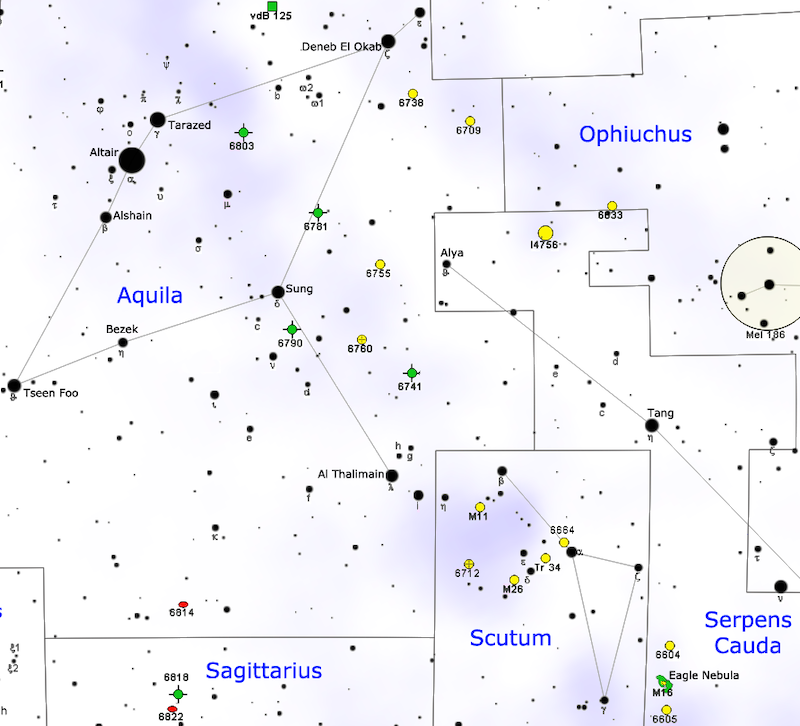
To find it, first locate the bright star Altair in the sky. It is the brightest star in the constellation Aquila the Eagle, and the second brightest star in the Summer Triangle. Altair is flanked on each side by the two moderately bright stars Tarazed and Alshain.

A star map with stars in black on white, with Messier 11 marked as a small yellow circle.

A star map showing Aquila and Scutum. Altair is a very bright star, easily identifiable in the sky since it’s part of the Summer Triangle. Image via Roberto Mura/ Wikimedia Commons.

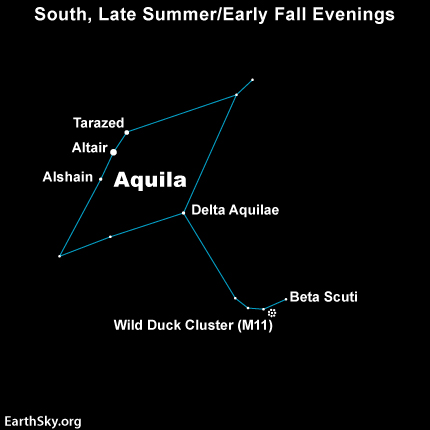
From Altair, following the chart below, you can star-hop in the southwest direction towards Messier 11. Delta Aquilae is your first hop, about 8 degrees from Altair. (For reference, the width of four fingers held at arm’s length approximates 8 degrees of sky.)

Using binoculars, keep going downward a bit more than twice the Altair-Delta Aquilae distance, till you see a semicircle of stars that pretty much fills your binocular field. The Wild Duck Cluster pops out as a hazy star-like object just beneath this semicircle star pattern.

Star chart of Aquila with five stars and Messier 11 labeled.

Messier 11, the Wild Duck cluster.

If you have a telescope, Messier 11 is best viewed when it’s relatively high in the southern sky. That’s in the wee hours before sunrise in spring, late night in early summer, and mid-evening in late summer and early fall.

Tight collection of whitish stars at the center of the image, with very sparse whitish stars over a wide field of view.

Messier 11, imaged by an 8-inch telescope. Image via Stephen Rahn/ Flickr.

Science and History

Like the Pleiades and the Hyades, Messier 11 (also called M11) is an open star cluster, except that it’s much farther away. The Pleiades and Hyades clusters lie about 444 light-years and 153 light-years away, respectively, while Messier 11 is about 6,120 light-years distant.

An open star cluster is a group of stars that formed from the same giant cloud of mostly molecular hydrogen. These massive clouds, often called stellar nurseries, are so dense that gravitational forces form compact conglomerations of molecular hydrogen that continue to contract until fusion reactions in the stars’ centers ignite the birth of new stars. Initially, the young stars are loosely bound together by gravity but they will eventually disperse over time.

Messier 11, one of the most massive open star clusters that we know of, has about 3,000 stars, with its hot blue stars congregated towards the center. The cluster is thought to have formed sometime between 250 to 316 million years ago. Astronomers refer to it as a metal-rich cluster because a nearby supernova likely seeded its molecular cloud complex with heavier elements.

In 1733, English naturalist William Derham was able to resolve Messier 11 as individual stars through a telescope, and not long after, in 1764, French astronomer Charles Messier added it to his famous catalog. This open star cluster got its unusual colloquial name, “Wild Duck Cluster,” from Admiral William Henry Smyth; while observing the cluster through a telescope in 1835, he noted a V-shaped pattern of its brightest stars that reminded him of the flight formation of wild ducks.

Messier 11 is positioned at RA: 18h 51m 5s; Dec: -6° 16′ 12″

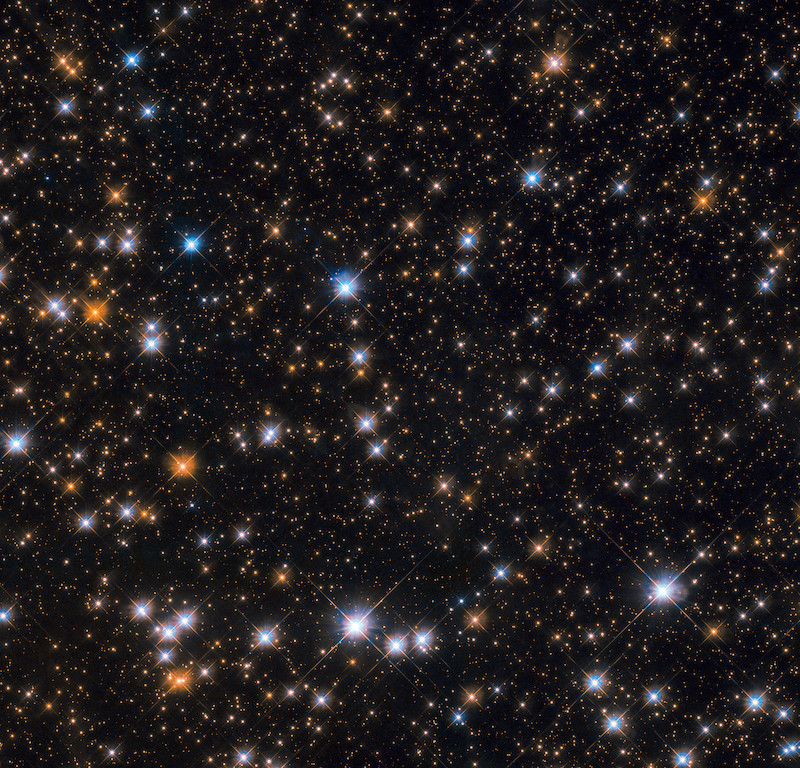
A star field showing a small section of Messier 11, with white, blue, and red stars.

A section of Messier 11 imaged by the Hubble Space Telescope’s Wide Field Camera 3. Image via P. Dobbie et al./ NASA/ ESA Hubble.

Bottom line: Messier 11, also known as the Wild Duck cluster, is an open star cluster in the constellation Scutum.


from EarthSky https://ift.tt/2YupL0C
A dense star field with a cluster of many bright blue stars concentrated at the center, and a sparser scattering of fainter reddish, yellow, and blue stars.

Messier 11, imaged by the European Southern Observatory’s 2.2-meter telescope at the La Silla Observatory in Chile. The blue stars near the center of the cluster are young, hot stars. Image via ESO.

The Wild Duck Cluster, also known as Messier 11, is an open star cluster in the direction of our constellation Scutum the Shield. This loose aggregation of stars lies about 6,120 light-years away. It’s quite faint; you’ll need binoculars or a telescope to see it. It consists of sibling stars, born from a cloud of gas and dust in space.

To find it, first locate the bright star Altair in the sky. It is the brightest star in the constellation Aquila the Eagle, and the second brightest star in the Summer Triangle. Altair is flanked on each side by the two moderately bright stars Tarazed and Alshain.

A star map with stars in black on white, with Messier 11 marked as a small yellow circle.

A star map showing Aquila and Scutum. Altair is a very bright star, easily identifiable in the sky since it’s part of the Summer Triangle. Image via Roberto Mura/ Wikimedia Commons.

From Altair, following the chart below, you can star-hop in the southwest direction towards Messier 11. Delta Aquilae is your first hop, about 8 degrees from Altair. (For reference, the width of four fingers held at arm’s length approximates 8 degrees of sky.)

Using binoculars, keep going downward a bit more than twice the Altair-Delta Aquilae distance, till you see a semicircle of stars that pretty much fills your binocular field. The Wild Duck Cluster pops out as a hazy star-like object just beneath this semicircle star pattern.

Star chart of Aquila with five stars and Messier 11 labeled.

Messier 11, the Wild Duck cluster.

If you have a telescope, Messier 11 is best viewed when it’s relatively high in the southern sky. That’s in the wee hours before sunrise in spring, late night in early summer, and mid-evening in late summer and early fall.

Tight collection of whitish stars at the center of the image, with very sparse whitish stars over a wide field of view.

Messier 11, imaged by an 8-inch telescope. Image via Stephen Rahn/ Flickr.

Science and History

Like the Pleiades and the Hyades, Messier 11 (also called M11) is an open star cluster, except that it’s much farther away. The Pleiades and Hyades clusters lie about 444 light-years and 153 light-years away, respectively, while Messier 11 is about 6,120 light-years distant.

An open star cluster is a group of stars that formed from the same giant cloud of mostly molecular hydrogen. These massive clouds, often called stellar nurseries, are so dense that gravitational forces form compact conglomerations of molecular hydrogen that continue to contract until fusion reactions in the stars’ centers ignite the birth of new stars. Initially, the young stars are loosely bound together by gravity but they will eventually disperse over time.

Messier 11, one of the most massive open star clusters that we know of, has about 3,000 stars, with its hot blue stars congregated towards the center. The cluster is thought to have formed sometime between 250 to 316 million years ago. Astronomers refer to it as a metal-rich cluster because a nearby supernova likely seeded its molecular cloud complex with heavier elements.

In 1733, English naturalist William Derham was able to resolve Messier 11 as individual stars through a telescope, and not long after, in 1764, French astronomer Charles Messier added it to his famous catalog. This open star cluster got its unusual colloquial name, “Wild Duck Cluster,” from Admiral William Henry Smyth; while observing the cluster through a telescope in 1835, he noted a V-shaped pattern of its brightest stars that reminded him of the flight formation of wild ducks.

Messier 11 is positioned at RA: 18h 51m 5s; Dec: -6° 16′ 12″

A star field showing a small section of Messier 11, with white, blue, and red stars.

A section of Messier 11 imaged by the Hubble Space Telescope’s Wide Field Camera 3. Image via P. Dobbie et al./ NASA/ ESA Hubble.

Bottom line: Messier 11, also known as the Wild Duck cluster, is an open star cluster in the constellation Scutum.


from EarthSky https://ift.tt/2YupL0C

95 new cool brown dwarfs in the sun’s neighborhood

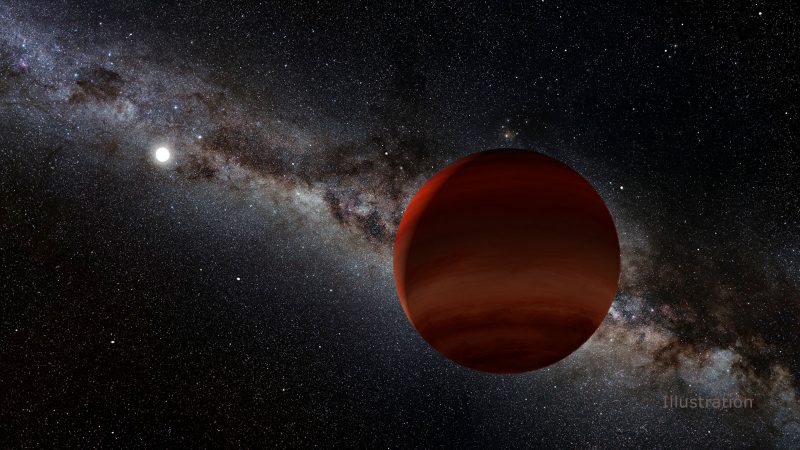
Large dark reddish spherical world with bright white star and galaxy in distance.

Artist’s concept of one of the 95 new cool brown dwarfs in the neighborhood of our sun. A companion white dwarf star is in the distance. Brown dwarfs are sometimes said to be star-planet hybrids. They’re not massive enough to ignite thermonuclear fusion reactions in their interiors, and so shine as stars do. Yet they’re too massive to be considered planets. Image via NOIRLab/ NSF/ AURA/ P. Marenfeld/ William Pendrill/ JPL.

Almost every week, astronomers announce new discoveries such as exoplanets found orbiting distant stars, asteroids whizzing past Earth, and faraway galaxies with their massive black holes blazing at the edge of the universe. On August 18, 2020, NASA announced yet another discovery – made by members of the public assisting with a citizen science project – in this case of another 95 new cosmic neighbors – brown dwarfs – many within just a few dozen light-years of our solar system.

The findings are currently pending publication in The Astrophysical Journal.

These citizen scientists helped to find the brown dwarfs through a NASA-funded project called Backyard Worlds: Planet 9. Like other such projects, this one is a collaboration between scientists and volunteers. It relies on data – lots of data – from various sources, including NASA’s Near-Earth Object Wide-Field Infrared Survey Explorer (NEOWISE) satellite, from NASA’s now-retired Spitzer Space Telescope and the National Science Foundation’s ground-based NOIRLab program, which involves five major obervatories. Sifting through the mountains of data collected by all these instruments is a huge task. That’s why citizen scientists are so helpful, said Aaron Meisner of NOIRLab. He co-founded Backyard Worlds, and he’s lead author of the new study:

Vast modern datasets can unlock landmark discoveries, and it’s exciting that these could be spotted first by citizen scientists. These Backyard Worlds discoveries show that members of the public can play an important role in reshaping our scientific understanding of our solar neighborhood.

Various colored spheres with white text annotations on black background.

Comparison of the typical masses of exoplanets, brown dwarfs and stars. Image via NASA/ Caltech/ R. Hurt (IPAC).

Jackie Faherty of the American Museum of Natural History in New York said:

This paper is evidence that the solar neighborhood is still uncharted territory and citizen scientists are excellent astronomical cartographers. Mapping the coldest brown dwarfs down to the lowest masses gives us key insights into the low-mass star-formation process while providing a target list for detailed studies of the atmospheres of Jupiter analogs.

Brown dwarfs are fascinating objects that are too small and not massive enough to be stars, but too large and too massive to be considered planets. Some brown dwarfs can have temperatures in the thousands of degrees, but that’s not enough to fully “ignite” and become stars. Others are much colder, and many of the newly discovered ones are in this category. Some are colder than the boiling point of water, while others are actually have temperatures close to that of Earth. There is also evidence that, just like gas giant and ice giant planets, brown dwarfs can have very stormy atmospheres. The brown dwarf Luhman 16A may look a lot like Jupiter.

Man with curly hair with grayish background.

Astronomer Aaron Meisner of NOIRLab. He is lead author on a citizen-science effort that led to the discovery of 95 new brown dwarf neighbors.

If these brown dwarfs are so relatively close to us, why weren’t they discovered until now?

The answer is that, since they’re relatively cool objects, they shine only faintly in visible light. They can also be seen in infrared light, but because of their cool temperatures, they’re faint in infrared as well.

These new brown dwarfs are a missing link in the types of brown dwarfs known to exist, these scientists said. By learning more about them, they said they can learn more about how these objects form, and how they relate to other stars and planets in our sun’s neighborhood.

Some brown dwarfs are cold enough to have water vapor clouds, similar to earthly clouds. There is evidence for this on the coldest known brown dwarf, WISE 0855, which was discovered in 2014 and is only about seven light-years away. With a temperature of minus 10 degrees Fahrenheit, or minus 23 degrees Celsius, some scientists thought it might actually be a rogue planet, floating freely in space between stars. The new discoveries now help to put WISE 0855 in the context of other cool brown dwarfs. According to astrophysicist Marc Kuchner, principal investigator of Backyard Worlds: Planet 9:

Our new discoveries help connect the dots between 0855 and the other known brown dwarfs.

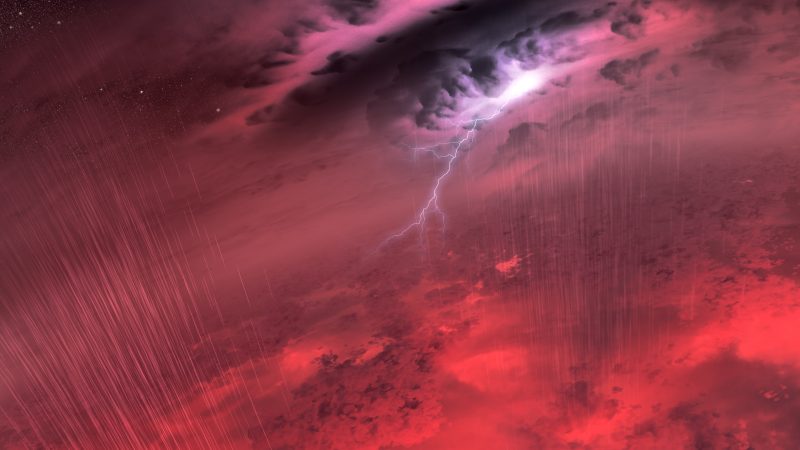
Lightning and rain in a turbulent reddish atmosphere above mottled red glowing landscape.

Artist’s concept of turbulent weather on a brown dwarf. Image via NASA/ JPL-Caltech/ University of Western Ontario/ Stony Brook U.

And just how did the citizen scientists find the new brown dwarfs?

The volunteers – over 100,000 of them – were approached by Backyard Worlds: Planet 9 to examine telescopic images consisting of trillions of pixels. Ultimately, 20 different citizen scientists from 10 countries became coauthors of the new study. They used sky maps produced from observations by WISE and NEOWISE and scoured additional archival datasets, such as those from the Nicholas U. Mayall Telescope at Kitt Peak National Observatory and Víctor Blanco 4-m Telescope at Cerro Tololo Inter-American Observatory (CTIO), both programs of NOIRLab. As one citizen scientist, Les Hamlet in Springfield, Missouri, said:

Being that this will be the first scientific paper that I’m a coauthor on, its publication will definitely be the highlight of working with Backyard Worlds so far. Also, being connected in some way with the now-retired Spitzer Space Telescope through this paper is kind of special to me.

These new brown dwarfs are just the latest to be discovered; Backyard Worlds: Planet 9 has previously found over 1,500 such cool worlds.

So … what’s next?

The Vera C. Rubin Observatory in Chile will soon image the entire southern hemispheric sky over 10 years, which should be yield many more cool brown dwarfs, among other discoveries. The upcoming James Webb Space Telescope (JWST) will be able to study some of these brown dwarfs more closely to find more clues as to how they form as well as other planet and atmospheres.

Brown dwarfs are enigmatic worlds, and scientists are now starting to learn how they came to be, in their cosmic place between planets and stars.

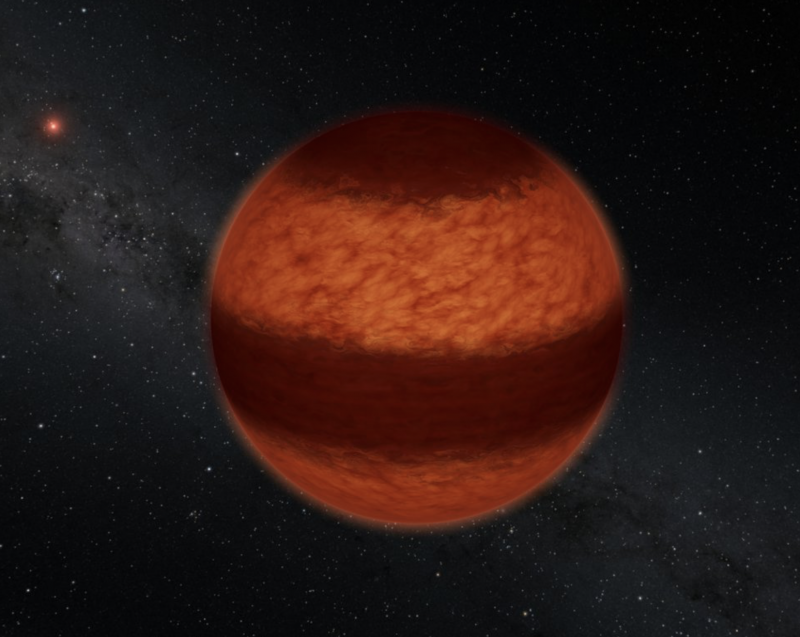
Reddish globe with wide dark bands and stars in background.

Artist’s concept of the brown dwarf Luhman 16A (not one of the newly-discovered brown dwarfs), which may have Jupiter-like bands. Image via Caltech/ R. Hurt (IPAC).

Bottom line: A group of citizen scientists working with Backyard Worlds: Planet 9 has discovered 95 new brown dwarfs in the sun’s neighborhood.


from EarthSky https://ift.tt/32mjrZY
Large dark reddish spherical world with bright white star and galaxy in distance.

Artist’s concept of one of the 95 new cool brown dwarfs in the neighborhood of our sun. A companion white dwarf star is in the distance. Brown dwarfs are sometimes said to be star-planet hybrids. They’re not massive enough to ignite thermonuclear fusion reactions in their interiors, and so shine as stars do. Yet they’re too massive to be considered planets. Image via NOIRLab/ NSF/ AURA/ P. Marenfeld/ William Pendrill/ JPL.

Almost every week, astronomers announce new discoveries such as exoplanets found orbiting distant stars, asteroids whizzing past Earth, and faraway galaxies with their massive black holes blazing at the edge of the universe. On August 18, 2020, NASA announced yet another discovery – made by members of the public assisting with a citizen science project – in this case of another 95 new cosmic neighbors – brown dwarfs – many within just a few dozen light-years of our solar system.

The findings are currently pending publication in The Astrophysical Journal.

These citizen scientists helped to find the brown dwarfs through a NASA-funded project called Backyard Worlds: Planet 9. Like other such projects, this one is a collaboration between scientists and volunteers. It relies on data – lots of data – from various sources, including NASA’s Near-Earth Object Wide-Field Infrared Survey Explorer (NEOWISE) satellite, from NASA’s now-retired Spitzer Space Telescope and the National Science Foundation’s ground-based NOIRLab program, which involves five major obervatories. Sifting through the mountains of data collected by all these instruments is a huge task. That’s why citizen scientists are so helpful, said Aaron Meisner of NOIRLab. He co-founded Backyard Worlds, and he’s lead author of the new study:

Vast modern datasets can unlock landmark discoveries, and it’s exciting that these could be spotted first by citizen scientists. These Backyard Worlds discoveries show that members of the public can play an important role in reshaping our scientific understanding of our solar neighborhood.

Various colored spheres with white text annotations on black background.

Comparison of the typical masses of exoplanets, brown dwarfs and stars. Image via NASA/ Caltech/ R. Hurt (IPAC).

Jackie Faherty of the American Museum of Natural History in New York said:

This paper is evidence that the solar neighborhood is still uncharted territory and citizen scientists are excellent astronomical cartographers. Mapping the coldest brown dwarfs down to the lowest masses gives us key insights into the low-mass star-formation process while providing a target list for detailed studies of the atmospheres of Jupiter analogs.

Brown dwarfs are fascinating objects that are too small and not massive enough to be stars, but too large and too massive to be considered planets. Some brown dwarfs can have temperatures in the thousands of degrees, but that’s not enough to fully “ignite” and become stars. Others are much colder, and many of the newly discovered ones are in this category. Some are colder than the boiling point of water, while others are actually have temperatures close to that of Earth. There is also evidence that, just like gas giant and ice giant planets, brown dwarfs can have very stormy atmospheres. The brown dwarf Luhman 16A may look a lot like Jupiter.

Man with curly hair with grayish background.

Astronomer Aaron Meisner of NOIRLab. He is lead author on a citizen-science effort that led to the discovery of 95 new brown dwarf neighbors.

If these brown dwarfs are so relatively close to us, why weren’t they discovered until now?

The answer is that, since they’re relatively cool objects, they shine only faintly in visible light. They can also be seen in infrared light, but because of their cool temperatures, they’re faint in infrared as well.

These new brown dwarfs are a missing link in the types of brown dwarfs known to exist, these scientists said. By learning more about them, they said they can learn more about how these objects form, and how they relate to other stars and planets in our sun’s neighborhood.

Some brown dwarfs are cold enough to have water vapor clouds, similar to earthly clouds. There is evidence for this on the coldest known brown dwarf, WISE 0855, which was discovered in 2014 and is only about seven light-years away. With a temperature of minus 10 degrees Fahrenheit, or minus 23 degrees Celsius, some scientists thought it might actually be a rogue planet, floating freely in space between stars. The new discoveries now help to put WISE 0855 in the context of other cool brown dwarfs. According to astrophysicist Marc Kuchner, principal investigator of Backyard Worlds: Planet 9:

Our new discoveries help connect the dots between 0855 and the other known brown dwarfs.

Lightning and rain in a turbulent reddish atmosphere above mottled red glowing landscape.

Artist’s concept of turbulent weather on a brown dwarf. Image via NASA/ JPL-Caltech/ University of Western Ontario/ Stony Brook U.

And just how did the citizen scientists find the new brown dwarfs?

The volunteers – over 100,000 of them – were approached by Backyard Worlds: Planet 9 to examine telescopic images consisting of trillions of pixels. Ultimately, 20 different citizen scientists from 10 countries became coauthors of the new study. They used sky maps produced from observations by WISE and NEOWISE and scoured additional archival datasets, such as those from the Nicholas U. Mayall Telescope at Kitt Peak National Observatory and Víctor Blanco 4-m Telescope at Cerro Tololo Inter-American Observatory (CTIO), both programs of NOIRLab. As one citizen scientist, Les Hamlet in Springfield, Missouri, said:

Being that this will be the first scientific paper that I’m a coauthor on, its publication will definitely be the highlight of working with Backyard Worlds so far. Also, being connected in some way with the now-retired Spitzer Space Telescope through this paper is kind of special to me.

These new brown dwarfs are just the latest to be discovered; Backyard Worlds: Planet 9 has previously found over 1,500 such cool worlds.

So … what’s next?

The Vera C. Rubin Observatory in Chile will soon image the entire southern hemispheric sky over 10 years, which should be yield many more cool brown dwarfs, among other discoveries. The upcoming James Webb Space Telescope (JWST) will be able to study some of these brown dwarfs more closely to find more clues as to how they form as well as other planet and atmospheres.

Brown dwarfs are enigmatic worlds, and scientists are now starting to learn how they came to be, in their cosmic place between planets and stars.

Reddish globe with wide dark bands and stars in background.

Artist’s concept of the brown dwarf Luhman 16A (not one of the newly-discovered brown dwarfs), which may have Jupiter-like bands. Image via Caltech/ R. Hurt (IPAC).

Bottom line: A group of citizen scientists working with Backyard Worlds: Planet 9 has discovered 95 new brown dwarfs in the sun’s neighborhood.


from EarthSky https://ift.tt/32mjrZY

1st quarter moon is August 25

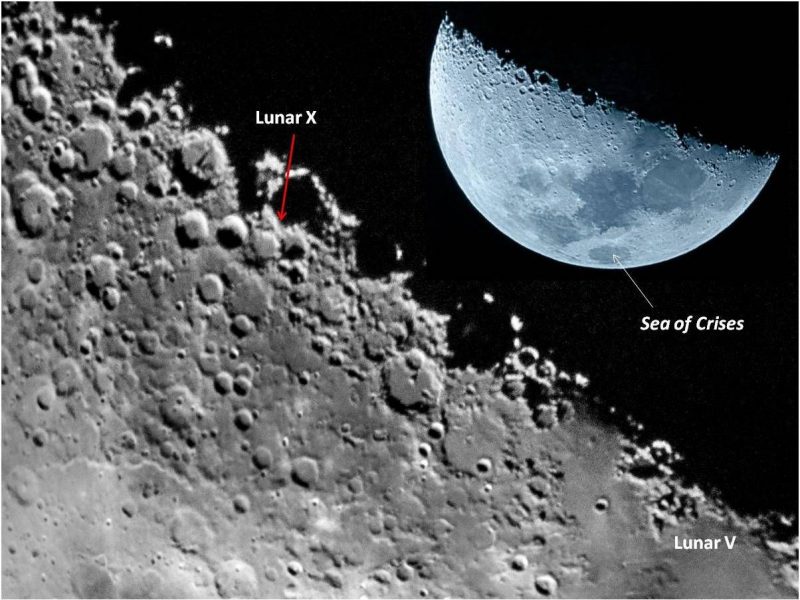
Closeup of edge of sunlight on moon, with inset photo of nearly semicircular moon.

View at EarthSky Community Photos. | Composite image of a moon nearly at 1st quarter with some of the features you can see on the moon at this phase – captured April 30, 2020 – by our friend Dr Ski in the Philippines. He wrote: “… 10 hours before 1st quarter and the Lunar V and Lunar X are well defined …” More about Lunar V and X below. Thank you, Dr Ski!

A first quarter moon rises around noon and sets around midnight. You’ll likely spot it in late afternoon or early evening, when it’s at its highest in the sky. At this moon phase, the moon is showing us precisely half of its lighted half. Or you might say that – at first quarter moon – we’re seeing half the moon’s day side.

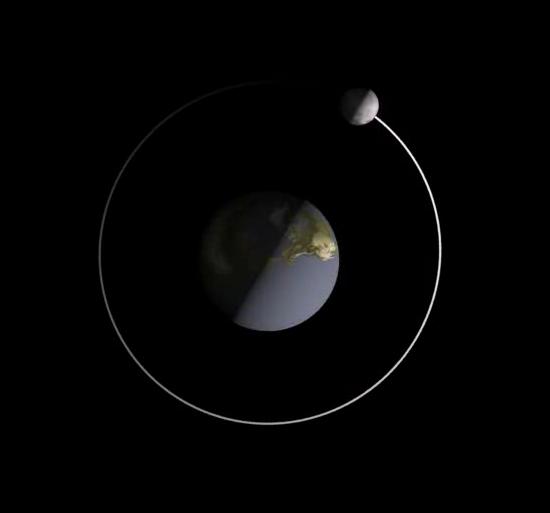
Half-lit Earth from north, and half-lit moon with divisions between dark and light sides lined up.

Click here to see animation. As seen from the north side of the moon’s orbital plane, the Earth rotates counterclockwise on its rotational axis, and the moon revolves counterclockwise around Earth. The terminators of the Earth and moon align at first and last quarter moons, and only the near half of the moon’s day side is visible from Earth.

We call this moon a quarter and not a half because it is one quarter of the way around in its orbit of Earth, as measured from one new moon to the next. Also, although a first quarter moon appears half-lit to us, the illuminated portion we see of a first quarter moon truly is just a quarter. We’re now seeing half the moon’s day side, that is. Another lighted quarter of the moon shines just as brightly in the direction opposite Earth!

And what about the term half moon? That’s a beloved term, but not an official one.

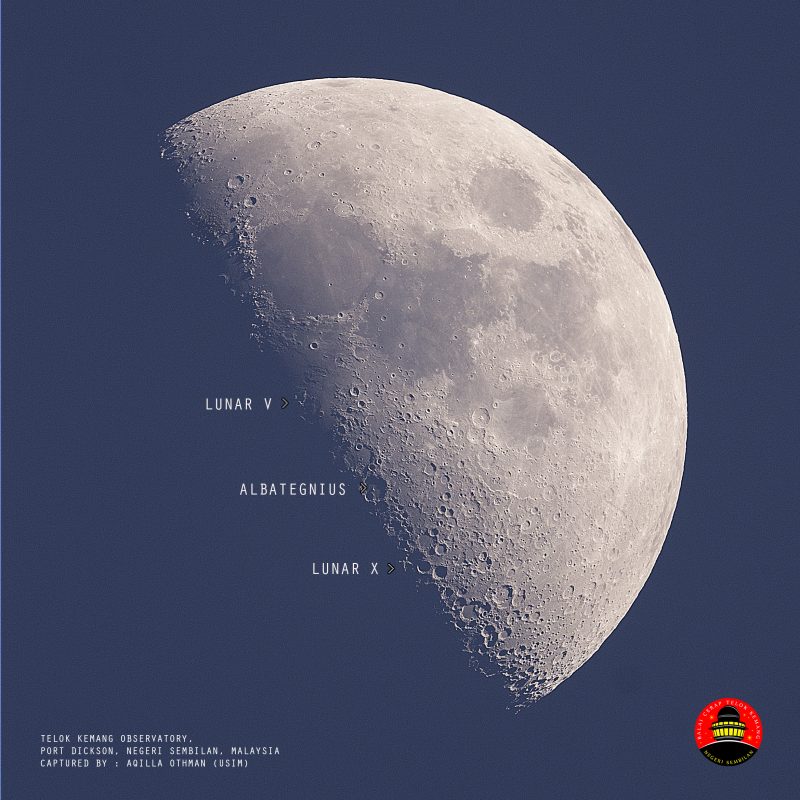
Half of the moon with tiny labeled X and V shapes along straight edge.

Lunar X and Lunar V appear when the moon is near its 1st quarter phase. They aren’t really Xs and Vs on the moon. They’re just high areas, catching sunlight, creating an example of pareidolia on the moon. Aqilla Othman in Port Dickson, Negeri Sembilan, Malaysia, caught them both in May 2017. Notice that he caught Lunar X and Lunar V.

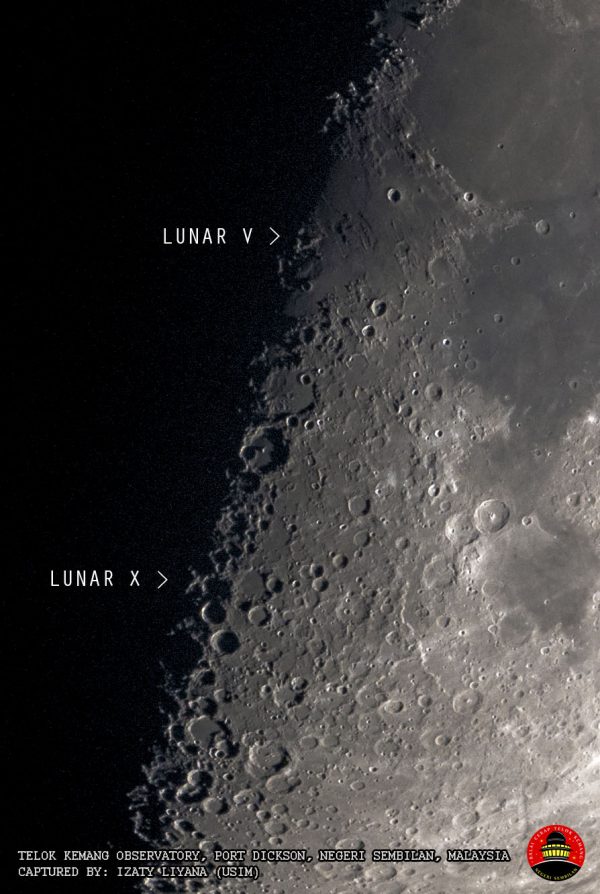
Closeup of boundary between light and dark areas of the moon with Lunar V and X labeled.

Here’s a closer look at Lunar X and Lunar V. Photo by Izaty Liyana in Port Dickson, Negeri Sembilan, Malaysia. What is Lunar X?

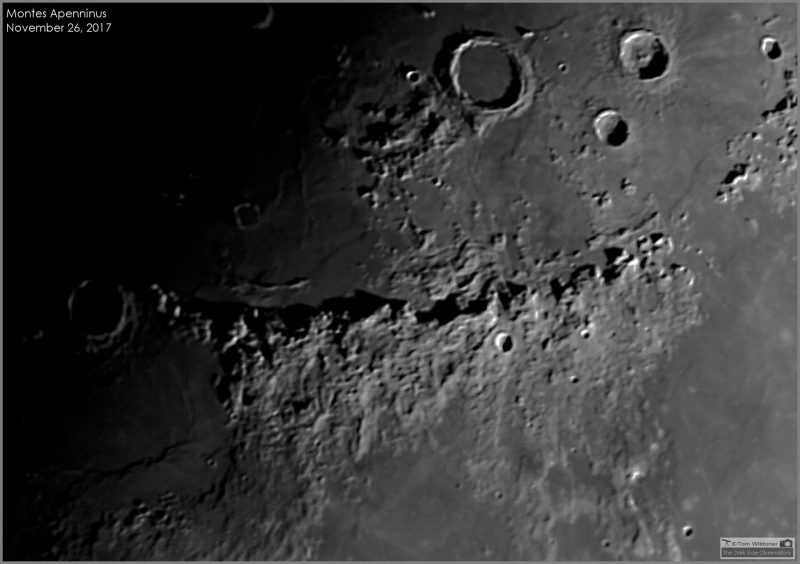
Telescopic closeup of band of mountains on moon with a few large craters.

Tom Wildoner wrote: “One of my favorite areas to photograph on the moon near the 1st quarter! I captured this view of the sun lighting up the mountain range called Montes Apenninus. The moon was casting a nice shadow on the back side of the mountains. This mountain range is about 370 miles (600 km) long with some of the peaks rising as high as 3.1 miles (5 km).”

Bottom line: The next 1st quarter moon will come on August 25, 2020, at 17:57 UTC.

Read more: Top 4 keys to understanding moon phases

Check out EarthSky’s guide to the bright planets.


from EarthSky https://ift.tt/2OIzLvs
Closeup of edge of sunlight on moon, with inset photo of nearly semicircular moon.

View at EarthSky Community Photos. | Composite image of a moon nearly at 1st quarter with some of the features you can see on the moon at this phase – captured April 30, 2020 – by our friend Dr Ski in the Philippines. He wrote: “… 10 hours before 1st quarter and the Lunar V and Lunar X are well defined …” More about Lunar V and X below. Thank you, Dr Ski!

A first quarter moon rises around noon and sets around midnight. You’ll likely spot it in late afternoon or early evening, when it’s at its highest in the sky. At this moon phase, the moon is showing us precisely half of its lighted half. Or you might say that – at first quarter moon – we’re seeing half the moon’s day side.

Half-lit Earth from north, and half-lit moon with divisions between dark and light sides lined up.

Click here to see animation. As seen from the north side of the moon’s orbital plane, the Earth rotates counterclockwise on its rotational axis, and the moon revolves counterclockwise around Earth. The terminators of the Earth and moon align at first and last quarter moons, and only the near half of the moon’s day side is visible from Earth.

We call this moon a quarter and not a half because it is one quarter of the way around in its orbit of Earth, as measured from one new moon to the next. Also, although a first quarter moon appears half-lit to us, the illuminated portion we see of a first quarter moon truly is just a quarter. We’re now seeing half the moon’s day side, that is. Another lighted quarter of the moon shines just as brightly in the direction opposite Earth!

And what about the term half moon? That’s a beloved term, but not an official one.

Half of the moon with tiny labeled X and V shapes along straight edge.

Lunar X and Lunar V appear when the moon is near its 1st quarter phase. They aren’t really Xs and Vs on the moon. They’re just high areas, catching sunlight, creating an example of pareidolia on the moon. Aqilla Othman in Port Dickson, Negeri Sembilan, Malaysia, caught them both in May 2017. Notice that he caught Lunar X and Lunar V.

Closeup of boundary between light and dark areas of the moon with Lunar V and X labeled.

Here’s a closer look at Lunar X and Lunar V. Photo by Izaty Liyana in Port Dickson, Negeri Sembilan, Malaysia. What is Lunar X?

Telescopic closeup of band of mountains on moon with a few large craters.

Tom Wildoner wrote: “One of my favorite areas to photograph on the moon near the 1st quarter! I captured this view of the sun lighting up the mountain range called Montes Apenninus. The moon was casting a nice shadow on the back side of the mountains. This mountain range is about 370 miles (600 km) long with some of the peaks rising as high as 3.1 miles (5 km).”

Bottom line: The next 1st quarter moon will come on August 25, 2020, at 17:57 UTC.

Read more: Top 4 keys to understanding moon phases

Check out EarthSky’s guide to the bright planets.


from EarthSky https://ift.tt/2OIzLvs

Wildfire sunsets and sunrises

Very orange sun hanging in a smokey sky.

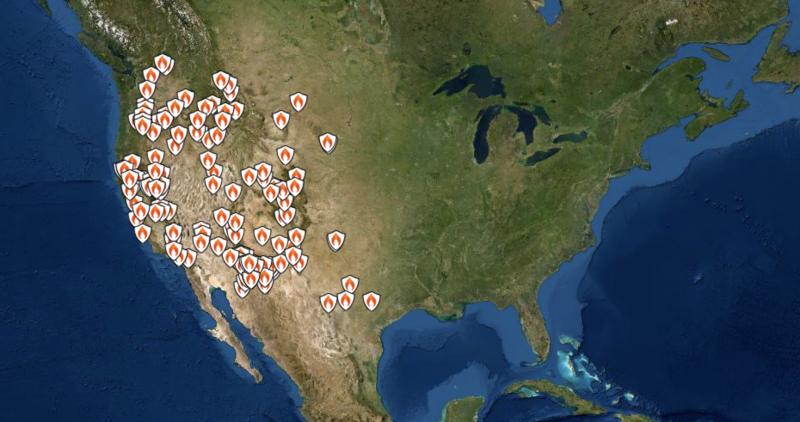
It’s wildfire season in the American West, and we’re receiving photos of fiery sunrises and sunsets. The sun always looks reddish when you see it near the horizon. That’s because, at such a time, you’re looking at the sun through more atmosphere than when the sun is overhead. But the effect is accentuatedwhen wildfires fill the air with smoke. The sky can look hazy, and the setting or rising sun may appear very red. Scott Hughes captured this vivid sunrise shot on August 22, 2020, just east of Cheyenne, Wyoming. Thank you, Scott.

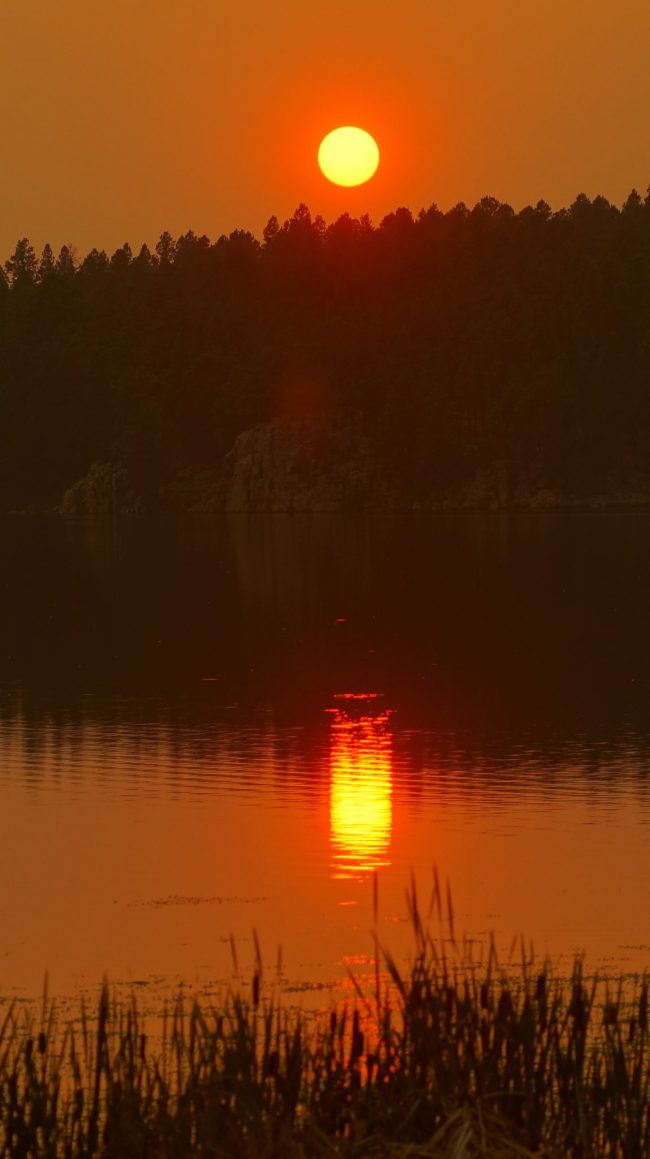
Orange wildfire sunset in the sky, and also reflected in a lake.

Jim Livingston captured this sunset image from Custer, South Dakota on August 21, 2020. He wrote: “South Dakota sunset, thanks to the California wildfires.”

Smokey sunrise over a body of water, with a bridge in the distance.

Ken Chan in San Mateo, California captured this smokey sunrise on Wednesday morning, August 19, 2020. He wrote: “The thick smoke filtered the sunrise on Wednesday. Yesterday was pretty clear, but the smoke has returned today.” Thank you, Ken.

Read: 3 California wildfires now rank among largest in state’s history, and they are still growing

A map of the U.S. showing wildfires crowded into the western half of the country.

Fires in the U.S. West on August 22, 2020 via Inciweb.

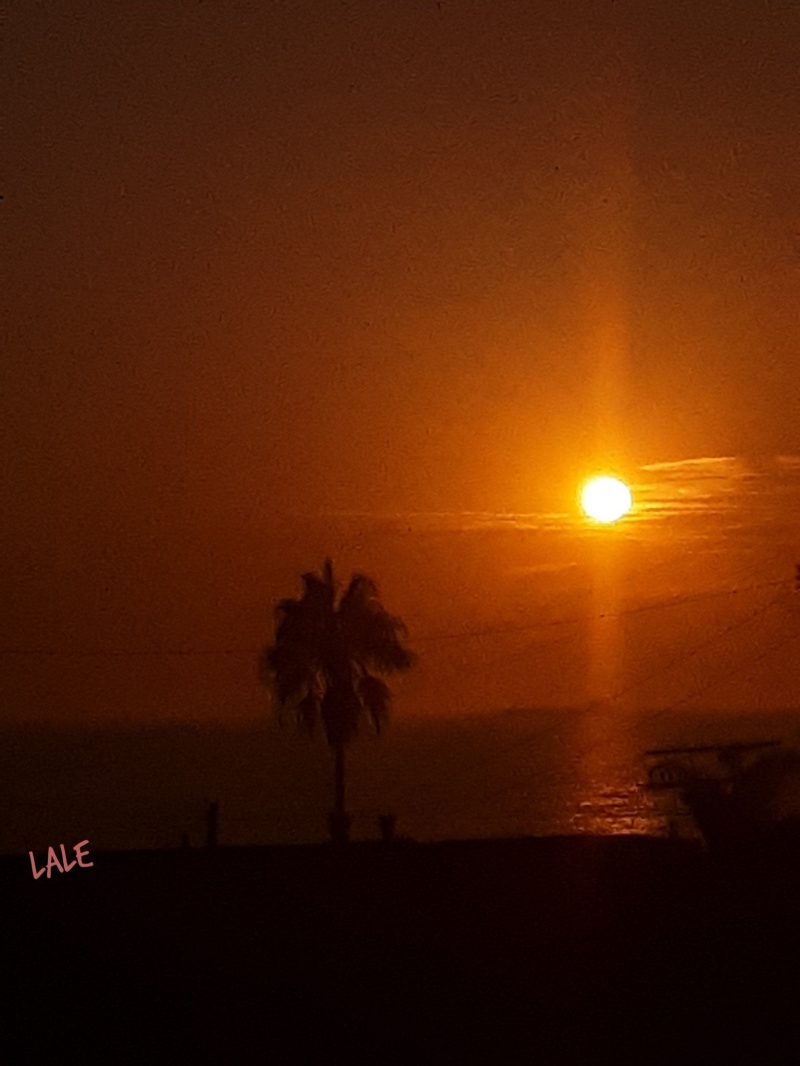
Smokey sunset over the ocean.

Laurie Engelhardt in Hermosa Beach, California captured this sunset scene on August 17, 2020. She wrote: “Beautiful sunset over Southern California!” Wildfire season began in California this year around early May. It typically ends when the first significant rainstorm of winter arrives, usually around October in Northern California, and roughly between late October to December in Southern California.

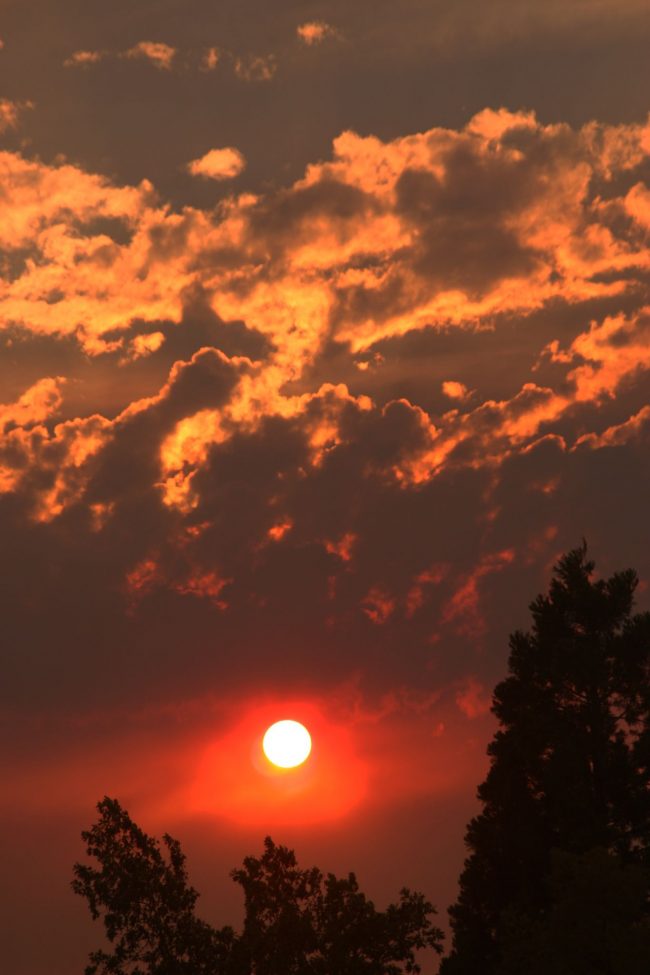
Fiery wildfire sunset, and fiery sky.

Kim Schuett in Spanish Springs, Nevada captured this image on August 16, 2020. She wrote: “An all-too-common California wildfire sunset. Smoke is from several fires. The nearest is the Loyalton Fire in the Tahoe National Forrest (44,147 acres). That fire is now contained, according to Inciweb, but burned nearly 50,000 acres.

By the way, the famous Lick Observatory – on the summit of Mount Hamilton, California, roughly 20 miles (30 km) east of San Jose, California – was also being threatened by wildfires this week. Lick Observatory posted the video below on YouTube on August 20, 2020, saying:

The wildfire that ran through Lick Observatory and surrounding areas August 19 and 20 was captured by HamCam2. The extent of the fire around our main telescope domes is especially evident in the nighttime photos. CalFire did excellent work protecting the facility and we give them our wholehearted thanks for their efforts. The HamCam2 camera is mounted on the top of the Lick Observatory Main Building and points east. The fire reached the observatory grounds in the early afternoon August 19 and continues to affect the observatory and surrounding areas the morning of August 20.

Fortunately, the fires around Lick Observatory now appear to be under control. for updates, visit Lick Observatory’s Facebook page:

Bottom line: Photos of vivid sunrises and sunsets, caused by smoke in the air in the North American West, due to wildfires.


from EarthSky https://ift.tt/3gi2Jjn
Very orange sun hanging in a smokey sky.

It’s wildfire season in the American West, and we’re receiving photos of fiery sunrises and sunsets. The sun always looks reddish when you see it near the horizon. That’s because, at such a time, you’re looking at the sun through more atmosphere than when the sun is overhead. But the effect is accentuatedwhen wildfires fill the air with smoke. The sky can look hazy, and the setting or rising sun may appear very red. Scott Hughes captured this vivid sunrise shot on August 22, 2020, just east of Cheyenne, Wyoming. Thank you, Scott.

Orange wildfire sunset in the sky, and also reflected in a lake.

Jim Livingston captured this sunset image from Custer, South Dakota on August 21, 2020. He wrote: “South Dakota sunset, thanks to the California wildfires.”

Smokey sunrise over a body of water, with a bridge in the distance.

Ken Chan in San Mateo, California captured this smokey sunrise on Wednesday morning, August 19, 2020. He wrote: “The thick smoke filtered the sunrise on Wednesday. Yesterday was pretty clear, but the smoke has returned today.” Thank you, Ken.

Read: 3 California wildfires now rank among largest in state’s history, and they are still growing

A map of the U.S. showing wildfires crowded into the western half of the country.

Fires in the U.S. West on August 22, 2020 via Inciweb.

Smokey sunset over the ocean.

Laurie Engelhardt in Hermosa Beach, California captured this sunset scene on August 17, 2020. She wrote: “Beautiful sunset over Southern California!” Wildfire season began in California this year around early May. It typically ends when the first significant rainstorm of winter arrives, usually around October in Northern California, and roughly between late October to December in Southern California.

Fiery wildfire sunset, and fiery sky.

Kim Schuett in Spanish Springs, Nevada captured this image on August 16, 2020. She wrote: “An all-too-common California wildfire sunset. Smoke is from several fires. The nearest is the Loyalton Fire in the Tahoe National Forrest (44,147 acres). That fire is now contained, according to Inciweb, but burned nearly 50,000 acres.

By the way, the famous Lick Observatory – on the summit of Mount Hamilton, California, roughly 20 miles (30 km) east of San Jose, California – was also being threatened by wildfires this week. Lick Observatory posted the video below on YouTube on August 20, 2020, saying:

The wildfire that ran through Lick Observatory and surrounding areas August 19 and 20 was captured by HamCam2. The extent of the fire around our main telescope domes is especially evident in the nighttime photos. CalFire did excellent work protecting the facility and we give them our wholehearted thanks for their efforts. The HamCam2 camera is mounted on the top of the Lick Observatory Main Building and points east. The fire reached the observatory grounds in the early afternoon August 19 and continues to affect the observatory and surrounding areas the morning of August 20.

Fortunately, the fires around Lick Observatory now appear to be under control. for updates, visit Lick Observatory’s Facebook page:

Bottom line: Photos of vivid sunrises and sunsets, caused by smoke in the air in the North American West, due to wildfires.


from EarthSky https://ift.tt/3gi2Jjn

Sun and Regulus in conjunction August 23

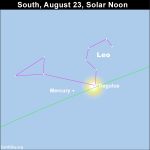
If you follow astronomy, you hear the word conjunction a lot. Most of the time, it alerts you to something cool to see in the night sky: two objects (maybe three) close together on the sky’s dome. But the word conjunction doesn’t always mean something to see. For example, on August 23, 2020, the sun is in conjunction with Regulus, the brightest star in the constellation Leo the Lion. You won’t see Regulus at all on this date, or near this date. At conjunction, this 1st-magnitude star rises with the sun, climbs highest up for the day with the sun at solar noon, then sets with the sun at the end of day.

Every year, Regulus meets up with the sun – or, in the language of astronomers, comes to conjunction – on or near August 23.

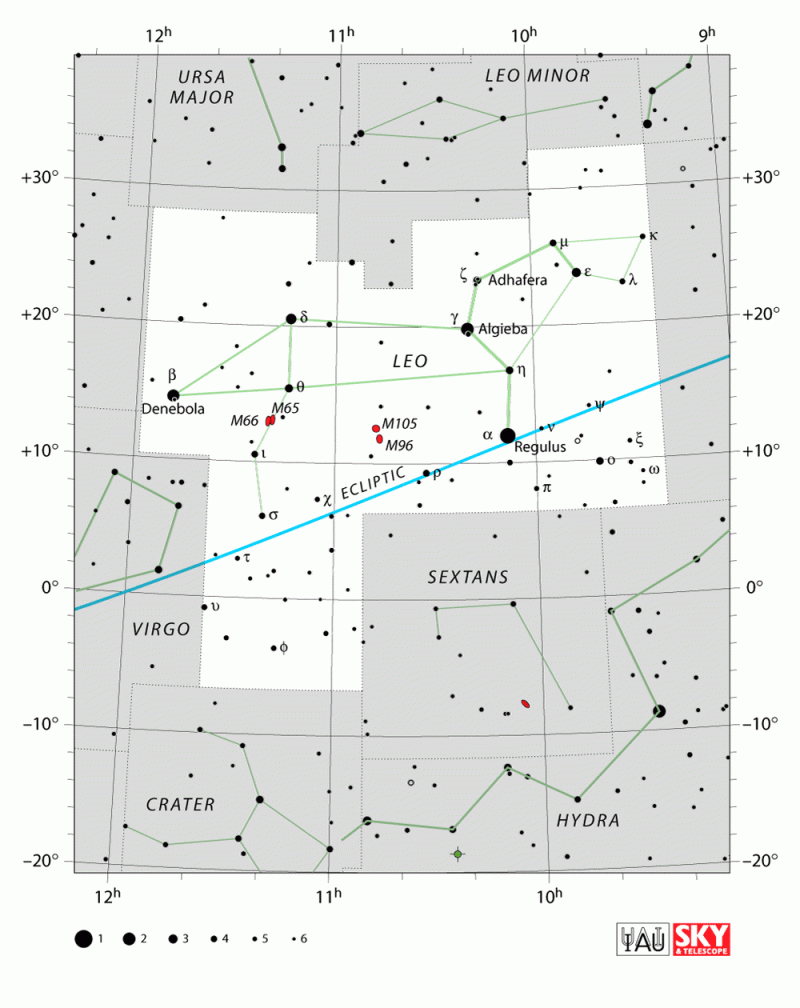
Star chart of the constellation Leo the Lion

Chart of the constellation Leo via the IAU. The ecliptic depicts the annual pathway of the sun in front of the constellations of the zodiac. The sun passes in front of the constellation Leo each year from around August 10 to September 17, and has its yearly conjunction with the star Regulus on or near August 23.

If you could see the stars during the daytime, you’d see the sun moving approximately one degree (two sun-diameters) eastward in front of the constellations of the zodiac daily. For reference, the sun’s angular diameter equals about 1/2 degree. One day later – on August 24 – the sun will be nearly one degree east of Regulus; and, one month later, the sun will be nearly 30 degrees east of Regulus on the sky’s dome.

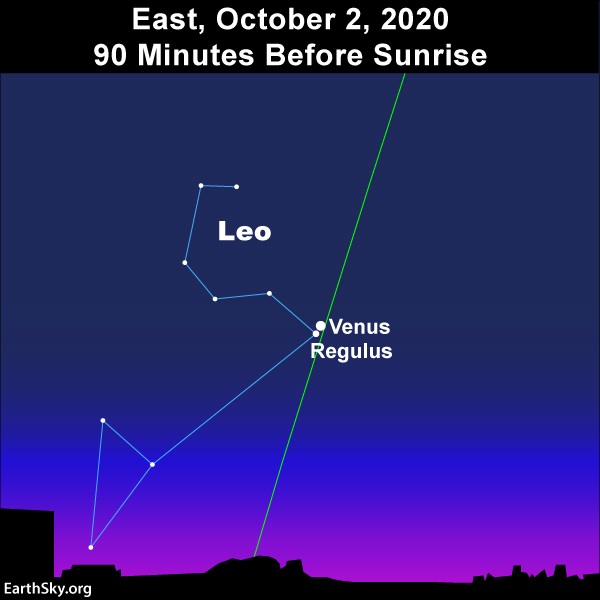
By around the September equinox, look for Regulus to light up the eastern sky before sunrise, and by early October, watch for the super-close conjunction of Regulus with the dazzling planet Venus. Can’t wait? Try Stellarium.

Venus and Reulus conjunction before sunrise on October 2, 2020.

Aft the sun-Regulus conjunction on August 23, 2020, Regulus shifts out of the evening sky and into the morning sky. Look for Regulus to have a conjunction with Venus on the morning of October 2, 2020.

Some six months from now – about one month before the March 2021 equinox – the sun will have moved 180 degrees from Regulus on the sky’s dome. Therefore, in late February, look for Regulus to shine all night long, from dusk until dawn. Then Regulus will rise in the east around sunset, climb highest up for the night around midnight, and set in the west around sunrise. In the Northern Hemisphere, we associate Regulus’ all-night presence as a welcome harbinger of the spring season.

Bottom line: On or around August 23 every year, Regulus is in conjunction with the sun and lost in the sun’s glare. Regulus will return to the morning sky around the September equinox.


from EarthSky https://ift.tt/2QjJ2gx

If you follow astronomy, you hear the word conjunction a lot. Most of the time, it alerts you to something cool to see in the night sky: two objects (maybe three) close together on the sky’s dome. But the word conjunction doesn’t always mean something to see. For example, on August 23, 2020, the sun is in conjunction with Regulus, the brightest star in the constellation Leo the Lion. You won’t see Regulus at all on this date, or near this date. At conjunction, this 1st-magnitude star rises with the sun, climbs highest up for the day with the sun at solar noon, then sets with the sun at the end of day.

Every year, Regulus meets up with the sun – or, in the language of astronomers, comes to conjunction – on or near August 23.

Star chart of the constellation Leo the Lion

Chart of the constellation Leo via the IAU. The ecliptic depicts the annual pathway of the sun in front of the constellations of the zodiac. The sun passes in front of the constellation Leo each year from around August 10 to September 17, and has its yearly conjunction with the star Regulus on or near August 23.

If you could see the stars during the daytime, you’d see the sun moving approximately one degree (two sun-diameters) eastward in front of the constellations of the zodiac daily. For reference, the sun’s angular diameter equals about 1/2 degree. One day later – on August 24 – the sun will be nearly one degree east of Regulus; and, one month later, the sun will be nearly 30 degrees east of Regulus on the sky’s dome.

By around the September equinox, look for Regulus to light up the eastern sky before sunrise, and by early October, watch for the super-close conjunction of Regulus with the dazzling planet Venus. Can’t wait? Try Stellarium.

Venus and Reulus conjunction before sunrise on October 2, 2020.

Aft the sun-Regulus conjunction on August 23, 2020, Regulus shifts out of the evening sky and into the morning sky. Look for Regulus to have a conjunction with Venus on the morning of October 2, 2020.

Some six months from now – about one month before the March 2021 equinox – the sun will have moved 180 degrees from Regulus on the sky’s dome. Therefore, in late February, look for Regulus to shine all night long, from dusk until dawn. Then Regulus will rise in the east around sunset, climb highest up for the night around midnight, and set in the west around sunrise. In the Northern Hemisphere, we associate Regulus’ all-night presence as a welcome harbinger of the spring season.

Bottom line: On or around August 23 every year, Regulus is in conjunction with the sun and lost in the sun’s glare. Regulus will return to the morning sky around the September equinox.


from EarthSky https://ift.tt/2QjJ2gx

Pesticides and industrial pollutants found in snow atop Arctic glaciers

One of four study sites, Austfonna is among the largest ice caps in the world, with an area of just over 3,200 square miles. Image via Andreas Weith/Wikimedia Commons

This article – written by Grace Palmer – is republished with permission from GlacierHub.

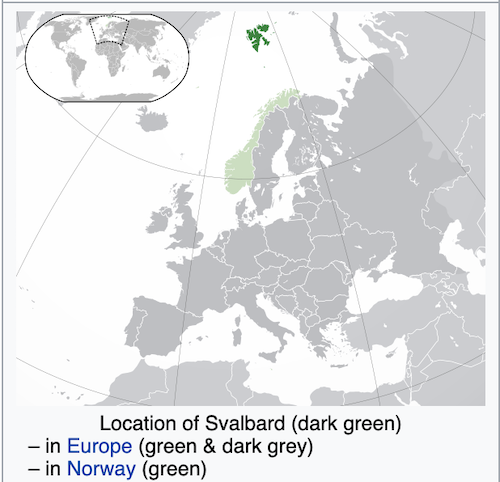
Researchers recently found pesticides and industrial compounds deposited in snow atop four high-elevation glacier sites on the Norwegian archipelago Svalbard, often considered a “pristine” environment. The long journey of these compounds — likely originating in the United States and Eurasia — shows the far-reaching impacts of industrial pollution.

Svalbard is located in the Arctic Ocean north of Scandinavia. At present, 57 percent of the archipelago is covered by glaciers and ice caps, and it has been subject to minimal local pollution. However, in a study published in early July, researchers reported 13 organochlorine pesticides (a chemical category that includes DDT) and seven industrial compounds deposited in glacial surface snow. Through computer modeling, the research team traced some pollutants back to their possible places of origin, which include the United States and Russia.

Image via Wikipedia.

The computer model in question is called Hybrid Single Particle Lagrangian Integrated Trajectory, and is used to study the long-range atmospheric transport of polluted air parcels. The authors identified “possible different air mass (and contaminant) source areas among sampling sites,” thus accounting for some of the different measurements between sites.

Svalbard has experienced minimal local industrial pollution, apart from the coal mining industry, which began when Norway gained sovereignty over the archipelago in 1920 and collapsed under government pressure in 2017. Like myriad other Arctic regions, however, Svalbard’s ice, soils, and water are subject to inputs of persistent organic pollutants, also known as POPs. POPs include pesticides and chemicals like DDT and polychlorinated biphenyls. They are characterized as being persistent, bioaccumulative, and toxic, and can be transported over great distances. Such chemicals resist environmental degradation and gradually accumulate in the body tissue of large predators like, for example, the polar bear. While POPs throughout the Arctic have been well-documented, this study represents the first attempt to understand how atmospheric pollutants are captured by snow and deposited at high-elevation glacial sites.

Waste incineration can release polychlorinated biphenyls (PCBs) into the atmosphere, where they travel the globe via long-range atmospheric transport. Image via Trish Walker/ Flickr

Because warm air from temperate industrial and agricultural regions tends to move poleward, the Arctic is particularly vulnerable to receiving the world’s pollution. And snow is uniquely efficient in “scavenging” POPs from the air and depositing them on the Earth’s surface. High in the atmosphere, pollutants can condense onto, or be captured by, falling snowflakes. Once settled on the surface of a glacier, fresh snowfall becomes firn (granular snow not yet compressed into ice) and then forms into ice. For the time being, the pesticides and industrial compounds captured by the falling snow are bound up in the frigid landscape. But as the climate warms and Arctic snow cover declines, certain compounds may volatize back into the atmosphere or be carried into surrounding waterways as ice melts.

Concern over persistent organic pollutant accumulation in the Arctic is frequently overshadowed by the threat of climate change, but many see the chemical buildup as a crisis in its own right. As Jianmin Ma, professor of environmental science at Peking University, told GlacierHub:

The snow and ice melting by arctic warming would release these POPs into the air and Arctic waters, enhancing [the] health risk of local residents and oceanic food webs.

In Aklavik, a hamlet located in Canada’s Arctic Northwest Territories, a woman cuts seal meat using a traditional ulu. Concentrations of legacy POPs are particularly high in the blubber of marine mammals. Image via G MacRae/ Flickr

Despite their minimal involvement in polluting activities, Indigenous people across the Arctic have felt these health impacts most acutely.

Indigenous peoples of the Arctic maintain a diet of local food sources, but these very same sources accumulate high levels of POPs. Fatty species of fish like halibut, herring, catfish, and certain kinds of salmon have been found to contain these toxic compounds. Polar bears, seals, and whales hold even higher levels of POPs. In the Arctic environment, the blubber of top-of-the-food chain marine mammals is unparalleled in its capacity to accumulate POPs. Studies have found that people who frequently consume seal, whale, polar bear, and sea birds have relatively high blood concentrations of POPs. For Indigenous people who rely on marine mammals, ingesting these pollutants is almost unavoidable and the consequences are significant. Among Inuit people, associated health risks include immune system complications, increased infectious disease rates among infants, and hypertension in adults.

Sheila Watt-Courtier, Inuit activist and former International Chair of the Inuit Circumpolar Council, said in an interview with BlueVoice:

The Inuit of the world become the net recipients of the byproducts of industry and the pesticides that are used. We get all the negative impacts of this. Contaminants remain here in the Arctic in high concentrations at the bottom of the Arctic sink where our marine mammals live and eat.

The concerns of Arctic Indigenous peoples are more or less reflected in the Stockholm Convention, which was adopted in May of 2001 and regulates production and release of certain POPs. The convention includes 11 of the 13 pesticides detected in the Svalbard study, but excludes chlorpyrifos. This chemical has been receiving increased attention in the Arctic because of its harmful properties. It was found in high quantities across all the study sites.

Despite evidence suggesting that chlorpyrifos damages brain development in children, the Environmental Protection Agency (EPA) under Donald Trump has resisted a ban on the pesticide. The state of California, however, has joined Europe in placing a ban on the substance, which is commonly applied to crops like corn, soybeans, cotton, and a variety of fruits and vegetables. As a result, the U.S. manufacturer of the pesticide is ending production this year.

While the California ban signals a win for public and environmental health, a troubling pattern emerges in the cyclical nature of pesticide development. Ma explained that “once a substance, including pesticides and industrial chemicals such as flame retardants [is] regulated or phased out, chemical industries… quickly develop other alternative chemicals.” And even after emissions of a polluting compound have been halted, pollutants remain mobile via long-range atmospheric and marine transport and persist in the environment for years or decades. It is an insidious cycle that will require significant political will to shut down.

With ever more powerful computer programming, the trajectories of polluted air parcels can be traced with reasonable accuracy, as demonstrated by the Svalbard study. While such technology could lead to political finger-pointing, assigning blame will mean nothing if governing bodies fail to curb the ongoing production POPs.

Bottom line: Researchers have recently discovered pesticides and industrial pollutants in snow atop Arctic glaciers.


from EarthSky https://ift.tt/3l7OvFo

One of four study sites, Austfonna is among the largest ice caps in the world, with an area of just over 3,200 square miles. Image via Andreas Weith/Wikimedia Commons

This article – written by Grace Palmer – is republished with permission from GlacierHub.

Researchers recently found pesticides and industrial compounds deposited in snow atop four high-elevation glacier sites on the Norwegian archipelago Svalbard, often considered a “pristine” environment. The long journey of these compounds — likely originating in the United States and Eurasia — shows the far-reaching impacts of industrial pollution.

Svalbard is located in the Arctic Ocean north of Scandinavia. At present, 57 percent of the archipelago is covered by glaciers and ice caps, and it has been subject to minimal local pollution. However, in a study published in early July, researchers reported 13 organochlorine pesticides (a chemical category that includes DDT) and seven industrial compounds deposited in glacial surface snow. Through computer modeling, the research team traced some pollutants back to their possible places of origin, which include the United States and Russia.

Image via Wikipedia.

The computer model in question is called Hybrid Single Particle Lagrangian Integrated Trajectory, and is used to study the long-range atmospheric transport of polluted air parcels. The authors identified “possible different air mass (and contaminant) source areas among sampling sites,” thus accounting for some of the different measurements between sites.

Svalbard has experienced minimal local industrial pollution, apart from the coal mining industry, which began when Norway gained sovereignty over the archipelago in 1920 and collapsed under government pressure in 2017. Like myriad other Arctic regions, however, Svalbard’s ice, soils, and water are subject to inputs of persistent organic pollutants, also known as POPs. POPs include pesticides and chemicals like DDT and polychlorinated biphenyls. They are characterized as being persistent, bioaccumulative, and toxic, and can be transported over great distances. Such chemicals resist environmental degradation and gradually accumulate in the body tissue of large predators like, for example, the polar bear. While POPs throughout the Arctic have been well-documented, this study represents the first attempt to understand how atmospheric pollutants are captured by snow and deposited at high-elevation glacial sites.

Waste incineration can release polychlorinated biphenyls (PCBs) into the atmosphere, where they travel the globe via long-range atmospheric transport. Image via Trish Walker/ Flickr

Because warm air from temperate industrial and agricultural regions tends to move poleward, the Arctic is particularly vulnerable to receiving the world’s pollution. And snow is uniquely efficient in “scavenging” POPs from the air and depositing them on the Earth’s surface. High in the atmosphere, pollutants can condense onto, or be captured by, falling snowflakes. Once settled on the surface of a glacier, fresh snowfall becomes firn (granular snow not yet compressed into ice) and then forms into ice. For the time being, the pesticides and industrial compounds captured by the falling snow are bound up in the frigid landscape. But as the climate warms and Arctic snow cover declines, certain compounds may volatize back into the atmosphere or be carried into surrounding waterways as ice melts.

Concern over persistent organic pollutant accumulation in the Arctic is frequently overshadowed by the threat of climate change, but many see the chemical buildup as a crisis in its own right. As Jianmin Ma, professor of environmental science at Peking University, told GlacierHub:

The snow and ice melting by arctic warming would release these POPs into the air and Arctic waters, enhancing [the] health risk of local residents and oceanic food webs.

In Aklavik, a hamlet located in Canada’s Arctic Northwest Territories, a woman cuts seal meat using a traditional ulu. Concentrations of legacy POPs are particularly high in the blubber of marine mammals. Image via G MacRae/ Flickr

Despite their minimal involvement in polluting activities, Indigenous people across the Arctic have felt these health impacts most acutely.

Indigenous peoples of the Arctic maintain a diet of local food sources, but these very same sources accumulate high levels of POPs. Fatty species of fish like halibut, herring, catfish, and certain kinds of salmon have been found to contain these toxic compounds. Polar bears, seals, and whales hold even higher levels of POPs. In the Arctic environment, the blubber of top-of-the-food chain marine mammals is unparalleled in its capacity to accumulate POPs. Studies have found that people who frequently consume seal, whale, polar bear, and sea birds have relatively high blood concentrations of POPs. For Indigenous people who rely on marine mammals, ingesting these pollutants is almost unavoidable and the consequences are significant. Among Inuit people, associated health risks include immune system complications, increased infectious disease rates among infants, and hypertension in adults.

Sheila Watt-Courtier, Inuit activist and former International Chair of the Inuit Circumpolar Council, said in an interview with BlueVoice:

The Inuit of the world become the net recipients of the byproducts of industry and the pesticides that are used. We get all the negative impacts of this. Contaminants remain here in the Arctic in high concentrations at the bottom of the Arctic sink where our marine mammals live and eat.

The concerns of Arctic Indigenous peoples are more or less reflected in the Stockholm Convention, which was adopted in May of 2001 and regulates production and release of certain POPs. The convention includes 11 of the 13 pesticides detected in the Svalbard study, but excludes chlorpyrifos. This chemical has been receiving increased attention in the Arctic because of its harmful properties. It was found in high quantities across all the study sites.

Despite evidence suggesting that chlorpyrifos damages brain development in children, the Environmental Protection Agency (EPA) under Donald Trump has resisted a ban on the pesticide. The state of California, however, has joined Europe in placing a ban on the substance, which is commonly applied to crops like corn, soybeans, cotton, and a variety of fruits and vegetables. As a result, the U.S. manufacturer of the pesticide is ending production this year.

While the California ban signals a win for public and environmental health, a troubling pattern emerges in the cyclical nature of pesticide development. Ma explained that “once a substance, including pesticides and industrial chemicals such as flame retardants [is] regulated or phased out, chemical industries… quickly develop other alternative chemicals.” And even after emissions of a polluting compound have been halted, pollutants remain mobile via long-range atmospheric and marine transport and persist in the environment for years or decades. It is an insidious cycle that will require significant political will to shut down.

With ever more powerful computer programming, the trajectories of polluted air parcels can be traced with reasonable accuracy, as demonstrated by the Svalbard study. While such technology could lead to political finger-pointing, assigning blame will mean nothing if governing bodies fail to curb the ongoing production POPs.

Bottom line: Researchers have recently discovered pesticides and industrial pollutants in snow atop Arctic glaciers.


from EarthSky https://ift.tt/3l7OvFo

adds 2