aads

News digest – skin cancer deaths, Public Health England plans and ‘one-shot’ radiotherapy

Hancock makes plans for Public Health England ‘to be replaced’

Matt Hancock plans to replace Public Health England (PHE) following claims that ministers are unhappy with the way PHE has responded to the pandemic. Reported in the Sunday Telegraph (£) and picked up by BBC News, the Health Secretary will be replacing PHE with a national agency that specialises in protecting the country from future pandemics. But despite the announcement, there’s still a lot we don’t know about the plans, which have been criticised as ‘risky and unjust’, as The Guardian explains.

150% rise in UK skin cancer deaths since 1970

The latest figures on skin cancer deaths, reported in our press release, reveal a 150% rise in skin cancer death rates since the 1970s. And the majority of cases are linked to overexposure to the sun, or using sunbeds. The results come with new warnings that approximately 4 in 10 UK adults say they have spent more time in the sun since the COVID-19 lockdown started, compared with the same time last year. Find out more at Sky News and the Evening Express.

Adverts banned as part of government’s new obesity strategy

Advertisements of foods that have more than 1.5g of salt – including sausage rolls and ketchup – may be banned from television before the 9pm watershed, reports the Daily Mail. It’s all part of the Government’s new obesity strategy, which was announced last month.

Patients with breast cancer respond well to ‘one-shot’ radiotherapy

New research picked up by the Guardian suggests that women with breast cancer who receive a single dose of radiotherapy during surgery, respond just as well as those who have up to 30 doses over 3 to 6 weeks. Here’s what our head information nurse, Martin Ledwick, had to say about the study.

Reducing the number of treatments and hospital visits is a good thing for patients. But as the women taking part in the study received radiotherapy at the same time as having a lumpectomy, doctors weren’t able to analyse their tumours in advance to see if they would need a longer course of radiotherapy until after their operation. While 20% of the women in this study did then need additional treatment, 80% of patients were spared this.

– Martin Ledwick, Cancer Research UK’s head information nurse.

Non-Hodgkin lymphoma treatment gets the green light for NHS use in England

Good news this week, as the National Institute for Health and Care Excellence (NICE) recommended a new combination therapy for adults with diffuse large B cell lymphoma on the NHS in England. After the initial rejection in March, a combination of polatuzumab vedotin (Polivy) and 2 existing cancer drugs will now be an option for people whose cancer has either not responded to, or come back after, initial treatment, and who are unable to have a stem cell transplant.

The team tackling the serious side effects of cancer treatment in an ageing population

By 2066, it’s predicted that around a quarter of the total UK population will be over 65 years old. And as life expectancy increases, an ageing population brings up a whole host of new challenges for healthcare, including the side effects of cancer treatments, which can often be experienced more intensely by older patients. Read more about the link between gut bacteria, fibre and radiotherapy in our latest blog post.

US lung cancer data points to the power of cancer research

New data from the US shows that deaths from non small cell lung cancer, the most common type of lung cancer, are decreasing. Deaths from non small cell lung cancer among US men dropped by 3.2% each year between 2006-2013, and by 6.3% between 2013-2016. In our blog post, we reflect on the impact of new targeted therapies.

And finally…

As we age, our chances of getting cancer increase, largely due to our exposure to cancer-causing agents, such as smoking and sun exposure. But new research, published in Nature, found that some of these harmful substances can be produced by our bodies as we age. They’ve discovered that a molecule produced during protein and fat digestion, which accumulates in the blood over time, may promote the spread of tumours.

Lilly


from Cancer Research UK – Science blog https://ift.tt/2QgkBAU

Hancock makes plans for Public Health England ‘to be replaced’

Matt Hancock plans to replace Public Health England (PHE) following claims that ministers are unhappy with the way PHE has responded to the pandemic. Reported in the Sunday Telegraph (£) and picked up by BBC News, the Health Secretary will be replacing PHE with a national agency that specialises in protecting the country from future pandemics. But despite the announcement, there’s still a lot we don’t know about the plans, which have been criticised as ‘risky and unjust’, as The Guardian explains.

150% rise in UK skin cancer deaths since 1970

The latest figures on skin cancer deaths, reported in our press release, reveal a 150% rise in skin cancer death rates since the 1970s. And the majority of cases are linked to overexposure to the sun, or using sunbeds. The results come with new warnings that approximately 4 in 10 UK adults say they have spent more time in the sun since the COVID-19 lockdown started, compared with the same time last year. Find out more at Sky News and the Evening Express.

Adverts banned as part of government’s new obesity strategy

Advertisements of foods that have more than 1.5g of salt – including sausage rolls and ketchup – may be banned from television before the 9pm watershed, reports the Daily Mail. It’s all part of the Government’s new obesity strategy, which was announced last month.

Patients with breast cancer respond well to ‘one-shot’ radiotherapy

New research picked up by the Guardian suggests that women with breast cancer who receive a single dose of radiotherapy during surgery, respond just as well as those who have up to 30 doses over 3 to 6 weeks. Here’s what our head information nurse, Martin Ledwick, had to say about the study.

Reducing the number of treatments and hospital visits is a good thing for patients. But as the women taking part in the study received radiotherapy at the same time as having a lumpectomy, doctors weren’t able to analyse their tumours in advance to see if they would need a longer course of radiotherapy until after their operation. While 20% of the women in this study did then need additional treatment, 80% of patients were spared this.

– Martin Ledwick, Cancer Research UK’s head information nurse.

Non-Hodgkin lymphoma treatment gets the green light for NHS use in England

Good news this week, as the National Institute for Health and Care Excellence (NICE) recommended a new combination therapy for adults with diffuse large B cell lymphoma on the NHS in England. After the initial rejection in March, a combination of polatuzumab vedotin (Polivy) and 2 existing cancer drugs will now be an option for people whose cancer has either not responded to, or come back after, initial treatment, and who are unable to have a stem cell transplant.

The team tackling the serious side effects of cancer treatment in an ageing population

By 2066, it’s predicted that around a quarter of the total UK population will be over 65 years old. And as life expectancy increases, an ageing population brings up a whole host of new challenges for healthcare, including the side effects of cancer treatments, which can often be experienced more intensely by older patients. Read more about the link between gut bacteria, fibre and radiotherapy in our latest blog post.

US lung cancer data points to the power of cancer research

New data from the US shows that deaths from non small cell lung cancer, the most common type of lung cancer, are decreasing. Deaths from non small cell lung cancer among US men dropped by 3.2% each year between 2006-2013, and by 6.3% between 2013-2016. In our blog post, we reflect on the impact of new targeted therapies.

And finally…

As we age, our chances of getting cancer increase, largely due to our exposure to cancer-causing agents, such as smoking and sun exposure. But new research, published in Nature, found that some of these harmful substances can be produced by our bodies as we age. They’ve discovered that a molecule produced during protein and fat digestion, which accumulates in the blood over time, may promote the spread of tumours.

Lilly


from Cancer Research UK – Science blog https://ift.tt/2QgkBAU

Hayabusa2 re-entry capsule approved to land in Australia

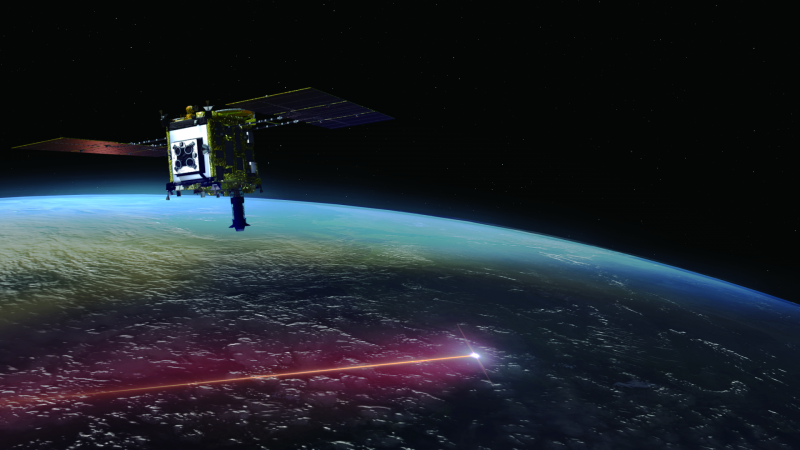
The curve of Earth in space, against a dark background, with the Hayabusa2 spacecraft above it and a purple streak headed to Earth's surface.

Artist’s concept of JAXA’s Hayabusa2 sweeping past Earth, as its sample-return capsule – carrying precious grains from the surface of asteroid Ryugu – plummets to Earth’s surface. Image via JAXA.

On February 22, 2019, the Hayabusa2 spacecraft of the Japan Aerospace Exploration Agency (JAXA) touched down briefly on near-Earth asteroid 162173 Ryugu and fired a bullet into the asteroid’s surface. The spacecraft collected a sample of dust puffed up during the maneuver, and now the spacecraft – carrying its precious cargo of an asteroid sample within a capsule on board – is headed back to Earth. The spacecraft will sweep past Earth, and the capsule will drop to Earth’s surface via parachute on December 6, 2020. JAXA said in an announcement on August 19, 2020, that it has now been officially informed that the capsule is approved for landing in Australia. JAXA said:

The Hayabusa2 re-entry capsule will return to Earth in South Australia on December 6, 2020 (Japan Time and Australian Time). The landing site will be the Woomera Prohibited Area. The issuance of the AROLSO [Authorization of Return of Overseas-Launched Space Object] gave a major step forward for the capsule recovery.

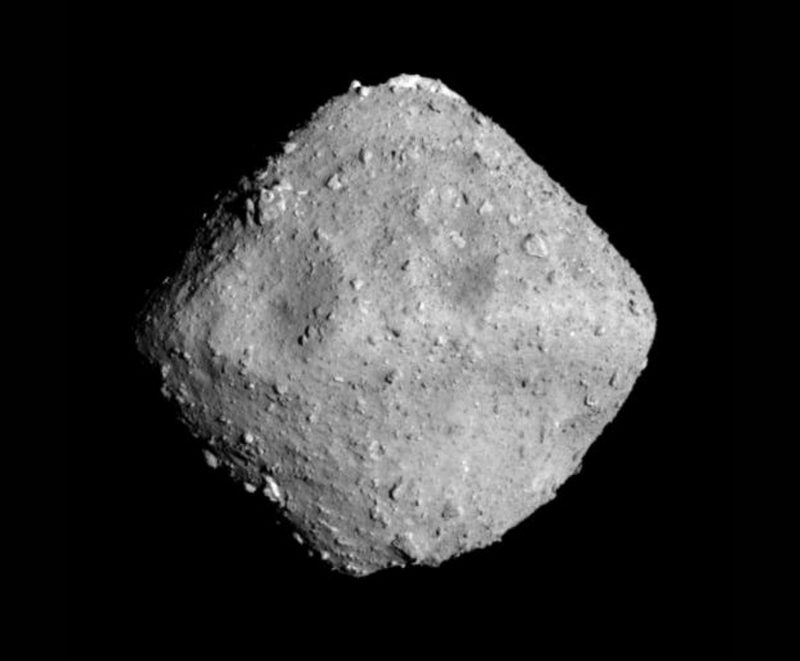
Rocky asteroid Ryugu, diamond-shaped, like a spinning top.

Ryugu as seen by Hayabusa2 on June 26, 2018. Image via JAXA/ University of Tokyo/ Kochi University/ Rikkyo University/ Nagoya University/ Chiba Institute of Technology/ Meiji University/ University of Aizu/ AIST.

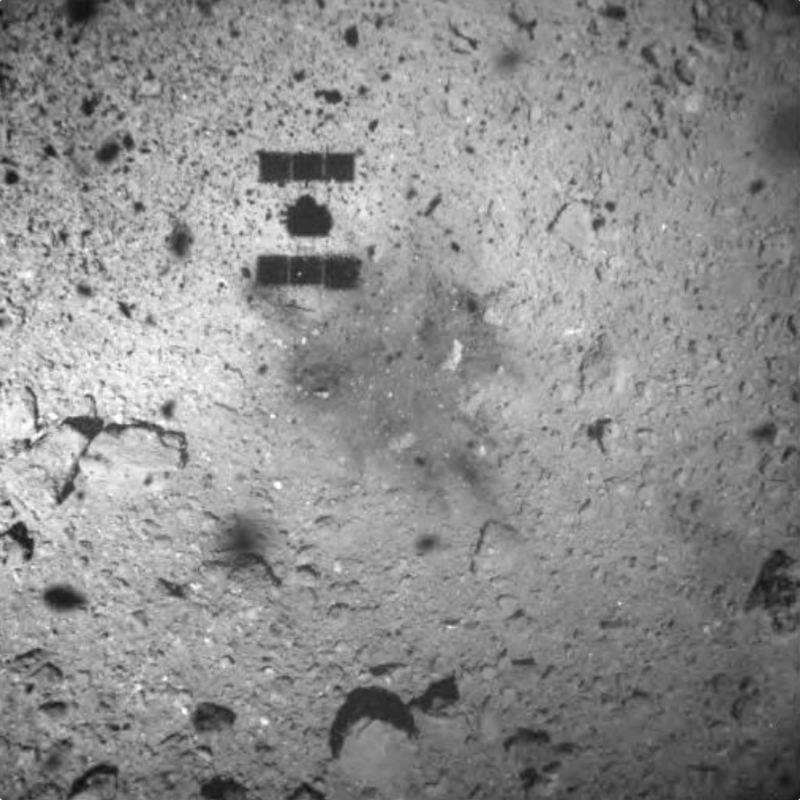
Spacecraft shadow, and a dark irregular spot, on the surface of a rocky gray asteroid.

Japan’s Hayabusa2 spacecraft captured this image in February 2019, during its ascent after touchdown on asteroid Ryugu. You can see the shadow of Hayabusa2 and a region of the surface of the asteroid apparently discolored by the touchdown. Image via JAXA (@haya2e_jaxa on Twitter).

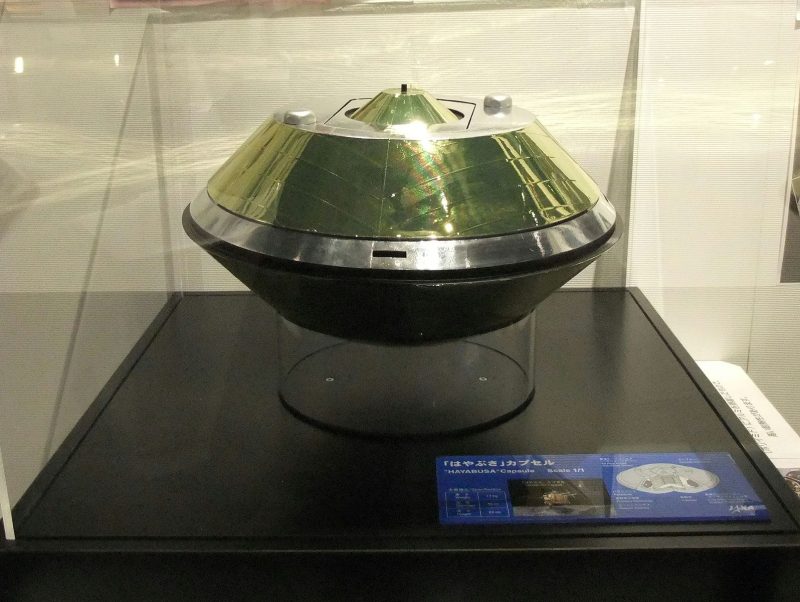
A 'flying saucer' shaped capsule, inside a glass display case.

Replica of the Hayabusa2 sample-return capsule, which measures about 16 inches (40 cm) in diameter. The capsule is scheduled to land, via parachute, in Australia’s Woomera Prohibited Area on December 6, 2020. Image via Wikimedia Commons.

Hayabusa2 was launched from Earth on December 3, 2014. The spacecraft rendezvoused with asteroid Ryugu on June 27, 2018. The mission follows an earlier JAXA Hayabusa mission (the name means Peregrine falcon), which, in 2010, returned samples from asteroid 25143 Itokawa, the first-ever asteroid to be the target of a sample return mission and the only other mission so far to have returned asteroid samples to Earth.

Hayabusa2 surveyed Ryugu for a year and a half. It left the asteroid with the precious sample safe inside its capsule in November, 2019.

After Hayabusa2 flies past Earth to deliver its sample capsule in late 2020, it is expected to retain 30 kg (66 lb) of xenon propellant, which can be used to extend its service and to fly by new targets to explore. As of August 2020, there are two scenarios under consideration for a mission extension. First, a Venus flyby in 2024 would set up the spacecraft for a November 2029 encounter with a small, quickly spinning near-Earth asteroid called 2001 AV43. During the flyby, Hayabusa2 could also conduct infrared observations of Venus. Alternatively, the spacecraft could be sent toward a rendezvous with another near-Earth asteroid and another fast rotator – 1998 KY26 – in July 2031.

White-jacketed scientists in a control room, looking anxious.

A live webcast showed Hayabusa2 scientists nervously monitoring Hayabusa2’s February 22, 2019 touchdown on distant asteroid Ryugu.

Bottom line: The Japan Aerospace Exploration Agency (JAXA) said this week that it has now been officially informed that its Hayabusa2 space capsule – carrying precious dust from the surface of near-Earth asteroid Ryugu – is approved for landing in Australia. If returned safely as planned on December 6, 2020, this asteroid dust will be only the second asteroid sample ever returned to Earth.

Read more from Nature: How space missions snatch pieces of other worlds and bring them back to Earth

Via JAXA


from EarthSky https://ift.tt/2EodVhn
The curve of Earth in space, against a dark background, with the Hayabusa2 spacecraft above it and a purple streak headed to Earth's surface.

Artist’s concept of JAXA’s Hayabusa2 sweeping past Earth, as its sample-return capsule – carrying precious grains from the surface of asteroid Ryugu – plummets to Earth’s surface. Image via JAXA.

On February 22, 2019, the Hayabusa2 spacecraft of the Japan Aerospace Exploration Agency (JAXA) touched down briefly on near-Earth asteroid 162173 Ryugu and fired a bullet into the asteroid’s surface. The spacecraft collected a sample of dust puffed up during the maneuver, and now the spacecraft – carrying its precious cargo of an asteroid sample within a capsule on board – is headed back to Earth. The spacecraft will sweep past Earth, and the capsule will drop to Earth’s surface via parachute on December 6, 2020. JAXA said in an announcement on August 19, 2020, that it has now been officially informed that the capsule is approved for landing in Australia. JAXA said:

The Hayabusa2 re-entry capsule will return to Earth in South Australia on December 6, 2020 (Japan Time and Australian Time). The landing site will be the Woomera Prohibited Area. The issuance of the AROLSO [Authorization of Return of Overseas-Launched Space Object] gave a major step forward for the capsule recovery.

Rocky asteroid Ryugu, diamond-shaped, like a spinning top.

Ryugu as seen by Hayabusa2 on June 26, 2018. Image via JAXA/ University of Tokyo/ Kochi University/ Rikkyo University/ Nagoya University/ Chiba Institute of Technology/ Meiji University/ University of Aizu/ AIST.

Spacecraft shadow, and a dark irregular spot, on the surface of a rocky gray asteroid.

Japan’s Hayabusa2 spacecraft captured this image in February 2019, during its ascent after touchdown on asteroid Ryugu. You can see the shadow of Hayabusa2 and a region of the surface of the asteroid apparently discolored by the touchdown. Image via JAXA (@haya2e_jaxa on Twitter).

A 'flying saucer' shaped capsule, inside a glass display case.

Replica of the Hayabusa2 sample-return capsule, which measures about 16 inches (40 cm) in diameter. The capsule is scheduled to land, via parachute, in Australia’s Woomera Prohibited Area on December 6, 2020. Image via Wikimedia Commons.

Hayabusa2 was launched from Earth on December 3, 2014. The spacecraft rendezvoused with asteroid Ryugu on June 27, 2018. The mission follows an earlier JAXA Hayabusa mission (the name means Peregrine falcon), which, in 2010, returned samples from asteroid 25143 Itokawa, the first-ever asteroid to be the target of a sample return mission and the only other mission so far to have returned asteroid samples to Earth.

Hayabusa2 surveyed Ryugu for a year and a half. It left the asteroid with the precious sample safe inside its capsule in November, 2019.

After Hayabusa2 flies past Earth to deliver its sample capsule in late 2020, it is expected to retain 30 kg (66 lb) of xenon propellant, which can be used to extend its service and to fly by new targets to explore. As of August 2020, there are two scenarios under consideration for a mission extension. First, a Venus flyby in 2024 would set up the spacecraft for a November 2029 encounter with a small, quickly spinning near-Earth asteroid called 2001 AV43. During the flyby, Hayabusa2 could also conduct infrared observations of Venus. Alternatively, the spacecraft could be sent toward a rendezvous with another near-Earth asteroid and another fast rotator – 1998 KY26 – in July 2031.

White-jacketed scientists in a control room, looking anxious.

A live webcast showed Hayabusa2 scientists nervously monitoring Hayabusa2’s February 22, 2019 touchdown on distant asteroid Ryugu.

Bottom line: The Japan Aerospace Exploration Agency (JAXA) said this week that it has now been officially informed that its Hayabusa2 space capsule – carrying precious dust from the surface of near-Earth asteroid Ryugu – is approved for landing in Australia. If returned safely as planned on December 6, 2020, this asteroid dust will be only the second asteroid sample ever returned to Earth.

Read more from Nature: How space missions snatch pieces of other worlds and bring them back to Earth

Via JAXA


from EarthSky https://ift.tt/2EodVhn

Old moon and young moon

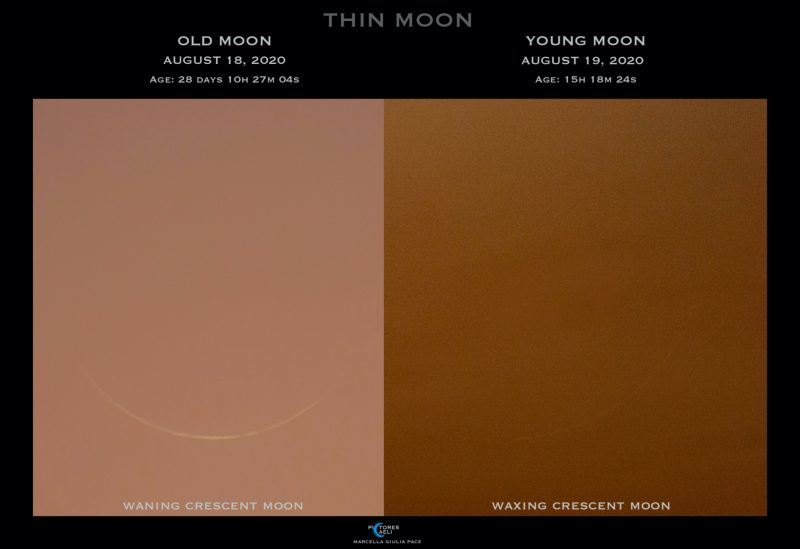
Two-paneled image, with extremly thin, barely visible crescents against dark orange.

View larger at EarthSky Community Photos. | Photos by Marcella Giulia Pace. Thank you for sharing, Marcella.

Marcella Giulia Pace in Modica, Sicily, Italy, caught both the old moon low in the east before sunrise on August 18, 2020, and the young moon low in the west after sunset on August 19. Between these two moon captures, new moon occurred on August 19 at 02:41 UTC. Marcella commented:

Yesterday I took a photo of the thin waxing crescent moon, just 15 hours old. I was waiting for so long to try this shoot. All the favorable conditions were there:

– The moon was about 7 degrees from the sun.

– The moon was close to perigee, it’s closest point to Earth (it would have reached it on August 21).

– Good visibility on the horizon.

I tried to shoot without using computer tools to point at the moon so I only used the camera mounted on a normal tripod. I didn’t see the moon with the unaided eye, but I knew the moon would have passed in front of my lens at 8 o’clock (from my position). And so it was: processing the image I managed to get the very thin sickle.

On the August 18, at dawn, I also took the thin waning crescent moon 20 minutes before sunrise.

Congratulations, Marcella!

Bottom line: Photos from Italy of the old moon one morning, and the young moon the following evening.


from EarthSky https://ift.tt/2E2d7Pv
Two-paneled image, with extremly thin, barely visible crescents against dark orange.

View larger at EarthSky Community Photos. | Photos by Marcella Giulia Pace. Thank you for sharing, Marcella.

Marcella Giulia Pace in Modica, Sicily, Italy, caught both the old moon low in the east before sunrise on August 18, 2020, and the young moon low in the west after sunset on August 19. Between these two moon captures, new moon occurred on August 19 at 02:41 UTC. Marcella commented:

Yesterday I took a photo of the thin waxing crescent moon, just 15 hours old. I was waiting for so long to try this shoot. All the favorable conditions were there:

– The moon was about 7 degrees from the sun.

– The moon was close to perigee, it’s closest point to Earth (it would have reached it on August 21).

– Good visibility on the horizon.

I tried to shoot without using computer tools to point at the moon so I only used the camera mounted on a normal tripod. I didn’t see the moon with the unaided eye, but I knew the moon would have passed in front of my lens at 8 o’clock (from my position). And so it was: processing the image I managed to get the very thin sickle.

On the August 18, at dawn, I also took the thin waning crescent moon 20 minutes before sunrise.

Congratulations, Marcella!

Bottom line: Photos from Italy of the old moon one morning, and the young moon the following evening.


from EarthSky https://ift.tt/2E2d7Pv

Amazing photos in Mars Reconnaissance Orbiter celebration

Smooth hill - a dune - surrounded by very many small, narrow parallel ripples.

View larger. | Sand dunes and ripples in Proctor Crater on Mars, as seen by the Mars Reconnaissance Orbiter on February 9, 2009. Image via NASA/ JPL-Caltech/ Univ. of Arizona.

Mars is a dry desert world, covered in reddish sand. In our lifetimes, spacecraft have revealed its amazing scenery and sweeping landscapes. It’s a world at once reminiscent of Earth, yet alien and strange. This week, to celebrate the launch of the Mars Reconnaissance Orbiter 15 years ago, NASA has shared some of the orbiter’s most breathtaking images. We found these images very beautiful and think you will, too, whether you’re a Mars aficionado or a newbie.

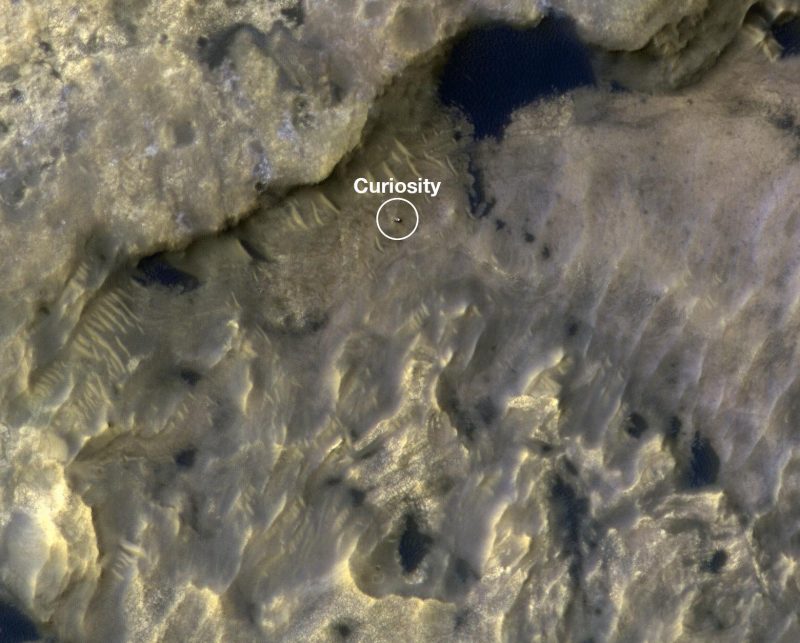
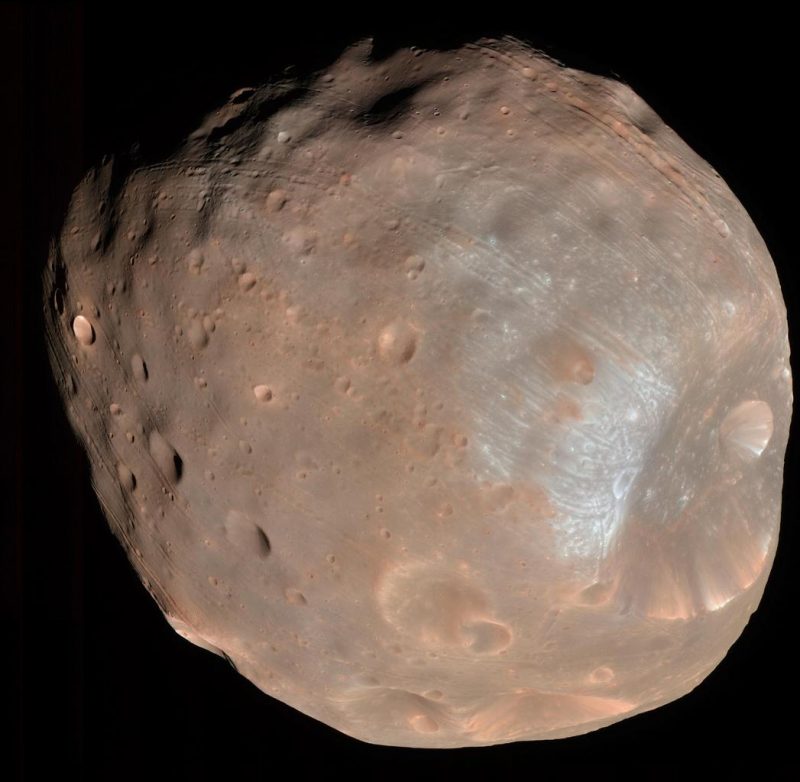
The Mars Reconnaussance Orbiter (MRO) has three cameras: The Mars Color Imager (MARCI), which has a fisheye lens for a daily global view of the planet; the Context Camera (CTX), which provides 19-mile-wide (30-kilometer-wide) black-and-white terrain shots; and the High-Resolution Imaging Science Experiment (HiRISE), which produces the beautiful and jaw-dropping images that MRO has become famous for. HiRISE takes the highest-resolution orbital images of the Martian surface ever obtained, and in full color. They show sand dunes, avalanches, craters, dust devils, old river and lake beds, mountains, gullies and more in exquisite detail. MRO has even been able to photograph rovers such as Curiosity and Opportunity, on the planet far below. It has also photographed the two small Martian moons, Phobos and Deimos.

The image at top of the sand dune and ripples in Proctor Crater is in enhanced color to bring out details. Like other images of still-active sand dunes, it shows that Mars isn’t a completely inactive, motionless world. Leslie Tamppari, MRO deputy project scientist at JPL, said in a statement:

The more we look, the more we discover. Before MRO, it wasn’t clear what on Mars really changed, if anything. We thought the atmosphere was so thin that there was almost no sand motion and most dune movement happened in the ancient past.

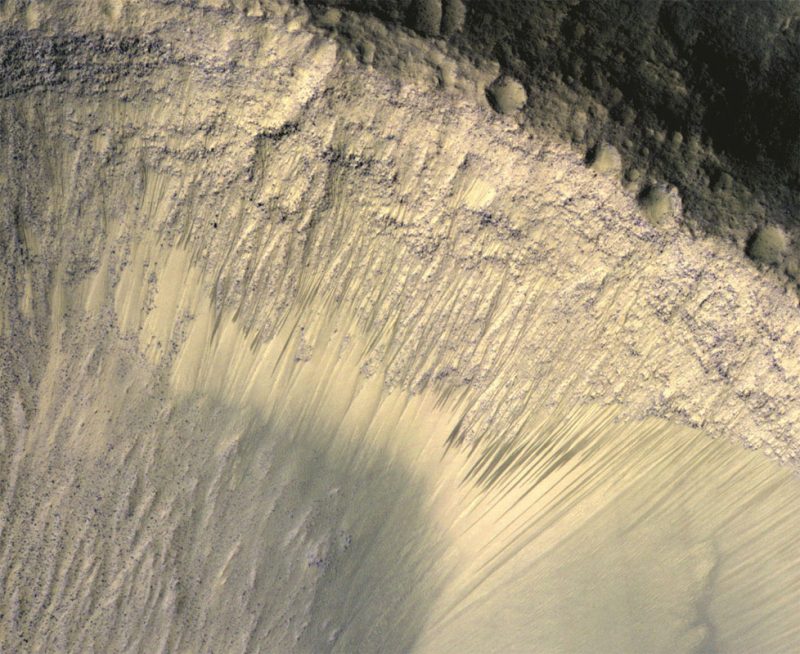
Long, thin, straight dark streaks on steep rocky slope.

View larger. | Recurring slope lineae (RSL) in a crater in Valles Marineris. Image via NASA/ JPL-Caltech/ Univ. of Arizona.

In the image above, we see dark streaks, called recurring slope lineae (RSL), on a steep crater wall in Valles Marineris. There is still much debate as to whether those might be small streams of briny liquid water.

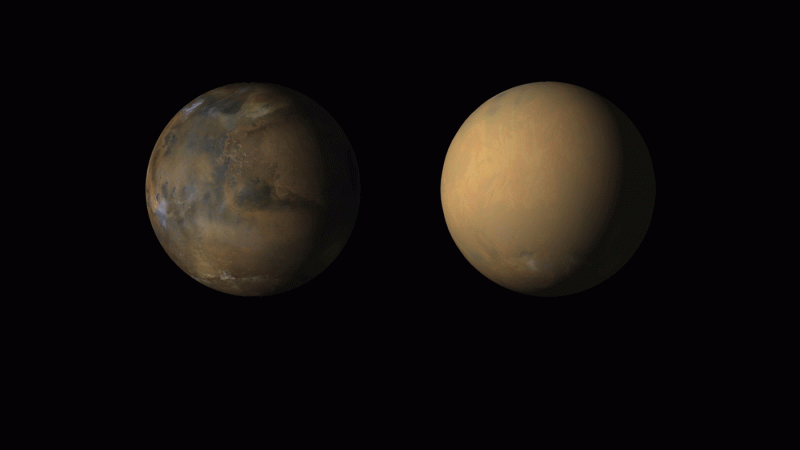
MRO has also watched dust storms on Mars, as seen in the image below. Most storms are fairly small and regional, but others can grow to encompass the entire planet, about once or twice a decade. These are called “planet-encircling dust events.” MARCI took the images in the summer of 2018. This was the storm that darkened the skies over the Opportunity rover and caused it to run out of power from its solar panels.

In the view from May, we see the Valles Marineris chasms (left), Meridiani Planum (center), an autumn dust storm in Acidalia Planitia (top) and the early spring south polar cap (bottom). The same regions are in the view from July, but completely obscured by dust.

Two reddish planets on black background. Left one has features. Right one smooth pale orange.

View larger. | Global dust storm seen by MRO in the summer of 2018 (right). Image via NASA/ JPL-Caltech/ MSSS.

Dust storms aren’t the only dusty phenomenon that MRO has seen. The next image below is a good example of a serpent-like dust devil, captured on February 16, 2012. The image was taken in a late spring afternoon in the Amazonis Planitia region of northern Mars.

The plume is about 98 feet (30 meters) in diameter, and based on the length of the shadow, is more than half a mile (800 meters) tall!

A westerly breeze created the S-like arc in the plume. Just like on Earth, Martian winds get their energy from the sun, even though Mars is much farther from the sun than Earth. Even though winds have lessened this time of year, they are still strong enough to produce dust devils like this one.

Dust devils have also been seen up close on the ground by the rovers Opportunity, Spirit and Curiosity.

An S-shaped white plume above reddish rocky terrain seen from orbit.

View larger. | A twisting dust devil in the Amazonis Planitia region of northern Mars. Image via NASA/ JPL-Caltech/ Univ. of Arizona.

Dust storms and dust devils aren’t the only way that Mars is still active. Avalanches are another common occurrence, especially when seasonal ice vaporizes in the warmer spring.

In the image below, taken on May 29, 2019, MRO captured avalanches on 1,640-foot-tall (500-meter-tall) cliffs at Mars’ north pole. The avalanches also had the effect of exposing hidden layers of ice and dust in the cliffs, going back millions of years or more. For scientists, these layers are like reading the book of Mars’ history, providing clues as to how the environment changed in the region over time.

Dusty cloud at base of steep cliff in reddish terrain.

View larger. | Avalanches on steep cliffs near the martian north pole on May 29, 2019. Image via NASA/ JPL-Caltech/ Univ. of Arizona.

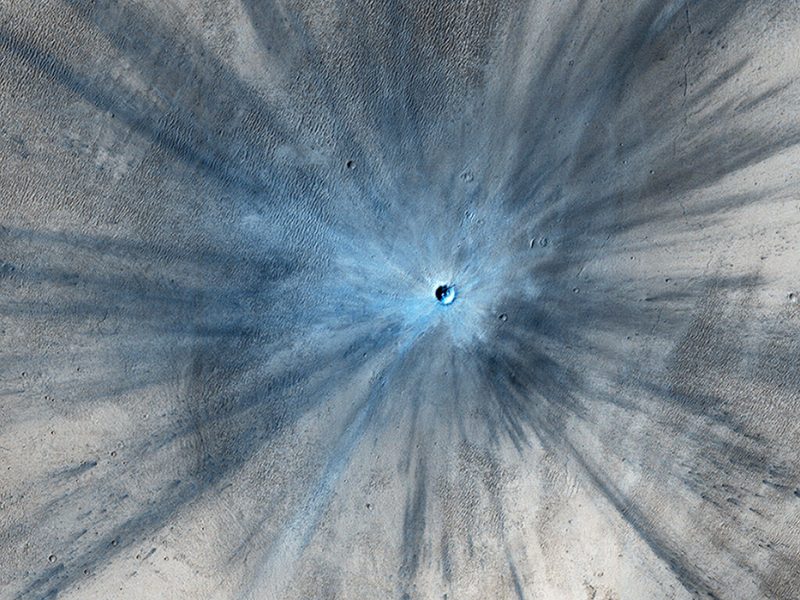
Another thing that MRO is good at is finding new craters. Such “fresh” craters can be identified by the new-looking ejecta blanket of rocky debris around them. Many more of these can be seen on Mars due to the planet’s very thin atmosphere, which doesn’t burn up larger meteors as easily as Earth’s atmosphere. More of them therefore actually impact the planet.

MRO has found over 800 new impact craters so far during its mission. The one pictured below is about 98 feet (30 meters) across. The impact was strong enough to throw ejecta as far as 9.3 miles (15 km).

On Mars, craters also last much longer than they do on Earth, again because of the thin atmosphere that erodes them more slowly.

Impact crater surrounded by very long dark and bright rays of rocky debris.

View larger. | A new impact crater, spotted by MRO on November 19, 2013. Image via NASA/ JPL-Caltech/ Univ. of Arizona.

MRO has been orbiting Mars since 2006, and has taken no less than 6,882,204 images, generating 194 terabytes of data. Those views of the red planet have helped to revolutionize our knowledge about this familiar yet alien world.

MRO has also taken images of mud volcanoes, and a recent study showed that mud which flows from them will flow in a manner similar to lava on Earth.

As well as taking incredible images, MRO also studies Mars with multiple other instruments. It measures the temperature of the atmosphere and dust and water vapor using Mars Climate Sounder (MCS), peers beneath the surface with radar using Shallow Radar (SHARAD) and analyzes different minerals on the surface in rocks and sand with the Compact Reconnaissance Imaging Spectrometer for Mars (CRISM).

Tiny, dark, square spot with white ring around it and white text, on lumpy reddish rocky terrain seen from above.

View larger. | NASA’s Curiosity rover in Gale Crater, as seen by MRO from orbit. Image via NASA/ JPL-Caltech/ Univ. of Arizona.

Reddish, oblong rocky cratered moon on black background.

View larger. | Mars’ largest moon Phobos, as seen by MRO on March 23, 2008. Image via NASA/ JPL-Caltech/ Univ. of Arizona.

Gray pimple-like conical hills with depressions on top on gray rocky terrain.

View larger. | Conical hills thought to be mud volcanoes, in Coprates Chasma on Mars, photographed by MRO. Image via Petr Brož/ MRO/ NASA/ JPL/ University of Arizona/ The Conversation.

False-color terrain with riverbed and duck-foot-shaped delta, seen from above.

View larger. | Enhanced-color image from MRO of the future landing site of the Perseverance rover in Jezero Crater in February 2021. An ancient river delta is still clearly visible. Image via NASA/ JPL-Caltech/ ASU.

The images sent back by MRO have been some of the most incredible of any planetary mission, and are the perfect way to celebrate the 15th anniversary of the launch. Along with all the other data to date, they have forever changed our view and understanding of the red planet.

More information about MRO is available on the mission website. Check out the HiRISE website for many thousand more images! You can even make a request for the spacecraft to take images of specific targets.

Bottom line: NASA has posted amazing photos of Mars to celebrate the 15th anniversary of the launch of Mars Reconnaissance Orbiter.

Via Jet Propulsion Laboratory


from EarthSky https://ift.tt/3hdkjX6
Smooth hill - a dune - surrounded by very many small, narrow parallel ripples.

View larger. | Sand dunes and ripples in Proctor Crater on Mars, as seen by the Mars Reconnaissance Orbiter on February 9, 2009. Image via NASA/ JPL-Caltech/ Univ. of Arizona.

Mars is a dry desert world, covered in reddish sand. In our lifetimes, spacecraft have revealed its amazing scenery and sweeping landscapes. It’s a world at once reminiscent of Earth, yet alien and strange. This week, to celebrate the launch of the Mars Reconnaissance Orbiter 15 years ago, NASA has shared some of the orbiter’s most breathtaking images. We found these images very beautiful and think you will, too, whether you’re a Mars aficionado or a newbie.

The Mars Reconnaussance Orbiter (MRO) has three cameras: The Mars Color Imager (MARCI), which has a fisheye lens for a daily global view of the planet; the Context Camera (CTX), which provides 19-mile-wide (30-kilometer-wide) black-and-white terrain shots; and the High-Resolution Imaging Science Experiment (HiRISE), which produces the beautiful and jaw-dropping images that MRO has become famous for. HiRISE takes the highest-resolution orbital images of the Martian surface ever obtained, and in full color. They show sand dunes, avalanches, craters, dust devils, old river and lake beds, mountains, gullies and more in exquisite detail. MRO has even been able to photograph rovers such as Curiosity and Opportunity, on the planet far below. It has also photographed the two small Martian moons, Phobos and Deimos.

The image at top of the sand dune and ripples in Proctor Crater is in enhanced color to bring out details. Like other images of still-active sand dunes, it shows that Mars isn’t a completely inactive, motionless world. Leslie Tamppari, MRO deputy project scientist at JPL, said in a statement:

The more we look, the more we discover. Before MRO, it wasn’t clear what on Mars really changed, if anything. We thought the atmosphere was so thin that there was almost no sand motion and most dune movement happened in the ancient past.

Long, thin, straight dark streaks on steep rocky slope.

View larger. | Recurring slope lineae (RSL) in a crater in Valles Marineris. Image via NASA/ JPL-Caltech/ Univ. of Arizona.

In the image above, we see dark streaks, called recurring slope lineae (RSL), on a steep crater wall in Valles Marineris. There is still much debate as to whether those might be small streams of briny liquid water.

MRO has also watched dust storms on Mars, as seen in the image below. Most storms are fairly small and regional, but others can grow to encompass the entire planet, about once or twice a decade. These are called “planet-encircling dust events.” MARCI took the images in the summer of 2018. This was the storm that darkened the skies over the Opportunity rover and caused it to run out of power from its solar panels.

In the view from May, we see the Valles Marineris chasms (left), Meridiani Planum (center), an autumn dust storm in Acidalia Planitia (top) and the early spring south polar cap (bottom). The same regions are in the view from July, but completely obscured by dust.

Two reddish planets on black background. Left one has features. Right one smooth pale orange.

View larger. | Global dust storm seen by MRO in the summer of 2018 (right). Image via NASA/ JPL-Caltech/ MSSS.

Dust storms aren’t the only dusty phenomenon that MRO has seen. The next image below is a good example of a serpent-like dust devil, captured on February 16, 2012. The image was taken in a late spring afternoon in the Amazonis Planitia region of northern Mars.

The plume is about 98 feet (30 meters) in diameter, and based on the length of the shadow, is more than half a mile (800 meters) tall!

A westerly breeze created the S-like arc in the plume. Just like on Earth, Martian winds get their energy from the sun, even though Mars is much farther from the sun than Earth. Even though winds have lessened this time of year, they are still strong enough to produce dust devils like this one.

Dust devils have also been seen up close on the ground by the rovers Opportunity, Spirit and Curiosity.

An S-shaped white plume above reddish rocky terrain seen from orbit.

View larger. | A twisting dust devil in the Amazonis Planitia region of northern Mars. Image via NASA/ JPL-Caltech/ Univ. of Arizona.

Dust storms and dust devils aren’t the only way that Mars is still active. Avalanches are another common occurrence, especially when seasonal ice vaporizes in the warmer spring.

In the image below, taken on May 29, 2019, MRO captured avalanches on 1,640-foot-tall (500-meter-tall) cliffs at Mars’ north pole. The avalanches also had the effect of exposing hidden layers of ice and dust in the cliffs, going back millions of years or more. For scientists, these layers are like reading the book of Mars’ history, providing clues as to how the environment changed in the region over time.

Dusty cloud at base of steep cliff in reddish terrain.

View larger. | Avalanches on steep cliffs near the martian north pole on May 29, 2019. Image via NASA/ JPL-Caltech/ Univ. of Arizona.

Another thing that MRO is good at is finding new craters. Such “fresh” craters can be identified by the new-looking ejecta blanket of rocky debris around them. Many more of these can be seen on Mars due to the planet’s very thin atmosphere, which doesn’t burn up larger meteors as easily as Earth’s atmosphere. More of them therefore actually impact the planet.

MRO has found over 800 new impact craters so far during its mission. The one pictured below is about 98 feet (30 meters) across. The impact was strong enough to throw ejecta as far as 9.3 miles (15 km).

On Mars, craters also last much longer than they do on Earth, again because of the thin atmosphere that erodes them more slowly.

Impact crater surrounded by very long dark and bright rays of rocky debris.

View larger. | A new impact crater, spotted by MRO on November 19, 2013. Image via NASA/ JPL-Caltech/ Univ. of Arizona.

MRO has been orbiting Mars since 2006, and has taken no less than 6,882,204 images, generating 194 terabytes of data. Those views of the red planet have helped to revolutionize our knowledge about this familiar yet alien world.

MRO has also taken images of mud volcanoes, and a recent study showed that mud which flows from them will flow in a manner similar to lava on Earth.

As well as taking incredible images, MRO also studies Mars with multiple other instruments. It measures the temperature of the atmosphere and dust and water vapor using Mars Climate Sounder (MCS), peers beneath the surface with radar using Shallow Radar (SHARAD) and analyzes different minerals on the surface in rocks and sand with the Compact Reconnaissance Imaging Spectrometer for Mars (CRISM).

Tiny, dark, square spot with white ring around it and white text, on lumpy reddish rocky terrain seen from above.

View larger. | NASA’s Curiosity rover in Gale Crater, as seen by MRO from orbit. Image via NASA/ JPL-Caltech/ Univ. of Arizona.

Reddish, oblong rocky cratered moon on black background.

View larger. | Mars’ largest moon Phobos, as seen by MRO on March 23, 2008. Image via NASA/ JPL-Caltech/ Univ. of Arizona.

Gray pimple-like conical hills with depressions on top on gray rocky terrain.

View larger. | Conical hills thought to be mud volcanoes, in Coprates Chasma on Mars, photographed by MRO. Image via Petr Brož/ MRO/ NASA/ JPL/ University of Arizona/ The Conversation.

False-color terrain with riverbed and duck-foot-shaped delta, seen from above.

View larger. | Enhanced-color image from MRO of the future landing site of the Perseverance rover in Jezero Crater in February 2021. An ancient river delta is still clearly visible. Image via NASA/ JPL-Caltech/ ASU.

The images sent back by MRO have been some of the most incredible of any planetary mission, and are the perfect way to celebrate the 15th anniversary of the launch. Along with all the other data to date, they have forever changed our view and understanding of the red planet.

More information about MRO is available on the mission website. Check out the HiRISE website for many thousand more images! You can even make a request for the spacecraft to take images of specific targets.

Bottom line: NASA has posted amazing photos of Mars to celebrate the 15th anniversary of the launch of Mars Reconnaissance Orbiter.

Via Jet Propulsion Laboratory


from EarthSky https://ift.tt/3hdkjX6

Born under the sign of Ophiuchus?

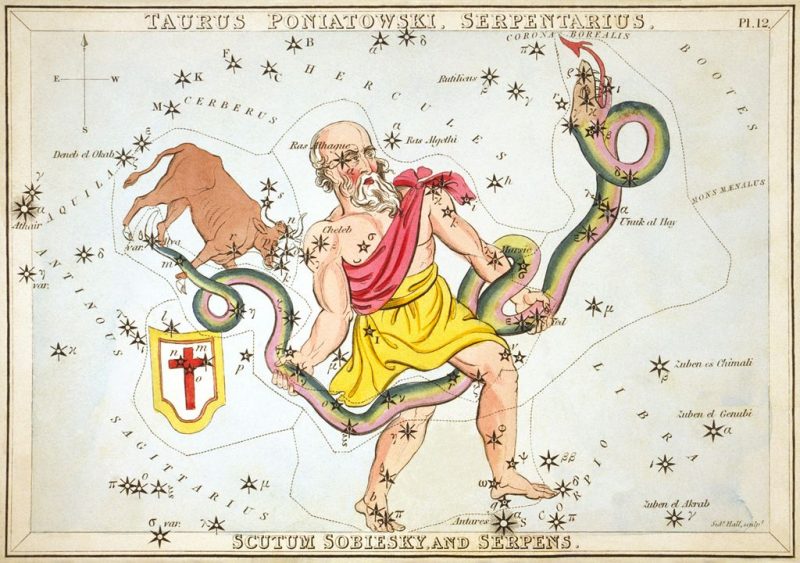
Antique colored etching of old man in Greek garb holding a long snake.

Ophiuchus holding the serpent, Serpens, as depicted in Urania’s Mirror, a set of constellation cards published in London c. 1825. Image via Wikipedia.

Born somewhere between November 30 and December 18? If so, chances are the sun passes in front of the constellation Ophiuchus the Serpent Bearer on your birthday. Now I can almost hear someone saying:

Wait a minute! There’s no Ophiuchus on the horoscope page.

You are absolutely correct. That’s because Ophiuchus is a constellation – not a sign – of the zodiac. Follow the links below to learn more about astrological signs versus astronomical constellations, when and where to locate Ophiuchus, some deep-sky treasures it contains, its mythology, its science and more.

Astrological signs versus astronomical constellations.

When and where to locate Ophiuchus.

Deep-sky objects in Ophiuchus.

Ophiuchus in myth and star lore.

Ophiuchus in history and science.
Night sky photo with lines of constellation Ophiuchus drawn in.

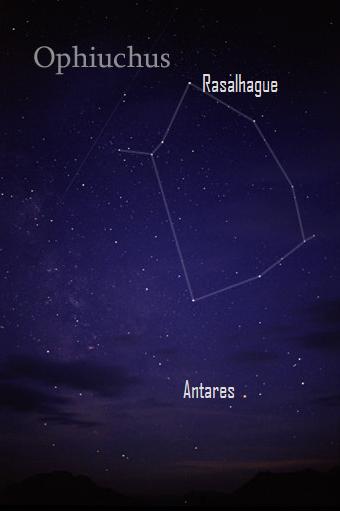
On a dark, moonless night, look for Ophiuchus above the bright ruddy star Antares. Photo via Till Credner/ AlltheSky.com.

Astrological signs versus astronomical constellations. The sun is in the sign Sagittarius from November 21 to December 21. But, in the present-day sky, the sun is in front of the astronomical constellation Ophiuchus from about November 30 to December 18. In 2019, the sun enters the constellation Ophiuchus on November 30 at 14 UTC (or for the U.S. Central Time Zone: November 30 at 8 a.m. CST). Then the sun enters the constellation Sagittarius on December 18, 2019, at 20 UTC – or at 2 p.m. CST.

Whether you’re speaking about astrological signs or astronomical constellations, the zodiac depicts the narrow beltway of stars on the stellar sphere through which the sun, moon and planets travel continuously. The zodiac runs astride the ecliptic – the sun’s yearly pathway in front of the backdrop stars. The band of the zodiac extends some 8o north and south of the ecliptic, spanning a total of 16o in width.

The sun is said to enter the sign Sagittarius around November 21, or whenever the sun is precisely 30o west of the December solstice point. The sun then enters the sign Capricorn on the December 21 solstice. So the sun passes through the sign Sagittarius for the month period before and up to the December solstice, irrespective of the sun shining in front of the constellation Ophiuchus from November 30 to December 18.

By the way, the December solstice point moves one degree westward in front of the zodiacal constellations – or backdrop stars – in about 72 years. The December solstice point will finally move into the constellation Ophiuchus by the year 2269.

When and where to locate Ophiuchus. The best time to observe Ophiuchus is during a Northern Hemisphere summer or a Southern Hemisphere winter. From the Northern Hemisphere, late July and early August present this constellation high in the southern sky at nightfall and early evening. It’s seen in the southwest sky on autumn evenings in the Northern Hemisphere.

This rather large constellation fills the area of sky to the north of the constellation Scorpius the Scorpion and to the south of the constellation Hercules the Hero. If you’re familiar with Scorpius’ brightest star Antares, try star-hopping to Ophiuchus from this ruddy gem of a star. The head of Ophiuchus is marked by the star Rasalhague (Alpha Ophiuchi).

Ophiuchus is joined in legend and in the sky to the constellation of the Serpent. If you have a dark sky, you might find this is one constellation that looks like what it’s supposed to be: a big guy holding a snake. The name Ophiuchus comes from two Greek words meaning serpent and holding.

Fuzzy band of stars - the Milky Way - with irregular dark markings in it.

Can you see the Pipe Nebula a little to the upper right of center? If not, click here and put your cursor over the photo.

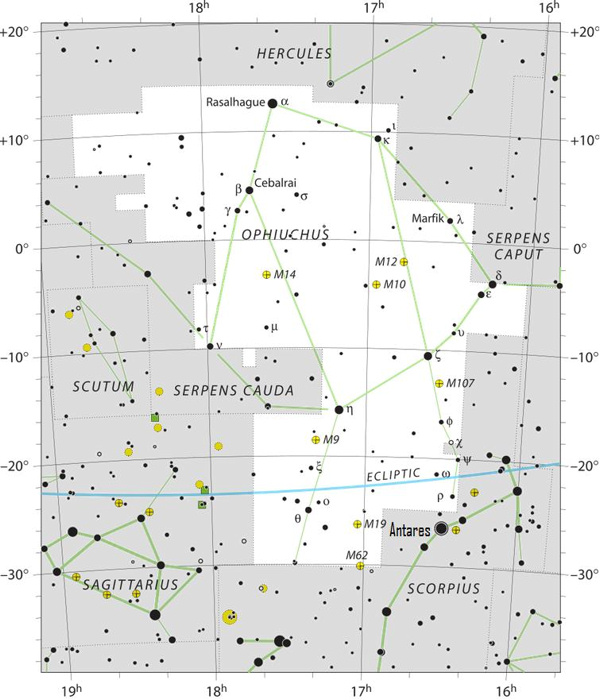
Star chart with stars in black on white.

View larger. | Ophiuchus the Serpent Bearer. Image via Wikipedia.

Deep-sky objects in Ophiuchus. On a night when the moon is absent, take your binoculars and use them to scan Ophiuchus, which lies near the band of the Milky Way and so has many deep-sky wonders. Ophiuchus boasts of numerous globular clusters, for example. The two easiest globular clusters to see with ordinary binoculars are M10 and M12, as shown on the above chart. Through binoculars, they look like faint puffs of light, but with the telescope, you begin to see these globular clusters for what they really are. They are immense stellar cities spanning a hundred to a few hundred light-years in diameter, teeming with hundreds of thousands of stars.

Another big deep-sky favorite is the Pipe Nebula, a vast interstellar cloud of gas and dust sweeping across about 7o of sky. At an arm’s length, that’s about the width of three to four fingers. This dark nebula resides at a distance of 600 to 700 light-years in southern Ophiuchus, and can be seen with the unaided eye in a dark, transparent sky. The Pipe Nebula is found due east of the star Antares, and due north of the stars Shaula and Lesath. These two stars (but not the Pipe Nebula) are shown on the above chart.

Marble statue of bearded man in Greek garb and a long snake writhing upward next to him.

The Greek Asclepius or Latin Aesculapius. The constellation Ophiuchus represents this legendary physician.

Ophiuchus in myth and star lore. In Greek sky lore, Ophiuchus represents Asclepius – said to have been the first doctor – always depicted holding a great serpent or snake. Depending on how it’s used, a snake’s venom can either kill or cure. It’s said that Asclepius concocted a potion from this snake venom, the blood of the Gorgon monster and an unknown herb to bring the dead back to life. This greatly alarmed the gods as it threatened to undo the natural order of things.

As the good doctor was trying to bring Orion the Hunter back to life, the god of the Underworld pleaded to Zeus, the king of the gods, to reconsider the ramifications of the death of death. Apparently his argument swayed the king of the gods. Zeus confiscated the potion, removed Asclepius from Earth and placed the gifted physician into the starry heavens.

We hardly know how the god of the Underworld made his appeal. Perhaps he said only that which never lives never dies, and that no mortal can have one without the other. The absence of death means the absence – not the continuance – of life. Sophocles may have expressed the myth’s inherent message when saying:

Better to die, and sleep the never-waking sleep, than linger on and dare to live when the soul’s life is gone.

Possibly, the poet T.S. Eliot reechoed the theme of the ever-living story in his Four Quartets:

We die with the dying:
See, they depart, and we go with them.
We are born with the dead:
See, they return, and bring us with them.

In any event, the association with Asclepius with snakes is why we sometimes see a staff with a serpent wound around it at doctor’s offices and hospitals, even today.

Man wearing a mill-wheel ruff collar and holding a compass.

The great Johannes Kepler (1571 to 1630). The star known as Kepler’s supernova exploded in 1604, within the boundaries of the constellation Ophiuchus.

Ophiuchus in history and science. It’s been more than 400 years since anyone has seen a supernova explosion of a star within our own Milky Way galaxy. But in the year 1604, a supernova known as Kepler’s Supernova exploded onto the scene, attaining naked-eye visibility for 18 months. It shone in southern Ophiuchus, not all that far from the Pipe Nebula.

Kepler’s Supernova in 1604 came upon the heels of Tycho’s Supernova that lit up Cassiopeia in 1572. These supernovae sent shock waves into the intelligentsia of Europe, which firmly believed in the Aristotelian notion of an immutable universe outside the orbit of the moon. Tycho Brahe took a parallax measurement of the 1572 supernova, proving that it could not be an atmospheric phenomenon. In fact, the supernova shone well beyond the moon’s orbit. Shortly thereafter Kepler’s Supernova in 1604 seemed to drive home the point all over again.

Moreover, Tycho Brahe measured the distance of a comet in 1577, also finding it to be farther away than the moon. Aristotelians wanted to believe comets were gases burning in the atmosphere, but once again, Tycho threw cold water on the idea of Aristotle’s immutable universe.

Enjoying EarthSky? Sign up for our free daily newsletter today!

Bottom line: The sun lies within the boundaries of the constellation Ophiuchus the Serpent Bearer for about 2 weeks of every year, and thus Ophiuchus is an informal member of the zodiac. Astrological signs versus astronomical constellations, how to locate Ophiuchus.

Taurus? Here’s your constellation
Gemini? Here’s your constellation
Cancer? Here’s your constellation
Leo? Here’s your constellation
Virgo? Here’s your constellation
Libra? Here’s your constellation
Scorpius? Here’s your constellation
Sagittarius? Here’s your constellation
Capricornus? Here’s your constellation
Aquarius? Here’s your constellation
Pisces? Here’s your constellation
Aries? Here’s your constellation
Birthday late November to early December? Here’s your constellation


from EarthSky https://ift.tt/3aGU0pI
Antique colored etching of old man in Greek garb holding a long snake.

Ophiuchus holding the serpent, Serpens, as depicted in Urania’s Mirror, a set of constellation cards published in London c. 1825. Image via Wikipedia.

Born somewhere between November 30 and December 18? If so, chances are the sun passes in front of the constellation Ophiuchus the Serpent Bearer on your birthday. Now I can almost hear someone saying:

Wait a minute! There’s no Ophiuchus on the horoscope page.

You are absolutely correct. That’s because Ophiuchus is a constellation – not a sign – of the zodiac. Follow the links below to learn more about astrological signs versus astronomical constellations, when and where to locate Ophiuchus, some deep-sky treasures it contains, its mythology, its science and more.

Astrological signs versus astronomical constellations.

When and where to locate Ophiuchus.

Deep-sky objects in Ophiuchus.

Ophiuchus in myth and star lore.

Ophiuchus in history and science.

Night sky photo with lines of constellation Ophiuchus drawn in.

On a dark, moonless night, look for Ophiuchus above the bright ruddy star Antares. Photo via Till Credner/ AlltheSky.com.

Astrological signs versus astronomical constellations. The sun is in the sign Sagittarius from November 21 to December 21. But, in the present-day sky, the sun is in front of the astronomical constellation Ophiuchus from about November 30 to December 18. In 2019, the sun enters the constellation Ophiuchus on November 30 at 14 UTC (or for the U.S. Central Time Zone: November 30 at 8 a.m. CST). Then the sun enters the constellation Sagittarius on December 18, 2019, at 20 UTC – or at 2 p.m. CST.

Whether you’re speaking about astrological signs or astronomical constellations, the zodiac depicts the narrow beltway of stars on the stellar sphere through which the sun, moon and planets travel continuously. The zodiac runs astride the ecliptic – the sun’s yearly pathway in front of the backdrop stars. The band of the zodiac extends some 8o north and south of the ecliptic, spanning a total of 16o in width.

The sun is said to enter the sign Sagittarius around November 21, or whenever the sun is precisely 30o west of the December solstice point. The sun then enters the sign Capricorn on the December 21 solstice. So the sun passes through the sign Sagittarius for the month period before and up to the December solstice, irrespective of the sun shining in front of the constellation Ophiuchus from November 30 to December 18.

By the way, the December solstice point moves one degree westward in front of the zodiacal constellations – or backdrop stars – in about 72 years. The December solstice point will finally move into the constellation Ophiuchus by the year 2269.

When and where to locate Ophiuchus. The best time to observe Ophiuchus is during a Northern Hemisphere summer or a Southern Hemisphere winter. From the Northern Hemisphere, late July and early August present this constellation high in the southern sky at nightfall and early evening. It’s seen in the southwest sky on autumn evenings in the Northern Hemisphere.

This rather large constellation fills the area of sky to the north of the constellation Scorpius the Scorpion and to the south of the constellation Hercules the Hero. If you’re familiar with Scorpius’ brightest star Antares, try star-hopping to Ophiuchus from this ruddy gem of a star. The head of Ophiuchus is marked by the star Rasalhague (Alpha Ophiuchi).

Ophiuchus is joined in legend and in the sky to the constellation of the Serpent. If you have a dark sky, you might find this is one constellation that looks like what it’s supposed to be: a big guy holding a snake. The name Ophiuchus comes from two Greek words meaning serpent and holding.

Fuzzy band of stars - the Milky Way - with irregular dark markings in it.

Can you see the Pipe Nebula a little to the upper right of center? If not, click here and put your cursor over the photo.

Star chart with stars in black on white.

View larger. | Ophiuchus the Serpent Bearer. Image via Wikipedia.

Deep-sky objects in Ophiuchus. On a night when the moon is absent, take your binoculars and use them to scan Ophiuchus, which lies near the band of the Milky Way and so has many deep-sky wonders. Ophiuchus boasts of numerous globular clusters, for example. The two easiest globular clusters to see with ordinary binoculars are M10 and M12, as shown on the above chart. Through binoculars, they look like faint puffs of light, but with the telescope, you begin to see these globular clusters for what they really are. They are immense stellar cities spanning a hundred to a few hundred light-years in diameter, teeming with hundreds of thousands of stars.

Another big deep-sky favorite is the Pipe Nebula, a vast interstellar cloud of gas and dust sweeping across about 7o of sky. At an arm’s length, that’s about the width of three to four fingers. This dark nebula resides at a distance of 600 to 700 light-years in southern Ophiuchus, and can be seen with the unaided eye in a dark, transparent sky. The Pipe Nebula is found due east of the star Antares, and due north of the stars Shaula and Lesath. These two stars (but not the Pipe Nebula) are shown on the above chart.

Marble statue of bearded man in Greek garb and a long snake writhing upward next to him.

The Greek Asclepius or Latin Aesculapius. The constellation Ophiuchus represents this legendary physician.

Ophiuchus in myth and star lore. In Greek sky lore, Ophiuchus represents Asclepius – said to have been the first doctor – always depicted holding a great serpent or snake. Depending on how it’s used, a snake’s venom can either kill or cure. It’s said that Asclepius concocted a potion from this snake venom, the blood of the Gorgon monster and an unknown herb to bring the dead back to life. This greatly alarmed the gods as it threatened to undo the natural order of things.

As the good doctor was trying to bring Orion the Hunter back to life, the god of the Underworld pleaded to Zeus, the king of the gods, to reconsider the ramifications of the death of death. Apparently his argument swayed the king of the gods. Zeus confiscated the potion, removed Asclepius from Earth and placed the gifted physician into the starry heavens.

We hardly know how the god of the Underworld made his appeal. Perhaps he said only that which never lives never dies, and that no mortal can have one without the other. The absence of death means the absence – not the continuance – of life. Sophocles may have expressed the myth’s inherent message when saying:

Better to die, and sleep the never-waking sleep, than linger on and dare to live when the soul’s life is gone.

Possibly, the poet T.S. Eliot reechoed the theme of the ever-living story in his Four Quartets:

We die with the dying:
See, they depart, and we go with them.
We are born with the dead:
See, they return, and bring us with them.

In any event, the association with Asclepius with snakes is why we sometimes see a staff with a serpent wound around it at doctor’s offices and hospitals, even today.

Man wearing a mill-wheel ruff collar and holding a compass.

The great Johannes Kepler (1571 to 1630). The star known as Kepler’s supernova exploded in 1604, within the boundaries of the constellation Ophiuchus.

Ophiuchus in history and science. It’s been more than 400 years since anyone has seen a supernova explosion of a star within our own Milky Way galaxy. But in the year 1604, a supernova known as Kepler’s Supernova exploded onto the scene, attaining naked-eye visibility for 18 months. It shone in southern Ophiuchus, not all that far from the Pipe Nebula.

Kepler’s Supernova in 1604 came upon the heels of Tycho’s Supernova that lit up Cassiopeia in 1572. These supernovae sent shock waves into the intelligentsia of Europe, which firmly believed in the Aristotelian notion of an immutable universe outside the orbit of the moon. Tycho Brahe took a parallax measurement of the 1572 supernova, proving that it could not be an atmospheric phenomenon. In fact, the supernova shone well beyond the moon’s orbit. Shortly thereafter Kepler’s Supernova in 1604 seemed to drive home the point all over again.

Moreover, Tycho Brahe measured the distance of a comet in 1577, also finding it to be farther away than the moon. Aristotelians wanted to believe comets were gases burning in the atmosphere, but once again, Tycho threw cold water on the idea of Aristotle’s immutable universe.

Enjoying EarthSky? Sign up for our free daily newsletter today!

Bottom line: The sun lies within the boundaries of the constellation Ophiuchus the Serpent Bearer for about 2 weeks of every year, and thus Ophiuchus is an informal member of the zodiac. Astrological signs versus astronomical constellations, how to locate Ophiuchus.

Taurus? Here’s your constellation
Gemini? Here’s your constellation
Cancer? Here’s your constellation
Leo? Here’s your constellation
Virgo? Here’s your constellation
Libra? Here’s your constellation
Scorpius? Here’s your constellation
Sagittarius? Here’s your constellation
Capricornus? Here’s your constellation
Aquarius? Here’s your constellation
Pisces? Here’s your constellation
Aries? Here’s your constellation
Birthday late November to early December? Here’s your constellation


from EarthSky https://ift.tt/3aGU0pI

What is a waxing crescent moon?

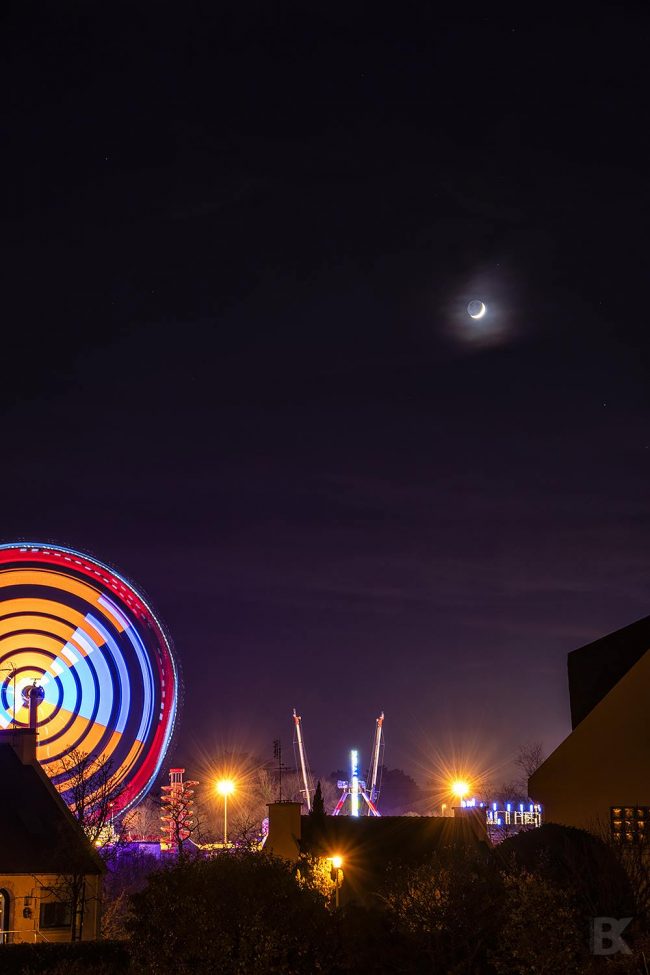
Night scene with large ferris wheel, with a crescent moon above it.

Waxing crescent moon with earthshine, over an amusement park in Brest, France, via BK-Photographies.

In the day or so after every new moon, a waxing crescent moon appears in the west shortly after sunset. Some people think a moon visible in the west after sunset is a rising moon. It’s not; it’s a setting moon. As Earth spins under the sky, all sky objects rise in the east and set in the west. A waxing crescent moon – visible in the western sky – follows the sun below the western horizon.

Also, a waxing crescent moon has nothing to do with Earth’s shadow on the moon. Earth’s shadow can fall on the moon only at full moon, when the moon and sun are opposite each other – on either side of Earth – in space. When Earth’s shadow falls on the moon, we have a lunar eclipse.

That’s not the case on a waxing crescent moon. Such a moon lies not opposite the sun, but, on the contrary, on nearly the same line of sight to the sun, as seen from Earth. There is a shadow on a crescent moon, but it’s the moon’s own shadow. You know how night on Earth happens on the part of Earth submerged in Earth’s own shadow? The same is true on the moon. When you stand looking at a waxing crescent moon, you’re seeing a thin fraction of the moon’s day side, or illuminated side, and a larger fraction of the moon’s night side, the side of the moon submerged in the moon’s own shadow.

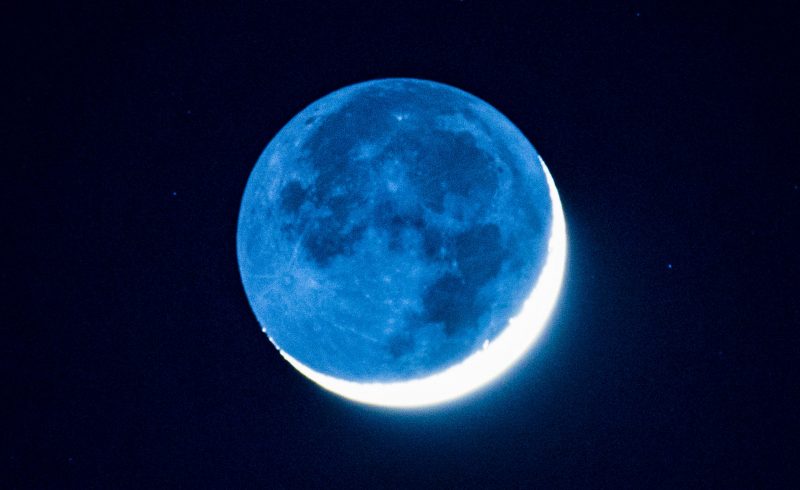
You might also see a pale glow on that night portion of the moon, when the moon is a crescent. That glow is called earthshine. It’s caused by the fact that – when we see a crescent moon in Earth’s sky – any moon people looking back at our world would see a nearly full Earth. Just as a full moon can illuminate an earthly landscape, so a full or nearly full Earth can illuminate the lunar landscape. And that’s what you’re seeing when you see earthshine. Read more about earthshine.

Crescent moon shot with a blue filter, so that the darkened portion of the moon looks blue.

Waxing crescent moon with earthshine, via Chuck Reinhart in Vincennes, Indiana.

Because the waxing crescent moon is nearly on a line with the Earth and sun, its illuminated hemisphere – or day side – is facing mostly away from us. We see only a slender fraction of the day side: a crescent moon. Each evening, because the moon is moving eastward in orbit around Earth, the moon appears farther from the sunset glare. It is moving farther from the Earth-sun line in space. Each evening, as the moon’s orbital motion carries it away from the Earth-sun line, we see more of the moon’s day side. Thus the crescent in the west after sunset appears to wax, or grow fatter each evening.

As the moon orbits Earth, it changes phase in an orderly way. Follow the links below to understand the phases of the moon.

New moon
Waxing crescent moon
First quarter moon
Waxing gibbous moon
Full moon
Waning gibbous moon
Last quarter moon
Waning crescent moon

Read more: 4 keys to understanding moon phases

Check out EarthSky’s guide to the bright planets.

Help EarthSky keep going! Please donate.


from EarthSky https://ift.tt/2YiQ9um
Night scene with large ferris wheel, with a crescent moon above it.

Waxing crescent moon with earthshine, over an amusement park in Brest, France, via BK-Photographies.

In the day or so after every new moon, a waxing crescent moon appears in the west shortly after sunset. Some people think a moon visible in the west after sunset is a rising moon. It’s not; it’s a setting moon. As Earth spins under the sky, all sky objects rise in the east and set in the west. A waxing crescent moon – visible in the western sky – follows the sun below the western horizon.

Also, a waxing crescent moon has nothing to do with Earth’s shadow on the moon. Earth’s shadow can fall on the moon only at full moon, when the moon and sun are opposite each other – on either side of Earth – in space. When Earth’s shadow falls on the moon, we have a lunar eclipse.

That’s not the case on a waxing crescent moon. Such a moon lies not opposite the sun, but, on the contrary, on nearly the same line of sight to the sun, as seen from Earth. There is a shadow on a crescent moon, but it’s the moon’s own shadow. You know how night on Earth happens on the part of Earth submerged in Earth’s own shadow? The same is true on the moon. When you stand looking at a waxing crescent moon, you’re seeing a thin fraction of the moon’s day side, or illuminated side, and a larger fraction of the moon’s night side, the side of the moon submerged in the moon’s own shadow.

You might also see a pale glow on that night portion of the moon, when the moon is a crescent. That glow is called earthshine. It’s caused by the fact that – when we see a crescent moon in Earth’s sky – any moon people looking back at our world would see a nearly full Earth. Just as a full moon can illuminate an earthly landscape, so a full or nearly full Earth can illuminate the lunar landscape. And that’s what you’re seeing when you see earthshine. Read more about earthshine.

Crescent moon shot with a blue filter, so that the darkened portion of the moon looks blue.

Waxing crescent moon with earthshine, via Chuck Reinhart in Vincennes, Indiana.

Because the waxing crescent moon is nearly on a line with the Earth and sun, its illuminated hemisphere – or day side – is facing mostly away from us. We see only a slender fraction of the day side: a crescent moon. Each evening, because the moon is moving eastward in orbit around Earth, the moon appears farther from the sunset glare. It is moving farther from the Earth-sun line in space. Each evening, as the moon’s orbital motion carries it away from the Earth-sun line, we see more of the moon’s day side. Thus the crescent in the west after sunset appears to wax, or grow fatter each evening.

As the moon orbits Earth, it changes phase in an orderly way. Follow the links below to understand the phases of the moon.

New moon
Waxing crescent moon
First quarter moon
Waxing gibbous moon
Full moon
Waning gibbous moon
Last quarter moon
Waning crescent moon

Read more: 4 keys to understanding moon phases

Check out EarthSky’s guide to the bright planets.

Help EarthSky keep going! Please donate.


from EarthSky https://ift.tt/2YiQ9um

Why some rain falls so hard

View from above of rainy street with two black umbrellas and a brilliantly colored striped umbrella.

A downpour or a drizzle: What causes the difference? Image via David Pinzer Photography/ Moment/ Getty Images.

By Jeffrey B. Halverson, University of Maryland, Baltimore County

Why does some rain fall harder than other rain?

There are some days when the rain falls peacefully and gently, nourishing the Earth. But on some other days the rain comes down in a torrential downpour that meteorologists like me call a cloudburst. Standing outside in one of these intense rainstorms can feel like being smothered in a heavy, wet towel. These storms can flood the lands below them and lead to great destruction.

So what causes this difference?

All rain comes from a combination of two things: moisture in the air – usually in the form of clouds – and currents of air moving upwards. As moist air rises up through a cloud, the air cools and the water in it turns into tiny raindrops.

This is the same thing that happens when you can see your breath on a cold evening. The temperature change from warm to cool causes water droplets to form in your breath.

In a cloud, these tiny raindrops are very light and float as the rising air pushes them up. But the higher they go, the larger and heavier they get. Eventually, they get so heavy that they fall to the Earth as rain.

People with umbrellas crossing a street in the rain.

All-day drizzles come from steady storms that don’t have much upward wind flow. Image via AP Photo/ Matt Rourke.

Cold air storms are steady and slow

Cold air can hold much less moisture than warm air, so wintertime clouds don’t have much water in them; they are thin and layered rather than puffy and tall and full of water.

Since cold air likes to sink to the ground, it’s difficult to get that air to rise quickly, so these wintertime clouds have only gentle upward air currents. As these slow currents sweep up through the thin clouds that don’t have much moisture, small raindrops form. Gravity easily pulls them down against the air current before they get too big. When clouds are thin and the air is moving slowly, you get nice calm rain.

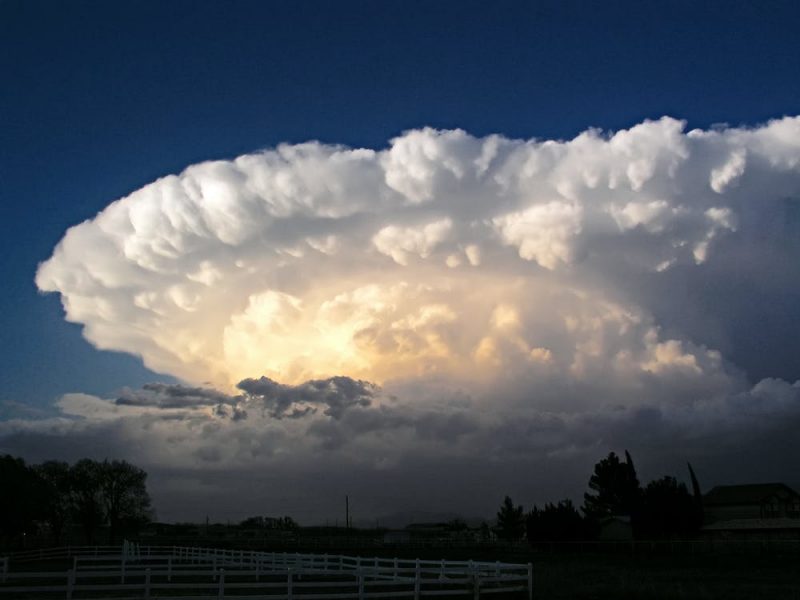
Huge white cloud in a blue sky. Wider at top than below.

Massive thunderstorms called supercells can form when the right weather ingredients come together. Image via Greg Lundeen/ NOAA/ Wikipedia.

Thunderstorms and big winter storms are quick and intense

Hard rainstorms happen when there is a lot of moisture in the air and the air moves upwards very fast. Summer thunderstorms are the perfect example.

The warm, moist air rises very quickly – like a hot air balloon – and can be moving as fast as 30 to 40 miles per hour. The air also holds much more moisture than winter clouds – up to five times as much.

All of this creates very tall, thick clouds that are full of moisture. Water droplets form quickly as the air moves up through the clouds. But since the wind is blowing upwards so fast, the droplets can get huge before gravity drags them down to Earth. When the weight of all the water droplets gets to be too much for the wind, the wind current collapses, and all the raindrops in the cloud come crashing down at once. These are summer thunderstorms.

Thunderstorms can drop one, two or even three inches of rain in less than an hour. These sudden torrential downpours, called cloudbursts, can lead to flash flooding that can overflow streams and roads and trap people wherever they are.

Thankfully, because thunderstorms are so violent and relatively small, they don’t last very long. Once the rain falls from the clouds and squashes the upward air currents, the clouds disappear and you often see a nice blue sky.

Of course, winter can deliver some strong storms too – especially over the warmer ocean water. When strong winter storms drop lots of heavy rain, the same principles are at work: lots of moisture in the air, fast upwards wind currents and tall clouds.

No two rainstorms are ever the same. Sometimes clouds can rain so hard it feels like you are standing in the shower. Other times they bring only a nice peaceful drizzle. Now, whether you are soaked or singing in the rain, you’ll know why.

Jeffrey B. Halverson, Professor of Geography & Environmental Systems, Associate Dean of the Graduate School, University of Maryland, Baltimore County

This article is republished from The Conversation under a Creative Commons license. Read the original article.

Bottom line: A meteorologist explains why some rain falls harder than other rain.

The Conversation


from EarthSky https://ift.tt/3hkXYao
View from above of rainy street with two black umbrellas and a brilliantly colored striped umbrella.

A downpour or a drizzle: What causes the difference? Image via David Pinzer Photography/ Moment/ Getty Images.

By Jeffrey B. Halverson, University of Maryland, Baltimore County

Why does some rain fall harder than other rain?

There are some days when the rain falls peacefully and gently, nourishing the Earth. But on some other days the rain comes down in a torrential downpour that meteorologists like me call a cloudburst. Standing outside in one of these intense rainstorms can feel like being smothered in a heavy, wet towel. These storms can flood the lands below them and lead to great destruction.

So what causes this difference?

All rain comes from a combination of two things: moisture in the air – usually in the form of clouds – and currents of air moving upwards. As moist air rises up through a cloud, the air cools and the water in it turns into tiny raindrops.

This is the same thing that happens when you can see your breath on a cold evening. The temperature change from warm to cool causes water droplets to form in your breath.

In a cloud, these tiny raindrops are very light and float as the rising air pushes them up. But the higher they go, the larger and heavier they get. Eventually, they get so heavy that they fall to the Earth as rain.

People with umbrellas crossing a street in the rain.

All-day drizzles come from steady storms that don’t have much upward wind flow. Image via AP Photo/ Matt Rourke.

Cold air storms are steady and slow

Cold air can hold much less moisture than warm air, so wintertime clouds don’t have much water in them; they are thin and layered rather than puffy and tall and full of water.

Since cold air likes to sink to the ground, it’s difficult to get that air to rise quickly, so these wintertime clouds have only gentle upward air currents. As these slow currents sweep up through the thin clouds that don’t have much moisture, small raindrops form. Gravity easily pulls them down against the air current before they get too big. When clouds are thin and the air is moving slowly, you get nice calm rain.

Huge white cloud in a blue sky. Wider at top than below.

Massive thunderstorms called supercells can form when the right weather ingredients come together. Image via Greg Lundeen/ NOAA/ Wikipedia.

Thunderstorms and big winter storms are quick and intense

Hard rainstorms happen when there is a lot of moisture in the air and the air moves upwards very fast. Summer thunderstorms are the perfect example.

The warm, moist air rises very quickly – like a hot air balloon – and can be moving as fast as 30 to 40 miles per hour. The air also holds much more moisture than winter clouds – up to five times as much.

All of this creates very tall, thick clouds that are full of moisture. Water droplets form quickly as the air moves up through the clouds. But since the wind is blowing upwards so fast, the droplets can get huge before gravity drags them down to Earth. When the weight of all the water droplets gets to be too much for the wind, the wind current collapses, and all the raindrops in the cloud come crashing down at once. These are summer thunderstorms.

Thunderstorms can drop one, two or even three inches of rain in less than an hour. These sudden torrential downpours, called cloudbursts, can lead to flash flooding that can overflow streams and roads and trap people wherever they are.

Thankfully, because thunderstorms are so violent and relatively small, they don’t last very long. Once the rain falls from the clouds and squashes the upward air currents, the clouds disappear and you often see a nice blue sky.

Of course, winter can deliver some strong storms too – especially over the warmer ocean water. When strong winter storms drop lots of heavy rain, the same principles are at work: lots of moisture in the air, fast upwards wind currents and tall clouds.

No two rainstorms are ever the same. Sometimes clouds can rain so hard it feels like you are standing in the shower. Other times they bring only a nice peaceful drizzle. Now, whether you are soaked or singing in the rain, you’ll know why.

Jeffrey B. Halverson, Professor of Geography & Environmental Systems, Associate Dean of the Graduate School, University of Maryland, Baltimore County

This article is republished from The Conversation under a Creative Commons license. Read the original article.

Bottom line: A meteorologist explains why some rain falls harder than other rain.

The Conversation


from EarthSky https://ift.tt/3hkXYao

adds 2